

- Industry Size (2026)
- USD 2.5 Bn
- Forecast (2036)
- USD 4.6 Bn
- CAGR (2026 to 2036)
- 6.3%
Automatic And Smart Pet Feeder Market Forecast and Outlook 2026 to 2036
The automatic and smart pet feeder market is projected to reach USD 2.5 billion in 2026, growing to USD 4.6 billion by 2036, reflecting a CAGR of 6.3%. This growth is driven by an increasing demand for pet convenience solutions, with technological innovations playing a key role. However, the market faces challenges such as high product costs and competition from traditional feeders. Pricing discipline remains critical as buyers are increasingly discerning about the value offered by smart devices. Consumer leverage is heightened by a range of options, and adoption rates vary across different regions. While urban areas exhibit strong demand, especially for programmable feeders, adoption in rural regions may face slower growth due to affordability concerns and awareness gaps. Volume predictability is linked to ongoing pet ownership trends, but seasonal and event-driven purchases impact consistency, influencing pricing and production strategies. The evolution of this market will depend on balancing innovation with affordability.
Quick Stats for Automatic and Smart Pet Feeder Market
- Automatic and Smart Pet Feeder Market Value (2026): USD 2.5 Billion
- Automatic and Smart Pet Feeder Market Forecast Value (2036): USD 4.6 Billion
- Automatic and Smart Pet Feeder Market Forecast CAGR 2026 to 2036: 6.3%
- Leading Product Type in Automatic and Smart Pet Feeder Market: Programmable Feeders
- Leading Application in Automatic and Smart Pet Feeder Market: Dogs
- Key Growth Regions in Automatic and Smart Pet Feeder Market: North America, Asia Pacific, Europe
- Top Key Players in Automatic and Smart Pet Feeder Market: PetSafe Brands, Whisker, PETKIT, WOPET, HoneyGuardian, Petlibro, DOGNESS, Sure Petcare, Catit
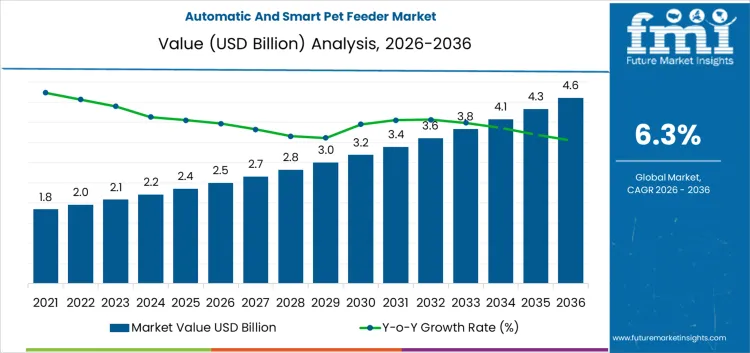
Automatic and Smart Pet Feeder Market Key Takeaways
| Metric | Value |
|---|---|
| Automatic and Smart Pet Feeder Market Value (2026) | USD 2.5 Billion |
| Automatic and Smart Pet Feeder Market Forecast Value (2036) | USD 4.6 Billion |
| Automatic and Smart Pet Feeder Market Forecast CAGR 2026 to 2036 | 6.3% |
Why Is the Automatic and Smart Pet Feeder Market Growing?
The automatic and smart pet feeder market is growing as pet ownership continues to rise globally, along with increasing demand for convenience and time-saving solutions among pet owners. Smart pet feeders offer automated feeding schedules, portion control, and real-time monitoring via mobile apps, addressing the busy lifestyles of modern pet owners who seek reliable ways to care for their pets when they are away from home. The ability to monitor pet health and feeding habits remotely is a key driver of the market.
Technological advancements are fueling growth in the automatic and smart pet feeder market. Integration with Wi-Fi, AI-powered feeding schedules, and voice command features are improving the user experience, while ensuring precise feeding and portioning for pets. The ability to incorporate cameras, sensors, and even treat dispensers has made these devices more versatile, enhancing their appeal to a wider audience of pet owners.
The increasing emphasis on pet health, the rise of smart home ecosystems, and the growing trend of premium pet care products are further contributing to the growth of the automatic and smart pet feeder market. As pet care becomes increasingly linked with technology, pet owners are more likely to invest in smart devices that help ensure their pets’ wellbeing and convenience. These factors are driving the consistent growth of the market over the forecast period.
What Does The Segment Overview Indicate About The Automatic and Smart Pet Feeder Market?
The automatic and smart pet feeder market is segmented by product type and application, highlighting the varying features and target pet populations. Programmable feeders lead the product segment with 30% share, due to their ability to schedule feedings and control portion sizes, making them ideal for busy pet owners. Gravity feeders, Bluetooth-enabled feeders, and camera-integrated systems cater to specific consumer needs for ease of use, connectivity, and monitoring. On the application side, dogs dominate with 55% share, as automatic feeders provide convenience and consistency in feeding routines for larger or more frequent feeders, while cats and other pets follow with smaller yet significant demand.
Why Do Programmable Feeders Hold the Leading Product Share in the Automatic and Smart Pet Feeder Market?
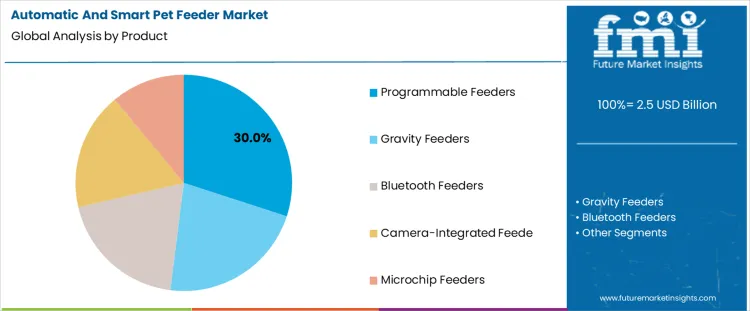
Programmable feeders hold the largest 30% share in the automatic and smart pet feeder market due to their ability to offer customizable feeding schedules and portion sizes. These feeders help pet owners ensure their pets are fed at specific times, even when they are not home. Their versatility makes them suitable for various pets, especially those with specific dietary needs or feeding routines. Programmable feeders are favored for their convenience, reducing the need for daily manual feeding and improving meal consistency. The growing trend of smart home devices and technology integration continues to enhance the appeal of these feeders, making them the preferred choice for busy pet owners seeking both functionality and control.
How Does the Dog Application Drive Demand in the Automatic and Smart Pet Feeder Market?
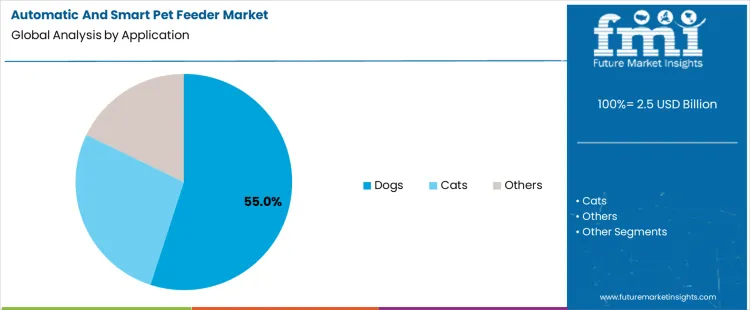
Dogs lead the application segment with 55% share in the automatic and smart pet feeder market, reflecting the higher feeding demands and feeding frequency associated with dogs, especially larger breeds or multiple dogs. Automatic feeders provide a consistent and convenient way to ensure pets are fed at regular intervals, whether for managing portion control, maintaining healthy weight, or feeding multiple dogs. Smart feeders are particularly popular for dog owners with busy schedules, offering them peace of mind knowing that their pets are fed properly and on time. With the increasing number of pet owners seeking more convenience, the demand for automatic feeders in the dog category continues to be the largest in the market.
What Are the Key Dynamics for the Automatic and Smart Pet Feeder Market?
The automatic and smart pet feeder market is driven by the growing trend of pet humanization, where pets are increasingly viewed as family members, leading to a demand for high-tech pet care products. Technological advancements, such as app integration, remote monitoring, and advanced portion control, are making smart feeders more attractive to pet owners seeking convenience and pet health monitoring. Rising disposable income and the increasing number of households with pet’s further support growth in the market. However, challenges related to cost, technology adoption barriers, and competition from traditional pet feeders remain. As technology becomes more accessible and consumer education increases, the market is expected to see continued growth.
What Are the Key Challenges in the Automatic and Smart Pet Feeder Market?
The automatic and smart pet feeder market faces challenges such as high product costs, technical limitations, and competition from traditional feeders. Smart feeders, particularly those with advanced features like cameras, Wi-Fi connectivity, and health monitoring, can be significantly more expensive than standard manual feeders, which may limit adoption among price-sensitive pet owners. Technical issues such as Wi-Fi connectivity problems, power supply failures, and the need for regular maintenance can discourage potential buyers. Compatibility with multiple pet types and managing different feeding habits is also a challenge for manufacturers. The market is also hindered by a lack of consumer awareness in certain regions, particularly among older pet owners who may not be familiar with smart technology.
How Are Technological Innovations Shaping the Automatic and Smart Pet Feeder Market?
Technological innovations are significantly shaping the automatic and smart pet feeder market, particularly in areas of connectivity, remote monitoring, and health tracking. Integration with IoT platforms and mobile apps has enhanced the ability to control and monitor pet feeding remotely, ensuring convenience for pet owners. Advances in portion control, voice commands, and even AI-based feeding schedules are improving the functionality of these feeders. Some devices are also incorporating real-time camera feeds, enabling pet owners to check on their pets during feeding time. Manufacturers are increasingly focusing on user-friendly designs, better battery life, and eco-friendly materials, responding to the growing demand for smart, sustainable pet care solutions.
What Is the Country-Wise Growth Outlook for the Automatic and Smart Pet Feeder Market?
The automatic and smart pet feeder market is growing as demand increases for convenient, time-saving solutions for pet care. The USA leads with a CAGR of 8.2%, supported by rising pet ownership, the increasing popularity of smart home devices, and high consumer spending on pet products. China follows with a CAGR of 7.5%, driven by rapid urbanization, rising disposable income, and the growing adoption of pet care technology. India shows a CAGR of 6.8%, with an expanding pet population and increasing awareness of smart pet care products. Japan grows at a CAGR of 5.9%, supported by a strong pet-loving culture and interest in automated pet care solutions. Germany grows at a CAGR of 6.2%, driven by the high adoption of pet care technology and increasing pet ownership in urban areas.
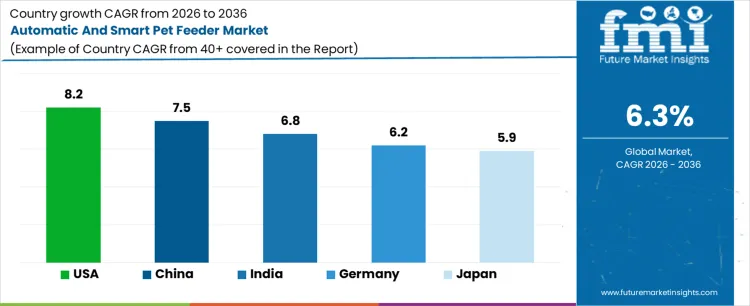
| Country | CAGR |
|---|---|
| USA | 8.2% |
| China | 7.5% |
| India | 6.8% |
| Japan | 5.9% |
| Germany | 6.2% |
Why Is the USA Leading in the Automatic and Smart Pet Feeder Market?
Demand for automatic and smart pet feeders in the USA is growing at a CAGR of 8.2%, driven by rising pet ownership, an increasing trend of convenience in pet care, and a strong market for smart home technology. As the number of pet owners in the USA continues to grow, so does the demand for products that can help pet owners save time and effort in feeding their pets? The rise of smart homes and IoT devices has further fueled the adoption of smart pet care products, including automatic pet feeders. These devices are becoming more popular for their ability to schedule meals, control portions, and provide remote feeding through mobile apps. The increasing disposable income and willingness to spend on pets as family members has made the USA one of the largest markets for smart pet feeders. The convenience of controlling feeding schedules, especially for busy pet owners, is encouraging the market’s expansion.
What Is Driving Growth in China’s Automatic and Smart Pet Feeder Market?
Sales for automatic and smart pet feeders in China are growing at a CAGR of 7.5%, supported by rising pet ownership, urbanization, and the growing adoption of smart technology. As China’s middle class expands, more families are adopting pets, and there is an increasing demand for innovative products that can help care for them. In urban areas, where busy lifestyles make regular pet care challenging, the demand for automatic pet feeders is especially high. China’s growing interest in smart home products is driving the adoption of IoT-enabled pet devices, such as smart pet feeders, which allow pet owners to manage their pets’ feeding schedules remotely. The rise of e-commerce platforms has also made these devices more accessible to a broader consumer base. With increasing awareness of pet health and nutrition, Chinese pet owners are also seeking devices that allow precise control over feeding portions and schedules, further boosting the demand for smart pet feeders.
What Is Contributing to the Growth of the Automatic and Smart Pet Feeder Market in India?
Demand for automatic and smart pet feeders in India is growing at a CAGR of 6.8%, driven by increasing pet ownership and rising awareness of smart pet care solutions. As more Indian households adopt pets, the need for convenient and efficient pet care products is growing. With busy urban lifestyles, pet owners are looking for ways to automate feeding schedules, especially in larger cities like Mumbai, Delhi, and Bangalore. The growing availability of affordable smart pet devices, coupled with a rise in disposable income, is helping drive the adoption of automatic pet feeders. Increasing awareness of pet health and the importance of nutrition is further propelling the demand for devices that allow precise control of portion sizes and feeding times. E-commerce platforms have made it easier for pet owners to purchase these devices, contributing to the growth of the market. As India’s pet care sector continues to expand, smart pet feeders are becoming an essential part of many households.
What Is Driving Adoption of Smart Pet Feeders in Japan?
Sales for automatic and smart pet feeders in Japan are growing at a CAGR of 5.9%, supported by the country’s strong pet-loving culture and interest in innovative pet care technology. Japan has one of the highest pet ownership rates in the world, particularly among urban dwellers who often seek ways to make pet care more convenient and efficient. Smart pet feeders are becoming increasingly popular as they offer an automated solution for busy pet owners, enabling them to schedule meals and monitor feeding habits remotely through mobile apps. The growing trend of treating pets as family members, coupled with a rising awareness of pet health and nutrition, is driving the adoption of advanced pet care products in Japan. Japan’s technological advancements and strong market for IoT devices are making smart pet feeders an attractive option for pet owners who prioritize convenience, precision, and control in feeding their pets.
What Is Supporting Growth in Germany’s Automatic and Smart Pet Feeder Market?
Demand for automatic and smart pet feeders in Germany is increasing at a CAGR of 6.2%, driven by the growing adoption of pet care technology and rising pet ownership. Germany has a large and affluent pet-owning population, with many pet owners looking for ways to simplify their daily routines through the use of technology. As the demand for smart home devices continues to rise, smart pet feeders are becoming more popular for their convenience, efficiency, and ability to cater to pets’ dietary needs. German pet owners are increasingly turning to automated pet feeders that can ensure precise portions and regular feeding schedules, especially for pets with specific dietary requirements. The country’s well-established retail sector and the availability of smart pet devices through both physical stores and e-commerce platforms make these products easily accessible to a wider consumer base. As awareness of pet health and convenience grows, the demand for smart pet feeders is expected to continue rising in Germany.
How Are Leading Companies Competing And Differentiating In The Automatic and Smart Pet Feeder Market?
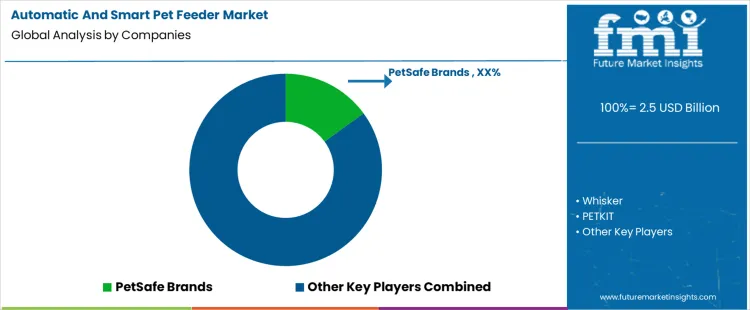
Competition in the automatic and smart pet feeder market is driven by convenience, technology integration, and pet care innovation. PetSafe Brands is positioned as a leader with a broad range of automated feeding solutions, emphasizing durability, reliability, and ease of use. Their products are designed for busy pet owners, offering features such as programmable feeding schedules, portion control, and compatibility with mobile apps for remote monitoring. Whisker differentiates itself with its smart pet feeders that combine precision feeding technology with sleek, modern design. The company emphasizes intuitive app controls, customizable feeding routines, and integration with home automation systems to enhance the pet feeding experience.
PETKIT stands out by focusing on health and well-being features, offering smart feeders equipped with advanced monitoring capabilities like calorie counting and feeding history tracking. The brand promotes its commitment to enhancing pet health through innovative technologies, such as built-in cameras and sensors that allow pet owners to interact with their pets during feeding times. WOPET and HoneyGuardian target both affordability and innovation, offering reliable smart pet feeders with automated portion control, remote feeding, and voice interaction features, catering to pet owners seeking both quality and value.
Petlibro and DOGNESS emphasize user-friendly designs with easy setup and management, offering pet feeders with automatic feeding schedules, portion control, and simple mobile app integration. Sure Petcare and Catit provide solutions with a strong focus on functionality and advanced features like multi-pet feeding, voice interaction, and notification systems. Across the market, differentiation is driven by integration with mobile technologies, health-monitoring features, and customization options that meet the needs of modern pet owners, with a strong focus on convenience, pet care, and user experience.
Key Players in Automatic And Smart Pet Feeder Market
- PetSafe Brands
- Whisker
- PETKIT
- WOPET
- HoneyGuardian
- Petlibro
- DOGNESS
- Sure Petcare
- Catit
Scope of Report
| Attributes | Description |
|---|---|
| Quantitative Unit | USD Billion |
| Product | Programmable Feeders, Gravity Feeders, Bluetooth Feeders, Camera-Integrated Feeders, Microchip Feeders |
| Application | Dogs, Cats, Others |
| Regions Covered | Asia Pacific, Europe, North America, Latin America, Middle East & Africa |
| Countries Covered | China, Japan, South Korea, India, Australia & New Zealand, ASEAN, Rest of Asia Pacific, Germany, United Kingdom, France, Italy, Spain, Nordic, BENELUX, Rest of Europe, United States, Canada, Mexico, Brazil, Chile, Rest of Latin America, Kingdom of Saudi Arabia, Other GCC Countries, Turkey, South Africa, Other African Union, Rest of Middle East & Africa |
| Key Companies Profiled | PetSafe Brands, Whisker, PETKIT, WOPET, HoneyGuardian, Petlibro, DOGNESS, Sure Petcare, Catit |
| Additional Attributes | Market revenue by product and application; regional adoption trends for different types of pet feeders; growth projections for 2026-2036; technological advancements in smart pet feeder systems; competitive analysis and market share of key players; evolving consumer preferences for smart pet care solutions. |
Automatic And Smart Pet Feeder Market by Key Segments
Product
- Programmable Feeders
- Gravity Feeders
- Bluetooth Feeders
- Camera‑Integrated Feede
- Microchip Feeders
Application
- Dogs
- Cats
- Others
Region
- Asia Pacific
- China
- Japan
- South Korea
- India
- Australia & New Zealand
- ASEAN
- Rest of Asia Pacific
- Europe
- Germany
- United Kingdom
- France
- Italy
- Spain
- Nordic
- BENELUX
- Rest of Europe
- North America
- United States
- Canada
- Mexico
- Latin America
- Brazil
- Chile
- Rest of Latin America
- Middle East & Africa
- Kingdom of Saudi Arabia
- Other GCC Countries
- Turkey
- South Africa
- Other African Union
- Rest of Middle East & Africa
Bibliography
- Abbott, R. (2023). Smart pet care technologies and automation trends. Journal of Consumer Electronics, 19(4), 215–228.
- International Trade Administration. (2024). Consumer electronics and smart home devices market overview. U.S. Department of Commerce.
- Office for National Statistics. (2024). UK household technology adoption and expenditure trends. Office for National Statistics.
- European Union Agency for Network and Information Security (ENISA). (2024). Smart home devices security and consumer safety considerations. European Union Agency for Network and Information Security.
Frequently Asked Questions
How big is the automatic and smart pet feeder market in 2026?
The global automatic and smart pet feeder market is estimated to be valued at USD 2.5 billion in 2026.
What will be the size of automatic and smart pet feeder market in 2036?
The market size for the automatic and smart pet feeder market is projected to reach USD 4.6 billion by 2036.
How much will be the automatic and smart pet feeder market growth between 2026 and 2036?
The automatic and smart pet feeder market is expected to grow at a 6.3% CAGR between 2026 and 2036.
What are the key product types in the automatic and smart pet feeder market?
The key product types in automatic and smart pet feeder market are programmable feeders, gravity feeders, bluetooth feeders, camera‑integrated feede and microchip feeders.
Which application segment to contribute significant share in the automatic and smart pet feeder market in 2026?
In terms of application, dogs segment to command 55.0% share in the automatic and smart pet feeder market in 2026.
Preview the report firsthand - request a free sample
Get SampleGet the brochure for pricing and purchase details.
Get PDFTable of Content
- Executive Summary
- Global Market Outlook
- Demand-side Trends
- Supply-side Trends
- Technology Roadmap Analysis
- Analysis and Recommendations
- Market Overview
- Market Coverage / Taxonomy
- Market Definition / Scope / Limitations
- Market Background
- Market Dynamics
- Drivers
- Restraints
- Opportunity
- Trends
- Scenario Forecast
- Demand in Optimistic Scenario
- Demand in Likely Scenario
- Demand in Conservative Scenario
- Opportunity Map Analysis
- Product Life Cycle Analysis
- Supply Chain Analysis
- Investment Feasibility Matrix
- Value Chain Analysis
- PESTLE and Porter’s Analysis
- Regulatory Landscape
- Regional Parent Market Outlook
- Production and Consumption Statistics
- Import and Export Statistics
- Market Dynamics
- Global Market Analysis 2021 to 2025 and Forecast, 2026 to 2036
- Historical Market Size Value (USD Million) Analysis, 2021 to 2025
- Current and Future Market Size Value (USD Million) Projections, 2026 to 2036
- Y-o-Y Growth Trend Analysis
- Absolute $ Opportunity Analysis
- Global Market Pricing Analysis 2021 to 2025 and Forecast 2026 to 2036
- Global Market Analysis 2021 to 2025 and Forecast 2026 to 2036, By Product
- Introduction / Key Findings
- Historical Market Size Value (USD Million) Analysis By Product, 2021 to 2025
- Current and Future Market Size Value (USD Million) Analysis and Forecast By Product, 2026 to 2036
- Programmable Feeders
- Gravity Feeders
- Bluetooth Feeders
- Camera‑Integrated Feede
- Microchip Feeders
- Programmable Feeders
- Y-o-Y Growth Trend Analysis By Product, 2021 to 2025
- Absolute $ Opportunity Analysis By Product, 2026 to 2036
- Global Market Analysis 2021 to 2025 and Forecast 2026 to 2036, By Application
- Introduction / Key Findings
- Historical Market Size Value (USD Million) Analysis By Application, 2021 to 2025
- Current and Future Market Size Value (USD Million) Analysis and Forecast By Application, 2026 to 2036
- Dogs
- Cats
- Others
- Dogs
- Y-o-Y Growth Trend Analysis By Application, 2021 to 2025
- Absolute $ Opportunity Analysis By Application, 2026 to 2036
- Global Market Analysis 2021 to 2025 and Forecast 2026 to 2036, By Region
- Introduction
- Historical Market Size Value (USD Million) Analysis By Region, 2021 to 2025
- Current Market Size Value (USD Million) Analysis and Forecast By Region, 2026 to 2036
- North America
- Latin America
- Western Europe
- Eastern Europe
- East Asia
- South Asia and Pacific
- Middle East & Africa
- Market Attractiveness Analysis By Region
- North America Market Analysis 2021 to 2025 and Forecast 2026 to 2036, By Country
- Historical Market Size Value (USD Million) Trend Analysis By Market Taxonomy, 2021 to 2025
- Market Size Value (USD Million) Forecast By Market Taxonomy, 2026 to 2036
- By Country
- USA
- Canada
- Mexico
- By Product
- By Application
- By Country
- Market Attractiveness Analysis
- By Country
- By Product
- By Application
- Key Takeaways
- Latin America Market Analysis 2021 to 2025 and Forecast 2026 to 2036, By Country
- Historical Market Size Value (USD Million) Trend Analysis By Market Taxonomy, 2021 to 2025
- Market Size Value (USD Million) Forecast By Market Taxonomy, 2026 to 2036
- By Country
- Brazil
- Chile
- Rest of Latin America
- By Product
- By Application
- By Country
- Market Attractiveness Analysis
- By Country
- By Product
- By Application
- Key Takeaways
- Western Europe Market Analysis 2021 to 2025 and Forecast 2026 to 2036, By Country
- Historical Market Size Value (USD Million) Trend Analysis By Market Taxonomy, 2021 to 2025
- Market Size Value (USD Million) Forecast By Market Taxonomy, 2026 to 2036
- By Country
- Germany
- UK
- Italy
- Spain
- France
- Nordic
- BENELUX
- Rest of Western Europe
- By Product
- By Application
- By Country
- Market Attractiveness Analysis
- By Country
- By Product
- By Application
- Key Takeaways
- Eastern Europe Market Analysis 2021 to 2025 and Forecast 2026 to 2036, By Country
- Historical Market Size Value (USD Million) Trend Analysis By Market Taxonomy, 2021 to 2025
- Market Size Value (USD Million) Forecast By Market Taxonomy, 2026 to 2036
- By Country
- Russia
- Poland
- Hungary
- Balkan & Baltic
- Rest of Eastern Europe
- By Product
- By Application
- By Country
- Market Attractiveness Analysis
- By Country
- By Product
- By Application
- Key Takeaways
- East Asia Market Analysis 2021 to 2025 and Forecast 2026 to 2036, By Country
- Historical Market Size Value (USD Million) Trend Analysis By Market Taxonomy, 2021 to 2025
- Market Size Value (USD Million) Forecast By Market Taxonomy, 2026 to 2036
- By Country
- China
- Japan
- South Korea
- By Product
- By Application
- By Country
- Market Attractiveness Analysis
- By Country
- By Product
- By Application
- Key Takeaways
- South Asia and Pacific Market Analysis 2021 to 2025 and Forecast 2026 to 2036, By Country
- Historical Market Size Value (USD Million) Trend Analysis By Market Taxonomy, 2021 to 2025
- Market Size Value (USD Million) Forecast By Market Taxonomy, 2026 to 2036
- By Country
- India
- ASEAN
- Australia & New Zealand
- Rest of South Asia and Pacific
- By Product
- By Application
- By Country
- Market Attractiveness Analysis
- By Country
- By Product
- By Application
- Key Takeaways
- Middle East & Africa Market Analysis 2021 to 2025 and Forecast 2026 to 2036, By Country
- Historical Market Size Value (USD Million) Trend Analysis By Market Taxonomy, 2021 to 2025
- Market Size Value (USD Million) Forecast By Market Taxonomy, 2026 to 2036
- By Country
- Kingdom of Saudi Arabia
- Other GCC Countries
- Turkiye
- South Africa
- Other African Union
- Rest of Middle East & Africa
- By Product
- By Application
- By Country
- Market Attractiveness Analysis
- By Country
- By Product
- By Application
- Key Takeaways
- Key Countries Market Analysis
- USA
- Pricing Analysis
- Market Share Analysis, 2025
- By Product
- By Application
- Canada
- Pricing Analysis
- Market Share Analysis, 2025
- By Product
- By Application
- Mexico
- Pricing Analysis
- Market Share Analysis, 2025
- By Product
- By Application
- Brazil
- Pricing Analysis
- Market Share Analysis, 2025
- By Product
- By Application
- Chile
- Pricing Analysis
- Market Share Analysis, 2025
- By Product
- By Application
- Germany
- Pricing Analysis
- Market Share Analysis, 2025
- By Product
- By Application
- UK
- Pricing Analysis
- Market Share Analysis, 2025
- By Product
- By Application
- Italy
- Pricing Analysis
- Market Share Analysis, 2025
- By Product
- By Application
- Spain
- Pricing Analysis
- Market Share Analysis, 2025
- By Product
- By Application
- France
- Pricing Analysis
- Market Share Analysis, 2025
- By Product
- By Application
- India
- Pricing Analysis
- Market Share Analysis, 2025
- By Product
- By Application
- ASEAN
- Pricing Analysis
- Market Share Analysis, 2025
- By Product
- By Application
- Australia & New Zealand
- Pricing Analysis
- Market Share Analysis, 2025
- By Product
- By Application
- China
- Pricing Analysis
- Market Share Analysis, 2025
- By Product
- By Application
- Japan
- Pricing Analysis
- Market Share Analysis, 2025
- By Product
- By Application
- South Korea
- Pricing Analysis
- Market Share Analysis, 2025
- By Product
- By Application
- Russia
- Pricing Analysis
- Market Share Analysis, 2025
- By Product
- By Application
- Poland
- Pricing Analysis
- Market Share Analysis, 2025
- By Product
- By Application
- Hungary
- Pricing Analysis
- Market Share Analysis, 2025
- By Product
- By Application
- Kingdom of Saudi Arabia
- Pricing Analysis
- Market Share Analysis, 2025
- By Product
- By Application
- Turkiye
- Pricing Analysis
- Market Share Analysis, 2025
- By Product
- By Application
- South Africa
- Pricing Analysis
- Market Share Analysis, 2025
- By Product
- By Application
- USA
- Market Structure Analysis
- Competition Dashboard
- Competition Benchmarking
- Market Share Analysis of Top Players
- By Regional
- By Product
- By Application
- Competition Analysis
- Competition Deep Dive
- PetSafe Brands
- Overview
- Product Portfolio
- Profitability by Market Segments (Product/Age /Sales Channel/Region)
- Sales Footprint
- Strategy Overview
- Marketing Strategy
- Product Strategy
- Channel Strategy
- Whisker
- PETKIT
- WOPET
- HoneyGuardian
- Petlibro
- DOGNESS
- Sure Petcare
- Catit
- PetSafe Brands
- Competition Deep Dive
- Assumptions & Acronyms Used
- Research Methodology


