

- Industry Size (2026)
- USD 465.9 Mn
- Forecast (2036)
- USD 747.7 Mn
- CAGR (2026 to 2036)
- 4.8%
Demand for Pet Snacks and Treats in South Korea Forecast and Outlook 2026 to 2036
Sales of pet snacks and treats in South Korea are projected to be valued at USD 465.9 million in 2026. This expanding industry is likely to reach USD 747.7 million by 2036, advancing at a compound annual growth rate of 4.8%. South Korea's rapid demographic shifts, characterized by an increase in single-person households and a declining birth rate, have elevated pets to the status of family members, a phenomenon locally termed "Petfam." This cultural transformation drives significant expenditure on premium nutrition, moving beyond basic sustenance to indulgent and functional rewards that mirror human dietary trends.
The industry's trajectory is heavily influenced by the predominance of small breed dogs such as Maltese, Poodles, and Pomeranians, which thrive in the country's apartment-centric living environment. Owners of these smaller companions often seek bite-sized, high-value rewards that cater to specific metabolic needs and picky eating habits. Consequently, the sector sees a surge in pet treat innovations focusing on palatability and texture, ranging from freeze-dried proteins to soft-baked goods designed for easy digestion.
Technological advancements in food processing are reshaping the landscape, allowing manufacturers to introduce human-grade ingredients and functional additives. Korean consumers show a marked preference for products claiming to enhance joint health, coat shine, and digestion, spurring demand for pet collagen treats and probiotic-infused snacks. The integration of transparent manufacturing processes, where owners can trace ingredients back to the source, is becoming a standard expectation rather than a luxury, pushing brands to adopt cleaner labels.
Quick Stats for Demand for Pet Snacks and Treats in South Korea
- Industry Value (2026): USD 465.9 million
- Industry Forecast Value (2036): USD 747.7 million
- Industry Forecast CAGR: 4.8%
- Leading Pet Type: Dogs (41.0%)
- Leading Distribution Channel: Specialty Pet Stores (92.6%)
- Leading Product: Eatables (68.5%)
- Key Growth Regions: Jeju, South Gyeongsang, South Jeolla, North Jeolla
- Key Players: Mars, Incorporated, Nestlé, SCHELL & KAMPETER, INC., The J.M. Smucker Company, Hill's Pet Nutrition
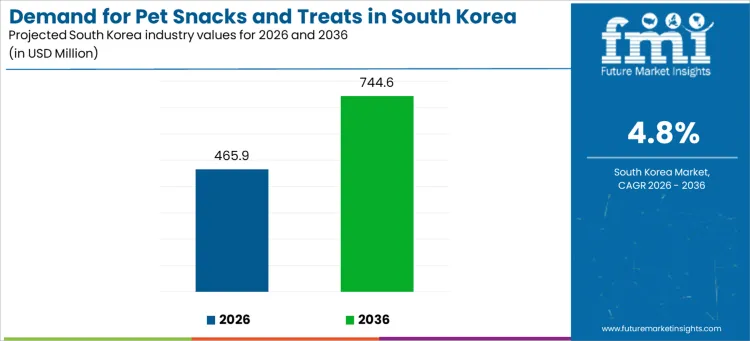
Demand for Pet Snacks and Treats in South Korea Key Takeaways
| Metric | Value |
|---|---|
| Industry Size (2026) | USD 465.9 million |
| Industry Value (2036) | USD 747.7 million |
| CAGR (2026 to 2036) | 4.8% |
How is the Sector Structured Across Key Segments?
The sector is segmented to address the distinct biological needs of different animals and the purchasing habits of Korean consumers. It is primarily categorized by pet type, reflecting the population distribution of companion animals. The distribution channel segment highlights where consumers prefer to shop, while the product segment distinguishes between nutritional snacks and functional chews. Each segment plays a vital role, where the dog segment drives innovation in flavors and specialty stores drive the volume of premium sales.
Why Do Canine Products Dominate the Landscape?
The dog segment commands a 41.0% share of the industry. This dominance is attributed to the deep-seated dog ownership culture in South Korea, where small breeds are ubiquitous. Owners of these active, indoor companions frequently use dog food and snacks for training and bonding purposes. The prevalence of separation anxiety in apartment-dwelling dogs also fuels the consumption of long-lasting chews and puzzle treats designed to keep pets occupied, sustaining a steady demand for varied canine confectionery.
Why Are Specialty Stores the Preferred Shopping Destination?
Specialty pet stores hold an overwhelming share of 92.6% within the distribution landscape. Unlike Western industries where supermarkets dominate, Korean consumers prefer dedicated pet boutiques, grooming salons, and veterinary clinics for purchasing treats. These venues offer a curated experience where owners can receive expert advice on nutrition and product suitability. The tactile nature of shopping for pet treats and chews, combined with the high trust placed in specialized retailers to stock safe, authentic products, cements this channel's supremacy over generalist retailers and online platforms.
How is the Eatable Category Maintaining its Lead?
The eatables product segment accounts for 68.5% of the industry share. This category, which includes biscuits, jerkies, and freeze-dried snacks, remains the default choice for daily rewarding and training. The dominance of this segment is fueled by the sheer variety of flavors and textures available, catering to the diverse palates of fussy eaters. Manufacturers are continuously innovating within this space, introducing soft-baked options for seniors and hypoallergenic varieties for pets with sensitivities, ensuring high-frequency purchasing.
How are Functional Chews Gaining Traction?
While eatables lead, the chewable segment captures a significant 31.5% share. South Korean pet owners are increasingly aware of periodontal disease, a common ailment in small breeds, driving demand for pet oral care products. Functional chews that double as dog dental chews offer a convenient solution for maintaining dental hygiene without the stress of brushing. This dual-purpose utility appeals to busy owners looking for efficient ways to manage their pet's health, securing a stable position for functional chews in the consumer basket.
Sector Dynamics Will Human-Grade Ingredients Become the Standard?
A major trend reshaping the landscape is the premiumization of ingredients, often referred to as the "humanization" of pet food. Consumers are scrutinizing labels for fillers and artificial additives, gravitating towards natural pet food claims. Brands introducing snacks made from single-source proteins, superfoods like blueberries, and grain-free formulas are capturing significant attention. This shift forces legacy manufacturers to reformulate products to meet the heightened safety and quality expectations of the modern Korean pet parent.
Does Economic Uncertainty Impact Discretionary Spending?
The most significant restraint is the sensitivity of the pet industry to broader economic downturns. As snacks and treats are often considered discretionary items compared to staple diets, inflation and rising living costs can lead to basket rationalization. Owners may trade down to value brands or reduce the frequency of treating. Overcoming this requires manufacturers to demonstrate clear value propositions, such as functional health benefits that justify the price premium by potentially reducing future veterinary costs.
How Can Private Labels Disupt the Status Quo?
The emerging field of private label pet food presents a frontier of opportunity. Retail chains and e-commerce platforms are launching their own high-quality snack lines at competitive price points. Suppliers who can partner with these retailers to produce exclusive, branded treats stand to capture significant revenue. This transitional landscape allows for rapid product iteration and localized flavors that resonate with Korean tastes, offering a counterbalance to the dominance of expensive imported brands.
How is the Pet Snack Landscape Evolving Across South Korea's Regions?
The regional sphere shows a concentration of premium consumption in tourist and urban hubs, while industrial regions focus on practical, high-value nutrition. High-growth areas are characterizing their development by integrating pet-friendly infrastructure with retail opportunities. As distinct provinces adapt to demographic changes, the utilization of pet products is becoming tailored to local lifestyles and economic conditions.
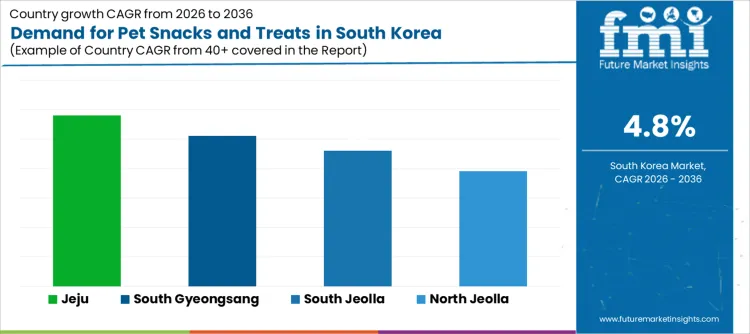
| Region | CAGR (2026 to 2036) |
|---|---|
| Jeju | 5.81% |
| South Gyeongsang | 5.09% |
| South Jeolla | 4.60% |
| North Jeolla | 3.88% |
Why is Pet-Friendly Tourism Driving Demand in Jeju?
Adoption of pet snacks in Jeju is projected to expand at a CAGR of 5.8%. As South Korea's premier vacation destination, the island has heavily invested in becoming a pet-friendly hub, allowing travelers to bring their companions on flights and into accommodations. This influx of tourists drives a unique demand for portable, travel-friendly treats and souvenir snacks made from local ingredients like Jeju black pork or tangerines. Specialized cafes and pet playgrounds across the island serve as retail touchpoints, encouraging impulse purchases of premium treats during leisure activities.
How is Urban Affluence Influencing South Gyeongsang?
Sales of pet treats in South Gyeongsang are likely to reach a CAGR of 5.0%. Encompassing major industrial cities like Changwon and Gimhae, and influenced by the proximity to Busan, this region possesses strong household purchasing power. The high density of apartment complexes fosters a close-knit community of small-breed owners who frequent local grooming salons and boutiques. Demand here focuses on high-end, functional snacks that serve as status symbols and health aids for pampered indoor pets, aligning with the region's relatively high disposable income levels.
What Role Does Companionship Play in South Jeolla?
The pet snack sector in South Jeolla is anticipated to rise at a CAGR of 4.6%. With a demographic profile skewing older, pets in this region often serve as vital companions for the elderly population. Consequently, the demand centers on palatable, soft-texture treats that are easy for senior owners to handle and for pets to digest. The emotional reliance on these animals ensures consistent spending on treats that facilitate bonding, even amidst a more conservative spending environment compared to the capital region.
How is Gradual Modernization Shaping North Jeolla?
Deployment of pet products in North Jeolla is expected to increase at a CAGR of 3.88%. As cities like Jeonju modernize and attract younger residents, the culture of pet humanization is steadily taking root. The transition from keeping dogs as outdoor guard animals to indoor family members is driving a shift from table scraps to commercial treats. Retailers are seeing growing interest in cat food and dog snacks that offer basic nutritional value, marking a developmental phase where standard commercial treats are replacing traditional feeding methods.
Competition Analysis
How Are Companies Competing and Strengthening Their Positions in the South Korean Pet Treat Industry?
The competitive landscape is defined by a battle between global brand recognition and local agility. Industry leaders like Mars and Nestlé are strengthening their positions by leveraging their massive distribution networks and scientific credentials to sell veterinary-grade treats. There is also a marked trend toward localization, where global firms are launching Korea-specific product lines that feature textures and flavors preferred by local breeds, such as soft-moist jerkies.
Mergers and acquisitions are targeted at artisanal brands, as larger conglomerates seek to acquire the "authentic" and "natural" image associated with smaller players. Leading companies are actively investing in digital marketing campaigns on platforms like Instagram and YouTube, utilizing pet influencers to reach the younger demographic. Furthermore, competitive intensity is driving a shift toward subscription models, where companies bundle data with monthly snack boxes to build long-term brand loyalty.
Key Companies
- Mars, Incorporated and its Affiliates
- Nestlé (Purina)
- SCHELL & KAMPETER, INC. (Diamond Pet Foods)
- The J.M. Smucker Company
- Hill's Pet Nutrition, Inc.
- Harim Pet Food
- BowWow Korea
- Dongwon F&B
Scope of Report
| Items | Values |
|---|---|
| Quantitative Units | USD Million |
| Pet Type | Dogs, Cats, Others |
| Distribution Channel | Specialty Pet Stores, Supermarkets & Hypermarkets, Online, Others |
| Product | Eatables, Chewable |
| Regions Covered | Jeju, South Gyeongsang, South Jeolla, North Jeolla |
| Key Companies Profiled | Mars, Nestlé, J.M. Smucker, Hill's, and others. |
Demand for Pet Snacks and Treats in South Korea by Segments
By Pet Type:
- Dogs
- Cats
- Others
By Distribution Channel:
- Specialty Pet Stores
- Supermarkets & Hypermarkets
- Online
- Others
By Product:
- Eatables
- Chewable
By Region:
- Jeju
- South Gyeongsang
- South Jeolla
- North Jeolla
Bibliography
- Ministry of Agriculture, Food and Rural Affairs (MAFRA). (2025, January 21). Announcement of results of the 2024 National Awareness Survey on Animal Welfare.
- Ministry of Agriculture, Food and Rural Affairs (MAFRA). (2025, January 21). Results of the 2024 National Awareness Survey on Animal Welfare.
- KB Financial Group. (2025, December 13). 2025 Korea Pet Report.
- Rural Development Administration. (2024, January 30). Korea to Establish Customized Pet Nutrition Standards.
- Statistics Korea (KOSTAT). (2025, October 23). Approval Notice for the Companion Animal Rearing Status Survey.
Frequently Asked Questions
How big is the demand for pet snacks and treats in south korea in 2026?
The demand for pet snacks and treats in south korea is estimated to be valued at USD 465.9 million in 2026.
What will be the size of pet snacks and treats in south korea in 2036?
The market size for the pet snacks and treats in south korea is projected to reach USD 744.6 million by 2036.
How much will be the demand for pet snacks and treats in south korea growth between 2026 and 2036?
The demand for pet snacks and treats in south korea is expected to grow at a 4.8% CAGR between 2026 and 2036.
What are the key product types in the pet snacks and treats in south korea?
The key product types in pet snacks and treats in south korea are 0.33 and 0.26.
Which 0.926 segment is expected to contribute significant share in the pet snacks and treats in south korea in 2026?
In terms of 0.926, 0.053 segment is expected to command 0.0% share in the pet snacks and treats in south korea in 2026.
Preview the report firsthand - request a free sample
Get SampleGet the brochure for pricing and purchase details.
Get PDFTable of Content
- Executive Summary
- South Korea Market Outlook
- Demand-side Trends
- Supply-side Trends
- Technology Roadmap Analysis
- Analysis and Recommendations
- Market Overview
- Market Coverage / Taxonomy
- Market Definition / Scope / Limitations
- Market Background
- Market Dynamics
- Drivers
- Restraints
- Opportunity
- Trends
- Scenario Forecast
- Demand in Optimistic Scenario
- Demand in Likely Scenario
- Demand in Conservative Scenario
- Opportunity Map Analysis
- Product Life Cycle Analysis
- Supply Chain Analysis
- Investment Feasibility Matrix
- Value Chain Analysis
- PESTLE and Porter’s Analysis
- Regulatory Landscape
- Regional Parent Market Outlook
- Production and Consumption Statistics
- Import and Export Statistics
- Market Dynamics
- South Korea Market Analysis 2021 to 2025 and Forecast, 2026 to 2036
- Historical Market Size Value (USD Million) Analysis, 2021 to 2025
- Current and Future Market Size Value (USD Million) Projections, 2026 to 2036
- Y-o-Y Growth Trend Analysis
- Absolute $ Opportunity Analysis
- South Korea Market Pricing Analysis 2021 to 2025 and Forecast 2026 to 2036
- South Korea Market Analysis 2021 to 2025 and Forecast 2026 to 2036, By 0.41
- Introduction / Key Findings
- Historical Market Size Value (USD Million) Analysis By 0.41 , 2021 to 2025
- Current and Future Market Size Value (USD Million) Analysis and Forecast By 0.41 , 2026 to 2036
- 0.33
- 0.26
- 0.33
- Y-o-Y Growth Trend Analysis By 0.41 , 2021 to 2025
- Absolute $ Opportunity Analysis By 0.41 , 2026 to 2036
- South Korea Market Analysis 2021 to 2025 and Forecast 2026 to 2036, By 0.926
- Introduction / Key Findings
- Historical Market Size Value (USD Million) Analysis By 0.926, 2021 to 2025
- Current and Future Market Size Value (USD Million) Analysis and Forecast By 0.926, 2026 to 2036
- 0.053
- 0.021
- 0.053
- Y-o-Y Growth Trend Analysis By 0.926, 2021 to 2025
- Absolute $ Opportunity Analysis By 0.926, 2026 to 2036
- South Korea Market Analysis 2021 to 2025 and Forecast 2026 to 2036, By 0.685
- Introduction / Key Findings
- Historical Market Size Value (USD Million) Analysis By 0.685, 2021 to 2025
- Current and Future Market Size Value (USD Million) Analysis and Forecast By 0.685, 2026 to 2036
- 0.315
- 0.315
- Y-o-Y Growth Trend Analysis By 0.685, 2021 to 2025
- Absolute $ Opportunity Analysis By 0.685, 2026 to 2036
- Market Structure Analysis
- Competition Dashboard
- Competition Benchmarking
- Market Share Analysis of Top Players
- By Regional
- By 0.41
- By 0.926
- By 0.685
- Competition Analysis
- Competition Deep Dive
- Competition Deep Dive
- Assumptions & Acronyms Used
- Research Methodology


