

- Industry Size (2026)
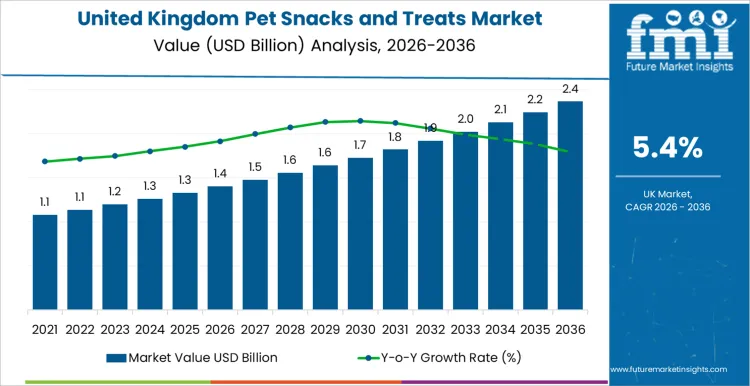
- USD 1.40 Bn
- Forecast (2036)
- USD 2.37 Bn
- CAGR (2026 to 2036)
- 5.4%
Pet Snacks and Treats Outlook in the UK 2026 to 2036
The pet snacks and treats consumption value in the UK is projected to reach USD 1.40 billion in 2026. This category is forecast to expand to USD 2.37 billion by 2036, advancing at a 5.4% CAGR. This growth is tied to how pet owners now treat snacks as part of daily nutrition routines rather than occasional rewards.
Treats are being used for training, bonding, oral care, enrichment, and portion-controlled feeding. Retail leaders are responding by expanding shelf space for functional formats such as dental chews, calming bites, gut-support products, and protein-forward items. The result is a high-velocity consumer goods segment where product differentiation, ingredient trust, and brand reputation shape buying behavior.
For stakeholders leading consumer product portfolios, the UK is attractive because pet ownership remains widespread, demand is resilient during household budget shifts, and premiumization continues across many price tiers. UK Pet Food reports that 17.2 million households in the UK own a pet in 2024 and estimates 36 million pets nationally, anchored by large dog and cat populations.
Quick Stats for Pet Snacks and Treats Demand in the UK
- Pet Snacks and Treats Valuation in the UK (2026): USD 1.40 billion
- Pet Snacks and Treats Forecast Valuation in the UK (2036): USD 2.37 billion
- Pet Snacks and Treats Forecast CAGR (2026 to 2036): 5.4%
- Leading Regional Growth: England (CAGR 5.9%)
- Leading Pet Type: Dogs (39%)
- Leading Distribution Channel: Specialty Pet Stores (88.0%)
- Leading Product Category: Eatables (56.0%)
- Key Companies Profiled: Mars, Incorporated and its Affiliates; Nestlé; SCHELL & KAMPETER, INC.; The J.M. Smucker Company; Hill's Pet Nutrition, Inc.
Why is the UK a High-Value Consumption Hub for Pet Snacks and Treats?
The UK has one of Europe’s most established companion animal cultures, supported by strong brand penetration, advanced retail infrastructure, and a consumer base that actively seeks trusted ingredients and proven benefits. UK Pet Food highlights that dogs and cats remain the largest owned pet groups, with 13.5 million dogs and 12.5 million cats in 2024. This base sustains repeat purchasing across multiple treat occasions each week, especially in multi-pet households.
Treat buying in the UK is driven by three powerful consumer expectations. First is functional value. Pet owners look for outcomes such as improved breath, plaque control, shinier coats, calmer behaviour, or digestive support.
Second is safety and transparency. Shoppers want recognizable ingredients, clear feeding guidance, and confidence in manufacturing standards. Third is convenience. Busy households prefer formats that fit into modern routines, including resealable packaging, single-serve portions, and subscription-ready packs for predictable replenishment.
European-level industry data indicates sustained growth in pet food spending and product innovation across the region, which shapes investment confidence in UK retail extensions and NPD pipelines. Category context across global treat demand is reflected in the pet treats and chews outlook, which tracks functional formats and evolving treat occasions across major consumer markets.
How is Pet Snacks and Treats Demand Segmented by Pet Type, Distribution Channel, and Product?
Segment patterns in the UK show where consumption is concentrated and how retail routes influence conversion. The leading segments below highlight where brands can scale efficiently and where differentiated positioning supports pricing power.
Why do dog-focused snacks and treats lead with a 39% share in the UK?
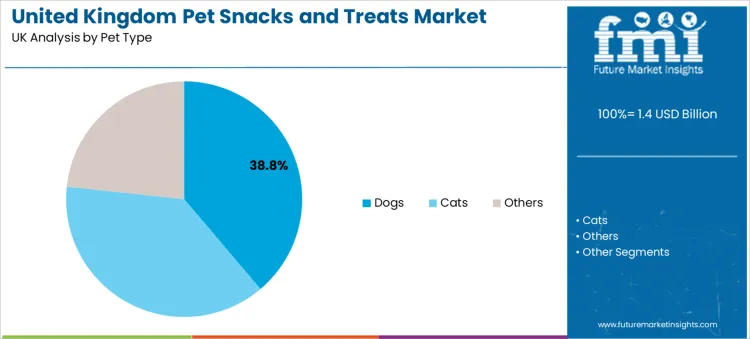
Dogs account for a 39% share, driven by frequent treat occasions tied to training, walking routines, and behavioural reinforcement. Many dog owners use treats daily, which supports high repeat purchasing and predictable volume flows for manufacturers and retail chains.
Dog treats are often bought in multiple formats at once, including training pieces for short rewards, longer chews for enrichment, and functional products that support dental hygiene. This behaviour favours portfolios with a strong size range, clear feeding guidance, and targeted benefits that are easy for non-experts to understand.
For brand leaders, the dog segment rewards innovation in texture, durability, and palatability. Soft bites can support older dogs, chewables can serve boredom prevention, and dental formats can support long-term oral routines. Product developers are increasingly aligning chew duration with caloric control so owners do not feel forced to choose between enrichment and weight management.
How do specialty pet stores secure an 88.0% share in UK distribution routes?
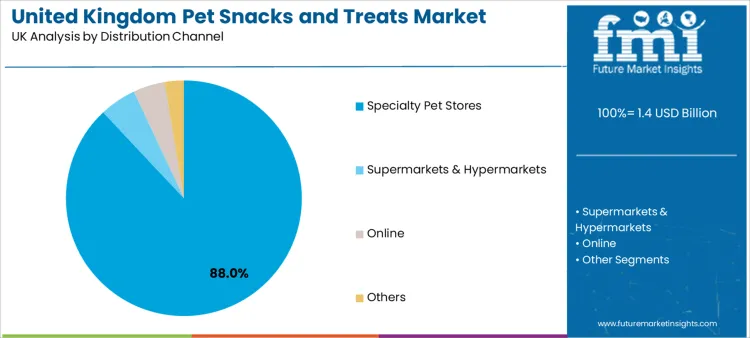
Specialty pet stores represent an 88.0% share, showing how strongly shoppers rely on expert-led retail environments for advice, product discovery, and premium assortment. These outlets win by offering a curated range that includes natural ingredient options, breed-specific items, sensitive stomach products, and premium functional claims that are not always stocked widely in general retail. Store teams often guide customers toward appropriate portioning, age-fit selection, and switching strategies when pets show intolerance or appetite changes.
This channel strength gives brands a powerful stage for education-led selling. Packaging clarity, staff training kits, and in-store sampling can influence conversion. It is a highly effective route for new launches, especially for formats that need explanation such as calming bites, joint-support chews, or dental products with measurable plaque benefits. Wider category context across pet nutrition and retail behaviour is supported by the pet food outlook, where clean-label demand and tailored nutrition are shaping shelf strategies across regions.
Why do eatables dominate with a 56.0% share across product formats?
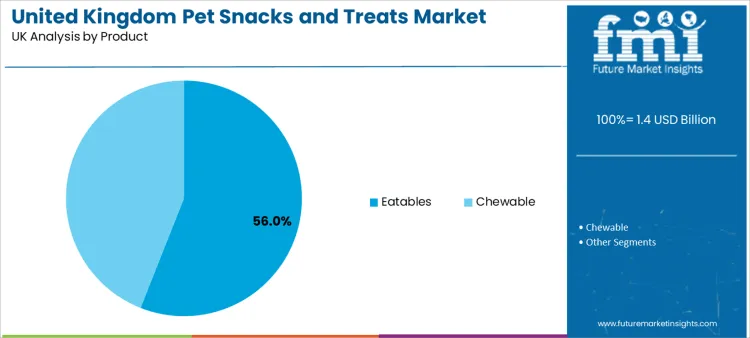
Eatables hold a 56.0% share, reflecting a strong consumer preference for treats that feel like food rather than accessories. This segment covers soft bites, crunchy snacks, functional biscuits, meat strips, and reward pieces that fit into daily training and bonding habits. Eatables scale well because they support a wide range of price points and are easy to introduce without major behaviour change from the owner.
Eatables are now being redesigned with stronger wellness narratives. Ingredient lists increasingly highlight protein sources, limited additives, grain-free positioning in selected lines, and digestive-friendly formulations. Brands that pair taste acceptance with health-aligned messaging tend to win repeat purchases. This segment also offers room for cross-category pairing, where main meals and treat packs are purchased together to maintain a consistent nutrition story across the feeding routine.
What are the Dynamics, Restraints, Opportunities, and Threats Shaping this Category in the UK?
How is pet humanisation sustaining higher treat frequency and premium value?
Treat consumption rises when owners view pets as family members and invest in quality, wellness, and variety. UK Pet Food positions pet nutrition as central to wellbeing, reinforcing the role of trusted, nutritionally appropriate products in long-term care. In practice, this supports premium treats with functional positioning such as dental care, calming support, coat health, and sensitive digestion.
Premiumisation is not limited to high-income households. Many shoppers manage budgets by trading down on some items while keeping treat quality intact, especially when treats are linked to training success or emotional bonding. Brands that offer a “better ingredient story” in accessible pack sizes can protect share even during cost pressure.
Do price sensitivity and health concerns limit volume growth in selected segments?
Rising living costs can affect basket size and frequency, especially for households managing multiple pets. When consumers become cost-aware, they may shift to larger packs, private label, or fewer impulse purchases. Health concerns also shape decision-making. Owners want calorie transparency, sensible portion guidance, and products that do not aggravate allergies or gastrointestinal sensitivity. Overfeeding risk remains a known issue across treat-heavy routines, pushing brands to improve pack education and support portion-controlled formats.
Where do functional benefits and novel ingredients create expansion pathways?
The strongest growth opportunities sit in treats that deliver a clear benefit while remaining enjoyable and easy to feed. Dental care, calming routines, and digestive support remain high-intent use cases. Innovation in protein diversity and sustainability is emerging too. In the UK, cultivated ingredients for pet food applications have begun to appear in limited launches, indicating future paths for alternative proteins in treat formats.
A second opportunity is format architecture. Brands can expand the eatables segment through texture-led line extensions such as crunchy on the outside with soft centres, layered chews, and combined dental plus palatability designs. Subscription-friendly packaging and freshness protection support direct-to-home replenishment strategies.
What threats can disrupt brand trust and retail momentum?
Trust is the most sensitive asset in pet nutrition. Any contamination event, unclear labelling, or quality perception issue can trigger rapid switching. Supply volatility in proteins, oils, and packaging materials can create formulation changes that affect palatability and repeat purchase. Retail shrink and promotion intensity can squeeze margins, especially when premium brands compete alongside aggressive private label growth.
Regulatory and compliance expectations across pet food standards continue to shape formulation discipline, labelling accuracy, and claims substantiation. European industry bodies track evolving standards and nutrition expectations, which influences how brands communicate benefits responsibly.
How is Pet Snacks and Treats Demand Evolving Across UK Regions?
Regional demand varies with household pet density, retail footprint concentration, and the presence of specialty pet retail ecosystems. The projected CAGR trends from 2026 to 2036 show stable expansion across all UK regions, led by England.
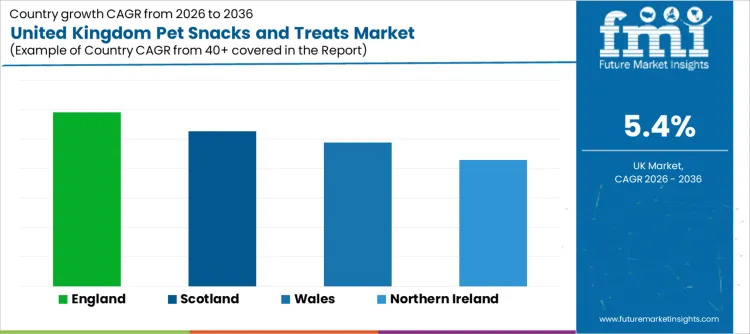
| Region | CAGR (2026-2036) |
|---|---|
| England | 5.9% |
| Scotland | 5.3% |
| Wales | 4.9% |
| Northern Ireland | 4.3% |
Why is England leading with a 5.9% CAGR in pet snack and treat consumption?
England leads with a 5.9% CAGR, supported by a dense concentration of retail outlets, strong specialty store penetration, and large multi-pet household bases. National grocery chains and premium pet specialists provide broad access to both value and premium treat formats.
Brands often prioritise England for new launches because distribution reach is wider and consumer discovery can scale faster. Promotional mechanics and loyalty engagement also help brands build repeat purchasing habits through multipack deals and mix-and-match options.
How is Scotland sustaining 5.3% CAGR through premium mix and wellness-led selection?
Scotland records 5.3% CAGR, supported by stable pet ownership patterns and steady adoption of wellness-oriented products. Owners often look for treats that support digestive comfort, coat health, and dental routines, especially in older pet cohorts.
Retailers that maintain strong range depth across sensitive stomach lines and functional chews gain consistent traction. Brand success in Scotland is tied to availability consistency and clear benefit communication that does not overwhelm the shopper.
What is driving Wales at 4.9% CAGR with practical value and routine-led feeding behaviour?
Wales shows a 4.9% CAGR, driven by routine treat usage in training, bonding, and enrichment. Value perception matters, making well-priced multipacks and familiar formats important. Specialty pet stores remain influential in guiding treat selection, particularly for owners seeking dietary support for allergies or weight management. Brands that pair credible nutrition positioning with approachable pricing can strengthen penetration across Wales.
Why does Northern Ireland grow at 4.3% CAGR with measured premium adoption and channel discipline?
Northern Ireland expands at 4.3% CAGR, reflecting steady demand where product trust and channel availability guide purchasing. Growth is supported by reliable distribution in key retail clusters and repeat buying patterns for core eatable formats.
Brands that maintain consistent product availability and deliver straightforward benefit claims tend to perform well. Portfolio strategies that balance everyday treats with occasional premium upgrades can support stable growth without forcing rapid behaviour shifts among consumers.
What Defines the Competitive Landscape for Pet Snacks and Treats in the UK?
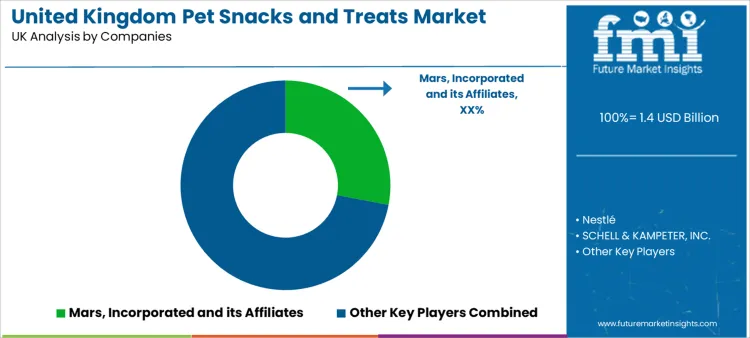
Competition is shaped by brand trust, ingredient quality perception, retail execution, and innovation cadence. Large players win through scale, multi-format portfolios, and consistent shelf presence. Premium challengers win through specialised claims, ingredient transparency, and strong positioning in specialty pet stores.
Mars and Nestlé maintain strong influence through broad pet nutrition portfolios and deep retail access. SCHELL & KAMPETER, INC., The J.M. Smucker Company, and Hill’s Pet Nutrition compete through targeted propositions, functional differentiation, and trusted product families. Category leadership increasingly depends on how effectively companies balance palatability with health outcomes, especially in dental care, digestive support, and calming claims.
Retail leaders and ingredient suppliers are tracking adjacent opportunities across dog-led consumption behaviour and evolving snack routines, supported by the dog food outlook. Brand teams building cat-specific treat extensions often align strategy with the cat food outlook, where palatability, texture variety, and life-stage nutrition remain essential themes.
Key Industry Participants
- Mars, Incorporated and its Affiliates
- Nestlé
- SCHELL & KAMPETER, INC.
- The J.M. Smucker Company
- Hill's Pet Nutrition, Inc.
Scope of Report
| Items | Values |
|---|---|
| Quantitative Units | USD Billion |
| Pet Type | Dogs; Cats; Others |
| Distribution Channel | Specialty Pet Stores; Supers & Hypers; Online; Others |
| Product | Eatables; Chewable |
| Regions Covered | England; Scotland; Wales; Northern Ireland |
| Key Companies Profiled | Mars, Incorporated and its Affiliates; Nestlé; SCHELL & KAMPETER, INC.; The J.M. Smucker Company; Hill's Pet Nutrition, Inc. |
Pet Snacks and Treats Demand in the UK by Segment
By Pet Type:
- Dogs
- Cats
- Others
By Distribution Channel:
- Specialty Pet Stores
- Supermarkets & Hypermarkets
- Online
- Others
By Product:
- Eatables
- Chewables
By Region:
- England
- Scotland
- Wales
- Northern Ireland
Bibliography
- FEDIAF. (2025). Facts & Figures 2025: The European pet food industry.
- FEDIAF. (2025). Statistics: European pet food industry overview.
- UK Pet Food. (2024). Paw-some new pet population data released by UK Pet Food.
- UK Pet Food. (2024). UK Pet Population 2024.
- UK Pet Food. (2024). Data & statistics.
Frequently Asked Questions
How big is the demand for pet snacks and treats in uk in 2026?
The demand for pet snacks and treats in uk is estimated to be valued at USD 1.4 billion in 2026.
What will be the size of pet snacks and treats in uk in 2036?
The market size for the pet snacks and treats in uk is projected to reach USD 2.4 billion by 2036.
How much will be the demand for pet snacks and treats in uk growth between 2026 and 2036?
The demand for pet snacks and treats in uk is expected to grow at a 5.4% CAGR between 2026 and 2036.
What are the key product types in the pet snacks and treats in uk?
The key product types in pet snacks and treats in uk are dogs, cats and others.
Which distribution channel segment is expected to contribute significant share in the pet snacks and treats in uk in 2026?
In terms of distribution channel, specialty pet stores segment is expected to command 88.0% share in the pet snacks and treats in uk in 2026.
Preview the report firsthand - request a free sample
Get SampleGet the brochure for pricing and purchase details.
Get PDFTable of Content
- Executive Summary
- UK Market Outlook
- Demand-side Trends
- Supply-side Trends
- Technology Roadmap Analysis
- Analysis and Recommendations
- Market Overview
- Market Coverage / Taxonomy
- Market Definition / Scope / Limitations
- Market Background
- Market Dynamics
- Drivers
- Restraints
- Opportunity
- Trends
- Scenario Forecast
- Demand in Optimistic Scenario
- Demand in Likely Scenario
- Demand in Conservative Scenario
- Opportunity Map Analysis
- Product Life Cycle Analysis
- Supply Chain Analysis
- Investment Feasibility Matrix
- Value Chain Analysis
- PESTLE and Porter’s Analysis
- Regulatory Landscape
- Regional Parent Market Outlook
- Production and Consumption Statistics
- Import and Export Statistics
- Market Dynamics
- UK Market Analysis 2021 to 2025 and Forecast, 2026 to 2036
- Historical Market Size Value (USD Million) Analysis, 2021 to 2025
- Current and Future Market Size Value (USD Million) Projections, 2026 to 2036
- Y-o-Y Growth Trend Analysis
- Absolute $ Opportunity Analysis
- UK Market Pricing Analysis 2021 to 2025 and Forecast 2026 to 2036
- UK Market Analysis 2021 to 2025 and Forecast 2026 to 2036, By Pet Type
- Introduction / Key Findings
- Historical Market Size Value (USD Million) Analysis By Pet Type , 2021 to 2025
- Current and Future Market Size Value (USD Million) Analysis and Forecast By Pet Type , 2026 to 2036
- Dogs
- Cats
- Others
- Dogs
- Y-o-Y Growth Trend Analysis By Pet Type , 2021 to 2025
- Absolute $ Opportunity Analysis By Pet Type , 2026 to 2036
- UK Market Analysis 2021 to 2025 and Forecast 2026 to 2036, By Distribution Channel
- Introduction / Key Findings
- Historical Market Size Value (USD Million) Analysis By Distribution Channel, 2021 to 2025
- Current and Future Market Size Value (USD Million) Analysis and Forecast By Distribution Channel, 2026 to 2036
- Specialty Pet Stores
- Supermarkets & Hypermarkets
- Online
- Others
- Specialty Pet Stores
- Y-o-Y Growth Trend Analysis By Distribution Channel, 2021 to 2025
- Absolute $ Opportunity Analysis By Distribution Channel, 2026 to 2036
- UK Market Analysis 2021 to 2025 and Forecast 2026 to 2036, By Product
- Introduction / Key Findings
- Historical Market Size Value (USD Million) Analysis By Product, 2021 to 2025
- Current and Future Market Size Value (USD Million) Analysis and Forecast By Product, 2026 to 2036
- Eatables
- Chewable
- Eatables
- Y-o-Y Growth Trend Analysis By Product, 2021 to 2025
- Absolute $ Opportunity Analysis By Product, 2026 to 2036
- Market Structure Analysis
- Competition Dashboard
- Competition Benchmarking
- Market Share Analysis of Top Players
- By Regional
- By Pet Type
- By Distribution Channel
- By Product
- Competition Analysis
- Competition Deep Dive
- Mars, Incorporated and its Affiliates
- Overview
- Product Portfolio
- Profitability by Market Segments (Product/Age /Sales Channel/Region)
- Sales Footprint
- Strategy Overview
- Marketing Strategy
- Product Strategy
- Channel Strategy
- Nestlé
- SCHELL & KAMPETER, INC.
- The J.M. Smucker Company
- Hill's Pet Nutrition, Inc.
- Mars, Incorporated and its Affiliates
- Competition Deep Dive
- Assumptions & Acronyms Used
- Research Methodology


