

- Industry Size (2026)
- USD 65.5 Mn
- Forecast (2036)
- USD 95.7 Mn
- CAGR (2026 to 2036)
- 4.3%
Demand for PET Color Shrink Label in UK Industry Size, Forecast and Outlook By FMI
In 2025, demand for PET color shrink labels in UK was valued at USD 62.8 million. Based on primary and secondary research, sales of PET color shrink labels are estimated to grow to USD 65.5 million in 2026 and USD 95.7 million by 2036. The market is projected to expand at a CAGR of 4.3% during the forecast period. An absolute dollar growth of USD 30.2 million between 2026 and 2036 reflects structural packaging redesign and premiumization rather than volume-only expansion.
Growth depends on increased conversion from standard labeling formats to high-shrink, full-body PET formats that improve shelf impact, brand differentiation, and recyclability compliance under evolving EPR schemes. Label suppliers are capturing value not from incremental unit counts alone, but from engineering complexity embedded in food, personal care, and pharmaceutical packaging systems that demand precise color reproduction and application reliability.
Summary of the Demand for PET Color Shrink Label in the UK
- Market Definition
- The market comprises heat-shrinkable PET labels designed for 360-degree decoration and tamper-evident branding across rigid plastic packaging applications.
- Demand Drivers
- Rising adoption of fully recyclable PET labels to meet recyclability mandates and EPR compliance in the UK.
- Expansion of premium food, beverage, and beauty packaging requiring high-impact, full-body decoration.
- Increasing integration of advanced printing technologies to improve color fidelity, including digital embellishments.
- Key Segments Analyzed
- Thickness: Thickness ≤0.05mm leads, accounting for 57.4% share in 2025 due to processing compatibility and material efficiency.
- Application: Food & Beverage remains the dominant consumption segment, driven by premiumization and brand differentiation.
- Region: England leads volume and value growth, driven by concentrated manufacturing and brand headquarter activity.
- Analyst Opinion
- Ismail Sutaria, principal consultant of the Packaging division at Future Market Insights, opines, “Value creation is shifting from basic decorative functionality toward engineered, high-precision labeling systems aligned with recyclability mandates and premium brand programs. High-fidelity color reproduction on recyclable PET substrates is no longer optional in high-growth segments, and suppliers that invest in printing precision and mono-material compatibility will define the competitive landscape through 2036.”
- Strategic Implications/Executive Takeaways
- Invest in advanced printing and pre-press capabilities for consistent high-fidelity color reproduction.
- Align film thickness strategies with lightweighting goals and regional recycling stream compatibility.
- Prioritize value-added decorative formats in food and beauty packaging to capture margin expansion.
- Methodology
- Built on primary interviews with label converters and FMCG brand leaders.
- Benchmarked against polymer consumption data and printing capacity trends.
- Validated using trade data and internal peer review.
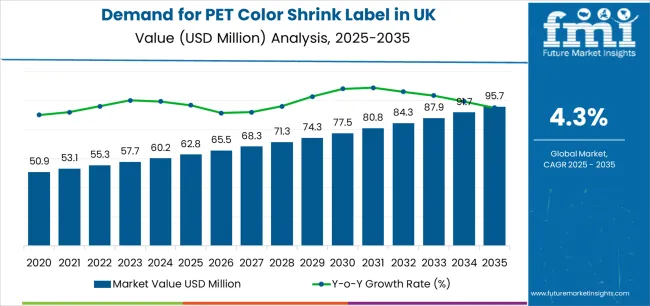
This performance reflects accelerating demand for high-value decorative and functional labeling systems across beauty, healthcare, food, and beverage packaging categories in the UK. England leads regional expansion, supported by concentrated manufacturing and packaging clusters, and rising conversion to premium decorated packaging in export-oriented FMCG production. Scotland follows, driven by specialty food and beverage manufacturing, while Wales and Northern Ireland benefit from packaging modernization and facility upgrades.
Mature demand pockets within the UK generate comparatively slower expansion in specific traditional sectors, where uptake is shaped more by replacement cycles and sustainability-led redesign than new unit growth, with lightweighting pressure acting as a structural constraint on material intensity per label.
Demand for PET Color Shrink Label in UK: Market Definition
The demand for PET color shrink label in the UK encompasses the deployment and supply of heat-shrinkable plastic labels made from polyethylene terephthalate (PET) designed to conform to the contours of rigid packaging containers. Manufactured using precision extrusion and printing processes, these labels offer 360-degree branding, tamper-evident functionality, and high-fidelity color reproduction. They are widely used in food, beverage, personal care, household, and pharmaceutical packaging where maximum shelf impact and secure product information are required.
Market Inclusions
The report includes UK and regional demand estimates in value terms, with a forecast period from 2026 to 2036. It provides segmentation by Thickness, Application, and Region. The analysis incorporates manufacturing technology trends, printing technology developments, recyclability alignment strategies, and performance benchmarking across decorative packaging formats. Regional demand dynamics, country-level growth rates, and competitive positioning are also evaluated.
Market Exclusions
The scope excludes non-shrink labeling formats such as pressure-sensitive and glue-applied labels. It also excludes revenues from packaged consumer goods and focuses strictly on the label component manufacturing and supply layer. Custom low-volume artisanal packaging formats and non-commercial laboratory prototypes are not considered due to negligible market contribution.
Research Methodology
- Primary Research: Interviews were conducted with label converters, printing equipment suppliers, polymer film producers, FMCG brand managers, and sustainability compliance advisors.
- Desk Research: Public company filings, polymer production statistics, trade data, packaging industry association publications, and regulatory documentation were reviewed.
- Market-Sizing and Forecasting: A hybrid top-down and bottom-up model was constructed, reconstructing demand from packaged product output volumes and label-per-unit consumption ratios across end-use industries.
- Data Validation and Update Cycle: Outputs were subjected to variance testing against production capacity data, trade flow benchmarking, and structured internal review prior to publication.
Demand for PET Color Shrink Label in UK: Drivers, Restraints, and Opportunities
Analysis indicates the UK has historically existed as a mature labeling market tied to everyday branding needs in food, beverage, and personal care packaging. Its baseline scale is anchored in the repeat purchase nature of these packaged goods, where labels must deliver visual impact and consistent performance at mass production economics. The market's valuation is increasingly linked to policy and retailer-driven packaging compliance, where label redesign becomes part of a broader shift toward recyclable, regulation-aligned rigid packaging [1].
Analysts observe a clear tension between legacy label formats optimized for low cost and newer premium PET designs that raise unit value through engineered print performance and sustainability profiles. Standard labels face pressure where brands push lightweighting and simplify material structures, while growth is concentrated in decorative formats that justify higher prices through superior gloss, haze control, and color vibrancy in premium food, beverage, and personal care packs. This shift nets out as higher value growth even when material use per label moderates, because precision printing and advanced film formulations add manufacturing complexity that supports margin expansion.
- BS ISO 7683:2024 Compliance Pull: The publication of BS ISO 7683:2024, "Design criteria and test methods for removable shrink labels applied to PET bottles," increases compliance scrutiny on label design and material choices, including removability in recycling processes [2]. This pushes suppliers toward PET-led mono-material strategies and tighter specification alignment with UK recycling streams, accelerating redesign cycles for beverage and home care packaging.
- UK EPR and Plastic Packaging Tax: The UK Plastic Packaging Tax and evolving EPR schemes are expanding producer reporting and cost allocation for packaging end-of-life management [3]. This raises the commercial value of weight reduction, design-for-recycling, and material simplification in label portfolios. Label suppliers that can support recycled content, recyclability claims, and documentation requirements gain procurement advantage with multinational FMCG buyers operating across the UK [4].
- Premiumization in Food and Beverage: The UK's strong premium food and beverage sector, including craft beverages, specialty foods, and organic products, is compounding growth through demand for high-impact, full-body decoration [5]. As regional output expands in these formats, high-fidelity color printing and precise shrink performance are adopted to maximize shelf appeal and brand differentiation, supporting faster market expansion.
Segmental Analysis
Demand for PET Color Shrink Label in UK: Analysis by Thickness
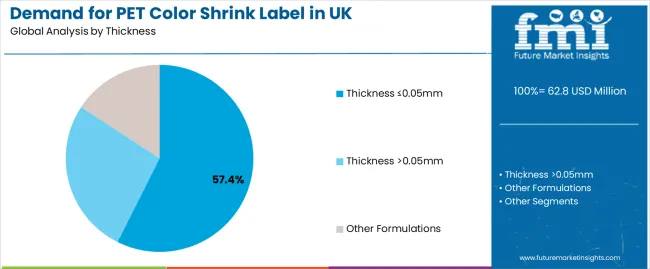
Demand for thickness ≤0.05mm is estimated to remain the leading material stream, capturing 57.4% of the market share in 2025. Its balance of processing compatibility, material efficiency, and consistent color reproduction supports growth in rigid packaging systems. This thickness range is also the default substrate for lightweighting strategies in the UK, which keeps it specified in many redesign programs even when brands seek to reduce overall material consumption.
- Standard Innovation: The development of BS ISO 7683:2024 provides a framework for designing labels that are not only high performing in application but also removable in recycling processes, influencing formulation strategies for thin films [2].
- Product Engineering: Label converters are extending their platforms to include ultra-thin films with enhanced shrinkage and printability, signaling continued product development investment in precision decoration where label integrity and consumer appeal are key purchase drivers [6].
- Compliance Alignment: The UK Plastic Packaging Tax increases pressure on component-level recyclability and material choices, which supports PET-led mono-material label roadmaps and accelerates specification changes across brand owners and converters [3].
Demand for PET Color Shrink Label in UK: Analysis by Application
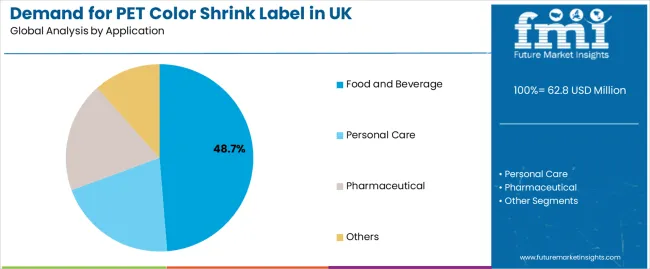
Food and Beverage generate maximum demand at 48.7% for PET color shrink labels because high-frequency launches and the need for standout on crowded retail shelves make visual impact and brand differentiation procurement-critical. At the same time, faster value growth is increasingly concentrated in personal care and beauty, where brands pay for decorative control, premium tactile feel, and high-gloss finishes, pushing PET shrink labels into higher-margin packaging programs [5].
- Portfolio Expansion: Label converters are strengthening their capabilities to serve premium food, beverage, and personal care formats, adding capacity for digital embellishments and high-definition printing [6].
- Innovation in Decoration: The industry is emphasizing advanced printing technologies as a core innovation pillar, combining high-shrink films with vibrant color reproduction in a single manufacturing step to improve production efficiency and structural bonding in decorative labels for food and personal care markets [7].
- Regional Pull-Through: The growth split in this market increasingly tracks end-use mix by geography, with England scaling unit volumes through FMCG brand expansions, while Scotland and Wales pull higher-value label specifications through premium product launches and recyclability-led redesign cycles under packaging policy pressure.
Regional Analysis
The demand for PET color shrink labels in the UK is segmented geographically across England, Scotland, Wales, and Northern Ireland. Growth dynamics differ based on packaging regulation intensity, FMCG brand concentration, and printing technology localization.
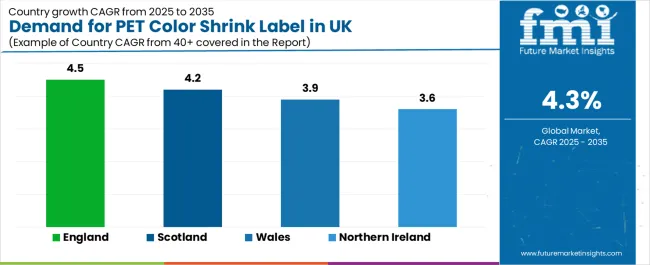
| Country | CAGR (2026-2036) |
|---|---|
| England | 4.5% |
| Scotland | 4.2% |
| Wales | 3.9% |
| Northern Ireland | 3.6% |
Source: Industry analysis based on proprietary forecasting model and primary research
England Market Analysis
England functions as the specification-driven procurement hub of the UK, where retailer mandates and brand ESG targets shape label selection. Major players operate large-scale label converting divisions serving food, beverage, and personal care brands concentrated in London and the South East, the Midlands, and the North West.
Demand for PET color shrink labels in England is forecasted to advance at a 4.5% CAGR through 2036. Retailer sustainability mandates and evolving UK-wide packaging compliance frameworks shape growth. The implementation of the Plastic Packaging Tax and EPR schemes affects component-level specifications, including labels [3]. Unlike other UK regions where growth may be more evenly spread, England's growth is driven by product mix upgrades. Premium food, beverage, and fragrance packaging programs increasingly require high-fidelity color reproduction, precise shrinkage control, and removability validation under standards like BS ISO 7683 [2].
Analysis of PET color shrink label demand in England consists of assessment of key manufacturing and brand hubs. Readers can find policy mapping, retailer mandate tracking, and label specification evolution trends.
Scotland Market Analysis
Demand for PET color shrink labels in Scotland is projected to rise at a 4.2% CAGR through 2036. Growth is influenced by the strength of its specialty food and beverage manufacturing, including distilleries, breweries, and premium food producers [5]. Scotland's strong export base in these sectors supports higher-value decorative formats, where premium brand presentation is critical for global markets.
Growth in this market is therefore export-aligned and brand-driven. Analysis of PET color shrink label demand in Scotland consists of regulatory impact assessment, recycling economics modeling, and label material transition insights.
Wales and Northern Ireland Market Analysis
Demand for PET color shrink labels in Wales and Northern Ireland is projected to rise at 3.9% and 3.6% CAGRs respectively through 2036. Growth is supported by manufacturing modernization, facility upgrades enabling new label formats, and their integration into wider UK supply chains.
These regions benefit from investments in automated packaging lines that require high-performance, consistent labeling solutions. Analysis of PET color shrink label demand in Wales and Northern Ireland consists of capacity tracking, supply chain linkage evaluation, and regional demand modeling.
Competitive Aligners for Market Players
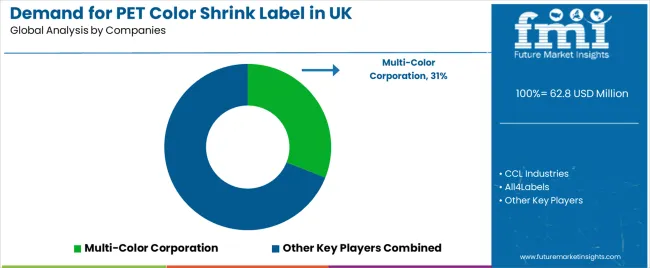
A mix of multinational labeling specialists and regional converters serves the demand for PET color shrink labels in the UK. As per industry estimates on the broader shrink sleeve market, top global players collectively control a significant share of value revenue, particularly in premium food, beverage, and personal care applications [8]. The primary competitive variable is not raw film pricing but engineering precision in printing, color management, and application reliability.
Large integrated players such as CCL Industries, Multi-Color Corporation, and Sleever International benefit from scale advantages in pre-press investment, automated printing lines, and pan-European customer contracts [9]. Companies with integrated decorative portfolios can cross-sell labels into food, beverage, and beauty accounts, reducing customer acquisition costs. Structural advantage also comes from technical service footprints that allow localized support near FMCG filling lines, minimizing downtime risk [6].
Buyer behavior in this market reflects concentrated procurement power. Multinational FMCG companies typically dual-source label suppliers to prevent dependency on a single converter and to maintain pricing discipline. Framework agreements often include multi-year volume commitments with cost pass-through mechanisms tied to polymer indices. As a result, pricing power for suppliers depends less on commodity swings and more on differentiated print quality, color consistency, compliance documentation, and the ability to support rapid SKU launches without tooling delays.
Recent Developments
- CCL Industries – Product Launch (March 2024): CCL Industries launched fully recyclable PET shrink sleeves for beverage brands, emphasizing sustainability and print quality [10].
- Multi-Color Corporation – Innovation (August 2024): Multi-Color Corporation introduced digital embellishment options for shrink sleeves, enhancing brand differentiation capabilities [6].
- Avery Dennison – Technology Integration (June 2024): Avery Dennison released QR-enabled shrink sleeve labels, adding interactive branding and authentication features [7].
Key Players in UK PET Color Shrink Label Demand
- Multi-Color Corporation
- CCL Industries
- All4Labels
- Constantia Flexibles
- Sleever International
- Fuji Seal International
- Berry Global Inc.
- Klöckner Pentaplast
- Huhtamaki
Scope of Report
| Metric | Value |
|---|---|
| Quantitative Units | USD 65.5 million (2026) to USD 95.7 million (2036), at a CAGR of 4.3% |
| Market Definition | The demand for PET color shrink labels in the UK comprises the deployment of heat-shrinkable PET labels for 360-degree decoration across food, beverage, personal care, and pharmaceutical packaging formats. |
| Thickness Segmentation | Thickness ≤0.05mm, Thickness >0.05mm |
| Application Segmentation | Food & Beverage, Personal Care & Cosmetics, Pharmaceutical, Others |
| Region Segmentation | England, Scotland, Wales, Northern Ireland |
| Key Companies Profiled | Multi-Color Corporation, CCL Industries, All4Labels, Constantia Flexibles, Sleever International, Fuji Seal International, Berry Global Inc., Klöckner Pentaplast, Huhtamaki |
| Forecast Period | 2026 to 2036 |
| Approach | Hybrid top-down and bottom-up market modeling validated through primary interviews with label converters, printers, and FMCG brand leaders, supported by trade benchmarking and production capacity analysis. |
Demand for PET Color Shrink Label in UK: Analysis by Segments
Thickness
- Thickness ≤0.05mm
- Thickness >0.05mm
Application
- Food & Beverage
- Personal Care
- Pharmaceutical
- Others
Region
- England
- Scotland
- Wales
- Northern Ireland
Bibliography
- The Grocer. (2025, October 8). How sustainability is reshaping FMCG packaging strategies.
- British Standards Institution. (2024). BS ISO 7683:2024: Design criteria and test methods for removable shrink labels applied to PET bottles. BSI.
- HM Revenue & Customs. (2024). Plastic Packaging Tax: Detailed Guidance.
- WRAP. (2025). UK Plastics Pact: Progress Report 2024-25.
- Food and Drink Federation. (2025). UK Food and Drink Export Performance 2024.
- Labels & Labeling. (2024, September 15). UK label converters invest in digital embellishment.
- Packaging Europe. (2024, June 12). Interactive packaging: Avery Dennison launches QR-enabled shrink sleeve.
- Office for National Statistics. (2025). UK Manufacturing Statistics: Packaging Materials. ONS.
- CCL Industries. (2025). Annual Report 2024. CCL Industries.
- Beverage Daily. (2024, March 20). CCL launches recyclable PET shrink sleeve for beverage brands.
This bibliography is provided for reader reference and is not exhaustive. The full report contains the complete reference list and detailed citations.
Frequently Asked Questions
How large is the demand for PET color shrink labels in the UK in 2026?
Demand for PET color shrink labels in the UK is estimated to be valued at USD 65.5 million in 2026.
What will be the market size for PET color shrink labels in the UK by 2036?
Market size for PET color shrink labels in the UK is projected to reach USD 95.7 million by 2036.
What is the expected demand growth for PET color shrink labels in the UK between 2026 and 2036?
Demand for PET color shrink labels in the UK is expected to grow at a 4.3% CAGR between 2026 and 2036.
Which thickness segment is poised to lead sales in the UK?
Thickness ≤0.05mm is expected to remain the leading thickness segment, anchored by its processing compatibility and material efficiency, and it held 57.4% share in 2025.
How significant is the role of Food & Beverage in driving adoption of PET color shrink labels in the UK?
Food & Beverage is a primary consumption sector because high-frequency product launches and the need for standout on retail shelves make visual impact and brand differentiation procurement-critical.
What is driving demand in England?
Premium dispensing upgrades in food, beverage, and beauty packaging, combined with packaging compliance pressure, are supporting demand growth in England.
What is the England growth outlook in this report?
England is projected to expand at a 4.5% CAGR during 2026 to 2036.
What type of demand dominates in Scotland?
Demand is driven primarily by the strength of its specialty food and beverage manufacturing, including distilleries and premium food producers serving export markets.
What is the Scotland growth outlook in this report?
Scotland is projected to expand at a 4.2% CAGR during 2026 to 2036.
Does the report cover Wales in its regional analysis?
Yes, Wales is included within the UK under the regional coverage framework.
What is the Wales growth outlook in this report?
Wales is projected to expand at a 3.9% CAGR during 2026 to 2036.
Does the report cover Northern Ireland in its regional analysis?
Yes, Northern Ireland is included within the UK and is covered in the country-wise assessment.
What is the Northern Ireland growth outlook in this report?
Northern Ireland is projected to expand at a 3.6% CAGR during 2026 to 2036.
What is a PET color shrink label and what is it mainly used for?
A PET color shrink label is a heat-shrinkable plastic label made from polyethylene terephthalate, mainly used for 360-degree decoration, tamper-evident branding, and product information display in food, beverage, personal care, and pharmaceutical packaging.
What does the demand for PET color shrink labels in the UK mean in this report?
It refers to the deployment and supply of PET color shrink labels in the UK by thickness, application, and region, measured in value terms.
What is included in the scope of this PET color shrink label demand report for the UK?
Scope includes market sizing and forecasting for 2026 to 2036, segmentation by thickness, application, and region, along with competitive assessment and regional outlook for England, Scotland, Wales, and Northern Ireland.
What is excluded from the scope of this report?
The scope excludes non-shrink labeling formats such as pressure-sensitive and glue-applied labels, and downstream packaged goods revenues, focusing strictly on label component manufacturing and supply.
Preview the report firsthand - request a free sample
Get SampleGet the brochure for pricing and purchase details.
Get PDFTable of Content
- Executive Summary
- Global Market Outlook
- Demand-side Trends
- Supply-side Trends
- Technology Roadmap Analysis
- Analysis and Recommendations
- Market Overview
- Market Coverage / Taxonomy
- Market Definition / Scope / Limitations
- Research Methodology
- Chapter Orientation
- Analytical Lens and Working Hypotheses
- Market Structure, Signals, and Trend Drivers
- Company Annual and Sustainability Reports
- Peer-reviewed Journals and Academic Literature
- Corporate Websites, Product Literature, and Technical Notes
- Earnings Decks and Investor Briefings
- Statutory Filings and Regulatory Disclosures
- Technical White Papers and Standards Notes
- Trade Journals, Industry Magazines, and Analyst Briefs
- Conference Proceedings, Webinars, and Seminar Materials
- Government Statistics Portals and Public Data Releases
- Press Releases and Reputable Media Coverage
- Specialist Newsletters and Curated Briefings
- Sector Databases and Reference Repositories
- FMI Internal Proprietary Databases and Historical Market Datasets
- Subscription Datasets and Paid Sources
- Social Channels, Communities, and Digital Listening Inputs
- Additional Desk Sources
- Expert Input and Fieldwork (Primary Evidence)
- Primary Modes
- Qualitative Interviews and Expert Elicitation
- Quantitative Surveys and Structured Data Capture
- Blended Approach
- Why Primary Evidence is Used
- Field Techniques
- Interviews
- Surveys
- Focus Groups
- Observational and In-context Research
- Social and Community Interactions
- Stakeholder Universe Engaged
- C-suite Leaders
- Board Members
- Presidents and Vice Presidents
- R&D and Innovation Heads
- Technical Specialists
- Domain Subject-matter Experts
- Scientists
- Physicians and Other Healthcare Professionals
- Governance, Ethics, and Data Stewardship
- Research Ethics
- Data Integrity and Handling
- Primary Modes
- Tooling, Models, and Reference Databases
- Data Engineering and Model Build
- Data Acquisition and Ingestion
- Cleaning, Normalisation, and Verification
- Synthesis, Triangulation, and Analysis
- Quality Assurance and Audit Trail
- Market Background
- Market Dynamics
- Drivers
- Restraints
- Opportunity
- Trends
- Scenario Forecast
- Demand in Optimistic Scenario
- Demand in Likely Scenario
- Demand in Conservative Scenario
- Opportunity Map Analysis
- Product Life Cycle Analysis
- Supply Chain Analysis
- Investment Feasibility Matrix
- Value Chain Analysis
- PESTLE and Porter’s Analysis
- Regulatory Landscape
- Regional Parent Market Outlook
- Production and Consumption Statistics
- Import and Export Statistics
- Market Dynamics
- Global Market Analysis 2021 to 2025 and Forecast, 2026 to 2036
- Historical Market Size Value (USD Million) Analysis, 2021 to 2025
- Current and Future Market Size Value (USD Million) Projections, 2026 to 2036
- Y-o-Y Growth Trend Analysis
- Absolute $ Opportunity Analysis
- Global Market Pricing Analysis 2021 to 2025 and Forecast 2026 to 2036
- Global Market Analysis 2021 to 2025 and Forecast 2026 to 2036, By Thickness
- Introduction / Key Findings
- Historical Market Size Value (USD Million) Analysis By Thickness , 2021 to 2025
- Current and Future Market Size Value (USD Million) Analysis and Forecast By Thickness , 2026 to 2036
- Thickness ≤0.05mm
- Thickness >0.05mm
- Thickness ≤0.05mm
- Y-o-Y Growth Trend Analysis By Thickness , 2021 to 2025
- Absolute $ Opportunity Analysis By Thickness , 2026 to 2036
- Global Market Analysis 2021 to 2025 and Forecast 2026 to 2036, By Application
- Introduction / Key Findings
- Historical Market Size Value (USD Million) Analysis By Application, 2021 to 2025
- Current and Future Market Size Value (USD Million) Analysis and Forecast By Application, 2026 to 2036
- Food and Beverage
- Personal Care
- Pharmaceutical
- Others
- Food and Beverage
- Y-o-Y Growth Trend Analysis By Application, 2021 to 2025
- Absolute $ Opportunity Analysis By Application, 2026 to 2036
- Global Market Analysis 2021 to 2025 and Forecast 2026 to 2036, By Region
- Introduction
- Historical Market Size Value (USD Million) Analysis By Region, 2021 to 2025
- Current Market Size Value (USD Million) Analysis and Forecast By Region, 2026 to 2036
- North America
- Latin America
- Western Europe
- Eastern Europe
- East Asia
- South Asia and Pacific
- Middle East & Africa
- Market Attractiveness Analysis By Region
- North America Market Analysis 2021 to 2025 and Forecast 2026 to 2036, By Country
- Historical Market Size Value (USD Million) Trend Analysis By Market Taxonomy, 2021 to 2025
- Market Size Value (USD Million) Forecast By Market Taxonomy, 2026 to 2036
- By Country
- USA
- Canada
- Mexico
- By Thickness
- By Application
- By Country
- Market Attractiveness Analysis
- By Country
- By Thickness
- By Application
- Key Takeaways
- Latin America Market Analysis 2021 to 2025 and Forecast 2026 to 2036, By Country
- Historical Market Size Value (USD Million) Trend Analysis By Market Taxonomy, 2021 to 2025
- Market Size Value (USD Million) Forecast By Market Taxonomy, 2026 to 2036
- By Country
- Brazil
- Chile
- Rest of Latin America
- By Thickness
- By Application
- By Country
- Market Attractiveness Analysis
- By Country
- By Thickness
- By Application
- Key Takeaways
- Western Europe Market Analysis 2021 to 2025 and Forecast 2026 to 2036, By Country
- Historical Market Size Value (USD Million) Trend Analysis By Market Taxonomy, 2021 to 2025
- Market Size Value (USD Million) Forecast By Market Taxonomy, 2026 to 2036
- By Country
- Germany
- UK
- Italy
- Spain
- France
- Nordic
- BENELUX
- Rest of Western Europe
- By Thickness
- By Application
- By Country
- Market Attractiveness Analysis
- By Country
- By Thickness
- By Application
- Key Takeaways
- Eastern Europe Market Analysis 2021 to 2025 and Forecast 2026 to 2036, By Country
- Historical Market Size Value (USD Million) Trend Analysis By Market Taxonomy, 2021 to 2025
- Market Size Value (USD Million) Forecast By Market Taxonomy, 2026 to 2036
- By Country
- Russia
- Poland
- Hungary
- Balkan & Baltic
- Rest of Eastern Europe
- By Thickness
- By Application
- By Country
- Market Attractiveness Analysis
- By Country
- By Thickness
- By Application
- Key Takeaways
- East Asia Market Analysis 2021 to 2025 and Forecast 2026 to 2036, By Country
- Historical Market Size Value (USD Million) Trend Analysis By Market Taxonomy, 2021 to 2025
- Market Size Value (USD Million) Forecast By Market Taxonomy, 2026 to 2036
- By Country
- China
- Japan
- South Korea
- By Thickness
- By Application
- By Country
- Market Attractiveness Analysis
- By Country
- By Thickness
- By Application
- Key Takeaways
- South Asia and Pacific Market Analysis 2021 to 2025 and Forecast 2026 to 2036, By Country
- Historical Market Size Value (USD Million) Trend Analysis By Market Taxonomy, 2021 to 2025
- Market Size Value (USD Million) Forecast By Market Taxonomy, 2026 to 2036
- By Country
- India
- ASEAN
- Australia & New Zealand
- Rest of South Asia and Pacific
- By Thickness
- By Application
- By Country
- Market Attractiveness Analysis
- By Country
- By Thickness
- By Application
- Key Takeaways
- Middle East & Africa Market Analysis 2021 to 2025 and Forecast 2026 to 2036, By Country
- Historical Market Size Value (USD Million) Trend Analysis By Market Taxonomy, 2021 to 2025
- Market Size Value (USD Million) Forecast By Market Taxonomy, 2026 to 2036
- By Country
- Kingdom of Saudi Arabia
- Other GCC Countries
- Turkiye
- South Africa
- Other African Union
- Rest of Middle East & Africa
- By Thickness
- By Application
- By Country
- Market Attractiveness Analysis
- By Country
- By Thickness
- By Application
- Key Takeaways
- Key Countries Market Analysis
- USA
- Pricing Analysis
- Market Share Analysis, 2025
- By Thickness
- By Application
- Canada
- Pricing Analysis
- Market Share Analysis, 2025
- By Thickness
- By Application
- Mexico
- Pricing Analysis
- Market Share Analysis, 2025
- By Thickness
- By Application
- Brazil
- Pricing Analysis
- Market Share Analysis, 2025
- By Thickness
- By Application
- Chile
- Pricing Analysis
- Market Share Analysis, 2025
- By Thickness
- By Application
- Germany
- Pricing Analysis
- Market Share Analysis, 2025
- By Thickness
- By Application
- UK
- Pricing Analysis
- Market Share Analysis, 2025
- By Thickness
- By Application
- Italy
- Pricing Analysis
- Market Share Analysis, 2025
- By Thickness
- By Application
- Spain
- Pricing Analysis
- Market Share Analysis, 2025
- By Thickness
- By Application
- France
- Pricing Analysis
- Market Share Analysis, 2025
- By Thickness
- By Application
- India
- Pricing Analysis
- Market Share Analysis, 2025
- By Thickness
- By Application
- ASEAN
- Pricing Analysis
- Market Share Analysis, 2025
- By Thickness
- By Application
- Australia & New Zealand
- Pricing Analysis
- Market Share Analysis, 2025
- By Thickness
- By Application
- China
- Pricing Analysis
- Market Share Analysis, 2025
- By Thickness
- By Application
- Japan
- Pricing Analysis
- Market Share Analysis, 2025
- By Thickness
- By Application
- South Korea
- Pricing Analysis
- Market Share Analysis, 2025
- By Thickness
- By Application
- Russia
- Pricing Analysis
- Market Share Analysis, 2025
- By Thickness
- By Application
- Poland
- Pricing Analysis
- Market Share Analysis, 2025
- By Thickness
- By Application
- Hungary
- Pricing Analysis
- Market Share Analysis, 2025
- By Thickness
- By Application
- Kingdom of Saudi Arabia
- Pricing Analysis
- Market Share Analysis, 2025
- By Thickness
- By Application
- Turkiye
- Pricing Analysis
- Market Share Analysis, 2025
- By Thickness
- By Application
- South Africa
- Pricing Analysis
- Market Share Analysis, 2025
- By Thickness
- By Application
- USA
- Market Structure Analysis
- Competition Dashboard
- Competition Benchmarking
- Market Share Analysis of Top Players
- By Regional
- By Thickness
- By Application
- Competition Analysis
- Competition Deep Dive
- Multi-Color Corporation
- Overview
- Product Portfolio
- Profitability by Market Segments (Product/Age /Sales Channel/Region)
- Sales Footprint
- Strategy Overview
- Marketing Strategy
- Product Strategy
- Channel Strategy
- CCL Industries
- All4Labels
- Constantia Flexibles
- Sleever International
- Fuji Seal International
- Multi-Color Corporation
- Competition Deep Dive
- Assumptions & Acronyms Used


