

- Industry Size (2026)
- USD 551.6 Mn
- Forecast (2036)
- USD 1376.9 Mn
- CAGR (2026 to 2036)
- 9.6%
Demand for Protein Snacks in the UK 2026 to 2036
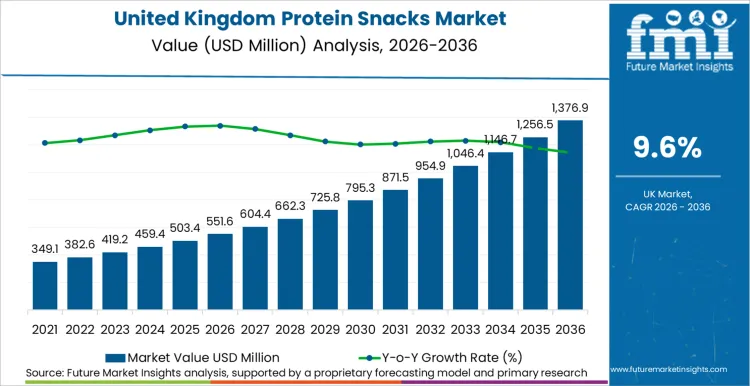
The UK industry for protein snacks is forecasted to grow from USD 551.6 million in 2026 to USD 1,376.9 million by 2036, at a strong CAGR of 9.6%. This growth is driven by evolving consumer preferences for convenient, nutritious snacking options that align with health and wellness trends. Increasing demand for protein-rich snacks is supported by busy lifestyles, a growing focus on fitness, and an increasing need for portable meal options that offer both satiety and sustained energy.
Shoppers are turning to protein snacks to bridge gaps between meals and maintain energy throughout the day. The rise in health-conscious behavior, particularly in the fitness community, is helping shape the demand for protein-packed snacks. Retailers are responding by expanding product lines to include a wide variety of protein-enriched options, including bars, crisps, and plant-based snacks. This growing category reflects a broader shift in consumer values toward functional nutrition, convenience, and healthier alternatives to traditional snacks.
Quick Stats for Protein Snacks Industry in the UK
- Protein Snacks Industry Value (2026): USD 551.6 million
- Protein Snacks Industry Forecast Value (2036): USD 1,376.9 million
- Protein Snacks Industry Forecast CAGR 2026 to 2036: 9.6%
- Leading Product Type by Demand Share: Protein Bars
- Fastest-Growing Regions: England, Scotland, Wales, Northern Ireland
- Key Industry Participants: Quest Nutrition LLC, General Mills (Nature Valley), Clif Bar & Company, Kellogg Co., Vitaco Health Australia, Powerful Men LLC
Protein Snacks Industry in the UK Key Takeaways
| Metric | Value |
|---|---|
| Industry Value (2026) | USD 551.6 million |
| Industry Forecast Value (2036) | USD 1,376.9 million |
| Forecast CAGR (2026 to 2036) | 9.6% |
Source: FMI analysis based on primary research and proprietary forecasting model
Why is the UK Building Steady Demand for Protein Snacks?
UK consumers are increasingly prioritizing convenient foods that support satiety and nutrition, driving interest in protein-rich snacks as alternatives to traditional treats. Busy lifestyles and a focus on healthier eating habits encourage people to choose options that deliver noticeable fullness between meals. Protein snacks fit this need by offering portable nutrition without the heaviness of full meals.
Retailers and brands in the UK adjust their portfolios to meet these preferences. Grocery aisles and convenience outlets allocate more space to bars, bites and crisp variants formulated with higher protein content. This reflects how shoppers evaluate snacks based on functional attributes like muscle support or energy balance. Independent food shops and petrol forecourt retailers also stock these products to cater to on-the-go purchasers looking for quick, satisfying options.
Fitness, wellness and diet trends reinforce demand patterns. Gym-goers, active professionals and weight-management consumers increasingly include protein snacks in daily routines as part of structured eating plans. Social channels and peer recommendations amplify awareness of novel flavours and formats, which encourages trial and repeat purchase. This dynamic keeps protein snacks relevant within the broader UK snacking landscape.
How is Protein Snacks Demand Segmented by Product Type, Distribution Channel, and Type in the UK?
Demand for protein snacks in the UK reflects the growing consumer preference for functional, on-the-go nutrition that supports active lifestyles, fitness, and dietary preferences. Segmentation follows product versatility, shopping convenience, and alignment with plant-based or meat-based protein sources.
Why do protein bars lead product-level demand?
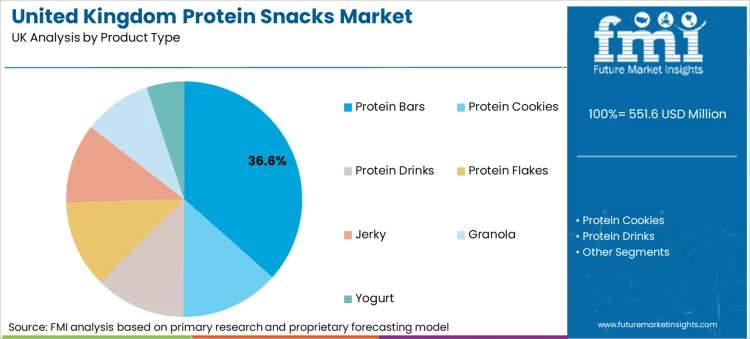
Protein bars account for 36.6% of the demand, positioning them as the top choice in the protein snacks category. This preference is driven by the convenience and portability of bars, making them ideal for consumers seeking quick, accessible, and energy-boosting options. Protein bars are widely used by individuals who require a snack that aligns with their fitness goals or busy schedules, offering a balanced combination of protein and carbohydrates.
The ability to customize bars with various flavours and functional ingredients further supports their dominance. Consumers also value the nutritional transparency provided by protein bar packaging, making them a go-to snack for those looking to manage their protein intake on the move.
What keeps online retail as the dominant distribution channel?
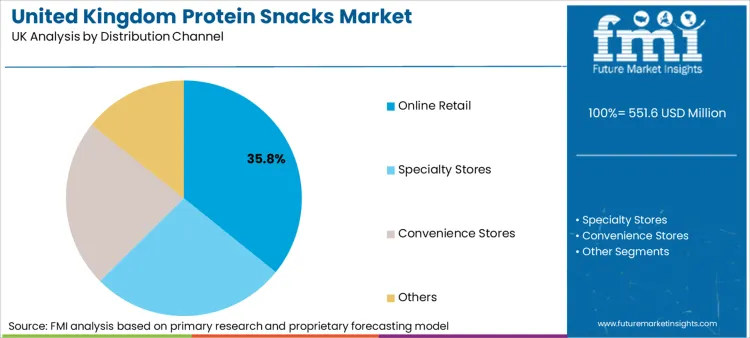
Online retail holds a 35.8% share, reflecting strong demand for the convenience of purchasing protein snacks from home. E-commerce platforms offer access to a broad selection of products, enabling consumers to easily compare different brands, ingredients, and pricing. The ability to shop from a variety of niche or specialized brands further drives online demand, catering to specific dietary needs like vegan, keto, or gluten-free options.
The convenience of home delivery and the growth of subscription-based models have also contributed to the increasing popularity of online shopping for protein snacks, allowing consumers to have their preferred products regularly delivered without needing to visit physical stores.
Why do plant-based protein snacks dominate in demand?
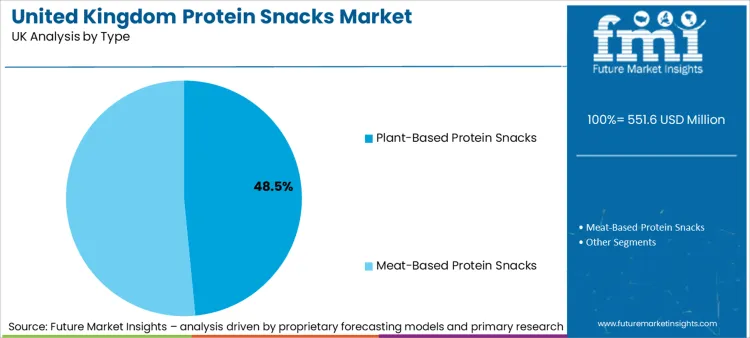
Plant-based protein snacks account for 48.5% of the demand, reflecting the growing trend towards plant-based diets driven by health, sustainability, and ethical concerns. These snacks cater to a wide range of consumers, including vegans, vegetarians, and those seeking to reduce their meat consumption. Plant-based protein snacks are perceived as healthier, with many consumers viewing them as a cleaner alternative to meat-based options.
The increasing availability of plant-based protein sources like peas, soy, and hemp also supports the continued growth of this segment. Plant-based protein snacks appeal not only to those with dietary preferences but also to a broader industry that values environmental sustainability and animal welfare.
What are the Key Dynamics in Demand for Protein Snacks in the UK?
Demand for protein snacks in the UK is rising as consumers seek convenient foods that support energy, satiety and active lifestyles. Retailers report increased purchases in chilled, ambient and on-the-go formats featuring high protein claims. Growth reflects interest among fitness-oriented adults, commuters and health-aware shoppers who prioritize nutrient density and portion control. Innovation in flavour, texture and clean-label positioning drives trial and repeat purchase.
How do lifestyle trends and occasion needs influence uptake?
Uptake of protein snacks in the UK is shaped by eating occasions that fall between structured meals, such as mid-morning breaks, post-work workouts and busy afternoons. Consumers engaged in strength training or endurance exercise allocate a share of their food spend to bars, bites and shake blends that deliver measurable protein per serving. Busy professionals choose fortified crackers and high-protein crisps that align with workday rhythms, seeking balance between taste and functional nutrition. Healthy ageing groups value protein to preserve muscle mass, driving interest in easy-to-chew formats and dairy-based protein snacks. Product developers tailor textures and flavour profiles to local preferences, with savoury and sweet variants coexisting across mainstream and specialist channels.
How do price sensitivity and sensory expectations shape continue demand?
Demand for protein snacks in the UK is influenced by how well products balance cost with eating enjoyment and perceived benefit. Many high-protein offerings carry a premium relative to conventional chips or biscuits, which limits adoption in value-oriented segments where shoppers weigh protein claims against price per pack. Sensory expectations play a crucial role; products that deliver desirable texture without graininess and appealing flavour without excessive sweetness increase repeat purchase likelihood. Protein source matters when consumers seek alternatives to whey, such as pea or soy, and developers invest in masking off-notes inherent to certain plant proteins. Packaging convenience, portion size and clarity of nutritional messaging affect purchase decisions at shelf, with brands that communicate clear serving protein content performing better among goal-driven segments.
How is Protein Snacks Demand Evolving across Key Regions in the UK?
Demand for protein snacks across the UK grows as consumers increasingly prioritize health-conscious, on-the-go snacking options. Regional variation reflects consumer lifestyle, retail penetration, and how manufacturers adapt to evolving dietary preferences, with an emphasis on clean-label, high-protein, and convenient snack formats.
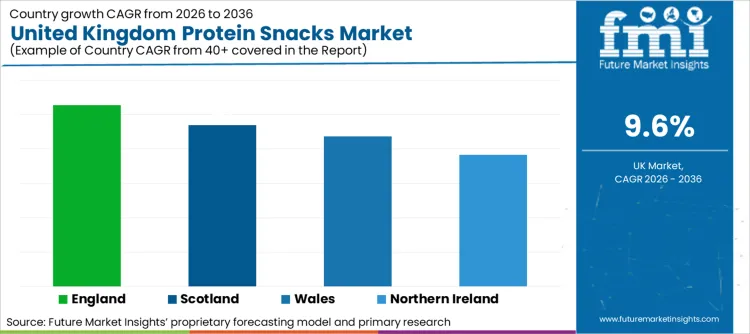
| Region | CAGR 2026 to 2036 |
|---|---|
| England | 10.5% |
| Scotland | 9.4% |
| Wales | 8.7% |
| Northern Ireland | 7.7% |
Source: FMI analysis based on primary research and proprietary forecasting model
Why is England leading expansion through larger consumer base and product variety?
England grows at 10.5%, driven by a broad consumer base and diverse product offerings across supermarkets, convenience stores, and health-focused retailers. Demand rises where protein snacks cater to both active lifestyles and diet-conscious consumers. Manufacturers prioritise innovation in flavors and formats that appeal to busy individuals seeking high-protein, low-sugar alternatives without compromising on taste.
How is Scotland progressing through targeted adoption in health-conscious consumer segments?
Scotland expands at 9.4%, shaped by steady uptake among health-conscious consumers and fitness-focused communities. Demand builds where protein snacks meet needs for quick, nutritious fuel during or after workouts. Buyers look for products that provide reliable protein content, clean ingredients, and clear health benefits, supporting both snack and meal replacement categories.
What is shaping Wales as consumers seek practical, protein-rich snack solutions?
Wales advances at 8.7%, driven by demand from busy individuals seeking protein-rich snacks that fit into fast-paced lifestyles. Demand strengthens when protein snacks deliver high satiety, energy, and muscle recovery benefits. Manufacturers focus on snack formats that are easy to consume, portable, and support dietary goals without compromising convenience or quality.
Why is Northern Ireland showing measured growth tied to selective brand adoption?
Northern Ireland records 7.7% growth, reflecting selective adoption of protein snacks as part of broader health and wellness trends. Adoption progresses when established brands offer trusted, consistent quality and value in protein-rich snack options. Demand improves as consumers gravitate toward well-known labels that deliver reliable nutrition while fitting into their specific dietary preferences.
What Defines the Competitive Landscape for Protein Snacks in the UK?
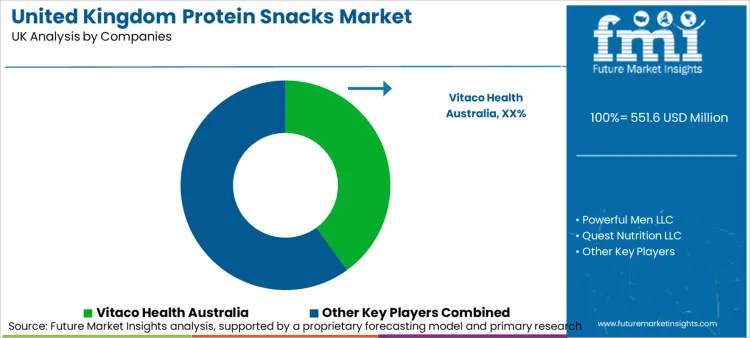
Demand for protein snacks in the UK is driven by health-conscious consumers, increasing interest in high-protein diets, and the convenience factor for on-the-go meal replacements. Buyers assess snack offerings based on protein content, taste, texture, and nutritional balance, particularly for products that cater to fitness, weight management, and general wellness. There is growing focus on clean label claims, such as no artificial additives, gluten-free, and dairy-free options. Procurement behavior tends to favor brands offering product innovation, a variety of flavors, and clear communication on protein sources (e.g., whey, plant-based, or mixed). The industry trend shows strong demand for plant-based protein snacks alongside traditional dairy or meat-based options, driven by dietary diversity and sustainability concerns.
Quest Nutrition LLC holds a strong position in the UK with its high-protein bars and snacks, widely popular due to their taste and nutritional profile. General Mills, under its Nature Valley brand, competes by integrating protein content into its established granola bar offerings, appealing to both mainstream and health-conscious consumers. Clif Bar & Company supports demand through its protein bars, emphasizing organic ingredients and sustainability, which resonate with a wide range of consumers. Kellogg Co. maintains relevance by leveraging its strong retail presence, offering protein-rich snacks as part of its broader portfolio. Vitaco Health Australia and Powerful Men LLC remain more niche players, focusing on specialized protein snacks for health-focused and fitness-driven segments. Competitive differentiation centers on protein sourcing, flavor innovation, ingredient transparency, and alignment with evolving dietary trends.
Key Industry Participants
- Quest Nutrition LLC
- Vitaco Health Australia
- Powerful Men LLC
- General Mills (Nature Valley)
- Clif Bar & Company
- Kellogg Co.
Scope of Report
| Items | Values |
|---|---|
| Quantitative Units | USD million |
| Product Type | Protein Bars; Protein Cookies; Protein Drinks; Protein Flakes; Jerky; Granola; Yogurt |
| Distribution Channel | Online Retail; Specialty Stores; Convenience Stores; Others |
| Type | Plant-Based Protein Snacks; Meat-Based Protein Snacks |
| Regions Covered | England; Scotland; Wales; Northern Ireland |
| Key Companies Profiled | Quest Nutrition LLC; Vitaco Health Australia; Powerful Men LLC; General Mills (Nature Valley); Clif Bar & Company; Kellogg Co. |
Protein Snacks Demand in the UK by Segments
Product Type:
- Protein Bars
- Protein Cookies
- Protein Drinks
- Protein Flakes
- Jerky
- Granola
- Yogurt
Distribution Channel:
- Online Retail
- Specialty Stores
- Convenience Stores
- Others
Type:
- Plant-Based Protein Snacks
- Meat-Based Protein Snacks
By Region
- England
- Scotland
- Wales
- Northern Ireland
Bibliography
- Public Health England. (2023). Protein intake, satiety, and dietary patterns in UK adults. UK Government.
- Department of Health and Social Care. (2023). National diet and nutrition survey: Years 11-12. UK Government.
- Food Standards Agency. (2024). Nutrition labelling, protein claims, and consumer understanding in packaged foods. UK Government.
- British Nutrition Foundation. (2023). High-protein foods, snacking behaviour, and healthy eating patterns. British Nutrition Foundation.
- Organisation for Economic Co-operation and Development. (2023). Changing food consumption patterns and functional food demand. OECD Publishing.
Frequently Asked Questions
How big is the protein snacks industry in the UK in 2026?
The protein snacks industry in the UK is projected to be valued at USD 551.6 million in 2026.
What will be the size of the protein snacks industry in the UK in 2036?
The industry size for protein snacks in the UK is projected to reach USD 1,376.9 million by 2036.
How much will the demand for protein snacks in the UK grow between 2026 and 2036?
Demand for protein snacks in the UK is projected to grow at a 9.6% CAGR between 2026 and 2036.
Which product type holds a significant share in the protein snacks industry in the UK in 2026?
In terms of product type, protein bars are expected to account for a 36.6% share in 2026.
Which type of protein snacks contributes a major share in the protein snacks industry in the UK in 2026?
The plant-based protein snacks segment is expected to account for a 48.5% share in the protein snacks industry in the UK in 2026.
Preview the report firsthand - request a free sample
Get SampleGet the brochure for pricing and purchase details.
Get PDFTable of Content
- Executive Summary
- UK Market Outlook
- Demand-side Trends
- Supply-side Trends
- Technology Roadmap Analysis
- Analysis and Recommendations
- Market Overview
- Market Coverage / Taxonomy
- Market Definition / Scope / Limitations
- Market Background
- Market Dynamics
- Drivers
- Restraints
- Opportunity
- Trends
- Scenario Forecast
- Demand in Optimistic Scenario
- Demand in Likely Scenario
- Demand in Conservative Scenario
- Opportunity Map Analysis
- Product Life Cycle Analysis
- Supply Chain Analysis
- Investment Feasibility Matrix
- Value Chain Analysis
- PESTLE and Porter’s Analysis
- Regulatory Landscape
- Regional Parent Market Outlook
- Production and Consumption Statistics
- Import and Export Statistics
- Market Dynamics
- UK Market Analysis 2021 to 2025 and Forecast, 2026 to 2036
- Historical Market Size Value (USD Million) Analysis, 2021 to 2025
- Current and Future Market Size Value (USD Million) Projections, 2026 to 2036
- Y-o-Y Growth Trend Analysis
- Absolute $ Opportunity Analysis
- UK Market Pricing Analysis 2021 to 2025 and Forecast 2026 to 2036
- UK Market Analysis 2021 to 2025 and Forecast 2026 to 2036, By Product Type
- Introduction / Key Findings
- Historical Market Size Value (USD Million) Analysis By Product Type , 2021 to 2025
- Current and Future Market Size Value (USD Million) Analysis and Forecast By Product Type , 2026 to 2036
- Protein Bars
- Protein Cookies
- Protein Drinks
- Protein Flakes
- Jerky
- Granola
- Yogurt
- Protein Bars
- Y-o-Y Growth Trend Analysis By Product Type , 2021 to 2025
- Absolute $ Opportunity Analysis By Product Type , 2026 to 2036
- UK Market Analysis 2021 to 2025 and Forecast 2026 to 2036, By Distribution Channel
- Introduction / Key Findings
- Historical Market Size Value (USD Million) Analysis By Distribution Channel, 2021 to 2025
- Current and Future Market Size Value (USD Million) Analysis and Forecast By Distribution Channel, 2026 to 2036
- Online Retail
- Specialty Stores
- Convenience Stores
- Others
- Online Retail
- Y-o-Y Growth Trend Analysis By Distribution Channel, 2021 to 2025
- Absolute $ Opportunity Analysis By Distribution Channel, 2026 to 2036
- UK Market Analysis 2021 to 2025 and Forecast 2026 to 2036, By Type
- Introduction / Key Findings
- Historical Market Size Value (USD Million) Analysis By Type, 2021 to 2025
- Current and Future Market Size Value (USD Million) Analysis and Forecast By Type, 2026 to 2036
- Plant-Based Protein Snacks
- Meat-Based Protein Snacks
- Plant-Based Protein Snacks
- Y-o-Y Growth Trend Analysis By Type, 2021 to 2025
- Absolute $ Opportunity Analysis By Type, 2026 to 2036
- Market Structure Analysis
- Competition Dashboard
- Competition Benchmarking
- Market Share Analysis of Top Players
- By Regional
- By Product Type
- By Distribution Channel
- By Type
- Competition Analysis
- Competition Deep Dive
- Vitaco Health Australia
- Overview
- Product Portfolio
- Profitability by Market Segments (Product/Age /Sales Channel/Region)
- Sales Footprint
- Strategy Overview
- Marketing Strategy
- Product Strategy
- Channel Strategy
- Powerful Men LLC
- Quest Nutrition LLC
- General Mills (Nature Valley)
- Clif Bar & Company
- Kellogg Co.
- Vitaco Health Australia
- Competition Deep Dive
- Assumptions & Acronyms Used
- Research Methodology


