

- Industry Size (2026)
- USD 1.6 Bn
- Forecast (2036)
- USD 4.1 Bn
- CAGR (2026 to 2036)
- 10.3%
Upcycled Food Waste Protein Snacks Market Size, Market Forecast and Outlook By FMI
The upcycled food waste protein snacks market was valued at USD 1.4 billion in 2025. Sector is poised to cross USD 1.6 billion in 2026 at a CAGR of 10.3% during the forecast period. Sustained investment propels the industry to USD 4.3 billion through 2036 as formulation parity is achieved where brewers spent grain and defatted oilseed cakes meet conventional soy isolate integrity without sensory penalties for emerging upcycled food products.
Procurement leaders are experiencing a rapid shift from viewing upcycled protein snacks as experimental marketing concepts to recognizing their strategic value as core binding ingredients. Formulators that postpone this transition risk losing cost competitiveness, particularly as inflation continues to elevate the price of conventional protein isolates. The functional advantage of these upcycled protein fractions lies in their superior moisture‑retention capabilities, which mitigate hardening in cold‑extruded bars and support extended shelf-life performance. By integrating products from food waste directly into mainstream product portfolios, brands can both stabilize supply chains against upstream volatility and meet increasingly stringent retailer sustainability requirements factors that will significantly influence the future trajectory of the upcycled food sector.
Summary of Upcycled Food Waste Protein Snacks Market
- Upcycled Food Waste Protein Snacks Market Definition
- This sector comprises packaged snacks utilizing protein isolates derived from agricultural waste streams. The boundary defining this space requires the functional extraction of protein from secondary byproducts to replace conventional virgin isolates in ready to eat formats.
- Demand Drivers in the Market
- Supply chain volatility compels formulation directors to qualify domestic agricultural byproducts as primary ingredients for upcycled snack product development.
- Retailer sustainability mandates require category managers to allocate shelf space specifically for products with verified circular economy credentials.
- Margin compression drives contract manufacturers to substitute premium virgin isolates with cost effective defatted oilseed and spent grain fractions.
- Key Segments Analyzed in the FMI Report
- Spent Grain Protein: Spent Grain Protein is expected to account for 32.5% share in 2026, driven by high supply density from the localized brewing industry and established dewatering infrastructure.
- Protein Bars: Protein Bars is expected to grab 36.2% share in 2026, as cold extrusion manufacturing processes benefit directly from the moisture retention capabilities of upcycled fractions.
- Online Retail: Online Retail is projected to hold 34.4% share in 2026, enabled by direct consumer education models that effectively communicate the technical nuance of circular formulations.
- Health & Fitness Consumers: Health & Fitness Consumers are anticipated to garner 41.6% share in 2026, driven by early adopter willingness to prioritize macronutrient density over conventional ingredient familiarity.
- India: 11.4% compound growth, resulting from massive agricultural processing residues meeting a rapidly formalizing clean label snack segment.
- Analyst Opinion at FMI
- Nandini Roy Choudhury, Principal Analyst, Food and Beverage, at FMI, states, "Category buyers assume the primary value of upcycled fractions is carbon accounting for corporate sustainability reports. In reality, the technical value lies in the hydrocolloid behavior of these specific proteins. Spent grain isolates retain moisture differently than conventional pea protein, which solves the notorious shelf hardening problem in extruded bars. Companies formulating exclusively for the sustainability narrative will lose to those utilizing the functional moisture retention properties."
- Strategic Implications / Executive Takeaways
- Formulation directors must prioritize supplier qualification for proprietary milling technologies to ensure consistent sensory profiles across variable waste batches.
- Contract manufacturers should integrate dynamic recipe software to manage the fluctuating nutritional profiles of seasonal agricultural residues.
- Procurement leads face the immediate necessity to secure long term offtake agreements with regional breweries before multinational food conglomerates monopolize the supply.
- Methodology
- Primary Research: Procurement directors at tier one consumer packaged goods brands and technical formulation leads at contract manufacturing facilities.
- Desk Research: Upcycled Food Association certification registries and agricultural processing residue volume datasets.
- Market-Sizing and Forecasting: Baseline volume anchored to the total verifiable tonnage of spent grain and defatted seed cake processed specifically for human consumption.
- Data Validation and Update Cycle: Forecasts triangulated against independent capital expenditure reports from commercial scale milling and extraction facilities.
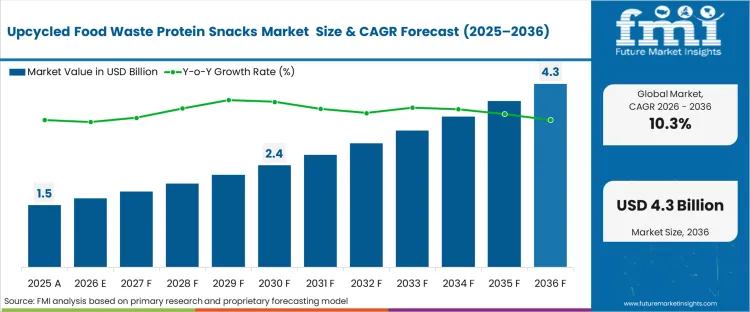
The commercialization of milling technologies capable of effectively reducing the astringency of upcycled fractions represents a key inflection point, enabling broad industry adoption. Contract manufacturers are central to this transition, as they provide mid‑tier upcycled snack brands with access to functional, food waste derived protein without necessitating investment in proprietary extraction or processing capabilities. As these efficiencies scale, sustainable protein snacks achieve cost parity with traditional whey‑based alternatives, positioning plant‑based products to compete not only on environmental benefits but also on price a critical milestone for the continued expansion of the sustainable protein snack market.
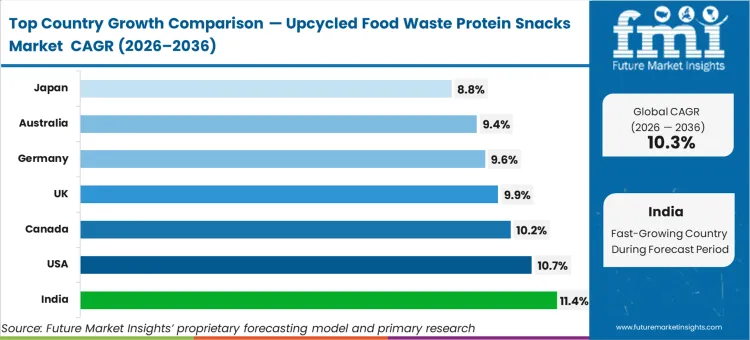
India leads the geographic expansion with an 11.4% CAGR. The United States follows closely at a 10.7% CAGR, while Canada is poised to advance at 10.2%. The United Kingdom is anticipated to track at 9.9%. Germany is estimated to expand at 9.6%, followed by Australia at 9.4%. Japan is projected to grow at 8.8%. The variance across these territories in the sustainable snack foods market stems directly from localized access to high density agricultural processing residues rather than varying consumer sentiment toward sustainable products.
Upcycled Food Waste Protein Snacks Market Key Takeaways
| Metric | Details |
|---|---|
| Industry Size (2026) | USD 1.6 billion |
| Industry Value (2036) | USD 4.3 billion |
| CAGR (2026 to 2036) | 10.3% |
Source: Future Market Insights (FMI) analysis, based on proprietary forecasting model and primary research
Upcycled Food Waste Protein Snacks Market Definition
The global upcycled food market in this specific segment encompasses consumer packaged goods formulated primarily using functional protein fractions extracted from agricultural and industrial food processing byproducts. Answering what are upcycled protein snacks fundamentally requires distinguishing this category from general sustainable foods: it demands the transformation of secondary waste streams into primary nutritional isolates, replacing conventional virgin proteins in the final product architecture of these circular economy food products.
Upcycled Food Waste Protein Snacks Market Inclusions
Product architectures within scope include cold extruded bars, savory chips, crackers, and baked items that utilize rescued ingredients as a core macro nutritional driver. These food upcycling snack products often incorporate alternative protein derivatives sourced from spent brewing grains, pressed oilseed cakes, and defatted fruit seeds, establishing the foundation of the modern food waste valorization snacks sector, including highly specialized upcycled vegetables snacks.
Upcycled Food Waste Protein Snacks Market Exclusions
Products that merely utilize ugly produce in its whole form without protein extraction are excluded, as they do not require secondary fractionation to produce eco-friendly snack products. Supplements and protein powders are also omitted, as the scope specifically isolates ready to eat snack formats with distinct texturization requirements within the healthy protein snack market.
Upcycled Food Waste Protein Snacks Market Research Methodology
- Primary Research: Procurement directors at tier one consumer packaged goods brands and technical formulation leads at contract manufacturing facilities.
- Desk Research: Upcycled Food Association certification registries and agricultural processing residue volume datasets to map circular economy food ingredients.
- Market-Sizing and Forecasting: Baseline volume anchored to the total verifiable tonnage of spent grain and defatted seed cake processed specifically for human consumption.
- Data Validation and Update Cycle: The sustainable snack industry forecast is triangulated against independent capital expenditure reports from commercial scale milling and extraction facilities.
Segmental Analysis
Upcycled Food Waste Protein Snacks Market Analysis by Protein Source
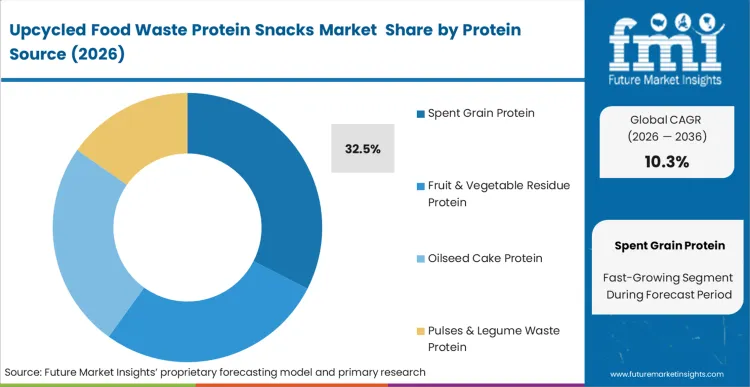
Virgin pea protein and soy isolates are increasingly exposed to supply chain instability, prompting procurement teams to accelerate the qualification of alternative binding solutions. According to FMI projections, Spent Grain Protein is expected to capture a significant 32.5% market share by 2026, driven largely by the brewing sector’s exceptional geographic concentration and its ability to deliver standardized by‑product streams suitable for snack applications. Manufacturers leveraging this ingredient benefit from consistent moisture characteristics, avoiding the variability commonly encountered in other agricultural waste-derived inputs.
The uniformity of plant-based protein obtained from brewing processes enables continuous extrusion operations to run reliably without frequent and costly recipe recalibrations. Formulators that effectively incorporate brewer’s spent grain proteins into snack formats achieve sensory performance on par with traditional isolates while realizing meaningful margin improvements. Conversely, brands that fail to qualify spent grain sources remain vulnerable to the pronounced price volatility typical of conventional commodity protein markets.
- Supply consistency: Regional brewery clusters provide predictable, high volume residue streams. Procurement directors secure stable pricing models divorced from global agricultural commodity fluctuations.
- Processing infrastructure: Existing dewatering technologies in commercial breweries limit upstream degradation. Formulators receive raw materials with intact functional properties suitable for texturization.
- Sensory neutrality: Advanced enzymatic treatments effectively mask the inherent bitterness of spent grains. Product developers expand food waste protein snacks applications into flavor sensitive healthy snacks without relying on heavy masking agents.
Upcycled Food Waste Protein Snacks Market Analysis by Product Type
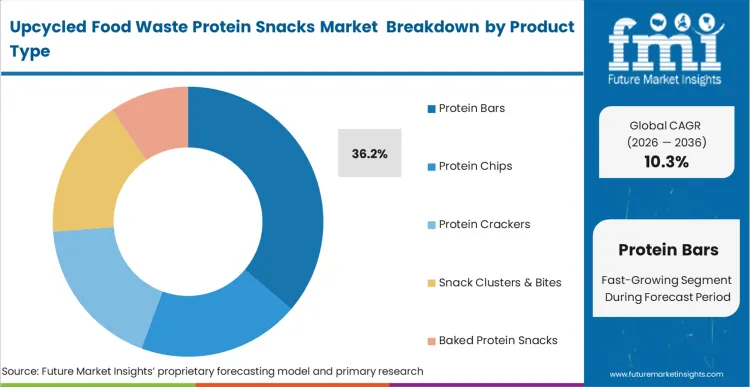
The core functional advantage of upcycled protein isolates lies in their superior water‑binding capacity, a key factor underpinning protein bars projected 36.2% market share in 2026. FMI analysts note that these upcycled fractions inherently slow the staling process in cold‑extruded formats, an essential performance attribute for the functional protein snacks category. Product developers increasingly rely on this natural hydrocolloid behavior to extend the shelf life of dense snack bars, achieving stability levels that conventional whey formulations cannot deliver without the use of synthetic humectants.
This operational superiority, rather than sustainability positioning alone, is driving the industry-wide shift toward alternative binder systems. Manufacturers that continue to rely on legacy protein matrices face ongoing reformulation challenges as they attempt to mitigate texture degradation throughout extended retail distribution cycles. In contrast, early adopters of upcycled isolates gain both functional resilience and a structural efficiency advantage in long‑term product performance.
- Extrusion compatibility: Upcycled fibers enhance dough cohesion during high pressure forming. Manufacturing leads reduce line stoppage and product deformation rates.
- Moisture migration: Inherent properties prevent water transfer between protein and carbohydrate matrices. Quality control teams observe significantly lower rejection rates during accelerated shelf life testing.
- Flavor release: Optimized cellular structures allow for improved aromatic delivery compared to dense virgin isolates. Sensory panels report superior flavor perception, driving higher consumer repurchase frequency.
Upcycled Food Waste Protein Snacks Market Analysis by Distribution Channel
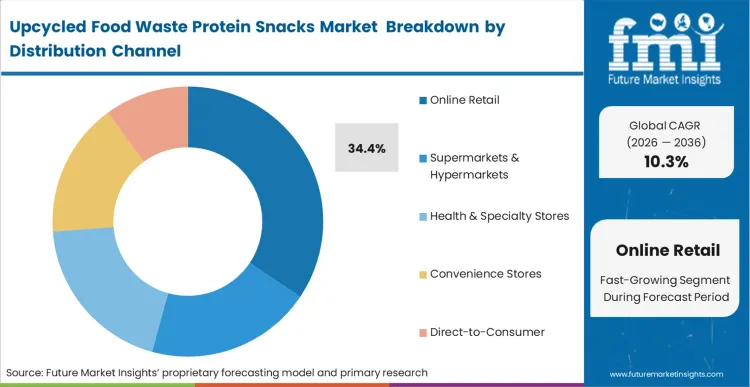
Online retail is projected to account for 34.4% of share in 2026, driven by the need for controlled and effective consumer education around circular, upcycled formulations. FMI’s analysis indicates that digital platforms enable brands to clearly articulate both the functional and environmental benefits of these next‑generation organic snack products, capabilities that cannot be fully conveyed through constrained on‑pack messaging within the better for you snacks category.
E‑commerce channels also provide real‑time consumer feedback on complex flavor profiles and textural innovations, supporting faster iterative development cycles. This direct engagement model reduces reliance on traditional supermarket category reviews, which often introduce long lead times and conservative ingredient acceptance thresholds.
Manufacturers dependent solely on legacy retail networks face materially slower adoption curves, as mainstream shoppers tend to gravitate toward familiar ingredient decks without the benefit of enhanced digital education or direct brand interaction.
- Educational bandwidth: Digital storefronts provide unlimited space for supply chain transparency data. Marketing directors effectively convert skeptical shoppers by detailing the exact provenance of upcycled fractions.
- Inventory rotation: Direct fulfillment models allow for tighter control over product freshness. Supply chain managers minimize markdown risks associated with unfamiliar products languishing on physical shelves.
- Subscription modeling: Targeted demographic data enables precise subscription targeting for functional nutritional snacks. Revenue officers secure recurring cash flow to fund further ingredient research and development.
Upcycled Food Waste Protein Snacks Market Analysis by End Consumer
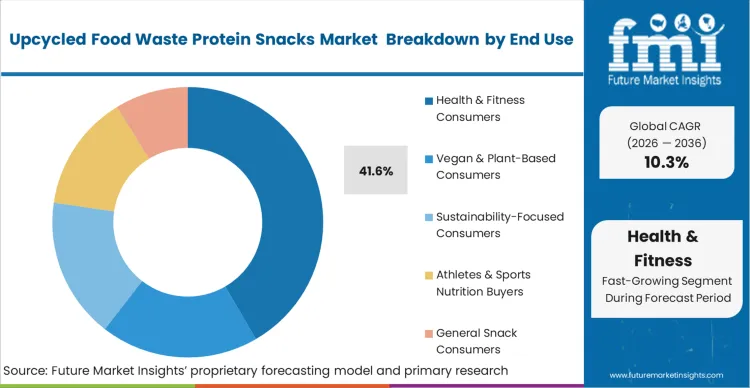
Health and fitness consumers remain the only demographic consistently prioritizing macronutrient density over traditional ingredient familiarity, underpinning their projected 41.6% share of the plant based snacks market in 2026. FMI’s analysis indicates that these buyers actively pursue innovative, sustainably sourced nutrition snacks that deliver targeted amino‑acid profiles while supporting broader sports‑nutrition objectives.
This segment is also more willing to accept the naturally earthier flavor notes associated with upcycled protein fractions, provided the protein‑to‑gram ratio satisfies their stringent performance requirements. As a result, brands frequently focus initial commercialization efforts on this cohort to establish baseline volume before allocating capital toward advanced flavor‑masking technologies needed for broader mainstream penetration.
Companies that attempt to enter general consumer channels without first cultivating an early adopter base often face accelerated capital burn, as they struggle to drive product trial among shoppers who place greater weight on ingredient familiarity and flavor neutrality.
- Nutritional validation: Early adopters meticulously verify amino acid completeness and bioavailability. Brands that publish independent lab assays rapidly capture loyalty and organic advocacy.
- Performance integration: Fitness enthusiasts seamlessly incorporate dense upcycled products into strict dietary regimens. Sales directors observe higher bulk purchase volumes compared to casual snacking demographics.
- Referral velocity: Concentrated communities within the fitness space accelerate brand awareness through digital word of mouth. Marketing teams achieve lower customer acquisition costs relative to broad consumer campaigns.
Upcycled Food Waste Protein Snacks Market Drivers, Restraints, and Opportunities
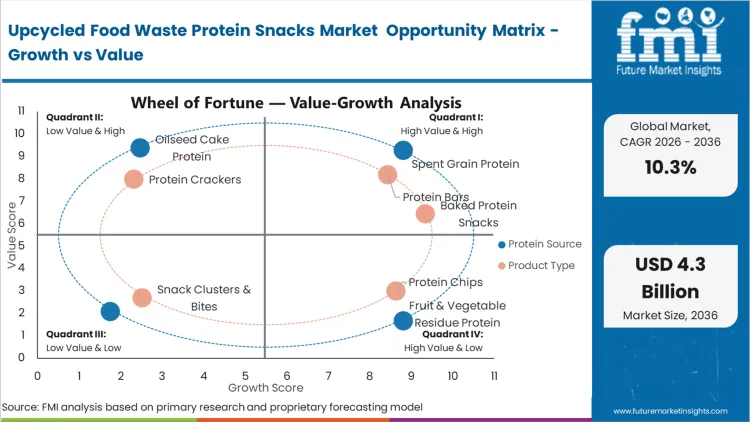
Margin compression at the contract manufacturing level is accelerating the industry’s shift away from conventional protein isolates and shaping current upcycled food innovation trends. Volatility in virgin pea and soy markets is compelling formulation teams to qualify cost‑stable alternative protein inputs that maintain product integrity. Upcycled protein fractions, particularly those sourced from regional brewing and oilseed processing streams, offer pricing models largely decoupled from global agricultural fluctuations, providing brands with meaningful insulation from raw material shocks. This economic imperative, rather than consumer‑driven sustainability preferences such as recyclable packaging, is the primary catalyst behind the rapid integration of upcycled materials into mainstream production environments.
Variable nutritional and functional profiles across disparate waste‑derived batches present a significant operational challenge for quality assurance teams. Unlike standardized virgin isolates, agricultural residues exhibit fluctuations in protein concentration and functional behavior influenced by seasonal conditions and regional processing methods. This variability necessitates more dynamic formulation systems, including adaptive recipe software and frequent recalibrations, which can be incompatible with facilities optimized for static, high‑throughput production. While advanced blending and homogenization technologies are emerging to mitigate these inconsistencies, the need for continuous testing and validation remains a material friction point for manufacturers seeking operational efficiency.
Opportunities in the Upcycled Food Waste Protein Snacks Market
- Savory application expansion: Improvements in defloration technologies enable the use of upcycled fractions in non sweet formats. Product developers capture new daypart consumption occasions by launching extruded snack food products utilizing upcycled banana flour like chips and crackers.
- Localized supply integration: Decentralized milling operations allow brands to source residues directly from regional processors, including low-impact potato peel powder. Procurement leads eliminate cross country freight costs while building resilient, localized supply chains.
- Clean label simplification: High functionality upcycled isolates replace multiple synthetic binders and texturizers. R&D directors achieve shorter ingredient lists, directly satisfying stringent retail buyer requirements for clean label food.
Regional Analysis
Based on the regional analysis, the Upcycled Food Waste Protein Snacks market is segmented into North America, Europe, Asia Pacific, and other regions across 40 plus countries.
.webp "Top Country Growth Comparison Upcycled Food Waste Protein Snacks Market Cagr (2026 2036)")
| Country | CAGR (2026 to 2036) |
|---|---|
| India | 11.4% |
| United States | 10.7% |
| Canada | 10.2% |
| United Kingdom | 9.9% |
| Germany | 9.6% |
| Australia | 9.4% |
| Japan | 8.8% |
Source: Future Market Insights (FMI) analysis, based on proprietary forecasting model and primary research
North America Upcycled Food Waste Protein Snacks Market Analysis
Capital availability and the depth of venture investment are playing a decisive role in shaping adoption patterns across North America processing facilities. Rather than depending on regulatory directives, the integration of upcycled protein fractions is being propelled by private equity funding that accelerates the scale‑up of proprietary extraction technologies for United States protein snacks applications. According to FMI’s assessment, this influx of capital enables regional contract manufacturers to deliver functional isolates at cost parity with traditional ingredients far more rapidly than in markets where progress is driven primarily by policy incentives.
The strategic emphasis across these facilities remains firmly on commercial viability and sensory optimization, ensuring that upcycled ingredients can perform competitively within the high‑value mainstream functional snacks category. As a result, financial backing, rather than compliance pressure, has emerged as the central catalyst for widespread adoption of upcycled protein solutions in the North America market.
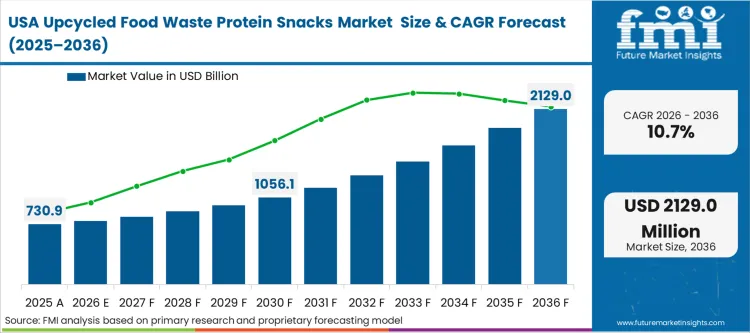
- United States: The United States has a highly concentrated network of craft breweries and commercial bakeries, creating a substantial and geographically dense supply of feedstock for extraction facilities that shape the upcycled snacks market in the country. Procurement teams benefit from this regional concentration, securing favorable offtake agreements that reduce inbound logistics costs for United States products from food waste. Because of these factors, the USA market revenue is projected to grow at a CAGR of 10.7%. By locking in localized supply contracts, brands effectively shield themselves from the offshore shipping disruptions that continue to affect traditional virgin protein commodities.
- Canada: Mature agricultural infrastructure in the country provides a significant advantage in processing pulse and legume residues. Formulation experts apply cold press extraction techniques that are specifically optimized for regional crops such as lentils and chickpeas, resulting in chickpea protein isolates with strong binding functionality. This specialized technical capability positions Canada manufacturers as preferred suppliers for high margin export markets that require advanced functional ingredients, which is expected to support market in Canada to record a CAGR of 10.2% in terms of revenue during the forecast period..
Europe Upcycled Food Waste Protein Snacks Market Analysis
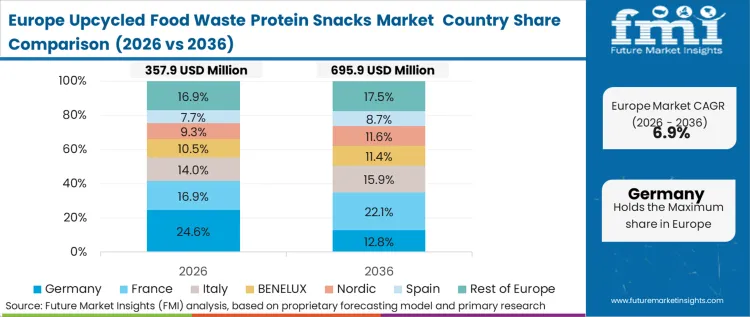
Stringent extended producer responsibility frameworks are requiring Europe food processors to internalize the full cost of their waste streams, significantly reshaping operational planning across the upcycled food waste protein snacks market in Europe. This regulatory environment encourages agricultural processors to collaborate proactively with extraction and refinement companies rather than relying on traditional waste disposal fees. As a result, Europe has developed a formalized and tightly managed supply network, in which upcycled fractions are tracked and verified through advanced digital traceability systems. This level of transparency supports the strict compliance standards of leading retail chains in Europe that prioritize verified vegan and sustainably sourced ingredients.
- United Kingdom: Procurement policies within major UK supermarket networks impose substantial penalties on brands that fail to incorporate certified circular economy inputs. The upcycled food waste protein snacks market in United Kingdom is expected to record a CAGR of 9.9% as category managers are increasingly removing legacy formulations from premium shelf space in order to make room for products that utilize verified rescued ingredients. Brands that align early with these retail requirements secure long-term merchandising agreements, creating competitive advantages that slow moving competitors may struggle to overcome.
- Germany: Germany’s strong precision engineering capabilities are accelerating the adoption of advanced enzymatic treatment facilities designed to eliminate the bitter flavor notes commonly associated with raw spent grains. Process engineers deploy these systems to achieve a high level of sensory neutrality, allowing upcycled isolates to function as complete replacements for whey in more delicate product applications. Demand for upcycled food waste protein snacks in Germany is rising which resulting in the market revenue to grow at a CAGR of 9.6% over the forecast period. The implementation of these technologies is fundamentally shifting the companies away from reliance on synthetic flavor masking and toward genuine ingredient innovation that improves overall product performance.
Asia Pacific Upcycled Food Waste Protein Snacks Market Analysis
The extensive scale of agricultural processing in the Asia Pacific creates a unique supply environment in which sheer processing volume compensates for the limited maturity of formal upcycling infrastructure. Major food conglomerates are increasingly bypassing early‑stage startups and installing extraction capabilities directly within their existing manufacturing networks. This vertically integrated approach enables rapid commercialization of upcycled food solutions at price points accessible to the region’s growing middle class. Across Asia Pacific, the primary focus remains on functional nutrition and affordability, rather than the premium sustainability‑oriented branding that dominates Western markets.
- India: Enormous agricultural processing sector in the country generates unmatched volumes of recoverable residues, particularly from oilseed and pulse processing. FMI projects the upcycled food waste protein snacks market in India to grow at an annual rate of 11.4%. Domestic manufacturers are adopting low-cost mechanical extraction methods that convert these residue streams into functional binders suitable for a rapidly formalizing packaged food segment. The effective utilization of these domestic byproduct streams significantly reduces India’s historical dependence on high priced imported protein isolates.
- Australia: Upcycled food waste protein snacks market in Australia is expected to register a CAGR of 9.4%, this is because stringent biosecurity regulations encourage domestic processors to maximize the value of locally generated agricultural byproducts. Technical teams prioritize extracting high value fractions from domestic wine and brewing operations, establishing a closed loop supply chain that remains insulated from international supply chain disruptions. This self-sufficient operating model helps maintain uninterrupted production, even during periods of severe global commodity shipping constraints.
- Japan: In Japan, food scientists prioritize the extraction of highly specific functional bioactives rather than broad spectrum macronutrients from food processing residues. Research and development teams concentrate on the distinctive texturizing capabilities of upcycled fibers, which support the creation of refined mouthfeels in premium retail applications, and this is one of the major factors due to which the market in Japan is expected to achieve a CAGR of 8.8%. This approach reflects a commercial environment in which technological precision and sensory sophistication are prioritized ahead of mass volume scale.
FMI's report includes secondary markets across Latin America and the Middle East. These regions demonstrate early-stage adoption characterized by multinational food conglomerates testing imported upcycled isolates in localized pilot programs before committing to regional extraction infrastructure.
Competitive Aligners for Market Players
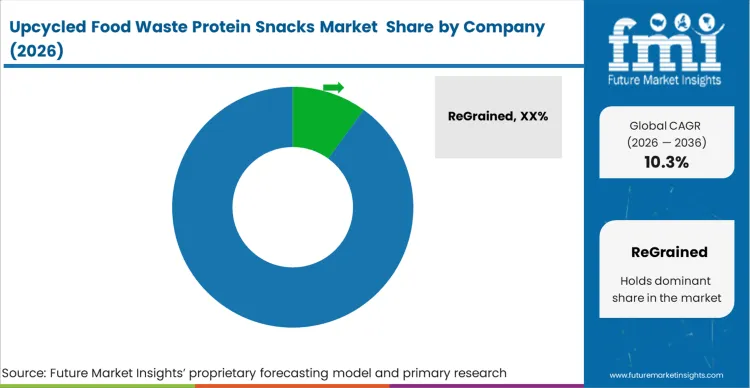
The sector operates with intense concentration at the supply integration tier, despite deep fragmentation at the consumer brand level among companies producing upcycled snacks. Major players like ReGrained and Renewal Mill hold leverage not through superior marketing, but by controlling the proprietary dewatering and milling technologies required to stabilize volatile waste streams. Procurement directors seeking reliable upcycled protein snack suppliers evaluate potential partners strictly on their ability to deliver consistent functional specifications batch over batch, heavily impacting variables like okara market share. Vendors lacking specialized homogenization hardware cannot guarantee the sensory neutrality required for continuous extrusion, effectively eliminating them from tier one qualification processes.
Incumbent upcycled snack manufacturers maintain their advantage through exclusive, multi year offtake agreements with major regional breweries and agricultural processors for highly consistent spent grain flour. These locked supply chains represent a formidable barrier to entry, as the physical infrastructure required to transport wet, perishable residues necessitates close geographic proximity between the waste generator and the extraction facility, presenting unique upcycled food investment opportunities. Challengers attempting to replicate this model must build localized processing hubs from the ground up, requiring massive upfront capital expenditure. Successful integration of sustainable food ingredients depends entirely on this localized footprint, rather than just the capability to formulate a finished product.
Large retail buyers actively resist monopolization at the supply tier by deliberately qualifying multiple mid sized upcycled food companies across different byproduct categories, even exploring alternative protein vectors like insect based snacks. This tension prevents any single supplier of spent grain or oilseed cake from dominating the entire plant-based foods category. As commercial scale extraction becomes standardized through 2036, the market will likely see a bifurcation between specialized ingredient providers handling the complex milling chemistry and consumer facing brands focused solely on final product architecture.
Key Players in Upcycled Food Waste Protein Snacks Market
- ReGrained
- Renewal Mill
- Planetarians
- Treasure8
- Outcast Foods
- NetZero Company
- Upcycled Foods Inc.
Scope of the Report
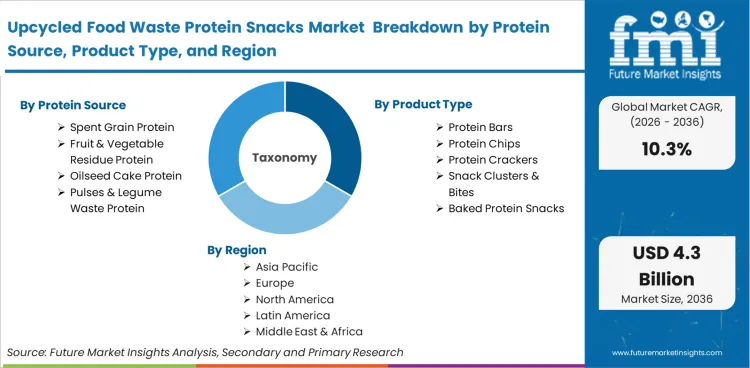
| Metric | Value |
|---|---|
| Quantitative Units | USD 1.6 billion to USD 4.3 billion, at a CAGR of 10.3% |
| Market Definition | This sector encompasses packaged snacks formulated using functional protein fractions extracted from agricultural processing byproducts. It requires the transformation of secondary waste streams into primary nutritional isolates for ready to eat formats. |
| Protein Source Segmentation | Spent Grain Protein, Fruit & Vegetable Residue Protein, Oilseed Cake Protein, Pulses & Legume Waste Protein, Other Food Processing By-product Proteins |
| Product Type Segmentation | Protein Bars, Protein Chips, Protein Crackers, Snack Clusters & Bites, Baked Protein Snacks |
| Distribution Channel Segmentation | Online Retail, Supermarkets & Hypermarkets, Health & Specialty Stores, Convenience Stores, Direct-to-Consumer |
| End Consumer Segmentation | Health & Fitness Consumers, Vegan & Plant-Based Consumers, Sustainability-Focused Consumers, Athletes & Sports Nutrition Buyers, General Snack Consumers |
| Regions Covered | North America, Europe, Asia Pacific, and other regions |
| Countries Covered | India, United States, Canada, United Kingdom, Germany, Australia, Japan, and 40 plus countries |
| Key Companies Profiled | ReGrained, Renewal Mill, Planetarians, Treasure8, Outcast Foods, NetZero Company, Upcycled Foods Inc. |
| Forecast Period | 2026 to 2036 |
| Approach | Research involved interviews with procurement directors and formulation leads at major food companies. Baselines were anchored to verifiable volumes of processed agricultural residues. Forecasts were cross validated against commercial capital expenditure reports for milling infrastructure. |
Source: Future Market Insights (FMI) analysis, based on proprietary forecasting model and primary research
Upcycled Food Waste Protein Snacks Market Analysis by Segments
- Protein Source:
- Spent Grain Protein
- Fruit & Vegetable Residue Protein
- Oilseed Cake Protein
- Pulses & Legume Waste Protein
- Other Food Processing By-product Proteins
- Product Type:
- Protein Bars
- Protein Chips
- Protein Crackers
- Snack Clusters & Bites
- Baked Protein Snacks
- Distribution Channel:
- Online Retail
- Supermarkets & Hypermarkets
- Health & Specialty Stores
- Convenience Stores
- Direct-to-Consumer
- End Consumer:
- Health & Fitness Consumers
- Vegan & Plant-Based Consumers
- Sustainability-Focused Consumers
- Athletes & Sports Nutrition Buyers
- General Snack Consumers
- Region:
- North America
- United States
- Canada
- Europe
- Germany
- United Kingdom
- France
- Italy
- Spain
- Asia Pacific
- China
- Japan
- South Korea
- Taiwan
- Singapore
- Latin America
- Brazil
- Mexico
- Argentina
- Middle East & Africa
- GCC Countries
- South Africa
- Israel
- Rest of Middle East & Africa
- North America
Bibliography
- Isaac-Bamgboye, F. J., & Oladipo, O. (2025, July). Upcycling technologies for food waste management: Creating value-added ingredients from food by-products. Journal of Environmental Planning and Management.
- Zaman, Q. U., Rahman, M. S., & Hossain, M. J. (2026, January). Consumer responses to upcycled foods and factors influencing acceptance. Sustainability.
- Bekavac, N., et al. (2025, June). Valorization of food waste: Extraction of bioactive compounds for functional foods. Antioxidants.
- CABI. (2025, August). Reviving resources: The role of upcycled foods in sustainable food systems. CABI Digital Library Case Studies.
- Bangar, S. P., et al. (2024, January). Strategies for upcycling food waste in food production and ingredient development. Food Quality and Preference.
This bibliography is provided for reader reference. The full FMI report contains the complete reference list with primary source documentation.
This Report Addresses
- Market intelligence to support strategic decision making across spent grain and oilseed cake extraction categories
- Market size estimation and 10-year revenue forecasts from 2026 to 2036, supported by verifiable agricultural processing residue volume datasets
- Growth opportunity mapping across specific product formats with emphasis on the commercial scale qualification of milling technologies
- Segment and regional revenue forecasts covering cold extruded bars and savory chips across stringent European extended producer responsibility frameworks
- Competition strategy assessment including supply integration tier concentration and multi year offtake agreements
- Capability development tracking including proprietary dewatering processes, enzymatic flavor masking, and Upcycled Certified standards
- Market access analysis covering European retail procurement networks and localized supply chain integration framework
- Market report delivery in PDF, Excel, PPT, and interactive dashboard formats for executive strategy, contract manufacturing qualification, and operational benchmarking use
Frequently Asked Questions
What are upcycled protein snacks?
These are packaged food products that utilize functional protein fractions extracted from agricultural processing byproducts, replacing conventional virgin isolates like whey or pea protein in the final formulation.
What is the market size of the upcycled food industry?
The specific upcycled protein snacks segment is valued at USD 1.6 billion in 2026, signaling that contract manufacturers have successfully moved beyond pilot testing and are deploying rescued fractions in commercial lines.
What CAGR is projected?
A 10.3% compound annual growth rate is projected through 2036, driven directly by the speed at which proprietary milling and enzymatic treatment facilities come online to process wet agricultural residues.
Which protein source segment leads?
Spent grain protein leads because localized brewery clusters offer a highly concentrated and predictable feedstock, allowing extraction facilities to bypass the logistical complexities associated with dispersed agricultural waste.
Which product type segment leads?
Protein bars dominate this category because the inherent moisture retention properties of upcycled isolates solve the persistent industry problem of cold extruded bars hardening during prolonged retail shelf life.
How are snacks made from food waste?
Contract manufacturers utilize specialized dewatering, milling, and enzymatic extraction technologies to isolate proteins from wet agricultural byproducts, which are then integrated into continuous extrusion lines.
Why are upcycled foods becoming popular?
Beyond consumer sustainability trends, popularity is driven by severe margin compression at the contract manufacturing tier, forcing procurement directors to abandon expensive virgin soy commodities for cost stable agricultural byproducts.
Which companies produce upcycled snack foods?
The sector relies on specialized extraction leaders like ReGrained, Renewal Mill, Planetarians, Treasure8, and Upcycled Foods Inc., who control the proprietary milling hardware required to stabilize volatile waste streams.
What ingredients are used in upcycled snacks?
Primary ingredients include protein isolates derived from brewers spent grain, defatted sunflower and oilseed cakes, okara (soy pulp), and specialized legume residues sourced from localized agricultural hubs.
Are upcycled snacks healthy?
Yes, they match or exceed conventional snacks in macronutrient density; fitness consumers meticulously evaluate these products through independent lab assays to verify amino acid completeness and bioavailability.
How does food upcycling reduce waste?
By converting high volume processing residues like spent grain into primary binders, the industry fundamentally shifts agricultural byproducts out of low value animal feed or landfill streams into human supply chains.
What defines the upcycled food vs traditional protein snacks comparison?
Traditional snacks rely on globally traded, price volatile virgin commodities like whey, while upcycled variants utilize localized, decoupled pricing models insulated from global agricultural shocks.
Which country grows fastest?
India advances at 11.4%, outpacing the United States structurally, because its massive domestic agricultural processing sector allows local manufacturers to adopt mechanical extraction techniques without relying on imported hardware.
How do extended producer responsibility frameworks shape European adoption?
European regulations penalize the disposal of processing residues, structurally compelling agricultural facilities to partner with extraction platforms rather than paying prohibitive landfill or incineration taxes.
Why are enzymatic treatments critical for market expansion?
Advanced enzymatic treatments neutralize the bitter organoleptic properties inherent in raw spent grains, allowing product developers to achieve sensory parity without relying on heavy synthetic flavor masking agents.
How do multi year offtake agreements impact competitive dynamics?
Incumbent extraction platforms lock up localized brewery residues through exclusive contracts, forcing new entrants to incur massive capital expenditures to build parallel processing hubs in untapped geographic regions.
Why do online retail channels hold such a significant share?
E-commerce platforms provide the necessary educational bandwidth to explain complex circular supply chains directly to consumers, bypassing the constrained communication limits of physical supermarket packaging.
What role do contract manufacturers play in accelerating adoption?
By investing in the specialized blending hardware required to handle variable fractions, contract manufacturers allow mid tier brands to access these functional ingredients without building their own proprietary extraction facilities.
How does moisture migration differ in upcycled formulations?
Upcycled fibers prevent water transfer between protein and carbohydrate matrices, significantly lowering rejection rates during accelerated shelf life testing compared to formulations relying solely on virgin whey isolates.
What prevents the immediate adoption of fruit and vegetable residues?
Unlike highly consistent spent grain, fruit residues exhibit extreme seasonal variability in moisture content and pectin levels, requiring highly specialized and expensive cold press extraction methods.
How do biosecurity regulations impact Australian procurement strategies?
Strict import controls force Australian manufacturers to maximize domestic wine and brewing byproducts, creating a closed loop supply chain that remains highly resilient against international shipping bottlenecks.
Why are major food conglomerates bypassing startups in the Asia Pacific?
Sheer processing volume allows Asian conglomerates to vertically integrate extraction capabilities directly into their existing footprints, achieving commercial scale far faster than startups reliant on external venture capital.
Preview the report firsthand - request a free sample
Get SampleGet the brochure for pricing and purchase details.
Get PDFTable of Content
- Executive Summary
- Global Market Outlook
- Demand-side Trends
- Supply-side Trends
- Technology Roadmap Analysis
- Analysis and Recommendations
- Market Overview
- Market Coverage / Taxonomy
- Market Definition / Scope / Limitations
- Research Methodology
- Chapter Orientation
- Analytical Lens and Working Hypotheses
- Market Structure, Signals, and Trend Drivers
- Benchmarking and Cross-market Comparability
- Market Sizing, Forecasting, and Opportunity Mapping
- Research Design and Evidence Framework
- Desk Research Programme (Secondary Evidence)
- Company Annual and Sustainability Reports
- Peer-reviewed Journals and Academic Literature
- Corporate Websites, Product Literature, and Technical Notes
- Earnings Decks and Investor Briefings
- Statutory Filings and Regulatory Disclosures
- Technical White Papers and Standards Notes
- Trade Journals, Industry Magazines, and Analyst Briefs
- Conference Proceedings, Webinars, and Seminar Materials
- Government Statistics Portals and Public Data Releases
- Press Releases and Reputable Media Coverage
- Specialist Newsletters and Curated Briefings
- Sector Databases and Reference Repositories
- FMI Internal Proprietary Databases and Historical Market Datasets
- Subscription Datasets and Paid Sources
- Social Channels, Communities, and Digital Listening Inputs
- Additional Desk Sources
- Expert Input and Fieldwork (Primary Evidence)
- Primary Modes
- Qualitative Interviews and Expert Elicitation
- Quantitative Surveys and Structured Data Capture
- Blended Approach
- Why Primary Evidence is Used
- Field Techniques
- Interviews
- Surveys
- Technical Specialists
- Domain Subject-matter Experts
- Scientists
- Physicians and Other Healthcare Professionals
- Governance, Ethics, and Data Stewardship
- Research Ethics
- Data Integrity and Handling
- Primary Modes
- Tooling, Models, and Reference Databases
- Desk Research Programme (Secondary Evidence)
- Data Engineering and Model Build
- Data Acquisition and Ingestion
- Cleaning, Normalisation, and Verification
- Synthesis, Triangulation, and Analysis
- Quality Assurance and Audit Trail
- Market Background
- Market Dynamics
- Drivers
- Restraints
- Opportunity
- Trends
- Scenario Forecast
- Demand in Optimistic Scenario
- Demand in Likely Scenario
- Demand in Conservative Scenario
- Opportunity Map Analysis
- Product Life Cycle Analysis
- Supply Chain Analysis
- Investment Feasibility Matrix
- Value Chain Analysis
- PESTLE and Porter’s Analysis
- Regulatory Landscape
- Regional Parent Market Outlook
- Production and Consumption Statistics
- Import and Export Statistics
- Market Dynamics
- Global Market Analysis 2021 to 2025 and Forecast, 2026 to 2036
- Historical Market Size Value (USD Million) Analysis, 2021 to 2025
- Current and Future Market Size Value (USD Million) Projections, 2026 to 2036
- Y-o-Y Growth Trend Analysis
- Absolute $ Opportunity Analysis
- Global Market Pricing Analysis 2021 to 2025 and Forecast 2026 to 2036
- Global Market Analysis 2021 to 2025 and Forecast 2026 to 2036, By Protein Source
- Introduction / Key Findings
- Historical Market Size Value (USD Million) Analysis By Protein Source , 2021 to 2025
- Current and Future Market Size Value (USD Million) Analysis and Forecast By Protein Source , 2026 to 2036
- Spent Grain Protein
- Fruit & Vegetable Residue Protein
- Oilseed Cake Protein
- Pulses & Legume Waste Protein
- Spent Grain Protein
- Y-o-Y Growth Trend Analysis By Protein Source , 2021 to 2025
- Absolute $ Opportunity Analysis By Protein Source , 2026 to 2036
- Global Market Analysis 2021 to 2025 and Forecast 2026 to 2036, By Product Type
- Introduction / Key Findings
- Historical Market Size Value (USD Million) Analysis By Product Type, 2021 to 2025
- Current and Future Market Size Value (USD Million) Analysis and Forecast By Product Type, 2026 to 2036
- Protein Bars
- Protein Chips
- Protein Crackers
- Snack Clusters & Bites
- Baked Protein Snacks
- Protein Bars
- Y-o-Y Growth Trend Analysis By Product Type, 2021 to 2025
- Absolute $ Opportunity Analysis By Product Type, 2026 to 2036
- Global Market Analysis 2021 to 2025 and Forecast 2026 to 2036, By Distribution Channel
- Introduction / Key Findings
- Historical Market Size Value (USD Million) Analysis By Distribution Channel, 2021 to 2025
- Current and Future Market Size Value (USD Million) Analysis and Forecast By Distribution Channel, 2026 to 2036
- Online Retail
- Supermarkets & Hypermarkets
- Health & Specialty Stores
- Convenience Stores
- Direct-to-Consumer
- Online Retail
- Y-o-Y Growth Trend Analysis By Distribution Channel, 2021 to 2025
- Absolute $ Opportunity Analysis By Distribution Channel, 2026 to 2036
- Global Market Analysis 2021 to 2025 and Forecast 2026 to 2036, By End Use
- Introduction / Key Findings
- Historical Market Size Value (USD Million) Analysis By End Use, 2021 to 2025
- Current and Future Market Size Value (USD Million) Analysis and Forecast By End Use, 2026 to 2036
- Health & Fitness Consumers
- Vegan & Plant-Based Consumers
- Sustainability-Focused Consumers
- Athletes & Sports Nutrition Buyers
- General Snack Consumers
- Health & Fitness Consumers
- Y-o-Y Growth Trend Analysis By End Use, 2021 to 2025
- Absolute $ Opportunity Analysis By End Use, 2026 to 2036
- Global Market Analysis 2021 to 2025 and Forecast 2026 to 2036, By Region
- Introduction
- Historical Market Size Value (USD Million) Analysis By Region, 2021 to 2025
- Current Market Size Value (USD Million) Analysis and Forecast By Region, 2026 to 2036
- North America
- Latin America
- Western Europe
- Eastern Europe
- East Asia
- South Asia and Pacific
- Middle East & Africa
- Market Attractiveness Analysis By Region
- North America Market Analysis 2021 to 2025 and Forecast 2026 to 2036, By Country
- Historical Market Size Value (USD Million) Trend Analysis By Market Taxonomy, 2021 to 2025
- Market Size Value (USD Million) Forecast By Market Taxonomy, 2026 to 2036
- By Country
- USA
- Canada
- Mexico
- By Protein Source
- By Product Type
- By Distribution Channel
- By End Use
- By Country
- Market Attractiveness Analysis
- By Country
- By Protein Source
- By Product Type
- By Distribution Channel
- By End Use
- Key Takeaways
- Latin America Market Analysis 2021 to 2025 and Forecast 2026 to 2036, By Country
- Historical Market Size Value (USD Million) Trend Analysis By Market Taxonomy, 2021 to 2025
- Market Size Value (USD Million) Forecast By Market Taxonomy, 2026 to 2036
- By Country
- Brazil
- Chile
- Rest of Latin America
- By Protein Source
- By Product Type
- By Distribution Channel
- By End Use
- By Country
- Market Attractiveness Analysis
- By Country
- By Protein Source
- By Product Type
- By Distribution Channel
- By End Use
- Key Takeaways
- Western Europe Market Analysis 2021 to 2025 and Forecast 2026 to 2036, By Country
- Historical Market Size Value (USD Million) Trend Analysis By Market Taxonomy, 2021 to 2025
- Market Size Value (USD Million) Forecast By Market Taxonomy, 2026 to 2036
- By Country
- Germany
- UK
- Italy
- Spain
- France
- Nordic
- BENELUX
- Rest of Western Europe
- By Protein Source
- By Product Type
- By Distribution Channel
- By End Use
- By Country
- Market Attractiveness Analysis
- By Country
- By Protein Source
- By Product Type
- By Distribution Channel
- By End Use
- Key Takeaways
- Eastern Europe Market Analysis 2021 to 2025 and Forecast 2026 to 2036, By Country
- Historical Market Size Value (USD Million) Trend Analysis By Market Taxonomy, 2021 to 2025
- Market Size Value (USD Million) Forecast By Market Taxonomy, 2026 to 2036
- By Country
- Russia
- Poland
- Hungary
- Balkan & Baltic
- Rest of Eastern Europe
- By Protein Source
- By Product Type
- By Distribution Channel
- By End Use
- By Country
- Market Attractiveness Analysis
- By Country
- By Protein Source
- By Product Type
- By Distribution Channel
- By End Use
- Key Takeaways
- East Asia Market Analysis 2021 to 2025 and Forecast 2026 to 2036, By Country
- Historical Market Size Value (USD Million) Trend Analysis By Market Taxonomy, 2021 to 2025
- Market Size Value (USD Million) Forecast By Market Taxonomy, 2026 to 2036
- By Country
- China
- Japan
- South Korea
- By Protein Source
- By Product Type
- By Distribution Channel
- By End Use
- By Country
- Market Attractiveness Analysis
- By Country
- By Protein Source
- By Product Type
- By Distribution Channel
- By End Use
- Key Takeaways
- South Asia and Pacific Market Analysis 2021 to 2025 and Forecast 2026 to 2036, By Country
- Historical Market Size Value (USD Million) Trend Analysis By Market Taxonomy, 2021 to 2025
- Market Size Value (USD Million) Forecast By Market Taxonomy, 2026 to 2036
- By Country
- India
- ASEAN
- Australia & New Zealand
- Rest of South Asia and Pacific
- By Protein Source
- By Product Type
- By Distribution Channel
- By End Use
- By Country
- Market Attractiveness Analysis
- By Country
- By Protein Source
- By Product Type
- By Distribution Channel
- By End Use
- Key Takeaways
- Middle East & Africa Market Analysis 2021 to 2025 and Forecast 2026 to 2036, By Country
- Historical Market Size Value (USD Million) Trend Analysis By Market Taxonomy, 2021 to 2025
- Market Size Value (USD Million) Forecast By Market Taxonomy, 2026 to 2036
- By Country
- Kingdom of Saudi Arabia
- Other GCC Countries
- Turkiye
- South Africa
- Other African Union
- Rest of Middle East & Africa
- By Protein Source
- By Product Type
- By Distribution Channel
- By End Use
- By Country
- Market Attractiveness Analysis
- By Country
- By Protein Source
- By Product Type
- By Distribution Channel
- By End Use
- Key Takeaways
- Key Countries Market Analysis
- USA
- Pricing Analysis
- Market Share Analysis, 2025
- By Protein Source
- By Product Type
- By Distribution Channel
- By End Use
- Canada
- Pricing Analysis
- Market Share Analysis, 2025
- By Protein Source
- By Product Type
- By Distribution Channel
- By End Use
- Mexico
- Pricing Analysis
- Market Share Analysis, 2025
- By Protein Source
- By Product Type
- By Distribution Channel
- By End Use
- Brazil
- Pricing Analysis
- Market Share Analysis, 2025
- By Protein Source
- By Product Type
- By Distribution Channel
- By End Use
- Chile
- Pricing Analysis
- Market Share Analysis, 2025
- By Protein Source
- By Product Type
- By Distribution Channel
- By End Use
- Germany
- Pricing Analysis
- Market Share Analysis, 2025
- By Protein Source
- By Product Type
- By Distribution Channel
- By End Use
- UK
- Pricing Analysis
- Market Share Analysis, 2025
- By Protein Source
- By Product Type
- By Distribution Channel
- By End Use
- Italy
- Pricing Analysis
- Market Share Analysis, 2025
- By Protein Source
- By Product Type
- By Distribution Channel
- By End Use
- Spain
- Pricing Analysis
- Market Share Analysis, 2025
- By Protein Source
- By Product Type
- By Distribution Channel
- By End Use
- France
- Pricing Analysis
- Market Share Analysis, 2025
- By Protein Source
- By Product Type
- By Distribution Channel
- By End Use
- India
- Pricing Analysis
- Market Share Analysis, 2025
- By Protein Source
- By Product Type
- By Distribution Channel
- By End Use
- ASEAN
- Pricing Analysis
- Market Share Analysis, 2025
- By Protein Source
- By Product Type
- By Distribution Channel
- By End Use
- Australia & New Zealand
- Pricing Analysis
- Market Share Analysis, 2025
- By Protein Source
- By Product Type
- By Distribution Channel
- By End Use
- China
- Pricing Analysis
- Market Share Analysis, 2025
- By Protein Source
- By Product Type
- By Distribution Channel
- By End Use
- Japan
- Pricing Analysis
- Market Share Analysis, 2025
- By Protein Source
- By Product Type
- By Distribution Channel
- By End Use
- South Korea
- Pricing Analysis
- Market Share Analysis, 2025
- By Protein Source
- By Product Type
- By Distribution Channel
- By End Use
- Russia
- Pricing Analysis
- Market Share Analysis, 2025
- By Protein Source
- By Product Type
- By Distribution Channel
- By End Use
- Poland
- Pricing Analysis
- Market Share Analysis, 2025
- By Protein Source
- By Product Type
- By Distribution Channel
- By End Use
- Hungary
- Pricing Analysis
- Market Share Analysis, 2025
- By Protein Source
- By Product Type
- By Distribution Channel
- By End Use
- Kingdom of Saudi Arabia
- Pricing Analysis
- Market Share Analysis, 2025
- By Protein Source
- By Product Type
- By Distribution Channel
- By End Use
- Turkiye
- Pricing Analysis
- Market Share Analysis, 2025
- By Protein Source
- By Product Type
- By Distribution Channel
- By End Use
- South Africa
- Pricing Analysis
- Market Share Analysis, 2025
- By Protein Source
- By Product Type
- By Distribution Channel
- By End Use
- USA
- Market Structure Analysis
- Competition Dashboard
- Competition Benchmarking
- Market Share Analysis of Top Players
- By Regional
- By Protein Source
- By Product Type
- By Distribution Channel
- By End Use
- Competition Analysis
- Competition Deep Dive
- ReGrained
- Overview
- Product Portfolio
- Profitability by Market Segments (Product/Age /Sales Channel/Region)
- Sales Footprint
- Strategy Overview
- Marketing Strategy
- Product Strategy
- Channel Strategy
- Renewal Mill
- Planetarians
- Treasure8
- Outcast Foods
- NetZero Company
- Upcycled Foods Inc.
- ReGrained
- Competition Deep Dive
- Assumptions & Acronyms Used


