

- Industry Size (2026)
- USD 168.3 Mn
- Forecast (2036)
- USD 614.8 Mn
- CAGR (2026 to 2036)
- 13.8%
Insect-Protein Pet Food Market Size, Market Forecast and Outlook By FMI
In 2025, the global insect-protein pet food market was valued at USD 142.6 million. Based on Future Market Insights analysis, the market is estimated to reach USD 168.3 million in 2026 and USD 614.8 million by 2036. FMI projects a CAGR of 13.8% between 2026 and 2036.
The insect-protein pet food segment sits at the intersection of sustainability-driven consumer demand and the veterinary community's growing recognition of alternative protein sources for animals with food sensitivities. Pet food formulators have responded by introducing black soldier fly-based dry kibbles, wet formats, and treat lines that carry verified single-ingredient protein claims alongside environmental benefit messaging. Consumption growth patterns differ considerably by region.
Summary of Insect-Protein Pet Food Market
- Market Definition
- The market covers dog and cat food products in which black soldier fly larvae (Hermetia illucens) serve as a primary or partial protein source, across dry, wet, freeze-dried, raw, and treat formats.
- Products are classified by the role of insect meal in the formulation (sole protein source versus blended), by species targeting, and by distribution channel, covering both branded and private-label finished goods through retail and e-commerce.
- The scope excludes live feeder products, veterinary prescription diets, and insect-derived ingredients used only as palatants or processing aids.
- Demand Drivers
- Pet owners in high-income markets, particularly households with annual incomes above USD 75,000, are applying sustainability criteria to pet food purchasing at increasing rates. Black soldier fly protein carries a lower land and water footprint per kilogram than conventional meat proteins, and this claim is resonating across premium retail channels in North America and Western Europe.
- Veterinary nutrition practitioners are recommending novel protein diets, including insect-based formulations, for dogs and cats presenting with chicken or beef sensitivities. This clinical use case is opening up distribution through veterinary clinics and specialist pet health retailers, creating a secondary channel alongside mainstream specialty retail.
- In South Korea and China, local insect farming infrastructure is reducing ingredient costs and enabling domestic brands to price insect-protein pet foods within reach of the urban middle-income pet owner cohort, expanding the addressable market beyond premium-only positioning.
- Key Segments analysed in the FMI report
- Dry kibble accounts for approximately 54% of market value in 2025, driven by its established place in pet owner feeding routines, longer shelf life compared to wet formats, and the availability of established contract manufacturing infrastructure for insect-meal inclusion at production scale.
- The dog food segment represents close to 68% of total market volume, reflecting the larger overall dog food market and earlier regulatory clearance for insect proteins in canine diets in multiple jurisdictions. Cat food formulations using BSF protein are growing but face additional palatability engineering requirements.
- Specialist pet retail and veterinary channels together account for approximately 47% of distribution value, reflecting the premium price positioning of most insect-protein SKUs and the role of staff recommendations in trial conversion. E-commerce accounts for a further 31%, with subscription delivery models showing strong repeat purchase rates.
- Analyst Opinion at FMI
- Nandini Roy, Principal Consultant at Future Market Insights, with a specialty in novel protein food and feed markets, notes that the insect-protein pet food category is entering a critical transition phase. The first wave of consumer adoption is concentrated in households already purchasing organic or functional pet food, and the next phase of growth will depend on whether mainstream pet food brands adopt insect protein as a blend ingredient in mid-tier products rather than confining it to premium-only lines. Regulatory decisions expected from the United States Food and Drug Administration and the codification of EFSA's positive opinion into EU member state national legislation will determine the pace of that transition. Brands that invest in clinical and nutritional substantiation now are likely to hold a durable advantage as the category moves from novelty to mainstream.
- Executive Takeaways
- Pet food manufacturers targeting North American households in the USD 50,000 to USD 100,000 annual household income band should position insect-protein SKUs within existing premium lines rather than launching standalone insect brands, reducing the consumer education burden and leveraging existing retail distribution relationships.
- Ingredient suppliers and contract manufacturers should prioritize capacity investments in dry kibble production lines capable of handling insect meal at inclusion rates between 15% and 40%, as this represents the broadest commercially viable formulation window across both the dog and cat food segments.
- Retailers operating specialty pet channels in Germany, the Netherlands, and the United Kingdom should assess shelf space reallocation from declining mainstream wet cat food SKUs toward insect-protein alternatives, where shelf velocity data from early adopter stores indicates above-average repeat purchase rates among trial converters.
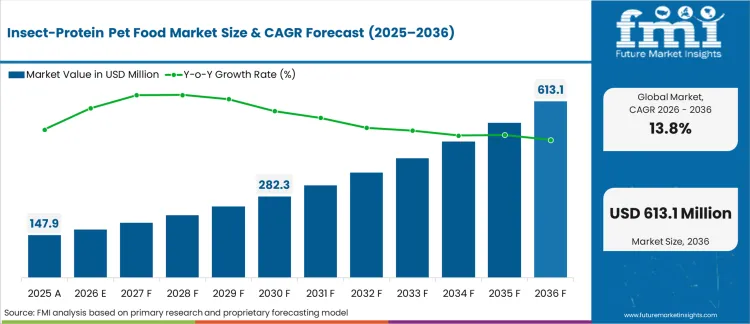
Western Europe leads on premiumization, with Germany, the United Kingdom, and the Netherlands producing a concentration of finished-product brands and early regulatory frameworks. The United States and Canada are entering a rapid adoption phase as retail listings expand and consumer education improves. Emerging markets in South and Southeast Asia represent a volume-growth opportunity given existing cultural familiarity with insect consumption, though per-unit pricing remains a constraint. FMI projects the following value CAGRs for 2026 to 2036: the United States at 12.4%, Germany at 11.2%, the United Kingdom at 11.8%, the Netherlands at 13.1%, Canada at 10.9%, Australia at 12.7%, South Korea at 14.6%, Brazil at 9.3%, Japan at 10.1%, and China at 16.2%.
Insect-Protein Pet Food Market Value (USD Million) Analysis, 2025-2036
| Year | Market Size (USD Million) |
|---|---|
| 2025 | 142.6 |
| 2026 | 168.3 |
| 2027 | 191.5 |
| 2028 | 217.9 |
| 2029 | 248.1 |
| 2030 | 282.4 |
| 2031 | 321.4 |
| 2032 | 365.6 |
| 2033 | 415.8 |
| 2034 | 472.9 |
| 2035 | 538.2 |
| 2036 | 614.8 |
Insect-Protein Pet Food Market Definition
The insect-protein pet food market encompasses commercially manufactured dog and cat food products in which black soldier fly larvae (Hermetia illucens), or processed derivatives of those larvae, serve as a primary or partial protein source. Products are classified by format (dry kibble, wet or loaf, freeze-dried, raw, and treats or toppers), by the role of insect meal in the recipe (sole protein source or blended with conventional protein), and by species targeting (canine or feline). The market covers both single-protein formulations positioned for dogs and cats with protein sensitivities and multi-protein blends in which insect meal contributes an environmental differentiation claim.
End consumers are companion animal owners purchasing through retail or e-commerce channels, and the scope covers both branded products and white-label or private-label lines produced under retailer contracts. The market does not include insect-protein products formulated for livestock, aquaculture, or agricultural use, nor does it include live insect feeding products sold through reptile or exotic pet specialist channels.
Insect-Protein Pet Food Market Inclusions
The report covers a comprehensive assessment of the market for the historical period (2021 to 2025) and the projected period (2026 to 2036) for metric tons and value in USD million. It covers segmental breakdowns of the market by protein source type, product format, pet type, protein claim positioning, pack size, distribution channel, and key regions across North America, Latin America, Europe, Asia Pacific, and Middle East and Africa.
Insect-Protein Pet Food Market Exclusions
The report excludes pet food products in which insect-derived ingredients appear only as a flavoring, palatant, or processing aid than as a declared protein source. It excludes raw insect-based products sold through live feeder channels for reptiles and exotic animals, insect-protein products formulated for livestock and aquaculture, and bulk ingredient trade in black soldier fly meal or oil not destined for finished pet food. The report also excludes veterinary prescription diets distributed exclusively through clinical or hospital channels, and insect-based pet food products that have not received applicable regulatory clearance in their primary markets.
Insect-Protein Pet Food Market Research Methodology
- Primary Research: FMI conducted structured interviews with black soldier fly meal producers, pet food contract manufacturers, ingredient distributors, specialty and natural pet food retailers, e-commerce platform buyers, and veterinary nutritionists. Interview topics covered category trends, pricing benchmarks at ingredient and finished-product levels, shelf performance and velocity data, private-label development activity, consumer purchasing frequency, and protein claim communication practices. Interviews were conducted across North America, Western Europe, and Asia Pacific.
- Desk Research: Secondary sources included company press releases and investor disclosures, pet specialty retailer annual reports, trade association publications from the Pet Food Institute (PFI), FEDIAF (European Pet Food Industry Federation), the International Platform of Insects for Food and Feed (IPIFF), and the Global Food Ingredients Alliance (GFIA). Government data sources included food and feed safety agency clearance records from the United States Food and Drug Administration (FDA), the European Food Safety Authority (EFSA), and Food Standards Australia New Zealand (FSANZ). Pricing benchmarks were drawn from retail audit sources and verified against shelf-level data collected during primary fieldwork.
- Market Sizing and Forecasting: FMI applied a volume-based bottom-up model, estimating market size by country using pet population data, pet food penetration rates, premium and novel protein adoption rates by income segment, and per-pet spending benchmarks. Country estimates were rolled up to regional and global totals and cross-validated against ingredient procurement volumes reported by black soldier fly producers and pet food contract manufacturers. Forecasts incorporate regulatory approval timelines by market, channel expansion curves for specialty and mass retail, and per-unit price trajectory modeling.
- Data Validation and Update Cycles: All volume and value estimates were cross-referenced against supply-side shipment and production data from insect ingredient suppliers, retail audit panel data, and household expenditure survey findings from primary interview inputs. Discrepancies of more than 8% between supply-side and demand-side estimates were resolved through targeted follow-up interviews. Data is reviewed at six-month intervals and will be updated following any material regulatory decision affecting market access in the United States, the European Union, or China.
Segmental Analysis
Insect-Protein Pet Food Market Analysis by Product Format
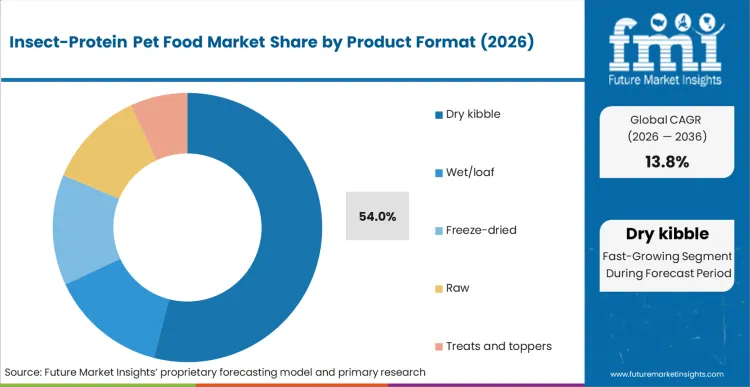
Dry kibble holds the leading share of the insect-protein pet food market at approximately 54% of total market value in 2026, a position that reflects structural advantages across the supply chain rather than consumer preference alone. Kibble production infrastructure is widely available through contract manufacturers already set up to handle alternative protein inclusions, and the format's shelf life and handling convenience reduce the retail and logistics barriers that constrain wet and raw insect-protein formats. The most commercially visible example of this dynamic is the expansion of the German brand Yarrah into insect-protein dry lines distributed through European pet retail chains and shipped internationally through their own e-commerce platform.
- Wet formats (loafs and gravies) are growing at an above-average clip within the cat food segment, where palatability is a more significant purchasing criterion than in canine diets. Companies including Yora Pet Foods and Protix have reported higher trial-to-repeat conversion rates in wet insect-protein cat foods than in comparable dry alternatives, attributing this to improved sensory acceptance among cats during transition from conventional protein sources. [2]
- Treats and toppers represent the fastest-growing format in volume terms, with an estimated CAGR of 18.4% between 2026 and 2036 based on FMI analysis. The lower price point per unit lowers the barrier to first purchase, and the format allows consumers to introduce insect protein into their pet's diet alongside an existing main meal rather than committing to a full dietary switch. [3]
Insect-Protein Pet Food Market Analysis by Pet Type
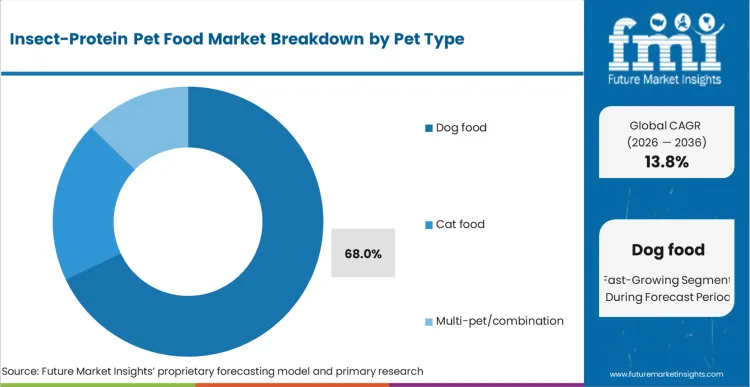
Dog food products account for approximately 68% of global insect-protein pet food market value in 2026. This share reflects both the larger overall dog food market and the fact that regulatory clearances for insect proteins in canine diets arrived earlier and covered a wider range of applications in the European Union and Australia. Brands in the United Kingdom, Germany, and Australia launched BSF-based dog kibbles between 2019 and 2022, building a four-year head start in consumer awareness and distribution coverage that cat food insect-protein products are still closing.
Insect-Protein Pet Food Market Analysis by Distribution Channel
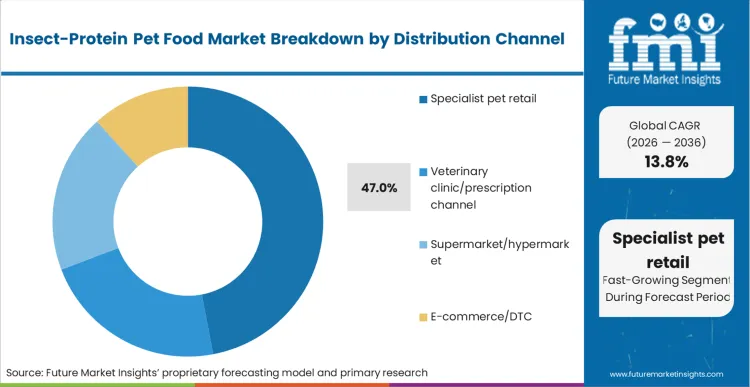
Specialist pet retail and veterinary channels together account for approximately 47% of distribution value in the insect-protein pet food market, a share considerably higher than these channels hold in the conventional pet food market overall. This reflects the premium pricing of most insect-protein SKUs and the role of knowledgeable staff in explaining novel protein benefits to hesitant consumers. In Germany and the Netherlands, specialist retail chains including Fressnapf and Welkoop have dedicated shelf sections for sustainable pet food, which is critical in driving trial of insect-protein products beyond the core early-adopter pet owner.
- E-commerce accounts for an estimated 31% of insect-protein pet food sales by value in 2026, driven heavily by subscription delivery services. Brands including Yora, Bug Bakes, and EntoBento have reported that more than 60% of their direct-to-consumer revenue comes from recurring subscriptions, a repeat purchase rate that significantly exceeds the category average in conventional dry pet food. [6]
- Mass grocery and hypermarket channels currently represent less than 14% of insect-protein pet food distribution by value but are expected to grow as larger conventional pet food companies introduce insect-protein lines to their portfolios. Mars Petcare's reported internal feasibility work on insect protein inclusion and Nestle Purina's ingredient diversification investments suggest that mass-channel distribution could begin scaling meaningfully. [7]
Insect-Protein Pet Food Market Drivers, Restraints and Opportunities
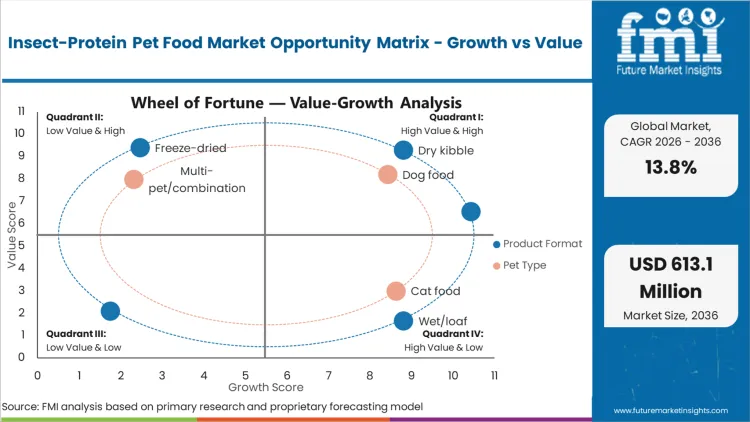
The insect-protein pet food market has moved from a fringe ingredient category to a commercially recognized alternative protein segment over the past four years, with the transition from artisan small-batch producers to vertically integrated insect farming operations fundamentally changing the economics of scale. Consumer demand is shaped by two converging forces: the search for hypoallergenic protein sources for pets with food sensitivities, and a broader sustainability orientation among pet owners in high-income markets. The supply side has responded with significant capital investment in black soldier fly production capacity, most visibly through the scale-up of European producers including Protix and Hermetia, and the emergence of new facilities in Southeast Asia and North America. [8]
- Pet humanization continues to reframe the premium pet food market in North America and Northern Europe, with a growing share of pet owners applying human food values, including environmental sustainability, clean-label ingredient sourcing, and clinical nutritional transparency, directly to their pet food purchasing decisions. Insect protein benefits directly from this shift because it addresses both the hypoallergenic positioning relevant to food-sensitive pets and the sustainability claim relevant to the environmentally motivated buyer.
- Regulatory fragmentation remains the most significant near-term constraint on market growth. The United States has not issued a final FDA ruling on black soldier fly protein in dog and cat food, leaving brands in the largest single pet food market operating in a state of regulatory ambiguity that limits retail shelf acceptance and advertising claims. China's feed ingredient approval process for novel insect proteins is similarly protracted. Until these two markets have clear regulatory pathways, the addressable market for insect-protein pet food will remain concentrated in Western Europe and Australia.
- The sensitivity and allergy management segment presents the clearest near-term revenue opportunity for insect-protein pet food manufacturers. Veterinary dermatologists and nutritionists are increasingly recommending novel protein diets as a first-line dietary elimination trial for dogs and cats presenting with chronic skin and gastrointestinal conditions. Brands that invest in clinical study data supporting their specific formulations, and that secure distribution through veterinary clinics alongside specialty retail, are positioned to capture a premium-priced, loyalty-oriented consumer segment that tends to hold purchasing decisions longer than the general pet owner population.
Regional Analysis
FMI's analysis of the global insect-protein pet food market covers seven regional groupings: North America, Latin America, Eastern Europe, Western Europe, South Asia and Pacific, East Asia, and Middle East and Africa. The full report includes market attractiveness assessments and per-capita pet food spending analyses across more than 30 countries. Country-level CAGR projections for 2026 to 2036 reflect variations in regulatory approval status, pet ownership rates, household income distribution, and the depth of specialty retail infrastructure.
.webp "Top Country Growth Comparison Insect Protein Pet Food Market Cagr (2026 2036)")
Country Wise Growth Comparison Table
| Country | Value CAGR (2026-2036) |
|---|---|
| United States | 12.4% |
| Germany | 11.2% |
| United Kingdom | 11.8% |
| Netherlands | 13.1% |
| Canada | 10.9% |
| Australia | 12.7% |
| South Korea | 14.6% |
| Brazil | 9.3% |
| Japan | 10.1% |
| China | 16.2% |
Source: Future Market Insights (FMI) analysis, based on proprietary forecasting model and primary research
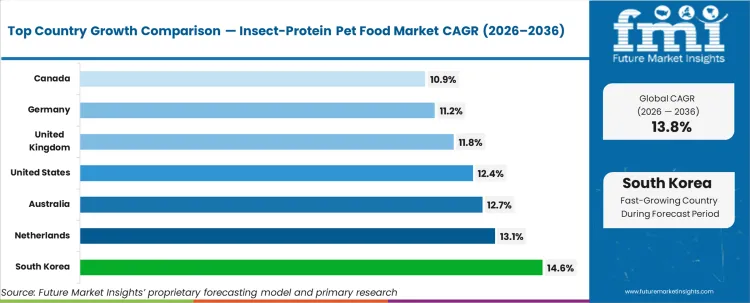
North America Market Analysis
North America is the second largest regional market for insect-protein pet food by value and is entering a period of accelerated growth as awareness spreads from the core early-adopter segment into a broader population of premium pet food buyers. The United States pet food market, the world's largest by value, has seen insect-protein products establish footholds in natural and specialty channels including Pet Supplies Plus, Whole Foods Market's pet section, and independent pet retailers concentrated in urban and suburban markets on both coasts. Canadian consumers in major metropolitan areas are showing comparable adoption patterns, supported by Health Canada's earlier regulatory engagement on novel food ingredients.
- The United States is projected to grow at a CAGR of 12.4% between 2026 and 2036, with growth concentrated in the premium dry kibble segment and the treat and topper format category, where lower per-unit prices enable trial without a full dietary commitment from the pet owner.
- Canada is projected at 10.9% CAGR, with growth driven by urban specialty retailers and online subscription services. A higher baseline penetration of natural and organic pet food in major Canadian cities provides a receptive consumer base for insect-protein positioning.
The full FMI report covers the United States and Canada at the state and province level, with channel-level market sizing and projected penetration curves by income segment.
Latin America Market Analysis
Latin America remains a nascent market for insect-protein pet food, with commercial-scale product availability limited to Brazil and, to a lesser extent, Chile and Colombia. The region's high overall pet ownership rate, particularly in Brazil, creates a large addressable volume opportunity, but median household income levels and the dominance of mass-market conventional pet food brands constrain near-term premium segment penetration. Insect-protein pet food in Latin America is currently positioned as an ultra-premium niche product distributed through select specialty urban retailers and high-end veterinary clinics.
- Brazil is projected at a 9.3% CAGR between 2026 and 2036, the lowest among the countries covered, reflecting price sensitivity in the broader market. However, the upper income quintile of Brazilian pet owners, concentrated in São Paulo and Rio de Janeiro, is showing purchasing behavior broadly comparable to Western European premium pet food consumers.
- The region's insect farming infrastructure is minimal compared to Europe and Asia, and the cost of importing finished insect-protein pet food or black soldier fly ingredient from offshore processors adds significantly to retail prices, reinforcing the niche positioning.
The full FMI report covers Brazil, Mexico, Argentina, and Chile, with per-capita pet food spending assessments and import-export trade analysis.
Europe Market Analysis
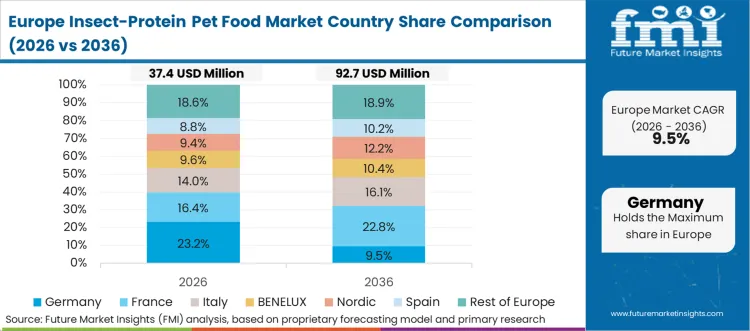
Europe is the most developed regional market for insect-protein pet food and the geography where the category originated commercially. Germany, the Netherlands, the United Kingdom, and France are home to the majority of established insect-protein pet food brands, and European Union regulatory frameworks, particularly EFSA's positive safety opinions on black soldier fly larvae for dogs and cats, have provided the compliance foundation that most other regions lack. The European market is in a premiumization phase, with insect-protein pet foods commanding per-kilogram retail prices 30% to 60% above comparable conventional protein alternatives in most markets.
- Germany leads the European market by value and is projected at 11.2% CAGR, supported by a high density of specialist pet retailers, strong consumer familiarity with sustainability labeling, and a mature natural pet food consumer base.
- The Netherlands, home to Protix, one of the world's largest black soldier fly producers, is projected at 13.1% CAGR, the highest among Western European countries in this study. Proximity to ingredient supply and a concentrated specialist retail infrastructure support above-average product availability and competitive pricing relative to other European markets.
The full FMI report covers the United Kingdom, Germany, France, the Netherlands, Belgium, Switzerland, Sweden, Denmark, and additional EU markets, with EFSA regulatory tracking and private-label activity monitoring.
Asia Pacific Market Analysis
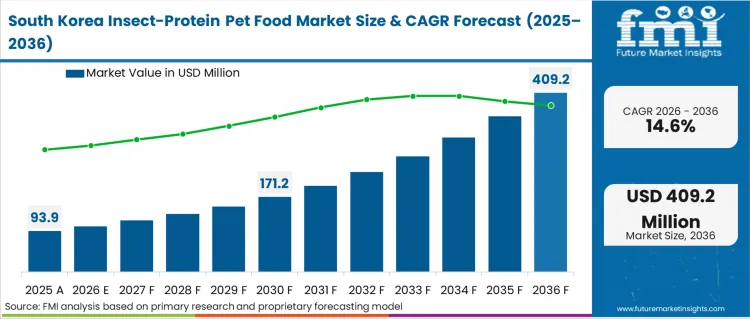
Asia Pacific presents the broadest range of market development stages of any region in this study. Australia is in an advanced premiumization phase comparable to Western Europe. South Korea and Japan have established and growing premium pet food sectors with regulatory frameworks that have accommodated insect-protein products, while China is at an earlier stage but represents the largest long-run volume opportunity in the region. Southeast Asian markets including Thailand and Vietnam have existing insect farming industries but very low pet food premiumization rates, creating a mid-term opportunity as incomes rise and modern retail penetration deepens.
- China is projected at a 16.2% CAGR, the highest of any country in this study, driven by rapid growth in urban pet ownership, rising willingness to pay for premium and functional pet food among upper-income households, and domestic insect farming capacity that is bringing input costs down. Regulatory approval timelines remain the primary variable affecting the pace of that growth.
- South Korea is projected at 14.6% CAGR, supported by a mature premium pet food market, a compact and efficient specialist retail network, and an urban consumer base with above-average receptivity to functional and novel-ingredient pet food claims.
The full FMI report covers Australia, Japan, South Korea, China, India, Thailand, Vietnam, and Indonesia, with per-pet spending analyses and regulatory status tracking by country.
Competitive Aligners for Market Players
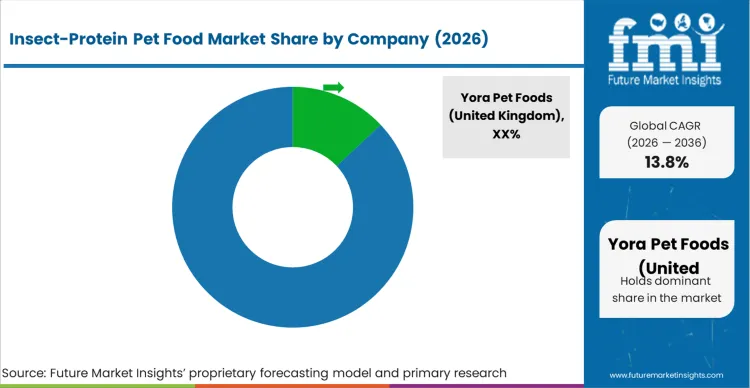
The insect-protein pet food market has a tiered competitive structure. A cohort of specialized insect-protein brands, most of them founded between 2016 and 2022 and concentrated in Western Europe and Australia, occupies the premium tier and holds the strongest brand equity within the category's current consumer base. These include Yora Pet Foods, Bug Bakes, and Chippin in the dog food segment and a smaller set of cat food specialists. At the mid-tier, a growing number of regional pet food manufacturers have added insect-protein lines to existing natural or functional pet food portfolios, competing primarily on distribution breadth and price relative to the specialist brands. The value end of the market remains largely absent from the insect-protein category, as production economics and retail positioning have not yet aligned to support mass-market pricing for BSF-based products.
Retailer relationships and shelf space allocation play an outsized role in category development at this stage. Specialist pet retailers including Fressnapf in Germany and Pets at Home in the United Kingdom function as gatekeepers for consumer trial, and brands that have secured favorable placement, whether through promotional support, sell-through guarantees, or sustainability credential alignment, hold a structural distribution advantage over brands competing primarily through e-commerce and direct-to-consumer channels. Own-label activity is beginning to emerge, with several European specialist pet retail chains exploring private-label insect-protein dry food in partnership with contract manufacturers. This development puts moderate margin pressure on established specialist brands but simultaneously validates the category's commercial viability and broadens consumer access to insect-protein pet food at lower price points.
Consumer behavior within the category divides along a loyalty-to-price-sensitivity axis. Buyers who have come to insect-protein pet food through a veterinary recommendation for an allergic or sensitive pet tend to exhibit high brand loyalty and low price sensitivity, making this segment commercially attractive despite its limited size. In contrast, sustainability-motivated buyers tend to be more price-aware and more willing to switch between insect-protein brands when promotional pricing or a new retail listing makes an alternative accessible. Conventional pet food brands that enter the category will likely target the latter segment first, using their established retail footprint and promotional capability to drive trial, which could compress margins for existing specialist brands in the mid-price range while leaving the clinical and veterinary channel protected.
Key Players Covered in the Study
- Yora Pet Foods (United Kingdom)
- Bug Bakes (United Kingdom)
- Chippin (United States)
- EntoBento (Germany)
- Wilder Harrier (Canada)
- Protix Biosystems (Netherlands)
- Hermetia Baruth (Germany)
- Next Protein (France)
- Jimini's (France)
- MealFood Europe (Spain)
- Gipsy Hill Brewing / Yora parent group (United Kingdom)
- Bud's Insect-based Pet Food (Australia)
- Nutrition Technologies (Singapore)
- InnovaFeed (France)
Report Scope
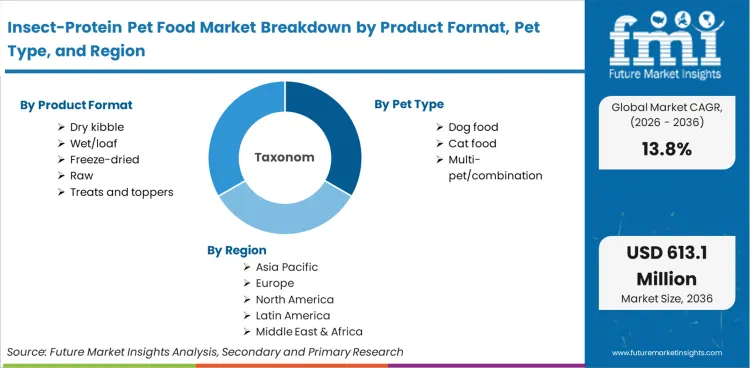
| Metric | Value |
|---|---|
| Quantitative Units | USD 168.3 million in 2026 to USD 614.8 million by 2036 at a CAGR of 13.8% |
| Market Definition | Commercially manufactured dog and cat food products in which black soldier fly larvae or processed derivatives serve as a primary or partial protein source, covering dry, wet, freeze-dried, raw, and treat formats through retail and e-commerce channels globally. |
| Protein Source Segmentation | Black soldier fly (sole protein), Black soldier fly (blended with conventional protein), Black soldier fly (blended with other alternative protein) |
| Product Format Segmentation | Dry kibble, Wet/loaf, Freeze-dried, Raw, Treats and toppers |
| Pet Type Segmentation | Dog food, Cat food, Multi-pet/combination |
| Protein Claim Positioning Segmentation | Single-protein hypoallergenic, Sustainability-positioned, Functional/performance, Standard alternative protein |
| Pack Size Segmentation | Up to 1 kg, 1 kg to 3 kg, 3 kg to 6 kg, Above 6 kg, Single-serve/pouch |
| Distribution Channel Segmentation | Specialist pet retail, Veterinary clinic/prescription channel, Supermarket/hypermarket, E-commerce/DTC, Other |
| Regions Covered | North America, Latin America, Eastern Europe, Western Europe, South Asia and Pacific, East Asia, Middle East and Africa |
| Countries Covered | United States, Canada, Brazil, Mexico, Argentina, United Kingdom, Germany, France, Netherlands, Belgium, Switzerland, Sweden, Denmark, Australia, Japan, South Korea, China, India, Thailand, Vietnam, Indonesia, Colombia, Chile |
| Key Players Covered in the Study | Yora Pet Foods, Bug Bakes, Chippin, EntoBento, Wilder Harrier, Protix Biosystems, Hermetia Baruth, Next Protein, Jimini's, MealFood Europe, Bud's Insect-based Pet Food, Nutrition Technologies, InnovaFeed, Gipsy Hill Brewing / Yora parent group |
| Forecast Period | 2026 to 2036 |
| Approach | Volume-based bottom-up model by country, using pet population data, premium pet food penetration rates by income segment, and per-pet spending benchmarks, rolled up to regional and global totals and validated against black soldier fly ingredient procurement volumes, retail audit data, and primary interview inputs. |
Insect-Protein Pet Food Market Analysis by Segments
By Protein Source:
- Black soldier fly (sole protein)
- Black soldier fly (blended with conventional protein)
- Black soldier fly (blended with other alternative protein)
By Product Format:
- Dry kibble
- Wet/loaf
- Freeze-dried
- Raw
- Treats and toppers
By Pet Type:
- Dog food
- Cat food
- Multi-pet/combination
By Protein Claim Positioning:
- Single-protein hypoallergenic
- Sustainability-positioned
- Functional/performance
- Standard alternative protein
By Pack Size:
- Up to 1 kg
- 1 kg to 3 kg
- 3 kg to 6 kg
- Above 6 kg
- Single-serve/pouch
By Distribution Channel:
- Specialist pet retail
- Veterinary clinic/prescription channel
- Supermarket/hypermarket
- E-commerce/DTC
- Other
By Region:
- North America
- Latin America
- Eastern Europe
- Western Europe
- South Asia and Pacific
- East Asia
- Middle East and Africa
Bibliography
- European Food Safety Authority (EFSA), "Novel foods: allergenicity assessment of insect proteins," EFSA Journal, Dec. 2022.
- G. M. Bosch, M. A. Zhang, and G. C. Saad, "Protein quality of insects as potential ingredients for dog and cat foods," Journal of Nutritional Science, vol. 4, e24, 2015.
- C. M. S. A. Neves et al., "Insects as Feed for Companion and Exotic Pets: A Current Trend," Animals, vol. 12, no. 11, p. 1401, Jun. 2022.
- Kansas State University, "Study: Insect proteins in pet food face processing challenges, Petfood Industry, Jul. 2025.
- A. Freel et al., "Effects of black soldier fly larvae as protein or fat sources on apparent nutrient digestibility, fecal microbiota, and metabolic profiles in beagle dogs," Frontiers in Microbiology, vol. 13, Nov. 2022.
- J. O. Heckmann et al., "Americans' acceptance of black soldier fly larvae as food for themselves, their dogs, and farmed animals," Food Quality and Preference, vol. 88, 2021.
- L. C. M. M. Spranghers et al., "In vitro digestibility and fermentability of selected insects for dog foods," Journal of Animal Physiology and Animal Nutrition, 2016.
- L. Van Gansbeke, "Insect based pet food: Consumer acceptance and nutritional sustainability," M.S. thesis, Faculty of Veterinary Medicine, Ghent University, 2023.
- Association of American Feed Control Officials (AAFCO), "Insect proteins in pet foods," LANI Pet, Jun. 2022.
- G. Secci, F. Bovera, and M. K. Naiel, "Potential application of black soldier fly fats in canine and feline diets," Journal of Animal Science and Technology, vol. 64, no. 6, 2022.
- World Journal of Advanced Research and Reviews, "Insects as a sustainable protein alternative in pet food," 2024.
This bibliography is provided for reader reference and is not exhaustive. The full report contains the complete reference list and detailed citations.
This report addresses
- Market intelligence enabling assessment of leading countries, product formats, protein positioning strategies, and distribution channel performance in the global insect-protein pet food market.
- Volume and revenue forecasts for 2026 to 2036, validated through per-pet spending modeling by country, income-segmented pet food penetration rates, and retail audit benchmarks from specialist pet retail and e-commerce channels.
- Growth opportunity mapping across product tiers - premium specialist brands, mid-tier conventional brand extensions with insect-protein lines, and private-label or own-brand insect-protein products.
- Segment and regional revenue forecasts by protein source type, product format, pet type, protein claim positioning, pack size, and distribution channel across more than 23 countries.
- Competitive strategy analysis covering brand positioning, distribution channel structure, ingredient sourcing models, recent product launches, and estimated market share for 14 key players.
- Consumer economic context analysis covering GDP per capita, household consumption rates, and food and consumer spend share across ten key markets, linking household purchasing power to category CAGR projections.
- Regulatory and labeling compliance tracking for black soldier fly protein approvals across the United States (FDA), European Union (EFSA), Australia (FSANZ), Canada (Health Canada), South Korea, Japan, and China.
- Report delivery formats including PDF, Excel data tables, PowerPoint summary deck, and interactive data dashboard.
Frequently Asked Questions
How large is the demand for insect-protein pet food in the global market in 2026?
Based on Future Market Insights analysis, the global insect-protein pet food market is estimated to reach USD 168.3 million in 2026, with Western Europe and North America accounting for the majority of that value.
What will the market size of insect-protein pet food by 2036?
FMI projects the global insect-protein pet food market will reach USD 614.8 million by 2036, representing close to a 3.7x increase over the 2026 base.
What is the expected demand growth rate for insect-protein pet food between 2026 and 2036?
FMI projects a CAGR of 13.8% for the global insect-protein pet food market between 2026 and 2036.
Which product format is expected to lead global insect-protein pet food sales?
Dry kibble is expected to maintain the leading share by value through 2036, accounting for approximately 54% of the market in 2025. Treats and toppers represent the fastest-growing format, with an estimated CAGR of 18.4% between 2026 and 2036.
How significant is the premium segment in driving category value versus volume?
The premium segment, comprising specialist insect-protein brands sold through specialty pet retail, veterinary channels, and e-commerce, accounts for the large majority of category value despite representing a smaller portion of overall pet food volume. Per-kilogram retail prices for insect-protein pet food typically run 30% to 60% above conventional protein alternatives in European and North American markets.
Which distribution channel accounts for the largest share of insect-protein pet food sales?
Specialist pet retail and veterinary channels together account for approximately 47% of insect-protein pet food distribution value, reflecting the premium positioning of most products and the role of staff recommendations in driving trial. E-commerce accounts for a further 31%.
How does household income growth influence per-capita pet food spending in emerging markets?
As household incomes rise and the share of spending on food declines in line with Engel's Law, available discretionary spending for premium categories including specialty pet food expands. This dynamic is most relevant for China and Brazil in this study, where food currently represents 25% to 28% of total household expenditure. As that share compresses toward the 11% to 14% range observed in high-income markets, the addressable market for premium pet food will grow substantially.
Which regions are entering the premiumization phase and what is driving the shift?
North America is entering an accelerated premiumization phase in insect-protein pet food as specialty retail distribution deepens and consumer awareness of novel protein benefits spreads beyond the early-adopter segment. South Korea and Australia are also in active premiumization phases. China is at an earlier stage but has the highest projected CAGR at 16.2%, driven by rapid urban pet ownership growth and rising disposable income among upper-income urban households.
How does private-label competition affect brand owner pricing and margin in this category?
Private-label activity is emerging in Western Europe, where specialist pet retail chains are exploring own-brand insect-protein dry food in partnership with contract manufacturers. This puts moderate pressure on mid-tier insect-protein brand pricing but does not yet threaten the premium specialist segment, which competes primarily on ingredient provenance, clinical substantiation, and sustainability certification than on price.
What role do clean-label and hypoallergenic claims play in purchase decisions for insect-protein pet food?
Hypoallergenic positioning is among the most commercially powerful purchase drivers in the category. Pet owners whose veterinarians have recommended a novel protein diet for a food-sensitive pet represent a high-loyalty, low-price-sensitivity buyer cohort. Single-protein and limited-ingredient claim structures, combined with veterinary endorsement, have been the primary route through which insect-protein pet food has achieved premium retail placement and above-average repeat purchase rates in its leading markets.
Preview the report firsthand - request a free sample
Get SampleGet the brochure for pricing and purchase details.
Get PDFTable of Content
- Executive Summary
- Global Market Outlook
- Demand-side Trends
- Supply-side Trends
- Technology Roadmap Analysis
- Analysis and Recommendations
- Market Overview
- Market Coverage / Taxonomy
- Market Definition / Scope / Limitations
- Research Methodology
- Chapter Orientation
- Analytical Lens and Working Hypotheses
- Market Structure, Signals, and Trend Drivers
- Benchmarking and Cross-market Comparability
- Market Sizing, Forecasting, and Opportunity Mapping
- Research Design and Evidence Framework
- Desk Research Programme (Secondary Evidence)
- Company Annual and Sustainability Reports
- Peer-reviewed Journals and Academic Literature
- Corporate Websites, Product Literature, and Technical Notes
- Earnings Decks and Investor Briefings
- Statutory Filings and Regulatory Disclosures
- Technical White Papers and Standards Notes
- Trade Journals, Industry Magazines, and Analyst Briefs
- Conference Proceedings, Webinars, and Seminar Materials
- Government Statistics Portals and Public Data Releases
- Press Releases and Reputable Media Coverage
- Specialist Newsletters and Curated Briefings
- Sector Databases and Reference Repositories
- FMI Internal Proprietary Databases and Historical Market Datasets
- Subscription Datasets and Paid Sources
- Social Channels, Communities, and Digital Listening Inputs
- Additional Desk Sources
- Expert Input and Fieldwork (Primary Evidence)
- Primary Modes
- Qualitative Interviews and Expert Elicitation
- Quantitative Surveys and Structured Data Capture
- Blended Approach
- Why Primary Evidence is Used
- Field Techniques
- Interviews
- Surveys
- Focus Groups
- Observational and In-context Research
- Social and Community Interactions
- Stakeholder Universe Engaged
- C-suite Leaders
- Board Members
- Presidents and Vice Presidents
- R&D and Innovation Heads
- Technical Specialists
- Domain Subject-matter Experts
- Scientists
- Physicians and Other Healthcare Professionals
- Governance, Ethics, and Data Stewardship
- Research Ethics
- Data Integrity and Handling
- Primary Modes
- Tooling, Models, and Reference Databases
- Desk Research Programme (Secondary Evidence)
- Data Engineering and Model Build
- Data Acquisition and Ingestion
- Cleaning, Normalisation, and Verification
- Synthesis, Triangulation, and Analysis
- Quality Assurance and Audit Trail
- Market Background
- Market Dynamics
- Drivers
- Restraints
- Opportunity
- Trends
- Scenario Forecast
- Demand in Optimistic Scenario
- Demand in Likely Scenario
- Demand in Conservative Scenario
- Opportunity Map Analysis
- Product Life Cycle Analysis
- Supply Chain Analysis
- Investment Feasibility Matrix
- Value Chain Analysis
- PESTLE and Porter’s Analysis
- Regulatory Landscape
- Regional Parent Market Outlook
- Production and Consumption Statistics
- Import and Export Statistics
- Market Dynamics
- Global Market Analysis 2021 to 2025 and Forecast, 2026 to 2036
- Historical Market Size Value (USD Million) Analysis, 2021 to 2025
- Current and Future Market Size Value (USD Million) Projections, 2026 to 2036
- Y-o-Y Growth Trend Analysis
- Absolute $ Opportunity Analysis
- Global Market Pricing Analysis 2021 to 2025 and Forecast 2026 to 2036
- Global Market Analysis 2021 to 2025 and Forecast 2026 to 2036, By Product Format
- Introduction / Key Findings
- Historical Market Size Value (USD Million) Analysis By Product Format , 2021 to 2025
- Current and Future Market Size Value (USD Million) Analysis and Forecast By Product Format , 2026 to 2036
- Dry kibble
- Wet/loaf
- Freeze-dried
- Raw
- Treats and toppers
- Dry kibble
- Y-o-Y Growth Trend Analysis By Product Format , 2021 to 2025
- Absolute $ Opportunity Analysis By Product Format , 2026 to 2036
- Global Market Analysis 2021 to 2025 and Forecast 2026 to 2036, By Pet Type
- Introduction / Key Findings
- Historical Market Size Value (USD Million) Analysis By Pet Type, 2021 to 2025
- Current and Future Market Size Value (USD Million) Analysis and Forecast By Pet Type, 2026 to 2036
- Dog food
- Cat food
- Multi-pet/combination
- Dog food
- Y-o-Y Growth Trend Analysis By Pet Type, 2021 to 2025
- Absolute $ Opportunity Analysis By Pet Type, 2026 to 2036
- Global Market Analysis 2021 to 2025 and Forecast 2026 to 2036, By Distribution Channel
- Introduction / Key Findings
- Historical Market Size Value (USD Million) Analysis By Distribution Channel, 2021 to 2025
- Current and Future Market Size Value (USD Million) Analysis and Forecast By Distribution Channel, 2026 to 2036
- Specialist pet retail
- Veterinary clinic/prescription channel
- Supermarket/hypermarket
- E-commerce/DTC
- Specialist pet retail
- Y-o-Y Growth Trend Analysis By Distribution Channel, 2021 to 2025
- Absolute $ Opportunity Analysis By Distribution Channel, 2026 to 2036
- Global Market Analysis 2021 to 2025 and Forecast 2026 to 2036, By Region
- Introduction
- Historical Market Size Value (USD Million) Analysis By Region, 2021 to 2025
- Current Market Size Value (USD Million) Analysis and Forecast By Region, 2026 to 2036
- North America
- Latin America
- Western Europe
- Eastern Europe
- East Asia
- South Asia and Pacific
- Middle East & Africa
- Market Attractiveness Analysis By Region
- North America Market Analysis 2021 to 2025 and Forecast 2026 to 2036, By Country
- Historical Market Size Value (USD Million) Trend Analysis By Market Taxonomy, 2021 to 2025
- Market Size Value (USD Million) Forecast By Market Taxonomy, 2026 to 2036
- By Country
- USA
- Canada
- Mexico
- By Product Format
- By Pet Type
- By Distribution Channel
- By Country
- Market Attractiveness Analysis
- By Country
- By Product Format
- By Pet Type
- By Distribution Channel
- Key Takeaways
- Latin America Market Analysis 2021 to 2025 and Forecast 2026 to 2036, By Country
- Historical Market Size Value (USD Million) Trend Analysis By Market Taxonomy, 2021 to 2025
- Market Size Value (USD Million) Forecast By Market Taxonomy, 2026 to 2036
- By Country
- Brazil
- Chile
- Rest of Latin America
- By Product Format
- By Pet Type
- By Distribution Channel
- By Country
- Market Attractiveness Analysis
- By Country
- By Product Format
- By Pet Type
- By Distribution Channel
- Key Takeaways
- Western Europe Market Analysis 2021 to 2025 and Forecast 2026 to 2036, By Country
- Historical Market Size Value (USD Million) Trend Analysis By Market Taxonomy, 2021 to 2025
- Market Size Value (USD Million) Forecast By Market Taxonomy, 2026 to 2036
- By Country
- Germany
- UK
- Italy
- Spain
- France
- Nordic
- BENELUX
- Rest of Western Europe
- By Product Format
- By Pet Type
- By Distribution Channel
- By Country
- Market Attractiveness Analysis
- By Country
- By Product Format
- By Pet Type
- By Distribution Channel
- Key Takeaways
- Eastern Europe Market Analysis 2021 to 2025 and Forecast 2026 to 2036, By Country
- Historical Market Size Value (USD Million) Trend Analysis By Market Taxonomy, 2021 to 2025
- Market Size Value (USD Million) Forecast By Market Taxonomy, 2026 to 2036
- By Country
- Russia
- Poland
- Hungary
- Balkan & Baltic
- Rest of Eastern Europe
- By Product Format
- By Pet Type
- By Distribution Channel
- By Country
- Market Attractiveness Analysis
- By Country
- By Product Format
- By Pet Type
- By Distribution Channel
- Key Takeaways
- East Asia Market Analysis 2021 to 2025 and Forecast 2026 to 2036, By Country
- Historical Market Size Value (USD Million) Trend Analysis By Market Taxonomy, 2021 to 2025
- Market Size Value (USD Million) Forecast By Market Taxonomy, 2026 to 2036
- By Country
- China
- Japan
- South Korea
- By Product Format
- By Pet Type
- By Distribution Channel
- By Country
- Market Attractiveness Analysis
- By Country
- By Product Format
- By Pet Type
- By Distribution Channel
- Key Takeaways
- South Asia and Pacific Market Analysis 2021 to 2025 and Forecast 2026 to 2036, By Country
- Historical Market Size Value (USD Million) Trend Analysis By Market Taxonomy, 2021 to 2025
- Market Size Value (USD Million) Forecast By Market Taxonomy, 2026 to 2036
- By Country
- India
- ASEAN
- Australia & New Zealand
- Rest of South Asia and Pacific
- By Product Format
- By Pet Type
- By Distribution Channel
- By Country
- Market Attractiveness Analysis
- By Country
- By Product Format
- By Pet Type
- By Distribution Channel
- Key Takeaways
- Middle East & Africa Market Analysis 2021 to 2025 and Forecast 2026 to 2036, By Country
- Historical Market Size Value (USD Million) Trend Analysis By Market Taxonomy, 2021 to 2025
- Market Size Value (USD Million) Forecast By Market Taxonomy, 2026 to 2036
- By Country
- Kingdom of Saudi Arabia
- Other GCC Countries
- Turkiye
- South Africa
- Other African Union
- Rest of Middle East & Africa
- By Product Format
- By Pet Type
- By Distribution Channel
- By Country
- Market Attractiveness Analysis
- By Country
- By Product Format
- By Pet Type
- By Distribution Channel
- Key Takeaways
- Key Countries Market Analysis
- USA
- Pricing Analysis
- Market Share Analysis, 2025
- By Product Format
- By Pet Type
- By Distribution Channel
- Canada
- Pricing Analysis
- Market Share Analysis, 2025
- By Product Format
- By Pet Type
- By Distribution Channel
- Mexico
- Pricing Analysis
- Market Share Analysis, 2025
- By Product Format
- By Pet Type
- By Distribution Channel
- Brazil
- Pricing Analysis
- Market Share Analysis, 2025
- By Product Format
- By Pet Type
- By Distribution Channel
- Chile
- Pricing Analysis
- Market Share Analysis, 2025
- By Product Format
- By Pet Type
- By Distribution Channel
- Germany
- Pricing Analysis
- Market Share Analysis, 2025
- By Product Format
- By Pet Type
- By Distribution Channel
- UK
- Pricing Analysis
- Market Share Analysis, 2025
- By Product Format
- By Pet Type
- By Distribution Channel
- Italy
- Pricing Analysis
- Market Share Analysis, 2025
- By Product Format
- By Pet Type
- By Distribution Channel
- Spain
- Pricing Analysis
- Market Share Analysis, 2025
- By Product Format
- By Pet Type
- By Distribution Channel
- France
- Pricing Analysis
- Market Share Analysis, 2025
- By Product Format
- By Pet Type
- By Distribution Channel
- India
- Pricing Analysis
- Market Share Analysis, 2025
- By Product Format
- By Pet Type
- By Distribution Channel
- ASEAN
- Pricing Analysis
- Market Share Analysis, 2025
- By Product Format
- By Pet Type
- By Distribution Channel
- Australia & New Zealand
- Pricing Analysis
- Market Share Analysis, 2025
- By Product Format
- By Pet Type
- By Distribution Channel
- China
- Pricing Analysis
- Market Share Analysis, 2025
- By Product Format
- By Pet Type
- By Distribution Channel
- Japan
- Pricing Analysis
- Market Share Analysis, 2025
- By Product Format
- By Pet Type
- By Distribution Channel
- South Korea
- Pricing Analysis
- Market Share Analysis, 2025
- By Product Format
- By Pet Type
- By Distribution Channel
- Russia
- Pricing Analysis
- Market Share Analysis, 2025
- By Product Format
- By Pet Type
- By Distribution Channel
- Poland
- Pricing Analysis
- Market Share Analysis, 2025
- By Product Format
- By Pet Type
- By Distribution Channel
- Hungary
- Pricing Analysis
- Market Share Analysis, 2025
- By Product Format
- By Pet Type
- By Distribution Channel
- Kingdom of Saudi Arabia
- Pricing Analysis
- Market Share Analysis, 2025
- By Product Format
- By Pet Type
- By Distribution Channel
- Turkiye
- Pricing Analysis
- Market Share Analysis, 2025
- By Product Format
- By Pet Type
- By Distribution Channel
- South Africa
- Pricing Analysis
- Market Share Analysis, 2025
- By Product Format
- By Pet Type
- By Distribution Channel
- USA
- Market Structure Analysis
- Competition Dashboard
- Competition Benchmarking
- Market Share Analysis of Top Players
- By Regional
- By Product Format
- By Pet Type
- By Distribution Channel
- Competition Analysis
- Competition Deep Dive
- Yora Pet Foods (Value (USD Million)ed Kingdom)
- Overview
- Product Portfolio
- Profitability by Market Segments (Product/Age /Sales Channel/Region)
- Sales Footprint
- Strategy Overview
- Marketing Strategy
- Product Strategy
- Channel Strategy
- Bug Bakes (Value (USD Million)ed Kingdom)
- Chippin (Value (USD Million)ed States)
- EntoBento (Germany)
- Wilder Harrier (Canada)
- Protix Biosystems (Netherlands)
- Hermetia Baruth (Germany)
- Next Protein (France)
- Jimini's (France)
- MealFood Europe (Spain)
- Yora Pet Foods (Value (USD Million)ed Kingdom)
- Competition Deep Dive
- Assumptions & Acronyms Used


