

- Industry Size (2026)
- USD 68 Bn
- Forecast (2036)
- USD 118.5 Bn
- CAGR (2026 to 2036)
- 5.7%
Upcycled Food Products Market Forecast and Outlook 2026 to 2036
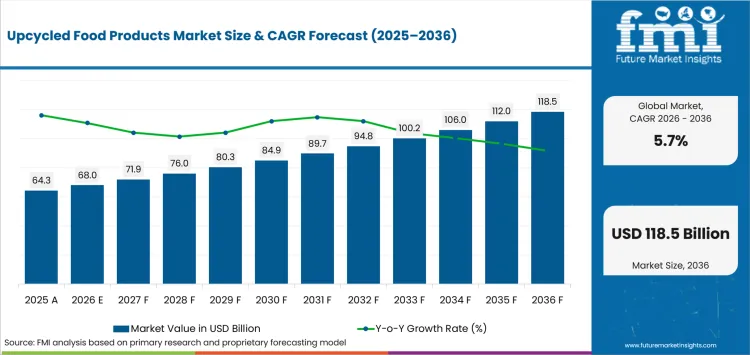
The upcycled food products market is likely to be valued at USD 68.0 billion in 2026 and is forecasted to reach USD 118.5 billion by 2036 at a CAGR of 5.7%. Value behavior is shaped by integration of surplus and byproduct streams into commercially viable food formulations rather than incremental product innovation alone. Demand formation reflects processor efforts to convert disposal liabilities into revenue generating inputs with nutritional and functional relevance. Capital allocation favors applications where recovered ingredients can be standardized for snacks, bakery products, and beverages without disrupting existing manufacturing lines. Purchasing decisions align with availability of consistent byproduct streams, labeling transparency requirements, and retailer acceptance of circular sourcing claims. Demand persistence concentrates where upcycling directly offsets raw material costs and waste handling expenses.
Operational complexity arises from variability inherent in byproduct composition, handling, and qualification for human consumption. Moisture content, fiber levels, and flavor intensity fluctuate across sourcing batches, complicating formulation control. Collection logistics increase cost due to perishability and decentralized generation points. Food safety validation extends qualification timelines through additional microbial, allergen, and contaminant testing. Inclusion rate limits emerge where sensory impacts affect taste, texture, or appearance. Regulatory interpretation of novel ingredient status varies across regions, adding approval uncertainty. Long-term supply contracts remain limited, reducing planning confidence for large product launches. Competitive pressure from conventional ingredients constrains pricing flexibility where functional performance advantages remain marginal.
Quick Stats for Upcycled Food Products Market
- Upcycled Food Products Market Value (2026): USD 68.0 billion
- Upcycled Food Products Market Forecast Value (2036): USD 118.5 billion
- Upcycled Food Products Market Forecast CAGR 2026 to 2036: 5.7%
- Leading Product Type by Demand Share: Snacks & Bars
- Fastest-Growing Countries: USA, UK, Germany, France, Japan
- Top Players in Global Demand: ReGrained, Renewal Mill, Barnana, Toast Ale, Rubies in the Rubble
Upcycled Food Products Market Key Takeaways
| Metric | Value |
|---|---|
| Market Value (2026) | USD 68.0 billion |
| Market Forecast Value (2036) | USD 118.5 billion |
| Forecast CAGR 2026 to 2036 | 5.7% |
Why is the Demand for Upcycled Food Products Market Growing?
Demand for upcycled food products is increasing as food manufacturers strive to reduce waste streams and optimize raw material utilization within supply chains. Food processors identify byproducts such as fruit pomace, spent grains, and imperfect produce that can be transformed into ingredients with nutritional value. Grocery retailers introduce upcycled product lines to address consumer interest in sustainable consumption patterns and reduce disposal costs associated with unsold goods. Institutional food service operators adopt ingredient innovations to support waste reduction objectives that align with corporate sustainability commitments. Culinary product developers explore upcycled inputs to expand product portfolios with fiber rich and nutrient enhanced offerings that differentiate their brands on retail shelves.
Food safety protocols and traceability frameworks are shaping adoption because quality assurance is essential when transforming byproducts into consumer products. Certification standards and third party verification provide confidence for buyers and partners assessing risk and compliance. Ingredient suppliers scale processing capacity to meet demand from snack, bakery, and beverage sectors seeking functional components derived from surplus outputs. Nutrition research highlighting the health benefits of certain upcycled ingredients informs product formulation strategies. Expanded distribution through multiple retail channels improves accessibility, encouraging more suppliers to integrate upcycled solutions into mainstream offerings.
How Are the Segments Classified in the Upcycled Food Products Market?
Demand for upcycled food products grows due to waste reduction priorities, ingredient cost optimization, and sustainability driven product development across food systems. Manufacturers integrate recovered inputs to improve resource efficiency while maintaining functional and nutritional performance. Retail acceptance increases as transparency and circular sourcing gain relevance. Supply chain pressures also encourage utilization of secondary streams to stabilize raw material availability and reduce disposal exposure.
Which product type represents the largest share of demand?
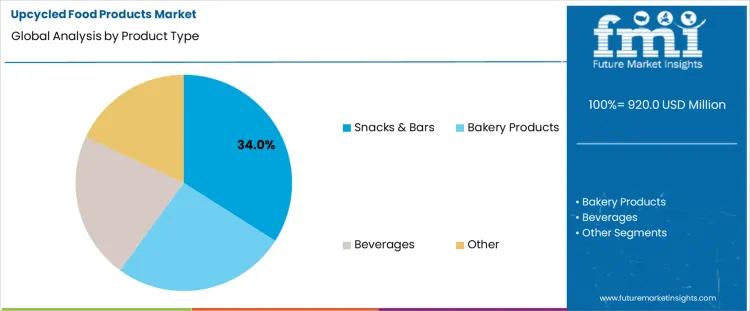
Snacks and bars account for a 32.9% share, reflecting strong alignment with convenience consumption and formulation flexibility. Compact formats accommodate diverse upcycled inputs without compromising texture or shelf stability. Product development benefits from portion control and flavor masking capabilities supporting consumer acceptance. High production throughput enables efficient scaling using variable byproduct streams. Distribution suitability across retail and on the go channels further supports volume concentration. Brand positioning around functionality and sustainability reinforces recurring demand across snack focused portfolios.
Key Points
- Supports flexible formulation with varied recovered ingredients
- Aligns with convenience driven consumption patterns
- Scales efficiently within high volume production systems
Which source material drives the largest share of demand?
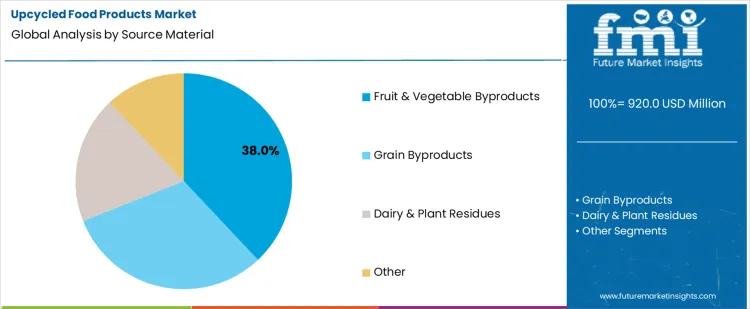
Fruit and vegetable byproducts represent a 38.0% share, driven by consistent availability and nutritional relevance. Processing residues provide fibers, antioxidants, and functional compounds suitable for reformulation. Supply streams originate from established processing operations, improving input reliability. Moisture and texture characteristics integrate well into snacks, bakery, and beverage applications. Valorization of these materials reduces disposal costs while supporting circular sourcing narratives across product lines.
Key Points
- Provides nutritionally functional components for reformulation
- Benefits from steady supply from processing operations
- Integrates effectively across multiple food categories
Which distribution channel accounts for the highest share of demand?
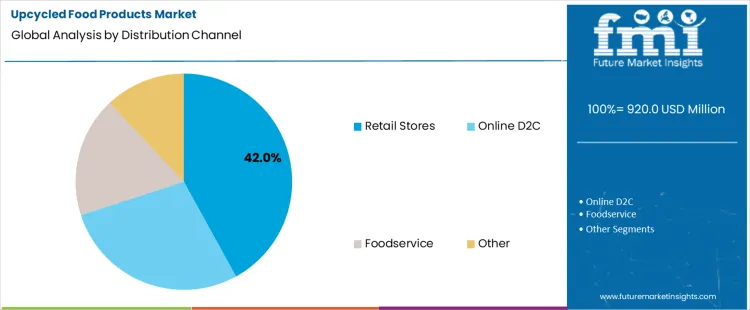
Retail stores hold a 42.0% share, reflecting accessibility and consumer discovery dynamics. Physical shelves enable visibility for sustainability labeled products and ingredient transparency claims. Established distribution networks support volume movement and repeat purchasing behavior. Retail placement also facilitates comparison with conventional alternatives, supporting trial adoption. Category integration within existing aisles reduces friction for mainstream consumers evaluating upcycled offerings.
Key Points
- Enables broad consumer access and product visibility
- Supports repeat purchasing through established channels
- Facilitates comparison with conventional food alternatives
What are the Key Dynamics in the Upcycled Food Products Market?
Demand dynamics in the upcycled food products market reflect resource efficiency priorities within food processing and consumer packaged goods production. Global activity centers on valorization of byproducts, surplus streams, and side fractions previously treated as waste. Value formation depends on nutritional retention, sensory acceptance, and supply traceability. Purchasing behavior aligns with sustainability compliance, ingredient cost optimization, and brand risk management within regulated food systems.
How do food waste valorization and sustainability compliance shape adoption?
Adoption expands as food manufacturers seek to reduce disposal costs while improving material yield across processing operations. Demand strengthens where byproducts such as fruit pomace, spent grains, and vegetable trimmings retain functional or nutritional value. Regulatory pressure on waste reporting and landfill diversion increases interest in upcycled inputs. Ingredient innovation teams leverage upcycled components to meet internal sustainability targets tied to procurement and lifecycle metrics.
Standardization of safety testing and labeling frameworks improves commercial viability. Foodservice and packaged food producers integrate upcycled ingredients to stabilize input availability during raw material volatility. Processing compatibility with existing formulations supports scalable use across snacks, bakery, beverages, and prepared foods without major equipment modification.
How do supply consistency and formulation constraints influence market scalability?
Market scalability remains constrained by variability in byproduct composition and fragmented supply sources. Demand encounters limits where inconsistent moisture, fiber, or nutrient profiles complicate formulation control. Collection and preprocessing logistics raise costs due to perishability and decentralized generation points. Food safety validation requires additional testing, extending qualification timelines. Sensory impacts such as bitterness, color variation, or texture changes restrict inclusion rates.
Regulatory interpretation of novel ingredient status adds approval complexity across regions. Price sensitivity increases where upcycled ingredients compete with established commodities offering predictable performance. Limited long-term contracts for byproduct streams reduce planning certainty for large-scale product launches.
How Is Demand for the Upcycled Food Products Market Evolving Globally?
Global demand for upcycled food products is increasing as food manufacturers prioritize waste valorization and resource efficiency within ingredient sourcing strategies. Expansion reflects structural pressure to reduce disposal costs while meeting sustainability disclosure and procurement requirements. Demand growth aligns with supply chain optimization, by product utilization economics, and retailer acceptance of circular food formulations. USA records 12.1% CAGR, UK records 11.4% CAGR, Germany records 10.2% CAGR, France records 9.6% CAGR, and Japan records 8.9% CAGR. Adoption remains driven by regulatory alignment, cost recovery from waste streams, and integration into mainstream packaged food portfolios globally.
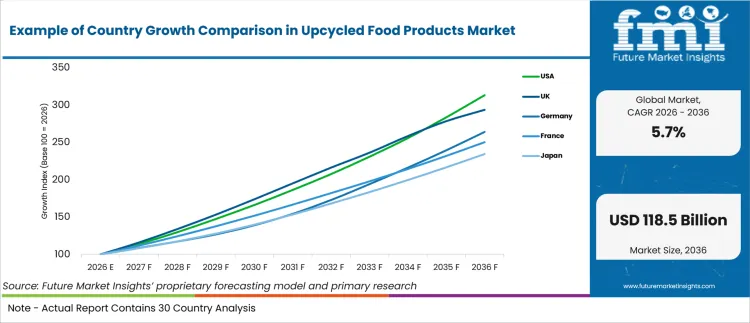
| Country | CAGR (%) |
|---|---|
| USA | 12.1% |
| UK | 11.4% |
| Germany | 10.2% |
| France | 9.6% |
| Japan | 8.9% |
How is the USA supporting growth of upcycled food products demand?
Demand for upcycled food products in the USA is expanding as packaged food companies integrate circular sourcing within product development strategies. Growth at 12.1% CAGR reflects retailer acceptance, venture investment, and consumer exposure to sustainability labeling. Food processors leverage by products from grains, fruits, and brewing operations to offset raw material cost volatility. Regulatory clarity around food safety supports commercialization of repurposed inputs. Large foodservice operators adopt upcycled ingredients to meet waste reduction commitments. Scaling benefits emerge from centralized processing infrastructure and logistics networks. Procurement decisions emphasize traceability, nutritional equivalence, and formulation compatibility across snacks, bakery, and beverage categories.
- Strong venture funding support
- Retailer driven sustainability commitments
- Availability of industrial food by products
- Advanced food processing infrastructure
Why is the UK seeing expansion in upcycled food products adoption?
Upcycled food products demand in the UK is rising as waste reduction policy and corporate reporting requirements influence food sourcing decisions. Expansion at 11.4% CAGR reflects alignment with national food waste reduction targets and retailer sustainability frameworks. Manufacturers incorporate surplus produce and processing residues into value added food lines. Consumer familiarity with ethical consumption supports shelf acceptance. Procurement emphasizes certified supply chains and consistent ingredient quality. Collaboration between retailers and suppliers improves demand visibility. Urban distribution networks support rapid product turnover. Adoption concentrates in bakery, cereals, and ready to eat categories serving mainstream grocery channels.
- National food waste reduction targets
- Retail led sustainability programs
- Strong consumer ethical awareness
- Efficient urban distribution networks
What factors are shaping upcycled food products sales in Germany?
Sales of upcycled food products in Germany are shaped by environmental regulation stringency and food quality standards. Growth at 10.2% CAGR reflects cautious integration into premium and functional food segments. Manufacturers prioritize process control, nutritional integrity, and compliance documentation. Limited tolerance for quality deviation constrains rapid volume scaling. Demand concentrates among brands emphasizing sustainability transparency and ingredient provenance. Food processors invest in technology enabling consistent by product transformation. Retail acceptance depends on certification and lifecycle impact disclosure. Adoption progresses steadily within baked goods, plant based foods, and snack formulations.
- Stringent food quality standards
- Emphasis on sustainability transparency
- Investment in processing technology
- Focus on premium food segments
How is France supporting growth of upcycled food products demand?
Upcycled food products demand in France is expanding as regulatory frameworks promote food waste reduction across the value chain. Growth at 9.6% CAGR aligns with mandatory waste diversion policies affecting retailers and processors. Culinary tradition influences careful formulation to maintain taste and quality expectations. Manufacturers utilize fruit, vegetable, and grain by products within soups, snacks, and condiments. Public awareness campaigns support acceptance of circular food concepts. Procurement decisions prioritize local sourcing and short supply chains. Adoption remains strongest among mission driven brands supplying urban retail and foodservice markets.
- Mandatory food waste legislation
- Strong culinary quality expectations
- Emphasis on local sourcing
- Growth of mission driven brands
What is driving expansion of upcycled food products demand in Japan?
Market demand for upcycled food products in Japan is advancing through measured adoption aligned with efficiency and quality discipline. Growth at 8.9% CAGR reflects integration of by products within beverages, snacks, and functional foods. Manufacturers prioritize precision processing and safety assurance. Limited landfill capacity increases interest in waste valorization economics. Consumer acceptance depends on quality consistency and subtle sustainability messaging. Procurement emphasizes long term supplier reliability. Adoption remains incremental due to conservative product launch practices. Urban food manufacturers leverage centralized facilities to manage by product streams efficiently.
- Limited waste disposal capacity
- Precision focused food manufacturing
- Conservative product introduction approach
- Centralized urban processing facilities
What is the competitive landscape of demand for the upcycled food products market globally?
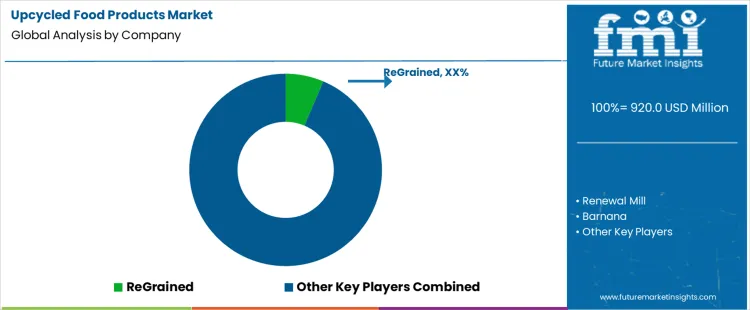
Demand for upcycled food products is driven by food waste reduction mandates, sustainability focused consumers, and circular economy adoption. Buyers evaluate ingredient safety, taste consistency, nutritional value, traceability, regulatory compliance, and alignment with sustainability commitments. Procurement behavior emphasizes transparent sourcing, reliable ingredient streams, scalable processing capability, and clear environmental impact metrics. Purchasing decisions prioritize supplier credibility, brand authenticity, price competitiveness, and compatibility with existing food manufacturing processes. Trend in the upcycled food products market reflects integration into mainstream retail, expansion beyond snacks, and growing acceptance among institutional and private label buyers.
ReGrained leads competitive positioning through early market entry, diversified product formats, and strong alignment with sustainability driven procurement programs. Renewal Mill supports demand by supplying upcycled ingredients enabling food manufacturers to integrate circular inputs into established formulations. Barnana participates through branded snack offerings leveraging rescued agricultural outputs and direct consumer engagement channels. Toast Ale maintains relevance by converting surplus bread into alcoholic beverages with clear waste reduction narratives. Rubies in the Rubble competes through condiment products utilizing surplus produce and partnerships with food service distributors. Competitive logic centers on ingredient access reliability, brand trust, processing scalability, and measurable waste reduction outcomes.
Key Players in the Upcycled Food Products Market
- ReGrained
- Renewal Mill
- Barnana
- Toast Ale
- Rubies in the Rubble
Scope of the Report
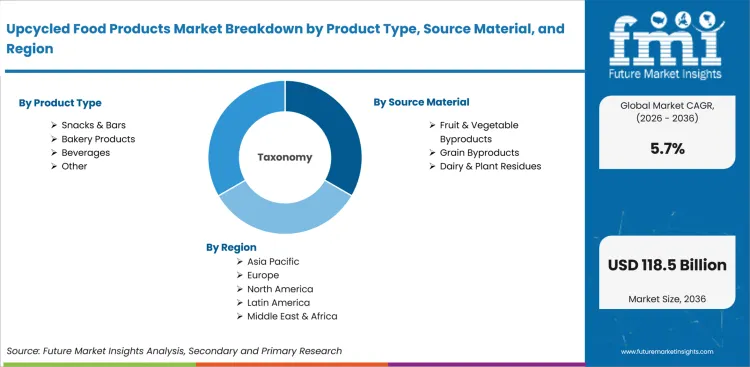
| Items | Values |
|---|---|
| Quantitative Units | USD million |
| Product Type | Snacks & Bars; Bakery Products; Beverages; Other |
| Source Material | Fruit & Vegetable Byproducts; Grain Byproducts; Dairy & Plant Residues; Other |
| Distribution Channel | Retail Stores; Online D2C; Foodservice; Other |
| Regions Covered | Asia Pacific, Europe, North America, Latin America, Middle East & Africa |
| Countries Covered | USA, UK, Germany, France, Japan, and 40+ countries |
| Key Companies Profiled | ReGrained; Renewal Mill; Barnana; Toast Ale; Rubies in the Rubble |
| Additional Attributes | Dollar sales by product type, source material, and distribution channel; ingredient recovery efficiency and consistency of upcycled inputs across fruit, grain, and dairy residues; food safety validation and traceability requirements for byproduct sourcing; formulation stability and shelf life performance; consumer acceptance linked to clean-label positioning; channel mix balancing retail placement, online D2C fulfillment, and foodservice partnerships. |
Upcycled Food Products Market by Segment
Product Type:
- Snacks & Bars
- Bakery Products
- Beverages
- Other
Source Material:
- Fruit & Vegetable Byproducts
- Grain Byproducts
- Dairy & Plant Residues
- Other
Distribution Channel:
- Retail Stores
- Online D2C
- Foodservice
- Other
Region:
- Asia Pacific
- China
- Japan
- South Korea
- India
- Australia & New Zealand
- ASEAN
- Rest of Asia Pacific
- Europe
- Germany
- United Kingdom
- France
- Italy
- Spain
- Nordic
- BENELUX
- Rest of Europe
- North America
- United States
- Canada
- Mexico
- Latin America
- Brazil
- Chile
- Rest of Latin America
- Middle East & Africa
- Kingdom of Saudi Arabia
- Other GCC Countries
- Turkey
- South Africa
- Other African Union
- Rest of Middle East & Africa
Bibliography
- Upcycled Food Association. (2024). Upcycled food industry market update 2024. Upcycled Food Association.
- Food and Agriculture Organization of the United Nations. (2024). Global food loss and waste database update 2024. FAO.
- United States Department of Agriculture. (2024). Food waste reduction and circular food systems report. USDA.
- United States Environmental Protection Agency. (2024). Food recovery hierarchy & waste reduction guidelines. U.S. EPA.
- European Commission. (2024). EU food waste and valorization framework: 2024 progress report. European Commission.
- European Food Safety Authority. (2023). Novel foods and byproduct-derived ingredients guidance update. EFSA.
Frequently Asked Questions
How big is the upcycled food products market in 2026?
The global upcycled food products market is estimated to be valued at USD 68.0 billion in 2026.
What will be the size of upcycled food products market in 2036?
The market size for the upcycled food products market is projected to reach USD 118.5 billion by 2036.
How much will be the upcycled food products market growth between 2026 and 2036?
The upcycled food products market is expected to grow at a 5.7% CAGR between 2026 and 2036.
What are the key product types in the upcycled food products market?
The key product types in upcycled food products market are snacks & bars, bakery products, beverages and other.
Which source material segment to contribute significant share in the upcycled food products market in 2026?
In terms of source material, fruit & vegetable byproducts segment to command 38.0% share in the upcycled food products market in 2026.
Preview the report firsthand - request a free sample
Get SampleGet the brochure for pricing and purchase details.
Get PDFTable of Content
- Executive Summary
- Global Market Outlook
- Demand-side Trends
- Supply-side Trends
- Technology Roadmap Analysis
- Analysis and Recommendations
- Market Overview
- Market Coverage / Taxonomy
- Market Definition / Scope / Limitations
- Market Background
- Market Dynamics
- Drivers
- Restraints
- Opportunity
- Trends
- Scenario Forecast
- Demand in Optimistic Scenario
- Demand in Likely Scenario
- Demand in Conservative Scenario
- Opportunity Map Analysis
- Product Life Cycle Analysis
- Supply Chain Analysis
- Investment Feasibility Matrix
- Value Chain Analysis
- PESTLE and Porter’s Analysis
- Regulatory Landscape
- Regional Parent Market Outlook
- Production and Consumption Statistics
- Import and Export Statistics
- Market Dynamics
- Global Market Analysis 2021 to 2025 and Forecast, 2026 to 2036
- Historical Market Size Value (USD Million) Analysis, 2021 to 2025
- Current and Future Market Size Value (USD Million) Projections, 2026 to 2036
- Y-o-Y Growth Trend Analysis
- Absolute $ Opportunity Analysis
- Global Market Pricing Analysis 2021 to 2025 and Forecast 2026 to 2036
- Global Market Analysis 2021 to 2025 and Forecast 2026 to 2036, By Product Type
- Introduction / Key Findings
- Historical Market Size Value (USD Million) Analysis By Product Type, 2021 to 2025
- Current and Future Market Size Value (USD Million) Analysis and Forecast By Product Type, 2026 to 2036
- Snacks & Bars
- Bakery Products
- Beverages
- Other
- Snacks & Bars
- Y-o-Y Growth Trend Analysis By Product Type, 2021 to 2025
- Absolute $ Opportunity Analysis By Product Type, 2026 to 2036
- Global Market Analysis 2021 to 2025 and Forecast 2026 to 2036, By Source Material
- Introduction / Key Findings
- Historical Market Size Value (USD Million) Analysis By Source Material, 2021 to 2025
- Current and Future Market Size Value (USD Million) Analysis and Forecast By Source Material, 2026 to 2036
- Fruit & Vegetable Byproducts
- Grain Byproducts
- Dairy & Plant Residues
- Other
- Fruit & Vegetable Byproducts
- Y-o-Y Growth Trend Analysis By Source Material, 2021 to 2025
- Absolute $ Opportunity Analysis By Source Material, 2026 to 2036
- Global Market Analysis 2021 to 2025 and Forecast 2026 to 2036, By Distribution Channel
- Introduction / Key Findings
- Historical Market Size Value (USD Million) Analysis By Distribution Channel, 2021 to 2025
- Current and Future Market Size Value (USD Million) Analysis and Forecast By Distribution Channel, 2026 to 2036
- Retail Stores
- Online D2C
- Foodservice
- Other
- Retail Stores
- Y-o-Y Growth Trend Analysis By Distribution Channel, 2021 to 2025
- Absolute $ Opportunity Analysis By Distribution Channel, 2026 to 2036
- Global Market Analysis 2021 to 2025 and Forecast 2026 to 2036, By Region
- Introduction
- Historical Market Size Value (USD Million) Analysis By Region, 2021 to 2025
- Current Market Size Value (USD Million) Analysis and Forecast By Region, 2026 to 2036
- North America
- Latin America
- Western Europe
- Eastern Europe
- East Asia
- South Asia and Pacific
- Middle East & Africa
- Market Attractiveness Analysis By Region
- North America Market Analysis 2021 to 2025 and Forecast 2026 to 2036, By Country
- Historical Market Size Value (USD Million) Trend Analysis By Market Taxonomy, 2021 to 2025
- Market Size Value (USD Million) Forecast By Market Taxonomy, 2026 to 2036
- By Country
- USA
- Canada
- Mexico
- By Product Type
- By Source Material
- By Distribution Channel
- By Country
- Market Attractiveness Analysis
- By Country
- By Product Type
- By Source Material
- By Distribution Channel
- Key Takeaways
- Latin America Market Analysis 2021 to 2025 and Forecast 2026 to 2036, By Country
- Historical Market Size Value (USD Million) Trend Analysis By Market Taxonomy, 2021 to 2025
- Market Size Value (USD Million) Forecast By Market Taxonomy, 2026 to 2036
- By Country
- Brazil
- Chile
- Rest of Latin America
- By Product Type
- By Source Material
- By Distribution Channel
- By Country
- Market Attractiveness Analysis
- By Country
- By Product Type
- By Source Material
- By Distribution Channel
- Key Takeaways
- Western Europe Market Analysis 2021 to 2025 and Forecast 2026 to 2036, By Country
- Historical Market Size Value (USD Million) Trend Analysis By Market Taxonomy, 2021 to 2025
- Market Size Value (USD Million) Forecast By Market Taxonomy, 2026 to 2036
- By Country
- Germany
- UK
- Italy
- Spain
- France
- Nordic
- BENELUX
- Rest of Western Europe
- By Product Type
- By Source Material
- By Distribution Channel
- By Country
- Market Attractiveness Analysis
- By Country
- By Product Type
- By Source Material
- By Distribution Channel
- Key Takeaways
- Eastern Europe Market Analysis 2021 to 2025 and Forecast 2026 to 2036, By Country
- Historical Market Size Value (USD Million) Trend Analysis By Market Taxonomy, 2021 to 2025
- Market Size Value (USD Million) Forecast By Market Taxonomy, 2026 to 2036
- By Country
- Russia
- Poland
- Hungary
- Balkan & Baltic
- Rest of Eastern Europe
- By Product Type
- By Source Material
- By Distribution Channel
- By Country
- Market Attractiveness Analysis
- By Country
- By Product Type
- By Source Material
- By Distribution Channel
- Key Takeaways
- East Asia Market Analysis 2021 to 2025 and Forecast 2026 to 2036, By Country
- Historical Market Size Value (USD Million) Trend Analysis By Market Taxonomy, 2021 to 2025
- Market Size Value (USD Million) Forecast By Market Taxonomy, 2026 to 2036
- By Country
- China
- Japan
- South Korea
- By Product Type
- By Source Material
- By Distribution Channel
- By Country
- Market Attractiveness Analysis
- By Country
- By Product Type
- By Source Material
- By Distribution Channel
- Key Takeaways
- South Asia and Pacific Market Analysis 2021 to 2025 and Forecast 2026 to 2036, By Country
- Historical Market Size Value (USD Million) Trend Analysis By Market Taxonomy, 2021 to 2025
- Market Size Value (USD Million) Forecast By Market Taxonomy, 2026 to 2036
- By Country
- India
- ASEAN
- Australia & New Zealand
- Rest of South Asia and Pacific
- By Product Type
- By Source Material
- By Distribution Channel
- By Country
- Market Attractiveness Analysis
- By Country
- By Product Type
- By Source Material
- By Distribution Channel
- Key Takeaways
- Middle East & Africa Market Analysis 2021 to 2025 and Forecast 2026 to 2036, By Country
- Historical Market Size Value (USD Million) Trend Analysis By Market Taxonomy, 2021 to 2025
- Market Size Value (USD Million) Forecast By Market Taxonomy, 2026 to 2036
- By Country
- Kingdom of Saudi Arabia
- Other GCC Countries
- Turkiye
- South Africa
- Other African Union
- Rest of Middle East & Africa
- By Product Type
- By Source Material
- By Distribution Channel
- By Country
- Market Attractiveness Analysis
- By Country
- By Product Type
- By Source Material
- By Distribution Channel
- Key Takeaways
- Key Countries Market Analysis
- USA
- Pricing Analysis
- Market Share Analysis, 2025
- By Product Type
- By Source Material
- By Distribution Channel
- Canada
- Pricing Analysis
- Market Share Analysis, 2025
- By Product Type
- By Source Material
- By Distribution Channel
- Mexico
- Pricing Analysis
- Market Share Analysis, 2025
- By Product Type
- By Source Material
- By Distribution Channel
- Brazil
- Pricing Analysis
- Market Share Analysis, 2025
- By Product Type
- By Source Material
- By Distribution Channel
- Chile
- Pricing Analysis
- Market Share Analysis, 2025
- By Product Type
- By Source Material
- By Distribution Channel
- Germany
- Pricing Analysis
- Market Share Analysis, 2025
- By Product Type
- By Source Material
- By Distribution Channel
- UK
- Pricing Analysis
- Market Share Analysis, 2025
- By Product Type
- By Source Material
- By Distribution Channel
- Italy
- Pricing Analysis
- Market Share Analysis, 2025
- By Product Type
- By Source Material
- By Distribution Channel
- Spain
- Pricing Analysis
- Market Share Analysis, 2025
- By Product Type
- By Source Material
- By Distribution Channel
- France
- Pricing Analysis
- Market Share Analysis, 2025
- By Product Type
- By Source Material
- By Distribution Channel
- India
- Pricing Analysis
- Market Share Analysis, 2025
- By Product Type
- By Source Material
- By Distribution Channel
- ASEAN
- Pricing Analysis
- Market Share Analysis, 2025
- By Product Type
- By Source Material
- By Distribution Channel
- Australia & New Zealand
- Pricing Analysis
- Market Share Analysis, 2025
- By Product Type
- By Source Material
- By Distribution Channel
- China
- Pricing Analysis
- Market Share Analysis, 2025
- By Product Type
- By Source Material
- By Distribution Channel
- Japan
- Pricing Analysis
- Market Share Analysis, 2025
- By Product Type
- By Source Material
- By Distribution Channel
- South Korea
- Pricing Analysis
- Market Share Analysis, 2025
- By Product Type
- By Source Material
- By Distribution Channel
- Russia
- Pricing Analysis
- Market Share Analysis, 2025
- By Product Type
- By Source Material
- By Distribution Channel
- Poland
- Pricing Analysis
- Market Share Analysis, 2025
- By Product Type
- By Source Material
- By Distribution Channel
- Hungary
- Pricing Analysis
- Market Share Analysis, 2025
- By Product Type
- By Source Material
- By Distribution Channel
- Kingdom of Saudi Arabia
- Pricing Analysis
- Market Share Analysis, 2025
- By Product Type
- By Source Material
- By Distribution Channel
- Turkiye
- Pricing Analysis
- Market Share Analysis, 2025
- By Product Type
- By Source Material
- By Distribution Channel
- South Africa
- Pricing Analysis
- Market Share Analysis, 2025
- By Product Type
- By Source Material
- By Distribution Channel
- USA
- Market Structure Analysis
- Competition Dashboard
- Competition Benchmarking
- Market Share Analysis of Top Players
- By Regional
- By Product Type
- By Source Material
- By Distribution Channel
- Competition Analysis
- Competition Deep Dive
- ReGrained
- Overview
- Product Portfolio
- Profitability by Market Segments (Product/Age /Sales Channel/Region)
- Sales Footprint
- Strategy Overview
- Marketing Strategy
- Product Strategy
- Channel Strategy
- Renewal Mill
- Barnana
- Toast Ale
- Rubies in the Rubble
- ReGrained
- Competition Deep Dive
- Assumptions & Acronyms Used
- Research Methodology


