

- Market Size (2026)
- USD 154.8 Mn
- Forecast (2036)
- USD 272.0 Mn
- CAGR (2026 to 2036)
- 5.8%
Upcycled Citrus Peel Fiber Concentrates Market Size, Market Forecast and Outlook By FMI
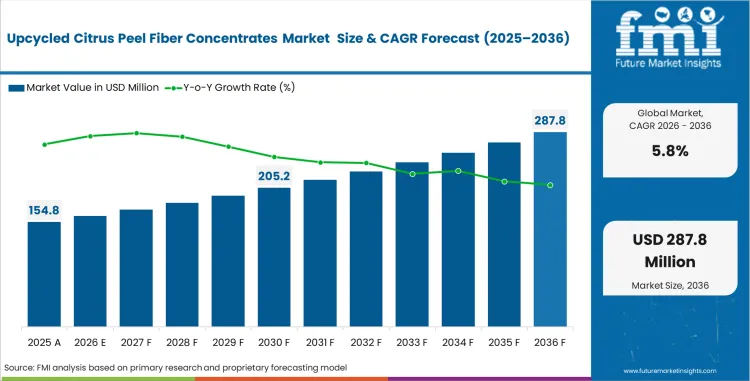
The upcycled citrus peel fiber concentrates market was valued at USD 146.3 million in 2025. Demand is poised to cross USD 154.8 million in 2026, expanding at a 5.8% CAGR during the projection period. The market is projected to reach USD 272.0 million by 2036, as food manufacturers in bakery and sauces increasingly evaluate peel-derived texturizers where they can simplify ingredient labels without compromising moisture management or texture performance.
Summary of Upcycled Citrus Peel Fiber Concentrates Market
- Market Snapshot
- The upcycled citrus peel fiber concentrates market is estimated at USD 146.3 million in 2025 and is projected to reach USD 272.0 million by 2036.
- The market is expected to expand at a CAGR of 5.8% from 2026 to 2036, adding USD 117.2 million in value over the forecast period.
- This is a narrower market than the broader citrus fiber category often cited in commercial sources, because the focus here is specifically on food-grade concentrates produced from upcycled citrus peel.
- Market scope is limited mainly to peel streams recovered from juice processing and does not include commodity citrus pulp or lower-value residue streams.
- Demand and Growth Drivers
- Demand is rising as food manufacturers look for ingredients that can bind water, improve mouthfeel, support texture, and help keep ingredient labels short and familiar.
- Interest is also growing because citrus processors and ingredient companies are under greater pressure to recover more value from peel side streams instead of treating them as low-value output.
- Orange remains the leading raw material source because large-scale orange processing generates the most commercially accessible peel stream for food-grade fiber concentrate production.
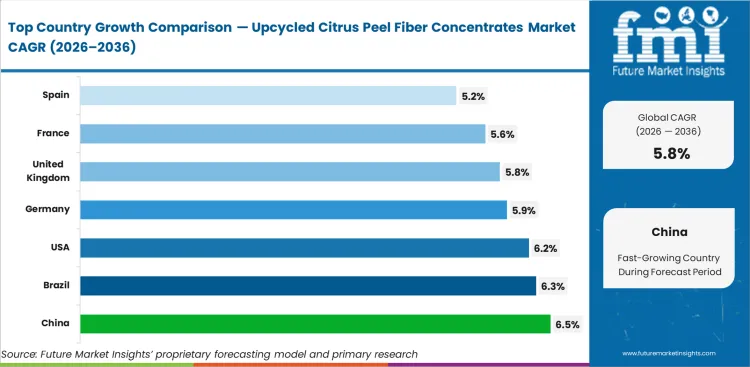
- Among key countries, China is projected to grow at 6.5% CAGR from 2026 to 2036, followed by Brazil at 6.3%, the United States at 6.2%, Germany at 5.9%, the United Kingdom at 5.8%, France at 5.6%, and Spain at 5.2%.
- Growth is held back by the fact that a large share of citrus peel still moves into pectin extraction, feed use, or lower-value local outlets rather than food-grade fiber concentration.
- Product and Segment View
- The market covers citrus-peel-derived fiber concentrates used mainly as texturizers, stabilizers, fat replacers, and fiber-enrichment ingredients in industrial food applications.
- Commercial use is concentrated in bakery products, sauces, dairy alternatives, meat products, beverages, and plant-based formulations.
- Powder remains the main commercial format because it fits standard industrial batching, mixing, transport, and dosing systems.
- Orange leads the source segment and is expected to account for 44.0% of the market in 2026, supported by its larger production and processing base.
- Texturizers lead the function segment with a 34.0% share in 2026, as texture control and moisture management remain the strongest commercial use case for citrus fiber concentrates.
- Bakery leads the application segment and is projected to account for 29.0% share in 2026, driven by fat reduction, moisture retention, crumb stability, and clean-label formulation needs.
- Powder leads the form segment with a projected 72.0% share in 2026, reflecting how most citrus fiber is supplied and handled in business-to-business ingredient channels.
- Food processors lead the end use segment and are expected to hold 83.0% share in 2026, since direct industrial formulation remains the main route to market.
- Scope includes food-grade peel fiber concentrates and multifunctional citrus-fiber systems, but excludes feed-grade citrus pulp, stand-alone pectin markets, cosmetic-only citrus fibers, and broader citrus by-product utilization categories.
- Geography and Competitive Outlook
- China, Brazil, and the United States are expected to remain the fastest-growing country markets over the forecast period.
- Germany, the United Kingdom, and France remain important demand centers tied to premium reformulation activity and clean-label product development.
- Competition is developing as ingredient suppliers expand citrus fiber portfolios and strengthen their position in specialty texturizing systems.
- Market structure remains fragmented, with a few leading suppliers, indicating a niche ingredient space served by a mix of global and regional suppliers.
Key Takeaways, Market Size, and Forecast
- Upcycled Citrus Peel Fiber Concentrates Market is projected to grow from USD 154.8 million in 2026 to USD 272.0 million by 2036, at a CAGR of 5.8%.
- The upcycled citrus peel fiber concentrates market was valued at USD 146.3 million in 2025.
- By 2036, the Upcycled Citrus Peel Fiber Concentrates Market is expected to be worth USD 272.0 million.
- From 2026 to 2036, the market is projected to expand at a CAGR of 5.8%.
- The market is projected to create an incremental opportunity of USD 117.2 million between 2026 and 2036.
- In 2026, Orange is expected to account for 44.0% of the source segment.
- China (6.5%) and Brazil (6.3%) are two of the fastest growing markets.
Upcycled citrus fiber concentrates are gaining traction as food manufacturers look for ingredients that can solve formulation problems while also making better use of processing waste. Peel streams from oranges, lemons, limes, and mandarins are now being converted into fiber-rich concentrates that help manage moisture, improve texture, replace part of the fat phase, and raise fiber content in finished products. That combination gives the category a practical role in both waste recovery and clean-label product development.
Demand is strongest in bakery products, sauces, dairy alternatives, processed meat applications, and plant-based formulations, where texture control and label simplicity matter at the same time. Manufacturers in these categories value ingredients that can perform more than one function without pushing formulations toward longer or more chemical-sounding ingredient statements. Powder remains the leading commercial format because it fits easily into standard industrial batching, mixing, and dosing systems.
Growth is driven by a stronger push to generate more value from food processing side streams, particularly as citrus processors and ingredient manufacturers look for ways to cut waste and build better-margin secondary products. Adoption is improving as suppliers publish more application results and show where citrus fiber can replace modified starches, gums, and similar texturizing systems without disrupting product performance. Cost, fiber recovery yield, and batch-to-batch food-grade consistency still limit production growth. Despite supply and consistency constraints, adoption is improving because food manufacturers are prioritizing multifunctional ingredients that support cleaner label positioning, waste-stream valorization, and formulation efficiency.
China is expected to register a 6.5% CAGR during the forecast period, due to domestic juice processors maximizing side-stream value recovery. The United States is projected to expand at a 6.2% CAGR over the forecast period, supported by retailer scrutiny of additive-heavy labels and continued formulation activity in bakery, sauces, and plant-based applications. Growth in Brazil is poised to expand at a 6.3% CAGR, Germany at 5.9% CAGR, United Kingdom at 5.8% CAGR, France and Spain at a 5.6% and 5.2% CAGR respectively.
Upcycled Citrus Peel Fiber Concentrates Market Key Takeaways
| Metric | Details |
|---|---|
| Industry Size (2026) | USD 154.8 million |
| Industry Value (2036) | USD 272.0 million |
| CAGR (2026 to 2036) | 5.8% |
Source: Future Market Insights (FMI) analysis, based on proprietary forecasting model and primary research
Segmental Analysis
Upcycled Citrus Peel Fiber Concentrates Market Analysis by Source
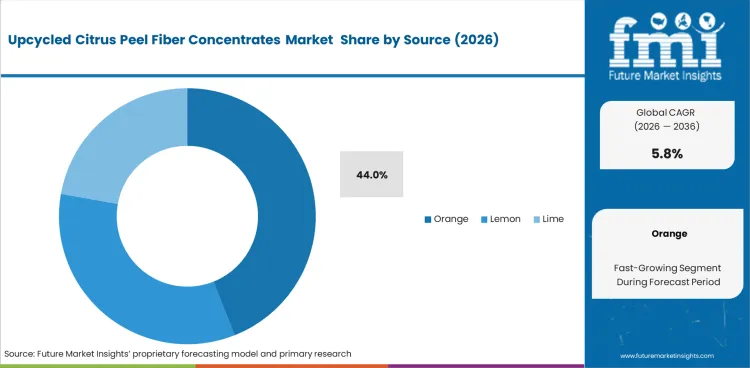
Large-scale orange juice processing creates a dependable peel supply across leading production hubs, giving suppliers a more stable raw material base than smaller citrus streams usually provide. That commercial scale makes ingredient replacement easier in moisture-sensitive formulations, since manufacturers can shift away from modified starches without disrupting established production practices. The orange segment is expected to hold 44.0% revenue share in 2026. Leadership of this segment comes from the breadth of global orange juice production, steady peel generation for fiber recovery, and well-established processing systems that keep extraction costs lower than several other citrus sources. Higher water-binding efficiency than many alternative citrus varieties, along with broad regulatory acceptance of orange-derived dietary fibers across major food safety markets, also supports wider use in commercial food applications. Performance can still vary between early-season and late-season peel lots, so purchasing agreements need precise viscosity specifications to avoid texture variation across finished food products.
- Initial formulation trigger: Product development teams reviewing clean-label options often begin with orange-derived concentrates because water-holding performance is strong and commercial-use behavior remains consistent in complex food systems. Existing production lines also benefit from a natural alternative to synthetic dough conditioners that works effectively in standard high-speed mixing environments without major equipment changes.
- Pilot qualification testing: Quality assurance teams review lot-to-lot viscosity, hydration behavior, and flavor neutrality in depth before approving a full ingredient shift across commercial product lines. Supply continuity also matters throughout this stage, since poor control over seasonal variation can introduce bitterness and weaken sensory stability in delicate finished applications.
- Contract renewal drivers: Consistent performance across repeated commercial-scale production runs strengthens supplier retention and supports longer purchase relationships across established ingredient accounts. Orange peel fiber also simplifies formulations by replacing several single-function additives used for structure, moisture retention, and texture balance in processed foods.
Upcycled Citrus Peel Fiber Concentrates Market Analysis by Function
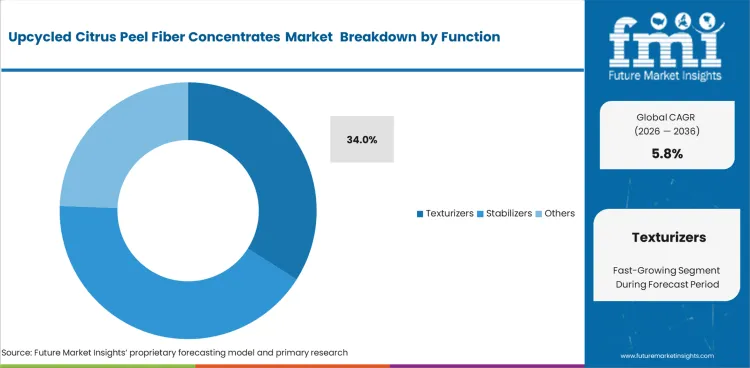
Formulation scientists rely on specific food stabilizers to manage free water and prevent syneresis in complex matrices like commercial sauces and dairy alternatives. Rising and volatile cost of synthetic hydrocolloid alternatives, and shear-stability these natural cellular networks provide during high-speed industrial homogenization are factors driving product adoption. Selecting high-shear stable peel texturizers maintains emulsion integrity without utilizing chemical agents. The texturizers segment is estimated to account for 34.0% revenue share in 2026, supported by strong demand for moisture management in shelf-life-sensitive bakery products and for free-water control in plant-based dairy alternatives. Texturizing capability drops severely if suppliers over-process the peel materials, as aggressive milling destroys the native cellular sponge structures required to trap water effectively.
- High-shear resilience: Specialized citrus texturizers maintain their complex cellular structures even under intense mechanical processing environments. In demanding plant-based beverage applications, formulation engineers can achieve stable, long-lasting emulsions by evaluating citrus fiber against modified starch. These successful results can be obtained without using secondary chemical stabilizers, thus avoiding clean-label rejections.
- Temperature abuse limits: Certain lower-grade concentrate products lose their water-binding efficacy entirely when subjected to repeated freeze-thaw cycles in commercial distribution. Product weeping and texture loss can increase if the selected fibers cannot handle routine thermal stress across commercial distribution.
- Particle size qualification: Exact milling specifications strictly determine the final mouthfeel in premium consumer applications. Ultra-fine powder formats are often preferred for dairy alternatives, as larger particle distributions can create gritty textures that weaken product acceptance.
Upcycled Citrus Peel Fiber Concentrates Market Analysis by Application
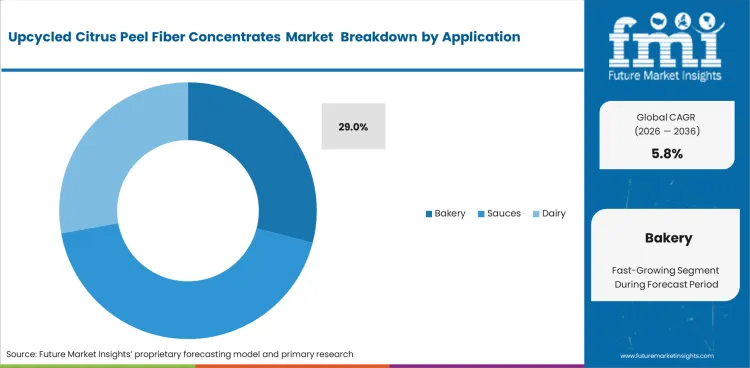
Industrial bakeries compare the price of premium functional ingredients with the steady spoilage losses seen in packaged breads and pastries. The bakery segment is expected to hold 29.0% revenue share in 2026, supported by wide commercial use. Strong adoption comes from retailer pressure to replace chemical dough conditioners, improve softness, lower egg costs, and reduce stale returns. Commercial bakeries use citrus fiber to slow moisture loss and support softer texture across longer shelf-life bakery products. Many industrial bakeries use upcycled citrus fiber at very low levels, mainly as a processing aid for better production yield.
- Egg and oil replacement: Citrus fiber supports reliable partial removal of costly liquid fats and eggs in large-scale cake and muffin batter production. Procurement teams save on raw materials while keeping crumb texture and eating quality at levels expected in bakery products.
- Yield retention scaling: High water-binding capacity of concentrated peel raises final baked dough weight after oven processing in industrial facilities. Plant managers gain more finished-product yield per batch, lifting margins and improving profitability in large bakeries.
- Stale-return reduction: Longer moisture retention slows the hardening and drying of bread crumbs during storage across commercial distribution systems. Logistics teams face fewer expired or stale returns from grocery retail partners, protecting profitability and lowering food waste exposure.
Upcycled Citrus Peel Fiber Concentrates Market Analysis by Form
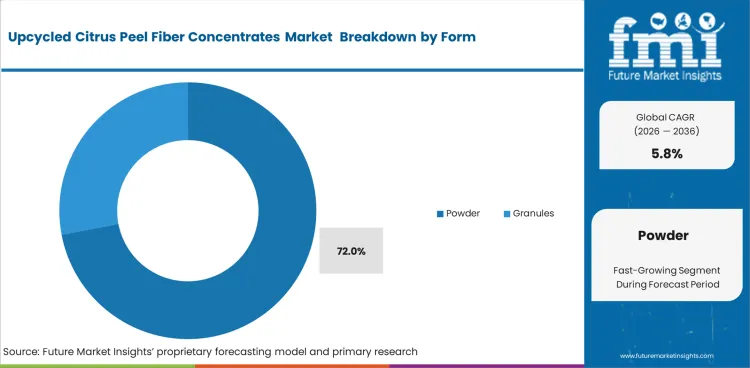
Ingredient blending teams need dry, free-flowing formats that work with existing pneumatic conveying lines and automated dry-mix systems. Longer shelf stability than wet or granular options, along with lower freight cost from reduced water mass, supports powder uptake. Suppliers also carry high drying expense during conversion of wet citrus residue into stable powder, so regional energy pricing affects margin and sourcing decisions. Larger granular grades may reduce unit cost, yet mixing often takes longer and hydration remains less uniform. In 2026, powder is projected to secure 72.0% share of market, supported by smoother dosing in automated systems and better control over lump formation during industrial wet-out.
- Hydration lumping prevention: Properly milled and agglomerated citrus powders disperse fast and evenly in commercial liquid phases. Production teams reduce dry-core lump formation and gain more uniform functional performance across full batch runs.
- Flowability constraints: Poorly processed powders may bridge or rat-hole inside large storage silos, disrupting output and slowing line efficiency. Precise moisture limits and flow standards in purchase agreements help prevent blockages in automated dosing equipment.
- Dusting hazard mitigation: Very fine powder grades can create airborne particulate during manual dumping on factory floors. Proper ventilation, enclosed transfer practices, and disciplined handling routines reduce respiratory exposure and support facility safety compliance.
Upcycled Citrus Peel Fiber Concentrates Market Analysis by End Use
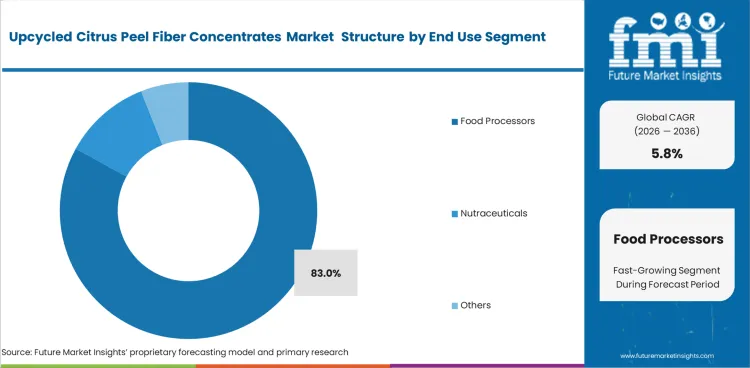
Large food manufacturers aim to remove intermediate blending stages in order to protect margin and keep formulation control close to production. The food processors segment is anticipated to account for 83.0% of the market in 2026, reflecting the fact that direct industrial formulation remains the primary commercialization route. Direct purchasing from primary fiber extractors supports lower blended cost and gives processors tighter control over texture performance in proprietary products. Scale also matters, since dedicated supply lines and pilot-scale validation require purchasing strength and technical resources that smaller buyers often lack. Brands relying on secondary blenders for core texturizers give up part of both margin and formulation flexibility.
- Enterprise validation tier: Global food companies often lead early adoption because internal R&D resources and pilot capacity support faster functional food qualification. Initial proof of concept for replacement of legacy synthetic hydrocolloids often starts at this level and shapes broader market confidence.
- Mid-market fast followers: Regional processors often move in after performance is proven at commercial scale. Existing supply lines and application data reduce early development risk and make label upgrades easier to justify.
- Co-manufacturing integration: Contract manufacturers increasingly adopt citrus fiber across shared production assets in order to serve varied client recipes with fewer changeovers. Reliable shear-stable powders support broader use across multiple formulations on one line.
Upcycled Citrus Peel Fiber Concentrates Market Drivers, Restraints, and Opportunities
Retailer and consumer preference for simpler ingredient declarations is increasing pressure on R&D teams to evaluate natural texturizers in place of more synthetic-sounding systems. In many food categories, clean-label positioning is shifting from a premium differentiator to a broader formulation expectation. Legacy pectin or modified starch systems cannot simply disappear from formulations, since moisture control and water binding remain central to sauce stability and baked-good texture. Upcycled citrus peel concentrates offer functional support for product integrity while also aligning with sustainability sourcing goals. Delay in reformulation raises exposure to sudden supplier shifts and retailer rejection, increasing cost and pressure during late-stage product revision.
Food-grade concentrate production also depends on specialized extraction and drying assets, and that limits total available supply. Conversion of wet, perishable side streams into stable, flavor-neutral, low fermentability dietary fiber requires major capital commitment. Many standard juice plants still route peel residue into animal feed or conventional pectin recovery because legacy routes demand less equipment specialization and less hygiene control. Diversion of raw material tightens availability for functional citrus peel fiber and leaves supply more exposed to crop disruption in key producing regions.
Opportunities in the Upcycled Citrus Peel Fiber Concentrates Market
- Meat-analogue structuring: Plant-based meat formulators need binders that retain performance under high cooking temperatures. Citrus peel fiber supports fat and moisture retention inside extruded vegetable protein systems and strengthens clean-label positioning.
- Clean-label dairy emulsification: Yogurt and cream cheese often rely on synthetic stabilizers for texture retention across long shelf life. Specialized fibers and related carbohydrates can support creamy mouthfeel while reducing reliance on chemical-sounding ingredients.
- Gluten-free baking optimization: Gluten removal weakens dough elasticity and reduces moisture retention. Upcycled citrus peel systems help rebuild structure, limit rapid staling, and reduce crumbling across alternative grain applications.
Regional Analysis
Based on regional analysis, the upcycled citrus peel fiber concentrates market is segmented into North America, Europe, Asia Pacific, Latin America, and Middle East & Africa, across 40 plus countries.
.webp "Top Country Growth Comparison Upcycled Citrus Peel Fiber Concentrates Market Cagr (2026 2036)")
| Country | CAGR (2026 to 2036) |
|---|---|
| China | 6.5% |
| Brazil | 6.3% |
| United States | 6.2% |
| Germany | 5.9% |
| United Kingdom | 5.8% |
| France | 5.6% |
| Spain | 5.2% |
Source: Future Market Insights (FMI) analysis, based on proprietary forecasting model and primary research
Asia Pacific Upcycled Citrus Peel Fiber Concentrates Market Analysis
Asia Pacific stands out because it offers a stronger link between citrus side-stream recovery and new ingredient manufacturing capacity. In this region, the market question is not only about reformulation demand but also about whether processors can turn peel disposal into a higher-value food-grade output. That creates a commercially different profile from demand-led Western markets. Buyers should watch processor modernization, drying and standardization capability, and the emergence of regional supply clusters tied to orange and mandarin processing. Where those capabilities improve, the region becomes more attractive for both local use and export-oriented powder supply. Asia Pacific also benefits from growing interest in cleaner labels across bakery, beverages, and dairy-alternative foods. For suppliers and investors, the region offers upside where waste valorization and ingredient commercialization advance together rather than separately.
- China: Country is projected to witness 6.5% CAGR in the upcycled citrus peel fiber concentrates market from 2026 to 2036. Growth stems from public support for agricultural residue valorization, broad domestic juice-processing capacity, and easier access to citrus side streams suitable for fiber extraction. Urban food categories also continue to create room for clean-label bakery, beverage, and dairy-alternative products that need reliable moisture control and texture support. Local sourcing brings an added cost-in-use advantage for major food manufacturers, since nearby supply can reduce import exposure, shorten replenishment cycles, and support better coordination between extraction plants and downstream formulators. China also benefits from a large manufacturing base able to absorb new functional ingredients across multiple food categories, giving suppliers a broader outlet for commercial scale-up and application development.
FMI's report includes a detailed analysis of Japan and South Korea. Market conditions across both advanced economies favor imported specialty fiber grades because domestic citrus cultivation remains limited and food manufacturers often need tightly specified ingredients for premium formulations.
Latin America Upcycled Citrus Peel Fiber Concentrates Market Analysis
Orange-processing dynamics shape commercial conditions across Latin America. Regional facilities generate very large volumes of wet peel residue, giving the area a strong raw-material base for upcycled fiber production. Movement from basic disposal or low-value outlet streams into food-grade recovery remains uneven, since sanitary drying, milling, and stabilization systems require meaningful capital commitment at older juice plants. Buyers sourcing from Latin America need close visibility into orange harvest patterns, seasonal weather disruption, and plant-level modernization activity, since each factor influences raw peel availability and output consistency. Regional appeal remains high because access to citrus side streams is broader than in many other markets, and established juice infrastructure provides a natural starting point for ingredient recovery. Commercial upside also rises as more processors seek added value from peel streams rather than relying only on feed, waste handling, or conventional pectin routes.
- Brazil: Long-term supply contracts secured by global ingredient blenders, along with modernization across domestic food manufacturing seeking functional clean-label inputs, continue to support adoption in Brazil. Sales of upcycled citrus peel fiber concentrates in Brazil are expected to increase at a CAGR of 6.3% during the forecast period. Expansion is based on Brazil’s standing as the leading global orange juice processor, giving local extractors deep feedstock access and stronger scale economics than most competing supply regions. Ongoing investment in sanitary drying and fiber handling capacity also improves suitability for food-grade applications. Large raw-material volume gives ingredient suppliers an opening to secure multi-year capacity and build steadier relationships with international buyers seeking dependable access to citrus fiber. Early commercial partnerships in Brazil can also improve price stability, reduce sourcing uncertainty, and create a stronger base for downstream blending, texturizing, and formulation programs.
FMI's report includes granular data on Argentina and Mexico. Both secondary processing hubs add useful redundancy for North American buyers seeking broader sourcing coverage outside primary Brazilian supply channels.
North America Upcycled Citrus Peel Fiber Concentrates Market Analysis
North America matters because it combines strong reformulation pressure with the technical infrastructure needed to qualify specialty texturizers quickly. Retail scrutiny of additive-heavy labels is pushing food manufacturers to revisit legacy stabilizer systems, particularly in bakery, sauces, plant-based dairy, and meat alternatives. The region also offers a commercially important advantage: mature pilot-testing, blending, and formula-optimization capability. That lowers the adoption barrier for citrus fiber concentrates compared with markets where application support is weaker. For buyers, the opportunity is less about raw-material abundance and more about conversion into approved commercial recipes. Suppliers that can demonstrate high-shear stability, hydration control, and sensory fit are better placed to win processor business. North America is therefore strategically important as a demand-led market where clean-label pressure and technical readiness reinforce each other.
- United States: Upcycled citrus peel fiber concentrates adoption in the United States is likely to advance at a CAGR of 6.2% by 2036. Expansion is supported by stronger clean-label standards across premium grocery channels, continued growth in plant-based dairy and meat-alternative categories, and rising interest in natural binders able to preserve viscosity and water control under industrial processing conditions. Additional support comes from domestic R&D investment aimed at removing dough conditioners and legacy stabilizers from commercial recipes. Imported concentrates can also move into established blending and ingredient-preparation systems with relatively limited disruption, improving practical uptake. Pilot-scale validation remains essential for processors replacing long-used synthetic systems. Citrus fibers still need to prove stability under high-shear mixing, thermal variation, and storage conditions before wider rollout. Commercial success in the United States often depends on a supplier’s ability to pair ingredient performance with detailed application guidance, sensory fit, and repeatable hydration behavior.
FMI's report includes comprehensive assessments of Canadian landscapes. Regulatory alignment across Canada and the United States supports broader use of similar clean-label fiber systems across shared retail and manufacturing networks.
Europe Upcycled Citrus Peel Fiber Concentrates Market Analysis
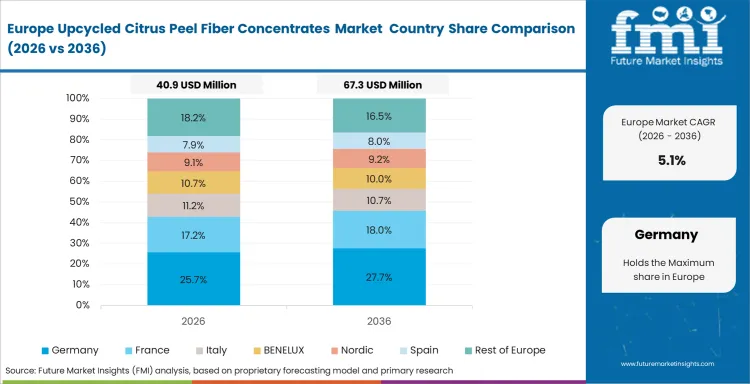
Europe is strategically important because sustainability expectations and formulation standards converge more tightly here than in many other regions. Buyers are not only evaluating whether an ingredient is upcycled; they are also testing whether it meets demanding requirements for mouthfeel, hydration profile, particle size, and label acceptance in premium products. That makes Europe a higher-specification market, especially in bakery, sauces, dairy alternatives, and selected meat applications. Regional citrus processing exists, but supply is more constrained and uneven than in major juice-exporting geographies, so buyers often prioritize dependable functional performance over lowest-cost bulk availability. Commercial success in Europe therefore depends on technical precision and consistency. Suppliers that can combine circular-economy relevance with reliable performance per kilogram are better placed to access premium formulation programs and longer-term processor relationships.
- Germany: Demand for upcycled citrus peel fiber concentrates in Germany is anticipated to rise at a CAGR of 5.9% through 2036. Growth reflects national emphasis on circular-economy practices, a well-developed plant-based food sector, and rising need for stable texturizers suited to clean-label product design. Consumer attention to ingredient declarations also supports movement toward peel-derived functionality in premium food categories. Commercial uptake in Germany gains added support from technical validation capabilities across food manufacturing, allowing processors to test citrus fiber against legacy hydrocolloids in a disciplined manner before larger rollout. Strong bakery and dairy-alternative activity further supports demand, since both segments rely on dependable moisture management and texture retention under commercially relevant storage and handling conditions.
- United Kingdom: Corporate sourcing commitments around sustainability, combined with solid formulation expertise across the domestic bakery segment, are lifting adoption across the United Kingdom. The market for upcycled citrus peel fiber concentrates in the United Kingdom is expected to grow at a CAGR of 5.8% during the study period. Major supermarket groups continue to raise clean-label expectations for contract manufacturers, while premium chilled categories maintain demand for natural moisture-management systems that preserve texture over shelf life. Successful use of citrus fiber helps local brands compete in value-added chilled grocery applications without depending on artificial stabilizers. Added traction also comes from continued innovation in prepared foods, convenience meals, and premium bakery lines, all of them requiring ingredients able to support label simplicity and functional reliability at the same time.
- France: upcycled citrus peel fiber concentrates adoption in France is likely to advance at a CAGR of 5.6% by 2036. Progress reflects strong consumer preference for natural ingredients, limited tolerance for chemical-sounding additives, and steady demand for cleaner formulations across sauces, dressings, and premium prepared foods. Retail price premiums associated with more natural positioning add support for peel-derived stabilizers, especially in food categories tied to sensory quality and ingredient transparency. Category teams moving toward citrus-based systems can improve label appeal while also maintaining functional performance in moisture-sensitive products. France also offers a commercially relevant base for suppliers able to combine culinary fit, clean-label positioning, and reliable batch consistency in formats suited to premium food manufacturing.
- Spain: upcycled citrus peel fiber concentrates sales in Spain are poised to grow at a CAGR of 5.2% during the assessment period. Growth is linked to local citrus-processing expertise, continued demand for natural fat-management and texturizing solutions, and rising pressure on extractors to improve yield from available peel streams. Commercial conditions remain more complex because orange availability can tighten and larger South American suppliers often operate with stronger scale advantages in bulk output. Even so, Spain retains importance through established know-how in ingredient extraction and closer ties to European food manufacturing demand. Efficiency in drying, milling, and functional standardization remains central to competitiveness, especially for suppliers targeting premium applications rather than commodity channels. Domestic processed meat and prepared-food segments also add useful demand support for fiber systems offering moisture retention and texture improvement.
FMI's report includes a detailed analysis of Italy and Benelux regions. Both areas serve as important import, blending, and distribution centers for specialized texturizers moving across the broader European Union.
Competitive Aligners for Market Players
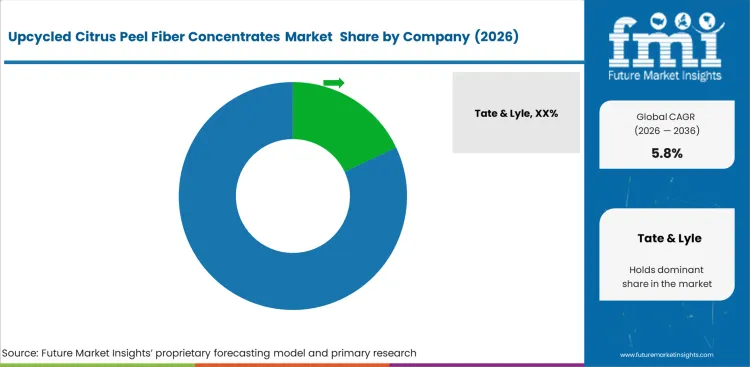
Supplier competition in upcycled citrus fiber concentrates is shaped primarily by functional performance, lot-to-lot consistency, and application support, rather than by unit cost alone. Purchasing personnel evaluating citrus fiber ingredient suppliers focus on lot-to-lot functional consistency, difficult operational metric to maintain when raw orange peel naturally varies by harvest season and regional climate. The ability to deliver specific viscosity profiles turns low-value agricultural waste into essential ingredients for major global food brands.
Established ingredient suppliers hold an advantage where they already have drying infrastructure, food-grade processing controls, and global distribution capabilities that support scale-up across multinational food accounts. Companies trying to gain citrus fiber share need advanced milling and non-chemical washing methods to deliver the flavor neutrality required for delicate food applications.
Key Players in the Upcycled Citrus Peel Fiber Concentrates Market
- Tate & Lyle
- Fiberstar, Inc.
- Ingredion Incorporated
- Cargill, Incorporated
- Herbafood Ingredients GmbH
- JRS Silvateam Ingredients S.r.l.
- CEAMSA
Scope of the Report
| Metric | Value |
|---|---|
| Quantitative Units | USD 154.8 million to USD 272.0 million, at a CAGR of 5.8% |
| Market Definition | Upcycled citrus peel fiber concentrates are specialized functional ingredients derived from juice-industry side streams and used to replace or reduce synthetic texturizers and legacy hydrocolloids in food formulations. |
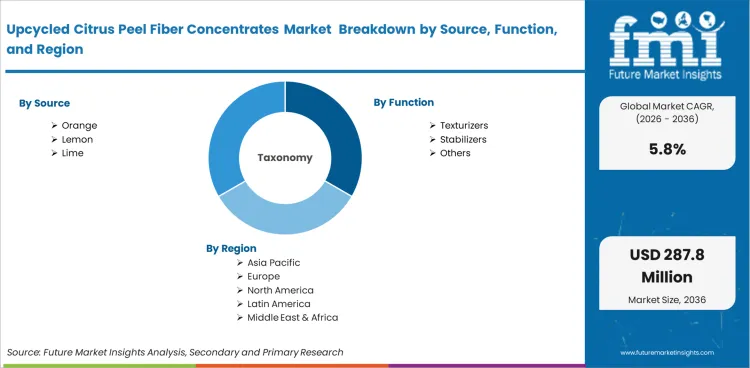
| Segmentation | Source, Function, Application, Form, End Use, Region |
| Regions Covered | North America, Europe, Asia Pacific, Latin America, and Middle East & Africa |
| Countries Covered | United States, Germany, United Kingdom, France, China, Brazil, Spain |
| Key Companies Profiled | Tate & Lyle, Fiberstar, Inc., Ingredion Incorporated, Cargill, Incorporated, Herbafood Ingredients GmbH, JRS Silvateam Ingredients S.r.l., CEAMSA |
| Forecast Period | 2026 to 2036 |
| Approach | Baseline sizing anchored to total addressable global citrus processing output minus tonnage diverted to raw feed and pure chemical pectin extraction. |
Source: Future Market Insights (FMI) analysis, based on proprietary forecasting model and primary research
Upcycled Citrus Peel Fiber Concentrates Market Analysis by Segments
Source
- Orange
- Lemon
- Lime
- Mandarin
Function
- Texturizers
- Stabilizers
- Fat replacers
- Fiber enrichment
Application
- Bakery
- Sauces
- Dairy
- Meat
- Beverages
- Plant-based
Form
- Powder
- Granules
End Use
- Food processors
- Ingredient blenders
- Nutraceuticals
- Foodservice
Bibliography
- Liu, X., et al. (2024). Modification, biological activity, applications, and future trends of citrus fiber as a functional component: A comprehensive review. International Journal of Biological Macromolecules.
- Núñez-Gómez, V., San Mateo, M., González-Barrio, R., & Periago, M. J. (2024). Chemical composition, functional and antioxidant properties of dietary fiber extracted from lemon peel after enzymatic treatment.
- Fu, M., Gao, X., Xie, Z., Xia, C., Gu, Q., & Li, P. (2024). Soluble dietary fiber from Citrus unshiu peel promotes antioxidant activity in oxidative stress mice and regulates intestinal microecology.
- Chen, L., Wu, Y., Guo, Y., Yan, X., Liu, W., & Huang, S. (2024). Preparation and characterization of soluble dietary fiber edible packaging films reinforced by nanocellulose from navel orange peel pomace.
- Zhao, X., Liu, Y., Huang, X., Cui, C., & Wang, W. (2025). Enhancing functionality of citrus fibers from peel and pulp pomace via combined alkaline hydrogen peroxide and xylanase modification.
- Zhang, Y., Zhang, S., Li, Q., Liu, S., Zhao, Y., & Wang, Z. (2025). Different types of dietary fibers from citrus peels synergistically stabilize Pickering emulsions.
This bibliography is provided for reader reference. The full FMI report contains the complete reference list with primary source documentation.
This Report Addresses
- Quality assurance managers securing lot-to-lot viscosity consistency when sourcing upcycled citrus fibers.
- Industrial bakery operations managers replacing synthetic dough conditioners with orange peel extracts.
- Plant-based dairy formulators mandating ultra-fine powder grades for creamy mouthfeel.
- Supply chain personnel navigating localized citrus harvest failures in Brazil and Spain.
- Spend management officers balancing premium clean-label ingredient costs against reduced stale-return rates.
- R&D personnel executing rapid recipe conversions following retail delisting threats.
- Facility managers optimizing wet peel conversion economics at existing juice plants.
- Sensory scientists evaluating flavor neutrality across diverse texturizer processing techniques.
Frequently Asked Questions
Explain the upcycled citrus peel fiber concentrates market structure.
Valuation sits at USD 154.8 million in 2026. This metric signals specialized adoption of high-performance texturizers by major food processors, entirely separate from bulk animal feed markets.
What is the citrus peel fiber market forecast through 2036?
Demand expands at a 5.8% CAGR through 2036. Clean-label reformulation pressures force commercial bakeries and sauce manufacturers to qualify these natural stabilizers, driving steady volume gains.
What drives demand for citrus peel fiber concentrates?
Demand is supported by ongoing reformulation activity as food brands look for ingredients that can reduce reliance on synthetic-sounding stabilizers while preserving moisture binding, texture, and label simplicity.
Why does orange dominate sourcing?
Orange holds 44.0% share because commercial juice operations generate highly centralized volumes of residual peel. Supply acquisition personnel rely on this feedstock scale to guarantee stable supply chains and predictable pricing.
Why do texturizers lead functionality?
Texturizers capture 34.0% share because commercial formulators prioritize moisture management over dietary fortification. Controlling free water prevents syneresis in sauces and extends shelf life in baked goods.
Why do formulators select citrus peel fiber for bakery applications?
Bakery operations account for 29.0% share because citrus fibers mimic fat properties and alter dough retrogradation. Operations managers rely on these properties to reduce liquid fats while preventing premature crumb staling.
Why do powder formats dominate handling?
Powders hold 72.0% share because automated industrial blenders require dry, flowable materials that resist lumping. Finely milled granules disperse rapidly during wet-out phases, maximizing factory throughput.
Why do food processors command end use?
Food processors capture 83.0% share by negotiating direct supply lines with fiber manufacturers. Securing customized blends at processor levels eliminates intermediate margins and guarantees proprietary texture control.
Why is China expanding faster than countries in Europe market?
Demand in China grows at a 6.5% CAGR as state-backed initiatives force domestic juice operators to valorize waste streams. Sourcing localized fiber eliminates import reliance, providing distinct cost-in-use advantages for bakeries.
What are common citrus peel fiber formulation challenges?
Converting perishable wet peel into stable, flavor-neutral powder requires specialized sanitary drying infrastructure. Few juice processors justify this capital expenditure, preferring simpler chemical pectin extraction or feed disposal routes.
Is citrus peel fiber clean label?
Citrus peel fiber is generally well aligned with clean-label positioning because it can help simplify ingredient statements, although adoption still depends on formulation fit, category norms, and retailer expectations.
How do citrus fiber vs modified starch compare in processing?
Compared with some starch systems, citrus peel fiber can offer useful hydration and water-management benefits in selected cold-processed or complex formulations, but performance still depends on particle size, dosage, and end-use conditions.
Why do brands use citrus peel fiber for dairy alternatives?
Formulators leverage shear-stable citrus powder to maintain emulsion integrity in vegan milks and yogurts. Removing legacy hydrocolloids while sustaining creamy mouthfeel remains critical for consumer acceptance in premium categories.
Why is supplier lot-to-lot consistency difficult?
Raw orange peel varies significantly based on harvest timing and regional weather patterns. Suppliers use milling and standardization protocols to reduce seasonal variability and maintain tighter viscosity targets across crop cycles.
Who are the leading upcycled citrus fiber companies?
Established suppliers include Tate & Lyle, Fiberstar, Inc., Ingredion Incorporated, and Cargill. Specialized regional producers like Herbafood Ingredients GmbH, JRS Silvateam, and CEAMSA also capture critical market share.
What role does Brazil play in global supply?
Brazil processes the largest volume of commercial orange juice globally, generating unmatched feedstock volumes. Early capacity contracts with Brazilian upcycling facilities allow global ingredient blenders to secure raw material access.
How to select a citrus fiber supplier reliably?
Automated food manufacturing lines cannot halt production due to localized citrus harvest failures. Quality assurance personnel actively qualify secondary fiber suppliers to guarantee redundancy across distinct global processing basins.
How do extreme milling protocols impact performance?
Over-processing citrus peel destroys native cellular sponge structures, reducing water-binding capacity. Buyers purchasing milled grades encounter broken emulsions and weeping in finished consumer applications.
What is the difference between citrus fiber and pectin?
Pectin production requires severe chemical extraction, altering cellular material. Upcycled citrus fiber preserves original fibrous matrices functioning as holistic texturizers, distinct from purified chemical derivatives.
How does citrus fiber impact gluten-free baking?
Removing gluten destroys natural dough elasticity. Bakery technologists leverage upcycled peel systems to rebuild networks, trapping moisture and preventing rapid crumbling associated with alternative grain recipes.
Why do food companies use citrus fiber instead of xanthan gum?
Consumer pushback against chemical-sounding additives forces brands to strip xanthan gum from labels. Natural peel fibers provide identical viscous control without triggering clean-label exclusion lists at premium retailers.
How do co-manufacturers adapt to clean-label trends?
Contract facilities mandate versatile, shear-stable citrus powders capable of working across multiple brand-client formulations. Standardizing on high-quality upcycled fiber reduces inventory complexity while satisfying diverse clean-label requirements.
Why does Spain trail other countries in Europe?
Juice processing companies in Spain faces severe localized orange availability constraints. Operations managers navigating these feedstock shortages optimize yield efficiency to compete against expanding South America-based bulk suppliers.
What drives contract renewals in this sector?
Predictable hydration performance across multiple industrial runs cements supplier relationships. Category managers securing reliable fiber avoid compounding costs associated with managing multiple single-function synthetic additives.
Preview the report firsthand - request a free sample
Get SampleGet the brochure for pricing and purchase details.
Get PDFTable of Content
- Executive Summary
- Global Market Outlook
- Demand-side Trends
- Supply-side Trends
- Technology Roadmap Analysis
- Analysis and Recommendations
- Market Overview
- Market Coverage / Taxonomy
- Market Definition / Scope / Limitations
- Research Methodology
- Chapter Orientation
- Analytical Lens and Working Hypotheses
- Market Structure, Signals, and Trend Drivers
- Desk Research Programme (Secondary Evidence)
- Company Annual and Sustainability Reports
- Peer-reviewed Journals and Academic Literature
- Corporate Websites, Product Literature, and Technical Notes
- Earnings Decks and Investor Briefings
- Statutory Filings and Regulatory Disclosures
- Technical White Papers and Standards Notes
- Trade Journals, Industry Magazines, and Analyst Briefs
- Conference Proceedings, Webinars, and Seminar Materials
- Government Statistics Portals and Public Data Releases
- Press Releases and Reputable Media Coverage
- Specialist Newsletters and Curated Briefings
- Sector Databases and Reference Repositories
- FMI Internal Proprietary Databases and Historical Market Datasets
- Subscription Datasets and Paid Sources
- Social Channels, Communities, and Digital Listening Inputs
- Why Primary Evidence is Used
- Field Techniques
- Interviews
- Surveys
- Focus Groups
- Observational and In-context Research
- Social and Community Interactions
- Stakeholder Universe Engaged
- C-suite Leaders
- Board Members
- Presidents and Vice Presidents
- R&D and Innovation Heads
- Technical Specialists
- Domain Subject-matter Experts
- Scientists
- Physicians and Other Healthcare Professionals
- Governance, Ethics, and Data Stewardship
- Research Ethics
- Data Integrity and Handling
- Tooling, Models, and Reference Databases
- Data Engineering and Model Build
- Data Acquisition and Ingestion
- Cleaning, Normalisation, and Verification
- Synthesis, Triangulation, and Analysis
- Quality Assurance and Audit Trail
- Market Background
- Market Dynamics
- Drivers
- Restraints
- Opportunity
- Trends
- Scenario Forecast
- Demand in Optimistic Scenario
- Global Market Analysis 2021 to 2025 and Forecast, 2026 to 2036
- Historical Market Size Value (USD Million) Analysis, 2021 to 2025
- Current and Future Market Size Value (USD Million) Projections, 2026 to 2036
- Y-o-Y Growth Trend Analysis
- Absolute $ Opportunity Analysis
- Global Market Pricing Analysis 2021 to 2025 and Forecast 2026 to 2036
- Global Market Analysis 2021 to 2025 and Forecast 2026 to 2036, By Source
- Introduction / Key Findings
- Historical Market Size Value (USD Million) Analysis By Source , 2021 to 2025
- Current and Future Market Size Value (USD Million) Analysis and Forecast By Source , 2026 to 2036
- Orange
- Lemon
- Lime
- Orange
- Y-o-Y Growth Trend Analysis By Source , 2021 to 2025
- Absolute $ Opportunity Analysis By Source , 2026 to 2036
- Global Market Analysis 2021 to 2025 and Forecast 2026 to 2036, By Function
- Introduction / Key Findings
- Historical Market Size Value (USD Million) Analysis By Function, 2021 to 2025
- Current and Future Market Size Value (USD Million) Analysis and Forecast By Function, 2026 to 2036
- Texturizers
- Stabilizers
- Others
- Texturizers
- Y-o-Y Growth Trend Analysis By Function, 2021 to 2025
- Absolute $ Opportunity Analysis By Function, 2026 to 2036
- Global Market Analysis 2021 to 2025 and Forecast 2026 to 2036, By Application
- Introduction / Key Findings
- Historical Market Size Value (USD Million) Analysis By Application, 2021 to 2025
- Current and Future Market Size Value (USD Million) Analysis and Forecast By Application, 2026 to 2036
- Bakery
- Sauces
- Dairy
- Bakery
- Y-o-Y Growth Trend Analysis By Application, 2021 to 2025
- Absolute $ Opportunity Analysis By Application, 2026 to 2036
- Global Market Analysis 2021 to 2025 and Forecast 2026 to 2036, By Form
- Introduction / Key Findings
- Historical Market Size Value (USD Million) Analysis By Form, 2021 to 2025
- Current and Future Market Size Value (USD Million) Analysis and Forecast By Form, 2026 to 2036
- Powder
- Granules
- Powder
- Y-o-Y Growth Trend Analysis By Form, 2021 to 2025
- Absolute $ Opportunity Analysis By Form, 2026 to 2036
- Global Market Analysis 2021 to 2025 and Forecast 2026 to 2036, By End Use
- Introduction / Key Findings
- Historical Market Size Value (USD Million) Analysis By End Use, 2021 to 2025
- Current and Future Market Size Value (USD Million) Analysis and Forecast By End Use, 2026 to 2036
- Food Processors
- Nutraceuticals
- Others
- Food Processors
- Y-o-Y Growth Trend Analysis By End Use, 2021 to 2025
- Absolute $ Opportunity Analysis By End Use, 2026 to 2036
- Global Market Analysis 2021 to 2025 and Forecast 2026 to 2036, By Region
- Introduction
- Historical Market Size Value (USD Million) Analysis By Region, 2021 to 2025
- Current Market Size Value (USD Million) Analysis and Forecast By Region, 2026 to 2036
- North America
- Latin America
- Western Europe
- Eastern Europe
- East Asia
- South Asia and Pacific
- Middle East & Africa
- Market Attractiveness Analysis By Region
- North America Market Analysis 2021 to 2025 and Forecast 2026 to 2036, By Country
- Historical Market Size Value (USD Million) Trend Analysis By Market Taxonomy, 2021 to 2025
- Market Size Value (USD Million) Forecast By Market Taxonomy, 2026 to 2036
- By Country
- USA
- Canada
- Mexico
- By Source
- By Function
- By Application
- By Form
- By End Use
- By Country
- Market Attractiveness Analysis
- By Country
- By Source
- By Function
- By Application
- By Form
- By End Use
- Key Takeaways
- Latin America Market Analysis 2021 to 2025 and Forecast 2026 to 2036, By Country
- Historical Market Size Value (USD Million) Trend Analysis By Market Taxonomy, 2021 to 2025
- Market Size Value (USD Million) Forecast By Market Taxonomy, 2026 to 2036
- By Country
- Brazil
- Chile
- Rest of Latin America
- By Source
- By Function
- By Application
- By Form
- By End Use
- By Country
- Market Attractiveness Analysis
- By Country
- By Source
- By Function
- By Application
- By Form
- By End Use
- Key Takeaways
- Western Europe Market Analysis 2021 to 2025 and Forecast 2026 to 2036, By Country
- Historical Market Size Value (USD Million) Trend Analysis By Market Taxonomy, 2021 to 2025
- Market Size Value (USD Million) Forecast By Market Taxonomy, 2026 to 2036
- By Country
- Germany
- UK
- Italy
- Spain
- France
- Nordic
- BENELUX
- Rest of Western Europe
- By Source
- By Function
- By Application
- By Form
- By End Use
- By Country
- Market Attractiveness Analysis
- By Country
- By Source
- By Function
- By Application
- By Form
- By End Use
- Key Takeaways
- Eastern Europe Market Analysis 2021 to 2025 and Forecast 2026 to 2036, By Country
- Historical Market Size Value (USD Million) Trend Analysis By Market Taxonomy, 2021 to 2025
- Market Size Value (USD Million) Forecast By Market Taxonomy, 2026 to 2036
- By Country
- Russia
- Poland
- Hungary
- Balkan & Baltic
- Rest of Eastern Europe
- By Source
- By Function
- By Application
- By Form
- By End Use
- By Country
- Market Attractiveness Analysis
- By Country
- By Source
- By Function
- By Application
- By Form
- By End Use
- Key Takeaways
- East Asia Market Analysis 2021 to 2025 and Forecast 2026 to 2036, By Country
- Historical Market Size Value (USD Million) Trend Analysis By Market Taxonomy, 2021 to 2025
- Market Size Value (USD Million) Forecast By Market Taxonomy, 2026 to 2036
- By Country
- China
- Japan
- South Korea
- By Source
- By Function
- By Application
- By Form
- By End Use
- By Country
- Market Attractiveness Analysis
- By Country
- By Source
- By Function
- By Application
- By Form
- By End Use
- Key Takeaways
- South Asia and Pacific Market Analysis 2021 to 2025 and Forecast 2026 to 2036, By Country
- Historical Market Size Value (USD Million) Trend Analysis By Market Taxonomy, 2021 to 2025
- Market Size Value (USD Million) Forecast By Market Taxonomy, 2026 to 2036
- By Country
- India
- ASEAN
- Australia & New Zealand
- Rest of South Asia and Pacific
- By Source
- By Function
- By Application
- By Form
- By End Use
- By Country
- Market Attractiveness Analysis
- By Country
- By Source
- By Function
- By Application
- By Form
- By End Use
- Key Takeaways
- Middle East & Africa Market Analysis 2021 to 2025 and Forecast 2026 to 2036, By Country
- Historical Market Size Value (USD Million) Trend Analysis By Market Taxonomy, 2021 to 2025
- Market Size Value (USD Million) Forecast By Market Taxonomy, 2026 to 2036
- By Country
- Kingdom of Saudi Arabia
- Other GCC Countries
- Turkiye
- South Africa
- Other African Union
- Rest of Middle East & Africa
- By Source
- By Function
- By Application
- By Form
- By End Use
- By Country
- Market Attractiveness Analysis
- By Country
- By Source
- By Function
- By Application
- By Form
- By End Use
- Key Takeaways
- Key Countries Market Analysis
- USA
- Pricing Analysis
- Market Share Analysis, 2025
- By Source
- By Function
- By Application
- By Form
- By End Use
- Canada
- Pricing Analysis
- Market Share Analysis, 2025
- By Source
- By Function
- By Application
- By Form
- By End Use
- Mexico
- Pricing Analysis
- Market Share Analysis, 2025
- By Source
- By Function
- By Application
- By Form
- By End Use
- Brazil
- Pricing Analysis
- Market Share Analysis, 2025
- By Source
- By Function
- By Application
- By Form
- By End Use
- Chile
- Pricing Analysis
- Market Share Analysis, 2025
- By Source
- By Function
- By Application
- By Form
- By End Use
- Germany
- Pricing Analysis
- Market Share Analysis, 2025
- By Source
- By Function
- By Application
- By Form
- By End Use
- UK
- Pricing Analysis
- Market Share Analysis, 2025
- By Source
- By Function
- By Application
- By Form
- By End Use
- Italy
- Pricing Analysis
- Market Share Analysis, 2025
- By Source
- By Function
- By Application
- By Form
- By End Use
- Spain
- Pricing Analysis
- Market Share Analysis, 2025
- By Source
- By Function
- By Application
- By Form
- By End Use
- France
- Pricing Analysis
- Market Share Analysis, 2025
- By Source
- By Function
- By Application
- By Form
- By End Use
- India
- Pricing Analysis
- Market Share Analysis, 2025
- By Source
- By Function
- By Application
- By Form
- By End Use
- ASEAN
- Pricing Analysis
- Market Share Analysis, 2025
- By Source
- By Function
- By Application
- By Form
- By End Use
- Australia & New Zealand
- Pricing Analysis
- Market Share Analysis, 2025
- By Source
- By Function
- By Application
- By Form
- By End Use
- China
- Pricing Analysis
- Market Share Analysis, 2025
- By Source
- By Function
- By Application
- By Form
- By End Use
- Japan
- Pricing Analysis
- Market Share Analysis, 2025
- By Source
- By Function
- By Application
- By Form
- By End Use
- South Korea
- Pricing Analysis
- Market Share Analysis, 2025
- By Source
- By Function
- By Application
- By Form
- By End Use
- Russia
- Pricing Analysis
- Market Share Analysis, 2025
- By Source
- By Function
- By Application
- By Form
- By End Use
- Poland
- Pricing Analysis
- Market Share Analysis, 2025
- By Source
- By Function
- By Application
- By Form
- By End Use
- Hungary
- Pricing Analysis
- Market Share Analysis, 2025
- By Source
- By Function
- By Application
- By Form
- By End Use
- Kingdom of Saudi Arabia
- Pricing Analysis
- Market Share Analysis, 2025
- By Source
- By Function
- By Application
- By Form
- By End Use
- Turkiye
- Pricing Analysis
- Market Share Analysis, 2025
- By Source
- By Function
- By Application
- By Form
- By End Use
- South Africa
- Pricing Analysis
- Market Share Analysis, 2025
- By Source
- By Function
- By Application
- By Form
- By End Use
- USA
- Market Structure Analysis
- Competition Dashboard
- Competition Benchmarking
- Market Share Analysis of Top Players
- By Regional
- By Source
- By Function
- By Application
- By Form
- By End Use
- Competition Analysis
- Competition Deep Dive
- Tate & Lyle
- Overview
- Product Portfolio
- Profitability by Market Segments (Product/Age /Sales Channel/Region)
- Sales Footprint
- Strategy Overview
- Marketing Strategy
- Product Strategy
- Channel Strategy
- Fiberstar, Inc.
- Ingredion Incorporated
- Cargill, Incorporated
- Herbafood Ingredients GmbH
- JRS Silvateam Ingredients S.r.l.
- CEAMSA
- Tate & Lyle
- Competition Deep Dive
- Market Dynamics
- Assumptions & Acronyms Used


