

- Industry Size (2026)
- USD Bn 3.93
- Forecast (2036)
- USD Bn 7.25
- CAGR (2026 to 2036)
- 6.3%
Potato Peel Powder Market Size, Market Forecast and Outlook By FMI
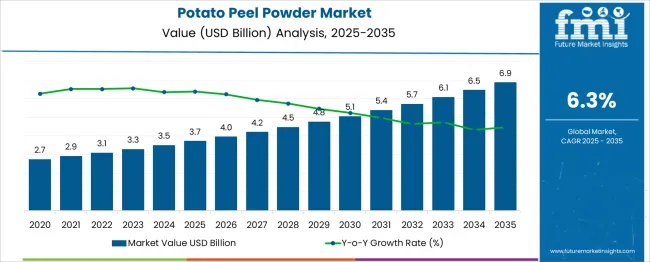
The potato peel powder market was valued at USD 3.70 billion in 2025, projected to reach USD 3.93 billion in 2026, and is forecast to expand to USD 7.25 billion by 2036 at a 6.3% CAGR. Food waste valorization mandates and the identification of bioactive compounds in potato peel are repositioning this processing by-product from a low-value waste stream into a functional ingredient for food, nutraceutical, cosmetic, and agricultural applications. Potato peel contains dietary fiber, polyphenols, glycoalkaloids, and starch that serve as raw material inputs for multiple downstream product categories.
As per FMI, conventional product type holds 63.0% share because the majority of commercial potato processing operates under conventional agricultural practices, and the primary industrial applications for potato peel powder in food manufacturing and animal feed do not require organic certification. Food & Beverage Industry anchors application share at 41.0% as food manufacturers specify potato peel powder as a dietary fiber supplement, natural colouring agent, and texture modifier in processed food formulations. Direct sales hold 38.0% of distribution share as potato processors supply peel powder directly to food manufacturers and animal feed compounders through industrial bulk contracts.
Summary of Potato Peel Powder Market
- Potato Peel Powder Market Definition
- Potato peel powder is a processed ingredient produced by drying and milling the outer skin residue from commercial potato processing operations. The resulting powder contains dietary fiber, starch, polyphenols, and minerals, serving as a functional ingredient in food formulation, nutraceutical production, cosmetic manufacturing, animal feed, and soil conditioning applications.
- Demand Drivers in the Marke
- Food waste valorization regulation: European Union food waste reduction targets and circular economy legislation are converting potato processing waste disposal from a cost centre into a revenue opportunity. FMI analysts note that potato processors who convert peel into dried powder reduce landfill disposal costs while generating ingredient sales revenue, creating a dual financial incentive for peel powder production investment.
- Dietary fiber fortification demand: Based on FMI's report, food manufacturers are sourcing natural dietary fiber ingredients for product fortification in response to consumer health awareness and regulatory nutrition labelling requirements. Potato peel powder provides a cost-effective dietary fiber source with neutral flavour that integrates into bakery, snack, and processed food formulations without affecting taste profiles.
- Upcycled ingredients consumer positioning: As per FMI, the 'upcycled food' consumer trend creates a premium positioning opportunity for products formulated with ingredients derived from food processing by-products. Potato peel powder qualifies for upcycled ingredient certification, enabling food brands to command premium pricing while communicating sustainability credentials on consumer packaging.
- Key Segments Analyzed in the FMI Report
- Conventional product type volume base: Conventional Potato Peel Powder holds 63.0% share in 2026. Industrial potato processing operations generating the bulk of peel by-product volumes operate under conventional agricultural practices, and the primary B2B applications in food manufacturing and animal feed do not require organic certification premiums.
- Food and beverage application anchor: Food & Beverage Industry commands 41.0% share in 2026. Food manufacturers procure potato peel powder as a dietary fiber supplement, texture modifier, and natural ingredient in processed food formulations, with the neutral flavour profile enabling broad application across bakery, snack, and meal product categories.
- Direct sales industrial procurement: Direct Sales holds 38.0% share in 2026. Potato processors supply peel powder directly to food manufacturers and animal feed compounders through bulk industrial contracts that specify moisture content, particle size, and microbiological limits.
- Analyst Opinion at FMI
- FMI analysts observe that the potato peel powder market is a by-product valorization story where growth depends on two parallel developments: potato processing volume expansion that increases the peel by-product supply base, and food industry demand growth for natural fiber, upcycled ingredients, and circular economy-compliant inputs. Producers co-located with major potato processing facilities hold structural cost advantages because they eliminate the peel transportation costs that erode margins for standalone peel powder manufacturers sourcing wet peel from distant processing plants.
- Strategic Implications / Executive Takeaways
- Potato processors should evaluate integrated peel powder production lines as a waste valorization investment that reduces disposal costs while generating ingredient revenue from a previously discarded by-product stream.
- Food manufacturers should specify potato peel powder in dietary fiber fortification formulations to capture both the functional nutrition benefit and the upcycled ingredient marketing premium.
- Agricultural input suppliers should evaluate potato peel powder as an organic soil conditioner and biostimulant ingredient for incorporation into sustainable agriculture product lines.
- Methodology
- Primary Research: FMI conducted detailed technical interviews with procurement specialists, production engineers, and operations directors across 40 countries to validate adoption timelines.
- Desk Research: Analysts aggregated public regulatory documentation, industry standards publications, and corporate disclosure filings.
- Market-Sizing and Forecasting: Forecasting models apply a hybrid methodology starting with global production and trade metrics and projecting adoption conversion rates.
- Data Validation and Update Cycle: Segment forecasts undergo cross-validation against quarterly and annual industry production and trade volumes.
China leads with an 8.5% CAGR, driven by the country's position as the largest potato producer globally and government circular economy policies incentivizing food processing waste utilization. India follows at 7.9% as potato processing capacity expansion generates increasing peel volumes and government programmes promote agricultural waste valorization. Germany registers a 7.2% pace anchored by EU food waste reduction targets and the starch processing industry's investment in by-product utilization. France tracks at 6.6% reflecting the French fry and potato chip manufacturing sector's adoption of peel powder production as a waste reduction strategy. UK operations advance at 6.0%, supported by food waste reduction legislation and the natural food ingredients trend. USA tracks at 5.4% driven by the potato processing industry in Idaho and Washington state and the upcycled ingredients consumer trend. Brazil expands at 4.7% as the domestic potato processing sector develops by-product utilization capabilities.
Potato Peel Powder Market Key Takeaways
| Metric | Details |
|---|---|
| Industry Size (2026) | USD Billion 3.93 |
| Industry Value (2036) | USD Billion 7.25 |
| CAGR (2026-2036) | 6.3% |
Potato Peel Powder Market Definition
Potato peel powder is a processed ingredient produced by drying and milling the outer skin residue from commercial potato processing operations. The resulting powder contains dietary fiber, starch, polyphenols, and minerals, serving as a functional ingredient in food formulation, nutraceutical production, cosmetic manufacturing, animal feed, and soil conditioning applications.
Potato Peel Powder Market Inclusions
Market scope includes conventional and organic potato peel powder for food, nutraceutical, cosmetic, animal feed, fertilizer, and textile applications. The report covers global and regional market sizes from 2026 to 2036, segmented by product type, application, distribution channel, and geography.
Potato Peel Powder Market Exclusions
Fresh potato peel sold as animal feed without drying and milling processing is excluded. Potato starch produced from whole potato tubers through conventional starch extraction falls outside scope. Potato protein isolate and other potato-derived ingredients that do not specifically originate from peel processing are excluded.
Potato Peel Powder Market Research Methodology
- Primary Research: Analysts engaged with procurement specialists, production managers, and supply chain directors to map the decision gates triggering purchasing cycles and supplier qualification requirements.
- Desk Research: Data collection phases aggregated regulatory filings, industry standards documentation, trade association publications, and public company disclosures.
- Market-Sizing and Forecasting: Baseline values derive from a hybrid top-down and bottom-up methodology, applying region-specific adoption curves to project growth velocity through 2036.
- Data Validation and Update Cycle: Projections are tested against publicly reported production volumes, trade data, and industry benchmarks with annual model recalibration.
Why is the Potato Peel Powder Market Growing?
Potato peel, once regarded as waste, is being repurposed into a nutrient-rich ingredient that serves both functional and nutritional roles across a variety of end-use sectors. The market is being driven by rising consumer awareness of food waste reduction and clean-label product demands.
Additionally, the inclusion of potato peel powder in formulations for fiber enrichment, natural preservatives, and cost-effective fillers has strengthened its appeal across processed food categories. The future outlook appears promising due to growing interest in circular food economy practices and government initiatives promoting the utilization of agricultural byproducts.
Advances in processing technologies and drying methods are further ensuring the preservation of nutrients, making potato peel powder a reliable and stable ingredient. As food producers aim to align with health trends and environmental goals, the demand for potato peel powder is anticipated to increase significantly across both developed and emerging economies..
Segmental Analysis
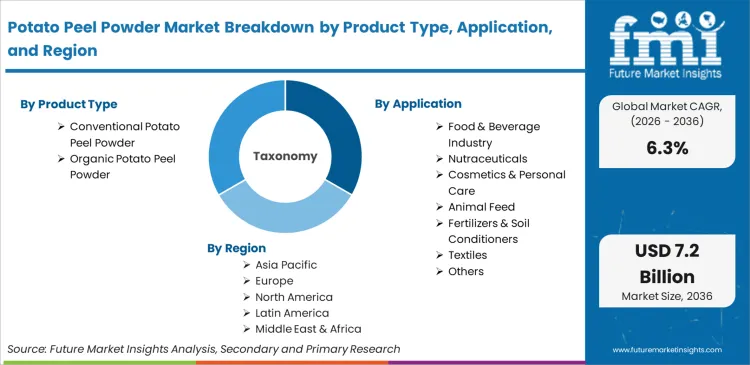
The potato peel powder market is segmented by product type, application, distribution channel, and geographic regions. The potato peel powder market is divided by product type into Conventional potato peel powder and Organic potato peel powder. In terms of application, the potato peel powder market is classified into the Food & beverage Industry, Nutraceuticals, Cosmetics & personal care, Animal feed, Fertilizers & soil conditioners, Textiles, and Others (biofuel production and biodegradable packaging. The distribution channel of the potato peel powder market is segmented into Direct sales, Supermarkets/Hypermarkets, Specialty stores, Online retail, and Others (wholesalers and distributors). Regionally, the potato peel powder industry is classified into North America, Latin America, Western Europe, Eastern Europe, Balkan & Baltic Countries, Russia & Belarus, Central Asia, East Asia, South Asia & Pacific, and the Middle East & Africa.
Insights into the Conventional Potato Peel Powder Product Type Segment
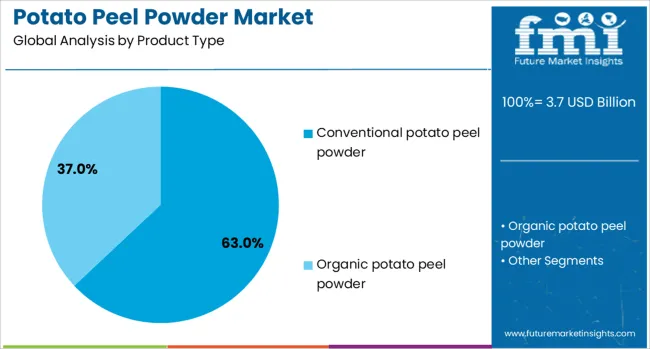
The conventional potato peel powder subsegment is projected to account for 63% of the Potato Peel Powder market revenue share in 2025, making it the leading product type. This segment has seen robust adoption due to its cost-effective production process and wide availability through established supply chains.
Manufacturers have continued to favor conventional potato peel powder as it meets the functional requirements for thickening, emulsifying, and stabilizing in processed foods without the need for organic certification. The abundance of raw material from large-scale potato processing operations has ensured a consistent supply, enabling bulk production at competitive prices.
In addition, the food industry has responded positively to the nutritional properties of conventional peel powder, particularly its fiber content and polyphenolic compounds, which contribute to extended shelf life and improved texture. The combination of economic viability, proven utility, and ease of formulation has positioned conventional potato peel powder as the most widely used category in the current market landscape..
Insights into the Food and Beverage Industry Application Segment
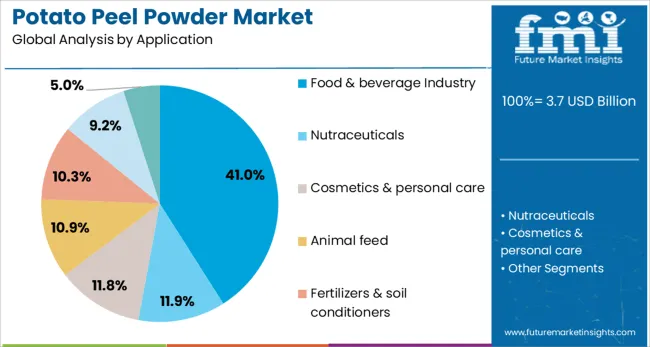
The food and beverage industry subsegment is anticipated to capture 41% of the Potato Peel Powder market revenue share in 2025, establishing itself as the dominant application. Growth in this segment has been influenced by the rising incorporation of potato peel powder into bakery goods, snacks, soups, and meat substitutes due to its functional benefits and natural origin. The demand for clean-label ingredients has prompted manufacturers to explore peel powder as a natural fiber enhancer and antioxidant source.
Its ability to improve product texture, water retention, and shelf stability has proven particularly valuable in processed food categories. Moreover, the increasing preference for plant-based and upcycled ingredients among consumers has aligned with the food and beverage sector's innovation strategies.
The economic feasibility of potato peel powder, coupled with its compatibility with high-volume production lines, has ensured its extensive use in this segment. Regulatory support for food waste valorization has further encouraged producers to integrate peel-based ingredients into mainstream food applications..
Insights into the Direct Sales Distribution Channel Segment
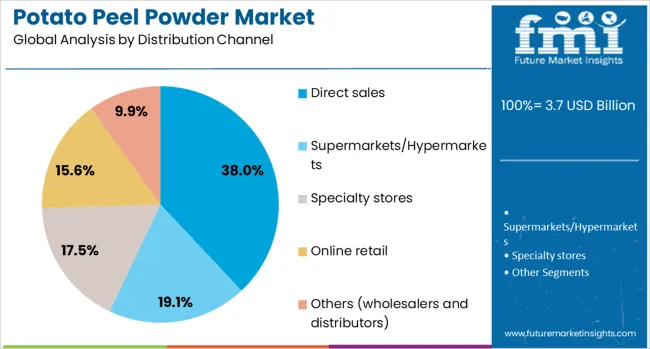
The direct sales subsegment is expected to hold 38% of the Potato Peel Powder market revenue share in 2025, emerging as the leading distribution channel. Growth in this channel has been supported by the strong relationships developed between manufacturers and food processing companies seeking customized supply arrangements. Direct sales have provided greater control over pricing, inventory, and product specifications, allowing buyers to tailor raw ingredient procurement to precise formulation needs.
The segment's dominance has also been reinforced by the growing trend of long-term procurement contracts and private labeling agreements. Reduced dependency on third-party distributors has enabled faster delivery cycles and improved margins for both suppliers and buyers.
Furthermore, the direct sales approach has proven especially effective in reaching commercial-scale users, such as bakery chains, snack manufacturers, and meat processors, who require consistent volume and quality. As demand for transparency and traceability increases in ingredient sourcing, the direct sales model is expected to maintain its leading position in the overall distribution strategy..
What are the Drivers, Restraints, and Key Trends of the Potato Peel Powder Market?
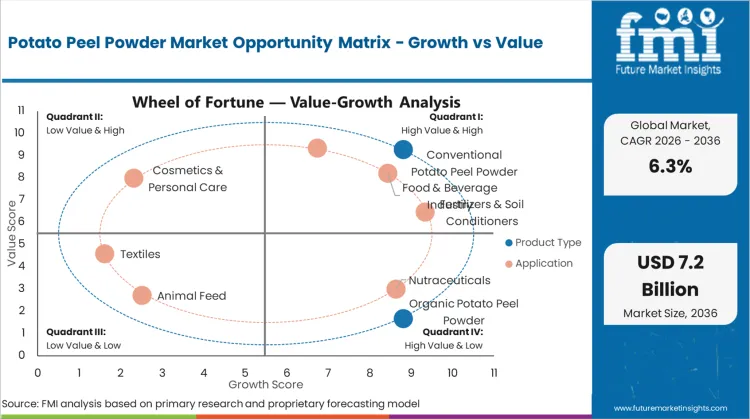
The potato peel powder market is expanding rapidly as manufacturers and consumers embrace sustainable, value-added food ingredients. This powder, produced from dehydrated potato peels, offers a source of dietary fiber, antioxidants, and natural color compounds. It is gaining traction in functional foods, animal feed, bakery items, and cosmetic formulations. Demand is driven by circular economy initiatives, food waste reduction policies, and growing interest in upcycling agricultural byproducts. Suppliers are collaborating with food and beverage brands to integrate potato peel powder in clean-label and nutrient-rich product lines. Regions with large potato production are leading adoption, while rising health awareness further spurs uptake in diverse end-use sectors.
Food Waste Reduction Efforts Boost Market Momentum
Global emphasis on reducing food waste and promoting circular economy principles is a major growth driver for potato peel powder. Producers generate significant volumes of peel byproducts during processing, and converting these into powder reduces disposal costs while creating functional ingredient value. Manufacturers supplying ingredients are collaborating with processing plants to collect peels, dry and mill them, and deliver repeatable quality. This approach supports sustainability goals and aligns with regulatory incentives encouraging waste valorisation. As brands seek to showcase eco-friendly sourcing, incorporating potato peel powder offers visible environmental credentials. Retail and foodservice operators that adopt upcycled ingredients can differentiate their products on sustainability platforms. These waste-conscious strategies strengthen demand and support a scalable supply chain for potato peel powder.
Nutritional Attributes Enhance Health‑Driven Product Positioning
Potato peel powder is valued for its dietary fiber content, micronutrients, antioxidant compounds, and potential prebiotic functionality. Formulators use it to enhance nutritional profiles in baked goods, snack bars, soups, seasoning blends, and fortified feeds. Its natural pigmentation and fiber also support cleaner label claims compared to synthetic additives. Brands targeting health-conscious consumers incorporate it under claims of gut-health support and plant-based nutrition. Color stability through processing and flavor neutrality are key features supporting broad usage. As demand grows for functional and minimally processed foods, potato peel powder fits into food manufacturers strategies aimed at nutrient enrichment. Its compatibility with gluten-free, vegan, and organic positioning further widens appeal. Nutritional advantages thus fuel integration into better-for-you product lines and wellness-focused applications.
Supply Chain Coordination Drives Quality Consistency
Building reliable supply chains for potato peel powder requires coordination between potato processors, dehydration plants, and packagers. Variability in peel moisture, microbial load, and residual starch content can affect powder color, flavor, and shelf life. Suppliers must standardize processing parameters such as drying temperature, milling fineness, and pre‑treatment hygiene to deliver consistent product quality. Quality assurance measures, including microbial testing, moisture analysis, and nutrient profiling, are essential. Heat-treatment or blanching steps may be needed to stabilize enzyme activity and minimize browning. Traceability across batches supports food safety certification when targeting human food ingredients. For animal feed applications, nutritional consistency and digestibility metrics must be validated. Suppliers that offer certified quality specifications and scalable processing platforms gain acceptance from food and feed manufacturers seeking dependable ingredient supply.
End‑User Acceptance and Market Education Challenge Growth
Wider adoption of potato peel powder is restrained by limited awareness and acceptance among food manufacturers and consumers. Many formulators are unfamiliar with its functional properties or may perceive it as a lower-quality waste derivative. Ingredient suppliers must provide technical support, recipe guidance, and performance data to demonstrate utility and acceptability. Educating consumers about upcycled ingredients and their benefits is important to counter skepticism. Misconceptions around color change, taste impact, or allergen status may delay adoption. Small brands and startups require assistance in regulatory labeling, nutrient claims, and supply formatting (for example, clean-label vs. flour blend). Broader promotional efforts through pilot programs, co-development with food technologists, and in-market demonstrations can help shift perception. Until these educational and marketing efforts scale, market growth may remain concentrated among sustainability-savvy innovators and niche wellness brands.
Analysis of Potato Peel Powder Market By Key Countries
.webp "Top Country Growth Comparison Potato Peel Powder Market Cagr (2026 2036)")
| Country | CAGR |
|---|---|
| China | 8.5% |
| India | 7.9% |
| Germany | 7.2% |
| France | 6.6% |
| UK | 6.0% |
| USA | 5.4% |
| Brazil | 4.7% |
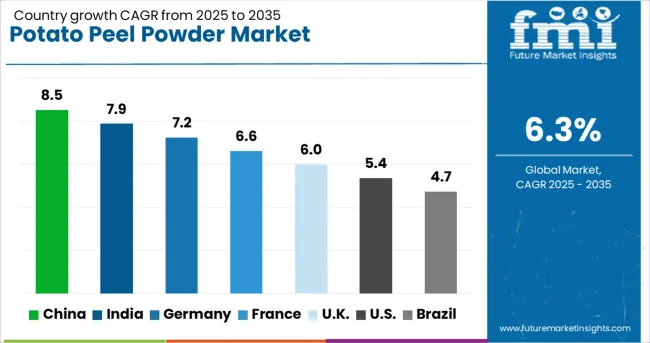
The potato peel powder market is expected to grow at a CAGR of 6.3% through 2035, driven by increasing demand for sustainable, functional food ingredients. China is developing its market leadership with a robust 8.5% growth rate, supported by investments in food waste valorization and natural additives. India follows closely at 7.9%, with manufacturers commercializing potato peel powder in animal feed, snacks, and nutraceuticals. Germany, expanding at 7.2%, is regulating food-grade applications of agri-waste through stringent quality controls and sustainable packaging initiatives. The UK, growing at 6.0%, is embracing clean-label and plant-based trends, incorporating potato peel powder in bakery and meat alternatives. The USA, with a 5.4% growth rate, is enhancing product formulations and expanding R&D in upcycled food tech. This report includes insights on 40+ countries; the top five markets are shown here for reference.
Potato Peel Powder Market Growth in China
China has experienced a robust CAGR of 8.5% in the potato peel powder market, driven by innovations in eco-efficient food ingredients and the circular economy. The country’s food processing sector has adopted advanced drying and milling techniques to convert potato waste into value-added powder rich in fiber and antioxidants. Government support for zero-waste food production and high demand from animal feed manufacturers further stimulate market expansion. Research institutions and agri-tech startups collaborated to optimize extraction processes and reduce microbial risks. End-use applications are diversifying into cosmetic formulations and biodegradable packaging. Strategic partnerships with European biotech firms have accelerated quality standards and export capabilities.
- Government incentives promoted food waste utilization
- Biotech collaborations boosted powder refinement quality
- Feed and cosmetic sectors expanded end-use demand
Potato Peel Powder Market Expansion in India
Potato peel powder market in India has witnessed a CAGR of 7.9%, propelled by rising interest in affordable, nutrient-rich ingredients for animal nutrition and human consumption. With abundant potato cultivation, domestic processors focused on low-cost dehydration and grinding units suitable for rural deployment. Demand from poultry and dairy feed industries has strengthened as awareness of fiber benefits increases. Regulatory relaxation on upcycled food ingredients and rising sustainability awareness among FMCG brands contributed to the trend. Additionally, startups have piloted micro-scale drying units that operate on renewable energy, enhancing feasibility for small farmers. India’s export potential is growing, targeting the Middle East and Southeast Asia.
- Rural processors adopted low-cost production models
- Feed sector created strong baseline demand
- Small-scale renewable drying enhanced local viability
Potato Peel Powder Market Trends in Germany
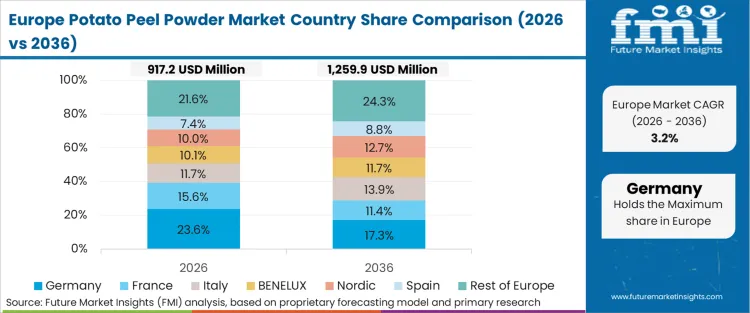
Germany has recorded a CAGR of 7.2% in the potato peel powder market, fueled by regulatory alignment with EU sustainability goals and consumer interest in clean-label products. Large food companies repurposed byproducts from fries and snack production into powdered ingredients suitable for bakery, pet food, and dietary supplements. R&D initiatives funded by government sustainability grants advanced shelf-life extension and nutrient retention techniques. Germany’s stringent safety standards pushed manufacturers to implement high-end quality controls, enabling exports to premium markets. The pharmaceutical and cosmetic industries have begun exploring bioactive compounds in potato peel extracts, further diversifying applications.
- EU compliance accelerated byproduct valorization
- Advanced safety measures enabled niche exports
- Cosmetic and pharma uses emerged in R&D
Potato Peel Powder Market Advancement in the United Kingdom
The United Kingdom has reported a CAGR of 6.0% in the potato peel powder market, supported by food waste reduction policies and rising interest in circular economy solutions. Local producers repurpose potato processing waste into fine powders used in fiber-rich breads, pet food, and soil conditioners. Retailers and food brands collaborated with suppliers to integrate upcycled ingredients into value-added product lines. Grant-funded pilot programs tested community-based drying units to promote local food sustainability. Stringent food safety and traceability systems added credibility to emerging producers. Despite Brexit challenges, the UK has maintained access to select European markets for specialized exports.
- Retail partnerships encouraged upcycled ingredient use
- Policy alignment drove local processing initiatives
- Food traceability systems built buyer trust
Potato Peel Powder Market Development in the United States
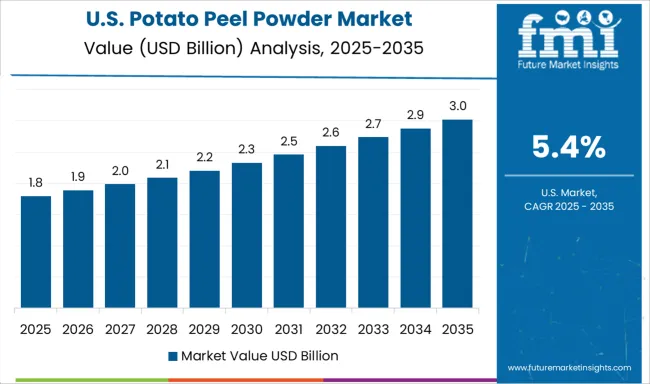
The United States has observed a CAGR of 5.4% in the Potato Peel Powder Market, propelled by innovations in upcycled food certification and a growing appetite for sustainable animal feed alternatives. The USA Department of Agriculture supported pilot programs aimed at turning food processing waste into shelf-stable feed ingredients. Mid-sized food processors and agricultural cooperatives explored value recovery through mobile processing equipment. Dietary supplement manufacturers are also incorporating potato peel extracts for fiber fortification. However, scalability remains a challenge due to high regulatory compliance costs and fragmented supply chains. Market interest is highest in states with strong agri-food infrastructure.
- USDA-funded programs tested upcycling models
- Feed and supplement sectors explored fiber enrichment
- Mobile equipment offered flexibility to co-ops
Competitive Landscape of Potato Peel Powder Market
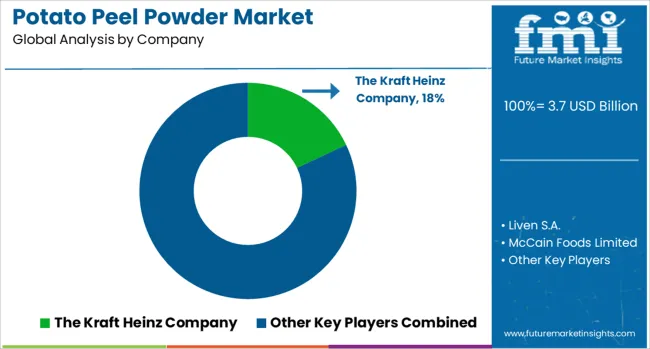
The potato peel powder market is gaining traction as industries seek to repurpose food waste into value-added, sustainable ingredients. Derived from dehydrated potato skins, potato peel powder is increasingly used in food formulations, animal feed, and bio-based packaging, owing to its high dietary fiber, antioxidant content, and functional starches. The market is driven by circular economy initiatives, cost-effective raw material sourcing, and rising demand for clean-label, upcycled food ingredients. The Kraft Heinz Company, a major player in the processed food industry, is leveraging byproduct innovation to extend its sustainability footprint, with potato peel powder being explored for both food and packaging solutions. Liven S.A., a key European snack manufacturer, integrates potato derivatives, including peel-based powders, into healthier snack formulations and extruded products.
McCain Foods Limited, a global potato processing leader, is investing in full-plant utilization strategies, turning potato peels into functional powders for secondary uses. Simplot Company and Royal Ingredients Group play significant roles in processing and supplying plant-based ingredients, including potato peel powders tailored for feed, food, and industrial applications. These companies focus on moisture control, microbiological safety, and customized granulation to meet diverse end-user needs. As sustainability, cost efficiency, and functional nutrition continue to influence purchasing decisions, suppliers who can scale up production of high-quality, traceable, and multi-use potato peel powder will lead this emerging segment of agri-waste valorization.
Scope of the Report
| Metric | Value |
|---|---|
| Quantitative Units | USD Billion 3.93 to USD Billion 7.25, at a CAGR of 6.3% |
| Market Definition | Potato peel powder is a processed ingredient produced by drying and milling the outer skin residue from commercial potato processing operations. The resulting powder contains dietary fiber, starch, polyphenols, and minerals, serving as a functional ingredient in food formulation, nutraceutical production, cosmetic manufacturing, animal feed, and soil conditioning applications. |
| Product Type Segmentation | Conventional Potato Peel Powder, Organic Potato Peel Powder |
| Application Segmentation | Food & Beverage Industry, Nutraceuticals, Cosmetics & Personal Care, Animal Feed, Fertilizers & Soil Conditioners, Textiles, Others |
| Distribution Channel Segmentation | Direct Sales, Supermarkets/Hypermarkets, Specialty Stores, Online Retail, Others |
| Regions Covered | North America, Latin America, Europe, East Asia, South Asia, Oceania, Middle East & Africa |
| Countries Covered | China, India, Germany, France, UK, USA, Brazil, and 40 plus countries |
| Key Companies Profiled | The Kraft Heinz Company, Liven S.A., McCain Foods Limited, Simplot Company, Royal Ingredients Group |
| Forecast Period | 2026 to 2036 |
| Approach | Hybrid top-down and bottom-up modelling anchored by primary interviews and public data benchmarking |
Potato Peel Powder Market by Segments
Product Type:
- Conventional potato peel powder
- Organic potato peel powder
Application:
- Food & beverage Industry
- Nutraceuticals
- Cosmetics & personal care
- Animal feed
- Fertilizers & soil conditioners
- Textiles
- Others (biofuel production and biodegradable packaging
Distribution Channel:
- Direct sales
- Supermarkets/Hypermarkets
- Specialty stores
- Online retail
- Others (wholesalers and distributors)
Region:
- North America
- USA
- Canada
- Mexico
- Latin America
- Brazil
- Chile
- Rest of Latin America
- Western Europe
- Germany
- UK
- Italy
- Spain
- France
- Nordic
- BENELUX
- Rest of Western Europe
- Eastern Europe
- Russia
- Poland
- Hungary
- Balkan & Baltic
- Rest of Eastern Europe
- East Asia
- China
- Japan
- South Korea
- South Asia and Pacific
- India
- ASEAN
- Australia & New Zealand
- Rest of South Asia and Pacific
- Middle East & Africa
- Kingdom of Saudi Arabia
- Other GCC Countries
- Turkiye
- South Africa
- Other African Union
- Rest of Middle East & Africa
Bibliography
- European Commission. (2024). Circular Economy Action Plan: Food Waste Prevention and By-Product Utilization. DG Environment.
- Food and Agriculture Organization of the United Nations. (2024). FAOSTAT: Crop Production Statistics, Potatoes. FAO.
- United States Environmental Protection Agency. (2024). Wasted Food Scale: Prevention and Diversion Strategies. U.S. EPA.
- International Potato Center. (2024). Annual Report: Global Potato Production and Processing Trends. CIP.
- Upcycled Food Association. (2024). State of the Upcycled Food Industry Report. UFA.
This bibliography is provided for reader reference. The full FMI report contains the complete reference list with primary research documentation.
Frequently Asked Questions
How large is the demand for Potato Peel Powder in the global market in 2026?
Demand for Potato Peel Powder in the global market is estimated to be valued at USD Billion 3.93 in 2026.
What will be the market size of Potato Peel Powder in the global market by 2036?
Market size for Potato Peel Powder is projected to reach USD Billion 7.25 by 2036.
What is the expected demand growth for Potato Peel Powder in the global market between 2026 and 2036?
Demand for Potato Peel Powder is expected to grow at a CAGR of 6.3% between 2026 and 2036.
Which Product Type is poised to lead global sales by 2026?
Conventional Potato Peel Powder accounts for 63.0% share in 2026.
How significant is the role of Food & Beverage Industry in Application?
Food & Beverage Industry commands 41.0% of the application segment in 2026.
What is the growth outlook for China?
China is projected to grow at a CAGR of 8.5% during 2026 to 2036.
What is the growth rate for India in this market?
India is projected to expand at a CAGR of 7.9% during 2026 to 2036.
What is Potato Peel Powder and what is it mainly used for?
Potato peel powder is a processed ingredient produced by drying and milling the outer skin residue from commercial potato processing operations. The resulting powder contains dietary fiber, starch, polyphenols, and minerals, serving as a functional ingredient in food formulation, nutraceutical production, cosmetic manufacturing, animal feed, and soil conditioning applications.
What is included in the scope of this Potato Peel Powder report?
Market scope includes conventional and organic potato peel powder for food, nutraceutical, cosmetic, animal feed, fertilizer, and textile applications. The report covers global and regional market sizes from 2026 to 2036, segmented by product type, application, distribution channel, and geography.
What is excluded from the scope of this report?
Fresh potato peel sold as animal feed without drying and milling processing is excluded. Potato starch produced from whole potato tubers through conventional starch extraction falls outside scope.
What does market forecast mean on this page?
The market forecast represents a model-based projection built on defined industry and supply chain assumptions for strategic planning purposes.
How does FMI build and validate the Potato Peel Powder forecast?
Forecasting models apply a hybrid top-down and bottom-up methodology and cross-validate projections against publicly available industry data and primary research inputs.
What does zero reliance on speculative third-party market research mean here?
Primary interviews, verified public regulatory documentation, and official industry standards registries are used instead of unverified syndicated estimates.
Preview the report firsthand - request a free sample
Get SampleGet the brochure for pricing and purchase details.
Get PDFTable of Content
- Executive Summary
- Global Market Outlook
- Demand-side Trends
- Supply-side Trends
- Technology Roadmap Analysis
- Analysis and Recommendations
- Market Overview
- Market Coverage / Taxonomy
- Market Definition / Scope / Limitations
- Research Methodology
- Chapter Orientation
- Analytical Lens and Working Hypotheses
- Market Structure, Signals, and Trend Drivers
- Benchmarking and Cross-market Comparability
- Market Sizing, Forecasting, and Opportunity Mapping
- Research Design and Evidence Framework
- Desk Research Programme (Secondary Evidence)
- Company Annual and Sustainability Reports
- Peer-reviewed Journals and Academic Literature
- Corporate Websites, Product Literature, and Technical Notes
- Earnings Decks and Investor Briefings
- Statutory Filings and Regulatory Disclosures
- Technical White Papers and Standards Notes
- Trade Journals, Industry Magazines, and Analyst Briefs
- Conference Proceedings, Webinars, and Seminar Materials
- Government Statistics Portals and Public Data Releases
- Press Releases and Reputable Media Coverage
- Specialist Newsletters and Curated Briefings
- Sector Databases and Reference Repositories
- FMI Internal Proprietary Databases and Historical Market Datasets
- Subscription Datasets and Paid Sources
- Social Channels, Communities, and Digital Listening Inputs
- Additional Desk Sources
- Expert Input and Fieldwork (Primary Evidence)
- Primary Modes
- Qualitative Interviews and Expert Elicitation
- Quantitative Surveys and Structured Data Capture
- Blended Approach
- Why Primary Evidence is Used
- Field Techniques
- Interviews
- Surveys
- Focus Groups
- Observational and In-context Research
- Social and Community Interactions
- Stakeholder Universe Engaged
- C-suite Leaders
- Board Members
- Presidents and Vice Presidents
- R&D and Innovation Heads
- Technical Specialists
- Domain Subject-matter Experts
- Scientists
- Physicians and Other Healthcare Professionals
- Governance, Ethics, and Data Stewardship
- Research Ethics
- Data Integrity and Handling
- Primary Modes
- Tooling, Models, and Reference Databases
- Desk Research Programme (Secondary Evidence)
- Data Engineering and Model Build
- Data Acquisition and Ingestion
- Cleaning, Normalisation, and Verification
- Synthesis, Triangulation, and Analysis
- Quality Assurance and Audit Trail
- Market Background
- Market Dynamics
- Drivers
- Restraints
- Opportunity
- Trends
- Scenario Forecast
- Demand in Optimistic Scenario
- Demand in Likely Scenario
- Demand in Conservative Scenario
- Opportunity Map Analysis
- Product Life Cycle Analysis
- Supply Chain Analysis
- Investment Feasibility Matrix
- Value Chain Analysis
- PESTLE and Porter’s Analysis
- Regulatory Landscape
- Regional Parent Market Outlook
- Production and Consumption Statistics
- Import and Export Statistics
- Market Dynamics
- Global Market Analysis 2021 to 2025 and Forecast, 2026 to 2036
- Historical Market Size Value (USD Million) Analysis, 2021 to 2025
- Current and Future Market Size Value (USD Million) Projections, 2026 to 2036
- Y-o-Y Growth Trend Analysis
- Absolute $ Opportunity Analysis
- Global Market Pricing Analysis 2021 to 2025 and Forecast 2026 to 2036
- Global Market Analysis 2021 to 2025 and Forecast 2026 to 2036, By Product Type
- Introduction / Key Findings
- Historical Market Size Value (USD Million) Analysis By Product Type , 2021 to 2025
- Current and Future Market Size Value (USD Million) Analysis and Forecast By Product Type , 2026 to 2036
- Conventional Potato Peel Powder
- Organic Potato Peel Powder
- Conventional Potato Peel Powder
- Y-o-Y Growth Trend Analysis By Product Type , 2021 to 2025
- Absolute $ Opportunity Analysis By Product Type , 2026 to 2036
- Global Market Analysis 2021 to 2025 and Forecast 2026 to 2036, By Application
- Introduction / Key Findings
- Historical Market Size Value (USD Million) Analysis By Application, 2021 to 2025
- Current and Future Market Size Value (USD Million) Analysis and Forecast By Application, 2026 to 2036
- Food & Beverage Industry
- Nutraceuticals
- Cosmetics & Personal Care
- Animal Feed
- Fertilizers & Soil Conditioners
- Textiles
- Others
- Food & Beverage Industry
- Y-o-Y Growth Trend Analysis By Application, 2021 to 2025
- Absolute $ Opportunity Analysis By Application, 2026 to 2036
- Global Market Analysis 2021 to 2025 and Forecast 2026 to 2036, By Distribution Channel
- Introduction / Key Findings
- Historical Market Size Value (USD Million) Analysis By Distribution Channel, 2021 to 2025
- Current and Future Market Size Value (USD Million) Analysis and Forecast By Distribution Channel, 2026 to 2036
- Direct Sales
- Supermarkets/Hypermarkets
- Specialty Stores
- Online Retail
- Others
- Direct Sales
- Y-o-Y Growth Trend Analysis By Distribution Channel, 2021 to 2025
- Absolute $ Opportunity Analysis By Distribution Channel, 2026 to 2036
- Global Market Analysis 2021 to 2025 and Forecast 2026 to 2036, By Region
- Introduction
- Historical Market Size Value (USD Million) Analysis By Region, 2021 to 2025
- Current Market Size Value (USD Million) Analysis and Forecast By Region, 2026 to 2036
- North America
- Latin America
- Western Europe
- Eastern Europe
- East Asia
- South Asia and Pacific
- Middle East & Africa
- Market Attractiveness Analysis By Region
- North America Market Analysis 2021 to 2025 and Forecast 2026 to 2036, By Country
- Historical Market Size Value (USD Million) Trend Analysis By Market Taxonomy, 2021 to 2025
- Market Size Value (USD Million) Forecast By Market Taxonomy, 2026 to 2036
- By Country
- USA
- Canada
- Mexico
- By Product Type
- By Application
- By Distribution Channel
- By Country
- Market Attractiveness Analysis
- By Country
- By Product Type
- By Application
- By Distribution Channel
- Key Takeaways
- Latin America Market Analysis 2021 to 2025 and Forecast 2026 to 2036, By Country
- Historical Market Size Value (USD Million) Trend Analysis By Market Taxonomy, 2021 to 2025
- Market Size Value (USD Million) Forecast By Market Taxonomy, 2026 to 2036
- By Country
- Brazil
- Chile
- Rest of Latin America
- By Product Type
- By Application
- By Distribution Channel
- By Country
- Market Attractiveness Analysis
- By Country
- By Product Type
- By Application
- By Distribution Channel
- Key Takeaways
- Western Europe Market Analysis 2021 to 2025 and Forecast 2026 to 2036, By Country
- Historical Market Size Value (USD Million) Trend Analysis By Market Taxonomy, 2021 to 2025
- Market Size Value (USD Million) Forecast By Market Taxonomy, 2026 to 2036
- By Country
- Germany
- UK
- Italy
- Spain
- France
- Nordic
- BENELUX
- Rest of Western Europe
- By Product Type
- By Application
- By Distribution Channel
- By Country
- Market Attractiveness Analysis
- By Country
- By Product Type
- By Application
- By Distribution Channel
- Key Takeaways
- Eastern Europe Market Analysis 2021 to 2025 and Forecast 2026 to 2036, By Country
- Historical Market Size Value (USD Million) Trend Analysis By Market Taxonomy, 2021 to 2025
- Market Size Value (USD Million) Forecast By Market Taxonomy, 2026 to 2036
- By Country
- Russia
- Poland
- Hungary
- Balkan & Baltic
- Rest of Eastern Europe
- By Product Type
- By Application
- By Distribution Channel
- By Country
- Market Attractiveness Analysis
- By Country
- By Product Type
- By Application
- By Distribution Channel
- Key Takeaways
- East Asia Market Analysis 2021 to 2025 and Forecast 2026 to 2036, By Country
- Historical Market Size Value (USD Million) Trend Analysis By Market Taxonomy, 2021 to 2025
- Market Size Value (USD Million) Forecast By Market Taxonomy, 2026 to 2036
- By Country
- China
- Japan
- South Korea
- By Product Type
- By Application
- By Distribution Channel
- By Country
- Market Attractiveness Analysis
- By Country
- By Product Type
- By Application
- By Distribution Channel
- Key Takeaways
- South Asia and Pacific Market Analysis 2021 to 2025 and Forecast 2026 to 2036, By Country
- Historical Market Size Value (USD Million) Trend Analysis By Market Taxonomy, 2021 to 2025
- Market Size Value (USD Million) Forecast By Market Taxonomy, 2026 to 2036
- By Country
- India
- ASEAN
- Australia & New Zealand
- Rest of South Asia and Pacific
- By Product Type
- By Application
- By Distribution Channel
- By Country
- Market Attractiveness Analysis
- By Country
- By Product Type
- By Application
- By Distribution Channel
- Key Takeaways
- Middle East & Africa Market Analysis 2021 to 2025 and Forecast 2026 to 2036, By Country
- Historical Market Size Value (USD Million) Trend Analysis By Market Taxonomy, 2021 to 2025
- Market Size Value (USD Million) Forecast By Market Taxonomy, 2026 to 2036
- By Country
- Kingdom of Saudi Arabia
- Other GCC Countries
- Turkiye
- South Africa
- Other African Union
- Rest of Middle East & Africa
- By Product Type
- By Application
- By Distribution Channel
- By Country
- Market Attractiveness Analysis
- By Country
- By Product Type
- By Application
- By Distribution Channel
- Key Takeaways
- Key Countries Market Analysis
- USA
- Pricing Analysis
- Market Share Analysis, 2025
- By Product Type
- By Application
- By Distribution Channel
- Canada
- Pricing Analysis
- Market Share Analysis, 2025
- By Product Type
- By Application
- By Distribution Channel
- Mexico
- Pricing Analysis
- Market Share Analysis, 2025
- By Product Type
- By Application
- By Distribution Channel
- Brazil
- Pricing Analysis
- Market Share Analysis, 2025
- By Product Type
- By Application
- By Distribution Channel
- Chile
- Pricing Analysis
- Market Share Analysis, 2025
- By Product Type
- By Application
- By Distribution Channel
- Germany
- Pricing Analysis
- Market Share Analysis, 2025
- By Product Type
- By Application
- By Distribution Channel
- UK
- Pricing Analysis
- Market Share Analysis, 2025
- By Product Type
- By Application
- By Distribution Channel
- Italy
- Pricing Analysis
- Market Share Analysis, 2025
- By Product Type
- By Application
- By Distribution Channel
- Spain
- Pricing Analysis
- Market Share Analysis, 2025
- By Product Type
- By Application
- By Distribution Channel
- France
- Pricing Analysis
- Market Share Analysis, 2025
- By Product Type
- By Application
- By Distribution Channel
- India
- Pricing Analysis
- Market Share Analysis, 2025
- By Product Type
- By Application
- By Distribution Channel
- ASEAN
- Pricing Analysis
- Market Share Analysis, 2025
- By Product Type
- By Application
- By Distribution Channel
- Australia & New Zealand
- Pricing Analysis
- Market Share Analysis, 2025
- By Product Type
- By Application
- By Distribution Channel
- China
- Pricing Analysis
- Market Share Analysis, 2025
- By Product Type
- By Application
- By Distribution Channel
- Japan
- Pricing Analysis
- Market Share Analysis, 2025
- By Product Type
- By Application
- By Distribution Channel
- South Korea
- Pricing Analysis
- Market Share Analysis, 2025
- By Product Type
- By Application
- By Distribution Channel
- Russia
- Pricing Analysis
- Market Share Analysis, 2025
- By Product Type
- By Application
- By Distribution Channel
- Poland
- Pricing Analysis
- Market Share Analysis, 2025
- By Product Type
- By Application
- By Distribution Channel
- Hungary
- Pricing Analysis
- Market Share Analysis, 2025
- By Product Type
- By Application
- By Distribution Channel
- Kingdom of Saudi Arabia
- Pricing Analysis
- Market Share Analysis, 2025
- By Product Type
- By Application
- By Distribution Channel
- Turkiye
- Pricing Analysis
- Market Share Analysis, 2025
- By Product Type
- By Application
- By Distribution Channel
- South Africa
- Pricing Analysis
- Market Share Analysis, 2025
- By Product Type
- By Application
- By Distribution Channel
- USA
- Market Structure Analysis
- Competition Dashboard
- Competition Benchmarking
- Market Share Analysis of Top Players
- By Regional
- By Product Type
- By Application
- By Distribution Channel
- Competition Analysis
- Competition Deep Dive
- The Kraft Heinz Company
- Overview
- Product Portfolio
- Profitability by Market Segments (Product/Age /Sales Channel/Region)
- Sales Footprint
- Strategy Overview
- Marketing Strategy
- Product Strategy
- Channel Strategy
- Liven S.A.
- McCain Foods Limited
- Simplot Company
- Royal Ingredients Group
- Others
- The Kraft Heinz Company
- Competition Deep Dive
- Assumptions & Acronyms Used


