

- Industry Size (2026)
- USD 565.7 Mn
- Forecast (2036)
- USD 904.1 Mn
- CAGR (2026 to 2036)
- 4.8%
Potato Fiber Market Size, Market Forecast and Outlook By FMI
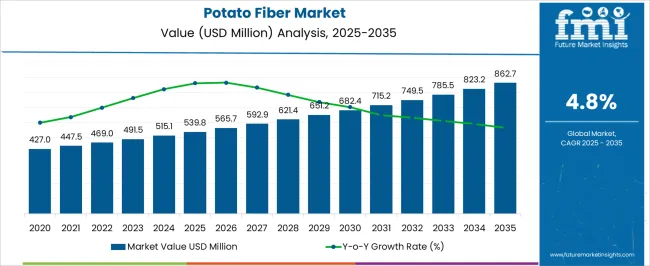
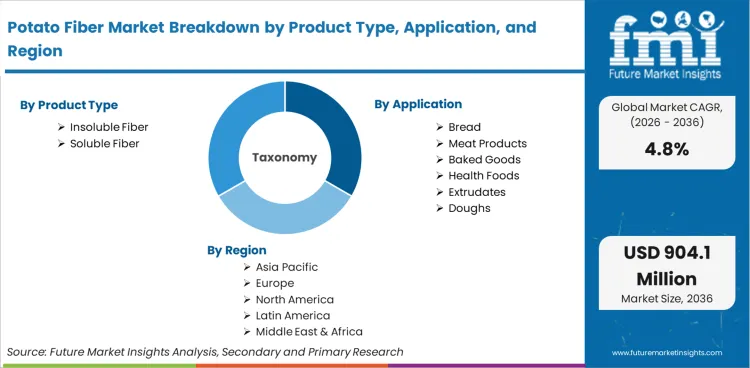
In 2025, the potato fiber market was valued at USD 539.8 million. Based on Future Market Insights' analysis, demand for potato fiber is estimated to grow to USD 565.7 million in 2026 and USD 904.1 million by 2036. FMI projects a CAGR of 4.8% during the forecast period.
Absolute dollar growth of USD 338.4 million over the decade reflects the market's graduation from commodity fiber supply to a differentiated functional ingredient category. The transition is anchored by two concurrent developments in 2025. In December 2025, Ingredion achieved its milestone of 100% sustainably sourced Tier 1 crops including potatoes under its 2030 All Life sustainability plan, enabling the company to provide certified sustainable potato fiber to global food and beverage clients who increasingly mandate Scope 3 emission transparency in ingredient procurement specifications. [1] In late 2025, Royal Avebe completed the acquisition of Solan, a Polish producer of potato flakes and granules, as a cornerstone of its Accelerate and Strengthen strategy, materially broadening the company's value-added potato derivatives capacity including functional fiber and starch for the European food sector. [2]
Summary of Potato Fiber Market
- Potato Fiber Market Definition
- The market covers insoluble and soluble dietary fiber fractions derived from potato processing, supplied in dry powder and granular formats to food manufacturers for bakery, meat processing, plant-based food, and health food product applications where water-binding capacity and clean-label fiber fortification are primary procurement criteria.
- Demand Drivers in the Market
- Clean-label reformulation in bakery and plant-based meat categories is driving adoption of potato fiber as a single-ingredient natural texturizer and water binder that replaces multi-component synthetic hydrocolloid systems, meeting retailer and consumer clean ingredient list requirements without functional performance trade-off.
- Scope 3 sustainability mandates from major food and beverage manufacturers are creating procurement pressure for certified sustainably sourced fiber ingredients, with Ingredion's December 2025 milestone of 100% sustainable Tier 1 crop sourcing establishing a competitive benchmark that other suppliers are under pressure to match.
- Zero-waste processing models within the potato starch industry are converting fiber from a low-value disposal problem into a commercial revenue stream, with leading processors investing in fiber refining infrastructure that produces food-grade functional specifications rather than the lower-value agricultural fiber previously treated as process waste.
- Key Segments Analyzed in the FMI Report
- Product Type: Insoluble Fiber holds approximately 63.5% of market share, reflecting its established performance credentials as a water-binding and fat absorption agent in bread, meat processing, and extruded snack applications where moisture management during processing and shelf-life extension under storage are key functional requirements.
- Application: Bread accounts for approximately 28.7% of application demand, driven by both fiber fortification claims in consumer health-positioned bakery products and the technological function of potato fiber in improving dough handling, crumb structure, and moisture retention in industrial bread production.
- Geography: Europe leads the market volume through established potato processing infrastructure in the Netherlands, Germany, and France, while Asia-Pacific represents the fastest-growing demand region through expanding functional food manufacturing and plant-based category development in China and India.
- Analyst Opinion at FMI
- Nandini Roy Choudhury, Principal Consultant for Food & Beverage at Future Market Insights, opines, 'In the updated version of the Potato Fiber Market Report for 2026 to 2036, CXOs will find that supply chain sustainability certification is transitioning from a differentiating attribute to a procurement entry requirement, with major food manufacturers enforcing Scope 3 emission accountability that will progressively exclude fiber suppliers operating without verified sustainable sourcing programs from premium category ingredient contracts. My findings also point to a structural advantage for processors with integrated zero-waste extraction models, as the ability to derive commercial-grade fiber, starch, and protein from the same potato input is producing per-unit cost structures that standalone fiber producers cannot replicate.'
- Strategic Implications / Executive Takeaways
- Establish certified sustainable sourcing programs aligned with Scope 3 emission transparency requirements as the threshold credential for retaining and winning contracts with major food and beverage manufacturers who are enforcing ingredient sustainability audit requirements in 2026 procurement cycles.
- Invest in integrated zero-waste processing models that derive commercial-grade fiber, starch, and protein fractions from the same potato input to achieve per-unit cost structures that reduce exposure to pricing pressure from synthetic texturizer alternatives in cost-sensitive bakery and meat processing segments.
- Expand pilot-to-scale commercialization programs in fast-growth markets including India to capture early-mover positioning in functional food categories where potato fiber has no established competitor ingredient and where the timeline from pilot success to bulk commercial delivery can be as short as three months based on Avebe's 2025 India experience.
- Methodology
- Validated through primary interviews with potato starch processors, functional fiber manufacturers, and food industry procurement specialists across Europe and Asia-Pacific.
- Zero reliance on speculative third-party market research reports; benchmarks sourced from European starch industry statistical publications and verified company investor disclosures and annual reports.
- Based on potato processing volume data, fiber extraction yield coefficients by process type, and verified application penetration rates across bakery, meat, and plant-based food manufacturing sectors.
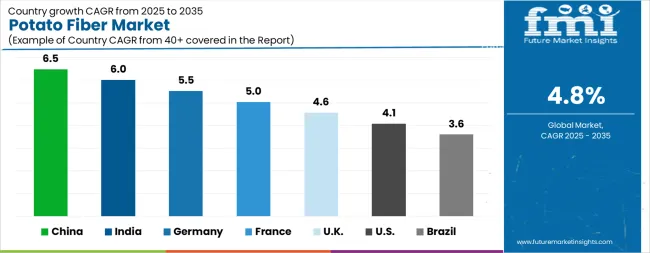
China (6.5% CAGR) leads country growth through expanding plant-based food manufacturing and functional bakery product development. India (6.0% CAGR) follows through rapid growth in processed food categories where functional fiber is an active reformulation target. Germany (5.5% CAGR) and France (5.0% CAGR) reflect European food industry demand for clean-label fiber fortification compliant with EU nutritional labeling frameworks. UK (4.6% CAGR) generates consistent growth from health food product development and plant-based meat category expansion. USA (4.1% CAGR) contributes steady demand from bakery reformulation and dietary fiber enrichment across mainstream food retail. Brazil (3.6% CAGR) reflects early-stage functional ingredient adoption. Insoluble Fiber holds approximately 63.5% of product type share; Bread applications account for approximately 28.7% of application demand.
Potato Fiber Market Definition
The potato fiber market comprises the global production, processing, and supply of dietary fiber fractions derived from potato processing operations, encompassing both insoluble fiber from potato cell wall material and soluble pectin-rich fractions extracted during starch and flake production. These fiber preparations are valued for their high water-binding capacity, fat absorption properties, and clean-label positioning as a single-ingredient natural fiber source applicable across bakery, meat processing, plant-based food, and health food product categories. The market includes fiber supplied in dry powder and granular formats to food manufacturers, bakery processors, and health food producers.
Potato Fiber Market Inclusions
The report includes Global and Regional Market Sizes (Volume and Value) and a 10-year Forecast (2026 to 2036). Coverage spans segmental breakdowns by product type (Insoluble Fiber and Soluble Fiber), application (Bread, Meat Products, Baked Goods, Health Foods, Extrudates, and Doughs), and geography across 40-plus countries.
Potato Fiber Market Exclusions
The scope excludes potato starch, potato protein, and potato flake products that do not carry a primary fiber designation in their commercial application. Whole potato and fresh potato products are outside the reportable market boundary. Dietary fiber blends where potato fiber is a minor secondary component within a multi-source fiber complex are excluded. Potato-derived bio-based fertilizers and agricultural soil amendment products, including byproduct streams from fiber extraction such as those used in Roquette's SOLULYS program, are excluded from the food ingredient market scope covered by this report.
Potato Fiber Market Research Methodology
- Primary Research: Interviews were conducted with potato starch processors, functional fiber ingredient manufacturers, bakery product developers, meat processing technologists, plant-based food formulators, and food industry procurement specialists across Europe, Asia-Pacific, and North America.
- Desk Research: Production data from national potato processing industry associations, company annual reports and investor disclosures, European starch industry statistical publications, and food ingredient trade databases supported volume and value benchmarking.
- Market-Sizing and Forecasting: A hybrid top-down and bottom-up model was developed. Demand was reconstructed from potato processing volume data, fiber extraction yield rates by process type, and application penetration rates across bakery, meat, and health food manufacturing, then validated against supplier capacity announcements.
- Data Validation and Update Cycle: Outputs undergo cross-validation against European starch industry trade statistics, sustainability certification records, and structured peer review by food ingredient specialists prior to release.
Why is the Potato Fiber Market Growing?
The Potato Fiber market is experiencing steady growth driven by the increasing awareness of dietary fibers and their health benefits, particularly in relation to digestive health and metabolic wellness. Rising demand for functional foods, clean-label products, and natural additives is shaping the current market scenario. The market is being supported by the growing adoption of plant-based ingredients in bakery, confectionery, and processed food applications.
Manufacturers are focusing on sustainable sourcing and extraction technologies to improve product quality while maintaining cost efficiency. Additionally, the convenience of incorporating potato fiber into a variety of formulations, coupled with its neutral taste and high water-binding capacity, is enabling wider acceptance across food and beverage products.
The future outlook for this market is promising as consumer preference continues to shift towards healthier diets and functional ingredients Investment in research and development for innovative fiber-rich formulations and the rising number of health-conscious consumers are expected to further drive the growth of potato fiber globally.
Segmental Analysis
The potato fiber market is segmented by product type, application, and geographic regions. By product type, potato fiber market is divided into Insoluble Fiber and Soluble Fiber. In terms of application, potato fiber market is classified into Bread, Meat Products, Baked Goods, Health Foods, Extrudates, and Doughs. Regionally, the potato fiber industry is classified into North America, Latin America, Western Europe, Eastern Europe, Balkan & Baltic Countries, Russia & Belarus, Central Asia, East Asia, South Asia & Pacific, and the Middle East & Africa.
Insights into the Insoluble Fiber Segment
The Insoluble Fiber product type is projected to hold 63.50% of the Potato Fiber market revenue share in 2026, making it the leading segment. This dominance is being attributed to its superior functional properties, including high water retention, bulking capacity, and textural enhancement in food products.
Its widespread adoption is facilitated by its role in improving digestive health and providing satiety, which aligns with the growing consumer focus on nutrition and wellness. Manufacturers prefer insoluble fiber due to its stability under thermal processing and compatibility with a variety of formulations, ranging from bakery to meat products.
The segment’s growth is also driven by its versatility in replacing synthetic additives and improving product shelf life As functional food consumption increases and regulatory support for dietary fibers strengthens, the Insoluble Fiber segment is expected to maintain its leading position, supported by both technological advancements in fiber extraction and expanding awareness of its health benefits.
Insights into the Bread Application Segment
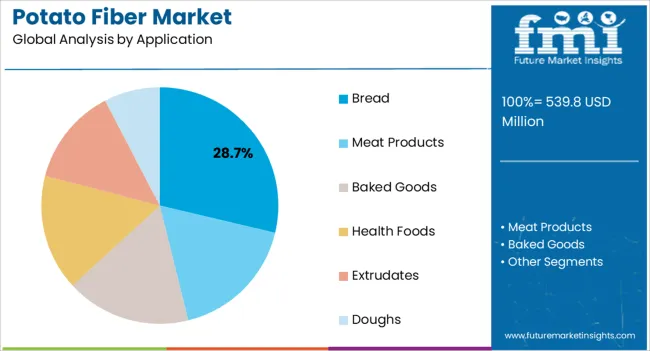
The Bread application segment is expected to account for 28.70% of the Potato Fiber market revenue share in 2026, reflecting its dominant use in bakery products. This growth is being driven by the increasing incorporation of fiber to improve nutritional content, texture, and moisture retention in bread formulations. Potato fiber enhances dough stability, reduces staling, and provides a soft crumb structure, making it highly valued by bakers and food manufacturers.
Consumer demand for high-fiber and functional bakery products has further reinforced its adoption. Additionally, the compatibility of potato fiber with clean-label and natural ingredient trends has increased its preference over synthetic or chemically modified alternatives.
The segment’s expansion is supported by the rise in ready-to-eat bakery consumption and the focus on healthier diets globally As bakery manufacturers continue to innovate and cater to health-conscious consumers, the Bread application segment is anticipated to remain a leading contributor to the overall Potato Fiber market revenue.
Market Overview
Market Outlook
Potato is a commercially important vegetable globally. The three crucial components that make potato nutritious to consume are vitamin C, dietary fiber, and potassium. Whereas, potato fiber is used as an additive in the food for the enrichment of dietary fiber, reduction of calories and carbohydrates and it helps in reducing fat absorption during cooking. The main technical property of potato fiber is the construction of the 3D fiber network in the end product. Potato fiber also helps in improving the stability and texture of the food, facilitating a high water binding capacity to the end product. Potato fibers are used in a wide range of food products such as baked goods, health foods, extrudates, dough, bread, and meat products.
The diets rich in potato fiber have a positive effect on health since their consumption has been linked to decreased incidence of numerous diseases. The prominence of food fibers has led to the advancement of a large and prospective market for fiber-rich items and ingredients. Growing consumer preference for healthy lifestyle coupled with needs for nutritious food products is expected to drive the growth of the potato fiber market.
Analysis of Potato Fiber Market By Key Countries
.webp "Top Country Growth Comparison Potato Fiber Market Cagr (2026 2036)")
| Country | CAGR |
|---|---|
| China | 6.5% |
| India | 6.0% |
| Germany | 5.5% |
| France | 5.0% |
| UK | 4.6% |
| USA | 4.1% |
| Brazil | 3.6% |
Source: FMI analysis based on primary research and proprietary forecasting model
Country-wise Analysis
The Potato Fiber Market is expected to register a CAGR of 4.8% during the forecast period, exhibiting varied country level momentum. China leads with the highest CAGR of 6.5%, followed by India at 6.0%. Developed markets such as Germany, France, and the UK continue to expand steadily, while the USA is likely to grow at consistent rates. Brazil posts the lowest CAGR at 3.6%, yet still underscores a broadly positive trajectory for the global Potato Fiber Market. In 2024, Germany held a dominant revenue in the Western Europe market and is expected to grow with a CAGR of 5.5%. The USA Potato Fiber Market is estimated to be valued at USD 196.9 million in 2026 and is anticipated to reach a valuation of USD 293.7 million by 2036. Sales are projected to rise at a CAGR of 4.1% over the forecast period between 2026 and 2036. While Japan and South Korea markets are estimated to be valued at USD 27.3 million and USD 14.2 million respectively in 2026.
Key Players in the Potato Fiber Market
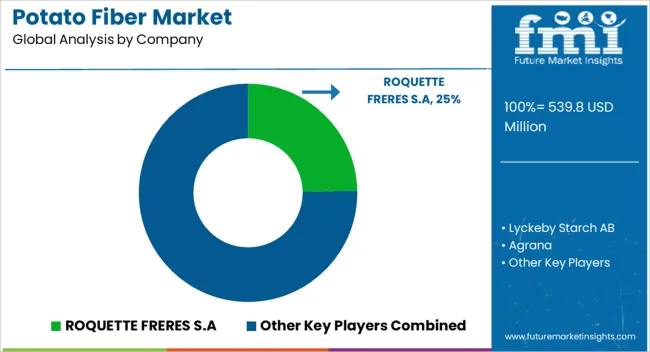
- ROQUETTE FRERES S.A
- Lyckeby Starch AB
- Agrana
- Emsland Group
- Avebe
- Ingredion
- Sanacel
- BI Nutraceuticals
- IFC
Recent Developments
The report includes full coverage of key trends from competitive benchmarking. Some of the recent developments covered in the reports:
- In late 2025, Royal Avebe successfully completed the acquisition of Solan, a Polish producer of potato flakes and granules, as a cornerstone of its Accelerate and Strengthen strategy. By integrating Solan's production capacity, Avebe materially broadened its footprint in the value-added potato derivatives market including functional fibers and starches serving the European food sector. [2]
- In April 2025, Avebe officially introduced a new high-value application for its functional potato fiber following successful pilot phases with industrial partners in India, advancing from test-phase to bulk pallet deliveries in less than three months and targeting specific mouthfeel challenges in dairy and plant-based formulations. [3]
- In December 2025, Ingredion achieved its key milestone under its 2030 All Life sustainability plan of ensuring 100% of its Tier 1 crops, including potatoes, are sustainably sourced, enabling the company to provide certified sustainable potato fiber to global food and beverage clients mandating Scope 3 emission transparency in ingredient procurement. [1]
- In March 2025, Roquette inaugurated a new production line at its Vecquemont site for SOLULYS, a bio-based fertilizer derived from potato starch processing byproducts, reflecting the market priority of byproduct valorization where waste streams from starch and fiber extraction are converted into high-value agricultural nutrients for sustainable crop production. [4]
Scope of the Report
| Metric | Value |
|---|---|
| Quantitative Units | USD 565.7 million (2026) to USD 904.1 million (2036), at a CAGR of 4.8% |
| Market Definition | The potato fiber market covers insoluble and soluble dietary fiber fractions derived from potato processing, supplied to food manufacturers for bakery, meat processing, plant-based food, and health food applications where water-binding capacity and clean-label fiber fortification are primary functional requirements. |
| Product Type Segmentation | Insoluble Fiber, Soluble Fiber |
| Application Segmentation | Bread, Meat Products, Baked Goods, Health Foods, Extrudates, Doughs |
| Regions Covered | North America, Latin America, Europe, East Asia, South Asia, Oceania, Middle East and Africa |
| Countries Covered | China, India, Germany, France, United Kingdom, United States, Brazil and 40 plus countries |
| Key Companies Profiled | ROQUETTE FRERES S.A., Lyckeby Starch AB, Agrana, Emsland Group, Avebe, Ingredion, Sanacel, BI Nutraceuticals, IFC |
| Forecast Period | 2026 to 2036 |
| Approach | Hybrid top-down and bottom-up market modeling validated through primary interviews with potato starch processors and food ingredient manufacturers, supported by European starch industry statistics and verified company capacity disclosures |
Potato Fiber Market by Segments
Product Type:
- Insoluble Fiber
- Soluble Fiber
Application:
- Bread
- Meat Products
- Baked Goods
- Health Foods
- Extrudates
- Doughs
Region:
- North America
- USA
- Canada
- Mexico
- Latin America
- Brazil
- Chile
- Rest of Latin America
- Western Europe
- Germany
- UK
- Italy
- Spain
- France
- Nordic
- BENELUX
- Rest of Western Europe
- Eastern Europe
- Russia
- Poland
- Hungary
- Balkan & Baltic
- Rest of Eastern Europe
- East Asia
- China
- Japan
- South Korea
- South Asia and Pacific
- India
- ASEAN
- Australia & New Zealand
- Rest of South Asia and Pacific
- Middle East & Africa
- Kingdom of Saudi Arabia
- Other GCC Countries
- Turkiye
- South Africa
- Other African Union
- Rest of Middle East & Africa
Bibliography
- [1] Ingredion Incorporated. (2025). Ingredion achieves 100% sustainably sourced Tier 1 crops milestone under 2030 All Life sustainability plan. Corporate Sustainability Report, December 2025. https://www.ingredion.com/
- [2] Royal Avebe. (2025). Royal Avebe presents integrated annual report 2024-2025: Solan acquisition completed as cornerstone of Accelerate and Strengthen strategy. Annual Report, Q4 2025. https://www.avebe.com/news/royal-avebe-presents-integrated-annual-report-2024-2025-and-looks-ahead-to-challenges-in-the-potato-market/
- [3] Royal Avebe. (2025). Avebe introduces new high-value functional potato fiber application in India, advancing from pilot to bulk pallet delivery in three months. Corporate News, April 2025. https://www.avebe.com/
- [4] Roquette Freres S.A. (2025). Roquette inaugurates SOLULYS bio-based fertilizer production line at Vecquemont site, demonstrating byproduct valorization from potato starch processing. Corporate Press Release, March 2025. https://www.roquette.com/
- [5] European Starch Industry Association. (2025). European starch industry: production statistics and market developments 2024-2025. Industry Statistical Report. Brussels: AAF. https://www.aaf-eu.org/
- [6] Food and Agriculture Organization of the United Nations. (2025). Global potato production and processing statistics: 2024 annual data. FAO Statistical Yearbook. Rome: FAO. https://www.fao.org/
This bibliography is provided for reader reference and is not exhaustive. The full report contains the complete reference list and detailed citations.
This Report Addresses
- Market intelligence to enable structured sourcing, sustainability program development, and application innovation strategy for potato fiber manufacturers, food ingredient distributors, bakery processors, and plant-based food developers
- Market size estimation and 10-year revenue forecasts from 2026 to 2036, supported by validated potato processing volume data, fiber yield benchmarks, and food manufacturer application penetration analysis
- Growth opportunity mapping across product type and application segments with emphasis on insoluble fiber transitions in plant-based meat and health food formulation, and sustainable sourcing certification program development
- Segment and regional revenue forecasts covering bread, meat products, baked goods, health foods, extrudates, and dough application channels across key processing geographies in Europe and Asia-Pacific
- Competition strategy assessment including zero-waste processing integration capability, sustainable sourcing certification program strength, and pilot-to-commercial scale deployment benchmarking
- Product and sustainability compliance tracking including EU organic ingredient certification, Scope 3 emission reporting frameworks, and clean-label fiber ingredient regulatory requirements
- Regulatory impact analysis covering EU food fiber labeling regulations, plant-based food ingredient approval pathways, and sustainability mandate enforcement timelines affecting potato fiber procurement
- Market report delivery in PDF, Excel, PPT, and interactive dashboard formats for executive and operational use
Frequently Asked Questions
How large is the demand for potato fiber in the global market in 2026?
Demand for potato fiber in the global market is estimated to be valued at USD 565.7 million in 2026.
What will be the market size of potato fiber by 2036?
Market size for potato fiber is projected to reach USD 904.1 million by 2036.
What is the expected CAGR for the potato fiber market between 2026 and 2036?
Demand for potato fiber is expected to grow at a CAGR of 4.8% between 2026 and 2036.
Which product type dominates the potato fiber market?
Insoluble Fiber holds approximately 63.5% of product type share, driven by its established water-binding and fat absorption performance in bread production, meat processing, and extruded snack applications where moisture management is a core functional requirement.
Which application segment leads potato fiber demand?
Bread accounts for approximately 28.7% of application demand, serving both fiber fortification claims in health-positioned bakery products and the functional role of potato fiber in improving dough handling and crumb structure in industrial bread production.
Which countries show the fastest growth in potato fiber demand?
China leads at 6.5% CAGR through 2036, followed by India at 6.0% and Germany at 5.5%, driven by plant-based food manufacturing expansion, functional food category growth, and European clean-label fiber reformulation respectively.
What did Avebe's Solan acquisition mean for the potato fiber market?
The acquisition of Solan in late 2025 broadened Avebe's value-added potato derivatives capacity including functional fibers and starches for the European food sector, reinforcing the market's consolidation trend toward integrated processors with larger footprints across the potato derivatives value chain.
How does Ingredion's sustainability milestone affect potato fiber procurement?
Ingredion's achievement of 100% sustainably sourced Tier 1 crops in December 2025 enables the company to provide certified sustainable potato fiber to clients mandating Scope 3 emission transparency, establishing a certification benchmark that progressively excludes non-certified suppliers from premium ingredient contracts.
Is Brazil covered in this report?
Yes, Brazil is covered within the Latin America regional scope at a projected 3.6% CAGR through 2036, reflecting early-stage functional ingredient adoption within the country's growing processed food and health food manufacturing sectors.
How does FMI validate the potato fiber market forecast?
The forecast uses a hybrid model validated through primary interviews with potato starch processors and food ingredient manufacturers, cross-referenced against European Starch Industry Association production statistics, FAO agricultural data, and verified company annual report capacity disclosures.
Preview the report firsthand - request a free sample
Get SampleGet the brochure for pricing and purchase details.
Get PDFTable of Content
- Executive Summary
- Global Market Outlook
- Demand-side Trends
- Supply-side Trends
- Technology Roadmap Analysis
- Analysis and Recommendations
- Market Overview
- Market Coverage / Taxonomy
- Market Definition / Scope / Limitations
- Research Methodology
- Chapter Orientation
- Analytical Lens and Working Hypotheses
- Market Structure, Signals, and Trend Drivers
- Company Annual and Sustainability Reports
- Peer-reviewed Journals and Academic Literature
- Corporate Websites, Product Literature, and Technical Notes
- Earnings Decks and Investor Briefings
- Statutory Filings and Regulatory Disclosures
- Technical White Papers and Standards Notes
- Trade Journals, Industry Magazines, and Analyst Briefs
- Conference Proceedings, Webinars, and Seminar Materials
- Government Statistics Portals and Public Data Releases
- Press Releases and Reputable Media Coverage
- Specialist Newsletters and Curated Briefings
- Sector Databases and Reference Repositories
- FMI Internal Proprietary Databases and Historical Market Datasets
- Subscription Datasets and Paid Sources
- Social Channels, Communities, and Digital Listening Inputs
- Additional Desk Sources
- Expert Input and Fieldwork (Primary Evidence)
- Primary Modes
- Qualitative Interviews and Expert Elicitation
- Quantitative Surveys and Structured Data Capture
- Blended Approach
- Why Primary Evidence is Used
- Field Techniques
- Interviews
- Surveys
- Focus Groups
- Observational and In-context Research
- Social and Community Interactions
- Stakeholder Universe Engaged
- C-suite Leaders
- Board Members
- Presidents and Vice Presidents
- R&D and Innovation Heads
- Technical Specialists
- Domain Subject-matter Experts
- Scientists
- Physicians and Other Healthcare Professionals
- Governance, Ethics, and Data Stewardship
- Research Ethics
- Data Integrity and Handling
- Primary Modes
- Tooling, Models, and Reference Databases
- Data Engineering and Model Build
- Data Acquisition and Ingestion
- Cleaning, Normalisation, and Verification
- Synthesis, Triangulation, and Analysis
- Quality Assurance and Audit Trail
- Market Background
- Market Dynamics
- Drivers
- Restraints
- Opportunity
- Trends
- Scenario Forecast
- Demand in Optimistic Scenario
- Demand in Likely Scenario
- Demand in Conservative Scenario
- Opportunity Map Analysis
- Product Life Cycle Analysis
- Supply Chain Analysis
- Investment Feasibility Matrix
- Value Chain Analysis
- PESTLE and Porter’s Analysis
- Regulatory Landscape
- Regional Parent Market Outlook
- Production and Consumption Statistics
- Import and Export Statistics
- Market Dynamics
- Global Market Analysis 2021 to 2025 and Forecast, 2026 to 2036
- Historical Market Size Value (USD Million) Analysis, 2021 to 2025
- Current and Future Market Size Value (USD Million) Projections, 2026 to 2036
- Y-o-Y Growth Trend Analysis
- Absolute $ Opportunity Analysis
- Global Market Pricing Analysis 2021 to 2025 and Forecast 2026 to 2036
- Global Market Analysis 2021 to 2025 and Forecast 2026 to 2036, By Product Type
- Introduction / Key Findings
- Historical Market Size Value (USD Million) Analysis By Product Type , 2021 to 2025
- Current and Future Market Size Value (USD Million) Analysis and Forecast By Product Type , 2026 to 2036
- Insoluble Fiber
- Soluble Fiber
- Insoluble Fiber
- Y-o-Y Growth Trend Analysis By Product Type , 2021 to 2025
- Absolute $ Opportunity Analysis By Product Type , 2026 to 2036
- Global Market Analysis 2021 to 2025 and Forecast 2026 to 2036, By Application
- Introduction / Key Findings
- Historical Market Size Value (USD Million) Analysis By Application, 2021 to 2025
- Current and Future Market Size Value (USD Million) Analysis and Forecast By Application, 2026 to 2036
- Bread
- Meat Products
- Baked Goods
- Health Foods
- Extrudates
- Doughs
- Bread
- Y-o-Y Growth Trend Analysis By Application, 2021 to 2025
- Absolute $ Opportunity Analysis By Application, 2026 to 2036
- Global Market Analysis 2021 to 2025 and Forecast 2026 to 2036, By Region
- Introduction
- Historical Market Size Value (USD Million) Analysis By Region, 2021 to 2025
- Current Market Size Value (USD Million) Analysis and Forecast By Region, 2026 to 2036
- North America
- Latin America
- Western Europe
- Eastern Europe
- East Asia
- South Asia and Pacific
- Middle East & Africa
- Market Attractiveness Analysis By Region
- North America Market Analysis 2021 to 2025 and Forecast 2026 to 2036, By Country
- Historical Market Size Value (USD Million) Trend Analysis By Market Taxonomy, 2021 to 2025
- Market Size Value (USD Million) Forecast By Market Taxonomy, 2026 to 2036
- By Country
- USA
- Canada
- Mexico
- By Product Type
- By Application
- By Country
- Market Attractiveness Analysis
- By Country
- By Product Type
- By Application
- Key Takeaways
- Latin America Market Analysis 2021 to 2025 and Forecast 2026 to 2036, By Country
- Historical Market Size Value (USD Million) Trend Analysis By Market Taxonomy, 2021 to 2025
- Market Size Value (USD Million) Forecast By Market Taxonomy, 2026 to 2036
- By Country
- Brazil
- Chile
- Rest of Latin America
- By Product Type
- By Application
- By Country
- Market Attractiveness Analysis
- By Country
- By Product Type
- By Application
- Key Takeaways
- Western Europe Market Analysis 2021 to 2025 and Forecast 2026 to 2036, By Country
- Historical Market Size Value (USD Million) Trend Analysis By Market Taxonomy, 2021 to 2025
- Market Size Value (USD Million) Forecast By Market Taxonomy, 2026 to 2036
- By Country
- Germany
- UK
- Italy
- Spain
- France
- Nordic
- BENELUX
- Rest of Western Europe
- By Product Type
- By Application
- By Country
- Market Attractiveness Analysis
- By Country
- By Product Type
- By Application
- Key Takeaways
- Eastern Europe Market Analysis 2021 to 2025 and Forecast 2026 to 2036, By Country
- Historical Market Size Value (USD Million) Trend Analysis By Market Taxonomy, 2021 to 2025
- Market Size Value (USD Million) Forecast By Market Taxonomy, 2026 to 2036
- By Country
- Russia
- Poland
- Hungary
- Balkan & Baltic
- Rest of Eastern Europe
- By Product Type
- By Application
- By Country
- Market Attractiveness Analysis
- By Country
- By Product Type
- By Application
- Key Takeaways
- East Asia Market Analysis 2021 to 2025 and Forecast 2026 to 2036, By Country
- Historical Market Size Value (USD Million) Trend Analysis By Market Taxonomy, 2021 to 2025
- Market Size Value (USD Million) Forecast By Market Taxonomy, 2026 to 2036
- By Country
- China
- Japan
- South Korea
- By Product Type
- By Application
- By Country
- Market Attractiveness Analysis
- By Country
- By Product Type
- By Application
- Key Takeaways
- South Asia and Pacific Market Analysis 2021 to 2025 and Forecast 2026 to 2036, By Country
- Historical Market Size Value (USD Million) Trend Analysis By Market Taxonomy, 2021 to 2025
- Market Size Value (USD Million) Forecast By Market Taxonomy, 2026 to 2036
- By Country
- India
- ASEAN
- Australia & New Zealand
- Rest of South Asia and Pacific
- By Product Type
- By Application
- By Country
- Market Attractiveness Analysis
- By Country
- By Product Type
- By Application
- Key Takeaways
- Middle East & Africa Market Analysis 2021 to 2025 and Forecast 2026 to 2036, By Country
- Historical Market Size Value (USD Million) Trend Analysis By Market Taxonomy, 2021 to 2025
- Market Size Value (USD Million) Forecast By Market Taxonomy, 2026 to 2036
- By Country
- Kingdom of Saudi Arabia
- Other GCC Countries
- Turkiye
- South Africa
- Other African Union
- Rest of Middle East & Africa
- By Product Type
- By Application
- By Country
- Market Attractiveness Analysis
- By Country
- By Product Type
- By Application
- Key Takeaways
- Key Countries Market Analysis
- USA
- Pricing Analysis
- Market Share Analysis, 2025
- By Product Type
- By Application
- Canada
- Pricing Analysis
- Market Share Analysis, 2025
- By Product Type
- By Application
- Mexico
- Pricing Analysis
- Market Share Analysis, 2025
- By Product Type
- By Application
- Brazil
- Pricing Analysis
- Market Share Analysis, 2025
- By Product Type
- By Application
- Chile
- Pricing Analysis
- Market Share Analysis, 2025
- By Product Type
- By Application
- Germany
- Pricing Analysis
- Market Share Analysis, 2025
- By Product Type
- By Application
- UK
- Pricing Analysis
- Market Share Analysis, 2025
- By Product Type
- By Application
- Italy
- Pricing Analysis
- Market Share Analysis, 2025
- By Product Type
- By Application
- Spain
- Pricing Analysis
- Market Share Analysis, 2025
- By Product Type
- By Application
- France
- Pricing Analysis
- Market Share Analysis, 2025
- By Product Type
- By Application
- India
- Pricing Analysis
- Market Share Analysis, 2025
- By Product Type
- By Application
- ASEAN
- Pricing Analysis
- Market Share Analysis, 2025
- By Product Type
- By Application
- Australia & New Zealand
- Pricing Analysis
- Market Share Analysis, 2025
- By Product Type
- By Application
- China
- Pricing Analysis
- Market Share Analysis, 2025
- By Product Type
- By Application
- Japan
- Pricing Analysis
- Market Share Analysis, 2025
- By Product Type
- By Application
- South Korea
- Pricing Analysis
- Market Share Analysis, 2025
- By Product Type
- By Application
- Russia
- Pricing Analysis
- Market Share Analysis, 2025
- By Product Type
- By Application
- Poland
- Pricing Analysis
- Market Share Analysis, 2025
- By Product Type
- By Application
- Hungary
- Pricing Analysis
- Market Share Analysis, 2025
- By Product Type
- By Application
- Kingdom of Saudi Arabia
- Pricing Analysis
- Market Share Analysis, 2025
- By Product Type
- By Application
- Turkiye
- Pricing Analysis
- Market Share Analysis, 2025
- By Product Type
- By Application
- South Africa
- Pricing Analysis
- Market Share Analysis, 2025
- By Product Type
- By Application
- USA
- Market Structure Analysis
- Competition Dashboard
- Competition Benchmarking
- Market Share Analysis of Top Players
- By Regional
- By Product Type
- By Application
- Competition Analysis
- Competition Deep Dive
- ROQUETTE FRERES S.A
- Overview
- Product Portfolio
- Profitability by Market Segments (Product/Age /Sales Channel/Region)
- Sales Footprint
- Strategy Overview
- Marketing Strategy
- Product Strategy
- Channel Strategy
- Lyckeby Starch AB
- Agrana
- Emsland Group
- Avebe
- Ingredion
- Sanacel
- BI Nutraceuticals
- IFC
- ROQUETTE FRERES S.A
- Competition Deep Dive
- Assumptions & Acronyms Used


