

- Market Size (2026)
- USD 63.4 Bn
- Forecast (2036)
- USD 116.6 Bn
- CAGR (2026 to 2036)
- 6.3%
How big is Better-for-You Snacks Market in 2026?
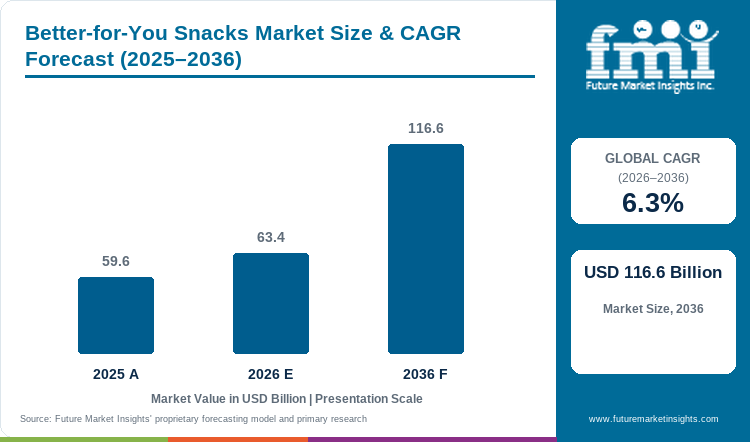
USD 63.4 Billion in 2026 and USD 116.6 Billion by 2036, expanding at 6.3% CAGR.
Sales of better-for-you snacks are estimated to grow at 6.3% from USD 63.4 Billion in 2026 to USD 116.6 Billion in 2036. The market was valued at USD 59.6 Billion in 2025. Consumers increasingly expect ordinary snacks to deliver a more visible nutritional benefit rather than behave like supplements. IFIC reported in July 2025 that 35% of U.S. adults had increased their protein intake during the previous year. Portable bars, popped snacks, crackers, nuts and similar formats can capture this demand when their nutritional proposition does not compromise taste or convenience.
The growth mechanism differs by country because labeling rules, retail structure and promotion policies determine how health positioning converts into sales. Canada's mandatory front-of-package nutrition symbol took effect from January 2026, while UK advertising restrictions for less-healthy food came into force on January 5, 2026. France implemented its updated Nutri-Score calculation in March 2025. These changes reinforce the same competitive pressure visible across the wider healthy snacks market: product formulation, label communication and mainstream shelf economics increasingly need to work together.
Key Takeaways of Better-for-You Snacks Market
- Buyers increasingly want familiar snacks with a clear nutritional benefit such as added protein, fiber, simpler ingredients, or lower levels of nutrients they seek to limit.
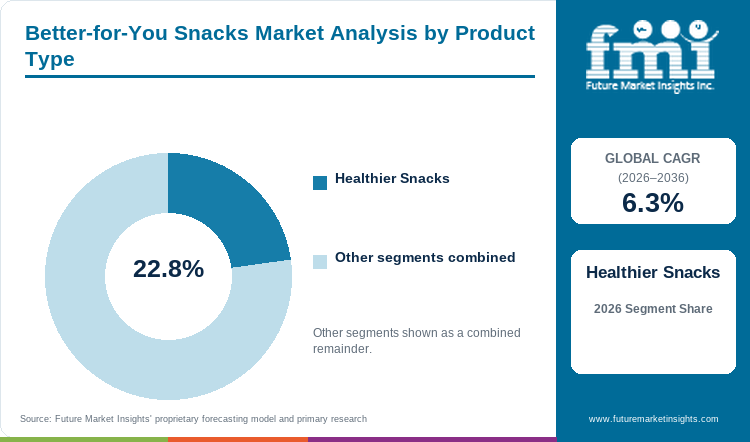
- In 2026, Healthier Snacks is estimated to account for 22.8% of product type demand because the proposition spans multiple everyday snack formats without requiring one narrow dietary identity.
- Ambient is estimated to hold 56.7% of merchandising form demand in 2026 because shelf stability supports broad distribution and reduces cold-chain requirements.
- Hypermarkets and supermarkets account for 32.0% of sales channel demand in 2026 because they provide a broad setting for comparing price, ingredient composition, and nutrition information across mainstream and specialist products.
- Taste and value remain decisive adoption factors, while labeling and advertising rules increasingly influence how health-led products are positioned.
- Active companies include PepsiCo Inc., Mondelēz International, Mars, Incorporated, General Mills, Inc., Flowers Foods, Inc., Snackruptors Inc. and Danone S.A.
Analyst Perspective
“Better-for-you snacks move into the mainstream when nutrition becomes part of the eating experience rather than a reason to tolerate a weaker product. Brands need a benefit consumers understand quickly, but repeat purchase still depends on taste, price and convenient availability.”
- Nandini Roy Choudhury, Principal Consultant, Future Market Insights
How is the Better-for-You Snacks Market segmented?
Better-for-You Snacks Market is segmented by Product Type, Merchandizing Form, Sales Channel, and Region.
Product Type includes Healthier Snacks, Added nutrition snacks, Less ingredients; Low in fat, salt and sugar, Earth-Friendly (Traceability, Organic), Dietary preferences Snacks and Gluten-free snacks. Merchandizing Form includes Ambient and Refrigerated/Frozen. Sales Channel includes Hypermarkets / Supermarkets, Online Retail, Convenience Stores, Food & Drink Specialty Stores, Independent Small Groceries, Discount Stores and Travel Retail.
Why does Healthier Snacks lead demand within the Product Type category?
Healthier Snacks gives manufacturers room to improve a familiar snack without forcing consumers into a specialized diet or narrowly defined functional claim. Chips, crackers, bars, cookies and popped snacks can all carry a broader better-for-you position through ingredient choice or nutritional improvement. PepsiCo's January 2025 acquisition of Siete Foods expanded its portfolio of grain-free snacks and products built around simpler ingredient positioning. The same demand for recognizable products with differentiated ingredients also supports the organic snack food market.
- Healthier Snacks holds a 22.8% share of Product Type in 2026 because the category covers several mainstream eating occasions and product formats.
- Broad positioning allows manufacturers to reformulate established snack concepts without depending entirely on one functional nutrient or dietary restriction.
Why does Ambient lead demand within the Merchandizing Form category?
Ambient snacks can move through supermarkets, convenience stores, e-commerce, travel retail and workplace channels without refrigerated handling. The format suits bars, crackers, chips, popcorn and other products where portability is part of the buying proposition. Across 2026, PepsiCo introduced protein and fiber innovations into several shelf-stable formats, including PopCorners Protein popped-corn snacks, announced in May 2026, Smartfood FiberPop coated popcorn, and Quaker Protein Granola Bars, reflecting how nutritional benefits can be layered into established ambient snack lines. Similar convenience-led demand is expanding the protein snacks market.
- Ambient holds a 56.7% share of Merchandizing Form in 2026 because shelf stability lowers handling complexity and widens possible points of sale.
- Single-serve and multipack ambient formats give brands flexibility across household, travel, workplace and impulse occasions.
Why do Hypermarkets / Supermarkets lead demand within the Sales Channel category?
Hypermarkets and supermarkets allow shoppers to compare conventional and better-for-you products within the same trip. Nutrition panels, front-of-pack communication, ingredients, promotional pricing and pack size can all influence the decision at shelf. Flowers Foods completed its acquisition of Simple Mills in February 2025 after the brand had already reached more than 30,000 natural and conventional stores. Mainstream grocery therefore gives focused brands a route beyond specialist health retail. The channel also supports dietary-led categories such as the gluten-free food market as they move into normal household purchasing.
- Hypermarkets / Supermarkets account for 32.0% of Sales Channel demand in 2026 because they combine high-frequency shopping with wide product comparison.
- The channel can move specialist brands into mainstream baskets when shelf productivity and price points are competitive with established snacks.
What are the drivers, restraints and opportunities in the Better-for-You Snacks Market?
Convenient nutrition supports demand, taste and value constrain conversion, and clearer nutrition propositions create room for better-formulated mainstream snacks.
- Driver: Consumers increasingly expect snacks to deliver a visible nutritional or ingredient benefit without sacrificing portability.
- Restraint: A health-oriented proposition still needs to satisfy taste and price expectations while meeting applicable labeling and promotional rules.
- Opportunity: Formulations that deliver clear nutrition benefits in familiar snack formats can gain wider retail and foodservice acceptance.
Why is everyday nutrition becoming a stronger snack purchase driver?
Nutrition goals increasingly move into occasions between meals. IFIC's July 2025 survey found that 35% of U.S. adults had increased their protein intake during the prior year. This creates opportunities for bars, crackers, popped snacks, nuts and other formats that can add protein, fiber or other nutritional benefits without changing how the product is eaten. The commercial advantage is strongest when consumers can understand the benefit quickly while still treating the product as an ordinary snack.
Why do taste, value and regulation still constrain conversion?
A health message does not remove the basic economics of snacking. Consumers still compare flavor, texture, portion size and price with conventional alternatives. Regulation adds another filter. Canada's front-of-package nutrition system makes high levels of saturated fat, sugars and sodium more prominent on many packaged foods. UK restrictions limit advertising options for products classified as less healthy. Better-for-you brands therefore need formulation and communication to support the same proposition rather than work against each other.
Where does formulation create the clearest opportunity?
The strongest opportunity is to place nutritional improvement inside familiar products. Protein bars, fiber-rich popcorn, reduced-sugar cookies, simple-ingredient crackers and fortified snacks do not require consumers to create a new eating occasion. The broader functional foods market shows how nutrition benefits increasingly compete on convenience as well as ingredient credibility. Suppliers that make the benefit obvious while protecting taste can expand into mainstream retail instead of remaining limited to specialist health channels.
Which country CAGRs are profiled in the Better-for-You Snacks Market?
| Country | CAGR |
|---|---|
| Italy | 8.0% |
| Canada | 7.7% |
| Japan | 7.4% |
| Brazil | 7.1% |
| Germany | 6.8% |
| France | 6.5% |
| UK | 6.2% |
| USA | 5.9% |
How do country-level CAGRs compare in the Better-for-You Snacks Market?
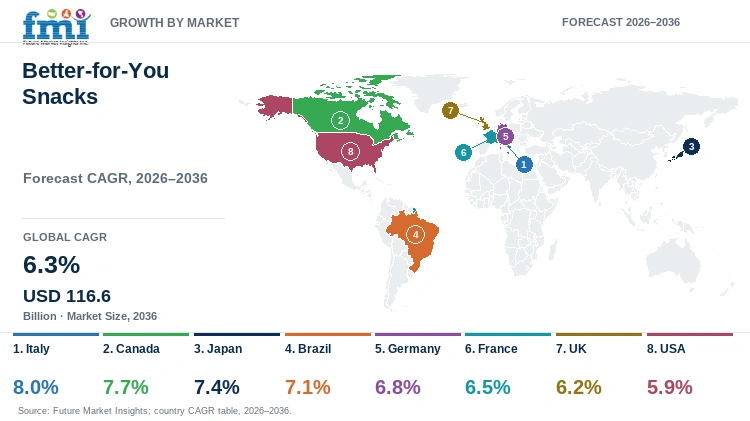
Italy, Canada and Japan form the higher-growth group at 7.4% to 8.0%. Brazil and Germany occupy the middle at 6.8% to 7.1%, while France, the UK and the USA range from 5.9% to 6.5%. Italy's 8.0% rate is 2.1 percentage points above the USA's 5.9%. These figures describe forecast growth rather than absolute market size.
- Italy's portion-based nutrition communication keeps serving size relevant to how manufacturers present a better-for-you proposition.
- Canada's front-of-package symbol creates a direct connection between formulation choices and package appearance.
- Japan gives suppliers established routes for communicating functional benefits when supporting requirements are met.
- Brazil's front-of-package framework makes added sugar, saturated fat and sodium particularly visible in packaged-food development.
- Germany combines mainstream snack demand with a retail environment where Nutri-Score can help shoppers compare products.
- France's updated Nutri-Score calculation increases the value of reformulation when participating brands use the label.
- UK advertising and promotion rules make nutrient profile increasingly relevant to media and retail planning.
- USA demand is supported by protein interest while the updated FDA “healthy” claim provides a current framework for qualifying foods.
Country-wise Analysis
- Italy's 8.0% CAGR from 2026 to 2036 is supported by a packaged-food environment where portion communication can influence how nutrition benefits are interpreted. The NutrInform Battery framework expresses energy and nutrient contribution against a defined portion, making serving architecture important for snack developers. Smaller packs can support calorie and nutrient management, but the portion still needs to feel sufficient for the price. Suppliers therefore need nutrition communication and pack economics to reinforce each other.
- Canada's Better-for-You Snacks Market is forecast to expand at 7.7% CAGR through 2036. The January 2026 front-of-package compliance deadline gives nutrient formulation a visible shelf consequence because many prepackaged products meeting specified saturated fat, sugars or sodium thresholds require the prescribed symbol. Snack manufacturers that improve nutrient profiles can strengthen the visual consistency of a better-for-you proposition, while retailers have a clearer basis for comparing competing recipes.
- Japan is projected to grow at 7.4% CAGR during the forecast period. Functional positioning remains commercially relevant because the Foods with Function Claims framework allows businesses to communicate defined benefits under established notification requirements. The system was updated operationally during 2025, increasing the importance of disciplined claim preparation. Snack suppliers can use this route for differentiated propositions when the functional benefit fits a convenient format and is supported appropriately.
- Brazil is forecast to advance at 7.1% CAGR from 2026 to 2036. Front-of-package labeling keeps added sugar, saturated fat and sodium central to formulation decisions for packaged snacks. Manufacturers can improve the front-panel outcome through recipe changes, but reducing one nutrient cannot come at the expense of texture or flavor. The strongest products will combine threshold management with the sensory qualities consumers expect from the underlying snack category.
- Germany's market is expected to expand at 6.8% CAGR through 2036. Nutri-Score remains a recognizable voluntary comparison tool for participating packaged-food brands, which can make nutritional differences easier to communicate within crowded grocery categories. Reformulation yields the clearest competitive benefit when the resulting Nutri-Score improvement is legible on-shelf and the product remains price-competitive with conventional alternatives.
- France is projected to grow at 6.5% CAGR over the forecast period. The country implemented its updated Nutri-Score algorithm in March 2025, changing how participating packaged foods are evaluated under the voluntary system. Snack manufacturers may need to consider the displayed outcome earlier in recipe development because formulation decisions can affect both nutritional positioning and shelf communication. Taste remains essential because a stronger score alone does not create repeat purchase.
- The UK's 6.2% CAGR reflects an environment where product formulation increasingly interacts with advertising economics. Restrictions on paid online advertising and pre-9 p.m. television advertising for less-healthy foods came into force in January 2026. Better-for-you snack manufacturers can gain commercial flexibility when their products fall outside restricted classifications, but media advantages need to be supported by acceptable taste and retail pricing.
- USA demand is forecast to rise at 5.9% CAGR from 2026 to 2036. Protein interest remains an important product-development signal, while the FDA's updated "healthy" nutrient content claim took effect on April 28, 2025, with mandatory compliance required by February 25, 2028, giving manufacturers a transition window to align product positioning with the revised criteria. The country has a large and crowded snack shelf, so a nutritional proposition needs to be understood quickly. Brands that combine visible benefit with familiar formats and competitive price architecture have a stronger route to repeat household purchase.
Who are the notable companies in the Better-for-You Snacks Market?
PepsiCo Inc., Mondelēz International, Mars, Incorporated, General Mills, Inc., Flowers Foods, Inc., Snackruptors Inc. and Danone S.A. are among the notable companies serving relevant better-for-you snack categories.
Competition combines global snacking businesses with focused brands that have moved into larger parent-company platforms. PepsiCo expanded its better-for-you portfolio through the 2025 acquisition of Siete Foods and continued adding protein and fiber formats in 2026. Mondelēz International participates through CLIF and other snack businesses. Mars combines KIND with the former Kellanova portfolio after completing its acquisition of Kellanova in December 2025.
Ownership changes have also strengthened specialist brands. Flowers Foods completed its acquisition of Simple Mills in February 2025, bringing a focused better-for-you cracker, cookie and snack-bar business into a larger packaged-food platform. Snackruptors acquired Hain Celestial's North American Snacks business in 2026, including Garden Veggie Snacks, Terra and Garden of Eatin'. Danone participates through refrigerated nutrition-led formats.
- Scaled snack platforms: PepsiCo Inc., Mondelēz International, Mars, Incorporated and General Mills, Inc. combine broad retail reach with established snack brands and nutrition-led extensions.
- Focused better-for-you portfolios within larger groups: Flowers Foods, Inc. participates through Simple Mills, while Mars includes KIND and RXBAR within its broader snacking organization.
- Health-led and refrigerated positions: Snackruptors adds established better-for-you salty-snack brands, while Danone extends the market into refrigerated nutrition-led snacking.
Competitive Benchmarking: Better-for-You Snacks Market
| Company | Ambient Better-for-You Snack Breadth | Protein and Functional Nutrition | Simple-Ingredient or Dietary-Preference Fit | Geographic Reach |
|---|---|---|---|---|
| PepsiCo Inc. | High | High | High | Global |
| Mondelēz International | High | High | Medium | Global |
| Mars, Incorporated | High | High | High | Global |
| General Mills, Inc. | High | Medium | Medium | Global |
| Flowers Foods, Inc. / Simple Mills | Medium | Medium | High | Primarily USA for the Simple Mills portfolio |
| Snackruptors Inc. | High | Medium | Medium | North America |
| Danone S.A. | Low | High | Medium | Global |
Scoring basis: High Ambient Better-for-You Snack Breadth denotes a broad current portfolio spanning several shelf-stable snack formats. Medium indicates a narrower multi-format position and Low denotes a more concentrated format. Protein and Functional Nutrition reflects the depth of current protein, fiber or defined nutrition-led snack propositions. Simple-Ingredient or Dietary-Preference Fit reflects current product positioning around recognizable ingredients, gluten-free, organic or related dietary attributes.
Key Developments in the Better-for-You Snacks Market
- In July 2026, PepsiCo Inc. spotlighted a broad lineup of functional snack and food formats extending protein and fiber positioning across its portfolio. The summer release featured PopCorners Protein popped-corn snacks with 9 grams of protein per serving, Smartfood FiberPop popcorn with 6 grams of fiber, and Quaker Protein Granola Bars in a new Chocolate Pretzel flavor with 10 grams of protein, reinforcing benefit-led propositions across familiar shelf-stable formats.
- In February 27, 2026, Hain Celestial Group completed the sale of its North American Snacks business to Snackruptors Inc. The transaction, announced February 2, 2026, transferred Garden Veggie Snacks, Terra and Garden of Eatin' to Snackruptors for USD 115 million, consolidating a recognized better-for-you salty-snack portfolio within the Canadian, family-owned manufacturer.
- In December 2025, Mars completed its acquisition of Kellanova. The transaction brought brands including RXBAR, Cheez-It, Pringles, Pop-Tarts and Rice Krispies Treats into the Mars Snacking organization and expanded its reach across both mainstream and nutrition-oriented snack occasions.
Key Players in the Better-for-You Snacks Market
Scaled Multi-Format Snack Platforms
- PepsiCo Inc.
- Mondelēz International
- Mars, Incorporated
- General Mills, Inc.
Focused Better-for-You Snack Portfolios
- Flowers Foods, Inc. / Simple Mills
- Snackruptors Inc.
Refrigerated and Nutrition-Led Formats
- Danone S.A.
Better-for-You Snacks Market - Report Scope
| Coverage field | Report scope |
|---|---|
| Market breakdown | Product Type; Merchandizing Form; Sales Channel |
| Quantitative Units | Revenue in USD Billion and CAGR in %. |
| Market Definition | Revenue includes packaged better-for-you snacks sold within the defined Product Type, Merchandizing Form and Sales Channel universe. It covers ambient and refrigerated/frozen snacks positioned through nutritional improvement, added nutrition, simplified ingredients, organic or traceable attributes, dietary preference or gluten-free propositions. Beverages, supplements, full meals and meal replacements are excluded. |
| Regions Covered | North America; Latin America; Western Europe; Eastern Europe; East Asia; South Asia and Pacific; Middle East and Africa |
| Countries Covered | USA; UK; France; Germany; Brazil; Japan; Canada; Italy |
| Key Companies Profiled | PepsiCo Inc.; Mondelēz International; Mars, Incorporated; General Mills, Inc.; Flowers Foods, Inc.; Snackruptors Inc.; Danone S.A. |
| Forecast Period | 2026 to 2036 |
| Approach | Primary and secondary research with market triangulation |
Better-for-You Snacks Market - Research Methodology
| Method | Approach |
|---|---|
| Primary Research | FMI analysts gather input from manufacturers, brand owners, distributors, retailers, foodservice participants, procurement teams and subject-matter experts. Interviews examine purchasing criteria, product evaluation, pricing, channel requirements and adoption barriers. |
| Desk Research | Desk research covers government statistics, regulatory publications, industry associations, technical literature, company filings, product information and official corporate announcements. |
| Market Sizing and Forecasting | Market sizing combines baseline demand with historical performance, segment structure, pricing and volume indicators, channel development, company participation and country-level demand conditions. |
| Data Validation | Estimates are compared with multiple market indicators, company activity, regulatory developments, industry trends and primary research findings to maintain consistency across segments and countries. |
Better-for-You Snacks Market by Segments
Better-for-You Snacks Market segmented by Product Type:
- Healthier Snacks
- Added nutrition snacks
- Less ingredients; Low in fat, salt and sugar
- Earth-Friendly (Traceability, Organic)
- Dietary preferences Snacks
- Gluten-free snacks
Better-for-You Snacks Market segmented by Merchandizing Form:
- Ambient
- Refrigerated/Frozen
Better-for-You Snacks Market segmented by Sales Channel:
- Hypermarkets / Supermarkets
- Online Retail
- Convenience Stores
- Food & Drink Specialty Stores
- Independent Small Groceries
- Discount Stores
- Travel Retail
Better-for-You Snacks Market by Region:
- North America
- United States
- Canada
- Latin America
- Brazil
- Mexico
- Argentina
- Chile
- Western Europe
- Germany
- France
- United Kingdom
- Italy
- Spain
- Benelux
- Nordics
- Eastern Europe
- Poland
- Czech Republic
- Romania
- Hungary
- East Asia
- China
- Japan
- South Korea
- South Asia and Pacific
- India
- ASEAN
- Australia and New Zealand
- Middle East and Africa
- GCC Countries
- South Africa
- Türkiye
- Israel
Research Sources and Bibliography
- International Food Information Council. (2025, July 9). IFIC Spotlight Survey: Americans' Perceptions of Protein.
- U.S. Food and Drug Administration. (2025, February 24). FDA Extends Effective Date for Updated “Healthy” Nutrient Content Claim.
- Canadian Food Inspection Agency. (2025, November 17). Front-of-package (FOP) nutrition symbol.
- UK Department of Health and Social Care and Department for Culture, Media and Sport. (2025, June 4). Restricting advertising of less healthy food or drink on TV and online: products in scope.
- Federal Ministry of Food and Agriculture, Germany. (2025, April 9). Hilfestellung für Unternehmen: Verwendung des Nutri-Score.
- Ministry of Health and Access to Care, France. (2025, March). Actualités PNNS 4: New Nutri-Score algorithm enters into force in France.
- Ministero della Salute, Italy. (2025, January 31). NutrInform nuovo sistema di etichettatura nutrizionale.
- Consumer Affairs Agency, Japan. (2025). Foods with Function Claims notification guidance and database materials.
- Agência Nacional de Vigilância Sanitária, Brazil. (2025). Review of food nutrition labeling regulations.
- PepsiCo Inc. (2025, January 17). PepsiCo Completes Acquisition of Siete Foods.
- PepsiCo Inc. (2026, July 20). Summer Snacking Heats Up: PepsiCo Foods Serve Up Bold Flavors, Pickle Trends and Protein Options for Life On-the-Go.
- Mars, Incorporated. (2025, December 11). Mars Completes Acquisition of Kellanova.
- The Hain Celestial Group. (2026, March 2). Hain Celestial Completes Sale of North American Snacks Business.
- Flowers Foods, Inc. (2025, February 21). Flowers Foods Completes Acquisition of Simple Mills.
- Kellanova. (2025, June 3). RXBAR Launches High Protein Innovation.
- General Mills, Inc. (2025). Fiscal 2025 Annual Report.
- Mondelēz International, Inc. (2026). 2025 Annual Report.
- Danone S.A. (2026). Integrated Annual Report 2025.
This bibliography is provided for reader reference and is not exhaustive. The full report contains the complete reference list and detailed citations.
This Report Answers
- How large is the Better-for-You Snacks Market in 2026 and what value is forecast for 2036?
- What is driving consumer demand for better-for-you snacks?
- Why does Healthier Snacks lead the Product Type category?
- Why does Ambient lead the Merchandizing Form category?
- How do profiled country growth rates differ from 2026 to 2036?
- Which companies participate in relevant better-for-you snack categories?
- What limits repeat purchase and broader retail adoption?
- What should manufacturers and retailers evaluate when developing or listing better-for-you snacks?
Frequently Asked Questions
How big is the Better-for-You Snacks Market in 2026?
The Better-for-You Snacks Market is valued at USD 63.4 Billion in 2026 and is forecast to reach USD 116.6 Billion by 2036. The market was valued at USD 59.6 Billion in 2025.
What is the CAGR of the Better-for-You Snacks Market from 2026 to 2036?
The market is forecast to expand at a 6.3% CAGR from 2026 to 2036, supported by nutrition-led product development and wider mainstream distribution.
Which Product Type leads the Better-for-You Snacks Market?
Healthier Snacks leads Product Type with a 22.8% share in 2026. Its broad positioning allows familiar snack formats to carry nutritional improvement without requiring one specialized dietary identity.
Which Merchandizing Form leads the Better-for-You Snacks Market?
Ambient leads Merchandizing Form with a 56.7% share in 2026. Shelf stability widens distribution and supports portable products without refrigerated handling.
Which Sales Channel leads the Better-for-You Snacks Market?
Hypermarkets / Supermarkets lead Sales Channel with a 32.0% share in 2026 because the format gives consumers broad product choice and direct comparison of price, ingredients and nutrition information.
Which profiled countries have the highest growth rates?
Italy has the highest profiled CAGR at 8.0%, followed by Canada at 7.7% and Japan at 7.4% from 2026 to 2036.
Preview the report firsthand - request a free sample
Get SampleGet the brochure for pricing and purchase details.
Get PDFTable of Content
- Key Takeaways
- Market Size and CAGR
- Top Growth Driver
- Fastest Growing Segment
- Leading Region
- Key Companies
- Emerging Opportunities
- Executive Summary
- Global Market Outlook
- Demand-side Trends
- Supply-side Trends
- Technology Roadmap Analysis
- Analysis and Recommendations
- Analyst Perspective (What is happening? Why now? What should investors know?)
- Key Questions Answered
- How large is the market?
- What is the CAGR?
- What are key trends?
- Which region dominates?
- Who are the leaders?
- Market Overview
- Market Coverage / Taxonomy
- Market Definition / Scope / Limitations
- Research Methodology
- Chapter Orientation
- Analytical Lens and Working Hypotheses
- Market Structure, Signals, and Trend Drivers
- Benchmarking and Cross-market Comparability
- Market Sizing, Forecasting, and Opportunity Mapping
- Research Design and Evidence Framework
- Desk Research Programme (Secondary Evidence)
- Expert Input and Fieldwork (Primary Evidence)
- Tooling, Models, and Reference Databases
- Data Engineering and Model Build
- Quality Assurance and Audit Trail
- Market Background
- Market Dynamics (Drivers, Restraints, Opportunity, Trends)
- Scenario Forecast (Optimistic, Likely, Conservative)
- Impact Analysis
- AI Impact
- Sustainability Impact
- Regulatory Impact
- Technology Impact
- Consumer / Buyer Analysis
- Purchase Drivers
- Adoption Barriers
- Buyer Journey
- Opportunity Map Analysis
- Product Life Cycle Analysis
- Supply Chain Analysis
- Investment Feasibility Matrix
- Value Chain Analysis
- PESTLE and Porter's Analysis
- Regulatory Landscape
- Regional Parent Market Outlook
- Production and Consumption Statistics
- Import and Export Statistics
- Global Market Analysis and Forecast, 2021 to 2036
- Historical Market Size Value (USD Billion) Analysis, 2021 to 2025
- Current and Future Market Size Value (USD Billion) Projections, 2026 to 2036
- Y-o-Y Growth Trend Analysis
- Absolute $ Opportunity Analysis
- Global Market Pricing Analysis, 2021 to 2036
- Global Market Analysis and Forecast, By Product Type, 2021 to 2036
- Introduction / Key Findings
- Historical Market Size Value (USD Billion) Analysis By Product Type, 2021 to 2025
- Current and Future Market Size Value (USD Billion) Analysis and Forecast By Product Type, 2026 to 2036
- Healthier Snacks
- Added nutrition snacks
- Less ingredients; Low in fat, salt and sugar
- Earth-Friendly (Traceability, Organic)
- Dietary preferences Snacks
- Gluten-free snacks
- Y-o-Y Growth Trend Analysis By Product Type, 2021 to 2025
- Absolute $ Opportunity Analysis By Product Type, 2026 to 2036
- Global Market Analysis and Forecast, By Merchandizing Form, 2021 to 2036
- Introduction / Key Findings
- Historical Market Size Value (USD Billion) Analysis By Merchandizing Form, 2021 to 2025
- Current and Future Market Size Value (USD Billion) Analysis and Forecast By Merchandizing Form, 2026 to 2036
- Ambient
- Refrigerated/Frozen
- Y-o-Y Growth Trend Analysis By Merchandizing Form, 2021 to 2025
- Absolute $ Opportunity Analysis By Merchandizing Form, 2026 to 2036
- Global Market Analysis and Forecast, By Sales Channel, 2021 to 2036
- Introduction / Key Findings
- Historical Market Size Value (USD Billion) Analysis By Sales Channel, 2021 to 2025
- Current and Future Market Size Value (USD Billion) Analysis and Forecast By Sales Channel, 2026 to 2036
- Hypermarkets / Supermarkets
- Online Retail
- Convenience Stores
- Food & Drink Specialty Stores
- Independent Small Groceries
- Discount Stores
- Travel Retail
- Y-o-Y Growth Trend Analysis By Sales Channel, 2021 to 2025
- Absolute $ Opportunity Analysis By Sales Channel, 2026 to 2036
- Global Market Analysis and Forecast, By Region, 2021 to 2036
- Introduction
- Historical Market Size Value (USD Billion) Analysis By Region, 2021 to 2025
- Current Market Size Value (USD Billion) Analysis and Forecast By Region, 2026 to 2036
- North America
- Latin America
- Western Europe
- Eastern Europe
- East Asia
- South Asia and Pacific
- Middle East and Africa
- Market Attractiveness Analysis By Region
- North America Market Analysis and Forecast, By Country, 2021 to 2036
- Historical Market Size Value (USD Billion) Trend Analysis By Market Taxonomy, 2021 to 2025
- Market Size Value (USD Billion) Forecast By Market Taxonomy, 2026 to 2036
- By Country
- United States
- Canada
- By Product Type
- By Merchandizing Form
- By Sales Channel
- By Country
- Market Attractiveness Analysis
- By Country
- By Product Type
- By Merchandizing Form
- By Sales Channel
- Key Takeaways
- Latin America Market Analysis and Forecast, By Country
- Historical Market Size Value (USD Billion) Trend Analysis By Market Taxonomy, 2021 to 2025
- Market Size Value (USD Billion) Forecast By Market Taxonomy, 2026 to 2036
- By Country
- Brazil
- Mexico
- Argentina
- Chile
- By Product Type
- By Merchandizing Form
- By Sales Channel
- By Country
- Market Attractiveness Analysis
- By Country
- By Product Type
- By Merchandizing Form
- By Sales Channel
- Key Takeaways
- Western Europe Market Analysis and Forecast, By Country
- Historical Market Size Value (USD Billion) Trend Analysis By Market Taxonomy, 2021 to 2025
- Market Size Value (USD Billion) Forecast By Market Taxonomy, 2026 to 2036
- By Country
- Germany
- France
- United Kingdom
- Italy
- Spain
- Benelux
- Nordics
- By Product Type
- By Merchandizing Form
- By Sales Channel
- By Country
- Market Attractiveness Analysis
- By Country
- By Product Type
- By Merchandizing Form
- By Sales Channel
- Key Takeaways
- Eastern Europe Market Analysis and Forecast, By Country
- Historical Market Size Value (USD Billion) Trend Analysis By Market Taxonomy, 2021 to 2025
- Market Size Value (USD Billion) Forecast By Market Taxonomy, 2026 to 2036
- By Country
- Poland
- Czech Republic
- Romania
- Hungary
- By Product Type
- By Merchandizing Form
- By Sales Channel
- By Country
- Market Attractiveness Analysis
- By Country
- By Product Type
- By Merchandizing Form
- By Sales Channel
- Key Takeaways
- East Asia Market Analysis and Forecast, By Country
- Historical Market Size Value (USD Billion) Trend Analysis By Market Taxonomy, 2021 to 2025
- Market Size Value (USD Billion) Forecast By Market Taxonomy, 2026 to 2036
- By Country
- China
- Japan
- South Korea
- By Product Type
- By Merchandizing Form
- By Sales Channel
- By Country
- Market Attractiveness Analysis
- By Country
- By Product Type
- By Merchandizing Form
- By Sales Channel
- Key Takeaways
- South Asia and Pacific Market Analysis and Forecast, By Country
- Historical Market Size Value (USD Billion) Trend Analysis By Market Taxonomy, 2021 to 2025
- Market Size Value (USD Billion) Forecast By Market Taxonomy, 2026 to 2036
- By Country
- India
- ASEAN
- Australia and New Zealand
- By Product Type
- By Merchandizing Form
- By Sales Channel
- By Country
- Market Attractiveness Analysis
- By Country
- By Product Type
- By Merchandizing Form
- By Sales Channel
- Key Takeaways
- Middle East and Africa Market Analysis and Forecast, By Country
- Historical Market Size Value (USD Billion) Trend Analysis By Market Taxonomy, 2021 to 2025
- Market Size Value (USD Billion) Forecast By Market Taxonomy, 2026 to 2036
- By Country
- GCC Countries
- South Africa
- Türkiye
- Israel
- By Product Type
- By Merchandizing Form
- By Sales Channel
- By Country
- Market Attractiveness Analysis
- By Country
- By Product Type
- By Merchandizing Form
- By Sales Channel
- Key Takeaways
- Key Countries Market Analysis
- United States
- Pricing Analysis
- Market Share Analysis, 2025
- By Product Type
- By Merchandizing Form
- By Sales Channel
- Canada
- Pricing Analysis
- Market Share Analysis, 2025
- By Product Type
- By Merchandizing Form
- By Sales Channel
- Mexico
- Pricing Analysis
- Market Share Analysis, 2025
- By Product Type
- By Merchandizing Form
- By Sales Channel
- Brazil
- Pricing Analysis
- Market Share Analysis, 2025
- By Product Type
- By Merchandizing Form
- By Sales Channel
- Chile
- Pricing Analysis
- Market Share Analysis, 2025
- By Product Type
- By Merchandizing Form
- By Sales Channel
- Germany
- Pricing Analysis
- Market Share Analysis, 2025
- By Product Type
- By Merchandizing Form
- By Sales Channel
- United Kingdom
- Pricing Analysis
- Market Share Analysis, 2025
- By Product Type
- By Merchandizing Form
- By Sales Channel
- Italy
- Pricing Analysis
- Market Share Analysis, 2025
- By Product Type
- By Merchandizing Form
- By Sales Channel
- Spain
- Pricing Analysis
- Market Share Analysis, 2025
- By Product Type
- By Merchandizing Form
- By Sales Channel
- France
- Pricing Analysis
- Market Share Analysis, 2025
- By Product Type
- By Merchandizing Form
- By Sales Channel
- India
- Pricing Analysis
- Market Share Analysis, 2025
- By Product Type
- By Merchandizing Form
- By Sales Channel
- ASEAN
- Pricing Analysis
- Market Share Analysis, 2025
- By Product Type
- By Merchandizing Form
- By Sales Channel
- Australia and New Zealand
- Pricing Analysis
- Market Share Analysis, 2025
- By Product Type
- By Merchandizing Form
- By Sales Channel
- China
- Pricing Analysis
- Market Share Analysis, 2025
- By Product Type
- By Merchandizing Form
- By Sales Channel
- Japan
- Pricing Analysis
- Market Share Analysis, 2025
- By Product Type
- By Merchandizing Form
- By Sales Channel
- South Korea
- Pricing Analysis
- Market Share Analysis, 2025
- By Product Type
- By Merchandizing Form
- By Sales Channel
- Poland
- Pricing Analysis
- Market Share Analysis, 2025
- By Product Type
- By Merchandizing Form
- By Sales Channel
- Hungary
- Pricing Analysis
- Market Share Analysis, 2025
- By Product Type
- By Merchandizing Form
- By Sales Channel
- Türkiye
- Pricing Analysis
- Market Share Analysis, 2025
- By Product Type
- By Merchandizing Form
- By Sales Channel
- South Africa
- Pricing Analysis
- Market Share Analysis, 2025
- By Product Type
- By Merchandizing Form
- By Sales Channel
- United States
- Market Structure Analysis
- Competition Dashboard
- Competition Benchmarking
- Market Share Analysis of Top Players
- By Regional
- By Product Type
- By Merchandizing Form
- By Sales Channel
- Emerging Startups
- Innovation Benchmarking
- Competition Analysis
- Competition Deep Dive
- PepsiCo Inc.
- Overview
- Product Portfolio
- Profitability by Market Segments
- Sales Footprint
- Strategy Overview
- Marketing Strategy
- Product Strategy
- Channel Strategy
- Mondelēz International
- Mars, Incorporated
- General Mills, Inc.
- Flowers Foods, Inc. / Simple Mills
- Snackruptors Inc.
- Danone S.A.
- PepsiCo Inc.
- Case Studies
- Success Stories
- Recent Developments
- Competition Deep Dive
- Assumptions & Acronyms Used


