

- Industry Size (2026)
- USD 596.3 Mn
- Forecast (2036)
- USD 1262.4 Mn
- CAGR (2026 to 2036)
- 7.8%
Fruit Snacks Outlook in the UK 2026 to 2036
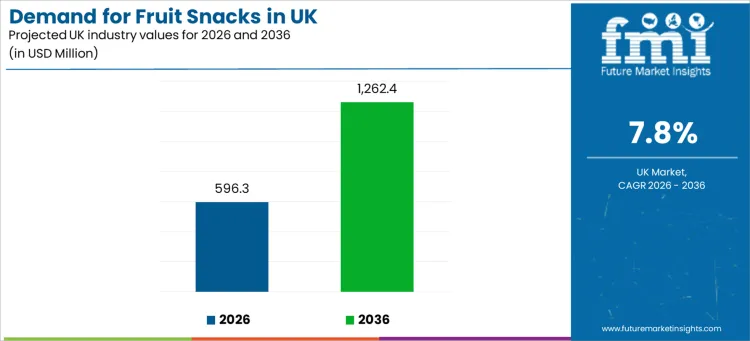
Demand for fruit snacks in the UK is projected at USD 596.3 million in 2026 and is expected to reach USD 1,262.4 million by 2036, expanding at a 7.8% CAGR. This rise is tied to everyday snacking behaviour shifting toward portable, portion-controlled formats that feel familiar, ingredient-led, and easier to fit into busy routines. Fruit snacks are increasingly positioned as “in-between” options that sit between indulgent confectionery and whole fruit, offering convenience while still leaning on fruit identity, texture variety, and shelf stability.
Fruit snacks include dried fruits, fruit chips, freeze-dried fruits, fruit leathers or rolls, fruit-based snack bars, and related formats that convert fruit ingredients into ready-to-eat packs. Buyers assess them through taste retention, mouthfeel, clean label compatibility, repeat purchase strength, storage performance, and price accessibility. Operators in retail and foodservice also evaluate them through shelf readiness, merchandising flexibility, and packaging efficiency that supports checkout impulse or planned pantry stocking.
For CEOs and brand owners, growth is linked to category expansion across health-forward positioning, family snacking, and on-the-go use cases. For ingredient processors and packaging suppliers, demand reflects the need for stable supply, consistent quality grading, and packaging formats that reduce spoilage risk while improving consumer experience.
Quick Stats for Fruit Snacks Demand in the UK
- Fruit Snacks Valuation in the UK (2026): USD 596.3 million
- Fruit Snacks Forecast Valuation in the UK (2036): USD 1,262.4 million
- Forecast CAGR (2026–2036): 7.8%
- Leading Regional Growth: England (8.6%)
- Leading Product Type: Dried Fruits (30.9% share)
- Leading Product Claim: Organic (34.2% share)
- Leading End Use Application: Retail/Household Consumption (56.4% share)
- Leading Sales Channel: Store-based Retail (62.2% share)
- Leading Packaging Type: Single-Serve Packs (32.8% share)
- Key Companies Profiled: Danone SA; Nestlé SA; Yakult Honsha Co., Ltd.; ADM; Kerry Group
Fruit Snacks in the UK Key Takeaways
| Metric | Value |
|---|---|
| Industry Value (2026) | USD 596.3 million |
| Industry Forecast Value (2036) | USD 1,262.4 million |
| Forecast CAGR (2026 to 2036) | 7.8% |
Why is the UK Building Strong Demand for Fruit Snacks?
UK snacking continues to evolve around portability, controlled portioning, and flexible anytime eating. Fruit snacks fit that pattern because they travel well, store well, and offer predictable taste without preparation. Families use them as lunchbox options. Office consumers treat them as desk snacks. Fitness-focused shoppers treat them as simple pre-workout carbs or a substitute for sweets.
Product claims are another demand catalyst. Organic leads at 34.2%, showing how many UK buyers now treat trust signals as part of everyday snack selection. Organic claims matter most when brands want to project minimal processing, ingredient simplicity, and sourcing discipline. Certification expectations shape formulation choices and supply chain controls. Soil Association standards describe the requirements used for organic certification in Great Britain, supporting how brands build compliance-ready organic product lines.
Retail rules and health policy pressure also influence category strategies. HFSS promotion and placement restrictions reshape how high-sugar snacks can be positioned, forcing brands to rethink visibility, pack architecture, and product mix. Government guidance explains how restrictions apply to promotions by location and by volume price, influencing which snack products can be pushed at high-traffic in-store zones. This environment makes fruit-led snacks attractive when brands want permissible placement, stronger health perception, and broader household acceptance.
Claims such as non-GMO, gluten-free, and vegan also continue to influence shopper attention. Brands cannot treat claims as purely marketing language. UK guidance on nutrition and health claims outlines compliance expectations under Regulation (EC) No 1924/2006, shaping what can be stated and how it must be substantiated.
Portfolio planning teams often align innovation pathways with broader category direction captured in fruit snack formats and consumer adoption, especially when deciding how to balance indulgence cues with cleaner label positioning in mainstream retail.
How is Fruit Snacks Demand Segmented by Product Type, Product Claim, End Use Application, Sales Channel, and Packaging Type?
Segmentation reflects how shoppers balance taste, convenience, and perceived wellness value. It also reflects how retailers and foodservice operators choose formats that are easy to stock, easy to sell, and less exposed to waste risk.
Why do dried fruits hold the largest product type share in the UK?
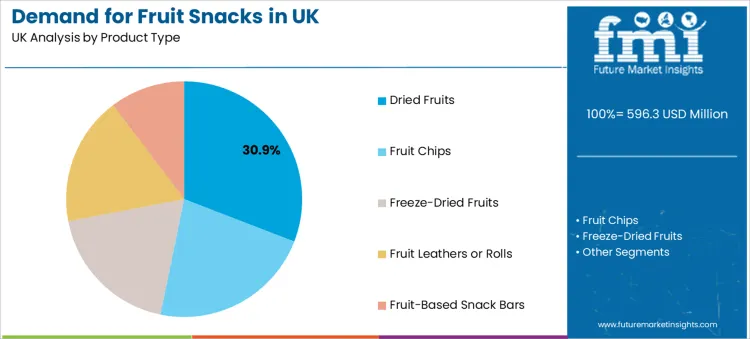
Dried fruits lead with a 30.9% share, placing them as the anchor format across everyday usage. This dominance reflects familiarity and trust. Consumers understand what dried fruits are, how they taste, and how they fit into routines. Dried fruits also work across multiple use cases: snacking, topping, baking, mixing into yogurt, and pairing with nuts.
From an operational perspective, dried fruit formats are efficient to distribute and store. They offer strong shelf stability and fewer handling constraints than fresh produce. Retailers also benefit from predictable replenishment and wider merchandising options, from snack aisles to health sections and impulse displays.
Why is Organic the leading product claim shaping Demand Decisions?
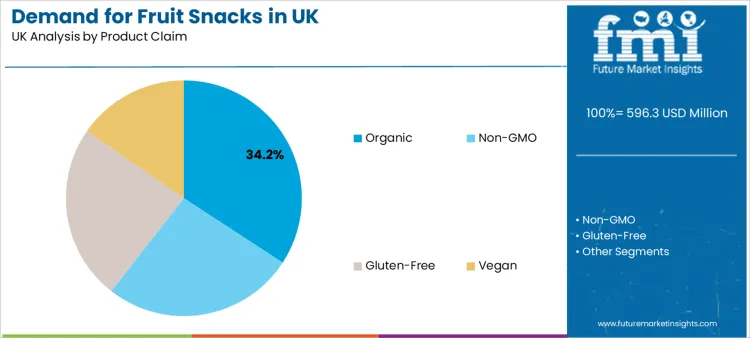
Organic holds a 34.2% share, indicating strong UK pull toward trust-based food choices. Organic positioning can support premium pricing, stronger repeat purchase behaviour, and wider acceptance among health-conscious households. It also influences packaging communication because shoppers often use organic as a shortcut for minimal processing and cleaner ingredient expectations.
Certification is not optional when brands play in this space. Soil Association organic standards define requirements that influence ingredient sourcing discipline, processing constraints, and labelling controls in Great Britain. Brands that manage certification well reduce compliance risk and strengthen retailer confidence during listings and audits.
Why does Retail and Household Consumption remain the Dominant End-use Application?
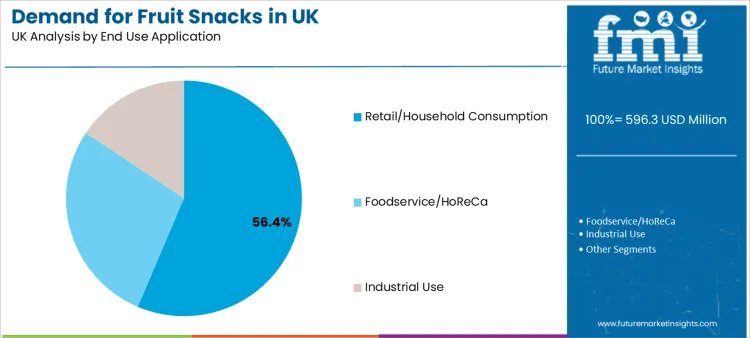
Retail/household consumption leads with a 56.4% share, showing that pantry stocking and personal snacking routines drive most volume. Home use supports repeat buying because households purchase multi-week supply, add snacks to grocery baskets, and treat fruit-based snacks as default options for children and adults.
Foodservice and HoReCa usage rises where cafés, hotels, and grab-and-go operators need portion-controlled snack options that fit bundled offers or mini retail displays. Industrial use remains relevant for brands using fruit snacks as inclusions, toppings, or ingredients in composite products.
Why does store-based retail stay the dominant sales channel despite online growth?
Store-based retail leads with a 62.2% share, reflecting how snacks still rely heavily on physical discovery, impulse purchase, and habitual add-ons during grocery trips. Shoppers often select fruit snacks while browsing adjacent items such as nuts, granola, cereals, and lunchbox products.
In-store presence also supports new format trials because consumers can compare packs, check ingredients quickly, and pick familiar textures without committing to bulk online buys. Online retail remains important for subscription behaviour, niche dietary needs, and premium packs, especially when consumers want specific claims or flavour profiles not widely stocked in stores.
Why are single-serve packs leading packaging choices across UK usage patterns?
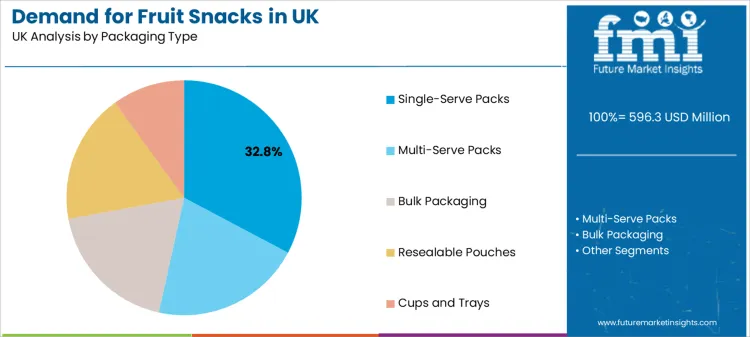
Single-serve packs lead with a 32.8% share, reflecting on-the-go usage and portion discipline. They help consumers avoid over-snacking while keeping products convenient for commuting, school, gyms, and office environments. For retailers, single-serve packs work well near checkouts and within meal-deal adjacencies where grab-and-go behaviour drives conversion.
Multi-serve packs support pantry economics and family stocking, while bulk packaging aligns with industrial and selected foodservice use. Resealable pouches continue to gain relevance because they protect texture and freshness after opening, supporting repeat consumption without quality drop-off.
Teams shaping packaging and channel strategy often keep an eye on adjacent growth patterns seen in better-for-you snack positioning and portion-led innovation in low-calorie snack foods, especially when format decisions need to work across both impulse and planned buying.
What are the Dynamics, Restraints, Opportunities, and Threats Shaping this Space?
What dynamics are strengthening UK demand fundamentals?
Snacking frequency remains high across working adults and families, supporting repeat purchase patterns. Product claim signals such as organic provide a strong pull when shoppers want reassurance without deep ingredient analysis.
Regulatory and public health pressure also shifts how snacks compete for visibility and promotional intensity. HFSS promotion restrictions influence placement and volume deal mechanics for products classified as less healthy, creating a commercial advantage for snack formats that can better align with healthier perception.
Claims compliance strengthens category discipline. UK guidance supports compliance with nutrition and health claims requirements under Regulation (EC) No 1924/2006, affecting how brands use on-pack messaging and advertising language.
What restraints can slow growth or narrow adoption routes?
Sugar perception is a key restraint. Some fruit snacks can still be viewed as sugar-dense even when fruit-based, pushing consumers to moderate usage or switch toward nuts, protein snacks, or savoury options. Texture fatigue is another constraint because some formats may feel repetitive without flavour variation and product innovation.
Price sensitivity also matters. Organic and premium claims can lift pricing beyond what some households accept for daily snacking. When inflation pressure rises, buyers may trade down into private label packs or multi-serve formats.
Where do practical opportunities sit for brands and suppliers?
Opportunities are strongest in differentiated formats and cleaner label execution. Freeze-dried offerings can deliver crisp textures while retaining fruit identity, giving brands a premium platform. Product teams often align premium development decisions with freeze-dried fruit formats used in snacking, especially when targeting modern retail shelves where texture novelty drives trial.
There is also a clear opportunity in channel strategy. Store-based retail remains dominant, yet online bundles and direct-to-consumer packs can create new customer acquisition routes and support personalised diet claims. Packaging innovation supports both channel approaches by protecting freshness while improving user experience.
What Threats can disrupt Demand Expectations?
Supply volatility in fruit inputs can create cost swings and quality inconsistencies. Weather-linked crop disruption can affect raw material pricing and availability, forcing manufacturers to change sourcing or reformulate blends.
Compliance risk is another threat. Misused claims, unclear labelling, or packaging that suggests unapproved health messaging can create retailer pushback and reputational damage. HFSS-related enforcement and retailer compliance expectations can also reshape shelf access and promotional calendars, influencing how brands plan launches and trade spend.
How is Fruit Snacks Demand Evolving across Key Regions in the UK?
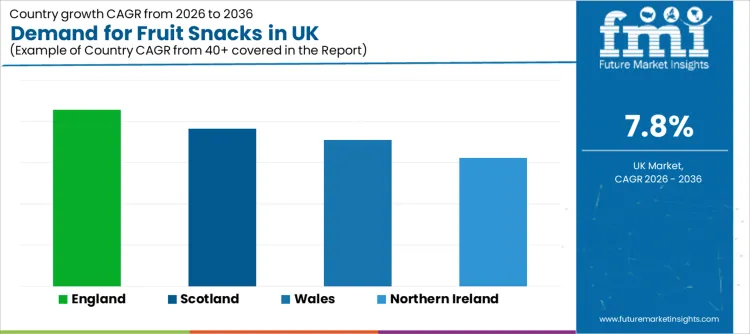
| Country | CAGR (2026-036) |
|---|---|
| England | 8.6% |
| Scotland | 7.6% |
| Wales | 7.1% |
| Northern Ireland | 6.2% |
Why is England leading growth through scale retail reach and product trial intensity?
England grows at 8.6%, driven by dense retail networks, higher brand competition, and broader flavour and format availability. New launches scale faster in England because store footprint is larger, distribution is wider, and shoppers are exposed to more merchandising points. Household snacking frequency and lunchbox buying also support repeat purchases, especially for single-serve packs designed for routine use.
How is Scotland building steady demand through premium cues and household stocking habits?
Scotland advances at 7.6%, supported by consistent household consumption and strong interest in trusted products that balance taste and ingredient confidence. Premium cues such as organic claims can perform well when shoppers want higher perceived quality. Retailers and brands also benefit from predictable repeat buying patterns tied to family snack needs and planned weekly shopping.
What is supporting Wales as fruit snacks adoption rises through practical value formats?
Wales grows at 7.1%, shaped by steady demand from households seeking convenient snack options that feel approachable and affordable. Value-friendly multi-serve packs and resealable formats can gain traction where families want everyday practicality while still choosing fruit-based alternatives. Brands that manage pricing discipline while protecting taste consistency tend to maintain stronger repeat sales in this region.
Why is Northern Ireland expanding at a measured pace through structured retail patterns and healthier food initiatives?
Northern Ireland increases at 6.2%, reflecting a steady demand profile where retail availability and household routines anchor purchase behaviour. Food environment improvement efforts also shape how brands and retailers approach snack positioning. The Food Standards Agency’s Making Food Better programme in Northern Ireland supports reformulation, portion improvements, and responsible promotions, influencing how healthier options are advanced.
What Defines the Competitive Landscape for Fruit Snacks in the UK?
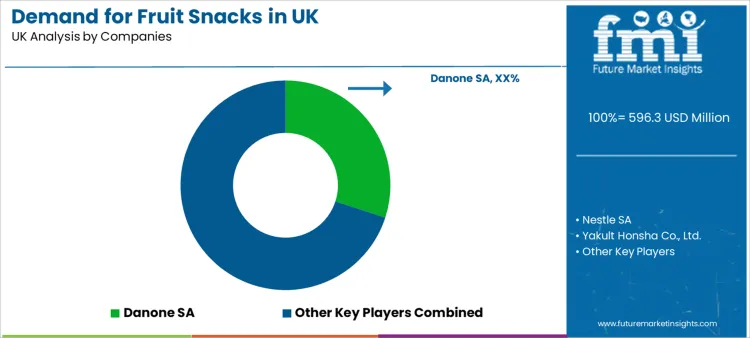
Competition is shaped by taste performance, credibility of claims, shelf execution, and packaging convenience. Brands compete on texture variety, flavour clarity, ingredient lists that feel simple, and packs that fit everyday routines. Retail success often depends on the ability to hold consistent quality through long shelf life while maintaining visual appeal that stands out in physical stores.
Danone SA competes through broad consumer reach and health-forward brand positioning potential. Nestlé SA competes through scale, distribution strength, and multi-format snack portfolios. Yakult Honsha Co., Ltd. competes through nutrition-linked brand trust and wellness adjacency. ADM competes through ingredient processing strength and supply chain capabilities that support scale manufacturing. Kerry Group competes through flavour, application expertise, and product development support for fruit-based snack innovations.
Teams shaping product pipelines often align competitive positioning with the wider fruit snack ecosystem captured through fruit snack formats and consumer adoption, especially when planning which formats can hold share across both store-based retail and online channel growth.
Key Industry Participants
- Danone SA
- Nestlé SA
- Yakult Honsha Co., Ltd.
- ADM
- Kerry Group
Scope of Report
| Items | Values |
|---|---|
| Quantitative Units | USD Million |
| Product Type | Dried Fruits; Fruit Chips; Freeze-Dried Fruits; Fruit Leathers or Rolls; Fruit-Based Snack Bars |
| Product Claim | Organic; Non-GMO; Gluten-Free; Vegan |
| End Use Application | Retail/Household Consumption; Foodservice/HoReCa; Industrial Use |
| Sales Channel | Store-based Retail; Online Retail |
| Packaging Type | Single-Serve Packs; Multi-Serve Packs; Bulk Packaging; Resealable Pouches; Cups and Trays |
| Regions Covered | England; Scotland; Wales; Northern Ireland |
| Key Companies Profiled | Danone SA; Nestlé SA; Yakult Honsha Co., Ltd.; ADM; Kerry Group |
Fruit Snacks Demand in the UK by Segments
By Product Type:
- Dried Fruits
- Fruit Chips
- Freeze-Dried Fruits
- Fruit Leathers or Rolls
- Fruit-Based Snack Bars
By Product Claim:
- Organic
- Non-GMO
- Gluten-Free
- Vegan
By End Use Application:
- Retail/Household Consumption
- Foodservice/HoReCa
- Industrial Use
By Sales Channel:
- Store-based Retail
- Online Retail
By Packaging Type:
-
Single-Serve Packs
- Multi-Serve Packs
- Bulk Packaging
- Resealable Pouches
- Cups and Trays
By Region:
- England
- Scotland
- Wales
- Northern Ireland
Bibliography
- Department of Health and Social Care. (2022). Restricting promotions of products high in fat, sugar or salt by location and by volume price: Implementation guidance.
- Food Standards Agency. (2020). Nutrition and health claims: Guidance to compliance with Regulation (EC) 1924/2006 on nutrition and health claims made on foods.
- Legislation.gov.uk. (2006). Regulation (EC) No 1924/2006 on nutrition and health claims made on foods.
- Soil Association. (2025). Organic standards for Great Britain: Food and drink.
- Food Standards Agency. (2025). Making Food Better programme (Northern Ireland).
Frequently Asked Questions
What is the outlook for fruit snacks demand in the UK for 2026?
In 2036, demand for fruit snacks in UK will likely be valued at USD 1,262.4 million.
At what rate will fruit snacks demand in UK progress from 2026 to 2036?
Fruit snacks demand in UK is anticipated to advance at a 7.8% CAGR from 2026 to 2036.
Which product type will account for the largest share of demand in the UK?
Dried fruits are likely to lead, capturing 30.9% of total demand share.
Which product claim is expected to lead demand in the UK?
Organic fruit snacks are expected to lead, accounting for 34.2% of total demand.
Which end use application is expected to remain dominant in the UK?
Retail/household consumption is expected to lead, accounting for 56.4% of total demand.
Which sales channel will remain the most important route to consumers in the UK?
Store-based retail is expected to lead, accounting for 62.2% of total demand.
Which packaging type is expected to lead fruit snacks usage in the UK?
Single-serve packs are expected to lead, accounting for 32.8% of total demand.
Preview the report firsthand - request a free sample
Get SampleGet the brochure for pricing and purchase details.
Get PDFTable of Content
- Executive Summary
- UK Market Outlook
- Demand-side Trends
- Supply-side Trends
- Technology Roadmap Analysis
- Analysis and Recommendations
- Market Overview
- Market Coverage / Taxonomy
- Market Definition / Scope / Limitations
- Market Background
- Market Dynamics
- Drivers
- Restraints
- Opportunity
- Trends
- Scenario Forecast
- Demand in Optimistic Scenario
- Demand in Likely Scenario
- Demand in Conservative Scenario
- Opportunity Map Analysis
- Product Life Cycle Analysis
- Supply Chain Analysis
- Investment Feasibility Matrix
- Value Chain Analysis
- PESTLE and Porter’s Analysis
- Regulatory Landscape
- Regional Parent Market Outlook
- Production and Consumption Statistics
- Import and Export Statistics
- Market Dynamics
- UK Market Analysis 2021 to 2025 and Forecast, 2026 to 2036
- Historical Market Size Value (USD Million) Analysis, 2021 to 2025
- Current and Future Market Size Value (USD Million) Projections, 2026 to 2036
- Y-o-Y Growth Trend Analysis
- Absolute $ Opportunity Analysis
- UK Market Pricing Analysis 2021 to 2025 and Forecast 2026 to 2036
- UK Market Analysis 2021 to 2025 and Forecast 2026 to 2036, By Product Type
- Introduction / Key Findings
- Historical Market Size Value (USD Million) Analysis By Product Type , 2021 to 2025
- Current and Future Market Size Value (USD Million) Analysis and Forecast By Product Type , 2026 to 2036
- Dried Fruits
- Fruit Chips
- Freeze-Dried Fruits
- Fruit Leathers or Rolls
- Fruit-Based Snack Bars
- Dried Fruits
- Y-o-Y Growth Trend Analysis By Product Type , 2021 to 2025
- Absolute $ Opportunity Analysis By Product Type , 2026 to 2036
- UK Market Analysis 2021 to 2025 and Forecast 2026 to 2036, By Product Claim
- Introduction / Key Findings
- Historical Market Size Value (USD Million) Analysis By Product Claim, 2021 to 2025
- Current and Future Market Size Value (USD Million) Analysis and Forecast By Product Claim, 2026 to 2036
- Organic
- Non-GMO
- Gluten-Free
- Vegan
- Organic
- Y-o-Y Growth Trend Analysis By Product Claim, 2021 to 2025
- Absolute $ Opportunity Analysis By Product Claim, 2026 to 2036
- UK Market Analysis 2021 to 2025 and Forecast 2026 to 2036, By End Use Application
- Introduction / Key Findings
- Historical Market Size Value (USD Million) Analysis By End Use Application, 2021 to 2025
- Current and Future Market Size Value (USD Million) Analysis and Forecast By End Use Application, 2026 to 2036
- Retail/Household Consumption
- Foodservice/HoReCa
- Industrial Use
- Retail/Household Consumption
- Y-o-Y Growth Trend Analysis By End Use Application, 2021 to 2025
- Absolute $ Opportunity Analysis By End Use Application, 2026 to 2036
- UK Market Analysis 2021 to 2025 and Forecast 2026 to 2036, By Sales Channel
- Introduction / Key Findings
- Historical Market Size Value (USD Million) Analysis By Sales Channel, 2021 to 2025
- Current and Future Market Size Value (USD Million) Analysis and Forecast By Sales Channel, 2026 to 2036
- Store-based Retail
- Online Retail
- Store-based Retail
- Y-o-Y Growth Trend Analysis By Sales Channel, 2021 to 2025
- Absolute $ Opportunity Analysis By Sales Channel, 2026 to 2036
- UK Market Analysis 2021 to 2025 and Forecast 2026 to 2036, By Packaging Type
- Introduction / Key Findings
- Historical Market Size Value (USD Million) Analysis By Packaging Type, 2021 to 2025
- Current and Future Market Size Value (USD Million) Analysis and Forecast By Packaging Type, 2026 to 2036
- Single-Serve Packs
- Multi-Serve Packs
- Bulk Packaging
- Resealable Pouches
- Cups and Trays
- Single-Serve Packs
- Y-o-Y Growth Trend Analysis By Packaging Type, 2021 to 2025
- Absolute $ Opportunity Analysis By Packaging Type, 2026 to 2036
- Market Structure Analysis
- Competition Dashboard
- Competition Benchmarking
- Market Share Analysis of Top Players
- By Regional
- By Product Type
- By Product Claim
- By End Use Application
- By Sales Channel
- By Packaging Type
- Competition Analysis
- Competition Deep Dive
- Danone SA
- Overview
- Product Portfolio
- Profitability by Market Segments (Product/Age /Sales Channel/Region)
- Sales Footprint
- Strategy Overview
- Marketing Strategy
- Product Strategy
- Channel Strategy
- Nestle SA
- Yakult Honsha Co., Ltd.
- ADM
- Kerry Group
- Danone SA
- Competition Deep Dive
- Assumptions & Acronyms Used
- Research Methodology


