

- Industry Size (2026)
- USD 184.5 Mn
- Forecast (2036)
- USD 363.9 Mn
- CAGR (2026 to 2036)
- 7.0%
Demand for Fruit Snacks in South Korea Forecast and Outlook 2026 to 2036
Revenue regarding fruit snack sales in South Korea is anticipated to reach USD 184.5 million in 2026. Expenditure on these nutritious treats is likely to ascend to USD 363.9 million by 2036, expanding at a compound annual growth rate of 7.0%. South Korean consumers are increasingly prioritizing health and wellness, driving a significant shift away from traditional sugary confectioneries toward natural alternatives. Busy lifestyles in urban centers like Seoul necessitate convenient, on-the-go nutrition, making portable fruit-based options highly attractive to office workers and students. Parents are also becoming more discerning about ingredients, seeking clean-label products for their children that offer essential vitamins without artificial additives. This cultural pivot towards "better-for-you" consumption is fundamentally reshaping the snack aisle, encouraging retailers to expand shelf space for dried, freeze-dried, and processed fruit items.
Government initiatives aimed at curbing childhood obesity and promoting healthier dietary habits are actively supporting industry expansion. Ministry of Food and Drug Safety regulations regarding nutritional labeling are becoming stricter, compelling manufacturers to be transparent about sugar content and additives. Public schools are increasingly incorporating fruit-based snacks into meal programs to ensure students receive adequate daily servings of vitamins. These policy measures create a supportive environment for brands that prioritize natural ingredients and minimal processing.
Quick Stats for Demand for Fruit Snacks in South Korea
- Demand for Fruit Snacks in South Korea Value (2026): USD 184.5 million
- Demand for Fruit Snacks in South Korea Forecast Value (2036): USD 363.9 million
- Demand for Fruit Snacks in South Korea Forecast CAGR: 7.0%
- Leading Product Type Segment for Fruit Snacks Industry in South Korea: Dried Fruits (32.0%)
- Leading Product Claim Segment for Fruit Snacks Industry in South Korea: Organic (36.0%)
- Leading End Use Segment for Fruit Snacks Industry in South Korea: Retail/Household Consumption (59.4%)
- Key Growth Regions for Fruit Snacks Industry in South Korea: Jeju, South Gyeongsang, South Jeolla, North Jeolla
- Fruit Snacks Industry in South Korea Key Players: Danone SA, Nestle SA, Yakult Honsha Co., Ltd., ADM, Kerry Group
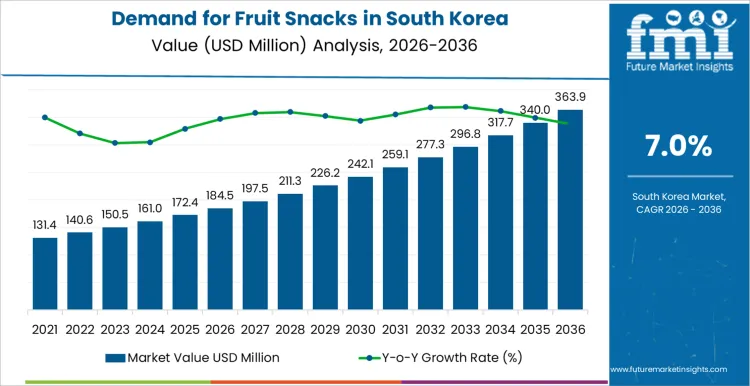
Technological advancements in food processing are revolutionizing product quality and variety. Adoption of advanced freeze-drying techniques preserves the nutritional value and texture of fresh produce, driving interest in freeze dried fruits style products locally. Innovations in frozen fruit bars manufacturing allow for the creation of snacks that retain the authentic taste of raw fruit without added sugars. Integration of functional ingredients like probiotics into fruit leathers is blurring the lines between snacks and supplements. Research into demand for fruit powders indicates a similar trend here, where fruit extracts are used to fortify snack bars. These technical strides enable producers to offer healthy snacks options that deliver both sensory indulgence and tangible health benefits.
Demand for Fruit Snacks in South Korea Key Takeaways
South Korea's snacking landscape is undergoing a premiumization wave, characterized by a move towards high-quality, functional ingredients. Dried fruits currently hold the largest portion of consumption, favored for their concentrated flavor and chewy texture. Retail channels remain the primary distribution point, although online platforms are gaining ground due to convenient delivery options. Organic and non-GMO claims are becoming standard expectations rather than niche differentiators. Competitive dynamics are led by global nutrition giants who are leveraging their R&D capabilities to introduce novel textures and flavors tailored to the sophisticated Korean palate.
| Metric | Value |
|---|---|
| Industry Size (2026) | USD 184.5 million |
| Industry Value (2036) | USD 363.9 million |
| CAGR (2026 to 2036) | 7.0% |
What Consumer Trends Are Fueling Fruit Snack Adoption?
Rising awareness regarding the benefits of plant-based diets acts as a primary catalyst for sector growth. Consumers are actively seeking demand for plant based snacks equivalent products that align with vegan and vegetarian lifestyles. Reliance on better for you snacks offerings is increasing as individuals look to manage weight and boost immunity through diet. Convenience stores are stocking more refrigerated snacks items, including fresh-cut fruits and fruit cups, catering to the immediate consumption needs of commuters. High internet penetration facilitates the rapid dissemination of health trends, prompting younger demographics to try novel fruit formats like fruit chips and leathers. This convergence of health awareness and digital influence ensures consistent demand for innovative fruit-based nutrition.
How is the Sector Structured Across Key Segments?
Structure of this domain is categorized by product configuration, specific product claims, and the end-user environment. Product segmentation distinguishes between traditional dried fruits, innovative freeze-dried options, and processed bars. Product claim classification highlights the growing consumer preference for organic and non-GMO certifications. End-user data underscores the dominance of household consumption compared to industrial applications or foodservice. Understanding this segmentation helps manufacturers tailor their supply chains; for instance, sourcing organic raw materials is crucial for premium retail lines, while bulk packaging serves the industrial sector. This division underscores the versatility of fruit snacks, which serve as both standalone treats and essential ingredients in broader food processing.
Why Does the Dried Fruits Category Maintain Dominance?
Dried Fruits command a 32.0% share of the industry. Traditional consumption habits in South Korea have long included dried persimmons (gotgam) and jujubes, creating a natural familiarity with this format. Modern processing technologies have expanded this category to include mangoes, berries, and citrus slices, appealing to a broader palate. Shelf-stability of dried fruits makes them an ideal pantry staple for households, reducing the frequency of grocery trips. Concentrated sweetness and nutrient density offer a satisfying alternative to candy, driving parents to purchase them for children. Cost-effectiveness compared to fresh fruit, especially out of season, further solidifies dried fruits as the leading volume driver in the fruit snack domain.
How is the Organic Segment Contributing to Sector Growth?
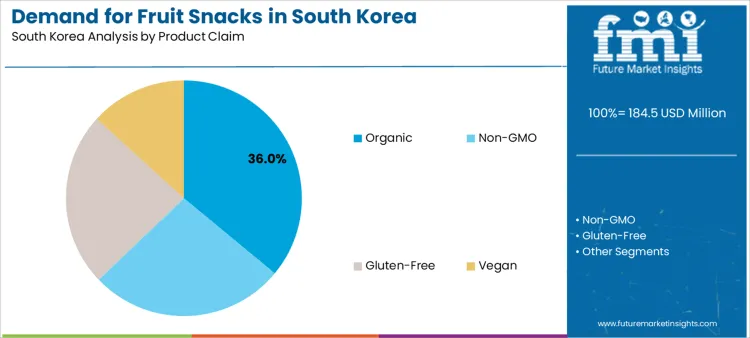
Organic products account for 36.0% of the usage share. Safety concerns related to pesticide residues and chemical fertilizers drive South Korean consumers towards certified organic options. Parents of young children are the primary demographic fueling this trend, willing to pay a premium for "clean" snacks. Fruit snacks industry analysis shows that organic certification serves as a trusted proxy for quality and safety. Retailers are dedicating specific aisles to organic foods, increasing visibility and accessibility. As disposable incomes rise, the trade-up to organic versions becomes a standard consumer behavior, ensuring this segment outpaces the broader industry growth rate.
Why Do Retail Households Lead Consumption?
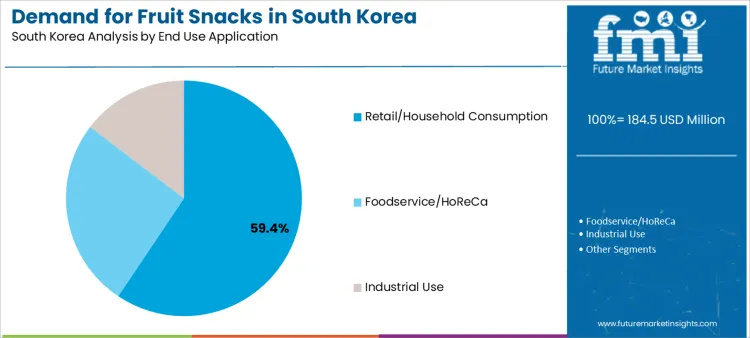
Retail/Household Consumption captures a 59.4% share of the sector. Direct-to-consumer sales through supers, convenience stores, and hypers form the backbone of distribution. Families purchase multi-packs for weekly consumption, packing them in school lunches or using them as office snacks. Rise of packaged fresh fruits options in convenience stores caters to the single-person household demographic. ing campaigns often target the household purchaser, emphasizing value and health benefits. Consequently, the retail environment remains the critical battleground for brand visibility and volume sales, far exceeding the consumption seen in commercial foodservice settings.
Will the Expansion of Online Retail Redefine Future Sales?
Usage of e-commerce platforms for grocery shopping is exceptionally high in South Korea. Online retail currently accounts for 26.0% of sales but is poised for rapid expansion. "Dawn delivery" services offered by major platforms allow consumers to receive fresh and dried fruit snacks within hours of ordering. This convenience factor drives bulk purchasing and subscription models. Digital platforms enable niche brands to reach a national audience without expensive physical listing fees. Integration of customer reviews and detailed product information on these sites builds trust, encouraging consumers to try new fruit snacks indicated products. As logistics networks optimize further, the online channel will likely become the primary growth engine.
How Do Supply Chain Fluctuations Impact Product Design?
Volatility in global fruit prices and seasonal availability directly impacts production costs. Manufacturers are mitigating these risks by diversifying sourcing regions and investing in frozen fruits and vegetables technologies to store raw materials. Climate change affecting crop yields necessitates flexible product formulations that can adapt to varying fruit supplies. Companies are also exploring local sourcing of Korean-grown fruits like strawberries and tangerines to reduce import dependency. Innovations in freeze dried fruits show how supply stability can be achieved through advanced preservation, ensuring consistent product availability on shelves despite agricultural fluctuations.
Is the Trend Towards Functional Fortification Affecting Demand?
Growth of the functional food sector is influencing snack development significantly. Consumers are looking for snacks that offer more than just basic nutrition; they want added benefits like gut health or energy boosting. Manufacturers are fortifying fruit snacks with vitamins, probiotics, and fiber. Fruit snacks demand trends reflect a similar move towards "superfood" ingredients. Usage of fruit powders and extracts allows for precise nutrient dosing in snack bars and leathers. This trend transforms simple fruit snacks into functional health supplements, allowing brands to command higher price points and appeal to health-obsessed demographics.
How is the Fruit Snack Landscape Evolving Across South Korea's Regions?
Regional consumption patterns reflect the distribution of agricultural production zones and urban consumer hubs. Metropolitan areas drive innovation and high-volume procurement of premium packaged snacks, while agricultural provinces utilize local produce for processing. Government support for regional food clusters is decentralizing demand, encouraging value-added processing near farms. Specific provinces with high tourism traffic are witnessing localized growth in portable snack sales. Understanding these geographical nuances allows companies to optimize distribution networks, ensuring fresh and diverse product availability across the peninsula.
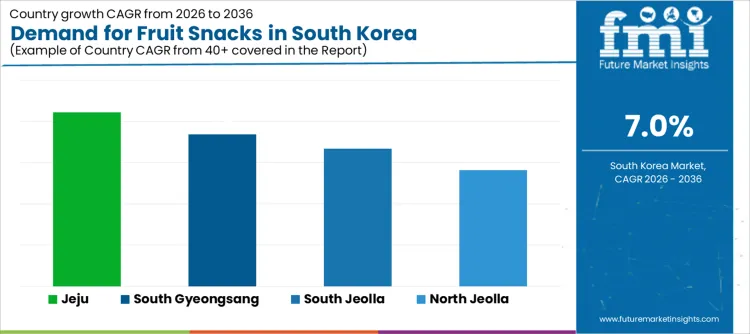
| Region | CAGR (2026 to 2036) |
|---|---|
| Jeju | 8.4% |
| South Gyeongsang | 7.4% |
| South Jeolla | 6.7% |
| North Jeolla | 5.6% |
Why is the Tourism Sector in Jeju Driving Rapid Growth?
Adoption of fruit snacks in Jeju is projected to expand at a CAGR of 8.4%. Jeju Island is famous for its citrus fruits, particularly hallabong and tangerines. Local producers are capitalizing on this by creating signature dried fruit souvenirs and citrus chips for tourists. High tourist footfall drives demand for portable, gift-worthy snack packs. "Jeju-made" branding commands a premium, appealing to visitors seeking authentic local flavors. Investments in processing facilities on the island allow for the immediate preservation of peak-season harvests, ensuring a high-quality product that sustains year-round sales growth.
How is Industrial Revitalization in South Gyeongsang Influencing Sales?
Sales of packaged snacks in South Gyeongsang are likely to reach a CAGR of 7.4%. This region hosts significant industrial zones where workers require convenient energy sources. Vending machines and convenience stores within industrial complexes are stocking more fruit snacks style energy bars and fruit packs. Corporate wellness programs in large manufacturing firms are encouraging the consumption of healthy snacks over junk food. Regional retailers are partnering with distributors to ensure consistent supply to these high-consumption zones, supporting steady volume growth in the area.
What Specific Factors Drive Demand in South Jeolla?
Expansion in South Jeolla is anticipated to rise at a CAGR of 6.7%. As a major agricultural hub, South Jeolla produces a vast array of fruits including pears and persimmons. Farmers are increasingly forming cooperatives to produce value-added dried fruit products, bypassing middlemen. This direct-to-consumer model, often facilitated by local government support, boosts regional income and product variety. Agritourism initiatives in the province also promote the sale of farm-fresh processed snacks. Focus on "local food" movements drives residents to support these regional products, fostering a sustainable local consumption loop.
Why is North Jeolla Modernizing its Food Clusters?
Deployment of food processing technologies in North Jeolla is expected to increase at a CAGR of 5.6%. The National Food Cluster located in Iksan is attracting food tech companies specializing in advanced drying and packaging. Research institutes in the region are developing new fruit snack formats, such as fruit-infused chocolates and functional jellies. Fruit snacks innovations are often studied and adapted here. While growing from a smaller base, the concentration of R&D expertise ensures that North Jeolla remains at the forefront of product innovation, driving long-term value creation in the sector.
What Strategic Initiatives Define Industry Leadership?
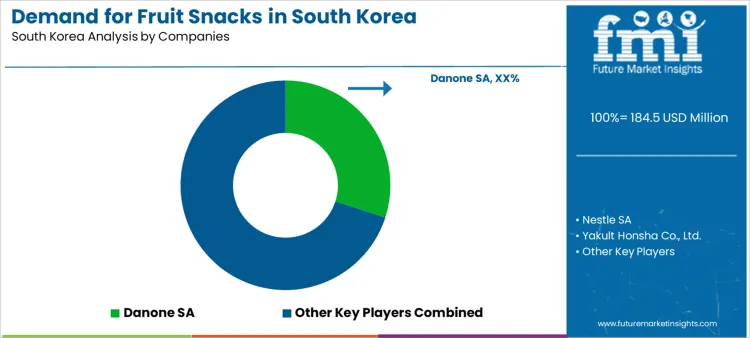
Danone SA commands a dominant position with a 30.0% share, leveraging its strong reputation in health and nutrition. Strategy revolves around integrating fruit snacks into its broader portfolio of dairy and plant-based products, offering comprehensive healthy snacking solutions. Danone invests in ing campaigns that highlight the nutritional density and natural origins of its ingredients. Competitors like Nestle and Yakult focus on specific functional benefits, such as digestion or immunity. Strategic partnerships with local retail chains ensure premium shelf placement, while investment in sustainable packaging appeals to eco-conscious consumers.
How Are Local Competitors Challenging Global Giants?
Domestic players are differentiating themselves through hyper-localization and usage of indigenous fruit varieties. Companies utilizing Korean pears, strawberries, and persimmons appeal to national pride and taste preferences. Smaller firms often innovate faster, introducing trendy formats like freeze-dried yogurt bites with fruit. They leverage online channels and social media ing to reach younger demographics effectively. By offering lower price points and "farm-to-table" traceability, local competitors carve out significant niches, challenging the dominance of multinational corporations.
Key Companies
- Danone SA
- Nestle SA
- Yakult Honsha Co., Ltd.
- ADM
- Kerry Group
Scope of Report
| Items | Values |
|---|---|
| Quantitative Units | USD Million |
| Product Type | Dried Fruits, Fruit Chips, Freeze-Dried Fruits, Fruit Leathers or Rolls, Fruit-Based Snack Bars |
| Product Claim | Organic, Non-GMO, Gluten-Free, Vegan |
| End Use | Retail/Household Consumption, Foodservice/HoReCa, Industrial Use |
| Regions Covered | Jeju, South Gyeongsang, South Jeolla, North Jeolla |
| Key Companies Profiled | Danone, Nestle, Yakult, ADM, Kerry Group |
Demand for Fruit Snacks in South Korea by Segments
By Product Type:
- Dried Fruits
- Fruit Chips
- Freeze-Dried Fruits
- Fruit Leathers or Rolls
- Fruit-Based Snack Bars
By Product Claim:
- Organic
- Non-GMO
- Gluten-Free
- Vegan
By End Use:
- Retail/Household Consumption
- Foodservice/HoReCa
- Industrial Use
By Sales Channel:
- Store-based Retail
- Online Retail
By Packaging Type:
- Single-Serve Packs
- Multi-Serve Packs
- Bulk Packaging
- Resealable Pouches
- Cups and Trays
Bibliography
- Ministry of Food and Drug Safety. (2024, December 30). 2024 food and drug statistical yearbook (26th edition). Ministry of Food and Drug Safety, Republic of Korea.
- Ministry of Food and Drug Safety. (2025, January 2). 2024 food and drug industry trend statistics (covering 2023 production and trade for food and related industries). Ministry of Food and Drug Safety, Republic of Korea.
- Korea Agro-Fisheries and Food Trade Corporation. (2024, October). 2024 processed food consumer attitude survey: Key results and implications. Korea Agro-Fisheries and Food Trade Corporation, Republic of Korea.
- Korea Agro-Fisheries and Food Trade Corporation. (2024, October). Food expenditure trends and 2024 Q4 outlook (including processed food expenditure analysis). Korea Agro-Fisheries and Food Trade Corporation, Republic of Korea.
- Korea Health Industry Development Institute. (2024). Nutrition statistics tables portal: Nutrient intake distribution based on national health and nutrition survey microdata. Korea Health Industry Development Institute, Republic of Korea.
Frequently Asked Questions
How big is the demand for Fruit Snacks in South Korea in 2026?
The demand for Fruit Snacks in South Korea is estimated to be valued at USD 184.5 million in 2026.
What will be the size of Fruit Snacks in South Korea in 2036?
The industry size for the Fruit Snacks in South Korea is projected to reach USD 363.9 million by 2036.
How much will be the demand for Fruit Snacks in South Korea growth between 2026 and 2036?
The demand for Fruit Snacks in South Korea is expected to grow at a 7.0% CAGR between 2026 and 2036.
What are the key product types in the Fruit Snacks in South Korea?
The key product types in Fruit Snacks in South Korea are Dried Fruits, Fruit Chips, and Freeze-Dried Fruits.
Which end user segment is expected to contribute significant share in the Fruit Snacks in South Korea in 2026?
By end user, Retail/Household Consumption segment is expected to command 59.4% share in the Fruit Snacks in South Korea in 2026.
Preview the report firsthand - request a free sample
Get SampleGet the brochure for pricing and purchase details.
Get PDFTable of Content
- Executive Summary
- South Korea Market Outlook
- Demand-side Trends
- Supply-side Trends
- Technology Roadmap Analysis
- Analysis and Recommendations
- Market Overview
- Market Coverage / Taxonomy
- Market Definition / Scope / Limitations
- Market Background
- Market Dynamics
- Drivers
- Restraints
- Opportunity
- Trends
- Scenario Forecast
- Demand in Optimistic Scenario
- Demand in Likely Scenario
- Demand in Conservative Scenario
- Opportunity Map Analysis
- Product Life Cycle Analysis
- Supply Chain Analysis
- Investment Feasibility Matrix
- Value Chain Analysis
- PESTLE and Porter’s Analysis
- Regulatory Landscape
- Regional Parent Market Outlook
- Production and Consumption Statistics
- Import and Export Statistics
- Market Dynamics
- South Korea Market Analysis 2021 to 2025 and Forecast, 2026 to 2036
- Historical Market Size Value (USD Million) Analysis, 2021 to 2025
- Current and Future Market Size Value (USD Million) Projections, 2026 to 2036
- Y-o-Y Growth Trend Analysis
- Absolute $ Opportunity Analysis
- South Korea Market Pricing Analysis 2021 to 2025 and Forecast 2026 to 2036
- South Korea Market Analysis 2021 to 2025 and Forecast 2026 to 2036, By Product Type
- Introduction / Key Findings
- Historical Market Size Value (USD Million) Analysis By Product Type , 2021 to 2025
- Current and Future Market Size Value (USD Million) Analysis and Forecast By Product Type , 2026 to 2036
- Dried Fruits
- Fruit Chips
- Freeze-Dried Fruits
- Fruit Leathers or Rolls
- Fruit-Based Snack Bars
- Dried Fruits
- Y-o-Y Growth Trend Analysis By Product Type , 2021 to 2025
- Absolute $ Opportunity Analysis By Product Type , 2026 to 2036
- South Korea Market Analysis 2021 to 2025 and Forecast 2026 to 2036, By Product Claim
- Introduction / Key Findings
- Historical Market Size Value (USD Million) Analysis By Product Claim, 2021 to 2025
- Current and Future Market Size Value (USD Million) Analysis and Forecast By Product Claim, 2026 to 2036
- Organic
- Non-GMO
- Gluten-Free
- Vegan
- Organic
- Y-o-Y Growth Trend Analysis By Product Claim, 2021 to 2025
- Absolute $ Opportunity Analysis By Product Claim, 2026 to 2036
- South Korea Market Analysis 2021 to 2025 and Forecast 2026 to 2036, By End Use Application
- Introduction / Key Findings
- Historical Market Size Value (USD Million) Analysis By End Use Application, 2021 to 2025
- Current and Future Market Size Value (USD Million) Analysis and Forecast By End Use Application, 2026 to 2036
- Retail/Household Consumption
- Foodservice/HoReCa
- Industrial Use
- Retail/Household Consumption
- Y-o-Y Growth Trend Analysis By End Use Application, 2021 to 2025
- Absolute $ Opportunity Analysis By End Use Application, 2026 to 2036
- South Korea Market Analysis 2021 to 2025 and Forecast 2026 to 2036, By Sales Channel
- Introduction / Key Findings
- Historical Market Size Value (USD Million) Analysis By Sales Channel, 2021 to 2025
- Current and Future Market Size Value (USD Million) Analysis and Forecast By Sales Channel, 2026 to 2036
- Store-based Retail
- Online Retail
- Store-based Retail
- Y-o-Y Growth Trend Analysis By Sales Channel, 2021 to 2025
- Absolute $ Opportunity Analysis By Sales Channel, 2026 to 2036
- South Korea Market Analysis 2021 to 2025 and Forecast 2026 to 2036, By Packaging Type
- Introduction / Key Findings
- Historical Market Size Value (USD Million) Analysis By Packaging Type, 2021 to 2025
- Current and Future Market Size Value (USD Million) Analysis and Forecast By Packaging Type, 2026 to 2036
- Single-Serve Packs
- Multi-Serve Packs
- Bulk Packaging
- Resealable Pouches
- Cups and Trays
- Single-Serve Packs
- Y-o-Y Growth Trend Analysis By Packaging Type, 2021 to 2025
- Absolute $ Opportunity Analysis By Packaging Type, 2026 to 2036
- Market Structure Analysis
- Competition Dashboard
- Competition Benchmarking
- Market Share Analysis of Top Players
- By Regional
- By Product Type
- By Product Claim
- By End Use Application
- By Sales Channel
- By Packaging Type
- Competition Analysis
- Competition Deep Dive
- Danone SA
- Overview
- Product Portfolio
- Profitability by Market Segments (Product/Age /Sales Channel/Region)
- Sales Footprint
- Strategy Overview
- Marketing Strategy
- Product Strategy
- Channel Strategy
- Nestle SA
- Yakult Honsha Co., Ltd.
- ADM
- Kerry Group
- Danone SA
- Competition Deep Dive
- Assumptions & Acronyms Used
- Research Methodology


