

- Industry Size (2026)
- USD 96.7 Mn
- Forecast (2036)
- USD 171.5 Mn
- CAGR (2026 to 2036)
- 5.9%
Fruit Pectin Industry in the UK Forecast Outlook 2026 to 2036
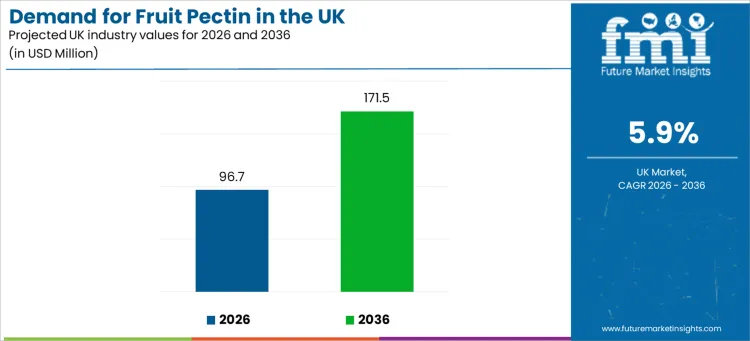
Demand for fruit pectin in the UK is likely to be valued at USD 96.7 million in 2026 and is projected to reach USD 171.5 million by 2036, at a CAGR of 5.9%. This demand reflects the expanding role of pectin as a functional ingredient that supports texture control, label clarity, and formulation reliability across food, supplement, and healthcare uses.
Fruit pectin is selected for its ability to deliver predictable gelling and stabilizing performance using plant-derived input streams such as citrus peel and apple pomace. UK formulators rely on pectin to manage viscosity, moisture retention, and structural integrity in products that require clean ingredient declarations. Consistent gel strength, neutral taste contribution, and compatibility with reduced-sugar systems shape procurement decisions across industrial production environments.
Quick Stats for Fruit Pectin Industry in the UK
- Fruit Pectin Industry Value (2026): USD 96.7 million
- Fruit Pectin Industry Forecast Value (2036): USD 171.5 million
- Fruit Pectin Industry Forecast CAGR (2026-2036): 5.9%
- Leading Application by Demand Share: Food supplements
- Fastest-Growing Regions: England, Scotland, Wales, Northern Ireland
- Key Industry Participants: CP Kelco, Cargill Inc., Devson Impex Pvt. Ltd., Nestlé S.A., Danone S.A.
Demand is reinforced by its adaptability across controlled processing conditions. Supplement developers, healthcare formulators, and food manufacturers value pectin for stable handling in dry form, precise dosing, and dependable behavior during hydration and thermal treatment. Repeat usage is driven by performance reliability rather than experimentation, positioning fruit pectin as a functional backbone ingredient supporting everyday production needs tied to quality assurance, shelf stability, and texture consistency.
Fruit Pectin Industry in the UK Key Takeaways
| Metric | Value |
|---|---|
| Industry Value (2026) | USD 96.7 million |
| Industry Forecast Value (2036) | USD 171.5 million |
| Forecast CAGR (2026 to 2036) | 5.9% |
Why is the UK Building Steady Demand for Fruit Pectin?
Demand for fruit pectin in the UK grows as food manufacturers and home cooks look for natural gelling and stabilizing options that align with cleaner ingredient preferences. Fruit pectin delivers texture control in jams, jellies and confectionery without synthetic additives, fitting consumer expectations for recognizable, plant-derived components. Manufacturers prefer pectin because it can help deliver consistent product performance in recipes consumers trust.
The UK food industry uses fruit pectin to improve shelf life and structure in dairy alternatives, dessert gels and fruit preparations. Product developers choose pectin to achieve desired mouthfeel and stability in yogurts, fruit drinks and spreadable toppings. Retailers adjust shelving to reflect this trend, placing pectin-enabled products where shoppers expect quality and natural formulations, which supports routine purchase behaviour.
Kitchens and small-scale bakers across the UK also influence consumption. Savvy consumers adopt fruit pectin to craft preserves and baked goods that meet taste and texture expectations. Cooking shows, social recipe forums and community cookbooks highlight pectin use, which normalises its presence in everyday cooking. Word-of-mouth appreciation for well-set preserves strengthens use across seasons, supporting demand grounded in practicality and quality results.
How is Fruit Pectin Demand Segmented by Application, End-User, and Form in the UK?
Demand for fruit pectin in the UK reflects how formulators prioritize fibre functionality, texture control, and compatibility with regulated health-led applications. Segmentation patterns follow usage intensity, validation requirements, and handling preferences within controlled production environments.
Why do food supplements lead application-level demand?
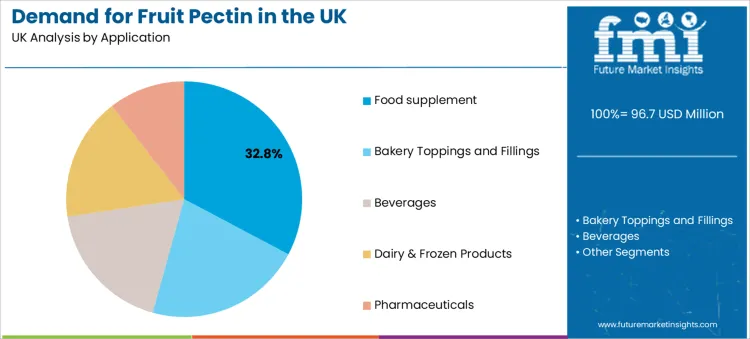
Food supplements hold a 32.8% share, placing them as the leading application. This position reflects rising use of pectin as a soluble fibre supporting digestive formulations, satiety-focused products, and controlled-release matrices. Supplement developers value pectin for its plant origin, neutral sensory profile, and compatibility with capsules, sachets, and chewable formats. Texture contribution and gel behaviour can be tuned precisely, which supports consistency across dosage forms without compromising swallowability or stability.
Formulation teams also rely on pectin to manage ingredient interactions where vitamins, minerals, or botanical extracts require suspension or uniform dispersion. This strengthens its role within supplement portfolios designed around repeat daily intake.
What positions the healthcare industry as the primary end-user?
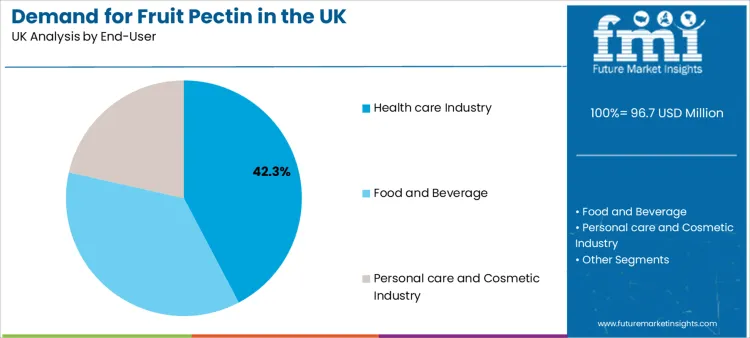
The healthcare industry represents a 42.3% share, reflecting structured demand driven by formulation standards, documentation discipline, and quality assurance requirements. Healthcare-focused users apply pectin in medical nutrition, controlled dietary products, and supportive therapeutic applications where excipient reliability matters. Procurement decisions emphasise traceability, specification clarity, and batch-to-batch consistency, which aligns with pectin sourced and processed under validated conditions.
Healthcare usage also benefits from pectin’s established acceptance within regulated environments, supporting long-term incorporation into approved product lines.
Why does original dry form remain the preferred handling option?
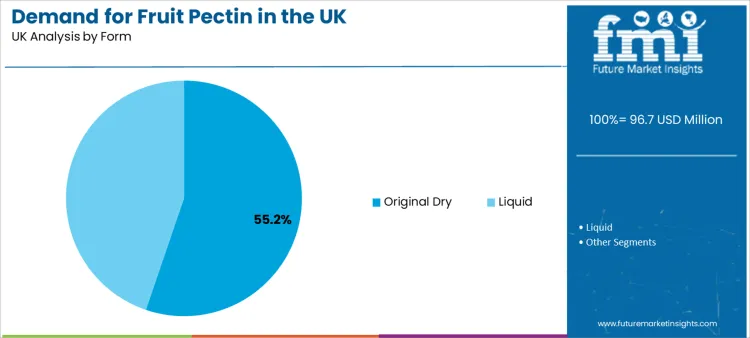
Original dry form accounts for a 55.2% share, indicating strong preference for storage stability and dosing control. Dry pectin supports accurate weighing, extended shelf life, and compatibility with dry blending systems used across supplements and healthcare formulations. Handling flexibility allows producers to hydrate pectin at controlled stages, reducing variability and supporting uniform gel development during processing.
What are the Key Dynamics in Demand for Fruit Pectin in the UK?
Demand for fruit pectin in the UK is influenced by its role as a gelling, stabilizing and texture-building ingredient in confectionery, jams, dairy desserts and bakery fillings. Fruit pectin is valued where clean-label claims and natural ingredient positioning are important, as it originates from citrus peel and apple pomace rather than synthetic thickeners. Usage patterns are tied to product portfolios that prioritize traditional textures, reduced sugar formulations and extended shelf stability.
How do reformulation trends and product quality expectations shape usage?
In UK food development, fruit pectin is selected to deliver consistent gel strength and mouthfeel in reduced-sugar and sugar-free applications, particularly in spreads and fruit preparations. Confectionery producers use high-methoxyl and low-methoxyl pectins with precise gelling profiles to achieve target bite and structural integrity in fruit jellies and soft chews. Dairy manufacturers incorporate pectin to stabilize acidified yogurt drinks and fruit-on-the-bottom formats, supporting suspension of fruit particles while maintaining smooth texture. Bakeries deploy pectin in fruit fillings and glazes to control moisture migration and prevent weeping during slicing and packaging.
How do ingredient costs and supply constraints affect ongoing demand?
Demand for fruit pectin in the UK is affected by ingredient pricing and seasonal raw material availability. Pectin extraction relies on citrus and apple waste streams, and variability in crop yields and peel quality impacts supply continuity and cost. Price increases for raw materials can constrain use in value-oriented categories where formulators must balance functional performance with retail price positioning. Manufacturers may adjust formulations if pectin grades do not consistently deliver required gel strength, adding complexity to sourcing strategies. Regulatory treatment of pectin as a natural texturizer supports clean-label claims, yet formulators must validate that functional performance persists across shelf life, which adds development time.
How is Fruit Pectin Demand Evolving across Key Regions in the UK?
Demand for fruit pectin across the UK progresses as manufacturers reformulate fruit-based products to improve texture control and label clarity. Regional variation reflects processing scale, application diversity, technical formulation capability, and how producers align gelling performance with sugar reduction and stability requirements.
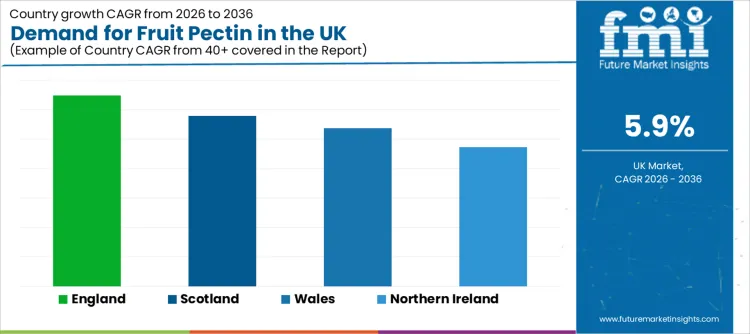
| Region | CAGR (2026 to 2036) |
|---|---|
| England | 6.5% |
| Scotland | 5.8% |
| Wales | 5.4% |
| Northern Ireland | 4.7% |
Why is England leading expansion through broad application use and reformulation activity?
England grows at 6.5%, supported by extensive use of fruit pectin across jams, fillings, beverages, and dairy applications. Demand rises where reformulation activity accelerates in response to sugar reduction and texture optimization needs. Producers value predictable gel strength, batch-to-batch consistency, and compatibility with high-throughput cooking and filling systems.
How is Scotland progressing through steady adoption in fruit-based and dairy products?
Scotland expands at 5.8%, shaped by consistent uptake in preserves, yogurt preparations, and chilled desserts. Manufacturers focus on pectin grades that deliver reliable set and mouthfeel under controlled processing conditions. Demand builds where technical teams select solutions that perform across seasonal fruit variability while maintaining visual appeal and consumer texture expectations.
What is shaping Wales as producers balance functionality with processing efficiency?
Wales advances at 5.4%, driven by practical selection among processors seeking functional gelling without excessive formulation complexity. Demand strengthens when fruit pectin integrates smoothly into existing recipes and cooking profiles. Buyers prioritize performance that supports stable viscosity, manageable cook times, and dependable results within smaller yet efficient production runs.
Why is Northern Ireland showing measured growth linked to targeted product ranges?
Northern Ireland records 4.7% growth, reflecting targeted use within defined product ranges rather than broad portfolio expansion. Adoption progresses where fruit pectin delivers clear improvements in texture stability and shelf presentation. Demand improves when processors validate performance across limited SKUs and maintain consistent supply aligned with planned production volumes.
What Defines the Competitive Landscape for Fruit Pectin in the UK?
Demand for fruit pectin in the UK is shaped by growth in reduced sugar jams, clean-label confectionery, dairy desserts, and plant-based applications. Buyers focus on gelling strength, setting temperature control, consistency across fruit systems, and performance in low-sugar or high-solids formulations. Evaluation also covers origin traceability, citrus versus apple sourcing, label acceptance, and batch-to-batch reliability. Procurement behavior favors suppliers able to support formulation optimization, regulatory compliance, and stable supply amid raw material variability. Trend in the UK industry reflects increasing preference for natural texturizers supporting sugar reduction without compromising mouthfeel or visual quality.
CP Kelco holds strong positioning in the UK through high-performance pectin grades widely adopted by jam, confectionery, and dairy manufacturers. Cargill Inc. competes by supplying fruit-based pectin solutions aligned with clean-label and sugar-reduction strategies. Devson Impex Pvt. Ltd. participates through cost-competitive pectin supply serving private-label and mid-sized manufacturers. Nestlé S.A. and Danone S.A. influence demand primarily as large-scale users, shaping specification standards and long-term sourcing expectations rather than acting as merchant suppliers. Competitive differentiation centers on pectin functionality precision, formulation support capability, supply consistency, and alignment with evolving sugar-reduction requirements.
Key Industry Participants
- CP Kelco
- Cargill Inc.
- Devson Impex Pvt. Ltd.
- Nestlé S.A.
- Danone S.A.
Scope of Report
| Items | Values |
|---|---|
| Quantitative Units | USD million |
| Application | Food supplement; Bakery Toppings and Fillings; Beverages; Dairy & Frozen Products; Pharmaceuticals |
| End-User | Health care Industry; Food and Beverage; Personal care and Cosmetic Industry |
| Form | Original Dry; Liquid |
| Function | Thickeners; Gelling Agents; Stabilizer; Fat Replacer; Detoxification Agents |
| Regions Covered | England; Scotland; Wales; Northern Ireland |
| Key Companies Profiled | CP Kelco; Cargill Inc.; Devson Impex Pvt. Ltd.; Nestlé S.A.; Danone S.A. |
Fruit Pectin Demand in the UK by Segments
Application:
- Food supplement
- Bakery Toppings and Fillings
- Beverages
- Dairy & Frozen Products
- Pharmaceuticals
End-User:
- Health care Industry
- Food and Beverage
- Personal care and Cosmetic Industry
Form:
- Original Dry
- Liquid
Function:
- Thickeners
- Gelling Agents
- Stabilizer
- Fat Replacer
- Detoxification Agents
By Region:
- England
- Scotland
- Wales
- Northern Ireland
Bibliography
- Food Standards Agency. (2023). Food additives, enzymes and flavourings: Pectin (E440) authorisation and permitted uses in the UK. UK Government.
- Food Standards Agency. (2024). Guidance on food additives used as thickeners, gelling agents, and stabilisers. UK Government.
- European Food Safety Authority. (2023). Re-evaluation of pectins (E 440i and E 440ii) as food additives. EFSA Journal, 21(5), e07932.
- Department for Environment, Food & Rural Affairs. (2023). UK fruit processing by-products and valorisation in food manufacturing. UK Government.
- Phillips, G. O., & Williams, P. A. (2023). Pectin: Structure-function relationships and applications in food systems. Food Hydrocolloids, 139, 108486.
- Ciriminna, R., Chavarría-Hernández, N., Rodríguez-Hernández, A. I., & Pagliaro, M. (2024). Pectin: A versatile biopolymer for food, nutraceutical, and pharmaceutical uses. Trends in Food Science & Technology, 144, 104269.
Frequently Asked Questions
How big is the fruit pectin industry in the UK in 2026?
The fruit pectin industry in the UK is projected to be valued at USD 96.7 million in 2026.
What will be the size of the fruit pectin industry in the UK in 2036?
The industry size for fruit pectin in the UK is projected to reach USD 171.5 million by 2036.
How much will the demand for fruit pectin in the UK grow between 2026 and 2036?
Demand for fruit pectin in the UK is projected to grow at a 5.9% CAGR between 2026 and 2036.
Which application holds a significant share in the fruit pectin industry in the UK in 2026?
In terms of application, food supplements are expected to account for a 32.8% share in 2026.
Which end-user segment contributes a major share in the fruit pectin industry in the UK in 2026?
The healthcare industry is expected to account for a 42.3% share in the fruit pectin industry in the UK in 2026.
Preview the report firsthand - request a free sample
Get SampleGet the brochure for pricing and purchase details.
Get PDFTable of Content
- Executive Summary
- UK Market Outlook
- Demand-side Trends
- Supply-side Trends
- Technology Roadmap Analysis
- Analysis and Recommendations
- Market Overview
- Market Coverage / Taxonomy
- Market Definition / Scope / Limitations
- Market Background
- Market Dynamics
- Drivers
- Restraints
- Opportunity
- Trends
- Scenario Forecast
- Demand in Optimistic Scenario
- Demand in Likely Scenario
- Demand in Conservative Scenario
- Opportunity Map Analysis
- Product Life Cycle Analysis
- Supply Chain Analysis
- Investment Feasibility Matrix
- Value Chain Analysis
- PESTLE and Porter’s Analysis
- Regulatory Landscape
- Regional Parent Market Outlook
- Production and Consumption Statistics
- Import and Export Statistics
- Market Dynamics
- UK Market Analysis 2021 to 2025 and Forecast, 2026 to 2036
- Historical Market Size Value (USD Million) Analysis, 2021 to 2025
- Current and Future Market Size Value (USD Million) Projections, 2026 to 2036
- Y-o-Y Growth Trend Analysis
- Absolute $ Opportunity Analysis
- UK Market Pricing Analysis 2021 to 2025 and Forecast 2026 to 2036
- UK Market Analysis 2021 to 2025 and Forecast 2026 to 2036, By Application
- Introduction / Key Findings
- Historical Market Size Value (USD Million) Analysis By Application , 2021 to 2025
- Current and Future Market Size Value (USD Million) Analysis and Forecast By Application , 2026 to 2036
- Food supplement
- Bakery Toppings and Fillings
- Beverages
- Dairy & Frozen Products
- Pharmaceuticals
- Food supplement
- Y-o-Y Growth Trend Analysis By Application , 2021 to 2025
- Absolute $ Opportunity Analysis By Application , 2026 to 2036
- UK Market Analysis 2021 to 2025 and Forecast 2026 to 2036, By End-User
- Introduction / Key Findings
- Historical Market Size Value (USD Million) Analysis By End-User, 2021 to 2025
- Current and Future Market Size Value (USD Million) Analysis and Forecast By End-User, 2026 to 2036
- Health care Industry
- Food and Beverage
- Personal care and Cosmetic Industry
- Health care Industry
- Y-o-Y Growth Trend Analysis By End-User, 2021 to 2025
- Absolute $ Opportunity Analysis By End-User, 2026 to 2036
- UK Market Analysis 2021 to 2025 and Forecast 2026 to 2036, By Form
- Introduction / Key Findings
- Historical Market Size Value (USD Million) Analysis By Form, 2021 to 2025
- Current and Future Market Size Value (USD Million) Analysis and Forecast By Form, 2026 to 2036
- Original Dry
- Liquid
- Original Dry
- Y-o-Y Growth Trend Analysis By Form, 2021 to 2025
- Absolute $ Opportunity Analysis By Form, 2026 to 2036
- UK Market Analysis 2021 to 2025 and Forecast 2026 to 2036, By Function
- Introduction / Key Findings
- Historical Market Size Value (USD Million) Analysis By Function, 2021 to 2025
- Current and Future Market Size Value (USD Million) Analysis and Forecast By Function, 2026 to 2036
- Thickeners
- Gelling Agents
- Stabilizer
- Fat Replacer
- Detoxification Agents
- Thickeners
- Y-o-Y Growth Trend Analysis By Function, 2021 to 2025
- Absolute $ Opportunity Analysis By Function, 2026 to 2036
- Market Structure Analysis
- Competition Dashboard
- Competition Benchmarking
- Market Share Analysis of Top Players
- By Regional
- By Application
- By End-User
- By Form
- By Function
- Competition Analysis
- Competition Deep Dive
- CP Kelco
- Overview
- Product Portfolio
- Profitability by Market Segments (Product/Age /Sales Channel/Region)
- Sales Footprint
- Strategy Overview
- Marketing Strategy
- Product Strategy
- Channel Strategy
- Cargill Inc.
- Devson Impex Pvt. Ltd.
- Nestlé S.A.
- Danone S.A.
- CP Kelco
- Competition Deep Dive
- Assumptions & Acronyms Used
- Research Methodology


