

- Industry Size (2026)
- USD 9.4 Bn
- Forecast (2036)
- USD 11.3 Bn
- CAGR (2026 to 2036)
- 1.9%
Automatic Transmission Torque Converter Market Size, Market Forecast and Outlook By FMI
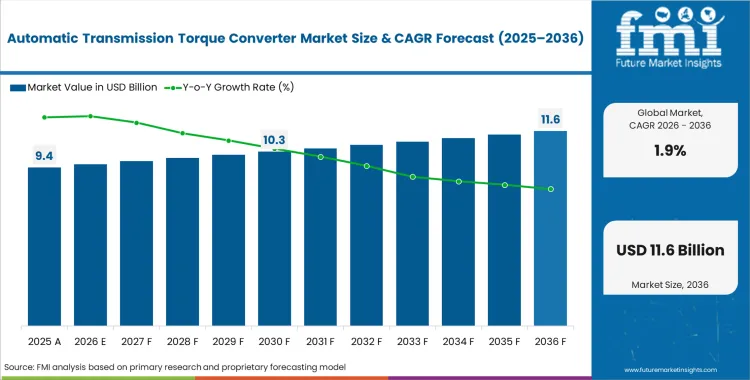
The automatic transmission torque converter market surpassed a value of USD 9.2 billion in 2025. Swift progress propels the industry revenue to hit USD 9.4 billion in 2026 at a torque converter CAGR of 1.9% during the forecast period. The market is projected to reach USD 11.3 billion by 2036, supported by continued investment as automakers redesign drivelines to manage the higher torque requirements of parallel hybrid systems. Growth is also shaped by the limited long-term expansion room created by wider battery electric vehicle adoption.
Car engineers are making design choices today that will determine if their vehicles remain competitive for the next ten years. If they stick with older, simpler clutches instead of upgrading to newer multi-plate designs, their cars will fail modern fuel efficiency tests. As a result, they are rushing to find suppliers who can build the upgraded versions. Buying teams looking at the automatic transmission torque converter forecast know that getting the cheapest part is no longer the goal. Instead, the part must be able to survive the extreme heat caused by hybrid braking systems, a reality that is driving steady automatic transmission torque converter adoption.
Summary of Automatic Transmission Torque Converter Market
- Market Snapshot
- In 2025, the automatic transmission torque converter market stood at USD 9.2 billion and is forecast to reach USD 11.3 billion by 2036.
- With growth projected at a 1.9% CAGR between 2026 and 2036, the market is likely to create an incremental opportunity of USD 1.9 billion over the next decade.
- Competing in this well-established industry comes down to checking all the right boxes for carmakers, such as making parts that last longer, fit perfectly, and transfer fluid power efficiently.
- Since these components are tied strictly to gas-powered engines and certain hybrids rather than fully electric vehicles, overall sales are climbing at a relatively modest pace.
- Demand and Growth Drivers
- A massive number of everyday cars and light trucks already rely on automatic gearboxes, providing a reliable foundation for ongoing sales in regions that heavily favor them.
- Gearboxes with plenty of speeds keep this technology alive and specifically, 6-to-8 speed models capture a 58% share.
- Even as the world shifts toward electric power, certain hybrid setups still need these fluid couplings, helping hybrid electric vehicles secure a 16% share of the pie.
- Looking at the global map, India is setting the pace with a 4.9% CAGR, trailing right behind are China at 3.2%, Mexico at 3.0%, the U.S. at 2.7%, South Korea at 2.6%, Germany at 2.3%, and Japan at 2.1%.
- What holds this sector back from explosive growth is the rising popularity of EVs, coupled with the fact that many major countries are already saturated with automatic cars.
- Product and Segment View
- This category includes, the fluid-based power couplers inside automatic gearboxes, covering both traditional gas engines and hybrid setups.
- These parts are primarily inside everyday commuter vehicles, which take up a dominant 66% share, along with light and heavy commercial trucks.
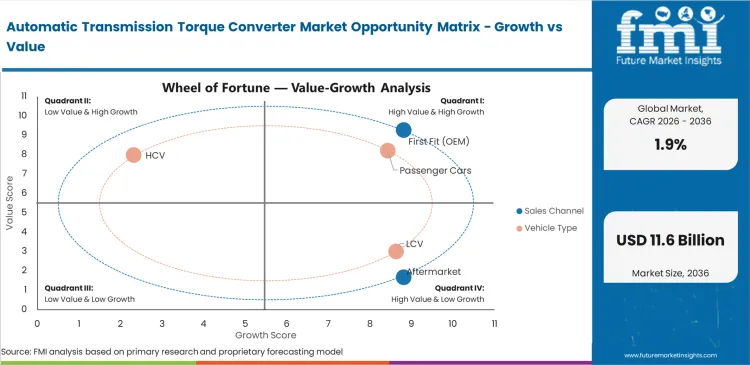
- Factory-installed parts absolutely dominate how these are sold, grabbing an 81% share because automakers prefer to source them directly as they build the car on the assembly line.
- As everyday commuters love the convenience of not shifting gears, regular passenger cars easily take the top spot in vehicle types, sitting comfortably at a 66% share.
- The sweet spot for most manufacturers remains the classic 6-to-8 speed transmission, a category that currently controls a 58% share of the business.
- Advanced multi-plate clutches are the go-to choice for handling heavier loads and smoother shifts, earning them a solid 59% share of the lock-up segment.
- Traditional gas and diesel engines are still the lifeblood here, capturing an 82% share and proving that fluid couplings rely heavily on the combustion engine's survival.
- Specifically leaving out dual-clutch computer brains, fully electric axles, and EV gears, focusing solely on factory and replacement fluid couplings for standard cars and trucks.
- Geography and Competitive Outlook
- While places like India, China, and Mexico are expanding the fastest, the U.S. provides a massive, steady stream of revenue because Americans have driven automatics for decades.
- Breaking into this business is incredibly tough for newcomers; instead, veteran giants like ZF, Aisin, Schaeffler, BorgWarner, Valeo, EXEDY, and Allison Transmission run the show thanks to their deep engineering roots and carmaker connections.
- ZF currently sits at the top of this moderately tight landscape, leaving the remaining sales to be fought over by other major factory suppliers and niche transmission specialists.
- To stay competitive, manufacturers need to serve both OEM demand and aftermarket replacement needs with equal consistency.
Tougher government emissions rules are the main reason this shift is happening right now. Automakers now have to squeeze electric motors directly into the transmission itself. Due to this, the old torque converter shapes and sizes simply do not fit anymore. To keep up, major automatic transmission component suppliers must immediately spend money on new factory equipment so they can build these advanced driveline control systems and devices.
India is anticipated to record a CAGR of 4.9% in the market through 2036, supported by rising domestic production of automatic vehicle variants. China follows with 3.2% CAGR as hybrid platform deployment continues to strengthen manufacturing demand. Mexico is projected to witness 3.0% CAGR over the forecast period, helped by its close integration with North American supply chains. The United States and South Korea are expected to post CAGRs of 2.7% and 2.6%, respectively, while Germany and Japan are likely to grow at 2.3% and 2.1%. Variation across these countries reflects differing momentum in hybrid adoption and electrification strategies.
Segmental Analysis
Automatic Transmission Torque Converter Market Analysis by Sales Channel
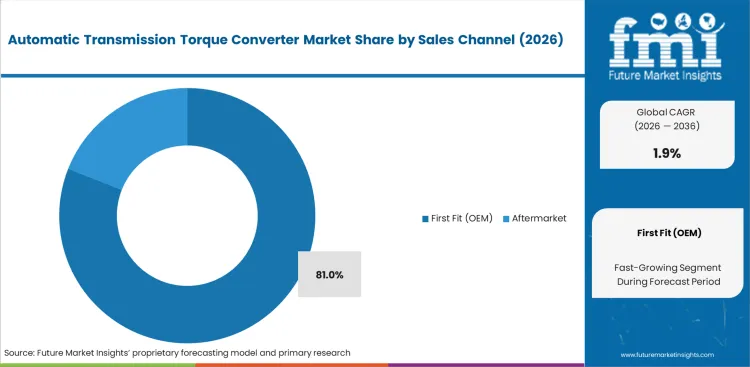
Structural dominance by the First Fit (OEM) segment stems directly from the tight engineering tolerances required to mate engines and gearboxes on the assembly line. The First Fit (OEM) category is expected to hold 81% OEM torque converter share in 2026. FMI's analysis indicates powertrain engineers treat the torque converter not as a bolt-on accessory, but as an integral element of the transmission housing that dictates specific software calibration mapping. Aftermarket replacement events occur rarely, primarily isolated to catastrophic failure scenarios or high-mileage taxi fleets. The aspect that torque converter aftermarket trends fail to show is how tightly OEMs lock down proprietary fluid dynamics designs, making unauthorized aftermarket replication virtually impossible. Sourcing managers prioritizing cost reduction over exact specification matching risk inducing severe drivability issues and warranty claims. Procurement directors evaluating automotive torque converter options rarely switch suppliers mid-cycle due to these extreme validation hurdles.
- Assembly Line Integration: Tier-1 suppliers ship fully balanced converter and transmission assemblies directly to vehicle production plants. Operations managers avoid standalone converter handling to prevent fluid contamination and spline damage.
- Warranty Validation Control: Automakers mandate strict First Fit component usage to maintain powertrain warranty parameters. Fleet maintenance directors attempting aftermarket substitution frequently void existing drivetrain coverage.
- Software Calibration Lock: Transmission control units feature software mapped specifically to the OEM converter's fluid coupling characteristics. Calibration engineers must rewrite shift logic entirely if alternate aftermarket hardware alters the expected stall speed.
Automatic Transmission Torque Converter Market Analysis by Vehicle Type
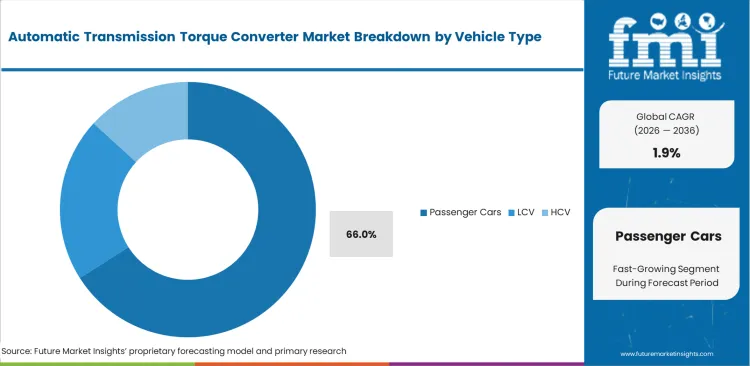
Baseline volume across the passenger segment heavily dictates global production scaling. Based on FMI's assessment, platform managers at major automakers utilize shared transmission architectures across dozens of distinct nameplates to amortize development costs. High torque-capacity variants developed for heavy trucks cannot scale down economically for commuter applications, forcing distinct engineering streams. Industry consensus assumes passenger car dominance reflects consumer preference, but stringent fuel economy regulations actually force passenger cars to adopt advanced multi-speed automatics far quicker than commercial fleets. This aspect majorly sets the passenger car torque converter demand to garner an expected 66% share in 2026. Product planning directors miscalculating the phase-out timeline of ICE passenger cars frequently strand capital in legacy stamping equipment. Buyers evaluating driveline torsional vibration dampers and couplings depend on robust platform planning.
- Platform Amortization Requirements: Automakers design a single torque converter family to service multiple vehicle models across different brands. Platform directors leverage this scale to negotiate aggressive price concessions from Tier-1 suppliers.
- NVH Standard Compliance: Passenger vehicle buyers demand seamless launch characteristics and zero noticeable shift shock. Driveline engineers specify complex internal dampers to isolate engine vibrations from the cabin.
- Packaging Space Constraints: Modern passenger car floorpans restrict the physical diameter available for transmission bells. Packaging engineers compel suppliers to develop flattened, oval-torus converter geometries to maintain ground clearance.
Automatic Transmission Torque Converter Market Analysis by Transmission Speed
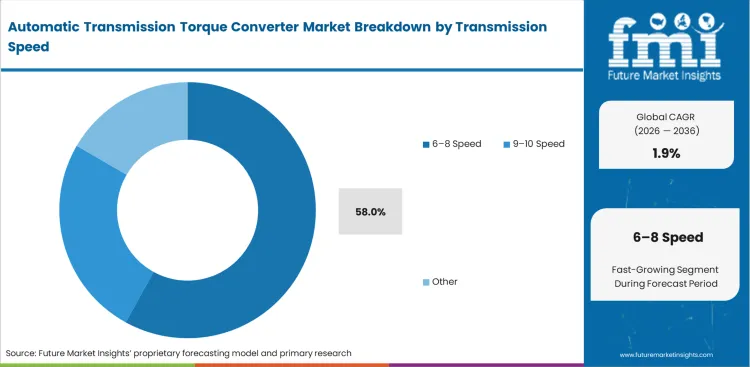
The standard 6–8 speed range represents the optimal intersection of manufacturing cost and efficiency gains. The 6 to 8 speed torque converter demand is estimated to represent 58% share in 2026 as FMI observes that, transmission designers face diminishing returns when adding gear sets beyond eight speeds, as internal parasitic losses begin to outweigh aerodynamic cruising benefits. Procurement officers evaluating automatic transmission sourcing strategies recognize this tier as the high-volume sweet spot. While marketing departments push 10-speed variants for premium branding, actual calibration data shows the transmission spends minimal time in top gears during real-world driving. Cost-engineering managers pushing for unnecessary ratio proliferation actively degrade overall powertrain reliability profiles.
- Ratio Spread Optimization: Engineers utilize 6-to-8 speed gearboxes to keep engines operating within narrow peak-efficiency RPM bands. Calibration specialists find this ratio count provides sufficient flexibility without excessive shifting frequency.
- Manufacturing Cost Baseline: Tier-1 suppliers operate highly optimized production lines for these standard planetary gearsets. Procurement directors face steep cost penalties when specifying 9-speed or 10-speed architectures.
- Software Processing Limits: Each additional gear requires exponentially more complex shift logic mapping. Transmission control engineers struggle to prevent gear hunting behaviors in architectures exceeding eight forward ratios.
Automatic Transmission Torque Converter Market Analysis by Lock-up Clutch
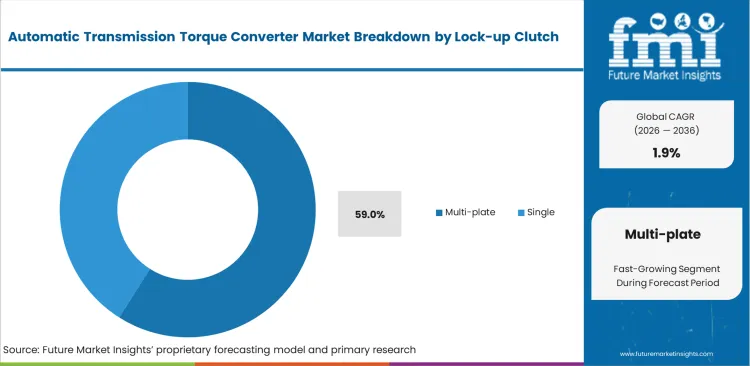
According to FMI's estimates, driveline engineers specify the lock-up clutch in automatic transmission systems to allow engagement at much lower vehicle speeds, drastically reducing energy lost to fluid shear. Single-plate legacy designs simply lack the thermal mass to survive partial-slip flex-lock strategies required by modern fuel economy standards. Efficiency mandates force the rapid transition toward multi-plate lock-up mechanisms leading the multi-plate lock-up clutch adoption is forecast to command 59% share in 2026. Procurement data obscures the fact that a multi-plate converter effectively houses a complete wet clutch pack inside the fluid coupling, closing the gap when comparing a torque converter vs dual clutch transmission. Systems engineers failing to specify upgraded friction materials face catastrophic shudder complaints during low-speed operation, forcing buyers evaluating an automotive transmission to demand robust clutches for towing applications.
- Thermal Dissipation Requirement: Continuous slip calibration generates immense heat within the converter housing. Friction material engineers specify multi-plate layouts to distribute this thermal load across a larger surface area.
- Low-Speed Engagement Logic: Modern transmissions lock the engine to the drivetrain almost immediately after vehicle launch. Drivability engineers require multi-plate robustness to absorb engine pulses during this rigid mechanical connection.
- Micro-Slip Vibration Damping: Controllers allow deliberate, minute clutch slippage to damp torsional driveline vibrations. NVH directors utilize this software-controlled slipping to eliminate the need for heavy physical dual-mass flywheels.
Automatic Transmission Torque Converter Market Analysis by Powertrain
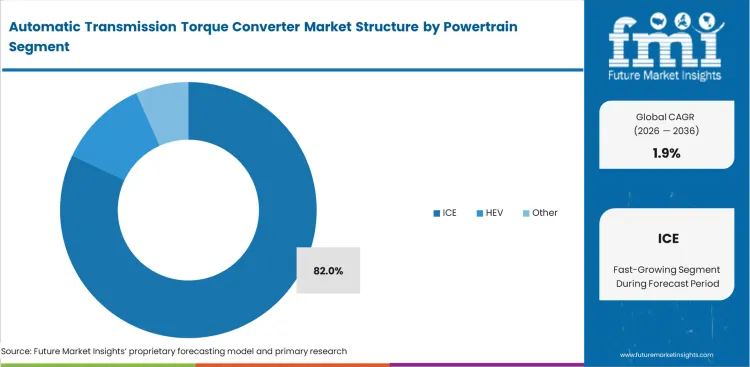
Legacy platforms sustain the massive internal combustion base volume, setting the ICE torque converter integration as likely to hold a share of 82% in 2026. As per FMI's projection, heavy truck and economy vehicle sectors resist immediate electrification, maintaining demand for standard converter architectures. Powertrain directors manage this sunsetting technology by freezing new ICE transmission development and extending current platform lifecycles. Generalists assume hybrids simply use ICE transmissions, but HEV torque converter demand actually requires removing the traditional stator and installing an electric traction motor directly into the converter space. Operations managers failing to tool up for these specialized hybrid transmission components risk losing access to the only growing sub-segment. They must carefully assess the torque converter vs EV reduction gear performance tradeoffs when planning for off road driveline couplings.
- Legacy Platform Extension: Automakers delay clean-sheet ICE transmission development to fund EV programs. Procurement teams extend existing Tier-1 supplier contracts for ICE converters to extract maximum amortization value.
- Hybrid Spatial Integration: P2 hybrid architectures replace the torque converter entirely or integrate it tightly with an electric motor. Packaging engineers force suppliers to redesign housings to accommodate high-voltage wiring and resolver sensors.
- Heavy-Duty Towing Requirements: Internal combustion engines paired with fluid couplings remain the only viable solution for sustained maximum-load towing. Commercial fleet directors refuse to adopt alternative drivetrains that overheat under heavy grade conditions.
Automatic Transmission Torque Converter Market Drivers, Restraints, and Opportunities
Car makers face massive financial fines if their vehicles do not meet strict new pollution rules. To avoid these penalties, engineers are forced to make automatic transmissions run much more efficiently. This is done by tweaking the car's computer to mechanically lock the transmission to the engine at very low speeds, sometimes as early as second gear. The problem is that older, basic torque converters simply break under that kind of stress. This leaves buying teams with no choice but to spend more money on advanced, heavy-duty parts, also called multi-plate converters. These upgraded parts can handle the intense heat and constant friction without making the inside of the car violently shake.
On the other hand, building modern hybrid cars creates a massive space problem. Engineers are being asked to squeeze an electric motor, a clutch, and a torque converter into the exact same tight space that used to hold just the converter alone. All those new parts often do not fit under the floor of existing car designs. Redesigning the entire frame of a vehicle to make extra room costs billions of dollars and takes a massive amount of corporate approval. Due to this huge roadblock, automakers are often forced to use smaller, less efficient parts, or they just put their hybrid plans on hold completely.
- Dedicated Hybrid Transmission (DHT) Integration: Driveline engineers optimize fluid couplings specifically for narrow engine operating bands. Automakers capture massive efficiency gains by abandoning compromise ICE-first designs.
- Advanced Friction Material Deployment: Chemical engineers develop paper and carbon-composite friction rings capable of surviving high-heat continuous slip. Tier-1 suppliers secure exclusive contracts by solving low-speed shudder issues.
- Solenoid Integration Streamlining: Transmission designers mount the automatic transmission solenoid pack directly adjacent to the converter feed circuit. Actuation engineers eliminate line pressure delays and improve lock-up response times.
Regional Analysis
Based on regional analysis, Automatic Transmission Torque Converter is segmented into North America, Europe, Asia-Pacific, Latin America, and Middle East & Africa across 40 plus countries.
.webp "Top Country Growth Comparison Automatic Transmission Torque Converter Market Cagr (2026 2036)")
| Country | CAGR (2026 to 2036) |
|---|---|
| India | 4.9% |
| China | 3.2% |
| Mexico | 3.0% |
| USA | 2.7% |
| South Korea | 2.6% |
| Germany | 2.3% |
| Japan | 2.1% |
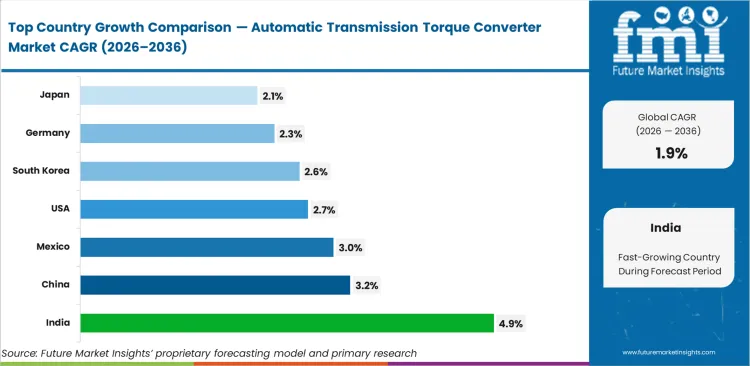
Source: Future Market Insights (FMI) analysis, based on proprietary forecasting model and primary research
Asia-Pacific Automatic Transmission Torque Converter Market Analysis
Aggressive hybrid platform deployment in advanced manufacturing hubs collides with a rapid manual-to-automatic transition in emerging urban centers across this geography. Regional manufacturers prioritize parallel hybrid architectures over immediate pure EV transitions to serve diverse domestic and export consumer bases. Driveline engineers specify highly complex automatic transmission driveline components featuring integrated traction motors and disconnect clutches for premium models, while simultaneously localizing cost-effective 6-speed units for entry-level commuters. FMI notes that this bifurcated engineering shift rapidly obsoletes basic fluid coupling manufacturing lines in mature hubs while creating massive volume opportunities in developing nations Suppliers who adapt to these dual requirements secure dominant positions in the fastest-growing powertrain segment globally.
- India: Localizing production remains the only viable strategy to meet strict cost ceilings demanded by domestic consumers. Demand for automatic transmission torque converters in India is expected to grow at a CAGR of 4.9% during the study period. Automakers succeeding here gain a validated operational template for other emerging mobility markets facing similar congestion hurdles, building a firmer competitive position against import-reliant challengers.
- China: Intense domestic competition forces local OEMs to rapidly deploy dedicated hybrid transmissions across their broader vehicle portfolios. Transmission calibration specialists demand durable multi-plate converters capable of handling high-torque electric motor inputs without overheating during urban commuting cycles. Domestic suppliers aggressively scale capabilities to meet these technical requirements, with the market in China expected to grow at a CAGR of 3.2% through 2036. This rapid technological maturation creates a large commercial opportunity for local vendors to export validated hybrid driveline hardware to developing economies seeking affordable electrification solutions.
- South Korea: The automatic transmission torque converter industry in South Korea is projected to witness 2.6% CAGR through 2036 as major domestic automakers consolidate transmission families around centralized eight-speed architectures designed for global export volume. Procurement directors use this standardization to drive down unit costs across vast, multi-continent production networks. Engineering teams focus on perfecting fluid dynamics within these standardized housings rather than developing bespoke solutions for niche models. This consolidation strategy supports long-term operational stability for preferred Tier-1 partners capable of meeting strict global warranty standards across millions of identical units.
- Japan: Lean manufacturing principles dictate a heavy reliance on continuously variable transmissions using specialized, low-profile torque converters. Packaging engineers require compact fluid couplings to maximize passenger cabin space in strictly regulated small vehicle footprints. Traditional stepped automatics remain largely confined to specific rear-wheel-drive luxury platforms and commercial vehicles, with Japan likely to post a CAGR of 2.1% through 2036. This specific domestic engineering preference creates a structural reality that limits direct foreign competition within the local supply chain.
FMI's report includes detailed analysis of Taiwan, Thailand, Indonesia, and broader ASEAN supply chain networks. Component sourcing directors increasingly use these Southeast Asian nations as highly efficient alternative manufacturing bases for legacy driveline hardware. Relocating basic stamping and welding processes allows prime facilities in Japan and South Korea to dedicate their capital exclusively to complex mechatronic hybrid modules.
Europe Automatic Transmission Torque Converter Market Analysis
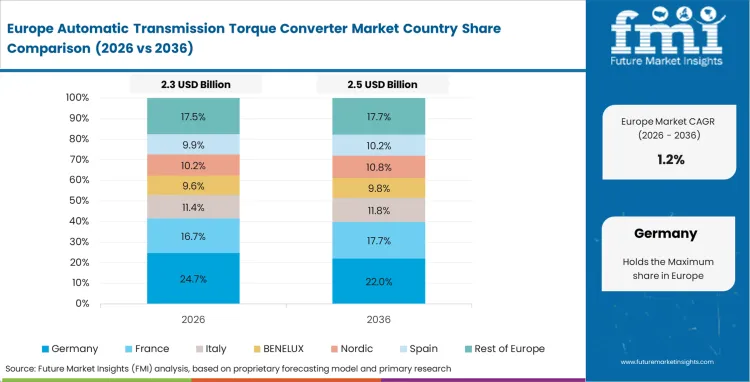
Stringent Euro 7 emissions testing forces European automakers to abandon traditional internal combustion strategies in favor of aggressive plug-in hybrid electric vehicle deployment. Driveline engineers face unique challenges in this geography, as buyers accustomed to high-speed autobahn cruising demand exceptional launch performance combined with flawless electric-to-combustion transitions. FMI's assessment indicates that while dual-clutch systems previously dominated the European performance sector, the integration of heavy traction motors pushes engineers back toward the thermal durability of fluid-coupled automatic transmissions. Manufacturing directors lacking the metallurgical expertise to produce these heat-resistant friction materials quickly find themselves disqualified from premium automaker supply chains currently transitioning their flagship sedans and SUVs to electrified platforms.
- Germany: Premium domestic automakers anchor the regional transition by converting their rear-wheel-drive architectures to advanced 8-speed plug-in hybrid layouts. The automatic transmission torque converter market in Germany is expected to grow at a CAGR of 2.3% through the assessment period, as transmission calibration specialists require advanced internal torsional dampers to eliminate detectable vibrations when the combustion engine engages at highway speeds. Achieving certification from these luxury brands delivers a crucial operational advantage, giving suppliers a quality benchmark that procurement teams recognize across global automotive programs.
FMI's report includes extensive coverage of France, Italy, the United Kingdom, and expanding Eastern European manufacturing corridors. Supply chain directors increasingly shift transmission component casting and initial assembly operations into countries like Poland and Hungary to maintain strict cost controls. This localized production strategy protects European automakers from volatile intercontinental shipping delays while satisfying regional economic value-add requirements necessary for favorable tax treatments on finalized vehicles.
North America Automatic Transmission Torque Converter Market Analysis
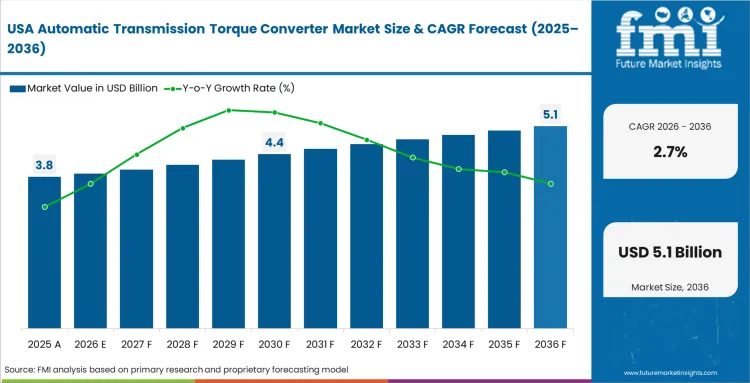
Heavy-duty towing requirements and large vehicle form factors strictly dictate North American driveline engineering constraints. Automakers rely heavily on heavy-duty fluid couplings for pickup trucks and full-size SUVs, as no other technology reliably handles the sustained thermal loads of maximum-capacity towing. Based on FMI's analysis, the regional push toward electrification creates a sharply bifurcated market where light commuter vehicles transition rapidly to battery electrics while heavy vehicles retain complex internal combustion and hybrid transmissions. Procurement managers manage this severe operational split by isolating heavy-duty converter sourcing from light-duty sunsetting programs, securing dedicated foundry capacity for high-margin truck platforms.
- Mexico: Manufacturers are consolidating North American production in Mexico to benefit from lower labor costs while complying with USMCA origin rules for duty-free regional trade. Heavy-duty truck platforms depend on this localized base to keep assembly lines supplied, and sales in Mexico are expected to grow at a CAGR of 3.0% during the assessment period. The shift is changing component logistics across the region and strengthening continent-based sourcing strategies.
- U.S.: Strong full-size truck production continues to support high-volume demand for durable fluid couplings, with the market in the United States expected to expand at a CAGR of 2.7% through 2036. Engineering teams are refining 10-speed transmission architectures to meet tighter fuel economy standards without reducing towing capability. Fleet buyers continue to prioritize proven reliability, which keeps demand centered on established drivetrain systems.
FMI's report includes detailed assessments of Canadian production facilities and cross-border integration dynamics. Facilities directors prioritize flexible manufacturing lines capable of rapid changeovers between legacy internal combustion variants and new hybrid-specific fluid couplings. Maintaining this manufacturing agility prevents catastrophic assembly line stoppages when consumer demand unexpectedly shifts back toward traditional gas-powered truck platforms during periods of volatile energy pricing or delayed charging infrastructure rollouts.
Competitive Aligners for Market Players
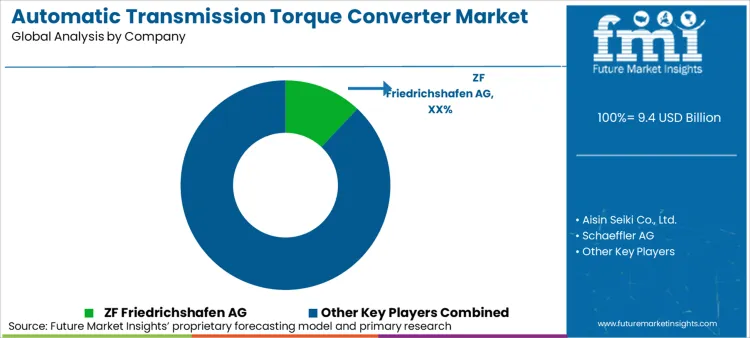
The transition toward hybrid architectures creates a distinct structural division between legacy stamping operations and advanced mechatronic integrators. Top torque converter manufacturers such as ZF and BorgWarner actively acquire or develop electric motor capabilities to offer fully integrated hybrid modules. Powertrain directors conducting a torque converter vendor comparison evaluate bids based not on the cost of the raw shell, but on the supplier's ability to deliver a calibrated, pre-assembled unit containing the fluid coupling, disconnect clutch, and DCT mechatronic control unit interfaces. Competitors lacking this systems-level integration capability find themselves relegated to supplying raw stamped shells to dominant Tier-1 aggregators.
Heavyweights possess massive, fully amortized manufacturing footprints that challengers cannot practically replicate. Producing a modern component requires highly specialized, capital-intensive electron beam welding and precise impeller blade brazing equipment, directly impacting procurement decisions during a ZF vs Aisin torque converter evaluation. Companies like EXEDY and Valeo leverage decades of metallurgical data to produce friction materials that survive continuous micro-slip conditions. Operations managers tracking Japan automatic gearbox valves constraints recognize that new transmission component suppliers automotive entrants face prohibitive capital barriers just to match the baseline NVH performance and warranty reliability of established automatic transmission torque converter suppliers.
Automakers aggressively counter this supplier power by standardizing bell housing dimensions and transmission input shaft splines across multiple vehicle platforms. Procurement departments execute dual-sourcing strategies for torque converter platform sourcing, forcing torque converter OEM suppliers to compete strictly on software calibration support and defect rates. Automakers deliberately maintain internal transmission assembly capabilities for flagship vehicles to avoid total dependency on external vendors supplying transmission fluid handling hardware.
Key Players in Automatic Transmission Torque Converter Market
- ZF
- Aisin
- Schaeffler
- BorgWarner
- Valeo
- EXEDY
- Allison Transmission
Scope of the Report
| Metric | Value |
|---|---|
| Quantitative Units | USD 9.4 billion to USD 11.3 billion, at a CAGR of 1.9% |
| Market Definition | Automatic Transmission Torque Converter serves as the hydrodynamic link between engine and gearbox, enabling vehicle idling and torque multiplication. This fluid coupling dictates launch feel, towing capacity, and baseline driveline efficiency. |
| Segmentation | By Sales Channel, By Vehicle Type, By Transmission Speed, By Lock-up Clutch, By Powertrain, and By Region |
| Regions Covered | North America, Latin America, Western Europe, Eastern Europe, East Asia, South Asia & Pacific, Middle East & Africa |
| Countries Covered | U.S., China, India, Germany, Japan, South Korea, Mexico |
| Key Companies Profiled | ZF, Aisin, Schaeffler, BorgWarner, Valeo, EXEDY, Allison Transmission |
| Forecast Period | 2026 to 2036 |
| Approach | OEM transmission installation rates cross-referenced with regional vehicle production volumes |
Source: Future Market Insights (FMI) analysis, based on proprietary forecasting model and primary research
Automatic Transmission Torque Converter Market by Segment
By Sales Channel
- First Fit (OEM)
- Aftermarket
By Vehicle Type
- Passenger Cars
- LCV
- HCV
By Transmission Speed
- 6-8 Speed
- 9-10 Speed
- Other
By Lock-up Clutch
- Single
- Multi-plate
By Powertrain
- ICE
- HEV
- Other
Regions:
- Asia Pacific
- India
- China
- Japan
- South Korea
- Indonesia
- Australia & New Zealand
- ASEAN
- Rest of Asia Pacific
- Europe
- Germany
- Italy
- France
- United Kingdom
- Spain
- Benelux
- Nordics
- Central & Eastern Europe
- Rest of Europe
- North America
- United States
- Canada
- Mexico
- Latin America
- Brazil
- Argentina
- Chile
- Rest of Latin America
- Middle East & Africa
- Kingdom of Saudi Arabia
- United Arab Emirates
- South Africa
- Turkey
- Rest of Middle East & Africa
Bibliography
- International Energy Agency. (2025). Global EV Outlook 2025.
- AISIN Corporation. (2026). AISIN to Strengthen Production System to Expand Business in India, 32 Billion Yen to Be Invested to Expand the Existing Plant and Establish a New Plant for Local Production of AT and CVT.
- United States Environmental Protection Agency. (2026). The 2025 EPA Automotive Trends Report.
- Jeyabalan, S. (2024). CFD Methodology for Torque Converter Clutch Slipping Modeling (SAE Technical Paper 2024-01-2150). SAE International.
- Sha, H. (2024). Torque Converter Modeling for Torque Control of Hybrid Electric Powertrains (SAE Technical Paper 2024-01-2780). SAE International.
- This bibliography is provided for reader reference. The full FMI report contains the complete reference list with primary source documentation.
This Report Addresses
- Procurement directors navigating multi-plate lock-up integration complexities.
- Calibration engineers optimizing continuous micro-slip software algorithms.
- Operations managers tooling facilities for hybrid transmission housing assemblies.
- Tier-1 suppliers evaluating friction material durability under high thermal loads.
- Platform directors amortizing legacy ICE architectures across multiple vehicle nameplates.
- Supply chain planners responding to localized 6-speed production shifts in India.
- Aftermarket distributors managing inventory transition risks for advanced fluid couplings.
- NVH specialists addressing low-speed shudder through specialized internal damper designs.
Frequently Asked Questions
What is the forecast for automatic transmission torque converters through 2036?
FMI estimates the industry reaches USD 9.4 billion in 2026 and expands to USD 11.3 billion by 2036.
Why is the torque converter market growing slowly at a 1.9% CAGR?
Battery electric vehicles completely remove the fluid coupling from the driveline, capping maximum volume expansion.
Which lock-up clutch type dominates torque converters?
Stricter WLTP testing forces engineers to utilize multi-plate designs to engage the lock-up mechanism at much lower speeds to eliminate fluid shear losses.
How much of the market comes from OEM sales?
First Fit (OEM) installations account for 81% of total volume because automakers lock transmission control unit software precisely to the proprietary stall speed of the factory converter.
What prevents aftermarket suppliers from capturing larger volume?
Replicating the exact fluid dynamics and balancing requirements for modern high-speed transmissions remains prohibitively difficult for third-party vendors.
Which vehicle type leads torque converter demand?
Passenger cars account for 66% of the volume because massive global commuter vehicle production sets a baseline that commercial truck volumes simply cannot match.
What structural constraint limits transmission ratios to the 6–8 speed range?
Adding more gearsets increases internal parasitic drag until it negates any aerodynamic cruising efficiency gains.
How do 10-speed transmissions impact overall reliability profiles?
Excessive gear hunting and constant shifting logic frequently degrade the perceived drivability and mechanical longevity of the unit.
Which countries are growing fastest in torque converters?
India leads growth at 4.9% as extreme urban traffic congestion rapidly forces domestic buyers to abandon manual gearboxes for automatic convenience.
Compare torque converter demand in India and China.
While India scales basic automatic commuter variants, China advances at 3.2% driven primarily by domestic automakers aggressively scaling dedicated hybrid transmissions requiring complex integrated modules.
How does electrification affect torque converter demand?
Engineers must hollow out standard designs to integrate electric traction motors directly into the housing geometry for parallel hybrids, while full EVs eliminate the component entirely.
What happens if a supplier utilizes inadequate friction materials?
Continuous micro-slip operation burns conventional materials rapidly, resulting in severe cabin vibration and immediate warranty replacement.
Why does ICE still dominate torque converter demand?
Heavy-duty towing and commercial applications rely heavily on legacy ICE drivetrains because they currently lack viable, cost-effective electrified alternatives.
What operational risk do plant managers face right now?
Facilities risk stranding massive capital in legacy stamping equipment as automakers demand entirely new form factors for electrified platforms.
How do NVH requirements shape fluid coupling geometry?
Driveline engineers install complex spring-loaded dampers inside the converter to absorb engine firing pulses before they reach the cabin.
Why do automakers dual-source these components?
Procurement departments utilize multiple suppliers to prevent catastrophic production halts and to aggressively control unit costs.
Which companies lead the torque converter market?
Major established suppliers including ZF, Aisin, Schaeffler, BorgWarner, Valeo, EXEDY, and Allison Transmission dictate global supply chain capabilities.
How does Mexico's 3.0% growth impact North America?
Nearshoring strategies push Tier-1 suppliers to consolidate assembly capacity south of the border to satisfy strict USMCA origin regulations.
Why do heavy commercial vehicles retain legacy single-plate designs?
Continuous heavy-load operation prioritizes extreme mechanical simplicity and raw heat dissipation over marginal aerodynamic efficiency gains.
What function does the transmission filter serve in these advanced systems?
It prevents microscopic friction material debris from jamming the highly sensitive transmission shift actuator mechanisms during operation.
How does software integration complicate converter replacement?
The automotive TCU continuously learns and adapts to the specific wear patterns of the factory-installed clutch plates, resisting aftermarket substitution.
What dictates the ultimate sunset timeline for this technology?
The speed at which automakers achieve cost parity for heavy-duty battery electric vehicles capable of sustained towing operations will determine the final volume decline.
Preview the report firsthand - request a free sample
Get SampleGet the brochure for pricing and purchase details.
Get PDFTable of Content
- Executive Summary
- Global Market Outlook
- Demand-side Trends
- Supply-side Trends
- Technology Roadmap Analysis
- Analysis and Recommendations
- Market Overview
- Market Coverage / Taxonomy
- Market Definition / Scope / Limitations
- Research Methodology
- Chapter Orientation
- Analytical Lens and Working Hypotheses
- Market Structure, Signals, and Trend Drivers
- Benchmarking and Cross-market Comparability
- Market Sizing, Forecasting, and Opportunity Mapping
- Research Design and Evidence Framework
- Desk Research Programme (Secondary Evidence)
- Company Annual and Sustainability Reports
- Peer-reviewed Journals and Academic Literature
- Corporate Websites, Product Literature, and Technical Notes
- Earnings Decks and Investor Briefings
- Statutory Filings and Regulatory Disclosures
- Technical White Papers and Standards Notes
- Trade Journals, Industry Magazines, and Analyst Briefs
- Conference Proceedings, Webinars, and Seminar Materials
- Government Statistics Portals and Public Data Releases
- Press Releases and Reputable Media Coverage
- Specialist Newsletters and Curated Briefings
- Sector Databases and Reference Repositories
- FMI Internal Proprietary Databases and Historical Market Datasets
- Subscription Datasets and Paid Sources
- Social Channels, Communities, and Digital Listening Inputs
- Additional Desk Sources
- Expert Input and Fieldwork (Primary Evidence)
- Primary Modes
- Qualitative Interviews and Expert Elicitation
- Quantitative Surveys and Structured Data Capture
- Blended Approach
- Why Primary Evidence is Used
- Field Techniques
- Interviews
- Surveys
- Focus Groups
- Observational and In-context Research
- Social and Community Interactions
- Stakeholder Universe Engaged
- C-suite Leaders
- Board Members
- Presidents and Vice Presidents
- R&D and Innovation Heads
- Technical Specialists
- Domain Subject-matter Experts
- Scientists
- Physicians and Other Healthcare Professionals
- Governance, Ethics, and Data Stewardship
- Research Ethics
- Data Integrity and Handling
- Primary Modes
- Tooling, Models, and Reference Databases
- Desk Research Programme (Secondary Evidence)
- Data Engineering and Model Build
- Data Acquisition and Ingestion
- Cleaning, Normalisation, and Verification
- Synthesis, Triangulation, and Analysis
- Quality Assurance and Audit Trail
- Market Background
- Market Dynamics
- Drivers
- Restraints
- Opportunity
- Trends
- Scenario Forecast
- Demand in Optimistic Scenario
- Demand in Likely Scenario
- Demand in Conservative Scenario
- Opportunity Map Analysis
- Product Life Cycle Analysis
- Supply Chain Analysis
- Investment Feasibility Matrix
- Value Chain Analysis
- PESTLE and Porter’s Analysis
- Regulatory Landscape
- Regional Parent Market Outlook
- Production and Consumption Statistics
- Import and Export Statistics
- Market Dynamics
- Global Market Analysis 2021 to 2025 and Forecast, 2026 to 2036
- Historical Market Size Value (USD Million) Analysis, 2021 to 2025
- Current and Future Market Size Value (USD Million) Projections, 2026 to 2036
- Y-o-Y Growth Trend Analysis
- Absolute $ Opportunity Analysis
- Global Market Pricing Analysis 2021 to 2025 and Forecast 2026 to 2036
- Global Market Analysis 2021 to 2025 and Forecast 2026 to 2036, By Sales Channel
- Introduction / Key Findings
- Historical Market Size Value (USD Million) Analysis By Sales Channel , 2021 to 2025
- Current and Future Market Size Value (USD Million) Analysis and Forecast By Sales Channel , 2026 to 2036
- First Fit (OEM)
- Aftermarket
- First Fit (OEM)
- Y-o-Y Growth Trend Analysis By Sales Channel , 2021 to 2025
- Absolute $ Opportunity Analysis By Sales Channel , 2026 to 2036
- Global Market Analysis 2021 to 2025 and Forecast 2026 to 2036, By Vehicle Type
- Introduction / Key Findings
- Historical Market Size Value (USD Million) Analysis By Vehicle Type, 2021 to 2025
- Current and Future Market Size Value (USD Million) Analysis and Forecast By Vehicle Type, 2026 to 2036
- Passenger Cars
- LCV
- HCV
- Passenger Cars
- Y-o-Y Growth Trend Analysis By Vehicle Type, 2021 to 2025
- Absolute $ Opportunity Analysis By Vehicle Type, 2026 to 2036
- Global Market Analysis 2021 to 2025 and Forecast 2026 to 2036, By Transmission Speed
- Introduction / Key Findings
- Historical Market Size Value (USD Million) Analysis By Transmission Speed, 2021 to 2025
- Current and Future Market Size Value (USD Million) Analysis and Forecast By Transmission Speed, 2026 to 2036
- 6–8 Speed
- 9–10 Speed
- Other
- 6–8 Speed
- Y-o-Y Growth Trend Analysis By Transmission Speed, 2021 to 2025
- Absolute $ Opportunity Analysis By Transmission Speed, 2026 to 2036
- Global Market Analysis 2021 to 2025 and Forecast 2026 to 2036, By Lock-up Clutch
- Introduction / Key Findings
- Historical Market Size Value (USD Million) Analysis By Lock-up Clutch, 2021 to 2025
- Current and Future Market Size Value (USD Million) Analysis and Forecast By Lock-up Clutch, 2026 to 2036
- Multi-plate
- Single
- Multi-plate
- Y-o-Y Growth Trend Analysis By Lock-up Clutch, 2021 to 2025
- Absolute $ Opportunity Analysis By Lock-up Clutch, 2026 to 2036
- Global Market Analysis 2021 to 2025 and Forecast 2026 to 2036, By Powertrain
- Introduction / Key Findings
- Historical Market Size Value (USD Million) Analysis By Powertrain, 2021 to 2025
- Current and Future Market Size Value (USD Million) Analysis and Forecast By Powertrain, 2026 to 2036
- ICE
- HEV
- Other
- ICE
- Y-o-Y Growth Trend Analysis By Powertrain, 2021 to 2025
- Absolute $ Opportunity Analysis By Powertrain, 2026 to 2036
- Global Market Analysis 2021 to 2025 and Forecast 2026 to 2036, By Region
- Introduction
- Historical Market Size Value (USD Million) Analysis By Region, 2021 to 2025
- Current Market Size Value (USD Million) Analysis and Forecast By Region, 2026 to 2036
- North America
- Latin America
- Western Europe
- Eastern Europe
- East Asia
- South Asia and Pacific
- Middle East & Africa
- Market Attractiveness Analysis By Region
- North America Market Analysis 2021 to 2025 and Forecast 2026 to 2036, By Country
- Historical Market Size Value (USD Million) Trend Analysis By Market Taxonomy, 2021 to 2025
- Market Size Value (USD Million) Forecast By Market Taxonomy, 2026 to 2036
- By Country
- USA
- Canada
- Mexico
- By Sales Channel
- By Vehicle Type
- By Transmission Speed
- By Lock-up Clutch
- By Powertrain
- By Country
- Market Attractiveness Analysis
- By Country
- By Sales Channel
- By Vehicle Type
- By Transmission Speed
- By Lock-up Clutch
- By Powertrain
- Key Takeaways
- Latin America Market Analysis 2021 to 2025 and Forecast 2026 to 2036, By Country
- Historical Market Size Value (USD Million) Trend Analysis By Market Taxonomy, 2021 to 2025
- Market Size Value (USD Million) Forecast By Market Taxonomy, 2026 to 2036
- By Country
- Brazil
- Chile
- Rest of Latin America
- By Sales Channel
- By Vehicle Type
- By Transmission Speed
- By Lock-up Clutch
- By Powertrain
- By Country
- Market Attractiveness Analysis
- By Country
- By Sales Channel
- By Vehicle Type
- By Transmission Speed
- By Lock-up Clutch
- By Powertrain
- Key Takeaways
- Western Europe Market Analysis 2021 to 2025 and Forecast 2026 to 2036, By Country
- Historical Market Size Value (USD Million) Trend Analysis By Market Taxonomy, 2021 to 2025
- Market Size Value (USD Million) Forecast By Market Taxonomy, 2026 to 2036
- By Country
- Germany
- UK
- Italy
- Spain
- France
- Nordic
- BENELUX
- Rest of Western Europe
- By Sales Channel
- By Vehicle Type
- By Transmission Speed
- By Lock-up Clutch
- By Powertrain
- By Country
- Market Attractiveness Analysis
- By Country
- By Sales Channel
- By Vehicle Type
- By Transmission Speed
- By Lock-up Clutch
- By Powertrain
- Key Takeaways
- Eastern Europe Market Analysis 2021 to 2025 and Forecast 2026 to 2036, By Country
- Historical Market Size Value (USD Million) Trend Analysis By Market Taxonomy, 2021 to 2025
- Market Size Value (USD Million) Forecast By Market Taxonomy, 2026 to 2036
- By Country
- Russia
- Poland
- Hungary
- Balkan & Baltic
- Rest of Eastern Europe
- By Sales Channel
- By Vehicle Type
- By Transmission Speed
- By Lock-up Clutch
- By Powertrain
- By Country
- Market Attractiveness Analysis
- By Country
- By Sales Channel
- By Vehicle Type
- By Transmission Speed
- By Lock-up Clutch
- By Powertrain
- Key Takeaways
- East Asia Market Analysis 2021 to 2025 and Forecast 2026 to 2036, By Country
- Historical Market Size Value (USD Million) Trend Analysis By Market Taxonomy, 2021 to 2025
- Market Size Value (USD Million) Forecast By Market Taxonomy, 2026 to 2036
- By Country
- China
- Japan
- South Korea
- By Sales Channel
- By Vehicle Type
- By Transmission Speed
- By Lock-up Clutch
- By Powertrain
- By Country
- Market Attractiveness Analysis
- By Country
- By Sales Channel
- By Vehicle Type
- By Transmission Speed
- By Lock-up Clutch
- By Powertrain
- Key Takeaways
- South Asia and Pacific Market Analysis 2021 to 2025 and Forecast 2026 to 2036, By Country
- Historical Market Size Value (USD Million) Trend Analysis By Market Taxonomy, 2021 to 2025
- Market Size Value (USD Million) Forecast By Market Taxonomy, 2026 to 2036
- By Country
- India
- ASEAN
- Australia & New Zealand
- Rest of South Asia and Pacific
- By Sales Channel
- By Vehicle Type
- By Transmission Speed
- By Lock-up Clutch
- By Powertrain
- By Country
- Market Attractiveness Analysis
- By Country
- By Sales Channel
- By Vehicle Type
- By Transmission Speed
- By Lock-up Clutch
- By Powertrain
- Key Takeaways
- Middle East & Africa Market Analysis 2021 to 2025 and Forecast 2026 to 2036, By Country
- Historical Market Size Value (USD Million) Trend Analysis By Market Taxonomy, 2021 to 2025
- Market Size Value (USD Million) Forecast By Market Taxonomy, 2026 to 2036
- By Country
- Kingdom of Saudi Arabia
- Other GCC Countries
- Turkiye
- South Africa
- Other African Union
- Rest of Middle East & Africa
- By Sales Channel
- By Vehicle Type
- By Transmission Speed
- By Lock-up Clutch
- By Powertrain
- By Country
- Market Attractiveness Analysis
- By Country
- By Sales Channel
- By Vehicle Type
- By Transmission Speed
- By Lock-up Clutch
- By Powertrain
- Key Takeaways
- Key Countries Market Analysis
- USA
- Pricing Analysis
- Market Share Analysis, 2025
- By Sales Channel
- By Vehicle Type
- By Transmission Speed
- By Lock-up Clutch
- By Powertrain
- Canada
- Pricing Analysis
- Market Share Analysis, 2025
- By Sales Channel
- By Vehicle Type
- By Transmission Speed
- By Lock-up Clutch
- By Powertrain
- Mexico
- Pricing Analysis
- Market Share Analysis, 2025
- By Sales Channel
- By Vehicle Type
- By Transmission Speed
- By Lock-up Clutch
- By Powertrain
- Brazil
- Pricing Analysis
- Market Share Analysis, 2025
- By Sales Channel
- By Vehicle Type
- By Transmission Speed
- By Lock-up Clutch
- By Powertrain
- Chile
- Pricing Analysis
- Market Share Analysis, 2025
- By Sales Channel
- By Vehicle Type
- By Transmission Speed
- By Lock-up Clutch
- By Powertrain
- Germany
- Pricing Analysis
- Market Share Analysis, 2025
- By Sales Channel
- By Vehicle Type
- By Transmission Speed
- By Lock-up Clutch
- By Powertrain
- UK
- Pricing Analysis
- Market Share Analysis, 2025
- By Sales Channel
- By Vehicle Type
- By Transmission Speed
- By Lock-up Clutch
- By Powertrain
- Italy
- Pricing Analysis
- Market Share Analysis, 2025
- By Sales Channel
- By Vehicle Type
- By Transmission Speed
- By Lock-up Clutch
- By Powertrain
- Spain
- Pricing Analysis
- Market Share Analysis, 2025
- By Sales Channel
- By Vehicle Type
- By Transmission Speed
- By Lock-up Clutch
- By Powertrain
- France
- Pricing Analysis
- Market Share Analysis, 2025
- By Sales Channel
- By Vehicle Type
- By Transmission Speed
- By Lock-up Clutch
- By Powertrain
- India
- Pricing Analysis
- Market Share Analysis, 2025
- By Sales Channel
- By Vehicle Type
- By Transmission Speed
- By Lock-up Clutch
- By Powertrain
- ASEAN
- Pricing Analysis
- Market Share Analysis, 2025
- By Sales Channel
- By Vehicle Type
- By Transmission Speed
- By Lock-up Clutch
- By Powertrain
- Australia & New Zealand
- Pricing Analysis
- Market Share Analysis, 2025
- By Sales Channel
- By Vehicle Type
- By Transmission Speed
- By Lock-up Clutch
- By Powertrain
- China
- Pricing Analysis
- Market Share Analysis, 2025
- By Sales Channel
- By Vehicle Type
- By Transmission Speed
- By Lock-up Clutch
- By Powertrain
- Japan
- Pricing Analysis
- Market Share Analysis, 2025
- By Sales Channel
- By Vehicle Type
- By Transmission Speed
- By Lock-up Clutch
- By Powertrain
- South Korea
- Pricing Analysis
- Market Share Analysis, 2025
- By Sales Channel
- By Vehicle Type
- By Transmission Speed
- By Lock-up Clutch
- By Powertrain
- Russia
- Pricing Analysis
- Market Share Analysis, 2025
- By Sales Channel
- By Vehicle Type
- By Transmission Speed
- By Lock-up Clutch
- By Powertrain
- Poland
- Pricing Analysis
- Market Share Analysis, 2025
- By Sales Channel
- By Vehicle Type
- By Transmission Speed
- By Lock-up Clutch
- By Powertrain
- Hungary
- Pricing Analysis
- Market Share Analysis, 2025
- By Sales Channel
- By Vehicle Type
- By Transmission Speed
- By Lock-up Clutch
- By Powertrain
- Kingdom of Saudi Arabia
- Pricing Analysis
- Market Share Analysis, 2025
- By Sales Channel
- By Vehicle Type
- By Transmission Speed
- By Lock-up Clutch
- By Powertrain
- Turkiye
- Pricing Analysis
- Market Share Analysis, 2025
- By Sales Channel
- By Vehicle Type
- By Transmission Speed
- By Lock-up Clutch
- By Powertrain
- South Africa
- Pricing Analysis
- Market Share Analysis, 2025
- By Sales Channel
- By Vehicle Type
- By Transmission Speed
- By Lock-up Clutch
- By Powertrain
- USA
- Market Structure Analysis
- Competition Dashboard
- Competition Benchmarking
- Market Share Analysis of Top Players
- By Regional
- By Sales Channel
- By Vehicle Type
- By Transmission Speed
- By Lock-up Clutch
- By Powertrain
- Competition Analysis
- Competition Deep Dive
- ZF
- Overview
- Product Portfolio
- Profitability by Market Segments (Product/Age /Sales Channel/Region)
- Sales Footprint
- Strategy Overview
- Marketing Strategy
- Product Strategy
- Channel Strategy
- Aisin
- Schaeffler
- BorgWarner
- Valeo
- EXEDY
- Allison Transmission
- ZF
- Competition Deep Dive
- Assumptions & Acronyms Used


