

- Industry Size (2026)
- USD 5.2 Bn
- Forecast (2036)
- USD 7.3 Bn
- CAGR (2026 to 2036)
- 3.4%
Automatic Transmission Solenoid Pack Market Size, Market Forecast and Outlook By FMI
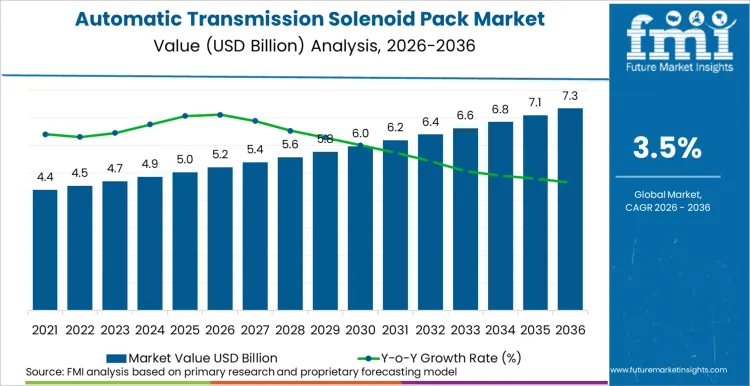
The automatic transmission solenoid pack market progressed at USD 5.0 billion in 2025. Demand is set to surpass USD 5.2 billion in 2026 at a 3.4% automatic transmission solenoid pack CAGR during the forecast period. Revenue expansion and gearbox solenoid pack demand lifts the total opportunity to USD 7.3 billion through 2036 as shifting vehicle architectures toward multi-speed hydraulic systems require more complex, higher-precision solenoid clusters to manage fluid pressure across tighter gear ratios.
Summary of Automatic Transmission Solenoid Pack Market
- Market Snapshot
- Opening with a valuation of USD 5.0 billion in 2025, the global landscape for automatic transmission solenoid packs market is on track to hit USD 7.3 billion by 2036.
- Expanding at a steady 3.4% CAGR through the next decade will unlock a massive incremental opportunity worth roughly USD 2.3 billion for component suppliers.
- Success in this mature control-component space relies heavily on how well a supplier can integrate their highly precise, oil-resistant solenoids directly into complex valve body architectures.
- Rather than relying on unpredictable aftermarket trends, long-term sales are structurally locked to the actual production volumes of new dual-clutch, CVT, and traditional automatic vehicles hitting the road.
- Demand and Growth Drivers
- Automakers around the world are increasingly swapping out manual gearboxes for electronically managed transmissions in both everyday passenger cars and light commercial fleets, pushing component demand steadily upward.
- Achieving the smooth shift quality and high fuel efficiency that modern drivers expect is impossible without the precise electrohydraulic pressure control provided by these critical solenoid packs.
- The massive number of aging automatic vehicles are already on the road across mature economies guarantees a reliable stream of replacement hardware orders for years to come.
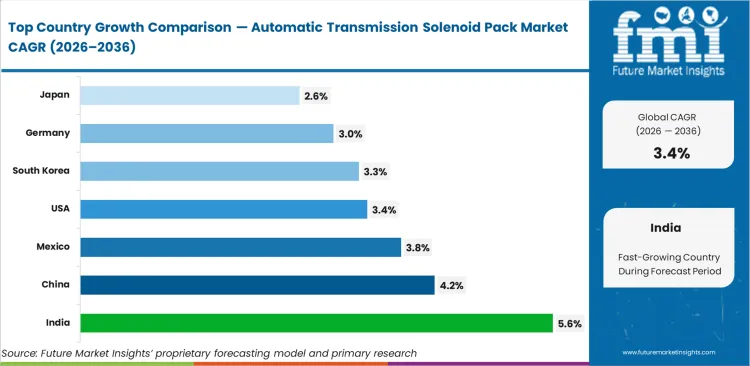
- Looking at regional expansion, India sets the pace with a fast 5.6% CAGR, closely trailed by China at 4.2% and Mexico at 3.8%, while established hubs like the U.S. at 3.4%, South Korea at 3.3%, Germany at 3.0%, and Japan at 2.6% continue to post steady, reliable gains.
- The rapid rise of pure battery-electric vehicles acts as a natural speed bump for this sector, as single-speed EV platforms simply do not require the same complex, multi-valve transmission hardware.
- Product and Segment View
- From a product standpoint, this industry encompasses the specialized electrohydraulic packs designed specifically to control traditional AT, advanced CVT, and rapid-fire DCT systems.
- While you will find these components doing heavy lifting in large commercial trucks and delivery vans, the sheer volume of everyday passenger cars makes them the undisputed primary target for manufacturers.
- Automakers prefer to install these modules directly on the assembly line to ensure perfect software calibration, allowing the First Fit OEM channel to easily dominate with an 85.0% share of all sales.
- Conventional hydraulic automatic platforms continue to represent the vast majority of the landscape, capturing a massive 71.0% share simply because planetary gearsets remain incredibly popular globally.
- The Passenger Cars segment firmly holds a 74.0% share, driven by the global consumer shift away from manual shifting in daily commuter traffic.
- Because modern transmissions require graduated, ultra-smooth fluid pressure control rather than basic on/off switching, proportional solenoids naturally lead the pack with a 49.0% share.
- Everything from standalone pressure-control solenoids to fully packaged electrohydraulic modules built to sit deep inside an automatic gearbox falls squarely within this market’s boundaries.
- Conversely, analysts exclude standalone transmission computers, entire mechatronic replacement systems, fluid pumps, filters, and any solenoid meant for a fuel or air-conditioning system rather than a gearbox.
- Geography and Competitive Outlook
- Rapidly developing manufacturing hubs like India, China, and Mexico offer the steepest growth trajectories, balancing out the massive, reliable, high-value replacement demand generated by millions of aging vehicles in the USA, Germany, and Japan.
- Winning contracts in this space requires much more than just building a durable valve; suppliers must prove they have the software calibration skills and engineering scale to support an automaker's entire global fleet.
- Household automotive names such as Robert Bosch GmbH (Bosch), Continental AG, Denso Corporation, Hitachi Astemo Ltd., Aisin Corporation, and Schaeffler AG crowd the top tier, alongside niche specialists like Nidec and Sonnax who carve out strong positions in aftermarket and adjacent valve channels.
As car computers get smarter, the industry is moving away from basic mechanical parts toward advanced, all-in-one smart modules. Operation managers and automotive OEM transmission solenoid pack suppliers don't just care about how long a part lasts anymore. Instead, they are measuring exactly how fast these driveline control systems react, because shaving off milliseconds of delay is crucial for meeting strict modern fuel economy rules. If car makers are slow to adopt this precise, smart technology, their vehicles will suffer from clunky gear shifts and wasted energy, which directly drags down the official fuel efficiency ratings for their entire lineup.
To make building vehicles easier and faster, purchasing directors are leaning heavily toward an automatic transmission solenoid pack manufacturers approach, preferring to buy complete, ready-to-install units rather than piecing together individual valves on the assembly line. Once these smart parts start speaking the same digital language across various automotive TCU interfaces, the cost of designing them will drop significantly. This breakthrough allows for a plug-and-play future, where a single physical part can be used across many different car models simply by updating its software.
India is expected to record the fastest growth at a 5.6% CAGR through 2036, supported by expanding light commercial vehicle demand. China is projected to grow at 4.2% CAGR, driven by the scale-up of domestic automatic transmission manufacturing. The market in Mexico is anticipated to rise at a 3.8% CAGR by 2036, followed by the United States at 3.4% and South Korea at 3.3%. Germany is set to expand at a 3.0% CAGR through 2036, while Japan is expected to register 2.6% CAGR over the same period. This variation reflects the different priorities across regions, with mature markets focusing more on DCT efficiency and emerging manufacturing hubs concentrating on cost-effective automatic transmission systems.
Segmental Analysis
Automatic Transmission Solenoid Pack Market Analysis by Transmission Type
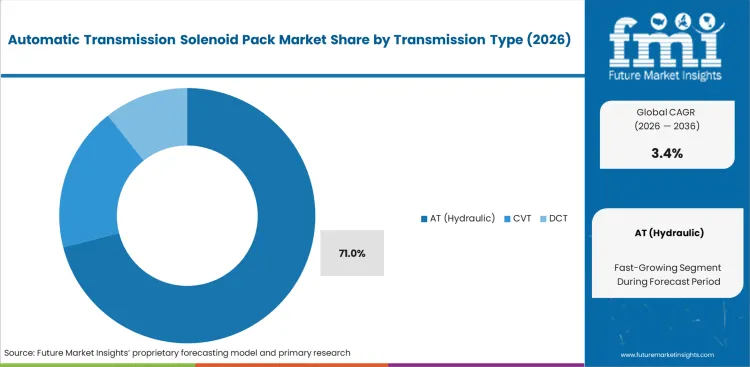
The displacement of traditional four-speed systems by high-ratio 8, 9, and 10-speed transmissions is the primary mechanism behind current share distributions. AT (Hydraulic) systems are estimated to represent 71.0% share in 2026, as planetary gearsets remain the preferred architecture for high-torque applications in SUVs and LCVs. Transmission engineers note that as ratios increase, the precision required for automotive solenoid actuation becomes critical to prevent shift-overlap and excessive clutch wear. Procurement directors at mid-size OEMs who fail to leverage these standardized mechatronic interfaces face significantly higher R&D costs and longer time-to-market for new vehicle launches.
- Ratio-Count Complexity: High-speed hydraulic systems require additional solenoids to manage the increased number of clutches and brakes in the planetary gearset. Transmission designers must balance the higher solenoid valve count with the hydraulic pump's capacity to maintain line pressure during rapid downshifts.
- CVT Pressure Management: Belt-and-pulley systems require continuous, high-precision pressure adjustments to prevent belt slip under varying load conditions. Procurement managers at Asian automotive brands prioritize solenoids with high thermal stability to ensure consistent CVT performance in tropical climates.
- DCT Actuation Speed: Dual-clutch systems demand near-instantaneous solenoid response to pre-select the next gear while the current gear is still engaged. R&D directors focus on reducing the automotive transmission synchronizer assembly lag through improved electromagnetic coil winding techniques.
Automatic Transmission Solenoid Pack Market Analysis by Solenoid Type
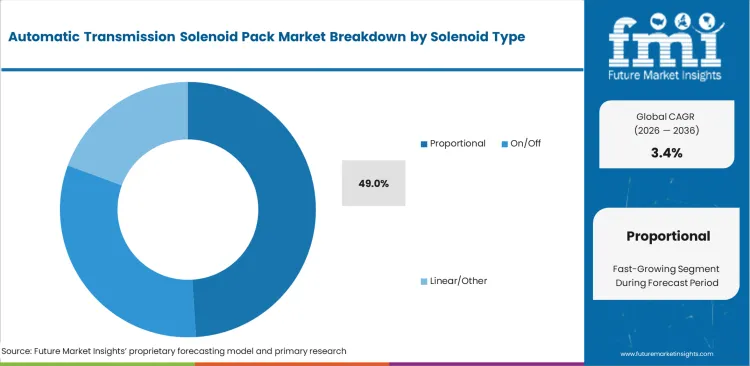
The proportional vs on off transmission solenoids debate is shifting, as proportional units are anticipated to capture 49.0% of the market in 2026, reflecting a move away from binary logic. The structural mechanism behind this position is the need for soft-shift capabilities, where the TCU modulates current to the solenoid to provide a graduated fluid pressure ramp. Transmission calibration engineers find that proportional valves are the only way to meet modern NVH (Noise, Vibration, and Harshness) targets in premium vehicle segments. FMI's view is that the share of linear solenoids understates their strategic importance, they are the primary enabler of adaptive shift logic that compensates for mechanical wear over time. A buyer who sticks with low-cost on/off solenoids for primary shift functions will face categorical failure in meeting the shift-quality expectations of modern consumers.
- Current-Controlled Pressure: Proportional valves allow the TCU to vary hydraulic pressure linearly with electrical current, enabling precise control over clutch engagement. Calibrators at Tier-1 suppliers use these valves to tune shift feel to match different driving modes, from Eco to Sport.
- Legacy Binary Actuation: On/off solenoids remain a cost-effective choice for non-shifting functions such as fluid cooling redirection or parking pawl engagement. Fleet managers at commercial vehicle AMT transmission operators rely on these robust components for their long-term durability in high-vibration environments.
- Adaptive Wear Compensation: Linear solenoids provide the granular feedback loop necessary for the control system to adjust fluid pressure as clutches thin over time. Service directors at major dealerships observe that transmissions equipped with advanced linear packs require fewer manual recalibrations over the vehicle's lifespan.
Automatic Transmission Solenoid Pack Market Analysis by Sales Channel
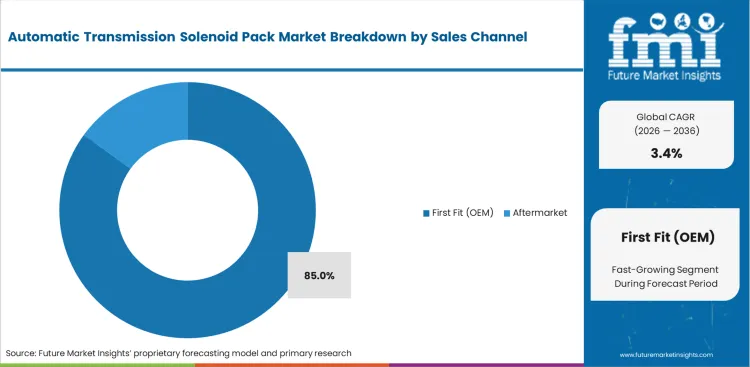
First Fit (OEM) installations are poised to garner 85.0% share in 2026, as the solenoid pack is increasingly treated as a non-serviceable part of the complete valve body assembly. The share logic here is tied to the modularization of the powertrain; OEMs prefer to source a validated automatic transmission torque converter and valve body cluster as a single unit to ensure system-level warranty compliance. The aftermarket category is likely to represent 15.0% of total share in 2026, with volume driven primarily by the remanufacturing sector. Transmission rebuilders who do not invest in advanced diagnostic equipment to test integrated mechatronic packs will find themselves excluded from servicing any vehicle platform released after 2022.
- OEM Integration Lock-In: Vehicle manufacturers qualify the solenoid pack as part of the overall transmission certification, making it difficult for third-party suppliers to enter the first-fit supply chain. Procurement directors at global OEMs maintain exclusive supply contracts with a few high-capability mechatronic specialists to guarantee transmission fluid compatibility.
- Remanufacturing Volume: Specialist rebuild shops drive demand for replacement solenoid sets as they refurbish high-mileage valve bodies for the used vehicle market. Category managers at parts distributors prioritize plug-and-play solenoid kits that include all necessary gaskets and seals for a specific transmission family.
- Electronic Validation Requirements: New aftermarket solenoids must often be flashed or paired with the vehicle's TCU, a step that requires proprietary OEM software. Professional technicians increasingly favor pre-calibrated packs that reduce the risk of shift-logic errors following a transmission overhaul.
Automatic Transmission Solenoid Pack Market Drivers, Restraints, and Opportunities
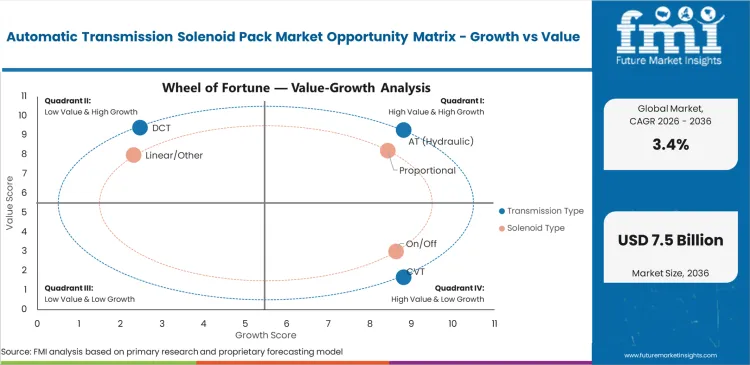
Fuel economy mandates are the primary commercial pressure forcing automotive OEMs to act now. As gear counts rise to 9 or 10 speeds to keep engines in their most efficient RPM range, the number of required solenoids per vehicle increases by up to 40.0%. Powertrain R&D directors at major automotive groups face a narrow window to transition their platforms; delaying the adoption of advanced proportional solenoid packs results in vehicle fleets that cannot compete on efficiency, leading to significant regulatory fines.
The fundamental structural friction slowing adoption is the high cost and complexity of mechatronic validation. Unlike mechanical valves, solenoid packs require extensive software-hardware integration testing to ensure they do not interfere with the vehicle's functional safety protocols. This friction persists because each new transmission variant requires a unique mechatronic calibration, creating a bottleneck in the engineering cycle. A partial solution is emerging through universal solenoid architectures that can be software-tuned, but current limitations in TCU processing power prevent widespread implementation across all vehicle segments.
- Hybrid-Specific Solenoid Tuning: Developing solenoids capable of handling the high-frequency shifting and rapid thermal cycling inherent in electric vehicle transmission hybrid architectures.
- Remanufacturing Diagnostic Tools: Providing specialist rebuild shops with the diagnostic hardware required to test and recalibrate integrated mechatronic solenoid packs.
- Low-Cost CVT Solutions: Engineering high-durability, cost-effective solenoid clusters for the automatic transmission expansion in emerging Southeast Asian and Indian markets.
Regional Analysis
Based on regional analysis, the global market for Automatic Transmission Solenoid Packs spans across multiple continents, highlighting a clear divide between mature markets seeking extreme efficiency and emerging regions prioritizing rapid, cost-effective automation. Demand is shaped by unique local driving habits, vehicle preferences, and manufacturing hubs across over 40 countries.
.webp "Top Country Growth Comparison Automatic Transmission Solenoid Pack Market Cagr (2026 2036)")
| Country | CAGR (2026 to 2036) |
|---|---|
| India | 5.6% |
| China | 4.2% |
| Mexico | 3.8% |
| USA | 3.4% |
| South Korea | 3.3% |
| Germany | 3.0% |
| Japan | 2.6% |
Source: Future Market Insights (FMI) analysis, based on proprietary forecasting model and primary research
North America & Latin America Automatic Transmission Solenoid Pack Market Analysis
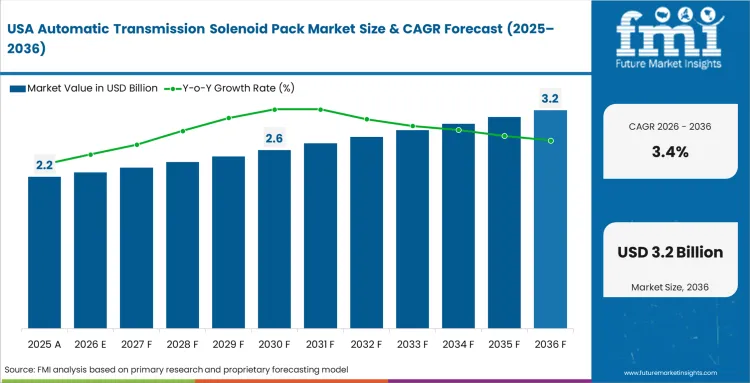
When you look at the Americas, the landscape is heavily defined by what consumers love to drive and where those vehicles are built. In the north, the focus is entirely on heavy-duty pickup trucks and large SUVs that require incredibly strong, high-torque hydraulic transmissions. Focus on the south, involve changes toward massive manufacturing operations that supply those exact vehicles. Instead of just adding more gears, automakers in this hemisphere are now looking to make their current 10-speed systems shift faster and smoother using high-frequency linear solenoids.
- USA: The love for big, capable vehicles means that demand for transmission control in the USA is anticipated to rise at a CAGR of 3.4% through 2036, largely because fleet owners refuse to compromise on durability. Buyers here prioritize systems with limp-home modes and built-in redundancy so that a single valve failure does not leave a commercial work truck stranded on the highway.
- Mexico: The solenoid pack market in Mexico is poised to expand at a CAGR of 3.8% through 2036, supported by the country’s role as a major export base for the North American vehicle industry. Local production facilities remain focused on supplying reliable solenoid packs for high-volume SUV and passenger vehicle programs. This gives suppliers in Mexico a strong manufacturing position within the regional automotive value chain.
FMI's report includes Canada and Brazil, showing how the broader Americas balance mature consumer preferences with growing localized manufacturing power to keep supply chains highly resilient.
Asia-Pacific Automatic Transmission Solenoid Pack Market Analysis
The Asia-Pacific region is a massive engine for growth, blending the high-tech production power of eastern countries with the rapid urbanization happening further south. Drivers here are shifting gears quite differently depending on where they live. Some nations are scaling up continuously variable transmissions (CVTs) for daily city driving, while others are finally upgrading from manual to automatic cars just to survive terrible urban traffic jams. This creates a highly diverse environment where both high-end hybrid parts and low-cost basic automated systems are in huge demand simultaneously.
- China: As local car brands decide to build their own advanced parts rather than buying them from overseas, the China transmission solenoid pack market is set to record a CAGR of 4.2% during the assessment period. This push to make transmission components domestically is creating a huge opportunity for local suppliers to step up and provide the necessary mechatronic hardware.
- South Korea: Demand for solenoid packs in South Korea is projected to rise at a 3.3% CAGR through 2036, supported by the country’s continued focus on expanding dual-clutch transmission platforms in global automotive markets. This export-oriented strategy is expected to sustain demand for high-speed proportional valves that support fast and precise gear shifts.
- Japan: Demand for solenoid packs in Japan is expected to grow at a CAGR of 2.6% through 2036, supported by the country’s continued focus on refined CVT systems and hybrid vehicle architectures. Precision calibration and transmission smoothness remain important priorities for Japanese automakers. This keeps component demand stable even in a relatively mature vehicle market.
- India: The solenoid pack market in India is anticipated to rise at a CAGR of 5.6% through 2036, driven by the shift toward more affordable and easier-to-drive passenger vehicles. Urban traffic conditions and rising consumer preference for convenience are supporting wider adoption of automatic transmission systems. This is gradually expanding demand for transmission control components across the domestic automotive sector.
FMI's report includes other ASEAN nations and Australia, illustrating how this massive corner of the globe is transitioning from basic manual driving to highly automated, software-driven commuting at an unprecedented pace.
Europe Automatic Transmission Solenoid Pack Market Analysis
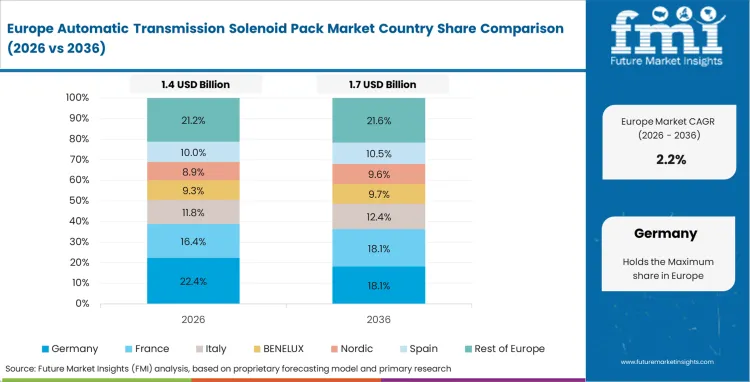
Across Europe, strict environmental rules and a deep cultural love for driving performance are forcing car makers to rethink how transmissions actually operate. The focus here is heavily on high-efficiency dual-clutch systems and complex hybrid setups. These advanced powertrains demand incredibly precise solenoid packs to keep emissions low without ruining the engaging driving experience that European car buyers expect.
- Germany: As the historic heart of automotive engineering, German manufacturers are pouring their resources into perfecting hybrid architectures and lightning-fast dual-clutch systems. Adapting to these complex new powertrain designs means Germany is expected to register a CAGR of 3.0% through 2036 as engineers build the next generation of eco-friendly but powerful cars. This keeps local component suppliers incredibly busy as they try to meet some of the tightest performance and emissions standards in the world.
FMI's report includes the UK, France, and Italy, highlighting a continent that is uniquely balancing its rich legacy of mechanical performance with the urgent need for highly advanced, electrified transmission control.
Competitive Aligners for Market Players
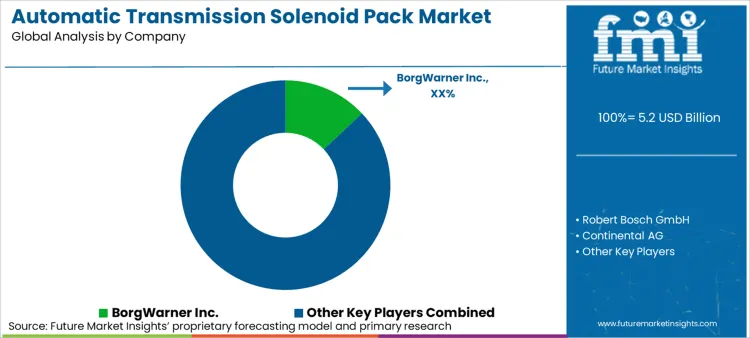
Control in the powertrain segment is shifting away from standalone component manufacturing and toward integrated system capability. Suppliers are no longer competing only on the production of individual metal parts. Their position increasingly depends on the ability to combine solenoids, sensors, and transmission control functions into pre-integrated modules. BorgWarner Inc. has strengthened its role by moving beyond basic valve supply and offering packaged solutions that fit more directly into modern transmission architectures. This makes life harder for smaller hydraulic specialists, since competitive value now depends heavily on how well hardware and software function together. Robert Bosch GmbH (Bosch) and Continental AG are reinforcing that shift by using their electronics expertise to develop modular systems that can be adapted more efficiently across vehicle programs, which reduces the strategic weight of standalone solenoid components.
Established suppliers hold another advantage through long validation histories and deep OEM relationships. A new entrant trying to become an OEM transmission solenoid valve supplier must do more than produce a dimensionally correct part. It must demonstrate that the component can withstand millions of shift cycles across extreme temperature ranges without performance loss. Denso Corporation and Aisin Corporation benefit from their close position within Toyota’s supply network, where long-standing integration and qualification history create strong incumbency advantages. Once a vehicle platform is validated around a specific solenoid pack, automakers are generally reluctant to switch suppliers because full revalidation carries high cost, engineering effort, and program risk.
Automakers may seek to avoid overdependence on any one supplier, though the technical direction of the market is moving toward more customized and software-linked designs rather than universal parts. The next competitive threshold is likely to center on hybrid-compatible systems. Suppliers such as Hitachi Astemo Ltd. and Schaeffler AG are already developing components suited to the rapid switching behavior and lower-voltage requirements of 48V hybrid platforms. Pricing still matters, though supplier selection increasingly depends on who can support smoother integration, stronger reliability, and better alignment with the software-driven architecture of next-generation vehicles.
Key Players in Automatic Transmission Solenoid Pack Market
- BorgWarner Inc.
- Robert Bosch GmbH (Bosch)
- Continental AG
- Denso Corporation
- Hitachi Astemo Ltd.
- Aisin Corporation
- Schaeffler AG
- Nidec Corporation
- Sonnax Industries Inc.
- ZF Friedrichshafen AG
Scope of the Report
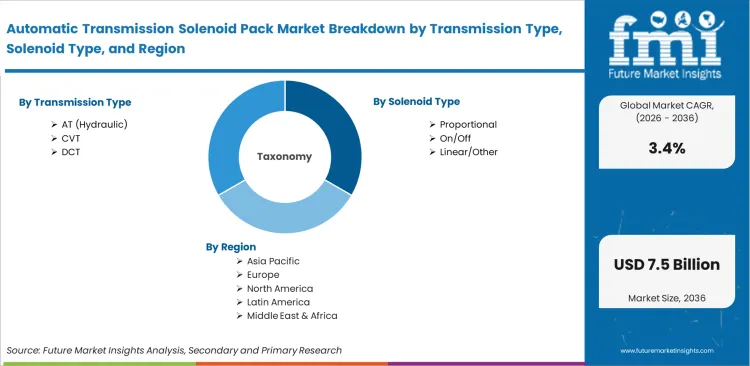
| Metric | Value |
|---|---|
| Quantitative Units | USD 5.2 billion to USD 7.3 billion, at a CAGR of 3.4% |
| Market Definition | Automatic transmission solenoid packs are electro-hydraulic control units that manage fluid pressure and flow within the transmission valve body to actuate gear shifts and torque converter functions. |
| Segmentation | Sales Channel, Transmission Type, Vehicle Type, Solenoid Type, Region |
| Regions Covered | North America, Latin America, Europe, East Asia, South Asia & Pacific, Middle East & Africa |
| Countries Covered | USA, China, India, Germany, Japan, South Korea, Mexico |
| Key Companies Profiled | BorgWarner Inc., Robert Bosch GmbH (Bosch), Continental AG, Denso Corporation, Hitachi Astemo Ltd., Aisin Corporation, Schaeffler AG, Nidec Corporation, Sonnax, ZF |
| Forecast Period | 2026 to 2036 |
| Approach | Top-down and bottom-up modeling based on vehicle production data and transmission-type adoption rates. |
Source: Future Market Insights (FMI) analysis, based on proprietary forecasting model and primary research
Segments
Sales Channel:
- First Fit (OEM)
- Aftermarket
Transmission Type:
- AT (Hydraulic)
- CVT
- DCT
Vehicle Type:
- Passenger Cars
- LCV
- HCV
Solenoid Type:
- On/Off
- Proportional
- Linear/Other
Regions:
- Asia Pacific
- India
- China
- Japan
- South Korea
- Indonesia
- Australia & New Zealand
- ASEAN
- Rest of Asia Pacific
- Europe
- Germany
- Italy
- France
- United Kingdom
- Spain
- Benelux
- Nordics
- Central & Eastern Europe
- Rest of Europe
- North America
- United States
- Canada
- Mexico
- Latin America
- Brazil
- Argentina
- Chile
- Rest of Latin America
- Middle East & Africa
- Kingdom of Saudi Arabia
- United Arab Emirates
- South Africa
- Turkey
- Rest of Middle East & Africa
Bibliography
- Environmental Protection Agency. (2026). The 2025 EPA Automotive Trends Report: Fuel Economy, and Technology since 1975 (EPA-420-R-26-001). U.S. Environmental Protection Agency.
- USA Department of Energy. (2025). 2024 Annual Merit Review Vehicle Technologies Office Results Report.
- Cui, J. (2024). A hydraulic control system integrating adaptive and PWM algorithms for hydro-mechanical continuously variable transmission. Frontiers in Mechanical Engineering, 10, 1431009.
- Min, Y.-S., Kim, Y.-J., Baek, S.-Y., Baek, S.-M., & Kim, W.-S. (2025). Development of electrohydraulic proportional valve model for precise steering control in autonomous tractors. Machines, 13(2), 138.
This bibliography is provided for reader reference. The full FMI report contains the complete reference list with primary source documentation.
This Report Addresses
- Structural shift from on/off to proportional solenoid actuation.
- Impact of multi-speed 9-speed and 10-speed transmissions on solenoid counts.
- Regional growth disparities between North American SUVs and Indian urban passenger cars.
- Competitive dynamics of the mechatronic integration trend among Tier-1 suppliers.
- Aftermarket remanufacturing opportunities for high-mileage hydraulic valve bodies.
- Regulatory fuel economy pressures driving transmission complexity.
- Modularization of solenoid clusters for platform-agnostic powertrain design.
- Thermal management challenges in hybrid-integrated transmission solenoids.
Bibliography
- Society of Automotive Engineers. (2023). Advances in automatic transmission control technology. SAE Technical Papers.
- International Council on Clean Transportation. (2023). Global overview of fuel efficiency and emission standards for light-duty vehicles. ICCT Publication.
- Automotive Research Association of India. (2024). Transmission technology trends and market analysis. ARAI Technical Report.
Frequently Asked Questions
What was the market value of the Automatic Transmission Solenoid Pack in 2025?
The market was valued at USD 5.0 billion in 2025, reflecting a stable base of hydraulic powertrain production.
Which Solenoid Type is expected to lead the market in 2026?
Proportional solenoids are estimated to account for 49.0% share in 2026 due to the need for adaptive shift logic.
What is the projected CAGR for the global market through 2036?
The market is poised to expand at a CAGR of 3.4% during the forecast period from 2026 to 2036.
Why are proportional solenoids used in automatic transmissions?
Proportional valves allow for soft-shift capabilities by graduating fluid pressure, which is essential for meeting modern shift-quality standards.
Which transmission type accounts for the highest share of solenoid demand?
AT (Hydraulic) systems are expected to hold 71.0% share in 2026 as they remain the standard for high-torque vehicles.
How does gear count impact the total number of solenoids in a vehicle?
Higher gear ratios, such as 9 and 10-speed systems, require more clutch actuators, increasing the solenoid count per pack.
What role does India play in the global market growth?
India is the fastest-growing country with a 5.6% CAGR, driven by the rapid urban transition to automatic systems.
Which company holds the largest estimated share in the market?
Borg Warner Inc. is a dominant player with an estimated 9.4% share, supported by its mechatronic integration capabilities.
How is the shift toward mechatronics impacting the aftermarket?
The aftermarket is shifting toward complete valve body replacement as integrated mechatronic units become too complex for individual solenoid repair.
How big is the automatic transmission solenoid pack market size in 2026?
The industry size is expected to reach USD 5.2 billion by 2026 as mechatronic complexity increases the value per unit.
Why is Mexico growing at a CAGR of 3.8%?
Mexico's growth is tied to its role as a major export hub for the North American SUV and pickup truck market.
What structural gate will accelerate the adoption of modular solenoid packs?
The standardization of communication protocols between the TCU and solenoid cluster will lower development costs for modular units.
Preview the report firsthand - request a free sample
Get SampleGet the brochure for pricing and purchase details.
Get PDFTable of Content
- Executive Summary
- Global Market Outlook
- Demand-side Trends
- Supply-side Trends
- Technology Roadmap Analysis
- Analysis and Recommendations
- Market Overview
- Market Coverage / Taxonomy
- Market Definition / Scope / Limitations
- Research Methodology
- Chapter Orientation
- Analytical Lens and Working Hypotheses
- Market Structure, Signals, and Trend Drivers
- Benchmarking and Cross-market Comparability
- Market Sizing, Forecasting, and Opportunity Mapping
- Research Design and Evidence Framework
- Desk Research Programme (Secondary Evidence)
- Company Annual and Sustainability Reports
- Peer-reviewed Journals and Academic Literature
- Corporate Websites, Product Literature, and Technical Notes
- Earnings Decks and Investor Briefings
- Statutory Filings and Regulatory Disclosures
- Technical White Papers and Standards Notes
- Trade Journals, Industry Magazines, and Analyst Briefs
- Conference Proceedings, Webinars, and Seminar Materials
- Government Statistics Portals and Public Data Releases
- Press Releases and Reputable Media Coverage
- Specialist Newsletters and Curated Briefings
- Additional Desk Sources
- Expert Input and Fieldwork (Primary Evidence)
- Primary Modes
- Qualitative Interviews and Expert Elicitation
- Quantitative Surveys and Structured Data Capture
- Blended Approach
- Why Primary Evidence is Used
- Field Techniques
- Interviews
- Surveys
- Focus Groups
- Observational and In-context Research
- Social and Community Interactions
- Stakeholder Universe Engaged
- C-suite Leaders
- Board Members
- Presidents and Vice Presidents
- R&D and Innovation Heads
- Technical Specialists
- Domain Subject-matter Experts
- Scientists
- Physicians and Other Healthcare Professionals
- Governance, Ethics, and Data Stewardship
- Research Ethics
- Data Integrity and Handling
- Primary Modes
- Tooling, Models, and Reference Databases
- Desk Research Programme (Secondary Evidence)
- Data Engineering and Model Build
- Data Acquisition and Ingestion
- Cleaning, Normalisation, and Verification
- Synthesis, Triangulation, and Analysis
- Quality Assurance and Audit Trail
- Market Background
- Market Dynamics
- Drivers
- Restraints
- Opportunity
- Trends
- Scenario Forecast
- Demand in Optimistic Scenario
- Demand in Likely Scenario
- Demand in Conservative Scenario
- Opportunity Map Analysis
- Product Life Cycle Analysis
- Supply Chain Analysis
- Investment Feasibility Matrix
- Value Chain Analysis
- PESTLE and Porter’s Analysis
- Regulatory Landscape
- Regional Parent Market Outlook
- Production and Consumption Statistics
- Import and Export Statistics
- Market Dynamics
- Global Market Analysis 2021 to 2025 and Forecast, 2026 to 2036
- Historical Market Size Value (USD Million) Analysis, 2021 to 2025
- Current and Future Market Size Value (USD Million) Projections, 2026 to 2036
- Y-o-Y Growth Trend Analysis
- Absolute $ Opportunity Analysis
- Global Market Pricing Analysis 2021 to 2025 and Forecast 2026 to 2036
- Global Market Analysis 2021 to 2025 and Forecast 2026 to 2036, By Transmission Type
- Introduction / Key Findings
- Historical Market Size Value (USD Million) Analysis By Transmission Type , 2021 to 2025
- Current and Future Market Size Value (USD Million) Analysis and Forecast By Transmission Type , 2026 to 2036
- AT (Hydraulic)
- CVT
- DCT
- AT (Hydraulic)
- Y-o-Y Growth Trend Analysis By Transmission Type , 2021 to 2025
- Absolute $ Opportunity Analysis By Transmission Type , 2026 to 2036
- Global Market Analysis 2021 to 2025 and Forecast 2026 to 2036, By Solenoid Type
- Introduction / Key Findings
- Historical Market Size Value (USD Million) Analysis By Solenoid Type, 2021 to 2025
- Current and Future Market Size Value (USD Million) Analysis and Forecast By Solenoid Type, 2026 to 2036
- Proportional
- On/Off
- Linear/Other
- Proportional
- Y-o-Y Growth Trend Analysis By Solenoid Type, 2021 to 2025
- Absolute $ Opportunity Analysis By Solenoid Type, 2026 to 2036
- Global Market Analysis 2021 to 2025 and Forecast 2026 to 2036, By Sales Channel
- Introduction / Key Findings
- Historical Market Size Value (USD Million) Analysis By Sales Channel, 2021 to 2025
- Current and Future Market Size Value (USD Million) Analysis and Forecast By Sales Channel, 2026 to 2036
- First Fit (OEM)
- Aftermarket
- First Fit (OEM)
- Y-o-Y Growth Trend Analysis By Sales Channel, 2021 to 2025
- Absolute $ Opportunity Analysis By Sales Channel, 2026 to 2036
- Global Market Analysis 2021 to 2025 and Forecast 2026 to 2036, By Region
- Introduction
- Historical Market Size Value (USD Million) Analysis By Region, 2021 to 2025
- Current Market Size Value (USD Million) Analysis and Forecast By Region, 2026 to 2036
- North America
- Latin America
- Western Europe
- Eastern Europe
- East Asia
- South Asia and Pacific
- Middle East & Africa
- Market Attractiveness Analysis By Region
- North America Market Analysis 2021 to 2025 and Forecast 2026 to 2036, By Country
- Historical Market Size Value (USD Million) Trend Analysis By Market Taxonomy, 2021 to 2025
- Market Size Value (USD Million) Forecast By Market Taxonomy, 2026 to 2036
- By Country
- USA
- Canada
- Mexico
- By Transmission Type
- By Solenoid Type
- By Sales Channel
- By Country
- Market Attractiveness Analysis
- By Country
- By Transmission Type
- By Solenoid Type
- By Sales Channel
- Key Takeaways
- Latin America Market Analysis 2021 to 2025 and Forecast 2026 to 2036, By Country
- Historical Market Size Value (USD Million) Trend Analysis By Market Taxonomy, 2021 to 2025
- Market Size Value (USD Million) Forecast By Market Taxonomy, 2026 to 2036
- By Country
- Brazil
- Chile
- Rest of Latin America
- By Transmission Type
- By Solenoid Type
- By Sales Channel
- By Country
- Market Attractiveness Analysis
- By Country
- By Transmission Type
- By Solenoid Type
- By Sales Channel
- Key Takeaways
- Western Europe Market Analysis 2021 to 2025 and Forecast 2026 to 2036, By Country
- Historical Market Size Value (USD Million) Trend Analysis By Market Taxonomy, 2021 to 2025
- Market Size Value (USD Million) Forecast By Market Taxonomy, 2026 to 2036
- By Country
- Germany
- UK
- Italy
- Spain
- France
- Nordic
- BENELUX
- Rest of Western Europe
- By Transmission Type
- By Solenoid Type
- By Sales Channel
- By Country
- Market Attractiveness Analysis
- By Country
- By Transmission Type
- By Solenoid Type
- By Sales Channel
- Key Takeaways
- Eastern Europe Market Analysis 2021 to 2025 and Forecast 2026 to 2036, By Country
- Historical Market Size Value (USD Million) Trend Analysis By Market Taxonomy, 2021 to 2025
- Market Size Value (USD Million) Forecast By Market Taxonomy, 2026 to 2036
- By Country
- Russia
- Poland
- Hungary
- Balkan & Baltic
- Rest of Eastern Europe
- By Transmission Type
- By Solenoid Type
- By Sales Channel
- By Country
- Market Attractiveness Analysis
- By Country
- By Transmission Type
- By Solenoid Type
- By Sales Channel
- Key Takeaways
- East Asia Market Analysis 2021 to 2025 and Forecast 2026 to 2036, By Country
- Historical Market Size Value (USD Million) Trend Analysis By Market Taxonomy, 2021 to 2025
- Market Size Value (USD Million) Forecast By Market Taxonomy, 2026 to 2036
- By Country
- China
- Japan
- South Korea
- By Transmission Type
- By Solenoid Type
- By Sales Channel
- By Country
- Market Attractiveness Analysis
- By Country
- By Transmission Type
- By Solenoid Type
- By Sales Channel
- Key Takeaways
- South Asia and Pacific Market Analysis 2021 to 2025 and Forecast 2026 to 2036, By Country
- Historical Market Size Value (USD Million) Trend Analysis By Market Taxonomy, 2021 to 2025
- Market Size Value (USD Million) Forecast By Market Taxonomy, 2026 to 2036
- By Country
- India
- ASEAN
- Australia & New Zealand
- Rest of South Asia and Pacific
- By Transmission Type
- By Solenoid Type
- By Sales Channel
- By Country
- Market Attractiveness Analysis
- By Country
- By Transmission Type
- By Solenoid Type
- By Sales Channel
- Key Takeaways
- Middle East & Africa Market Analysis 2021 to 2025 and Forecast 2026 to 2036, By Country
- Historical Market Size Value (USD Million) Trend Analysis By Market Taxonomy, 2021 to 2025
- Market Size Value (USD Million) Forecast By Market Taxonomy, 2026 to 2036
- By Country
- Kingdom of Saudi Arabia
- Other GCC Countries
- Turkiye
- South Africa
- Other African Union
- Rest of Middle East & Africa
- By Transmission Type
- By Solenoid Type
- By Sales Channel
- By Country
- Market Attractiveness Analysis
- By Country
- By Transmission Type
- By Solenoid Type
- By Sales Channel
- Key Takeaways
- Key Countries Market Analysis
- USA
- Pricing Analysis
- Market Share Analysis, 2025
- By Transmission Type
- By Solenoid Type
- By Sales Channel
- Canada
- Pricing Analysis
- Market Share Analysis, 2025
- By Transmission Type
- By Solenoid Type
- By Sales Channel
- Mexico
- Pricing Analysis
- Market Share Analysis, 2025
- By Transmission Type
- By Solenoid Type
- By Sales Channel
- Brazil
- Pricing Analysis
- Market Share Analysis, 2025
- By Transmission Type
- By Solenoid Type
- By Sales Channel
- Chile
- Pricing Analysis
- Market Share Analysis, 2025
- By Transmission Type
- By Solenoid Type
- By Sales Channel
- Germany
- Pricing Analysis
- Market Share Analysis, 2025
- By Transmission Type
- By Solenoid Type
- By Sales Channel
- UK
- Pricing Analysis
- Market Share Analysis, 2025
- By Transmission Type
- By Solenoid Type
- By Sales Channel
- Italy
- Pricing Analysis
- Market Share Analysis, 2025
- By Transmission Type
- By Solenoid Type
- By Sales Channel
- Spain
- Pricing Analysis
- Market Share Analysis, 2025
- By Transmission Type
- By Solenoid Type
- By Sales Channel
- France
- Pricing Analysis
- Market Share Analysis, 2025
- By Transmission Type
- By Solenoid Type
- By Sales Channel
- India
- Pricing Analysis
- Market Share Analysis, 2025
- By Transmission Type
- By Solenoid Type
- By Sales Channel
- ASEAN
- Pricing Analysis
- Market Share Analysis, 2025
- By Transmission Type
- By Solenoid Type
- By Sales Channel
- Australia & New Zealand
- Pricing Analysis
- Market Share Analysis, 2025
- By Transmission Type
- By Solenoid Type
- By Sales Channel
- China
- Pricing Analysis
- Market Share Analysis, 2025
- By Transmission Type
- By Solenoid Type
- By Sales Channel
- Japan
- Pricing Analysis
- Market Share Analysis, 2025
- By Transmission Type
- By Solenoid Type
- By Sales Channel
- South Korea
- Pricing Analysis
- Market Share Analysis, 2025
- By Transmission Type
- By Solenoid Type
- By Sales Channel
- Russia
- Pricing Analysis
- Market Share Analysis, 2025
- By Transmission Type
- By Solenoid Type
- By Sales Channel
- Poland
- Pricing Analysis
- Market Share Analysis, 2025
- By Transmission Type
- By Solenoid Type
- By Sales Channel
- Hungary
- Pricing Analysis
- Market Share Analysis, 2025
- By Transmission Type
- By Solenoid Type
- By Sales Channel
- Kingdom of Saudi Arabia
- Pricing Analysis
- Market Share Analysis, 2025
- By Transmission Type
- By Solenoid Type
- By Sales Channel
- Turkiye
- Pricing Analysis
- Market Share Analysis, 2025
- By Transmission Type
- By Solenoid Type
- By Sales Channel
- South Africa
- Pricing Analysis
- Market Share Analysis, 2025
- By Transmission Type
- By Solenoid Type
- By Sales Channel
- USA
- Market Structure Analysis
- Competition Dashboard
- Competition Benchmarking
- Market Share Analysis of Top Players
- By Regional
- By Transmission Type
- By Solenoid Type
- By Sales Channel
- Competition Analysis
- Competition Deep Dive
- BorgWarner Inc.
- Overview
- Product Portfolio
- Profitability by Market Segments (Product/Age /Sales Channel/Region)
- Sales Footprint
- Strategy Overview
- Marketing Strategy
- Product Strategy
- Channel Strategy
- Robert Bosch GmbH (Bosch)
- Continental AG
- Denso Corporation
- Hitachi Astemo Ltd.
- Aisin Corporation
- Schaeffler AG
- Nidec Corporation
- Sonnax Industries Inc.
- ZF Friedrichshafen AG
- BorgWarner Inc.
- Competition Deep Dive
- Assumptions & Acronyms Used


