

- Industry Size (2026)
- USD 0.53 Bn
- Forecast (2036)
- USD 1.21 Bn
- CAGR (2026 to 2036)
- 8.7%
Millimeter-Wave and Sub-THz Semiconductor Device Characterization Platforms Market Size, Market Forecast, and Outlook By FMI
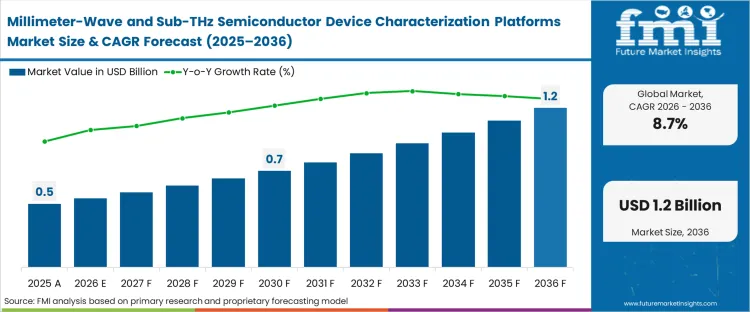
The millimeter-wave and sub-THz semiconductor device characterization platforms market was valued at USD 0.48 Billion in 2025, expanding at a compound annual growth rate (CAGR) of 8.7% from 2026 to 2036. By 2036, demand is expected to reach USD 1.21 billion, up from USD 0.53 billion in 2026. Semiconductor Manufacturers (IDMs & Foundries) currently represent the primary procurement demographic, accounting for 44.3% of the total share in 2026.
Summary of Millimeter-Wave and Sub-THz Semiconductor Device Characterization Platforms Market
- Research Methodology
- Primary Data Collection: Interviews conducted with Chief Technology Officers at major semiconductor foundries and senior test engineers at tier-one telecom equipment OEMs to validate frequency roadmap adoption.
- Secondary Source Verification: Analysis of 10-K filings, annual reports from top-tier test and measurement vendors, and technical whitepapers from organizations like NIST and the ITU-R.
- Market Modeling: Utilization of a proprietary bottom-up forecasting model that correlates fab capacity expansions and R&D expenditure in the 6G and automotive radar sectors.
- Validation Protocols: Cross-referencing findings with trade association data and academic research publications focused on terahertz metrology and advanced device physics.
- Analyst Opinion at FMI:
- Nikhil Kaitwade, Principal Analyst, Testing Equipment, at FMI, observes, “We are witnessing a structural shift where the boundary between the chip and the measurement system is effectively disappearing. In the sub-THz regime, the probe tip itself becomes a critical part of the circuit design, not just an observation point. For semiconductor manufacturers, the investment in characterization platforms is moving from the 'capital expense' column to the 'strategic survival' column. As 6G research intensifies, the bottleneck isn't just designing the transistor; it is proving that the transistor performs as simulated at 200 GHz. Those who master on-wafer characterization now will dictate the yield curves of the 2030s. The dominance of VNA-based systems remains unchallenged for now, but the rise of integrated, software-defined test platforms is the trend to watch as the industry demands faster time-to-market for complex integrated circuit testing cycles.”
Millimeter-Wave and Sub-THz Semiconductor Device Characterization Platforms Market Historical and Forecast Analysis
| Year | Value (USD Billion) |
|---|---|
| 2025 | 0.48 |
| 2026 | 0.53 |
| 2036 | 1.21 |
Source: Future Market Insights analysis, based on proprietary forecasting model and primary research
Foundries and IDMs are facing a hard pivot as the shift toward 6G and advanced 77GHz automotive radar pushes silicon performance to its theoretical limits. The commercial stakes are no longer just about raw bandwidth but the ability to characterize parasitic effects and signal integrity at frequencies where standard PCB materials begin to behave like antennas. Measurement accuracy at these scales determines the difference between a high-yield silicon run and a multimillion-dollar re-tapeout, forcing a transition toward more sophisticated semiconductor test equipment that can handle sub-micron probing. This fundamental change in how devices are validated is driving a replacement cycle for legacy RF test equipment that lacks the dynamic range required for sub-THz applications.
The gate condition for this market is the industry-wide migration from D-band to G-band and eventually to Terahertz frequencies. As 6G specifications move toward 100+ GHz, the trigger for equipment investment shifts from curiosity-driven R&D to high-volume manufacturing readiness. Consequently, vendors that fail to offer integrated, low-noise floor platforms will be locked out of the upcoming 6g technology infrastructure deployments, where precise phase noise and linearity metrics are mandatory for system-on-chip validation.
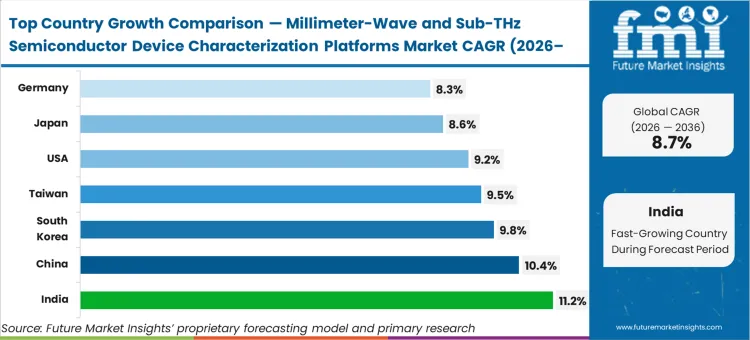
Geographical growth is dominated by hubs with high fab density and active 6G testbeds. India leads the expansion with a projected 11.2% CAGR, followed closely by China at 10.4% and South Korea at 9.8%. Taiwan and the United States follow with 9.5% and 9.2% respectively, while Japan at 8.6% and Germany at 8.3% represent more mature markets focused on automotive and industrial high-frequency electronics upgrades.
Millimeter-Wave and Sub-THz Semiconductor Device Characterization Platforms Market Definition
The millimeter wave test equipment market covers specialized hardware and software designed to measure the electrical performance of chips operating between 30 GHz and 1 THz. These systems evaluate parameters such as S-parameters, noise figure, and power efficiency at very high frequencies. They differ from standard benchtop tools by using frequency extenders, specialized waveguides, and micro-probing setups to maintain signal accuracy at the wafer level. As electronic measurement equipment evolves, these platforms have become essential for verifying the performance of GaN, InP, and advanced CMOS devices used in next-generation wireless infrastructure.
Millimeter-Wave and Sub-THz Semiconductor Device Characterization Platforms Market Inclusions
The market includes high-performance mmWave VNA systems equipped with frequency extenders for mmWave bands, on-wafer probe stations designed for vibration-free sub-micron positioning, and signal generator units capable of producing coherent sub-THz tones. It also encompasses thermal control systems required for characterization under extreme environmental conditions, along with specialized calibration kits for waveguide and coaxial interfaces. Software suites that automate de-embedding and modeling of parasitic elements are also integral components. Furthermore, the market covers integrated test benches used specifically for microwave devices and phased-array antenna characterization within the 5G and early 6G spectral bands.
Millimeter-Wave and Sub-THz Semiconductor Device Characterization Platforms Market Exclusions
This market excludes low-frequency RF test equipment operating below 30 GHz and generic laboratory multimeters or basic oscilloscopes. It does not account for the semiconductor devices themselves or the finished consumer electronics that incorporate these chips. Standard logic analyzers used for digital verification are excluded unless they are part of a specialized mmWave mixed-signal test platform. Services such as third-party lab testing and outsourced characterization are not part of the platform hardware valuation. Additionally, software-only EDA tools that perform purely theoretical simulation without a physical hardware interface are removed from the market sizing to ensure a focus on characterization infrastructure.
Segmental Analysis
Millimeter-Wave and Sub-THz Semiconductor Device Characterization Platforms Market By Frequency Range
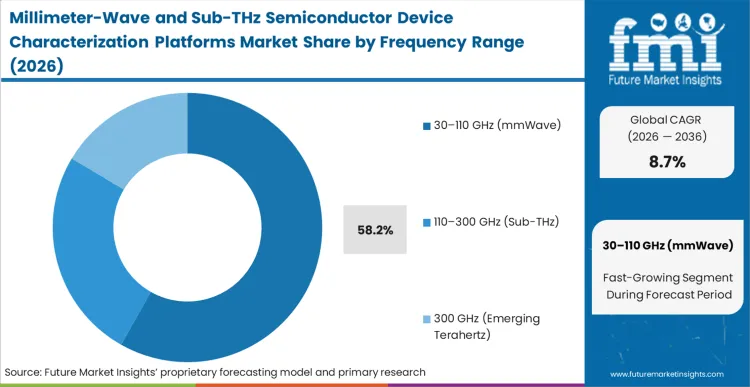
The 30-110 GHz (mmWave) segment currently supports the market with a 58.2% share, driven by the growing maturity of 5G FR2 and widespread use of 77 GHz automotive radar systems. As silicon-germanium (SiGe) and gallium nitride (GaN) technologies become common for high-power amplifiers, the need for accurate testing in these bands has moved from specialized aerospace labs to high-volume production environments. At the same time, sub-THz semiconductor testing platforms are gaining momentum as 6G R&D shifts from theory to practical prototyping. Testing at these frequencies requires changes in signal delivery methods, often using direct waveguide interfaces to reduce the high signal loss seen in coaxial cables. This challenge creates strong opportunities for network analyzer manufacturers that can offer stable, low-noise frequency extension solutions.
- 30-110 GHz (mmWave): Maintains a dominant share as it remains the primary deployment zone for commercial 5G infrastructure and ADAS sensors.
- 110-300 GHz (Sub-THz): Seeing the highest growth rate among research institutes as they race to define the physical layer standards for 2030.
- 300 GHz (Emerging Terahertz): Represents the technological frontier, currently limited to specialized terahertz technology research and exotic material characterization.
Millimeter-Wave and Sub-THz Semiconductor Device Characterization Platforms Market By Platform Type
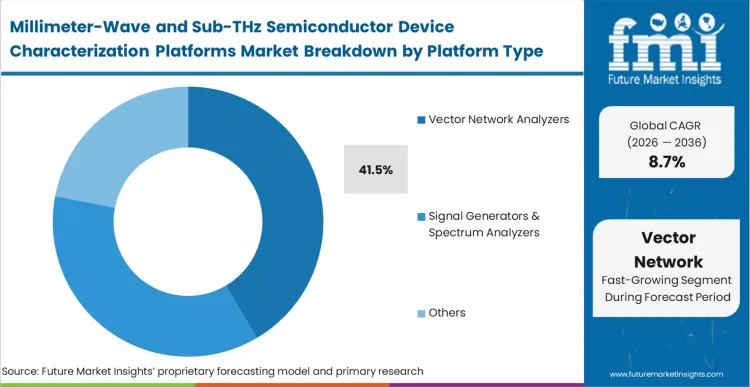
High-frequency validation is largely built on mmWave characterization systems, with Vector Network Analyzers holding a 41.5% share. As frequencies move beyond 100 GHz, even small physical distances between the device and the measurement port can introduce phase errors. Engineers can no longer depend on separate benchtop setups connected by long cables, leading to a shift toward more compact systems where frequency extenders are directly connected to mmWave probe stations. Accurate phase control makes VNA-based setups essential for reliable S-parameter measurements.
The industry is also moving toward more integrated test environments. Facility teams prefer systems that combine signal generation and analysis in one setup, helping reduce calibration effort on the production floor. This has increased the focus on equipment that brings multiple functions together, with buyers now evaluating suppliers based on their ability to offer integrated software that can handle complex processes. Vendors offering only standalone instruments are gradually losing ground to more complete sub-THz testing solutions.
- Vector Network Analyzer (VNA)-based systems: Remaining the standard for high-frequency device measurement.
- Signal Generators and Spectrum Analyzers: Support testing by generating and capturing complex signals used in advanced systems.
- On-wafer Probe Stations and Integrated Test Platforms: Address alignment and thermal challenges required for precise testing at very high frequencies.
Millimeter-Wave and Sub-THz Semiconductor Device Characterization Platforms Market By Application
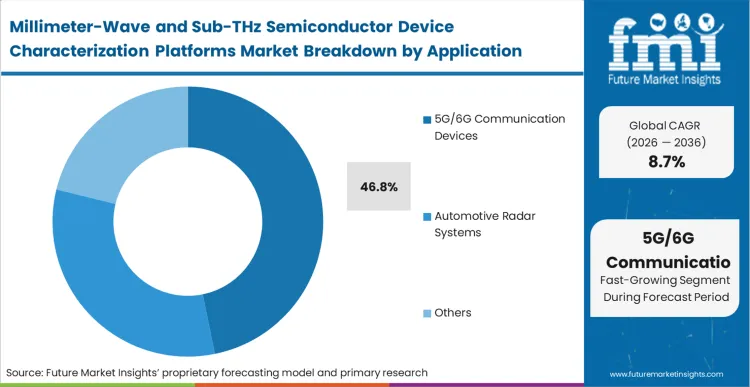
The need to advance next-generation communication standards is placing 5G and 6G devices at the center of the market. Foundries and telecom companies are actively developing transceivers that can handle higher bandwidths, increasing the demand for testing solutions that operate beyond 300 GHz. The move from early 5G networks to sub-terahertz systems also requires changes in antenna design, making accurate testing essential for large-scale deployment, with 5G and 6G communication devices expected to account for a 46.8% share.
The automotive sector continues to drive demand. Autonomous driving systems rely on high-resolution radar, requiring testing setups that can simulate real-world interference across different conditions. In parallel, defense organizations are increasing their use of sub-terahertz measurement systems. Applications such as electronic warfare and secure communication are moving to higher frequencies, leading to greater investment in advanced testing tools for sensitive components.
- 5G and 6G Communication Devices: Represent 46.8% of the segment, with a strong focus on infrastructure development and R&D.
- Automotive Radar Systems: Require continuous testing to meet safety standards and support autonomous functions.
- Aerospace and Defense Electronics and Advanced Semiconductor R&D: Focus on high-precision testing to support critical applications and research.
Millimeter-Wave and Sub-THz Semiconductor Device Characterization Platforms Market By End User
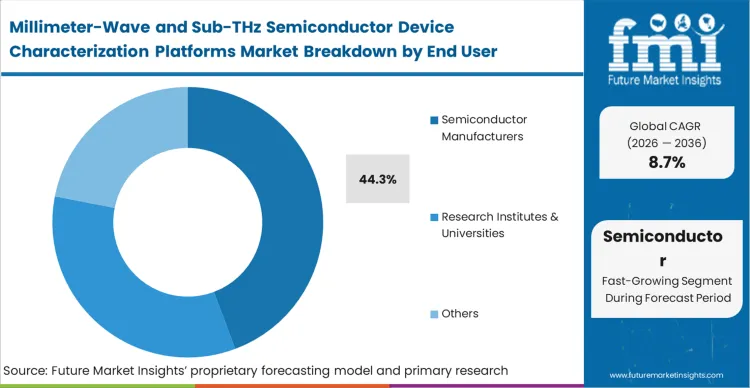
Semiconductor manufacturers, including IDMs and foundries, remain the largest contributors, accounting for 44.3% of the market. This is linked to the high level of investment required for advanced node fabrication, where understanding parasitic effects at mmWave frequencies is essential for maintaining stable production yields. Foundries in Taiwan and South Korea are actively upgrading wafer probe stations to handle smaller contact pads and higher frequency ranges. At the same time, telecom equipment OEMs are expanding their in-house testing capabilities to reduce dependence on external labs, aiming for stronger control over the development of 6G base stations and user equipment.
- Semiconductor Manufacturers: Driving volume through the adoption of 200mm and 300mm wafer probing for high-frequency RFICs.
- Telecom Equipment OEMs: Investing heavily in 5g testing equipment to validate proprietary beamforming and MIMO antenna architectures.
- Research Institutes: Acting as the early adopters for 300+ GHz systems, often collaborating with defense labs on secure communication protocols.
Market Dynamics
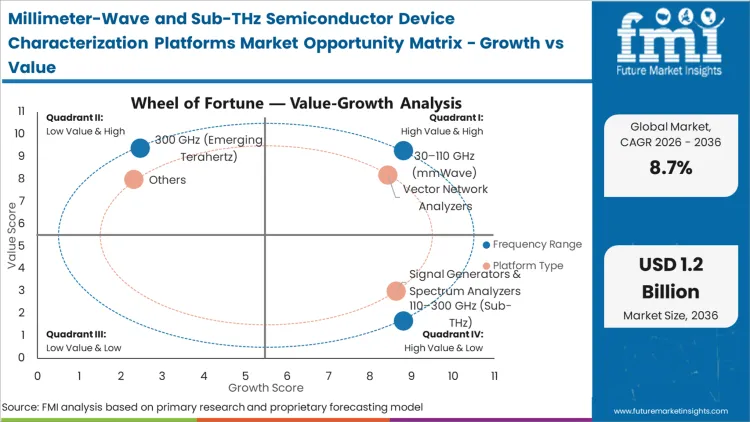
The push for widespread connectivity and the shift toward 6G spectrum allocation are driving platform adoption. As spectral density in the sub-6 GHz range reaches its limits, moving to mmWave and sub-THz bands is becoming necessary for high-capacity urban networks. This transition requires a major upgrade of existing wireless test equipment, since older systems cannot handle the high attenuation and phase noise seen at higher frequencies. At the same time, the use of AI in RF characterization platforms is reducing the time needed for complex multi-port measurements, making high-frequency testing more practical for large-scale production.
Market growth is limited by the high cost of sub-THz instrumentation and the shortage of skilled RF engineers needed to operate these systems. Testing at frequencies above 200 GHz requires extreme precision, where even small environmental changes like vibrations or temperature shifts can affect results and increase operational complexity. The lack of standard calibration methods for frequencies above 300 GHz also creates challenges, as results from different platforms are not always directly comparable, slowing collaboration across the industry.
Opportunities
- Automotive Sensor Fusion: The evolution of automotive radar from simple proximity detection to high-resolution imaging creates a demand for characterization platforms that can test 77-81 GHz chips under realistic road-interference scenarios.
- Advanced Packaging Validation: The rise of advanced semiconductor packaging techniques, like chiplets and 3D stacking, requires new characterization methods to assess signal integrity across high-speed interconnects.
- Defense Modernization: Increased spending on defense electronics for electronic warfare and secure satellite links is driving the need for ultra-wideband characterization platforms that offer high dynamic range and jamming resistance.
Regional Analysis
The global sector for semiconductor characterization is defined by the geographic concentration of fabrication capacity and telecommunications research. Based on the regional analysis, the Millimeter-Wave and Sub-THz Semiconductor Device Characterization Platforms market is segmented into North America, Latin America, Europe, East Asia, South Asia & Pacific, and Middle East & Africa across 40 plus countries.
.webp "Top Country Growth Comparison Millimeter Wave And Sub Thz Semiconductor Device Characterization Platforms Market Cagr (2026 2036)")
| Country | CAGR (2026 to 2036) |
|---|---|
| India | 11.2% |
| China | 10.4% |
| South Korea | 9.8% |
| Taiwan | 9.5% |
| United States | 9.2% |
| Japan | 8.6% |
| Germany | 8.3% |
Source: Future Market Insights (FMI) analysis, based on proprietary forecasting model and primary research
Asia Pacific Millimeter-Wave and Sub-THz Semiconductor Device Characterization Platforms Market Analysis
Foundry operations across Eastern and Southern Asian territories operate on massive scales, fundamentally altering how procurement directors approach metrology investments. Rather than purchasing isolated instruments for distinct research projects, facility managers acquire entire fleets of integrated vector network analyzers to sustain parallel high-volume testing lines. Local ecosystems depend heavily on rapid design iteration for advanced 6G baseband processors and ultra-high-speed memory interconnects. Process engineers face immense pressure to deliver physically verified device models to fabless clients faster than competitors. This condition forces regional hubs to rapidly expand their internal sub-terahertz characterization capabilities. Outsourcing specific measurements remains virtually impossible due to strict intellectual protections surrounding novel compound materials and 3D chiplet architectures.
- India: Surging government subsidies directed at establishing domestic compound semiconductor design centers create a massive greenfield requirement for high-frequency validation hardware. Advancing at an 11.2% CAGR, local engineering directors skip legacy instrument investments and directly outfit new laboratories with automated D-band and sub-THz capable probing stations. Without an entrenched base of older generation equipment to replace, purchasing cycles move rapidly from initial facility planning to full fleet deployment. RF designers rely on these specific platforms to characterize exotic materials meant for future telecommunications hardware. Installing comprehensive measurement capabilities immediately elevates regional engineering hubs into viable competitors for global fabless design contracts.
- China: Aggressive state directives mandating self-sufficiency in sixth-generation telecommunications infrastructure force systems architects to establish completely independent validation pipelines. Expanding at 10.4%, this territory absorbs immense volumes of frequency extenders to characterize domestic radar and base station transceiver prototypes. Metrology professionals understand that achieving repeatable physical extraction without relying on restricted foreign calibration software requires massive internal research expenditures. Facility managers push probe station vendors to deliver custom automation scripts capable of handling highly unique, locally developed wafer layouts. Establishing unassailable physical verification frameworks dictates where this specific territory heads next in establishing sub-terahertz radio frequency standards.
- South Korea: Memory integration specialists investigating vertical chiplet stacking face severe parasitic challenges that only direct physical characterization can resolve. Registering a 9.8% expansion rate, testing facilities procure high-precision analyzers to validate signal integrity across microscopic interconnects. Engineers mapping out ultra-fast data transfer protocols cannot rely on theoretical estimates when attempting to push frequencies beyond 150 GHz. Procurement teams demand extreme temperature calibration capabilities from vendors, anticipating the need to test these advanced architectures under severe thermal stress. Securing reliable, traceable extraction data changes how packaging directors transition experimental 3D assemblies into commercial mass production.
- Taiwan: Intense yield protection mandates within leading contract manufacturing centers require exhaustive physical testing of every new process geometry. Progressing at 9.5%, foundry directors invest heavily in integrated load-pull setups to defend their highly guarded process intellectual property. Fabless clients increasingly refuse to sign manufacturing agreements without seeing physically verified sub-terahertz S-parameters extracted directly from silicon. This dynamic forces cleanroom managers to install massive active vibration isolation systems, accommodating the extreme mechanical sensitivity of 300 GHz probe alignments. Foundries possessing these highly specific validation capabilities capture the most lucrative, next-generation aerospace and telecommunication fabrication contracts.
- Japan: Growing at a steady 8.6%, established automotive sensor engineering laboratories rely on indigenous precision measurement expertise to refine high-frequency collision avoidance systems. Metrology directors possess deep legacy fleets of vector network analyzers, meaning new purchases focus specifically on specialized millimeter-wave extension heads rather than complete system overhauls. RF technicians demand extreme phase stability from these modules, prioritizing long-term measurement repeatability over rapid testing throughput. Local standards organizations require extensive data lineage documentation before approving any component for vehicular integration. This reality dictates slower, highly deliberate procurement cycles where extensive vendor validation precedes any actual hardware acquisition.
North America Millimeter-Wave and Sub-THz Semiconductor Device Characterization Platforms Market Analysis
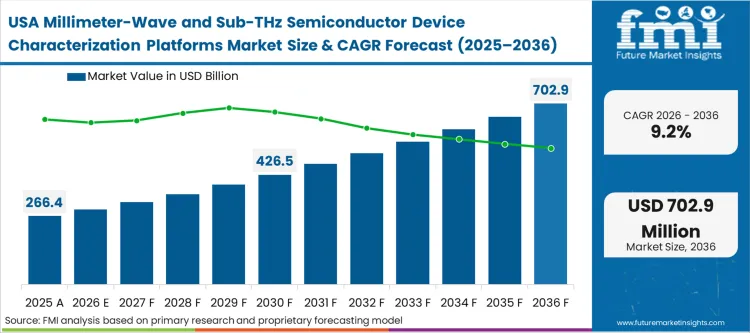
Aerospace contractors dictate physical measurement requirements throughout this territory. Testing directors prioritize absolute measurement traceability to national standards laboratories over high-volume testing speeds. Securing unassailable data lineage allows these engineering organizations to defend complex component specifications during intense governmental audits. Procurement cycles stretch extensively as buyers demand exhaustive physical validation of any sub-terahertz platform before signing authorization papers. Massive investments in quantum computing infrastructure create niche demands for vector network analyzers modified specifically for cryogenic environments. Facility managers collaborate directly with equipment vendors to design custom thermal chambers capable of housing microscopic probes operating near absolute zero.
- United States: Defense systems integrators mandate fully characterized component behavior across extreme high-frequency spectrums to support advanced satellite communication architectures. Advancing at 9.2%, specialized metrology laboratories upgrade their extraction capabilities to meet strict governmental qualification standards. Operations directors cannot bid on classified aerospace contracts without possessing integrated hardware capable of verifying silicon performance beyond 200 GHz. RF theorists collaborate extensively with national metrology institutes to ensure their physical testing protocols align perfectly with emerging calibration regulations. Successfully characterizing these unique components opens pathways for manufacturers to secure next-generation military and commercial low-earth orbit communication network agreements.
Europe Millimeter-Wave and Sub-THz Semiconductor Device Characterization Platforms Market Analysis
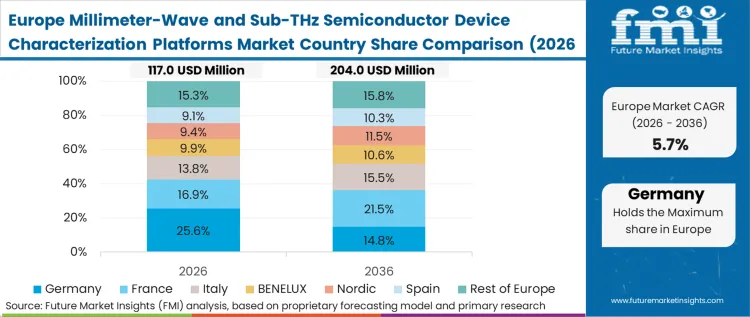
Automotive engineering centers and industrial automation consortiums drive metrology demands across this region. Sensor validation teams continually test new collision avoidance prototypes against strict safety standards. Failure to characterize these high-frequency modules precisely leads directly to lethal automotive malfunctions. This reality forces quality assurance directors to demand extreme accuracy from their test benches. Regional telecommunications operators pushing for advanced localized private networks require exact physical models of base station components. Equipment buyers exhibit extreme loyalty to established regional instrument manufacturers, relying on deep pre-existing relationships and rapid localized maintenance support.
- Germany: Deep integration of automotive radar engineering hubs establishes a persistent requirement for highly accurate millimeter-wave validation platforms. Expanding at 8.3%, domestic testing facilities continually upgrade their existing vector network analyzers with advanced frequency extenders to keep pace with higher resolution sensor designs. Quality control managers prioritize hardware capable of simulating severe environmental degradation on bare wafer prototypes. Strict regional automotive compliance frameworks force metrology teams to maintain exhaustive calibration logs for every single component tested. Maintaining this rigorous physical measurement discipline ensures local manufacturers retain their dominant positions within the premium vehicular safety component supply chain.
Competitive Landscape
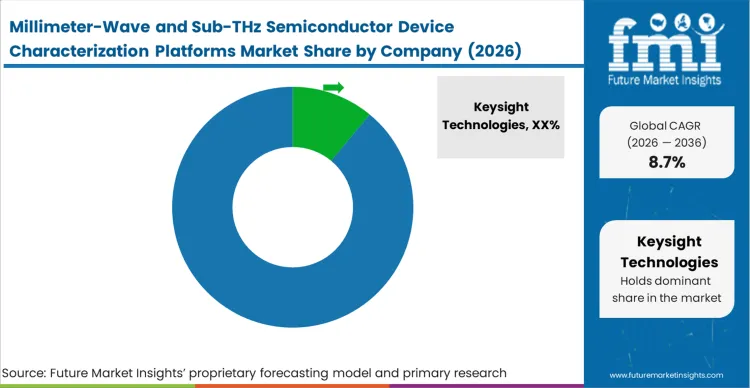
The market has high technical entry barriers, so it is largely dominated by a few specialized players with strong expertise in microwave physics. These companies maintain their position by offering integrated ecosystems where hardware, software, and calibration standards work together, making it difficult for foundries and research labs to switch providers. Competition is increasingly focused on reducing time-to-insight, with platforms designed to automate complex de-embedding processes at sub-THz frequencies.
Innovation is focused on extending the frequency range of VNAs while maintaining dynamic range and stable noise performance. Key players are forming partnerships with probe station manufacturers to deliver complete, integrated characterization setups. Some smaller firms are exploring software-defined radio (SDR) approaches to testing, while established vendors rely on long-term relationships with standards bodies and their ability to provide accurate, traceable results that meet the strict requirements of semiconductor foundries.
Mid-tier players are gaining ground by focusing on niche areas such as high-temperature aerospace testing and specialized material characterization. As the industry moves toward 300 GHz and beyond, competition is shifting from basic hardware performance to deeper measurement expertise, helping customers understand and manage signal behavior at terahertz frequencies.
Key Players in Millimeter-Wave and Sub-THz Semiconductor Device Characterization Platforms Market
- Keysight Technologies
- Rohde & Schwarz GmbH & Co. KG
- Anritsu Corporation
- Tektronix, Inc.
- Advantest Corporation
- FormFactor, Inc.
- MPI Corporation
Millimeter-Wave and Sub-THz Semiconductor Device Characterization Platforms Market Segmentation
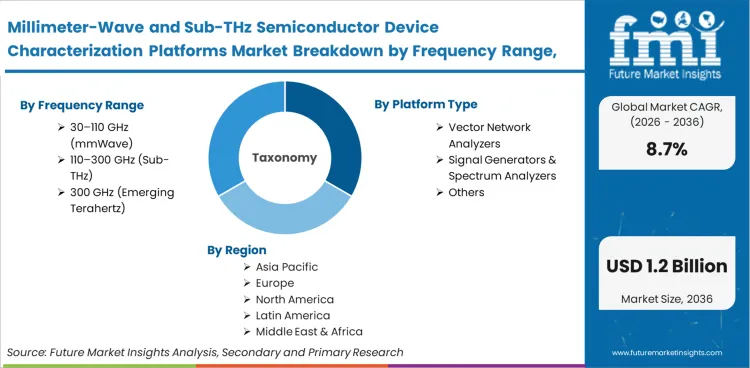
| Metric | Value |
|---|---|
| Quantitative Units | USD 0.53 Billion (2026) to USD 1.21 Billion (2036), at a CAGR of 8.7% |
| Market Definition | Specialized hardware/software environments for measuring electrical properties of chips between 30 GHz and 1 THz, utilizing frequency extenders and on-wafer probing. |
| Segmentation | Frequency Range, Platform Type, Application, End User, and Region |
| Regions Covered | North America, Latin America, Europe, East Asia, South Asia & Pacific, Middle East & Africa |
| Countries Covered | United States, China, Japan, Germany, South Korea, Taiwan, India |
| Key Companies Profiled | Keysight Technologies, Rohde & Schwarz, Anritsu, Tektronix, Advantest, FormFactor, MPI Corporation |
| Forecast Period | 2026 to 2036 |
| Approach | Bottom-up forecasting model based on fab capacity and R&D expenditure |
Source: Future Market Insights analysis, based on a proprietary forecasting model and primary research
Millimeter-Wave and Sub-THz Semiconductor Device Characterization Platforms Market Analysis by Segments
Frequency Range:
- 30-110 GHz (mmWave)
- 110-300 GHz (Sub-THz)
- 300 GHz (Emerging Terahertz)
Platform Type:
- Vector Network Analyzer (VNA)-based systems
- Signal Generators & Spectrum Analyzers
- On-wafer Probe Stations
- Integrated Test Platforms
Application:
- 5G/6G Communication Devices
- Automotive Radar Systems
- Aerospace & Defense Electronics
- Advanced Semiconductor R&D
End User:
- Semiconductor Manufacturers (IDMs & Foundries)
- Research Institutes & Universities
- Telecom Equipment OEMs
- Defense & Aerospace Labs
Region:
- North America
- United States
- Canada
- Latin America
- Brazil
- Mexico
- Rest of Latin America
- Europe
- Germany
- United Kingdom
- France
- Italy
- Spain
- Nordics
- BENELUX
- Russia
- Rest of Europe
- East Asia
- China
- Japan
- South Korea
- South Asia & Pacific
- India
- ASEAN
- Australia & New Zealand
- Rest of South Asia & Pacific
- Middle East & Africa
- GCC Countries
- South Africa
- North Africa
- Rest of MEA
Bibliography
- National Institute of Standards and Technology. On-wafer capacitor characterization including uncertainty estimates up to 1.0 THz. (2024).
- Federal Communications Commission. FCC TAC 6G Working Group Report 2025. (2025).
- Fraunhofer Institute for Industrial Mathematics ITWM. THz-SEMICON: Precise semiconductor testing with terahertz technology. (2025).
- Chalmers University of Technology. Effects of ground-to-ground connections on coplanar waveguide calibration standards for terahertz on-wafer measurements. (2025).
- MDPI. Development of an extended-band mTRL calibration kit for direct on-wafer characterization of InP HEMTs from 250 MHz to 1.1 THz. (2025).
- Nature Communications. All-plasmonic sub-terahertz wireless communication link. (2025).
- Nano Letters. On-chip THz-TDS platform for high-sensitivity analysis of ultrathin conductive films. (2025).
- International Journal of Microwave and Wireless Technologies. A 250 MHz to 1.1 THz sub-mm wave on-wafer characterization of InP HEMT using a multiline thru-reflect-line calibration kit. (2025).
Frequently Asked Questions
What is the current value of the global characterization platforms market?
The market was valued at USD 0.48 Billion in 2025 and is expected to grow steadily as 6G trials begin.
Which frequency range is currently the most dominant?
The 30-110 GHz (mmWave) range holds a 58.2% share, largely due to 5G and automotive radar applications.
What is the projected growth rate for this market through 2036?
FMI projects a CAGR of 8.7% between 2026 and 2036, driven by semiconductor innovation and 6G development.
Who are the primary end users for these high-frequency platforms?
Semiconductor manufacturers, specifically IDMs and foundries, are the lead buyers, representing 44.3% of the 2026 market.
How is 6G driving test equipment demand?
6G requires testing above 100 GHz, which forces a mandatory upgrade cycle from legacy RF tools to sub-THz testing platforms.
Which country is showing the fastest growth in this sector?
India leads with a 11.2% CAGR, supported by new semiconductor fab initiatives and indigenous 6G research.
What are the main technical challenges in sub-THz characterization?
Signal attenuation, noise floor management, and the need for sub-micron probing accuracy are the primary engineering hurdles.
Are mmWave VNA systems still relevant at frequencies above 300 GHz?
Yes, but they require specialized frequency extenders and waveguide interfaces to maintain dynamic range and accuracy.
What is the difference between mmWave and sub-THz in this context?
MmWave typically covers up to 110 GHz, while sub-THz refers to the 110 GHz to 300 GHz spectrum targeted for 6G.
Why are on-wafer probe stations critical for this market?
At these frequencies, coaxial cables lose too much signal; testing must happen directly on the wafer to ensure valid results.
What role does automotive radar play in market growth?
The standardization of 77 GHz radar in vehicles provides a consistent, high-volume demand for mmWave characterization systems.
Are there any specific materials driving the need for new platforms?
The adoption of GaN and InP for high-frequency power amplifiers requires characterization tools with high power handling and precision.
What is the impact of AI on characterization platforms?
AI is being used to automate calibration, speed up multi-port measurements, and improve the accuracy of de-embedding models.
How does the cost of these platforms compare to standard RF equipment?
Sub-THz systems are significantly more expensive due to the precision engineering required for frequency extenders and probes.
Which region has the highest concentration of key market players?
North America and Europe host several major incumbents, though East Asia is home to the largest customer base.
Is the aerospace and defense sector a significant contributor?
Yes, secure satellite communications and electronic warfare at high frequencies drive a substantial portion of specialized tool sales.
What is the "gate condition" mentioned in the market outlook?
It is the migration from D-band to G-band, which triggers the need for new, higher-frequency characterization infrastructure.
Can existing 5G test equipment be upgraded to sub-THz?
Generally no; the physics of sub-THz signals usually requires entirely different waveguides and frequency extension hardware.
What is the expected value of the market by 2036?
The market is forecast to reach USD 1.21 Billion as 6G technology moves into the early commercialization phase.
How does regional fab expansion affect the characterization market?
Every new semiconductor fab requires a dedicated characterization lab, directly driving platform sales in those specific geographies.
Are research institutes still a major part of the market?
They remain critical early adopters for the 300 GHz+ segment, even as commercial foundries dominate the lower bands.
What is the commercial stake for semiconductor firms in this market?
Yield and performance validation; missing a target at these frequencies can lead to extremely costly chip redesigns.
What are "integrated test platforms"?
These are all-in-one systems that combine VNA, signal generation, and probing into a single software-controlled environment.
Will the 300 GHz segment become commercialized by 2036?
It is expected to be in the early stages of commercial deployment for specialized 6G and industrial sensing applications.
Preview the report firsthand - request a free sample
Get SampleGet the brochure for pricing and purchase details.
Get PDFTable of Content
- Executive Summary
- Global Market Outlook
- Demand-side Trends
- Supply-side Trends
- Technology Roadmap Analysis
- Analysis and Recommendations
- Market Overview
- Market Coverage / Taxonomy
- Market Definition / Scope / Limitations
- Research Methodology
- Chapter Orientation
- Analytical Lens and Working Hypotheses
- Market Sizing, Forecasting, and Opportunity Mapping
- Research Design and Evidence Framework
- Desk Research Programme (Secondary Evidence)
- Company Annual and Sustainability Reports
- Peer-reviewed Journals and Academic Literature
- Corporate Websites, Product Literature, and Technical Notes
- Earnings Decks and Investor Briefings
- Statutory Filings and Regulatory Disclosures
- Technical White Papers and Standards Notes
- Trade Journals, Industry Magazines, and Analyst Briefs
- Conference Proceedings, Webinars, and Seminar Materials
- Government Statistics Portals and Public Data Releases
- Press Releases and Reputable Media Coverage
- Specialist Newsletters and Curated Briefings
- Sector Databases and Reference Repositories
- FMI Internal Proprietary Databases and Historical Market Datasets
- Subscription Datasets and Paid Sources
- Social Channels, Communities, and Digital Listening Inputs
- Additional Desk Sources
- Expert Input and Fieldwork (Primary Evidence)
- Primary Modes
- Qualitative Interviews and Expert Elicitation
- Quantitative Surveys and Structured Data Capture
- Blended Approach
- Why Primary Evidence is Used
- Observational and In-context Research
- Social and Community Interactions
- Primary Modes
- Stakeholder Universe Engaged
- C-suite Leaders
- Board Members
- Presidents and Vice Presidents
- R&D and Innovation Heads
- Technical Specialists
- Domain Subject-matter Experts
- Scientists
- Physicians and Other Healthcare Professionals
- Governance, Ethics, and Data Stewardship
- Research Ethics
- Data Integrity and Handling
- Desk Research Programme (Secondary Evidence)
- Tooling, Models, and Reference Databases
- Data Engineering and Model Build
- Data Acquisition and Ingestion
- Cleaning, Normalisation, and Verification
- Synthesis, Triangulation, and Analysis
- Quality Assurance and Audit Trail
- Market Background
- Market Dynamics
- Drivers
- Restraints
- Opportunity
- Trends
- Scenario Forecast
- Demand in Optimistic Scenario
- Demand in Likely Scenario
- Demand in Conservative Scenario
- Opportunity Map Analysis
- Product Life Cycle Analysis
- Supply Chain Analysis
- Investment Feasibility Matrix
- Value Chain Analysis
- PESTLE and Porter’s Analysis
- Regulatory Landscape
- Regional Parent Market Outlook
- Production and Consumption Statistics
- Import and Export Statistics
- Market Dynamics
- Global Market Analysis 2021 to 2025 and Forecast, 2026 to 2036
- Historical Market Size Value (USD Million) Analysis, 2021 to 2025
- Current and Future Market Size Value (USD Million) Projections, 2026 to 2036
- Y-o-Y Growth Trend Analysis
- Absolute $ Opportunity Analysis
- Global Market Pricing Analysis 2021 to 2025 and Forecast 2026 to 2036
- Global Market Analysis 2021 to 2025 and Forecast 2026 to 2036, By Frequency Range
- Introduction / Key Findings
- Historical Market Size Value (USD Million) Analysis By Frequency Range , 2021 to 2025
- Current and Future Market Size Value (USD Million) Analysis and Forecast By Frequency Range , 2026 to 2036
- 30–110 GHz (mmWave)
- 110–300 GHz (Sub-THz)
- 300 GHz (Emerging Terahertz)
- 30–110 GHz (mmWave)
- Y-o-Y Growth Trend Analysis By Frequency Range , 2021 to 2025
- Absolute $ Opportunity Analysis By Frequency Range , 2026 to 2036
- Global Market Analysis 2021 to 2025 and Forecast 2026 to 2036, By Platform Type
- Introduction / Key Findings
- Historical Market Size Value (USD Million) Analysis By Platform Type, 2021 to 2025
- Current and Future Market Size Value (USD Million) Analysis and Forecast By Platform Type, 2026 to 2036
- Vector Network Analyzers
- Signal Generators & Spectrum Analyzers
- Others
- Vector Network Analyzers
- Y-o-Y Growth Trend Analysis By Platform Type, 2021 to 2025
- Absolute $ Opportunity Analysis By Platform Type, 2026 to 2036
- Global Market Analysis 2021 to 2025 and Forecast 2026 to 2036, By Application
- Introduction / Key Findings
- Historical Market Size Value (USD Million) Analysis By Application, 2021 to 2025
- Current and Future Market Size Value (USD Million) Analysis and Forecast By Application, 2026 to 2036
- 5G/6G Communication Devices
- Automotive Radar Systems
- Others
- 5G/6G Communication Devices
- Y-o-Y Growth Trend Analysis By Application, 2021 to 2025
- Absolute $ Opportunity Analysis By Application, 2026 to 2036
- Global Market Analysis 2021 to 2025 and Forecast 2026 to 2036, By End User
- Introduction / Key Findings
- Historical Market Size Value (USD Million) Analysis By End User, 2021 to 2025
- Current and Future Market Size Value (USD Million) Analysis and Forecast By End User, 2026 to 2036
- Semiconductor Manufacturers
- Research Institutes & Universities
- Others
- Semiconductor Manufacturers
- Y-o-Y Growth Trend Analysis By End User, 2021 to 2025
- Absolute $ Opportunity Analysis By End User, 2026 to 2036
- Global Market Analysis 2021 to 2025 and Forecast 2026 to 2036, By Region
- Introduction
- Historical Market Size Value (USD Million) Analysis By Region, 2021 to 2025
- Current Market Size Value (USD Million) Analysis and Forecast By Region, 2026 to 2036
- North America
- Latin America
- Western Europe
- Eastern Europe
- East Asia
- South Asia and Pacific
- Middle East & Africa
- Market Attractiveness Analysis By Region
- North America Market Analysis 2021 to 2025 and Forecast 2026 to 2036, By Country
- Historical Market Size Value (USD Million) Trend Analysis By Market Taxonomy, 2021 to 2025
- Market Size Value (USD Million) Forecast By Market Taxonomy, 2026 to 2036
- By Country
- USA
- Canada
- Mexico
- By Frequency Range
- By Platform Type
- By Application
- By End User
- By Country
- Market Attractiveness Analysis
- By Country
- By Frequency Range
- By Platform Type
- By Application
- By End User
- Key Takeaways
- Latin America Market Analysis 2021 to 2025 and Forecast 2026 to 2036, By Country
- Historical Market Size Value (USD Million) Trend Analysis By Market Taxonomy, 2021 to 2025
- Market Size Value (USD Million) Forecast By Market Taxonomy, 2026 to 2036
- By Country
- Brazil
- Chile
- Rest of Latin America
- By Frequency Range
- By Platform Type
- By Application
- By End User
- By Country
- Market Attractiveness Analysis
- By Country
- By Frequency Range
- By Platform Type
- By Application
- By End User
- Key Takeaways
- Western Europe Market Analysis 2021 to 2025 and Forecast 2026 to 2036, By Country
- Historical Market Size Value (USD Million) Trend Analysis By Market Taxonomy, 2021 to 2025
- Market Size Value (USD Million) Forecast By Market Taxonomy, 2026 to 2036
- By Country
- Germany
- UK
- Italy
- Spain
- France
- Nordic
- BENELUX
- Rest of Western Europe
- By Frequency Range
- By Platform Type
- By Application
- By End User
- By Country
- Market Attractiveness Analysis
- By Country
- By Frequency Range
- By Platform Type
- By Application
- By End User
- Key Takeaways
- Eastern Europe Market Analysis 2021 to 2025 and Forecast 2026 to 2036, By Country
- Historical Market Size Value (USD Million) Trend Analysis By Market Taxonomy, 2021 to 2025
- Market Size Value (USD Million) Forecast By Market Taxonomy, 2026 to 2036
- By Country
- Russia
- Poland
- Hungary
- Balkan & Baltic
- Rest of Eastern Europe
- By Frequency Range
- By Platform Type
- By Application
- By End User
- By Country
- Market Attractiveness Analysis
- By Country
- By Frequency Range
- By Platform Type
- By Application
- By End User
- Key Takeaways
- East Asia Market Analysis 2021 to 2025 and Forecast 2026 to 2036, By Country
- Historical Market Size Value (USD Million) Trend Analysis By Market Taxonomy, 2021 to 2025
- Market Size Value (USD Million) Forecast By Market Taxonomy, 2026 to 2036
- By Country
- China
- Japan
- South Korea
- By Frequency Range
- By Platform Type
- By Application
- By End User
- By Country
- Market Attractiveness Analysis
- By Country
- By Frequency Range
- By Platform Type
- By Application
- By End User
- Key Takeaways
- South Asia and Pacific Market Analysis 2021 to 2025 and Forecast 2026 to 2036, By Country
- Historical Market Size Value (USD Million) Trend Analysis By Market Taxonomy, 2021 to 2025
- Market Size Value (USD Million) Forecast By Market Taxonomy, 2026 to 2036
- By Country
- India
- ASEAN
- Australia & New Zealand
- Rest of South Asia and Pacific
- By Frequency Range
- By Platform Type
- By Application
- By End User
- By Country
- Market Attractiveness Analysis
- By Country
- By Frequency Range
- By Platform Type
- By Application
- By End User
- Key Takeaways
- Middle East & Africa Market Analysis 2021 to 2025 and Forecast 2026 to 2036, By Country
- Historical Market Size Value (USD Million) Trend Analysis By Market Taxonomy, 2021 to 2025
- Market Size Value (USD Million) Forecast By Market Taxonomy, 2026 to 2036
- By Country
- Kingdom of Saudi Arabia
- Other GCC Countries
- Turkiye
- South Africa
- Other African Union
- Rest of Middle East & Africa
- By Frequency Range
- By Platform Type
- By Application
- By End User
- By Country
- Market Attractiveness Analysis
- By Country
- By Frequency Range
- By Platform Type
- By Application
- By End User
- Key Takeaways
- Key Countries Market Analysis
- USA
- Pricing Analysis
- Market Share Analysis, 2025
- By Frequency Range
- By Platform Type
- By Application
- By End User
- Canada
- Pricing Analysis
- Market Share Analysis, 2025
- By Frequency Range
- By Platform Type
- By Application
- By End User
- Mexico
- Pricing Analysis
- Market Share Analysis, 2025
- By Frequency Range
- By Platform Type
- By Application
- By End User
- Brazil
- Pricing Analysis
- Market Share Analysis, 2025
- By Frequency Range
- By Platform Type
- By Application
- By End User
- Chile
- Pricing Analysis
- Market Share Analysis, 2025
- By Frequency Range
- By Platform Type
- By Application
- By End User
- Germany
- Pricing Analysis
- Market Share Analysis, 2025
- By Frequency Range
- By Platform Type
- By Application
- By End User
- UK
- Pricing Analysis
- Market Share Analysis, 2025
- By Frequency Range
- By Platform Type
- By Application
- By End User
- Italy
- Pricing Analysis
- Market Share Analysis, 2025
- By Frequency Range
- By Platform Type
- By Application
- By End User
- Spain
- Pricing Analysis
- Market Share Analysis, 2025
- By Frequency Range
- By Platform Type
- By Application
- By End User
- France
- Pricing Analysis
- Market Share Analysis, 2025
- By Frequency Range
- By Platform Type
- By Application
- By End User
- India
- Pricing Analysis
- Market Share Analysis, 2025
- By Frequency Range
- By Platform Type
- By Application
- By End User
- ASEAN
- Pricing Analysis
- Market Share Analysis, 2025
- By Frequency Range
- By Platform Type
- By Application
- By End User
- Australia & New Zealand
- Pricing Analysis
- Market Share Analysis, 2025
- By Frequency Range
- By Platform Type
- By Application
- By End User
- China
- Pricing Analysis
- Market Share Analysis, 2025
- By Frequency Range
- By Platform Type
- By Application
- By End User
- Japan
- Pricing Analysis
- Market Share Analysis, 2025
- By Frequency Range
- By Platform Type
- By Application
- By End User
- South Korea
- Pricing Analysis
- Market Share Analysis, 2025
- By Frequency Range
- By Platform Type
- By Application
- By End User
- Russia
- Pricing Analysis
- Market Share Analysis, 2025
- By Frequency Range
- By Platform Type
- By Application
- By End User
- Poland
- Pricing Analysis
- Market Share Analysis, 2025
- By Frequency Range
- By Platform Type
- By Application
- By End User
- Hungary
- Pricing Analysis
- Market Share Analysis, 2025
- By Frequency Range
- By Platform Type
- By Application
- By End User
- Kingdom of Saudi Arabia
- Pricing Analysis
- Market Share Analysis, 2025
- By Frequency Range
- By Platform Type
- By Application
- By End User
- Turkiye
- Pricing Analysis
- Market Share Analysis, 2025
- By Frequency Range
- By Platform Type
- By Application
- By End User
- South Africa
- Pricing Analysis
- Market Share Analysis, 2025
- By Frequency Range
- By Platform Type
- By Application
- By End User
- USA
- Market Structure Analysis
- Competition Dashboard
- Competition Benchmarking
- Market Share Analysis of Top Players
- By Regional
- By Frequency Range
- By Platform Type
- By Application
- By End User
- Competition Analysis
- Competition Deep Dive
- Keysight Technologies
- Overview
- Product Portfolio
- Profitability by Market Segments (Product/Age /Sales Channel/Region)
- Sales Footprint
- Strategy Overview
- Marketing Strategy
- Product Strategy
- Channel Strategy
- Rohde & Schwarz GmbH & Co. KG
- Anritsu Corporation
- Tektronix, Inc.
- Advantest Corporation
- FormFactor, Inc.
- Keysight Technologies
- Competition Deep Dive
- Assumptions & Acronyms Used


