

- Industry Size (2026)
- Forecast (2036)
- CAGR
- (2026 to 2036)
Satellite Communications and Direct-to-Device RF Test Platforms Market Size, Market Forecast and Outlook By FMI
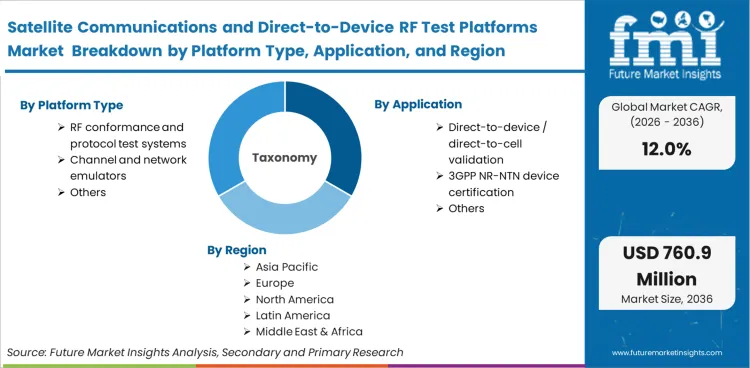
The satellite communications and direct-to-device RF test platforms market was valued at USD 218.8 million in 2025. Demand is expected to cross USD 245.0 million in 2026 at a CAGR of 12.00% during this forecast period. Sustained investment lifts cumulative revenue to USD 760.7 million by 2036 as hardware engineers transition from testing static ground stations to validating fast-moving low-Earth orbit connections under extreme Doppler shifts, accelerating overall NTN testing market growth.
Smartphone manufacturers currently face immediate mandates to validate unmodified handset transceivers against space-borne cell towers using specialized direct-to-device satellite test platform setups. Hardware engineers must lock down radio designs for upcoming 3GPP Release 17 deployments or risk missing critical operator launch windows. Validating rf test equipment protocols against simulated LEO constellations introduces massive fading profiles previously ignored by terrestrial lab environments. Testing directors who delay upgrading to NTN device testing solutions face severe commercial penalties when unvalidated baseband chips drop connections during actual satellite handovers, making direct-to-cell RF conformance testing a mandatory procurement priority.
Standardized 3GPP non-terrestrial network specifications trigger an immediate shift from proprietary payload validation toward universal 3GPP NTN conformance test systems. Baseband designers previously built custom testbeds for specific proprietary constellations. Unified standardization forces chipset vendors to adopt universal wireless network test equipment platforms, fundamentally accelerating satellite handset interoperability testing qualification cycles across all terrestrial boundaries.
Summary of Satellite Communications and Direct-to-Device RF Test Platforms Market
- Satellite Communications and Direct-to-Device RF Test Platforms Market Definition
- Specialized laboratory hardware and simulation software designed specifically to validate radio frequency links, protocol conformance, and baseband performance between terrestrial user equipment and orbital satellite networks.
- Demand Drivers in the Market
- Smartphone release cycles compel baseband architects to validate hybrid terrestrial-satellite handover protocols using RF test equipment for NTN devices before silicon tape-out.
- Low-Earth orbit constellation deployments force gateway engineers to deploy satellite channel emulation for direct-to-cell to verify Doppler compensation algorithms under extreme velocity conditions.
- Standardized specifications require independent certification lab directors to upgrade conformance platforms for novel non-terrestrial requirements.
- Key Segments Analyzed in the FMI Report
- RF conformance and protocol test systems: anticipated to hold 34.0% share in 2026, driven by mandatory certification requirements for new 3GPP Release 17 devices.
- Direct-to-device / direct-to-cell validation: projected to capture 44.0% share in 2026, as handset OEMs prioritize unmodified smartphone-to-satellite connectivity.
- Device and chipset vendors: set to account for 31.0% share in 2026, bearing primary responsibility for early-stage silicon validation.
- 3GPP NR-NTN: estimated to hold 48.0% share in 2026, establishing standardized architectural dominance over legacy proprietary links.
- Integrated lab and benchtop platforms: poised to secure 58.0% share in 2026, serving high-volume R&D environments.
- United States: 13.4% compound growth, anchored by aggressive commercial satellite constellation launches and defense sector convergence.
- Analyst Opinion at FMI
- Ronak Shah Principal Analyst, Technology, at FMI, observes that, "Procurement directors at handset OEMs assume upgrading telecom testing equipment for satellite compatibility requires simple software licensing over existing 5G testers. In reality, massive path delays and extreme Doppler shifts generated by LEO satellites overwhelm traditional terrestrial buffer architectures entirely. Purchasing teams attempting to retrofit legacy cellular platforms consistently fail early protocol conformance checks, forcing expensive emergency procurement of dedicated non-terrestrial emulators late in hardware development cycles."
- Strategic Implications / Executive Takeaways
- Baseband silicon architects must front-load channel emulation investments to catch synchronization failures before semiconductor fabrication begins.
- Constellation operators gain significant time-to-market advantages by sharing digital twin traffic models directly with handset testing partners.
- Certification labs face immediate pressure to build comprehensive over-the-air chamber environments capable of simulating multi-orbit interference patterns.
- Methodology
- Primary Research: Validation lab directors, RF engineering leads, and baseband modem architects
- Desk Research: 3GPP RAN plenary documents, FCC orbital deployment filings, and GSMA specification sheets
- Market-Sizing and Forecasting: Annual procurement budgets for RF instrumentation across top tier-1 device manufacturers
- Data Validation and Update Cycle: Cross-referenced against quarterly earnings of specialized measurement equipment vendors
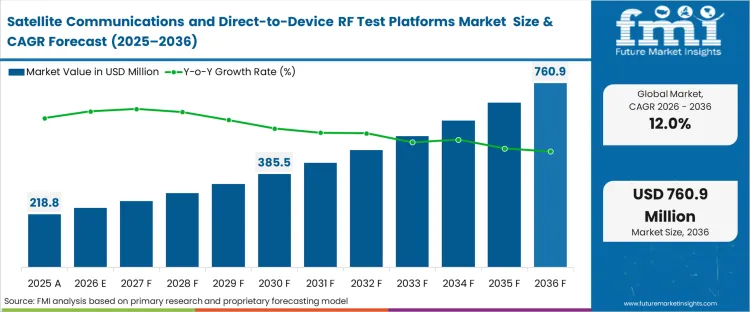
| Metric | Details |
|---|---|
| Industry Size (2026) | USD 245.0 million |
| Industry Value (2036) | USD 760.7 million |
| CAGR (2026–2036) | 12.00% |
Source: Future Market Insights (FMI) analysis, based on proprietary forecasting model and primary research
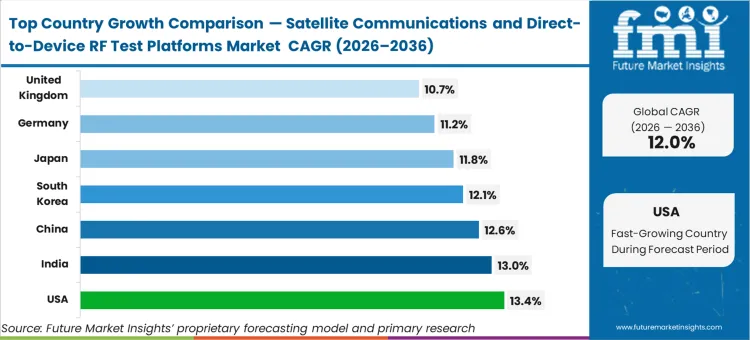
United States leads at 13.4% as defense contractors merge commercial mobile network architectures with legacy military space assets, expanding domestic satellite RF test platform market size. India tracks at 13.0% driven by domestic telecom operators seeking universal rural coverage through orbital base stations. China advances at 12.6% while national space programs rapidly deploy parallel commercial broadband constellations. South Korea grows at 12.1% through aggressive handset OEM investment in early hybrid mobility validation. Japan expands at 11.8% as automotive manufacturers integrate orbital connectivity into next-generation telematics control units. Germany records 11.2% through strict vehicle validation requirements. United Kingdom realizes 10.7% compound growth leveraging deep legacy expertise in satellite payload instrumentation.
Satellite Communications and Direct-to-Device RF Test Platforms Market Definition
Specialized laboratory instrumentation and software emulators designed to validate radio frequency performance between terrestrial endpoints and orbital relays define this sector. Equipment simulates extreme Doppler shifts, massive path loss, fading profiles, and synchronization challenges inherent to non-terrestrial networks. Solutions span component-level spectrum analysis to full-stack direct-to-device satellite certification testing verification.
Satellite Communications and Direct-to-Device RF Test Platforms Market Inclusions
Scope covers radio frequency test equipment explicitly optimized for non-terrestrial link validation, alongside dedicated NR-NTN testing equipment. Core systems encompass advanced NTN network emulator hardware, signaling testers, network simulators, and over-the-air chamber solutions supporting satellite protocols. Software licenses tied directly to protocol conformance testing also fall within assessed boundaries.
Satellite Communications and Direct-to-Device RF Test Platforms Market Exclusions
General-purpose oscilloscopes lacking specific non-terrestrial software profiles fall outside assessed parameters. Operational network monitoring probes permanently deployed at live ground stations remain excluded because they perform active network assurance rather than pre-deployment direct-to-device RF validation platforms design qualification. Standard terrestrial cellular base station testers lack orbital emulation capabilities and are subsequently excluded.
Satellite Communications and Direct-to-Device RF Test Platforms Market Research Methodology
- Primary Research: Validation lab directors, RF engineering leads, and baseband modem architects
- Desk Research: 3GPP RAN plenary documents, FCC orbital deployment filings, and GSMA specification sheets
- Market-Sizing and Forecasting: Annual procurement budgets for RF instrumentation across top tier-1 device manufacturers
- Data Validation and Update Cycle: Cross-referenced against quarterly earnings of specialized measurement equipment vendors
Segmental Analysis
Satellite Communications and Direct-to-Device RF Test Platforms Market Analysis by Platform type
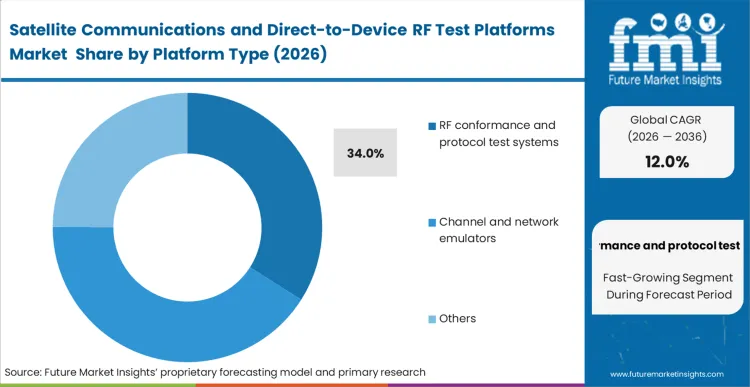
Mandatory validation standards dictate platform selection for certification lab directors evaluating incoming consumer hardware. RF conformance and protocol test systems secure 34.0% share precisely because regulatory bodies reject devices lacking certified protocol compliance logs. Lab managers rely on these specific platforms to execute thousands of automated 5g testing cases mandated by 3GPP specifications. Upgrading this infrastructure enables testing facilities to clear massive backlogs of next-generation handset certifications. FMI's analysis indicates basic RF analysis tools mask critical timing errors visible only within full protocol stack emulators. What component procurement officers often miss is how quickly static NTN RF test equipment hardware becomes obsolete without continuous protocol software updates tracking evolving 3GPP releases. Hardware developers relying exclusively on basic signal generators discover baseband synchronization failures only during live orbital trials, delaying commercial launches by entire quarters.
- Initial R&D selection: Baseband modem architects prioritize deep protocol visibility tools to debug fundamental handshake sequences during early silicon development. These engineers require complete transparency into timing advance loops to prevent catastrophic tape-out flaws.
- Qualification phase verification: Certification lab directors demand automated conformance systems matching exact regulatory body specifications. Failure to match official test case parameters renders internal qualification data useless for actual consumer device approval.
- Production line scaling: Manufacturing test engineers deploy simplified 5g testing equipment alongside dedicated direct-to-cell OTA test systems focused purely on RF calibration and antenna alignment. Production floors strip away deep protocol analysis to maximize hourly hardware throughput.
Satellite Communications and Direct-to-Device RF Test Platforms Market Analysis by Application
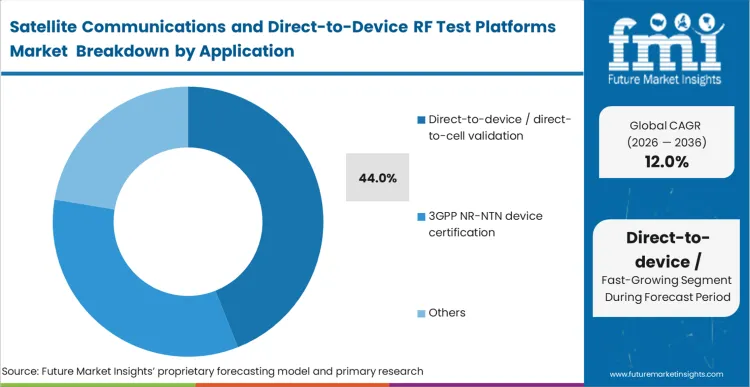
Consumer demand for ubiquitous connectivity forces handset manufacturers to prove unmodified cellular antennas can reach orbital relays. Direct-to-device validation commands 44.0% share because failure at this exact interface breaks entire commercial business models for satellite operators. RF engineering leads use complex fading models to verify tiny smartphone antennas can establish reliable uplinks despite atmospheric attenuation. As per FMI's projection, executing this specific validation in controlled test and measurement equipment environments isolates hardware flaws before expensive physical prototypes reach field trials. Most product managers assume successful lab-bench synchronization guarantees outdoor performance, ignoring how user hand-grip variations uniquely detune antennas pointed toward overhead satellites. OEMs skipping rigorous satellite-to-phone test equipment chamber testing suffer immediate customer churn when flagship phones fail to deliver promised emergency messaging capabilities under light tree cover.
- Baseline sensitivity expectations: Antenna design leads extract maximum gain metrics using isolated chamber tests to prove theoretical link closure. Early prototypes easily pass these idealized baseline scenarios before encountering simulated multi-path interference.
- Dynamic mobility degradation: Systems engineers uncover catastrophic packet loss when introducing simulated LEO velocity profiles into baseline connections. Fast-moving satellites induce Doppler shifts exceeding terrestrial modem tracking loop capabilities, requiring immediate algorithmic remediation.
- Qualification standard thresholds: Quality assurance directors reject baseband revisions failing to maintain continuous sessions during simulated multi-satellite handovers. Passing this specific threshold remains mandatory before authorizing mass production runs.
Satellite Communications and Direct-to-Device RF Test Platforms Market Analysis by End user
Component integration timelines force early-stage silicon developers to internalize massive testing infrastructure costs. Device and chipset vendors represent 31.0% share because baseband silicon architects must simulate entire orbital networks on their desks long before physical satellites launch. These designers utilize advanced network emulators to feed continuous high-latency, high-Doppler signals directly into prototype transceivers. FMI analysts note that simulating full constellation dynamics locally prevents expensive silicon respins caused by unforeseen protocol timing mismatches. Financial controllers evaluating NTN chipset test solutions frequently view these multimillion-dollar emulator purchases as redundant to mobile operator labs, failing to realize mobile operators refuse to test unvalidated silicon entirely. Chipset vendors attempting to outsource initial validation to external labs lose critical debugging speed, allowing better-equipped competitors to dominate early-adopter handset design wins.
- Silicon procurement logic: Baseband architects purchase dedicated channel emulators to isolate hardware timing bugs before tape-out. Catching a synchronization error here saves tens of millions in semiconductor fabrication rework costs.
- Integration lifecycle penalties: Firmware engineering teams face severe project delays when sharing limited physical testing resources across multiple development branches. Bottlenecks in lab access push commercial delivery dates past critical holiday retail release windows.
- Lifecycle cost realization: Operations managers discover initial capital expenditures for comprehensive emulation testbeds pale against expenses incurred recalling fundamentally flawed handset hardware from global retail distribution channels.
Satellite Communications and Direct-to-Device RF Test Platforms Market Analysis by Architecture / standard focus
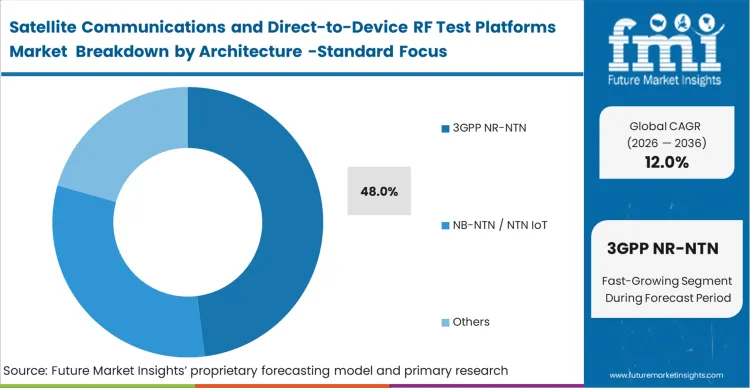
Fragmented proprietary networks present immense scaling barriers for hardware manufacturers seeking global interoperability. Standard 3GPP NR-NTN architecture captures 48.0% estimated share by providing a unified specification that allows modem architects to build single-chip solutions supporting multiple satellite operators. Validation lab directors align testbed investments heavily toward this standard to guarantee compatibility with mainstream cellular ecosystems. Based on FMI's assessment, conforming to NR-NTN protocols allows spectrum analyzer platforms to seamlessly bridge terrestrial and non-terrestrial measurement routines. Strategy directors at testing firms often misjudge legacy proprietary network longevity, underestimating how rapidly major telecom operators will force tier-1 handset makers into pure 3GPP compliance. Test equipment vendors focusing strictly on older proprietary architectures face rapid obsolescence as mobile network operators refuse to certify devices lacking standard NR-NTN capabilities.
- Early adopter movement: Handset silicon vendors adopt standard-compliant emulators first to secure contracts with major smartphone brands launching next-generation flagship devices.
- Operator ecosystem alignment: Mobile network operators mandate rigorous NR-NTN test reporting to ensure new devices integrate flawlessly with existing billing and roaming cellular core networks.
- Lagging proprietary conversions: Niche industrial IoT hardware developers eventually abandon legacy satellite links once mass-market 3GPP silicon drives component costs below historical proprietary modem pricing structures.
Satellite Communications and Direct-to-Device RF Test Platforms Market Analysis by Deployment environment
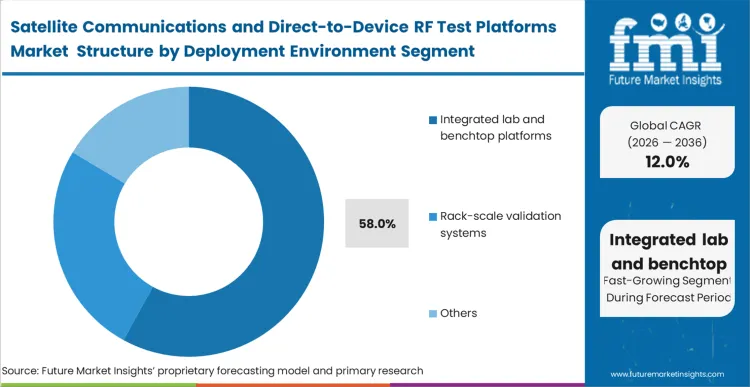
High-fidelity simulation requires immense computational processing physically located adjacent to device prototypes. Integrated lab and benchtop platforms generate 58.0% share because RF engineering leads require immediate, localized control over complex simulation parameters during daily debugging sessions. Engineers wire these massive processing units directly to prototype silicon, minimizing external cable loss while generating precise rf spectrum analyzer outputs. According to FMI's estimates, centralized lab testing environments enable tight coordination between antenna designers and protocol software developers working on identical hardware revisions. Facility managers evaluating footprint costs often attempt to push emulation into generic cloud computing environments, discovering too late that cloud latency ruins nanosecond-precision timing loops required for valid baseband synchronization testing. Hardware teams deprived of dedicated benchtop emulators suffer massive productivity drains trying to replicate complex timing failures reported by remote field-testing teams.
- Signal synchronization failure: Baseband developers utilize benchtop systems to precisely replicate sub-millisecond timing errors that cause catastrophic session drops during simulated satellite network handovers.
- Cloud latency vulnerabilities: Protocol engineers discover remote software-based testing platforms inject artificial delays into measurement loops, generating false-positive failure reports on fundamentally sound baseband hardware components.
- Calibration remediation paths: Quality assurance teams rely on isolated laboratory environments to definitively prove whether a failed connection stems from hardware limitations or unpredictable external atmospheric interference.
Satellite Communications and Direct-to-Device RF Test Platforms Market Drivers, Restraints, and Opportunities
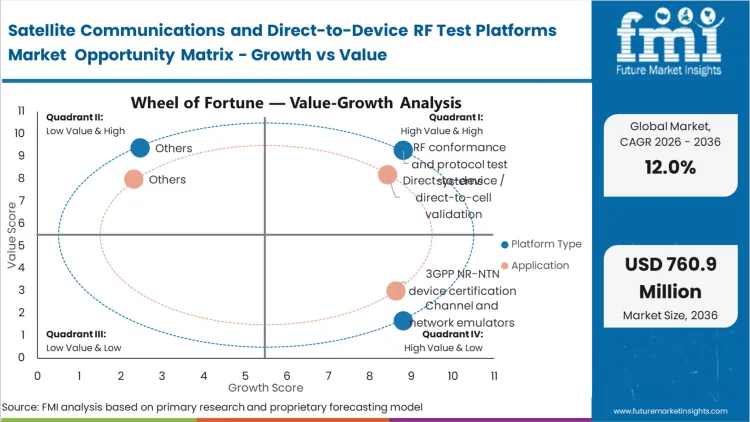
Smartphone original equipment manufacturers face existential commercial threats if next-generation flagship devices lack satellite emergency messaging capabilities. Hardware engineering directors must qualify entirely new baseband silicon against orbital parameters before strict production deadlines. Delaying instrument procurement forces engineering teams to rely on theoretical mathematical models rather than hardware-in-the-loop validation, leading to catastrophic silicon tape-out failures. This severe time-to-market pressure compels immediate purchasing of advanced signal generator platforms capable of simulating complete low-Earth orbit constellation dynamics within terrestrial laboratories.
Lack of standardized over-the-air testing methodologies for unmodified smartphones inside anechoic chambers fundamentally slows final device certification. Validation lab directors struggle to correlate isolated conducted RF measurements with actual radiated performance under simulated multi-path fading conditions. This persists structurally because legacy chamber designs cannot physically accommodate massive simulated distances required for orbital links without introducing artificial reflections. While compact antenna test ranges provide partial evaluation paths, they currently lack dynamic spatial interference modeling required to fully approve hybrid terrestrial-satellite beamforming algorithms.
Opportunities in the Satellite Communications and Direct-to-Device RF Test Platforms Market
- Digital twin traffic integration: Signal analyzer providers generate new revenue by offering software that replicates exact live-network congestion data directly from active constellation operators.
- Field-portable diagnostic deployment: Agile satellite communications test equipment vendors secure contracts with mobile network operators to provide ruggedized handheld protocol analyzers for ground-station maintenance crews.
- Automated certification-as-a-service: Specialized NTN lab test platform suppliers open dedicated lab facilities allowing smaller IoT device makers to rent hourly time on high-end NR-NTN conformance systems.
Regional Analysis
.webp "Top Country Growth Comparison Satellite Communications And Direct To Device Rf Test Platforms Market Cagr (2026 2036)")
Based on regional analysis, Satellite Communications and Direct-to-Device RF Test Platforms Market is segmented into North America, Asia Pacific, and Europe across 40 plus countries.
| Country | CAGR (2026 to 2036) |
|---|---|
| United States | 13.4% |
| India | 13.0% |
| China | 12.6% |
| South Korea | 12.1% |
| Japan | 11.8% |
| Germany | 11.2% |
| United Kingdom | 10.7% |
Source: Future Market Insights (FMI) analysis, based on proprietary forecasting model and primary research
North America Satellite Communications and Direct-to-Device RF Test Platforms Market Analysis
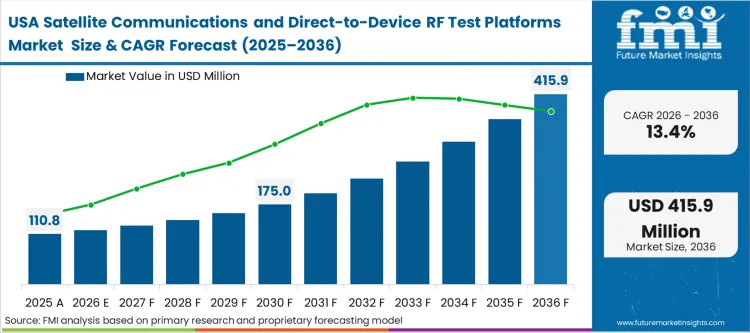
Aggressive commercial low-Earth orbit constellation deployments fundamentally dictate hardware validation timelines across this territory. Defense contractors and commercial aerospace companies simultaneously demand specialized ota chambers and antenna test systems to prove massive phased array antennas operate correctly prior to launch integration. Systems engineering leads at satellite manufacturing facilities rely on these complex emulators to verify payload interoperability across multiple frequency bands. FMI's analysis indicates tight collaboration between local handset makers and domestic constellation operators accelerates specific testing feature requirements faster than global standardization bodies can publish them.
- United States: Defense department initiatives force domestic aerospace contractors to integrate commercial 5G standards directly into classified military satellite payloads. Component engineering directors command immense testing budgets to ensure commercial-off-the-shelf baseband silicon survives hostile jamming environments, driving 13.4% compound growth. This intense defense-commercial crossover uniquely positions local test vendors to capture premium, highly customized validation contracts unavailable elsewhere.
FMI's report includes Canada alongside primary regional assessment. Cross-border aerospace partnerships continue accelerating local investments into specialized gateway validation infrastructure.
Asia Pacific Satellite Communications and Direct-to-Device RF Test Platforms Market Analysis
Dominant semiconductor foundries and massive consumer electronics manufacturing bases require extraordinary volumes of high-speed calibration equipment. Manufacturing test directors evaluate instrument purchases based purely on throughput milliseconds, optimizing production lines churning out millions of satellite-capable smartphones. Validation labs serving these giant handset original equipment manufacturers absorb newest 3GPP NR-NTN conformance testers immediately upon release. As per FMI's projection, sheer volume requirements combined with a robust satellite communications RF test market forecast force global test equipment vendors to establish dedicated engineering support centers directly adjacent to major Asian fabrication hubs.
- India: Domestic telecommunications operators leverage orbital connectivity to bypass massive terrestrial fiber-optic deployment costs across rugged rural geographies. Network planning directors aggressively source satellite communication components validation tools, fueling 13.0% CAGR as they prove foreign orbital technology integrates reliably with local core networks. Upgrading this infrastructure fundamentally alters rural connectivity economics for participating mobile operators.
- China: Parallel state-sponsored broadband constellation deployments force domestic handset manufacturers to rapidly validate dual-network compatibility. RF engineering leads demand specialized testbeds capable of simulating interference between indigenous satellites and terrestrial 5G base stations, registering 12.6% compound growth. Domestic equipment vendors aggressively undercut international competitors on pricing while matching core protocol simulation capabilities.
- South Korea: Smartphone manufacturers push global technology boundaries by designing early prototypes utilizing entirely unmodified cellular antennas for orbital connections. R&D directors secure advanced channel emulation systems, driving 12.1% compound growth as they battle to achieve first-to-market status with flagship direct-to-device messaging features.
- Japan: Automotive giants redesign connected-car architectures to include resilient orbital links for autonomous driving telemetry in dead zones. Telematics engineering leads deploy robust fading simulators, supporting 11.8% compound growth to guarantee emergency vehicle communications remain active during natural disasters. This stringent safety requirement forces tier-1 automotive suppliers into unprecedented satellite validation cycles.
FMI's report includes Taiwan and Australia in its comprehensive analysis. Taiwan's critical semiconductor design ecosystem requires advanced emulation tools to validate next-generation modem intellectual property before fabrication.
Europe Satellite Communications and Direct-to-Device RF Test Platforms Market Analysis
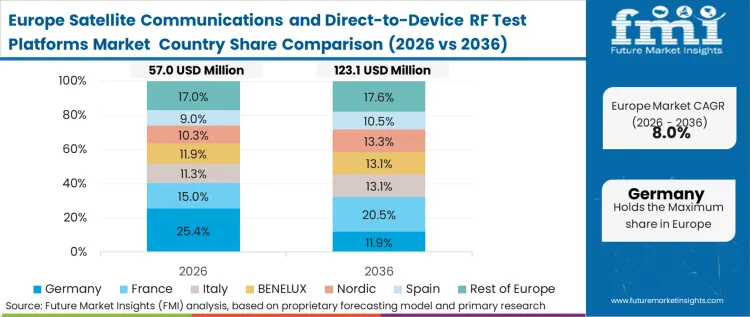
Stringent regulatory frameworks concerning spectrum interference and space debris drive highly specialized RF validation requirements across regional aerospace consortiums. Lab managers at international testing agencies utilize massive satcom terminal emulation suites to prove new constellation deployments will not disrupt legacy broadcast satellite signals. Satellite payload architects require granular signal analysis capabilities to ensure transmit power levels comply perfectly with complex cross-border spectrum allocations. In FMI's view, deep legacy expertise in radio astronomy and deep-space telemetry heavily influences local demands for extreme-precision measurement accuracy over pure manufacturing throughput.
- Germany: Deeply entrenched automotive supplier networks begin integrating non-terrestrial modems into next-generation commercial fleet tracking systems. Validation engineering directors focus intensely on multi-path interference modeling, supporting 11.2% compound growth to ensure continuous truck telemetry across diverse geographic topologies. Successfully mastering these complex signal environments secures massive long-term contracts with pan-European logistics fleets.
- United Kingdom: A high concentration of niche aerospace design firms develops specialized satellite payloads for global constellation operators. RF design leads rely heavily on advanced spectrum analysis platforms, driving 10.7% compound growth to validate complex beam-steering algorithms before payload integration. Local engineering teams consistently dictate precise testing requirements later adopted globally.
FMI's report includes France and Italy within regional evaluations. Substantial regional space agency investments in next-generation orbital infrastructure continuously drive localized demand for ultra-high-fidelity signal simulation platforms.
Competitive Aligners for Market Players
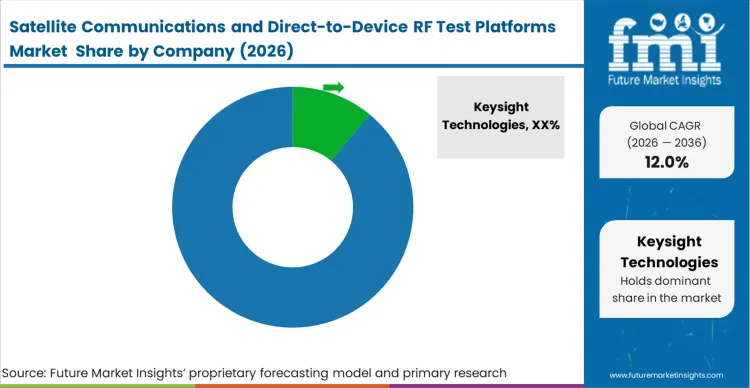
Dominant instrumentation providers aggressively lock in tier-1 smartphone manufacturers by delivering customized 3GPP Release 17 testing suites months ahead of official standardization deadlines. Keysight NTN testing architectures, Rohde & Schwarz CMX500 NTN signaling testers, and Anritsu NTN RF conformance setups deploy deep engineering teams directly inside major chipset design facilities, writing proprietary test scripts that eventually become industry benchmarks. When mobile operators mandate specific certification logs, they inevitably default to formats generated by these incumbent platforms, effectively freezing smaller test equipment vendors out of lucrative compliance workflows.
Incumbent leaders maintain their positions through massive software libraries comprising tens of thousands of pre-validated 3GPP test cases. Replicating this specific intellectual property requires hundreds of engineer-years, creating an impenetrable moat against new hardware entrants attempting to sell basic satcom on the move signal generators. Challengers like Calnex Solutions and LitePoint must therefore target highly specific niches, offering ultra-efficient production-line calibration tools or advancing VIAVI NTN digital twin testing paradigms where raw processing speed outweighs comprehensive protocol library depth.
Large silicon vendors combat this vendor lock-in by designing abstraction layers within their internal validation software, allowing them to hot-swap testing hardware based purely on capital expenditure requirements. Procurement directors actively fund smaller instrumentation startups to maintain pricing leverage during bulk manufacturing equipment negotiations. Handset original equipment manufacturers structurally push testbeds away from expensive monolithic hardware boxes toward software-defined radio architectures, forcing incumbents to fundamentally pivot business models toward recurring software licensing over physical instrument sales.
Key Players in Satellite Communications and Direct-to-Device RF Test Platforms Market
- Keysight Technologies
- Rohde & Schwarz
- Anritsu Corporation
- VIAVI Solutions Inc.
- Spirent Communications plc
- Calnex Solutions plc
- LitePoint (a Teradyne company)
Scope of the Report
| Metric | Value |
|---|---|
| Quantitative Units | USD 245.0 million to USD 760.7 million, at a CAGR of 12.00% |
| Market Definition | Specialized laboratory hardware and simulation software designed specifically to validate radio frequency links, protocol conformance, and baseband performance between terrestrial user equipment and orbital satellite networks. |
| Segmentation | Platform type, Application, End user, Architecture / standard focus, Deployment environment, and Region |
| Regions Covered | North America, Latin America, Western Europe, Eastern Europe, Asia Pacific, and Middle East and Africa |
| Countries Covered | United States, India, China, South Korea, Japan, Germany, United Kingdom |
| Key Companies Profiled | Keysight Technologies, Rohde & Schwarz, Anritsu Corporation, VIAVI Solutions Inc., Spirent Communications plc, Calnex Solutions plc, LitePoint (a Teradyne company) |
| Forecast Period | 2026 to 2036 |
| Approach | Annual procurement budgets for RF instrumentation across top tier-1 device manufacturers |
Source: Future Market Insights (FMI) analysis, based on proprietary forecasting model and primary research
Satellite Communications and Direct-to-Device RF Test Platforms Market Analysis by Segments
- Platform type
- RF conformance and protocol test systems
- Channel and network emulators
- OTA chambers and antenna test systems
- Spectrum and signal analysis platforms
- Integrated digital-twin and traffic testbeds
- Application
- Direct-to-device / direct-to-cell validation
- 3GPP NR-NTN device certification
- NB-NTN and satellite IoT testing
- Gateway and ground-station RF validation
- Satellite modem and payload interoperability testing
- End user
- Device and chipset vendors
- Network equipment vendors
- Satellite operators and service providers
- Mobile network operators
- Certification labs and research institutes
- Architecture / standard focus
- 3GPP NR-NTN
- NB-NTN / NTN IoT
- Hybrid TN-NTN handover and mobility
- Proprietary satcom RF links
- Multi-orbit LEO/MEO/GEO emulation
- Deployment environment
- Integrated lab and benchtop platforms
- Rack-scale validation systems
- Field-portable RF analysis
- Cloud-connected digital-twin environments
- Chamber-based OTA environments
- Region
- North America
- Latin America
- Western Europe
- Eastern Europe
- Asia Pacific
- Middle East and Africa
Bibliography
- 3GPP. (2024, May 14). Non-Terrestrial Networks (NTN). 3GPP.
- Anritsu Corporation. (2025, October 10). Anritsu Introduces RF Conformance Test Cases for 5G NR NTN Devices. Anritsu.
- Federal Communications Commission. (2024, December 31). Single Network Future: Supplemental Coverage from Space, Report and Order and Further Notice of Proposed Rulemaking. FCC.
- GSMA. (2025, June 11). Non-Terrestrial Networks - Opportunities and Challenges. GSMA.
- LitePoint. (2025, October 28). Designing and Testing Non-Terrestrial Networks.
This bibliography is provided for reader reference. The full FMI report contains the complete reference list with primary source documentation.
This Report Addresses
- Smartphone baseband validation bottlenecks impacting 3GPP Release 17 non-terrestrial launch timelines.
- Extreme Doppler shift emulation requirements mandated by fast-moving low-Earth orbit constellation deployments.
- Certification lab procurement strategies transitioning from proprietary payload testing to universal standard conformance.
- Handset antenna detuning challenges discovered during multi-path fading simulations in dedicated anechoic chambers.
- Financial risks associated with delaying specialized channel emulator investments prior to baseband silicon tape-out.
- Mobile operator mandates driving strict NR-NTN protocol compliance verification across all consumer mobile hardware.
- Defense sector demands accelerating commercial 5G standard integration within classified military satellite payloads.
- Production-line throughput optimization leveraging high-speed RF calibration instruments inside massive Asian fabrication facilities.
Frequently Asked Questions
What is being counted in the satellite communications and direct-to-device RF test platforms market?
FMI tracks specialized hardware emulators, signaling testers, and conformance software explicitly built to validate radio frequency performance between terrestrial endpoints and orbital relays. General-purpose oscilloscopes and active network monitoring probes permanently deployed at live ground stations fall outside these financial metrics entirely.
Why is NTN testing becoming a commercial spending category now?
Hardware engineering directors must qualify entirely new baseband silicon against orbital parameters before upcoming 3GPP Release 17 production deadlines. Handset manufacturers face existential commercial threats if next-generation flagship devices launch without proven satellite emergency messaging capabilities, forcing immediate procurement of validation platforms.
How does direct-to-cell testing differ from conventional mobile RF testing?
Standard cellular testing assumes stationary towers and predictable multi-path fading models based on static terrestrial clutter. Direct-to-cell testing introduces massive atmospheric attenuation, extreme signal latency, and dynamic spatial interference generated by rapidly moving low-Earth orbit relays.
Which buyers are driving early demand for NTN test platforms?
Baseband modem architects require precise reproduction of fast-moving low-Earth orbit Doppler shifts directly on their lab benches to isolate silicon timing bugs. Simulating these extreme frequency offsets locally prevents discovering catastrophic synchronization failures during expensive live-satellite field trials later in development.
What is the difference between NR-NTN and NB-NTN test requirements?
NR-NTN conformance focuses heavily on high-bandwidth, low-latency connectivity simulating complex 5G New Radio protocols over satellite links. NB-NTN testing prioritizes narrow-band satellite iot applications, requiring emulators to validate ultra-low-power transmission efficiency and massive machine-type communication scaling.
Which companies currently offer dedicated NTN or D2D test solutions?
Dominant instrumentation providers including Keysight Technologies, Rohde & Schwarz, and Anritsu Corporation deploy deep engineering teams directly inside major chipset design facilities. Challengers like VIAVI Solutions, Spirent Communications, Calnex Solutions, and LitePoint target specialized niches including production-line calibration and advanced digital twin emulation.
Why do Doppler, delay, and handover behavior matter in NTN lab validation?
Legacy terrestrial testing platforms fundamentally lack deep memory buffers required to simulate extreme signal propagation delays. Engineers discovering this limitation must procure entirely new hardware architectures designed specifically to replicate fast-moving satellite velocity profiles that induce massive frequency shifting.
How large could the NTN RF test platform market become by 2036?
Revenue is expected to cross USD 760.7 million by 2036, driven primarily by unified global specifications replacing proprietary legacy networks. Mobile operators universally mandate NR-NTN conformance, guaranteeing sustained demand as massive consumer hardware volumes require continuous independent testing verification.
What types of test platforms are needed across conformance, emulation, and OTA?
Certification labs rely on protocol test systems to generate official compliance logs required by regulatory bodies. R&D engineers utilize network emulators to simulate complex Doppler fading locally, while OTA chambers validate actual radiated antenna performance for uav satellite communication applications under simulated atmospheric conditions.
Which regions are likely to lead demand growth?
North America dominates initial spending as defense contractors merge resilient commercial 5G technologies into classified payloads. Asia Pacific rapidly scales procurement volumes as massive consumer electronics manufacturing bases optimize production lines churning out millions of next-generation satellite-capable smartphones.
Why does standard chamber testing fail for satellite connections?
Traditional compact antenna test ranges cannot physically accommodate massive simulated distances without generating artificial structural reflections. RF engineering leads struggle to correlate isolated conducted measurements with actual radiated performance evaluating satellite phased array antenna integration under extreme multi-path atmospheric conditions.
What counter-strategy do hardware manufacturers use against vendor lock-in?
Procurement directors actively fund smaller small satellite instrumentation startups and mandate software-defined radio architectures to maintain pricing leverage. Silicon vendors build thick abstraction layers into validation software, enabling rapid substitution of physical testing hardware based purely on capital expenditure limits.
Preview the report firsthand - request a free sample
Get SampleGet the brochure for pricing and purchase details.
Get PDFTable of Content
- Executive Summary
- Global Market Outlook
- Demand-side Trends
- Supply-side Trends
- Technology Roadmap Analysis
- Analysis and Recommendations
- Market Overview
- Market Coverage / Taxonomy
- Market Definition / Scope / Limitations
- Research Methodology
- Chapter Orientation
- Analytical Lens and Working Hypotheses
- Market Structure, Signals, and Trend Drivers
- Benchmarking and Cross-market Comparability
- Market Sizing, Forecasting, and Opportunity Mapping
- Research Design and Evidence Framework
- Desk Research Programme (Secondary Evidence)
- Company Annual and Sustainability Reports
- Peer-reviewed Journals and Academic Literature
- Corporate Websites, Product Literature, and Technical Notes
- Earnings Decks and Investor Briefings
- Statutory Filings and Regulatory Disclosures
- Technical White Papers and Standards Notes
- Trade Journals, Industry Magazines, and Analyst Briefs
- Conference Proceedings, Webinars, and Seminar Materials
- Government Statistics Portals and Public Data Releases
- Press Releases and Reputable Media Coverage
- Specialist Newsletters and Curated Briefings
- Sector Databases and Reference Repositories
- FMI Internal Proprietary Databases and Historical Market Datasets
- Subscription Datasets and Paid Sources
- Social Channels, Communities, and Digital Listening Inputs
- Additional Desk Sources
- Expert Input and Fieldwork (Primary Evidence)
- Primary Modes
- Qualitative Interviews and Expert Elicitation
- Quantitative Surveys and Structured Data Capture
- Blended Approach
- Why Primary Evidence is Used
- Field Techniques
- Interviews
- Surveys
- Focus Groups
- Observational and In-context Research
- Social and Community Interactions
- Stakeholder Universe Engaged
- C-suite Leaders
- Board Members
- Presidents and Vice Presidents
- R&D and Innovation Heads
- Technical Specialists
- Domain Subject-matter Experts
- Scientists
- Physicians and Other Healthcare Professionals
- Governance, Ethics, and Data Stewardship
- Research Ethics
- Data Integrity and Handling
- Primary Modes
- Tooling, Models, and Reference Databases
- Desk Research Programme (Secondary Evidence)
- Data Engineering and Model Build
- Data Acquisition and Ingestion
- Cleaning, Normalisation, and Verification
- Synthesis, Triangulation, and Analysis
- Quality Assurance and Audit Trail
- Market Background
- Market Dynamics
- Drivers
- Restraints
- Opportunity
- Trends
- Scenario Forecast
- Demand in Optimistic Scenario
- Demand in Likely Scenario
- Demand in Conservative Scenario
- Opportunity Map Analysis
- Product Life Cycle Analysis
- Supply Chain Analysis
- Investment Feasibility Matrix
- Value Chain Analysis
- PESTLE and Porter’s Analysis
- Regulatory Landscape
- Regional Parent Market Outlook
- Production and Consumption Statistics
- Import and Export Statistics
- Market Dynamics
- Global Market Analysis 2021 to 2025 and Forecast, 2026 to 2036
- Historical Market Size Value (USD Million) Analysis, 2021 to 2025
- Current and Future Market Size Value (USD Million) Projections, 2026 to 2036
- Y-o-Y Growth Trend Analysis
- Absolute $ Opportunity Analysis
- Global Market Pricing Analysis 2021 to 2025 and Forecast 2026 to 2036
- Global Market Analysis 2021 to 2025 and Forecast 2026 to 2036, By Platform Type
- Introduction / Key Findings
- Historical Market Size Value (USD Million) Analysis By Platform Type , 2021 to 2025
- Current and Future Market Size Value (USD Million) Analysis and Forecast By Platform Type , 2026 to 2036
- RF conformance and protocol test systems
- Channel and network emulators
- Others
- RF conformance and protocol test systems
- Y-o-Y Growth Trend Analysis By Platform Type , 2021 to 2025
- Absolute $ Opportunity Analysis By Platform Type , 2026 to 2036
- Global Market Analysis 2021 to 2025 and Forecast 2026 to 2036, By Application
- Introduction / Key Findings
- Historical Market Size Value (USD Million) Analysis By Application, 2021 to 2025
- Current and Future Market Size Value (USD Million) Analysis and Forecast By Application, 2026 to 2036
- Direct-to-device / direct-to-cell validation
- 3GPP NR-NTN device certification
- Others
- Direct-to-device / direct-to-cell validation
- Y-o-Y Growth Trend Analysis By Application, 2021 to 2025
- Absolute $ Opportunity Analysis By Application, 2026 to 2036
- Global Market Analysis 2021 to 2025 and Forecast 2026 to 2036, By End User
- Introduction / Key Findings
- Historical Market Size Value (USD Million) Analysis By End User, 2021 to 2025
- Current and Future Market Size Value (USD Million) Analysis and Forecast By End User, 2026 to 2036
- Device and chipset vendors
- Network equipment vendors
- Others
- Device and chipset vendors
- Y-o-Y Growth Trend Analysis By End User, 2021 to 2025
- Absolute $ Opportunity Analysis By End User, 2026 to 2036
- Global Market Analysis 2021 to 2025 and Forecast 2026 to 2036, By Architecture -Standard Focus
- Introduction / Key Findings
- Historical Market Size Value (USD Million) Analysis By Architecture -Standard Focus, 2021 to 2025
- Current and Future Market Size Value (USD Million) Analysis and Forecast By Architecture -Standard Focus, 2026 to 2036
- 3GPP NR-NTN
- NB-NTN / NTN IoT
- Others
- 3GPP NR-NTN
- Y-o-Y Growth Trend Analysis By Architecture -Standard Focus, 2021 to 2025
- Absolute $ Opportunity Analysis By Architecture -Standard Focus, 2026 to 2036
- Global Market Analysis 2021 to 2025 and Forecast 2026 to 2036, By Deployment Environment
- Introduction / Key Findings
- Historical Market Size Value (USD Million) Analysis By Deployment Environment, 2021 to 2025
- Current and Future Market Size Value (USD Million) Analysis and Forecast By Deployment Environment, 2026 to 2036
- Integrated lab and benchtop platforms
- Rack-scale validation systems
- Others
- Integrated lab and benchtop platforms
- Y-o-Y Growth Trend Analysis By Deployment Environment, 2021 to 2025
- Absolute $ Opportunity Analysis By Deployment Environment, 2026 to 2036
- Global Market Analysis 2021 to 2025 and Forecast 2026 to 2036, By Region
- Introduction
- Historical Market Size Value (USD Million) Analysis By Region, 2021 to 2025
- Current Market Size Value (USD Million) Analysis and Forecast By Region, 2026 to 2036
- North America
- Latin America
- Western Europe
- Eastern Europe
- East Asia
- South Asia and Pacific
- Middle East & Africa
- Market Attractiveness Analysis By Region
- North America Market Analysis 2021 to 2025 and Forecast 2026 to 2036, By Country
- Historical Market Size Value (USD Million) Trend Analysis By Market Taxonomy, 2021 to 2025
- Market Size Value (USD Million) Forecast By Market Taxonomy, 2026 to 2036
- By Country
- USA
- Canada
- Mexico
- By Platform Type
- By Application
- By End User
- By Architecture -Standard Focus
- By Deployment Environment
- By Country
- Market Attractiveness Analysis
- By Country
- By Platform Type
- By Application
- By End User
- By Architecture -Standard Focus
- By Deployment Environment
- Key Takeaways
- Latin America Market Analysis 2021 to 2025 and Forecast 2026 to 2036, By Country
- Historical Market Size Value (USD Million) Trend Analysis By Market Taxonomy, 2021 to 2025
- Market Size Value (USD Million) Forecast By Market Taxonomy, 2026 to 2036
- By Country
- Brazil
- Chile
- Rest of Latin America
- By Platform Type
- By Application
- By End User
- By Architecture -Standard Focus
- By Deployment Environment
- By Country
- Market Attractiveness Analysis
- By Country
- By Platform Type
- By Application
- By End User
- By Architecture -Standard Focus
- By Deployment Environment
- Key Takeaways
- Western Europe Market Analysis 2021 to 2025 and Forecast 2026 to 2036, By Country
- Historical Market Size Value (USD Million) Trend Analysis By Market Taxonomy, 2021 to 2025
- Market Size Value (USD Million) Forecast By Market Taxonomy, 2026 to 2036
- By Country
- Germany
- UK
- Italy
- Spain
- France
- Nordic
- BENELUX
- Rest of Western Europe
- By Platform Type
- By Application
- By End User
- By Architecture -Standard Focus
- By Deployment Environment
- By Country
- Market Attractiveness Analysis
- By Country
- By Platform Type
- By Application
- By End User
- By Architecture -Standard Focus
- By Deployment Environment
- Key Takeaways
- Eastern Europe Market Analysis 2021 to 2025 and Forecast 2026 to 2036, By Country
- Historical Market Size Value (USD Million) Trend Analysis By Market Taxonomy, 2021 to 2025
- Market Size Value (USD Million) Forecast By Market Taxonomy, 2026 to 2036
- By Country
- Russia
- Poland
- Hungary
- Balkan & Baltic
- Rest of Eastern Europe
- By Platform Type
- By Application
- By End User
- By Architecture -Standard Focus
- By Deployment Environment
- By Country
- Market Attractiveness Analysis
- By Country
- By Platform Type
- By Application
- By End User
- By Architecture -Standard Focus
- By Deployment Environment
- Key Takeaways
- East Asia Market Analysis 2021 to 2025 and Forecast 2026 to 2036, By Country
- Historical Market Size Value (USD Million) Trend Analysis By Market Taxonomy, 2021 to 2025
- Market Size Value (USD Million) Forecast By Market Taxonomy, 2026 to 2036
- By Country
- China
- Japan
- South Korea
- By Platform Type
- By Application
- By End User
- By Architecture -Standard Focus
- By Deployment Environment
- By Country
- Market Attractiveness Analysis
- By Country
- By Platform Type
- By Application
- By End User
- By Architecture -Standard Focus
- By Deployment Environment
- Key Takeaways
- South Asia and Pacific Market Analysis 2021 to 2025 and Forecast 2026 to 2036, By Country
- Historical Market Size Value (USD Million) Trend Analysis By Market Taxonomy, 2021 to 2025
- Market Size Value (USD Million) Forecast By Market Taxonomy, 2026 to 2036
- By Country
- India
- ASEAN
- Australia & New Zealand
- Rest of South Asia and Pacific
- By Platform Type
- By Application
- By End User
- By Architecture -Standard Focus
- By Deployment Environment
- By Country
- Market Attractiveness Analysis
- By Country
- By Platform Type
- By Application
- By End User
- By Architecture -Standard Focus
- By Deployment Environment
- Key Takeaways
- Middle East & Africa Market Analysis 2021 to 2025 and Forecast 2026 to 2036, By Country
- Historical Market Size Value (USD Million) Trend Analysis By Market Taxonomy, 2021 to 2025
- Market Size Value (USD Million) Forecast By Market Taxonomy, 2026 to 2036
- By Country
- Kingdom of Saudi Arabia
- Other GCC Countries
- Turkiye
- South Africa
- Other African Union
- Rest of Middle East & Africa
- By Platform Type
- By Application
- By End User
- By Architecture -Standard Focus
- By Deployment Environment
- By Country
- Market Attractiveness Analysis
- By Country
- By Platform Type
- By Application
- By End User
- By Architecture -Standard Focus
- By Deployment Environment
- Key Takeaways
- Key Countries Market Analysis
- USA
- Pricing Analysis
- Market Share Analysis, 2025
- By Platform Type
- By Application
- By End User
- By Architecture -Standard Focus
- By Deployment Environment
- Canada
- Pricing Analysis
- Market Share Analysis, 2025
- By Platform Type
- By Application
- By End User
- By Architecture -Standard Focus
- By Deployment Environment
- Mexico
- Pricing Analysis
- Market Share Analysis, 2025
- By Platform Type
- By Application
- By End User
- By Architecture -Standard Focus
- By Deployment Environment
- Brazil
- Pricing Analysis
- Market Share Analysis, 2025
- By Platform Type
- By Application
- By End User
- By Architecture -Standard Focus
- By Deployment Environment
- Chile
- Pricing Analysis
- Market Share Analysis, 2025
- By Platform Type
- By Application
- By End User
- By Architecture -Standard Focus
- By Deployment Environment
- Germany
- Pricing Analysis
- Market Share Analysis, 2025
- By Platform Type
- By Application
- By End User
- By Architecture -Standard Focus
- By Deployment Environment
- UK
- Pricing Analysis
- Market Share Analysis, 2025
- By Platform Type
- By Application
- By End User
- By Architecture -Standard Focus
- By Deployment Environment
- Italy
- Pricing Analysis
- Market Share Analysis, 2025
- By Platform Type
- By Application
- By End User
- By Architecture -Standard Focus
- By Deployment Environment
- Spain
- Pricing Analysis
- Market Share Analysis, 2025
- By Platform Type
- By Application
- By End User
- By Architecture -Standard Focus
- By Deployment Environment
- France
- Pricing Analysis
- Market Share Analysis, 2025
- By Platform Type
- By Application
- By End User
- By Architecture -Standard Focus
- By Deployment Environment
- India
- Pricing Analysis
- Market Share Analysis, 2025
- By Platform Type
- By Application
- By End User
- By Architecture -Standard Focus
- By Deployment Environment
- ASEAN
- Pricing Analysis
- Market Share Analysis, 2025
- By Platform Type
- By Application
- By End User
- By Architecture -Standard Focus
- By Deployment Environment
- Australia & New Zealand
- Pricing Analysis
- Market Share Analysis, 2025
- By Platform Type
- By Application
- By End User
- By Architecture -Standard Focus
- By Deployment Environment
- China
- Pricing Analysis
- Market Share Analysis, 2025
- By Platform Type
- By Application
- By End User
- By Architecture -Standard Focus
- By Deployment Environment
- Japan
- Pricing Analysis
- Market Share Analysis, 2025
- By Platform Type
- By Application
- By End User
- By Architecture -Standard Focus
- By Deployment Environment
- South Korea
- Pricing Analysis
- Market Share Analysis, 2025
- By Platform Type
- By Application
- By End User
- By Architecture -Standard Focus
- By Deployment Environment
- Russia
- Pricing Analysis
- Market Share Analysis, 2025
- By Platform Type
- By Application
- By End User
- By Architecture -Standard Focus
- By Deployment Environment
- Poland
- Pricing Analysis
- Market Share Analysis, 2025
- By Platform Type
- By Application
- By End User
- By Architecture -Standard Focus
- By Deployment Environment
- Hungary
- Pricing Analysis
- Market Share Analysis, 2025
- By Platform Type
- By Application
- By End User
- By Architecture -Standard Focus
- By Deployment Environment
- Kingdom of Saudi Arabia
- Pricing Analysis
- Market Share Analysis, 2025
- By Platform Type
- By Application
- By End User
- By Architecture -Standard Focus
- By Deployment Environment
- Turkiye
- Pricing Analysis
- Market Share Analysis, 2025
- By Platform Type
- By Application
- By End User
- By Architecture -Standard Focus
- By Deployment Environment
- South Africa
- Pricing Analysis
- Market Share Analysis, 2025
- By Platform Type
- By Application
- By End User
- By Architecture -Standard Focus
- By Deployment Environment
- USA
- Market Structure Analysis
- Competition Dashboard
- Competition Benchmarking
- Market Share Analysis of Top Players
- By Regional
- By Platform Type
- By Application
- By End User
- By Architecture -Standard Focus
- By Deployment Environment
- Competition Analysis
- Competition Deep Dive
- Keysight Technologies
- Overview
- Product Portfolio
- Profitability by Market Segments (Product/Age /Sales Channel/Region)
- Sales Footprint
- Strategy Overview
- Marketing Strategy
- Product Strategy
- Channel Strategy
- Rohde & Schwarz
- Anritsu Corporation
- VIAVI Solutions Inc.
- Spirent Communications plc
- Calnex Solutions plc
- Keysight Technologies
- Competition Deep Dive
- Assumptions & Acronyms Used


