

- Industry Size (2026)
- USD 4.35 Bn
- Forecast (2036)
- USD 10.0 Bn
- CAGR (2026 to 2036)
- 8.7%
Radio Frequency Test Equipment Market Size, Market Forecast and Outlook By FMI
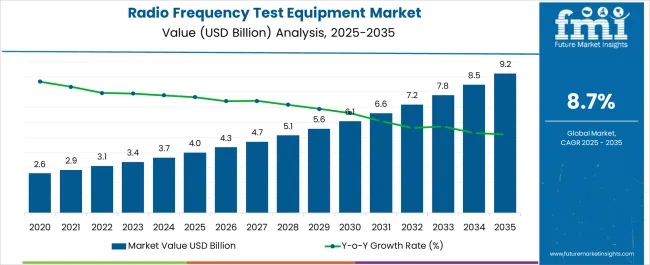
In 2025, the radio frequency test equipment market was valued at USD 4.0 billion. Based on Future Market Insights' analysis, demand for radio frequency test equipment is estimated to grow to USD 4.35 billion in 2026 and USD 10.0 billion by 2036. FMI projects a CAGR of 8.7% during the forecast period.
An absolute dollar growth of USD 5.65 billion between 2026 and 2036 reflects structural advancements in wireless technology rather than volume-only expansion of general-purpose test gear. Growth depends on increased investment in 5G network infrastructure, the proliferation of connected devices, and the rising complexity of RF components in automotive, defense, and industrial applications requiring sophisticated characterization and compliance testing . As per FMI, test equipment suppliers are capturing value not from incremental unit counts alone, but from software content, measurement speed, and multi-function integration that reduce test times and improve accuracy in both R&D and production environments.
Summary of the Radio Frequency Test Equipment Market
- Market Definition
- The market comprises precision electronic instruments designed to generate, measure, and analyze radio frequency signals for design validation, manufacturing test, and network maintenance across multiple industries.
- Demand Drivers
- Accelerating 5G network deployment requiring comprehensive testing of base stations, small cells, and user equipment.
- Rising complexity of RF components in automotive radar, V2X communication, and connected vehicle systems.
- Expanding defense and aerospace investment in radar, electronic warfare, and satellite communication systems.
- Growing semiconductor manufacturing requiring RF test for advanced nodes and compound semiconductor devices.
- Key Segments Analyzed
- Product Type: Network Analyzers lead, accounting for 25.0% share in 2025 due to their critical role in characterizing signal integrity and network parameters.
- Test Functions: Radio Receiver Servicing dominates with 40.0% share, reflecting continuous calibration and maintenance needs across wireless infrastructure.
- Product Form: Portable equipment represents the largest form factor at 50.0% share, driven by field testing and on-site troubleshooting requirements.
- Geography: Asia-Pacific leads volume growth through infrastructure investment, while North America and Europe drive value through advanced applications.
- Analyst Opinion at FMI
- Nikhil Kaitwade, Head of Industrial Automation at Future Market Insights, opines, 'In this updated edition of the Radio Frequency Test Equipment Market report, industry participants will recognize that value creation is shifting from standalone hardware toward integrated software-measurement ecosystems. Suppliers that embed intelligence into their instruments will capture margin expansion beyond traditional equipment sales. The race is no longer about higher frequency alone, but about smarter measurement that accelerates innovation cycles from lab to production floor.'
- Strategic Implications/Executive Takeaways
- Invest in software-defined architectures that enable instrument reconfiguration for evolving standards without hardware replacement.
- Develop multi-function platforms combining network analysis, spectrum analysis, and signal generation capabilities.
- Strengthen automated test solutions for production environments where test time reduction drives customer ROI.
- Build deep application expertise in high-growth segments including automotive radar and satellite communications.
- Methodology
- Built on primary interviews with RF test equipment manufacturers and end-user procurement leaders.
- Benchmarked against telecommunications infrastructure deployment data and semiconductor production statistics.
- Validated using trade data and internal peer review as per FMI modeling standards.
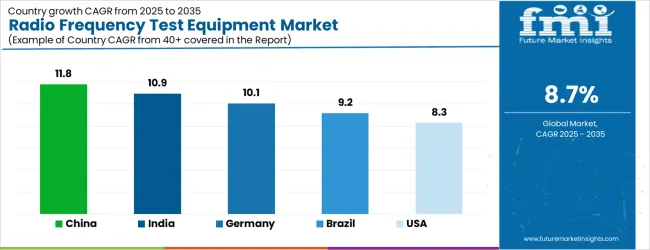
China (11.8% CAGR) leads global expansion, supported by massive 5G infrastructure investment, domestic semiconductor manufacturing growth, and expanding electronics production requiring rigorous quality testing . India (10.9% CAGR) follows, driven by telecommunications network expansion, government initiatives for electronics manufacturing, and increasing defense modernization programs. Germany (10.1% CAGR) grows on the back of its strong automotive and industrial automation sectors, where RF test requirements for radar, connectivity, and Industry 4.0 applications are accelerating. Brazil (9.2% CAGR) benefits from telecommunications infrastructure upgrades and growing industrial automation adoption.
Mature markets such as the United States (8.3% CAGR), the United Kingdom (7.4% CAGR), and Japan (6.6% CAGR) generate comparatively slower expansion, where demand is shaped more by technology refresh cycles and upgrades to address emerging standards than by new infrastructure build-out, with intense competition and price pressure acting as structural constraints on value growth.
Radio Frequency Test Equipment Market Definition
The radio frequency test equipment market covers the global production and supply of electronic instruments used to generate, measure, and analyze RF signals across specified frequency ranges. These instruments characterize the performance, integrity, and compliance of components, modules, and systems operating in the radio frequency spectrum. They are widely used in telecommunications, automotive, aerospace and defense, broadcasting, industrial, and research applications where precise RF measurement is essential for design validation, manufacturing test, and network maintenance.
Market Inclusions
The report includes global and regional market size estimates in value terms, with a forecast period from 2026 to 2036. It provides segmentation by Product Type, Test Functions, Product Form, Frequency, End-Use Industry, and Region. The analysis incorporates technology trends including higher frequency coverage, wider bandwidth analysis, software-defined architectures, and automated test capabilities. Regional demand dynamics, country-level growth rates, and competitive positioning are also evaluated as per FMI methodology.
Market Exclusions
The scope excludes general-purpose electronic test equipment not specifically optimized for RF applications, calibration services and related after-sales support, and custom-built one-off test systems for specialized research applications. It also excludes revenues from related categories such as DC power supplies and basic signal generators not intended for RF measurement, focusing strictly on equipment designed for RF testing and analysis.
Research Methodology
- Primary Research: Interviews were conducted with RF test equipment manufacturers, component suppliers, telecommunications network operators, automotive electronics engineers, and defense procurement specialists.
- Desk Research: Public company filings, telecommunications industry statistics, trade data under relevant HS codes, technical standards publications, and regulatory documentation were reviewed.
- Market-Sizing and Forecasting: A hybrid top-down and bottom-up model was constructed, reconstructing demand from infrastructure deployment data, semiconductor production volumes, and equipment replacement cycles across end-use industries.
- Data Validation and Update Cycle: Outputs were subjected to variance testing against production capacity data, trade flow benchmarking, and structured internal review prior to publication.
Radio Frequency Test Equipment Market Drivers, Restraints, and Opportunities
Future Market Insights analysis indicates the market has historically been shaped by the cyclical nature of telecommunications infrastructure investment and the continuous evolution of wireless standards. Its baseline scale is anchored in the fundamental requirement for RF measurement across design, manufacturing, and network operations. As per FMI, the market's valuation is increasingly linked to technology complexity, where each new generation of wireless technology demands more sophisticated test capabilities.
FMI analysts observe a structural shift from general-purpose benchtop instruments toward application-specific, software-centric solutions that address the unique requirements of 5G, automotive radar, and satellite communications. Traditional instruments optimized for basic parameter measurement face pressure where integrated systems demand comprehensive characterization, while growth is concentrated in platforms that justify higher prices through measurement speed, accuracy, and software depth. This shift nets out as higher value growth because software content and measurement intelligence support margin expansion.
- 5G and beyond infrastructure investment: Global 5G network deployment continues driving demand for test equipment across R&D, manufacturing, and field installation. The evolution toward 5G-Advanced and initial 6G research creates sustained requirements for higher frequency coverage, wider bandwidth analysis, and more complex waveform generation and analysis.
- Automotive radar and connectivity expansion: The automotive industry's adoption of advanced driver assistance systems (ADAS) incorporating radar sensors creates substantial RF test requirements. 77 GHz radar sensors, V2X communication modules, and in-vehicle connectivity systems all demand sophisticated test solutions during development and production.
- Spectrum scarcity and sharing: Growing congestion in the RF spectrum and the introduction of spectrum sharing frameworks create new test requirements for interference analysis and coexistence verification. Regulatory requirements for spectrum compliance drive demand for spectrum analyzers and monitoring systems.
- Semiconductor test intensity: Advanced semiconductor nodes and compound semiconductor devices (GaN, SiC) for RF applications require specialized test capabilities. The increasing integration of RF functions into system-on-chip designs creates test challenges that drive demand for high-performance measurement solutions.
- Cost and complexity pressures: The rising cost of high-end RF test equipment creates budget constraints for some users, particularly smaller enterprises and educational institutions. This pressure drives interest in modular, scalable platforms and software-based solutions that reduce initial investment.
Segmental Analysis
Radio Frequency Test Equipment Market Analysis by Product Type
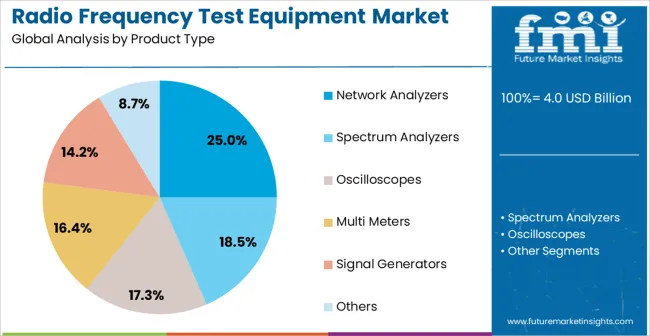
Based on FMI's radio frequency test equipment market report, network analyzers represent the leading product type, projected to hold 25.0% of the market revenue share in 2025 . This dominance is driven by their essential role in characterizing signal integrity, impedance matching, and transmission line behavior in complex RF systems. Network analyzers provide critical measurements including S-parameters, insertion loss, and return loss that are fundamental to designing and validating components from individual filters to complete antenna systems.
Spectrum analyzers constitute the second-largest segment, essential for analyzing signal frequency content, identifying interference, and measuring spectral purity. These instruments find application across all end-use industries, from telecommunications infrastructure testing to electromagnetic compatibility compliance. The evolution toward real-time spectrum analysis capabilities has expanded their utility for transient signal detection and interference hunting.
Oscilloscopes with high bandwidth capabilities serve both RF and general-purpose applications, with modern instruments offering frequency domain analysis through Fast Fourier Transform capabilities. Multi meters with RF measurement functions serve basic field applications where high precision is not required. Signal generators provide controlled stimulus signals for receiver testing, component characterization, and system verification.
- Network analyzer evolution: Modern network analyzers incorporate wider frequency ranges (beyond 100 GHz), faster sweep speeds, and multiport capabilities supporting complex device characterization. Software options for specific applications (antenna test, material measurement) add value beyond basic hardware.
- Spectrum analyzer real-time capability: Real-time spectrum analysis enabling detection of transient and pulsed signals has become increasingly important for radar, electronic warfare, and interference hunting applications. This capability commands premium pricing and expands application reach.
- Modular platform growth: PXI and AXIe modular formats enable configurable test systems combining multiple instrument types in a single chassis. This approach reduces footprint and enables automated test applications, particularly in production environments.
Radio Frequency Test Equipment Market Analysis by Test Functions
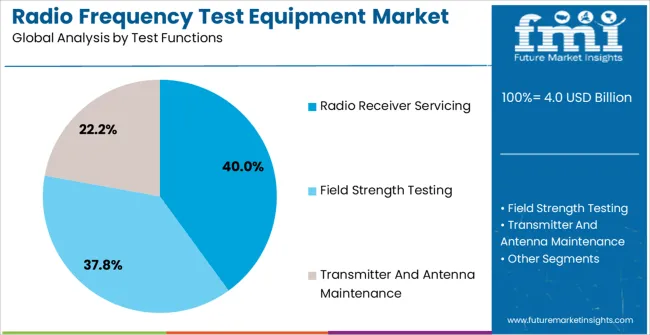
Radio Receiver Servicing represents the largest test function segment, projected to capture 40.0% of the market revenue share in 2025 . This leadership reflects the continuous need for calibration, alignment, and performance verification of radio receivers across telecommunications infrastructure, broadcasting, defense communications, and consumer device manufacturing. Receiver sensitivity, selectivity, and dynamic range measurements require specialized test equipment including signal generators and modulation analyzers.
Field Strength Testing commands a significant share, driven by requirements for coverage verification, interference investigation, and regulatory compliance. Field strength measurements ensure that broadcast and communications systems operate within licensed parameters and that new deployments achieve intended coverage areas without causing harmful interference. Portable spectrum analyzers and dedicated field strength meters serve these applications.
Transmitter And Antenna Maintenance represents the third major test function, encompassing measurements of transmitter output power, modulation quality, harmonic content, and antenna characteristics including VSWR and radiation patterns. These measurements are essential during installation, routine maintenance, and troubleshooting of communications infrastructure.
- Receiver testing complexity growth: Modern receivers supporting multiple modulation formats, wide bandwidths, and MIMO configurations require sophisticated test capabilities. Test equipment must generate complex waveforms and analyze receiver performance across multiple parameters simultaneously.
- Field testing automation: Automated test routines embedded in portable instruments reduce operator skill requirements and improve measurement consistency. This trend supports broader deployment of field testing capabilities across network operations teams.
- Interference hunting specialization: Dedicated features for interference hunting including spectrograms, persistence displays, and direction-finding capabilities have become valued additions to field test instruments. These capabilities accelerate problem resolution in congested spectrum environments.
Radio Frequency Test Equipment Market Analysis by Product Form
Portable equipment represents the largest product form segment, projected to account for 50.0% of the market revenue share in 2025 . This leadership is driven by the extensive requirements for field testing across telecommunications network installation and maintenance, broadcast coverage verification, and on-site troubleshooting in defense and industrial applications. Portable instruments offer the mobility necessary for technicians to access remote cell sites, broadcast towers, and industrial facilities where benchtop equipment cannot be deployed.
Modular equipment represents the fastest-growing form factor, driven by the demand for configurable, scalable test solutions in both R&D and production environments. Modular platforms enable users to assemble precisely the test capabilities required, adding instruments as needs evolve. This approach reduces initial investment while providing upgrade paths for emerging requirements. PXI and AXIe formats dominate this segment, supported by extensive instrument availability from multiple vendors.
Benchtop equipment maintains a significant share for laboratory applications where highest performance and maximum measurement capability are required. Research institutions, design centers, and manufacturing quality laboratories invest in benchtop instruments offering ultimate specifications in frequency range, dynamic range, and measurement accuracy.
- Portable performance improvement: Advances in battery technology, component miniaturization, and power management have enabled portable instruments with performance approaching benchtop equivalents. High-end portable spectrum analyzers now offer frequency coverage to 50 GHz and above.
- Modular ecosystem expansion: The modular instrument ecosystem has expanded beyond traditional RF measurements to include digital test, power supplies, and switching, enabling complete test system integration within a single chassis. Software-defined instrument architectures support reconfiguration for evolving requirements.
- Software portability: Instrument software increasingly runs on standard computing platforms, enabling common user interfaces and measurement algorithms across portable, modular, and benchtop form factors. This consistency reduces training requirements and enables seamless workflow transition between environments.
Radio Frequency Test Equipment Market Analysis by End-Use Industry
Telecommunication represents the largest end-use industry, driven by massive investment in 5G network infrastructure and the continuous evolution of wireless standards. Network equipment manufacturers require comprehensive test capabilities during R&D and production, while network operators invest in field test equipment for installation and maintenance. The transition from 5G to 5G-Advanced and eventual 6G will sustain test equipment demand over the forecast period.
Automotive has emerged as a high-growth end-use industry, driven by the proliferation of radar sensors for ADAS, V2X communication modules, and in-vehicle connectivity systems. 77 GHz radar sensors require specialized test capabilities including antenna characterization and target simulation. V2X modules operating at 5.9 GHz demand comprehensive RF validation to ensure reliable communication in challenging automotive environments.
Aerospace and Defense maintains significant demand for high-performance test equipment supporting radar development, electronic warfare systems, satellite communications, and secure communications. Defense applications often require specialized capabilities including pulsed signal analysis, phase noise measurement, and operation in extreme environments. Budget cycles and program milestones influence procurement patterns.
Industrial applications include wireless sensor networks, industrial IoT deployments, and RF-based manufacturing processes requiring monitoring and control. Research institutions including universities and government laboratories invest in test equipment for fundamental research and technology development.
- Telecommunication test intensity: Each new wireless generation increases test requirements. 5G's use of millimeter-wave frequencies, massive MIMO, and beamforming demands test capabilities far beyond those required for 4G. This increasing test intensity supports value growth even as unit volumes moderate.
- Automotive radar evolution: The transition from 24 GHz to 77 GHz radar and the emergence of 4D imaging radar create escalating test requirements. Automotive radar test systems must simulate complex scenarios with multiple targets, distances, and velocities to validate sensor performance.
- Satellite communications expansion: Low Earth Orbit satellite constellations and high-throughput satellites create new test requirements for ground terminals and user equipment. Phased array antennas and electronically steered beams demand sophisticated test approaches.
Regional Analysis
The radio frequency test equipment market is segmented geographically across North America, Europe, Asia-Pacific, Latin America, and Middle East & Africa. Growth dynamics differ based on telecommunications infrastructure maturity, defense investment levels, and electronics manufacturing concentration.
| Country | CAGR |
|---|---|
| China | 11.8% |
| India | 10.9% |
| Germany | 10.1% |
| Brazil | 9.2% |
| USA | 8.3% |
| UK | 7.4% |
Source: Future Market Insights (FMI) analysis, based on proprietary forecasting model and primary research
North America Market Analysis
North America functions as a technology leadership market where early adoption of advanced wireless standards and strong defense investment drive demand for high-performance test equipment. Major players including Keysight Technologies, Viavi Solutions, and National Instruments maintain strong regional presence with extensive R&D operations and customer support infrastructure.
- United States: Demand for radio frequency test equipment in the United States is projected to advance at 8.3% CAGR through 2036. The USA market combines commercial demand from telecommunications equipment manufacturers and network operators with substantial defense and aerospace test requirements. The United States market was estimated at USD 1.4 billion in 2025 .
- Commercial 5G deployment continues driving test equipment investment as network operators expand coverage and capacity. Equipment manufacturers serving global markets maintain significant test operations in the U.S., supporting both R&D and production test requirements. The emergence of private 5G networks for industrial applications creates additional test demand.
- Defense and aerospace test requirements remain substantial, with investment in radar modernization, electronic warfare capabilities, and satellite communications. Defense contractors require sophisticated test capabilities for system development and production acceptance. Government laboratories and test ranges invest in specialized measurement systems.
FMI's analysis of radio frequency test equipment market in North America consists of country-wise assessment that includes the United States and Canada. Readers can find defense budget analysis, telecommunications investment tracking, and technology adoption patterns.
Europe Market Analysis
Europe represents a sophisticated market where strong automotive, defense, and telecommunications sectors drive demand for advanced test equipment. Regional players including Rohde & Schwarz maintain strong engineering presence aligned with European industrial requirements and regulatory standards.
- Germany: Demand for radio frequency test equipment in Germany is projected to rise at 10.1% CAGR through 2036. Growth is influenced by Germany's position as Europe's largest automotive manufacturer and its strong industrial automation sector. In 2024, Germany held dominant revenue share in the Western Europe market .
- The automotive industry's adoption of radar sensors and V2X communication creates substantial test requirements. German automotive suppliers and manufacturers invest in RF test capabilities for development and production validation. The transition toward autonomous driving functions amplifies these requirements.
- Industrial automation embracing wireless connectivity for Industry 4.0 applications drives demand for test equipment validating industrial wireless systems. German machinery and equipment manufacturers require test capabilities for wireless interfaces integrated into their products.
FMI's analysis of radio frequency test equipment market in Europe consists of country-wise assessment that includes Germany, United Kingdom, France, Italy, and Spain. Readers can find automotive radar test analysis, industrial wireless adoption tracking, and regulatory compliance assessment.
Asia-Pacific Market Analysis
Asia-Pacific represents the largest and fastest-growing regional market, driven by telecommunications infrastructure investment, electronics manufacturing concentration, and semiconductor industry expansion. The region encompasses both mature markets like Japan and rapidly developing markets like China and India.
- China: Radio frequency test equipment sales in China are projected to rise at 11.8% CAGR through 2036, the highest among major markets . Growth is supported by massive 5G infrastructure investment, with China having deployed over 3 million 5G base stations, creating sustained test requirements for equipment manufacturing and network maintenance . Domestic semiconductor manufacturing expansion drives demand for RF test in production environments.
- Chinese telecommunications equipment manufacturers including Huawei and ZTE maintain extensive test operations supporting global market supply. The domestic electronics manufacturing ecosystem requires test capabilities across component, module, and finished product levels. Government investment in advanced manufacturing and technology self-sufficiency supports test equipment adoption.
- Research institutions and universities in China invest in advanced test capabilities supporting 6G research and technology development. These investments position China for future leadership in wireless technology while driving current test equipment demand.
FMI's analysis of radio frequency test equipment market in Asia-Pacific consists of country-wise assessment that includes China, India, Japan, and South Korea. Readers can find infrastructure deployment tracking, manufacturing ecosystem analysis, and research investment assessment.
- India: Demand for radio frequency test equipment in India is projected to rise at 10.9% CAGR through 2036 . Growth is supported by telecommunications network expansion, with major operators deploying 5G infrastructure across urban and increasingly rural areas. Government initiatives promoting domestic electronics manufacturing create new test requirements for locally produced devices and equipment.
- Defense modernization programs in India drive demand for radar and communications test equipment. Indigenous defense manufacturing initiatives create test requirements across development and production phases. Space research organization requirements for satellite and launch vehicle testing contribute specialized demand.
- The telecom regulatory authority's spectrum management and compliance monitoring activities create ongoing requirements for field test equipment. Growing electronics manufacturing under production-linked incentive schemes supports test equipment adoption in production environments.
FMI's analysis of radio frequency test equipment market in Asia-Pacific consists of country-wise assessment that includes China, India, Japan, and South Korea. Readers can find infrastructure deployment analysis, manufacturing policy tracking, and defense procurement assessment.
- Japan: Japan represents a mature but technologically sophisticated market where demand for radio frequency test equipment is projected to rise at 6.6% CAGR through 2036. Japanese electronics manufacturers maintain substantial test operations supporting global product development and production. The automotive industry's leadership in advanced driver assistance systems drives radar and connectivity test requirements. Telecommunications equipment manufacturers serving global markets maintain test capabilities aligned with international standards.
- Research institutions including universities and government laboratories invest in advanced test capabilities supporting next-generation wireless research. The transition toward 6G and terahertz communications creates early-stage test requirements that Japanese researchers address.
FMI's analysis of radio frequency test equipment market in Asia-Pacific consists of country-wise assessment that includes China, India, Japan, and South Korea. Readers can find automotive electronics analysis, research investment tracking, and manufacturing ecosystem assessment.
Competitive Aligners for Market Players
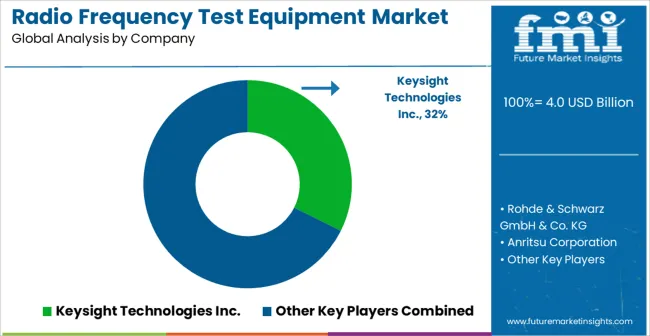
The radio frequency test equipment market is moderately consolidated, with specialized test and measurement manufacturers dominating high-performance segments while broader electronics companies participate in specific categories. Global leaders including Keysight Technologies, Rohde & Schwarz, and Anritsu Corporation leverage deep RF expertise, extensive patent portfolios, and global service networks to maintain leadership positions.
Keysight Technologies, as the largest pure-play test and measurement company, offers comprehensive RF test solutions across all product categories and end-use industries. The company's strength in software-defined instruments and measurement applications provides differentiation beyond hardware specifications.
Rohde & Schwarz brings deep European engineering heritage and strong positions in broadcast, aerospace, and defense test. The company's vertical integration including component manufacturing supports performance optimization and supply chain control.
Anritsu Corporation maintains strong positions in telecommunications test, particularly in field test and network analysis. The company's focus on wireless test includes specialized solutions for 5G and emerging standards.
Viavi Solutions specializes in network test and measurement, with strong positions in field test and assurance applications. National Instruments leads in modular test platforms, enabling configurable automated test systems. Yokogawa Electric and Teledyne Technologies participate in specific RF test categories.
- Keysight Technologies - Financial Performance (2025): Keysight reported fiscal year 2025 revenue with communications solutions group contributing substantial share, reflecting continued 5G and aerospace defense investment.
- Rohde & Schwarz - Technology Leadership (2025): Rohde & Schwarz continued investment in high-frequency test capabilities, introducing solutions addressing 6G research and automotive radar requirement.
- Anritsu Corporation - Product Innovation (2025): Anritsu advanced its field test portfolio with solutions supporting 5G deployment and maintenance, emphasizing ease of use and measurement speed.
Key Players in the Radio Frequency Test Equipment Market
- Keysight Technologies Inc.
- Rohde & Schwarz GmbH & Co. KG
- Anritsu Corporation
- Viavi Solutions Inc.
- National Instruments Corporation
- Yokogawa Electric Corporation
- Teledyne Technologies Incorporated
Scope of Report
| Metric | Value |
|---|---|
| Quantitative Units | USD 4.35 billion (2026) to USD 10.0 billion (2036), at a CAGR of 8.7% |
| Market Definition | The radio frequency test equipment market comprises the global production and supply of electronic instruments designed to generate, measure, and analyze RF signals for design validation, manufacturing test, and network maintenance across telecommunications, automotive, defense, industrial, and research applications. |
| Product Type Segmentation | Network Analyzers, Spectrum Analyzers, Oscilloscopes, Multi Meters, Signal Generators, Others |
| Test Functions Segmentation | Radio Receiver Servicing, Field Strength Testing, Transmitter And Antenna Maintenance |
| Product Form Segmentation | Portable, Modular, Others |
| Frequency Segmentation | Up To 1 GHz, 1 GHz To 6 GHz, More Than 6 GHz |
| End-Use Industry Segmentation | Automotive, Radio And Television Broadcasting, Telecommunication, Satellite Communications, Industrial, Research |
| Region Segmentation | North America, Europe, Asia-Pacific, Latin America, Middle East & Africa |
| Countries Covered | United States, Canada, Germany, United Kingdom, France, Italy, Spain, China, India, Japan, South Korea, Brazil and 40+ countries |
| Key Companies Profiled | Keysight Technologies Inc., Rohde & Schwarz GmbH & Co. KG, Anritsu Corporation, Viavi Solutions Inc., National Instruments Corporation, Yokogawa Electric Corporation, Teledyne Technologies Incorporated |
| Forecast Period | 2026 to 2036 |
| Approach | Hybrid top-down and bottom-up market modeling validated through primary interviews with RF test equipment manufacturers, component suppliers, and end-user procurement leaders, supported by infrastructure deployment data and production statistics |
Radio Frequency Test Equipment Market Analysis by Segments
Product Type:
- Network Analyzers
- Spectrum Analyzers
- Oscilloscopes
- Multi Meters
- Signal Generators
- Others
Test Functions:
- Radio Receiver Servicing
- Field Strength Testing
- Transmitter And Antenna Maintenance
Product Form:
- Portable
- Modular
- Others
Frequency:
- Up To 1 GHz
- 1 GHz To 6 GHz
- More Than 6 GHz
End-Use Industry:
- Automotive
- Radio And Television Broadcasting
- Telecommunication
- Satellite Communications
- Industrial
- Research
Region:
- North America (United States, Canada, Mexico)
- Latin America (Brazil, Chile, Rest of Latin America)
- Western Europe (Germany, United Kingdom, Italy, Spain, France, Nordic, BENELUX, Rest of Western Europe)
- Eastern Europe (Russia, Poland, Hungary, Balkan & Baltic, Rest of Eastern Europe)
- East Asia (China, Japan, South Korea)
- South Asia and Pacific (India, ASEAN, Australia & New Zealand, Rest of South Asia and Pacific)
- Middle East & Africa (Kingdom of Saudi Arabia, Other GCC Countries, Turkiye, South Africa, Other African Union, Rest of Middle East & Africa)
Bibliography
- Keysight Technologies Inc. (2025). Annual Report 2025.
- Rohde & Schwarz GmbH & Co. KG. (2025). Company Annual Report 2024-2025.
- Anritsu Corporation. (2025). Integrated Report 2025.
- Viavi Solutions Inc. (2025). Annual Report 2025.
- National Instruments Corporation. (2025). Annual Report 2025.
- Yokogawa Electric Corporation. (2025). Integrated Report 2025.
- Teledyne Technologies Incorporated. (2025). Annual Report 2025.
- International Telecommunication Union. (2025). Global 5G Deployment Status Report.
- 3rd Generation Partnership Project (3GPP). (2025). Release 18 and 19 Specifications.
- USA Department of Defense. (2025). Defense Budget Materials.
- European Telecommunications Standards Institute. (2025). Standards Publication Summary.
- Ministry of Industry and Information Technology, China. (2025). Communications Industry Statistics.
This bibliography is provided for reader reference and is not exhaustive. The full report contains the complete reference list and detailed citations.
This Report Addresses
- Market intelligence to enable structured strategic decision-making across radio frequency test equipment manufacturers, component suppliers, telecommunications network operators, and defense procurement specialists, focusing on the shift from standalone hardware toward integrated software-measurement ecosystems.
- Market size estimation and 10-year revenue forecasts, including validated CAGR and absolute dollar opportunity sizing.
- Growth opportunity mapping across Product Type, Test Functions, Product Form, Frequency, and End-Use Industry, with emphasis on software-defined architectures, multi-function platforms, and automated test environments.
- Segment and regional forecasting covering the RF test equipment landscape, alongside demand trajectories driven by 5G infrastructure investment, automotive radar evolution, and defense modernization programs.
- Competition strategy assessment, including analysis of software content development, measurement speed optimization, and multi-function integration capabilities that reduce test times and improve accuracy across R&D and production environments.
- Product and technology tracking focused on higher frequency coverage, wider bandwidth analysis, real-time spectrum analysis, and modular platform architectures supporting evolving wireless standards.
- Regulatory policy analysis covering spectrum compliance requirements, international telecommunications standards, and defense procurement specifications influencing equipment design and market access.
- Report delivery in PDF, Excel, and presentation-ready formats to support executive planning, product development alignment, and competitive benchmarking across mature and high-growth markets including the United States, Germany, China, and India.
Frequently Asked Questions
How large is the radio frequency test equipment market in 2026?
Demand for radio frequency test equipment is estimated to be valued at USD 4.35 billion in 2026.
What will be the market size of radio frequency test equipment by 2036?
Market size for radio frequency test equipment is projected to reach USD 10.0 billion by 2036.
What is the expected demand growth for radio frequency test equipment between 2026 and 2036?
Demand for radio frequency test equipment is expected to grow at an 8.7% CAGR between 2026 and 2036.
Which product type is poised to lead global sales?
Network analyzers lead with 25.0% share in 2025, driven by their critical role in characterizing signal integrity and network parameters .
Which test functions segment contributes the largest share?
Radio receiver servicing commands 40.0% share, reflecting continuous calibration and maintenance needs across wireless infrastructure.
Which product form segment is the largest?
Portable equipment represents the largest form factor at 50.0% share, driven by field testing and on-site troubleshooting requirements.
Which end-use industry drives the most demand?
Telecommunication leads, driven by 5G infrastructure investment and continuous wireless standard evolution.
How significant is 5G deployment in driving market growth?
5G deployment is a primary demand driver, with each new wireless generation increasing test complexity and requirements.
What is driving demand in China?
Massive 5G infrastructure investment, domestic semiconductor manufacturing growth, and expanding electronics production drive China's leadership.
What is the China growth outlook?
China is projected to expand at an 11.8% CAGR during 2026 to 2036.
What drives India's market growth?
Telecommunications network expansion, government electronics manufacturing initiatives, and defense modernization programs support India's growth .
What is the India growth outlook?
India is projected to expand at a 10.9% CAGR during 2026 to 2036.
What characterizes the German market?
Germany's strong automotive and industrial automation sectors drive RF test requirements for radar, connectivity, and Industry 4.0 applications .
What is the Germany growth outlook?
Germany is projected to expand at a 10.1% CAGR during 2026 to 2036.
What drives the United States market?
Commercial 5G deployment and substantial defense and aerospace test requirements shape USA demand.
What is the United States growth outlook?
The United States is projected to expand at an 8.3% CAGR during 2026 to 2036.
What is the United Kingdom growth outlook?
The United Kingdom is projected to expand at a 7.4% CAGR during 2026 to 2036.
What is the Japan growth outlook?
Japan is projected to expand at a 6.6% CAGR during 2026 to 2036.
What is the Brazil growth outlook?
Brazil is projected to expand at a 9.2% CAGR during 2026 to 2036.
What is radio frequency test equipment and what is it mainly used for?
Radio frequency test equipment comprises electronic instruments used to generate, measure, and analyze RF signals for design validation, manufacturing test, and network maintenance across telecommunications, automotive, defense, and industrial applications.
What does the radio frequency test equipment market mean in this report?
It refers to the global manufacturing and supply of instruments designed for RF testing and analysis, segmented by product type, test functions, product form, frequency, end-use industry, and region, measured in value terms.
What is included in the scope of this report?
Scope includes market sizing and forecasting for 2026 to 2036, segmentation by product type, test functions, product form, frequency, end-use industry, and region, along with competitive assessment and country-wise outlook.
What is excluded from the scope of this report?
The scope excludes general-purpose electronic test equipment not optimized for RF applications, calibration services, and custom-built one-off test systems.
Preview the report firsthand - request a free sample
Get SampleGet the brochure for pricing and purchase details.
Get PDFTable of Content
- Executive Summary
- Global Market Outlook
- Demand-side Trends
- Supply-side Trends
- Technology Roadmap Analysis
- Analysis and Recommendations
- Market Overview
- Market Coverage / Taxonomy
- Market Definition / Scope / Limitations
- Research Methodology
- Chapter Orientation
- Analytical Lens and Working Hypotheses
- Market Structure, Signals, and Trend Drivers
- Benchmarking and Cross-market Comparability
- Market Sizing, Forecasting, and Opportunity Mapping
- Research Design and Evidence Framework
- Desk Research Programme (Secondary Evidence)
- Company Annual and Sustainability Reports
- Peer-reviewed Journals and Academic Literature
- Corporate Websites, Product Literature, and Technical Notes
- Earnings Decks and Investor Briefings
- Statutory Filings and Regulatory Disclosures
- Technical White Papers and Standards Notes
- Trade Journals, Industry Magazines, and Analyst Briefs
- Conference Proceedings, Webinars, and Seminar Materials
- Government Statistics Portals and Public Data Releases
- Press Releases and Reputable Media Coverage
- Specialist Newsletters and Curated Briefings
- Sector Databases and Reference Repositories
- FMI Internal Proprietary Databases and Historical Market Datasets
- Subscription Datasets and Paid Sources
- Social Channels, Communities, and Digital Listening Inputs
- Additional Desk Sources
- Expert Input and Fieldwork (Primary Evidence)
- Primary Modes
- Qualitative Interviews and Expert Elicitation
- Quantitative Surveys and Structured Data Capture
- Blended Approach
- Why Primary Evidence is Used
- Field Techniques
- Interviews
- Surveys
- Focus Groups
- Observational and In-context Research
- Social and Community Interactions
- Stakeholder Universe Engaged
- C-suite Leaders
- Board Members
- Presidents and Vice Presidents
- R&D and Innovation Heads
- Technical Specialists
- Domain Subject-matter Experts
- Scientists
- Physicians and Other Healthcare Professionals
- Governance, Ethics, and Data Stewardship
- Research Ethics
- Data Integrity and Handling
- Primary Modes
- Tooling, Models, and Reference Databases
- Desk Research Programme (Secondary Evidence)
- Data Engineering and Model Build
- Data Acquisition and Ingestion
- Cleaning, Normalisation, and Verification
- Synthesis, Triangulation, and Analysis
- Quality Assurance and Audit Trail
- Market Background
- Market Dynamics
- Drivers
- Restraints
- Opportunity
- Trends
- Scenario Forecast
- Demand in Optimistic Scenario
- Demand in Likely Scenario
- Demand in Conservative Scenario
- Opportunity Map Analysis
- Product Life Cycle Analysis
- Supply Chain Analysis
- Investment Feasibility Matrix
- Value Chain Analysis
- PESTLE and Porter’s Analysis
- Regulatory Landscape
- Regional Parent Market Outlook
- Production and Consumption Statistics
- Import and Export Statistics
- Market Dynamics
- Global Market Analysis 2021 to 2025 and Forecast, 2026 to 2036
- Historical Market Size Value (USD Million) Analysis, 2021 to 2025
- Current and Future Market Size Value (USD Million) Projections, 2026 to 2036
- Y-o-Y Growth Trend Analysis
- Absolute $ Opportunity Analysis
- Global Market Pricing Analysis 2021 to 2025 and Forecast 2026 to 2036
- Global Market Analysis 2021 to 2025 and Forecast 2026 to 2036, By Product Type
- Introduction / Key Findings
- Historical Market Size Value (USD Million) Analysis By Product Type , 2021 to 2025
- Current and Future Market Size Value (USD Million) Analysis and Forecast By Product Type , 2026 to 2036
- Network Analyzers
- Spectrum Analyzers
- Oscilloscopes
- Multi Meters
- Signal Generators
- Network Analyzers
- Y-o-Y Growth Trend Analysis By Product Type , 2021 to 2025
- Absolute $ Opportunity Analysis By Product Type , 2026 to 2036
- Global Market Analysis 2021 to 2025 and Forecast 2026 to 2036, By Test Functions
- Introduction / Key Findings
- Historical Market Size Value (USD Million) Analysis By Test Functions, 2021 to 2025
- Current and Future Market Size Value (USD Million) Analysis and Forecast By Test Functions, 2026 to 2036
- Radio Receiver Servicing
- Field Strength Testing
- Transmitter And Antenna Maintenance
- Radio Receiver Servicing
- Y-o-Y Growth Trend Analysis By Test Functions, 2021 to 2025
- Absolute $ Opportunity Analysis By Test Functions, 2026 to 2036
- Global Market Analysis 2021 to 2025 and Forecast 2026 to 2036, By Product Form
- Introduction / Key Findings
- Historical Market Size Value (USD Million) Analysis By Product Form, 2021 to 2025
- Current and Future Market Size Value (USD Million) Analysis and Forecast By Product Form, 2026 to 2036
- Portable equipment
- Portable equipment
- Y-o-Y Growth Trend Analysis By Product Form, 2021 to 2025
- Absolute $ Opportunity Analysis By Product Form, 2026 to 2036
- Global Market Analysis 2021 to 2025 and Forecast 2026 to 2036, By Region
- Introduction
- Historical Market Size Value (USD Million) Analysis By Region, 2021 to 2025
- Current Market Size Value (USD Million) Analysis and Forecast By Region, 2026 to 2036
- North America
- Latin America
- Western Europe
- Eastern Europe
- East Asia
- South Asia and Pacific
- Middle East & Africa
- Market Attractiveness Analysis By Region
- North America Market Analysis 2021 to 2025 and Forecast 2026 to 2036, By Country
- Historical Market Size Value (USD Million) Trend Analysis By Market Taxonomy, 2021 to 2025
- Market Size Value (USD Million) Forecast By Market Taxonomy, 2026 to 2036
- By Country
- USA
- Canada
- Mexico
- By Product Type
- By Test Functions
- By Product Form
- By Country
- Market Attractiveness Analysis
- By Country
- By Product Type
- By Test Functions
- By Product Form
- Key Takeaways
- Latin America Market Analysis 2021 to 2025 and Forecast 2026 to 2036, By Country
- Historical Market Size Value (USD Million) Trend Analysis By Market Taxonomy, 2021 to 2025
- Market Size Value (USD Million) Forecast By Market Taxonomy, 2026 to 2036
- By Country
- Brazil
- Chile
- Rest of Latin America
- By Product Type
- By Test Functions
- By Product Form
- By Country
- Market Attractiveness Analysis
- By Country
- By Product Type
- By Test Functions
- By Product Form
- Key Takeaways
- Western Europe Market Analysis 2021 to 2025 and Forecast 2026 to 2036, By Country
- Historical Market Size Value (USD Million) Trend Analysis By Market Taxonomy, 2021 to 2025
- Market Size Value (USD Million) Forecast By Market Taxonomy, 2026 to 2036
- By Country
- Germany
- UK
- Italy
- Spain
- France
- Nordic
- BENELUX
- Rest of Western Europe
- By Product Type
- By Test Functions
- By Product Form
- By Country
- Market Attractiveness Analysis
- By Country
- By Product Type
- By Test Functions
- By Product Form
- Key Takeaways
- Eastern Europe Market Analysis 2021 to 2025 and Forecast 2026 to 2036, By Country
- Historical Market Size Value (USD Million) Trend Analysis By Market Taxonomy, 2021 to 2025
- Market Size Value (USD Million) Forecast By Market Taxonomy, 2026 to 2036
- By Country
- Russia
- Poland
- Hungary
- Balkan & Baltic
- Rest of Eastern Europe
- By Product Type
- By Test Functions
- By Product Form
- By Country
- Market Attractiveness Analysis
- By Country
- By Product Type
- By Test Functions
- By Product Form
- Key Takeaways
- East Asia Market Analysis 2021 to 2025 and Forecast 2026 to 2036, By Country
- Historical Market Size Value (USD Million) Trend Analysis By Market Taxonomy, 2021 to 2025
- Market Size Value (USD Million) Forecast By Market Taxonomy, 2026 to 2036
- By Country
- China
- Japan
- South Korea
- By Product Type
- By Test Functions
- By Product Form
- By Country
- Market Attractiveness Analysis
- By Country
- By Product Type
- By Test Functions
- By Product Form
- Key Takeaways
- South Asia and Pacific Market Analysis 2021 to 2025 and Forecast 2026 to 2036, By Country
- Historical Market Size Value (USD Million) Trend Analysis By Market Taxonomy, 2021 to 2025
- Market Size Value (USD Million) Forecast By Market Taxonomy, 2026 to 2036
- By Country
- India
- ASEAN
- Australia & New Zealand
- Rest of South Asia and Pacific
- By Product Type
- By Test Functions
- By Product Form
- By Country
- Market Attractiveness Analysis
- By Country
- By Product Type
- By Test Functions
- By Product Form
- Key Takeaways
- Middle East & Africa Market Analysis 2021 to 2025 and Forecast 2026 to 2036, By Country
- Historical Market Size Value (USD Million) Trend Analysis By Market Taxonomy, 2021 to 2025
- Market Size Value (USD Million) Forecast By Market Taxonomy, 2026 to 2036
- By Country
- Kingdom of Saudi Arabia
- Other GCC Countries
- Turkiye
- South Africa
- Other African Union
- Rest of Middle East & Africa
- By Product Type
- By Test Functions
- By Product Form
- By Country
- Market Attractiveness Analysis
- By Country
- By Product Type
- By Test Functions
- By Product Form
- Key Takeaways
- Key Countries Market Analysis
- USA
- Pricing Analysis
- Market Share Analysis, 2025
- By Product Type
- By Test Functions
- By Product Form
- Canada
- Pricing Analysis
- Market Share Analysis, 2025
- By Product Type
- By Test Functions
- By Product Form
- Mexico
- Pricing Analysis
- Market Share Analysis, 2025
- By Product Type
- By Test Functions
- By Product Form
- Brazil
- Pricing Analysis
- Market Share Analysis, 2025
- By Product Type
- By Test Functions
- By Product Form
- Chile
- Pricing Analysis
- Market Share Analysis, 2025
- By Product Type
- By Test Functions
- By Product Form
- Germany
- Pricing Analysis
- Market Share Analysis, 2025
- By Product Type
- By Test Functions
- By Product Form
- UK
- Pricing Analysis
- Market Share Analysis, 2025
- By Product Type
- By Test Functions
- By Product Form
- Italy
- Pricing Analysis
- Market Share Analysis, 2025
- By Product Type
- By Test Functions
- By Product Form
- Spain
- Pricing Analysis
- Market Share Analysis, 2025
- By Product Type
- By Test Functions
- By Product Form
- France
- Pricing Analysis
- Market Share Analysis, 2025
- By Product Type
- By Test Functions
- By Product Form
- India
- Pricing Analysis
- Market Share Analysis, 2025
- By Product Type
- By Test Functions
- By Product Form
- ASEAN
- Pricing Analysis
- Market Share Analysis, 2025
- By Product Type
- By Test Functions
- By Product Form
- Australia & New Zealand
- Pricing Analysis
- Market Share Analysis, 2025
- By Product Type
- By Test Functions
- By Product Form
- China
- Pricing Analysis
- Market Share Analysis, 2025
- By Product Type
- By Test Functions
- By Product Form
- Japan
- Pricing Analysis
- Market Share Analysis, 2025
- By Product Type
- By Test Functions
- By Product Form
- South Korea
- Pricing Analysis
- Market Share Analysis, 2025
- By Product Type
- By Test Functions
- By Product Form
- Russia
- Pricing Analysis
- Market Share Analysis, 2025
- By Product Type
- By Test Functions
- By Product Form
- Poland
- Pricing Analysis
- Market Share Analysis, 2025
- By Product Type
- By Test Functions
- By Product Form
- Hungary
- Pricing Analysis
- Market Share Analysis, 2025
- By Product Type
- By Test Functions
- By Product Form
- Kingdom of Saudi Arabia
- Pricing Analysis
- Market Share Analysis, 2025
- By Product Type
- By Test Functions
- By Product Form
- Turkiye
- Pricing Analysis
- Market Share Analysis, 2025
- By Product Type
- By Test Functions
- By Product Form
- South Africa
- Pricing Analysis
- Market Share Analysis, 2025
- By Product Type
- By Test Functions
- By Product Form
- USA
- Market Structure Analysis
- Competition Dashboard
- Competition Benchmarking
- Market Share Analysis of Top Players
- By Regional
- By Product Type
- By Test Functions
- By Product Form
- Competition Analysis
- Competition Deep Dive
- Keysight Technologies Inc.
- Overview
- Product Portfolio
- Profitability by Market Segments (Product/Age /Sales Channel/Region)
- Sales Footprint
- Strategy Overview
- Marketing Strategy
- Product Strategy
- Channel Strategy
- Rohde & Schwarz GmbH & Co. KG
- Anritsu Corporation
- Viavi Solutions Inc.
- National Instruments Corporation
- Yokogawa Electric Corporation
- Keysight Technologies Inc.
- Competition Deep Dive
- Assumptions & Acronyms Used


