

- Industry Size (2026)
- USD 1.6 Bn
- Forecast (2036)
- USD 3.2 Bn
- CAGR (2026 to 2036)
- 7.5%
High-Volume RF Front-End Module Test Systems Market Size, Market Forecast, and Outlook By FMI
The high-volume RF front-end module test systems market was valued at USD 1.4 billion in 2025. Sales are on track to go beyond USD 1.6 billion by 2026, growing steadily at a CAGR of 7.5%. With continuous investments shaping the market, overall revenue is expected to touch nearly USD 3.2 billion by 2036. This growth is largely driven by the shift toward 5G Advanced, where modules now require more frequent and complex multi-band calibration than before.
Test engineering teams are dealing with rising thermal limits, as high-frequency parallel calibration generates intense localized heat. This creates a trade-off between maintaining throughput and avoiding heat-related testing errors. At the same time, delaying upgrades to next-generation handlers can result in missed qualification cycles for upcoming flagship smartphone launches.
Summary of High-Volume RF Front-End Module Test Systems Market
- High-Volume RF Front-End Module Test Systems Market Definition
- Automated hardware and software platforms verifying electrical performance and signal integrity of radio frequency components at production scale.
- Demand Drivers in the Market
- Expanding carrier aggregation requirements compel test engineering directors to implement multi-band parallel verification sequences.
- Thermal density limitations inside compact System-in-Package formats force packaging facility managers to adopt active temperature control during calibration.
- Strict zero-defect penalty clauses from smartphone OEMs push OSAT procurement heads to mandate comprehensive functional screening before final shipment.
- Key Segments Analyzed in the FMI Report
- By Test System Type: Automated Test Equipment (ATE) is projected to hold 58.2% share in 2026, driven by existing factory floor integration constraints.
- By Frequency Range: Sub-6 GHz is estimated to account for 64.5% share in 2026, sustained by massive IoT volume requirements.
- By Device Type Tested: RF Front-End Modules (FEMs) is set to lead Device Type Tested through 2036, reflecting concentration of integration complexity.
- By End Use: Smartphone Manufacturing is expected to record 52.6% share in 2026, anchored by absolute production volumes.
- By Test Stage: Package-Level Testing is anticipated to maintain a 61.3% position in 2026, capturing defects missed during earlier wafer probes.
- Analyst Opinion at FMI
- Nikhil Kaitwade, Principal Analyst, Technology, at FMI, points out, "Procurement teams frequently assume high-frequency test capacity can scale linearly with adoption rates. This expectation fails because thermal dissipation requirements during high-volume testing create a nonlinear footprint expansion. You cannot simply purchase more testers to meet volume goals; you have to redesign physical cleanroom floors to manage ambient heat generated by parallel handlers. Equipment vendors securing massive 5g infrastructure contracts are those solving facility-level thermal equations, circumventing traditional RF testing challenges."
- Strategic Implications / Executive Takeaways
- OSAT procurement heads must evaluate handler thermal dissipation capabilities before committing to next-generation ATE platforms.
- Test engineering directors face increasing pressure to shift calibration sequences earlier in production flows to minimize late-stage scrap costs.
- Equipment vendors risk losing market position if they fail to integrate active liquid cooling directly into contactor blocks.
- Methodology
- Primary Research: Test engineering directors, packaging facility managers, and OSAT procurement heads
- Desk Research: 3GPP technical standards, IEEE testing methodologies, and SEC filings
- Market-Sizing and Forecasting: Installed base replacement cycles and annual semiconductor equipment capital expenditure
- Data Validation and Update Cycle: UN Comtrade semiconductor equipment trade flows and SIA shipment trends
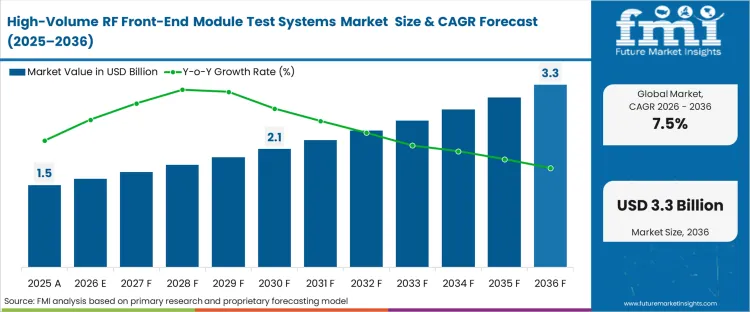
High-Volume RF Front-End Module Test Systems Market Key Takeaways
| Metric | Details |
|---|---|
| Industry Size (2026) | USD 1.6 Billion |
| Industry Value (2036) | USD 3.2 Billion |
| CAGR (2026 to 2036) | 7.5% |
Source: Future Market Insights (FMI) analysis, based on a proprietary forecasting model and primary research
FMI analysis also highlights a common gap. While buyers focus heavily on the cost of test equipment, they often overlook the additional investment needed for cleanroom upgrades and cooling infrastructure. Evaluating total RF equipment pricing requires factoring in these facility overhauls alongside massive semiconductor manufacturing equipment expenditures.
When automated handlers achieve zero-downtime thermal stabilization across parallel test sites, the economics of module verification change permanently. Equipment manufacturers unlock this capability by integrating active liquid cooling directly into contactor blocks. Crossing this threshold makes comprehensive wafer-level RF screening commercially viable for mid-tier consumer devices, accelerating overall RF test adoption trends.
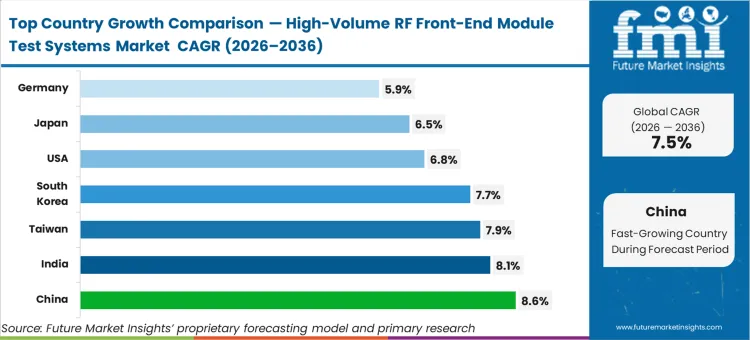
Growth rates vary across regions, reflecting differences in manufacturing focus and industry structure. China is expected to grow at 8.6%, supported by semiconductor localization initiatives and fab expansion, while India follows at 8.1% with increased smartphone assembly activity. Taiwan records 7.9% growth, driven by its advanced packaging capabilities, and South Korea reaches 7.7% due to developments in memory and foundry integration.
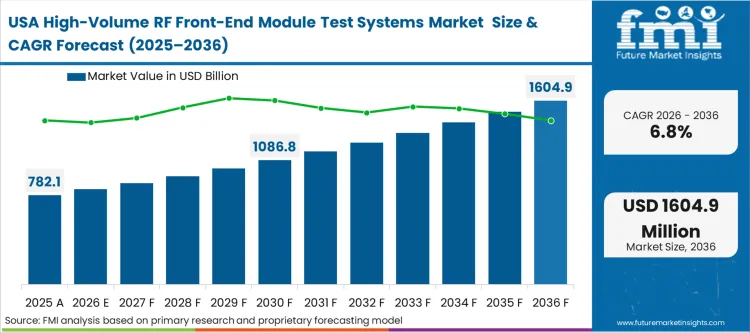
The United States is projected to grow at 6.8%, supported by demand from defense and aerospace RF applications, while Japan expands at 6.5% with its focus on precision components. Germany, at 5.9%, continues to see steady growth through automotive connectivity investments, despite relatively lower consumer electronics volumes. Regional trends reflect differences between foundry-driven and assembly-led ecosystems.
High-Volume RF Front-End Module Test Systems Definition
High-Volume RF Front-End Module Test Systems Market encompasses automated hardware and software platforms utilized to verify the electrical performance and signal integrity of radio frequency components at production scale. Verification occurs across multiple frequencies and thermal states to ensure compliance with wireless transmission standards before final device integration.
High-Volume RF Front-End Module Test Systems Inclusions
Scope parameters strictly cover dedicated ATE platforms, parametric analyzers, handler interfaces, and contactor technologies designed specifically for high-speed RF validation. Systems capable of parallel multi-site screening for integrated RF components and complex Wi-Fi chipset architectures fall within this boundary. Software modules managing test sequencing and yield analytics are integrated components of primary hardware valuation, directly addressing core RF FEM testing demand.
High-Volume RF Front-End Module Test Systems Exclusions
General-purpose oscilloscopes and benchtop network analyzers are not included here, as they do not support the high-speed automated handler integration needed for large-scale production. Similarly, standalone thermal chambers used only for basic environmental testing without RF signal input are excluded. Laboratory-grade tools meant for detailed characterization are left out, since they are not designed to handle the throughput required in production environments.
High-Volume RF Front-End Module Test Systems Market Research Methodology
- Primary Research: Test engineering directors, packaging facility managers, and OSAT procurement heads
- Desk Research: 3GPP technical standards, IEEE testing methodologies, and SEC filings for major equipment vendors
- Market-Sizing and Forecasting: Installed base replacement cycles and annual semiconductor equipment capital expenditure budgets
- Data Validation and Update Cycle: UN Comtrade semiconductor equipment trade flows and Semiconductor Industry Association shipment trends
Segmental Analysis
High-Volume RF Front-End Module Test Systems Market Analysis by Test System Type
Automated Test Equipment (ATE) is expected to capture 58.2% of the market in 2026, supported by OSAT procurement teams aiming to improve throughput without replacing existing handler automation, as current factory setups continue to influence upgrade decisions. FMI analysis suggests that this dominance is driven more by software continuity than hardware performance, with many test engineering teams continuing to use legacy ATE for mmWave calibration since rewriting large volumes of proprietary test code is more resource-intensive than upgrading hardware. At the same time, high-frequency calibration is increasingly handled by specialized systems operating alongside main ATE lines, creating a more parallel testing environment, and relying solely on older platforms may lead to bottlenecks as rising multi-band complexity begins to exceed legacy system capabilities, prompting a gradual shift in RF testing and automation approaches.
- Handler integration: Legacy software compatibility drives initial purchase decisions. OSAT procurement heads prioritize platforms supporting existing codebases over raw measurement speed.
- Calibration penalty: High-frequency characterization requires constant recalibration cycles. Test engineering directors experience hidden downtime that degrades overall equipment effectiveness metrics.
- Architecture lock-in: Extensive customized test sequencing creates high switching costs. Facilities must fund massive software rewrites to transition toward competing hardware ecosystems.
High-Volume RF Front-End Module Test Systems Market Analysis by Frequency Range
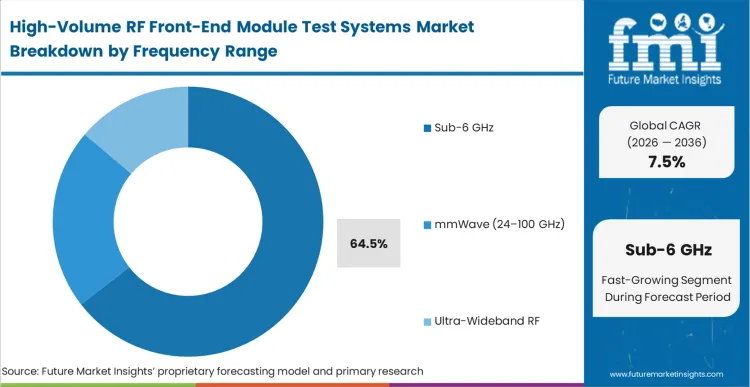
Volume economics continue to support established frequency bands over emerging high-frequency spectrums, especially with the rapid scale-up of IoT production. Semiconductor product managers focus on improving testing efficiency for these mature bands, as even small cost gains can scale significantly at high volumes. Sub-6 GHz is projected to account for a 64.5% share in 2026, driven by the growing number of IoT devices entering production. FMI analysis highlights that despite the attention on high-frequency testing, Sub-6 GHz calibration is becoming more time-intensive due to complex carrier aggregation requirements from telecom operators. The assumption that mature frequencies require less testing is no longer valid, as modules now need to operate across multiple sub-bands at the same time without interference. Foundries ignoring this growing sensor testing complexity face severe yield hits during final assembly qualification, altering the overall RF test systems forecast.
- Volume anchoring: Established protocols dictate baseline testing floors. Product managers secure absolute volume advantages by focusing on IoT and mid-tier smartphone deployments.
- Aggregation complexity: Simultaneous multi-band transmission creates hidden interference vectors. Test engineers discover thermal anomalies only when stressing all operational bands simultaneously.
- Margin compression: Mature technologies face relentless price pressure from device manufacturers. Equipment suppliers must deliver higher throughput to maintain profitability on legacy platforms.
High-Volume RF Front-End Module Test Systems Market Analysis by Device Type Tested
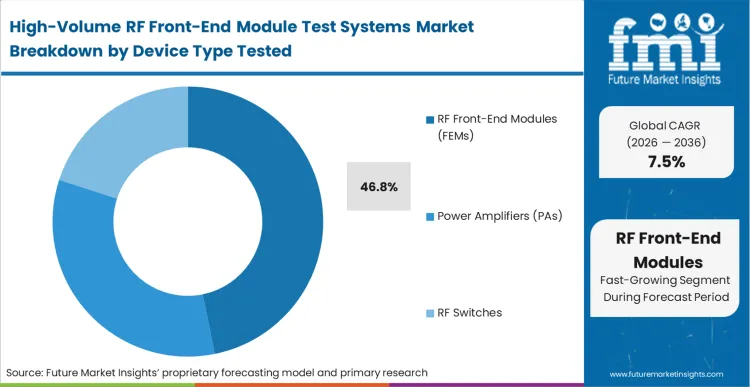
Integration density is pushing component validation deeper into process flows, extending testing beyond individual parts to full-system behavior. Packaging facility managers rely on these systems to detect interaction issues between internal elements that pass wafer-level testing. FMI analysis shows module validation now focuses heavily on thermal behavior, not just functional checks. Heat generated by internal amplifiers during test bursts impacts nearby filters, leading to complete module failure. Manufacturers using sequential discrete testing for highly integrated RF power amplifier modules face significant scrap rates at final assembly stages, highlighting growing RF testing demands and their impact on facility investments. RF Front-End Modules (FEMs) are expected to account for 46.8% of the market in 2026.
- Thermal masking: Dense architectures concentrate heat generation during continuous calibration. Packaging facility managers face elevated false-failure rates if cooling mechanisms cannot match test speeds.
- Yield baseline: Complete module verification establishes final quality gates before shipment. Operators eliminate downstream penalty clauses by intercepting interaction defects early.
- Discrete obsolescence: Individual component characterization loses relevance as integration increases. Facilities must invest in comprehensive module platforms or lose their most profitable contracts.
High-Volume RF Front-End Module Test Systems Market Analysis by End Use
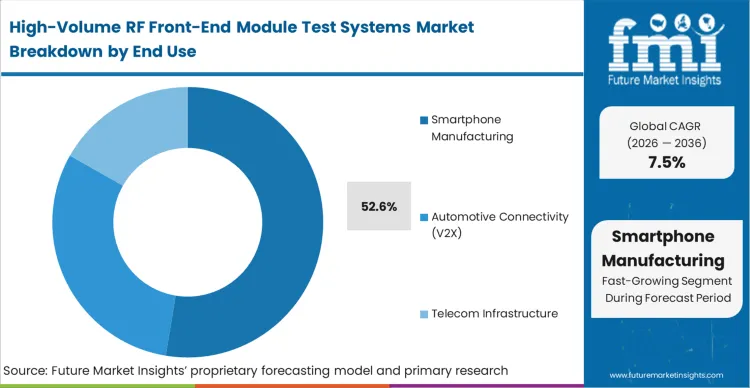
Capital equipment deployment across global supply chains is largely driven by production volumes. The scale and complexity of devices shipped each year place a strong demand on testing infrastructure. Smartphone manufacturing is expected to account for 52.6% of the market in 2026. Production teams at leading contract manufacturers invest heavily in large parallel test setups to meet tight seasonal launch timelines. FMI analysis indicates that equipment demand is influenced more by penalty clauses linked to field failures than by overall phone volumes. This commercial pressure pushes suppliers to carry out more extensive testing, increasing equipment installations beyond standard yield expectations. Suppliers that do not meet OEM testing requirements risk exclusion from future flagship programs, affecting their role in RF testing and broader consumer electronics production.
- Launch windows: Seasonal consumer hardware releases create massive capacity spikes. Production directors authorize aggressive capital expenditures to avoid bottlenecks during peak manufacturing periods.
- Penalty avoidance: Strict vendor quality agreements penalize field failures severely. Suppliers offset this commercial risk by implementing redundant screening protocols across multiple temperature states.
- Capacity overhang: Facilities maintain idle equipment during off-peak months. Managers struggle to justify fixed capital costs when production volumes drop between major product launches.
High-Volume RF Front-End Module Test Systems Market Analysis by Test Stage
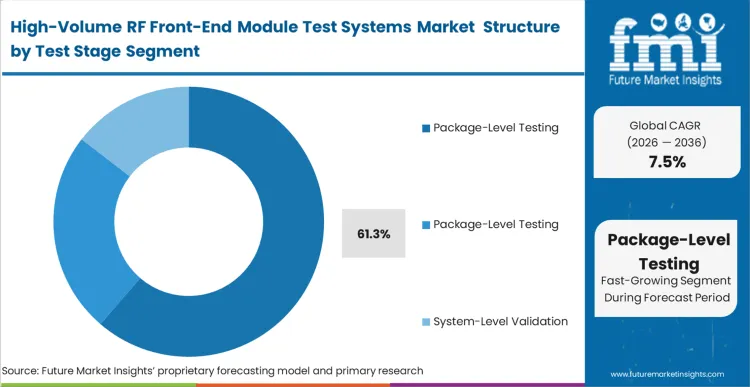
The defect interception strategy defines where capital is allocated across manufacturing lines. Package-Level Testing is expected to hold 61.3% of the market in 2026, acting as a critical checkpoint before components become unusable. Quality teams carry out extensive screening at this stage since failure costs rise sharply once modules move into final assembly. Facilities that treat RF packaging tests as basic functional checks instead of detailed structural validation face major yield losses when units reach system integrators. FMI analysis shows the shift toward System-in-Package formats has led packaging facilities to detect bare-die defects missed during wafer-level testing due to pad pitch limits.
- Defect amplification: Failed components become exponentially more expensive to scrap later in production. Quality assurance heads deploy maximum screening resources immediately after encapsulation.
- Probe limitations: Ultra-fine pitch geometries prevent complete electrical verification at wafer stages. Package-level systems absorb diagnostic burdens previously handled upstream.
- Integration finality: Once sealed, internal module components cannot undergo rework. Operators face total material loss if test parameters fail to capture subtle performance deviations.
High-Volume RF Front-End Module Test Systems Market Drivers, Restraints, and Opportunities
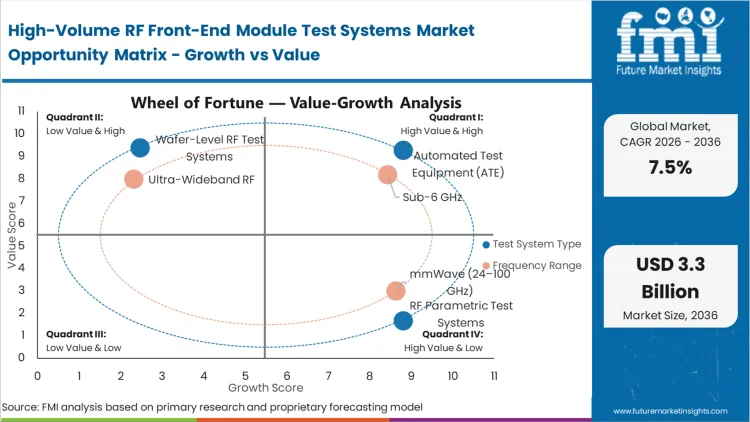
Strict zero-defect quality requirements push OSAT procurement teams to carry out detailed screening across multiple temperature conditions. Telecom operators require deeper carrier aggregation testing to support network density, increasing calibration time for each unit. This raises the baseline testing intensity needed to maintain acceptable yield. Facilities face heavy financial penalties for field failures, leading to higher investment in high-throughput parallel test platforms to protect margins while meeting volume targets. RF cost analysis shows upfront investment in thermal management helps avoid major losses from downstream scrap.
Physical wear in handler contactors reduces overall equipment performance. High-speed insertion damages sensitive RF pins, leading to frequent maintenance and lower throughput. This ongoing wear limits the actual output of parallel testing systems, pushing production teams to install more equipment to meet basic targets. Predictive maintenance software helps manage replacement cycles. Material limitations in contactor durability continue to restrict overall system efficiency.
Opportunities in the High-Volume RF Front-End Module Test Systems Market
- Active thermal contactors: Integrating localized liquid cooling directly into handler blocks prevents false failures during high-speed parallel testing. Test engineering directors eliminate yield degradation caused by heat buildup.
- Digital twin validation: Simulating physical iot chip testing environments allows operators to optimize calibration sequences offline. Facilities boost overall equipment effectiveness by minimizing physical downtime during product changeovers.
- Over-the-air array calibration: Developing specialized chambers for antenna module verification bypasses physical connector limitations. Packaging facility managers achieve accurate high-frequency characterization without relying on fragile physical probes.
Regional Analysis
Based on regional analysis, the high-volume RF front-end module test systems market is segmented into East Asia, South Asia, North America, and Europe across 40-plus countries.
.webp "Top Country Growth Comparison High Volume Rf Front End Module Test Systems Market Cagr (2026 2036)")
| Country | CAGR (2026 to 2036) |
| China | 8.6% |
| India | 8.1% |
| Taiwan | 7.9% |
| South Korea | 7.7% |
| United States | 6.8% |
| Japan | 6.5% |
| Germany | 5.9% |
Source: Future Market Insights (FMI) analysis, based on a proprietary forecasting model and primary research
East Asia High-Volume RF Front-End Module Test Systems Market Analysis
Domestic semiconductor localization mandates shape capital equipment decisions across the region. Government initiatives require fab operators to build independent supply chains, driving faster adoption of advanced screening platforms. FMI analysis shows fab expansion efforts focus on building large-scale capacity instead of specialized capabilities, with a preference for vendors that can deliver quickly at scale. Expanding local fabs closely track RF test equipment size projections to ensure floor plans can support future parallel testing growth and evolving RF testing needs.
- China: Large capital investments in domestic fabrication are driving an 8.6% growth rate. Fab directors focus on equipment that can support high-mix production for consumer devices. Vendors that secure early qualification often gain long-term maintenance contracts, ensuring steady revenue over time.
- Taiwan: Complete dominance of advanced packaging ecosystems propels a 7.9% growth trajectory. OSAT procurement heads demand extreme precision handler integration to support complex multi-chip module verification. Taiwan's operators effectively dictate global testing standards by setting baseline qualification requirements for next-generation platforms.
- South Korea: Memory and logic integration strategies support a 7.7% compound growth rate. Packaging facility managers deploy high-throughput RF platforms alongside advanced memory testers to validate integrated mobile processors. Facilities integrating these capabilities capture premium contracts from flagship device manufacturers.
- Japan: Precision component manufacturing expertise anchors a 6.5% steady growth rate. Test engineering directors focus on ultra-high reliability screening for specialized industrial applications. Vendors meeting these stringent qualification standards often leverage the resulting data to market their systems globally.
South Asia High-Volume RF Front-End Module Test Systems Market Analysis
Smartphone assembly onshoring initiatives are reshaping capital equipment flows into the region. Global electronics manufacturers are setting up local production hubs to serve large domestic markets while avoiding import tariffs. FMI analysis notes that test engineering teams in these new facilities rely on highly automated, turnkey platforms to address the shortage of experienced RF diagnostic personnel. Using a structured RF procurement approach helps these emerging hubs avoid over-provisioning and supports the integration of new AI-based RF testing methods.
- India: Aggressive mobile phone manufacturing subsidies drive an 8.1% compound growth rate. Production directors face immense pressure to scale output rapidly while maintaining global quality standards. Equipment vendors offering intuitive software interfaces and automated yield analytics capture market share by reducing operator training requirements.
North America High-Volume RF Front-End Module Test Systems Market Analysis
Specialized defense and aerospace RF deployments drive testing requirements outside typical consumer cycles. Facility managers focus more on extreme environmental stress testing and validation of sensitive architectures rather than volume metrics. FMI analysis notes that while consumer production shifts offshore, engineering design control remains local, deciding which test platforms overseas partners use. This trend supports the role of domestic validation centers working on mmWave RF testing frameworks.
- United States: Strict defense contractor qualification requirements shape a 6.8% expansion rate. Test engineering directors require highly flexible platforms capable of characterizing classified waveforms and custom module architectures. Equipment suppliers successful in this sector use resulting high-margin revenue to fund research and development for broader commercial applications.
Europe High-Volume RF Front-End Module Test Systems Market Analysis
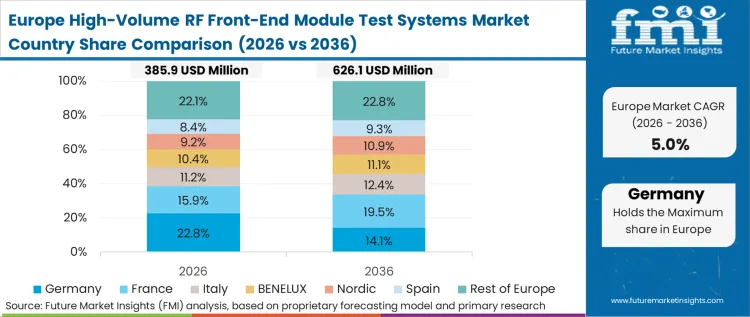
Automotive connectivity investments are shaping how regional testing infrastructure develops. Telematics and autonomous driving programs require reliable validation of complex V2X communication modules. Facility managers focus more on reliability testing than on throughput, since automotive recalls can lead to major financial losses. European automakers closely evaluate RF testing performance before approving any communication module for road use, working with leading RF test equipment providers.
- Germany: High-reliability automotive module production sustains a 5.9% compound growth rate. Quality assurance heads demand extensive thermal cycling integrated directly with RF parametric testing. German operators force equipment vendors to develop specialized handlers capable of managing heavy automotive components without compromising signal integrity.
FMI's report includes detailed analysis of the United Kingdom, France, Brazil, and Southeast Asian manufacturing hubs. Secondary markets exhibit accelerating adoption rates as global electronic test equipment assembly diversifies away from concentrated legacy production centers. Advanced automotive connectivity requirements will continue shaping regional dynamics.
Competitive Aligners for Market Players
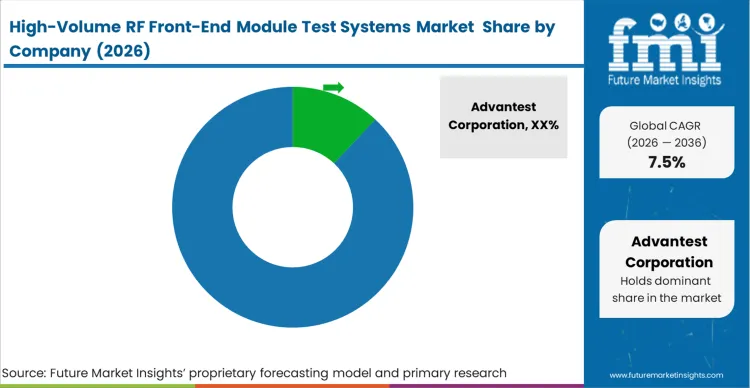
Competitive dynamics follow a high-stakes qualification cycle where software ecosystems matter more than hardware performance. Companies like Advantest Corporation and Teradyne, Inc. hold strong positions not just because of faster testers, but because they offer a continuous software environment from early silicon testing to high-volume production. Test engineering teams rarely approve new platforms if it means rewriting years of existing test code. Competition focuses on control over factory integration systems rather than individual measurement tools. A strong RF supplier comparison depends on full compatibility with existing legacy code.
Established players have large libraries of pre-validated test sequences tailored to specific foundry processes and smartphone OEM requirements. New entrants need to offer reliable tools that can automatically convert existing test programs to their platforms without issues. National Instruments addresses this with modular instrument flexibility, while Keysight Technologies, Inc., builds on its strength in early-stage R&D labs to extend into high-volume production. During internal vendor evaluations, OSATs often disadvantage suppliers that do not provide strong automated code translation capabilities for 5G RF testing.
Large OSATs push back against vendor lock-in by promoting multi-vendor standardization, aiming to separate test software from specific hardware platforms. Procurement teams split orders between main and secondary suppliers to keep pricing leverage during capacity expansion. Vendors respond by subsidizing proprietary handler interfaces, making it costly and difficult to switch to competing systems from a mechanical integration perspective. This ongoing dynamic leads buyers to continuously benchmark RF systems to maintain negotiation leverage.
Key Players in High-Volume RF Front-End Module Test Systems Market
- Advantest Corporation
- Teradyne, Inc.
- Cohu, Inc.
- Chroma ATE Inc.
- National Instruments (NI)
- Keysight Technologies, Inc.
- Rohde & Schwarz GmbH & Co KG
Scope of the Report
| Metric | Value |
| Quantitative Units | USD 1.6 Billion to USD 3.2 Billion, at a CAGR of 7.5% |
| Market Definition | Automated hardware and software platforms verifying electrical performance and signal integrity of radio frequency components at production scale. |
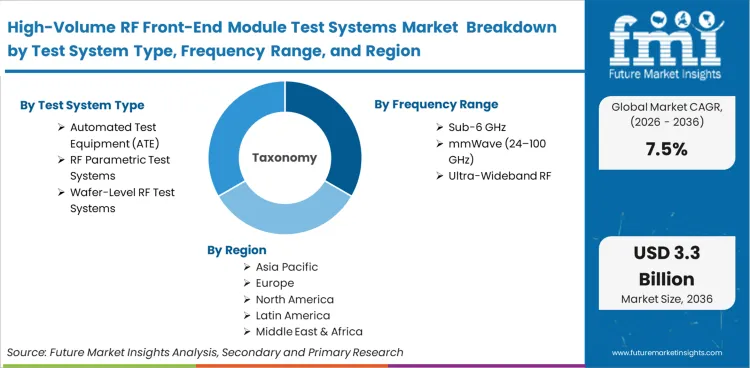
| Segmentation | Test System Type, Frequency Range, Device Type Tested, End Use, Test Stage, and Region |
| Regions Covered | North America, Latin America, Europe, East Asia, South Asia, Oceania, Middle East and Africa |
| Countries Covered | United States, Canada, Brazil, Mexico, Germany, United Kingdom, France, Italy, Spain, China, Japan, South Korea, India, ASEAN, ANZ, GCC |
| Key Companies Profiled | Advantest Corporation, Teradyne, Inc., Cohu, Inc., Chroma ATE Inc., National Instruments (NI), Keysight Technologies, Inc., Rohde & Schwarz GmbH & Co KG |
| Forecast Period | 2026 to 2036 |
| Approach | Installed base replacement cycles and annual semiconductor equipment capital expenditure budgets |
Source: Future Market Insights (FMI) analysis, based on proprietary forecasting model and primary research
High-Volume RF Front-End Module Test Systems Market Analysis by Segments
Test System Type:
- Automated Test Equipment (ATE)
- RF Parametric Test Systems
- Wafer-Level RF Test Systems
- Final Test & System-Level Platforms
Frequency Range:
- Sub-6 GHz
- mmWave (24-100 GHz)
- Ultra-Wideband RF
Device Type Tested:
- RF Front-End Modules (FEMs)
- Power Amplifiers (PAs)
- RF Switches
- Antenna Tuners
- Filters & Duplexers
End Use:
- Smartphone Manufacturing
- IoT & Wearables
- Automotive Connectivity (V2X)
- Telecom Infrastructure
Test Stage:
- Wafer-Level Testing
- Package-Level Testing
- System-Level Validation
Region:
- North America
- Latin America
- Europe
- East Asia
- South Asia
- Oceania
- Middle East and Africa
Bibliography
- Advantest Corporation. (2025, February). Annual report 2024.
- Teradyne, Inc. (2025, March). Form 10-K annual report.
- Keysight Technologies. (2024, November). 5G RF design and test challenges.
- Rohde & Schwarz. (2024, October). 5G mmWave measurement fundamentals.
- IEEE. (2024). RF front-end module testing for 5G and beyond. IEEE Transactions on Microwave Theory and Techniques.
- Semiconductor Industry Association. (2025, January). 2024 semiconductor industry outlook.
- 3GPP. (2024). NR; base station radio transmission and reception.
- USA International Trade Commission. (2025). Semiconductor equipment trade statistics.
- National Institute of Standards and Technology. (2024). RF measurement calibration standards.
- OpenPR. (2026, February). Vertical Probe Cards Market Set to Witness Expansion.
This bibliography is provided for reader reference. The full FMI report contains the complete reference list with primary source documentation.
Frequently Asked Questions
What is the projected value of the market in 2036?
Valuation reaches USD 3.2 billion by 2036. This doubling reflects a permanent increase in baseline test intensity as 5G Advanced modules require exponential increases in multi-band parallel calibration.
What is the expected compound annual growth rate?
Sector advances at 7.5% annually. Strict zero-defect clauses from smartphone manufacturers compel packaging facilities to invest heavily in parallel validation platforms to protect final assembly margins.
Why does Automated Test Equipment (ATE) dominate the system type segment?
Legacy factory floor architecture dictates ongoing procurement. Facilities prioritize existing codebase compatibility to avoid catastrophic downtime associated with rewriting decades of proprietary testing protocols.
Why do Sub-6 GHz frequencies maintain the largest share?
Absolute production volume remains concentrated here. Massive IoT deployments and mid-tier smartphone manufacturing rely on established bands, securing long-term testing demand despite headlines focusing on high-frequency spectrums.
Why do RF Front-End Modules lead device testing?
Integration density concentrates performance risk at module levels. Individual components might pass earlier probes, but operators must verify thermal and signal interactions when these elements operate simultaneously in compact formats.
Why does smartphone manufacturing account for the majority of end use?
Strict seasonal release windows define capital equipment cycles. Contract manufacturers over-provision testing capacity to meet intense production spikes, avoiding massive financial penalties for missing flagship device launch dates.
Why is package-level testing critical to facility yields?
Ultra-fine geometries prevent complete electrical characterization at wafer stages. Screening immediately after encapsulation intercepts defects before modules enter highly expensive final device integration processes.
Why does China lead regional growth metrics?
Aggressive domestic semiconductor localization mandates drive rapid fab equipping. Facilities prioritize massive parallel test capacity to scale output independently of foreign supply chains.
What distinguishes Taiwan's operational approach?
Advanced packaging expertise anchors ecosystems. Local operators dictate global equipment standards by enforcing extreme precision requirements for multi-chip module handling and signal verification.
What barrier restricts new vendor entry?
Software architecture lock-in creates extreme switching costs. Challengers must deliver seamless codebase translation tools, as superior hardware performance alone cannot justify expenses of rewriting facility-wide testing sequences.
How do OSATs mitigate vendor pricing power?
Procurement heads enforce multi-vendor standardization initiatives. By splitting handler orders across different suppliers, facilities abstract software layers and maintain negotiating leverage during major capacity expansions.
What operational friction degrades throughput models?
Physical contactor wear remains a persistent limitation. High-speed mechanical handler insertion damages delicate RF pins over time, forcing constant recalibration stops that reduce overall equipment effectiveness.
How do thermal constraints impact testing strategies?
Parallel calibration generates extreme localized heat. Facilities must implement active liquid cooling directly into contactor blocks to prevent thermal-induced false failures during continuous production runs.
Why is India expanding testing capacity so rapidly?
Subsidized mobile assembly onshoring forces rapid ecosystem development. Operators require highly automated, turnkey validation platforms to maintain global quality standards despite local shortages in specialized diagnostic personnel.
How does North America differ from Asian manufacturing hubs?
Defense and aerospace deployments dictate regional capital expenditure. Engineering directors prioritize extreme environmental stress screening and classified waveform characterization over absolute consumer volume metrics.
What drives demand in the German market?
Automotive connectivity initiatives mandate fail-safe component verification. Stringent V2X communication standards compel operators to integrate extensive thermal cycling with high-frequency parametric validation.
What role does digital twin technology play?
Simulated environments allow operators to optimize calibration sequences offline. Facilities minimize physical downtime during product changeovers, significantly boosting daily throughput capabilities.
Why do equipment suppliers subsidize handler interfaces?
Proprietary mechanical connections reinforce vendor lock-in. By reducing initial integration costs, suppliers make transitioning to competing test setups prohibitively expensive for packaging facilities.
How do carrier aggregation requirements affect test duration?
Simultaneous multi-band transmission testing increases exponentially. Engineers must verify complex interference vectors, discovering critical thermal anomalies only when stressing all operational bands simultaneously.
Why are standalone thermal chambers excluded from this analysis?
Basic environmental stress screening lacks active functional validation. Comprehensive RF testing requires simultaneous signal injection and high-speed handler integration during temperature cycling.
What limits the adoption of standalone parametric systems?
Bifurcated test floors complicate factory automation. While parametric systems offer superior millimeter-wave characterization, integrating them alongside legacy ATE lines requires complex physical routing and data management.
How do zero-defect agreements influence equipment density?
Punitive commercial structures force redundant verification. Suppliers deploy extensive parallel screening capabilities simply to intercept marginal components that could trigger massive financial penalties upon field failure.
Preview the report firsthand - request a free sample
Get SampleGet the brochure for pricing and purchase details.
Get PDFTable of Content
- Executive Summary
- Global Market Outlook
- Demand-side Trends
- Supply-side Trends
- Technology Roadmap Analysis
- Analysis and Recommendations
- Market Overview
- Market Coverage / Taxonomy
- Market Definition / Scope / Limitations
- Research Methodology
- Chapter Orientation
- Analytical Lens and Working Hypotheses
- Market Structure, Signals, and Trend Drivers
- Benchmarking and Cross-market Comparability
- Market Sizing, Forecasting, and Opportunity Mapping
- Research Design and Evidence Framework
- Desk Research Programme (Secondary Evidence)
- Company Annual and Sustainability Reports
- Peer-reviewed Journals and Academic Literature
- Corporate Websites, Product Literature, and Technical Notes
- Earnings Decks and Investor Briefings
- Statutory Filings and Regulatory Disclosures
- Technical White Papers and Standards Notes
- Trade Journals, Industry Magazines, and Analyst Briefs
- Conference Proceedings, Webinars, and Seminar Materials
- Government Statistics Portals and Public Data Releases
- Press Releases and Reputable Media Coverage
- Specialist Newsletters and Curated Briefings
- Sector Databases and Reference Repositories
- FMI Internal Proprietary Databases and Historical Market Datasets
- Subscription Datasets and Paid Sources
- Social Channels, Communities, and Digital Listening Inputs
- Additional Desk Sources
- Expert Input and Fieldwork (Primary Evidence)
- Primary Modes
- Qualitative Interviews and Expert Elicitation
- Quantitative Surveys and Structured Data Capture
- Blended Approach
- Why Primary Evidence is Used
- Field Techniques
- Interviews
- Surveys
- Focus Groups
- Observational and In-context Research
- Social and Community Interactions
- Stakeholder Universe Engaged
- C-suite Leaders
- Board Members
- Presidents and Vice Presidents
- R&D and Innovation Heads
- Technical Specialists
- Domain Subject-matter Experts
- Scientists
- Physicians and Other Healthcare Professionals
- Governance, Ethics, and Data Stewardship
- Research Ethics
- Data Integrity and Handling
- Primary Modes
- Tooling, Models, and Reference Databases
- Desk Research Programme (Secondary Evidence)
- Data Engineering and Model Build
- Data Acquisition and Ingestion
- Cleaning, Normalisation, and Verification
- Synthesis, Triangulation, and Analysis
- Quality Assurance and Audit Trail
- Market Background
- Market Dynamics
- Drivers
- Restraints
- Opportunity
- Trends
- Scenario Forecast
- Demand in Optimistic Scenario
- Demand in Likely Scenario
- Demand in Conservative Scenario
- Opportunity Map Analysis
- Product Life Cycle Analysis
- Supply Chain Analysis
- Investment Feasibility Matrix
- Value Chain Analysis
- PESTLE and Porter’s Analysis
- Regulatory Landscape
- Regional Parent Market Outlook
- Production and Consumption Statistics
- Import and Export Statistics
- Market Dynamics
- Global Market Analysis 2021 to 2025 and Forecast, 2026 to 2036
- Historical Market Size Value (USD Million) Analysis, 2021 to 2025
- Current and Future Market Size Value (USD Million) Projections, 2026 to 2036
- Y-o-Y Growth Trend Analysis
- Absolute $ Opportunity Analysis
- Global Market Pricing Analysis 2021 to 2025 and Forecast 2026 to 2036
- Global Market Analysis 2021 to 2025 and Forecast 2026 to 2036, By Test System Type
- Introduction / Key Findings
- Historical Market Size Value (USD Million) Analysis By Test System Type , 2021 to 2025
- Current and Future Market Size Value (USD Million) Analysis and Forecast By Test System Type , 2026 to 2036
- Automated Test Equipment (ATE)
- RF Parametric Test Systems
- Wafer-Level RF Test Systems
- Automated Test Equipment (ATE)
- Y-o-Y Growth Trend Analysis By Test System Type , 2021 to 2025
- Absolute $ Opportunity Analysis By Test System Type , 2026 to 2036
- Global Market Analysis 2021 to 2025 and Forecast 2026 to 2036, By Frequency Range
- Introduction / Key Findings
- Historical Market Size Value (USD Million) Analysis By Frequency Range, 2021 to 2025
- Current and Future Market Size Value (USD Million) Analysis and Forecast By Frequency Range, 2026 to 2036
- Sub-6 GHz
- mmWave (24-100 GHz)
- Ultra-Wideband RF
- Sub-6 GHz
- Y-o-Y Growth Trend Analysis By Frequency Range, 2021 to 2025
- Absolute $ Opportunity Analysis By Frequency Range, 2026 to 2036
- Global Market Analysis 2021 to 2025 and Forecast 2026 to 2036, By Device Type Tested
- Introduction / Key Findings
- Historical Market Size Value (USD Million) Analysis By Device Type Tested, 2021 to 2025
- Current and Future Market Size Value (USD Million) Analysis and Forecast By Device Type Tested, 2026 to 2036
- RF Front-End Modules (FEMs)
- Power Amplifiers (PAs)
- RF Switches
- RF Front-End Modules (FEMs)
- Y-o-Y Growth Trend Analysis By Device Type Tested, 2021 to 2025
- Absolute $ Opportunity Analysis By Device Type Tested, 2026 to 2036
- Global Market Analysis 2021 to 2025 and Forecast 2026 to 2036, By End Use
- Introduction / Key Findings
- Historical Market Size Value (USD Million) Analysis By End Use, 2021 to 2025
- Current and Future Market Size Value (USD Million) Analysis and Forecast By End Use, 2026 to 2036
- Smartphone Manufacturing
- Automotive Connectivity (V2X)
- Telecom Infrastructure
- Smartphone Manufacturing
- Y-o-Y Growth Trend Analysis By End Use, 2021 to 2025
- Absolute $ Opportunity Analysis By End Use, 2026 to 2036
- Global Market Analysis 2021 to 2025 and Forecast 2026 to 2036, By Test Stage
- Introduction / Key Findings
- Historical Market Size Value (USD Million) Analysis By Test Stage, 2021 to 2025
- Current and Future Market Size Value (USD Million) Analysis and Forecast By Test Stage, 2026 to 2036
- Package-Level Testing
- Package-Level Testing
- System-Level Validation
- Package-Level Testing
- Y-o-Y Growth Trend Analysis By Test Stage, 2021 to 2025
- Absolute $ Opportunity Analysis By Test Stage, 2026 to 2036
- Global Market Analysis 2021 to 2025 and Forecast 2026 to 2036, By Region
- Introduction
- Historical Market Size Value (USD Million) Analysis By Region, 2021 to 2025
- Current Market Size Value (USD Million) Analysis and Forecast By Region, 2026 to 2036
- North America
- Latin America
- Western Europe
- Eastern Europe
- East Asia
- South Asia and Pacific
- Middle East & Africa
- Market Attractiveness Analysis By Region
- North America Market Analysis 2021 to 2025 and Forecast 2026 to 2036, By Country
- Historical Market Size Value (USD Million) Trend Analysis By Market Taxonomy, 2021 to 2025
- Market Size Value (USD Million) Forecast By Market Taxonomy, 2026 to 2036
- By Country
- USA
- Canada
- Mexico
- By Test System Type
- By Frequency Range
- By Device Type Tested
- By End Use
- By Test Stage
- By Country
- Market Attractiveness Analysis
- By Country
- By Test System Type
- By Frequency Range
- By Device Type Tested
- By End Use
- By Test Stage
- Key Takeaways
- Latin America Market Analysis 2021 to 2025 and Forecast 2026 to 2036, By Country
- Historical Market Size Value (USD Million) Trend Analysis By Market Taxonomy, 2021 to 2025
- Market Size Value (USD Million) Forecast By Market Taxonomy, 2026 to 2036
- By Country
- Brazil
- Chile
- Rest of Latin America
- By Test System Type
- By Frequency Range
- By Device Type Tested
- By End Use
- By Test Stage
- By Country
- Market Attractiveness Analysis
- By Country
- By Test System Type
- By Frequency Range
- By Device Type Tested
- By End Use
- By Test Stage
- Key Takeaways
- Western Europe Market Analysis 2021 to 2025 and Forecast 2026 to 2036, By Country
- Historical Market Size Value (USD Million) Trend Analysis By Market Taxonomy, 2021 to 2025
- Market Size Value (USD Million) Forecast By Market Taxonomy, 2026 to 2036
- By Country
- Germany
- UK
- Italy
- Spain
- France
- Nordic
- BENELUX
- Rest of Western Europe
- By Test System Type
- By Frequency Range
- By Device Type Tested
- By End Use
- By Test Stage
- By Country
- Market Attractiveness Analysis
- By Country
- By Test System Type
- By Frequency Range
- By Device Type Tested
- By End Use
- By Test Stage
- Key Takeaways
- Eastern Europe Market Analysis 2021 to 2025 and Forecast 2026 to 2036, By Country
- Historical Market Size Value (USD Million) Trend Analysis By Market Taxonomy, 2021 to 2025
- Market Size Value (USD Million) Forecast By Market Taxonomy, 2026 to 2036
- By Country
- Russia
- Poland
- Hungary
- Balkan & Baltic
- Rest of Eastern Europe
- By Test System Type
- By Frequency Range
- By Device Type Tested
- By End Use
- By Test Stage
- By Country
- Market Attractiveness Analysis
- By Country
- By Test System Type
- By Frequency Range
- By Device Type Tested
- By End Use
- By Test Stage
- Key Takeaways
- East Asia Market Analysis 2021 to 2025 and Forecast 2026 to 2036, By Country
- Historical Market Size Value (USD Million) Trend Analysis By Market Taxonomy, 2021 to 2025
- Market Size Value (USD Million) Forecast By Market Taxonomy, 2026 to 2036
- By Country
- China
- Japan
- South Korea
- By Test System Type
- By Frequency Range
- By Device Type Tested
- By End Use
- By Test Stage
- By Country
- Market Attractiveness Analysis
- By Country
- By Test System Type
- By Frequency Range
- By Device Type Tested
- By End Use
- By Test Stage
- Key Takeaways
- South Asia and Pacific Market Analysis 2021 to 2025 and Forecast 2026 to 2036, By Country
- Historical Market Size Value (USD Million) Trend Analysis By Market Taxonomy, 2021 to 2025
- Market Size Value (USD Million) Forecast By Market Taxonomy, 2026 to 2036
- By Country
- India
- ASEAN
- Australia & New Zealand
- Rest of South Asia and Pacific
- By Test System Type
- By Frequency Range
- By Device Type Tested
- By End Use
- By Test Stage
- By Country
- Market Attractiveness Analysis
- By Country
- By Test System Type
- By Frequency Range
- By Device Type Tested
- By End Use
- By Test Stage
- Key Takeaways
- Middle East & Africa Market Analysis 2021 to 2025 and Forecast 2026 to 2036, By Country
- Historical Market Size Value (USD Million) Trend Analysis By Market Taxonomy, 2021 to 2025
- Market Size Value (USD Million) Forecast By Market Taxonomy, 2026 to 2036
- By Country
- Kingdom of Saudi Arabia
- Other GCC Countries
- Turkiye
- South Africa
- Other African Union
- Rest of Middle East & Africa
- By Test System Type
- By Frequency Range
- By Device Type Tested
- By End Use
- By Test Stage
- By Country
- Market Attractiveness Analysis
- By Country
- By Test System Type
- By Frequency Range
- By Device Type Tested
- By End Use
- By Test Stage
- Key Takeaways
- Key Countries Market Analysis
- USA
- Pricing Analysis
- Market Share Analysis, 2025
- By Test System Type
- By Frequency Range
- By Device Type Tested
- By End Use
- By Test Stage
- Canada
- Pricing Analysis
- Market Share Analysis, 2025
- By Test System Type
- By Frequency Range
- By Device Type Tested
- By End Use
- By Test Stage
- Mexico
- Pricing Analysis
- Market Share Analysis, 2025
- By Test System Type
- By Frequency Range
- By Device Type Tested
- By End Use
- By Test Stage
- Brazil
- Pricing Analysis
- Market Share Analysis, 2025
- By Test System Type
- By Frequency Range
- By Device Type Tested
- By End Use
- By Test Stage
- Chile
- Pricing Analysis
- Market Share Analysis, 2025
- By Test System Type
- By Frequency Range
- By Device Type Tested
- By End Use
- By Test Stage
- Germany
- Pricing Analysis
- Market Share Analysis, 2025
- By Test System Type
- By Frequency Range
- By Device Type Tested
- By End Use
- By Test Stage
- UK
- Pricing Analysis
- Market Share Analysis, 2025
- By Test System Type
- By Frequency Range
- By Device Type Tested
- By End Use
- By Test Stage
- Italy
- Pricing Analysis
- Market Share Analysis, 2025
- By Test System Type
- By Frequency Range
- By Device Type Tested
- By End Use
- By Test Stage
- Spain
- Pricing Analysis
- Market Share Analysis, 2025
- By Test System Type
- By Frequency Range
- By Device Type Tested
- By End Use
- By Test Stage
- France
- Pricing Analysis
- Market Share Analysis, 2025
- By Test System Type
- By Frequency Range
- By Device Type Tested
- By End Use
- By Test Stage
- India
- Pricing Analysis
- Market Share Analysis, 2025
- By Test System Type
- By Frequency Range
- By Device Type Tested
- By End Use
- By Test Stage
- ASEAN
- Pricing Analysis
- Market Share Analysis, 2025
- By Test System Type
- By Frequency Range
- By Device Type Tested
- By End Use
- By Test Stage
- Australia & New Zealand
- Pricing Analysis
- Market Share Analysis, 2025
- By Test System Type
- By Frequency Range
- By Device Type Tested
- By End Use
- By Test Stage
- China
- Pricing Analysis
- Market Share Analysis, 2025
- By Test System Type
- By Frequency Range
- By Device Type Tested
- By End Use
- By Test Stage
- Japan
- Pricing Analysis
- Market Share Analysis, 2025
- By Test System Type
- By Frequency Range
- By Device Type Tested
- By End Use
- By Test Stage
- South Korea
- Pricing Analysis
- Market Share Analysis, 2025
- By Test System Type
- By Frequency Range
- By Device Type Tested
- By End Use
- By Test Stage
- Russia
- Pricing Analysis
- Market Share Analysis, 2025
- By Test System Type
- By Frequency Range
- By Device Type Tested
- By End Use
- By Test Stage
- Poland
- Pricing Analysis
- Market Share Analysis, 2025
- By Test System Type
- By Frequency Range
- By Device Type Tested
- By End Use
- By Test Stage
- Hungary
- Pricing Analysis
- Market Share Analysis, 2025
- By Test System Type
- By Frequency Range
- By Device Type Tested
- By End Use
- By Test Stage
- Kingdom of Saudi Arabia
- Pricing Analysis
- Market Share Analysis, 2025
- By Test System Type
- By Frequency Range
- By Device Type Tested
- By End Use
- By Test Stage
- Turkiye
- Pricing Analysis
- Market Share Analysis, 2025
- By Test System Type
- By Frequency Range
- By Device Type Tested
- By End Use
- By Test Stage
- South Africa
- Pricing Analysis
- Market Share Analysis, 2025
- By Test System Type
- By Frequency Range
- By Device Type Tested
- By End Use
- By Test Stage
- USA
- Market Structure Analysis
- Competition Dashboard
- Competition Benchmarking
- Market Share Analysis of Top Players
- By Regional
- By Test System Type
- By Frequency Range
- By Device Type Tested
- By End Use
- By Test Stage
- Competition Analysis
- Competition Deep Dive
- Advantest Corporation
- Overview
- Product Portfolio
- Profitability by Market Segments (Product/Age /Sales Channel/Region)
- Sales Footprint
- Strategy Overview
- Marketing Strategy
- Product Strategy
- Channel Strategy
- Teradyne, Inc.
- Cohu, Inc.
- Chroma ATE Inc.
- National Instruments (NI)
- Keysight Technologies, Inc.
- Advantest Corporation
- Competition Deep Dive
- Assumptions & Acronyms Used


