

- Market Size (2026)
- USD 756.2 Mn
- Forecast (2036)
- USD 1891.2 Mn
- CAGR (2026 to 2036)
- 9.6%
Space Situational Awareness Sensor and Tracking Performance Test Systems Market Size, Market Forecast and Outlook By FMI
Summary of Space Situational Awareness Sensor and Tracking Performance Test Systems Market
- Demand and growth drivers
- Orbital congestion is increasing the need for trusted validation before sensor networks move into active surveillance service.
- Small satellite growth is expanding the number of objects that must be detected and tracked with dependable pointing accuracy.
- Defense and civil agencies invest in space safety programs that require repeatable optical and radar sensor checks.
- Product and segment view
- Optical telescope systems lead the sensor base because deep space observation and catalog upkeep require precise imaging performance.
- Calibration and alignment lead test activity because sensor pointing error can weaken later tracking results.
- Government entities are the largest demand center because national surveillance duties carry the heaviest test burden.
- Geography and competitive outlook
- China and the United States are central demand centers because both countries pair national security programs with large space activity bases.
- Brazil and South Korea show faster expansion because both are building capability and adding new surveillance assets.
- Suppliers that combine optical precision and network integration support are likely to hold a stronger position.
- Analyst Opinion
- Nikhil Kaitwade, Principal Consultant at FMI says, “Suppliers that can improve calibration reliability and cross-sensor validation efficiency while supporting government and integrator-led SSA programs are likely to strengthen their position over the forecast period.”
- Market Value Analysis
- The market is moving from program-specific tooling toward more repeatable validation platforms used across multiple tracking architectures.
- Demand is strongest in systems that improve pointing accuracy, measurement confidence, and sensor-to-sensor consistency.
- Growth also reflects a wider need to validate optical, radar, RF, and hybrid benches before they feed operational awareness networks.
- Public funding remains the main support base because national agencies still carry the largest burden for orbital safety work.
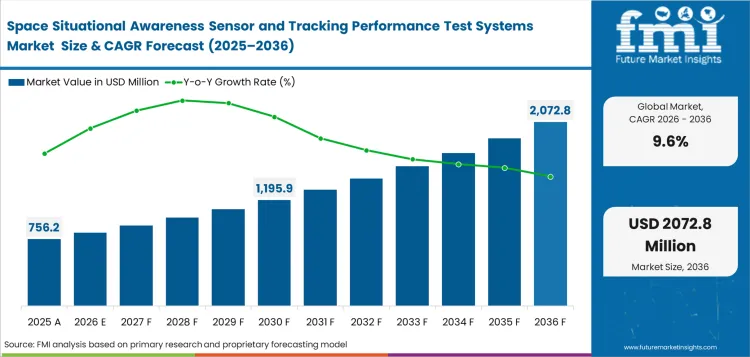
Key Takeaways, Market Size, and Forecast
- The space situational awareness sensor and tracking performance test systems market was valued at USD 690.0 million in 2025.
- Demand is expected to reach USD 1,891.2 million by 2036.
- The forecast period implies a 9.6% CAGR from 2026 to 2036.
- The market creates an incremental opportunity of USD 1,135.0 million during the forecast period.
- Ground test ranges are expected to account for 46.0% of deployment mode demand in 2026 because high fidelity tracking trials still rely on dedicated range infrastructure.
- China at 11.2% and Brazil at 10.6% are the fastest growing country demand pools in this assessment.
Market Definition
The market includes equipment and software used to verify sensing performance for space object detection, tracking, and characterization. It covers optical, radar, RF, and hybrid validation setups used to test calibration accuracy, pointing precision, motion tracking quality, signal integrity, and multi-sensor data fusion before operational deployment.
Market Inclusions
Scope includes optical telescope test benches, phased-array radar validation systems, passive RF evaluation tools, laser ranging calibration setups, timing and synchronization hardware, motion simulation rigs, data fusion validation software, and field verification systems used for space situational awareness programs.
Market Exclusions
Scope excludes general satellite manufacturing equipment, launch systems, broad mission control software, routine observatory hardware sold without dedicated test function, and standard laboratory instruments that are not configured for SSA sensor performance work.
Market Research Methodology
- Primary Research: The assessment was framed around current SSA program language, active supplier positioning, and public evidence from defense and civil space initiatives.
- Desk Research: Public material from FMI, ISRO, ESA, NASA, LeoLabs, and L3Harris was used to map demand direction and recent capability additions.
- Market Sizing and Forecasting: The 2025 value was back calculated from the current FMI 2026 estimate and the published ten year CAGR, while segment shares were aligned to the live FMI target page and extended through closely matched test workflow assumptions.
- Data Validation and Update Cycle: Figures were checked against CAGR math, parent SSA market scale, supplier breadth, and current country level space monitoring activity.
Why is the market growing?
- Rising satellite congestion is lifting the value of sensor verification because tracking errors can weaken conjunction assessment and collision avoidance work.
- More mixed sensor networks are being deployed and that raises the need for careful fusion testing across optical, radar, and RF assets.
- Public safety and defense programs are increasing their demand for validated instruments that can support reliable catalog maintenance and object monitoring.
Growth is supported by heavier orbital traffic and the need for trusted surveillance data. Demand rises with congestion and constellation growth. Accurate tracking of space objects carries more value. Current sector evidence supports this direction. Programs tied to space situational awareness and small satellite deployment are increasing the number of sensors that must be checked before they enter operational service.
Demand is increasing because users need to prove accuracy across more than one sensor type. Optical telescopes need precise alignment and stable motion tracking. Radar systems need stable RF behavior and interference control. Hybrid benches need synchronized inputs that keep correlation errors low during joint observation trials. This is pushing users toward integrated validation assets. Single lab setups carry less value in this environment.
Capital burden slows wider rollout in smaller programs. High precision light sources and motion simulators raise setup cost. Timing hardware adds more cost pressure. Regional access to test ranges is uneven. Demand is strongest in countries that already fund national surveillance programs or host large research and defense centers.
Market Segmentation Analysis
- Ground test ranges are expected to account for 46.0% of deployment mode demand in 2026 because full motion tracking checks still need controlled range assets and calibrated observation geometry.
- Government entities are expected to represent 44.0% of end use demand in 2026 because national agencies fund the heaviest sustained surveillance and debris monitoring workload.
- LEO tracking is expected to account for 39.0% of target orbit demand in 2026 because dense traffic in low Earth orbit requires frequent validation of tracking continuity and object classification.
- Optical telescope systems are expected to hold 34.0% of sensor type demand in 2026 because they remain the main tool for high resolution object observation across large orbital volumes.
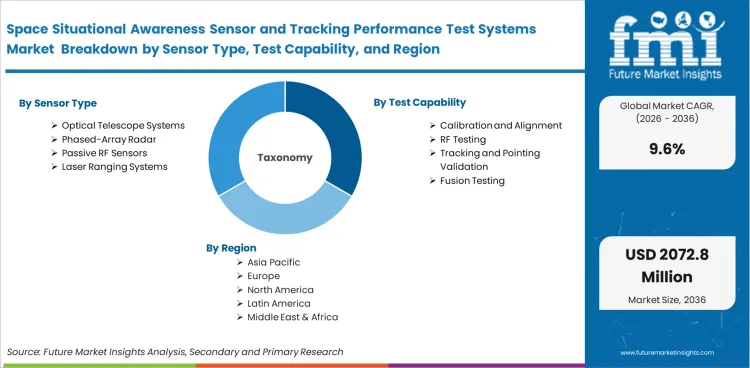
The market for space situational awareness sensor and tracking performance test systems is divided into groups based on sensor type, test capability, end user, deployment mode, target orbit, validation modality, and region. There are Optical Telescope Systems, Phased-Array Radar, Passive RF Sensors, and Laser Ranging Systems by sensor type. By end user, the market covers government entities, system integrators, commercial SSA providers, and universities.
Insights into the Sensor Type Segment
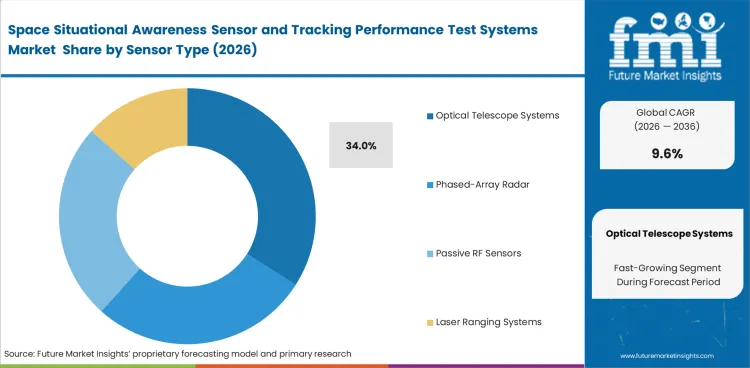
- In 2026, optical telescope systems will make up 34.0% of the market. The largest sub segment is deep space optical tracking, where sharp imaging and stable pointing support catalog maintenance and long range object observation.
- Phased array radar is a major sub segment because all weather detection supports active tracking missions. Passive RF sensors help identify transmitting targets. Laser ranging supports precise orbit refinement work.
Insights into the Test Capability Segment
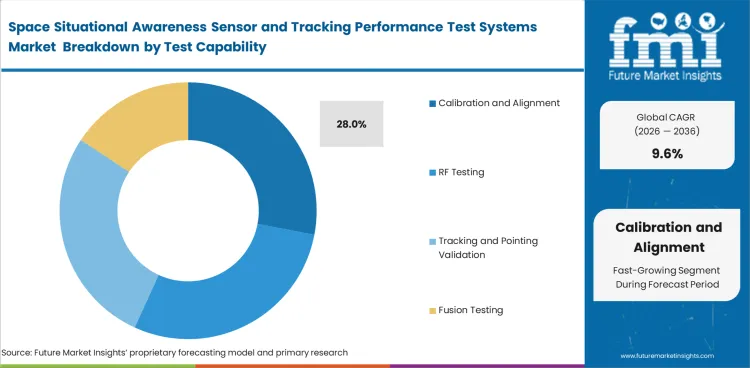
- In 2026, calibration and alignment will make up 28.0% of the market. This sub segment leads because small pointing errors can reduce detection quality across long observation windows and weaken later tracking performance.
- RF testing holds an equal share in current FMI data. Calibration and alignment is the headline sub segment in this format. Tracking and pointing validation supports dynamic motion checks. Fusion testing is gaining importance as mixed sensor networks expand.
Insights into the End User Segment
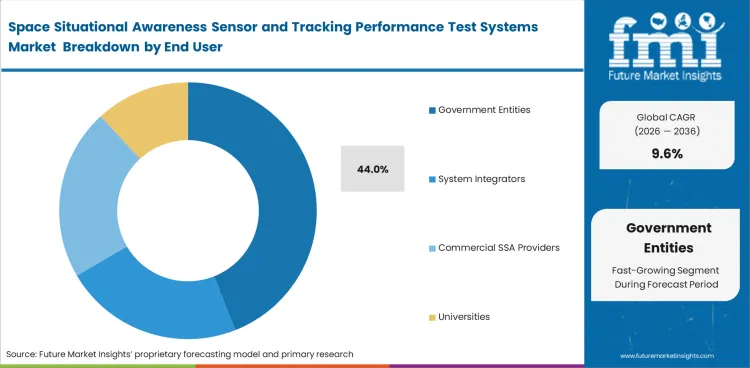
- In 2026, government entities will make up 44.0% of the market. The biggest sub segment is national surveillance and debris monitoring programs, where public agencies fund the largest recurring validation workload.
- System integrators are the next major demand center because they connect optical and radar assets into operational chains. Commercial SSA providers are expanding their role. Universities continue to support pilot testing and sensor research.
Insights into the Deployment Mode Segment
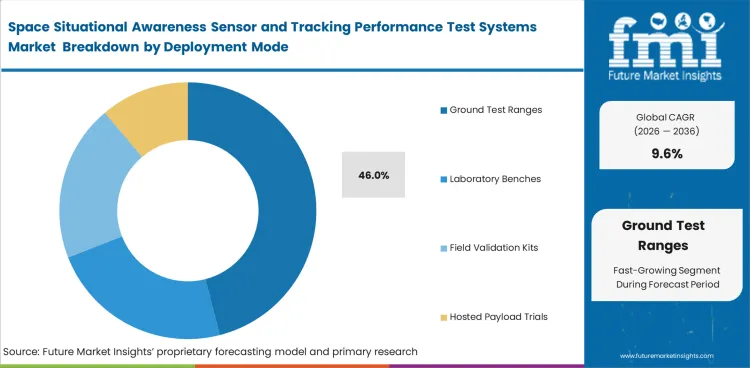
- In 2026, ground test ranges will make up 46.0% of the market. This leading sub segment supports wide angle tracking drills and realistic motion simulation under controlled observation conditions.
- Laboratory benches are important for calibration and subsystem validation before larger trials begin. Field validation kits support installed system checks. Hosted payload trials are smaller because their use is more program specific.
Insights into the Target Orbit Segment
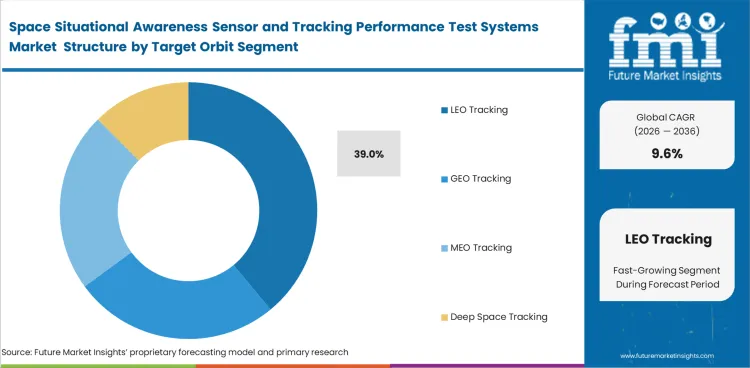
- In 2026, LEO tracking will make up 39.0% of the market. This sub segment leads because dense constellation traffic and debris activity keep low Earth orbit at the center of validation demand.
- GEO tracking is important for high value asset monitoring and continuity checks. MEO and deep space tracking absorb targeted spending in programs that require precise long range observation and orbit refinement.
Insights into the Modality Segment
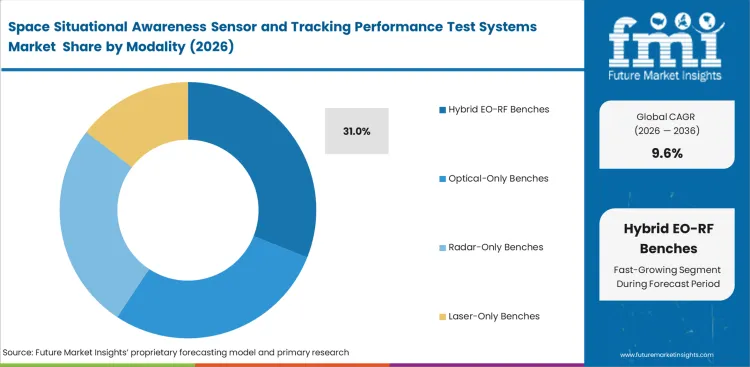
- In 2026, hybrid EO RF benches will make up 31.0% of the market. This leading sub segment allows users to compare optical observations with radio frequency tracking outputs in one validation setup.
- Optical only benches are close behind because telescope based awareness programs have a large installed base. Radar benches support all weather verification. Laser benches focus on ranging and precise orbit measurement.
Space Situational Awareness Sensor and Tracking Performance Test Systems Market Drivers, Restraints, and Opportunities
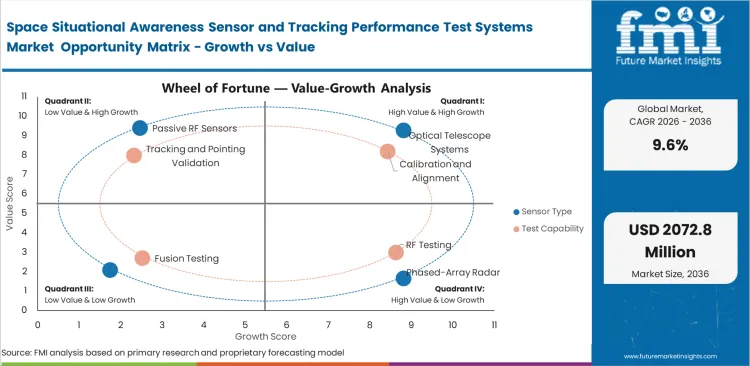
- Rising orbital congestion and the expansion of satellite constellations are increasing the need for validated sensor systems that can support reliable tracking and collision assessment.
- High setup costs for precision light sources and motion simulators limit adoption in smaller programs. This keeps demand concentrated in countries with established surveillance budgets and test infrastructure.
- Wider use of optical and radar sensor networks is creating new opportunities for integrated validation platforms that improve calibration accuracy and tracking confidence.
The space situational awareness sensor and tracking performance test systems market is expanding because orbital traffic is increasing and surveillance networks need trusted validation before operational deployment. Demand benefits from the rise of mixed sensor architectures that require careful calibration and repeatable tracking verification. High capital requirements are a barrier. Opportunity is building in government surveillance programs and integrated validation environments.
Orbital Congestion and Validation Demand
Demand is rising because more satellites and debris objects are increasing the need for dependable tracking performance. Sensor operators need systems that can verify pointing accuracy and motion tracking quality before assets move into live surveillance roles. This makes validation work more important across optical and radar monitoring programs.
Capital Burden and Infrastructure Constraints
Adoption is limited by the high cost of precision validation infrastructure. Motion simulators and synchronization hardware raise project budgets and make entry harder for smaller users. Demand is strongest in government programs and research centers that already support dedicated test ranges and advanced calibration infrastructure.
Analysis of Space Situational Awareness Sensor and Tracking Performance Test Systems Market By Key Countries
.webp "Top Country Growth Comparison Space Situational Awareness Sensor And Tracking Performance Test Systems Market Cagr (2026 2036)")
| Country | CAGR |
|---|---|
| China | 11.2% |
| Brazil | 10.6% |
| United States | 9.8% |
| South Korea | 9.4% |
| United Kingdom | 8.9% |
| India | 8.6% |
| Japan | 8.2% |
Source: FMI analysis based on the published target-market page and current public SSA activity indicators
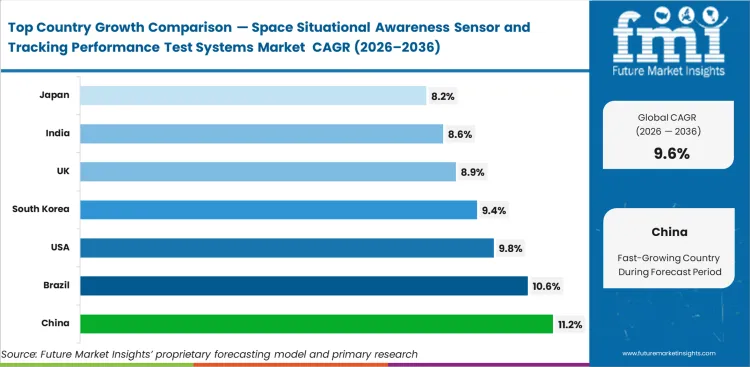
Space Situational Awareness Sensor and Tracking Performance Test Systems Market CAGR Analysis By Country
- China ranks first with an 11.2% CAGR. State backed surveillance programs and domestic capability expansion keep demand for optical and infrared validation systems growing faster.
- Brazil at 10.6% shows rapid expansion because astronomy based observation activity and shared facilities support demand for modular telescope and radar test assets with lower entry cost.
- The United States at 9.8% and South Korea at 9.4% are growing because defense connected modernization and structured sensor verification programs support steady equipment demand.
- The United Kingdom is at 8.9%, India is at 8.6%, and Japan is at 8.2%. These markets show stable expansion because public program continuity and mission assurance work keep validation demand active.
The global space situational awareness sensor and tracking performance test systems market is expected to grow at a 9.6% CAGR from 2026 to 2036. The study covers the main demand centers listed below.
Sales Analysis of Space Situational Awareness Sensor and Tracking Performance Test Systems Market in China
The China space situational awareness sensor and tracking performance test systems market is projected to grow at a CAGR of 11.2% through 2036. State backed surveillance programs keep adding optical and infrared validation work.
- State backed surveillance projects keep demand tied to secure internal validation capacity.
- Infrared and optical programs increase the need for multi sensor performance checks.
- Domestic manufacturing depth supports repeated upgrades. Isolated purchases are less common in this market.
Opportunity Analysis of Space Situational Awareness Sensor and Tracking Performance Test Systems Market in Brazil
The Brazil space situational awareness sensor and tracking performance test systems market is projected to grow at a CAGR of 10.6% through 2036. Growth comes from astronomy based observation programs and demand for modular telescope and radar test assets with lower entry cost.
- Academic astronomy and national observation work keep modular telescope test demand active.
- Shared facilities support lower cost validation for developing radar and optical programs.
- International cooperation helps local programs align with wider testing practice.
Demand Outlook for Space Situational Awareness Sensor and Tracking Performance Test Systems Market in the United States
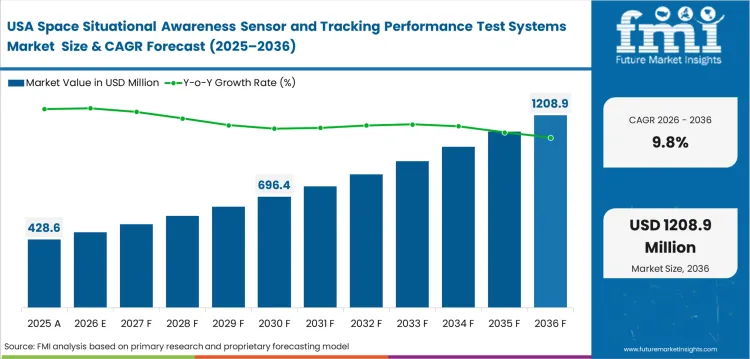
The United States space situational awareness sensor and tracking performance test systems market is projected to grow at a CAGR of 9.8% through 2036. Defense modernization and commercial traffic management require deeper sensor qualification.
- Defense modernization supports long running spending on radar, telescope, and integration validation.
- Commercial traffic management adds demand for reliable tracking and fusion checks.
- Established suppliers keep the country central to higher value equipment demand.
Future Outlook for Space Situational Awareness Sensor and Tracking Performance Test Systems Market in South Korea
The South Korea space situational awareness sensor and tracking performance test systems market is projected to grow at a CAGR of 9.4% through 2036. National security planning is pulling more surveillance sensors into structured verification programs.
- National security planning keeps surveillance accuracy tied to repeatable validation work.
- Sensor integration programs create demand for optical and RF checks.
- Domestic capability building supports steady investment in field and lab verification.
Market Analysis of Space Situational Awareness Sensor and Tracking Performance Test Systems Market in the United Kingdom
The United Kingdom space situational awareness sensor and tracking performance test systems market is projected to grow at a CAGR of 8.9% through 2036. Research observatories and defense coordination increase demand for precise calibration systems.
- Research observatories support demand for calibration accuracy and pointing discipline.
- International coordination roles raise the value of interoperable test practice.
- Defense and civil projects keep optical tracking systems in active review.
Development Outlook for Space Situational Awareness Sensor and Tracking Performance Test Systems Market in India
The India space situational awareness sensor and tracking performance test systems market is projected to grow at a CAGR of 8.6% through 2036. SSA monitoring activity and domestic sensor development are raising demand for local validation capacity.
- Growing SSA reporting activity raises the need for dependable local sensor verification.
- Domestic mission programs support careful optical tracking and debris monitoring work.
- Research and government labs are likely to add modular test assets before wider deployment.
In-depth Analysis of Space Situational Awareness Sensor and Tracking Performance Test Systems Market in Japan
The Japan space situational awareness sensor and tracking performance test systems market is projected to grow at a CAGR of 8.2% through 2036. Debris monitoring and mission assurance programs support careful optical and tracking performance checks.
- Mission assurance work supports disciplined optical and tracking performance checks.
- Debris monitoring increases the need for accurate observation and orbit refinement.
- Public program continuity keeps demand stable. Abrupt change is less likely in this market.
Competitive Landscape and Strategic Positioning
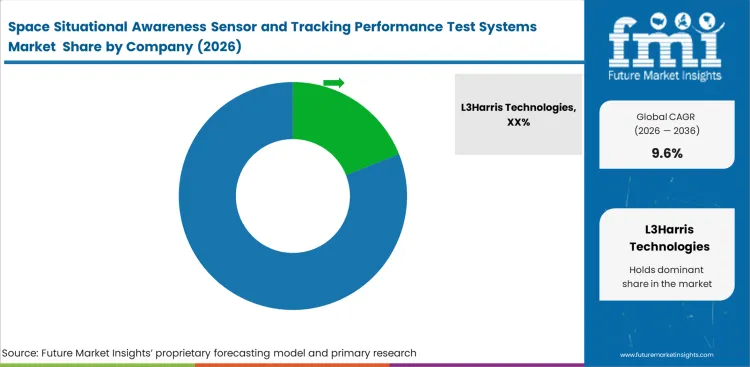
Competition is led by suppliers that already serve defense or high precision measurement programs. Large contractors such as L3Harris Technologies, Northrop Grumman, Lockheed Martin, and BAE Systems benefit from long relationships with public customers and from their ability to support integrated radar and optical programs. Measurement specialists such as Rohde & Schwarz, Teledyne Technologies, Thorlabs, and Keysight Technologies add strength in calibration, RF validation, and optical instrumentation. Demand also connects naturally with adjacent FMI areas such as space radar systems, satellite ground station programs, and satellite simulator tools because users often compare sensor validation budgets against wider ground and mission infrastructure spending.
The field remains moderately fragmented. L3Harris Technologies is estimated to account for 12.0% of current demand because it spans telescope upgrades, radar modernization, and command-linked awareness programs. Specialist operators such as LeoLabs and Anduril are sharpening competition through faster network expansion and more software-led space monitoring services. That pattern should keep larger primes strong in national programs while giving smaller specialists room in modular and service-oriented deployments.
Key Companies in the Space Situational Awareness Sensor and Tracking Performance Test Systems Market
Key global companies leading the space situational awareness sensor and tracking performance test systems market include:
- L3Harris Technologies (USA), Northrop Grumman (USA), Lockheed Martin (USA), and BAE Systems (UK). These companies hold strong positions through long-standing government relationships, integrated defense capabilities, and the ability to support optical, radar, and command-linked surveillance validation programs.
- Rohde & Schwarz (Germany), Teledyne Technologies (USA), Thorlabs (USA), and Keysight Technologies (USA) have built a strong presence by supplying calibration tools, RF validation systems, optical instrumentation, and precision measurement platforms used in sensor performance testing environments.
- LeoLabs (USA) and Anduril (USA) represent the more agile specialist group in this space. These companies are strengthening their presence through network-led surveillance services, software-driven monitoring capability, and expansion into next-generation space domain awareness and validation programs.
Competitive Benchmarking
| Company | Sensor breadth | Precision validation | Integration support | Footprint |
|---|---|---|---|---|
| L3Harris Technologies | High | High | High | Global |
| Northrop Grumman | High | Medium | High | Global |
| Lockheed Martin | High | Medium | High | Global |
| BAE Systems | Medium | Medium | Medium | Global |
| Rohde & Schwarz | Medium | High | Medium | Global |
| Teledyne Technologies | Medium | High | Medium | Global |
| Thorlabs | Medium | High | Low | Multi-region |
| Keysight Technologies | Medium | High | Medium | Global |
| LeoLabs | Medium | Medium | High | Multi-region |
| Anduril | Medium | Medium | High | United States-led |
Source: Future Market Insights analysis and current public company activity, 2026.
Key Developments
- In March 2026: Anduril reached an agreement to acquire ExoAnalytic Solutions to accelerate space domain awareness and missile defense capabilities.
- April 2025: LeoLabs announced Scout, a next-generation expeditionary radar for advanced space domain awareness missions, designed for mobility, modularity, and rapid deployment.
Key Players in the Space Situational Awareness Sensor and Tracking Performance Test Systems Market:
Major Global Players:
- L3Harris Technologies
- Northrop Grumman
- Lockheed Martin
- BAE Systems
- Rohde & Schwarz
- Teledyne Technologies
- Keysight Technologies
Emerging Players/Startups:
- LeoLabs
- Anduril
- Thorlabs
Scope of the Report
| Parameter | Details |
|---|---|
| Quantitative Units | USD 756.2 million to USD 1,891.2 million, at a CAGR of 9.6% |
| Market Definition | The space situational awareness sensor and tracking performance test systems market includes equipment and software used to verify sensing performance for space object detection, tracking, and characterization across optical, radar, RF, and hybrid validation setups before operational deployment. |
| Regions Covered | North America, Latin America, Europe, East Asia, South Asia and Pacific |
| Countries Covered | China, Brazil, United States, South Korea, United Kingdom, India, Japan |
| Key Companies Profiled | L3Harris Technologies, Northrop Grumman, Lockheed Martin, BAE Systems, Rohde & Schwarz, Teledyne Technologies, Thorlabs, Keysight Technologies, LeoLabs, Anduril |
| Forecast Period | 2026 to 2036 |
| Approach | Live FMI market page plus public SSA activity evidence and segment extension analysis |
Market by Segments
By Sensor Type
- Optical Telescope Systems
- Phased-Array Radar
- Passive RF Sensors
- Laser Ranging Systems
By Test Capability
- Calibration and Alignment
- RF Testing
- Tracking and Pointing Validation
- Fusion Testing
By End User
- Government Entities
- System Integrators
- Commercial SSA Providers
- Universities
By Deployment Mode
- Ground Test Ranges
- Laboratory Benches
- Field Validation Kits
- Hosted Payload Trials
By Target Orbit
- LEO Tracking
- GEO Tracking
- MEO Tracking
- Deep Space Tracking
By Modality
- Hybrid EO-RF Benches
- Optical-Only Benches
- Radar-Only Benches
- Laser-Only Benches
By Region
- North America
- United States
- Canada
- Mexico
- Europe
- Germany
- United Kingdom
- France
- Italy
- Spain
- East Asia
- China
- Japan
- South Korea
- South Asia and Pacific
- India
- ASEAN
- Australia and New Zealand
- Rest of World
Bibliography
- Anduril Industries, Inc. (2026, March 11). Anduril reaches agreement to acquire ExoAnalytic Solutions to accelerate space domain awareness and missile defense capabilities.
- LeoLabs. (2025, April 4). LeoLabs announces next-generation expeditionary radar for advanced space domain awareness missions.
- Petit, A., Duthil, L., Tarrieu, H., Pouzin, N., & Garot, J. (2025, April). Performance of a network of stations dedicated to optical survey and associated services for space safety. In S. Lemmens, T. Flohrer, & F. Schmitz (Eds.), Proceedings of the 9th European Conference on Space Debris, Bonn, Germany, 1-4 April 2025. ESA Space Debris Office.
- Gambarotto, C., Grattagliano, P., De Maria, L., & Montaruli, M. F. (2025, April). SSA performance assessment of cislunar periodic orbits for fragmentation events monitoring. In S. Lemmens, T. Flohrer, & F. Schmitz (Eds.), Proceedings of the 9th European Conference on Space Debris, Bonn, Germany, 1-4 April 2025. ESA Space Debris Office.
- Ionescu, L., Scagnoli, R., Bira, C., Hobincu, R., & Bostan, D. (2025, April). Cheia tracking radar, measurement results and lessons learned. In S. Lemmens, T. Flohrer, & F. Schmitz (Eds.), Proceedings of the 9th European Conference on Space Debris, Bonn, Germany, 1-4 April 2025. ESA Space Debris Office.
This Report Answers
- What is the expected size of the market in 2026 and 2036?
- How fast is the market projected to expand from 2026 to 2036?
- Which parent segment carries the highest dominant share in 2026?
- Why do government entities remain the largest end user block?
- Why do ground test ranges stay ahead of other deployment options?
- Which countries show the fastest demand expansion through 2036?
- Which companies remain most visible in current competitive activity?
- What products and services fall inside the study boundary?
Frequently Asked Questions
How large is the market in 2026?
The market is expected to reach USD 756.2 million in 2026 based on the live FMI target page and current assessment.
What will the market size be by 2036?
The market is projected to reach USD 1,891.2 million by 2036 under the current ten year forecast path.
What CAGR is projected from 2026 to 2036?
The market is expected to expand at a 9.6% CAGR during the 2026 to 2036 forecast period.
Which segment leads deployment mode demand?
Ground test ranges lead deployment mode demand with 46.0% share in 2026 because full motion trials still need calibrated range assets.
Which end user segment leads the market?
Government entities lead end use demand with 44.0% share in 2026 because national surveillance duties carry the largest test burden.
Which country grows fastest?
China is the fastest growing country in this comparison with a projected 11.2% CAGR through 2036.
Preview the report firsthand - request a free sample
Get SampleGet the brochure for pricing and purchase details.
Get PDFTable of Content
- Executive Summary
- Global Market Outlook
- Demand-side Trends
- Supply-side Trends
- Technology Roadmap Analysis
- Analysis and Recommendations
- Market Overview
- Market Coverage / Taxonomy
- Market Definition / Scope / Limitations
- Research Methodology
- Chapter Orientation
- Analytical Lens and Working Hypotheses
- Market Structure, Signals, and Trend Drivers
- Benchmarking and Cross-market Comparability
- Market Sizing, Forecasting, and Opportunity Mapping
- Research Design and Evidence Framework
- Desk Research Programme (Secondary Evidence)
- Company Annual and Sustainability Reports
- Peer-reviewed Journals and Academic Literature
- Corporate Websites, Product Literature, and Technical Notes
- Earnings Decks and Investor Briefings
- Statutory Filings and Regulatory Disclosures
- Technical White Papers and Standards Notes
- Trade Journals, Industry Magazines, and Analyst Briefs
- Conference Proceedings, Webinars, and Seminar Materials
- Government Statistics Portals and Public Data Releases
- Press Releases and Reputable Media Coverage
- Specialist Newsletters and Curated Briefings
- Sector Databases and Reference Repositories
- FMI Internal Proprietary Databases and Historical Market Datasets
- Subscription Datasets and Paid Sources
- Social Channels, Communities, and Digital Listening Inputs
- Additional Desk Sources
- Expert Input and Fieldwork (Primary Evidence)
- Primary Modes
- Qualitative Interviews and Expert Elicitation
- Quantitative Surveys and Structured Data Capture
- Blended Approach
- Why Primary Evidence is Used
- Field Techniques
- Interviews
- Surveys
- Focus Groups
- Observational and In-context Research
- Social and Community Interactions
- Stakeholder Universe Engaged
- C-suite Leaders
- Board Members
- Presidents and Vice Presidents
- R&D and Innovation Heads
- Technical Specialists
- Domain Subject-matter Experts
- Scientists
- Physicians and Other Healthcare Professionals
- Governance, Ethics, and Data Stewardship
- Research Ethics
- Data Integrity and Handling
- Primary Modes
- Tooling, Models, and Reference Databases
- Desk Research Programme (Secondary Evidence)
- Data Engineering and Model Build
- Data Acquisition and Ingestion
- Cleaning, Normalisation, and Verification
- Synthesis, Triangulation, and Analysis
- Quality Assurance and Audit Trail
- Market Background
- Market Dynamics
- Drivers
- Restraints
- Opportunity
- Trends
- Scenario Forecast
- Demand in Optimistic Scenario
- Demand in Likely Scenario
- Demand in Conservative Scenario
- Opportunity Map Analysis
- Product Life Cycle Analysis
- Supply Chain Analysis
- Investment Feasibility Matrix
- Value Chain Analysis
- PESTLE and Porter’s Analysis
- Regulatory Landscape
- Regional Parent Market Outlook
- Production and Consumption Statistics
- Import and Export Statistics
- Market Dynamics
- Global Market Analysis 2021 to 2025 and Forecast, 2026 to 2036
- Historical Market Size Value (USD Million) Analysis, 2021 to 2025
- Current and Future Market Size Value (USD Million) Projections, 2026 to 2036
- Y-o-Y Growth Trend Analysis
- Absolute $ Opportunity Analysis
- Global Market Pricing Analysis 2021 to 2025 and Forecast 2026 to 2036
- Global Market Analysis 2021 to 2025 and Forecast 2026 to 2036, By Sensor Type
- Introduction / Key Findings
- Historical Market Size Value (USD Million) Analysis By Sensor Type , 2021 to 2025
- Current and Future Market Size Value (USD Million) Analysis and Forecast By Sensor Type , 2026 to 2036
- Optical Telescope Systems
- Phased-Array Radar
- Passive RF Sensors
- Laser Ranging Systems
- Optical Telescope Systems
- Y-o-Y Growth Trend Analysis By Sensor Type , 2021 to 2025
- Absolute $ Opportunity Analysis By Sensor Type , 2026 to 2036
- Global Market Analysis 2021 to 2025 and Forecast 2026 to 2036, By Test Capability
- Introduction / Key Findings
- Historical Market Size Value (USD Million) Analysis By Test Capability, 2021 to 2025
- Current and Future Market Size Value (USD Million) Analysis and Forecast By Test Capability, 2026 to 2036
- Calibration and Alignment
- RF Testing
- Tracking and Pointing Validation
- Fusion Testing
- Calibration and Alignment
- Y-o-Y Growth Trend Analysis By Test Capability, 2021 to 2025
- Absolute $ Opportunity Analysis By Test Capability, 2026 to 2036
- Global Market Analysis 2021 to 2025 and Forecast 2026 to 2036, By End User
- Introduction / Key Findings
- Historical Market Size Value (USD Million) Analysis By End User, 2021 to 2025
- Current and Future Market Size Value (USD Million) Analysis and Forecast By End User, 2026 to 2036
- Government Entities
- System Integrators
- Commercial SSA Providers
- Universities
- Government Entities
- Y-o-Y Growth Trend Analysis By End User, 2021 to 2025
- Absolute $ Opportunity Analysis By End User, 2026 to 2036
- Global Market Analysis 2021 to 2025 and Forecast 2026 to 2036, By Deployment Mode
- Introduction / Key Findings
- Historical Market Size Value (USD Million) Analysis By Deployment Mode, 2021 to 2025
- Current and Future Market Size Value (USD Million) Analysis and Forecast By Deployment Mode, 2026 to 2036
- Ground Test Ranges
- Laboratory Benches
- Field Validation Kits
- Hosted Payload Trials
- Ground Test Ranges
- Y-o-Y Growth Trend Analysis By Deployment Mode, 2021 to 2025
- Absolute $ Opportunity Analysis By Deployment Mode, 2026 to 2036
- Global Market Analysis 2021 to 2025 and Forecast 2026 to 2036, By Target Orbit
- Introduction / Key Findings
- Historical Market Size Value (USD Million) Analysis By Target Orbit, 2021 to 2025
- Current and Future Market Size Value (USD Million) Analysis and Forecast By Target Orbit, 2026 to 2036
- LEO Tracking
- GEO Tracking
- MEO Tracking
- Deep Space Tracking
- LEO Tracking
- Y-o-Y Growth Trend Analysis By Target Orbit, 2021 to 2025
- Absolute $ Opportunity Analysis By Target Orbit, 2026 to 2036
- Global Market Analysis 2021 to 2025 and Forecast 2026 to 2036, By Modality
- Introduction / Key Findings
- Historical Market Size Value (USD Million) Analysis By Modality, 2021 to 2025
- Current and Future Market Size Value (USD Million) Analysis and Forecast By Modality, 2026 to 2036
- Hybrid EO-RF Benches
- Optical-Only Benches
- Radar-Only Benches
- Laser-Only Benches
- Hybrid EO-RF Benches
- Y-o-Y Growth Trend Analysis By Modality, 2021 to 2025
- Absolute $ Opportunity Analysis By Modality, 2026 to 2036
- Global Market Analysis 2021 to 2025 and Forecast 2026 to 2036, By Region
- Introduction
- Historical Market Size Value (USD Million) Analysis By Region, 2021 to 2025
- Current Market Size Value (USD Million) Analysis and Forecast By Region, 2026 to 2036
- North America
- Latin America
- Western Europe
- Eastern Europe
- East Asia
- South Asia and Pacific
- Middle East & Africa
- Market Attractiveness Analysis By Region
- North America Market Analysis 2021 to 2025 and Forecast 2026 to 2036, By Country
- Historical Market Size Value (USD Million) Trend Analysis By Market Taxonomy, 2021 to 2025
- Market Size Value (USD Million) Forecast By Market Taxonomy, 2026 to 2036
- By Country
- USA
- Canada
- Mexico
- By Sensor Type
- By Test Capability
- By End User
- By Deployment Mode
- By Target Orbit
- By Modality
- By Country
- Market Attractiveness Analysis
- By Country
- By Sensor Type
- By Test Capability
- By End User
- By Deployment Mode
- By Target Orbit
- By Modality
- Key Takeaways
- Latin America Market Analysis 2021 to 2025 and Forecast 2026 to 2036, By Country
- Historical Market Size Value (USD Million) Trend Analysis By Market Taxonomy, 2021 to 2025
- Market Size Value (USD Million) Forecast By Market Taxonomy, 2026 to 2036
- By Country
- Brazil
- Chile
- Rest of Latin America
- By Sensor Type
- By Test Capability
- By End User
- By Deployment Mode
- By Target Orbit
- By Modality
- By Country
- Market Attractiveness Analysis
- By Country
- By Sensor Type
- By Test Capability
- By End User
- By Deployment Mode
- By Target Orbit
- By Modality
- Key Takeaways
- Western Europe Market Analysis 2021 to 2025 and Forecast 2026 to 2036, By Country
- Historical Market Size Value (USD Million) Trend Analysis By Market Taxonomy, 2021 to 2025
- Market Size Value (USD Million) Forecast By Market Taxonomy, 2026 to 2036
- By Country
- Germany
- UK
- Italy
- Spain
- France
- Nordic
- BENELUX
- Rest of Western Europe
- By Sensor Type
- By Test Capability
- By End User
- By Deployment Mode
- By Target Orbit
- By Modality
- By Country
- Market Attractiveness Analysis
- By Country
- By Sensor Type
- By Test Capability
- By End User
- By Deployment Mode
- By Target Orbit
- By Modality
- Key Takeaways
- Eastern Europe Market Analysis 2021 to 2025 and Forecast 2026 to 2036, By Country
- Historical Market Size Value (USD Million) Trend Analysis By Market Taxonomy, 2021 to 2025
- Market Size Value (USD Million) Forecast By Market Taxonomy, 2026 to 2036
- By Country
- Russia
- Poland
- Hungary
- Balkan & Baltic
- Rest of Eastern Europe
- By Sensor Type
- By Test Capability
- By End User
- By Deployment Mode
- By Target Orbit
- By Modality
- By Country
- Market Attractiveness Analysis
- By Country
- By Sensor Type
- By Test Capability
- By End User
- By Deployment Mode
- By Target Orbit
- By Modality
- Key Takeaways
- East Asia Market Analysis 2021 to 2025 and Forecast 2026 to 2036, By Country
- Historical Market Size Value (USD Million) Trend Analysis By Market Taxonomy, 2021 to 2025
- Market Size Value (USD Million) Forecast By Market Taxonomy, 2026 to 2036
- By Country
- China
- Japan
- South Korea
- By Sensor Type
- By Test Capability
- By End User
- By Deployment Mode
- By Target Orbit
- By Modality
- By Country
- Market Attractiveness Analysis
- By Country
- By Sensor Type
- By Test Capability
- By End User
- By Deployment Mode
- By Target Orbit
- By Modality
- Key Takeaways
- South Asia and Pacific Market Analysis 2021 to 2025 and Forecast 2026 to 2036, By Country
- Historical Market Size Value (USD Million) Trend Analysis By Market Taxonomy, 2021 to 2025
- Market Size Value (USD Million) Forecast By Market Taxonomy, 2026 to 2036
- By Country
- India
- ASEAN
- Australia & New Zealand
- Rest of South Asia and Pacific
- By Sensor Type
- By Test Capability
- By End User
- By Deployment Mode
- By Target Orbit
- By Modality
- By Country
- Market Attractiveness Analysis
- By Country
- By Sensor Type
- By Test Capability
- By End User
- By Deployment Mode
- By Target Orbit
- By Modality
- Key Takeaways
- Middle East & Africa Market Analysis 2021 to 2025 and Forecast 2026 to 2036, By Country
- Historical Market Size Value (USD Million) Trend Analysis By Market Taxonomy, 2021 to 2025
- Market Size Value (USD Million) Forecast By Market Taxonomy, 2026 to 2036
- By Country
- Kingdom of Saudi Arabia
- Other GCC Countries
- Turkiye
- South Africa
- Other African Union
- Rest of Middle East & Africa
- By Sensor Type
- By Test Capability
- By End User
- By Deployment Mode
- By Target Orbit
- By Modality
- By Country
- Market Attractiveness Analysis
- By Country
- By Sensor Type
- By Test Capability
- By End User
- By Deployment Mode
- By Target Orbit
- By Modality
- Key Takeaways
- Key Countries Market Analysis
- USA
- Pricing Analysis
- Market Share Analysis, 2025
- By Sensor Type
- By Test Capability
- By End User
- By Deployment Mode
- By Target Orbit
- By Modality
- Canada
- Pricing Analysis
- Market Share Analysis, 2025
- By Sensor Type
- By Test Capability
- By End User
- By Deployment Mode
- By Target Orbit
- By Modality
- Mexico
- Pricing Analysis
- Market Share Analysis, 2025
- By Sensor Type
- By Test Capability
- By End User
- By Deployment Mode
- By Target Orbit
- By Modality
- Brazil
- Pricing Analysis
- Market Share Analysis, 2025
- By Sensor Type
- By Test Capability
- By End User
- By Deployment Mode
- By Target Orbit
- By Modality
- Chile
- Pricing Analysis
- Market Share Analysis, 2025
- By Sensor Type
- By Test Capability
- By End User
- By Deployment Mode
- By Target Orbit
- By Modality
- Germany
- Pricing Analysis
- Market Share Analysis, 2025
- By Sensor Type
- By Test Capability
- By End User
- By Deployment Mode
- By Target Orbit
- By Modality
- UK
- Pricing Analysis
- Market Share Analysis, 2025
- By Sensor Type
- By Test Capability
- By End User
- By Deployment Mode
- By Target Orbit
- By Modality
- Italy
- Pricing Analysis
- Market Share Analysis, 2025
- By Sensor Type
- By Test Capability
- By End User
- By Deployment Mode
- By Target Orbit
- By Modality
- Spain
- Pricing Analysis
- Market Share Analysis, 2025
- By Sensor Type
- By Test Capability
- By End User
- By Deployment Mode
- By Target Orbit
- By Modality
- France
- Pricing Analysis
- Market Share Analysis, 2025
- By Sensor Type
- By Test Capability
- By End User
- By Deployment Mode
- By Target Orbit
- By Modality
- India
- Pricing Analysis
- Market Share Analysis, 2025
- By Sensor Type
- By Test Capability
- By End User
- By Deployment Mode
- By Target Orbit
- By Modality
- ASEAN
- Pricing Analysis
- Market Share Analysis, 2025
- By Sensor Type
- By Test Capability
- By End User
- By Deployment Mode
- By Target Orbit
- By Modality
- Australia & New Zealand
- Pricing Analysis
- Market Share Analysis, 2025
- By Sensor Type
- By Test Capability
- By End User
- By Deployment Mode
- By Target Orbit
- By Modality
- China
- Pricing Analysis
- Market Share Analysis, 2025
- By Sensor Type
- By Test Capability
- By End User
- By Deployment Mode
- By Target Orbit
- By Modality
- Japan
- Pricing Analysis
- Market Share Analysis, 2025
- By Sensor Type
- By Test Capability
- By End User
- By Deployment Mode
- By Target Orbit
- By Modality
- South Korea
- Pricing Analysis
- Market Share Analysis, 2025
- By Sensor Type
- By Test Capability
- By End User
- By Deployment Mode
- By Target Orbit
- By Modality
- Russia
- Pricing Analysis
- Market Share Analysis, 2025
- By Sensor Type
- By Test Capability
- By End User
- By Deployment Mode
- By Target Orbit
- By Modality
- Poland
- Pricing Analysis
- Market Share Analysis, 2025
- By Sensor Type
- By Test Capability
- By End User
- By Deployment Mode
- By Target Orbit
- By Modality
- Hungary
- Pricing Analysis
- Market Share Analysis, 2025
- By Sensor Type
- By Test Capability
- By End User
- By Deployment Mode
- By Target Orbit
- By Modality
- Kingdom of Saudi Arabia
- Pricing Analysis
- Market Share Analysis, 2025
- By Sensor Type
- By Test Capability
- By End User
- By Deployment Mode
- By Target Orbit
- By Modality
- Turkiye
- Pricing Analysis
- Market Share Analysis, 2025
- By Sensor Type
- By Test Capability
- By End User
- By Deployment Mode
- By Target Orbit
- By Modality
- South Africa
- Pricing Analysis
- Market Share Analysis, 2025
- By Sensor Type
- By Test Capability
- By End User
- By Deployment Mode
- By Target Orbit
- By Modality
- USA
- Market Structure Analysis
- Competition Dashboard
- Competition Benchmarking
- Market Share Analysis of Top Players
- By Regional
- By Sensor Type
- By Test Capability
- By End User
- By Deployment Mode
- By Target Orbit
- By Modality
- Competition Analysis
- Competition Deep Dive
- L3Harris Technologies
- Overview
- Product Portfolio
- Profitability by Market Segments (Product/Age /Sales Channel/Region)
- Sales Footprint
- Strategy Overview
- Marketing Strategy
- Product Strategy
- Channel Strategy
- Northrop Grumman
- Lockheed Martin
- BAE Systems
- Rohde & Schwarz
- Teledyne Technologies
- Keysight Technologies
- LeoLabs
- Anduril
- Thorlabs
- L3Harris Technologies
- Competition Deep Dive
- Assumptions & Acronyms Used


