

- Industry Size (2026)
- USD 6.5 Bn
- Forecast (2036)
- USD 15.8 Bn
- CAGR (2026 to 2036)
- 9.2%
Space Radar Market Forecast and Outlook 2026 to 2036
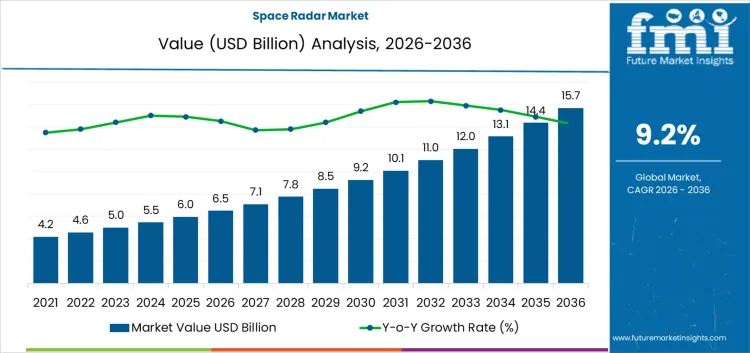
From USD 6.5 billion in 2026, the space radar market is expected to reach USD 15.8 billion by 2036, implying a CAGR of 9.20%. Activity remains concentrated among a small group of countries that operate sovereign space surveillance, earth observation, and defense reconnaissance programs. Adoption patterns differ sharply between regions with established launch and satellite manufacturing capacity and those that depend on purchased data services. Cost advantages cluster around nations with domestic launch infrastructure, sensor integration capability, and long running public procurement budgets, which shapes where payloads are designed and assembled.
Across the period, expansion follows government funding cycles and strategic program approvals rather than commercial demand signals. North America, Europe, and parts of East Asia account for most new deployments, while other regions participate mainly as data users. Budget timing, export controls, and industrial policy influence project pacing and supplier selection. Local industrial ecosystems matter more than unit production costs. The market grows through program scale and constellation buildouts, not through widespread diffusion across private operators or consumer oriented space applications.
Quick Stats of the Space Radar Market
- Space Radar Market Value (2026): USD 6.5 billion
- Space Radar Forecast Value (2036): USD 15.8 billion
- Space Radar Forecast CAGR 2026 to 2036: 9.2%
- Leading Radar Type in Space Radar Market: Synthetic Aperture Radar (65 % share)
- Leading Deployment Platform in Space Radar Market: Satellite-Based Radar (70 % share)
- Key Growth Regions in Space Radar Market: India, China, Brazil, USA, UK
- Top Players in Space Radar Market: Northrop Grumman Corporation, Raytheon Technologies Corporation, Lockheed Martin Corporation, Thales Group, Airbus Defence and Space, ICEYE, LeoLabs
What is the Growth Forecast for Space Radar Market through 2036?
Between 2026 and 2031, the space radar market is projected to expand from USD 6.5 billion along a growth path consistent with a 9.2% CAGR, driven less by satellite counts and more by changes in how data is collected and trusted. Synthetic aperture radar becomes the backbone of new constellations because it delivers consistent imagery regardless of daylight or weather, which changes procurement logic for governments and commercial operators alike. Investment during this phase concentrates on building persistent observation capability rather than on one-off missions. Platform decisions increasingly favor satellite-based systems designed for frequent revisit rates and rapid tasking. Budget allocations follow information reliability and coverage guarantees, not only launch cadence or payload novelty.
From 2031 to 2036, the market is expected to reach USD 15.8 billion, with growth shaped by the operational integration of radar data into defense planning, climate monitoring, and infrastructure risk management. Radar shifts from being a specialized sensor to becoming a routine decision input across multiple agencies and industries. This raises spending on constellation replenishment, ground processing, and application-specific mission tuning. Military surveillance and disaster management absorb a larger share of data output, while commercial Earth observation matures into subscription-like service models. Competitive positioning depends on system reliability, revisit performance, and analytics integration, favoring players such as Northrop Grumman, Raytheon Technologies, Lockheed Martin, Thales, Airbus Defence and Space, ICEYE, and LeoLabs.
Space Radar Market Key Takeaways
| Metric | Value |
|---|---|
| Market Value (2026) | USD 6.5 billion |
| Forecast Value (2036) | USD 15.8 billion |
| Forecast CAGR 2026 to 2036 | 9.2% |
How Is the Space Radar Market Advancing Satellite and Space-Based Surveillance?
Space radar systems are increasingly adopted for Earth observation, reconnaissance, and space situational awareness, providing high-resolution imaging and all-weather monitoring capabilities. Historically, satellite imaging relied on optical sensors, which were limited by cloud cover, daylight, and atmospheric conditions. Modern space radars, including synthetic aperture radar (SAR) and interferometric systems, operate across multiple frequencies to capture terrain, maritime, and infrastructure data with precise spatial resolution. Aerospace agencies, defense organizations, and commercial satellite operators prioritize signal accuracy, orbital stability, and data processing capability. Early adoption focused on military and scientific missions, while current demand spans environmental monitoring, disaster management, and commercial Earth observation, driven by increased satellite launches, data-driven decision-making, and global security requirements. Frequency range, resolution, and onboard processing capabilities influence deployment and supplier selection.
Growing demand for real-time Earth observation, national security, and space situational awareness is shaping market growth. Compared with traditional optical satellites, space radar systems emphasize cloud-penetrating imaging, high revisit rates, and precise geospatial data collection. Cost structures depend on radar sensor technology, satellite bus integration, and data handling infrastructure, concentrating margins among suppliers delivering reliable, high-performance platforms. Space agencies and commercial operators adopt radar satellites to enhance surveillance, improve environmental monitoring, and support operational planning. By 2036, space radar systems are expected to become standard in both governmental and commercial satellite constellations, supporting high-resolution imaging, persistent monitoring, and advanced space intelligence capabilities.
What Factors Are Shaping the Demand for Space Radar by Radar Architecture and Deployment Platform in 2026?
The space radar market in 2026 is segmented by radar type and by operating platform. By radar architecture, demand is divided into synthetic aperture radar, Doppler radar, continuous wave radar, weather radar, and other formats that differ in resolution, coverage, and signal processing requirements. By platform, demand is organized around satellite based, airborne, ground based, and shipborne systems, each serving different mission profiles and persistence needs. These segments reflect how defense agencies, civil authorities, and commercial operators balance revisit rates, data reliability, orbital constraints, and operating cost while building observation and surveillance capabilities that must function across wide geographic areas and under varied atmospheric conditions.
Why Does Synthetic Aperture Radar Dominate Space Radar Programs?
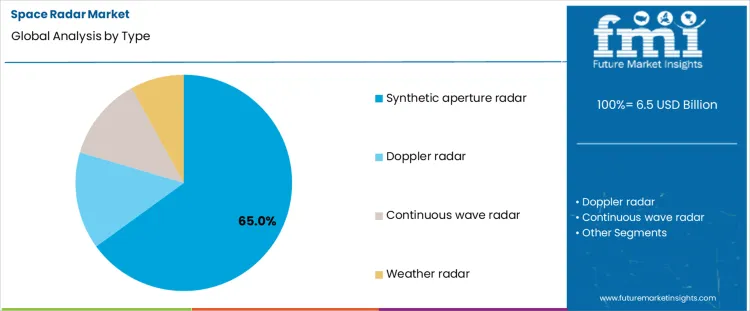
Synthetic aperture radar accounts for about 65% of demand in 2026, reflecting its ability to deliver high resolution imagery independent of daylight and cloud cover. This capability makes it valuable for applications where optical systems fail or provide inconsistent results. SAR systems also allow wide area coverage with consistent data quality, which supports mapping, surveillance, and change detection tasks over long periods. Once a satellite platform is launched, the marginal cost of collecting additional data is low, which favors sensors that maximize information return per pass. The processing complexity is accepted because ground infrastructure and algorithms are already mature. This combination of reliability, coverage, and analytical usefulness keeps SAR as the central architecture in newest space radar missions.
Doppler, continuous wave, and weather radars serve more specific measurement roles. Doppler systems focus on velocity and motion, which suits tracking and meteorological uses but does not replace imaging needs. Continuous wave radars are efficient for certain ranging and detection tasks, yet they lack the spatial detail required for mapping. Weather radars are optimized for atmospheric observation rather than surface monitoring. These architectures are often integrated as complementary sensors or used in dedicated missions. Their demand follows niche requirements rather than broad surveillance programs, which limits their overall share compared with SAR, which functions as a general purpose backbone for many civilian and defense oriented observation strategies.
Why Do Satellite Based Platforms Account for the Majority of Space Radar Deployment?
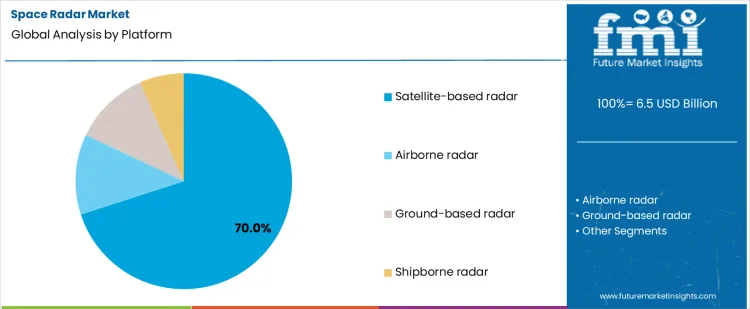
Satellite based radar represents about 70% of demand in 2026 because it offers persistent, wide area coverage without reliance on local access or overflight permissions. Once in orbit, these platforms can revisit the same locations on predictable schedules, which is critical for monitoring borders, infrastructure, oceans, and environmental changes. Satellites also operate above weather and political boundaries, which simplifies long term mission planning. Although launch and development costs are high, the operational life and data continuity justify the investment for many governments and commercial operators. This strategic value and independence from regional constraints keep satellite platforms as the primary deployment choice for space radar systems.
Airborne, ground based, and shipborne radars serve roles tied to tactical flexibility and localized coverage. Airborne systems provide rapid redeployment and targeted observation, yet they are limited by flight time and airspace access. Ground based radars offer continuous monitoring of fixed regions but cannot cover large or remote areas. Shipborne radars focus on maritime environments and move with fleet operations. These platforms are essential within their domains, yet they complement rather than replace satellites. Their demand is driven by specific operational needs, while satellite systems remain the only option for sustained, global scale radar observation programs across civil, defense, and commercial users.
Why Are Orbital Congestion, Surveillance Obligations, and Mission Assurance Requirements Driving the Space Radar Market through 2036?
Demand is being pulled by operational risk rather than by exploration ambition. Low Earth orbit is crowded with active spacecraft and debris, and collision avoidance now depends on persistent, weather independent sensing. Radar provides detection and tracking that optical systems cannot guarantee during eclipse or cloud cover. Defense users also require assured awareness of maneuvering objects and small targets. Civil operators face insurance and regulatory pressure to document conjunction screening quality. Once a constellation commits to a radar based monitoring layer, it becomes a standing cost of operations. This anchors procurement to continuity of coverage and reliability metrics instead of launch cadence alone.
What Budget Cycles, Launch Constraints, and System Complexity Are Holding Back Faster Expansion?
Restraints come from program economics and integration burden. Space qualified radar payloads are heavy, power hungry, and expensive to build and test. Launch availability and mass limits force tradeoffs against revenue generating instruments. Ground segment upgrades and data processing pipelines add further cost and schedule risk. Government budgets move in multiyear cycles, which slows fleet refresh even when threats evolve quickly. Commercial operators hesitate to duplicate capability that some public systems already provide. These factors lengthen decision timelines and favor incremental upgrades over rapid constellation scale up, keeping growth lumpy and dependent on a small number of committed anchor customers.
How Are Constellation Architectures, Data Fusion, and Procurement Models Reshaping This Category?
The structure is shifting from single exquisite assets to layered networks. Operators combine space based radar with ground sensors and optical payloads, which changes performance requirements toward coverage and revisit rather than peak resolution. Smaller satellites carrying narrower mission radars are being distributed across orbits to improve persistence. Data value increasingly comes from fusion and analytics, not from the sensor alone, which favors suppliers that deliver integrated pipelines. Procurement is also moving toward service contracts for monitoring and alerts rather than hardware only buys. The category is becoming an infrastructure service, specified around uptime and response time instead of platform prestige.
What is the Demand for Space Radar by Country?
| Country | CAGR (%) |
|---|---|
| USA | 8.5% |
| UK | 8.0% |
| China | 10.0% |
| India | 11.2% |
| Brazil | 8.7% |
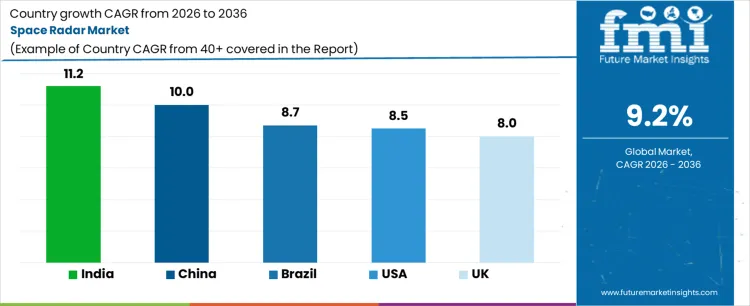
Demand for space radar is rising as governments and defense organizations invest in advanced surveillance, navigation, and earth observation capabilities. India leads with an 11.2% CAGR, driven by national security initiatives, satellite deployment programs, and investment in advanced radar technologies. China follows at 10.0%, supported by expansion of space infrastructure, military and civilian satellite programs, and technological advancements. Brazil records 8.7% growth, shaped by space monitoring initiatives and regional defense strategies. The USA grows at 8.5%, influenced by military and scientific satellite programs. The UK shows 8.0% CAGR, reflecting steady adoption of radar technology in space applications for defense, communications, and environmental monitoring.
How is the United States experiencing growth in the space radar market?
United States is experiencing growth at a CAGR of 8.5%, driven by expansion in military, aerospace, and satellite surveillance programs. Space radar systems are used for satellite tracking, space situational awareness, and defense monitoring. Manufacturers and suppliers are producing radars optimized for long-range detection, high-resolution imaging, and integration with national space and defense infrastructure. Demand is concentrated in government research facilities, defense contractors, and aerospace hubs such as Cape Canaveral and Huntsville. Investments focus on system reliability, signal processing capabilities, and compliance with federal aerospace and defense standards rather than large-scale commercial deployment. Growth reflects increasing satellite launches and emphasis on space situational awareness.
- Military and aerospace expansion drives adoption.
- Radars optimize long-range detection and imaging.
- Government facilities and aerospace hubs concentrate demand.
- System reliability and regulatory compliance guide investment.
How is the United Kingdom witnessing growth in the space radar market?
United Kingdom is witnessing growth at a CAGR of 8%, fueled by investments in satellite monitoring, defense space programs, and research in Surrey and Glasgow. Space radar systems are used to track orbital debris, support satellite navigation, and enhance national defense surveillance capabilities. Manufacturers are producing radars optimized for high-resolution imaging, reliability in orbital tracking, and integration with UK space agencies’ infrastructure. Demand is concentrated in defense research facilities, satellite control centers, and aerospace R&D hubs. Investments prioritize system performance, signal accuracy, and adherence to national aerospace and defense standards. Growth reflects the UK’s strategic focus on space security and technological independence.
- Satellite monitoring drives adoption.
- Radars optimize orbital tracking and imaging accuracy.
- Defense and R&D hubs concentrate demand.
- System performance and regulatory compliance guide investment.
How is China experiencing growth in the space radar market?
China is experiencing growth at a CAGR of 10%, supported by expansion of military, aerospace, and civil space programs. Space radar systems are critical for satellite tracking, debris monitoring, and long-range imaging. Manufacturers are producing radars optimized for high detection resolution, operational reliability, and integration with national space infrastructure across Beijing, Shanghai, and Xi’an. Demand is concentrated in government research centers, satellite control facilities, and aerospace industrial hubs. Investments focus on system durability, signal processing capabilities, and compliance with national aerospace standards rather than large-scale commercial use. Growth reflects rising satellite launches and focus on space situational awareness.
- Military and civil space programs drive adoption.
- Radars enhance detection resolution and reliability.
- Research centers and satellite facilities concentrate demand.
- System durability and standards compliance guide investment.
How is India witnessing growth in the space radar market?
India is witnessing growth at a CAGR of 11.2%, fueled by initiatives in defense, space exploration, and satellite surveillance led by ISRO and DRDO. Space radar systems are used for orbital debris tracking, satellite monitoring, and strategic defense. Manufacturers are producing radars optimized for high-resolution imaging, long-range detection, and integration with India’s space infrastructure in Bengaluru, Hyderabad, and Thiruvananthapuram. Demand is concentrated in government research facilities, satellite monitoring centers, and defense R&D hubs. Investments focus on system reliability, signal accuracy, and compliance with national aerospace and defense standards. Growth reflects increasing satellite launches and strategic focus on indigenous space capabilities.
- Space exploration and defense drive adoption.
- Radars optimize imaging resolution and long-range detection.
- Research facilities and satellite centers concentrate demand.
- System reliability and compliance guide investment.
How is Brazil experiencing growth in the space radar market?
Brazil is experiencing growth at a CAGR of 8.7%, supported by expansion in aerospace programs, satellite monitoring, and defense initiatives, particularly in São José dos Campos and Brasília. Space radar systems are critical for monitoring orbital debris, supporting national satellites, and enhancing aerospace surveillance capabilities. Manufacturers are producing radars optimized for long-range detection, high-resolution imaging, and operational reliability under tropical conditions. Demand is concentrated in aerospace research centers, satellite monitoring facilities, and defense installations. Investments focus on system durability, signal processing capabilities, and compliance with Brazilian aerospace standards. Growth reflects increasing space program activity and investment in national satellite infrastructure.
- Aerospace and defense programs drive adoption.
- Radars optimize detection range and imaging resolution.
- Research and satellite monitoring centers concentrate demand.
- System durability and compliance guide investment.
Who Competes in the Space Radar Market and What Defines Their Capabilities?
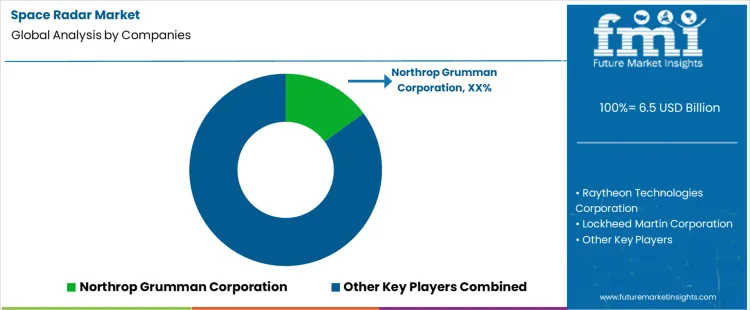
Competition in the space radar market is defined by radar resolution, revisit frequency, signal processing capability, and suitability for spaceborne platforms. Northrop Grumman Corporation supplies radar systems and subsystems designed for space situational awareness and defense applications, with experience in large spaceborne sensors and spacecraft integration. Raytheon Technologies Corporation develops advanced radar payloads and digital beamforming techniques tailored for earth observation and target tracking from orbit. Lockheed Martin Corporation delivers space radar solutions integrated with satellites that support imaging, surveillance, and monitoring missions. Thales Group provides radar and sensor modules engineered for compact space platforms with high reliability. Airbus Defence and Space offers spaceborne radar instruments designed for environmental monitoring, disaster response, and reconnaissance missions with established aerospace integration experience.
Other competitors include emerging and specialized providers focused on small satellite radar services and data analytics. ICEYE develops synthetic aperture radar (SAR) satellites that deliver all weather, day night imaging with rapid revisit rates for commercial and government clients. LeoLabs operates a constellation of ground based and space oriented sensors, including radar systems, to track objects in low earth orbit and support space safety. Regional and niche firms contribute radar components, signal processing software, and hosted payload services for microsatellites and cubesats. Differentiation in this market arises from spatial resolution, temporal revisit ability, data latency, and integration with ground processing and analytics systems. Suppliers that combine proven space qualification, scalable radar architectures, and robust data delivery frameworks are positioned to serve defense, environmental monitoring, and commercial reconnaissance segments of the space radar market.
Key Players in the Space Radar Market
- Northrop Grumman Corporation
- Raytheon Technologies Corporation
- Lockheed Martin Corporation
- Thales Group
- Airbus Defence and Space
- ICEYE
- LeoLabs
Scope of the Report
| Items | Values |
|---|---|
| Quantitative Units (2026) | USD billion |
| Type | Synthetic Aperture Radar, Doppler Radar, Continuous Wave Radar, Weather Radar |
| Platform | Satellite-based Radar, Airborne Radar, Ground-based Radar, Shipborne Radar |
| Application | Earth Observation, Weather Monitoring, Military Surveillance, Disaster Management |
| Regions Covered | Asia Pacific, Europe, North America, Latin America, Middle East & Africa |
| Countries Covered | China, Japan, South Korea, India, Australia & New Zealand, ASEAN, Germany, United Kingdom, France, Italy, Spain, Nordic, BENELUX, United States, Canada, Mexico, Brazil, Chile, Saudi Arabia, Turkey, South Africa, and other regional markets |
| Key Companies Profiled | Northrop Grumman Corporation, Raytheon Technologies Corporation, Lockheed Martin Corporation, Thales Group, Airbus Defence and Space, ICEYE, LeoLabs |
| Additional Attributes | Dollar sales by radar type, platform, and application, synthetic aperture radar forming the backbone of most new constellations due to all-weather and day-night imaging capability, satellite-based platforms accounting for the majority of deployments because of persistent global coverage, demand driven primarily by government surveillance, defense, and space situational awareness programs rather than commercial uptake, procurement paced by multi-year budget cycles and strategic approvals, market expansion tied to constellation buildouts and system integration rather than unit volume growth, increasing importance of data processing, fusion, and analytics alongside sensor hardware, and competitive positioning based on revisit performance, system reliability, and integration with ground segment infrastructure. |
Space Radar Market Segmentation
Type:
- Synthetic aperture radar
- Doppler radar
- Continuous wave radar
- Weather radar
Platform:
- Satellite-based radar
- Airborne radar
- Ground-based radar
- Shipborne radar
Application:
- Earth observation
- Weather monitoring
- Military surveillance
- Disaster management
Region:
- Asia Pacific
- China
- Japan
- South Korea
- India
- Australia & New Zealand
- ASEAN
- Rest of Asia Pacific
- Europe
- Germany
- United Kingdom
- France
- Italy
- Spain
- Nordic
- BENELUX
- Rest of Europe
- North America
- United States
- Canada
- Mexico
- Latin America
- Brazil
- Chile
- Rest of Latin America
- Middle East & Africa
- Kingdom of Saudi Arabia
- Other GCC Countries
- Turkey
- South Africa
- Other African Union
- Rest of Middle East & Africa
Bibliography
- National Aeronautics and Space Administration. (2024). Synthetic aperture radar (SAR): Principles and applications in Earth observation.
- European Space Agency. (2023). Spaceborne radar and synthetic aperture radar missions for Earth observation.
- European Space Agency. (2024). Space safety and space situational awareness programme overview.
- United States Government Accountability Office. (2023). Space situational awareness: Status of efforts to track and manage orbital debris (GAO-23-106177).
- National Aeronautics and Space Administration & Office of Science and Technology Policy. (2024). Orbital debris and space traffic management update.
Frequently Asked Questions
How big is the space radar market in 2026?
The global space radar market is estimated to be valued at USD 6.5 billion in 2026.
What will be the size of space radar market in 2036?
The market size for the space radar market is projected to reach USD 15.7 billion by 2036.
How much will be the space radar market growth between 2026 and 2036?
The space radar market is expected to grow at a 9.2% CAGR between 2026 and 2036.
What are the key product types in the space radar market?
The key product types in space radar market are synthetic aperture radar, doppler radar, continuous wave radar and weather radar.
Which platform segment to contribute significant share in the space radar market in 2026?
In terms of platform, satellite-based radar segment to command 70.0% share in the space radar market in 2026.
Preview the report firsthand - request a free sample
Get SampleGet the brochure for pricing and purchase details.
Get PDFTable of Content
- Executive Summary
- Global Market Outlook
- Demand-side Trends
- Supply-side Trends
- Technology Roadmap Analysis
- Analysis and Recommendations
- Market Overview
- Market Coverage / Taxonomy
- Market Definition / Scope / Limitations
- Market Background
- Market Dynamics
- Drivers
- Restraints
- Opportunity
- Trends
- Scenario Forecast
- Demand in Optimistic Scenario
- Demand in Likely Scenario
- Demand in Conservative Scenario
- Opportunity Map Analysis
- Product Life Cycle Analysis
- Supply Chain Analysis
- Investment Feasibility Matrix
- Value Chain Analysis
- PESTLE and Porter’s Analysis
- Regulatory Landscape
- Regional Parent Market Outlook
- Production and Consumption Statistics
- Import and Export Statistics
- Market Dynamics
- Global Market Analysis 2021 to 2025 and Forecast, 2026 to 2036
- Historical Market Size Value (USD Million) Analysis, 2021 to 2025
- Current and Future Market Size Value (USD Million) Projections, 2026 to 2036
- Y-o-Y Growth Trend Analysis
- Absolute $ Opportunity Analysis
- Global Market Pricing Analysis 2021 to 2025 and Forecast 2026 to 2036
- Global Market Analysis 2021 to 2025 and Forecast 2026 to 2036, By Type
- Introduction / Key Findings
- Historical Market Size Value (USD Million) Analysis By Type, 2021 to 2025
- Current and Future Market Size Value (USD Million) Analysis and Forecast By Type, 2026 to 2036
- Synthetic aperture radar
- Doppler radar
- Continuous wave radar
- Weather radar
- Synthetic aperture radar
- Y-o-Y Growth Trend Analysis By Type, 2021 to 2025
- Absolute $ Opportunity Analysis By Type, 2026 to 2036
- Global Market Analysis 2021 to 2025 and Forecast 2026 to 2036, By Platform
- Introduction / Key Findings
- Historical Market Size Value (USD Million) Analysis By Platform, 2021 to 2025
- Current and Future Market Size Value (USD Million) Analysis and Forecast By Platform, 2026 to 2036
- Satellite-based radar
- Airborne radar
- Ground-based radar
- Shipborne radar
- Satellite-based radar
- Y-o-Y Growth Trend Analysis By Platform, 2021 to 2025
- Absolute $ Opportunity Analysis By Platform, 2026 to 2036
- Global Market Analysis 2021 to 2025 and Forecast 2026 to 2036, By Application
- Introduction / Key Findings
- Historical Market Size Value (USD Million) Analysis By Application, 2021 to 2025
- Current and Future Market Size Value (USD Million) Analysis and Forecast By Application, 2026 to 2036
- Earth observation
- Weather monitoring
- Military surveillance
- Disaster management
- Earth observation
- Y-o-Y Growth Trend Analysis By Application, 2021 to 2025
- Absolute $ Opportunity Analysis By Application, 2026 to 2036
- Global Market Analysis 2021 to 2025 and Forecast 2026 to 2036, By Region
- Introduction
- Historical Market Size Value (USD Million) Analysis By Region, 2021 to 2025
- Current Market Size Value (USD Million) Analysis and Forecast By Region, 2026 to 2036
- North America
- Latin America
- Western Europe
- Eastern Europe
- East Asia
- South Asia and Pacific
- Middle East & Africa
- Market Attractiveness Analysis By Region
- North America Market Analysis 2021 to 2025 and Forecast 2026 to 2036, By Country
- Historical Market Size Value (USD Million) Trend Analysis By Market Taxonomy, 2021 to 2025
- Market Size Value (USD Million) Forecast By Market Taxonomy, 2026 to 2036
- By Country
- USA
- Canada
- Mexico
- By Type
- By Platform
- By Application
- By Country
- Market Attractiveness Analysis
- By Country
- By Type
- By Platform
- By Application
- Key Takeaways
- Latin America Market Analysis 2021 to 2025 and Forecast 2026 to 2036, By Country
- Historical Market Size Value (USD Million) Trend Analysis By Market Taxonomy, 2021 to 2025
- Market Size Value (USD Million) Forecast By Market Taxonomy, 2026 to 2036
- By Country
- Brazil
- Chile
- Rest of Latin America
- By Type
- By Platform
- By Application
- By Country
- Market Attractiveness Analysis
- By Country
- By Type
- By Platform
- By Application
- Key Takeaways
- Western Europe Market Analysis 2021 to 2025 and Forecast 2026 to 2036, By Country
- Historical Market Size Value (USD Million) Trend Analysis By Market Taxonomy, 2021 to 2025
- Market Size Value (USD Million) Forecast By Market Taxonomy, 2026 to 2036
- By Country
- Germany
- UK
- Italy
- Spain
- France
- Nordic
- BENELUX
- Rest of Western Europe
- By Type
- By Platform
- By Application
- By Country
- Market Attractiveness Analysis
- By Country
- By Type
- By Platform
- By Application
- Key Takeaways
- Eastern Europe Market Analysis 2021 to 2025 and Forecast 2026 to 2036, By Country
- Historical Market Size Value (USD Million) Trend Analysis By Market Taxonomy, 2021 to 2025
- Market Size Value (USD Million) Forecast By Market Taxonomy, 2026 to 2036
- By Country
- Russia
- Poland
- Hungary
- Balkan & Baltic
- Rest of Eastern Europe
- By Type
- By Platform
- By Application
- By Country
- Market Attractiveness Analysis
- By Country
- By Type
- By Platform
- By Application
- Key Takeaways
- East Asia Market Analysis 2021 to 2025 and Forecast 2026 to 2036, By Country
- Historical Market Size Value (USD Million) Trend Analysis By Market Taxonomy, 2021 to 2025
- Market Size Value (USD Million) Forecast By Market Taxonomy, 2026 to 2036
- By Country
- China
- Japan
- South Korea
- By Type
- By Platform
- By Application
- By Country
- Market Attractiveness Analysis
- By Country
- By Type
- By Platform
- By Application
- Key Takeaways
- South Asia and Pacific Market Analysis 2021 to 2025 and Forecast 2026 to 2036, By Country
- Historical Market Size Value (USD Million) Trend Analysis By Market Taxonomy, 2021 to 2025
- Market Size Value (USD Million) Forecast By Market Taxonomy, 2026 to 2036
- By Country
- India
- ASEAN
- Australia & New Zealand
- Rest of South Asia and Pacific
- By Type
- By Platform
- By Application
- By Country
- Market Attractiveness Analysis
- By Country
- By Type
- By Platform
- By Application
- Key Takeaways
- Middle East & Africa Market Analysis 2021 to 2025 and Forecast 2026 to 2036, By Country
- Historical Market Size Value (USD Million) Trend Analysis By Market Taxonomy, 2021 to 2025
- Market Size Value (USD Million) Forecast By Market Taxonomy, 2026 to 2036
- By Country
- Kingdom of Saudi Arabia
- Other GCC Countries
- Turkiye
- South Africa
- Other African Union
- Rest of Middle East & Africa
- By Type
- By Platform
- By Application
- By Country
- Market Attractiveness Analysis
- By Country
- By Type
- By Platform
- By Application
- Key Takeaways
- Key Countries Market Analysis
- USA
- Pricing Analysis
- Market Share Analysis, 2025
- By Type
- By Platform
- By Application
- Canada
- Pricing Analysis
- Market Share Analysis, 2025
- By Type
- By Platform
- By Application
- Mexico
- Pricing Analysis
- Market Share Analysis, 2025
- By Type
- By Platform
- By Application
- Brazil
- Pricing Analysis
- Market Share Analysis, 2025
- By Type
- By Platform
- By Application
- Chile
- Pricing Analysis
- Market Share Analysis, 2025
- By Type
- By Platform
- By Application
- Germany
- Pricing Analysis
- Market Share Analysis, 2025
- By Type
- By Platform
- By Application
- UK
- Pricing Analysis
- Market Share Analysis, 2025
- By Type
- By Platform
- By Application
- Italy
- Pricing Analysis
- Market Share Analysis, 2025
- By Type
- By Platform
- By Application
- Spain
- Pricing Analysis
- Market Share Analysis, 2025
- By Type
- By Platform
- By Application
- France
- Pricing Analysis
- Market Share Analysis, 2025
- By Type
- By Platform
- By Application
- India
- Pricing Analysis
- Market Share Analysis, 2025
- By Type
- By Platform
- By Application
- ASEAN
- Pricing Analysis
- Market Share Analysis, 2025
- By Type
- By Platform
- By Application
- Australia & New Zealand
- Pricing Analysis
- Market Share Analysis, 2025
- By Type
- By Platform
- By Application
- China
- Pricing Analysis
- Market Share Analysis, 2025
- By Type
- By Platform
- By Application
- Japan
- Pricing Analysis
- Market Share Analysis, 2025
- By Type
- By Platform
- By Application
- South Korea
- Pricing Analysis
- Market Share Analysis, 2025
- By Type
- By Platform
- By Application
- Russia
- Pricing Analysis
- Market Share Analysis, 2025
- By Type
- By Platform
- By Application
- Poland
- Pricing Analysis
- Market Share Analysis, 2025
- By Type
- By Platform
- By Application
- Hungary
- Pricing Analysis
- Market Share Analysis, 2025
- By Type
- By Platform
- By Application
- Kingdom of Saudi Arabia
- Pricing Analysis
- Market Share Analysis, 2025
- By Type
- By Platform
- By Application
- Turkiye
- Pricing Analysis
- Market Share Analysis, 2025
- By Type
- By Platform
- By Application
- South Africa
- Pricing Analysis
- Market Share Analysis, 2025
- By Type
- By Platform
- By Application
- USA
- Market Structure Analysis
- Competition Dashboard
- Competition Benchmarking
- Market Share Analysis of Top Players
- By Regional
- By Type
- By Platform
- By Application
- Competition Analysis
- Competition Deep Dive
- Northrop Grumman Corporation
- Overview
- Product Portfolio
- Profitability by Market Segments (Product/Age /Sales Channel/Region)
- Sales Footprint
- Strategy Overview
- Marketing Strategy
- Product Strategy
- Channel Strategy
- Raytheon Technologies Corporation
- Lockheed Martin Corporation
- Thales Group
- Airbus Defence and Space
- ICEYE
- LeoLabs
- Northrop Grumman Corporation
- Competition Deep Dive
- Assumptions & Acronyms Used
- Research Methodology


