

- Industry Size (2026)
- USD 756.2 Mn
- Forecast (2036)
- USD 1891.2 Mn
- CAGR (2026 to 2036)
- 9.6%
Space Situational Awareness Sensor Test Systems Market Forecast and Outlook 2026 to 2036
Demand for space situational awareness sensor test systems market is valued at USD 756.2 million in 2026 and is projected to reach USD 1,891.2 million by 2036, expanding at a CAGR of 9.6%. Demand growth is driven by rising orbital congestion, increasing satellite constellations, and requirement for accurate detection, tracking, and characterization of space objects.
Optical telescope systems represent leading sensor type in global demand due to high-resolution imaging capability, suitability for deep-space object tracking, and effectiveness in conjunction with ground-based and space-based surveillance architectures. Test system adoption focuses on calibration accuracy, sensor sensitivity validation, pointing precision, and performance verification under variable atmospheric and lighting conditions.
China, Brazil, USA, South Korea, and United Kingdom emerge as fastest-growing countries, supported by national space security programs and expanded investment in space domain awareness infrastructure. Raytheon Technologies, Northrop Grumman, L3Harris, BAE Systems, Lockheed Martin, Keysight Technologies, Rohde and Schwarz, Teledyne, Thorlabs, and Hexagon maintain strong positions through advanced sensor test capabilities, integrated optical and RF validation platforms, and long-standing defense and space systems expertise.
Quick Stats for Space Situational Awareness Sensor Test Systems Market
- Space Situational Awareness Sensor Test Systems Market Value (2026): USD 756.2 million
- Space Situational Awareness Sensor Test Systems Market Forecast Value (2036): USD 1,891.2 million
- Space Situational Awareness Sensor Test Systems Market Forecast CAGR (2026-2036): 9.6%
- Leading Sensor Type in Global Demand: Optical Telescope Systems
- Fastest-Growing Countries: China, Brazil, USA, South Korea, United Kingdom
- Top Players in Global Demand: Raytheon Technologies, Northrop Grumman, L3Harris, BAE Systems, Lockheed Martin, Keysight Technologies, Rohde & Schwarz, Teledyne, Thorlabs, Hexagon

Space Situational Awareness Sensor Test Systems Market Key Takeaways
| Metric | Value |
|---|---|
| Market Value (2026) | USD 756.2 million |
| Market Forecast Value (2036) | USD 1891.2 million |
| Forecast CAGR (2026-2036) | 9.6% |
Why is the Demand for Space Situational Awareness Sensor Test Systems Market Growing?
Demand for space situational awareness sensor test systems is growing globally due to increasing reliance on space assets and rising congestion in Earth orbit. Governments, commercial satellite operators, and space agencies require accurate tracking and characterization of objects to protect satellites, prevent collisions, and maintain long term operational safety. Growth in small satellite constellations, rideshare launches, and debris populations increases complexity of the orbital environment, which strengthens the need for validated sensor performance before deployment. Test systems support evaluation of radar, optical, and laser-based detectors used in space situational awareness networks that monitor position, velocity, and signature data.
Defense and civil space organizations adopt structured testing to verify detection sensitivity, false alarm rates, and multi sensor integration under controlled conditions. International collaboration on space traffic management encourages standardized test protocols for interoperability across distributed ground stations and sensor arrays. Academic and research institutions invest in test infrastructure to support advanced algorithm development, sensor fusion, and predictive modeling research. Commercial satellite manufacturers integrate tested awareness capabilities to meet customer expectations for service continuity. Ongoing emphasis on space safety, sustainable operations, and regulatory compliance reinforces structured testing as a global priority across aerospace and defense sectors.
How Are the Segments Classified in the Space Situational Awareness Sensor Test Systems Market?
Demand for space situational awareness sensor test systems globally is shaped by orbital congestion, debris monitoring requirements, and protection of space-based assets. Stakeholders evaluate sensor calibration accuracy, tracking precision, data fusion capability, and interoperability across multi-sensor networks. Adoption patterns reflect coordinated deployment across civil, defense, and commercial space surveillance programs supporting continuous monitoring and collision avoidance operations.
Which Sensor Type Accounts for the Largest Share of Global Demand?
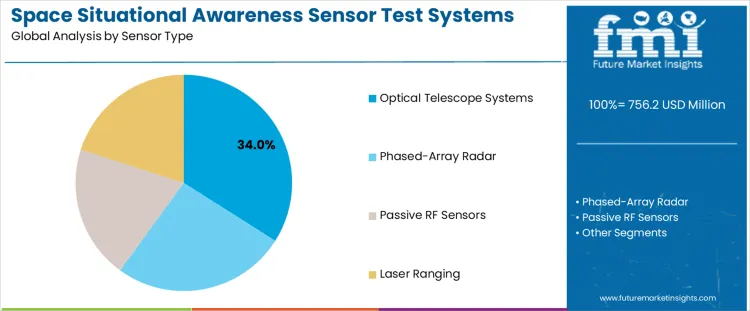
Optical telescope systems hold 34.0%, accounting for the largest share of global demand. These systems support high-resolution observation of objects in low and geostationary orbits, enabling characterization and catalog maintenance. Phased-array radar holds 26.0%, providing all-weather detection and range measurement for active tracking. Passive RF sensors account for 20.0%, supporting signal-based detection and identification of transmitting objects. Laser ranging also holds 20.0%, enabling precise distance measurement and orbit refinement. Sensor-type distribution reflects reliance on optical observation complemented by radar and ranging technologies.
Key Points
- Optical telescopes lead due to high-resolution observation capability.
- Phased-array radar supports all-weather tracking.
- RF and laser systems enhance detection and orbit precision.
Which Test Capability Drives the Highest Share of Global Testing Activity?
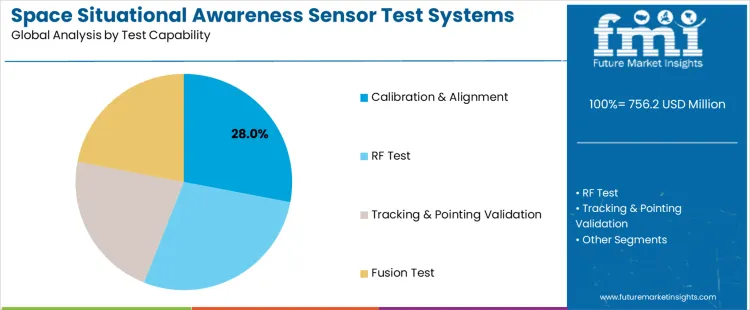
Calibration and alignment hold 28.0%, driving the highest share of global testing activity. Accurate alignment ensures sensor pointing precision and measurement reliability across observation campaigns. RF testing also holds 28.0%, supporting validation of radar performance, signal integrity, and interference management. Tracking and pointing validation account for 22.0%, ensuring dynamic object-following accuracy. Fusion testing holds 22.0%, validating data integration across heterogeneous sensor networks. Test-capability distribution reflects emphasis on foundational accuracy and sensor interoperability.
Key Points
- Calibration and alignment underpin measurement accuracy.
- RF testing ensures radar signal reliability.
- Fusion tests validate multi-sensor data integration.
Which End-User Group Represents the Largest Share of Global Demand?

Government entities hold 44.0%, representing the largest end-user share globally. Governments manage national space surveillance responsibilities, debris mitigation programs, and defense-related monitoring. System integrators hold 24.0%, supporting deployment and integration of multi-sensor architectures. Commercial SSA providers account for 20.0%, delivering monitoring services for satellite operators. Universities hold 12.0%, supporting research, algorithm development, and sensor experimentation. End-user distribution reflects primary responsibility of public institutions for space domain awareness.
Key Points
- Governments lead due to national surveillance responsibilities.
- Integrators support system deployment and integration.
- Commercial and academic users contribute services and research.
What are the Key Dynamics in the Space Situational Awareness Sensor Test Systems Market?
Global demand rises as space agencies, defense organizations, commercial operators, and research institutions expand capabilities to detect, track, and characterize resident space objects (RSOs), debris, and emerging threats. Sensor test systems enable validation of optical, radar, LIDAR, and RF tracking technologies used within space situational awareness (SSA) networks. Adoption aligns with growing space traffic, constellation deployments, and emphasis on orbital safety, collision avoidance, and space domain awareness across multiple regions. Usage spans laboratory development, field test ranges, and integrated sensor networks requiring rigorous performance assessment.
How do expanding space operations and orbital safety priorities shape global demand?
The proliferation of satellites-especially large constellations&-heightens need for accurate tracking and cataloging of objects in low Earth orbit (LEO), medium Earth orbit (MEO), and geostationary orbit (GEO). SSA sensor test systems validate detection sensitivity, tracking continuity, and data quality for radar arrays, optical telescopes, and hybrid sensor suites. Defense and civil space agencies require traceable performance verification to support conjunction assessment, maneuver planning, and space traffic coordination. Commercial operators deploy test systems to qualify proprietary sensors embedded in ground and hosted payload networks. Test platforms simulate target signatures, dynamic motion, and environmental conditions to ensure robust sensor operation before field deployment. Shared data standards and cross-network interoperability drive demand for harmonized test methodologies.
How do capital intensity, technical complexity, and infrastructure distribution influence market scalability?
SSA sensor test systems involve significant investment in high-power signal generators, calibrated light sources, motion simulation rigs, and precision timing infrastructure. Laboratory facilities must support high-fidelity emulation of orbital dynamics, sensor pointing accuracy, and environmental noise factors. Integration of multi-modality sensor data requires advanced processing and synchronization frameworks, increasing test campaign complexity. Regional disparities in dedicated test ranges and high-performance facilities concentrate capability within major aerospace and defense centers, while emerging space nations seek partnerships or service access to validate sensor technologies. Regulatory frameworks affecting spectrum use for radar and RF tests shape permissible testing environments. Skilled engineers and cross-disciplinary expertise are critical for test design and execution. Global growth depends on modular, scalable test solutions and collaborative networks that lower entry barriers for diversified SSA sensor development.
How Is Demand for Space Situational Awareness Sensor Test Systems Evolving?
Demand for space situational awareness sensor test systems is increasing globally due to rising satellite congestion, debris monitoring requirements, and defense space surveillance priorities. China leads with an 11.2% CAGR, supported by large-scale space surveillance infrastructure and orbital monitoring programs. Brazil follows at 10.6%, driven by capability development and academic space observation initiatives. USA records a 9.8% CAGR, shaped by defense modernization and commercial space traffic management needs. South Korea posts 9.4%, reflecting integration of space surveillance within national security planning. UK records 8.9%, supported by collaborative research facilities and international data-sharing roles. Growth reflects heightened emphasis on sensor accuracy, tracking reliability, and ground-based validation worldwide.
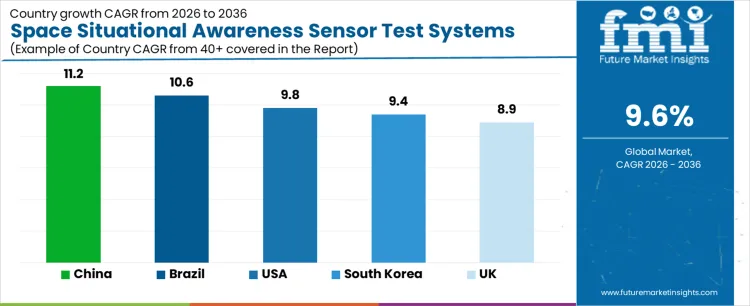
| Country | CAGR (%) |
|---|---|
| China | 11.2 |
| Brazil | 10.6 |
| USA | 9.8 |
| South Korea | 9.4 |
| UK | 8.9 |
What factors are accelerating adoption of SSA sensor test systems in China?
China drives demand through expansion of space surveillance networks, military space awareness programs, and commercial satellite tracking needs. Country’s CAGR of 11.2% reflects investment in test systems validating optical, radar, and infrared SSA sensors. Facilities support calibration, sensitivity assessment, and multi-object tracking performance testing. Emphasis remains on in-house testing to ensure data security and operational reliability. Integration of ground-based sensors with space-based assets increases validation complexity. Academic and state laboratories expand parallel testing capabilities. Growth remains policy-supported and scale-driven, aligned with long-term national space security objectives.
- Expansion of national space surveillance infrastructure
- Validation of optical, radar, and infrared sensors
- Emphasis on secure in-house testing capability
- Government-backed investment in SSA systems
Why is Brazil emerging as a fast-growing SSA sensor test system market?
Brazil demand is shaped by development of national space awareness capability, satellite tracking initiatives, and academic astronomy programs. Country’s CAGR of 10.6% reflects rising investment in sensor test systems for optical telescopes and tracking radars. Shared facilities enable cost-efficient validation of detection accuracy and tracking consistency. Collaboration with international space agencies supports alignment with global SSA standards. Demand favors modular and mid-scale test platforms suitable for research and operational pilots. Growth remains capability-building focused, aligned with gradual strengthening of domestic space monitoring infrastructure.
- National and academic space tracking initiatives
- Shared sensor testing and calibration facilities
- Alignment with international SSA standards
- Modular test system adoption
How do defense and commercial space needs shape SSA testing demand in the USA?
USA demand reflects defense space surveillance programs, commercial satellite operations, and space traffic management initiatives. Country’s CAGR of 9.8% is supported by need for testing systems validating sensor accuracy, data fusion, and tracking reliability. Defense agencies emphasize repeatable testing under simulated orbital conditions. Commercial operators require calibration to support collision avoidance services. Test platforms integrate simulation, data analytics, and sensor fusion tools. Growth remains program-driven, aligned with increasing reliance on SSA data for operational and regulatory decision-making.
- Defense-led space surveillance requirements
- Commercial space traffic management needs
- Sensor fusion and data accuracy validation
- Simulation-integrated testing platforms
What role does South Korea’s security focus play in SSA test system growth?
South Korea demand reflects integration of SSA capabilities into national defense and aerospace monitoring frameworks. Country’s CAGR of 9.4% is supported by adoption of test systems for validating ground-based sensors and data processing pipelines. Programs emphasize precision tracking, system interoperability, and operational readiness. Government-backed initiatives promote domestic testing capability development. Demand favors compact and high-accuracy systems suitable for research and operational validation. Growth remains security-driven, aligned with strengthening national space monitoring and early warning capabilities.
- Defense-oriented space monitoring initiatives
- Precision tracking and interoperability testing
- Government-supported domestic capability development
- Compact and accurate test system requirements
How is the UK positioned within the global SSA sensor test ecosystem?
UK demand reflects collaborative research models, space domain awareness participation, and international data-sharing roles. Country’s CAGR of 8.9% is supported by investment in shared SSA sensor test facilities serving academia, defense, and commercial users. Test systems support calibration, algorithm validation, and performance benchmarking. Public funding encourages infrastructure upgrades and cross-sector collaboration. Demand favors versatile platforms adaptable to optical and radar sensors. Growth remains ecosystem-driven, aligned with UK’s role in multinational SSA initiatives and space security partnerships.
- Shared SSA sensor testing infrastructure
- Algorithm and performance validation focus
- Government-funded collaborative research
- Participation in international SSA programs
What is the competitive landscape of demand for space situational awareness sensor test systems?

Demand for space situational awareness sensor test systems is driven by growth in orbital congestion and defense monitoring requirements. Testing programs validate radar, optical, infrared, and radio frequency sensors supporting detection, tracking, and characterization of space objects. Buyers require calibrated targets, signal emulation, timing accuracy, and environmental simulation matching operational mission profiles. Procurement teams prioritize end-to-end verification, data integrity, and compatibility with command, control, and analytics pipelines. Reliability during continuous monitoring scenarios and ability to reproduce complex orbital dynamics influence supplier selection. Trend in global market reflects increased investment in multi-sensor fusion and persistent monitoring architectures.
Raytheon Technologies maintains strong positioning through integrated sensor test solutions supporting radar and electro-optical SSA programs. Northrop Grumman operates proprietary and customer-facing test infrastructure validating space surveillance sensors and processing chains. L3Harris supports sensor test and integration with emphasis on data links, signal processing, and resilient architectures. BAE Systems contributes test capabilities aligned with defense-grade electro-optical and RF sensing programs. Lockheed Martin deploys internal test assets supporting end-to-end validation of space domain awareness systems. Keysight Technologies and Rohde and Schwarz supply RF signal generation, analysis, and timing solutions used across SSA sensor testing. Teledyne and Thorlabs provide imaging sensors, detectors, and optical instrumentation supporting calibration and laboratory validation. Hexagon contributes metrology, positioning, and simulation tools supporting sensor alignment and geospatial accuracy. Competitive differentiation depends on scenario realism, calibration traceability, integration depth, and support for multi-domain sensing architectures.
Key Players in the Space Situational Awareness Sensor Test Systems Market
- Raytheon Technologies
- Northrop Grumman
- L3Harris
- BAE Systems
- Lockheed Martin
- Keysight Technologies
- Rohde & Schwarz
- Teledyne
- Thorlabs
- Hexagon
Scope of the Report
| Items | Values |
|---|---|
| Quantitative Units | USD million |
| Sensor Type | Optical Telescope Systems; Phased-Array Radar Sensors; Passive RF Sensors; Laser Ranging Systems |
| Test Capability | Calibration and Alignment Testing; RF and Signal Integrity Testing; Tracking and Pointing Validation; Multi-Sensor Data Fusion Testing |
| End User | Government and Defense Agencies; Commercial SSA Service Providers; System Integrators; Universities and Research Institutions |
| Regions Covered | Asia Pacific; Europe; North America; Latin America; Middle East & Africa |
| Countries Covered | USA; China; Brazil; UK; South Korea; and 40+ countries |
| Key Companies Profiled | Raytheon Technologies; Northrop Grumman; L3Harris; BAE Systems; Lockheed Martin; Keysight Technologies; Rohde & Schwarz; Teledyne; Thorlabs; Hexagon |
| Additional Attributes | Dollar sales by sensor and test capability; growing SSA investments for space traffic management; rising adoption of optical, radar, and RF sensor fusion; emphasis on calibration accuracy and tracking validation; integration with digital simulation environments; demand driven by defense modernization and commercial satellite constellation monitoring. |
Space Situational Awareness Sensor Test Systems Market by Segment
Sensor Type:
- Optical Telescope Systems
- Phased-Array Radar
- Passive RF Sensors
- Laser Ranging
Test Capability:
- Calibration & Alignment
- RF Test
- Tracking & Pointing Validation
- Fusion Test
End User:
- Government
- Commercial SSA Providers
- System Integrators
- Universities
Region:
- Asia Pacific
- China
- Japan
- South Korea
- India
- Australia & New Zealand
- ASEAN
- Rest of Asia Pacific
- Europe
- Germany
- United Kingdom
- France
- Italy
- Spain
- Nordic
- BENELUX
- Rest of Europe
- North America
- United States
- Canada
- Mexico
- Latin America
- Brazil
- Chile
- Rest of Latin America
- Middle East & Africa
- Kingdom of Saudi Arabia
- Other GCC Countries
- Turkey
- South Africa
- Other African Union
- Rest of Middle East & Africa
Frequently Asked Questions
How big is the space situational awareness sensor test systems market in 2026?
The global space situational awareness sensor test systems market is estimated to be valued at USD 756.2 million in 2026.
What will be the size of space situational awareness sensor test systems market in 2036?
The market size for the space situational awareness sensor test systems market is projected to reach USD 1,891.2 million by 2036.
How much will be the space situational awareness sensor test systems market growth between 2026 and 2036?
The space situational awareness sensor test systems market is expected to grow at a 9.6% CAGR between 2026 and 2036.
What are the key sensor types in the space situational awareness sensor test systems market?
The key sensor types in space situational awareness sensor test systems market are optical telescope systems, phased-array radar, passive RF sensors and laser ranging.
Which test capability segment to contribute significant share in the space situational awareness sensor test systems market in 2026?
In terms of test capability, calibration & alignment segment to command 28.0% share in the space situational awareness sensor test systems market in 2026.
Preview the report firsthand - request a free sample
Get SampleGet the brochure for pricing and purchase details.
Get PDFTable of Content
- Executive Summary
- Global Market Outlook
- Demand-side Trends
- Supply-side Trends
- Technology Roadmap Analysis
- Analysis and Recommendations
- Market Overview
- Market Coverage / Taxonomy
- Market Definition / Scope / Limitations
- Market Background
- Market Dynamics
- Drivers
- Restraints
- Opportunity
- Trends
- Scenario Forecast
- Demand in Optimistic Scenario
- Demand in Likely Scenario
- Demand in Conservative Scenario
- Opportunity Map Analysis
- Product Life Cycle Analysis
- Supply Chain Analysis
- Investment Feasibility Matrix
- Value Chain Analysis
- PESTLE and Porter’s Analysis
- Regulatory Landscape
- Regional Parent Market Outlook
- Production and Consumption Statistics
- Import and Export Statistics
- Market Dynamics
- Global Market Analysis 2021 to 2025 and Forecast, 2026 to 2036
- Historical Market Size Value (USD Million) Analysis, 2021 to 2025
- Current and Future Market Size Value (USD Million) Projections, 2026 to 2036
- Y-o-Y Growth Trend Analysis
- Absolute $ Opportunity Analysis
- Global Market Pricing Analysis 2021 to 2025 and Forecast 2026 to 2036
- Global Market Analysis 2021 to 2025 and Forecast 2026 to 2036, By Sensor Type
- Introduction / Key Findings
- Historical Market Size Value (USD Million) Analysis By Sensor Type , 2021 to 2025
- Current and Future Market Size Value (USD Million) Analysis and Forecast By Sensor Type , 2026 to 2036
- Optical Telescope Systems
- Phased-Array Radar
- Passive RF Sensors
- Laser Ranging
- Optical Telescope Systems
- Y-o-Y Growth Trend Analysis By Sensor Type , 2021 to 2025
- Absolute $ Opportunity Analysis By Sensor Type , 2026 to 2036
- Global Market Analysis 2021 to 2025 and Forecast 2026 to 2036, By Test Capability
- Introduction / Key Findings
- Historical Market Size Value (USD Million) Analysis By Test Capability, 2021 to 2025
- Current and Future Market Size Value (USD Million) Analysis and Forecast By Test Capability, 2026 to 2036
- Calibration & Alignment
- RF Test
- Tracking & Pointing Validation
- Fusion Test
- Calibration & Alignment
- Y-o-Y Growth Trend Analysis By Test Capability, 2021 to 2025
- Absolute $ Opportunity Analysis By Test Capability, 2026 to 2036
- Global Market Analysis 2021 to 2025 and Forecast 2026 to 2036, By End User
- Introduction / Key Findings
- Historical Market Size Value (USD Million) Analysis By End User, 2021 to 2025
- Current and Future Market Size Value (USD Million) Analysis and Forecast By End User, 2026 to 2036
- Government
- Commercial SSA Providers
- System Integrators
- Universities
- Government
- Y-o-Y Growth Trend Analysis By End User, 2021 to 2025
- Absolute $ Opportunity Analysis By End User, 2026 to 2036
- Global Market Analysis 2021 to 2025 and Forecast 2026 to 2036, By Region
- Introduction
- Historical Market Size Value (USD Million) Analysis By Region, 2021 to 2025
- Current Market Size Value (USD Million) Analysis and Forecast By Region, 2026 to 2036
- North America
- Latin America
- Western Europe
- Eastern Europe
- East Asia
- South Asia and Pacific
- Middle East & Africa
- Market Attractiveness Analysis By Region
- North America Market Analysis 2021 to 2025 and Forecast 2026 to 2036, By Country
- Historical Market Size Value (USD Million) Trend Analysis By Market Taxonomy, 2021 to 2025
- Market Size Value (USD Million) Forecast By Market Taxonomy, 2026 to 2036
- By Country
- USA
- Canada
- Mexico
- By Sensor Type
- By Test Capability
- By End User
- By Country
- Market Attractiveness Analysis
- By Country
- By Sensor Type
- By Test Capability
- By End User
- Key Takeaways
- Latin America Market Analysis 2021 to 2025 and Forecast 2026 to 2036, By Country
- Historical Market Size Value (USD Million) Trend Analysis By Market Taxonomy, 2021 to 2025
- Market Size Value (USD Million) Forecast By Market Taxonomy, 2026 to 2036
- By Country
- Brazil
- Chile
- Rest of Latin America
- By Sensor Type
- By Test Capability
- By End User
- By Country
- Market Attractiveness Analysis
- By Country
- By Sensor Type
- By Test Capability
- By End User
- Key Takeaways
- Western Europe Market Analysis 2021 to 2025 and Forecast 2026 to 2036, By Country
- Historical Market Size Value (USD Million) Trend Analysis By Market Taxonomy, 2021 to 2025
- Market Size Value (USD Million) Forecast By Market Taxonomy, 2026 to 2036
- By Country
- Germany
- UK
- Italy
- Spain
- France
- Nordic
- BENELUX
- Rest of Western Europe
- By Sensor Type
- By Test Capability
- By End User
- By Country
- Market Attractiveness Analysis
- By Country
- By Sensor Type
- By Test Capability
- By End User
- Key Takeaways
- Eastern Europe Market Analysis 2021 to 2025 and Forecast 2026 to 2036, By Country
- Historical Market Size Value (USD Million) Trend Analysis By Market Taxonomy, 2021 to 2025
- Market Size Value (USD Million) Forecast By Market Taxonomy, 2026 to 2036
- By Country
- Russia
- Poland
- Hungary
- Balkan & Baltic
- Rest of Eastern Europe
- By Sensor Type
- By Test Capability
- By End User
- By Country
- Market Attractiveness Analysis
- By Country
- By Sensor Type
- By Test Capability
- By End User
- Key Takeaways
- East Asia Market Analysis 2021 to 2025 and Forecast 2026 to 2036, By Country
- Historical Market Size Value (USD Million) Trend Analysis By Market Taxonomy, 2021 to 2025
- Market Size Value (USD Million) Forecast By Market Taxonomy, 2026 to 2036
- By Country
- China
- Japan
- South Korea
- By Sensor Type
- By Test Capability
- By End User
- By Country
- Market Attractiveness Analysis
- By Country
- By Sensor Type
- By Test Capability
- By End User
- Key Takeaways
- South Asia and Pacific Market Analysis 2021 to 2025 and Forecast 2026 to 2036, By Country
- Historical Market Size Value (USD Million) Trend Analysis By Market Taxonomy, 2021 to 2025
- Market Size Value (USD Million) Forecast By Market Taxonomy, 2026 to 2036
- By Country
- India
- ASEAN
- Australia & New Zealand
- Rest of South Asia and Pacific
- By Sensor Type
- By Test Capability
- By End User
- By Country
- Market Attractiveness Analysis
- By Country
- By Sensor Type
- By Test Capability
- By End User
- Key Takeaways
- Middle East & Africa Market Analysis 2021 to 2025 and Forecast 2026 to 2036, By Country
- Historical Market Size Value (USD Million) Trend Analysis By Market Taxonomy, 2021 to 2025
- Market Size Value (USD Million) Forecast By Market Taxonomy, 2026 to 2036
- By Country
- Kingdom of Saudi Arabia
- Other GCC Countries
- Turkiye
- South Africa
- Other African Union
- Rest of Middle East & Africa
- By Sensor Type
- By Test Capability
- By End User
- By Country
- Market Attractiveness Analysis
- By Country
- By Sensor Type
- By Test Capability
- By End User
- Key Takeaways
- Key Countries Market Analysis
- USA
- Pricing Analysis
- Market Share Analysis, 2025
- By Sensor Type
- By Test Capability
- By End User
- Canada
- Pricing Analysis
- Market Share Analysis, 2025
- By Sensor Type
- By Test Capability
- By End User
- Mexico
- Pricing Analysis
- Market Share Analysis, 2025
- By Sensor Type
- By Test Capability
- By End User
- Brazil
- Pricing Analysis
- Market Share Analysis, 2025
- By Sensor Type
- By Test Capability
- By End User
- Chile
- Pricing Analysis
- Market Share Analysis, 2025
- By Sensor Type
- By Test Capability
- By End User
- Germany
- Pricing Analysis
- Market Share Analysis, 2025
- By Sensor Type
- By Test Capability
- By End User
- UK
- Pricing Analysis
- Market Share Analysis, 2025
- By Sensor Type
- By Test Capability
- By End User
- Italy
- Pricing Analysis
- Market Share Analysis, 2025
- By Sensor Type
- By Test Capability
- By End User
- Spain
- Pricing Analysis
- Market Share Analysis, 2025
- By Sensor Type
- By Test Capability
- By End User
- France
- Pricing Analysis
- Market Share Analysis, 2025
- By Sensor Type
- By Test Capability
- By End User
- India
- Pricing Analysis
- Market Share Analysis, 2025
- By Sensor Type
- By Test Capability
- By End User
- ASEAN
- Pricing Analysis
- Market Share Analysis, 2025
- By Sensor Type
- By Test Capability
- By End User
- Australia & New Zealand
- Pricing Analysis
- Market Share Analysis, 2025
- By Sensor Type
- By Test Capability
- By End User
- China
- Pricing Analysis
- Market Share Analysis, 2025
- By Sensor Type
- By Test Capability
- By End User
- Japan
- Pricing Analysis
- Market Share Analysis, 2025
- By Sensor Type
- By Test Capability
- By End User
- South Korea
- Pricing Analysis
- Market Share Analysis, 2025
- By Sensor Type
- By Test Capability
- By End User
- Russia
- Pricing Analysis
- Market Share Analysis, 2025
- By Sensor Type
- By Test Capability
- By End User
- Poland
- Pricing Analysis
- Market Share Analysis, 2025
- By Sensor Type
- By Test Capability
- By End User
- Hungary
- Pricing Analysis
- Market Share Analysis, 2025
- By Sensor Type
- By Test Capability
- By End User
- Kingdom of Saudi Arabia
- Pricing Analysis
- Market Share Analysis, 2025
- By Sensor Type
- By Test Capability
- By End User
- Turkiye
- Pricing Analysis
- Market Share Analysis, 2025
- By Sensor Type
- By Test Capability
- By End User
- South Africa
- Pricing Analysis
- Market Share Analysis, 2025
- By Sensor Type
- By Test Capability
- By End User
- USA
- Market Structure Analysis
- Competition Dashboard
- Competition Benchmarking
- Market Share Analysis of Top Players
- By Regional
- By Sensor Type
- By Test Capability
- By End User
- Competition Analysis
- Competition Deep Dive
- Raytheon Technologies
- Overview
- Product Portfolio
- Profitability by Market Segments (Product/Age /Sales Channel/Region)
- Sales Footprint
- Strategy Overview
- Marketing Strategy
- Product Strategy
- Channel Strategy
- Northrop Grumman
- L3Harris
- BAE Systems
- Lockheed Martin
- Keysight Technologies
- Rohde & Schwarz
- Teledyne
- Thorlabs
- Hexagon
- Raytheon Technologies
- Competition Deep Dive
- Assumptions & Acronyms Used
- Research Methodology


