

- Industry Size (2026)
- USD 561.85 Mn
- Forecast (2036)
- USD 1538.76 Mn
- CAGR (2026 to 2036)
- 10.6%
Conveyor-Free Sortation Modules Market Size, Market Forecast and Outlook By FMI
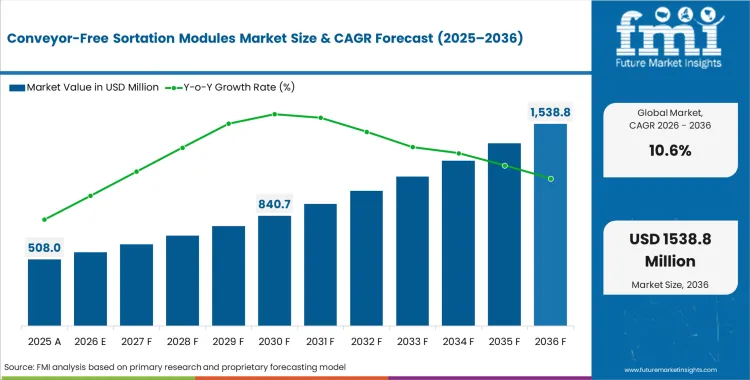
The conveyor-free sortation modules market was valued at USD 508.00 million in 2025, projected to reach USD 561.85 million in 2026, and is forecast to expand to USD 1538.76 million by 2036 at a 10.6% CAGR. Warehouse operators managing seasonal demand spikes and multi-client fulfillment contracts are replacing fixed conveyor infrastructure with modular, autonomous sorting cells that can be deployed, relocated, and scaled without facility reconstruction. The shift from capital-intensive belt-driven sortation to flexible pod-based architectures reflects a broader transition in logistics infrastructure planning, where lease-cycle flexibility and rapid commissioning timelines now outweigh throughput density as procurement decision criteria.
Summary of Conveyor-Free Sortation Modules Market
- Market Overview
- The conveyor-free sortation modules market is valued at USD 508.00 million in 2025 and is projected to reach USD 1538.76 million by 2036.
- The industry is expected to grow at a 10.6% CAGR from 2026 to 2036, creating an incremental opportunity of USD 976.91 million.
- Demand and Growth Drivers
- Demand is accelerating as warehouse operators replace fixed conveyor infrastructure with reconfigurable autonomous sorting cells to manage seasonal volume spikes.
- Vision-guided robotics and autonomous shuttle technologies are compressing deployment timelines and reducing facility modification requirements.
- Growth is supported by third-party logistics operators seeking modular capacity additions that avoid production downtime during installation.
- Among key countries, India leads at 12.0% CAGR, followed by China at 11.0%, the USA at 8.8%, Brazil at 8.0%, Germany at 7.0%, and Japan at 5.0%.
- Product and Segment View
- The market includes modular sortation pods, mobile sort pods, high-speed sortation modules, and small-footprint sorters using vision-guided and autonomous shuttle technologies.
- These systems integrate with warehouse execution platforms through decentralized control architectures that eliminate single-point conveyor dependencies.
- Modular Sortation Pods lead by System Type with 60.0% share in 2026.
- The scope includes hardware, embedded controls, and integration services, while excluding traditional belt-driven conveyor systems and standalone autonomous mobile robots.
- Geography and Competitive Outlook
- India and China are the fastest-growing markets due to greenfield warehouse construction and rapid e-commerce fulfillment network expansion.
- North America and Europe represent mature but active demand bases where brownfield facility upgrades drive modular sortation adoption.
- Competition is shaped by system integration capability, autonomous navigation accuracy, and warehouse management software interoperability, with key players including Swisslog, GreyOrange, Hikrobot, Knapp, SSI Schaefer Partners, Daifuku.
- Analyst Opinion at FMI
- Nikhil Kaitwade, Principal Consultant for Automation and Logistics, opines: 'In my analysis, I have observed that the primary constraint in modern parcel distribution is not sorting speed but the physical rigidity of fixed conveyor infrastructure. Fulfillment operations attempting to manage multi-client contracts and seasonal volume fluctuations using permanent belt-driven sortation face unavoidable capacity mismatches. Logistics architects who continue specifying fixed conveyor systems will find themselves unable to meet the commissioning timelines and layout flexibility demanded by lease-cycle aware facility planners.'
- Strategic Implications / Executive Takeaways
- System integrators must certify interoperability with tier-1 warehouse execution platforms to qualify for multi-site logistics facility contracts.
- Capital project directors should phase out fixed conveyor sortation specifications and mandate modular pod-based architectures in all new distribution center procurement.
- Logistics engineers must develop autonomous navigation deployment competencies to support rapid commissioning of conveyor-free sorting cells.
Parcel carriers and third-party logistics operators face compounding pressure from rising labor costs, shrinking delivery windows, and escalating parcel volumes that exceed the physical expansion capacity of legacy distribution centers. Conveyor-free sortation modules address this constraint by enabling operators to add sorting capacity in discrete increments without shutting down live operations. Facility planners executing multi-phase warehouse buildouts now specify modular sortation pods as baseline infrastructure rather than retrofit additions, compressing deployment timelines from months to weeks.
All major regional markets reflect differentiated adoption trajectories. India sets the pace with a 12.0% CAGR, followed by China at 11.0%. USA operations advance at a 8.8% rate. Brazil tracks at 8.0%. Germany registers a 7.0% pace. Japan expands at a 5.0% trajectory.
Conveyor-Free Sortation Modules Market Key Takeaways
| Metric | Details |
|---|---|
| Industry Size (2026) | USD 561.85 million |
| Industry Value (2036) | USD 1538.76 million |
| CAGR (2026 to 2036) | 10.6% |
Source: Future Market Insights, 2026
Conveyor-Free Sortation Modules Market Definition
Conveyor-Free Sortation Modules are modular, self-contained sorting units that operate without fixed conveyor infrastructure. These systems use autonomous mobile robots, vision-guided shuttles, and decentralized sorting cells to route parcels, packages, and items within warehouses, distribution centers, and fulfillment hubs. They replace traditional belt-driven sortation lines with flexible, reconfigurable layouts that adapt to seasonal volume fluctuations and facility footprint constraints.
Conveyor-Free Sortation Modules Market Inclusions
Market scope covers modular sortation pods, mobile sort pods, high-speed sortation modules, small-footprint sorters, and associated software orchestration layers. The analysis spans system-level revenue from hardware, embedded controls, and integration services across cloud-based and on-premise deployment models.
Conveyor-Free Sortation Modules Market Exclusions
The scope excludes traditional belt-driven conveyor sortation systems, standalone autonomous mobile robots sold without sortation functionality, and warehouse management software platforms that lack embedded sortation algorithms. Manual sorting labor costs and general warehouse racking are also outside the defined boundary.
Conveyor-Free Sortation Modules Market Research Methodology
- Primary Research: Analysts engaged with procurement specialists, facility engineers, and operations directors to map decision gates that trigger system upgrades and new equipment specifications.
- Desk Research: Data collection phases aggregated regulatory compliance timelines, industry standards ratification schedules, and published facility investment disclosures from leading operators.
- Market-Sizing and Forecasting: Baseline values derive from a bottom-up aggregation of equipment shipment records and contract award databases, applying region-specific adoption curves to project future demand velocity.
- Data Validation and Update Cycle: Projections are tested against publicly reported capital expenditure guidance and quarterly equipment revenue disclosures from leading manufacturers.
What Is Driving the Demand for the Conveyor-Free Sortation Modules Market?
Early demand for conveyor-free sortation modules originated from operational limits in traditional conveyor based infrastructures used in distribution and fulfilment centres. Conventional conveyor systems required significant floor space, incurred high maintenance costs, and lacked flexibility for frequent layout changes. Initial adopters, including e-commerce fulfilment centres and third party logistics providers, sought modular alternatives that could support higher throughput with reduced infrastructure constraints. Historical growth reflected rapid expansion of e-commerce ordering volumes, rising expectations for order accuracy, and the need to manage peak seasonal demand. Early uptake concentrated in larger facilities where capital budgets supported pilot installations, and where throughput gains could be measured against legacy system performance.
Future demand for conveyor-free sortation modules is expected to reflect broader adoption across diverse logistics segments rather than selective innovation use. Growth will be driven by the need for flexible automation that supports dynamic fulfilment strategies, including zone based task allocation, rapid reconfiguration, and space optimisation in multi-tenant facilities. Advances in autonomous mobile robots, integrated vision systems, and distributed control software are reducing deployment costs and enhancing real time sortation accuracy. Unlike historical growth tied primarily to e-commerce mega hubs, future expansion will include mid-sized warehouses and omnichannel distribution networks seeking modular automation. Demand will be shaped by productivity metrics, total cost of ownership evaluations, and integration with warehouse management systems rather than solely by throughput ceilings of fixed conveyor lines.
What Factors Are Affecting the Demand for Conveyor Free Sortation Modules Market in Terms of End Use Application and Packaging and System Type?
Demand for conveyor free sortation modules is organized by end use application and packaging or system type across logistics and distribution operations. E commerce and distribution centers account for about 55% of total demand, driven by high parcel volumes and space constraints. Parcel and postal sortation, automotive component handling, and retail last mile hubs form additional application areas with distinct throughput and accuracy requirements. Regional parcel hubs and other uses contribute incremental demand. Packaging and system type influences deployment flexibility, scalability, and integration with existing layouts. Modular sortation pods, mobile sort pods, high speed modules, and small footprint sorters address varied operational needs. These segments explain demand patterns shaped by throughput intensity, space availability, and labor interaction rather than uniform automation adoption.
What Drives Demand by End Use Application in the Conveyor Free Sortation Modules Market?
E commerce and distribution centers lead demand due to rapid order fulfillment cycles and fluctuating parcel volumes. These environments require adaptable sortation without fixed conveyor infrastructure. Parcel and postal sortation facilities adopt conveyor free modules to manage peak season variability and routing complexity. Automotive component sortation relies on accuracy and part integrity rather than sheer volume. Retail and last mile hubs use compact systems to operate within urban space limits. Regional parcel hubs adopt selectively where legacy layouts restrict conveyor expansion. Adoption intensity aligns with throughput variability and space constraints. End use demand concentrates where operational flexibility directly affects processing speed and labor efficiency across daily sorting activities.
Application driven demand remains stable because volume variability persists across logistics networks. E commerce operators value systems that can be reconfigured as demand shifts. Postal and parcel operators integrate modules to supplement fixed infrastructure. Automotive users prioritize controlled handling over speed. Last mile hubs apply systems to reduce manual sorting within limited footprints. Regional hubs deploy modules to address bottlenecks rather than full redesigns. These patterns limit volatility in adoption. End use segmentation highlights reliance on adaptable sortation rather than permanent conveyor investment. Demand therefore reflects structural logistics pressures embedded within distribution models rather than discretionary automation upgrades.
How Does Packaging and System Type Shape Demand for Conveyor Free Sortation Modules Market?
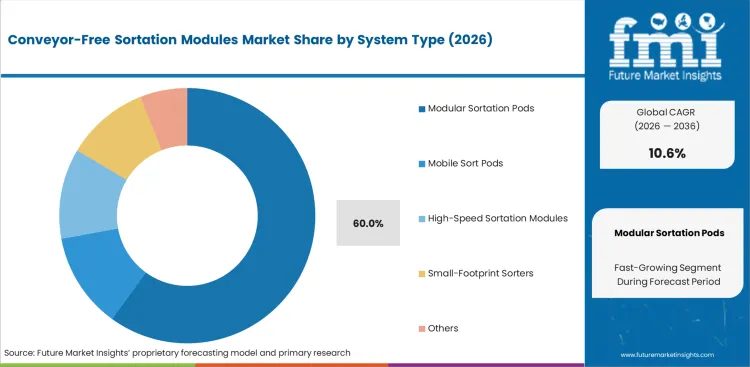
Modular sortation pods account for about 60% of total demand, making them the leading system type. Their dominance reflects ease of scaling and reconfiguration within existing facilities. Mobile sort pods support temporary or seasonal capacity expansion. High speed sortation modules are applied where throughput requirements are concentrated in limited zones. Small footprint sorters serve retail and last mile hubs with severe space constraints. Other system types address niche operational needs. System selection depends on floor space, mobility requirements, and integration effort. Demand follows practical deployment considerations rather than maximum speed capability across logistics and distribution operators.
Modular pods maintain leadership due to predictable performance and incremental expansion capability. Mobile pods appeal to operators managing short term volume spikes. High speed modules are adopted selectively where fixed zones justify higher investment. Small footprint systems address urban logistics constraints. Organizations favor systems that minimize facility disruption during installation. This limits rapid shifts toward complex configurations. Packaging and system type therefore stabilize demand by aligning with existing layouts and operational rhythms. These constraints explain why modular and mobile systems retain higher penetration than fully fixed high speed alternatives across diverse sorting environments.
How Are Conveyor Free Sortation Modules Being Integrated Into Modern Material Handling Systems?
Use appears in logistics and e commerce fulfillment centers where flexibility and modularity are prioritized over traditional conveyor systems. Operators adopt these modules to route parcels and products across multiple packing or staging areas without fixed belt infrastructure. Retail distribution hubs use them to sort varied SKU sizes with minimal footprint. Third party logistics providers implement modular units for temporary or seasonal spikes in order volume. These applications reflect operational needs focused on space efficiency, routing flexibility, and rapid deployment rather than conventional conveyor throughput.
What Operational Conditions Encourage Adoption of Conveyor Free Sortation Modules?
Selection aligns with facilities managing high SKU variability, dynamic routing, and changing workflow patterns. Modules allow operators to reconfigure sorting pathways quickly to adapt to peak demand. Warehouses benefit from reduced floor space occupation compared with fixed conveyor layouts. Automation teams favor systems compatible with robotics and automated guided vehicles. Logistics managers rely on modules to reduce bottlenecks in cross docking or multi zone sorting operations. These conditions arise from efficiency, adaptability, and scalable workflow priorities within modern fulfillment environments.
Which Practical Considerations Limit Wider Use of Conveyor Free Sortation Modules?
Capital investment remains higher than basic conveyor belts for small facilities. Integration with existing warehouse management systems may require software and control adjustments. Staff training is needed to operate and maintain modular units. Load stability varies by parcel size and weight, affecting performance. Maintenance planning must account for multiple moving components and modular connectivity. These factors result in selective deployment where operational flexibility, throughput efficiency, and reconfigurability justify higher cost and technical complexity.
What is the Demand for Conveyor Free Sortation Modules by Country?
.webp "Top Country Growth Comparison Conveyor Free Sortation Modules Market Cagr (2026 2036)")
| Country | CAGR (%) |
|---|---|
| USA | 8.8% |
| China | 11.0% |
| Germany | 7.0% |
| India | 12.0% |
| Brazil | 8.0% |
| Japan | 5.0% |
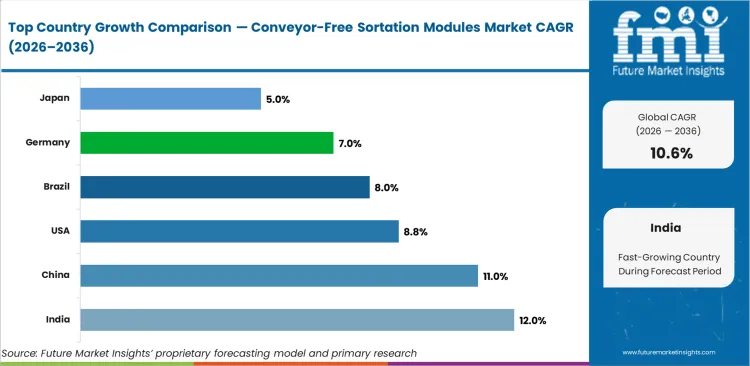
The demand for conveyor free sortation modules varies across countries, driven by warehouse automation, e commerce growth, and logistics efficiency requirements. India leads with a 12.0% CAGR, supported by rapid expansion in e commerce, retail distribution centers, and adoption of automated sortation solutions. China follows at 11.0%, driven by large scale fulfillment operations and high throughput distribution networks. The USA grows at 8.8%, reflecting adoption in logistics, retail, and industrial warehouses. Brazil records 8.0%, shaped by organized retail and growing warehousing infrastructure. Germany posts 7.0%, supported by established industrial standards, while Japan grows at 5.0%, reflecting mature logistics operations and steady adoption of automated sortation technologies.
How Is Automated Material Handling Driving Growth in the United States?
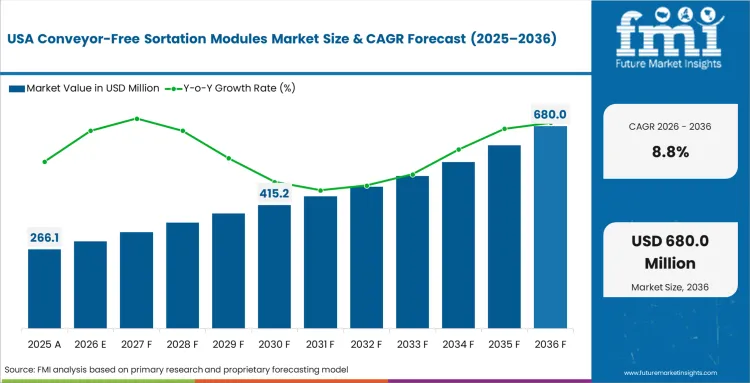
In the United States, revenue from the conveyor-free sortation modules market is expanding at a CAGR of 8.8% through 2036, driven by adoption of advanced sortation systems for e-commerce, retail, and industrial distribution centers. Manufacturers and logistics operators are integrating conveyor-free modules to improve sorting speed, reduce labor dependency, and optimize warehouse throughput. Demand is concentrated in parcel distribution, consumer goods, and packaged food handling. Domestic system integrators are supplying modular sortation solutions compatible with existing warehouse management systems. High order volumes, growing e-commerce fulfillment, and recurring operational needs are sustaining predictable procurement nationwide.
- Parcel distribution, consumer goods, and packaged food handling drive adoption of conveyor-free sortation modules
- Modular systems reduce labor dependency and improve sorting speed
- Domestic integrators provide solutions compatible with warehouse management systems
- E-commerce growth sustains predictable procurement and recurring operational usage
How Is Industrial Efficiency Supporting Demand in China?
In China, revenue from the conveyor-free sortation modules market is growing at a CAGR of 11% through 2036, driven by rapid expansion of e-commerce logistics and high-volume distribution operations. Operators are adopting conveyor-free sortation modules for efficient handling of parcels, consumer products, and industrial shipments. Demand is strong across modern warehouses, fulfillment centers, and cross-docking facilities. Domestic suppliers are scaling modular sortation production and integration services. High throughput volumes and structured warehouse operations are sustaining rapid adoption nationwide.
- E-commerce and high-volume distribution networks support adoption of conveyor-free sortation modules
- Parcels, consumer products, and industrial shipments are primary applications
- Domestic suppliers scale production and integration of modular systems
- Structured warehouse operations sustain consistent adoption
How Do Warehouse Standards Shape Market Expansion in Germany?
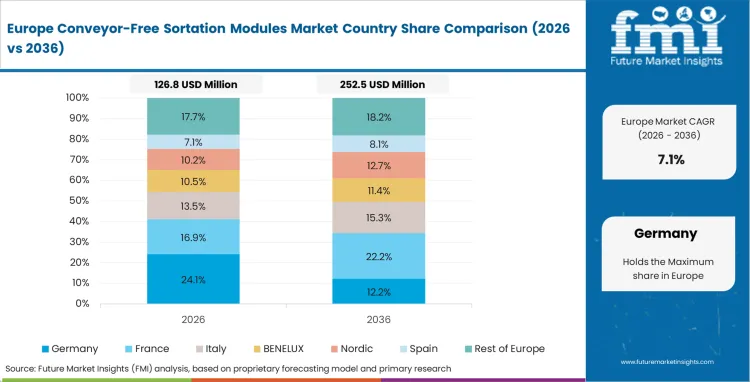
Germany continues to record steady growth in the conveyor-free sortation modules market at a CAGR of 7% through 2036, supported by efficiency and operational standards in modern warehouse management. Logistics operators are integrating conveyor-free sortation modules for parcel sorting, industrial components, and consumer goods. Demand is concentrated in automated distribution centers with high operational throughput. Domestic integrators provide modular systems designed for reliability, precision, and easy scalability. Stable warehouse operations and compliance-driven procurement practices are sustaining measured adoption across domestic facilities nationwide.
- Warehouse operational standards support adoption of conveyor-free sortation modules
- Parcel, consumer goods, and industrial components are primary applications
- Domestic integrators provide reliable and scalable modular systems
- Compliance and efficiency requirements sustain predictable adoption
How Is Organized Logistics Driving Growth in India?
India is witnessing strong expansion in the conveyor-free sortation modules market at a CAGR of 12% through 2036, supported by growth in organized warehousing, e-commerce fulfillment, and retail distribution networks. Operators are adopting conveyor-free sortation modules to handle parcels, consumer goods, and food shipments efficiently while minimizing labor requirements. Demand is rising across urban fulfillment centers and distribution hubs. Domestic suppliers are providing cost-aligned modular sortation solutions suited for high-volume operations. Expanding logistics infrastructure and organized warehouse networks are sustaining robust procurement nationwide.
- Organized warehousing and e-commerce fulfillment drive demand for conveyor-free sortation modules
- Parcels, consumer goods, and food shipments anchor adoption
- Domestic suppliers provide cost-aligned modular sortation solutions
- Logistics and warehouse network expansion sustain procurement growth
How Are Consumer Goods Distribution Needs Supporting Adoption in Brazil?
Brazil is seeing steady growth in the conveyor-free sortation modules market at a CAGR of 8% through 2036, supported by expansion of consumer goods distribution and modern retail logistics. Operators are integrating conveyor-free modules to improve sorting efficiency, reduce manual handling, and optimize warehouse throughput. Demand is concentrated in retail distribution centers and parcel handling hubs. Domestic integrators are expanding modular system production and implementation capacity. Growth in retail and consumer goods shipments is sustaining recurring procurement across packaging and logistics operations nationwide.
- Consumer goods and parcel distribution drive adoption of conveyor-free sortation modules
- Modular systems reduce manual handling and improve warehouse efficiency
- Domestic integrators expand production and implementation capacity
- Retail and logistics growth sustain recurring procurement
How Does Mature Logistics Infrastructure Influence Stability in Japan?
Japan is maintaining measured growth in the conveyor-free sortation modules market at a CAGR of 5% through 2036, supported by mature logistics infrastructure and selective adoption of automated sorting systems. Operators apply conveyor-free modules for parcels, retail goods, and industrial shipments. Demand remains focused on reliability, precision, and integration with existing warehouse management systems. Domestic suppliers emphasize robust design and consistent performance. Stable operational volumes and replacement-driven procurement are sustaining predictable adoption across established logistics operations nationwide.
- Mature logistics networks favor selective adoption of conveyor-free sortation modules
- Parcels, retail goods, and industrial shipments anchor baseline demand
- Domestic suppliers ensure robust design and reliable performance
- Replacement-driven procurement sustains predictable adoption
Which Companies Are Influencing Competition in the Conveyor Free Sortation Modules Market Across Automated Warehousing and Fulfillment Systems?
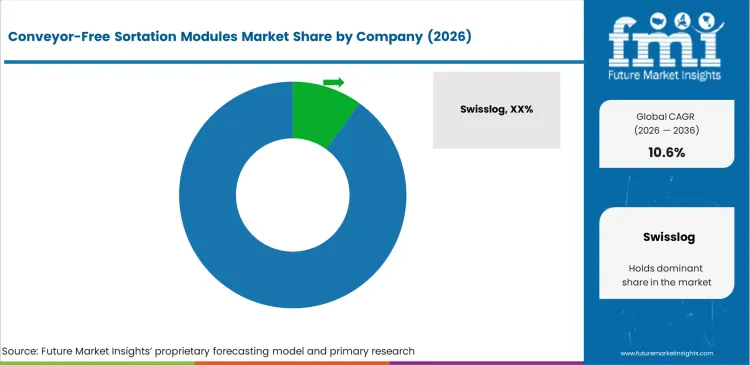
Competition in the conveyor-free sortation modules market is shaped by automation providers focused on flexible, modular goods handling. Swisslog and GreyOrange are prominent in deploying mobile and robotic sortation concepts that reduce fixed conveyor dependence in fulfillment centers. Their systems are commonly adopted in e commerce and omni channel warehouses where layout flexibility and rapid reconfiguration matter.
Knapp contributes through shuttle based and hybrid sortation architectures designed for high density storage environments. Daifuku applies deep material handling experience to non-conveyor sortation modules integrated into large scale distribution facilities. These companies compete on system reliability, throughput consistency, and the ability to integrate sortation with warehouse control software and upstream automation equipment.
Regional specialists and technology focused suppliers add depth to the competitive landscape. Hikrobot plays a visible role in Asia by combining machine vision, robotics, and autonomous modules suited for parcel and piece level sorting. SSI Schaefer partners with local integrators to deploy conveyor free elements within broader intralogistics projects rather than selling standalone modules. System integrators influence competitive outcomes by selecting components that align with customer workflows and facility constraints. Differentiation centers on scalability, fault tolerance, and ease of maintenance in live warehouse operations. Market entry depends on proven deployment references, software interoperability, and customer confidence in non-conveyor based material flow rather than mechanical novelty alone.
Key Players in the Conveyor Free Sortation Modules Market
- Swisslog
- GreyOrange
- Hikrobot
- Knapp
- SSI Schaefer Partners
- Daifuku
Scope of the Report
| Metric | Value |
|---|---|
| Quantitative Units | USD 561.85 million to USD 1538.76 million, at a CAGR of 10.6% |
| Market Definition | Conveyor-Free Sortation Modules are modular, self-contained sorting units that operate without fixed conveyor infrastructure. |
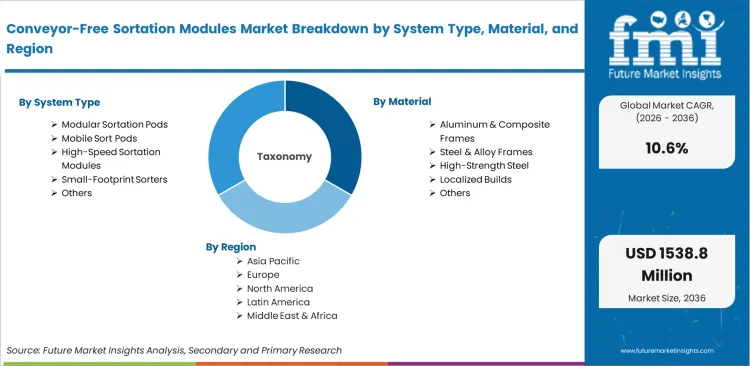
| Segmentation | System Type (Modular Sortation Pods, Mobile Sort Pods, High-Speed Sortation Modules, Small-Footprint Sorters, Others); Material (Aluminum & Composite Frames, Steel & Alloy Frames, High-Strength Steel, Localized Builds, Others); Technology (Autonomous Shuttles / Vision Sorting, AGV + Vision Systems, Vision-Guided Robotics, Semi-Autonomous Sorting Cells, Others) |
| Regions Covered | North America, Latin America, Europe, East Asia, South Asia, Oceania, Middle East & Africa |
| Countries Covered | India, China, USA, Brazil, Germany, Japan, and 40 plus countries |
| Key Companies Profiled | Swisslog, GreyOrange, Hikrobot, Knapp, SSI Schaefer Partners, Daifuku |
| Forecast Period | 2026 to 2036 |
| Approach | Forecasting models apply a bottom-up methodology starting with global installed base metrics and projecting conversion rates to next-generation systems. |
Conveyor Free Sortation Modules Market Segmentation
Packaging / System Type:
- Modular Sortation Pods
- Mobile Sort Pods
- High-Speed Sortation Modules
- Small-Footprint Sorters
- Others
Material:
- Aluminum & Composite Frames
- Steel & Alloy Frames
- High-Strength Steel
- Localized Builds
- Others
Technology:
- Autonomous Shuttles / Vision Sorting
- AGV + Vision Systems
- Vision-Guided Robotics
- Semi-Autonomous Sorting Cells
- Others
Region
-
Asia Pacific
- China
- Japan
- South Korea
- India
- Australia & New Zealand
- ASEAN
- Rest of Asia Pacific
-
Europe
- Germany
- United Kingdom
- France
- Italy
- Spain
- Nordic
- BENELUX
- Rest of Europe
-
North America
- United States
- Canada
- Mexico
-
Latin America
- Brazil
- Chile
- Rest of Latin America
-
Middle East & Africa
- Kingdom of Saudi Arabia
- Other GCC Countries
- Turkey
- South Africa
- Other African Union
- Rest of Middle East & Africa
Bibliography
- International Federation of Robotics. (2025). World Robotics 2025: Service Robots Report. IFR.
- Organisation for Economic Co-operation and Development. (2025, June). Urban Logistics Hubs: Summary and Conclusions. OECD.
- Material Handling Industry. (2025). Annual Industry Report 2025. MHI.
- European Commission, Directorate-General for Internal Market. (2025). Machinery Regulation 2023/1230 Implementation Guidance. European Commission.
- Bureau of Labor Statistics. (2025). Occupational Employment and Wage Statistics: Transportation and Material Moving Occupations. USA Department of Labor.
This bibliography is provided for reader reference. The full Future Market Insights report contains the complete reference list with primary research documentation.
Frequently Asked Questions
How large is the demand for Conveyor-Free Sortation Modules in the global market in 2026?
Demand for Conveyor-Free Sortation Modules in the global market is estimated to be valued at USD 561.85 million in 2026.
What will be the market size of Conveyor-Free Sortation Modules in the global market by 2036?
Market size for Conveyor-Free Sortation Modules is projected to reach USD 1538.76 million by 2036.
What is the expected demand growth for Conveyor-Free Sortation Modules in the global market between 2026 and 2036?
Demand for Conveyor-Free Sortation Modules is expected to grow at a CAGR of 10.6% between 2026 and 2036.
Which System Type is poised to lead global sales by 2026?
Modular Sortation Pods accounts for 60% in 2026 based on FMI analysis.
What is the India growth outlook in this report?
India is projected to grow at a CAGR of 12.0% during 2026 to 2036.
What is Conveyor-Free Sortation Modules and what is it mainly used for?
Conveyor-Free Sortation Modules are modular, self-contained sorting units that operate without fixed conveyor infrastructure. These systems use autonomous mobile robots, vision-guided shuttles, and decentralized sorting cells to route parcels, packages, and items within warehouses, distribution centers, and fulfillment hubs.
What is included in the scope of this Conveyor-Free Sortation Modules report?
Market scope covers modular sortation pods, mobile sort pods, high-speed sortation modules, small-footprint sorters, and associated software orchestration layers. The analysis spans system-level revenue from hardware, embedded controls, and integration services across cloud-based and on-premise deployment models.
Preview the report firsthand - request a free sample
Get SampleGet the brochure for pricing and purchase details.
Get PDFTable of Content
- Executive Summary
- Global Market Outlook
- Demand-side Trends
- Supply-side Trends
- Technology Roadmap Analysis
- Analysis and Recommendations
- Market Overview
- Market Coverage / Taxonomy
- Market Definition / Scope / Limitations
- Research Methodology
- Chapter Orientation
- Analytical Lens and Working Hypotheses
- Market Structure, Signals, and Trend Drivers
- Benchmarking and Cross-market Comparability
- Market Sizing, Forecasting, and Opportunity Mapping
- Research Design and Evidence Framework
- Desk Research Programme (Secondary Evidence)
- Company Annual and Sustainability Reports
- Peer-reviewed Journals and Academic Literature
- Corporate Websites, Product Literature, and Technical Notes
- Earnings Decks and Investor Briefings
- Statutory Filings and Regulatory Disclosures
- Technical White Papers and Standards Notes
- Trade Journals, Industry Magazines, and Analyst Briefs
- Conference Proceedings, Webinars, and Seminar Materials
- Government Statistics Portals and Public Data Releases
- FMI Internal Proprietary Databases and Historical Market Datasets
- Subscription Datasets and Paid Sources
- Social Channels, Communities, and Digital Listening Inputs
- Additional Desk Sources
- Expert Input and Fieldwork (Primary Evidence)
- Primary Modes
- Qualitative Interviews and Expert Elicitation
- Quantitative Surveys and Structured Data Capture
- Blended Approach
- Why Primary Evidence is Used
- Field Techniques
- Interviews
- Surveys
- Focus Groups
- Observational and In-context Research
- Social and Community Interactions
- Stakeholder Universe Engaged
- C-suite Leaders
- Board Members
- Presidents and Vice Presidents
- R&D and Innovation Heads
- Technical Specialists
- Domain Subject-matter Experts
- Scientists
- Physicians and Other Healthcare Professionals
- Governance, Ethics, and Data Stewardship
- Research Ethics
- Data Integrity and Handling
- Primary Modes
- Tooling, Models, and Reference Databases
- Desk Research Programme (Secondary Evidence)
- Data Engineering and Model Build
- Data Acquisition and Ingestion
- Cleaning, Normalisation, and Verification
- Synthesis, Triangulation, and Analysis
- Quality Assurance and Audit Trail
- Market Background
- Market Dynamics
- Drivers
- Restraints
- Opportunity
- Trends
- Scenario Forecast
- Demand in Optimistic Scenario
- Demand in Likely Scenario
- Demand in Conservative Scenario
- Opportunity Map Analysis
- Product Life Cycle Analysis
- Supply Chain Analysis
- Investment Feasibility Matrix
- Value Chain Analysis
- PESTLE and Porter’s Analysis
- Regulatory Landscape
- Regional Parent Market Outlook
- Production and Consumption Statistics
- Import and Export Statistics
- Market Dynamics
- Global Market Analysis 2021 to 2025 and Forecast, 2026 to 2036
- Historical Market Size Value (USD Million) Analysis, 2021 to 2025
- Current and Future Market Size Value (USD Million) Projections, 2026 to 2036
- Y-o-Y Growth Trend Analysis
- Absolute $ Opportunity Analysis
- Global Market Pricing Analysis 2021 to 2025 and Forecast 2026 to 2036
- Global Market Analysis 2021 to 2025 and Forecast 2026 to 2036, By System Type
- Introduction / Key Findings
- Historical Market Size Value (USD Million) Analysis By System Type , 2021 to 2025
- Current and Future Market Size Value (USD Million) Analysis and Forecast By System Type , 2026 to 2036
- Modular Sortation Pods
- Mobile Sort Pods
- High-Speed Sortation Modules
- Small-Footprint Sorters
- Others
- Modular Sortation Pods
- Y-o-Y Growth Trend Analysis By System Type , 2021 to 2025
- Absolute $ Opportunity Analysis By System Type , 2026 to 2036
- Global Market Analysis 2021 to 2025 and Forecast 2026 to 2036, By Material
- Introduction / Key Findings
- Historical Market Size Value (USD Million) Analysis By Material, 2021 to 2025
- Current and Future Market Size Value (USD Million) Analysis and Forecast By Material, 2026 to 2036
- Aluminum & Composite Frames
- Steel & Alloy Frames
- High-Strength Steel
- Localized Builds
- Others
- Aluminum & Composite Frames
- Y-o-Y Growth Trend Analysis By Material, 2021 to 2025
- Absolute $ Opportunity Analysis By Material, 2026 to 2036
- Global Market Analysis 2021 to 2025 and Forecast 2026 to 2036, By Technology
- Introduction / Key Findings
- Historical Market Size Value (USD Million) Analysis By Technology, 2021 to 2025
- Current and Future Market Size Value (USD Million) Analysis and Forecast By Technology, 2026 to 2036
- Autonomous Shuttles / Vision Sorting
- AGV + Vision Systems
- Vision-Guided Robotics
- Semi-Autonomous Sorting Cells
- Others
- Autonomous Shuttles / Vision Sorting
- Y-o-Y Growth Trend Analysis By Technology, 2021 to 2025
- Absolute $ Opportunity Analysis By Technology, 2026 to 2036
- Global Market Analysis 2021 to 2025 and Forecast 2026 to 2036, By Region
- Introduction
- Historical Market Size Value (USD Million) Analysis By Region, 2021 to 2025
- Current Market Size Value (USD Million) Analysis and Forecast By Region, 2026 to 2036
- North America
- Latin America
- Western Europe
- Eastern Europe
- East Asia
- South Asia and Pacific
- Middle East & Africa
- Market Attractiveness Analysis By Region
- North America Market Analysis 2021 to 2025 and Forecast 2026 to 2036, By Country
- Historical Market Size Value (USD Million) Trend Analysis By Market Taxonomy, 2021 to 2025
- Market Size Value (USD Million) Forecast By Market Taxonomy, 2026 to 2036
- By Country
- USA
- Canada
- Mexico
- By System Type
- By Material
- By Technology
- By Country
- Market Attractiveness Analysis
- By Country
- By System Type
- By Material
- By Technology
- Key Takeaways
- Latin America Market Analysis 2021 to 2025 and Forecast 2026 to 2036, By Country
- Historical Market Size Value (USD Million) Trend Analysis By Market Taxonomy, 2021 to 2025
- Market Size Value (USD Million) Forecast By Market Taxonomy, 2026 to 2036
- By Country
- Brazil
- Chile
- Rest of Latin America
- By System Type
- By Material
- By Technology
- By Country
- Market Attractiveness Analysis
- By Country
- By System Type
- By Material
- By Technology
- Key Takeaways
- Western Europe Market Analysis 2021 to 2025 and Forecast 2026 to 2036, By Country
- Historical Market Size Value (USD Million) Trend Analysis By Market Taxonomy, 2021 to 2025
- Market Size Value (USD Million) Forecast By Market Taxonomy, 2026 to 2036
- By Country
- Germany
- UK
- Italy
- Spain
- France
- Nordic
- BENELUX
- Rest of Western Europe
- By System Type
- By Material
- By Technology
- By Country
- Market Attractiveness Analysis
- By Country
- By System Type
- By Material
- By Technology
- Key Takeaways
- Eastern Europe Market Analysis 2021 to 2025 and Forecast 2026 to 2036, By Country
- Historical Market Size Value (USD Million) Trend Analysis By Market Taxonomy, 2021 to 2025
- Market Size Value (USD Million) Forecast By Market Taxonomy, 2026 to 2036
- By Country
- Russia
- Poland
- Hungary
- Balkan & Baltic
- Rest of Eastern Europe
- By System Type
- By Material
- By Technology
- By Country
- Market Attractiveness Analysis
- By Country
- By System Type
- By Material
- By Technology
- Key Takeaways
- East Asia Market Analysis 2021 to 2025 and Forecast 2026 to 2036, By Country
- Historical Market Size Value (USD Million) Trend Analysis By Market Taxonomy, 2021 to 2025
- Market Size Value (USD Million) Forecast By Market Taxonomy, 2026 to 2036
- By Country
- China
- Japan
- South Korea
- By System Type
- By Material
- By Technology
- By Country
- Market Attractiveness Analysis
- By Country
- By System Type
- By Material
- By Technology
- Key Takeaways
- South Asia and Pacific Market Analysis 2021 to 2025 and Forecast 2026 to 2036, By Country
- Historical Market Size Value (USD Million) Trend Analysis By Market Taxonomy, 2021 to 2025
- Market Size Value (USD Million) Forecast By Market Taxonomy, 2026 to 2036
- By Country
- India
- ASEAN
- Australia & New Zealand
- Rest of South Asia and Pacific
- By System Type
- By Material
- By Technology
- By Country
- Market Attractiveness Analysis
- By Country
- By System Type
- By Material
- By Technology
- Key Takeaways
- Middle East & Africa Market Analysis 2021 to 2025 and Forecast 2026 to 2036, By Country
- Historical Market Size Value (USD Million) Trend Analysis By Market Taxonomy, 2021 to 2025
- Market Size Value (USD Million) Forecast By Market Taxonomy, 2026 to 2036
- By Country
- Kingdom of Saudi Arabia
- Other GCC Countries
- Turkiye
- South Africa
- Other African Union
- Rest of Middle East & Africa
- By System Type
- By Material
- By Technology
- By Country
- Market Attractiveness Analysis
- By Country
- By System Type
- By Material
- By Technology
- Key Takeaways
- Key Countries Market Analysis
- USA
- Pricing Analysis
- Market Share Analysis, 2025
- By System Type
- By Material
- By Technology
- Canada
- Pricing Analysis
- Market Share Analysis, 2025
- By System Type
- By Material
- By Technology
- Mexico
- Pricing Analysis
- Market Share Analysis, 2025
- By System Type
- By Material
- By Technology
- Brazil
- Pricing Analysis
- Market Share Analysis, 2025
- By System Type
- By Material
- By Technology
- Chile
- Pricing Analysis
- Market Share Analysis, 2025
- By System Type
- By Material
- By Technology
- Germany
- Pricing Analysis
- Market Share Analysis, 2025
- By System Type
- By Material
- By Technology
- UK
- Pricing Analysis
- Market Share Analysis, 2025
- By System Type
- By Material
- By Technology
- Italy
- Pricing Analysis
- Market Share Analysis, 2025
- By System Type
- By Material
- By Technology
- Spain
- Pricing Analysis
- Market Share Analysis, 2025
- By System Type
- By Material
- By Technology
- France
- Pricing Analysis
- Market Share Analysis, 2025
- By System Type
- By Material
- By Technology
- India
- Pricing Analysis
- Market Share Analysis, 2025
- By System Type
- By Material
- By Technology
- ASEAN
- Pricing Analysis
- Market Share Analysis, 2025
- By System Type
- By Material
- By Technology
- Australia & New Zealand
- Pricing Analysis
- Market Share Analysis, 2025
- By System Type
- By Material
- By Technology
- China
- Pricing Analysis
- Market Share Analysis, 2025
- By System Type
- By Material
- By Technology
- Japan
- Pricing Analysis
- Market Share Analysis, 2025
- By System Type
- By Material
- By Technology
- South Korea
- Pricing Analysis
- Market Share Analysis, 2025
- By System Type
- By Material
- By Technology
- Russia
- Pricing Analysis
- Market Share Analysis, 2025
- By System Type
- By Material
- By Technology
- Poland
- Pricing Analysis
- Market Share Analysis, 2025
- By System Type
- By Material
- By Technology
- Hungary
- Pricing Analysis
- Market Share Analysis, 2025
- By System Type
- By Material
- By Technology
- Kingdom of Saudi Arabia
- Pricing Analysis
- Market Share Analysis, 2025
- By System Type
- By Material
- By Technology
- Turkiye
- Pricing Analysis
- Market Share Analysis, 2025
- By System Type
- By Material
- By Technology
- South Africa
- Pricing Analysis
- Market Share Analysis, 2025
- By System Type
- By Material
- By Technology
- USA
- Market Structure Analysis
- Competition Dashboard
- Competition Benchmarking
- Market Share Analysis of Top Players
- By Regional
- By System Type
- By Material
- By Technology
- Competition Analysis
- Competition Deep Dive
- Swisslog
- Overview
- Product Portfolio
- Profitability by Market Segments (Product/Age /Sales Channel/Region)
- Sales Footprint
- Strategy Overview
- Marketing Strategy
- Product Strategy
- Channel Strategy
- GreyOrange
- Hikrobot
- Knapp
- SSI Schaefer Partners
- Daifuku
- Swisslog
- Competition Deep Dive
- Assumptions & Acronyms Used


