

- Industry Size (2026)
- USD 8.3 Bn
- Forecast (2036)
- USD 14.3 Bn
- CAGR (2026 to 2036)
- 5.6%
Center Console Modules Market Forecast and Outlook 2026 to 2036
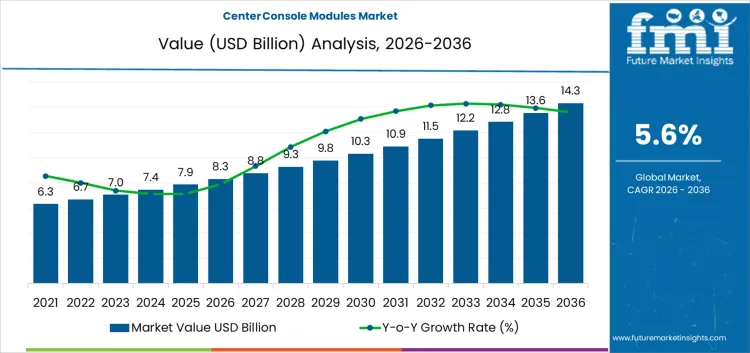
The center console modules market is likely to be valued at USD 8.3 billion in 2026 and is projected to reach USD 14.3 billion by 2036, reflecting a CAGR of 5.6%. Early period growth follows changes in vehicle interior architecture and the steady expansion of multi-function console layouts across passenger segments. Demand is shaped by platform level design decisions that lock module size, layout, and integration points several years before production. Value per vehicle rises with added storage structures, control interfaces, and integrated support frames. Supplier competition centers on dimensional accuracy, surface quality, and assembly consistency rather than frequent design turnover or feature novelty.
As the forecast period advances, procurement priorities shift toward parts commonality and controlled variant counts across vehicle lines. Automakers reduce tooling complexity by reusing console structures with limited cosmetic changes. Replacement demand remains modest and tied mainly to accident repair rather than wear. Volume growth stays aligned with vehicle production, while pricing remains under pressure from cost reduction programs. Capacity planning follows awarded platforms and model cycle timing. The later years show steadier expansion, supported by predictable interior packaging strategies and gradual increases in content per vehicle rather than abrupt shifts in design or function.
Quick Stats of the Center Console Modules Market
- Center Console Modules Market Value (2026): USD 8.3 billion
- Center Console Modules Forecast Value (2036): USD 14.3 billion
- Center Console Modules Forecast CAGR 2026 to 2036: 5.6%
- Leading Feature Content in Center Console Modules: Storage & Cupholder Modules (34 % share)
- Leading Material in Center Console Modules: Soft-Touch Plastics (44 % share)
- Key Growth Regions in Center Console Modules Market: China, India, South Korea, USA, Germany
- Top Players in Center Console Modules Market: FORVIA, Yanfeng Automotive Interiors, Magna International, Lear, Hyundai Mobis, Grupo Antolin, Toyota Boshoku, IAC Group, Adient, Dräxlmaier Group
What is the Growth Forecast for Center Console Modules Market through 2036?
Between 2026 and 2031, the center console modules market is expected to expand from USD 8.3 billion along a path consistent with a 5.6% CAGR, reaching the early part of its long-term growth curve. Unlike safety or powertrain components, the console evolves as a packaging and user-interface zone, which makes value growth more sensitive to interior design strategies than to vehicle production cycles alone. Storage and cupholder modules remain the volume anchor, though integration of controls and charging surfaces steadily increases bill-of-material content per vehicle. Material choices reflect tactile and visual priorities rather than structural demands, with soft-touch plastics and trim surfaces shaping perceived quality. OEMs increasingly standardize console architectures across platforms while allowing visible surface variation by trim level.
From 2031 to 2036, the market is projected to reach USD 14.3 billion, with expansion driven by the console’s shift from a passive storage structure into a functional interface hub. Larger infotainment screens, reconfigured seating layouts, and the spread of connected features increase both the physical size and the electronic integration of console assemblies. This raises module complexity even in mid-priced vehicles, lifting average selling prices without requiring proportional unit growth. Supply remains concentrated in OEM and Tier 1 programs, where integration capability, surface finish control, and logistics coordination matter more than individual part cost. Competitive positioning favors interior system specialists able to manage multi-material assemblies and design-to-cost programs, including FORVIA, Yanfeng Automotive Interiors, Magna International, Lear, Hyundai Mobis, Grupo Antolin, Toyota Boshoku, IAC Group, Adient, and Dräxlmaier Group.
Center Console Modules Market Key Takeaways
| Metric | Value |
|---|---|
| Market Value (2026) | USD 8.3 billion |
| Forecast Value (2036) | USD 14.3 billion |
| Forecast CAGR 2026 to 2036 | 5.6% |
How Are Center Console Modules Enhancing Vehicle Interior Functionality?
Center console modules are increasingly adopted to integrate storage, control interfaces, and connectivity features within modern vehicle interiors. Historically, center consoles offered limited functionality, primarily providing storage and basic controls, which constrained ergonomics and user convenience. Modern modules combine multifunctional storage, touch-sensitive controls, wireless charging, climate control interfaces, and infotainment integration, improving driver and passenger experience. Automotive OEMs, interior component suppliers, and electronics manufacturers prioritize durability, design flexibility, and integration with vehicle electronics. Early adoption focused on premium and luxury vehicles, while current demand spans passenger cars, SUVs, and electric vehicles, driven by consumer expectations for convenience, connectivity, and interior ergonomics. Material quality, design adaptability, and system compatibility influence supplier selection.
Rising focus on interior comfort, digital connectivity, and modular vehicle design is shaping market growth. Compared with traditional consoles, contemporary modules emphasize multifunctionality, electronic integration, and ergonomic optimization. Cost structures depend on material selection, electronics integration, and assembly complexity, concentrating margins among suppliers delivering high-quality, reliable modules. Vehicle manufacturers adopt center console modules to enhance occupant convenience, support interior customization, and integrate multiple vehicle systems efficiently. By 2036, multifunctional center console modules are expected to become standard across passenger, commercial, and electric vehicles, supporting interior usability, connected features, and advanced in-cabin experiences.
What Factors Are Shaping the Demand for Center Console Modules by Feature Content and Material Choice in 2026?
The center console modules market in 2026 is segmented by feature content and material choice. By feature content, demand is divided into storage and cupholder modules, HMI and controls integrated consoles, wireless charging and connectivity consoles, and other formats that differ in functional density and integration depth. By material, demand is organized around soft touch plastics, hard plastics, aluminum and decor trims, and other finishes that determine surface durability, tactile perception, and assembly methods. These segments reflect how interior modules are specified through cost targets, tooling strategies, supplier integration models, and late stage design changes that affect interior build complexity and warranty exposure across vehicle programs.
Why Do Storage and Cupholder Modules Form the Largest Feature Content Segment?
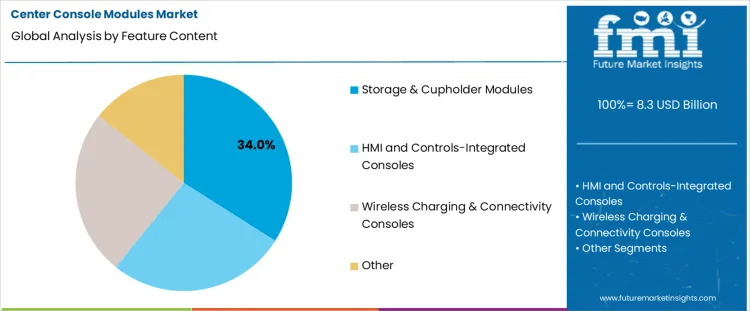
Storage and cupholder modules account for about 34% of demand in 2026, reflecting their role as the structural baseline of most center console designs. These modules establish the physical layout between front seats and often serve as the mounting base for other components. Automakers treat them as mandatory content rather than optional features, which ensures high installation rates across trims and vehicle classes. Their designs emphasize robustness, low squeak and rattle risk, and ease of assembly rather than electronic integration. Tooling for these parts is usually frozen early in the program to protect interior packaging stability. High volumes support long production runs and stable supplier utilization, which reinforces their position as the dominant feature content category.
HMI integrated and connectivity focused consoles follow a different adoption pattern shaped by electrical architecture and feature bundling strategies. These modules require coordination between display systems, switches, wiring harnesses, and software validation, which increases development effort and integration risk. Their inclusion depends on trim structure and regional feature expectations rather than baseline interior architecture. Wireless charging adds thermal management and electromagnetic compatibility checks, which further extends validation cycles. Volumes remain lower because these consoles concentrate in higher specification vehicles and selected markets. Their demand grows through option packages rather than through universal fitment, which keeps them structurally secondary to basic storage based modules in total unit terms across global production portfolios.
Why Do Soft Touch Plastics Dominate Material Selection in Center Console Modules?
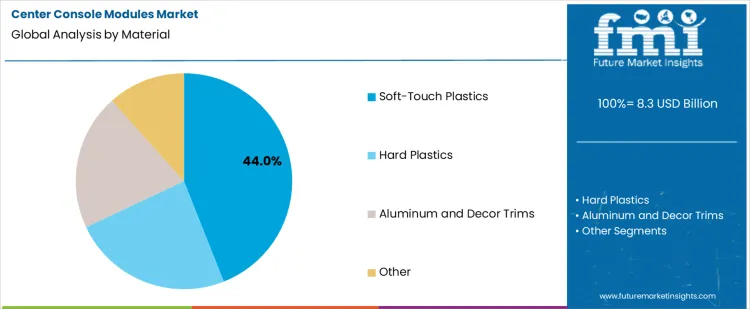
Soft touch plastics represent about 44% of demand in 2026 because they balance perceived quality with manufacturing practicality. These materials allow automakers to improve tactile surfaces without committing to complex multi material assemblies. They also help mask minor fit variations and reduce visible wear over time, which lowers warranty risk for high contact interior zones. From a production standpoint, soft touch skins can be applied over standardized substrates, preserving tooling investments across multiple programs. Their weight and cost profiles remain easier to manage than metal or layered trim solutions. This combination of aesthetic acceptance, process flexibility, and risk control keeps soft touch plastics as the preferred material choice for large volume center console applications.
Hard plastics and aluminum or decor trims serve more targeted roles tied to cost positioning and visual differentiation. Hard plastics remain common in entry vehicles where interior price points are tightly controlled and surface expectations are modest. Aluminum and decorative trims introduce additional process steps, tighter tolerance requirements, and more complex supply chains. These materials also increase the number of part variants and inspection points on the assembly line. Their use depends on trim strategy and brand positioning rather than structural necessity. As a result, their volumes remain lower and more fragmented, while soft touch plastics continue to anchor the majority of center console material demand across mainstream vehicle programs.
Why Are Cockpit Zoning and Electrical Architecture Changes Lifting the Role of Center Console Modules through 2036?
Growth is anchored in how vehicle interiors are packaged, not in decoration. Cockpits are now zoned into functional blocks, and the center console concentrates power distribution, storage, controls, and user interfaces in one structure. Electric vehicles intensify this because flat floors and relocated drivetrains free space that must be structurally managed and wired cleanly. OEMs prefer preassembled console modules to reduce assembly time and interface risk on final lines. Fleet and shared mobility programs also value standardized, easily configurable consoles. Once a console becomes the host for switches, ports, and storage, its inclusion shifts from optional to default equipment.
What Cost, Weight, and Integration Tradeoffs Are Limiting Console Content Expansion?
Constraints come from module economics and vehicle mass targets. Every added function increases part count, wiring, tooling, and validation effort. Console structures compete with seats, batteries, and safety systems for mass and space. Thermal management for electronics adds further complexity. OEMs also guard against rattle, squeak, and wear issues because the console is a high touch surface. Repairability matters since damaged trim or electronics often require replacing the whole unit. In price sensitive segments, simple consoles meet functional needs and protect margins. These pressures force strict content discipline and prevent unchecked feature stacking across many vehicle programs.
How Are Platform Sharing and Supplier Consolidation Reorganizing This Category?
Structural change is coming from purchasing strategy rather than styling cycles. Platform sharing pushes console designs toward common load paths and standardized attachment points, even when top surfaces differ. This favors suppliers able to deliver families of modules from shared tooling. OEMs also reduce the number of interior system partners to simplify integration and accountability. Regional production is gaining weight to control logistics cost and response time to design changes. Software driven feature definitions shift value toward consoles that accept late configuration. Over time, fewer suppliers will ship higher volumes of configurable modules aligned tightly with vehicle platform schedules.
What is the Demand for Center Console Modules by Country?
| Country | CAGR (%) |
|---|---|
| China | 6.3% |
| India | 6.0% |
| USA | 4.4% |
| Germany | 3.9% |
| South Korea | 4.8% |
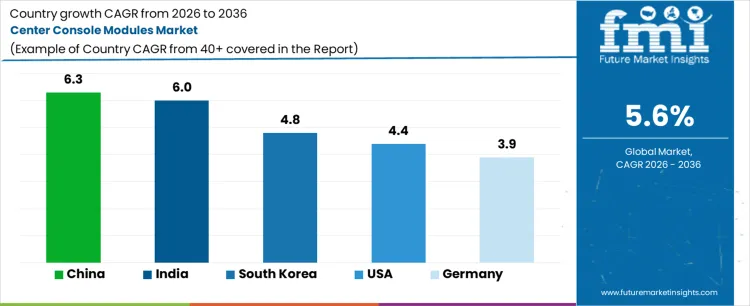
Demand for center console modules is rising as automotive manufacturers focus on vehicle interior functionality, ergonomics, and integration of infotainment and control systems. China leads with a 6.3% CAGR, driven by growing passenger vehicle production, adoption of advanced interior features, and rising consumer demand for enhanced cabin convenience. India follows at 6.0%, supported by expanding automotive manufacturing and rising preference for premium interior components. South Korea grows at 4.8%, shaped by domestic production and integration of multifunctional console modules. The USA records 4.4% growth, reflecting mature market adoption and replacement demand. Germany shows 3.9% CAGR, influenced by established automotive interiors standards and gradual integration of advanced console modules.
How is China experiencing growth in the center console modules market?
China is experiencing growth at a CAGR of 6.3%, supported by adoption of center console modules market solutions to enhance vehicle interior functionality, ergonomics, and user convenience. Manufacturers and suppliers are producing modules optimized for durability, integration with electronic controls, and compatibility with various automotive models. Demand is concentrated in automotive production hubs, interior component assembly plants, and R&D centers. Investments focus on material quality, system reliability, and compliance with automotive standards rather than large-scale deployment. Growth reflects rising vehicle production, industrial adoption of advanced interior systems, and increasing consumer demand for functional, high-quality interiors.
- Interior functionality drives adoption.
- Modules optimize durability and electronic integration.
- Production hubs and assembly plants concentrate demand.
- Material quality and standards compliance guide investment.
How is India witnessing growth in the center console modules market?
India is witnessing growth at a CAGR of 6%, fueled by adoption of center console modules market solutions to improve vehicle interior ergonomics, electronic integration, and user convenience. Manufacturers and suppliers are deploying modules optimized for durability, component integration, and compatibility with vehicle control systems. Demand is concentrated in automotive manufacturing hubs, interior assembly facilities, and R&D centers. Investments prioritize material performance, system reliability, and adherence to automotive standards rather than fleet-scale deployment. Growth reflects increasing vehicle production, industrial adoption of functional interior systems, and rising consumer preference for high-quality cabin features.
- Vehicle interior ergonomics drives adoption.
- Modules ensure durability and electronic integration.
- Manufacturing hubs and assembly facilities concentrate demand.
- Material performance and standards compliance guide investment.
How is the United States experiencing growth in the center console modules market?
United States is experiencing growth at a CAGR of 4.4%, supported by adoption of center console modules market solutions to enhance interior functionality, convenience, and operational reliability in passenger vehicles. Manufacturers and suppliers are producing modules optimized for durability, integration with electronic systems, and compatibility with automotive interiors. Demand is concentrated in automotive assembly plants, interior component production hubs, and R&D centers. Investments focus on material quality, system reliability, and compliance with automotive standards rather than large-scale deployment. Growth reflects moderate vehicle production, industrial adoption of functional interior systems, and focus on user experience.
- Interior functionality drives adoption.
- Modules optimize durability and electronic integration.
- Assembly plants and production hubs concentrate demand.
- Material quality and compliance guide investment.
How is Germany witnessing growth in the center console modules market?
Germany is witnessing growth at a CAGR of 3.9%, fueled by adoption of center console modules market solutions to improve vehicle interior ergonomics, system integration, and operational reliability. Manufacturers and suppliers are deploying modules optimized for material durability, electronic connectivity, and compatibility with automotive interiors. Demand is concentrated in automotive production hubs, interior assembly plants, and R&D centers. Investments prioritize system reliability, material performance, and compliance with automotive standards rather than fleet-scale deployment. Growth reflects moderate vehicle production, industrial adoption of advanced interior systems, and focus on cabin quality and convenience.
- Interior ergonomics drives adoption.
- Modules enhance durability and electronic connectivity.
- Production hubs and assembly plants concentrate demand.
- System reliability and standards compliance guide investment.
How is South Korea experiencing growth in the center console modules market?
South Korea is experiencing growth at a CAGR of 4.8%, supported by adoption of center console modules market solutions to enhance vehicle interior functionality, ergonomics, and operational performance. Manufacturers and suppliers are producing modules optimized for durability, electronic integration, and compatibility with various automotive models. Demand is concentrated in automotive manufacturing hubs, interior component assembly facilities, and R&D centers. Investments focus on material quality, system reliability, and compliance with automotive standards rather than large-scale deployment. Growth reflects industrial adoption of functional interior systems, rising vehicle production, and focus on user convenience.
- Vehicle interior functionality drives adoption.
- Modules ensure durability and electronic integration.
- Manufacturing hubs and assembly facilities concentrate demand.
- Material quality and system reliability guide investment.
Who Competes in the Center Console Modules Market and What Defines Their Capabilities?
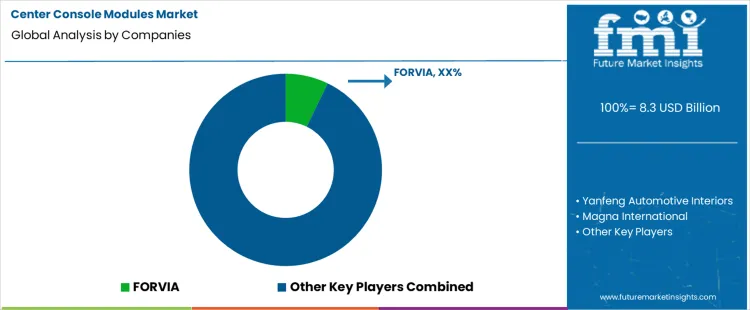
Competition in the center console modules market is defined by design flexibility, material quality, and integration with vehicle electronics and ergonomics. FORVIA supplies center console modules engineered for modularity, occupant comfort, and seamless integration with infotainment and storage systems. Yanfeng Automotive Interiors develops console assemblies with advanced materials, customizable layouts, and electronic integration for premium vehicle interiors. Magna International delivers center console systems designed for lightweight construction, modularity, and high manufacturing consistency. Lear provides console modules with integrated controls, storage, and surface finishes suitable for multiple vehicle segments. Hyundai Mobis focuses on modules integrated with electronic interfaces and advanced driver assistance system components.
Grupo Antolin develops center console systems emphasizing lightweight materials, design flexibility, and manufacturability. Toyota Boshoku supplies modular assemblies designed for ergonomic layouts and integration with seating and storage solutions. IAC Group provides customizable console modules with durable finishes and integrated electronic components. Adient delivers center console modules with compatibility for multiple interior configurations. Other regional and specialty suppliers provide lightweight, modular, and electronically integrated solutions for console assemblies. Competitive differentiation arises from material quality, modularity, integration capability, ergonomic design, and manufacturing efficiency across vehicle segments.
Key Players in the Center Console Modules Market
- FORVIA
- Yanfeng Automotive Interiors
- Magna International
- Lear
- Hyundai Mobis
- Grupo Antolin
- Toyota Boshoku
- IAC Group
- Adient
- Dräxlmaier Group
Scope of the Report
| Items | Values |
|---|---|
| Quantitative Units (2026) | USD billion |
| Feature Content | Storage & Cupholder Modules, HMI and Controls-Integrated Consoles, Wireless Charging & Connectivity Consoles, Other |
| Material | Soft-Touch Plastics, Hard Plastics, Aluminum and Decor Trims, Other |
| Vehicle Segment | Passenger Cars, SUVs and Crossovers, Light Commercial Vehicles, Other |
| Sales Channel | OEM and Tier 1 Supply, Aftermarket Accessories, Service Replacement, Other |
| Regions Covered | Asia Pacific, Europe, North America, Latin America, Middle East & Africa |
| Countries Covered | China, Japan, South Korea, India, Australia & New Zealand, ASEAN, Germany, United Kingdom, France, Italy, Spain, Nordic, BENELUX, United States, Canada, Mexico, Brazil, Chile, Saudi Arabia, Turkey, South Africa, and other regional markets |
| Key Companies Profiled | FORVIA, Yanfeng Automotive Interiors, Magna International, Lear, Hyundai Mobis, Grupo Antolin, Toyota Boshoku, IAC Group, Adient, Dräxlmaier Group |
| Additional Attributes | Dollar sales by feature content, material, vehicle segment, and sales channel, platform-driven console architecture standardization, integration of storage, HMI, and connectivity functions within single assemblies, sourcing concentrated in OEM and Tier 1 programs, material and surface finish driven cost structures, and content growth linked to interior packaging strategies rather than replacement demand. |
Center Console Modules Market Segmentation
Feature Content:
- Storage & Cupholder Modules
- HMI and Controls-Integrated Consoles
- Wireless Charging & Connectivity Consoles
- Other
Material:
- Soft-Touch Plastics
- Hard Plastics
- Aluminum and Decor Trims
- Other
Vehicle Segment:
- Passenger Cars
- SUVs and Crossovers
- Light Commercial Vehicles
- Other
Sales Channel:
- OEM and Tier 1 Supply
- Aftermarket Accessories
- Service Replacement
- Other
Region:
- Asia Pacific
- China
- Japan
- South Korea
- India
- Australia & New Zealand
- ASEAN
- Rest of Asia Pacific
- Europe
- Germany
- United Kingdom
- France
- Italy
- Spain
- Nordic
- BENELUX
- Rest of Europe
- North America
- United States
- Canada
- Mexico
- Latin America
- Brazil
- Chile
- Rest of Latin America
- Middle East & Africa
- Kingdom of Saudi Arabia
- Other GCC Countries
- Turkey
- South Africa
- Other African Union
- Rest of Middle East & Africa
Bibliography
- International Organization for Standardization. (2024). ISO 6549: Road vehicles Interior fittings Impact test method. International Organization for Standardization.
- International Organization for Standardization. (2023). ISO 6603-2: Plastics Determination of puncture impact behaviour of rigid plastics Part 2 Instrumented impact testing. International Organization for Standardization.
- National Highway Traffic Safety Administration. (2024). Federal Motor Vehicle Safety Standard No. 201: Occupant protection in interior impact. USA Department of Transportation.
- Society of Automotive Engineers. (2024). SAE J839: Test method for measuring interior component impact performance. SAE International.
- United Nations Economic Commission for Europe. (2024). UN Regulation No. 21: Interior fittings.
Frequently Asked Questions
How big is the center console modules market in 2026?
The global center console modules market is estimated to be valued at USD 8.3 billion in 2026.
What will be the size of center console modules market in 2036?
The market size for the center console modules market is projected to reach USD 14.3 billion by 2036.
How much will be the center console modules market growth between 2026 and 2036?
The center console modules market is expected to grow at a 5.6% CAGR between 2026 and 2036.
What are the key product types in the center console modules market?
The key product types in center console modules market are storage & cupholder modules, HMI and controls-integrated consoles, wireless charging & connectivity consoles and other.
Which material segment to contribute significant share in the center console modules market in 2026?
In terms of material, soft-touch plastics segment to command 44.0% share in the center console modules market in 2026.
Preview the report firsthand - request a free sample
Get SampleGet the brochure for pricing and purchase details.
Get PDFTable of Content
- Executive Summary
- Global Market Outlook
- Demand-side Trends
- Supply-side Trends
- Technology Roadmap Analysis
- Analysis and Recommendations
- Market Overview
- Market Coverage / Taxonomy
- Market Definition / Scope / Limitations
- Market Background
- Market Dynamics
- Drivers
- Restraints
- Opportunity
- Trends
- Scenario Forecast
- Demand in Optimistic Scenario
- Demand in Likely Scenario
- Demand in Conservative Scenario
- Opportunity Map Analysis
- Product Life Cycle Analysis
- Supply Chain Analysis
- Investment Feasibility Matrix
- Value Chain Analysis
- PESTLE and Porter’s Analysis
- Regulatory Landscape
- Regional Parent Market Outlook
- Production and Consumption Statistics
- Import and Export Statistics
- Market Dynamics
- Global Market Analysis 2021 to 2025 and Forecast, 2026 to 2036
- Historical Market Size Value (USD Million) Analysis, 2021 to 2025
- Current and Future Market Size Value (USD Million) Projections, 2026 to 2036
- Y-o-Y Growth Trend Analysis
- Absolute $ Opportunity Analysis
- Global Market Pricing Analysis 2021 to 2025 and Forecast 2026 to 2036
- Global Market Analysis 2021 to 2025 and Forecast 2026 to 2036, By Feature Content
- Introduction / Key Findings
- Historical Market Size Value (USD Million) Analysis By Feature Content , 2021 to 2025
- Current and Future Market Size Value (USD Million) Analysis and Forecast By Feature Content , 2026 to 2036
- Storage & Cupholder Modules
- HMI and Controls-Integrated Consoles
- Wireless Charging & Connectivity Consoles
- Other
- Storage & Cupholder Modules
- Y-o-Y Growth Trend Analysis By Feature Content , 2021 to 2025
- Absolute $ Opportunity Analysis By Feature Content , 2026 to 2036
- Global Market Analysis 2021 to 2025 and Forecast 2026 to 2036, By Material
- Introduction / Key Findings
- Historical Market Size Value (USD Million) Analysis By Material, 2021 to 2025
- Current and Future Market Size Value (USD Million) Analysis and Forecast By Material, 2026 to 2036
- Soft-Touch Plastics
- Hard Plastics
- Aluminum and Decor Trims
- Other
- Soft-Touch Plastics
- Y-o-Y Growth Trend Analysis By Material, 2021 to 2025
- Absolute $ Opportunity Analysis By Material, 2026 to 2036
- Global Market Analysis 2021 to 2025 and Forecast 2026 to 2036, By Vehicle Segment
- Introduction / Key Findings
- Historical Market Size Value (USD Million) Analysis By Vehicle Segment, 2021 to 2025
- Current and Future Market Size Value (USD Million) Analysis and Forecast By Vehicle Segment, 2026 to 2036
- Passenger Cars
- SUVs and Crossovers
- Light Commercial Vehicles
- Other
- Passenger Cars
- Y-o-Y Growth Trend Analysis By Vehicle Segment, 2021 to 2025
- Absolute $ Opportunity Analysis By Vehicle Segment, 2026 to 2036
- Global Market Analysis 2021 to 2025 and Forecast 2026 to 2036, By Sales Channel
- Introduction / Key Findings
- Historical Market Size Value (USD Million) Analysis By Sales Channel, 2021 to 2025
- Current and Future Market Size Value (USD Million) Analysis and Forecast By Sales Channel, 2026 to 2036
- OEM and Tier 1 Supply
- Aftermarket Accessories
- Service Replacement
- Other
- OEM and Tier 1 Supply
- Y-o-Y Growth Trend Analysis By Sales Channel, 2021 to 2025
- Absolute $ Opportunity Analysis By Sales Channel, 2026 to 2036
- Global Market Analysis 2021 to 2025 and Forecast 2026 to 2036, By Region
- Introduction
- Historical Market Size Value (USD Million) Analysis By Region, 2021 to 2025
- Current Market Size Value (USD Million) Analysis and Forecast By Region, 2026 to 2036
- North America
- Latin America
- Western Europe
- Eastern Europe
- East Asia
- South Asia and Pacific
- Middle East & Africa
- Market Attractiveness Analysis By Region
- North America Market Analysis 2021 to 2025 and Forecast 2026 to 2036, By Country
- Historical Market Size Value (USD Million) Trend Analysis By Market Taxonomy, 2021 to 2025
- Market Size Value (USD Million) Forecast By Market Taxonomy, 2026 to 2036
- By Country
- USA
- Canada
- Mexico
- By Feature Content
- By Material
- By Vehicle Segment
- By Sales Channel
- By Country
- Market Attractiveness Analysis
- By Country
- By Feature Content
- By Material
- By Vehicle Segment
- By Sales Channel
- Key Takeaways
- Latin America Market Analysis 2021 to 2025 and Forecast 2026 to 2036, By Country
- Historical Market Size Value (USD Million) Trend Analysis By Market Taxonomy, 2021 to 2025
- Market Size Value (USD Million) Forecast By Market Taxonomy, 2026 to 2036
- By Country
- Brazil
- Chile
- Rest of Latin America
- By Feature Content
- By Material
- By Vehicle Segment
- By Sales Channel
- By Country
- Market Attractiveness Analysis
- By Country
- By Feature Content
- By Material
- By Vehicle Segment
- By Sales Channel
- Key Takeaways
- Western Europe Market Analysis 2021 to 2025 and Forecast 2026 to 2036, By Country
- Historical Market Size Value (USD Million) Trend Analysis By Market Taxonomy, 2021 to 2025
- Market Size Value (USD Million) Forecast By Market Taxonomy, 2026 to 2036
- By Country
- Germany
- UK
- Italy
- Spain
- France
- Nordic
- BENELUX
- Rest of Western Europe
- By Feature Content
- By Material
- By Vehicle Segment
- By Sales Channel
- By Country
- Market Attractiveness Analysis
- By Country
- By Feature Content
- By Material
- By Vehicle Segment
- By Sales Channel
- Key Takeaways
- Eastern Europe Market Analysis 2021 to 2025 and Forecast 2026 to 2036, By Country
- Historical Market Size Value (USD Million) Trend Analysis By Market Taxonomy, 2021 to 2025
- Market Size Value (USD Million) Forecast By Market Taxonomy, 2026 to 2036
- By Country
- Russia
- Poland
- Hungary
- Balkan & Baltic
- Rest of Eastern Europe
- By Feature Content
- By Material
- By Vehicle Segment
- By Sales Channel
- By Country
- Market Attractiveness Analysis
- By Country
- By Feature Content
- By Material
- By Vehicle Segment
- By Sales Channel
- Key Takeaways
- East Asia Market Analysis 2021 to 2025 and Forecast 2026 to 2036, By Country
- Historical Market Size Value (USD Million) Trend Analysis By Market Taxonomy, 2021 to 2025
- Market Size Value (USD Million) Forecast By Market Taxonomy, 2026 to 2036
- By Country
- China
- Japan
- South Korea
- By Feature Content
- By Material
- By Vehicle Segment
- By Sales Channel
- By Country
- Market Attractiveness Analysis
- By Country
- By Feature Content
- By Material
- By Vehicle Segment
- By Sales Channel
- Key Takeaways
- South Asia and Pacific Market Analysis 2021 to 2025 and Forecast 2026 to 2036, By Country
- Historical Market Size Value (USD Million) Trend Analysis By Market Taxonomy, 2021 to 2025
- Market Size Value (USD Million) Forecast By Market Taxonomy, 2026 to 2036
- By Country
- India
- ASEAN
- Australia & New Zealand
- Rest of South Asia and Pacific
- By Feature Content
- By Material
- By Vehicle Segment
- By Sales Channel
- By Country
- Market Attractiveness Analysis
- By Country
- By Feature Content
- By Material
- By Vehicle Segment
- By Sales Channel
- Key Takeaways
- Middle East & Africa Market Analysis 2021 to 2025 and Forecast 2026 to 2036, By Country
- Historical Market Size Value (USD Million) Trend Analysis By Market Taxonomy, 2021 to 2025
- Market Size Value (USD Million) Forecast By Market Taxonomy, 2026 to 2036
- By Country
- Kingdom of Saudi Arabia
- Other GCC Countries
- Turkiye
- South Africa
- Other African Union
- Rest of Middle East & Africa
- By Feature Content
- By Material
- By Vehicle Segment
- By Sales Channel
- By Country
- Market Attractiveness Analysis
- By Country
- By Feature Content
- By Material
- By Vehicle Segment
- By Sales Channel
- Key Takeaways
- Key Countries Market Analysis
- USA
- Pricing Analysis
- Market Share Analysis, 2025
- By Feature Content
- By Material
- By Vehicle Segment
- By Sales Channel
- Canada
- Pricing Analysis
- Market Share Analysis, 2025
- By Feature Content
- By Material
- By Vehicle Segment
- By Sales Channel
- Mexico
- Pricing Analysis
- Market Share Analysis, 2025
- By Feature Content
- By Material
- By Vehicle Segment
- By Sales Channel
- Brazil
- Pricing Analysis
- Market Share Analysis, 2025
- By Feature Content
- By Material
- By Vehicle Segment
- By Sales Channel
- Chile
- Pricing Analysis
- Market Share Analysis, 2025
- By Feature Content
- By Material
- By Vehicle Segment
- By Sales Channel
- Germany
- Pricing Analysis
- Market Share Analysis, 2025
- By Feature Content
- By Material
- By Vehicle Segment
- By Sales Channel
- UK
- Pricing Analysis
- Market Share Analysis, 2025
- By Feature Content
- By Material
- By Vehicle Segment
- By Sales Channel
- Italy
- Pricing Analysis
- Market Share Analysis, 2025
- By Feature Content
- By Material
- By Vehicle Segment
- By Sales Channel
- Spain
- Pricing Analysis
- Market Share Analysis, 2025
- By Feature Content
- By Material
- By Vehicle Segment
- By Sales Channel
- France
- Pricing Analysis
- Market Share Analysis, 2025
- By Feature Content
- By Material
- By Vehicle Segment
- By Sales Channel
- India
- Pricing Analysis
- Market Share Analysis, 2025
- By Feature Content
- By Material
- By Vehicle Segment
- By Sales Channel
- ASEAN
- Pricing Analysis
- Market Share Analysis, 2025
- By Feature Content
- By Material
- By Vehicle Segment
- By Sales Channel
- Australia & New Zealand
- Pricing Analysis
- Market Share Analysis, 2025
- By Feature Content
- By Material
- By Vehicle Segment
- By Sales Channel
- China
- Pricing Analysis
- Market Share Analysis, 2025
- By Feature Content
- By Material
- By Vehicle Segment
- By Sales Channel
- Japan
- Pricing Analysis
- Market Share Analysis, 2025
- By Feature Content
- By Material
- By Vehicle Segment
- By Sales Channel
- South Korea
- Pricing Analysis
- Market Share Analysis, 2025
- By Feature Content
- By Material
- By Vehicle Segment
- By Sales Channel
- Russia
- Pricing Analysis
- Market Share Analysis, 2025
- By Feature Content
- By Material
- By Vehicle Segment
- By Sales Channel
- Poland
- Pricing Analysis
- Market Share Analysis, 2025
- By Feature Content
- By Material
- By Vehicle Segment
- By Sales Channel
- Hungary
- Pricing Analysis
- Market Share Analysis, 2025
- By Feature Content
- By Material
- By Vehicle Segment
- By Sales Channel
- Kingdom of Saudi Arabia
- Pricing Analysis
- Market Share Analysis, 2025
- By Feature Content
- By Material
- By Vehicle Segment
- By Sales Channel
- Turkiye
- Pricing Analysis
- Market Share Analysis, 2025
- By Feature Content
- By Material
- By Vehicle Segment
- By Sales Channel
- South Africa
- Pricing Analysis
- Market Share Analysis, 2025
- By Feature Content
- By Material
- By Vehicle Segment
- By Sales Channel
- USA
- Market Structure Analysis
- Competition Dashboard
- Competition Benchmarking
- Market Share Analysis of Top Players
- By Regional
- By Feature Content
- By Material
- By Vehicle Segment
- By Sales Channel
- Competition Analysis
- Competition Deep Dive
- FORVIA
- Overview
- Product Portfolio
- Profitability by Market Segments (Product/Age /Sales Channel/Region)
- Sales Footprint
- Strategy Overview
- Marketing Strategy
- Product Strategy
- Channel Strategy
- Yanfeng Automotive Interiors
- Magna International
- Lear
- Hyundai Mobis
- Grupo Antolin
- Toyota Boshoku
- IAC Group
- Adient
- Dräxlmaier Group
- FORVIA
- Competition Deep Dive
- Assumptions & Acronyms Used
- Research Methodology


