

- Market Size (2026)
- USD 5.0 Bn
- Forecast (2036)
- USD 8.8 Bn
- CAGR (2026 to 2036)
- 5.8%
Noise-Damping Interior Insulation and Panel Systems Market Size, Market Forecast and Outlook By FMI
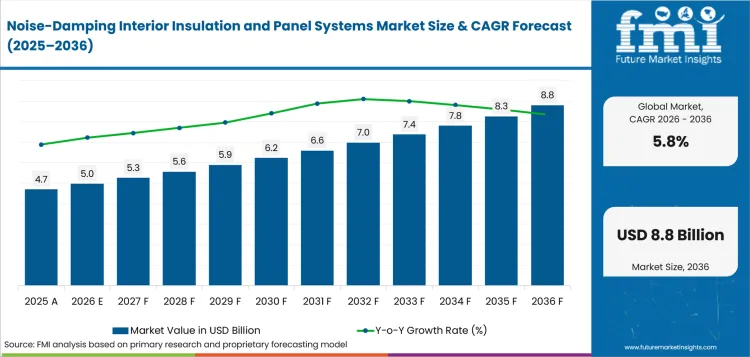
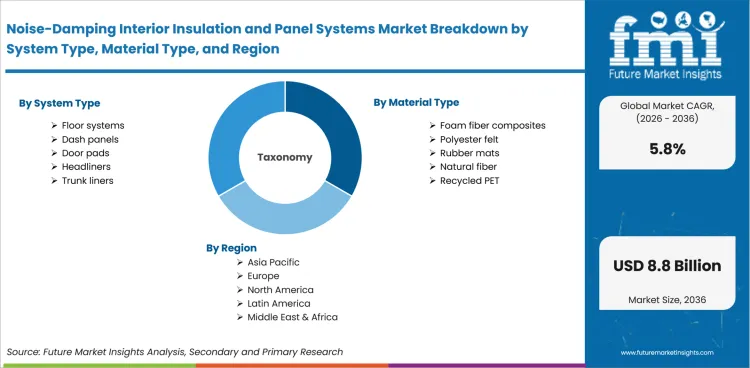
The Noise-Damping Interior Insulation and Panel Systems Market stood at USD 4.7 billion in 2025. The market value is expected to reach USD 5.0 billion in 2026 and USD 8.8 billion by 2036, expanding at a 5.8% CAGR from 2026 to 2036, driven by rising cabin quietness needs and stronger use of lightweight acoustic materials, with OEM line fit accounting for 83.7% share and passenger cars contributing 62.4% share as automakers focus on comfort and lower cabin vibration.
Key Takeaways Market Size and Forecast
- Noise-damping interior insulation and panel systems market stood at USD 4.7 billion in 2025.
- The market is expected to reach USD 5.0 billion in 2026.
- By 2036, industry revenue is forecast to reach USD 8.8 billion.
- Demand is expected to advance at 5.8% CAGR over the forecast period.
- Market revenue is predicted to add USD 3.8 billion in incremental opportunity over 2026 to 2036.
- OEM line fit is expected to hold 83.7% share of sales channel demand in 2026.
- Passenger cars are anticipated to represent 62.4% share of vehicle class demand in 2026.
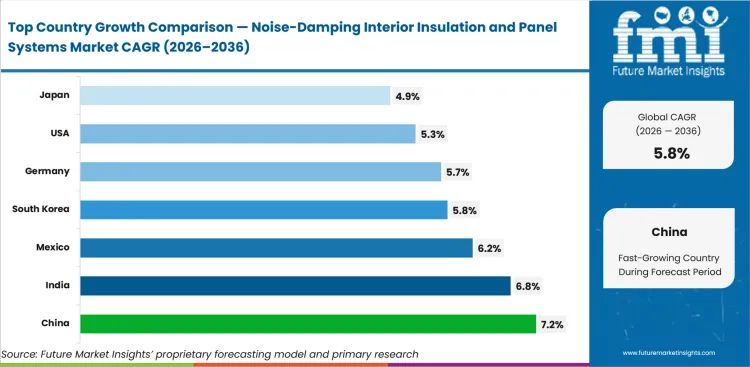
- China at 7.2% CAGR and India at 6.8% CAGR are forecast to lead country-level demand through 2036
Summary of the Noise-Damping Interior Insulation and Panel Systems Market
- Demand and Growth Drivers
- Automakers are giving more attention to cabin quietness as vehicle interiors become more important for comfort.
- Electric vehicles need better sound control because road noise is easier to hear inside the cabin. Demand for vehicle interior NVH testing is rising as OEMs check cabin sound before final trim approval.
- Demand is growing for interior parts that reduce vibration and make daily driving smoother.
- Product and Segment View
- Floor systems are important because lower body panels carry road sound into the cabin. This support demand for lightweight acoustic floor systems.
- Dash panels help reduce sound from the front section of the vehicle and improve cabin comfort.
- Foam fiber composites are gaining use because they help control noise without adding much weight.
- Geography and Competitive Outlook
- China has rising demand as electric vehicle production supports advanced cabin insulation use.
- India is gaining interest as passenger vehicle programs add more comfort-focused interior parts.
- Suppliers with lightweight materials and tested acoustic performance can improve access to new vehicle programs as automotive interior design focuses more on cabin comfort.
- Analyst Opinion
- Nikhil Kaitwade of FMI says, "Noise-damping interior insulation is becoming a cabin quality decision for automakers. EVs and hybrid platforms make road noise easier to hear. Suppliers that combine low weight with tuned acoustic response will be preferred in new vehicle programs."
- Noise-Damping Interior Insulation and Panel Systems Market Value Analysis
- Noise-damping insulation is moving from a hidden trim input into a clearer part of acoustic insulation design for vehicle cabins.
- Demand is rising as electric vehicles make road noise and panel vibration easier to hear inside the cabin.
- Automakers need lighter panels that reduce sound without adding too much vehicle weight.
- Floor systems and dash panels add value because these areas handle much of the sound entering the cabin.
- Suppliers can gain more program value by offering materials that combine sound control with easier recycling.
Cabin noise control is becoming more difficult as vehicle makers reduce weight and use more recyclable materials. Recyclable acoustic systems are gaining interest because they help reduce cabin noise and support end-of-life material recovery. Autoneum reported in 2025 that its Propylat PET interior solution uses 100% polyester and absorbs tire and electric motor noise. This gives OEMs a practical way to combine sound control with recycling goals. Interior air quality is also affecting material choice. BASF stated in 2025 that its Elastoflex® E acoustic foam system achieves fogging values below 0.5 mg under DIN 75201. This helps vehicle makers manage cabin comfort and interior emission needs through one material platform. Suppliers with recyclable designs and tested low-emission acoustic materials are likely to gain stronger access to future vehicle interior programs.
Noise-Damping Interior Insulation and Panel Systems Market Definition
Noise-damping interior insulation and panel systems cover acoustic absorbers and trim-backed panels installed inside vehicles. Parts reduce road noise and airflow sound inside the cabin. Scope covers floor mats and dash insulators. Door pads and headliner absorbers are included. Trunk liners and wheelhouse interior systems are included as engineered vehicle parts.
Noise-Damping Interior Insulation and Panel Systems Market Inclusions
Market inclusions cover noise-damping interior insulation and panel systems categorized by system type. Floor systems and dash panels are included. Door pads, headliners, and trunk liners complete the system scope. Material type covers foam fiber composites and polyester felt. Rubber mats, natural fiber, and recycled PET complete the material scope. Vehicle class covers passenger cars and SUVs. Light trucks, commercial vehicles, and electric vehicles complete the vehicle scope. Application area includes floor and dash, doors and roof, trunk area, wheelhouse liners, and cockpit panels. The scope includes cabin insulation parts integrated within automotive interior trim parts, with sound control and vibration reduction working inside one comfort system. Revenue scope covers 2026 to 2036. Key stakeholders include automakers, tier 1 interior suppliers, acoustic material converters, trim module makers, material suppliers, vehicle design teams, and cabin NVH testing providers.
Noise-Damping Interior Insulation and Panel Systems Market Exclusions
Scope excludes exterior sound barriers and industrial plant silencers unless sold into vehicle interiors. General acoustic wall coverings are excluded. Mechanical seat structures and electronic noise cancellation are excluded unless bundled with an interior acoustic panel package.
Noise-Damping Interior Insulation and Panel Systems Market Research Methodology
- Primary Research: FMI analysts reviewed interior acoustic suppliers and trim module makers across major producing countries.
- Desk Research: Study inputs used IEA electric vehicle data and public supplier product documents.
- Market Sizing and Forecasting: Market size was estimated by vehicle output and acoustic content per vehicle.
- Data Validation: Forecast checks compared EV share and passenger car output across key production markets.
Why is the Noise-Damping Interior Insulation and Panel Systems Market Growing?
- EV expansion is raising cabin quietness cabins because lower engine noise makes road and tire sound easier to hear.
- Lightweight trim programs favor felt and fiber parts that control noise with less added weight.
- Recycled acoustic materials create an upgrade route as automakers need traceable sustainability content inside vehicle interiors.
Cabin damping demand is rising as electric vehicles change what drivers hear inside vehicles. IEA reported a 65.0% battery electric share of electric car sales in 2025. Engine noise drops sharply in battery models so tire roar and panel vibration become more obvious. Acoustic packages need earlier placement in platform design. Suppliers with interior NVH testing systems can prove performance before tooling release.
Global vehicle output gives acoustic suppliers a large program funnel. ACEA reported global car production of 78.7 million units in 2025 and registrations of 77.6 million units. Higher vehicle output keeps OEM sourcing active across floor systems and dash pads. Interior damping parts are specified by platform. Each new model cycle can reset supplier positions through material cost and acoustic proof.
Market Segmentation Analysis
- With 41.5% share expected in 2026, floor systems are forecast to lead system type demand.
- Foam fiber composites are anticipated to account for 38.2% share of material type demand in 2026.
- Passenger cars form the main vehicle class and are forecast to hold 62.4% share in 2026.
- By 2026, floor and dash applications are expected to hold 44.6% share.
- OEM line fit is expected to account for 83.7% share in 2026.
The market is divided into five primary segment groups based on system type and material type. Vehicle class, application area and sales channel complete the structure. System type covers floor systems and dash panels. Door pads and headliners are included. Trunk liners complete the group. Material type covers foam fiber composites and polyester felt. Rubber mats and natural fiber are included. Recycled PET completes the material scope. Vehicle class covers passenger cars and SUVs. Light trucks and commercial vehicles are included. Electric vehicles complete the vehicle class scope. Application area covers floor and dash. Doors and roof are included. Trunk area and wheelhouse liners are included. Cockpit panels complete the application scope. Sales channel covers OEM line fit and tier 1 modules. Retrofit kits and MRO replacement complete the sales channel scope.
Insights into Noise-Damping Interior Insulation and Panel Systems Market by System Type
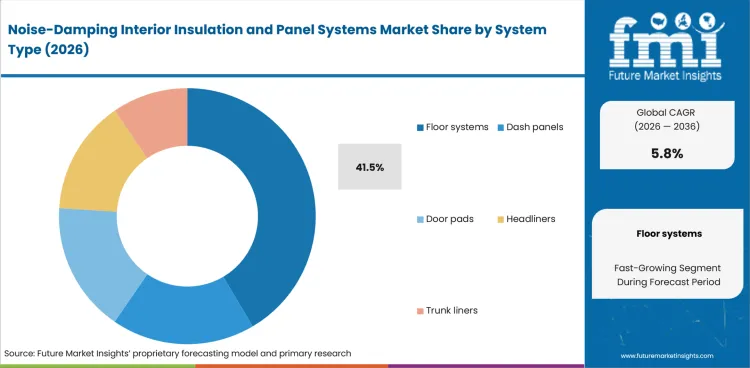
- Floor systems are expected to hold 41.5% share in 2026 as road and tire vibration enter through the floor pan. Lower-cabin damping is a core acoustic package for EV and combustion platforms.
- Dash panels support front cabin quietness by absorbing firewall noise from motors and HVAC units during daily driving. Headliners and trunk liners support secondary acoustic control as automotive headliner demand reflects roof comfort and cabin quietness needs.
Insights into Noise-Damping Interior Insulation and Panel Systems Market by Material Type
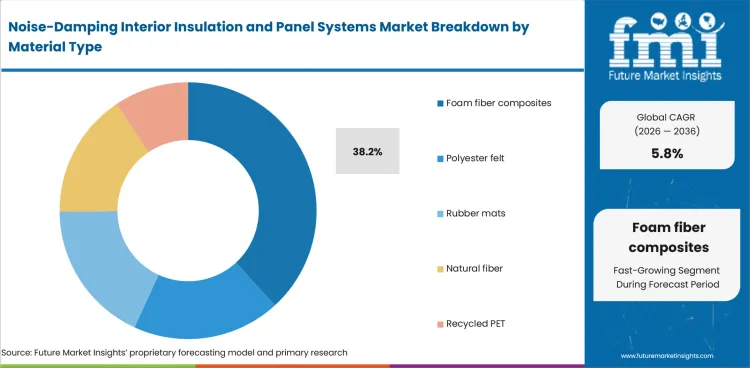
- Foam fiber composites balance sound absorption with part weight. Material type demand is expected to place 38.2% share on foam fiber composites in 2026.
- Polyester felt supports cabin absorbers and trunk liners. Automotive nonwoven fabrics help suppliers balance part weight and sound absorption. Recycled PET is drawing program interest as automakers request traceable recycled content in interior acoustic parts.
Insights into Noise-Damping Interior Insulation and Panel Systems Market by Vehicle Class
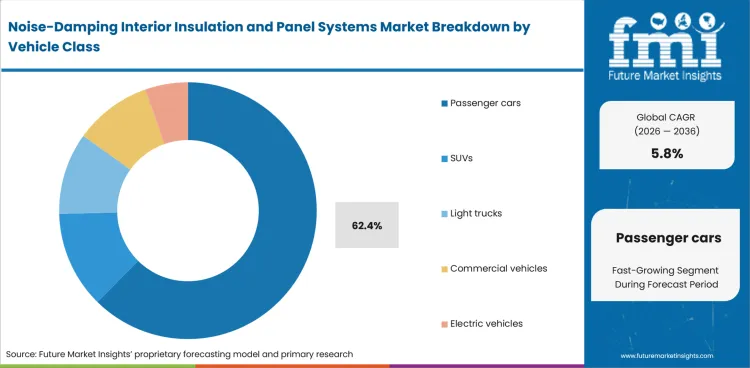
- Passenger cars are forecast to represent 62.4% share of vehicle class demand in 2026 as cabin comfort influences daily driving perception.
- SUVs need more floor and wheelhouse damping as larger cabins can amplify low-frequency sound. Electric vehicles need tuned acoustic panels as motor whine and tire sound are more noticeable without engine masking.
Insights into Noise-Damping Interior Insulation and Panel Systems Market by Application Area
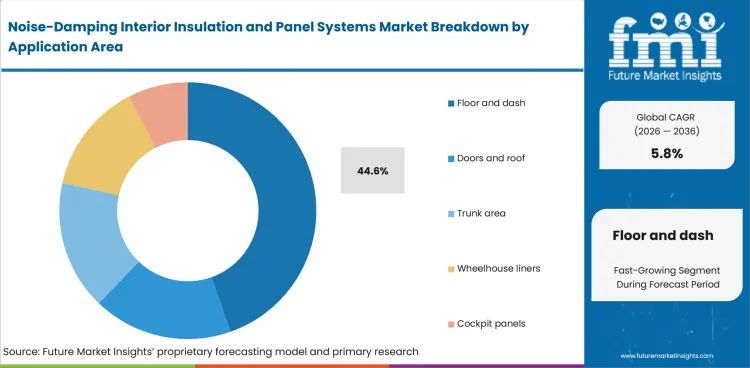
- Floor and dash applications are expected to hold 44.6% share in 2026 because footwell and firewall zones receive heavy noise transfer.
- Doors and roof need absorber pads to reduce panel vibration and wind noise during highway driving. Wheelhouse liners protect cabin comfort as wider tires and higher EV weight raise road noise exposure.
Insights into Noise-Damping Interior Insulation and Panel Systems Market by Sales Channel
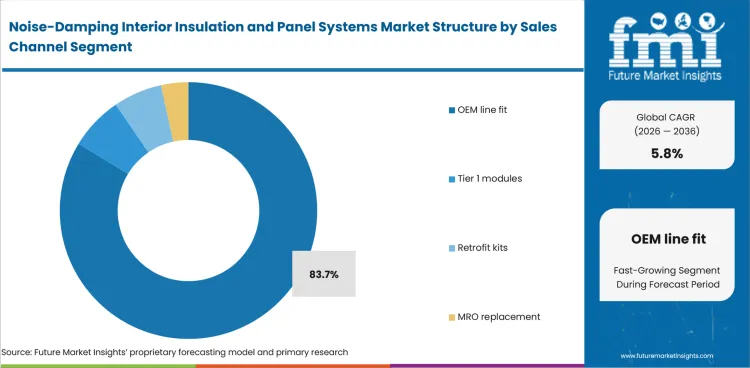
- OEM line fit leads sales channel demand as acoustic parts must be engineered before vehicle program release. Share is expected to reach 83.7% in 2026.
- Tier 1 modules support dashboard and door programs by bundling trim surfaces with hidden absorbers. Retrofit kits serve a smaller pool because many damping parts need exact geometry and fastener alignment.
Noise-Damping Interior Insulation and Panel Systems Market Drivers Restraints and Opportunities
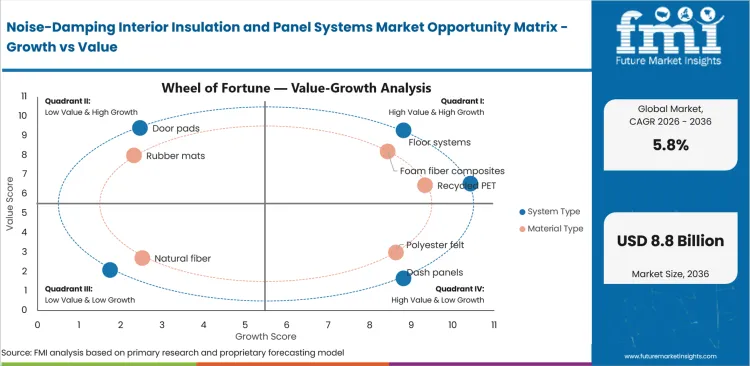
- EV cabin quietness is lifting demand for floor and dash insulation as tire sound is easier to hear.
- Material cost pressure can slow supplier conversion to recycled acoustic structures if price targets are tight.
- Lightweight mono-material systems create an opportunity as OEMs seek easier recycling and lower trim mass.
EV Cabin Noise Recalibration
Electric vehicles reduce engine noise inside the cabin. Road noise and panel vibration become more noticeable during city and highway driving. IEA expects electric car sales to reach 23.0 million in 2026 with 28.0% share of total car sales. Vehicle makers need acoustic packages that can address new sound sources. Suppliers with test data for motor whine and tire noise can enter platform work earlier.
Material Cost Limits
Acoustic panels must meet price targets set during vehicle program planning. Recycled PET and engineered composites can cost more than basic felt in some regions. Cost pressure is stronger in entry-level vehicles as comfort content has strict limits. Suppliers need local material access and low-scrap molding routes. Cost control can decide whether a material enters high-volume platforms.
Recycled Panel Upgrades
Automakers are asking for lighter trim and clearer material traceability files. Autoneum says its Ultra-Silent frunk uses up to 70.0% recycled PET and is designed for full recyclability. Such systems prove how acoustic function and recycled content can work in one part. Low-scrap manufacturing can improve supplier margins. Recycled panels support OEM sustainability targets and recycled technical textiles give suppliers a clearer route for cabin acoustic material recovery.
Competitive Landscape and Strategic Positioning
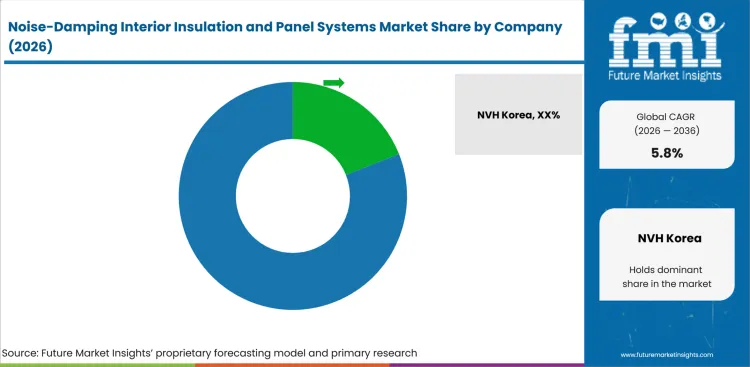
- Competition centers on acoustic package tuning and low-weight material conversion.
- Suppliers are judged on floor system depth and dash absorber matching.
- Recycled PET capability is becoming important as OEMs ask for traceable interior content.
- Entry barriers include program approval and vehicle-level acoustic validation.
Competitive positioning depends on proven cabin acoustic performance before tooling release. Autoneum has depth in acoustic and thermal management for light vehicles. Adler Pelzer Group and Sumitomo Riko serve insulation and sound control needs across vehicle platforms. FORVIA’s agreement to sell its Interiors Business Group to Apollo Funds in April 2026 indicates a reorganization of interior assets. Demand for automotive interior plastic components supports suppliers able to combine surface trim with hidden acoustic layers.
Autoneum strengthened China access by completing a 70.0% majority stake acquisition in Jiangsu Huanyu Group in February 2025. Antolin received public funding in March 2026 for electric vehicle interior component work. Sumitomo Electric began a tender offer in October 2025 to make Sumitomo Riko a wholly owned subsidiary. Supplier restructuring points toward closer control over acoustic materials and interior module capability.
Key Companies in the Noise-Damping Interior Insulation and Panel Systems Market
- Acoustic System Specialists: Autoneum and Adler Pelzer Group hold strong positions through floor absorbers and thermal acoustic systems.
- Interior Module Suppliers: FORVIA Interiors Business and Grupo Antolin serve trim programs with hidden acoustic layers.
- Material and Sound Control Players: 3M and Sumitomo Riko support damping materials and rubber-based sound control parts.
Competitive Benchmarking: Noise-Damping Interior Insulation and Panel Systems Market
| Company | Acoustic Package Depth | Lightweight Material Use | EV Cabin Match | Global Program Reach |
|---|---|---|---|---|
| Autoneum | High | High | High | Global with China depth |
| Adler Pelzer Group | High | Medium | Medium | Europe and North America centered |
| FORVIA Interiors Business | Medium | Medium | Medium | Global interior module reach |
| Grupo Antolin | Medium | Medium | Medium | Europe and India depth |
| Toyota Boshoku | Medium | Medium | High | Japan and Asia centered |
| 3M | Medium | High | Medium | Global materials reach |
| Sumitomo Riko | Medium | Medium | Medium | Japan and Asia strength |
Source: Future Market Insights competitive analysis, 2026.
Key Developments in Noise-Damping Interior Insulation and Panel Systems Market
- In February 2026, Autoneum developed the Ultra-Silent Frunk for battery electric vehicles. The polyester-based textile component offers acoustic and thermal insulation. It uses up to 70.0% recycled material and has entered series production for two BEV models in China and Germany.
- In December 2025, Autoneum supplied several polyester-based acoustic and thermal components for the Polestar 5. The vehicle uses Ultra-Silent Hush Panels under the interior cockpit and polyester felt outer dashes for noise and thermal insulation.
Key Players in the Noise-Damping Interior Insulation and Panel Systems Market
Major Global Players
- Autoneum
- Adler Pelzer Group
- FORVIA Interiors Business
- Grupo Antolin
- Toyota Boshoku
Specialist and Material Players
- 3M
- Sumitomo Riko
- UGN Inc.
- IAC Group
- Freudenberg Performance Materials
Analysis of Noise-Damping Interior Insulation and Panel Systems Market by Key Countries
.webp "Top Country Growth Comparison Noise Damping Interior Insulation And Panel Systems Market Cagr (2026 2036)")
| Country | CAGR |
|---|---|
| China | 7.2% |
| India | 6.8% |
| Mexico | 6.2% |
| South Korea | 5.8% |
| Germany | 5.7% |
| United States | 5.3% |
| Japan | 4.9% |
Source: Future Market Insights, 2026.
Sales Analysis of Noise-Damping Interior Insulation and Panel Systems Market in China
Fastest-growing country market · 2026 to 2036
China Market Outlook
China is forecast to lead country demand at 7.2% CAGR through 2036. The market is estimated at USD 1,100.0 million in 2026 and is forecast to reach USD 2,204.7 million by 2036, creating USD 1,104.7 million in incremental opportunity.
China matters because EV production and local vehicle programs run at large scale. Cabin noise control has become more important as electric powertrains make tire sound and floor vibration easier to hear.
Key Growth Drivers
- IEA reported more than 13.0 million electric cars sold in China in 2025, raising demand for EV-specific floor systems and dash panels.
- Close to 55.0% of new cars sold in China were electric in 2025, which gives acoustic suppliers a large EV cabin program pool.
- China accounted for nearly 75.0% of electric cars produced globally in 2025, creating a large local need for molded cabin insulation.
- Chinese electric car exports doubled to over 2.5 million units in 2025, which raises the need for acoustic parts that meet export vehicle standards.
Key Restraints
- IEA reported China electric car sales rose by less than 20.0% in 2025, which points to slower expansion after earlier high volume jumps.
- Electric car sales share rose by only about 6.0 percentage points in 2025, which can reduce urgency for some new acoustic upgrades.
- China’s 2025 policy-backed trade-in program covered over 11.5 million automobiles, which shows that vehicle replacement demand still depends on government-supported incentives.
What makes China unique
China is unique because EV scale and local trim supply are close to each other. Acoustic suppliers can test and ship cabin parts faster when plants sit near OEM assembly lines.
Key Companies
- Autoneum China
- Jiangsu Huanyu Group
- Yanfeng
- Ningbo Tuopu Group
- Changchun Faway Automobile Components
Sales & Supply Channels
- OEM line fit
- Tier 1 interior modules
- Local acoustic converters
- EV platform supply programs
- Aftermarket insulation kits
Market Taxonomy & Sub-Regions Covered
| Category | Segments |
|---|---|
| By System Type | Floor systems, Dash panels, Door pads, Headliners, Trunk liners |
| By Material Type | Foam fiber composites, Polyester felt, Rubber mats, Natural fiber, Recycled PET |
| By Vehicle Class | Passenger cars, SUVs, Light trucks, Commercial vehicles, Electric vehicles |
| By Application Area | Floor and dash, Doors and roof, Trunk area, Wheelhouse liners, Cockpit panels |
| By Sales Channel | OEM line fit, Tier 1 modules, Retrofit kits, MRO replacement |
| Key Sub-Regions Covered | Guangdong, Jiangsu, Zhejiang, Shanghai, Chongqing, Hubei, Jilin |
Frequently Asked Questions
How fast is China’s noise-damping interior insulation and panel systems market growing?
China is forecast to expand at 7.2% CAGR through 2036, making it the fastest-growing country in the provided list.
What is the China market value by 2036?
The China market is forecast to reach USD 2,204.7 million by 2036, up from USD 1,100.0 million in 2026.
What is driving demand in China?
Demand is led by EV production scale and export vehicle programs. Local OEMs also need lighter acoustic panels for battery vehicles.
Sales Analysis of Noise-Damping Interior Insulation and Panel Systems Market in India
High-readiness country market · 2026 to 2036
India Market Outlook
India is forecast to expand at 6.8% CAGR during the forecast period. The market is estimated at USD 350.0 million in 2026 and is forecast to reach USD 675.7 million by 2036, creating USD 325.7 million in incremental opportunity.
India demand comes from passenger vehicle programs and SUV output. Automakers need cost-controlled acoustic packages that improve cabin comfort without adding too much weight.
Key Growth Drivers
- SIAM reported passenger vehicle sales of 46.43 lakh units in FY 2025 to 2026, raising demand for OEM line fit acoustic insulation.
- Utility vehicles held 66.0% share in passenger vehicles in Q1 FY 2025 to 2026, which increases floor and wheelhouse damping needs.
- IEA reported India electric car sales reached 165,000 units in 2025, creating more need for EV floor and dash insulation.
- SIAM reported passenger vehicle exports of 9.05 lakh units in FY 2025 to 2026, which raises demand for acoustic parts in export programs.
Key Restraints
- SIAM reported passenger vehicle sales were lower by 1.4% in Q1 FY 2025 to 2026, which can slow short-term acoustic part orders.
- Passenger cars declined by 11.2% in Q1 FY 2025 to 2026, which can reduce demand for compact cabin insulation programs.
- Commercial vehicle sales fell 0.6% in Q1 FY 2025 to 2026, which can limit acoustic upgrades in fleet-focused interiors.
What makes India unique
India is unique because SUV demand and cost-sensitive vehicle programs move together. Suppliers need acoustic parts that are light and affordable for local assembly plants.
Key Companies
- Bharat Seats Limited
- Krishna Maruti Limited
- Samvardhana Motherson Automotive Systems
- Machino Plastics Limited
- IAC International Automotive India Pvt. Ltd.
Sales & Supply Channels
- OEM line fit
- Tier 1 interior suppliers
- Local trim converters
- Export vehicle programs
- Service replacement channels
Market Taxonomy & Sub-Regions Covered
| Category | Segments |
|---|---|
| By System Type | Floor systems, Dash panels, Door pads, Headliners, Trunk liners |
| By Material Type | Foam fiber composites, Polyester felt, Rubber mats, Natural fiber, Recycled PET |
| By Vehicle Class | Passenger cars, SUVs, Light trucks, Commercial vehicles, Electric vehicles |
| By Application Area | Floor and dash, Doors and roof, Trunk area, Wheelhouse liners, Cockpit panels |
| By Sales Channel | OEM line fit, Tier 1 modules, Retrofit kits, MRO replacement |
| Key Sub-Regions Covered | Haryana, Maharashtra, Tamil Nadu, Gujarat, Karnataka, Uttar Pradesh, Delhi NCR |
Frequently Asked Questions
How fast is India’s noise-damping interior insulation and panel systems market growing?
India is forecast to expand at 6.8% CAGR through 2036, led by passenger vehicle programs and SUV output.
What is the India market value by 2036?
The India market is forecast to reach USD 675.7 million by 2036, up from USD 350.0 million in 2026.
Which segment leads demand in India?
OEM line fit leads because floor systems and dash panels must be approved during vehicle design and assembly planning.
Sales Analysis of Noise-Damping Interior Insulation and Panel Systems Market in Mexico
Export-linked country market · 2026 to 2036
Mexico Market Outlook
Mexico is expected to advance at 6.2% CAGR between 2026 and 2036. The market is estimated at USD 300.0 million in 2026 and is forecast to reach USD 547.5 million by 2036, creating USD 247.5 million in incremental opportunity.
Mexico market is built around export vehicle assembly and North American platform supply. Acoustic panels made in Mexico often need to match cabin comfort standards for vehicles sold in the United States.
Key Growth Drivers
- INEGI reported Mexico produced 3,953,494 light vehicles in 2025, creating factory demand for floor systems and dash panels.
- Light trucks formed 77.2% of Mexico light vehicle production in 2025, which increases lower-cabin and wheelhouse insulation needs.
- Mexico exported 3,385,785 light vehicles in 2025, keeping OEM acoustic sourcing active for export platforms.
- INEGI reported April 2026 production of 329,878 light vehicles, which points to active platform supply for interior components.
Key Restraints
- INEGI data showed light vehicle exports fell 2.7% in 2025, which can reduce acoustic part volumes linked with export programs.
- Light vehicle production declined 0.9% in 2025, creating pressure on suppliers serving high-volume platform builds.
- The United States accounted for 78.4% of Mexico light vehicle exports in 2025, creating exposure to one main destination market.
What makes Mexico unique
Mexico is unique because export assembly and acoustic part conversion sit inside the same regional supply corridor. Suppliers that serve North American platforms can use Mexico for lower freight cost and faster line support.
Key Companies
- UGN Inc.
- Auria Solutions
- IAC Group Mexico
- Adler Pelzer de México
- Autoneum Mexico
Sales & Supply Channels
- OEM line fit
- Tier 1 trim modules
- Export platform supply
- Local acoustic converters
- North America program channels
Market Taxonomy & Sub-Regions Covered
| Category | Segments |
|---|---|
| By System Type | Floor systems, Dash panels, Door pads, Headliners, Trunk liners |
| By Material Type | Foam fiber composites, Polyester felt, Rubber mats, Natural fiber, Recycled PET |
| By Vehicle Class | Passenger cars, SUVs, Light trucks, Commercial vehicles, Electric vehicles |
| By Application Area | Floor and dash, Doors and roof, Trunk area, Wheelhouse liners, Cockpit panels |
| By Sales Channel | OEM line fit, Tier 1 modules, Retrofit kits, MRO replacement |
| Key Sub-Regions Covered | Nuevo León, Coahuila, Guanajuato, Puebla, San Luis Potosí, Aguascalientes, State of Mexico |
Frequently Asked Questions
How fast is Mexico’s noise-damping interior insulation and panel systems market growing?
Mexico is forecast to expand at 6.2% CAGR by 2036, led by export vehicle production and light truck output.
What is the Mexico market value by 2036?
The Mexico market is forecast to reach USD 547.5 million by 2036, up from USD 300.0 million in 2026.
Why do floor systems matter in Mexico?
Floor systems matter because light trucks dominate production and need stronger lower-cabin sound control.
Sales Analysis of Noise-Damping Interior Insulation and Panel Systems Market in South Korea
EV-focused country market · 2026 to 2036
South Korea Market Outlook
South Korea is expected to record 5.8% CAGR during the forecast period. The market is estimated at USD 260.0 million in 2026 and is forecast to reach USD 456.9 million by 2036, creating USD 196.9 million in incremental opportunity.
South Korea market is supported by EV platforms and export-focused vehicle programs. Cabin quietness carries value because Korean vehicles compete in markets that compare comfort and interior quality closely.
Key Growth Drivers
- Trade.gov reported Korea produced 407,009 EVs in 2025, creating a stronger program pool for EV cabin acoustic systems.
- EVs accounted for 11.0% of Korea’s total automobile production in 2025, which raises demand for floor and dash insulation.
- IEA reported Korea electric car sales reached more than 200,000 units in 2025, increasing the need for EV-specific cabin damping.
- Electric car sales in Korea rose by around 65.0% in 2025, which creates a larger testing base for noise-control parts.
Key Restraints
- Korea’s electric car sales had stayed around 130,000 units for several years before 2025, which signals a slower earlier base for EV-specific acoustic parts.
- Korea’s zero-emission vehicle target aims for 50.0% of new car sales by 2030, so suppliers must prepare before full demand scale arrives.
- Compact EV layouts create weight and space limits, which can reduce insulation thickness in some cabin zones.
What makes South Korea unique
South Korea is unique because OEMs use domestic suppliers for export-ready interiors. Acoustic insulation must meet repeat quality needs across EVs and SUVs built for global sales.
Key Companies
- NVH Korea
- Seoyon E-Hwa
- Daesol Ausys
- Duckyang Industry
- Daehan Solution
Sales & Supply Channels
- OEM line fit
- OEM-linked tier 1 suppliers
- EV platform programs
- Export vehicle programs
- Local validation channels
Market Taxonomy & Sub-Regions Covered
| Category | Segments |
|---|---|
| By System Type | Floor systems, Dash panels, Door pads, Headliners, Trunk liners |
| By Material Type | Foam fiber composites, Polyester felt, Rubber mats, Natural fiber, Recycled PET |
| By Vehicle Class | Passenger cars, SUVs, Light trucks, Commercial vehicles, Electric vehicles |
| By Application Area | Floor and dash, Doors and roof, Trunk area, Wheelhouse liners, Cockpit panels |
| By Sales Channel | OEM line fit, Tier 1 modules, Retrofit kits, MRO replacement |
| Key Sub-Regions Covered | Ulsan, Gyeonggi, Seoul, Incheon, Busan, Daegu, Chungcheongnam-do |
Frequently Asked Questions
How fast is South Korea’s noise-damping interior insulation and panel systems market growing?
South Korea is forecast to expand at 5.8% CAGR through 2036, led by EV programs and export vehicle platforms.
What is the South Korea market value by 2036?
The South Korea market is forecast to reach USD 456.9 million by 2036, up from USD 260.0 million in 2026.
What makes South Korea important for suppliers?
South Korea matters because OEMs need consistent acoustic parts for EVs and SUVs sold in export markets.
Sales Analysis of Noise-Damping Interior Insulation and Panel Systems Market in Germany
Premium vehicle country market · 2026 to 2036
Germany Market Outlook
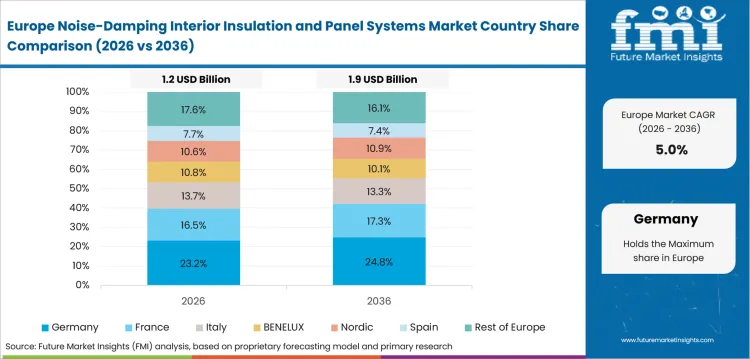
Germany is projected to move at 5.7% CAGR across the forecast period. The market is estimated at USD 520.0 million in 2026 and is forecast to reach USD 905.2 million by 2036, creating USD 385.2 million in incremental opportunity.
Germany matters because premium vehicle programs set strict cabin sound targets. EV output increases the need for lighter floor systems and recycled acoustic panels with verified performance.
Key Growth Drivers
- VDA reported 864,000 electric cars were produced in Germany in the first half of 2025, raising demand for EV cabin insulation.
- Electric cars formed 40.0% of German domestic car production in the first half of 2025, which raises demand for recycled PET and foam fiber composites.
- VDA expected around 1.7 million electric cars to be manufactured in Germany during 2025, creating a large acoustic package pipeline.
- Germany exported 283,500 new cars in July 2025, which keeps OEM acoustic requirements active for international vehicle programs.
Key Restraints
- German new passenger car registrations totaled 1,667,600 units after seven months of 2025, down 2.0% against the prior year.
- Overall order intake was 1.0% lower in July 2025, which can affect short-term supplier call-offs for cabin materials.
- VDA stated in 2025 that more public charging points and grid expansion were needed, which can slow EV confidence if infrastructure work lags.
What makes Germany unique
Germany is unique because acoustic performance is a clear part of premium vehicle quality. Suppliers must prove part weight, sound reduction and material recovery before program approval.
Key Companies
- Freudenberg Performance Materials
- Röchling Automotive
- MöllerTech
- Adler Pelzer Group
- Continental Surface Solutions
Sales & Supply Channels
- OEM line fit
- Premium vehicle programs
- Tier 1 interior modules
- Material validation channels
- EV platform supply
Market Taxonomy & Sub-Regions Covered
| Category | Segments |
|---|---|
| By System Type | Floor systems, Dash panels, Door pads, Headliners, Trunk liners |
| By Material Type | Foam fiber composites, Polyester felt, Rubber mats, Natural fiber, Recycled PET |
| By Vehicle Class | Passenger cars, SUVs, Light trucks, Commercial vehicles, Electric vehicles |
| By Application Area | Floor and dash, Doors and roof, Trunk area, Wheelhouse liners, Cockpit panels |
| By Sales Channel | OEM line fit, Tier 1 modules, Retrofit kits, MRO replacement |
| Key Sub-Regions Covered | Bavaria, Baden-Württemberg, Lower Saxony, North Rhine-Westphalia, Saxony, Hesse, Bremen |
Frequently Asked Questions
How fast is Germany’s noise-damping interior insulation and panel systems market growing?
Germany is forecast to expand at 5.7% CAGR through 2036, led by EV output and premium vehicle acoustic targets.
What is the Germany market value by 2036?
The Germany market is forecast to reach USD 905.2 million by 2036, up from USD 520.0 million in 2026.
Which material segment has the strongest position in Germany?
Foam fiber composites lead material demand. Recycled PET is expected to move faster as OEMs request lower-weight cabin materials.
Sales Analysis of Noise-Damping Interior Insulation and Panel Systems Market in the United States
Large vehicle country market · 2026 to 2036
United States Market Outlook
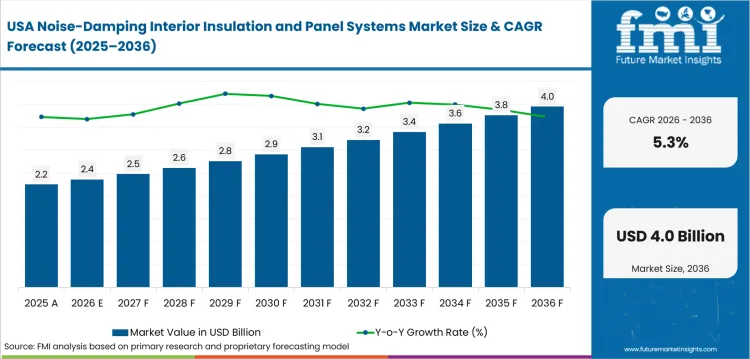
The United States market is expected to rise at 5.3% CAGR by 2036. The market is estimated at USD 920.0 million in 2026 and is forecast to reach USD 1,542.0 million by 2036, creating USD 622.0 million in incremental opportunity.
United States demand comes from pickups, SUVs and EV programs. Larger cabins need more lower-body insulation because road noise travels through floor panels and wheelhouse areas.
Key Growth Drivers
- IEA reported United States electric car sales reached around 1.5 million units in 2025, creating demand for EV-specific acoustic packages.
- Large cars and SUVs accounted for over 80.0% of United States car sales in 2025, which raises floor system and wheelhouse liner demand.
- Over 85.0% of electric models available in the United States were large cars or SUVs in 2025, which increases acoustic content per EV.
- Used electric car sales in the United States reached less than 400,000 transactions in 2025, creating future service demand for cabin replacement parts.
Key Restraints
- IEA reported United States electric car sales in Q4 2025 were 45.0% lower than Q4 2024, which can slow EV-specific sourcing decisions.
- Electric cars made up only 6.0% to 7.0% of United States car sales in Q4 2025, limiting near-term acoustic demand from EV platforms.
- Less than 20.0% of available electric car models had a base trim price below the median ICE price in 2025, which limits EV reach in price-sensitive households.
What makes the United States unique
The United States is unique because larger vehicles raise acoustic content per unit. Floor systems and wheelhouse liners are important because pickups and SUVs carry more tire noise into the cabin.
Key Companies
- 3M
- Dow
- Auria Solutions
- Woodbridge Group
- L&L Products
Sales & Supply Channels
- OEM line fit
- Tier 1 interior modules
- North American platform supply
- Commercial vehicle channels
- Service replacement outlets
Market Taxonomy & Sub-Regions Covered
| Category | Segments |
|---|---|
| By System Type | Floor systems, Dash panels, Door pads, Headliners, Trunk liners |
| By Material Type | Foam fiber composites, Polyester felt, Rubber mats, Natural fiber, Recycled PET |
| By Vehicle Class | Passenger cars, SUVs, Light trucks, Commercial vehicles, Electric vehicles |
| By Application Area | Floor and dash, Doors and roof, Trunk area, Wheelhouse liners, Cockpit panels |
| By Sales Channel | OEM line fit, Tier 1 modules, Retrofit kits, MRO replacement |
| Key Sub-Regions Covered | Michigan, Ohio, Tennessee, Kentucky, Alabama, Texas, South Carolina |
Frequently Asked Questions
How fast is the United States noise-damping interior insulation and panel systems market growing?
The United States is forecast to expand at 5.3% CAGR by 2036, led by SUVs and EV platform demand.
What is the United States market value by 2036?
The United States market is forecast to reach USD 1,542.0 million by 2036, up from USD 920.0 million in 2026.
Which segment leads demand in the United States?
OEM line fit leads because acoustic systems are designed into factory floor and dash assemblies before production starts.
Sales Analysis of Noise-Damping Interior Insulation and Panel Systems Market in Japan
Hybrid-focused country market · 2026 to 2036
Japan Market Outlook
Japan is anticipated to progress at 4.9% CAGR over the ten-year period. The market is estimated at USD 320.0 million in 2026 and is forecast to reach USD 516.3 million by 2036, creating USD 196.3 million in incremental opportunity.
Japan market is built around refined cabin quality and compact packaging. Acoustic systems need precise fit because many vehicles use tight interior layouts and hybrid powertrains.
Key Growth Drivers
- Trade.gov reported 4,421,494 new passenger vehicles were sold in Japan in 2024, keeping OEM acoustic system demand active.
- Hybrid vehicles held 54.8% of new passenger car sales in Japan in 2024, raising demand for acoustic parts that manage engine start-stop sound.
- Japan’s automotive sector employed 5.58 million people in 2024, reflecting a deep manufacturing and service network for vehicle components.
- Auto manufacturing accounted for 13.9% of Japan’s manufacturing GDP in 2024, which keeps domestic supplier capability important.
Key Restraints
- New EVs accounted for only 1.35% of new vehicles sold in Japan in 2024, which limits EV-specific acoustic redesign.
- Japan sold 59,736 new EVs in 2024, which is a smaller pool for EV-only cabin insulation programs.
- IEA reported electric cars accounted for less than 3.0% of Japan car sales in 2025, limiting the speed of EV acoustic package turnover.
What makes Japan unique
Japan is unique because hybrid powertrains and compact vehicle design shape acoustic requirements. Suppliers must deliver thin and precise cabin parts that fit tight vehicle layouts.
Key Companies
- Toyota Boshoku
- Sumitomo Riko
- Hayashi Telempu
- Howa Co., Ltd.
- Nihon Tokushu Toryo
Sales & Supply Channels
- OEM line fit
- Japanese tier 1 supplier networks
- Hybrid vehicle programs
- Compact vehicle platforms
- Service replacement channels
Market Taxonomy & Sub-Regions Covered
| Category | Segments |
|---|---|
| By System Type | Floor systems, Dash panels, Door pads, Headliners, Trunk liners |
| By Material Type | Foam fiber composites, Polyester felt, Rubber mats, Natural fiber, Recycled PET |
| By Vehicle Class | Passenger cars, SUVs, Light trucks, Commercial vehicles, Electric vehicles |
| By Application Area | Floor and dash, Doors and roof, Trunk area, Wheelhouse liners, Cockpit panels |
| By Sales Channel | OEM line fit, Tier 1 modules, Retrofit kits, MRO replacement |
| Key Sub-Regions Covered | Aichi, Shizuoka, Kanagawa, Saitama, Tochigi, Fukuoka, Hiroshima |
Frequently Asked Questions
How fast is Japan’s noise-damping interior insulation and panel systems market growing?
Japan is forecast to expand at 4.9% CAGR by 2036, led by hybrid vehicle needs and cabin comfort standards.
What is the Japan market value by 2036?
The Japan market is forecast to reach USD 516.3 million by 2036, up from USD 320.0 million in 2026.
Why are hybrid vehicles important in Japan?
Hybrid vehicles matter because engine start-stop behavior makes cabin sound changes more noticeable to drivers.
Report Scope and Coverage
| Parameter | Details |
|---|---|
| Quantitative Units | USD 5.0 billion to USD 8.8 billion at 5.8% CAGR |
| Market Definition | Vehicle interior acoustic absorbers and trim-backed noise-control panels used to reduce cabin noise and panel vibration |
| Segments Covered | System type, material type, vehicle class, application area, sales channel, and region |
| System Type | Floor systems, dash panels, door pads, headliners, and trunk liners |
| Material Type | Foam fiber composites, polyester felt, rubber mats, natural fiber, and recycled PET |
| Vehicle Class | Passenger cars, SUVs, light trucks, commercial vehicles, and electric vehicles |
| Application Area | Floor and dash, doors and roof, trunk area, wheelhouse liners, and cockpit panels |
| Sales Channel | OEM line fit, tier 1 modules, retrofit kits, and MRO replacement |
| Regions Covered | North America, Latin America, Western Europe, Eastern Europe, East Asia, South Asia and Pacific, Middle East & Africa |
| Countries Covered | United States, China, India, Mexico, South Korea, Germany, Japan, and more than 30.0 countries |
| Key Companies Profiled | Autoneum, Adler Pelzer Group, FORVIA Interiors Business, Grupo Antolin, Toyota Boshoku, 3M, and Sumitomo Riko |
| Forecast Period | 2026 to 2036 |
| Approach | Hybrid bottom-up and top-down method using vehicle output, acoustic content per vehicle, EV production trends, platform mix, and supplier activity |
Source: Future Market Insights, 2026.
Noise-Damping Interior Insulation and Panel Systems Market Breakdown by System Type, Material Type, Vehicle Class, Application Area, Sales Channel, and Region
Noise-Damping Interior Insulation and Panel Systems Market Segmented by System Type
- Floor systems
- Dash panels
- Door pads
- Headliners
- Trunk liners
Noise-Damping Interior Insulation and Panel Systems Market Segmented by Material Type
- Foam fiber composites
- Polyester felt
- Rubber mats
- Natural fiber
- Recycled PET
Noise-Damping Interior Insulation and Panel Systems Market Segmented by Vehicle Class
- Passenger cars
- SUVs
- Light trucks
- Commercial vehicles
- Electric vehicles
Noise-Damping Interior Insulation and Panel Systems Market Segmented by Application Area
- Floor and dash
- Doors and roof
- Trunk area
- Wheelhouse liners
- Cockpit panels
Noise-Damping Interior Insulation and Panel Systems Market Segmented by Sales Channel
- OEM line fit
- Tier 1 modules
- Retrofit kits
- MRO replacement
Noise-Damping Interior Insulation and Panel Systems Market by Region
- North America
- Latin America
- Western Europe
- Eastern Europe
- East Asia
- South Asia and Pacific
- Middle East & Africa
Research Sources and Bibliography
- Autoneum. (2024, December 13). Extension of sustainable polyester-based product portfolio for commercial vehicles. Autoneum.
- BASF. (n.d.). Elastoflex® E (PU): Semi-rigid foam system.
- International Energy Agency. (2026, May 20). Trends in electric cars. In Global EV Outlook 2026.
- International Energy Agency. (2026, May 20). Executive summary. In Global EV Outlook 2026.
- International Energy Agency. (2026, May 20). Manufacturing and trade. In Global EV Outlook 2026.
- International Energy Agency. (2026, May 20). Electric vehicle model availability. In Global EV Outlook 2026.
- International Energy Agency. (2026, May 20). Used electric cars. In Global EV Outlook 2026
- European Automobile Manufacturers’ Association. (2026, April 2). Economic and market report: Global and EU auto industry, full year 2025. ACEA.
- Autoneum. (2026, February). Exterior components for light vehicles. Autoneum.
- Society of Indian Automobile Manufacturers. (2026, April 14). Auto industry performance of Q4 (Jan-March 2026) & FY 2025-26. SIAM.
- Society of Indian Automobile Manufacturers. (2025, July 15). Key highlights from Q1 (April-June 2025). SIAM.
- Instituto Nacional de Estadística y Geografía. (2026, January 9). Registro Administrativo de la Industria Automotriz de Vehículos Ligeros: Diciembre de 2025. INEGI.
- Instituto Nacional de Estadística y Geografía. (2026, May 11). Registro Administrativo de la Industria Automotriz de Vehículos Ligeros: Abril de 2026. INEGI.
- International Trade Administration. (2025, July 21). South Korea electric vehicles EV market. Trade.gov.
- Verband der Automobilindustrie. (2025, August 4). Production and market in July 2025: Electric car production at record levels in first half of the year. VDA.
- International Trade Administration. (2025, November 20). Japan: Automotive. Trade.gov.
- Autoneum. (2025, February 28). Acquisition of majority shareholding in Jiangsu Huanyu Group by Autoneum successfully completed. Autoneum.
- Antolin. (2025, December 5). Antolin to sell three legal entities in India to Shriram Pistons & Rings for €159 million. Antolin.
- Antolin. (2026, March 24). SEPIDES funds Antolin project to optimize interior components enhancing electric vehicle range. Antolin.
- FORVIA. (2026, April 27). FORVIA to sell its Interiors Business Group to Apollo Funds. FORVIA.
- Sumitomo Electric Industries, Ltd. (2025, October 30). Notice concerning commencement of tender offer for shares of Sumitomo Riko Company Limited and transfer of shares in Sumitomo Densetsu Co., Ltd. for the tender offer by Daiwa House Industry Co., Ltd. Sumitomo Electric.
- Autoneum. (2026, February 4). Sustainable, lightweight, and sound absorbing: Polyester-based front trunk solution for BEVs. Autoneum.
- Autoneum. (2025, December 16). Autoneum and Polestar set new benchmarks for passenger experience and sustainability. Autoneum.
- The State Council of the People’s Republic of China. (2026, January 2). China’s trade-in program drives consumer goods sales by 2.6 trln yuan in 2025. The State Council of the People’s Republic of China.
This Report Answers
- What is the 2026 value of the noise-damping interior insulation and panel systems market?
- What revenue level is expected by 2036 and what CAGR supports the forecast?
- Which system type is expected to hold the leading share in 2026?
- Which material type is most important for lightweight cabin acoustic control?
- Which countries are forecast to expand faster than the global market average?
- How does OEM line fit affect supplier selection and program timing?
- How are EV cabins changing demand for acoustic interior panels?
- Which sources and methods support the forecast numbers?
Frequently Asked Questions
What is the noise-damping interior insulation and panel systems market size in 2026?
Noise-damping interior insulation and panel systems market is expected to reach USD 5.0 billion in 2026 as OEMs add acoustic content to floor and dash trim systems.
What is the expected market value by 2036?
Industry revenue is forecast to reach USD 8.8 billion by 2036, supported by EV cabin quietness needs and lightweight trim materials.
What CAGR is expected between 2026 and 2036?
Demand is expected to advance at 5.8% CAGR between 2026 and 2036 as acoustic packages move earlier into vehicle platform planning.
Which segment leads system type demand?
Floor systems are expected to hold 41.5% share in 2026 as lower-body panels handle tire and road vibration first.
Why does OEM line fit dominate sales channel demand?
OEM line fit is expected to hold 83.7% share in 2026 as acoustic panels need geometry matching before vehicle assembly starts.
Which countries lead country-level demand?
China and India lead country-level demand with 7.2% CAGR and 6.8% CAGR by 2036 as EV output and passenger car programs expand.
Preview the report firsthand - request a free sample
Get SampleGet the brochure for pricing and purchase details.
Get PDFTable of Content
- Key Takeaways
- Market Size and CAGR
- Top Growth Driver
- Fastest Growing Segment
- Leading Region
- Key Companies
- Emerging Opportunities
- Executive Summary
- Global Market Outlook
- Demand-side Trends
- Supply-side Trends
- Technology Roadmap Analysis
- Analysis and Recommendations
- Analyst Perspective (What is happening? Why now? What should investors know?)
- Key Questions Answered
- How large is the market?
- What is the CAGR?
- What are key trends?
- Which region dominates?
- Who are the leaders?
- Market Overview
- Market Coverage / Taxonomy
- Market Definition / Scope / Limitations
- Research Methodology
- Chapter Orientation
- Analytical Lens and Working Hypotheses
- Market Structure, Signals, and Trend Drivers
- Benchmarking and Cross-market Comparability
- Market Sizing, Forecasting, and Opportunity Mapping
- Research Design and Evidence Framework
- Desk Research Programme (Secondary Evidence)
- Expert Input and Fieldwork (Primary Evidence)
- Tooling, Models, and Reference Databases
- Data Engineering and Model Build
- Quality Assurance and Audit Trail
- Market Background
- Market Dynamics (Drivers, Restraints, Opportunity, Trends)
- Scenario Forecast (Optimistic, Likely, Conservative)
- Impact Analysis
- AI Impact
- Sustainability Impact
- Regulatory Impact
- Technology Impact
- Consumer / Buyer Analysis
- Purchase Drivers
- Adoption Barriers
- Buyer Journey
- Opportunity Map Analysis
- Product Life Cycle Analysis
- Supply Chain Analysis
- Investment Feasibility Matrix
- Value Chain Analysis
- PESTLE and Porter's Analysis
- Regulatory Landscape
- Regional Parent Market Outlook
- Production and Consumption Statistics
- Import and Export Statistics
- Global Market Analysis and Forecast, 2021 to 2036
- Historical Market Size Value (USD Billion) & Volume (Unit) Analysis, 2021 to 2025
- Current and Future Market Size Value (USD Billion) & Volume (Unit) Projections, 2026 to 2036
- Y-o-Y Growth Trend Analysis
- Absolute $ Opportunity Analysis
- Global Market Pricing Analysis, 2021 to 2036
- Global Market Analysis and Forecast, By System Type, 2021 to 2036
- Introduction / Key Findings
- Historical Market Size Value (USD Billion) & Volume (Unit) Analysis By System Type, 2021 to 2025
- Current and Future Market Size Value (USD Billion) & Volume (Unit) Analysis and Forecast By System Type, 2026 to 2036
- Floor systems
- Dash panels
- Door pads
- Headliners
- Trunk liners
- Floor systems
- Y-o-Y Growth Trend Analysis By System Type, 2021 to 2025
- Absolute $ Opportunity Analysis By System Type, 2026 to 2036
- Global Market Analysis and Forecast, By Material Type, 2021 to 2036
- Introduction / Key Findings
- Historical Market Size Value (USD Billion) & Volume (Unit) Analysis By Material Type, 2021 to 2025
- Current and Future Market Size Value (USD Billion) & Volume (Unit) Analysis and Forecast By Material Type, 2026 to 2036
- Foam fiber composites
- Polyester felt
- Rubber mats
- Natural fiber
- Recycled PET
- Foam fiber composites
- Y-o-Y Growth Trend Analysis By Material Type, 2021 to 2025
- Absolute $ Opportunity Analysis By Material Type, 2026 to 2036
- Global Market Analysis and Forecast, By Vehicle Class, 2021 to 2036
- Introduction / Key Findings
- Historical Market Size Value (USD Billion) & Volume (Unit) Analysis By Vehicle Class, 2021 to 2025
- Current and Future Market Size Value (USD Billion) & Volume (Unit) Analysis and Forecast By Vehicle Class, 2026 to 2036
- Passenger cars
- SUVs
- Light trucks
- Commercial vehicles
- Electric vehicles
- Passenger cars
- Y-o-Y Growth Trend Analysis By Vehicle Class, 2021 to 2025
- Absolute $ Opportunity Analysis By Vehicle Class, 2026 to 2036
- Global Market Analysis and Forecast, By Application Area, 2021 to 2036
- Introduction / Key Findings
- Historical Market Size Value (USD Billion) & Volume (Unit) Analysis By Application Area, 2021 to 2025
- Current and Future Market Size Value (USD Billion) & Volume (Unit) Analysis and Forecast By Application Area, 2026 to 2036
- Floor and dash
- Doors and roof
- Trunk area
- Wheelhouse liners
- Cockpit panels
- Floor and dash
- Y-o-Y Growth Trend Analysis By Application Area, 2021 to 2025
- Absolute $ Opportunity Analysis By Application Area, 2026 to 2036
- Global Market Analysis and Forecast, By Sales Channel, 2021 to 2036
- Introduction / Key Findings
- Historical Market Size Value (USD Billion) & Volume (Unit) Analysis By Sales Channel, 2021 to 2025
- Current and Future Market Size Value (USD Billion) & Volume (Unit) Analysis and Forecast By Sales Channel, 2026 to 2036
- OEM line fit
- Tier 1 modules
- Retrofit kits
- MRO replacement
- OEM line fit
- Y-o-Y Growth Trend Analysis By Sales Channel, 2021 to 2025
- Absolute $ Opportunity Analysis By Sales Channel, 2026 to 2036
- Global Market Analysis and Forecast, By Region, 2021 to 2036
- Introduction
- Historical Market Size Value (USD Billion) & Volume (Unit) Analysis By Region, 2021 to 2025
- Current Market Size Value (USD Billion) & Volume (Unit) Analysis and Forecast By Region, 2026 to 2036
- North America
- Latin America
- Western Europe
- Eastern Europe
- East Asia
- South Asia and Pacific
- Middle East & Africa
- Market Attractiveness Analysis By Region
- North America Market Analysis and Forecast, By Country, 2021 to 2036
- Historical Market Size Value (USD Billion) & Volume (Unit) Trend Analysis By Market Taxonomy, 2021 to 2025
- Market Size Value (USD Billion) & Volume (Unit) Forecast By Market Taxonomy, 2026 to 2036
- By Country
- USA
- Canada
- Mexico
- By System Type
- By Material Type
- By Vehicle Class
- By Application Area
- By Sales Channel
- By Country
- Market Attractiveness Analysis
- By Country
- By System Type
- By Material Type
- By Vehicle Class
- By Application Area
- By Sales Channel
- Key Takeaways
- Latin America Market Analysis and Forecast, By Country
- Historical Market Size Value (USD Billion) & Volume (Unit) Trend Analysis By Market Taxonomy, 2021 to 2025
- Market Size Value (USD Billion) & Volume (Unit) Forecast By Market Taxonomy, 2026 to 2036
- By Country
- Brazil
- Chile
- Rest of Latin America
- By System Type
- By Material Type
- By Vehicle Class
- By Application Area
- By Sales Channel
- By Country
- Market Attractiveness Analysis
- By Country
- By System Type
- By Material Type
- By Vehicle Class
- By Application Area
- By Sales Channel
- Key Takeaways
- Western Europe Market Analysis and Forecast, By Country
- Historical Market Size Value (USD Billion) & Volume (Unit) Trend Analysis By Market Taxonomy, 2021 to 2025
- Market Size Value (USD Billion) & Volume (Unit) Forecast By Market Taxonomy, 2026 to 2036
- By Country
- Germany
- UK
- Italy
- Spain
- France
- Nordic
- BENELUX
- Rest of Western Europe
- By System Type
- By Material Type
- By Vehicle Class
- By Application Area
- By Sales Channel
- By Country
- Market Attractiveness Analysis
- By Country
- By System Type
- By Material Type
- By Vehicle Class
- By Application Area
- By Sales Channel
- Key Takeaways
- Eastern Europe Market Analysis and Forecast, By Country
- Historical Market Size Value (USD Billion) & Volume (Unit) Trend Analysis By Market Taxonomy, 2021 to 2025
- Market Size Value (USD Billion) & Volume (Unit) Forecast By Market Taxonomy, 2026 to 2036
- By Country
- Russia
- Poland
- Hungary
- Balkan & Baltic
- Rest of Eastern Europe
- By System Type
- By Material Type
- By Vehicle Class
- By Application Area
- By Sales Channel
- By Country
- Market Attractiveness Analysis
- By Country
- By System Type
- By Material Type
- By Vehicle Class
- By Application Area
- By Sales Channel
- Key Takeaways
- East Asia Market Analysis and Forecast, By Country
- Historical Market Size Value (USD Billion) & Volume (Unit) Trend Analysis By Market Taxonomy, 2021 to 2025
- Market Size Value (USD Billion) & Volume (Unit) Forecast By Market Taxonomy, 2026 to 2036
- By Country
- China
- Japan
- South Korea
- By System Type
- By Material Type
- By Vehicle Class
- By Application Area
- By Sales Channel
- By Country
- Market Attractiveness Analysis
- By Country
- By System Type
- By Material Type
- By Vehicle Class
- By Application Area
- By Sales Channel
- Key Takeaways
- South Asia and Pacific Market Analysis and Forecast, By Country
- Historical Market Size Value (USD Billion) & Volume (Unit) Trend Analysis By Market Taxonomy, 2021 to 2025
- Market Size Value (USD Billion) & Volume (Unit) Forecast By Market Taxonomy, 2026 to 2036
- By Country
- India
- ASEAN
- Australia & New Zealand
- Rest of South Asia and Pacific
- By System Type
- By Material Type
- By Vehicle Class
- By Application Area
- By Sales Channel
- By Country
- Market Attractiveness Analysis
- By Country
- By System Type
- By Material Type
- By Vehicle Class
- By Application Area
- By Sales Channel
- Key Takeaways
- Middle East & Africa Market Analysis and Forecast, By Country
- Historical Market Size Value (USD Billion) & Volume (Unit) Trend Analysis By Market Taxonomy, 2021 to 2025
- Market Size Value (USD Billion) & Volume (Unit) Forecast By Market Taxonomy, 2026 to 2036
- By Country
- Kingdom of Saudi Arabia
- Other GCC Countries
- Türkiye
- South Africa
- Other African Union
- Rest of Middle East & Africa
- By System Type
- By Material Type
- By Vehicle Class
- By Application Area
- By Sales Channel
- By Country
- Market Attractiveness Analysis
- By Country
- By System Type
- By Material Type
- By Vehicle Class
- By Application Area
- By Sales Channel
- Key Takeaways
- Key Countries Market Analysis
- USA
- Pricing Analysis
- Market Share Analysis, 2025
- By System Type
- By Material Type
- By Vehicle Class
- By Application Area
- By Sales Channel
- Canada
- Pricing Analysis
- Market Share Analysis, 2025
- By System Type
- By Material Type
- By Vehicle Class
- By Application Area
- By Sales Channel
- Mexico
- Pricing Analysis
- Market Share Analysis, 2025
- By System Type
- By Material Type
- By Vehicle Class
- By Application Area
- By Sales Channel
- Brazil
- Pricing Analysis
- Market Share Analysis, 2025
- By System Type
- By Material Type
- By Vehicle Class
- By Application Area
- By Sales Channel
- Chile
- Pricing Analysis
- Market Share Analysis, 2025
- By System Type
- By Material Type
- By Vehicle Class
- By Application Area
- By Sales Channel
- Germany
- Pricing Analysis
- Market Share Analysis, 2025
- By System Type
- By Material Type
- By Vehicle Class
- By Application Area
- By Sales Channel
- UK
- Pricing Analysis
- Market Share Analysis, 2025
- By System Type
- By Material Type
- By Vehicle Class
- By Application Area
- By Sales Channel
- Italy
- Pricing Analysis
- Market Share Analysis, 2025
- By System Type
- By Material Type
- By Vehicle Class
- By Application Area
- By Sales Channel
- Spain
- Pricing Analysis
- Market Share Analysis, 2025
- By System Type
- By Material Type
- By Vehicle Class
- By Application Area
- By Sales Channel
- France
- Pricing Analysis
- Market Share Analysis, 2025
- By System Type
- By Material Type
- By Vehicle Class
- By Application Area
- By Sales Channel
- India
- Pricing Analysis
- Market Share Analysis, 2025
- By System Type
- By Material Type
- By Vehicle Class
- By Application Area
- By Sales Channel
- ASEAN
- Pricing Analysis
- Market Share Analysis, 2025
- By System Type
- By Material Type
- By Vehicle Class
- By Application Area
- By Sales Channel
- Australia & New Zealand
- Pricing Analysis
- Market Share Analysis, 2025
- By System Type
- By Material Type
- By Vehicle Class
- By Application Area
- By Sales Channel
- China
- Pricing Analysis
- Market Share Analysis, 2025
- By System Type
- By Material Type
- By Vehicle Class
- By Application Area
- By Sales Channel
- Japan
- Pricing Analysis
- Market Share Analysis, 2025
- By System Type
- By Material Type
- By Vehicle Class
- By Application Area
- By Sales Channel
- South Korea
- Pricing Analysis
- Market Share Analysis, 2025
- By System Type
- By Material Type
- By Vehicle Class
- By Application Area
- By Sales Channel
- Russia
- Pricing Analysis
- Market Share Analysis, 2025
- By System Type
- By Material Type
- By Vehicle Class
- By Application Area
- By Sales Channel
- Poland
- Pricing Analysis
- Market Share Analysis, 2025
- By System Type
- By Material Type
- By Vehicle Class
- By Application Area
- By Sales Channel
- Hungary
- Pricing Analysis
- Market Share Analysis, 2025
- By System Type
- By Material Type
- By Vehicle Class
- By Application Area
- By Sales Channel
- Kingdom of Saudi Arabia
- Pricing Analysis
- Market Share Analysis, 2025
- By System Type
- By Material Type
- By Vehicle Class
- By Application Area
- By Sales Channel
- Türkiye
- Pricing Analysis
- Market Share Analysis, 2025
- By System Type
- By Material Type
- By Vehicle Class
- By Application Area
- By Sales Channel
- South Africa
- Pricing Analysis
- Market Share Analysis, 2025
- By System Type
- By Material Type
- By Vehicle Class
- By Application Area
- By Sales Channel
- USA
- Market Structure Analysis
- Competition Dashboard
- Competition Benchmarking
- Market Share Analysis of Top Players
- By Regional
- By System Type
- By Material Type
- By Vehicle Class
- By Application Area
- By Sales Channel
- Emerging Startups
- Innovation Benchmarking
- Competition Analysis
- Competition Deep Dive
- Autoneum
- Overview
- Product Portfolio
- Profitability by Market Segments (Product/Region/Sales Channel)
- Sales Footprint
- Strategy Overview
- Marketing Strategy
- Product Strategy
- Channel Strategy
- Adler Pelzer Group
- FORVIA Interiors Business
- Grupo Antolin
- Toyota Boshoku
- 3M
- Sumitomo Riko
- Autoneum
- Case Studies
- Success Stories
- Recent Developments
- Competition Deep Dive
- Assumptions & Acronyms Used


