

- Industry Size (2026)
- USD 1298.8 Mn
- Forecast (2036)
- USD 1904.1 Mn
- CAGR (2026 to 2036)
- 3.9%
Interior Trim Retention Fasteners Market Forecast and Outlook 2026 to 2036
The interior trim retention fasteners market is valued at USD 1,298.8 million in 2026 and is forecasted to reach USD 1,904.1 million by 2036, expanding at a CAGR of 3.9%. Value behavior is anchored in the structural need to secure non-load-bearing interior components while preserving fit, finish, and acoustic stability across vehicle cabins. Each vehicle interior incorporates a high count of fixed retention points across doors, consoles, dashboards, and trim panels, linking baseline demand to interior architecture complexity rather than exterior platform changes. Fasteners used in these locations must balance holding force, removability, and material compatibility to prevent noise, surface damage, or misalignment over service life.
Evolution across the forecast period reflects rising interior content density, tighter tolerance control, and growing sensitivity to squeak and rattle performance. Electrified platforms intensify acoustic scrutiny, increasing reliance on consistent retention under vibration and thermal cycling. Material creep, repeated service removal, and decorative surface protection constrain reuse and limit standardization across models. Validation requirements for insertion force, retention consistency, odor, and long-term fatigue extend qualification cycles and reinforce application-specific designs. Replacement demand concentrates around interior repairs, infotainment upgrades, and trim removal events where retention degradation mandates part renewal. Procurement decisions emphasize dimensional repeatability, stable polymer behavior, and assembly efficiency, supporting steady value expansion driven by interior quality management and lifecycle service needs rather than structural redesign frequency.
Quick Stats for Interior Trim Retention Fasteners Market
- Interior Trim Retention Fasteners Market Value (2026): USD 1,298.8 million
- Interior Trim Retention Fasteners Market Forecast Value (2036): USD 1,904.1 million
- Interior Trim Retention Fasteners Market Forecast CAGR 2026 to 2036: 3.9%
- Leading Fastener Type by Demand Share: Metal Spring Clips
- Fastest-Growing Countries: India, Vietnam, China, Mexico, Thailand
- Top Players in Global Demand: Nifco, ARaymond, ITW Automotive, KSS Automotive, Essentra Components, Heyco, Stanley Engineered Fastening, Bossard Group, Lisi Plastics, SFS Group
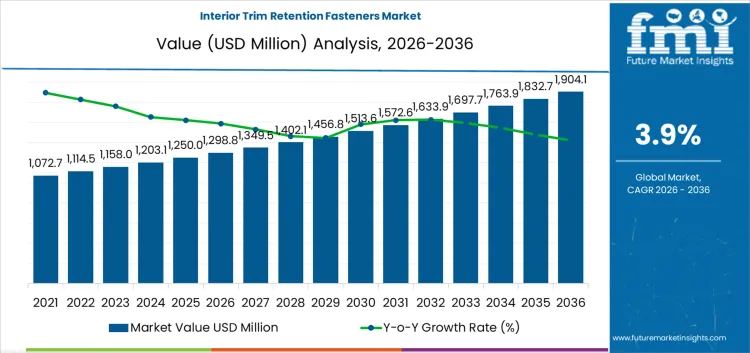
Interior Trim Retention Fasteners Market Key Takeaways
| Metric | Value |
|---|---|
| Market Value (2026) | USD 1,298.8 million |
| Market Forecast Value (2036) | USD 1,904.1 million |
| Forecast CAGR 2026 to 2036 | 3.9% |
Why is the Demand for Interior Trim Retention Fasteners Growing?
Demand for interior trim retention fasteners is rising as vehicle manufacturers and automotive suppliers prioritize consistent fit, finish, and assembly efficiency in cabin components. Interior trim panels, consoles, and garnish elements require fasteners that secure attachments while accommodating repeated service and occupant load without loosening or damaging materials. Engineers specify fasteners with precise dimensional control, material compatibility, and adequate holding strength because poor retention can lead to noise, rattles, or premature wear that affects perceived quality. Procurement teams assess material grade, surface treatment, and manufacturing consistency to ensure parts meet stringent assembly tolerances and support repeatable installation processes on high volume production lines.
Vehicle designers also consider ease of service removal and replacement during maintenance, and interior trim fasteners with predictable engagement and release characteristics support that requirement. Expansion of vehicle model variants and customization options reinforces uptake of diverse fastener designs tailored to specific materials such as composites, plastics, and lightweight alloys used in modern cabins. OEMs coordinate with fastener suppliers to validate performance under thermal cycling and vibration conditions representative of real world use. Service facilities require inventory of certified retention fasteners that match engineering specifications to maintain interior quality during repairs. These technical and operational considerations support sustained demand for interior trim retention fasteners in evolving mobility segments.
How Are the Segments Classified in the Interior Trim Retention Fasteners Market?
Demand for interior trim retention fasteners is shaped by cabin fit quality expectations, assembly efficiency requirements, and long-term retention reliability. Interior components require secure fastening to prevent noise, vibration, and visible misalignment during vehicle operation. Adoption aligns with increasing interior feature density and modular trim architectures. Fastener selection prioritizes ease of installation, removal capability, and material compatibility with trim substrates. Segment classification reflects differentiation by fastener design, material composition, and interior installation area. Structure highlights how retention mechanism, polymer or metal choice, and trim location influence specification preferences, installation frequency, and utilization patterns across vehicle interiors.
Which Fastener Type Represents the Largest Share of Demand?
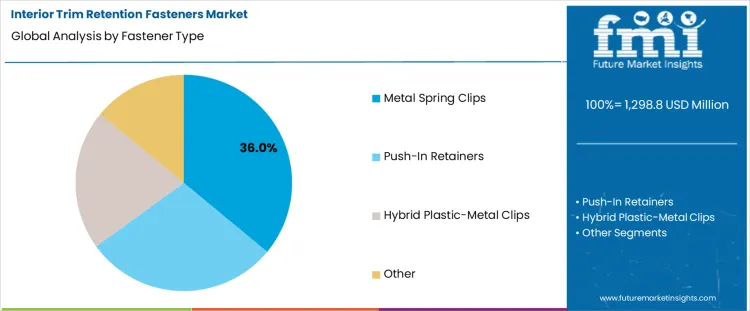
Metal spring clips hold 36.0%, representing the largest share among fastener types due to strong retention force and repeatable engagement. These clips provide consistent clamping across varying panel thickness and tolerance conditions. Resistance to loosening under vibration supports noise control and long-term trim stability. Installation speed aligns with high-volume interior assembly processes. Push-in retainers support quick assembly with lower retention force. Hybrid plastic-metal clips balance strength and flexibility for sensitive trim materials. Fastener type segmentation reflects preference for resilient, reusable solutions delivering reliable trim retention under repeated thermal and vibration exposure.
Key Points
- Metal spring clips provide strong and repeatable retention.
- Vibration resistance supports interior noise control.
- Other fasteners address ease of assembly or material sensitivity.
Which Material Accounts for the Highest Share of Demand?
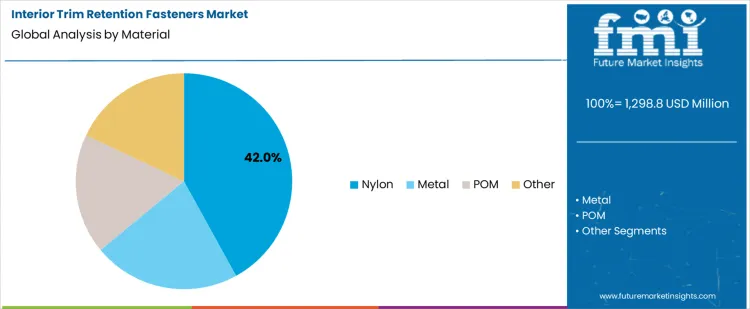
Nylon holds 42.0%, representing the largest share among materials used for interior trim fasteners. Nylon offers flexibility, fatigue resistance, and compatibility with interior plastics. Low weight supports mass reduction objectives while maintaining adequate retention strength. Moldability enables complex clip geometries supporting snap-fit designs. Metal fasteners provide higher stiffness with added weight and corrosion considerations. POM offers dimensional stability with lower flexibility. Material segmentation reflects preference for polymer-based solutions balancing durability, assembly performance, and compatibility with decorative interior surfaces.
Key Points
- Nylon delivers flexibility and fatigue resistance.
- Lightweight properties support interior mass reduction.
- Other materials address stiffness or dimensional stability needs.
Which Interior Area Drives the Largest Share of Demand?
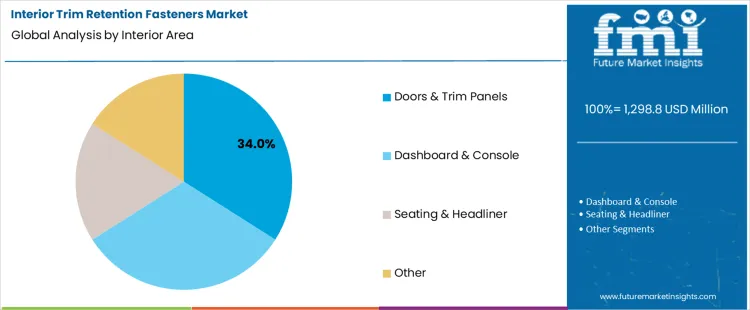
Doors and trim panels hold 34.0%, representing the largest share among interior areas using retention fasteners. These panels require multiple fastening points to maintain alignment and prevent rattling. Frequent door operation increases vibration and stress exposure. Fastener reliability directly affects perceived build quality and acoustic comfort. Dashboard and console areas require secure fastening with tighter visual tolerances. Seating and headliner applications operate under lower cycle intensity. Interior area segmentation reflects concentration of fastening demand where panel count, movement, and vibration exposure remain highest within the vehicle cabin.
Key Points
- Door panels require numerous secure retention points.
- Vibration exposure increases retention reliability needs.
- Other areas prioritize visual alignment and stability.
What are the Key Dynamics in the Interior Trim Retention Fasteners Market?
Demand for interior trim retention fasteners reflects assembly requirements for securing non-structural interior components within vehicle cabins. Adoption spans passenger vehicles, commercial vehicles, and electric platforms using modular interior architectures. Global scope aligns with interior quality expectations, assembly efficiency targets, and serviceability considerations. Usage centers on clips, push-in retainers, snap fasteners, and integrated retention features designed for repeatable installation and noise control.
How do interior modularity and assembly efficiency requirements shape adoption?
Vehicle interiors rely on numerous trim panels, consoles, pillars, and liners requiring secure yet removable attachment. Demand increases as OEMs adopt modular interiors to simplify assembly sequencing and reduce build time. Retention fasteners enable rapid tool-free or low-torque installation on production lines. Consistent retention force supports flush fit and gap control, influencing perceived interior quality. Electric vehicle platforms increase interior component density due to packaging freedom, raising fastener count per vehicle. Noise and rattle prevention depends on retention design and material damping characteristics. Adoption reflects manufacturing need for speed, repeatability, and cosmetic stability rather than structural performance.
How do material selection, durability limits, and cost pressure influence market scalability?
Interior fasteners face cost sensitivity due to high volume usage and limited functional differentiation. Demand sensitivity rises where price targets restrict use of advanced polymers or reinforced designs. Material creep and fatigue affect long-term retention under temperature cycling. Repeated service removal reduces retention force, influencing warranty outcomes. Color, finish, and odor requirements increase material qualification complexity. Platform-specific trim geometry limits fastener standardization. Supply chain dependence on injection molding capacity affects availability. Quality variation directly impacts squeak and rattle issues, constraining aggressive cost optimization.
How Is Demand for Interior Trim Retention Fasteners Evolving Globally?
Demand for interior trim retention fasteners is expanding globally due to rising vehicle production, cabin quality expectations, and maintenance-led replacement across passenger and commercial fleets. Usage aligns with secure fixation of panels, noise reduction, and durability under thermal cycling and vibration. OEMs prioritize fasteners enabling quick assembly, consistent fit, and damage-free serviceability. Electrification and infotainment growth increase interior component density, raising fastening points per vehicle. Growth rates in India at 4.9%, Vietnam at 4.8%, China at 4.6%, Mexico at 4.3%, and Thailand at 4.1% indicate steady expansion driven by interior content growth, assembly efficiency targets, and lifecycle servicing needs.
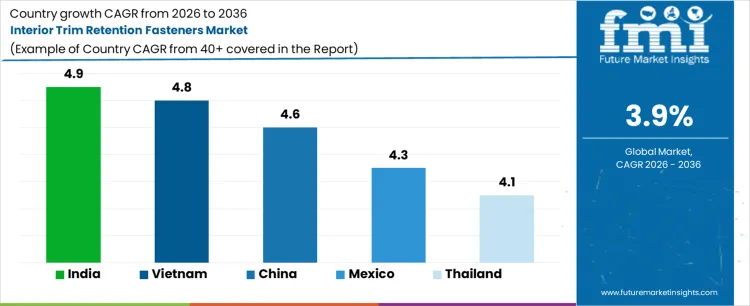
| Country | CAGR (%) |
|---|---|
| India | 4.9% |
| Vietnam | 4.8% |
| China | 4.6% |
| Mexico | 4.3% |
| Thailand | 4.1% |
What Is Driving Interior Trim Fastener Demand Growth in India?
India is growing at a CAGR of 4.9%, supported by rising vehicle production and interior feature upgrades. Compact SUVs and passenger cars adopt higher trim content, increasing clip and fastener counts. High temperature variation influences material selection for retention strength and creep resistance. OEMs emphasize assembly speed and cost efficiency, favoring standardized plastic fasteners. Expanding service networks increase replacement demand during interior repairs. Growth reflects interior value enhancement and production scale rather than luxury segment expansion.
- Rising interior content in mass-market vehicles
- Temperature variation affecting material performance
- Assembly speed and cost efficiency priorities
- Service-led replacement during interior repairs
Why Is Vietnam Showing Accelerated Expansion in Trim Fastener Demand?
Interior trim retention fastener demand in Vietnam is expanding at a CAGR of 4.8%, driven by growth in vehicle assembly and supplier localization. New manufacturing programs adopt modern interior architectures with modular panels. OEMs prefer fasteners enabling quick installation and consistent fit. Climate conditions influence adoption of corrosion-resistant and heat-stable materials. Export-oriented production aligns specifications with global standards. Demand growth reflects manufacturing base expansion and localization depth rather than domestic vehicle parc growth.
- Expansion of vehicle assembly operations
- Modular interior panel architectures adoption
- Climate-driven material performance requirements
- Export-aligned interior quality standards
How Is China Sustaining Demand for Interior Trim Retention Fasteners?
China is growing at a CAGR of 4.6%, supported by high vehicle production volumes and interior feature density. Infotainment screens, ambient lighting, and integrated consoles increase fastening points. OEMs standardize fasteners to support high-speed automated assembly. Electrified vehicles emphasize quiet cabins, raising importance of secure trim retention. Large domestic supplier base supports scale and cost control. Demand growth reflects interior system complexity and production intensity rather than vehicle population expansion.
- High interior feature density per vehicle
- Automated assembly requiring standardized fasteners
- Noise reduction focus in electrified vehicles
- Strong domestic supplier scale advantages
What Factors Are Shaping Interior Trim Fastener Demand in Mexico?
Interior trim retention fastener demand in Mexico is expanding at a CAGR of 4.3%, influenced by export-oriented vehicle manufacturing. Assembly plants follow global OEM interior quality and fit standards. Fasteners support repeatable installation across high-volume platforms. Interior module outsourcing increases need for standardized retention solutions. Consistent production volumes sustain predictable OEM demand. Growth reflects export platform continuity and supplier integration rather than changes in domestic consumer preference.
- Export-focused vehicle assembly operations
- Global OEM interior fit and finish standards
- Modular interior component sourcing
- Predictable demand from stable production volumes
Why Is Thailand Experiencing Steady Growth in Interior Trim Fasteners?
Interior trim retention fastener demand in Thailand is growing at a CAGR of 4.1%, shaped by regional manufacturing hubs and climate exposure. Passenger cars and pickup trucks sustain steady interior component volumes. Heat and humidity influence material durability and retention force requirements. OEMs prioritize serviceability and reduced squeak and rattle performance. Preventive replacement occurs during interior repairs and refurbishments. Growth remains steady, reflecting manufacturing continuity and maintenance needs rather than rapid interior redesign.
- Passenger car and pickup production volumes
- Heat and humidity affecting retention materials
- Focus on squeak and rattle reduction
- Maintenance-driven replacement during refurbishments
What is the competitive landscape of demand for the interior trim retention fasteners market globally?
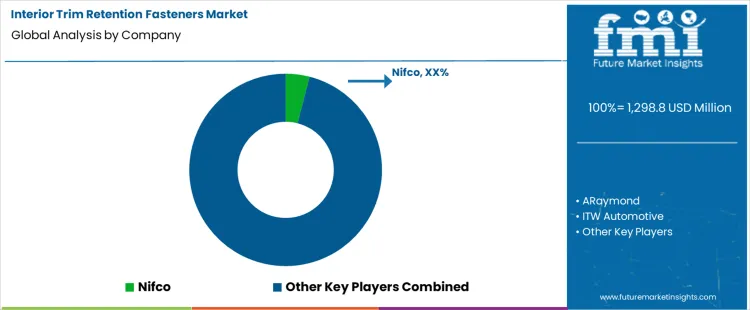
Demand for interior trim retention fasteners is driven by vehicle production growth and increasing complexity of interior assemblies that require secure, lightweight, and repeatable attachment solutions. These fasteners are used in door panels, dashboards, consoles, headliners, and trim modules to provide reliable fit, rattle-free performance, and ease of assembly. Buyers evaluate retention force, material durability, corrosion resistance, compatibility with plastics and composites, and installation method suitability for automated or manual assembly. Procurement teams prioritize suppliers with proven OEM qualifications, global manufacturing footprint, quality certifications, and capability to support diverse vehicle platforms. Trend in the global market reflects greater use of soft-touch and multi-material interiors, NVH performance requirements, and tightening of interior component tolerances.
Nifco holds leading positioning through a broad portfolio of interior trim retention clips, fasteners, and modular attachment solutions widely adopted by global OEMs supported by strong engineering and application support. ARaymond supports demand with innovative fastening systems and assembly solutions optimized for interior trim retention with secure engagement and ease of installation. ITW Automotive contributes retention fasteners and joined solutions aligned with automated production lines and assembly efficiency goals. KSS Automotive supplies clip and fastener systems tailored for interior applications with emphasis on retention consistency and material compatibility. Essentra Components participates with diversified retention hardware and fastener technologies used across automotive interior assemblies. Competitive differentiation depends on retention reliability, material performance, ease of assembly, and ability to meet stringent OEM specifications across vehicle segments.
Key Players in the Interior Trim Retention Fasteners Market
- Nifco
- ARaymond
- ITW Automotive
- KSS Automotive
- Essentra Components
- Heyco
- Stanley Engineered Fastening
- Bossard Group
- Lisi Plastics
- SFS Group
Scope of the Report
| Items | Values |
|---|---|
| Quantitative Units | USD million |
| Fastener Type | Metal Spring Clips; Push-In Retainers; Hybrid Plastic-Metal Clips; Other |
| Material | Nylon; Metal; POM; Other |
| Interior Area | Doors & Trim Panels; Dashboard & Console; Seating & Headliner; Other |
| Sales Channel | Tier-1 Interior Modules; OEM Direct; Aftermarket; Other |
| Regions Covered | Asia Pacific, Europe, North America, Latin America, Middle East & Africa |
| Countries Covered | India, Vietnam, China, Mexico, Thailand, and 40+ countries |
| Key Companies Profiled | Nifco; ARaymond; ITW Automotive; KSS Automotive; Essentra Components; Heyco; Stanley Engineered Fastening; Bossard Group; Lisi Plastics; SFS Group |
| Additional Attributes | Dollar sales by fastener type and interior area; adoption trends for push-in and hybrid clips enabling faster assembly and squeak-and-rattle reduction; retention force consistency, insertion effort, and fatigue performance metrics; material durability, creep resistance, and temperature stability considerations; compatibility with mixed substrates and decorative surfaces; assembly automation readiness and reworkability; aftermarket replacement linked to trim removal frequency; compliance with OEM interior NVH targets, fit-and-finish standards, and recyclability requirements influencing trim retention fastener selection. |
Interior Trim Retention Fasteners Market by Segment
Fastener Type:
- Metal Spring Clips
- Push-In Retainers
- Hybrid Plastic-Metal Clips
- Other
Material:
- Nylon
- Metal
- POM
- Other
Interior Area:
- Doors & Trim Panels
- Dashboard & Console
- Seating & Headliner
- Other
Sales Channel:
- Tier-1 Interior Modules
- OEM Direct
- Aftermarket
- Other
Region:
- Asia Pacific
- China
- Japan
- South Korea
- India
- Australia & New Zealand
- ASEAN
- Rest of Asia Pacific
- Europe
- Germany
- United Kingdom
- France
- Italy
- Spain
- Nordic
- BENELUX
- Rest of Europe
- North America
- United States
- Canada
- Mexico
- Latin America
- Brazil
- Chile
- Rest of Latin America
- Middle East & Africa
- Kingdom of Saudi Arabia
- Other GCC Countries
- Turkey
- South Africa
- Other African Union
- Rest of Middle East & Africa
Bibliography
- European Commission. (2023). Regulation (EU) 2019/2144 on type-approval requirements for motor vehicles and their components, including interior fittings, occupant safety, and durability of non-structural interior attachment systems (consolidated version with staged application in force during 2023). Official Journal of the European Union.
- European Commission. (2024). Commission Implementing Regulation (EU) 2023/2591 establishing detailed technical provisions for vehicle safety and durability, including interior component retention, vibration resistance, and serviceability requirements (applicable from 2024). Official Journal of the European Union.
- United Nations Economic Commission for Europe. (2023). UNECE Regulation No. 21: Uniform provisions concerning the approval of vehicles with regard to interior fittings, including retention integrity of trim components under normal use and impact conditions (consolidated text incorporating amendments in force during 2023). United Nations.
- United Nations Economic Commission for Europe. (2024). UNECE Regulation No. 12: Steering mechanism and interior component interaction requirements, including interior trim attachment behavior during collision events (latest amendments applicable from 2024). United Nations.
- International Organization for Standardization. (2023). ISO 6603-2: Plastics-Determination of puncture impact behaviour-Instrumented impact testing (current edition referenced for validation of interior trim retention and clip performance). International Organization for Standardization.
Frequently Asked Questions
How big is the interior trim retention fasteners market in 2026?
The global interior trim retention fasteners market is estimated to be valued at USD 1,298.8 million in 2026.
What will be the size of interior trim retention fasteners market in 2036?
The market size for the interior trim retention fasteners market is projected to reach USD 1,904.1 million by 2036.
How much will be the interior trim retention fasteners market growth between 2026 and 2036?
The interior trim retention fasteners market is expected to grow at a 3.9% CAGR between 2026 and 2036.
What are the key product types in the interior trim retention fasteners market?
The key product types in interior trim retention fasteners market are metal spring clips, push-in retainers, hybrid plastic-metal clips and other.
Which material segment to contribute significant share in the interior trim retention fasteners market in 2026?
In terms of material, nylon segment to command 42.0% share in the interior trim retention fasteners market in 2026.
Preview the report firsthand - request a free sample
Get SampleGet the brochure for pricing and purchase details.
Get PDFTable of Content
- Executive Summary
- Global Market Outlook
- Demand-side Trends
- Supply-side Trends
- Technology Roadmap Analysis
- Analysis and Recommendations
- Market Overview
- Market Coverage / Taxonomy
- Market Definition / Scope / Limitations
- Market Background
- Market Dynamics
- Drivers
- Restraints
- Opportunity
- Trends
- Scenario Forecast
- Demand in Optimistic Scenario
- Demand in Likely Scenario
- Demand in Conservative Scenario
- Opportunity Map Analysis
- Product Life Cycle Analysis
- Supply Chain Analysis
- Investment Feasibility Matrix
- Value Chain Analysis
- PESTLE and Porter’s Analysis
- Regulatory Landscape
- Regional Parent Market Outlook
- Production and Consumption Statistics
- Import and Export Statistics
- Market Dynamics
- Global Market Analysis 2021 to 2025 and Forecast, 2026 to 2036
- Historical Market Size Value (USD Million) Analysis, 2021 to 2025
- Current and Future Market Size Value (USD Million) Projections, 2026 to 2036
- Y-o-Y Growth Trend Analysis
- Absolute $ Opportunity Analysis
- Global Market Pricing Analysis 2021 to 2025 and Forecast 2026 to 2036
- Global Market Analysis 2021 to 2025 and Forecast 2026 to 2036, By Fastener Type
- Introduction / Key Findings
- Historical Market Size Value (USD Million) Analysis By Fastener Type , 2021 to 2025
- Current and Future Market Size Value (USD Million) Analysis and Forecast By Fastener Type , 2026 to 2036
- Metal Spring Clips
- Push-In Retainers
- Hybrid Plastic-Metal Clips
- Other
- Metal Spring Clips
- Y-o-Y Growth Trend Analysis By Fastener Type , 2021 to 2025
- Absolute $ Opportunity Analysis By Fastener Type , 2026 to 2036
- Global Market Analysis 2021 to 2025 and Forecast 2026 to 2036, By Material
- Introduction / Key Findings
- Historical Market Size Value (USD Million) Analysis By Material, 2021 to 2025
- Current and Future Market Size Value (USD Million) Analysis and Forecast By Material, 2026 to 2036
- Nylon
- Metal
- POM
- Other
- Nylon
- Y-o-Y Growth Trend Analysis By Material, 2021 to 2025
- Absolute $ Opportunity Analysis By Material, 2026 to 2036
- Global Market Analysis 2021 to 2025 and Forecast 2026 to 2036, By Interior Area
- Introduction / Key Findings
- Historical Market Size Value (USD Million) Analysis By Interior Area, 2021 to 2025
- Current and Future Market Size Value (USD Million) Analysis and Forecast By Interior Area, 2026 to 2036
- Doors & Trim Panels
- Dashboard & Console
- Seating & Headliner
- Other
- Doors & Trim Panels
- Y-o-Y Growth Trend Analysis By Interior Area, 2021 to 2025
- Absolute $ Opportunity Analysis By Interior Area, 2026 to 2036
- Global Market Analysis 2021 to 2025 and Forecast 2026 to 2036, By Sales Channel
- Introduction / Key Findings
- Historical Market Size Value (USD Million) Analysis By Sales Channel, 2021 to 2025
- Current and Future Market Size Value (USD Million) Analysis and Forecast By Sales Channel, 2026 to 2036
- Tier-1 Interior Modules
- OEM Direct
- Aftermarket
- Other
- Tier-1 Interior Modules
- Y-o-Y Growth Trend Analysis By Sales Channel, 2021 to 2025
- Absolute $ Opportunity Analysis By Sales Channel, 2026 to 2036
- Global Market Analysis 2021 to 2025 and Forecast 2026 to 2036, By Region
- Introduction
- Historical Market Size Value (USD Million) Analysis By Region, 2021 to 2025
- Current Market Size Value (USD Million) Analysis and Forecast By Region, 2026 to 2036
- North America
- Latin America
- Western Europe
- Eastern Europe
- East Asia
- South Asia and Pacific
- Middle East & Africa
- Market Attractiveness Analysis By Region
- North America Market Analysis 2021 to 2025 and Forecast 2026 to 2036, By Country
- Historical Market Size Value (USD Million) Trend Analysis By Market Taxonomy, 2021 to 2025
- Market Size Value (USD Million) Forecast By Market Taxonomy, 2026 to 2036
- By Country
- USA
- Canada
- Mexico
- By Fastener Type
- By Material
- By Interior Area
- By Sales Channel
- By Country
- Market Attractiveness Analysis
- By Country
- By Fastener Type
- By Material
- By Interior Area
- By Sales Channel
- Key Takeaways
- Latin America Market Analysis 2021 to 2025 and Forecast 2026 to 2036, By Country
- Historical Market Size Value (USD Million) Trend Analysis By Market Taxonomy, 2021 to 2025
- Market Size Value (USD Million) Forecast By Market Taxonomy, 2026 to 2036
- By Country
- Brazil
- Chile
- Rest of Latin America
- By Fastener Type
- By Material
- By Interior Area
- By Sales Channel
- By Country
- Market Attractiveness Analysis
- By Country
- By Fastener Type
- By Material
- By Interior Area
- By Sales Channel
- Key Takeaways
- Western Europe Market Analysis 2021 to 2025 and Forecast 2026 to 2036, By Country
- Historical Market Size Value (USD Million) Trend Analysis By Market Taxonomy, 2021 to 2025
- Market Size Value (USD Million) Forecast By Market Taxonomy, 2026 to 2036
- By Country
- Germany
- UK
- Italy
- Spain
- France
- Nordic
- BENELUX
- Rest of Western Europe
- By Fastener Type
- By Material
- By Interior Area
- By Sales Channel
- By Country
- Market Attractiveness Analysis
- By Country
- By Fastener Type
- By Material
- By Interior Area
- By Sales Channel
- Key Takeaways
- Eastern Europe Market Analysis 2021 to 2025 and Forecast 2026 to 2036, By Country
- Historical Market Size Value (USD Million) Trend Analysis By Market Taxonomy, 2021 to 2025
- Market Size Value (USD Million) Forecast By Market Taxonomy, 2026 to 2036
- By Country
- Russia
- Poland
- Hungary
- Balkan & Baltic
- Rest of Eastern Europe
- By Fastener Type
- By Material
- By Interior Area
- By Sales Channel
- By Country
- Market Attractiveness Analysis
- By Country
- By Fastener Type
- By Material
- By Interior Area
- By Sales Channel
- Key Takeaways
- East Asia Market Analysis 2021 to 2025 and Forecast 2026 to 2036, By Country
- Historical Market Size Value (USD Million) Trend Analysis By Market Taxonomy, 2021 to 2025
- Market Size Value (USD Million) Forecast By Market Taxonomy, 2026 to 2036
- By Country
- China
- Japan
- South Korea
- By Fastener Type
- By Material
- By Interior Area
- By Sales Channel
- By Country
- Market Attractiveness Analysis
- By Country
- By Fastener Type
- By Material
- By Interior Area
- By Sales Channel
- Key Takeaways
- South Asia and Pacific Market Analysis 2021 to 2025 and Forecast 2026 to 2036, By Country
- Historical Market Size Value (USD Million) Trend Analysis By Market Taxonomy, 2021 to 2025
- Market Size Value (USD Million) Forecast By Market Taxonomy, 2026 to 2036
- By Country
- India
- ASEAN
- Australia & New Zealand
- Rest of South Asia and Pacific
- By Fastener Type
- By Material
- By Interior Area
- By Sales Channel
- By Country
- Market Attractiveness Analysis
- By Country
- By Fastener Type
- By Material
- By Interior Area
- By Sales Channel
- Key Takeaways
- Middle East & Africa Market Analysis 2021 to 2025 and Forecast 2026 to 2036, By Country
- Historical Market Size Value (USD Million) Trend Analysis By Market Taxonomy, 2021 to 2025
- Market Size Value (USD Million) Forecast By Market Taxonomy, 2026 to 2036
- By Country
- Kingdom of Saudi Arabia
- Other GCC Countries
- Turkiye
- South Africa
- Other African Union
- Rest of Middle East & Africa
- By Fastener Type
- By Material
- By Interior Area
- By Sales Channel
- By Country
- Market Attractiveness Analysis
- By Country
- By Fastener Type
- By Material
- By Interior Area
- By Sales Channel
- Key Takeaways
- Key Countries Market Analysis
- USA
- Pricing Analysis
- Market Share Analysis, 2025
- By Fastener Type
- By Material
- By Interior Area
- By Sales Channel
- Canada
- Pricing Analysis
- Market Share Analysis, 2025
- By Fastener Type
- By Material
- By Interior Area
- By Sales Channel
- Mexico
- Pricing Analysis
- Market Share Analysis, 2025
- By Fastener Type
- By Material
- By Interior Area
- By Sales Channel
- Brazil
- Pricing Analysis
- Market Share Analysis, 2025
- By Fastener Type
- By Material
- By Interior Area
- By Sales Channel
- Chile
- Pricing Analysis
- Market Share Analysis, 2025
- By Fastener Type
- By Material
- By Interior Area
- By Sales Channel
- Germany
- Pricing Analysis
- Market Share Analysis, 2025
- By Fastener Type
- By Material
- By Interior Area
- By Sales Channel
- UK
- Pricing Analysis
- Market Share Analysis, 2025
- By Fastener Type
- By Material
- By Interior Area
- By Sales Channel
- Italy
- Pricing Analysis
- Market Share Analysis, 2025
- By Fastener Type
- By Material
- By Interior Area
- By Sales Channel
- Spain
- Pricing Analysis
- Market Share Analysis, 2025
- By Fastener Type
- By Material
- By Interior Area
- By Sales Channel
- France
- Pricing Analysis
- Market Share Analysis, 2025
- By Fastener Type
- By Material
- By Interior Area
- By Sales Channel
- India
- Pricing Analysis
- Market Share Analysis, 2025
- By Fastener Type
- By Material
- By Interior Area
- By Sales Channel
- ASEAN
- Pricing Analysis
- Market Share Analysis, 2025
- By Fastener Type
- By Material
- By Interior Area
- By Sales Channel
- Australia & New Zealand
- Pricing Analysis
- Market Share Analysis, 2025
- By Fastener Type
- By Material
- By Interior Area
- By Sales Channel
- China
- Pricing Analysis
- Market Share Analysis, 2025
- By Fastener Type
- By Material
- By Interior Area
- By Sales Channel
- Japan
- Pricing Analysis
- Market Share Analysis, 2025
- By Fastener Type
- By Material
- By Interior Area
- By Sales Channel
- South Korea
- Pricing Analysis
- Market Share Analysis, 2025
- By Fastener Type
- By Material
- By Interior Area
- By Sales Channel
- Russia
- Pricing Analysis
- Market Share Analysis, 2025
- By Fastener Type
- By Material
- By Interior Area
- By Sales Channel
- Poland
- Pricing Analysis
- Market Share Analysis, 2025
- By Fastener Type
- By Material
- By Interior Area
- By Sales Channel
- Hungary
- Pricing Analysis
- Market Share Analysis, 2025
- By Fastener Type
- By Material
- By Interior Area
- By Sales Channel
- Kingdom of Saudi Arabia
- Pricing Analysis
- Market Share Analysis, 2025
- By Fastener Type
- By Material
- By Interior Area
- By Sales Channel
- Turkiye
- Pricing Analysis
- Market Share Analysis, 2025
- By Fastener Type
- By Material
- By Interior Area
- By Sales Channel
- South Africa
- Pricing Analysis
- Market Share Analysis, 2025
- By Fastener Type
- By Material
- By Interior Area
- By Sales Channel
- USA
- Market Structure Analysis
- Competition Dashboard
- Competition Benchmarking
- Market Share Analysis of Top Players
- By Regional
- By Fastener Type
- By Material
- By Interior Area
- By Sales Channel
- Competition Analysis
- Competition Deep Dive
- Nifco
- Overview
- Product Portfolio
- Profitability by Market Segments (Product/Age /Sales Channel/Region)
- Sales Footprint
- Strategy Overview
- Marketing Strategy
- Product Strategy
- Channel Strategy
- ARaymond
- ITW Automotive
- KSS Automotive
- Essentra Components
- Heyco
- Stanley Engineered Fastening
- Bossard Group
- Lisi Plastics
- SFS Group
- Nifco
- Competition Deep Dive
- Assumptions & Acronyms Used
- Research Methodology


