

- Market Size (2026)
- USD 2.9 Bn
- Forecast (2036)
- USD 10.8 Bn
- CAGR (2026 to 2036)
- 14.1%
How big is the goods-to-person robots market in 2026?
USD 2.9 billion in 2026 and USD 10.8 billion by 2036 at a 14.1% CAGR.
The goods-to-person robots market is expected to grow from USD 2.5 billion in 2025 to USD 10.8 billion by 2036 at 14.1% CAGR. Fulfillment operators are shifting order picking away from long walking routes toward robot-supported movement between storage and stations. Autonomous Mobile Robots are forecast to represent 42.0% share in 2026. Brownfield Retrofit is expected to secure 61.0% share in 2026 due to demand from active warehouses that need automation without full rebuilds.
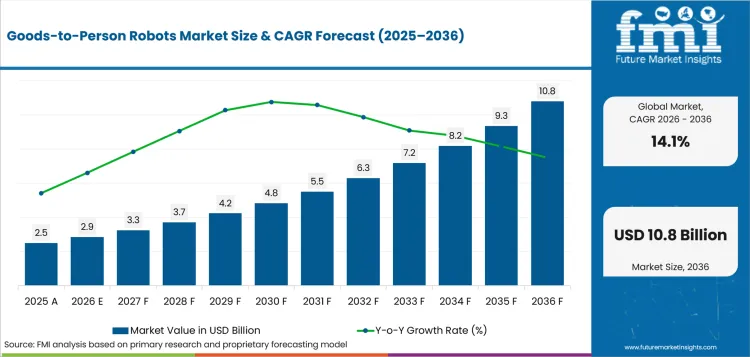
| Metric | Value |
|---|---|
| 2026 Market Size | USD 2.9 billion |
| 2036 Market Size | USD 10.8 billion |
| Forecast CAGR (2026-2036) | 14.1% |
| Leading Robot Type | Autonomous Mobile Robots |
| Autonomous Mobile Robots Share (2026) | 42.0% |
| Leading Deployment | Brownfield Retrofit |
| Brownfield Retrofit Share (2026) | 61.0% |
| Fastest-growing Country | India |
| India CAGR by 2036 | 16.2% |
Summary of Goods-to-Person Robots Market
| Market Signal | Commercial Impact |
|---|---|
| Demand and Growth Drivers | Demand for goods-to-person robots is increasing as fulfillment centers scale order volumes and seek to reduce picker walking time while maintaining consistent throughput.
|
| Product and Segment View | Autonomous Mobile Robots, 50-250 kg payload, e-commerce fulfillment, and brownfield retrofit deployments lead their respective market segments.
|
| Geography and Growth Outlook | Asia continues to lead market expansion while North America strengthens adoption through advanced logistics automation.
|
| Competitive Landscape | Competition increasingly focuses on fleet scalability, software integration, and warehouse productivity.
|
| Analyst Perspective | Goods-to-person robots are becoming a strategic operational investment as fulfillment providers prioritize automation, reliability, and software connectivity.
- Nikhil Kaitwade, Principal Consultant at Future Market Insights |
Automation evidence supports this forecast. IFR reported that 542,000 industrial robots were installed worldwide in 2024. Operational robot stock reached 4.664 million units in the same year. Goods-to-person systems are part of this wider automation stack. Buyers compare pick rate and software control before they commit to fleet purchases.
Which factors support expansion in the goods-to-person robots market?
Robot fleets raise market value by reducing worker travel and improving pick station productivity.
- System revenue is supported by fleet hardware and orchestration software sold within the same project.
- Buyer access is widened by Robot-as-a-Service models that reduce early capital exposure for seasonal sites.
- Application volume is added by returns handling and store replenishment workflows inside retail distribution centers.
- Adoption barriers are reduced when AMRs fit current aisles and avoid large fixed infrastructure changes.
- Integration risk remains the trade-off when warehouse software cannot assign tasks cleanly to robot fleets.
Why is the goods-to-person robots market growing?
Fulfillment centers are adopting goods-to-person systems to cut walking time and protect pick accuracy. E-commerce orders have smaller baskets and more returns, which raises station workload. In the United States, the Census Bureau reported first-quarter retail e-commerce sales of USD 326.7 billion in 2026. This scale creates demand for systems that bring goods to the worker instead of sending workers through long aisles.
Automation readiness is also widening outside factories. IFR reported 542,000 industrial robot installations in 2024 and a global operational stock of 4.664 million units. This gives warehouse buyers a broader supplier pool and more familiarity with robot service models. The same uptime expectations are now moving into goods-to-person buying decisions.
How is the goods-to-person robots market segmented?
The goods-to-person robots industry is segmented by robot type, payload class, end use, deployment, sales model.
- Autonomous mobile robots are projected to hold 42.0% share in 2026 due to routing flexibility inside active warehouses.
- The 50-250 kg payload class is anticipated to secure 52.0% share in 2026 for tote and shelf movement.
- E-commerce fulfillment is expected to represent 45.0% share in 2026 owing to fast order cycles and return flows.
- Brownfield retrofit is forecast to account for 61.0% share in 2026 with leased warehouses avoiding major rebuilds.
- Capex purchase is estimated to hold 57.0% share in 2026 among large buyers seeking asset control.
Which robot type leads the goods-to-person robots market?
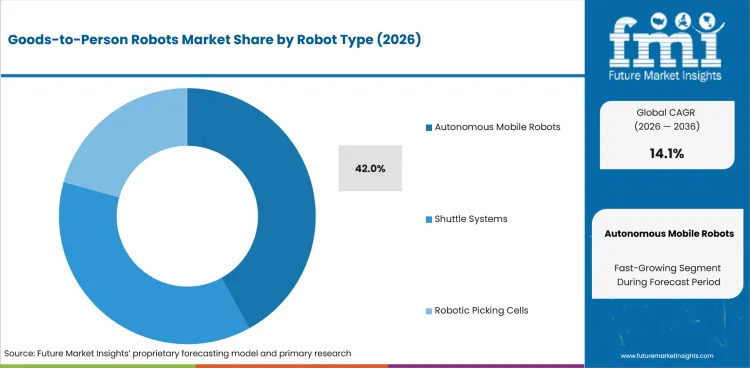
- Autonomous mobile robots are projected to account for 42.0% share in 2026 due to flexible movement across active warehouse floors.
- Shuttle systems remain useful in dense cube storage where structured layouts and high throughput justify fixed storage design.
Which payload class leads the goods-to-person robots market?
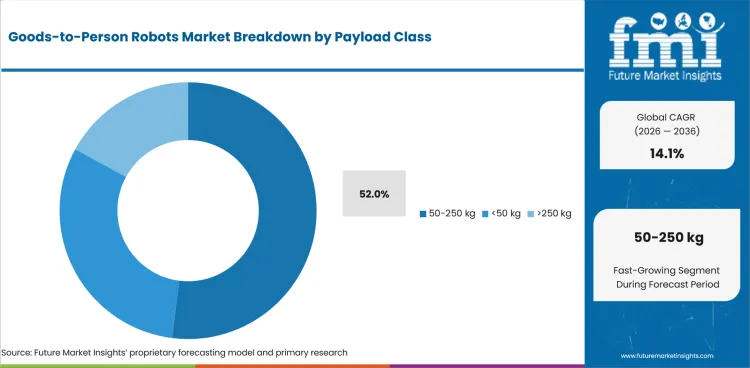
- The 50-250 kg class is expected to represent 52.0% share in 2026 through tote and mobile rack handling.
- Heavy payload systems need stronger floors and wider traffic buffers, which makes approval harder in leased sites.
Which end use leads the goods-to-person robots market?
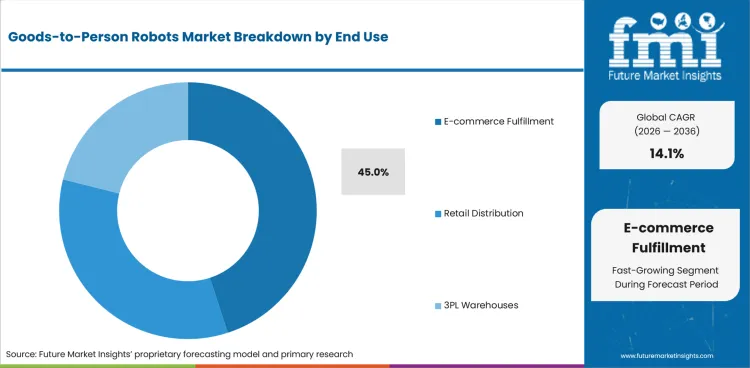
- E-commerce fulfillment is anticipated to account for 45.0% share in 2026 with dense picking and rapid returns workflows.
- Retail distribution gains value when store replenishment requires accurate inventory movement across more frequent order waves.
Which deployment model leads the goods-to-person robots market?
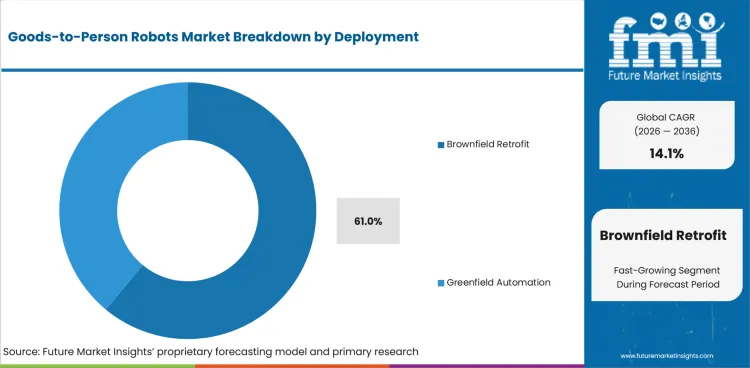
- Brownfield retrofit is forecast to hold 61.0% share in 2026 through phased automation inside active warehouses.
- Greenfield projects remain important when large hubs are designed around robot traffic from the first layout stage.
Which sales model leads the goods-to-person robots market?
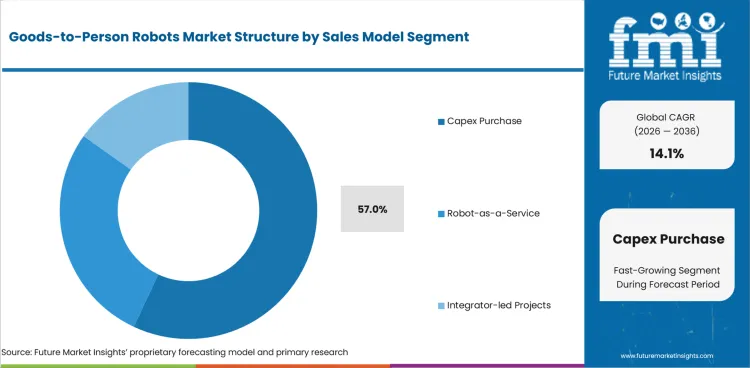
- Capex purchase is projected to secure 57.0% share in 2026 with large enterprises preferring long-term asset control.
- Robot-as-a-Service is anticipated to gain attention in seasonal warehouses when volume changes make fleet size harder to plan.
What factors drive or restrain the goods-to-person robots market?
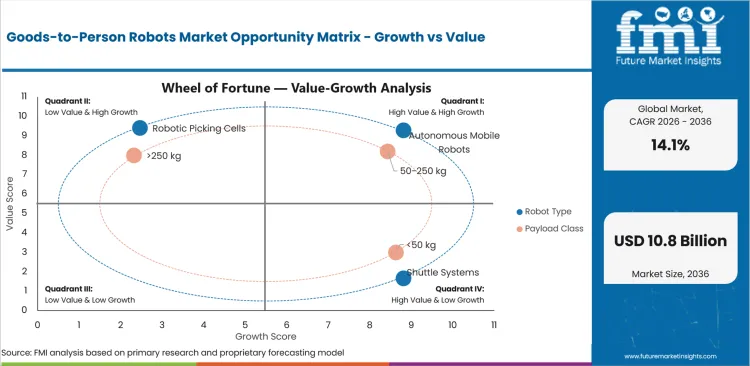
E-commerce pick density and brownfield constraints support demand. Software integration risk still slows large-scale adoption.
- Driver: E-commerce pick density increases robot value by replacing associate travel during order batching.
- Driver: Brownfield warehouse limits favor AMRs that fit current aisles and active facilities.
- Restraint: Integration risk slows orders when warehouse systems cannot share clean task data.
- Opportunity: Robotic picking cells can lift system value when grippers handle mixed-SKU orders more reliably.
Goods-to-Person Robots Market Demand Outlook
Pick station productivity is the first ROI test for buyers comparing robot projects with labor hours saved per order. Locus Robotics reported in April 2025 that its deployments surpassed 5 billion units picked worldwide. That scale gives buyers a practical benchmark for robot fleet use beyond small pilots. Suppliers that keep stations fed during peak waves should gain stronger project approval.
Retrofit Adoption and Purchase Behavior Analysis
Retrofit adoption depends on installation work that does not disrupt live order flow. Kardex said in February 2026 that Cutter & Buck selected it for a second AutoStore project in Texas. The project supports a goods-to-person system at the Grand Prairie site. Buyers value this route when current buildings must keep shipping orders during installation.
Integration Risk and Decision-driver Analysis
Goods-to-person robots fail commercially when warehouse software cannot assign tasks cleanly. Kardex and Paccurate announced in June 2025 that Paccurate cartonization would run through Kardex FulfillX software. That link shows why order planning and packing data must work with goods-to-person stations. Robot hardware alone does not solve task allocation or exception handling.
Which countries are growing fastest in the goods-to-person robots market?
India 16.2% CAGR, China 15.8% CAGR, South Korea 14.6% CAGR, Japan 13.7% CAGR, United States 13.4% CAGR, Germany 13.2% CAGR, United Kingdom 12.8% CAGR, and France 12.6% CAGR through 2036.
.webp "Top Country Growth Comparison Goods To Person Robots Market Cagr (2026 2036)")
| Country | CAGR |
|---|---|
| India | 16.2% |
| China | 15.8% |
| South Korea | 14.6% |
| Japan | 13.7% |
| United States | 13.4% |
| Germany | 13.2% |
| United Kingdom | 12.8% |
| France | 12.6% |
Source: Future Market Insights, 2026.
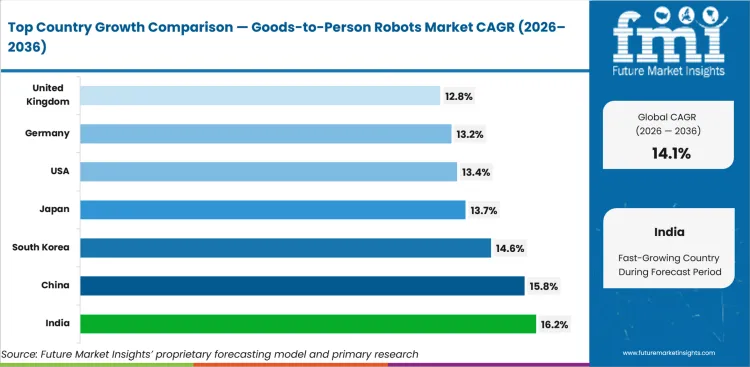
How do country-level CAGRs compare in the goods-to-person robots market?
- India is projected to record 16.2% CAGR by 2036 through logistics parks and export-hub pilots.
- China is forecast to reach 15.8% CAGR by 2036 with online retail scale and local robot supply.
- South Korea is expected to post 14.6% CAGR by 2036 through dense e-commerce and robot familiarity.
- Japan is anticipated to advance at 13.7% CAGR by 2036 due to labor scarcity and compact facilities.
- The United States is estimated to rise at 13.4% CAGR by 2036 through 3PL networks and e-commerce density.
- Germany is forecast to grow at 13.2% CAGR by 2036 with manufacturing logistics and engineering-led demand.
- The United Kingdom is projected to expand at 12.8% CAGR by 2036 through compact retrofit automation.
- France is expected to register 12.6% CAGR by 2036 with e-commerce transactions and local supplier references.
How fast is the goods-to-person robots market growing in India?
A 16.2% CAGR by 2036 reflects logistics modernization and fast e-commerce warehouse buildout.
Country Market Snapshot Table
| Parameter | Value |
|---|---|
| Market Size in 2025 (Value) | USD 154.9 million |
| Market Size in 2026 (Value) | USD 180.0 million |
| Market Forecast in 2036 (Value) | USD 807.9 million |
| CAGR (2026 to 2036) | 16.2% |
| Years Considered | 2021 to 2036 |
| Base Year | 2025 |
| Forecast Period | 2026 to 2036 |
| Units Considered | Value (USD million) |
| Leading Sub-Region | Delhi NCR and western logistics corridors |
India Goods-to-Person Robots Market Outlook
India demand is entering a faster buildout phase through e-commerce warehouses and logistics corridors. Large retailers and 3PLs are expected to be the first buyers with enough volume for robot fleets.
Uneven warehouse readiness is expected to slow adoption outside top sites. Vendors must offer phased installations and clear payback plans.
Key Growth Drivers
- Government-backed export hub pilots are expected to support warehouse automation trials in high-volume logistics zones. PIB reported in August 2025 that five E-Commerce Export Hub pilot projects were proposed for implementation.
- Public funding support is expected to reduce early setup pressure for export-linked warehouse modernization. PIB reported in February 2026 that E-Commerce Export Hub assistance is capped at INR 10 crore or 30% of approved project cost.
- Quick commerce and retail distribution are expected to increase pressure on picking speed within dense urban fulfillment networks.
- Domestic robotics capability is expected to reduce service friction for large Indian buyers during fleet rollout.
Key Restraints
- Logistics cost pressure can limit automation budgets for mid-sized operators that still need transport and storage upgrades. PIB reported India’s logistics cost was estimated at 7.97% of GDP in September 2025.
- Price sensitivity can delay adoption among mid-sized warehouse operators that need faster payback before robot purchases.
- Older warehouses may need floor and software upgrades before goods-to-person robot rollout can begin.
What makes India unique
India stands out for fast demand formation and uneven warehouse readiness across operators.
Key Companies
- GreyOrange
- Addverb
- AutoStore
- Geekplus
- Kardex
Sales & Marketing Channels
- Direct enterprise sales
- Indian systems integrators
- E-commerce logistics procurement
- 3PL framework agreements
- Pilot-to-scale contracts
- Local service partners
Country Segment Breakdown Table
| Segment | Sub-Segments |
|---|---|
| By Robot Type | Autonomous Mobile Robots · Shuttle Systems · Robotic Picking Cells · Hybrid GTP Systems |
| By Payload Class | <50 kg · 50-250 kg · >250 kg |
| By End Use | E-commerce Fulfillment · Retail Distribution · 3PL Warehouses · Manufacturing Logistics |
| By Deployment | Greenfield Automation · Brownfield Retrofit |
| By Sales Model | Robot-as-a-Service · Capex Purchase · Integrator-led Projects |
| Key Sub-Regions Covered | Delhi NCR · Mumbai-Pune · Bengaluru · Hyderabad · Chennai · Ahmedabad |
Frequently Asked Questions
How fast is India goods-to-person robots market growing?
India is projected to grow at 16.2% CAGR from 2026 to 2036.
Who leads India goods-to-person robots market?
GreyOrange and Addverb lead local service support. AutoStore and Geekplus compete through warehouse automation references.
What is driving adoption in India goods-to-person robots market?
E-commerce export hubs and quick-commerce networks are pulling automation toward faster pick cycles. Service access remains central for large buyers.
Why is China a leading growth market for goods-to-person robots?
A 15.8% CAGR by 2036 is backed by e-commerce scale and local robot supply.
Country Market Snapshot Table
| Parameter | Value |
|---|---|
| Market Size in 2025 (Value) | USD 561.3 million |
| Market Size in 2026 (Value) | USD 650.0 million |
| Market Forecast in 2036 (Value) | USD 2,818.4 million |
| CAGR (2026 to 2036) | 15.8% |
| Years Considered | 2021 to 2036 |
| Base Year | 2025 |
| Forecast Period | 2026 to 2036 |
| Units Considered | Value (USD million) |
| Leading Sub-Region | Yangtze River Delta and Pearl River Delta logistics clusters |
China Goods-to-Person Robots Market Outlook
China demand benefits from large online retail activity and a broad domestic robotics supply chain. Local suppliers are expected to test systems quickly across regional fulfillment hubs.
Price competition is expected to keep hardware margins under pressure. Vendors with software depth and service coverage should defend accounts better than hardware-only suppliers.
Key Growth Drivers
- Online retail scale is expected to keep goods-to-person robot demand high across large fulfillment hubs. NBS reported that China’s online retail sales reached RMB 15,972.2 billion in 2025.
- Consumer replacement activity is expected to increase parcel and replenishment pressure across retail warehouses. China’s State Council reported consumer goods trade-in programs benefited 366 million purchases in 2025.
- Large e-commerce platforms are expected to create dense picking and replenishment needs across regional hubs.
- Domestic robot suppliers are expected to support faster customization and service response for warehouse operators.
Key Restraints
- Lower investment activity can make buyers more selective about large automation projects. NBS reported fixed-asset investment excluding rural households fell 3.8% in 2025.
- Hardware price competition can reduce supplier margins and weaken service quality after robot installation.
- Large buyers may demand custom software integration that smaller vendors cannot fund at scale.
What makes China unique
China stands out for local robot supply and e-commerce scale that speed up goods-to-person system trials.
Key Companies
- Geekplus
- AutoStore
- Dematic
- Swisslog
- Hai Robotics
- Quicktron
Sales & Marketing Channels
- Direct platform sales
- Domestic systems integrators
- E-commerce fulfillment procurement
- Manufacturing logistics channels
- Regional service partners
- Software ecosystem partnerships
Country Segment Breakdown Table
| Segment | Sub-Segments |
|---|---|
| By Robot Type | Autonomous Mobile Robots · Shuttle Systems · Robotic Picking Cells · Hybrid GTP Systems |
| By Payload Class | <50 kg · 50-250 kg · >250 kg |
| By End Use | E-commerce Fulfillment · Retail Distribution · 3PL Warehouses · Manufacturing Logistics |
| By Deployment | Greenfield Automation · Brownfield Retrofit |
| By Sales Model | Robot-as-a-Service · Capex Purchase · Integrator-led Projects |
| Key Sub-Regions Covered | Yangtze River Delta · Pearl River Delta · Beijing-Tianjin-Hebei · Chengdu-Chongqing · Wuhan · Xi'an |
Frequently Asked Questions
How fast is China goods-to-person robots market growing?
China is projected to grow at 15.8% CAGR from 2026 to 2036.
Who leads China goods-to-person robots market?
Geekplus and AutoStore compete through local service support. Dematic and Swisslog compete through warehouse automation references.
What is driving adoption in China goods-to-person robots market?
Large online retail platforms and local robot makers are moving pilots into regional fulfillment hubs. Software depth decides supplier selection.
What supports goods-to-person robots adoption in South Korea?
A 14.6% CAGR by 2036 is supported by robot familiarity and urban logistics pressure.
Country Market Snapshot Table
| Parameter | Value |
|---|---|
| Market Size in 2025 (Value) | USD 104.7 million |
| Market Size in 2026 (Value) | USD 120.0 million |
| Market Forecast in 2036 (Value) | USD 468.8 million |
| CAGR (2026 to 2036) | 14.6% |
| Years Considered | 2021 to 2036 |
| Base Year | 2025 |
| Forecast Period | 2026 to 2036 |
| Units Considered | Value (USD million) |
| Leading Sub-Region | Seoul Capital Area and Busan logistics corridors |
South Korea Goods-to-Person Robots Market Outlook
South Korea demand is supported by deep robot familiarity in manufacturing and compact urban logistics. Buyers are expected to screen suppliers for uptime and local spare parts access.
Electronics and cosmetics logistics create high accuracy requirements. Integration quality should remain a main buying filter.
Key Growth Drivers
- Online order volume is expected to support stronger demand for goods-to-person robots in high-density warehouses. Statistics Korea reported online shopping transaction value of KRW 24.1280 trillion in April 2026.
- Export logistics needs are expected to support accurate warehouse movement for parts and finished goods. MOTIR reported Korea’s exports reached USD 709.7 billion in 2025.
- Electronics logistics is expected to require accurate parts movement and controlled warehouse workflows.
- E-commerce platforms are expected to need faster picking and returns handling for urban consumers.
Key Restraints
- Softer retail activity can delay automation decisions for warehouses tied to consumer demand. Statistics Korea reported the retail sales index fell 3.6% month over month in April 2026.
- Compact urban warehouses can limit safe traffic paths for larger robot fleets.
- Foreign suppliers may face buyer hesitation when local service depth is limited.
What makes South Korea unique
South Korea stands out for high robot maturity and tight warehouse space in major logistics corridors.
Key Companies
- AutoStore
- Geekplus
- Dematic
- Swisslog
Sales & Marketing Channels
- Local integrator partnerships
- Direct enterprise sales
- Electronics logistics procurement
- Retail automation channels
- Service partner networks
- Warehouse software integration routes
Country Segment Breakdown Table
| Segment | Sub-Segments |
|---|---|
| By Robot Type | Autonomous Mobile Robots · Shuttle Systems · Robotic Picking Cells · Hybrid GTP Systems |
| By Payload Class | <50 kg · 50-250 kg · >250 kg |
| By End Use | E-commerce Fulfillment · Retail Distribution · 3PL Warehouses · Manufacturing Logistics |
| By Deployment | Greenfield Automation · Brownfield Retrofit |
| By Sales Model | Robot-as-a-Service · Capex Purchase · Integrator-led Projects |
| Key Sub-Regions Covered | Seoul Capital Area · Busan · Incheon · Daegu · Daejeon · Gwangju |
Frequently Asked Questions
How fast is South Korea goods-to-person robots market growing?
South Korea is projected to grow at 14.6% CAGR from 2026 to 2036.
Who leads South Korea goods-to-person robots market?
AutoStore and Geekplus compete through local service support. Dematic and Swisslog compete through warehouse automation references.
What is driving adoption in South Korea goods-to-person robots market?
Urban e-commerce and electronics logistics are pushing warehouses toward accurate goods movement. Local service depth remains a buying filter.
How is the goods-to-person robots market advancing in Japan?
A 13.7% CAGR by 2036 reflects labor scarcity and high expectations for service accuracy.
Country Market Snapshot Table
| Parameter | Value |
|---|---|
| Market Size in 2025 (Value) | USD 215.5 million |
| Market Size in 2026 (Value) | USD 245.0 million |
| Market Forecast in 2036 (Value) | USD 884.6 million |
| CAGR (2026 to 2036) | 13.7% |
| Years Considered | 2021 to 2036 |
| Base Year | 2025 |
| Forecast Period | 2026 to 2036 |
| Units Considered | Value (USD million) |
| Leading Sub-Region | Tokyo-Osaka logistics belt |
Japan Goods-to-Person Robots Market Outlook
Japan demand is shaped by labor scarcity and tightly controlled fulfillment processes. Buyers are expected to value systems that fit small spaces and maintain high picking accuracy.
Manufacturing logistics creates another route for goods-to-person robots. Suppliers with safety documentation and local service capability should be better placed.
Key Growth Drivers
- E-commerce scale is expected to support goods-to-person systems that keep pick accuracy high in compact sites. METI reported Japan’s domestic B-to-C e-commerce market reached 26.1 trillion yen in 2024.
- Household income improvement is expected to support retail demand that feeds warehouse order flow. Statistics Bureau of Japan reported worker-household income rose 2.3% in real terms in April 2026.
- Manufacturing logistics is expected to use robots for parts staging and controlled line feeding.
- Retailers are expected to seek compact systems that support high accuracy in constrained buildings.
Key Restraints
- Weak household spending can reduce retail order growth and slow warehouse automation approval. Statistics Bureau of Japan reported real household spending fell 0.5% in April 2026.
- Compact facilities may limit fleet size and staging space for larger robot systems.
- Buyers often require long proof cycles before scaling automation across multiple sites.
What makes Japan unique
Japan stands out for warehouse robot adoption shaped by precision manufacturing culture and strict service expectations.
Key Companies
- Toyota Advanced Logistics
- Omron
- AutoStore
- Geekplus
- Swisslog
- Daifuku
Sales & Marketing Channels
- Direct OEM channels
- Local robotics distributors
- Factory automation integrators
- Retail logistics procurement
- Maintenance service networks
- Software integration partners
Country Segment Breakdown Table
| Segment | Sub-Segments |
|---|---|
| By Robot Type | Autonomous Mobile Robots · Shuttle Systems · Robotic Picking Cells · Hybrid GTP Systems |
| By Payload Class | <50 kg · 50-250 kg · >250 kg |
| By End Use | E-commerce Fulfillment · Retail Distribution · 3PL Warehouses · Manufacturing Logistics |
| By Deployment | Greenfield Automation · Brownfield Retrofit |
| By Sales Model | Robot-as-a-Service · Capex Purchase · Integrator-led Projects |
| Key Sub-Regions Covered | Tokyo · Osaka · Nagoya · Yokohama · Fukuoka · Sapporo |
Frequently Asked Questions
How fast is Japan goods-to-person robots market growing?
Japan is projected to grow at 13.7% CAGR from 2026 to 2036.
Who leads Japan goods-to-person robots market?
Toyota Advanced Logistics and Omron lead local service support. AutoStore and Geekplus compete through warehouse automation references.
What is driving adoption in Japan goods-to-person robots market?
Labor scarcity and compact warehouse layouts are encouraging goods-to-person systems. Retailers value accurate picking before larger network rollouts.
What is the goods-to-person robots market outlook in the United States?
A 13.4% CAGR during the forecast period reflects e-commerce order density and large 3PL networks.
Country Market Snapshot Table
| Parameter | Value |
|---|---|
| Market Size in 2025 (Value) | USD 692.2 million |
| Market Size in 2026 (Value) | USD 785.0 million |
| Market Forecast in 2036 (Value) | USD 2,760.6 million |
| CAGR (2026 to 2036) | 13.4% |
| Years Considered | 2021 to 2036 |
| Base Year | 2025 |
| Forecast Period | 2026 to 2036 |
| Units Considered | Value (USD million) |
| Leading Sub-Region | South Atlantic and Midwest fulfillment corridors |
United States Goods-to-Person Robots Market Outlook
United States demand is anchored in dense e-commerce order flow and large outsourced fulfillment networks. Buyers are expected to start with high-walking zones before expanding fleets into putaway and returns.
Capital approval is expected to depend on payback proof and field service access. Suppliers with U.S. support teams should retain stronger enterprise accounts.
Key Growth Drivers
- E-commerce order density is expected to keep robot fleets central to pick-station planning. U.S. Census Bureau data reported retail e-commerce sales at USD 326.7 billion in the first quarter of 2026.
- Consumer spending is expected to support retail replenishment and fulfillment activity across large distribution networks. BEA reported personal consumption expenditures increased USD 111.1 billion in April 2026.
- Large 3PL networks are expected to create repeatable rollout opportunities across customer contracts.
- Retailers are expected to use medium-payload robots to reduce travel time in returns-heavy operations.
Key Restraints
- Lower industrial capacity use can make some buyers cautious about new automation commitments. Federal Reserve data reported manufacturing utilization at 75.7% in May 2026.
- Older warehouse software can slow task assignment when inventory data is not clean enough for robot fleets.
- Regional distributors may delay projects when contract volume does not justify system integration work.
What makes United States unique
The United States is different due to large 3PL networks that can repeat one validated robotics design across several nodes.
Key Companies
- Locus Robotics
- Dematic
- AutoStore
- Kardex
- Geekplus
- Exotec
- GreyOrange
Sales & Marketing Channels
- Direct enterprise sales
- Systems integrator partnerships
- 3PL framework agreements
- RaaS contracts
- Warehouse software partner channels
- Trade show enterprise pipeline
Country Segment Breakdown Table
| Segment | Sub-Segments |
|---|---|
| By Robot Type | Autonomous Mobile Robots · Shuttle Systems · Robotic Picking Cells · Hybrid GTP Systems |
| By Payload Class | <50 kg · 50-250 kg · >250 kg |
| By End Use | E-commerce Fulfillment · Retail Distribution · 3PL Warehouses · Manufacturing Logistics |
| By Deployment | Greenfield Automation · Brownfield Retrofit |
| By Sales Model | Robot-as-a-Service · Capex Purchase · Integrator-led Projects |
| Key Sub-Regions Covered | South Atlantic · Midwest · Texas · California · New Jersey · Pacific Northwest |
Frequently Asked Questions
How fast is United States goods-to-person robots market growing?
United States is projected to grow at 13.4% CAGR from 2026 to 2036.
Who leads United States goods-to-person robots market?
Locus Robotics and Dematic lead local service support. AutoStore and Kardex compete through warehouse automation references.
What is driving adoption in United States goods-to-person robots market?
E-commerce order density and 3PL contracts are moving automation into returns-heavy sites. Field service coverage shapes vendor selection.
How fast is the goods-to-person robots market growing in Germany?
A 13.2% CAGR by 2036 is supported by industrial robot familiarity and strict engineering validation.
Country Market Snapshot Table
| Parameter | Value |
|---|---|
| Market Size in 2025 (Value) | USD 251.8 million |
| Market Size in 2026 (Value) | USD 285.0 million |
| Market Forecast in 2036 (Value) | USD 984.7 million |
| CAGR (2026 to 2036) | 13.2% |
| Years Considered | 2021 to 2036 |
| Base Year | 2025 |
| Forecast Period | 2026 to 2036 |
| Units Considered | Value (USD million) |
| Leading Sub-Region | North Rhine-Westphalia and Bavaria logistics clusters |
Germany Goods-to-Person Robots Market Outlook
Germany demand starts from a deep automation culture in manufacturing and intralogistics. Warehouse buyers are expected to demand uptime proof before scaling from pilot to network use.
Engineering validation is expected to lengthen some sales cycles. Vendors with local service teams and documented safety cases should gain better buyer confidence.
Key Growth Drivers
- E-commerce revenue is expected to support investment in warehouse systems that improve pick accuracy. U.S. International Trade Administration estimated Germany e-commerce revenue at USD 100.6 billion in 2024.
- Online trade demand is expected to keep retail warehouses focused on fast-moving categories. Destatis reported online trade turnover was highest for clothing at just under EUR 10 billion.
- Manufacturing logistics users are expected to need parts movement between storage and production cells.
- Spare parts distribution is expected to favor systems that raise pick accuracy and reduce aisle travel.
Key Restraints
- Softer manufacturing orders can lengthen approval cycles for automation linked to production logistics. Destatis reported manufacturing new orders fell 3.8% month over month in April 2026.
- Engineering approval cycles can stretch sales lead times for new robot architectures.
- Strict ERP and warehouse software links can raise integration work before rollout.
What makes Germany unique
Germany stands out for factory automation standards that strongly influence warehouse robot buying decisions.
Key Companies
- Dematic
- Kardex
- AutoStore
- Swisslog
- Exotec
- Geekplus
Sales & Marketing Channels
- Engineering-led direct sales
- Certified systems integrators
- Manufacturing automation consultants
- Retail distribution procurement
- Lifecycle service contracts
- ERP and warehouse software partners
Country Segment Breakdown Table
| Segment | Sub-Segments |
|---|---|
| By Robot Type | Autonomous Mobile Robots · Shuttle Systems · Robotic Picking Cells · Hybrid GTP Systems |
| By Payload Class | <50 kg · 50-250 kg · >250 kg |
| By End Use | E-commerce Fulfillment · Retail Distribution · 3PL Warehouses · Manufacturing Logistics |
| By Deployment | Greenfield Automation · Brownfield Retrofit |
| By Sales Model | Robot-as-a-Service · Capex Purchase · Integrator-led Projects |
| Key Sub-Regions Covered | North Rhine-Westphalia · Bavaria · Baden-Wurttemberg · Hesse · Hamburg · Berlin |
Frequently Asked Questions
How fast is Germany goods-to-person robots market growing?
Germany is projected to grow at 13.2% CAGR from 2026 to 2036.
Who leads Germany goods-to-person robots market?
Dematic and Kardex lead local service support. AutoStore and Swisslog compete through warehouse automation references.
What is driving adoption in Germany goods-to-person robots market?
Manufacturing logistics and spare parts distribution are driving storage-to-line movement. Engineering proof remains central before wider fleet rollout.
How is the goods-to-person robots market performing in the United Kingdom?
A 12.8% CAGR by 2036 is supported by online retail use and compact warehouse layouts.
Country Market Snapshot Table
| Parameter | Value |
|---|---|
| Market Size in 2025 (Value) | USD 137.4 million |
| Market Size in 2026 (Value) | USD 155.0 million |
| Market Forecast in 2036 (Value) | USD 516.9 million |
| CAGR (2026 to 2036) | 12.8% |
| Years Considered | 2021 to 2036 |
| Base Year | 2025 |
| Forecast Period | 2026 to 2036 |
| Units Considered | Value (USD million) |
| Leading Sub-Region | London and Midlands logistics corridors |
United Kingdom Goods-to-Person Robots Market Outlook
United Kingdom demand is shaped by online retail and tight warehouse property conditions. Retailers are expected to favor compact retrofit systems that protect service speed.
Seasonal order peaks are expected to keep RaaS interest active. Integrators should remain important when smaller sites need phased installation planning.
Key Growth Drivers
- Online retail growth is expected to support robot demand in warehouses that manage frequent order waves. ONS reported online sales values increased 12.2% year over year in May 2026.
- Public robotics funding is expected to help suppliers and adopters test automation in practical operating settings. UKRI stated that Robotics Adoption Hubs can request grant funding between GBP 2 million and GBP 7.5 million per project.
- Retailers are expected to use goods-to-person systems to manage returns and click-and-collect preparation.
- Compact distribution sites are expected to favor robot fleets that reduce walking distance without major building changes.
Key Restraints
- Retail volatility can delay automation decisions when buyers wait for clearer demand signals. ONS reported retail sales volumes fell 1.3% in April 2026 after a March increase.
- High warehouse rents can make robot utilization the main test for capital approval.
- Small site footprints can restrict staging zones and safe robot traffic separation.
What makes United Kingdom unique
The United Kingdom stands out for dense online retail behavior and compact retrofit automation demand.
Key Companies
- AutoStore
- Locus Robotics
- Dematic
- Exotec
- Geekplus
- Swisslog
Sales & Marketing Channels
- UK systems integrators
- Direct retail automation sales
- 3PL procurement frameworks
- RaaS pilots
- Warehouse management software channels
- Trade events and automation workshops
Country Segment Breakdown Table
| Segment | Sub-Segments |
|---|---|
| By Robot Type | Autonomous Mobile Robots · Shuttle Systems · Robotic Picking Cells · Hybrid GTP Systems |
| By Payload Class | <50 kg · 50-250 kg · >250 kg |
| By End Use | E-commerce Fulfillment · Retail Distribution · 3PL Warehouses · Manufacturing Logistics |
| By Deployment | Greenfield Automation · Brownfield Retrofit |
| By Sales Model | Robot-as-a-Service · Capex Purchase · Integrator-led Projects |
| Key Sub-Regions Covered | London · Midlands · Manchester · Birmingham · Leeds · Glasgow |
Frequently Asked Questions
How fast is United Kingdom goods-to-person robots market growing?
United Kingdom is projected to grow at 12.8% CAGR from 2026 to 2036.
Who leads United Kingdom goods-to-person robots market?
AutoStore and Locus Robotics lead local service support. Dematic and Exotec compete through warehouse automation references.
What is driving adoption in United Kingdom goods-to-person robots market?
Online retail demand and compact buildings support retrofit robot fleets. Integrator support helps buyers manage phased installation.
What is driving goods-to-person robots growth in France?
A 12.6% CAGR by 2036 is supported by e-commerce transactions and local supplier visibility.
Country Market Snapshot Table
| Parameter | Value |
|---|---|
| Market Size in 2025 (Value) | USD 119.9 million |
| Market Size in 2026 (Value) | USD 135.0 million |
| Market Forecast in 2036 (Value) | USD 442.3 million |
| CAGR (2026 to 2036) | 12.6% |
| Years Considered | 2021 to 2036 |
| Base Year | 2025 |
| Forecast Period | 2026 to 2036 |
| Units Considered | Value (USD million) |
| Leading Sub-Region | Paris basin and northern logistics corridors |
France Goods-to-Person Robots Market Outlook
France demand is shaped by e-commerce transaction density and retail logistics modernization. Goods-to-person systems are expected to improve picking consistency during order peaks.
Local supplier references give buyers a practical proof base. Rollout planning should remain careful when labor consultation and site preparation extend timelines.
Key Growth Drivers
- E-commerce scale is expected to support higher goods-to-person robot demand in retail and 3PL warehouses. U.S. International Trade Administration estimated the French e-commerce market at USD 189 billion in May 2026.
- Transaction density is expected to raise pressure on pick stations during order peaks. FEVAD reported French e-commerce reached EUR 175.3 billion across 2.6 billion transactions in 2024.
- Fashion and pharmacy distribution are expected to favor goods-to-person systems with stable station productivity.
- Local Exotec references are expected to improve buyer confidence in warehouse robotics.
Key Restraints
- Intense online competition can reduce retailer margins and make automation payback harder to approve. Trade.gov reported that the French e-commerce market is highly competitive in May 2026.
- Workforce consultation can lengthen project schedules before automation reaches live order work.
- Mid-sized retailers may delay automation when order volatility weakens payback visibility.
What makes France unique
France stands out through domestic warehouse robotics references that give buyers local proof points for goods-to-person automation.
Key Companies
- Exotec
- AutoStore
- Dematic
- Kardex
- Geekplus
- Swisslog
Sales & Marketing Channels
- Direct supplier sales
- Retail logistics integrators
- Fashion distribution channels
- Pharmacy distribution channels
- 3PL automation procurement
- Lifecycle service contracts
Country Segment Breakdown Table
| Segment | Sub-Segments |
|---|---|
| By Robot Type | Autonomous Mobile Robots · Shuttle Systems · Robotic Picking Cells · Hybrid GTP Systems |
| By Payload Class | <50 kg · 50-250 kg · >250 kg |
| By End Use | E-commerce Fulfillment · Retail Distribution · 3PL Warehouses · Manufacturing Logistics |
| By Deployment | Greenfield Automation · Brownfield Retrofit |
| By Sales Model | Robot-as-a-Service · Capex Purchase · Integrator-led Projects |
| Key Sub-Regions Covered | Paris · Lille · Lyon · Marseille · Toulouse · Nantes |
Frequently Asked Questions
How fast is France goods-to-person robots market growing?
France is projected to grow at 12.6% CAGR from 2026 to 2036.
Who leads France goods-to-person robots market?
Exotec and AutoStore lead local service support. Dematic and Kardex compete through warehouse automation references.
What is driving adoption in France goods-to-person robots market?
E-commerce transactions and local Exotec references support buyer confidence. Labor planning can still stretch project timelines.
Who are the leading companies in the goods-to-person robots market?
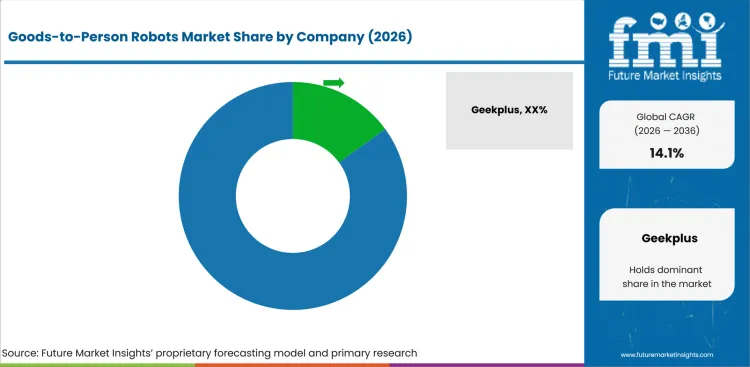
Robot OEMs and cube-storage specialists compete on workflow control. Integrators compete on lifecycle support and accountability.
- Mobile robot suppliers win by proving flexible routing and high uptime inside active warehouses.
- Storage-system specialists gain buyers through density improvement and reliable workstation throughput.
- Integrators stand out with software links and service accountability across complex enterprise sites.
- Specialist robotics firms gain pilots when they solve a clear picking or retrofit problem faster.
Competition is concentrated around robot fleets and storage architecture. Geekplus and Locus Robotics compete through mobile robot fleets for flexible goods movement. AutoStore and Exotec stand out with storage systems that raise density and station output. Dematic and Swisslog compete through integration depth and service coverage. Toyota Advanced Logistics and Kardex add lifecycle service strength for enterprise buyers.
Supplier selection is shifting away from robot specifications alone. Buyers now ask how the system connects with labor planning and exception handling. Locus Robotics introduced Locus Array in April 2026 for autonomous robots-to-goods workflows. AutoStore launched CarouselAI and VersaPort in March 2025 to improve robotic picking and flexible workflows. These moves show why software control and service capacity are becoming decisive purchase factors.
Competitive Benchmarking Table
| Company | Robot Portfolio Depth | Software and Orchestration Strength | Retrofit Fit | Service Reach | Geographic Footprint |
|---|---|---|---|---|---|
| Geekplus | Very Strong | Strong | Very Strong | Strong | Global with strong China and Asia presence |
| Locus Robotics | Very Strong | Very Strong | Very Strong | Very Strong | North America and Europe |
| AutoStore | Very Strong | Strong | Strong | Very Strong | Global |
| Exotec | Very Strong | Strong | Strong | Strong | Europe and North America |
| Dematic | Strong | Very Strong | Strong | Very Strong | Global |
| Swisslog | Strong | Strong | Strong | Very Strong | Global |
| Kardex | Strong | Strong | Very Strong | Strong | Europe and North America |
| GreyOrange | Strong | Very Strong | Very Strong | Strong | India, North America, and global enterprise accounts |
| Toyota Advanced Logistics | Strong | Moderate | Moderate | Very Strong | Japan and global industrial accounts |
| Omron | Strong | Strong | Moderate | Strong | Japan and Asia |
Source: Future Market Insights competitive analysis, 2026.
What are the latest developments in the goods-to-person robots market?
- In April 2026, Locus Robotics introduced Locus Array for autonomous warehouse workflows and robots-to-goods execution.
- In March 2025, AutoStore launched CarouselAI and VersaPort to support robotic picking and more flexible warehouse workflows.
- In November 2024, Geekplus unveiled vision-driven robots with Intel and a next-generation Pallet-to-Person solution at CeMAT 2024.
Goods-to-Person Robots Market - Report Scope
| Parameter | Details |
|---|---|
| Forecast period | 2026 to 2036 |
| Historical period | 2021 to 2025 |
| Quantitative unit | Revenue in USD billion |
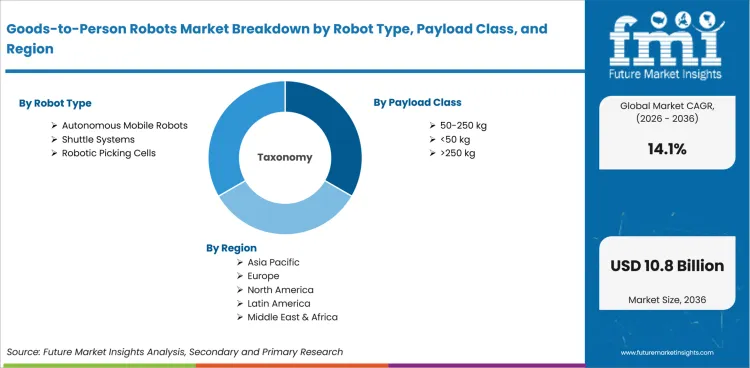
| By robot type | Autonomous Mobile Robots, shuttle systems, robotic picking cells, hybrid GTP systems |
| By payload class | <50 kg, 50-250 kg, >250 kg |
| By end use | E-commerce fulfillment, retail distribution, 3PL warehouses, manufacturing logistics |
| By deployment | Greenfield automation, brownfield retrofit |
| By sales model | Robot-as-a-Service, capex purchase, integrator-led projects |
| Regions covered | North America, Europe, Asia Pacific, Latin America, Middle East and Africa |
| Countries covered | India, China, South Korea, Japan, United States, Germany, United Kingdom, France |
| Key companies profiled | Geekplus, Locus Robotics, GreyOrange, AutoStore, Swisslog, Dematic, Exotec, Kardex, Toyota Advanced Logistics, Omron |
| Approach | Hybrid bottom-up and top-down methodology using robot system revenue, payload mix, end-use adoption, deployment model, software integration depth, and country automation readiness |
Source: Future Market Insights, 2026.
Goods-to-Person Robots Market - Scope & Definition
| Parameter | Scope |
|---|---|
| Market Definition | Robotic systems that bring totes, shelves, bins, or inventory carriers to human or robotic picking stations inside warehouses and fulfillment centers. |
| Included Robot Types | Autonomous Mobile Robots, shuttle systems, robotic picking cells, and hybrid goods-to-person systems. |
| Included Payload Classes | <50 kg, 50-250 kg, and >250 kg robot payload categories. |
| Included End Uses | E-commerce fulfillment, retail distribution, 3PL warehouses, and manufacturing logistics. |
| Included Deployments | Greenfield automation projects and brownfield retrofit installations inside active or newly built facilities. |
| Included Sales Models | Robot-as-a-Service, capex purchase, and integrator-led project models. |
| Excluded Products | Conventional forklifts, manual carts, conveyor-only systems, service robots outside warehouse goods movement, and unrelated factory automation systems. |
| Geographic Coverage | United States, United Kingdom, Germany, France, Japan, China, South Korea, India, and wider regional markets. |
Goods-to-Person Robots Market - Research Methodology
| Research Step | Method Used |
|---|---|
| Primary Research | FMI analysts reviewed inputs from warehouse operators, robotics integrators, automation consultants, 3PL buyers, and fulfillment technology managers. |
| Desk Research | Research covered robotics association data, official e-commerce statistics, company product pages, public automation evidence, and warehouse technology updates. |
| Market Sizing | The model used robot system revenue, average system pricing, payload class mix, deployment type, and end-use adoption by country. |
| Forecast Validation | Forecasts were checked against supplier portfolios, installation signals, automation density, e-commerce activity, and warehouse demand indicators. |
| Quality Control | Source verification, duplicate statistic checks, segment consistency review, and reference-format alignment were completed before final table preparation. |
Goods-to-Person Robots Market by Segments
Goods-to-Person Robots Market Segmented by Robot Type:
- Autonomous Mobile Robots
- Shuttle Systems
- Robotic Picking Cells
- Hybrid GTP Systems
Goods-to-Person Robots Market Segmented by Payload Class:
- <50 kg
- 50-250 kg
- >250 kg
Goods-to-Person Robots Market Segmented by End Use:
- E-commerce Fulfillment
- Retail Distribution
- 3PL Warehouses
- Manufacturing Logistics
Goods-to-Person Robots Market Segmented by Deployment:
- Greenfield Automation
- Brownfield Retrofit
Goods-to-Person Robots Market Segmented by Sales Model:
- Robot-as-a-Service
- Capex Purchase
- Integrator-led Projects
Goods-to-Person Robots Market by Region:
- North America
- United States
- Canada
- Europe
- Germany
- United Kingdom
- France
- Italy
- Spain
- Asia Pacific
- China
- Japan
- South Korea
- Taiwan
- Singapore
- Latin America
- Brazil
- Mexico
- Argentina
- Middle East & Africa
- GCC Countries
- South Africa
- Israel
Research Sources and Bibliography
- International Federation of Robotics. (2025, September 25). World Robotics 2025 report - Industrial robots.
- UK Research and Innovation. (2026). Robotics Adoption Hubs.
- U.S. Census Bureau. (2026, May 18). Quarterly retail e-commerce sales: 1st quarter 2026.
- U.S. Bureau of Economic Analysis. (2026, May 28). Personal income and outlays, April 2026.
- Board of Governors of the Federal Reserve System. (2026, June 15). Industrial production and capacity utilization.
- Office for National Statistics. (2026, June 19). Retail sales, Great Britain: May 2026.
- Office for National Statistics. (2026, May 22). Retail sales, Great Britain: April 2026.
- German Federal Statistical Office. (2026). Online trade is steadily gaining in importance.
- U.S. International Trade Administration. (2025, August 1). Germany - eCommerce.
- Fédération du e-commerce et de la vente à distance. (2025, September 1). Key figures for e-commerce in France 2025.
- Ministry of Economy, Trade and Industry. (2025, August 26). Results of FY2024 e-commerce market survey compiled.
- National Bureau of Statistics of China. (2026, January 20). Total retail sales of consumer goods in December 2025.
- Statistics Korea. (2026, June 1). Online shopping in April 2026.
- Press Information Bureau of India. (2025, August 5). E-commerce export hubs to support Indian SMEs.
- Press Information Bureau of India. (2025, September 20). Assessment of logistics cost in India.
- AutoStore. (2025, March 4). AutoStore unveils new AI-powered robotics.
- Locus Robotics. (2026, April 13). Locus Array: Beginning of the autonomous warehouse era.
- Geekplus. (2024, November 6). Geek+ unveils vision-driven robots with Intel and next-gen Pallet-to-Person solution at CeMAT 2024.
- Exotec. (2025, October 15). Exotec celebrates 10 years of innovation.
- GreyOrange. (2026, April 14). Dematic expands flexible automation capabilities through GreyOrange partnering relationship.
- State Council of the People's Republic of China. (2026, January 22). China's consumer goods trade-in programs benefit 366 million purchases in 2025.
- Press Information Bureau of India. (2026, February 24). Export Promotion Mission: Building an Integrated Pathway to Global Markets.
- Locus Robotics. (2025, April 24). Locus Robotics surpasses 5 billion pick milestone, accelerating global adoption of mobile warehouse automation. H
- Kardex. (2026, February 6). Kardex selected for second AutoStore project with Cutter & Buck in Texas.
- Kardex. (2025, June 30). Kardex and Paccurate partner to revolutionize warehouse automation with intelligent cartonization.
The bibliography uses government sources and official company publications where available. Association sources are used only when official government data is limited.
This Report Answers
- What is the 2026 value of the Goods-to-Person Robots Market and how does it compare with 2025?
- What market value is forecast for Goods-to-Person Robots Market by 2036?
- What CAGR is expected for the Goods-to-Person Robots Market during 2026 to 2036?
- Which robot type is projected to hold the leading share in 2026?
- Which end-use segment is expected to account for the largest 2026 demand share?
- Why do brownfield warehouses prefer modular goods-to-person robot installations?
- Which countries are projected to grow fastest in the Goods-to-Person Robots Market?
- Which companies compete in robot fleets and orchestration software?
- What products and adjacent systems are excluded from this market scope?
- How does FMI validate the forecast across robot types and countries?
Frequently Asked Questions
How large is the Goods-to-Person Robots Market expected to be in the near term?
The market is expanding as fulfillment centers adopt robots to reduce picker travel and stabilize order throughput.
What is the long term outlook for the Goods-to-Person Robots Market?
The outlook remains strong as robot fleets move from pilot deployments into core warehouse operating models.
How fast is the Goods-to-Person Robots Market expected to grow?
Growth is driven by e commerce order density, labor constraints, and broader warehouse automation investment cycles.
What is the main driver of goods to person robot demand?
Demand is driven by the need to cut walking time, improve pick accuracy, and protect service levels during peak volumes.
Which robot type dominates the market?
Autonomous mobile robots dominate because they can operate flexibly in active warehouse environments.
Which payload class is most widely used?
Mid range payload robots are preferred because they suit tote, shelf, and rack movement in most fulfillment workflows.
Which end use segment generates the highest demand?
E commerce fulfillment leads demand due to dense SKU profiles, rapid order cycles, and high return volumes.
Which deployment model is most commonly chosen?
Brownfield retrofits dominate because operators want automation without rebuilding existing warehouses.
What does the Goods-to-Person Robots Market include?
The market includes robotic systems that bring totes or shelves to human and robotic picking stations.
How does FMI forecast the Goods-to-Person Robots Market?
FMI combines robot revenue and payload mix. End-use demand and country readiness are checked against supplier evidence.
Which goods-to-person robot is best for e-commerce fulfillment?
Autonomous Mobile Robots work well for many e-commerce sites due to flexible routing and phased scaling.
Preview the report firsthand - request a free sample
Get SampleGet the brochure for pricing and purchase details.
Get PDFTable of Content
- Key Takeaways
- Market Size and CAGR
- Top Growth Driver
- Fastest Growing Segment
- Leading Region
- Key Companies
- Emerging Opportunities
- Executive Summary
- Global Market Outlook
- Demand-side Trends
- Supply-side Trends
- Technology Roadmap Analysis
- Analysis and Recommendations
- Analyst Perspective (What is happening? Why now? What should investors know?)
- Key Questions Answered
- How large is the market?
- What is the CAGR?
- What are key trends?
- Which region dominates?
- Who are the leaders?
- Market Overview
- Market Coverage / Taxonomy
- Market Definition / Scope / Limitations
- Research Methodology
- Chapter Orientation
- Analytical Lens and Working Hypotheses
- Market Structure, Signals, and Trend Drivers
- Benchmarking and Cross-market Comparability
- Market Sizing, Forecasting, and Opportunity Mapping
- Research Design and Evidence Framework
- Desk Research Programme (Secondary Evidence)
- Expert Input and Fieldwork (Primary Evidence)
- Tooling, Models, and Reference Databases
- Data Engineering and Model Build
- Quality Assurance and Audit Trail
- Market Background
- Market Dynamics (Drivers, Restraints, Opportunity, Trends)
- Scenario Forecast (Optimistic, Likely, Conservative)
- Impact Analysis
- AI Impact
- Sustainability Impact
- Regulatory Impact
- Technology Impact
- Consumer / Buyer Analysis
- Purchase Drivers
- Adoption Barriers
- Buyer Journey
- Opportunity Map Analysis
- Product Life Cycle Analysis
- Supply Chain Analysis
- Investment Feasibility Matrix
- Value Chain Analysis
- PESTLE and Porter's Analysis
- Regulatory Landscape
- Regional Parent Market Outlook
- Production and Consumption Statistics
- Import and Export Statistics
- Global Market Analysis and Forecast, 2021 to 2036
- Historical Market Size Value (USD Million) Analysis, 2021 to 2025
- Current and Future Market Size Value (USD Million) Projections, 2026 to 2036
- Y-o-Y Growth Trend Analysis
- Absolute $ Opportunity Analysis
- Global Market Pricing Analysis, 2021 to 2036
- Global Market Analysis and Forecast, By Robot Type, 2021 to 2036
- Introduction / Key Findings
- Historical Market Size Value (USD Million) Analysis By Robot Type, 2021 to 2025
- Current and Future Market Size Value (USD Million) Analysis and Forecast By Robot Type, 2026 to 2036
- Autonomous Mobile Robots
- Shuttle Systems
- Robotic Picking Cells
- Autonomous Mobile Robots
- Y-o-Y Growth Trend Analysis By Robot Type, 2021 to 2025
- Absolute $ Opportunity Analysis By Robot Type, 2026 to 2036
- Global Market Analysis and Forecast, By Payload Class, 2021 to 2036
- Introduction / Key Findings
- Historical Market Size Value (USD Million) Analysis By Payload Class, 2021 to 2025
- Current and Future Market Size Value (USD Million) Analysis and Forecast By Payload Class, 2026 to 2036
- 50-250 kg
- <50 kg
- >250 kg
- 50-250 kg
- Y-o-Y Growth Trend Analysis By Payload Class, 2021 to 2025
- Absolute $ Opportunity Analysis By Payload Class, 2026 to 2036
- Global Market Analysis and Forecast, By End Use, 2021 to 2036
- Introduction / Key Findings
- Historical Market Size Value (USD Million) Analysis By End Use, 2021 to 2025
- Current and Future Market Size Value (USD Million) Analysis and Forecast By End Use, 2026 to 2036
- E-commerce Fulfillment
- Retail Distribution
- 3PL Warehouses
- E-commerce Fulfillment
- Y-o-Y Growth Trend Analysis By End Use, 2021 to 2025
- Absolute $ Opportunity Analysis By End Use, 2026 to 2036
- Global Market Analysis and Forecast, By Deployment, 2021 to 2036
- Introduction / Key Findings
- Historical Market Size Value (USD Million) Analysis By Deployment, 2021 to 2025
- Current and Future Market Size Value (USD Million) Analysis and Forecast By Deployment, 2026 to 2036
- Brownfield Retrofit
- Greenfield Automation
- Brownfield Retrofit
- Y-o-Y Growth Trend Analysis By Deployment, 2021 to 2025
- Absolute $ Opportunity Analysis By Deployment, 2026 to 2036
- Global Market Analysis and Forecast, By Sales Model, 2021 to 2036
- Introduction / Key Findings
- Historical Market Size Value (USD Million) Analysis By Sales Model, 2021 to 2025
- Current and Future Market Size Value (USD Million) Analysis and Forecast By Sales Model, 2026 to 2036
- Capex Purchase
- Robot-as-a-Service
- Integrator-led Projects
- Capex Purchase
- Y-o-Y Growth Trend Analysis By Sales Model, 2021 to 2025
- Absolute $ Opportunity Analysis By Sales Model, 2026 to 2036
- Global Market Analysis and Forecast, By Region, 2021 to 2036
- Introduction
- Historical Market Size Value (USD Million) Analysis By Region, 2021 to 2025
- Current Market Size Value (USD Million) Analysis and Forecast By Region, 2026 to 2036
- North America
- Latin America
- Western Europe
- Eastern Europe
- East Asia
- South Asia and Pacific
- Middle East & Africa
- Market Attractiveness Analysis By Region
- North America Market Analysis and Forecast, By Country, 2021 to 2036
- Historical Market Size Value (USD Million) Trend Analysis By Market Taxonomy, 2021 to 2025
- Market Size Value (USD Million) Forecast By Market Taxonomy, 2026 to 2036
- By Country
- USA
- Canada
- Mexico
- By Robot Type
- By Payload Class
- By End Use
- By Deployment
- By Sales Model
- By Country
- Market Attractiveness Analysis
- By Country
- By Robot Type
- By Payload Class
- By End Use
- By Deployment
- By Sales Model
- Key Takeaways
- Latin America Market Analysis and Forecast, By Country
- Historical Market Size Value (USD Million) Trend Analysis By Market Taxonomy, 2021 to 2025
- Market Size Value (USD Million) Forecast By Market Taxonomy, 2026 to 2036
- By Country
- Brazil
- Chile
- Rest of Latin America
- By Robot Type
- By Payload Class
- By End Use
- By Deployment
- By Sales Model
- By Country
- Market Attractiveness Analysis
- By Country
- By Robot Type
- By Payload Class
- By End Use
- By Deployment
- By Sales Model
- Key Takeaways
- Western Europe Market Analysis and Forecast, By Country
- Historical Market Size Value (USD Million) Trend Analysis By Market Taxonomy, 2021 to 2025
- Market Size Value (USD Million) Forecast By Market Taxonomy, 2026 to 2036
- By Country
- Germany
- UK
- Italy
- Spain
- France
- Nordic
- BENELUX
- Rest of Western Europe
- By Robot Type
- By Payload Class
- By End Use
- By Deployment
- By Sales Model
- By Country
- Market Attractiveness Analysis
- By Country
- By Robot Type
- By Payload Class
- By End Use
- By Deployment
- By Sales Model
- Key Takeaways
- Eastern Europe Market Analysis and Forecast, By Country
- Historical Market Size Value (USD Million) Trend Analysis By Market Taxonomy, 2021 to 2025
- Market Size Value (USD Million) Forecast By Market Taxonomy, 2026 to 2036
- By Country
- Russia
- Poland
- Hungary
- Balkan & Baltic
- Rest of Eastern Europe
- By Robot Type
- By Payload Class
- By End Use
- By Deployment
- By Sales Model
- By Country
- Market Attractiveness Analysis
- By Country
- By Robot Type
- By Payload Class
- By End Use
- By Deployment
- By Sales Model
- Key Takeaways
- East Asia Market Analysis and Forecast, By Country
- Historical Market Size Value (USD Million) Trend Analysis By Market Taxonomy, 2021 to 2025
- Market Size Value (USD Million) Forecast By Market Taxonomy, 2026 to 2036
- By Country
- China
- Japan
- South Korea
- By Robot Type
- By Payload Class
- By End Use
- By Deployment
- By Sales Model
- By Country
- Market Attractiveness Analysis
- By Country
- By Robot Type
- By Payload Class
- By End Use
- By Deployment
- By Sales Model
- Key Takeaways
- South Asia and Pacific Market Analysis and Forecast, By Country
- Historical Market Size Value (USD Million) Trend Analysis By Market Taxonomy, 2021 to 2025
- Market Size Value (USD Million) Forecast By Market Taxonomy, 2026 to 2036
- By Country
- India
- ASEAN
- Australia & New Zealand
- Rest of South Asia and Pacific
- By Robot Type
- By Payload Class
- By End Use
- By Deployment
- By Sales Model
- By Country
- Market Attractiveness Analysis
- By Country
- By Robot Type
- By Payload Class
- By End Use
- By Deployment
- By Sales Model
- Key Takeaways
- Middle East & Africa Market Analysis and Forecast, By Country
- Historical Market Size Value (USD Million) Trend Analysis By Market Taxonomy, 2021 to 2025
- Market Size Value (USD Million) Forecast By Market Taxonomy, 2026 to 2036
- By Country
- Kingdom of Saudi Arabia
- Other GCC Countries
- Türkiye
- South Africa
- Other African Union
- Rest of Middle East & Africa
- By Robot Type
- By Payload Class
- By End Use
- By Deployment
- By Sales Model
- By Country
- Market Attractiveness Analysis
- By Country
- By Robot Type
- By Payload Class
- By End Use
- By Deployment
- By Sales Model
- Key Takeaways
- Key Countries Market Analysis
- USA
- Pricing Analysis
- Market Share Analysis, 2025
- By Robot Type
- By Payload Class
- By End Use
- By Deployment
- By Sales Model
- Canada
- Pricing Analysis
- Market Share Analysis, 2025
- By Robot Type
- By Payload Class
- By End Use
- By Deployment
- By Sales Model
- Mexico
- Pricing Analysis
- Market Share Analysis, 2025
- By Robot Type
- By Payload Class
- By End Use
- By Deployment
- By Sales Model
- Brazil
- Pricing Analysis
- Market Share Analysis, 2025
- By Robot Type
- By Payload Class
- By End Use
- By Deployment
- By Sales Model
- Chile
- Pricing Analysis
- Market Share Analysis, 2025
- By Robot Type
- By Payload Class
- By End Use
- By Deployment
- By Sales Model
- Germany
- Pricing Analysis
- Market Share Analysis, 2025
- By Robot Type
- By Payload Class
- By End Use
- By Deployment
- By Sales Model
- UK
- Pricing Analysis
- Market Share Analysis, 2025
- By Robot Type
- By Payload Class
- By End Use
- By Deployment
- By Sales Model
- Italy
- Pricing Analysis
- Market Share Analysis, 2025
- By Robot Type
- By Payload Class
- By End Use
- By Deployment
- By Sales Model
- Spain
- Pricing Analysis
- Market Share Analysis, 2025
- By Robot Type
- By Payload Class
- By End Use
- By Deployment
- By Sales Model
- France
- Pricing Analysis
- Market Share Analysis, 2025
- By Robot Type
- By Payload Class
- By End Use
- By Deployment
- By Sales Model
- India
- Pricing Analysis
- Market Share Analysis, 2025
- By Robot Type
- By Payload Class
- By End Use
- By Deployment
- By Sales Model
- ASEAN
- Pricing Analysis
- Market Share Analysis, 2025
- By Robot Type
- By Payload Class
- By End Use
- By Deployment
- By Sales Model
- Australia & New Zealand
- Pricing Analysis
- Market Share Analysis, 2025
- By Robot Type
- By Payload Class
- By End Use
- By Deployment
- By Sales Model
- China
- Pricing Analysis
- Market Share Analysis, 2025
- By Robot Type
- By Payload Class
- By End Use
- By Deployment
- By Sales Model
- Japan
- Pricing Analysis
- Market Share Analysis, 2025
- By Robot Type
- By Payload Class
- By End Use
- By Deployment
- By Sales Model
- South Korea
- Pricing Analysis
- Market Share Analysis, 2025
- By Robot Type
- By Payload Class
- By End Use
- By Deployment
- By Sales Model
- Russia
- Pricing Analysis
- Market Share Analysis, 2025
- By Robot Type
- By Payload Class
- By End Use
- By Deployment
- By Sales Model
- Poland
- Pricing Analysis
- Market Share Analysis, 2025
- By Robot Type
- By Payload Class
- By End Use
- By Deployment
- By Sales Model
- Hungary
- Pricing Analysis
- Market Share Analysis, 2025
- By Robot Type
- By Payload Class
- By End Use
- By Deployment
- By Sales Model
- Kingdom of Saudi Arabia
- Pricing Analysis
- Market Share Analysis, 2025
- By Robot Type
- By Payload Class
- By End Use
- By Deployment
- By Sales Model
- Türkiye
- Pricing Analysis
- Market Share Analysis, 2025
- By Robot Type
- By Payload Class
- By End Use
- By Deployment
- By Sales Model
- South Africa
- Pricing Analysis
- Market Share Analysis, 2025
- By Robot Type
- By Payload Class
- By End Use
- By Deployment
- By Sales Model
- USA
- Market Structure Analysis
- Competition Dashboard
- Competition Benchmarking
- Market Share Analysis of Top Players
- By Regional
- By Robot Type
- By Payload Class
- By End Use
- By Deployment
- By Sales Model
- Emerging Startups
- Innovation Benchmarking
- Competition Analysis
- Competition Deep Dive
- Geekplus
- Overview
- Product Portfolio
- Profitability by Market Segments (Product/Region/Sales Channel)
- Sales Footprint
- Strategy Overview
- Marketing Strategy
- Product Strategy
- Channel Strategy
- Locus Robotics
- GreyOrange
- AutoStore
- Swisslog
- Dematic
- Geekplus
- Case Studies
- Success Stories
- Recent Developments
- Competition Deep Dive
- Assumptions & Acronyms Used


