

- Market Size (2026)
- USD 450.0 Mn
- Forecast (2036)
- USD 6203.6 Mn
- CAGR (2026 to 2036)
- 30.0%
How big is Warehouse Humanoid Robots Market in 2026?
USD 450.0 million in 2026 and USD 6,203.6 million by 2036 at a 30.0% CAGR.
Sales of warehouse humanoid robots are projected to rise from USD 450.0 million in 2026 to USD 6,203.6 million by 2036 at a 30.0% CAGR. Warehouse humanoid robots address manual transfers that remain between conveyors, carts and workstations designed around human reach. In July 2026, the USA Bureau of Labor Statistics listed 433,060 hand material movers in warehousing and storage during 2025. The employment base shows how much repeated handling remains inside facilities that already use transport automation. A split workflow lets warehouse robotics handle travel while a humanoid completes a measured physical handoff. Commercial approval depends on repeatable transfer volume and reliable recovery across ordinary daily warehouse shifts.
Country demand starts from different operating constraints, and high United States labor costs raise the value of automating repeated handling at active fulfillment sites. China benefits from domestic humanoid developers that can shorten hardware feedback cycles around logistics tasks. In July 2026, the USA Bureau of Labor Statistics placed the 2025 mean annual wage for hand material movers in warehousing and storage at USD 45,380. The wage level strengthens the case for trials that record output and recovery time beside support needs. A sourcing plan for humanoid robot platforms should define one workflow and one service owner. Commercial expansion should follow measured work rather than an assumption that one body can replace several warehouse systems.
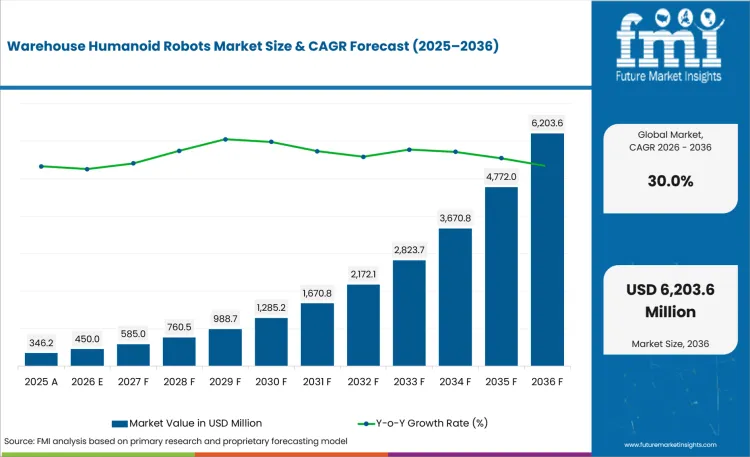
Key Takeaways of Warehouse Humanoid Robots Market
- Demand for warehouse humanoid robots is driven by transfer points that remain dependent on repeated lifting and placement by people, with tote and case movement offering a narrow, measurable task.
- Bipedal humanoids are estimated to lead the form factor category with 52.0% share in 2026, owing to their access to work heights and transfer points originally created for people.
- Tote handling is the dominant application segment, projected to hold 38.0% share in 2026, reflecting repeatable container shapes that expose missed grasps and incomplete transfers quickly.
- Hardware is estimated to lead component share at 54.0% in 2026, driven by joints and batteries that form the physical platform, with sensing and computing determining productive availability.
- Software and service income gains weight as installed fleets require skill updates, route changes, diagnostic support, and reliable restart procedures across operating shifts.
- China, the United States, India, and Europe/Latin America are expected to follow distinct adoption paths, shaped by domestic humanoid design, dispersed fulfillment sites requiring local maintenance, wheeled designs suited to smooth floors, and reliance on named operating partners for integration support.
- Competition centers on Agility Robotics, Figure, Humanoid, NEURA Robotics, UBTECH Robotics, Addverb, Geekplus, and Hangcha, with vendors differentiating through measured logistics results, tote-movement and picking integration, and logistics-specific body designs addressing payload and stability.
Analyst Perspective
"The warehouse humanoid robots market is entering a phase where operational discipline is becoming a stronger differentiator than navigation capability. Initial productivity gains are only sustained when fleets maintain predictable performance through shift changes, traffic congestion, battery cycles, and routine system interruptions. Warehouse operators are increasingly evaluating automation through fleet availability, recovery efficiency, and throughput stability because these factors determine the economics of large-scale deployment. The providers likely to gain long-term traction will be those that reduce operational complexity with structured fleet management, well-defined service accountability, and proven performance across diverse warehouse environments."
- Nikhil Kaitwade, Principal Analyst at Future Market Insights
Source: FMI's proprietary forecasting model and primary research
How is the Warehouse Humanoid Robots Market segmented?
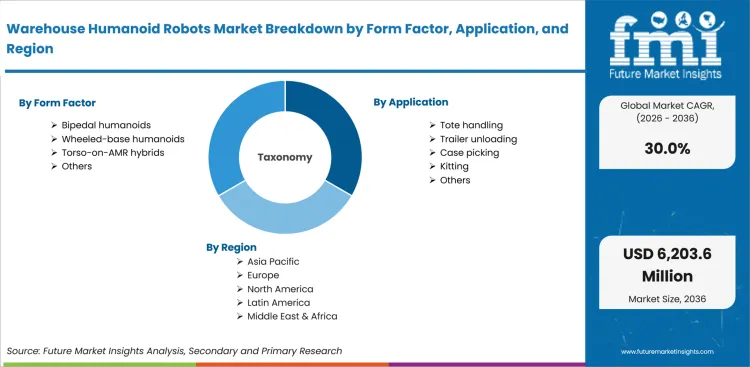
The warehouse humanoid robots market is segmented by Form Factor, Application, Component, End-use Industry, Business Model, and Region.
The segmentation first compares robot body design with the warehouse work assigned to each platform. It then separates hardware revenue from software and service income to show how recurring value develops. End-use Industry identifies the operator that controls the workflow and carries daily performance responsibility, while Business Model explains how that operator pays for equipment and ongoing support. A third-party logistics provider may start with tote transfer under a service contract and later add kitting or workstation feeding. That sequence connects the robot with 5PL logistics services that coordinate capacity across customer sites. Regional analysis tests whether local service coverage can support installation and recurring operations across several facilities.
Why do bipedal humanoids hold leading share within the form factor category?
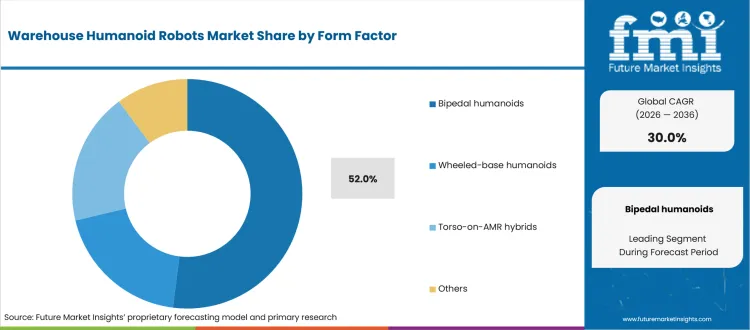
Bipedal robots can use aisles and work heights created for employees without rebuilding every transfer station. That access adds an operating burden since balance recovery and charging can interrupt a shift. In June 2026 Agility Robotics reported more than 65,000 operating hours across nine customer facilities in manufacturing and logistics. The record shows why form factor decisions must combine physical access with recovery behavior and service readiness.
- By Form Factor, bipedal humanoids are forecast to represent 52.0% of 2026 revenue due to their ability to reach racks and conveyors built for people. The share reflects current investment in full humanoid bodies, although warehouses must compare that access with balance recovery and energy use across a normal operating shift.
- Warehouse operators are expected to test walking access beside mobile robot fleet control on routes that already contain carts or autonomous mobile robots. A useful deployment assigns the humanoid a defined transfer task and measures recovery without blocking traffic. Repeat orders depend on stable output with limited supervision through ordinary shifts and changing loads.
Why does tote handling dominate the application category?
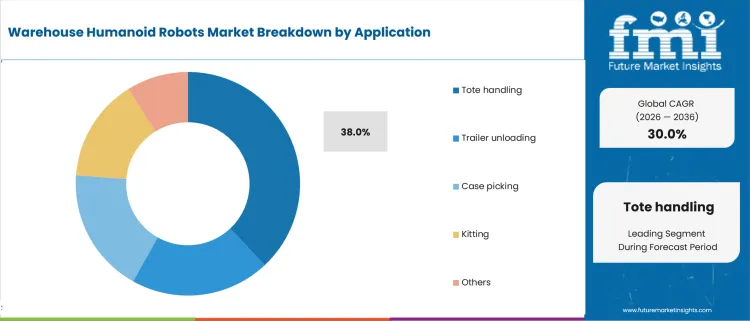
Totes give early deployments a controlled object for warehouse trials, but distribution work soon adds bags and boxes. Figure reported in June 2025 that Helix averaged 4.31 seconds per package using 60 hours of demonstration data. The same update recorded correct barcode orientation on 94.4% of handled packages across the mixed-package task. These results show why bin-picking vision software and grasp control must improve together as object variation increases.
- In 2026, tote handling is expected to account for 38.0% of Application revenue due to predictable dimensions and known transfer points. The dominance reflects the value of a task that exposes failed grasps quickly and produces a clear cycle count. That position does not imply that every tote size or surface presents the same handling difficulty.
- Distribution centers can track completed transfers and missed handoffs without relying on a broad productivity claim. Garment sorting robots illustrate the harder end of the same problem because soft objects change shape during each grasp. Tote programs therefore create a controlled starting point for improving perception before task variety expands inside active facilities.
Why does hardware leads within the component category?
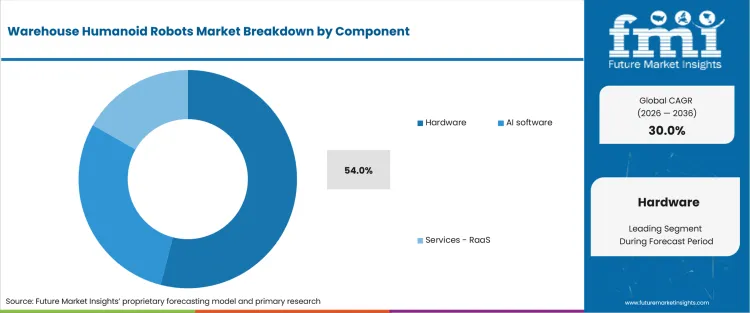
Hardware category includes the joints and batteries that power a robot through a normal warehouse shift. Its sensors and safety controls guide each movement and protect nearby workers during routine task execution. In March 2025 Agility Robotics reported that Digit launched a battery lasting up to four hours with autonomous docking at a charging station. The update added new grippers with safety controls that connect hardware design with daily robot availability.
- By component, hardware is estimated to account for 54.0% in 2026 because every complete robot requires joints, batteries, sensing, computing, and safety controls. The share reflects the capital needed to build a body that survives repeated industrial motion. It also shows why serviceable modules and planned charging affect the economic value of the installed platform.
- Fleet planning should account for battery technologies and charging access across the planned shift before a warehouse commits to the required unit count. Accurate object and position data make machine vision cameras part of the same investment decision. A lower purchase price offers little value if energy use or sensor faults reduce productive availability.
What are the drivers, restraints, and opportunities in the Warehouse Humanoid Robots Market?
Repetitive material work is expected to support targeted trials inside human-oriented warehouse layouts that retain manual handoffs. Reliability limits are anticipated to slow wider deployment until robots complete ordinary shifts under changing loads.
- Driver: Repetitive material work and hard-to-fill shifts are expected to support trials for tote movement and workstation feeding in human-oriented facilities.
- Restraint: Balance recovery and grasp reliability are anticipated to slow deployment until robots complete normal shifts under changing loads and floor conditions.
- Opportunity: Service contracts are projected to reduce early ownership risk by linking robot access with maintenance and field response under one operating plan.
Repetitive material work creates a labor and safety problem at sites that cannot rebuild every station. In July 2026 the USA Bureau of Labor Statistics reported 4.8 recordable injuries and illnesses per 100 full-time workers in warehousing and storage during 2024. The rate does not measure robot demand, but it explains why operators test automation for lifting and repeated movement. Humanoids gain commercial value by removing a defined task without slowing the surrounding warehouse flow.
One unstable step can force a controlled restart that interrupts nearby warehouse work during operations. Reliability becomes an approval test because each site must recover the robot without blocking flow. In March 2026, Humanoid reported that HMND 01 Alpha handled three tote types with an 8 kg payload in a live production logistics proof of concept. The robot received tasks through SAP Extended Warehouse Management and repeated a picking cycle inside the facility. Those results connect recovery behavior and control integration with recurring warehouse use under ordinary operating conditions.
Service contracts can turn a narrow pilot into an operating plan with clear responsibility for uptime and field support. In May 2026, Figure signed a commercial agreement with Catalyst Brands for humanoids at its Reno distribution and logistics center. The agreement places robot performance inside an active distribution network with a named owner for expansion decisions. Humanoids can then bridge goods-to-person robots with nearby manual stations under one accountable service plan.
Which country CAGRs are profiled in the Warehouse Humanoid Robots Market?
| Country | CAGR |
|---|---|
| China | 34.0% |
| United States | 32.0% |
| India | 29.0% |
| European Union | 27.0% |
| Latin America | 26.0% |
Source: FMI's proprietary forecasting model and primary research
How do country-level CAGRs compare in the Warehouse Humanoid Robots Market?
The country comparison spans 8.0 percentage points across the warehouse humanoid robots market. China records the highest CAGR at 34.0%, followed by the United States at 32.0%. India reaches 29.0%, while the European Union and Latin America post 27.0% and 26.0%, respectively. The ranking reflects different stages of warehouse automation, labor availability and investment in humanoid robotics.
- China leads with a CAGR of 34.0%. Warehouse operators are evaluating humanoid robots for material handling, order picking and repetitive logistics tasks as facilities expand automation beyond conventional robotic systems.
- The United States follows at 32.0%, 2.0 percentage points below China. Adoption is linked to fulfillment center modernization, where humanoid robots are being assessed for workflows that require mobility, object handling and interaction with existing warehouse infrastructure.
- India records a CAGR of 29.0%, placing it 3.0 percentage points behind the United States. Investment is increasing in warehouse automation technologies that improve operational efficiency while supporting the expansion of distribution and logistics networks.
- The European Union posts a CAGR of 27.0%, 2.0 percentage points below India. Companies are exploring humanoid robots for warehouse operations that involve mixed manual and automated processes. Deployment differs among member states because logistics infrastructure, labor markets and automation strategies are not uniform.
- Latin America reaches a CAGR of 26.0%, 1.0 percentage point below the European Union. Interest is centered on warehouse automation projects that improve inventory movement, internal transport and operational consistency as distribution facilities adopt more advanced robotic systems.
Comparable CAGRs do not indicate identical market conditions. Warehouse layouts, automation maturity, labor economics and capital investment priorities influence deployment decisions and long-term commercial opportunities. The full report provides country-level CAGR analysis across North America, Latin America, Europe, East Asia, South Asia, Oceania and the Middle East and Africa.
Country-wise Analysis
- China’s warehouse humanoid programs benefit from domestic robot makers that can test hardware against local sorting and handling workflows. The national outlook is projected to record 34.0% CAGR from 2026 to 2036, supported by shorter feedback cycles between developers and logistics sites. UBTECH Robotics reported in September 2025 that Walker S2 combined a 15 kg payload with a three-minute autonomous battery change for continuous industrial work. The figures matter for warehouse use because payload and charging interruptions determine how many units a transfer lane needs. Domestic operators can compare those specifications with tote weights and shift schedules before approving a pilot. Competition will favor developers that pair local hardware supply with service teams capable of restoring a stopped unit without disrupting nearby flow.
- United States fulfillment networks provide active sites that can test humanoids against changing packages and established automation systems. Warehouse humanoid demand in the United States is forecast to rise at 32.0% CAGR over the assessment period, driven by developers working with logistics operators. The USA Bureau of Labor Statistics reported in July 2026 that private warehousing and storage included 23,757 establishments during the fourth quarter of 2025. That site base creates a dispersed service challenge since each program needs maintenance and restart support near the facility. Agility Robotics said in November 2025 that Digit completed NRTL field testing at a live e-commerce fulfillment site. Wider orders depend on comparable safety evidence across several layouts and operating loads at active fulfillment sites.
- India combines a domestic warehouse automation base with developers that are designing humanoids for industrial material movement. Adoption of warehouse humanoid robots in India is estimated to expand at 29.0% CAGR through 2036, shaped by local engineering and service capability. Addverb stated in June 2026 that it planned to install 3,000 humanoid units in industrial facilities by 2030. The target links national product development with a defined commercial scale rather than a laboratory ambition. A wheeled platform can reduce balance demands on smooth warehouse floors and direct more energy toward manipulation. Local logistics operators should test service response and repeatable handoffs before committing several facilities to the same platform.
- European warehouse programs place more weight on software integration and safety evidence that can be reviewed across several operating sites. The European Union sector is projected to record 27.0% CAGR from 2026 to 2036, supported by named warehouse trials from regional robot developers. NEURA Robotics reported in November 2025 that 4NE1 autonomously completed real-time picking in a BITZER warehouse. The same official release said the integration could support 24/7 utilization through SAP Extended Warehouse Management. Operators need local proof covering restart behavior and staff interaction near the picking area at each facility. Commercial expansion will favor platforms that can reuse validated software links without rebuilding the operating case at each warehouse.
- Latin American demand is forming through retailers that already manage regional distribution networks and can sponsor a defined operating program. Warehouse humanoid robot sales in Latin America are forecast to expand at 26.0% CAGR by 2036, supported by cross-border fulfillment operations. Agility Robotics reported in December 2025 that Digit had completed more than 100,000 tote moves before its commercial agreement with Mercado Libre. The agreement created a route into warehouse operations at the retailer’s San Antonio facility with options for regional expansion. That record gives local teams a measured transfer task instead of a general robotics demonstration. Investment decisions will depend on parts access and field response across the countries served by the distribution network.
Who are the notable companies in the Warehouse Humanoid Robots Market?
Profiles cover eight companies: Agility Robotics and Figure; Humanoid and NEURA Robotics; UBTECH Robotics and Addverb; Geekplus and Hangcha.
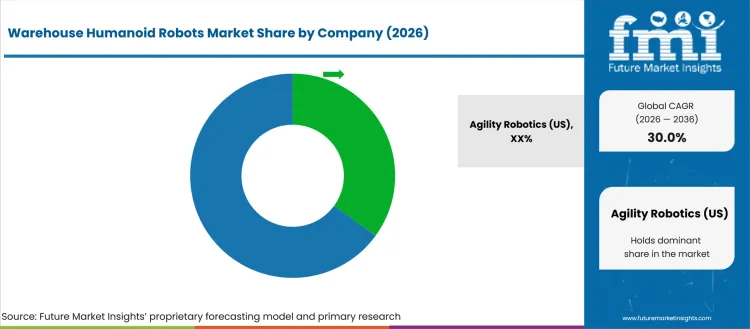
Published warehouse task evidence separates the competitive field from industrial humanoid programs that lack routine site results. Agility Robotics and Figure provide measured logistics work from named fulfillment or distribution settings that warehouse operators can compare directly. Humanoid and NEURA Robotics connect their platforms with tote handling or autonomous picking inside facilities using warehouse management software. UBTECH Robotics and Addverb focus on logistics body designs that address payload, charging, or stability. Geekplus and Hangcha bring established warehouse automation channels to humanoid programs at earlier validation stages. Across these approaches, machine vision systems remain central to object recognition and controlled recovery during repeated warehouse handling.
- Agility Robotics connects Digit with tote movement and field support inside active commercial logistics sites. In June 2026 the company announced a definitive agreement to go public through a merger with Churchill Capital Corp XI, pending regulatory and shareholder approval. Its public record covers operating hours and repeated task milestones from several named customer facilities. That evidence gives warehouse teams a practical basis for comparing output with recovery and service needs.
- Figure focuses on learned package handling across bags and boxes that fixed equipment often treats as separate problems. Its commercial position depends on carrying laboratory speed into full shifts with changing package conditions. Warehouse teams need stable label orientation and safe recovery records to justify expanding the assigned task list.
- Humanoid and NEURA Robotics provide facility-level evidence through tote handling and autonomous picking at named industrial sites. UBTECH Robotics and Addverb place more weight on logistics body design and practical stability across smooth warehouse floors. Geekplus and Hangcha bring established warehouse automation channels, but their humanoid programs need longer public operating records.
Competitive Benchmarking: Warehouse Humanoid Robots Market
| Company | Warehouse Task Evidence | Commercial Commitment | Service Readiness | Geographic Reach |
|---|---|---|---|---|
| Agility Robotics | High | High | High | High |
| Figure | High | High | Medium | Medium |
| Humanoid | High | High | Medium | Medium |
| NEURA Robotics | Medium | Low | Medium | Medium |
| UBTECH Robotics | Medium | Medium | Medium | Medium |
| Addverb | Low | Medium | High | High |
| Geekplus | Medium | Medium | High | High |
| Hangcha | Low | Low | High | High |
The ratings compare four evidence dimensions across eight companies and separate trial evidence from commercial support. Warehouse Task Evidence covers named trials or measured output, while Commercial Commitment reflects signed agreements or active programs. Service Readiness considers published support capacity, and Geographic Reach reflects documented customer support across more than one national market.
Source: Future Market Insights competitive assessment based on official company announcements published from January 2025 through June 2026.
Key Developments in the Warehouse Humanoid Robots Market
- In January 2026, Humanoid completed a two-week on-site proof of concept with Siemens for tote-to-conveyor destacking at the Siemens Electronics Factory in Erlangen. The official announcement reported 60 tote moves per hour with more than eight hours of uptime and pick-and-place success above 90%. The measured results give warehouse operators a practical benchmark for comparing throughput with battery availability and recovery needs during repeated tote movement.
- In February 2025, Figure introduced Helix for logistics package manipulation and triaging, training the system on eight hours of curated human demonstration data. The system handled mixed packages rather than one prepared container type and used visual reasoning to orient labels during placement. The development matters for warehouse humanoid robots because distribution centers need one manipulation system to handle bags, boxes, and other package shapes without separate fixed equipment for every item class.
- In October 2025, Hangcha demonstrated the X1 Series logistics humanoid at CeMAT ASIA for transporting and palletizing cartons plus handling and stacking smaller totes or bins. The event connected a humanoid body with tasks already served by forklifts and mobile equipment across warehouse sites. The commercial test is whether Hangcha can translate its material-handling service network into reliable support for manipulation software and recovery procedures during recurring operations.
Key Players in the Warehouse Humanoid Robots Market
Bipedal warehouse humanoid developers
- Agility Robotics
- Figure
- NEURA Robotics
- UBTECH Robotics
Wheeled and hybrid warehouse humanoid developers
- Humanoid
- Addverb
- Geekplus
- Hangcha
Warehouse Humanoid Robots Market - Report Scope
| Coverage field | Report scope |
|---|---|
| Market breakdown | Form Factor, Application, Component, End-use Industry, Business Model, and Region. |
| Quantitative Units | Revenue in USD million, revenue share in %, and CAGR in %. |
| Market Definition | Human-shaped robots used for material handling and related warehouse tasks in facilities built around human reach and walking paths. |
| Regions Covered | North America, Latin America, Europe, East Asia, South Asia, Oceania, and the Middle East and Africa. |
| Countries Covered | China, United States, India, Germany, United Kingdom, France, Brazil, Mexico, and other national markets within the regional forecast. |
| Key Companies Profiled | Agility Robotics, Figure, Humanoid, NEURA Robotics, UBTECH Robotics, Addverb, Geekplus, and Hangcha. |
| Forecast Period | 2026 to 2036. |
| Approach | Market sizing combines operator and developer interviews with government labor data and official company announcements. The forecast moderates early adoption assumptions through pilot conversion rates, safety validation and service capacity. |
Source: Future Market Insights proprietary forecasting model and primary research
Warehouse Humanoid Robots Market - Research Methodology
| Method | Approach |
|---|---|
| Primary Research | FMI analysts gathered input from manufacturers, service providers, technology developers, distributors, end users, sourcing teams, and subject-matter experts. Interviews examined purchasing decisions, product or service evaluation, adoption barriers, approval requirements, pricing considerations, and expectations for technical or commercial support. Respondents were also asked what evidence is required before a trial, pilot, or initial order develops into regular purchasing. |
| Desk Research | Desk research covered government statistics, regulatory publications, trade data, industry associations, technical literature, standards, company filings, product information, and official corporate announcements. Sources were reviewed for relevance, publication date, geographic coverage, and consistency with the defined market scope. Claims relating to performance, applications, approvals, capacity, investment, and commercial activity were retained only when supported by credible public evidence. |
| Market Sizing and Forecasting | The market model combined the baseline value with historical performance, segment structure, pricing and volume indicators, adoption levels, company participation, and country-level demand conditions. Forecast assumptions considered economic activity, investment trends, regulatory developments, technology adoption, purchasing cycles, supply availability, and barriers to wider market use. Segment and regional estimates were reconciled before the final market total was calculated. |
| Data Validation | Estimates were checked against multiple independent indicators, including public data, company activity, trade patterns, industry developments, and findings from primary interviews. Validation also tested whether products, services, applications, and company revenues fell within the defined market boundaries. Adjacent categories, unsupported claims, overlapping revenues, and activities without direct market relevance were excluded to reduce double counting and maintain consistency across segments and countries. |
Source: Future Market Insights proprietary forecasting model and primary research
Warehouse Humanoid Robots Market by Segments
Warehouse Humanoid Robots Market segmented by Form Factor:
- Bipedal Humanoids
- Wheeled-base Humanoids
- Hybrid Humanoid Platforms
- Upper-body Humanoids on Mobile Bases
Warehouse Humanoid Robots Market segmented by Application:
- Tote Handling
- Case and Parcel Movement
- Kitting and Workstation Feeding
- Trailer Unloading
Warehouse Humanoid Robots Market segmented by Component:
- Hardware
- AI Software and Control
- Services and Robots-as-a-Service
Warehouse Humanoid Robots Market segmented by End-use Industry:
- Third-party Logistics
- Retail and E-commerce Fulfillment
- Manufacturing Warehouses
- Food and Consumer Goods Distribution
Warehouse Humanoid Robots Market segmented by Business Model:
- Robots-as-a-Service
- Direct Purchase
- Lease and Subscription
- Pilot and Managed Service Programs
Warehouse Humanoid Robots Market by Region:
- North America
- United States
- Canada
- Latin America
- Brazil
- Mexico
- Argentina
- Europe
- Germany
- United Kingdom
- France
- Italy
- Spain
- East Asia
- China
- Japan
- South Korea
- South Asia
- India
- Thailand
- Indonesia
- Oceania
- Australia
- New Zealand
- Middle East and Africa
- GCC Countries
- South Africa
- Türkiye
Research Sources and Bibliography
- USA Bureau of Labor Statistics. (2026, July 15). Warehousing and Storage: NAICS 493.
- Agility Robotics. (2026, June 24). Agility Robotics to Go Public Through Merger with Churchill Capital Corp XI.
- Figure. (2025, June 7). Scaling Helix: A New State of the Art in Humanoid Logistics.
- Agility Robotics. (2025, March 31). Agility Robotics Announces New Innovations for Humanoid Robot Digit.
- Humanoid. (2026, March 30). HMND 01 Alpha Goes to Work: Production Logistics POC with SAP and Martur Fompak.
- Figure. (2026, May 26). Figure Signs Agreement with Catalyst Brands to Scale Humanoid Operations.
- UBTECH Robotics. (2025, September 16). Interim Report 2025.
- Agility Robotics. (2025, November 24). Beyond the Hype.
- Addverb. (2026, June 24). Addverb Celebrates Its 10-Year Anniversary, Grows US Presence.
- NEURA Robotics. (2025, November 5). NEURA Robotics, SAP and BITZER: Redefining Logistics.
- Agility Robotics. (2025, December 10). Mercado Libre and Agility Robotics Announce Commercial Agreement to Deploy Humanoid Robots.
- Humanoid. (2026, January 15). Humanoid and Siemens Complete a Proof of Concept for Industrial Logistics.
- Figure. (2025, February 26). Helix Accelerating Real-World Logistics.
- Geekplus. (2026, April 27). Geekplus Brain and Gino 1 at LogiMAT 2026.
- Hangcha. (2025, October 31). Hangcha Forum Highlights Humanoid Robotics at CeMAT ASIA 2025.
This bibliography is provided for reader reference and uses primary government, standards-body, official trade body, and company sources.
This Report Answers
- What market value is estimated for 2026 and 2036?
- What CAGR is projected from 2026 to 2036?
- Which form factors and warehouse tasks shape the revenue outlook?
- Which labor and safety pressures support warehouse humanoid trials?
- How do country CAGRs differ across the five profiled markets?
- Which companies have published warehouse task evidence or commercial agreements?
- How does FMI validate segment shares and country forecasts?
- What should operations teams measure before expanding beyond a pilot?
- How do charging, recovery and service responsibility affect deployment economics?
Frequently Asked Questions
What is driving growth in the Warehouse Humanoid Robots Market?
Warehouses are testing humanoids for manual handoffs that remain between transport systems and human workstations. Growth depends on robots completing those tasks through normal shifts with limited supervision and predictable service support.
Who are the key players in the Warehouse Humanoid Robots Market?
Agility Robotics and Figure have published measured warehouse results from named active customer logistics sites. Humanoid and NEURA Robotics add facility trials, while UBTECH Robotics and Addverb provide logistics-focused platforms.
What is a notable restraint in the Warehouse Humanoid Robots Market?
Balance recovery and grasp reliability can interrupt active warehouse flows even if a prepared demonstration succeeds. Site approval therefore depends on observed restart behavior under changing loads with staff and mobile equipment nearby.
Why should executives track the Warehouse Humanoid Robots Market?
Humanoid platforms can automate physical handoffs that remain difficult for fixed warehouse equipment in active sites. Executives should track whether service contracts convert narrow trials into stable operations with predictable support costs.
What business problem does the Warehouse Humanoid Robots Market address?
The market addresses repetitive movement across facilities that were designed around human reach and walking paths. A useful robot can bridge separate automated systems without rebuilding every rack or transfer station around a dedicated machine.
What should procurement teams evaluate?
Teams should compare completed transfers with recovery time and charging needs under ordinary shift conditions. Contracts should identify responsibility for software updates and on-site support as a pilot becomes recurring production work.
What limits return on investment for warehouse humanoid deployments?
Returns weaken when recovery and charging reduce productive time across ordinary warehouse shifts at active sites. The business case suffers further if service quotations exclude maintenance labor costs or spare units.
What supports long-term commercial confidence?
Long operating records show whether output reliably survives normal warehouse loads and frequent shift changes. Clear maintenance response and skill-update plans give operations teams evidence for approving more robots or additional tasks.
Preview the report firsthand - request a free sample
Get SampleGet the brochure for pricing and purchase details.
Get PDFTable of Content
- Key Takeaways
- Market Size and CAGR
- Top Growth Driver
- Fastest Growing Segment
- Leading Region
- Key Companies
- Emerging Opportunities
- Executive Summary
- Global Market Outlook
- Demand-side Trends
- Supply-side Trends
- Technology Roadmap Analysis
- Analysis and Recommendations
- Analyst Perspective (What is happening? Why now? What should investors know?)
- Key Questions Answered
- How large is the market?
- What is the CAGR?
- What are key trends?
- Which region dominates?
- Who are the leaders?
- Market Overview
- Market Coverage / Taxonomy
- Market Definition / Scope / Limitations
- Research Methodology
- Chapter Orientation
- Analytical Lens and Working Hypotheses
- Market Structure, Signals, and Trend Drivers
- Benchmarking and Cross-market Comparability
- Market Sizing, Forecasting, and Opportunity Mapping
- Research Design and Evidence Framework
- Desk Research Programme (Secondary Evidence)
- Expert Input and Fieldwork (Primary Evidence)
- Tooling, Models, and Reference Databases
- Data Engineering and Model Build
- Quality Assurance and Audit Trail
- Market Background
- Market Dynamics (Drivers, Restraints, Opportunity, Trends)
- Scenario Forecast (Optimistic, Likely, Conservative)
- Impact Analysis
- AI Impact
- Sustainability Impact
- Regulatory Impact
- Technology Impact
- Consumer / Buyer Analysis
- Purchase Drivers
- Adoption Barriers
- Buyer Journey
- Opportunity Map Analysis
- Product Life Cycle Analysis
- Supply Chain Analysis
- Investment Feasibility Matrix
- Value Chain Analysis
- PESTLE and Porter's Analysis
- Regulatory Landscape
- Regional Parent Market Outlook
- Production and Consumption Statistics
- Import and Export Statistics
- Global Market Analysis and Forecast, 2021 to 2036
- Historical Market Size Value (USD Million) Analysis, 2021 to 2025
- Current and Future Market Size Value (USD Million) Projections, 2026 to 2036
- Y-o-Y Growth Trend Analysis
- Absolute $ Opportunity Analysis
- Global Market Pricing Analysis, 2021 to 2036
- Global Market Analysis and Forecast, By Form Factor, 2021 to 2036
- Introduction / Key Findings
- Historical Market Size Value (USD Million) Analysis By Form Factor, 2021 to 2025
- Current and Future Market Size Value (USD Million) Analysis and Forecast By Form Factor, 2026 to 2036
- Bipedal humanoids
- Wheeled-base humanoids
- Torso-on-AMR hybrids
- Others
- Bipedal humanoids
- Y-o-Y Growth Trend Analysis By Form Factor, 2021 to 2025
- Absolute $ Opportunity Analysis By Form Factor, 2026 to 2036
- Global Market Analysis and Forecast, By Application, 2021 to 2036
- Introduction / Key Findings
- Historical Market Size Value (USD Million) Analysis By Application, 2021 to 2025
- Current and Future Market Size Value (USD Million) Analysis and Forecast By Application, 2026 to 2036
- Tote handling
- Trailer unloading
- Case picking
- Kitting
- Others
- Tote handling
- Y-o-Y Growth Trend Analysis By Application, 2021 to 2025
- Absolute $ Opportunity Analysis By Application, 2026 to 2036
- Global Market Analysis and Forecast, By Component, 2021 to 2036
- Introduction / Key Findings
- Historical Market Size Value (USD Million) Analysis By Component, 2021 to 2025
- Current and Future Market Size Value (USD Million) Analysis and Forecast By Component, 2026 to 2036
- Hardware
- AI software
- Services - RaaS
- Hardware
- Y-o-Y Growth Trend Analysis By Component, 2021 to 2025
- Absolute $ Opportunity Analysis By Component, 2026 to 2036
- Global Market Analysis and Forecast, By End-use Industry, 2021 to 2036
- Introduction / Key Findings
- Historical Market Size Value (USD Million) Analysis By End-use Industry, 2021 to 2025
- Current and Future Market Size Value (USD Million) Analysis and Forecast By End-use Industry, 2026 to 2036
- 3PL
- E-commerce
- Retail DC
- Manufacturing logistics
- 3PL
- Y-o-Y Growth Trend Analysis By End-use Industry, 2021 to 2025
- Absolute $ Opportunity Analysis By End-use Industry, 2026 to 2036
- Global Market Analysis and Forecast, By Business Model, 2021 to 2036
- Introduction / Key Findings
- Historical Market Size Value (USD Million) Analysis By Business Model, 2021 to 2025
- Current and Future Market Size Value (USD Million) Analysis and Forecast By Business Model, 2026 to 2036
- Robots-as-a-Service
- Pilot programs
- Direct purchase
- Lease
- Robots-as-a-Service
- Y-o-Y Growth Trend Analysis By Business Model, 2021 to 2025
- Absolute $ Opportunity Analysis By Business Model, 2026 to 2036
- Global Market Analysis and Forecast, By Region, 2021 to 2036
- Introduction
- Historical Market Size Value (USD Million) Analysis By Region, 2021 to 2025
- Current Market Size Value (USD Million) Analysis and Forecast By Region, 2026 to 2036
- North America
- Latin America
- Western Europe
- Eastern Europe
- East Asia
- South Asia and Pacific
- Middle East & Africa
- Market Attractiveness Analysis By Region
- North America Market Analysis and Forecast, By Country, 2021 to 2036
- Historical Market Size Value (USD Million) Trend Analysis By Market Taxonomy, 2021 to 2025
- Market Size Value (USD Million) Forecast By Market Taxonomy, 2026 to 2036
- By Country
- USA
- Canada
- By Form Factor
- By Application
- By Component
- By End-use Industry
- By Business Model
- By Country
- Market Attractiveness Analysis
- By Country
- By Form Factor
- By Application
- By Component
- By End-use Industry
- By Business Model
- Key Takeaways
- Latin America Market Analysis and Forecast, By Country
- Historical Market Size Value (USD Million) Trend Analysis By Market Taxonomy, 2021 to 2025
- Market Size Value (USD Million) Forecast By Market Taxonomy, 2026 to 2036
- By Country
- Brazil
- Mexico
- Chile
- Rest of Latin America
- By Form Factor
- By Application
- By Component
- By End-use Industry
- By Business Model
- By Country
- Market Attractiveness Analysis
- By Country
- By Form Factor
- By Application
- By Component
- By End-use Industry
- By Business Model
- Key Takeaways
- Western Europe Market Analysis and Forecast, By Country
- Historical Market Size Value (USD Million) Trend Analysis By Market Taxonomy, 2021 to 2025
- Market Size Value (USD Million) Forecast By Market Taxonomy, 2026 to 2036
- By Country
- Germany
- UK
- Italy
- Spain
- France
- Nordic
- BENELUX
- Rest of Western Europe
- By Form Factor
- By Application
- By Component
- By End-use Industry
- By Business Model
- By Country
- Market Attractiveness Analysis
- By Country
- By Form Factor
- By Application
- By Component
- By End-use Industry
- By Business Model
- Key Takeaways
- Eastern Europe Market Analysis and Forecast, By Country
- Historical Market Size Value (USD Million) Trend Analysis By Market Taxonomy, 2021 to 2025
- Market Size Value (USD Million) Forecast By Market Taxonomy, 2026 to 2036
- By Country
- Russia
- Poland
- Hungary
- Balkan & Baltic
- Rest of Eastern Europe
- By Form Factor
- By Application
- By Component
- By End-use Industry
- By Business Model
- By Country
- Market Attractiveness Analysis
- By Country
- By Form Factor
- By Application
- By Component
- By End-use Industry
- By Business Model
- Key Takeaways
- East Asia Market Analysis and Forecast, By Country
- Historical Market Size Value (USD Million) Trend Analysis By Market Taxonomy, 2021 to 2025
- Market Size Value (USD Million) Forecast By Market Taxonomy, 2026 to 2036
- By Country
- China
- Japan
- South Korea
- By Form Factor
- By Application
- By Component
- By End-use Industry
- By Business Model
- By Country
- Market Attractiveness Analysis
- By Country
- By Form Factor
- By Application
- By Component
- By End-use Industry
- By Business Model
- Key Takeaways
- South Asia and Pacific Market Analysis and Forecast, By Country
- Historical Market Size Value (USD Million) Trend Analysis By Market Taxonomy, 2021 to 2025
- Market Size Value (USD Million) Forecast By Market Taxonomy, 2026 to 2036
- By Country
- India
- ASEAN
- Australia & New Zealand
- Rest of South Asia and Pacific
- By Form Factor
- By Application
- By Component
- By End-use Industry
- By Business Model
- By Country
- Market Attractiveness Analysis
- By Country
- By Form Factor
- By Application
- By Component
- By End-use Industry
- By Business Model
- Key Takeaways
- Middle East & Africa Market Analysis and Forecast, By Country
- Historical Market Size Value (USD Million) Trend Analysis By Market Taxonomy, 2021 to 2025
- Market Size Value (USD Million) Forecast By Market Taxonomy, 2026 to 2036
- By Country
- Kingdom of Saudi Arabia
- Other GCC Countries
- Türkiye
- South Africa
- Other African Union
- Rest of Middle East & Africa
- By Form Factor
- By Application
- By Component
- By End-use Industry
- By Business Model
- By Country
- Market Attractiveness Analysis
- By Country
- By Form Factor
- By Application
- By Component
- By End-use Industry
- By Business Model
- Key Takeaways
- Key Countries Market Analysis
- USA
- Pricing Analysis
- Market Share Analysis, 2025
- By Form Factor
- By Application
- By Component
- By End-use Industry
- By Business Model
- Canada
- Pricing Analysis
- Market Share Analysis, 2025
- By Form Factor
- By Application
- By Component
- By End-use Industry
- By Business Model
- Mexico
- Pricing Analysis
- Market Share Analysis, 2025
- By Form Factor
- By Application
- By Component
- By End-use Industry
- By Business Model
- Brazil
- Pricing Analysis
- Market Share Analysis, 2025
- By Form Factor
- By Application
- By Component
- By End-use Industry
- By Business Model
- Chile
- Pricing Analysis
- Market Share Analysis, 2025
- By Form Factor
- By Application
- By Component
- By End-use Industry
- By Business Model
- Germany
- Pricing Analysis
- Market Share Analysis, 2025
- By Form Factor
- By Application
- By Component
- By End-use Industry
- By Business Model
- UK
- Pricing Analysis
- Market Share Analysis, 2025
- By Form Factor
- By Application
- By Component
- By End-use Industry
- By Business Model
- Italy
- Pricing Analysis
- Market Share Analysis, 2025
- By Form Factor
- By Application
- By Component
- By End-use Industry
- By Business Model
- Spain
- Pricing Analysis
- Market Share Analysis, 2025
- By Form Factor
- By Application
- By Component
- By End-use Industry
- By Business Model
- France
- Pricing Analysis
- Market Share Analysis, 2025
- By Form Factor
- By Application
- By Component
- By End-use Industry
- By Business Model
- India
- Pricing Analysis
- Market Share Analysis, 2025
- By Form Factor
- By Application
- By Component
- By End-use Industry
- By Business Model
- ASEAN
- Pricing Analysis
- Market Share Analysis, 2025
- By Form Factor
- By Application
- By Component
- By End-use Industry
- By Business Model
- Australia & New Zealand
- Pricing Analysis
- Market Share Analysis, 2025
- By Form Factor
- By Application
- By Component
- By End-use Industry
- By Business Model
- China
- Pricing Analysis
- Market Share Analysis, 2025
- By Form Factor
- By Application
- By Component
- By End-use Industry
- By Business Model
- Japan
- Pricing Analysis
- Market Share Analysis, 2025
- By Form Factor
- By Application
- By Component
- By End-use Industry
- By Business Model
- South Korea
- Pricing Analysis
- Market Share Analysis, 2025
- By Form Factor
- By Application
- By Component
- By End-use Industry
- By Business Model
- Russia
- Pricing Analysis
- Market Share Analysis, 2025
- By Form Factor
- By Application
- By Component
- By End-use Industry
- By Business Model
- Poland
- Pricing Analysis
- Market Share Analysis, 2025
- By Form Factor
- By Application
- By Component
- By End-use Industry
- By Business Model
- Hungary
- Pricing Analysis
- Market Share Analysis, 2025
- By Form Factor
- By Application
- By Component
- By End-use Industry
- By Business Model
- Kingdom of Saudi Arabia
- Pricing Analysis
- Market Share Analysis, 2025
- By Form Factor
- By Application
- By Component
- By End-use Industry
- By Business Model
- Türkiye
- Pricing Analysis
- Market Share Analysis, 2025
- By Form Factor
- By Application
- By Component
- By End-use Industry
- By Business Model
- South Africa
- Pricing Analysis
- Market Share Analysis, 2025
- By Form Factor
- By Application
- By Component
- By End-use Industry
- By Business Model
- USA
- Market Structure Analysis
- Competition Dashboard
- Competition Benchmarking
- Market Share Analysis of Top Players
- By Regional
- By Form Factor
- By Application
- By Component
- By End-use Industry
- By Business Model
- Emerging Startups
- Innovation Benchmarking
- Competition Analysis
- Competition Deep Dive
- Agility Robotics (US)
- Overview
- Product Portfolio
- Profitability by Market Segments
- Sales Footprint
- Strategy Overview
- Marketing Strategy
- Product Strategy
- Channel Strategy
- Figure (US)
- Apptronik - GXO (US)
- Boston Dynamics (US-KR)
- Agility Robotics (US)
- Case Studies
- Success Stories
- Recent Developments
- Competition Deep Dive
- Assumptions & Acronyms Used


