

- Market Size (2026)
- USD 1.1 Bn
- Forecast (2036)
- USD 1.8 Bn
- CAGR (2026 to 2036)
- 4.9%
How big is Air Operated Hoists Market in 2026?
USD 1.1 billion in 2026 and USD 1.8 billion by 2036 at a 4.9% CAGR.
The air operated hoists market is projected to expand from USD 1.1 billion in 2026 to USD 1.8 billion by 2036 at 4.9% CAGR. Repeated plant lifting favors pneumatic equipment where duty cycle and controlled motion outweigh motor simplicity. Destatis reported in August 2026 that German manufacturing orders rose 3.1% during June, reinforcing the industrial activity served by material handling equipment.
Order conversion differs across maintenance-intensive assets because sites vary in compressed-air capacity and local service distance. The USA Energy Information Administration reported in March 2026 that five new Gulf of America oil projects entered service during 2025. Those assets add maintenance locations where offshore crane systems and pneumatic lifting equipment must meet site-specific duty and safety requirements.
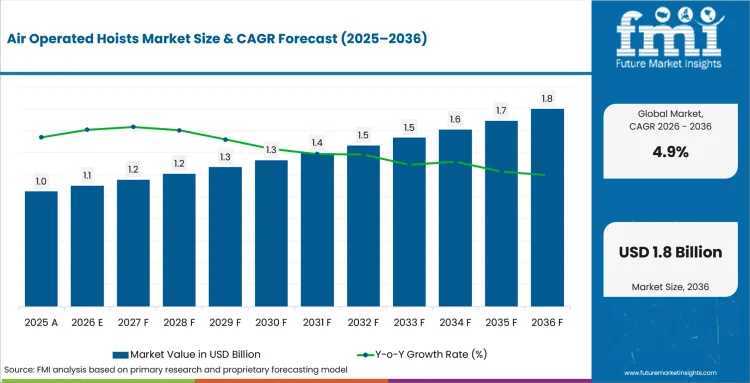
Key Takeaways of Air Operated Hoists Market
- Industrial maintenance and production work sustain demand where repeated lifting requires controllable pneumatic motion across demanding operating environments.
- By hoist type, air chain hoists are estimated to hold 38.0% in 2026 owing to chain architecture spanning routine production and heavy repeat-duty lifting.
- In 2026, the 1-5 ton range is expected to lead load capacity with 42.0% share because common plant loads fit standard runway and trolley arrangements.
- Pendant control is projected to hold 39.0% share in 2026 owing to direct speed command while operators stand clear of suspended loads.
- Compressed-air pressure and filtration requirements can raise commissioning work or weaken operating speed at sites with marginal utility capacity.
- Ingersoll Rand, J.D. Neuhaus, Columbus McKinnon, Kito Crosby, Harrington Hoists, Toku Pneumatic, Red Rooster Lifting, and Tiger Lifting define the controlled company set.
Analyst Perspective
"Air operated hoists should be evaluated around duty cycle and air quality before rated capacity becomes the deciding specification. Commercial advantage comes from proving hazardous-area suitability and supporting inspection or parts access throughout the installed life."
- Nikhil Kaitwade, Principal Consultant, Future Market Insights
How is the Air Operated Hoists Market segmented?
The air operated hoists market is segmented by hoist type, load capacity, control, end use, sales channel and region.
Hoist type covers air chain hoists, air wire rope hoists, air balancers, spark-resistant hoists, and low-headroom air hoists. Load capacity spans below 1 ton through above 20 tons, while control covers pendant, rope, remote, and integrated trolley formats. End use covers manufacturing, oil and gas, shipbuilding, mining, and chemical plants. Sales channels include industrial distributors, direct OEM, rental and service, and MRO channels.
Why do air chain hoists lead demand within the hoist type category?
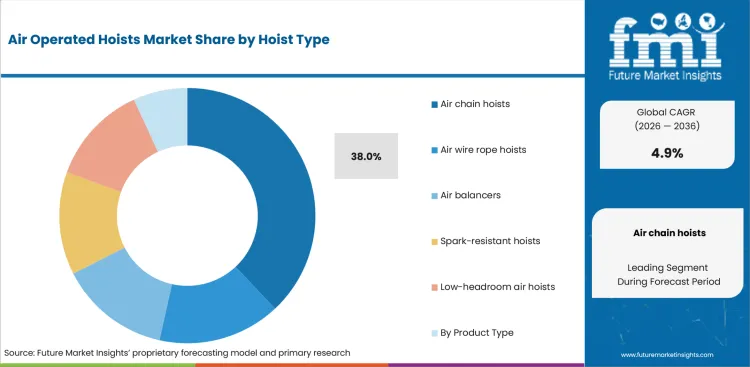
Air chain hoists cover repeated vertical lifting without the reeving layouts needed by many wire rope systems across industrial plants with frequent maintenance cycles. The compact load path also suits trolley mounting in production bays because operators can combine vertical movement with beam travel inside limited headroom and crowded machinery.
- Based on hoist type, air chain hoists are projected to account for 38.0% in 2026 due to one architecture handling routine plant lifting and demanding repeat-duty work.
- Hazardous-area trolley demand extends chain-hoist use beyond fixed hook mounting, and Kito Crosby launched Harrington MCE air-powered trolleys for TCE-IIB Ex certified air hoists in February 2025.
Why does the 1-5 ton range lead the load capacity category?
The 1-5 ton range matches motors and pumps plus tooling assemblies that plants handle during production changes or scheduled maintenance across general manufacturing sites. These loads often fit existing beams and trolley systems without the engineered rigging plans required for heavier offshore decommissioning lifts or major equipment replacements.
- The 1-5 ton range is set to lead the load capacity with 42.0% share in 2026 due to common plant loads fitting standard beams and trolley systems.
- Heavy-capacity orders become more project-specific as load increases, and Kito Crosby expanded Harrington TCK air hoists with new 10-ton and 25-ton models in September 2025.
Why does pendant control lead demand within the control category?
Pendant control gives operators direct speed command from a defined working position beside machinery without requiring a separate wireless control system or dedicated receiver hardware. The hand-held interface also supports emergency-stop functions and fine feathering during steel coil handling or equipment alignment inside crowded production areas with limited operator movement onsite.
- By control, pendant control is forecast to represent 39.0% in 2026 driven by direct speed command during stationary and trolley-mounted lifting.
- Control selection increasingly enters the quotation workflow before engineering review, and J.D. Neuhaus launched an online configurator for selected mini and PROFI air hoists in June 2026.
Why do industrial distributors lead demand within the sales channel category?
Air-hoist orders require beam dimensions and hose routing plus pressure checks before a distributor can release a suitable configuration for a production line or shutdown. Local technical staff can resolve those site details while carrying common accessories and replacement parts for installed units that cannot tolerate long service delays.
- The sales channel is forecast to be led by industrial distributors at 38.0% share in 2026 due to local configuration support and parts access before installation.
- Regional coordination becomes part of channel value after technical questions reach the manufacturer, and J.D. Neuhaus appointed a dedicated South Korea regional contact in May 2026.
What are the drivers, restraints and opportunities in the Air Operated Hoists Market?
Repeated industrial lifting supports demand, compressed-air requirements constrain ownership economics, and local application support creates the clearest revenue route.
- Driver: Repeated plant and project lifts favor pneumatic hoists where controlled motion and high duty cycles justify compressed-air operation.
- Restraint: Air pressure and filtration requirements add installation checks that can reduce speed or increase maintenance at poorly prepared sites.
- Opportunity: Application engineering and regional service convert complex lifting requirements into configured orders with lower commissioning and downtime risk.
Industrial Duty Keeps Pneumatic Lifting Relevant
Industrial activity raises lifting frequency across production lines and maintenance programs that already use plant air. Saudi Arabia's General Authority for Statistics reported in April 2026 that industrial production increased 8.9% year over year during February. Pneumatic equipment gains purchase relevance when repeated lifting occurs alongside compressed-air controls that can sustain pressure during each operating cycle and scheduled shutdown.
Air-System Readiness Raises Ownership Friction
Site fit can block an air-hoist installation even when rated capacity matches the planned lift. Red Rooster Lifting reported in July 2026 that an offshore turbine project used a 6-tonne low-headroom air hoist after its existing crane cradle was condemned. Plants using refrigerated air dryers must still confirm pressure and filtration at the hoist connection before commissioning another pneumatic load.
Regional Support Converts Engineering Need into Revenue
Hazardous-area lifts and low-headroom installations often require more technical work than a catalogue selection alone provides. J.D. Neuhaus reported in July 2026 that its Singapore subsidiary maintained DIN EN ISO 9001:2015 certification for regional quality-management processes. Regional teams combining application checks with compressor rental knowledge can shorten clarification cycles and protect recurring parts or inspection revenue after installation.
Which country CAGRs are profiled in the Air Operated Hoists Market?
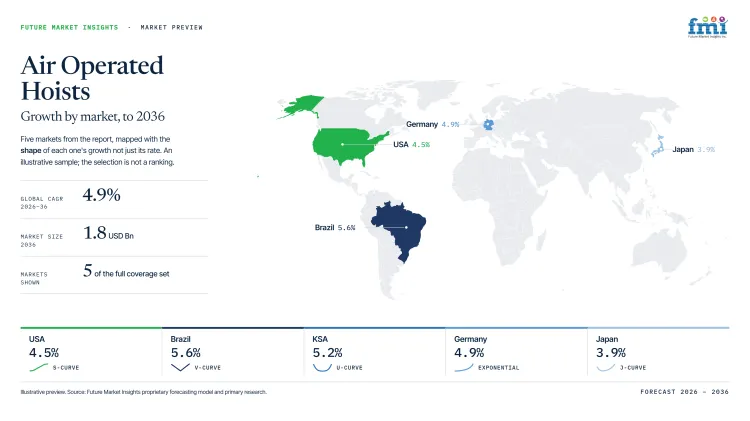
| Country | CAGR |
|---|---|
| Brazil | 5.6% |
| KSA | 5.2% |
| Germany | 4.9% |
| USA | 4.5% |
| Japan | 3.9% |
How do country-level CAGRs compare in the Air Operated Hoists Market?
The forecasts span 1.7 percentage points from Brazil at 5.6% to Japan at 3.9% within the market. Brazil and KSA form the faster group because offshore or hydrocarbon activity keeps heavy maintenance lifting active. Germany and USA occupy the middle range, while Japan reflects a selective automation-led investment pattern.
- Brazil combines offshore production intensity with service requirements around remote maritime assets.
- KSA pairs energy projects with localization rules favoring approved regional supply and support.
- Germany balances replacement demand against ATEX documentation and plant qualification requirements.
- USA spreads replacement orders across manufacturing sites and an offshore maintenance base.
- Japan rewards compact handling equipment that fits automated shipbuilding and production workflows.
CAGR differences describe forecast pace rather than current market scale or installed equipment volume. The full report provides country-level CAGR analysis across North America, Latin America, Europe, East Asia, South Asia, Oceania and the Middle East and Africa.
Country-wise Analysis
- Brazilian offshore maintenance concentrates pneumatic lifting demand around maritime platforms that require corrosion-aware equipment plus service planning for restricted deck layouts and remote schedules where compressed air supports maintenance tools through year-round operations. The air operated hoists market in Brazil is projected to record 5.6% CAGR through 2036, with ANP reporting in May 2026 that maritime fields produced 98% of national oil during March across producing basins. Offshore concentration favors rental access and local repair capacity for urgent lifts during shutdown windows, yet long travel distances raise response costs and reward distributors holding certified parts near major petroleum service hubs.
- Saudi energy projects generate recurring lifting work across plants and maintenance contractors that must buy from approved channels meeting local content expectations plus severe-duty operating requirements across major industrial sites and large turnaround programs. KSA is estimated to post 5.2% CAGR over the forecast period, with Aramco reporting in February 2026 that its iktva program reached 70% local content across goods and services procurement within its Saudi supply network. Regional inventory and application support improve access to approved supply routes during project execution. Documentation requirements can delay new entrants until local distributors establish service capacity and accepted procurement credentials.
- German chemical and process plants route pneumatic hoists through engineering review because hazardous work areas require conformity records plus site documentation before equipment enters routine maintenance service across regulated production facilities and repair planning. Air operated hoist sales in Germany are forecast to expand at 4.9% CAGR by 2036, with Destatis reporting in August 2026 that manufacturing production increased 0.2% during June across the national industrial base. Dense industrial service networks improve inspection and spare-parts access for installed hoists during maintenance cycles. ATEX documentation can extend quotation periods unless manufacturers provide complete technical records before plant approval and service release.
- US demand spans factories and energy operations where local distributors combine air-hoist selection with parts availability plus repair support across widely separated industrial regions and offshore service corridors with different operating conditions and purchasing practices. Demand for air operated hoists in USA is anticipated to rise at 4.5% CAGR during the assessment period, with the US Census Bureau reporting July 2026 durable-goods orders of USD 334.8 billion. The broad industrial base supports replacement orders and stocked configurations across many maintenance sites nationwide.
- Japanese shipyards and manufacturers prioritize compact installation plus precise load control because handling equipment increasingly operates beside structured production cells and restricted assembly areas with limited access for larger lifting systems. Adoption of air operated hoists in Japan is estimated to expand at 3.9% CAGR through 2036, with MLIT launching a Japan-US AI shipbuilding robotics program in July 2026 for production automation and simulation work. Automation investment favors controlled pneumatic handling for defined assembly tasks and repeat service work around modernized production cells, yet manufacturers must fit tighter integration requirements and provide dependable local support before standard use in practice.
Who are the notable companies in the Air Operated Hoists Market?
Ingersoll Rand, J.D. Neuhaus, Columbus McKinnon, Kito Crosby, Harrington Hoists, Toku Pneumatic, Red Rooster Lifting, and Tiger Lifting are the notable companies serving this market.
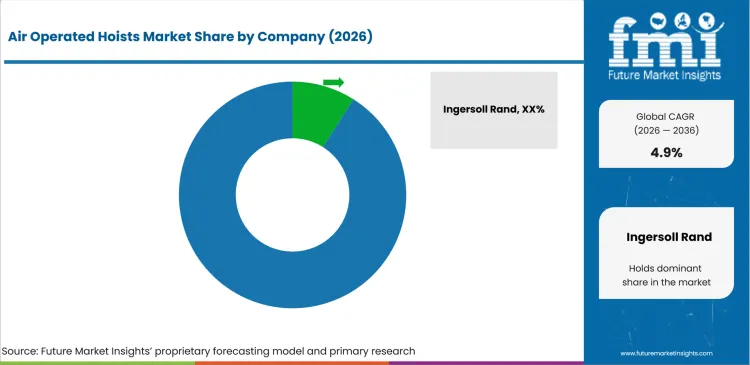
Competition combines broad lifting platforms with pneumatic specialists and regional service providers that sell configured equipment for demanding industrial work. Entry barriers arise from hazardous-area documentation and application engineering plus parts support for equipment connected to the customer's compressed-air supply. Lifecycle service and condensate separators also matter because poor air quality can reduce reliability after a technically correct hoist selection.
- Columbus McKinnon, Kito Crosby, and Harrington Hoists combine broad lifting portfolios with established industrial channels and engineering support.
- J.D. Neuhaus, Ingersoll Rand, and Toku Pneumatic compete with dedicated pneumatic lifting ranges that address varied capacities and operating conditions.
- Red Rooster Lifting and Tiger Lifting differentiate around specialist applications, rental or service access, and regional availability for project-driven work.
Competitive Benchmarking: Air Operated Hoists Market
| Company | Pneumatic Range Breadth | Hazardous-Area Coverage | Service and Configuration | Geographic Reach |
|---|---|---|---|---|
| Ingersoll Rand | High | Medium | Medium | Global |
| J.D. Neuhaus | High | High | High | Global |
| Columbus McKinnon | High | High | High | Global |
| Kito Crosby | High | High | High | Global |
| Harrington Hoists | High | High | High | North America and international sales |
| Toku Pneumatic | Medium | Medium | Medium | Asia and international distributors |
| Red Rooster Lifting | High | High | High | United Kingdom and international offshore |
| Tiger Lifting | High | High | High | Europe, North America, Asia and Middle East |
Key Developments in the Air Operated Hoists Market
- In February 2026, Columbus McKinnon completed its acquisition of Kito Crosby and combined two large lifting portfolios under one corporate platform.
- In September 2025, Tiger Lifting established Tiger MENA in the UAE with pneumatic hoists held in stock for GCC and African customers.
- In May 2025, J.D. Neuhaus opened a Dubai office to strengthen regional coordination and support for Middle East industrial customers.
Key Players in the Air Operated Hoists Market
Broad Lifting Platforms
- Columbus McKinnon
- Kito Crosby
- Harrington Hoists
Pneumatic Hoist Specialists
- Ingersoll Rand
- J.D. Neuhaus
- Toku Pneumatic
Project and Regional Service Providers
- Red Rooster Lifting
- Tiger Lifting
Air Operated Hoists Market - Report Scope
| Coverage field | Report scope |
|---|---|
| Market breakdown | By hoist type, load capacity, control, end use, sales channel and region. |
| Quantitative Units | Revenue in USD billion and CAGR in%. |
| Market Definition | Commercial air-operated or pneumatic hoists and configured hoist-trolley packages where the hoist is the principal lifting product. Electric, manual, hydraulic hoists, cranes, compressors, rigging hardware, and downstream service revenue are excluded. |
| Regions Covered | North America, Latin America, Europe, East Asia, South Asia and Pacific, and Middle East and Africa. |
| Countries Covered | Brazil, KSA, Germany, USA, Japan, and 20+ countries included in the full report. |
| Key Companies Profiled | Ingersoll Rand, J.D. Neuhaus, Columbus McKinnon, Kito Crosby, Harrington Hoists, Toku Pneumatic, Red Rooster Lifting, and Tiger Lifting. |
| Forecast Period | 2026 to 2036. |
| Approach | Primary and secondary research with market triangulation. |
Air Operated Hoists Market - Research Methodology
| Method | Approach |
|---|---|
| Primary Research | FMI analysts gathered input from manufacturers, service providers, technology developers, distributors, end users, procurement teams, and subject-matter experts. Interviews examined purchasing decisions, product or service evaluation, adoption barriers, approval requirements, pricing considerations, and expectations for technical or commercial support. Respondents were also asked what evidence is required before a trial, pilot, or initial order develops into regular purchasing. |
| Desk Research | Desk research covered government statistics, regulatory publications, trade data, industry associations, technical literature, standards, company filings, product information, and official corporate announcements. Sources were reviewed for relevance, publication date, geographic coverage, and consistency with the defined market scope. Claims relating to performance, applications, approvals, capacity, investment, and commercial activity were retained only when supported by credible public evidence. |
| Market Sizing and Forecasting | The market model combined the baseline value with historical performance, segment structure, pricing and volume indicators, adoption levels, company participation, and country-level demand conditions. Forecast assumptions considered economic activity, investment trends, regulatory developments, technology adoption, purchasing cycles, supply availability, and barriers to wider market use. Segment and regional estimates were reconciled before the final market total was calculated. |
| Data Validation | Estimates were checked against multiple independent indicators, including public data, company activity, trade patterns, industry developments, and findings from primary interviews. Validation also tested whether products, services, applications, and company revenues fell within the defined market boundaries. Adjacent categories, unsupported claims, overlapping revenues, and activities without direct market relevance were excluded to reduce double counting and maintain consistency across segments and countries. |
Air Operated Hoists Market by Segments
Air Operated Hoists Market segmented by Hoist Type:
- Air Chain Hoists
- Air Wire Rope Hoists
- Air Balancers
- Spark-Resistant Hoists
- Low-Headroom Air Hoists
Air Operated Hoists Market segmented by Load Capacity:
- 1-5 Ton
- Below 1 Ton
- 5-20 Ton
- Above 20 Ton
Air Operated Hoists Market segmented by Control:
- Pendant Control
- Rope Control
- Remote Control
- Integrated Trolley Control
Air Operated Hoists Market segmented by End Use:
- Manufacturing
- Oil & Gas
- Shipbuilding
- Mining
- Chemical Plants
Air Operated Hoists Market segmented by Sales Channel:
- Industrial Distributors
- Direct OEM
- Rental / Service
- MRO Channel
Air Operated Hoists Market by Region:
- North America
- United States
- Canada
- Latin America
- Brazil
- Mexico
- Chile
- Rest of Latin America
- Western Europe
- Germany
- United Kingdom
- Italy
- Spain
- France
- Nordics
- Benelux
- Rest of Western Europe
- Eastern Europe
- Russia
- Poland
- Hungary
- Balkan and Baltic States
- Rest of Eastern Europe
- East Asia
- China
- Japan
- South Korea
- South Asia and Pacific
- India
- ASEAN
- Australia and New Zealand
- Rest of South Asia and Pacific
- Middle East and Africa
- Kingdom of Saudi Arabia
- Other GCC Countries
- Türkiye
- South Africa
- Other African Union Countries
- Rest of Middle East and Africa
Research Sources and Bibliography
- German Federal Statistical Office (Destatis). (2026, August 6). New orders in manufacturing in June 2026: +3.1% on the previous month.
- USA Energy Information Administration. (2026, March 31). USA crude oil production rose in 2025, setting new record.
- Kito Crosby. (2025, February 24). Kito Crosby Launches New Harrington MCE Air Powered Trolleys for Use with their TCE-IIB Ex Certified Spark Resistant Air Hoists.
- Kito Crosby. (2025, September 8). Kito Crosby Expands Harrington TCK Air Hoist Line with New 10 and 25 Ton Models.
- J.D. Neuhaus. (2026, June 26). New JDN air hoist configurator launched: J.D. Neuhaus expands digital services.
- J.D. Neuhaus. (2026, May 6). J.D. Neuhaus strengthens local support in South Korea with new regional contact.
- General Authority for Statistics. (2026, April 9). Industrial Production Index increases by 8.9% in February 2026.
- Red Rooster Lifting. (2026, July 1). Low Headroom Hoist & Trolleys in Restricted Offshore Access Projects.
- J.D. Neuhaus. (2026, July 2). J.D. Neuhaus Singapore Remains Certified to DIN EN ISO 9001:2015.
- National Agency of Petroleum, Natural Gas and Biofuels (ANP). (2026, May 4). Em março, o Brasil teve produção de 5,531 milhões de barris de óleo equivalente por dia (boe/d) de petróleo e gás natural.
- Saudi Aramco. (2026, February 11). Aramco achieves 70% local content target through flagship iktva program.
- German Federal Statistical Office (Destatis). (2026, August 7). Production in June 2026: +0.2% on the previous month.
- USA Census Bureau. (2026, July 27). Monthly Advance Report on Durable Goods Manufacturers' Shipments, Inventories and Orders.
- Ministry of Land, Infrastructure, Transport and Tourism. (2026, July 17). Japan-USA Joint R&D on AI Shipbuilding Technologies Launches.
- Columbus McKinnon. (2026, February 4). Columbus McKinnon Completes Acquisition of Kito Crosby.
- Tiger Lifting. (2025, September 8). Tiger MENA - Middle East & North Africa is now established.
- J.D. Neuhaus. (2025, May 5). J.D. Neuhaus Group Expands Presence in Middle East with New Office in Dubai.
This bibliography is provided for reader reference and is not exhaustive. The full report contains the complete reference list and detailed citations
This Report Answers
- How large is the air operated hoists market in 2026 and 2036?
- Which industrial operating conditions sustain demand for pneumatic lifting equipment?
- Why do air chain hoists account for 38.0% of hoist type demand in 2026?
- How does the 1-5 ton capacity range align with routine plant lifting requirements?
- Why does pendant control remain a common operating interface for air hoists?
- How do country growth rates differ across the five profiled air operated hoist markets?
- Which companies compete across broad lifting platforms and pneumatic specialist positions?
- What limits purchase conversion when site compressed-air systems are poorly prepared?
- Where do service and application engineering create recurring commercial value?
Frequently Asked Questions
How big is the Air Operated Hoists Market in 2026?
The air operated hoists market is valued at USD 1.1 billion in 2026 and is projected to reach USD 1.8 billion by 2036. Repeated industrial lifting and hazardous-area requirements sustain purchasing where pneumatic duty characteristics fit plant utilities.
What is the CAGR of the Air Operated Hoists Market from 2026 to 2036?
The air operated hoists market is projected to grow at a 4.9% CAGR between 2026 and 2036. Expansion reflects maintenance and replacement demand at industrial sites that can provide the pressure and air quality required for rated hoist performance.
Which hoist type leads the Air Operated Hoists Market?
Air chain hoists are projected to account for 38.0% of the air operated hoists market by hoist type in 2026. Their broad capacity coverage and trolley compatibility suit recurring production and maintenance lifts across industrial sites.
How much value will the Air Operated Hoists Market add between 2026 and 2036?
The air operated hoists market is expected to add USD 0.7 billion in value between 2026 and 2036. The increase reflects recurring industrial maintenance and hazardous-area lifting demand across sites with suitable compressed-air infrastructure.
Which companies are active in the Air Operated Hoists Market?
The air operated hoists market includes Ingersoll Rand, J.D. Neuhaus, Columbus McKinnon, Kito Crosby, Harrington Hoists, Toku Pneumatic, Red Rooster Lifting, and Tiger Lifting. These companies compete through pneumatic range breadth, hazardous-area coverage, and local service support across demanding industrial applications.
Preview the report firsthand - request a free sample
Get SampleGet the brochure for pricing and purchase details.
Get PDFTable of Content
- Key Takeaways
- Market Size and CAGR
- Top Growth Driver
- Fastest Growing Segment
- Leading Region
- Key Companies
- Emerging Opportunities
- Executive Summary
- Global Market Outlook
- Demand-side Trends
- Supply-side Trends
- Technology Roadmap Analysis
- Analysis and Recommendations
- Analyst Perspective (What is happening? Why now? What should investors know?)
- Key Questions Answered
- How large is the market?
- What is the CAGR?
- What are key trends?
- Which region dominates?
- Who are the leaders?
- Market Overview
- Market Coverage / Taxonomy
- Market Definition / Scope / Limitations
- Research Methodology
- Chapter Orientation
- Analytical Lens and Working Hypotheses
- Market Structure, Signals, and Trend Drivers
- Benchmarking and Cross-market Comparability
- Market Sizing, Forecasting, and Opportunity Mapping
- Research Design and Evidence Framework
- Desk Research Programme (Secondary Evidence)
- Expert Input and Fieldwork (Primary Evidence)
- Tooling, Models, and Reference Databases
- Data Engineering and Model Build
- Quality Assurance and Audit Trail
- Market Background
- Market Dynamics (Drivers, Restraints, Opportunity, Trends)
- Scenario Forecast (Optimistic, Likely, Conservative)
- Impact Analysis
- AI Impact
- Sustainability Impact
- Regulatory Impact
- Technology Impact
- Consumer / Buyer Analysis
- Purchase Drivers
- Adoption Barriers
- Buyer Journey
- Opportunity Map Analysis
- Product Life Cycle Analysis
- Supply Chain Analysis
- Investment Feasibility Matrix
- Value Chain Analysis
- PESTLE and Porter's Analysis
- Regulatory Landscape
- Regional Parent Market Outlook
- Production and Consumption Statistics
- Import and Export Statistics
- Global Market Analysis and Forecast, 2021 to 2036
- Historical Market Size Value (USD Billion) Analysis, 2021 to 2025
- Current and Future Market Size Value (USD Billion) Projections, 2026 to 2036
- Y-o-Y Growth Trend Analysis
- Absolute $ Opportunity Analysis
- Global Market Pricing Analysis, 2021 to 2036
- Global Market Analysis and Forecast, By Hoist Type, 2021 to 2036
- Introduction / Key Findings
- Historical Market Size Value (USD Billion) Analysis By Hoist Type, 2021 to 2025
- Current and Future Market Size Value (USD Billion) Analysis and Forecast By Hoist Type, 2026 to 2036
- Air chain hoists
- Air wire rope hoists
- Air balancers
- Spark-resistant hoists
- Low-headroom air hoists
- By Product Type
- Air chain hoists
- Y-o-Y Growth Trend Analysis By Hoist Type, 2021 to 2025
- Absolute $ Opportunity Analysis By Hoist Type, 2026 to 2036
- Global Market Analysis and Forecast, By Load Capacity, 2021 to 2036
- Introduction / Key Findings
- Historical Market Size Value (USD Billion) Analysis By Load Capacity, 2021 to 2025
- Current and Future Market Size Value (USD Billion) Analysis and Forecast By Load Capacity, 2026 to 2036
- 1-5 ton
- Below 1 ton
- 5-20 ton
- Above 20 ton
- By Pressure Range
- 1-5 ton
- Y-o-Y Growth Trend Analysis By Load Capacity, 2021 to 2025
- Absolute $ Opportunity Analysis By Load Capacity, 2026 to 2036
- Global Market Analysis and Forecast, By Control, 2021 to 2036
- Introduction / Key Findings
- Historical Market Size Value (USD Billion) Analysis By Control, 2021 to 2025
- Current and Future Market Size Value (USD Billion) Analysis and Forecast By Control, 2026 to 2036
- Pendant control
- Rope control
- Remote control
- Integrated trolley control
- By Material
- Pendant control
- Y-o-Y Growth Trend Analysis By Control, 2021 to 2025
- Absolute $ Opportunity Analysis By Control, 2026 to 2036
- Global Market Analysis and Forecast, By End Use, 2021 to 2036
- Introduction / Key Findings
- Historical Market Size Value (USD Billion) Analysis By End Use, 2021 to 2025
- Current and Future Market Size Value (USD Billion) Analysis and Forecast By End Use, 2026 to 2036
- Manufacturing
- Oil & gas
- Shipbuilding
- Mining
- Chemical plants
- By Application
- Manufacturing
- Y-o-Y Growth Trend Analysis By End Use, 2021 to 2025
- Absolute $ Opportunity Analysis By End Use, 2026 to 2036
- Global Market Analysis and Forecast, By Sales Channel, 2021 to 2036
- Introduction / Key Findings
- Historical Market Size Value (USD Billion) Analysis By Sales Channel, 2021 to 2025
- Current and Future Market Size Value (USD Billion) Analysis and Forecast By Sales Channel, 2026 to 2036
- Industrial distributors
- Direct OEM
- Rental / service
- MRO channel
- By Sales Channel
- Industrial distributors
- Y-o-Y Growth Trend Analysis By Sales Channel, 2021 to 2025
- Absolute $ Opportunity Analysis By Sales Channel, 2026 to 2036
- Global Market Analysis and Forecast, By Region, 2021 to 2036
- Introduction
- Historical Market Size Value (USD Billion) Analysis By Region, 2021 to 2025
- Current Market Size Value (USD Billion) Analysis and Forecast By Region, 2026 to 2036
- North America
- Latin America
- Western Europe
- Eastern Europe
- East Asia
- South Asia and Pacific
- Middle East & Africa
- Market Attractiveness Analysis By Region
- North America Market Analysis and Forecast, By Country, 2021 to 2036
- Historical Market Size Value (USD Billion) Trend Analysis By Market Taxonomy, 2021 to 2025
- Market Size Value (USD Billion) Forecast By Market Taxonomy, 2026 to 2036
- By Country
- USA
- Canada
- By Hoist Type
- By Load Capacity
- By Control
- By End Use
- By Sales Channel
- By Country
- Market Attractiveness Analysis
- By Country
- By Hoist Type
- By Load Capacity
- By Control
- By End Use
- By Sales Channel
- Key Takeaways
- Latin America Market Analysis and Forecast, By Country
- Historical Market Size Value (USD Billion) Trend Analysis By Market Taxonomy, 2021 to 2025
- Market Size Value (USD Billion) Forecast By Market Taxonomy, 2026 to 2036
- By Country
- Brazil
- Mexico
- Chile
- Rest of Latin America
- By Hoist Type
- By Load Capacity
- By Control
- By End Use
- By Sales Channel
- By Country
- Market Attractiveness Analysis
- By Country
- By Hoist Type
- By Load Capacity
- By Control
- By End Use
- By Sales Channel
- Key Takeaways
- Western Europe Market Analysis and Forecast, By Country
- Historical Market Size Value (USD Billion) Trend Analysis By Market Taxonomy, 2021 to 2025
- Market Size Value (USD Billion) Forecast By Market Taxonomy, 2026 to 2036
- By Country
- Germany
- UK
- Italy
- Spain
- France
- Nordic
- BENELUX
- Rest of Western Europe
- By Hoist Type
- By Load Capacity
- By Control
- By End Use
- By Sales Channel
- By Country
- Market Attractiveness Analysis
- By Country
- By Hoist Type
- By Load Capacity
- By Control
- By End Use
- By Sales Channel
- Key Takeaways
- Eastern Europe Market Analysis and Forecast, By Country
- Historical Market Size Value (USD Billion) Trend Analysis By Market Taxonomy, 2021 to 2025
- Market Size Value (USD Billion) Forecast By Market Taxonomy, 2026 to 2036
- By Country
- Russia
- Poland
- Hungary
- Balkan & Baltic
- Rest of Eastern Europe
- By Hoist Type
- By Load Capacity
- By Control
- By End Use
- By Sales Channel
- By Country
- Market Attractiveness Analysis
- By Country
- By Hoist Type
- By Load Capacity
- By Control
- By End Use
- By Sales Channel
- Key Takeaways
- East Asia Market Analysis and Forecast, By Country
- Historical Market Size Value (USD Billion) Trend Analysis By Market Taxonomy, 2021 to 2025
- Market Size Value (USD Billion) Forecast By Market Taxonomy, 2026 to 2036
- By Country
- China
- Japan
- South Korea
- By Hoist Type
- By Load Capacity
- By Control
- By End Use
- By Sales Channel
- By Country
- Market Attractiveness Analysis
- By Country
- By Hoist Type
- By Load Capacity
- By Control
- By End Use
- By Sales Channel
- Key Takeaways
- South Asia and Pacific Market Analysis and Forecast, By Country
- Historical Market Size Value (USD Billion) Trend Analysis By Market Taxonomy, 2021 to 2025
- Market Size Value (USD Billion) Forecast By Market Taxonomy, 2026 to 2036
- By Country
- India
- ASEAN
- Australia & New Zealand
- Rest of South Asia and Pacific
- By Hoist Type
- By Load Capacity
- By Control
- By End Use
- By Sales Channel
- By Country
- Market Attractiveness Analysis
- By Country
- By Hoist Type
- By Load Capacity
- By Control
- By End Use
- By Sales Channel
- Key Takeaways
- Middle East & Africa Market Analysis and Forecast, By Country
- Historical Market Size Value (USD Billion) Trend Analysis By Market Taxonomy, 2021 to 2025
- Market Size Value (USD Billion) Forecast By Market Taxonomy, 2026 to 2036
- By Country
- Kingdom of Saudi Arabia
- Other GCC Countries
- Türkiye
- South Africa
- Other African Union
- Rest of Middle East & Africa
- By Hoist Type
- By Load Capacity
- By Control
- By End Use
- By Sales Channel
- By Country
- Market Attractiveness Analysis
- By Country
- By Hoist Type
- By Load Capacity
- By Control
- By End Use
- By Sales Channel
- Key Takeaways
- Key Countries Market Analysis
- USA
- Pricing Analysis
- Market Share Analysis, 2025
- By Hoist Type
- By Load Capacity
- By Control
- By End Use
- By Sales Channel
- Canada
- Pricing Analysis
- Market Share Analysis, 2025
- By Hoist Type
- By Load Capacity
- By Control
- By End Use
- By Sales Channel
- Mexico
- Pricing Analysis
- Market Share Analysis, 2025
- By Hoist Type
- By Load Capacity
- By Control
- By End Use
- By Sales Channel
- Brazil
- Pricing Analysis
- Market Share Analysis, 2025
- By Hoist Type
- By Load Capacity
- By Control
- By End Use
- By Sales Channel
- Chile
- Pricing Analysis
- Market Share Analysis, 2025
- By Hoist Type
- By Load Capacity
- By Control
- By End Use
- By Sales Channel
- Germany
- Pricing Analysis
- Market Share Analysis, 2025
- By Hoist Type
- By Load Capacity
- By Control
- By End Use
- By Sales Channel
- UK
- Pricing Analysis
- Market Share Analysis, 2025
- By Hoist Type
- By Load Capacity
- By Control
- By End Use
- By Sales Channel
- Italy
- Pricing Analysis
- Market Share Analysis, 2025
- By Hoist Type
- By Load Capacity
- By Control
- By End Use
- By Sales Channel
- Spain
- Pricing Analysis
- Market Share Analysis, 2025
- By Hoist Type
- By Load Capacity
- By Control
- By End Use
- By Sales Channel
- France
- Pricing Analysis
- Market Share Analysis, 2025
- By Hoist Type
- By Load Capacity
- By Control
- By End Use
- By Sales Channel
- India
- Pricing Analysis
- Market Share Analysis, 2025
- By Hoist Type
- By Load Capacity
- By Control
- By End Use
- By Sales Channel
- ASEAN
- Pricing Analysis
- Market Share Analysis, 2025
- By Hoist Type
- By Load Capacity
- By Control
- By End Use
- By Sales Channel
- Australia & New Zealand
- Pricing Analysis
- Market Share Analysis, 2025
- By Hoist Type
- By Load Capacity
- By Control
- By End Use
- By Sales Channel
- China
- Pricing Analysis
- Market Share Analysis, 2025
- By Hoist Type
- By Load Capacity
- By Control
- By End Use
- By Sales Channel
- Japan
- Pricing Analysis
- Market Share Analysis, 2025
- By Hoist Type
- By Load Capacity
- By Control
- By End Use
- By Sales Channel
- South Korea
- Pricing Analysis
- Market Share Analysis, 2025
- By Hoist Type
- By Load Capacity
- By Control
- By End Use
- By Sales Channel
- Russia
- Pricing Analysis
- Market Share Analysis, 2025
- By Hoist Type
- By Load Capacity
- By Control
- By End Use
- By Sales Channel
- Poland
- Pricing Analysis
- Market Share Analysis, 2025
- By Hoist Type
- By Load Capacity
- By Control
- By End Use
- By Sales Channel
- Hungary
- Pricing Analysis
- Market Share Analysis, 2025
- By Hoist Type
- By Load Capacity
- By Control
- By End Use
- By Sales Channel
- Kingdom of Saudi Arabia
- Pricing Analysis
- Market Share Analysis, 2025
- By Hoist Type
- By Load Capacity
- By Control
- By End Use
- By Sales Channel
- Türkiye
- Pricing Analysis
- Market Share Analysis, 2025
- By Hoist Type
- By Load Capacity
- By Control
- By End Use
- By Sales Channel
- South Africa
- Pricing Analysis
- Market Share Analysis, 2025
- By Hoist Type
- By Load Capacity
- By Control
- By End Use
- By Sales Channel
- USA
- Market Structure Analysis
- Competition Dashboard
- Competition Benchmarking
- Market Share Analysis of Top Players
- By Regional
- By Hoist Type
- By Load Capacity
- By Control
- By End Use
- By Sales Channel
- Emerging Startups
- Innovation Benchmarking
- Competition Analysis
- Competition Deep Dive
- Ingersoll Rand
- Overview
- Product Portfolio
- Profitability by Market Segments
- Sales Footprint
- Strategy Overview
- Marketing Strategy
- Product Strategy
- Channel Strategy
- J.D. Neuhaus
- Kito Crosby
- Columbus McKinnon
- Toku Pneumatic
- Red Rooster Lifting
- Harrington Hoists
- Tiger Lifting
- Yale Hoists
- KHC
- Ingersoll Rand
- Case Studies
- Success Stories
- Recent Developments
- Competition Deep Dive
- Assumptions & Acronyms Used


