

- Industry Size (2026):
- USD 1.9 Bn
- Forecast (2036)
- USD 3.2 Bn
- CAGR (2026 to 2036)
- 5.2%
Refrigerant Compressed Air Dryers Market Forecast and Outlook 2026 to 2036
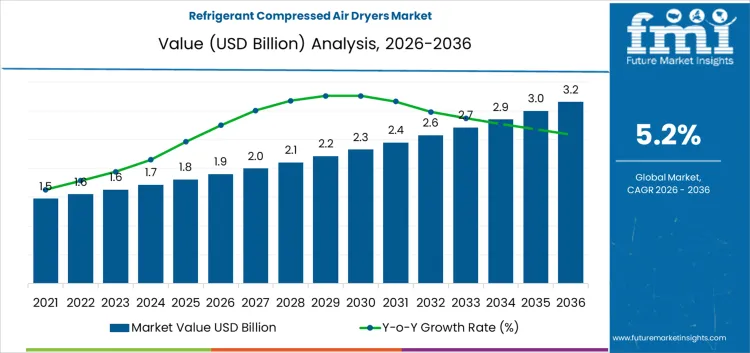
The refrigerant compressed air dryers market is growing from USD 1.9 billion in 2026 and is projected to reach USD 3.2 billion by 2036, reflecting a CAGR of 5.20%. Early demand is shaped by the spread of pneumatic equipment in packaging, food processing, electronics, and general manufacturing. Dryer selection follows compressor sizing, duty cycles, and ambient conditions, which fixes capacity choices for long periods. Purchasing decisions focus on operating stability, service access, and predictable performance under continuous load.
As the period progresses, buying behavior becomes more influenced by operating cost control and maintenance planning. Energy consumption and service intervals receive closer scrutiny as plants standardize utility systems across multiple sites. Replacement demand grows from the large installed base built during earlier automation cycles. Supplier changes remain limited because dryers are integrated into validated air systems and pipe layouts. Pricing remains competitive, though minimum performance thresholds restrict specification downgrades. Capacity expansion follows industrial production trends and factory upgrades. The market maintains steady growth, supported by routine compliance needs and the structural dependence of manufacturing on compressed air reliability.
Quick Stats of the Refrigerant Compressed Air Dryers Market
- Refrigerant Compressed Air Dryers Market Value (2026): USD 1.9 billion
- Refrigerant Compressed Air Dryers Forecast Value (2036): USD 3.2 billion
- Refrigerant Compressed Air Dryers Market Forecast CAGR 2026 to 2036: 5.2%
- Leading Dryer Configuration in Refrigerant Compressed Air Dryers Market: Cycling Refrigerated Dryers (46% share)
- Leading Capacity Class in Refrigerant Compressed Air Dryers Market: Up to 50 SCFM (22% share)
- Key Growth Regions in Refrigerant Compressed Air Dryers Market: India, Indonesia, Vietnam, Mexico, USA
- Top Players in Refrigerant Compressed Air Dryers Market: Atlas Copco, Ingersoll Rand, Parker Hannifin, Kaeser Kompressoren, SPX FLOW, Donaldson Company, Beko Technologies, Sullair (Hitachi), FS-Curtis, Regional Manufacturers
What is the Growth Forecast for Refrigerant Compressed Air Dryers Market through 2036?
Between 2026 and 2031, the refrigerant compressed air dryers market is projected to grow from USD 1.9 billion along a steady path consistent with a 5.2% CAGR, shaped by the way compressed air quality standards are enforced inside production environments. In many factories, moisture control is not a productivity upgrade but a prerequisite for tool reliability, surface finish, and process stability. Cycling and non-cycling dryers coexist because users optimize for different load profiles and energy costs. Demand is tied more closely to plant uptime requirements and maintenance policies than to headline capital spending cycles. Purchases frequently ride along with compressor installations or capacity expansions, which explains the strong influence of OEM sales networks in this category.
From 2031 to 2036, the market is expected to reach USD 3.2 billion, with growth driven by incremental tightening of quality requirements across food, beverage, and precision manufacturing rather than by sudden changes in factory design. Integrated dryer-compressor packages gain relevance where space, installation time, and service coordination matter more than standalone equipment optimization. Larger capacity systems become more common as production lines consolidate and scale. Buying decisions increasingly factor lifecycle energy cost and service accessibility instead of only purchase price. Competitive positioning rests on installed base, service coverage, and integration with compressor portfolios, supporting players such as Atlas Copco, Ingersoll Rand, Parker Hannifin, Kaeser Kompressoren, SPX FLOW, Donaldson Company, Beko Technologies, Sullair (Hitachi), FS-Curtis, and regional manufacturers.
Refrigerant Compressed Air Dryers Market Key Takeaways
| Metric | Value |
|---|---|
| Market Value (2026) | USD 1.9 billion |
| Forecast Value (2036) | USD 3.2 billion |
| Forecast CAGR 2026 to 2036 | 5.2% |
How Are Refrigerant Compressed Air Dryers Optimizing Industrial Air Systems?
Refrigerant compressed air dryers are increasingly adopted to remove moisture from compressed air systems, preventing corrosion, contamination, and equipment malfunction across industrial operations. Historically, compressed air systems relied on manual or basic moisture separation methods, which often allowed water vapor to accumulate, reducing system reliability and increasing maintenance requirements. Modern refrigerant dryers use cooling coils, condensate removal mechanisms, and thermostatic controls to efficiently lower air temperature, condense moisture, and maintain consistent dew points. Industrial manufacturers, process engineers, and facility managers prioritize drying efficiency, energy consumption, and reliability under continuous operation. Early adoption focused on high-precision manufacturing and food processing facilities, while current demand spans automotive plants, pharmaceuticals, and general industrial applications, driven by equipment protection, product quality standards, and operational efficiency. Dew point stability, energy efficiency, and maintenance requirements influence supplier selection.
Rising industrial automation, quality control standards, and equipment longevity requirements are shaping market growth. Compared with conventional moisture separation methods, modern refrigerant compressed air dryers emphasize precise temperature control, consistent moisture removal, and low energy consumption. Cost structures depend on refrigerant system quality, heat exchange efficiency, and maintenance design, concentrating margins among suppliers capable of delivering reliable, high-performance solutions. Manufacturers and plant operators adopt these dryers to reduce system corrosion, prevent product contamination, and maintain operational efficiency. By 2036, refrigerant compressed air dryers are expected to become standard across industrial sectors, supporting equipment reliability, consistent air quality, and process efficiency.
What Factors Are Shaping the Demand for Refrigerant Compressed Air Dryers by Operating Mode and Capacity Class in 2026?
The refrigerant compressed air dryers market in 2026 is segmented by dryer configuration and by capacity range. By operating mode, demand is divided into cycling refrigerated dryers, non-cycling refrigerated dryers, integrated dryer compressor packages, and other formats that differ in energy management, control complexity, and installation approach. By capacity, demand is organized around units Up to 50 SCFM, 50 to 300 scfm, above 300 scfm, and other ranges that reflect plant size and air system architecture. These segments reflect how operators balance moisture removal needs, power consumption, reliability expectations, and space constraints across diverse industrial and workshop environments.
Why Do Cycling Refrigerated Dryers Lead in Overall Installations?
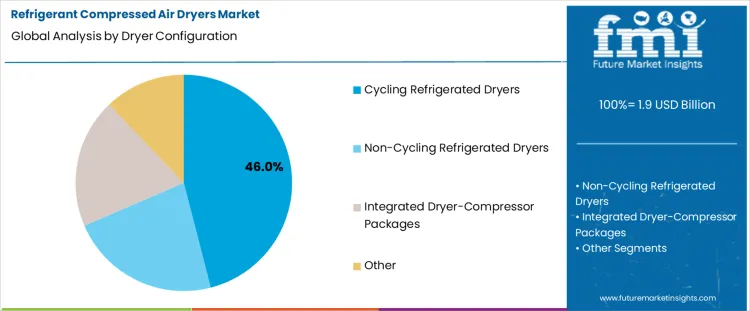
Cycling refrigerated dryers account for about 46% of demand in 2026, reflecting their advantage in reducing energy use during partial load operation. These systems switch their refrigeration circuits on and off in response to air demand, which lowers power consumption in facilities with variable usage patterns. Many workshops and small to mid-sized plants do not run compressors at constant full load, making energy modulation an important cost control lever. Cycling designs also reduce wear on refrigeration components during low demand periods, which can extend service intervals. Their control systems have matured to the point where reliability concerns are limited. This combination of operating cost savings and acceptable complexity supports their leading position across a wide range of applications.
Non-cycling dryers and integrated packages serve more stable or space constrained installations. Non-cycling units maintain constant refrigeration, which suits processes with steady air demand and simplifies control logic at the expense of higher energy use. Integrated dryer compressor packages appeal where floor space is limited or where a single supplier solution reduces installation work. These configurations trade flexibility for simplicity and compactness. Their adoption depends on operating patterns, maintenance preferences, and layout constraints rather than on pure energy efficiency. As a result, they remain important options but do not displace cycling dryers as the default choice in mixed use and variable load environments.
Why Do Small Capacity Units Dominate in Unit Volumes?
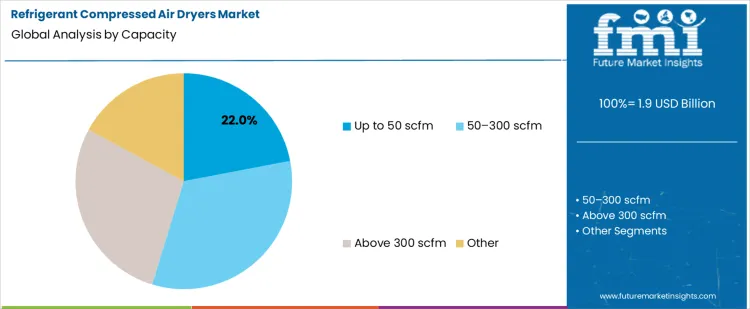
Units Up to 50 SCFM represent about 22% of demand in 2026 because they serve the large population of small workshops, service centers, and decentralized air points. Many facilities operate multiple small compressors close to the point of use rather than a single central system, which multiplies the number of low capacity dryers required. These units are easy to install, require limited electrical infrastructure, and are often purchased as standard accessories with compressors. Replacement cycles are also shorter in this segment because equipment is exposed to harsher handling and less formal maintenance. This high site count and frequent turnover explain why small capacity dryers lead in unit shipments even though their individual value is modest.
The 50 to 300 scfm and above 300 scfm segments represent progressively larger, more centralized air systems. These installations serve production lines or whole plants, which reduces the number of dryers needed per site. Their equipment is specified through engineering projects with longer planning cycles and higher emphasis on redundancy and service contracts. Although these units account for a large share of installed air treatment capacity, their purchase frequency is lower. Demand in these classes tracks industrial investment cycles rather than routine replacement, which keeps their unit volumes below those of the small capacity segment despite higher per unit prices.
Why Are Moisture Control Economics and Equipment Protection Standards Sustaining Demand for Refrigerant Compressed Air Dryers through 2036?
Demand is anchored in risk avoidance rather than in production expansion. In manufacturing, moisture in compressed air causes corrosion, product defects, and control failures that can shut down entire lines. Refrigerant dryers offer a predictable, low operating cost way to meet standard dew point requirements across most general industrial applications. Many plants treat them as baseline infrastructure tied to compressor installations rather than optional upgrades. As equipment becomes more automated and sensor dependent, tolerance for air quality variation shrinks. Even when factories limit capital spending, they still replace or maintain dryers because the cost of moisture related failure far exceeds the cost of the drying system.
What Energy Cost, Performance Limits, and Application Boundaries Are Constraining Market Expansion?
Limits come from where the technology fits. Refrigerant dryers cannot achieve very low dew points, which excludes them from pharmaceutical, food freeze, or outdoor winter operations that require desiccant systems. They also add continuous electrical load to compressed air systems, making them targets for energy audits and cost cutting programs. In smaller plants, operators sometimes accept higher moisture risk to avoid the upfront expense. Heat exchanger fouling and refrigerant circuit maintenance also raise lifecycle cost concerns. These factors cap their role to general purpose applications and prevent them from capturing share in higher specification or extreme environment use cases.
How Are Compressed Air System Optimization and Environmental Rules Changing This Category?
Change is coming from system level thinking. Plants increasingly view compressors, dryers, and filters as one efficiency problem rather than separate purchases. This favors right sized dryers, better cycling controls, and closer integration with compressor load management. Environmental rules around refrigerants are also pushing redesign of cooling circuits and fluid choices, which affects cost and service practices. Some users adopt hybrid layouts, using refrigerant dryers for base load and desiccant units for critical lines. The category is becoming more segmented by duty profile and more tightly engineered into overall compressed air performance strategies rather than bought as a standalone utility accessory.
What is the Demand for Refrigerant Compressed Air Dryers by Country?
| Country | CAGR (%) |
|---|---|
| India | 6.4% |
| Indonesia | 6.0% |
| Vietnam | 5.8% |
| Mexico | 5.5% |
| USA | 3.3% |
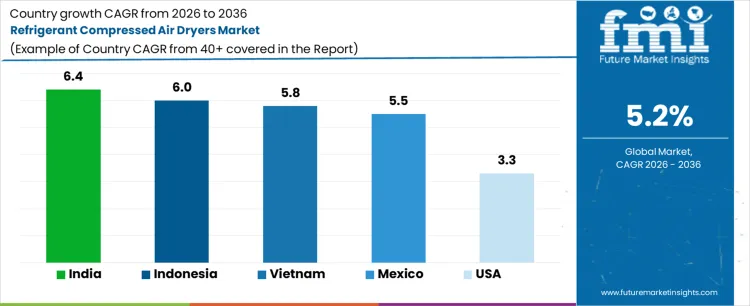
Demand for refrigerant compressed air dryers is rising as industrial facilities and manufacturing plants adopt solutions to remove moisture from compressed air, ensuring operational efficiency, equipment longevity, and product quality. India leads with a 6.4% CAGR, driven by expanding manufacturing sectors, infrastructure growth, and rising adoption of compressed air systems. Indonesia follows at 6.0%, supported by industrial automation and growth in manufacturing facilities. Vietnam records 5.8% growth, shaped by increasing industrial production and maintenance of air quality in pneumatic systems. Mexico grows at 5.5%, influenced by industrial equipment modernization. The USA shows 3.3% CAGR, reflecting mature markets with stable demand and replacement cycles.
How is India experiencing growth in the refrigerant compressed air dryers market?
India is experiencing growth at a CAGR of 6.4%, supported by adoption of refrigerant compressed air dryers to improve compressed air quality, system efficiency, and industrial equipment reliability. Manufacturers and suppliers are producing dryers optimized for moisture removal, energy efficiency, and integration with industrial compressed air systems. Demand is concentrated in manufacturing hubs, industrial plants, and process industries. Investments focus on material durability, operational performance, and compliance with industrial standards rather than fleet-scale deployment. Growth reflects increasing industrial activity, adoption of reliable compressed air solutions, and focus on energy-efficient operations in manufacturing and processing sectors.
- Compressed air quality drives adoption.
- Dryers optimize moisture removal and energy efficiency.
- Manufacturing hubs and industrial plants concentrate demand.
- Material durability and standards compliance guide investment.
How is Indonesia witnessing growth in the refrigerant compressed air dryers market?
Indonesia is witnessing growth at a CAGR of 6%, fueled by adoption of refrigerant compressed air dryers to enhance air system efficiency, equipment reliability, and moisture control in industrial processes. Manufacturers and suppliers are deploying dryers optimized for high moisture removal, energy-efficient operation, and compatibility with compressed air systems. Demand is concentrated in industrial manufacturing hubs, production facilities, and process plants. Investments prioritize material performance, operational reliability, and adherence to industrial standards rather than large-scale deployment. Growth reflects industrial adoption of energy-efficient air systems and focus on equipment performance.
- Industrial efficiency drives adoption.
- Dryers improve moisture removal and energy performance.
- Manufacturing hubs and production facilities concentrate demand.
- Material performance and standards compliance guide investment.
How is Vietnam experiencing growth in the refrigerant compressed air dryers market?
Vietnam is experiencing growth at a CAGR of 5.8%, supported by adoption of refrigerant compressed air drying equipment to ensure compressed air quality, operational reliability, and energy efficiency in industrial applications. Manufacturers and suppliers are producing dryers optimized for moisture control, durability, and seamless integration with compressed air networks. Demand is concentrated in manufacturing plants, industrial facilities, and process industries. Investments focus on material performance, system reliability, and compliance with industrial standards rather than fleet-scale deployment. Growth reflects moderate industrial activity, adoption of high-quality compressed air systems, and focus on energy-efficient operation.
- Compressed air reliability drives adoption.
- Dryers enhance moisture control and durability.
- Manufacturing plants and industrial facilities concentrate demand.
- Material performance and standards compliance guide investment.
How is Mexico witnessing growth in the refrigerant compressed air dryers market?
Mexico is witnessing growth at a CAGR of 5.5%, fueled by adoption of refrigerant compressed air dryers to improve compressed air quality, operational reliability, and industrial equipment performance. Manufacturers and suppliers are deploying dryers optimized for moisture removal, durability, and integration with industrial air systems. Demand is concentrated in manufacturing hubs, process plants, and industrial facilities. Investments prioritize material performance, energy efficiency, and compliance with industrial standards rather than large-scale deployment. Growth reflects industrial adoption of reliable compressed air solutions, moderate manufacturing activity, and focus on operational efficiency.
- Compressed air quality drives adoption.
- Dryers optimize moisture removal and system durability.
- Manufacturing hubs and process plants concentrate demand.
- Material performance and standards compliance guide investment.
How is the United States experiencing growth in the refrigerant compressed air dryers market?
United States is experiencing growth at a CAGR of 3.3%, supported by adoption of refrigerant compressed air dryers to enhance compressed air quality, system efficiency, and industrial equipment longevity. Manufacturers and suppliers are producing dryers optimized for moisture removal, material durability, and integration with industrial compressed air systems. Demand is concentrated in manufacturing hubs, industrial plants, and process facilities. Investments focus on operational reliability, energy efficiency, and compliance with industrial standards rather than large-scale deployment. Growth reflects moderate industrial activity, adoption of high-quality compressed air systems, and emphasis on energy-efficient operations.
- Compressed air efficiency drives adoption.
- Dryers enhance moisture removal and durability.
- Manufacturing hubs and industrial plants concentrate demand.
- Operational reliability and compliance guide investment.
Who Competes in the Refrigerant Compressed Air Dryers Market and What Defines Their Capabilities?
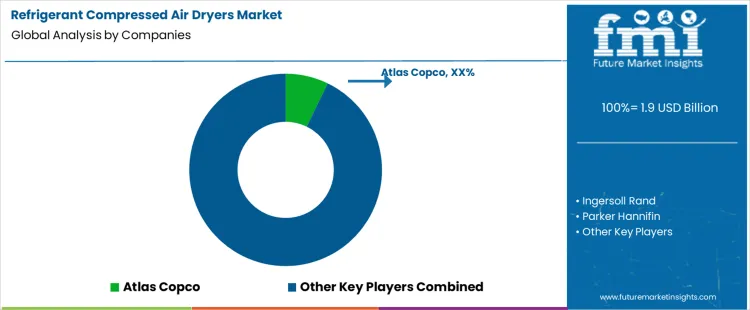
Competition in the refrigerant compressed air dryers market is defined by moisture removal efficiency, energy consumption, and reliability in industrial compressed air systems. Atlas Copco supplies dryers engineered for consistent pressure dew point, low energy use, and long service life in manufacturing and process industries. Ingersoll Rand develops dryers optimized for high-capacity air treatment, corrosion resistance, and easy maintenance. Parker Hannifin provides refrigerant dryers designed for precision moisture control and compatibility with existing compressed air networks. Kaeser Kompressoren delivers units with energy-efficient refrigeration circuits and robust industrial performance. SPX FLOW supplies compact and modular dryers for diverse industrial applications.
Donaldson Company provides dryers with integrated filtration and corrosion-resistant components. Beko Technologies delivers energy-efficient dryers with stable pressure dew point output. Sullair (Hitachi) supplies refrigerant dryers optimized for continuous operation and high-capacity applications. FS-Curtis provides reliable dryers for industrial and commercial settings. Other regional manufacturers focus on cost-effective, energy-efficient solutions with varying capacity ranges. Competitive differentiation arises from moisture removal efficiency, energy consumption, maintenance requirements, durability, and compatibility with industrial compressed air systems. Suppliers offering reliable, energy-efficient, and robust dryers maintain strong positioning in global industrial applications.
Key Players in the Refrigerant Compressed Air Dryers Market
- Atlas Copco
- Ingersoll Rand
- Parker Hannifin
- Kaeser Kompressoren
- SPX FLOW
- Donaldson Company
- Beko Technologies
- Sullair (Hitachi)
- FS-Curtis
- Regional Manufacturers
Scope of the Report
| Items | Values |
|---|---|
| Quantitative Units (2026) | USD billion |
| Dryer Configuration | Cycling Refrigerated Dryers, Non-Cycling Refrigerated Dryers, Integrated Dryer-Compressor Packages, Other |
| Capacity | Up to 50 SCFM, 50–300 scfm, Above 300 scfm, Other |
| End Use | Manufacturing, Automotive & Metalworking, Food & Beverage, Others |
| Sales Channel | Compressor OEM Networks, Distributors, System Integrators, Other |
| Regions Covered | Asia Pacific, Europe, North America, Latin America, Middle East & Africa |
| Countries Covered | China, Japan, South Korea, India, Australia & New Zealand, ASEAN, Germany, United Kingdom, France, Italy, Spain, Nordic, BENELUX, United States, Canada, Mexico, Brazil, Chile, Saudi Arabia, Turkey, South Africa, and other regional markets |
| Key Companies Profiled | Atlas Copco, Ingersoll Rand, Parker Hannifin, Kaeser Kompressoren, SPX FLOW, Donaldson Company, Beko Technologies, Sullair (Hitachi), FS-Curtis, and regional manufacturers |
| Additional Attributes | Dollar sales by dryer configuration, capacity, end use, and sales channel, demand anchored in moisture control as a reliability requirement rather than discretionary upgrade, strong linkage of dryer purchases to compressor installations and plant uptime policies, large installed base driving replacement demand, cycling dryers favored for variable load energy savings, small capacity units dominating unit volumes due to decentralized air points, integrated dryer-compressor packages gaining relevance where space and service coordination matter, technology limited to general purpose dew point ranges, and procurement influenced by lifecycle energy cost, service coverage, and integration with compressor portfolios. |
Refrigerant Compressed Air Dryers Market Segmentation
Dryer Configuration:
- Cycling Refrigerated Dryers
- Non-Cycling Refrigerated Dryers
- Integrated Dryer-Compressor Packages
- Other
Capacity:
- Up to 50 SCFM
- 50–300 scfm
- Above 300 scfm
- Other
End Use:
- Manufacturing
- Automotive & Metalworking
- Food & Beverage
- Others
Sales Channel:
- Compressor OEM Networks
- Distributors
- System Integrators
- Other
Region
Asia Pacific
- China
- Japan
- South Korea
- India
- Australia & New Zealand
- ASEAN
- Rest of Asia Pacific
Europe
- Germany
- United Kingdom
- France
- Italy
- Spain
- Nordic
- BENELUX
- Rest of Europe
North America
- United States
- Canada
- Mexico
Latin America
- Brazil
- Chile
- Rest of Latin America
Middle East & Africa
- Kingdom of Saudi Arabia
- Other GCC Countries
- Turkey
- South Africa
- Rest of African Union
- Rest of Middle East & Africa
Bibliography
- European Parliament, & Council of the European Union. (2024). Regulation (EU) 2024/573 of 7 February 2024 on fluorinated greenhouse gases and repealing Regulation (EU) No 517/2014. Official Journal of the European Union.
- U.S. Environmental Protection Agency. (2024). Phasedown of hydrofluorocarbons: October 2023 final rule (Fact sheet, updated December 2024). U.S. Environmental Protection Agency.
- International Energy Agency. (2024). Energy efficiency 2024. International Energy Agency.
Frequently Asked Questions
How big is the refrigerant compressed air dryers market in 2026?
The global refrigerant compressed air dryers market is estimated to be valued at USD 1.9 billion in 2026.
What will be the size of refrigerant compressed air dryers market in 2036?
The market size for the refrigerant compressed air dryers market is projected to reach USD 3.2 billion by 2036.
How much will be the refrigerant compressed air dryers market growth between 2026 and 2036?
The refrigerant compressed air dryers market is expected to grow at a 5.2% CAGR between 2026 and 2036.
What are the key product types in the refrigerant compressed air dryers market?
The key product types in refrigerant compressed air dryers market are cycling refrigerated dryers, non-cycling refrigerated dryers, integrated dryer-compressor packages and other.
Which capacity segment to contribute significant share in the refrigerant compressed air dryers market in 2026?
In terms of capacity, up to 50 scfm segment to command 22.0% share in the refrigerant compressed air dryers market in 2026.
Preview the report firsthand - request a free sample
Get SampleGet the brochure for pricing and purchase details.
Get PDFTable of Content
- Executive Summary
- Global Market Outlook
- Demand-side Trends
- Supply-side Trends
- Technology Roadmap Analysis
- Analysis and Recommendations
- Market Overview
- Market Coverage / Taxonomy
- Market Definition / Scope / Limitations
- Market Background
- Market Dynamics
- Drivers
- Restraints
- Opportunity
- Trends
- Scenario Forecast
- Demand in Optimistic Scenario
- Demand in Likely Scenario
- Demand in Conservative Scenario
- Opportunity Map Analysis
- Product Life Cycle Analysis
- Supply Chain Analysis
- Investment Feasibility Matrix
- Value Chain Analysis
- PESTLE and Porter’s Analysis
- Regulatory Landscape
- Regional Parent Market Outlook
- Production and Consumption Statistics
- Import and Export Statistics
- Market Dynamics
- Global Market Analysis 2021 to 2025 and Forecast, 2026 to 2036
- Historical Market Size Value (USD Million) Analysis, 2021 to 2025
- Current and Future Market Size Value (USD Million) Projections, 2026 to 2036
- Y-o-Y Growth Trend Analysis
- Absolute $ Opportunity Analysis
- Global Market Pricing Analysis 2021 to 2025 and Forecast 2026 to 2036
- Global Market Analysis 2021 to 2025 and Forecast 2026 to 2036, By Dryer Configuration
- Introduction / Key Findings
- Historical Market Size Value (USD Million) Analysis By Dryer Configuration, 2021 to 2025
- Current and Future Market Size Value (USD Million) Analysis and Forecast By Dryer Configuration, 2026 to 2036
- Cycling Refrigerated Dryers
- Non-Cycling Refrigerated Dryers
- Integrated Dryer-Compressor Packages
- Other
- Cycling Refrigerated Dryers
- Y-o-Y Growth Trend Analysis By Dryer Configuration, 2021 to 2025
- Absolute $ Opportunity Analysis By Dryer Configuration, 2026 to 2036
- Global Market Analysis 2021 to 2025 and Forecast 2026 to 2036, By Capacity
- Introduction / Key Findings
- Historical Market Size Value (USD Million) Analysis By Capacity, 2021 to 2025
- Current and Future Market Size Value (USD Million) Analysis and Forecast By Capacity, 2026 to 2036
- Up to 50 SCFM
- 50–300 scfm
- Above 300 scfm
- Other
- Up to 50 SCFM
- Y-o-Y Growth Trend Analysis By Capacity, 2021 to 2025
- Absolute $ Opportunity Analysis By Capacity, 2026 to 2036
- Global Market Analysis 2021 to 2025 and Forecast 2026 to 2036, By End Use
- Introduction / Key Findings
- Historical Market Size Value (USD Million) Analysis By End Use, 2021 to 2025
- Current and Future Market Size Value (USD Million) Analysis and Forecast By End Use, 2026 to 2036
- Manufacturing
- Automotive & Metalworking
- Food & Beverage
- Others
- Manufacturing
- Y-o-Y Growth Trend Analysis By End Use, 2021 to 2025
- Absolute $ Opportunity Analysis By End Use, 2026 to 2036
- Global Market Analysis 2021 to 2025 and Forecast 2026 to 2036, By Sales Channel
- Introduction / Key Findings
- Historical Market Size Value (USD Million) Analysis By Sales Channel, 2021 to 2025
- Current and Future Market Size Value (USD Million) Analysis and Forecast By Sales Channel, 2026 to 2036
- Compressor OEM Networks
- Distributors
- System Integrators
- Other
- Compressor OEM Networks
- Y-o-Y Growth Trend Analysis By Sales Channel, 2021 to 2025
- Absolute $ Opportunity Analysis By Sales Channel, 2026 to 2036
- Global Market Analysis 2021 to 2025 and Forecast 2026 to 2036, By Region
- Introduction
- Historical Market Size Value (USD Million) Analysis By Region, 2021 to 2025
- Current Market Size Value (USD Million) Analysis and Forecast By Region, 2026 to 2036
- North America
- Latin America
- Western Europe
- Eastern Europe
- East Asia
- South Asia and Pacific
- Middle East & Africa
- Market Attractiveness Analysis By Region
- North America Market Analysis 2021 to 2025 and Forecast 2026 to 2036, By Country
- Historical Market Size Value (USD Million) Trend Analysis By Market Taxonomy, 2021 to 2025
- Market Size Value (USD Million) Forecast By Market Taxonomy, 2026 to 2036
- By Country
- USA
- Canada
- Mexico
- By Dryer Configuration
- By Capacity
- By End Use
- By Sales Channel
- By Country
- Market Attractiveness Analysis
- By Country
- By Dryer Configuration
- By Capacity
- By End Use
- By Sales Channel
- Key Takeaways
- Latin America Market Analysis 2021 to 2025 and Forecast 2026 to 2036, By Country
- Historical Market Size Value (USD Million) Trend Analysis By Market Taxonomy, 2021 to 2025
- Market Size Value (USD Million) Forecast By Market Taxonomy, 2026 to 2036
- By Country
- Brazil
- Chile
- Rest of Latin America
- By Dryer Configuration
- By Capacity
- By End Use
- By Sales Channel
- By Country
- Market Attractiveness Analysis
- By Country
- By Dryer Configuration
- By Capacity
- By End Use
- By Sales Channel
- Key Takeaways
- Western Europe Market Analysis 2021 to 2025 and Forecast 2026 to 2036, By Country
- Historical Market Size Value (USD Million) Trend Analysis By Market Taxonomy, 2021 to 2025
- Market Size Value (USD Million) Forecast By Market Taxonomy, 2026 to 2036
- By Country
- Germany
- UK
- Italy
- Spain
- France
- Nordic
- BENELUX
- Rest of Western Europe
- By Dryer Configuration
- By Capacity
- By End Use
- By Sales Channel
- By Country
- Market Attractiveness Analysis
- By Country
- By Dryer Configuration
- By Capacity
- By End Use
- By Sales Channel
- Key Takeaways
- Eastern Europe Market Analysis 2021 to 2025 and Forecast 2026 to 2036, By Country
- Historical Market Size Value (USD Million) Trend Analysis By Market Taxonomy, 2021 to 2025
- Market Size Value (USD Million) Forecast By Market Taxonomy, 2026 to 2036
- By Country
- Russia
- Poland
- Hungary
- Balkan & Baltic
- Rest of Eastern Europe
- By Dryer Configuration
- By Capacity
- By End Use
- By Sales Channel
- By Country
- Market Attractiveness Analysis
- By Country
- By Dryer Configuration
- By Capacity
- By End Use
- By Sales Channel
- Key Takeaways
- East Asia Market Analysis 2021 to 2025 and Forecast 2026 to 2036, By Country
- Historical Market Size Value (USD Million) Trend Analysis By Market Taxonomy, 2021 to 2025
- Market Size Value (USD Million) Forecast By Market Taxonomy, 2026 to 2036
- By Country
- China
- Japan
- South Korea
- By Dryer Configuration
- By Capacity
- By End Use
- By Sales Channel
- By Country
- Market Attractiveness Analysis
- By Country
- By Dryer Configuration
- By Capacity
- By End Use
- By Sales Channel
- Key Takeaways
- South Asia and Pacific Market Analysis 2021 to 2025 and Forecast 2026 to 2036, By Country
- Historical Market Size Value (USD Million) Trend Analysis By Market Taxonomy, 2021 to 2025
- Market Size Value (USD Million) Forecast By Market Taxonomy, 2026 to 2036
- By Country
- India
- ASEAN
- Australia & New Zealand
- Rest of South Asia and Pacific
- By Dryer Configuration
- By Capacity
- By End Use
- By Sales Channel
- By Country
- Market Attractiveness Analysis
- By Country
- By Dryer Configuration
- By Capacity
- By End Use
- By Sales Channel
- Key Takeaways
- Middle East & Africa Market Analysis 2021 to 2025 and Forecast 2026 to 2036, By Country
- Historical Market Size Value (USD Million) Trend Analysis By Market Taxonomy, 2021 to 2025
- Market Size Value (USD Million) Forecast By Market Taxonomy, 2026 to 2036
- By Country
- Kingdom of Saudi Arabia
- Other GCC Countries
- Turkiye
- South Africa
- Other African Union
- Rest of Middle East & Africa
- By Dryer Configuration
- By Capacity
- By End Use
- By Sales Channel
- By Country
- Market Attractiveness Analysis
- By Country
- By Dryer Configuration
- By Capacity
- By End Use
- By Sales Channel
- Key Takeaways
- Key Countries Market Analysis
- USA
- Pricing Analysis
- Market Share Analysis, 2025
- By Dryer Configuration
- By Capacity
- By End Use
- By Sales Channel
- Canada
- Pricing Analysis
- Market Share Analysis, 2025
- By Dryer Configuration
- By Capacity
- By End Use
- By Sales Channel
- Mexico
- Pricing Analysis
- Market Share Analysis, 2025
- By Dryer Configuration
- By Capacity
- By End Use
- By Sales Channel
- Brazil
- Pricing Analysis
- Market Share Analysis, 2025
- By Dryer Configuration
- By Capacity
- By End Use
- By Sales Channel
- Chile
- Pricing Analysis
- Market Share Analysis, 2025
- By Dryer Configuration
- By Capacity
- By End Use
- By Sales Channel
- Germany
- Pricing Analysis
- Market Share Analysis, 2025
- By Dryer Configuration
- By Capacity
- By End Use
- By Sales Channel
- UK
- Pricing Analysis
- Market Share Analysis, 2025
- By Dryer Configuration
- By Capacity
- By End Use
- By Sales Channel
- Italy
- Pricing Analysis
- Market Share Analysis, 2025
- By Dryer Configuration
- By Capacity
- By End Use
- By Sales Channel
- Spain
- Pricing Analysis
- Market Share Analysis, 2025
- By Dryer Configuration
- By Capacity
- By End Use
- By Sales Channel
- France
- Pricing Analysis
- Market Share Analysis, 2025
- By Dryer Configuration
- By Capacity
- By End Use
- By Sales Channel
- India
- Pricing Analysis
- Market Share Analysis, 2025
- By Dryer Configuration
- By Capacity
- By End Use
- By Sales Channel
- ASEAN
- Pricing Analysis
- Market Share Analysis, 2025
- By Dryer Configuration
- By Capacity
- By End Use
- By Sales Channel
- Australia & New Zealand
- Pricing Analysis
- Market Share Analysis, 2025
- By Dryer Configuration
- By Capacity
- By End Use
- By Sales Channel
- China
- Pricing Analysis
- Market Share Analysis, 2025
- By Dryer Configuration
- By Capacity
- By End Use
- By Sales Channel
- Japan
- Pricing Analysis
- Market Share Analysis, 2025
- By Dryer Configuration
- By Capacity
- By End Use
- By Sales Channel
- South Korea
- Pricing Analysis
- Market Share Analysis, 2025
- By Dryer Configuration
- By Capacity
- By End Use
- By Sales Channel
- Russia
- Pricing Analysis
- Market Share Analysis, 2025
- By Dryer Configuration
- By Capacity
- By End Use
- By Sales Channel
- Poland
- Pricing Analysis
- Market Share Analysis, 2025
- By Dryer Configuration
- By Capacity
- By End Use
- By Sales Channel
- Hungary
- Pricing Analysis
- Market Share Analysis, 2025
- By Dryer Configuration
- By Capacity
- By End Use
- By Sales Channel
- Kingdom of Saudi Arabia
- Pricing Analysis
- Market Share Analysis, 2025
- By Dryer Configuration
- By Capacity
- By End Use
- By Sales Channel
- Turkiye
- Pricing Analysis
- Market Share Analysis, 2025
- By Dryer Configuration
- By Capacity
- By End Use
- By Sales Channel
- South Africa
- Pricing Analysis
- Market Share Analysis, 2025
- By Dryer Configuration
- By Capacity
- By End Use
- By Sales Channel
- USA
- Market Structure Analysis
- Competition Dashboard
- Competition Benchmarking
- Market Share Analysis of Top Players
- By Regional
- By Dryer Configuration
- By Capacity
- By End Use
- By Sales Channel
- Competition Analysis
- Competition Deep Dive
- Atlas Copco
- Overview
- Product Portfolio
- Profitability by Market Segments (Product/Age /Sales Channel/Region)
- Sales Footprint
- Strategy Overview
- Marketing Strategy
- Product Strategy
- Channel Strategy
- Ingersoll Rand
- Parker Hannifin
- Kaeser Kompressoren
- SPX FLOW
- Donaldson Company
- Beko Technologies
- Sullair (Hitachi)
- FS-Curtis
- Regional Manufacturers
- Atlas Copco
- Competition Deep Dive
- Assumptions & Acronyms Used
- Research Methodology


