

- Industry Size (2026)
- USD 1.7 Bn
- Forecast (2036)
- USD 3.0 Bn
- CAGR (2026 to 2036)
- 5.9%
Adsorption Air Dryers Market Forecast and Outlook 2026 to 2036
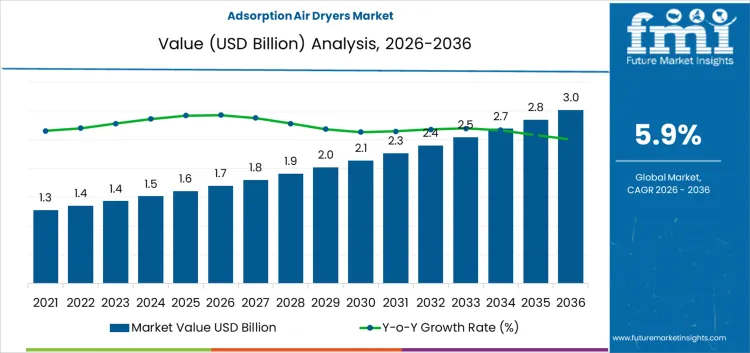
From USD 1.7 billion in 2026, the adsorption air dryers market is forecast to reach USD 3.0 billion by 2036, implying a CAGR of 5.90%. Demand is concentrated in regions where low dew point air is treated as a process requirement rather than a utility upgrade, including pharmaceuticals, electronics, and food processing hubs in East Asia, Western Europe, and parts of North America. Adoption remains uneven because many industries can operate with simpler drying methods. Geographic cost advantages emerge around desiccant production, vessel fabrication, and valve assembly, which shapes where systems are built and exported.
Over the period, growth patterns reflect the spread of moisture sensitive manufacturing rather than uniform industrial expansion. New capacity additions in Southeast Asia and Eastern Europe increase system installations, while mature regions show steadier, specification driven procurement. Energy prices and purge air losses influence regional technology choices and operating economics. Local fabrication capability and service coverage affect buyer preferences more than brand reach alone. Distribution remains project oriented, tied to plant engineering cycles. The market expands through selective industry adoption and regional process upgrades, not through broad replacement of simpler compressed air drying methods.
Quick Stats of the Adsorption Air Dryers Market
- Adsorption Air Dryers Market Value (2026): USD 1.7 billion
- Adsorption Air Dryers Forecast Value (2036): USD 3.0 billion
- Adsorption Air Dryers Forecast CAGR 2026 to 2036: 5.9%
- Leading Technology in Adsorption Air Dryers Market: Heatless Desiccant Dryers (46 % share)
- Leading Dew Point in Adsorption Air Dryers Market: -40 °C Dew Point (48 % share)
- Key Growth Regions in Adsorption Air Dryers Market: India, China, Mexico, USA, Germany
- Top Players in Adsorption Air Dryers Market: Atlas Copco, Ingersoll Rand, Parker Hannifin, Donaldson Company, Kaeser Kompressoren, SPX FLOW, Beko Technologies, Gardner Denver, Sullair (Hitachi), Regional OEMs
What is the Growth Forecast for Adsorption Air Dryers Market through 2036?
Between 2026 and 2031, the adsorption air dryers market is projected to grow from USD 1.7 billion along a path consistent with a 5.9% CAGR, driven by applications where moisture is a process risk rather than a nuisance. Electronics, semiconductor, and pharmaceutical lines require defined dew points to avoid corrosion, condensation, and product defects, which makes desiccant systems part of quality control infrastructure. Heatless and heated configurations coexist because operators balance energy cost against air quality targets and uptime requirements. Investment decisions are therefore governed by compliance standards and failure risk, not by general plant utility upgrades. Sales frequently occur through compressor OEM networks and specialist air treatment suppliers as part of certified system packages.
From 2031 to 2036, the market is expected to reach USD 3.0 billion, with growth tied to the spread of precision manufacturing and to tighter process specifications across a wider range of industries. Lower dew point requirements become more common outside traditional high-end sectors, extending demand into advanced metalworking, battery production, and specialty materials. Energy efficiency and purge loss reduction gain importance as operating cost scrutiny increases. Buyers increasingly evaluate total lifecycle cost rather than only capital price. Competitive positioning depends on process expertise, application engineering support, and service capability, favoring suppliers such as Atlas Copco, Ingersoll Rand, Parker Hannifin, Donaldson Company, Kaeser Kompressoren, SPX FLOW, Beko Technologies, Gardner Denver, Sullair (Hitachi), and a broad group of regional OEMs.
Adsorption Air Dryers Market Key Takeaways
| Metric | Value |
|---|---|
| Market Value (2026) | USD 1.7 billion |
| Forecast Value (2036) | USD 3.0 billion |
| Forecast CAGR 2026 to 2036 | 5.9% |
How Are Adsorption Air Dryers Ensuring Moisture-Free Compressed Air Systems?
Adsorption air dryers are increasingly adopted to remove moisture from compressed air in industrial and manufacturing systems, preventing corrosion, freezing, and contamination of downstream equipment. Historically, basic refrigerated or manual drying methods offered limited performance, leaving residual moisture that compromised pneumatic tools, instrumentation, and product quality. Modern adsorption dryers use desiccant materials, dual-tower designs, and automated regeneration cycles to achieve extremely low dew points and continuous operation.
Industrial manufacturers, process engineers, and facility managers prioritize moisture removal efficiency, energy consumption, and operational reliability. Early adoption focused on high-precision manufacturing, chemical, and pharmaceutical industries, while current demand spans automotive, food and beverage, and electronics production, driven by equipment protection, product quality standards, and regulatory compliance. Desiccant type, regeneration efficiency, and airflow capacity influence supplier selection.
Increasing industrial automation, stringent quality control requirements, and environmental regulations are shaping market growth. Compared with conventional drying methods, adsorption air dryers emphasize ultra-low dew points, energy-efficient operation, and compatibility with complex compressed air networks. Cost structures depend on desiccant materials, tower design, and control systems, concentrating margins among suppliers capable of delivering reliable, high-performance solutions.
Manufacturers adopt these systems to prevent equipment corrosion, maintain product quality, and ensure uninterrupted operation. By 2036, adsorption air dryers are expected to become standard in industrial and manufacturing applications, supporting operational reliability, precision process control, and energy-efficient compressed air management.
What Factors Are Shaping the Demand for Adsorption Air Dryers by Regeneration Method and Required Dew Point in 2026?
The adsorption air dryers market in 2026 is segmented by technology and by delivered dew point. By regeneration method, demand is divided into heatless desiccant dryers, heated desiccant dryers, blower purge systems, and other configurations that differ in energy use, purge air consumption, and control complexity. By performance target, demand is organized around minus 40 °C, minus 70 °C, minus 20 °C, and other dew point levels that reflect process sensitivity to moisture. These segments reflect how operators weigh operating cost, compressed air losses, installation scale, and risk tolerance when specifying drying systems for industrial air networks.
Why Do Heatless Desiccant Dryers Lead in Overall Installations?
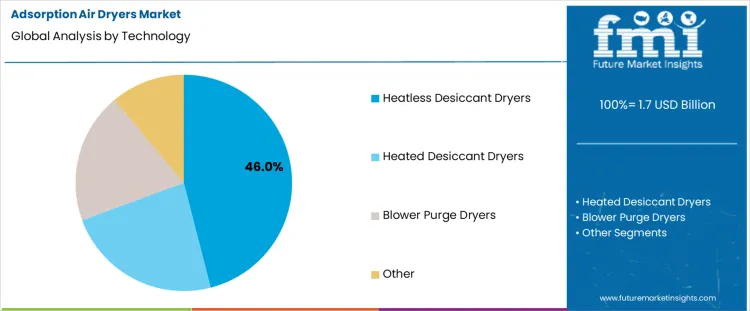
Heatless desiccant dryers account for about 46% of demand in 2026, reflecting their mechanical simplicity and low upfront complexity. These systems use a portion of dried compressed air to regenerate the desiccant, which avoids heaters, blowers, and additional power circuits. This design suits facilities that value predictable operation and minimal control systems over absolute energy efficiency. Installation is straightforward, and maintenance tasks are limited to valve servicing and periodic desiccant replacement. Their performance is stable across a wide range of operating conditions, which reduces commissioning effort. In many plants, the cost of purge air is accepted as a tradeoff for lower capital expense and easier integration into existing compressed air networks.
Heated and blower purge dryers address operating cost rather than installation simplicity. Heated systems reduce purge air losses by using external energy to regenerate the desiccant, which lowers compressed air consumption at the expense of added electrical or steam infrastructure. Blower purge designs go further by eliminating purge air use, relying instead on ambient air for regeneration, which suits large continuous duty systems. Both options introduce more components, control logic, and maintenance points. Their adoption is strongest in large plants where energy cost dominates lifecycle economics. In smaller or variable use installations, the added complexity often outweighs the efficiency gains, which keeps heatless designs as the most common choice.
Why Is the Minus 40 °C Dew Point the Most Widely Specified Performance Level?
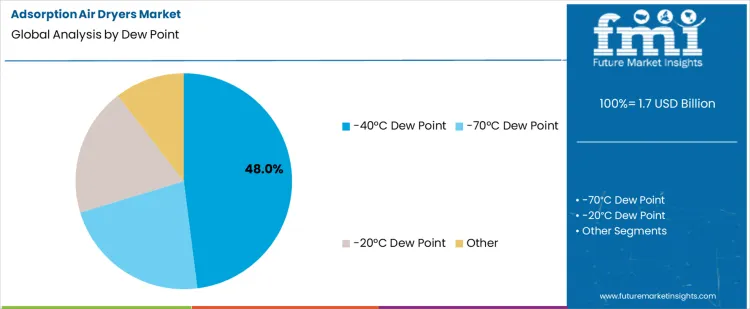
The minus 40 °C dew point segment represents about 48% of demand in 2026 because it covers the moisture protection needs of most industrial processes and outdoor piping networks. At this level, condensation and freezing risks are largely removed under typical operating conditions, which protects valves, instruments, and pneumatic equipment. Achieving lower dew points requires more desiccant, longer regeneration cycles, or additional energy input, which increases system cost and complexity. Many users therefore specify minus 40 °C as a balanced target between protection and expense. Standards and long established practice in many industries also reinforce this level as a default specification, which supports its widespread adoption across diverse applications.
The minus 70 °C and minus 20 °C segments serve more specialized requirements. Ultra-low dew points are needed in electronics, pharmaceutical, or critical instrumentation environments where even trace moisture can cause product or process failure. These systems are fewer in number and more tightly controlled. The minus 20 °C class suits applications with lower risk tolerance, such as general plant air in temperate climates or non-critical processes. Their equipment is simpler and cheaper, yet not suitable for cold or sensitive uses. This spread of needs keeps minus 40 °C as the central reference point, with other levels applied selectively based on process and environmental risk.
Why Are Process Reliability and Ultra Dry Air Requirements Keeping Adsorption Air Dryers Essential through 2036?
Demand exists because certain processes cannot tolerate moisture at any level that refrigerant systems can provide. In pharmaceuticals, food packaging, electronics, and outdoor installations in cold climates, even small amounts of water vapor cause defects, freezing, or corrosion. Adsorption dryers deliver consistently low dew points that protect both products and equipment. Plants often treat them as insurance against stoppages rather than as efficiency investments. Once a production line is qualified with a specific air quality class, the drying method becomes fixed. This locks adsorption systems into long operating lives and ties replacement demand to plant uptime priorities rather than to capital cycle timing.
What Energy Intensity and Operating Cost Exposure Are Limiting Wider Use outside Critical Applications?
The main restraint is cost of ownership. Regeneration consumes either compressed air or external energy, both of which reduce overall system efficiency. In many general purpose plants, this penalty outweighs the benefit of very low dew points. Maintenance of valves, heaters, and desiccant beds adds further expense and requires skilled attention. Poorly maintained systems can waste large amounts of air without obvious symptoms. Because of this, many operators restrict adsorption dryers to only the most sensitive lines and use cheaper technologies elsewhere. This confines the category to applications where moisture risk clearly justifies the ongoing energy and service burden.
How Are Energy Management Practices and System Integration Changing Adsorption Dryer Design and Use?
Change is coming from how plants manage utilities. Users increasingly monitor compressed air as a major energy consumer, which pushes adsorption dryers toward demand controlled regeneration and better synchronization with compressor loading. Integration with plant control systems allows dryers to idle or reduce purge during low usage periods. Some facilities combine technologies, using adsorption units only for critical branches while supplying the rest of the network with simpler dryers. At the design level, modular skid based packages simplify installation and relocation. The category is moving toward more selective deployment and smarter operation rather than blanket, always on usage across entire air systems.
What is the Demand for Adsorption Air Dryers by Country?
| Country | CAGR (%) |
|---|---|
| India | 6.7% |
| China | 6.0% |
| Mexico | 5.2% |
| USA | 3.6% |
| Germany | 3.1% |
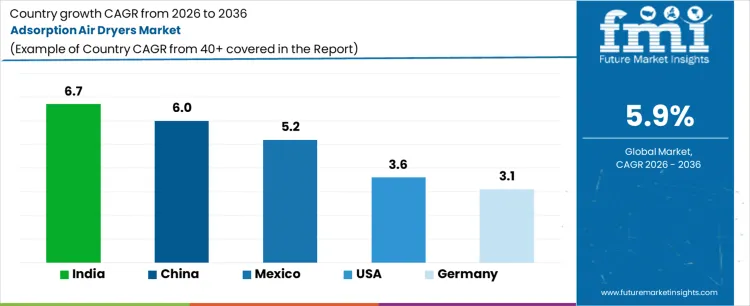
Demand for adsorption air dryers is rising as industrial and manufacturing facilities adopt solutions to remove moisture from compressed air, ensuring operational efficiency, equipment longevity, and product quality. India leads with a 6.7% CAGR, driven by expanding manufacturing sectors, industrial automation, and increased use of pneumatic systems. China follows at 6.0%, supported by growth in manufacturing and maintenance of air quality in industrial processes. Mexico records 5.2% growth, shaped by rising industrial infrastructure and air compression system adoption. The USA grows at 3.6%, reflecting stable demand and replacement cycles in mature markets. Germany shows 3.1% CAGR, influenced by steady industrial production and ongoing equipment maintenance requirements.
How is India experiencing growth in the adsorption air dryers market?
India is experiencing growth at a CAGR of 6.7%, driven by expansion of industrial clusters in Maharashtra, Gujarat, and Tamil Nadu where automotive, chemical, and pharmaceutical manufacturing require high-quality compressed air. Adsorption air dryers are critical to removing moisture from compressed air, protecting machinery, and ensuring process reliability. Manufacturers are producing dryers optimized for energy efficiency, high adsorption capacity, and durability under tropical humidity conditions. Demand is concentrated in large-scale manufacturing plants, process industries, and maintenance hubs. Investments focus on material quality, system reliability, and compliance with national industrial standards. Growth reflects rising industrial mechanization, modernization of air systems, and increased focus on operational efficiency.
- Industrial expansion drives adoption.
- Dryers optimize moisture removal and energy efficiency.
- Manufacturing plants and process industries concentrate demand.
- Material quality and standards compliance guide investment.
How is China witnessing growth in the adsorption air dryers market?
China is witnessing growth at a CAGR of 6%, supported by industrial expansion in Jiangsu, Guangdong, and Zhejiang where heavy machinery, electronics, and automotive production dominates. Adsorption air dryers are essential to maintain consistent compressed air quality and prevent equipment corrosion in high-volume factories. Manufacturers supply dryers optimized for high adsorption efficiency, energy savings, and operation under dusty or humid factory conditions. Demand is concentrated in industrial zones, production facilities, and R&D centers. Investments prioritize system performance, material durability, and adherence to Chinese industrial and safety standards. Growth reflects industrial modernization, automation adoption, and the need for reliable compressed air systems.
- Heavy manufacturing drives adoption.
- Dryers enhance adsorption efficiency and system reliability.
- Industrial zones and production facilities concentrate demand.
- Material durability and compliance guide investment.
How is Mexico experiencing growth in the adsorption air dryers market?
Mexico is experiencing growth at a CAGR of 5.2%, fueled by automotive, electronics, and food processing clusters in Querétaro, Guanajuato, and Nuevo León. Adsorption air dryers remove moisture from compressed air systems, protecting assembly lines and pneumatic tools. Manufacturers produce dryers optimized for energy efficiency, operational durability, and compatibility with diverse industrial systems. Demand is concentrated in manufacturing hubs, industrial parks, and maintenance facilities. Investments focus on material quality, system reliability, and compliance with Mexican industrial standards. Growth reflects industrial expansion, adoption of automated production lines, and increasing need for reliable compressed air quality.
- Automotive and electronics clusters drive adoption.
- Dryers optimize energy efficiency and moisture removal.
- Industrial hubs and manufacturing parks concentrate demand.
- Material quality and standards compliance guide investment.
How is the United States witnessing growth in the adsorption air dryers market?
United States is experiencing growth at a CAGR of 3.6%, supported by adoption of adsorption air dryers in automotive, chemical, and food processing industries. Systems are critical to maintain moisture-free compressed air for precision equipment and process consistency. Manufacturers supply dryers optimized for high adsorption performance, durability, and energy efficiency in moderate climates. Demand is concentrated in manufacturing hubs, assembly plants, and maintenance facilities. Investments focus on material performance, operational reliability, and adherence to industrial and safety standards rather than fleet-scale deployment. Growth reflects moderate industrial expansion and increasing adoption of energy-efficient compressed air systems.
- Industrial precision drives adoption.
- Dryers enhance adsorption performance and durability.
- Manufacturing hubs and assembly plants concentrate demand.
- Material quality and standards compliance guide investment.
How is Germany experiencing growth in the adsorption air dryers market?
Germany is experiencing growth at a CAGR of 3.1%, fueled by automotive, engineering, and chemical industries in Stuttgart, Munich, and Wolfsburg. Adsorption air dryers ensure moisture-free compressed air for manufacturing, pneumatic automation, and workshop operations. Manufacturers are producing dryers optimized for adsorption efficiency, energy savings, and durability under continuous industrial operation. Demand is concentrated in automotive hubs, engineering plants, and industrial facilities. Investments prioritize material performance, system reliability, and compliance with EU industrial and safety standards. Growth reflects steady industrial activity, modernization of air systems, and focus on energy-efficient, reliable compressed air solutions.
- Automotive and engineering hubs drive adoption.
- Dryers optimize adsorption efficiency and energy savings.
- Industrial plants and workshops concentrate demand.
- Material performance and EU compliance guide investment.
Who Competes in the Adsorption Air Dryers Market and What Defines Their Capabilities?
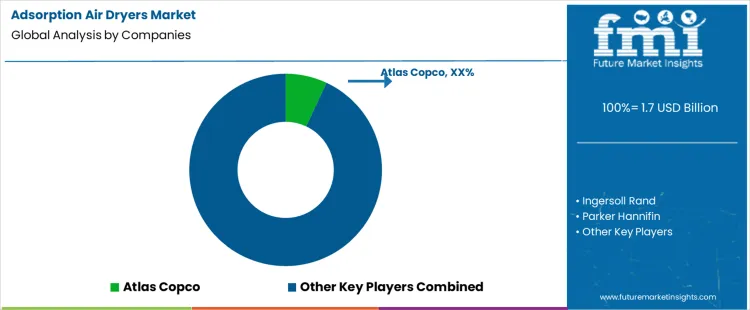
Competition in the adsorption air dryers market is shaped by moisture removal performance, pressure dew point stability, and suitability for industrial compressed air systems. Atlas Copco supplies adsorption dryers engineered for low pressure dew points and robust performance in continuous operation. Ingersoll Rand provides units optimized for reliability and integration with industrial air systems across manufacturing and processing plants. Parker Hannifin offers dryers designed for precision moisture control in heavy duty air applications. Donaldson Company delivers adsorption systems combined with filtration media to enhance air quality. Kaeser Kompressoren supplies modular dryers with energy efficient operation and strong moisture adsorption for plant air networks. SPX FLOW focuses on compact and scalable dryers for diverse industrial settings and maintenance regimes.
Donaldson Company offers dryers with integrated dust control and corrosion resistant components for long service life. Beko Technologies supplies energy efficient adsorption dryers with stable performance under varying load conditions. Gardner Denver provides industrial dryers engineered for reliability and ease of maintenance in compressed air networks. Sullair (Hitachi) delivers systems optimized for continuous operation and heavy use. Other regional OEMs supply cost effective dryers tailored to local industrial demands. Competitive differentiation arises from pressure dew point capability, purge air efficiency, ease of service, and compatibility with factory automation and air quality standards. Suppliers that combine documented performance, maintenance support, and compliance with industrial specifications maintain relevance in global compressed air drying applications.
Key Players in the Adsorption Air Dryers Market
- Atlas Copco
- Ingersoll Rand
- Parker Hannifin
- Donaldson Company
- Kaeser Kompressoren
- SPX FLOW
- Beko Technologies
- Gardner Denver
- Sullair (Hitachi)
- Regional OEMs
Scope of the Report
| Items | Values |
|---|---|
| Quantitative Units (2026) | USD billion |
| Technology | Heatless Desiccant Dryers, Heated Desiccant Dryers, Blower Purge Dryers, Other |
| Dew Point | -40°C Dew Point, -70°C Dew Point, -20°C Dew Point, Other |
| End Use | Electronics & Semiconductors, Pharma & Healthcare, Manufacturing, Others |
| Sales Channel | Compressor OEM Networks, Specialty Air Treatment OEMs, Distributors, Other |
| Regions Covered | Asia Pacific, Europe, North America, Latin America, Middle East & Africa |
| Countries Covered | China, Japan, South Korea, India, Australia & New Zealand, ASEAN, Germany, United Kingdom, France, Italy, Spain, Nordic, BENELUX, United States, Canada, Mexico, Brazil, Chile, Saudi Arabia, Turkey, South Africa, and other regional markets |
| Key Companies Profiled | Atlas Copco, Ingersoll Rand, Parker Hannifin, Donaldson Company, Kaeser Kompressoren, SPX FLOW, Beko Technologies, Gardner Denver, Sullair (Hitachi), Regional OEMs |
| Additional Attributes | Dollar sales by technology, dew point, end use, and sales channel, heatless desiccant dryers representing the largest share due to simplicity and low upfront complexity, -40°C dew point being the most widely specified performance level, demand concentrated in process-critical industries such as electronics, pharmaceuticals, and precision manufacturing, procurement driven by compliance standards and process risk rather than utility upgrades, project-oriented sales tied to plant engineering cycles, evaluation increasingly based on lifecycle cost and purge air losses, selective deployment alongside simpler drying methods, and market growth shaped by spread of moisture-sensitive manufacturing rather than uniform industrial expansion. |
Adsorption Air Dryers Market Segmentation
Technology:
- Heatless Desiccant Dryers
- Heated Desiccant Dryers
- Blower Purge Dryers
- Other
Dew Point:
- -40°C Dew Point
- -70°C Dew Point
- -20°C Dew Point
- Other
End Use:
- Electronics & Semiconductors
- Pharma & Healthcare
- Manufacturing
- Others
Sales Channel:
- Compressor OEM Networks
- Specialty Air Treatment OEMs
- Distributors
- Other
Region:
- Asia Pacific
- China
- Japan
- South Korea
- India
- Australia & New Zealand
- ASEAN
- Rest of Asia Pacific
- Europe
- Germany
- United Kingdom
- France
- Italy
- Spain
- Nordic
- BENELUX
- Rest of Europe
- North America
- United States
- Canada
- Mexico
- Latin America
- Brazil
- Chile
- Rest of Latin America
- Middle East & Africa
- Kingdom of Saudi Arabia
- Other GCC Countries
- Turkey
- South Africa
- Other African Union
- Rest of Middle East & Africa
Bibliography
- U.S. Department of Energy. (2025). Compressed Air Systems. U.S. Department of Energy, Office of Energy Efficiency & Renewable Energy. This covers best practices and performance guidance for compressed air systems, including dryers.
- International Energy Agency. (2023). Energy Efficiency 2023. International Energy Agency. Annual analysis of global energy efficiency trends, providing context for efficiency in industrial systems like compressed air drying.
- Zaim, A. (2025). Industrial Compressed Air System Optimization: Experimental Evaluation of Energy Efficiency and Sustainability Gains. Processes, 13(11), 3590. Academic study on optimizing industrial compressed air systems that directly relates to energy performance considerations for air dryers.
Frequently Asked Questions
How big is the adsorption air dryers market in 2026?
The global adsorption air dryers market is estimated to be valued at USD 1.7 billion in 2026.
What will be the size of adsorption air dryers market in 2036?
The market size for the adsorption air dryers market is projected to reach USD 3.0 billion by 2036.
How much will be the adsorption air dryers market growth between 2026 and 2036?
The adsorption air dryers market is expected to grow at a 5.9% CAGR between 2026 and 2036.
What are the key product types in the adsorption air dryers market?
The key product types in adsorption air dryers market are heatless desiccant dryers, heated desiccant dryers, blower purge dryers and other.
Which dew point segment to contribute significant share in the adsorption air dryers market in 2026?
In terms of dew point, -40°c dew point segment to command 48.0% share in the adsorption air dryers market in 2026.
Preview the report firsthand - request a free sample
Get SampleGet the brochure for pricing and purchase details.
Get PDFTable of Content
- Executive Summary
- Global Market Outlook
- Demand-side Trends
- Supply-side Trends
- Technology Roadmap Analysis
- Analysis and Recommendations
- Market Overview
- Market Coverage / Taxonomy
- Market Definition / Scope / Limitations
- Market Background
- Market Dynamics
- Drivers
- Restraints
- Opportunity
- Trends
- Scenario Forecast
- Demand in Optimistic Scenario
- Demand in Likely Scenario
- Demand in Conservative Scenario
- Opportunity Map Analysis
- Product Life Cycle Analysis
- Supply Chain Analysis
- Investment Feasibility Matrix
- Value Chain Analysis
- PESTLE and Porter’s Analysis
- Regulatory Landscape
- Regional Parent Market Outlook
- Production and Consumption Statistics
- Import and Export Statistics
- Market Dynamics
- Global Market Analysis 2021 to 2025 and Forecast, 2026 to 2036
- Historical Market Size Value (USD Million) Analysis, 2021 to 2025
- Current and Future Market Size Value (USD Million) Projections, 2026 to 2036
- Y-o-Y Growth Trend Analysis
- Absolute $ Opportunity Analysis
- Global Market Pricing Analysis 2021 to 2025 and Forecast 2026 to 2036
- Global Market Analysis 2021 to 2025 and Forecast 2026 to 2036, By Technology
- Introduction / Key Findings
- Historical Market Size Value (USD Million) Analysis By Technology, 2021 to 2025
- Current and Future Market Size Value (USD Million) Analysis and Forecast By Technology, 2026 to 2036
- Heatless Desiccant Dryers
- Heated Desiccant Dryers
- Blower Purge Dryers
- Other
- Heatless Desiccant Dryers
- Y-o-Y Growth Trend Analysis By Technology, 2021 to 2025
- Absolute $ Opportunity Analysis By Technology, 2026 to 2036
- Global Market Analysis 2021 to 2025 and Forecast 2026 to 2036, By Dew Point
- Introduction / Key Findings
- Historical Market Size Value (USD Million) Analysis By Dew Point, 2021 to 2025
- Current and Future Market Size Value (USD Million) Analysis and Forecast By Dew Point, 2026 to 2036
- -40°C Dew Point
- -70°C Dew Point
- -20°C Dew Point
- Other
- -40°C Dew Point
- Y-o-Y Growth Trend Analysis By Dew Point, 2021 to 2025
- Absolute $ Opportunity Analysis By Dew Point, 2026 to 2036
- Global Market Analysis 2021 to 2025 and Forecast 2026 to 2036, By End Use
- Introduction / Key Findings
- Historical Market Size Value (USD Million) Analysis By End Use, 2021 to 2025
- Current and Future Market Size Value (USD Million) Analysis and Forecast By End Use, 2026 to 2036
- Electronics & Semiconductors
- Pharma & Healthcare
- Manufacturing
- Others
- Electronics & Semiconductors
- Y-o-Y Growth Trend Analysis By End Use, 2021 to 2025
- Absolute $ Opportunity Analysis By End Use, 2026 to 2036
- Global Market Analysis 2021 to 2025 and Forecast 2026 to 2036, By Sales Channel
- Introduction / Key Findings
- Historical Market Size Value (USD Million) Analysis By Sales Channel, 2021 to 2025
- Current and Future Market Size Value (USD Million) Analysis and Forecast By Sales Channel, 2026 to 2036
- Compressor OEM Networks
- Specialty Air Treatment OEMs
- Distributors
- Other
- Compressor OEM Networks
- Y-o-Y Growth Trend Analysis By Sales Channel, 2021 to 2025
- Absolute $ Opportunity Analysis By Sales Channel, 2026 to 2036
- Global Market Analysis 2021 to 2025 and Forecast 2026 to 2036, By Region
- Introduction
- Historical Market Size Value (USD Million) Analysis By Region, 2021 to 2025
- Current Market Size Value (USD Million) Analysis and Forecast By Region, 2026 to 2036
- North America
- Latin America
- Western Europe
- Eastern Europe
- East Asia
- South Asia and Pacific
- Middle East & Africa
- Market Attractiveness Analysis By Region
- North America Market Analysis 2021 to 2025 and Forecast 2026 to 2036, By Country
- Historical Market Size Value (USD Million) Trend Analysis By Market Taxonomy, 2021 to 2025
- Market Size Value (USD Million) Forecast By Market Taxonomy, 2026 to 2036
- By Country
- USA
- Canada
- Mexico
- By Technology
- By Dew Point
- By End Use
- By Sales Channel
- By Country
- Market Attractiveness Analysis
- By Country
- By Technology
- By Dew Point
- By End Use
- By Sales Channel
- Key Takeaways
- Latin America Market Analysis 2021 to 2025 and Forecast 2026 to 2036, By Country
- Historical Market Size Value (USD Million) Trend Analysis By Market Taxonomy, 2021 to 2025
- Market Size Value (USD Million) Forecast By Market Taxonomy, 2026 to 2036
- By Country
- Brazil
- Chile
- Rest of Latin America
- By Technology
- By Dew Point
- By End Use
- By Sales Channel
- By Country
- Market Attractiveness Analysis
- By Country
- By Technology
- By Dew Point
- By End Use
- By Sales Channel
- Key Takeaways
- Western Europe Market Analysis 2021 to 2025 and Forecast 2026 to 2036, By Country
- Historical Market Size Value (USD Million) Trend Analysis By Market Taxonomy, 2021 to 2025
- Market Size Value (USD Million) Forecast By Market Taxonomy, 2026 to 2036
- By Country
- Germany
- UK
- Italy
- Spain
- France
- Nordic
- BENELUX
- Rest of Western Europe
- By Technology
- By Dew Point
- By End Use
- By Sales Channel
- By Country
- Market Attractiveness Analysis
- By Country
- By Technology
- By Dew Point
- By End Use
- By Sales Channel
- Key Takeaways
- Eastern Europe Market Analysis 2021 to 2025 and Forecast 2026 to 2036, By Country
- Historical Market Size Value (USD Million) Trend Analysis By Market Taxonomy, 2021 to 2025
- Market Size Value (USD Million) Forecast By Market Taxonomy, 2026 to 2036
- By Country
- Russia
- Poland
- Hungary
- Balkan & Baltic
- Rest of Eastern Europe
- By Technology
- By Dew Point
- By End Use
- By Sales Channel
- By Country
- Market Attractiveness Analysis
- By Country
- By Technology
- By Dew Point
- By End Use
- By Sales Channel
- Key Takeaways
- East Asia Market Analysis 2021 to 2025 and Forecast 2026 to 2036, By Country
- Historical Market Size Value (USD Million) Trend Analysis By Market Taxonomy, 2021 to 2025
- Market Size Value (USD Million) Forecast By Market Taxonomy, 2026 to 2036
- By Country
- China
- Japan
- South Korea
- By Technology
- By Dew Point
- By End Use
- By Sales Channel
- By Country
- Market Attractiveness Analysis
- By Country
- By Technology
- By Dew Point
- By End Use
- By Sales Channel
- Key Takeaways
- South Asia and Pacific Market Analysis 2021 to 2025 and Forecast 2026 to 2036, By Country
- Historical Market Size Value (USD Million) Trend Analysis By Market Taxonomy, 2021 to 2025
- Market Size Value (USD Million) Forecast By Market Taxonomy, 2026 to 2036
- By Country
- India
- ASEAN
- Australia & New Zealand
- Rest of South Asia and Pacific
- By Technology
- By Dew Point
- By End Use
- By Sales Channel
- By Country
- Market Attractiveness Analysis
- By Country
- By Technology
- By Dew Point
- By End Use
- By Sales Channel
- Key Takeaways
- Middle East & Africa Market Analysis 2021 to 2025 and Forecast 2026 to 2036, By Country
- Historical Market Size Value (USD Million) Trend Analysis By Market Taxonomy, 2021 to 2025
- Market Size Value (USD Million) Forecast By Market Taxonomy, 2026 to 2036
- By Country
- Kingdom of Saudi Arabia
- Other GCC Countries
- Turkiye
- South Africa
- Other African Union
- Rest of Middle East & Africa
- By Technology
- By Dew Point
- By End Use
- By Sales Channel
- By Country
- Market Attractiveness Analysis
- By Country
- By Technology
- By Dew Point
- By End Use
- By Sales Channel
- Key Takeaways
- Key Countries Market Analysis
- USA
- Pricing Analysis
- Market Share Analysis, 2025
- By Technology
- By Dew Point
- By End Use
- By Sales Channel
- Canada
- Pricing Analysis
- Market Share Analysis, 2025
- By Technology
- By Dew Point
- By End Use
- By Sales Channel
- Mexico
- Pricing Analysis
- Market Share Analysis, 2025
- By Technology
- By Dew Point
- By End Use
- By Sales Channel
- Brazil
- Pricing Analysis
- Market Share Analysis, 2025
- By Technology
- By Dew Point
- By End Use
- By Sales Channel
- Chile
- Pricing Analysis
- Market Share Analysis, 2025
- By Technology
- By Dew Point
- By End Use
- By Sales Channel
- Germany
- Pricing Analysis
- Market Share Analysis, 2025
- By Technology
- By Dew Point
- By End Use
- By Sales Channel
- UK
- Pricing Analysis
- Market Share Analysis, 2025
- By Technology
- By Dew Point
- By End Use
- By Sales Channel
- Italy
- Pricing Analysis
- Market Share Analysis, 2025
- By Technology
- By Dew Point
- By End Use
- By Sales Channel
- Spain
- Pricing Analysis
- Market Share Analysis, 2025
- By Technology
- By Dew Point
- By End Use
- By Sales Channel
- France
- Pricing Analysis
- Market Share Analysis, 2025
- By Technology
- By Dew Point
- By End Use
- By Sales Channel
- India
- Pricing Analysis
- Market Share Analysis, 2025
- By Technology
- By Dew Point
- By End Use
- By Sales Channel
- ASEAN
- Pricing Analysis
- Market Share Analysis, 2025
- By Technology
- By Dew Point
- By End Use
- By Sales Channel
- Australia & New Zealand
- Pricing Analysis
- Market Share Analysis, 2025
- By Technology
- By Dew Point
- By End Use
- By Sales Channel
- China
- Pricing Analysis
- Market Share Analysis, 2025
- By Technology
- By Dew Point
- By End Use
- By Sales Channel
- Japan
- Pricing Analysis
- Market Share Analysis, 2025
- By Technology
- By Dew Point
- By End Use
- By Sales Channel
- South Korea
- Pricing Analysis
- Market Share Analysis, 2025
- By Technology
- By Dew Point
- By End Use
- By Sales Channel
- Russia
- Pricing Analysis
- Market Share Analysis, 2025
- By Technology
- By Dew Point
- By End Use
- By Sales Channel
- Poland
- Pricing Analysis
- Market Share Analysis, 2025
- By Technology
- By Dew Point
- By End Use
- By Sales Channel
- Hungary
- Pricing Analysis
- Market Share Analysis, 2025
- By Technology
- By Dew Point
- By End Use
- By Sales Channel
- Kingdom of Saudi Arabia
- Pricing Analysis
- Market Share Analysis, 2025
- By Technology
- By Dew Point
- By End Use
- By Sales Channel
- Turkiye
- Pricing Analysis
- Market Share Analysis, 2025
- By Technology
- By Dew Point
- By End Use
- By Sales Channel
- South Africa
- Pricing Analysis
- Market Share Analysis, 2025
- By Technology
- By Dew Point
- By End Use
- By Sales Channel
- USA
- Market Structure Analysis
- Competition Dashboard
- Competition Benchmarking
- Market Share Analysis of Top Players
- By Regional
- By Technology
- By Dew Point
- By End Use
- By Sales Channel
- Competition Analysis
- Competition Deep Dive
- Atlas Copco
- Overview
- Product Portfolio
- Profitability by Market Segments (Product/Age /Sales Channel/Region)
- Sales Footprint
- Strategy Overview
- Marketing Strategy
- Product Strategy
- Channel Strategy
- Ingersoll Rand
- Parker Hannifin
- Donaldson Company
- Kaeser Kompressoren
- SPX FLOW
- Beko Technologies
- Gardner Denver
- Sullair (Hitachi)
- Regional OEMs
- Atlas Copco
- Competition Deep Dive
- Assumptions & Acronyms Used
- Research Methodology


