

- Industry Size (2026)
- USD 860 Mn
- Forecast (2036)
- USD 1248.7 Mn
- CAGR (2026 to 2036)
- 3.8%
Air Hoist Market Forecast and Outlook 2026 to 2036
The air hoist market is projected to reach USD 1,248.7 million by 2036, growing at a CAGR of 3.8% from its 2026 value of USD 860 million. Production concentration will be a critical factor, with a few large manufacturers dominating the market, often leveraging economies of scale to maintain competitive pricing. Regional manufacturing control will impact supply chain dynamics, as production is concentrated in key regions with established industrial capabilities, such as North America, Europe, and Asia.
However, this concentration also exposes the market to risks related to geopolitical instability, raw material shortages, and supply chain disruptions. Suppliers will need to manage these dependencies carefully, ensuring that production lines remain flexible and capable of meeting demand without excessive lead times. As regional variations in production capabilities and logistical constraints evolve, maintaining supply reliability will become increasingly difficult, requiring companies to build more resilient, localized supply chains to safeguard against external shocks.
Quick Stats for the Air Hoist Market
- Air Hoist Market Value (2026): USD 860 million
- Air Hoist Market Forecast Value (2036): USD 1,248.7 million
- Air Hoist Market Global Forecast CAGR 2026 to 2036: 3.8%
- Air Hoist Market Leading Segment: Pneumatic Chain Hoists (62%)
- Key Growth Regions in Air Hoist Market: India
- Top Players in Air Hoist Market: Ingersoll Rand, KITO Corporation, Columbus McKinnon, J.D. Neuhaus, Harrington Hoists, Konecranes, Red Rooster Lifting, Demag (Terex MH), Yale Hoists (Columbus McKinnon)
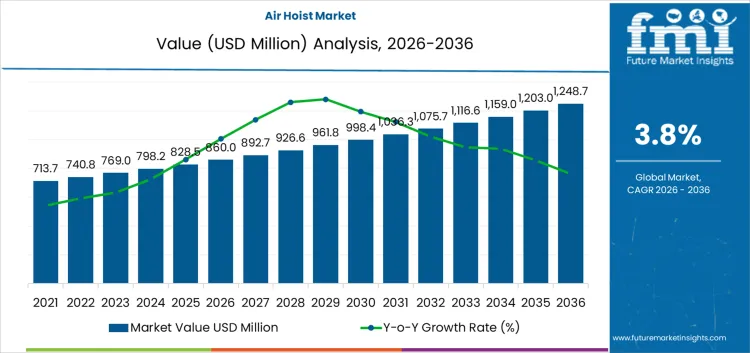
What is the 5-Year Growth Block Analysis for the Air Hoist Market through 2036?
The 5-year growth block analysis for the air hoist market suggests gradual, consistent growth, with increasing demand driven by expanding industrial operations and the need for more efficient lifting solutions. From 2026 to 2028, the market will experience steady growth, with values rising from USD 860 million to USD 926.6 million. This period reflects the early stages of adoption and expansion in manufacturing and construction industries, where air hoists are becoming a standard part of material handling equipment.
Between 2028 and 2032, the market will continue to expand, reaching USD 1,036.3 million by 2032. This phase will see a shift in the demand profile, as more industries, especially in heavy manufacturing and automotive sectors, integrate advanced air hoists into their operations for improved efficiency and safety. The adoption of new technologies and improvements in air hoist designs will further accelerate this phase. From 2032 to 2036, the market will maintain a steady upward trajectory, reaching USD 1,248.7 million, driven by sustained growth in industrial sectors and the ongoing development of more specialized, efficient air hoist systems.
Air Hoist Market Key Takeaways
| Metric | Value |
|---|---|
| Industry Sales Value (2026) | USD 860 million |
| Industry Forecast Value (2036) | USD 1,248.7 million |
| Industry Forecast CAGR 2026 to 2036 | 3.8% |
What Is Driving the Air Hoist Market?
Historically, the air hoist market evolved from manual lifting methods and early mechanical hoists used in industrial and construction settings to improve safety and productivity. Conventional approaches to lifting heavy loads relied on block and tackle setups, chain falls, or basic electric hoists that required stable power supplies and often struggled in harsh environments such as marine, mining, and heavy fabrication facilities. Air powered hoists emerged as a compelling alternative because they could operate reliably in environments where electrical systems posed spark hazards or where compressed air was more readily available, such as offshore platforms, chemical plants, and shipyards.
Early adopters valued pneumatic hoists for their robustness under extreme conditions, inherent flame resistance, and ability to deliver smooth, controllable lifting motion with fewer moving electrical components subject to failure. These formative applications helped define core performance expectations for air hoists: durability, consistent lifting power, modular design for maintenance access, and compatibility with existing plant compressed air infrastructure. This historical phase laid the foundation for broader interest in pneumatic lifting solutions where environmental conditions or safety classifications limited the use of electric hoists.
Future demand for the air hoist market is expected to be shaped by ongoing industrialization, heightened emphasis on workplace safety, and growth in sectors that demand dependable lifting equipment in challenging environments. Growth will be driven by maintenance, repair, and operations (MRO) strategies that prioritize equipment capable of withstanding temperature extremes, dust, humidity, or corrosive atmospheres. Industries such as oil and gas, maritime, mining, and heavy manufacturing will continue to value air powered hoists for their reliability, reduced risk of electrical ignition in hazardous zones, and ease of serviceability.
Advances in ergonomic controls, integrated braking systems, and modular components that reduce downtime or spare parts inventories will further enhance market appeal. Demand will also be supported by the expanding use of compressed air distribution systems in facilities where pneumatic tools and equipment are standard, enabling seamless integration of air hoists without extensive electrical upgrades. Barriers include competition from increasingly capable electric and battery powered hoists in general purpose applications, and considerations around compressed air energy efficiency. Long term market expansion will depend on how effectively manufacturers deliver solutions that balance operational safety, durability, and ease of maintenance while aligning with evolving industrial lifting requirements across diverse end use sectors.
What are the Key Segments in the Air Hoist Market?
The air hoist market is segmented by hoist type and capacity. Hoist types include pneumatic chain hoists, pneumatic wire rope hoists, trolley hoists, and others, with pneumatic chain hoists leading the market at 62%. Capacity segments include 1-3 tons, up to 1 ton, above 3 tons, and others, with 1-3 tons representing the largest share at 46%. The market is driven by the growing demand for efficient lifting solutions in industries such as manufacturing, construction, and material handling, where air-powered hoists are preferred for their safety, reliability, and ability to handle heavy loads in harsh environments. The increasing focus on automation and safety in industrial applications is further fueling the demand for air hoists across various sectors. Key regions driving the growth include North America, Europe, and Asia Pacific, where industrial expansion and technological advancements are promoting the adoption of air hoist systems.
What is Driving Growth in the Pneumatic Chain Hoists Segment?
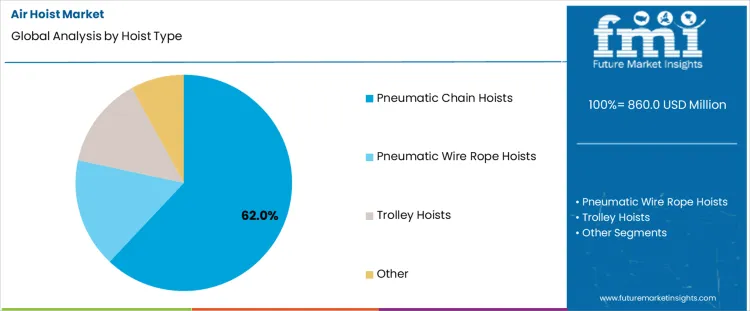
Pneumatic chain hoists are the leading hoist type in the Air Hoist market, holding 62% of the market share. This growth is driven by the high demand for pneumatic chain hoists due to their robust performance, ease of use, and ability to handle heavy lifting in a variety of industrial applications. Pneumatic chain hoists are ideal for environments where electric hoists may not be suitable, such as areas with explosive atmospheres, high humidity, or extreme temperatures, as they do not rely on electrical power.
They are widely used in industries like automotive, manufacturing, and construction, where safety, reliability, and lifting capacity are critical. Pneumatic chain hoists offer precise control, ease of operation, and minimal maintenance requirements, making them a preferred choice for many applications. As industrial automation and material handling systems continue to evolve, the demand for pneumatic chain hoists is expected to grow, particularly in regions like North America and Europe, where industrial production is rapidly advancing.
What is Driving the Demand for 1-3 Tons Capacity in the Air Hoist Market?
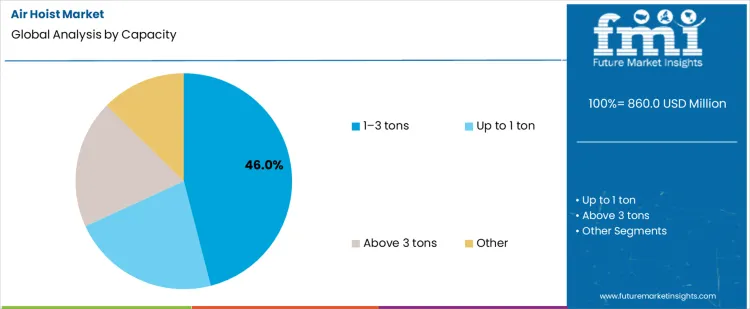
The 1-3 tons capacity segment leads the market, accounting for 46% of the market share. This growth is primarily driven by the versatility and wide applicability of air hoists in the 1-3 tons capacity range, which are suitable for handling medium to heavy loads in various industrial sectors. Hoists in this capacity range are ideal for applications in manufacturing, assembly lines, and maintenance tasks, where precise lifting and load handling are required.
The 1-3 tons capacity range is particularly popular in industries such as automotive, aerospace, and material handling, where heavy components need to be lifted and moved efficiently and safely. These hoists provide the right balance of lifting capacity and operational efficiency for a wide range of tasks, making them highly sought after. As industries continue to demand more automated, high-performance lifting solutions, the demand for 1-3 tons capacity air hoists is expected to remain strong, especially in regions experiencing industrial growth, such as Asia Pacific and North America.
What are the Key Dynamics in the Air Hoist Market?
The air hoist market is growing as industries seek efficient, reliable, and safe lifting solutions for heavy loads. Air hoists are powered by compressed air and are commonly used in environments where electricity-powered hoists may pose safety or environmental risks. They are ideal for hazardous environments, such as those in the oil and gas, chemical, and mining industries, due to their explosion-proof features. The market is driven by the increasing need for material handling equipment that can withstand harsh working conditions, offer precise load control, and provide safety benefits. Additionally, the rising demand for automation and efficient industrial operations is contributing to the growth of air hoists as they can operate seamlessly in heavy-duty tasks, providing versatility and energy efficiency.
What are the Key Drivers of Growth in the Air Hoist Market?
Several factors are driving the growth of the air hoist market. One key driver is the increasing need for lifting equipment in industries like automotive, construction, and manufacturing, where heavy loads need to be moved with precision and safety. Air hoists, with their high lifting capacity, precise load handling, and ability to operate in hazardous environments, are in demand. Another driver is the rising emphasis on safety standards in industrial environments. Air hoists are inherently safe due to their explosion-proof design and the fact that they do not produce sparks, making them ideal for use in dangerous environments. The demand for automation and efficient manufacturing processes is also a driver, as industries seek to improve productivity with less downtime. Furthermore, the expansion of industries such as oil and gas, mining, and aerospace, which require heavy-duty lifting solutions, continues to drive market demand for air hoists. Finally, innovations in air hoist technology, such as improved controls, lightweight designs, and increased lifting capacities, are also fueling the market’s growth.
What are the Key Restraints in the Air Hoist Market?
Despite the positive growth trends, the air hoist market faces several challenges. One significant restraint is the high cost of air hoists compared to other lifting technologies, such as electric hoists. This price difference may limit their adoption, especially for small to medium-sized businesses with limited budgets. Another challenge is the need for a reliable and continuous supply of compressed air, which could limit the use of air hoists in areas without proper air compression infrastructure. While air hoists are ideal for hazardous environments, their maintenance and operation require specialized knowledge and skilled personnel, which could increase labor and operational costs. Additionally, the availability of alternative lifting technologies, such as electric or hydraulic hoists, which may be more energy-efficient or less expensive, may slow the growth of air hoists in certain applications. Lastly, the lack of awareness about the benefits of air hoists, especially in regions with less industrialization, could be a barrier to market expansion.
What are the Key Trends in the Air Hoist Market?
Several key trends are shaping the air hoist market. One major trend is the growing integration of smart technologies in air hoists. The adoption of IoT-enabled hoists that provide real-time data on performance, maintenance schedules, and operational efficiency is becoming increasingly popular. These technologies improve overall productivity and reduce downtime. Another trend is the development of energy-efficient air hoists, with manufacturers focusing on reducing compressed air consumption and improving the overall energy use of their systems. There is also a trend toward the miniaturization and lightweight design of air hoists, making them more adaptable to a wider range of applications and environments, particularly in industries where space is limited. Additionally, there is a growing focus on increasing the durability and reliability of air hoists, particularly for use in harsh environments such as mining and offshore oil and gas platforms. As safety becomes a more prominent concern in industrial environments, air hoists that meet or exceed stringent safety standards are gaining traction. These trends indicate that the market will continue to innovate to meet the evolving demands of modern industries.
What is the Country-Wise Analysis of the Air Hoist Market?
The air hoist market is growing as industries such as manufacturing, construction, and logistics increasingly adopt air-powered lifting solutions for their efficiency, safety, and ability to operate in hazardous environments. Air hoists are used for lifting heavy loads in industrial settings, where electric hoists may not be suitable due to the risk of sparks or overheating. The market is driven by the demand for safer, more efficient material handling solutions and the increasing adoption of air-powered lifting technologies. Countries like India, Indonesia, Saudi Arabia, Mexico, and Brazil are witnessing growth in this market due to the expansion of industrial sectors, infrastructure development, and increasing awareness of the benefits of air hoists in specific applications.
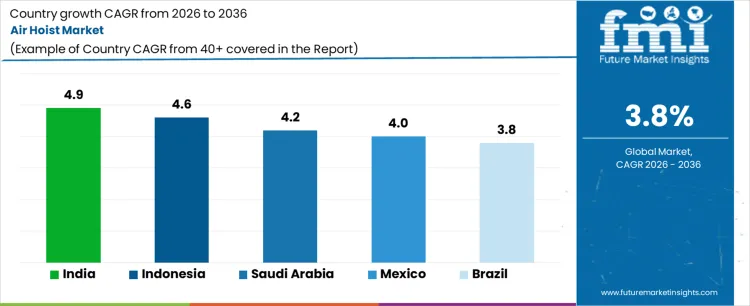
| Country | CAGR (%) |
|---|---|
| India | 4.9 |
| Indonesia | 4.6 |
| Saudi Arabia | 4.2 |
| Mexico | 4 |
| Brazil | 3.8 |
What is Driving the Growth of the Air Hoist Market in India?
India’s air hoist market is growing at a CAGR of 4.9%, the highest among the countries analyzed. The growth is largely driven by the expanding industrial and construction sectors in India, where air hoists are increasingly being adopted for lifting heavy loads in manufacturing and material handling applications. Air hoists are particularly useful in industries that require explosion-proof equipment or operate in hazardous environments, such as chemical and pharmaceutical manufacturing. Additionally, India’s infrastructure development, government investments in industrialization, and focus on improving manufacturing processes are contributing to the market’s growth. As India continues to modernize its industrial sector, the demand for air hoists is expected to rise steadily.
How is the Air Hoist Market Performing in Indonesia?
Indonesia’s air hoist market is growing at a CAGR of 4.6%. The market growth is driven by the increasing demand for efficient and safe material handling solutions in Indonesia’s expanding manufacturing, construction, and logistics industries. Air hoists offer several advantages, including ease of use, safety, and the ability to operate in hazardous environments, making them ideal for use in chemical plants and other industries requiring non-electric lifting solutions. The country’s focus on improving infrastructure and industrial capabilities, along with the rising demand for efficient lifting technologies, is expected to continue supporting the market’s growth. As Indonesia’s industrial base continues to develop, the adoption of air hoists is anticipated to increase.
What Factors are Shaping the Air Hoist Market in Saudi Arabia?
Saudi Arabia’s air hoist market is growing at a CAGR of 4.2%. The market growth is driven by the country’s increasing investments in industrial sectors, including oil and gas, construction, and manufacturing. Air hoists are particularly suitable for industries where safety is critical and where air-powered lifting solutions are preferred over electric alternatives. The growing focus on infrastructure development and industrial expansion in Saudi Arabia, along with the need for reliable and efficient material handling solutions, is contributing to the demand for air hoists. As the country continues to diversify its economy and invest in industrial projects, the demand for air hoists is expected to rise steadily.
How is the Air Hoist Market Evolving in Mexico?
Mexico’s air hoist market is growing at a CAGR of 4%. The market is driven by the increasing demand for air hoists in Mexico’s manufacturing, automotive, and construction industries. Air hoists are increasingly being adopted due to their ability to provide safe and efficient lifting solutions in environments where electricity may not be suitable. The growing automotive industry in Mexico, as well as the expansion of manufacturing capabilities in the country, is contributing to the rise in demand for air hoists. Additionally, the Mexican government’s focus on improving infrastructure and industrial growth is expected to further drive the adoption of air hoists. As Mexico’s industrial sector continues to expand, the demand for material handling equipment like air hoists is expected to grow.
What is Contributing to the Growth of the Air Hoist Market in Brazil?
Brazil’s air hoist market is growing at a CAGR of 3.8%. The market is primarily driven by the country’s expanding manufacturing and construction sectors, where air hoists are increasingly used for lifting heavy materials in a safe and efficient manner. Air hoists are also preferred in industries such as oil and gas, where explosion-proof equipment is required. Brazil’s focus on improving industrial capabilities and infrastructure, along with the growth of its manufacturing and logistics sectors, is contributing to the demand for air hoists. Although the growth rate is slower compared to other countries, Brazil’s industrial growth and need for efficient lifting solutions are expected to continue driving the market for air hoists in the coming years.
What is the Competitive Landscape for the Air Hoist Market?
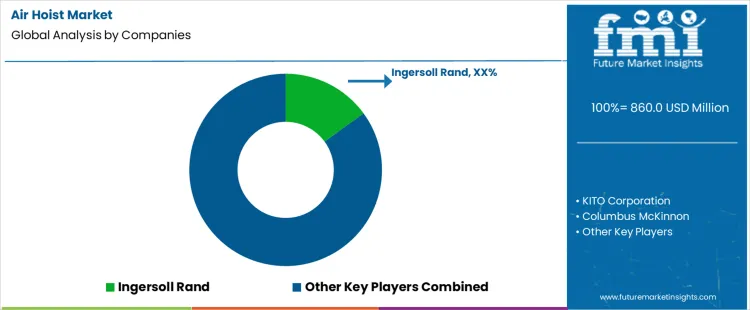
The air hoist market is growing as industries such as manufacturing, construction, and mining demand efficient lifting solutions for heavy loads in challenging environments. Ingersoll Rand leads the market, offering high-quality air hoists that are known for their durability, safety, and precision in lifting operations. The company’s expertise in air power tools and industrial solutions allows it to provide reliable hoisting solutions for various applications. KITO Corporation is a key player, providing air hoists that focus on high performance and safety, offering robust lifting systems suitable for diverse industrial environments.
Columbus McKinnon competes with a comprehensive range of air hoists designed to handle heavy loads, providing efficient and user-friendly solutions for industries that require precise load handling. J.D. Neuhaus is another strong competitor, known for its premium air hoists that are particularly suitable for use in hazardous environments, offering solutions that prioritize safety and reliability. Harrington Hoists offers high-quality, cost-effective air hoists, focusing on efficiency and ease of use, making them popular in manufacturing and warehouse operations. Konecranes provides lifting solutions, including air hoists, that emphasize innovation and technology integration, ensuring optimal performance in demanding industrial settings.
Red Rooster Lifting offers reliable and durable air hoists designed for heavy-duty lifting operations, catering to industries that require precise control and safety in their lifting systems. Demag (Terex MH) is actively involved in the market, offering air hoists that are known for their high performance and customizable features, catering to both small and large-scale industrial needs. Yale Hoists (Columbus McKinnon) also contributes to the market by providing robust and cost-effective air hoisting solutions suitable for a wide range of industrial applications.
To stay competitive in the air hoist market, companies focus on product innovation, safety features, and customer-centric solutions. Ingersoll Rand continues to lead by enhancing its air hoists with advanced features such as digital load monitoring and improved energy efficiency. KITO Corporation is expanding its product offerings with more customizable hoisting solutions, focusing on flexibility and reliability in heavy-duty applications. Columbus McKinnon invests in advanced technologies to offer air hoists that improve safety, efficiency, and ease of use, ensuring that they meet the evolving needs of industries.
J.D. Neuhaus focuses on providing highly reliable hoisting solutions for critical lifting operations, particularly in hazardous environments, with an emphasis on safety. Harrington Hoists is expanding its portfolio with air hoists that deliver high performance while minimizing maintenance costs, catering to both small and large-scale users. Konecranes focuses on integrating smart technologies into its hoists, improving control and monitoring for enhanced safety and operational efficiency.
Red Rooster Lifting continues to innovate by offering air hoists that prioritize durability and ease of operation. Demag (Terex MH) focuses on providing air hoists with customized features to suit different industrial needs, ensuring scalability and high performance. Yale Hoists (Columbus McKinnon) enhances its air hoists with improved load handling capabilities and safety features, catering to industries requiring precision and reliability. These strategies position these companies to remain key players in the expanding air hoist market, catering to the growing demand for efficient, safe, and customizable lifting solutions.
Key Players of the Air Hoist Market
- Ingersoll Rand
- KITO Corporation
- Columbus McKinnon
- J.D. Neuhaus
- Harrington Hoists
- Konecranes
- Red Rooster Lifting
- Demag (Terex MH)
- Yale Hoists (Columbus McKinnon)
Scope of the Report
| Items | Values |
|---|---|
| Quantitative Units (2026) | USD Million |
| Hoist Type | Pneumatic Chain Hoists, Pneumatic Wire Rope Hoists, Trolley Hoists, Other |
| Capacity | 1-3 tons, Up to 1 ton, Above 3 tons, Other |
| End Use | Manufacturing & Assembly, Shipyards & Marine, Oil & Gas, Others |
| Sales Channel | Industrial Distributors, Direct OEM Sales, Rental Channels, Other |
| Companies | Ingersoll Rand, KITO Corporation, Columbus McKinnon, J.D. Neuhaus, Harrington Hoists, Konecranes, Red Rooster Lifting, Demag (Terex MH), Yale Hoists (Columbus McKinnon) |
| Regions Covered | North America, Latin America, Western Europe, Eastern Europe, South Asia and Pacific, East Asia, Middle East & Africa |
| Countries Covered | United States, Canada, Mexico, Brazil, Argentina, Germany, France, United Kingdom, Italy, Spain, Netherlands, China, India, Japan, South Korea, ANZ, GCC Countries, South Africa |
| Additional Attributes | Dollar by sales by hoist type, capacity, end use, and sales channel. Includes market trends towards safety, automation, cost-effectiveness, and the role of air hoists in lifting and material handling applications. |
Air Hoist Market Segmentation
Hoist Type
- Pneumatic Chain Hoists
- Pneumatic Wire Rope Hoists
- Trolley Hoists
- Other
Capacity
- 1-3 tons
- Up to 1 ton
- Above 3 tons
- Other
End Use
- Manufacturing & Assembly
- Shipyards & Marine
- Oil & Gas
- Others
Sales Channel
- Industrial Distributors
- Direct OEM Sales
- Rental Channels
- Other
Region
- Asia Pacific
- China
- Japan
- India
- Australia & New Zealand
- ASEAN
- Rest of Asia Pacific
- Europe
- Germany
- United Kingdom
- France
- Italy
- Spain
- Nordic
- BENELUX
- Rest of Europe
- North America
- United States
- Canada
- Mexico
- Latin America
- Brazil
- Argentina
- Rest of Latin America
- Middle East & Africa
- Kingdom of Saudi Arabia
- Other GCC Countries
- South Africa
- Rest of Middle East & Africa
Bibliography
- Ingersoll Rand. (2023). High-Quality Air Hoists for Industrial and Construction Applications. Ingersoll Rand.
- KITO Corporation. (2023). Innovative Pneumatic Hoisting Solutions for Heavy-Duty Lifting. KITO Corporation.
- Columbus McKinnon. (2023). Reliable Pneumatic Hoists for Efficient Material Handling. Columbus McKinnon.
- J.D. Neuhaus. (2023). Premium Air Hoists for Hazardous Environments. J.D. Neuhaus.
- Harrington Hoists. (2023). Cost-Effective and Efficient Pneumatic Air Hoists. Harrington Hoists.
Frequently Asked Questions
How big is the air hoist market in 2026?
The global air hoist market is estimated to be valued at USD 860.0 million in 2026.
What will be the size of air hoist market in 2036?
The market size for the air hoist market is projected to reach USD 1,248.7 million by 2036.
How much will be the air hoist market growth between 2026 and 2036?
The air hoist market is expected to grow at a 3.8% CAGR between 2026 and 2036.
What are the key product types in the air hoist market?
The key product types in air hoist market are pneumatic chain hoists, pneumatic wire rope hoists, trolley hoists and other.
Which capacity segment to contribute significant share in the air hoist market in 2026?
In terms of capacity, 1–3 tons segment to command 46.0% share in the air hoist market in 2026.
Preview the report firsthand - request a free sample
Get SampleGet the brochure for pricing and purchase details.
Get PDFTable of Content
- Executive Summary
- Global Market Outlook
- Demand-side Trends
- Supply-side Trends
- Technology Roadmap Analysis
- Analysis and Recommendations
- Market Overview
- Market Coverage / Taxonomy
- Market Definition / Scope / Limitations
- Market Background
- Market Dynamics
- Drivers
- Restraints
- Opportunity
- Trends
- Scenario Forecast
- Demand in Optimistic Scenario
- Demand in Likely Scenario
- Demand in Conservative Scenario
- Opportunity Map Analysis
- Product Life Cycle Analysis
- Supply Chain Analysis
- Investment Feasibility Matrix
- Value Chain Analysis
- PESTLE and Porter’s Analysis
- Regulatory Landscape
- Regional Parent Market Outlook
- Production and Consumption Statistics
- Import and Export Statistics
- Market Dynamics
- Global Market Analysis 2021 to 2025 and Forecast, 2026 to 2036
- Historical Market Size Value (USD Million) Analysis, 2021 to 2025
- Current and Future Market Size Value (USD Million) Projections, 2026 to 2036
- Y-o-Y Growth Trend Analysis
- Absolute $ Opportunity Analysis
- Global Market Pricing Analysis 2021 to 2025 and Forecast 2026 to 2036
- Global Market Analysis 2021 to 2025 and Forecast 2026 to 2036, By Hoist Type
- Introduction / Key Findings
- Historical Market Size Value (USD Million) Analysis By Hoist Type, 2021 to 2025
- Current and Future Market Size Value (USD Million) Analysis and Forecast By Hoist Type, 2026 to 2036
- Pneumatic Chain Hoists
- Pneumatic Wire Rope Hoists
- Trolley Hoists
- Other
- Pneumatic Chain Hoists
- Y-o-Y Growth Trend Analysis By Hoist Type, 2021 to 2025
- Absolute $ Opportunity Analysis By Hoist Type, 2026 to 2036
- Global Market Analysis 2021 to 2025 and Forecast 2026 to 2036, By Capacity
- Introduction / Key Findings
- Historical Market Size Value (USD Million) Analysis By Capacity, 2021 to 2025
- Current and Future Market Size Value (USD Million) Analysis and Forecast By Capacity, 2026 to 2036
- 1-3 tons
- Up to 1 ton
- Above 3 tons
- Other
- 1-3 tons
- Y-o-Y Growth Trend Analysis By Capacity, 2021 to 2025
- Absolute $ Opportunity Analysis By Capacity, 2026 to 2036
- Global Market Analysis 2021 to 2025 and Forecast 2026 to 2036, By End Use
- Introduction / Key Findings
- Historical Market Size Value (USD Million) Analysis By End Use, 2021 to 2025
- Current and Future Market Size Value (USD Million) Analysis and Forecast By End Use, 2026 to 2036
- Manufacturing & Assembly
- Shipyards & Marine
- Oil & Gas
- Others
- Manufacturing & Assembly
- Y-o-Y Growth Trend Analysis By End Use, 2021 to 2025
- Absolute $ Opportunity Analysis By End Use, 2026 to 2036
- Global Market Analysis 2021 to 2025 and Forecast 2026 to 2036, By Sales Channel
- Introduction / Key Findings
- Historical Market Size Value (USD Million) Analysis By Sales Channel, 2021 to 2025
- Current and Future Market Size Value (USD Million) Analysis and Forecast By Sales Channel, 2026 to 2036
- Industrial Distributors
- Direct OEM Sales
- Rental Channels
- Other
- Industrial Distributors
- Y-o-Y Growth Trend Analysis By Sales Channel, 2021 to 2025
- Absolute $ Opportunity Analysis By Sales Channel, 2026 to 2036
- Global Market Analysis 2021 to 2025 and Forecast 2026 to 2036, By Region
- Introduction
- Historical Market Size Value (USD Million) Analysis By Region, 2021 to 2025
- Current Market Size Value (USD Million) Analysis and Forecast By Region, 2026 to 2036
- North America
- Latin America
- Western Europe
- Eastern Europe
- East Asia
- South Asia and Pacific
- Middle East & Africa
- Market Attractiveness Analysis By Region
- North America Market Analysis 2021 to 2025 and Forecast 2026 to 2036, By Country
- Historical Market Size Value (USD Million) Trend Analysis By Market Taxonomy, 2021 to 2025
- Market Size Value (USD Million) Forecast By Market Taxonomy, 2026 to 2036
- By Country
- USA
- Canada
- Mexico
- By Hoist Type
- By Capacity
- By End Use
- By Sales Channel
- By Country
- Market Attractiveness Analysis
- By Country
- By Hoist Type
- By Capacity
- By End Use
- By Sales Channel
- Key Takeaways
- Latin America Market Analysis 2021 to 2025 and Forecast 2026 to 2036, By Country
- Historical Market Size Value (USD Million) Trend Analysis By Market Taxonomy, 2021 to 2025
- Market Size Value (USD Million) Forecast By Market Taxonomy, 2026 to 2036
- By Country
- Brazil
- Chile
- Rest of Latin America
- By Hoist Type
- By Capacity
- By End Use
- By Sales Channel
- By Country
- Market Attractiveness Analysis
- By Country
- By Hoist Type
- By Capacity
- By End Use
- By Sales Channel
- Key Takeaways
- Western Europe Market Analysis 2021 to 2025 and Forecast 2026 to 2036, By Country
- Historical Market Size Value (USD Million) Trend Analysis By Market Taxonomy, 2021 to 2025
- Market Size Value (USD Million) Forecast By Market Taxonomy, 2026 to 2036
- By Country
- Germany
- UK
- Italy
- Spain
- France
- Nordic
- BENELUX
- Rest of Western Europe
- By Hoist Type
- By Capacity
- By End Use
- By Sales Channel
- By Country
- Market Attractiveness Analysis
- By Country
- By Hoist Type
- By Capacity
- By End Use
- By Sales Channel
- Key Takeaways
- Eastern Europe Market Analysis 2021 to 2025 and Forecast 2026 to 2036, By Country
- Historical Market Size Value (USD Million) Trend Analysis By Market Taxonomy, 2021 to 2025
- Market Size Value (USD Million) Forecast By Market Taxonomy, 2026 to 2036
- By Country
- Russia
- Poland
- Hungary
- Balkan & Baltic
- Rest of Eastern Europe
- By Hoist Type
- By Capacity
- By End Use
- By Sales Channel
- By Country
- Market Attractiveness Analysis
- By Country
- By Hoist Type
- By Capacity
- By End Use
- By Sales Channel
- Key Takeaways
- East Asia Market Analysis 2021 to 2025 and Forecast 2026 to 2036, By Country
- Historical Market Size Value (USD Million) Trend Analysis By Market Taxonomy, 2021 to 2025
- Market Size Value (USD Million) Forecast By Market Taxonomy, 2026 to 2036
- By Country
- China
- Japan
- South Korea
- By Hoist Type
- By Capacity
- By End Use
- By Sales Channel
- By Country
- Market Attractiveness Analysis
- By Country
- By Hoist Type
- By Capacity
- By End Use
- By Sales Channel
- Key Takeaways
- South Asia and Pacific Market Analysis 2021 to 2025 and Forecast 2026 to 2036, By Country
- Historical Market Size Value (USD Million) Trend Analysis By Market Taxonomy, 2021 to 2025
- Market Size Value (USD Million) Forecast By Market Taxonomy, 2026 to 2036
- By Country
- India
- ASEAN
- Australia & New Zealand
- Rest of South Asia and Pacific
- By Hoist Type
- By Capacity
- By End Use
- By Sales Channel
- By Country
- Market Attractiveness Analysis
- By Country
- By Hoist Type
- By Capacity
- By End Use
- By Sales Channel
- Key Takeaways
- Middle East & Africa Market Analysis 2021 to 2025 and Forecast 2026 to 2036, By Country
- Historical Market Size Value (USD Million) Trend Analysis By Market Taxonomy, 2021 to 2025
- Market Size Value (USD Million) Forecast By Market Taxonomy, 2026 to 2036
- By Country
- Kingdom of Saudi Arabia
- Other GCC Countries
- Turkiye
- South Africa
- Other African Union
- Rest of Middle East & Africa
- By Hoist Type
- By Capacity
- By End Use
- By Sales Channel
- By Country
- Market Attractiveness Analysis
- By Country
- By Hoist Type
- By Capacity
- By End Use
- By Sales Channel
- Key Takeaways
- Key Countries Market Analysis
- USA
- Pricing Analysis
- Market Share Analysis, 2025
- By Hoist Type
- By Capacity
- By End Use
- By Sales Channel
- Canada
- Pricing Analysis
- Market Share Analysis, 2025
- By Hoist Type
- By Capacity
- By End Use
- By Sales Channel
- Mexico
- Pricing Analysis
- Market Share Analysis, 2025
- By Hoist Type
- By Capacity
- By End Use
- By Sales Channel
- Brazil
- Pricing Analysis
- Market Share Analysis, 2025
- By Hoist Type
- By Capacity
- By End Use
- By Sales Channel
- Chile
- Pricing Analysis
- Market Share Analysis, 2025
- By Hoist Type
- By Capacity
- By End Use
- By Sales Channel
- Germany
- Pricing Analysis
- Market Share Analysis, 2025
- By Hoist Type
- By Capacity
- By End Use
- By Sales Channel
- UK
- Pricing Analysis
- Market Share Analysis, 2025
- By Hoist Type
- By Capacity
- By End Use
- By Sales Channel
- Italy
- Pricing Analysis
- Market Share Analysis, 2025
- By Hoist Type
- By Capacity
- By End Use
- By Sales Channel
- Spain
- Pricing Analysis
- Market Share Analysis, 2025
- By Hoist Type
- By Capacity
- By End Use
- By Sales Channel
- France
- Pricing Analysis
- Market Share Analysis, 2025
- By Hoist Type
- By Capacity
- By End Use
- By Sales Channel
- India
- Pricing Analysis
- Market Share Analysis, 2025
- By Hoist Type
- By Capacity
- By End Use
- By Sales Channel
- ASEAN
- Pricing Analysis
- Market Share Analysis, 2025
- By Hoist Type
- By Capacity
- By End Use
- By Sales Channel
- Australia & New Zealand
- Pricing Analysis
- Market Share Analysis, 2025
- By Hoist Type
- By Capacity
- By End Use
- By Sales Channel
- China
- Pricing Analysis
- Market Share Analysis, 2025
- By Hoist Type
- By Capacity
- By End Use
- By Sales Channel
- Japan
- Pricing Analysis
- Market Share Analysis, 2025
- By Hoist Type
- By Capacity
- By End Use
- By Sales Channel
- South Korea
- Pricing Analysis
- Market Share Analysis, 2025
- By Hoist Type
- By Capacity
- By End Use
- By Sales Channel
- Russia
- Pricing Analysis
- Market Share Analysis, 2025
- By Hoist Type
- By Capacity
- By End Use
- By Sales Channel
- Poland
- Pricing Analysis
- Market Share Analysis, 2025
- By Hoist Type
- By Capacity
- By End Use
- By Sales Channel
- Hungary
- Pricing Analysis
- Market Share Analysis, 2025
- By Hoist Type
- By Capacity
- By End Use
- By Sales Channel
- Kingdom of Saudi Arabia
- Pricing Analysis
- Market Share Analysis, 2025
- By Hoist Type
- By Capacity
- By End Use
- By Sales Channel
- Turkiye
- Pricing Analysis
- Market Share Analysis, 2025
- By Hoist Type
- By Capacity
- By End Use
- By Sales Channel
- South Africa
- Pricing Analysis
- Market Share Analysis, 2025
- By Hoist Type
- By Capacity
- By End Use
- By Sales Channel
- USA
- Market Structure Analysis
- Competition Dashboard
- Competition Benchmarking
- Market Share Analysis of Top Players
- By Regional
- By Hoist Type
- By Capacity
- By End Use
- By Sales Channel
- Competition Analysis
- Competition Deep Dive
- Ingersoll Rand
- Overview
- Product Portfolio
- Profitability by Market Segments (Product/Age /Sales Channel/Region)
- Sales Footprint
- Strategy Overview
- Marketing Strategy
- Product Strategy
- Channel Strategy
- KITO Corporation
- Columbus McKinnon
- J.D. Neuhaus
- Harrington Hoists
- Konecranes
- Red Rooster Lifting
- Demag (Terex MH)
- Yale Hoists (Columbus McKinnon)
- Ingersoll Rand
- Competition Deep Dive
- Assumptions & Acronyms Used
- Research Methodology


