

- Market Size (2026)
- USD 182.6 Mn
- Forecast (2036)
- USD 286.3 Mn
- CAGR (2026 to 2036)
- 4.6%
How big is Air Hoist Handles Market in 2026?
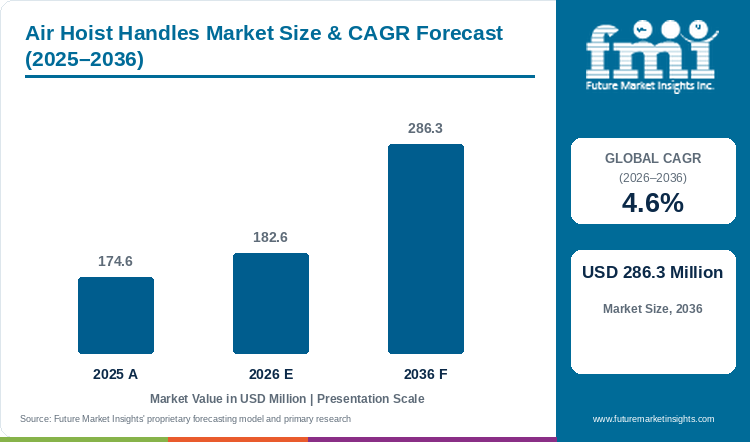
Demand for air hoist handles is projected to expand at 4.6% CAGR between 2026 and 2036. Industry value grows from USD 174.6 million in 2025 to USD 182.6 million in 2026 and is projected to reach USD 286.3 million by 2036.
FMI estimates air hoist handles market at USD 174.6 million in 2025 and USD 182.6 million in 2026. The market is projected to reach USD 286.3 million by 2036, witnessing 4.6% CAGR. Air hoist handles control lift movement, speed and emergency stop, and receives regular contact. In June 2026, the U.S. Bureau of Economic Analysis reported USD 121.8 billion of new foreign direct investment expenditure in manufacturing during 2025, accounting for 52.5% of total expenditure.[1] Expansion of manufacturing assets is expected to support replacement demand. Buyers requires matched valves, hoses and control layouts, due to which documents remain the final commercial filter.
Regional demand differs by country, as Brazil air hoist handles market is projected to grow at 5.3% CAGR, whereas South Korea is forecast to expand at 5.0% CAGR through 2036. Brazil reported oil and gas production of 4.9 million barrels of oil equivalent per day in June 2025, with offshore fields supplying most output.[2] Offshore maintenance is increasing use of rugged and corrosion-resistant controls in Brazil. South Korean shipyards requires quick replacement and local service for pneumatic lifting equipment. Application in shipbuilding, oil and gas workshops and maintenance is expected to support demand. Availability of compatible parts, emergency-stop options and technical records will influence product selection in these countries.
Key Takeaways
- Industrial users replace worn controls to keep pneumatic hoists responsive during frequent lifts.
- Pendant control handles are projected to hold 36.0% of 2026 revenue because they combine remote operator positioning with direct pneumatic command and safety-feature integration.
- The 0.5-2 ton segment is projected to represent 42.0% of 2026 revenue because it covers a broad set of repetitive plant and maintenance lifts where operators interact with the handle on every cycle.
- Steel is expected to account for 31.0% of 2026 revenue because rugged duty and repairability remain important for exposed control hardware in heavy industrial environments.
- Brazil is projected to expand at 5.3% CAGR through 2036 while South Korea is expected to grow at 5.0%.
- Notable companies in the Air Hoist Handles market include Ingersoll Rand, Kito Crosby, J.D. Neuhaus, Columbus McKinnon, Toku Pneumatic.
Analyst Perspective
“FMI analysis expects installed hoists to support a continuing market for compatible replacement handles. Buyers will favor controls that restore predictable lifting movement without extending the equipment's service window.”
- Nikhil Kaitwade, Principal Consultant, Future Market Insights.
How is the air hoist handles market segmented?
The air hoist handles market is segmented by Handle Type, Hoist Capacity, Material, Application and Sales Channel, plus region. In 2026, the leading subsegments are pendant control handles at 36.0% of handle type demand, 0.5-2 ton at 42.0% of hoist capacity demand, steel at 31.0% of material demand, manufacturing lines at 28.0% of application demand and hoist oem spares at 38.0% of sales channel demand.
Handle Type separates the operator interface by control architecture and replacement form.
Hoist Capacity distinguishes handles used on compact plant hoists from those paired with heavier industrial lifting systems.
Material reflects tradeoffs between impact resistance and weight. It also captures corrosion exposure and grip design.
Application captures the operating environment that determines wear, safety requirements, and control frequency.
Sales Channel distinguishes verified OEM spares from MRO distribution.It also captures direct aftermarket sourcing and repair-shop routes.
These axes describe the practical buying decision more closely than the hoist itself because the handle is selected for a specific control scheme and worksite.
What makes Pendant control handles central to the Handle Type category?
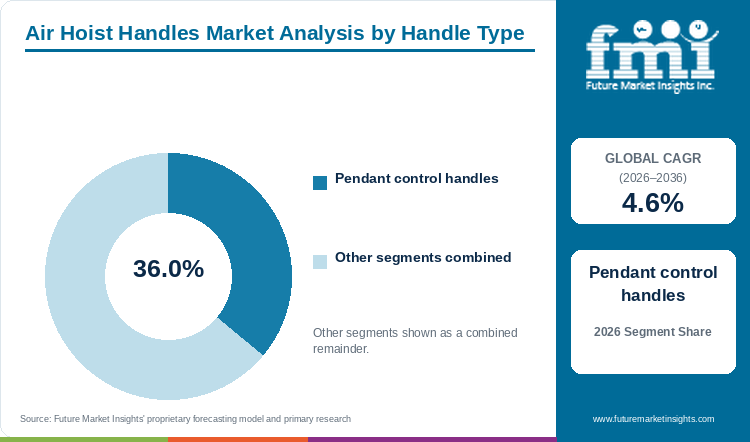
In 2026, pendant control handles is expected to account for 36.0% of handle type demand in the global market.
Pendant control handles lead because they put the primary up and down command in the operator’s hand while allowing the operator to stand clear of the suspended load. They can integrate proportional pneumatic valves, protective guards, and emergency-stop functions in one serviceable assembly. Ingersoll Rand documents pendant-handle options across several air-hoist families and pairs the handle with series-specific hose assemblies.
- Pendant control handles hold 36.0% of 2026 revenue because they combine remote operator positioning with direct pneumatic command and safety-feature integration.
- In May 2026, the U.S. Bureau of Labor Statistics reported 2,600 hoist and winch operators and 42,890 crane and tower operators based on May 2025 employment data.[3] This operating base supports recurring use of hand-held lifting controls.
Why does 0.5-2 ton lead the Hoist Capacity category?
In 2026, 0.5-2 ton is forecast to represent 42.0% of hoist capacity demand in the global market.
The 0.5-2 ton band sits at the center of routine industrial lifting. Typical work includes machine loading and assembly support. Maintenance and repeated positioning also fit this capacity range. These jobs require frequent operator input but do not always justify the specialized controls and project engineering associated with very high-capacity systems. TOKU’s TCR range spans 500 kg to 2 tons and is designed around precise variable-speed control. The band also overlaps common capacities in plant air-hoist families from other suppliers. High interaction frequency increases wear exposure across buttons and levers. Guards, valves, and grips can also require replacement while the hoist remains mechanically serviceable.
- The 0.5-2 ton segment represents 42.0% of 2026 revenue because it covers a broad set of repetitive plant and maintenance lifts where operators interact with the handle on every cycle.
- In September 2025, Kito Crosby expanded Harrington’s TCK air-hoist line with 10- and 25-ton models, showing how above-5-ton demand is more specialized around heavy-duty applications and emergency-stop pendants.
How does Steel support the Material category?
In 2026, steel is projected to hold 31.0% of material demand in the global market.
Steel leads where buyers favor impact tolerance and repairable mechanical hardware in exposed industrial controls. A handle assembly can combine a grip body with valve hardware and levers. Guards, fasteners, and fittings mean material choice is rarely uniform across the complete control. Steel therefore competes with aluminum and engineering plastics rather than replacing them in every component. The case for steel arises where controls can be struck or dragged during service. Foundries and mining maintenance are clear examples. Shipyards and oil and gas workshops present similar handling exposure. Lighter materials remain attractive when operator fatigue, corrosion behavior, or compact ergonomic form carries more weight in the specification.
- Steel accounts for 31.0% of 2026 revenue because rugged duty and repairability remain important for exposed control hardware in heavy industrial environments.
- In September 2025, Kito Crosby specified robust cast-iron construction and corrosion-resistant components for new Harrington TCK heavy-duty air hoists, reinforcing the wider premium placed on durable metallic hardware around pneumatic lifting systems.
What supports Manufacturing lines in the Application category?
In 2026, manufacturing lines is estimated to make up 28.0% of application demand in the global market.
Manufacturing lines lead because the handle is touched repeatedly during positioning and loading. Changeover and maintenance tasks add further control cycles. That repeated use raises the commercial value of low push force, intuitive button placement, and predictable speed modulation. Columbus McKinnon’s Unified pneumatic control handles are designed for precise load positioning and use profiled grips with guarded buttons. TOKU identifies assembly lines and high-speed production among its air-hoist applications. Unlike occasional maintenance lifts, line-side work exposes the control to many short cycles and makes operator comfort part of productivity. Buyers therefore evaluate the handle as a human-machine interface as well as a spare part.
- Manufacturing lines hold 28.0% of 2026 revenue because repetitive positioning creates frequent handle interaction and places a premium on ergonomic response.
- Columbus McKinnon’s 2026 Unified control-handle range documents profiled ergonomic grips and guarded buttons. It also includes pneumatic configurations intended for air-hoist and lift-assist applications.
What drives Hoist OEM spares in the Sales Channel category?
In 2026, hoist OEM spares is anticipated to capture 38.0% of sales channel demand in the global market.
Hoist OEM spares lead because a control that looks interchangeable can still differ in valve function and hose routing. Port size, control length, and emergency-stop arrangement can also determine fit. Incorrect matching can reverse motion commands or leave the control incompatible with the hoist valve architecture. OEM part mapping reduces that risk and gives maintenance teams a clearer route from the installed model to the replacement assembly. The channel also carries service documentation and access to related hoses or fittings. MRO distributors remain important for local stock, while repair shops win when a valve or lever can be rebuilt economically. For critical lifts, however, fit assurance keeps the OEM route central.
- Hoist OEM spares account for 38.0% of 2026 revenue because verified model compatibility lowers installation risk and reduces troubleshooting time.
- In June 2026, Columbus McKinnon presented Magnetek Flex Pro 2 wireless controls for material handling and mobile hydraulic equipment.
What are the drivers, restraints, and opportunities in the air hoist handles market?
Recurring safety-led replacement supports demand, while control compatibility slows substitution and modular retrofit kits open a route to faster aftermarket revenue.
- Driver: Inspection, wear, and uptime pressure support replacement of safety-critical air-hoist control handles.
- Restraint: Model-specific control hardware and certifications fragment the replacement universe.
- Opportunity: Configurable ergonomic kits can reduce downtime across legacy air-hoist fleets.
Installed Hoists Sustain Handle Demand
Inspection of air hoist controls is increasing replacement demand where a damaged lever or emergency stop can stop an otherwise serviceable hoist. In August 2026, OSHA extended its warehouse and distribution center National Emphasis Program from three years to five years and kept material handling and storage among its inspection targets.[4] Maintenance teams can retain the complete hoist, but failed control still prevents safe lifting. Increasing inspection of operating response is expected to drive air hoist handles market growth.
Model Compatibility Restricts Replacement
Air hoist handles are connected with a defined pneumatic circuit, due to which every replacement cannot be used with every model. CSA B167-2026 is the fifth edition of the national standard and covers air-powered hoists, with revised requirements for transmitters and inspections.[5] Different capacity, control material and hazardous-area requirement increases the number of handle configurations. High stocking cost and limited availability of older controls may hamper the market growth.
Service Networks Support Spare Sales
Service networks are creating growth opportunities by helping users source an air hoist and its controls according to application. In September 2026, the U.S. Census Bureau reported July manufactured-goods orders of USD 663.6 billion, up 0.9% from June.[6] The active manufacturing base keeps maintenance and replacement channels commercially relevant. Availability of guided selection with local spare stock is anticipated to support aftermarket sales.
Which country CAGRs are profiled in the air hoist handles market?
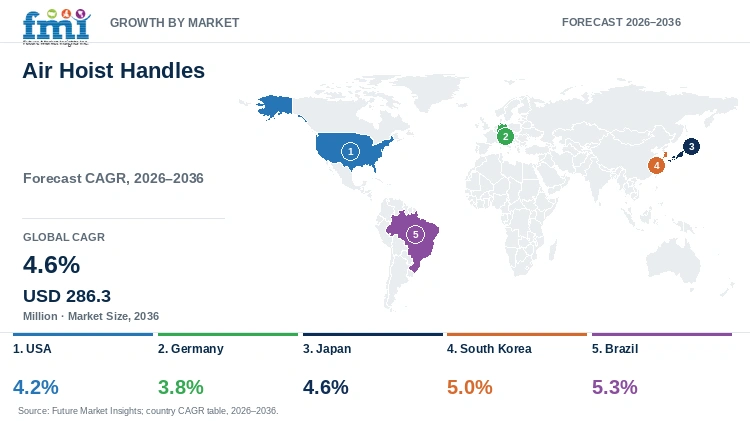
| Country | CAGR |
|---|---|
| USA | 4.2% |
| Germany | 3.8% |
| Japan | 4.6% |
| South Korea | 5.0% |
| Brazil | 5.3% |
How do country-level CAGRs compare in the air hoist handles market?
Country demand for air hoist handles reflects different local applications and investment cycles. Each outlook depends on how those conditions translate into product use.
- Brazil at 5.3% CAGR is 0.3 percentage points above South Korea. The difference favors earlier channel build-out in offshore and heavy-maintenance corridors where spare availability can shorten downtime.
- South Korea at 5.0% CAGR is 0.4 percentage points above Japan. Suppliers can justify deeper service stock where shipyard and export manufacturing activity creates concentrated industrial lifting demand.
- Japan at 4.6% CAGR is 0.4 percentage points above the USA. The comparison points to steadier retrofit demand in a mature industrial base rather than a simple expansion story.
- The USA at 4.2% CAGR is 0.4 percentage points above Germany. Both markets reward documented compatibility, but Germany places a higher premium on conformity for hazardous industrial environments.
The full report provides country-wise CAGR outlooks across North America, Latin America, Western Europe, Eastern Europe, East Asia, South Asia and Pacific, and the Middle East and Africa.
Country-wise Analysis
- USA buyers commonly route air-hoist handle replacement through plant MRO teams, authorized distributors, and service technicians who must match the control to an installed hoist family. Demand for Air Hoist Handles in the USA is forecast to rise at 4.2% CAGR from 2026 to 2036. In March 2026, the U.S. Census Bureau reported seasonally adjusted material handling equipment shipments of USD 2.979 billion for January 2026, up 4.1% from December 2025.[7] The friction is that safety documentation and exact pneumatic compatibility can slow substitution across brands. Suppliers can win by stocking high-turn OEM assemblies and publishing reliable model-to-handle cross-references.
- German industrial users tend to value traceability and documented conformity when controls are used around capital equipment or potentially explosive atmospheres. Sales of Air Hoist Handles in Germany are estimated to expand at 3.8% CAGR from 2026 to 2036. Destatis reported in February 2026 that Germany’s real manufacturing order stock was 7.0% above the prior year in December 2025, with other transport equipment and fabricated metal products contributing to the increase.[8] The local friction is a long qualification cycle when hazardous-area requirements apply. Suppliers need documented materials, control logic, and retrofit instructions rather than relying on visual interchangeability. Service teams also check that a replacement preserves the approved control layout.
- Japanese buyers often prioritize smooth positioning and long service life in mature production systems where pneumatic lifting equipment can remain in service through repeated maintenance cycles. Adoption of Air Hoist Handles in Japan is forecast to expand at 4.6% CAGR from 2026 to 2036. METI’s February 2026 revised industrial report showed December 2025 production 2.6% above the prior year, while the operating-ratio index was 2.2% higher year over year.[9] A mature installed base can lengthen the interval between complete control replacements. Suppliers can respond with compact retrofit kits and precise valve feel that preserve familiar operator workflows. That can favor a familiar control design when a plant needs predictable lifting movement.
- South Korean demand is shaped by export manufacturing and shipyard activity, where pneumatic lifting remains useful in repetitive maintenance and heavy fabrication work. Demand for Air Hoist Handles in South Korea is forecast to rise at 5.0% CAGR from 2026 to 2036. The Ministry of Trade, Industry and Energy reported in July 2025 that June ship exports surged 63.4% year over year to USD 2.5 billion and first-half ship exports increased 18.8% to USD 13.9 billion.[10] The friction is fast service under demanding marine conditions. Suppliers should combine local stock with corrosion-aware configurations and clear emergency-stop options. Local stock helps crews return a damaged hoist to service during a planned stop.
- Brazilian buyers in offshore and industrial maintenance place high value on rugged controls that can be serviced quickly near operating assets. Sales of Air Hoist Handles in Brazil are forecast to expand at 5.3% CAGR from 2026 to 2036. In August 2026, Brazil’s ANP reported June oil and gas production of 5.842 million barrels of oil equivalent per day; offshore fields produced 98.1% of oil and 87.6% of natural gas.[11] The friction is serving geographically dispersed sites with the correct certified spare. Suppliers can improve conversion through MRO distributors and repair shops that hold matched handles, valves, and fittings.
Who are the notable companies in the air hoist handles market?
Ingersoll Rand, Kito Crosby, J.D. Neuhaus, Columbus McKinnon, Toku Pneumatic, Red Rooster Lifting, Harrington Hoists, Tiger Lifting, Yale Hoists, and KHC are the notable companies profiled in this market.
Competition is split between integrated hoist manufacturers, broader lifting-system groups, and specialist pneumatic suppliers. Integrated OEMs compete by tying the handle to a known air-hoist family and a documented spare path. Broader motion-control groups can offer ergonomic pendant designs and adjacent controls across several lifting architectures. Specialists differentiate through hazardous-duty knowledge, rental or service support, and regional stocking. The practical competitive unit is not the handle shell alone. Buyers compare valve response with emergency-stop options and hose or port compatibility. Service documentation and part availability also influence the decision. This favors suppliers that can map a failed control to a replacement without forcing the maintenance team to redesign the entire pneumatic circuit.
- Integrated hoist and OEM-spare ecosystems: Ingersoll Rand, J.D. Neuhaus, Kito Crosby, and Harrington Hoists compete through model-specific controls and established lifting-equipment channels.
- Multi-brand lifting and control portfolios: Columbus McKinnon, Yale Hoists, and Toku Pneumatic combine broader lifting platforms with pneumatic pendant or variable-speed control options.
- Specialist pneumatic and regional service routes: Red Rooster Lifting, Tiger Lifting, and KHC compete through industrial service access, regional availability, and application-specific air-hoist experience.
Competitive Benchmarking: Air Hoist Handles Market
| Company | Pneumatic Handle Breadth | Safety & Hazard Controls | Aftermarket & Configuration Support | Geographic Reach |
|---|---|---|---|---|
| Ingersoll Rand | High | High | High | High |
| Kito Crosby | Medium | High | High | High |
| J.D. Neuhaus | High | High | High | High |
| Columbus McKinnon | High | Medium | High | High |
| Toku Pneumatic | High | High | Medium | Low |
| Red Rooster Lifting | Medium | High | High | Low |
| Harrington Hoists | Medium | High | High | Medium |
| Tiger Lifting | Medium | High | High | Medium |
| Yale Hoists | Low | Low | Medium | High |
| KHC | Low | Low | Medium | Low |
Scoring basis: High indicates broad documented capability for the stated measure. Medium reflects a narrower documented role, while Low means public material shows limited direct coverage. Ratings compare the named companies within this market only.
Key Developments in the Air Hoist Handles Market
- In June 2026, Columbus McKinnon presented the Magnetek Flex Pro 2 wireless control range for demanding equipment applications. The range includes 4-, 6-, 8- and 12-button transmitter options.
- In February 2026, Columbus McKinnon completed its acquisition of Kito Crosby after regulatory reviews. The combination brought Kito, Harrington, and other lifting brands into the same corporate group as Columbus McKinnon and Yale.
- In September 2025, Kito Crosby expanded the Harrington TCK air-hoist line with 10- and 25-ton models. The new units include an emergency-stop pendant as part of a heavy-duty package designed for mining and shipyard work. It also targets construction and petrochemical applications.
- In September 2025, Tiger Lifting established Tiger MENA in the UAE and stated that its pneumatic hoists were stocked for delivery across the GCC and Africa. The move places air-hoist inventory closer to oil and gas, shipyard, and heavy-industrial users in the region.
Key Players in the Air Hoist Handles Market
Integrated Air-Hoist OEM and Spare Ecosystems
- Ingersoll Rand
- J.D. Neuhaus
- Kito Crosby
- Harrington Hoists
Multi-Brand Lifting and Pneumatic Control Platforms
- Columbus McKinnon
- Yale Hoists
- Toku Pneumatic
Specialist Pneumatic and Regional Service Suppliers
- Red Rooster Lifting
- Tiger Lifting
- KHC
Air Hoist Handles Market - Report Scope
| Coverage field | Report scope |
|---|---|
| Market breakdown | Handle Type, Hoist Capacity, Material, Application, and Sales Channel |
| Quantitative Units | USD Million |
| Market Definition | Revenue from operator handles and hand-held control assemblies sold specifically for pneumatic or air hoists within the stated segmentation. Downstream finished-hoist revenue, adjacent lifting systems, and substitute control-system revenue are excluded. |
| Regions Covered | North America; Latin America; Western Europe; Eastern Europe; East Asia; South Asia and Pacific; Middle East and Africa |
| Countries Covered | USA, Germany, Japan, South Korea, Brazil, and more than twenty-five additional countries in the full report |
| Key Companies Profiled | Ingersoll Rand, Kito Crosby, J.D. Neuhaus, Columbus McKinnon, Toku Pneumatic, Red Rooster Lifting, Harrington Hoists, Tiger Lifting, Yale Hoists, KHC |
| Forecast Period | 2026 to 2036 |
| Approach | Hybrid bottom-up and top-down sizing that reconciles supplier offerings, installed air-hoist applications, replacement cycles, channel evidence, and relevant industrial demand indicators. |
Air Hoist Handles Market - Research Methodology
| Method | Approach |
|---|---|
| Market inputs | Market inputs are assessed against the defined product and service boundary. Public company information and official industry data are used to test commercial relevance where available. |
| Desk Research | Desk research uses official government data, standards, association material, company product pages and dated announcements. Sources are checked for product relevance, date, geography and scope. |
| Market Sizing and Forecasting | FMI forecasts use proprietary market estimates and the stated segment structure. Public evidence informs the direction of demand but does not independently establish FMI market values or shares. |
| Data Validation | The market boundary is checked for adjacent products and double counting. Values, units, forecast years, country rates and parent-segment share denominators are reconciled within the report. |
Air Hoist Handles Market by Segments
Air Hoist Handles Market segmented by Handle Type:
- Pendant control handles
- Throttle handles
- Ergonomic control handles
- Remote lever handles
- Replacement handle kits
Air Hoist Handles Market segmented by Hoist Capacity:
- 0.5-2 ton
- Below 0.5 ton
- 2-5 ton
- Above 5 ton
Air Hoist Handles Market segmented by Material:
- Steel
- Aluminum
- Engineering plastic
- Rubberized grip assemblies
Air Hoist Handles Market segmented by Application:
- Manufacturing lines
- Shipyards
- Mining maintenance
- Foundries
- Oil & gas workshops
Air Hoist Handles Market segmented by Sales Channel:
- Hoist OEM spares
- MRO distributors
- Direct aftermarket
- Repair service shops
Air Hoist Handles Market by Region:
- North America
- United States
- Canada
- Latin America
- Brazil
- Mexico
- Argentina
- Chile
- Western Europe
- Germany
- France
- United Kingdom
- Italy
- Spain
- Benelux
- Nordics
- Eastern Europe
- Poland
- Czech Republic
- Romania
- Hungary
- East Asia
- China
- Japan
- South Korea
- South Asia and Pacific
- India
- ASEAN
- Australia and New Zealand
- Middle East and Africa
- GCC Countries
- South Africa
- Türkiye
- Israel
Research Sources and Bibliography
- [1] U.S. Bureau of Economic Analysis. (2026, June 10). New foreign direct investment in the United States, 2025.
- [2] Ministry of Mines and Energy, Brazil. (2025, August 4). Brazil’s oil and gas production reaches a record 4.9 million barrels per day.
- [3] U.S. Bureau of Labor Statistics. (2026, May 15). Occupational employment and wages-May 2025.
- [4] Occupational Safety and Health Administration. (2026, August 6). Protecting warehouse workers. QuickTakes.
- [5] CSA Group. (2026). CSA B167-2026: Overhead cranes, gantry cranes, monorails, hoists, and jib cranes.
- [6] U.S. Census Bureau. (2026, September 2). Monthly full report on manufacturers’ shipments, inventories, and orders: July 2026.
- [7] U.S. Census Bureau. (2026, March 18). Manufacturers’ shipments, inventories, and orders: January 2026 full report.
- [8] Federal Statistical Office of Germany (Destatis). (2026, February 19). Stock of orders in manufacturing in December 2025: +1.2% on the previous month.
- [9] Ministry of Economy, Trade and Industry, Japan. (2026, February 16). Indices of Industrial Production: Revised Report for December 2025.
- [10] Ministry of Trade, Industry and Energy, Republic of Korea. (2025, July 1). Korea's exports grow 4.3% in June.
- [11] National Agency of Petroleum, Natural Gas and Biofuels (ANP), Brazil. (2026, August 3). Consolidated oil and gas production data for June 2026.
This bibliography is provided for reader reference and is not exhaustive. The full report contains the complete reference list and detailed citations.
This Report Answers
- How big is the Air Hoist Handles market in 2026?
- What value is the Air Hoist Handles market projected to reach by 2036?
- Which segment leads the Air Hoist Handles market in 2026?
- Which sales channel is prominent in the Air Hoist Handles market?
- Which countries show notable Air Hoist Handles market growth through 2036?
- Who are notable companies in the Air Hoist Handles market?
Frequently Asked Questions
How big is the air hoist handles market in 2026?
Future Market Insights estimates that the air hoist handles market will be valued at USD 182.6 million in 2026. The market is projected to reach USD 286.3 million by 2036 owing to increasing replacement of worn pneumatic controls.
What is the air hoist handles market CAGR from 2026 to 2036?
As per FMI, the air hoist handles market is projected to grow at 4.6% CAGR from 2026 to 2036. Increasing maintenance of installed pneumatic hoists is expected to support the market growth.
Why is pendant control handles prominent in the air hoist handles market?
Pendant control handles are projected to hold 36.0% of handle type demand in 2026. The segment benefits from direct pneumatic command and suitable operator distance from suspended loads.
Why does 0.5–2 ton matter in the air hoist handles market?
The 0.5–2 ton segment is estimated to account for 42.0% of hoist capacity demand in 2026. Increasing use in plant and maintenance lifting is expected to support the segment growth.
Which country has notable air hoist handles market growth?
FMI analysis predicts Brazil to register 5.3% CAGR from 2026 to 2036. Offshore and industrial maintenance is expected to support demand for rugged compatible controls.
Who are notable companies in the air hoist handles market?
Key participants include Ingersoll Rand, Kito Crosby, J.D. Neuhaus, Columbus McKinnon and Toku Pneumatic. These companies are focusing on compatible controls, portfolio expansion and regional service support.
Preview the report firsthand - request a free sample
Get SampleGet the brochure for pricing and purchase details.
Get PDFTable of Content
- Key Takeaways
- Market Size and CAGR
- Top Growth Driver
- Fastest Growing Segment
- Leading Region
- Key Companies
- Emerging Opportunities
- Executive Summary
- Global Market Outlook
- Demand-side Trends
- Supply-side Trends
- Technology Roadmap Analysis
- Analysis and Recommendations
- Analyst Perspective (What is happening? Why now? What should investors know?)
- Key Questions Answered
- How large is the market?
- What is the CAGR?
- What are key trends?
- Which region dominates?
- Who are the leaders?
- Market Overview
- Market Coverage / Taxonomy
- Market Definition / Scope / Limitations
- Research Methodology
- Chapter Orientation
- Analytical Lens and Working Hypotheses
- Market Structure, Signals, and Trend Drivers
- Benchmarking and Cross-market Comparability
- Market Sizing, Forecasting, and Opportunity Mapping
- Research Design and Evidence Framework
- Desk Research Programme (Secondary Evidence)
- Expert Input and Fieldwork (Primary Evidence)
- Tooling, Models, and Reference Databases
- Data Engineering and Model Build
- Quality Assurance and Audit Trail
- Market Background
- Market Dynamics (Drivers, Restraints, Opportunity, Trends)
- Scenario Forecast (Optimistic, Likely, Conservative)
- Impact Analysis
- AI Impact
- Sustainability Impact
- Regulatory Impact
- Technology Impact
- Consumer / Buyer Analysis
- Purchase Drivers
- Adoption Barriers
- Buyer Journey
- Opportunity Map Analysis
- Product Life Cycle Analysis
- Supply Chain Analysis
- Investment Feasibility Matrix
- Value Chain Analysis
- PESTLE and Porter's Analysis
- Regulatory Landscape
- Regional Parent Market Outlook
- Production and Consumption Statistics
- Import and Export Statistics
- Global Market Analysis and Forecast, 2021 to 2036
- Historical Market Size Value (USD Million) Analysis, 2021 to 2025
- Current and Future Market Size Value (USD Million) Projections, 2026 to 2036
- Y-o-Y Growth Trend Analysis
- Absolute $ Opportunity Analysis
- Global Market Pricing Analysis, 2021 to 2036
- Global Market Analysis and Forecast, By Handle Type, 2021 to 2036
- Introduction / Key Findings
- Historical Market Size Value (USD Million) Analysis By Handle Type, 2021 to 2025
- Current and Future Market Size Value (USD Million) Analysis and Forecast By Handle Type, 2026 to 2036
- Pendant control handles
- Throttle handles
- Ergonomic control handles
- Remote lever handles
- Replacement handle kits
- Y-o-Y Growth Trend Analysis By Handle Type, 2021 to 2025
- Absolute $ Opportunity Analysis By Handle Type, 2026 to 2036
- Global Market Analysis and Forecast, By Hoist Capacity, 2021 to 2036
- Introduction / Key Findings
- Historical Market Size Value (USD Million) Analysis By Hoist Capacity, 2021 to 2025
- Current and Future Market Size Value (USD Million) Analysis and Forecast By Hoist Capacity, 2026 to 2036
- 0.5-2 ton
- Below 0.5 ton
- 2-5 ton
- Above 5 ton
- Y-o-Y Growth Trend Analysis By Hoist Capacity, 2021 to 2025
- Absolute $ Opportunity Analysis By Hoist Capacity, 2026 to 2036
- Global Market Analysis and Forecast, By Material, 2021 to 2036
- Introduction / Key Findings
- Historical Market Size Value (USD Million) Analysis By Material, 2021 to 2025
- Current and Future Market Size Value (USD Million) Analysis and Forecast By Material, 2026 to 2036
- Steel
- Aluminum
- Engineering plastic
- Rubberized grip assemblies
- Y-o-Y Growth Trend Analysis By Material, 2021 to 2025
- Absolute $ Opportunity Analysis By Material, 2026 to 2036
- Global Market Analysis and Forecast, By Application, 2021 to 2036
- Introduction / Key Findings
- Historical Market Size Value (USD Million) Analysis By Application, 2021 to 2025
- Current and Future Market Size Value (USD Million) Analysis and Forecast By Application, 2026 to 2036
- Manufacturing lines
- Shipyards
- Mining maintenance
- Foundries
- Oil & gas workshops
- Y-o-Y Growth Trend Analysis By Application, 2021 to 2025
- Absolute $ Opportunity Analysis By Application, 2026 to 2036
- Global Market Analysis and Forecast, By Sales Channel, 2021 to 2036
- Introduction / Key Findings
- Historical Market Size Value (USD Million) Analysis By Sales Channel, 2021 to 2025
- Current and Future Market Size Value (USD Million) Analysis and Forecast By Sales Channel, 2026 to 2036
- Hoist OEM spares
- MRO distributors
- Direct aftermarket
- Repair service shops
- Y-o-Y Growth Trend Analysis By Sales Channel, 2021 to 2025
- Absolute $ Opportunity Analysis By Sales Channel, 2026 to 2036
- Global Market Analysis and Forecast, By Region, 2021 to 2036
- Introduction
- Historical Market Size Value (USD Million) Analysis By Region, 2021 to 2025
- Current Market Size Value (USD Million) Analysis and Forecast By Region, 2026 to 2036
- North America
- Latin America
- Western Europe
- Eastern Europe
- East Asia
- South Asia and Pacific
- Middle East and Africa
- Market Attractiveness Analysis By Region
- North America Market Analysis and Forecast, By Country, 2021 to 2036
- Historical Market Size Value (USD Million) Trend Analysis By Market Taxonomy, 2021 to 2025
- Market Size Value (USD Million) Forecast By Market Taxonomy, 2026 to 2036
- By Country
- United States
- Canada
- By Handle Type
- By Hoist Capacity
- By Material
- By Application
- By Sales Channel
- By Country
- Market Attractiveness Analysis
- By Country
- By Handle Type
- By Hoist Capacity
- By Material
- By Application
- By Sales Channel
- Key Takeaways
- Latin America Market Analysis and Forecast, By Country
- Historical Market Size Value (USD Million) Trend Analysis By Market Taxonomy, 2021 to 2025
- Market Size Value (USD Million) Forecast By Market Taxonomy, 2026 to 2036
- By Country
- Brazil
- Mexico
- Argentina
- Chile
- By Handle Type
- By Hoist Capacity
- By Material
- By Application
- By Sales Channel
- By Country
- Market Attractiveness Analysis
- By Country
- By Handle Type
- By Hoist Capacity
- By Material
- By Application
- By Sales Channel
- Key Takeaways
- Western Europe Market Analysis and Forecast, By Country
- Historical Market Size Value (USD Million) Trend Analysis By Market Taxonomy, 2021 to 2025
- Market Size Value (USD Million) Forecast By Market Taxonomy, 2026 to 2036
- By Country
- Germany
- France
- United Kingdom
- Italy
- Spain
- Benelux
- Nordics
- By Handle Type
- By Hoist Capacity
- By Material
- By Application
- By Sales Channel
- By Country
- Market Attractiveness Analysis
- By Country
- By Handle Type
- By Hoist Capacity
- By Material
- By Application
- By Sales Channel
- Key Takeaways
- Eastern Europe Market Analysis and Forecast, By Country
- Historical Market Size Value (USD Million) Trend Analysis By Market Taxonomy, 2021 to 2025
- Market Size Value (USD Million) Forecast By Market Taxonomy, 2026 to 2036
- By Country
- Poland
- Czech Republic
- Romania
- Hungary
- By Handle Type
- By Hoist Capacity
- By Material
- By Application
- By Sales Channel
- By Country
- Market Attractiveness Analysis
- By Country
- By Handle Type
- By Hoist Capacity
- By Material
- By Application
- By Sales Channel
- Key Takeaways
- East Asia Market Analysis and Forecast, By Country
- Historical Market Size Value (USD Million) Trend Analysis By Market Taxonomy, 2021 to 2025
- Market Size Value (USD Million) Forecast By Market Taxonomy, 2026 to 2036
- By Country
- China
- Japan
- South Korea
- By Handle Type
- By Hoist Capacity
- By Material
- By Application
- By Sales Channel
- By Country
- Market Attractiveness Analysis
- By Country
- By Handle Type
- By Hoist Capacity
- By Material
- By Application
- By Sales Channel
- Key Takeaways
- South Asia and Pacific Market Analysis and Forecast, By Country
- Historical Market Size Value (USD Million) Trend Analysis By Market Taxonomy, 2021 to 2025
- Market Size Value (USD Million) Forecast By Market Taxonomy, 2026 to 2036
- By Country
- India
- ASEAN
- Australia and New Zealand
- By Handle Type
- By Hoist Capacity
- By Material
- By Application
- By Sales Channel
- By Country
- Market Attractiveness Analysis
- By Country
- By Handle Type
- By Hoist Capacity
- By Material
- By Application
- By Sales Channel
- Key Takeaways
- Middle East and Africa Market Analysis and Forecast, By Country
- Historical Market Size Value (USD Million) Trend Analysis By Market Taxonomy, 2021 to 2025
- Market Size Value (USD Million) Forecast By Market Taxonomy, 2026 to 2036
- By Country
- GCC Countries
- South Africa
- Türkiye
- Israel
- By Handle Type
- By Hoist Capacity
- By Material
- By Application
- By Sales Channel
- By Country
- Market Attractiveness Analysis
- By Country
- By Handle Type
- By Hoist Capacity
- By Material
- By Application
- By Sales Channel
- Key Takeaways
- Key Countries Market Analysis
- United States
- Pricing Analysis
- Market Share Analysis, 2025
- By Handle Type
- By Hoist Capacity
- By Material
- By Application
- By Sales Channel
- Canada
- Pricing Analysis
- Market Share Analysis, 2025
- By Handle Type
- By Hoist Capacity
- By Material
- By Application
- By Sales Channel
- Mexico
- Pricing Analysis
- Market Share Analysis, 2025
- By Handle Type
- By Hoist Capacity
- By Material
- By Application
- By Sales Channel
- Brazil
- Pricing Analysis
- Market Share Analysis, 2025
- By Handle Type
- By Hoist Capacity
- By Material
- By Application
- By Sales Channel
- Chile
- Pricing Analysis
- Market Share Analysis, 2025
- By Handle Type
- By Hoist Capacity
- By Material
- By Application
- By Sales Channel
- Germany
- Pricing Analysis
- Market Share Analysis, 2025
- By Handle Type
- By Hoist Capacity
- By Material
- By Application
- By Sales Channel
- United Kingdom
- Pricing Analysis
- Market Share Analysis, 2025
- By Handle Type
- By Hoist Capacity
- By Material
- By Application
- By Sales Channel
- Italy
- Pricing Analysis
- Market Share Analysis, 2025
- By Handle Type
- By Hoist Capacity
- By Material
- By Application
- By Sales Channel
- Spain
- Pricing Analysis
- Market Share Analysis, 2025
- By Handle Type
- By Hoist Capacity
- By Material
- By Application
- By Sales Channel
- France
- Pricing Analysis
- Market Share Analysis, 2025
- By Handle Type
- By Hoist Capacity
- By Material
- By Application
- By Sales Channel
- India
- Pricing Analysis
- Market Share Analysis, 2025
- By Handle Type
- By Hoist Capacity
- By Material
- By Application
- By Sales Channel
- ASEAN
- Pricing Analysis
- Market Share Analysis, 2025
- By Handle Type
- By Hoist Capacity
- By Material
- By Application
- By Sales Channel
- Australia and New Zealand
- Pricing Analysis
- Market Share Analysis, 2025
- By Handle Type
- By Hoist Capacity
- By Material
- By Application
- By Sales Channel
- China
- Pricing Analysis
- Market Share Analysis, 2025
- By Handle Type
- By Hoist Capacity
- By Material
- By Application
- By Sales Channel
- Japan
- Pricing Analysis
- Market Share Analysis, 2025
- By Handle Type
- By Hoist Capacity
- By Material
- By Application
- By Sales Channel
- South Korea
- Pricing Analysis
- Market Share Analysis, 2025
- By Handle Type
- By Hoist Capacity
- By Material
- By Application
- By Sales Channel
- Poland
- Pricing Analysis
- Market Share Analysis, 2025
- By Handle Type
- By Hoist Capacity
- By Material
- By Application
- By Sales Channel
- Hungary
- Pricing Analysis
- Market Share Analysis, 2025
- By Handle Type
- By Hoist Capacity
- By Material
- By Application
- By Sales Channel
- Türkiye
- Pricing Analysis
- Market Share Analysis, 2025
- By Handle Type
- By Hoist Capacity
- By Material
- By Application
- By Sales Channel
- South Africa
- Pricing Analysis
- Market Share Analysis, 2025
- By Handle Type
- By Hoist Capacity
- By Material
- By Application
- By Sales Channel
- United States
- Market Structure Analysis
- Competition Dashboard
- Competition Benchmarking
- Market Share Analysis of Top Players
- By Regional
- By Handle Type
- By Hoist Capacity
- By Material
- By Application
- By Sales Channel
- Emerging Startups
- Innovation Benchmarking
- Competition Analysis
- Competition Deep Dive
- Ingersoll Rand
- Overview
- Product Portfolio
- Profitability by Market Segments
- Sales Footprint
- Strategy Overview
- Marketing Strategy
- Product Strategy
- Channel Strategy
- Kito Crosby
- J.D. Neuhaus
- Columbus McKinnon
- Toku Pneumatic
- Red Rooster Lifting
- Harrington Hoists
- Tiger Lifting
- Yale Hoists
- KHC
- Ingersoll Rand
- Case Studies
- Success Stories
- Recent Developments
- Competition Deep Dive
- Assumptions & Acronyms Used


