

- Market Size (2026)
- USD 650.0 Mn
- Forecast (2036)
- 8961.0 Mn
- CAGR (2026 to 2036)
- 30.0%
How big is Robotic Truck & Container Unloading Market in 2026?
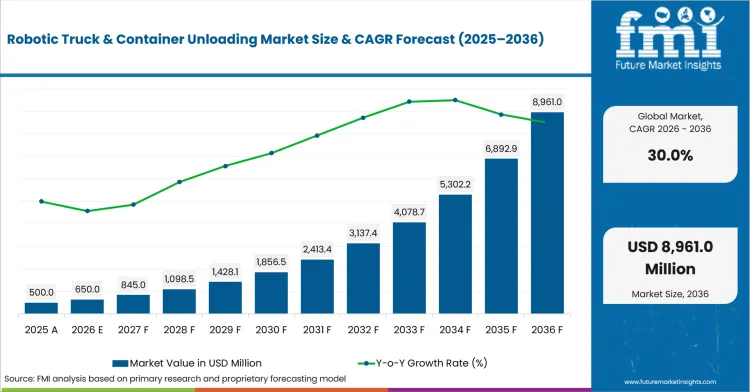
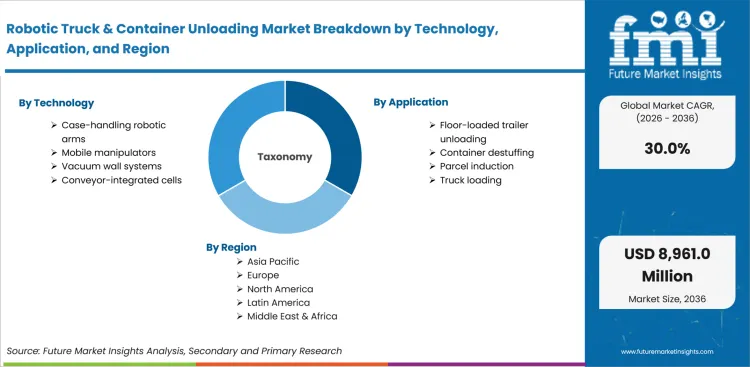
USD 650.0 million in 2026 and USD 8,961.0 million by 2036 at a 30.0% CAGR.
Sales of robotic truck and container unloading systems are estimated to rise at a 30.0% CAGR through 2036, increasing valuation from USD 650.0 million in 2026 to USD 8,961.0 million by 2036. Trailer arrivals frequently fall outside planned staffing windows, and mobile robotic unloaders help maintain carton flow without adding more workers inside trailers during peak receiving periods. With USA retail e-commerce sales reaching USD 326.7 billion in the first quarter of 2026, slow receiving doors can quickly create downstream bottlenecks that delay storage, picking and order fulfillment across the wider distribution network.
USA logistics networks test mobile unloaders across several doors at parcel and retail sites with changing inbound schedules. South Korean warehouses value quick fault recovery to protect timed export flows from missed transfers. European projects need clear safety documents and proof that the robot works with existing dock equipment. Site reviews start with carton range and trailer depth, then turn to fleet size and repair coverage. In February 2026, the USA Bureau of Transportation Statistics reported USD 127.8 billion in North American transborder freight for December 2025. Freight at this scale turns a slow receiving door into a visible cost across ports and inland warehouses. Managers compare mobile unloading with other logistics robots that reduce dock pressure across freight-handling networks. Systems that handle unstable stacks without forcing a warehouse rebuild offer the clearest practical advantage.
| Metric | Value |
|---|---|
| 2025 Market Size | USD 500.0 million |
| 2026 Market Size | USD 650.0 million |
| 2036 Market Size | USD 8,961.0 million |
| Forecast CAGR (2026-2036) | 30.0% |
| Technology Focus | Case-handling robotic arms (40.0% share in 2026) |
| Application Focus | Floor-loaded trailer unloading (44.0% share in 2026) |
| Component Focus | Hardware (58.0% share in 2026) |
Summary of the Robotic Truck & Container Unloading Market
| Market Signal | Commercial Impact |
|---|---|
| Demand and Growth Drivers | Trailer arrivals that outpace available labor turn unloading into a business problem at busy receiving docks. Torn boxes and unstable stacks make mixed freight harder for both people and robots during unloading.
|
| Product and Segment View | At busy receiving docks, case-handling arms and floor-loaded trailers define the first product test for safe gripping and reliable transfer into the next process. The mobile base and arm set reach, and the gripper determines carton range.
|
| Geography and Growth Outlook | Country growth reflects freight intensity and the way each region approves new warehouse equipment. USA projects favor easy movement between doors, but European projects require deeper safety evidence.
|
| Competitive Landscape | Competition separates robots built for trailer unloading from wider platforms that add loading or pallet work. Warehouses need proof that a machine handles their cartons and remains available during normal shifts.
|
| Analyst Perspective | The central question is whether a robot repeats its demonstration performance during ordinary shifts at active warehouse sites. Recovery from shifted cartons often decides whether a pilot becomes regular use across several doors.
|
Source: FMI's proprietary forecasting model and primary research
How is the robotic truck & container unloading market segmented?
The robotic truck & container unloading industry is segmented by technology, application, component, end-use industry, business model, and region.
The report divides the market by technology, application, component, end-use industry, business model, and region. Technology covers case-handling arms, mobile manipulators, vacuum wall systems, and conveyor-integrated cells used across different trailer layouts. Application separates floor-loaded trailer unloading from container destuffing, parcel induction, and truck loading. Component analysis distinguishes hardware from AI software and service. End users include parcel carriers, third-party logistics firms, retail distribution centers, and manufacturers. Business models cover direct purchase, robots-as-a-service, leases, and pilot programs. Regional coverage spans North America, Latin America, Europe, East Asia, South Asia, Oceania, and the Middle East and Africa.
How does case-handling robotics shape demand within the technology category?
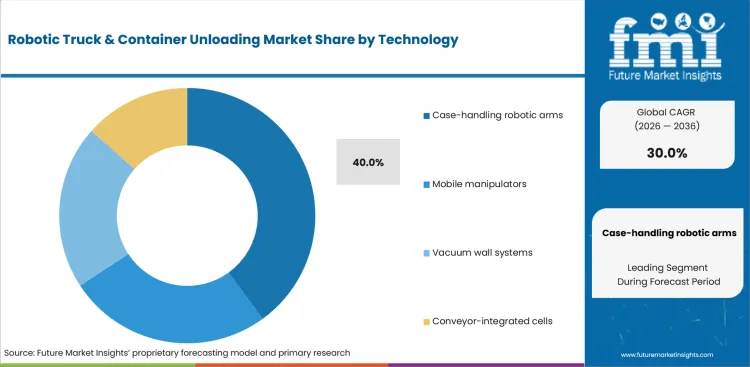
Loose cartons shift throughout unloading as each pick changes the shape of the remaining stack. A robot must identify torn boxes and tilted cases while detecting new gaps that appear inside a narrow trailer. Case-handling arms combine camera vision with a mobile base and a gripper built for this work. Commercial value depends on how often the robot clears a difficult pick without calling a person back into the trailer.
- Case-handling robotic arms are projected to hold a 40.0% share of the technology category in 2026 supported by their fit with mixed cartons. In May 2025, DHL Group signed an agreement with Boston Dynamics to expand Stretch use across its operations. DHL's decision shows that large logistics groups are expanding beyond small trials and building fleets for daily freight with limited manual help.
- Parcel carriers and third-party logistics firms value mobile robots that serve several doors during the same shift and avoid the limits of fixed cells during early project reviews. One platform follows changing trailer positions without major conveyor work, which improves the business case at sites with uneven arrival schedules.
What supports floor-loaded trailer unloading within the application category?
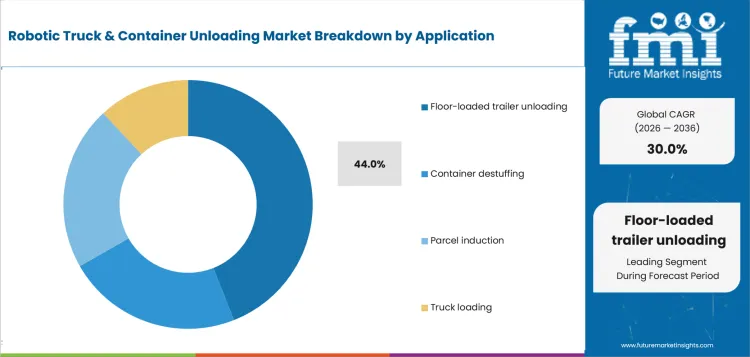
Floor-loaded trailers carry loose cartons instead of pallets, so the stack changes shape with every pick. The robot must read each new carton face as it travels farther into the trailer. Warehouse managers watch reach and carton transfer closely to prevent a second bottleneck at the receiving conveyor.
- By application, floor-loaded trailer unloading is estimated to hold a 44.0% in 2026 due to the strain created by loose cartons. In August 2025, Anyware Robotics reported commercial Pixmo use at Saddle Creek Logistics in Modesto. The project gives managers a practical example of robotic unloading inside an existing operation without installing a large fixed cell.
- Retail and parcel networks are expected to spend more on floor-loaded unloading as irregular carton walls slow crews and delay receiving. Downstream postal automation systems also shape sorting and induction capacity after trailer unloading. Unloading speed creates little value if the next conveyor lacks enough capacity, so the better project balances robot output with receiving-line flow.
How do warehouse operators evaluate hardware within the component category?
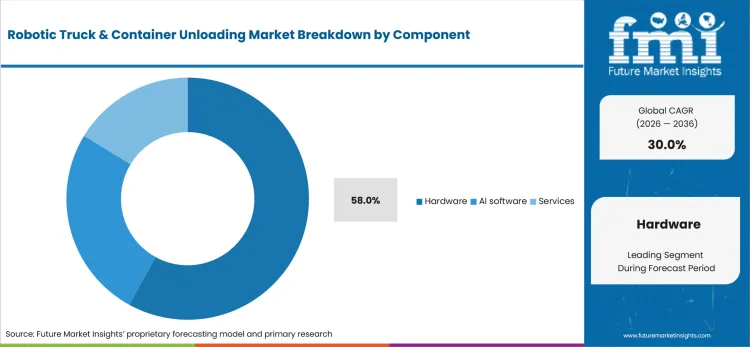
Hardware determines whether an unloading robot reaches the back of a trailer and transfers the required cartons. Software and service determine how often the machine remains available during daily work at busy sites. The practical test is whether the robot reaches every required carton and transfers it without repeated manual resets.
- Based on component category, hardware is projected to hold a 58.0% share in 2026, driven by the cost of the arm and mobile platform. In March 2025, Anyware Robotics secured USD 12 million in seed funding to support commercial Pixmo use. The funding shows that investors view unloading hardware as a warehouse product instead of a lab project. It gives the company room to improve the machine and expand use across additional sites.
- Mobile hardware appeals to warehouses that lack enough space or volume for a fixed cell at every receiving door. Repair response and software updates determine how often the machine remains available during a working week. Price says little about value if the robot is unavailable during the busiest receiving hours. A sound offer pairs suitable hardware with a maintenance plan that protects dock flow.
What drives parcel and post demand within the end-use industry category?
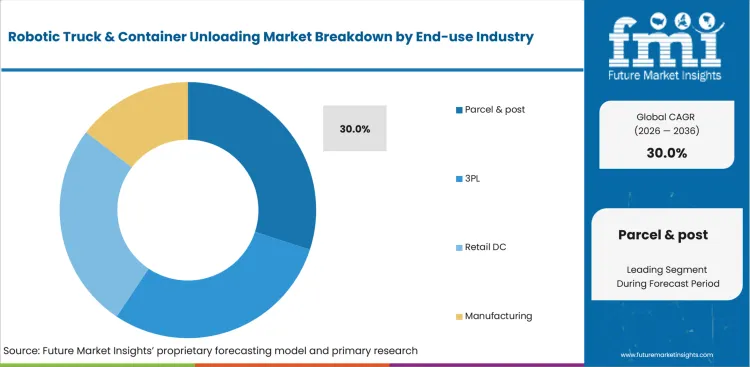
Parcel and post networks receive sharp bursts of freight that expose the limits of manual unloading. At parcel hubs, a slow receiving door reduces flow into induction and sorting during peak periods. These companies value a steady feed of cartons more than a short burst of picking speed. For this group, reliable transfer and quick recovery carry the most commercial value during peak periods.
- Parcel and post is forecast to represent a 30.0% end-use share in 2026, driven by repeated inbound peaks. In October 2025, Dexterity began operational validation of Mech with Sagawa Express inside Japan's parcel network. The program shows that parcel carriers are testing robotic truck handling within established networks and safety practices.
- Parcel networks are expected to invest in unloading systems as labor gaps disrupt induction schedules during concentrated arrival periods. Warehouse planners also assess goods-to-person robots when estimating labor needs across storage and picking steps that follow unloading.
How is direct purchase positioned within the business model category?
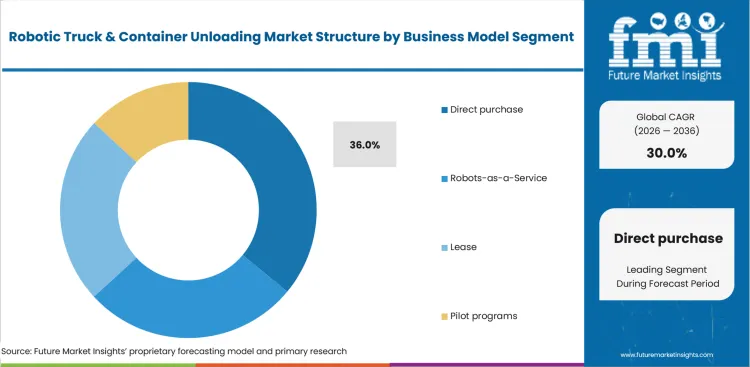
Direct purchase fits distribution centers with steady trailer volume and enough technical staff to own equipment for several years. Lower-volume sites face a different calculation as weekly trailer counts change across seasonal programs throughout the year. Those warehouses need a flexible way to test carton fit and repair needs without taking full ownership risk at the start.
- Direct purchase is projected to account for a 36.0% share in 2026 due to asset control at high-use sites. In January 2025, States Logistics documented regular production use of Contoro Robotics' Dock Duck at one warehouse. Daily performance and repair needs give managers a real basis for comparing ownership with service-based access.
- Consistent use supports asset ownership and in-house maintenance at high-volume distribution centers over several years. Smaller sites usually begin with robots-as-a-service or a structured pilot at one receiving door.
What are the drivers, restraints, and opportunities in the robotic truck & container unloading market?
Labor shortages at receiving docks are expected to support investment in robotic unloading. Damaged cartons and unstable stacks are anticipated to extend trials until error recovery improves. Mobile service contracts are projected to widen access for sites with changing trailer volume and limited capital budgets.
- Driver: Persistent dock labor gaps are projected to support investment in robots that unload loose cartons without sending people inside trailers.
- Restraint: Damaged packages and unstable freight walls are anticipated to extend trials as recovery performance often differs from staged demonstrations.
- Opportunity: Mobile systems and service-based contracts are expected to open projects at sites that lack the volume for a fixed automated cell.
Trailer arrivals change significantly as compared to staffing plans, leaving too few people for demanding unloading work. In February 2025, Pickle Robot published an operating example from Yusen Logistics showing its robots handling hundreds of boxes. The example shows that useful automation must fit the existing receiving process and maintain a steady handoff into the next warehouse step throughout the shift.
Damaged cartons and leaning stacks make real freight one of the main technical barrier during staged robot tests. In March 2025, Dexterity introduced Mech for truck loading and described other warehouse tasks for future use. The product path highlights an important difference: loading and unloading require separate movements and error handling. Warehouse managers protect payback by testing the exact freight direction and carton range instead of treating every truck-handling robot as interchangeable.
Flexible contracts let a warehouse test freight without purchasing a fleet at a single site. In June 2025, Pickle Robot appointed Fred Hopke as vice president of engineering and planned to hire 50 engineers by September. The expansion shows how much technical support is needed as unloading robots progress from trials to routine dock work. Early reviews compare repair coverage, ownership cost and autonomous warehouse robots that can support changing dock schedules. Sites with several receiving doors gain more value from one mobile platform that serves each door as schedules change.
Which country CAGRs are profiled in the robotic truck & container unloading market?
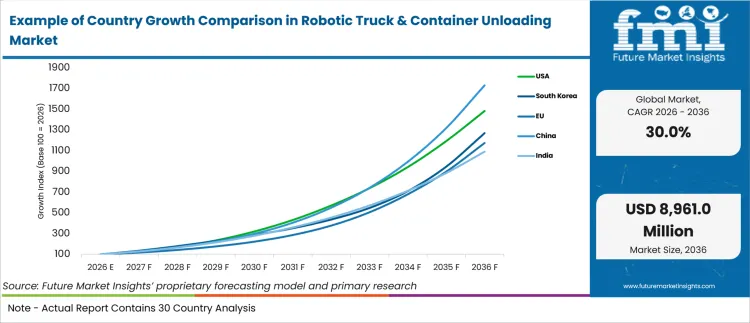
| Country | CAGR |
|---|---|
| United States | 31.0% |
| South Korea | 29.0% |
| European Union | 28.0% |
Source: FMI's proprietary forecasting model and primary research
How do country-level CAGRs compare in the robotic truck & container unloading market?
Country growth reflects freight volume and the speed at which a pilot becomes routine dock work. The United States combines large parcel networks with active testing of mobile unloaders across regional distribution centers. South Korean warehouses focus on timed export flows and dependable transfer between receiving and outbound staging. European Union projects place greater weight on safety documents and fit with existing conveyors during formal reviews. All three markets face the same physical strain, but delay costs and approval steps differ across each region. A long service gap erases labor savings during a concentrated receiving period, so local repair coverage affects company selection.
- USA-based distribution networks handle heavy inbound flows across regional fulfillment centers and cross-border routes every day. Demand in the United States is forecast to rise at a 31.0% CAGR by 2036. Mobile systems suit parcel carriers and third-party logistics firms that need one robot to serve several doors. In June 2026, the USA Bureau of Transportation Statistics reported USD 150.8 billion in North American transborder freight for April 2026. Freight at that scale raises the cost of delays at busy receiving doors across regional logistics networks. Boston Dynamics and Pickle Robot give local warehouses purpose-built options for unloading loose cartons from floor-loaded trailers. Later parcel handling may also depend on automated parcel terminals inside retail and logistics networks. USA projects are likely to favor machines that fit existing conveyors and travel easily between receiving doors.
- South Korean export warehouses work against tight shipping windows and have little room for daily receiving delays. The market is expected to post a 29.0% CAGR during the forecast period, as factories and logistics firms need dependable transfer from receiving into storage and outbound staging during busy export periods. South Korea's trade ministry reported in April 2026 that March exports reached USD 86.1 billion. The record value reflects the warehouse work needed to support the country's monthly export flow. South Korean exporters and third-party logistics firms compare repair support and conveyor fit during each platform review.
- European Union warehouse projects place detailed safety records beside throughput goals during formal equipment reviews. Adoption is anticipated to expand at a 28.0% CAGR from 2026 to 2036 over the full forecast period. Many sites must connect new robots to established conveyors and follow documented machine-safety procedures. In April 2025, the World Trade Organization placed European Union merchandise exports at USD 2.80 trillion for 2024. Trade at that scale creates a broad receiving burden across ports and inland distribution centers. European logistics operators often require documented recovery methods and local service as conditions for wider project approval.
Who are the notable companies in the robotic truck & container unloading market?
Boston Dynamics, Pickle Robot, Mujin, Anyware Robotics, Contoro Robotics, and Dexterity are the notable companies shaping this market.
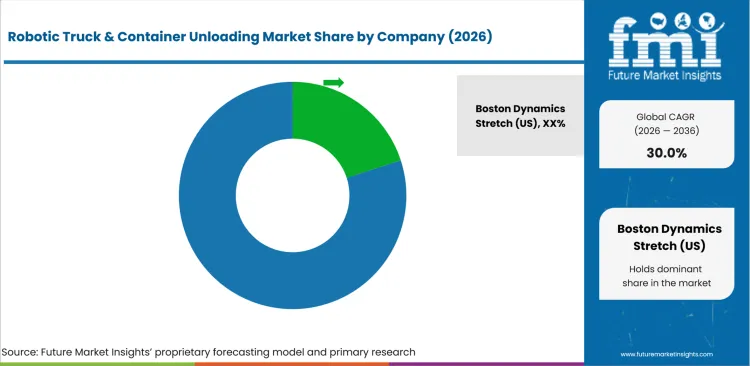
The competitive field includes purpose-built trailer unloaders and broader mobile robots that add loading or pallet work. A stopped dock disrupts receiving and the labor planned for later warehouse tasks, making mixed-carton handling the first test during a serious product review. Repair coverage becomes equally important during daily use at a busy receiving site with frequent trailer arrivals. Carton transfer from the dock into automated sortation systems shows whether unloading output can move smoothly into the next process. Companies build trust by showing steady transfer from trailer to conveyor during full shifts without repeated stoppages. A serious shortlist first separates direct unloading evidence from broad warehouse-robot claims, then compares price and contract terms.
- Boston Dynamics and Pickle Robot focus on mobile case unloading inside floor-loaded trailers at active distribution centers. Their products address work that warehouses want to remove from manual crews, so carton range and repair response carry more weight than company size. A broad robot portfolio adds little value without direct proof of reliable dock performance at active sites.
- Mujin and Anyware Robotics connect trailer unloading with carton transfer into the warehouse processes that follow. TruckBot places cartons onto a conveyor, while Pixmo travels between receiving doors during the same shift. Their approach suits sites that want one platform to support more of the warehouse process instead of operating as an isolated picking machine.
- Contoro Robotics uses remote help and service-based access to reduce the commitment needed for an early project. Dexterity approaches truck handling with a broader platform that includes loading validation and other warehouse uses. The contrast shows that companies compete on contract design and operating help as well as gripping hardware.
Competitive Benchmarking: Robotic Truck & Container Unloading Market
| Company | Unloading focus | Mixed-carton handling | Dock mobility | Service capability | Geographic reach |
|---|---|---|---|---|---|
| Boston Dynamics | High | High | High | High | North America and Europe / Regional |
| Pickle Robot | High | High | High | Medium | United States / Country-specific |
| Mujin | High | High | Medium | Medium | United States and Japan / Regional |
| Anyware Robotics | High | High | High | Medium | United States / Country-specific |
| Contoro Robotics | High | Medium | High | High | United States / Country-specific |
| Dexterity | Low | High | Medium | Medium | North America and Japan / Regional |
Scoring basis: High means the company has substantial direct capability supported by product information or proof from daily use. Medium means the capability is relevant but remains partial or indirect across the applications documented by the company. Low means official sources provide little direct evidence for that exact area of robotic trailer or container unloading.
Source: Future Market Insights competitive analysis, 2026. Ratings reflect relative portfolio relevance and workflow fit. Service capability and geographic reach shape the remaining comparison.
Key Developments in the Robotic Truck & Container Unloading Market
- In December 2025, Mujin, raised USD 233 million to expand MujinOS and support international growth in warehouse automation across logistics and manufacturing markets. MujinOS controls TruckBot for trailer and container unloading, so the funding supports stronger product service and partner coverage for projects that connect robotic picking with conveyor-based freight transfer. The investment reflects demand for connected systems that carry cartons into later warehouse processes without repeated handling.
- In April 2025, Anyware Robotics, received MHI's Best New Innovation award for a Pixmo demonstration at ProMat 2025 in Chicago that combined container unloading with mobile palletizing. The demonstration showed one robot performing several warehouse tasks, which lets operators spread equipment cost across the shift instead of installing separate machines for unloading and palletizing.
- In January 2025, Pickle Robot, announced regular use of its unloading robot at Randa Apparel & Accessories' Fort Worth fulfillment center during routine apparel receiving operations. Pickle reported more than 1.5 million pounds unloaded from mid-October 2024 to the announcement date, giving warehouses practical evidence from normal dock work instead of a controlled demonstration.
- In March 2025, Boston Dynamics, launched a consulting practice to help organizations assess automation needs and plan robot use across existing warehouse operations and equipment. The practice adds site planning and worker training to the equipment offer, showing that support services are becoming part of the commercial package for warehouses adopting new robots.
Key Players in the Robotic Truck & Container Unloading Market
Purpose-built mobile trailer unloading systems
- Boston Dynamics
- Pickle Robot
- Mujin
Flexible container-handling and service-based platforms
- Anyware Robotics
- Contoro Robotics
Truck-loading and adjacent case-handling platforms
- Dexterity
Robotic Truck & Container Unloading Market - Report Scope
| Coverage field | Report scope |
|---|---|
| Market breakdown | Technology, application, component, end-use industry, business model, and region |
| Quantitative Units | Revenue in USD million, volume in units, and CAGR in % |
| Market Definition | Robotic systems designed to transfer loose cartons from trucks and shipping containers into warehouse receiving operations. |
| Regions Covered | North America, Latin America, Europe, East Asia, South Asia, Oceania, and the Middle East and Africa |
| Countries Covered | United States, South Korea, European Union, and 22+ countries within the regional model |
| Key Companies Profiled | Boston Dynamics, Pickle Robot, Mujin, Anyware Robotics, Contoro Robotics, and Dexterity |
| Forecast Period | 2026 to 2036 |
| Approach | This report uses hybrid bottom-up and top-down market sizing supported by primary interviews and official company evidence. |
Source: Future Market Insights - analysis driven by proprietary forecasting models and primary research
Robotic Truck & Container Unloading Market - Research Methodology
| Method | Approach |
|---|---|
| Primary Research | Primary research uses interviews with warehouse managers and parcel carriers that run active receiving docks. Third-party logistics firms and system integrators explain how trailer mix affects dock flow and worker safety. Participants describe the carton tests and manual recovery steps used during pilot reviews at operating sites. |
| Desk Research | Desk research reviews official freight data and government trade releases alongside dated company announcements about commercial use. Each company is linked to direct evidence for trailer unloading or container destuffing in official sources. Truck-loading work is assessed separately so related capability does not distort the market view used for market sizing. Product pages explain system functions, and operating announcements show whether the equipment has worked in a real warehouse. |
| Market Sizing and Forecasting | Market sizing combines company activity with freight movement and warehouse investment across the covered regions. Revenue estimates are checked against technology shares and demand by application across the market model. Country growth is applied to the regional values in a separate step for each market. The base and forecast value are tested across the forecast period. Scenario analysis covers pilot conversion and service-based access at sites with different trailer volumes. |
| Data Validation | Data validation compares official company evidence with interviews from warehouse managers and system integrators used in the model. Segment shares and country forecasts are checked against carton mix and dock conditions at the sites discussed. Robots built mainly for related tasks are excluded unless official evidence confirms unloading use in a warehouse. Follow-up interviews resolve conflicting inputs, and agreement across the remaining data points allows the market model to be finalized for publication and client use. |
Source: Future Market Insights (FMI) analysis, based on proprietary forecasting model and primary research
Robotic Truck & Container Unloading Market by Segments
Robotic Truck & Container Unloading Market segmented by Technology:
- Case-handling robotic arms
- Mobile manipulators
- Vacuum wall systems
- Conveyor-integrated cells
Robotic Truck & Container Unloading Market segmented by Application:
- Floor-loaded trailer unloading
- Container destuffing
- Parcel induction
- Truck loading
Robotic Truck & Container Unloading Market segmented by Component:
- Hardware
- AI software
- Services
Robotic Truck & Container Unloading Market segmented by End-use Industry:
- Parcel and post
- Third-party logistics
- Retail distribution centers
- Manufacturing
Robotic Truck & Container Unloading Market segmented by Business Model:
- Direct purchase
- Robots-as-a-service
- Lease
- Pilot programs
Robotic Truck & Container Unloading Market by Region:
- North America
- United States
- Canada
- Latin America
- Brazil
- Mexico
- Argentina
- Europe
- Germany
- United Kingdom
- France
- Italy
- Spain
- East Asia
- China
- Japan
- South Korea
- South Asia
- India
- Thailand
- Indonesia
- Oceania
- Australia
- New Zealand
- Middle East and Africa
- GCC countries
- South Africa
- Türkiye
Research Sources and Bibliography
- Anyware Robotics. (2025, March). Anyware Robotics Secures USD 12 Million in Seed Funding and Deploys Pixmo Commercially. Anyware Robotics.
- Anyware Robotics. (2025, April). Anyware Robotics Wins Best New Innovation at ProMat 2025. Anyware Robotics.
- Anyware Robotics. (2025, August). Anyware Robotics’ Pixmo Robot Streamlines Container Unloading at Saddle Creek Logistics’ Modesto Facility. Anyware Robotics.
- Boston Dynamics. (2025, March). Boston Dynamics Launches Consulting Services. Boston Dynamics.
- Boston Dynamics. (2026). Stretch. Boston Dynamics.
- Contoro Robotics. (2026). Autonomous Trailer & Container Unloading. Contoro Robotics.
- Dexterity. (2025, March). Meet the Mech. Dexterity.
- Dexterity. (2025, October). Mech Begins Truck Loading Operational Validation with Sagawa Express. Dexterity.
- DHL Group. (2025, May). DHL Group Signs MOU with Boston Dynamics and Accelerates Cross-Business Automation Strategy. DHL Group.
- Ministry of Trade, Industry and Resources. (2026, April). March 2026 Exports Reach Record USD 86.1 Billion, Surpassing USD 80 Billion for the First Time. Republic of Korea.
- Mujin. (2025, December). Mujin Raises USD 233 Million to Accelerate Global Growth and Advance Industrial Automation and Intelligent Robotics. Mujin.
- Mujin. (2026). Truck and Trailer Unloading. Mujin.
- Pickle Robot. (2025, January). Pickle Robot Is in Production Unloading Merchandise for Randa Apparel & Accessories to Improve Productivity, Associate Safety, and Retention. Pickle Robot.
- Pickle Robot. (2025, February). Pickle Robot at Yusen Logistics. Pickle Robot.
- Pickle Robot. (2025, June). Pickle Robot Hires New VP of Engineering, Adding 50 New Engineers by September. Pickle Robot.
- States Logistics Services. (2025, January). Revolutionizing the Unloading Process with AI-Powered Robots. States Logistics Services.
- USA Bureau of Transportation Statistics. (2026, February). North American Transborder Freight Data for December 2025. USA Department of Transportation.
- USA Bureau of Transportation Statistics. (2026, June). North American Transborder Freight Increased 19.4% in April 2026 from April 2025. USA Department of Transportation.
- USA Census Bureau. (2026, May). Quarterly Retail E-Commerce Sales Report. USA Department of Commerce.
- World Trade Organization. (2025, April). Global Trade Outlook and Statistics. World Trade Organization.
This bibliography is provided for reader reference. It uses official government, trade body, and company sources that directly support the evidence in this report.
This Report Answers
- What market value is estimated for robotic truck and container unloading systems in 2026 and by 2036?
- What CAGR is projected for the market from 2026 to 2036?
- Which technology and application segments shape demand at warehouse docks and container handling sites?
- Which labor and operating pressures support investment in automated unloading across logistics networks?
- How do projected CAGRs differ across the United States, South Korea, and the European Union?
- Which companies compete on carton handling, dock mobility, service reach, and operating flexibility?
- How does FMI check market values and country forecasts against company evidence and interviews?
- What should purchasers resolve ahead of fleet expansion or a long-term contract with one provider?
- How do machine records and safety practices affect company selection at established warehouse sites?
Frequently Asked Questions
What is driving growth in the Robotic Truck & Container Unloading Market?
Changing trailer schedules make warehouse labor difficult to plan, and loose cartons make the work physically demanding. Mobile robots help receiving operations maintain a steadier carton flow without placing more people inside trailers.
Who are the key players in the Robotic Truck & Container Unloading Market?
Boston Dynamics, Pickle Robot, and Mujin offer systems built around loose-carton unloading at active warehouse sites. Anyware Robotics and Contoro Robotics add mobile or service-based options, and Dexterity brings a broader truck-handling platform.
What is a notable restraint in the Robotic Truck & Container Unloading Market?
Torn cartons and unstable freight walls expose weak vision or gripping during normal shifts. Trials often continue until the robot handles common errors without repeated manual help during routine warehouse shifts.
Why should executives track the Robotic Truck & Container Unloading Market?
Unloading automation changes warehouse labor needs and dock capacity within the same inbound receiving process. Early platform choices affect expansion cost because existing doors and conveyors limit later fleet growth.
What business problem does the Robotic Truck & Container Unloading Market address?
The market addresses the slow and physically demanding movement of loose cartons from trailers and containers. Better unloading flow reduces inbound queues and protects receiving schedules across concentrated peak arrival periods.
What should procurement leaders evaluate before selecting suppliers?
Procurement leaders should test carton range and conveyor fit under normal trailer conditions at the selected site. They should confirm repair response and safe manual recovery ahead of wider use across several receiving doors.
What limits return on investment for purchasers?
Low trailer volume and frequent manual help reduce how often the system creates value during ordinary warehouse shifts. A poorly matched contract extends payback even if the robot performs well during controlled trials.
How do suppliers build long-term account confidence?
Companies earn long-term trust by repeating agreed performance across different loads and operating shifts at customer sites. Clear maintenance terms and honest operating limits improve renewal decisions at the end of the first contract.
Preview the report firsthand - request a free sample
Get SampleGet the brochure for pricing and purchase details.
Get PDFTable of Content
- Key Takeaways
- Market Size and CAGR
- Top Growth Driver
- Fastest Growing Segment
- Leading Region
- Key Companies
- Emerging Opportunities
- Executive Summary
- Global Market Outlook
- Demand-side Trends
- Supply-side Trends
- Technology Roadmap Analysis
- Analysis and Recommendations
- Analyst Perspective (What is happening? Why now? What should investors know?)
- Key Questions Answered
- How large is the market?
- What is the CAGR?
- What are key trends?
- Which region dominates?
- Who are the leaders?
- Market Overview
- Market Coverage / Taxonomy
- Market Definition / Scope / Limitations
- Research Methodology
- Chapter Orientation
- Analytical Lens and Working Hypotheses
- Market Structure, Signals, and Trend Drivers
- Benchmarking and Cross-market Comparability
- Market Sizing, Forecasting, and Opportunity Mapping
- Research Design and Evidence Framework
- Desk Research Programme (Secondary Evidence)
- Expert Input and Fieldwork (Primary Evidence)
- Tooling, Models, and Reference Databases
- Data Engineering and Model Build
- Quality Assurance and Audit Trail
- Market Background
- Market Dynamics (Drivers, Restraints, Opportunity, Trends)
- Scenario Forecast (Optimistic, Likely, Conservative)
- Impact Analysis
- AI Impact
- Sustainability Impact
- Regulatory Impact
- Technology Impact
- Consumer / Buyer Analysis
- Purchase Drivers
- Adoption Barriers
- Buyer Journey
- Opportunity Map Analysis
- Product Life Cycle Analysis
- Supply Chain Analysis
- Investment Feasibility Matrix
- Value Chain Analysis
- PESTLE and Porter's Analysis
- Regulatory Landscape
- Regional Parent Market Outlook
- Production and Consumption Statistics
- Import and Export Statistics
- Global Market Analysis and Forecast, 2021 to 2036
- Historical Market Size Value (USD Mn) Analysis, 2021 to 2025
- Current and Future Market Size Value (USD Mn) Projections, 2026 to 2036
- Y-o-Y Growth Trend Analysis
- Absolute $ Opportunity Analysis
- Global Market Pricing Analysis, 2021 to 2036
- Global Market Analysis and Forecast, By Technology, 2021 to 2036
- Introduction / Key Findings
- Historical Market Size Value (USD Mn) Analysis By Technology, 2021 to 2025
- Current and Future Market Size Value (USD Mn) Analysis and Forecast By Technology, 2026 to 2036
- Case-handling robotic arms
- Mobile manipulators
- Vacuum wall systems
- Conveyor-integrated cells
- Case-handling robotic arms
- Y-o-Y Growth Trend Analysis By Technology, 2021 to 2025
- Absolute $ Opportunity Analysis By Technology, 2026 to 2036
- Global Market Analysis and Forecast, By Application, 2021 to 2036
- Introduction / Key Findings
- Historical Market Size Value (USD Mn) Analysis By Application, 2021 to 2025
- Current and Future Market Size Value (USD Mn) Analysis and Forecast By Application, 2026 to 2036
- Floor-loaded trailer unloading
- Container destuffing
- Parcel induction
- Truck loading
- Floor-loaded trailer unloading
- Y-o-Y Growth Trend Analysis By Application, 2021 to 2025
- Absolute $ Opportunity Analysis By Application, 2026 to 2036
- Global Market Analysis and Forecast, By Component, 2021 to 2036
- Introduction / Key Findings
- Historical Market Size Value (USD Mn) Analysis By Component, 2021 to 2025
- Current and Future Market Size Value (USD Mn) Analysis and Forecast By Component, 2026 to 2036
- Hardware
- AI software
- Services
- Hardware
- Y-o-Y Growth Trend Analysis By Component, 2021 to 2025
- Absolute $ Opportunity Analysis By Component, 2026 to 2036
- Global Market Analysis and Forecast, By End-use Industry, 2021 to 2036
- Introduction / Key Findings
- Historical Market Size Value (USD Mn) Analysis By End-use Industry, 2021 to 2025
- Current and Future Market Size Value (USD Mn) Analysis and Forecast By End-use Industry, 2026 to 2036
- Parcel & post
- 3PL
- Retail DC
- Manufacturing
- Parcel & post
- Y-o-Y Growth Trend Analysis By End-use Industry, 2021 to 2025
- Absolute $ Opportunity Analysis By End-use Industry, 2026 to 2036
- Global Market Analysis and Forecast, By Business Model, 2021 to 2036
- Introduction / Key Findings
- Historical Market Size Value (USD Mn) Analysis By Business Model, 2021 to 2025
- Current and Future Market Size Value (USD Mn) Analysis and Forecast By Business Model, 2026 to 2036
- Direct purchase
- Robots-as-a-Service
- Lease
- Pilot programs
- Direct purchase
- Y-o-Y Growth Trend Analysis By Business Model, 2021 to 2025
- Absolute $ Opportunity Analysis By Business Model, 2026 to 2036
- Global Market Analysis and Forecast, By Region, 2021 to 2036
- Introduction
- Historical Market Size Value (USD Mn) Analysis By Region, 2021 to 2025
- Current Market Size Value (USD Mn) Analysis and Forecast By Region, 2026 to 2036
- North America
- Latin America
- Western Europe
- Eastern Europe
- East Asia
- South Asia and Pacific
- Middle East & Africa
- Market Attractiveness Analysis By Region
- North America Market Analysis and Forecast, By Country, 2021 to 2036
- Historical Market Size Value (USD Mn) Trend Analysis By Market Taxonomy, 2021 to 2025
- Market Size Value (USD Mn) Forecast By Market Taxonomy, 2026 to 2036
- By Country
- USA
- Canada
- By Technology
- By Application
- By Component
- By End-use Industry
- By Business Model
- By Country
- Market Attractiveness Analysis
- By Country
- By Technology
- By Application
- By Component
- By End-use Industry
- By Business Model
- Key Takeaways
- Latin America Market Analysis and Forecast, By Country
- Historical Market Size Value (USD Mn) Trend Analysis By Market Taxonomy, 2021 to 2025
- Market Size Value (USD Mn) Forecast By Market Taxonomy, 2026 to 2036
- By Country
- Brazil
- Mexico
- Chile
- Rest of Latin America
- By Technology
- By Application
- By Component
- By End-use Industry
- By Business Model
- By Country
- Market Attractiveness Analysis
- By Country
- By Technology
- By Application
- By Component
- By End-use Industry
- By Business Model
- Key Takeaways
- Western Europe Market Analysis and Forecast, By Country
- Historical Market Size Value (USD Mn) Trend Analysis By Market Taxonomy, 2021 to 2025
- Market Size Value (USD Mn) Forecast By Market Taxonomy, 2026 to 2036
- By Country
- Germany
- UK
- Italy
- Spain
- France
- Nordic
- BENELUX
- Rest of Western Europe
- By Technology
- By Application
- By Component
- By End-use Industry
- By Business Model
- By Country
- Market Attractiveness Analysis
- By Country
- By Technology
- By Application
- By Component
- By End-use Industry
- By Business Model
- Key Takeaways
- Eastern Europe Market Analysis and Forecast, By Country
- Historical Market Size Value (USD Mn) Trend Analysis By Market Taxonomy, 2021 to 2025
- Market Size Value (USD Mn) Forecast By Market Taxonomy, 2026 to 2036
- By Country
- Russia
- Poland
- Hungary
- Balkan & Baltic
- Rest of Eastern Europe
- By Technology
- By Application
- By Component
- By End-use Industry
- By Business Model
- By Country
- Market Attractiveness Analysis
- By Country
- By Technology
- By Application
- By Component
- By End-use Industry
- By Business Model
- Key Takeaways
- East Asia Market Analysis and Forecast, By Country
- Historical Market Size Value (USD Mn) Trend Analysis By Market Taxonomy, 2021 to 2025
- Market Size Value (USD Mn) Forecast By Market Taxonomy, 2026 to 2036
- By Country
- China
- Japan
- South Korea
- By Technology
- By Application
- By Component
- By End-use Industry
- By Business Model
- By Country
- Market Attractiveness Analysis
- By Country
- By Technology
- By Application
- By Component
- By End-use Industry
- By Business Model
- Key Takeaways
- South Asia and Pacific Market Analysis and Forecast, By Country
- Historical Market Size Value (USD Mn) Trend Analysis By Market Taxonomy, 2021 to 2025
- Market Size Value (USD Mn) Forecast By Market Taxonomy, 2026 to 2036
- By Country
- India
- ASEAN
- Australia & New Zealand
- Rest of South Asia and Pacific
- By Technology
- By Application
- By Component
- By End-use Industry
- By Business Model
- By Country
- Market Attractiveness Analysis
- By Country
- By Technology
- By Application
- By Component
- By End-use Industry
- By Business Model
- Key Takeaways
- Middle East & Africa Market Analysis and Forecast, By Country
- Historical Market Size Value (USD Mn) Trend Analysis By Market Taxonomy, 2021 to 2025
- Market Size Value (USD Mn) Forecast By Market Taxonomy, 2026 to 2036
- By Country
- Kingdom of Saudi Arabia
- Other GCC Countries
- Türkiye
- South Africa
- Other African Union
- Rest of Middle East & Africa
- By Technology
- By Application
- By Component
- By End-use Industry
- By Business Model
- By Country
- Market Attractiveness Analysis
- By Country
- By Technology
- By Application
- By Component
- By End-use Industry
- By Business Model
- Key Takeaways
- Key Countries Market Analysis
- USA
- Pricing Analysis
- Market Share Analysis, 2025
- By Technology
- By Application
- By Component
- By End-use Industry
- By Business Model
- Canada
- Pricing Analysis
- Market Share Analysis, 2025
- By Technology
- By Application
- By Component
- By End-use Industry
- By Business Model
- Mexico
- Pricing Analysis
- Market Share Analysis, 2025
- By Technology
- By Application
- By Component
- By End-use Industry
- By Business Model
- Brazil
- Pricing Analysis
- Market Share Analysis, 2025
- By Technology
- By Application
- By Component
- By End-use Industry
- By Business Model
- Chile
- Pricing Analysis
- Market Share Analysis, 2025
- By Technology
- By Application
- By Component
- By End-use Industry
- By Business Model
- Germany
- Pricing Analysis
- Market Share Analysis, 2025
- By Technology
- By Application
- By Component
- By End-use Industry
- By Business Model
- UK
- Pricing Analysis
- Market Share Analysis, 2025
- By Technology
- By Application
- By Component
- By End-use Industry
- By Business Model
- Italy
- Pricing Analysis
- Market Share Analysis, 2025
- By Technology
- By Application
- By Component
- By End-use Industry
- By Business Model
- Spain
- Pricing Analysis
- Market Share Analysis, 2025
- By Technology
- By Application
- By Component
- By End-use Industry
- By Business Model
- France
- Pricing Analysis
- Market Share Analysis, 2025
- By Technology
- By Application
- By Component
- By End-use Industry
- By Business Model
- India
- Pricing Analysis
- Market Share Analysis, 2025
- By Technology
- By Application
- By Component
- By End-use Industry
- By Business Model
- ASEAN
- Pricing Analysis
- Market Share Analysis, 2025
- By Technology
- By Application
- By Component
- By End-use Industry
- By Business Model
- Australia & New Zealand
- Pricing Analysis
- Market Share Analysis, 2025
- By Technology
- By Application
- By Component
- By End-use Industry
- By Business Model
- China
- Pricing Analysis
- Market Share Analysis, 2025
- By Technology
- By Application
- By Component
- By End-use Industry
- By Business Model
- Japan
- Pricing Analysis
- Market Share Analysis, 2025
- By Technology
- By Application
- By Component
- By End-use Industry
- By Business Model
- South Korea
- Pricing Analysis
- Market Share Analysis, 2025
- By Technology
- By Application
- By Component
- By End-use Industry
- By Business Model
- Russia
- Pricing Analysis
- Market Share Analysis, 2025
- By Technology
- By Application
- By Component
- By End-use Industry
- By Business Model
- Poland
- Pricing Analysis
- Market Share Analysis, 2025
- By Technology
- By Application
- By Component
- By End-use Industry
- By Business Model
- Hungary
- Pricing Analysis
- Market Share Analysis, 2025
- By Technology
- By Application
- By Component
- By End-use Industry
- By Business Model
- Kingdom of Saudi Arabia
- Pricing Analysis
- Market Share Analysis, 2025
- By Technology
- By Application
- By Component
- By End-use Industry
- By Business Model
- Türkiye
- Pricing Analysis
- Market Share Analysis, 2025
- By Technology
- By Application
- By Component
- By End-use Industry
- By Business Model
- South Africa
- Pricing Analysis
- Market Share Analysis, 2025
- By Technology
- By Application
- By Component
- By End-use Industry
- By Business Model
- USA
- Market Structure Analysis
- Competition Dashboard
- Competition Benchmarking
- Market Share Analysis of Top Players
- By Regional
- By Technology
- By Application
- By Component
- By End-use Industry
- By Business Model
- Emerging Startups
- Innovation Benchmarking
- Competition Analysis
- Competition Deep Dive
- Boston Dynamics Stretch (US)
- Overview
- Product Portfolio
- Profitability by Market Segments
- Sales Footprint
- Strategy Overview
- Marketing Strategy
- Product Strategy
- Channel Strategy
- Dexterity (US)
- Honeywell Robotics (US)
- Contoro (US-KR)
- Boston Dynamics Stretch (US)
- Case Studies
- Success Stories
- Recent Developments
- Competition Deep Dive
- Assumptions & Acronyms Used


