

- Industry Size (2026)
- USD 1.24 Bn
- Forecast (2036)
- USD 4.2 Bn
- CAGR (2026 to 2036)
- 13.00%
Cloud PLC Market Size, Market Forecast and Outlook By FMI
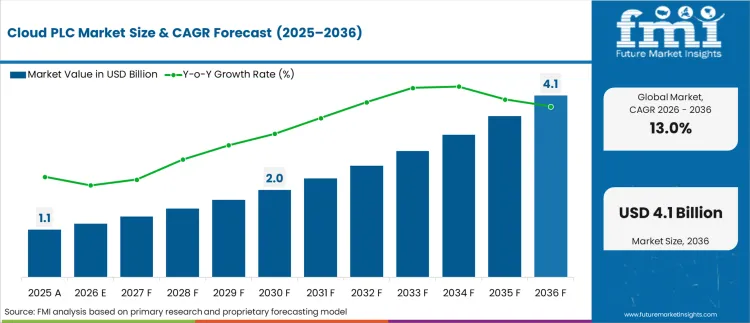
In 2025, the cloud PLC market crossed a valuation of USD 1.1 billion. Demand is projected to push valuation to USD 1.24 billion in 2026 and USD 4.2 billion by 2036, implying a 13.0% CAGR, with tier-1 automotive and discrete manufacturers decoupling control logic from proprietary hardware to scale enterprise-wide data infrastructures.
Capital allocation strategies increasingly favor software-defined architectures over rigid capital expenditure. Siemens and Audi implemented virtual PLC technology across multiple production lines to scale AI-empowered automation without physical controller constraints in 2025 [1]. Plant operators interpret this architectural shift as proof that hardware-agnostic runtime environments have crossed the commercial threshold for mission-critical smart factory operations. Buyers who delay transitioning to decoupled control structures face compounding integration costs during subsequent industrial automation equipment upgrades.
Cedrik Neike, CEO of Digital Industries and Member of the Managing Board of Siemens AG, opined, “Controllers truly are the ‘brains’ of machines and factories. Now we are virtualizing these brains and bringing them to the cloud. This accelerates the digital transformation at Audi and increases agility, efficiency, and security in production, for more flexible, future-proof manufacturing. Together, we are taking automotive production to a new level and significantly strengthening competitiveness.”[2] Procurement teams specify software-defined control frameworks to eliminate the multi-year upgrade cycles inherent in proprietary ecosystems. Equipment buyers that secure enterprise-wide virtual runtime agreements protect operations against component obsolescence, shifting the automation bottleneck from physical provisioning to seamless software deployment workflows.
Summary of Cloud PLC Market
- Cloud PLC Market Definition
- A software-defined industrial control architecture that abstracts programmable logic controller functions from dedicated hardware, executing real-time automation tasks within edge servers, industrial PCs, or cloud environments.
- Demand Drivers in the Market
- Equipment manufacturers prioritize hardware-independent control logic to mitigate semiconductor supply chain vulnerabilities and compress lead times.
- The transition toward IT/OT convergence forces plant managers to integrate enterprise data analytics directly into factory-floor execution cycles.
- Scaling multi-site operations demands centralized management and over-the-air firmware update capabilities that legacy physical controllers cannot support.
- Key Segments Analyzed in the FMI Report
- Virtual PLC: 54% segment share reflecting the operational imperative to abstract control logic from underlying semiconductor limits.
- Edge/industrial PC Runtime: 58% share balancing IT integration with the absolute necessity of deterministic execution.
- Asia Pacific Highlight: Rapid edge-to-cloud PLC shift in discrete sectors fueled by rapid infrastructure digitization programs.
- Analyst Opinion at FMI
- Nikhil Kaitwade, Principal Consultant for Process Automation at Future Market Insights, opines, “We observe that virtual PLC adoption fundamentally rewrites vendor lock-in dynamics. As software decouples from hardware, automation suppliers that fail to pivot toward open, containerized runtime environments will rapidly lose relevance in greenfield digital factory projects.”
- Strategic Implications / Executive Takeaways
- Reconfigure procurement criteria to evaluate runtime performance and API interoperability rather than physical I/O constraints.
- Establish standardized IT server infrastructure on the factory floor to support multi-vendor virtual controller deployments.
- Transition maintenance budgets from reactive hardware replacement to proactive software licensing and lifecycle orchestration.
- Methodology
- Direct interviews with automation engineering heads, industrial software architects, and IIoT platform product managers globally.
- Extrapolation of industrial PC shipment data and regional manufacturing value-added performance indices.
- Bottom-up adoption modeling tracking the migration of control loops from dedicated hardware to edge and cloud compute nodes.
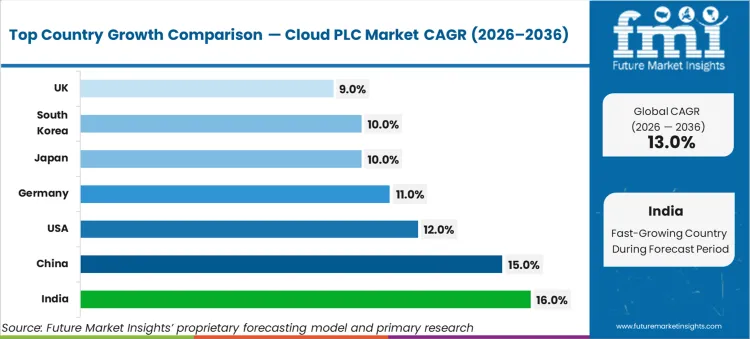
Demand dynamics diverge sharply across core manufacturing hubs, with India anticipating a 16.0% CAGR through 2036 as digital initiatives drive edge-to-cloud PLC adoption among mid-market logistics and discrete sectors. China follows with a 15.0% expansion, anchored by state-backed industrial IoT investments scaling automated production. In contrast, the United States tracks a 12.0% trajectory, prioritizing process industry modernization and stringent cybersecurity integration. Germany posts an 11.0% growth rate, relying on established Industrie 4.0 frameworks to shift hardware-heavy architectures toward edge runtimes. Concurrently, Japan and South Korea both project a 10.0% CAGR, aligning rigorous reliability standards with national smart factory roadmaps, while the United Kingdom advances at 9.0%, leveraging digital innovation funding to support software-centric manufacturing transitions.
Cloud PLC Market Definition
Cloud PLC represents a software-defined industrial control paradigm that decouples the programmable logic runtime from proprietary physical controllers. The system executes deterministic control tasks using containerized software running on standard IT hardware, edge servers, or centralized cloud instances. This architecture enables seamless integration with high-level industrial iot analytics and enterprise resource planning networks. An example is a virtualized bottling line controller hosted on a local edge server communicating via standard Ethernet protocols.
Cloud PLC Market Inclusions
The scope covers pure virtual PLCs, soft PLCs integrated into third-party hardware, and cloud-hosted runtime software subscriptions. It includes the associated engineering software environments, edge orchestration tools, and technical integration services necessary for deployment. Hardware specifically designated as edge compute nodes for virtual control execution, such as high-performance industrial PCs, is also included.
Cloud PLC Market Exclusions
Standard physical, micro, and nano PLCs that rely on closed, vendor-specific hardware execution environments are strictly excluded. Standalone embedded controllers lacking cloud or edge networking capabilities fall outside the boundary. General-purpose cloud services storage and basic data historian software without real-time logic execution features are not measured within this taxonomy.
Cloud PLC Market Research Methodology
- Primary Research: Direct interviews with automation engineering heads, industrial software architects, and IIoT platform product managers globally.
- Desk Research: Extrapolation of industrial PC shipment data and regional manufacturing value-added indices.
- Market-Sizing and Forecasting: Bottom-up adoption modeling tracking the migration of control loops from dedicated hardware to edge and cloud compute nodes.
- Data Validation and Update Cycle: Findings underwent cross-verification against official industrial capability reports and peer-reviewed automation journals before final forecast integration.
Segmental Analysis
Cloud PLC Market Analysis by Product Type
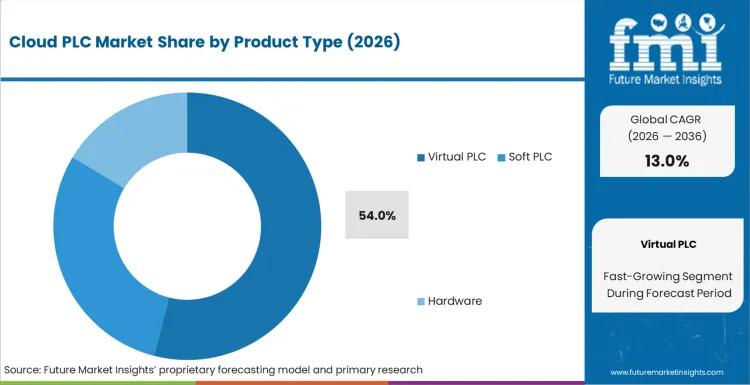
Virtual PLC solutions capture a dominant 54% share in 2026, reflecting the operational imperative to abstract control logic from underlying semiconductor limits. The manufacturers aggressively decouple runtime environments to enable agile production retooling without deploying new physical racks. A 2025 report indicates 29% of organizations are planning to adopt cloud-based manufacturing solutions in the coming years [3]. This software-first approach allows plant engineers to consolidate multiple machine controllers into centralized multi-access edge computing clusters. Buyers avoiding virtualized infrastructure risk being locked into legacy upgrade cycles that severely compromise long-term operational flexibility.
- Technical Validation: High-performance hypervisors guarantee the deterministic execution times required for mission-critical virtual PLC and soft PLC synchronization.
- Product Innovation: Automation vendors introduce hardware-agnostic runtime containers that seamlessly migrate across disparate edge architectures.
- Procurement Shifts: IT departments increasingly influence factory-floor purchasing, favoring standard commercial off-the-shelf processing systems.
Cloud PLC Market Analysis by Component
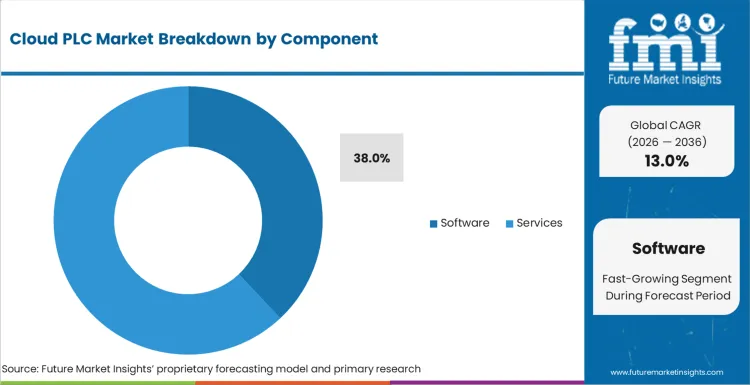
Software commands 38% of the segment volume in 2026 as the commercial value of automation transitions from physical modules to licensing frameworks. Tier-1 automation providers are transitioning legacy business models toward subscription-based network automation orchestration. Schneider Electric launched EcoStruxure Automation Expert in 2025 with full cloud-hosted PLC runtime capabilities to decouple lifecycle management from physical hardware limits [4]. FMI analysts opine that control logic libraries and collaborative environments are becoming primary differentiators in vendor selection. End-users specifying robust software suites guarantee forward compatibility while minimizing hardware-dependent obsolescence.
- Adoption: Accelerates where engineering teams require simultaneous, collaborative programming environments hosted via centralized networks.
- Logistics Advantage: Over-the-air firmware updates eliminate the need for technicians to physically interface with distributed controllers.
- Process Compatibility: Software platforms seamlessly ingest APIs from enterprise resource planning systems to dynamically adjust automated production rates.
Cloud PLC Market Analysis by End Use
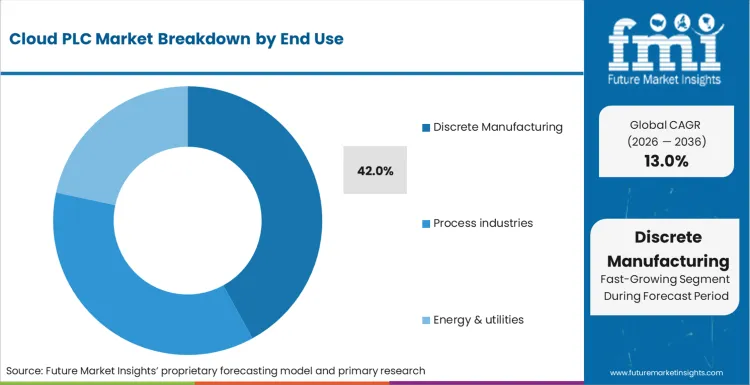
Discrete manufacturing leads with 42% segment share as automotive and electronics sectors accelerate the deployment of highly flexible, software-defined assembly lines. The integration of complex robotics demands localized compute power that traditional micro and nano plc units cannot sustainably provide. The global market value of industrial robot installations has reached an all-time high of USD 16.7 billion [5]. This surge in mechanized capacity necessitates centralized, virtualized control environments to manage complex coordination without introducing latency. Facilities operating without edge-based programmable robots control infrastructure face significant bottlenecks when scaling operations.
- Cost structures tighten when operators attempt to scale proprietary hardware networks across rapidly expanding assembly workcells.
- Supplier positioning improves as vendors offer pre-integrated virtual libraries for specific MES software for discrete manufacturing tasks.
- Requalification cycles lengthen as software-defined control allows rapid virtual testing before physical line commissioning processes.
Cloud PLC Market Analysis by Deployment Model
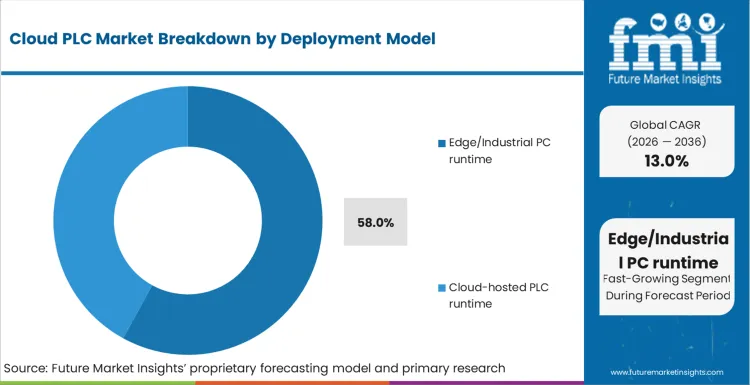
The edge/industrial PC runtime segment accounts for 58% of volumes in 2026, balancing the demand for IT integration with the absolute necessity of deterministic execution. To navigate this operational tension, operators deploy hardened factory floor edge AI industrial pcs directly adjacent to the machinery they govern. June 2025, Rockwell Automation launched OptixEdge, an innovative edge-gateway solution designed to revolutionize data processing. This launch responds to findings that only 44% of industrial data is currently used effectively by manufacturers [6]. This localized compute capability insulates critical automation loops from external network disruptions while simultaneously streaming performance telemetry to broader data lakes.
- Volume Concentration: Industrial PC form factors that support virtualization while surviving harsh factory conditions.
- Dietary Compliance: Strict data sovereignty regulations compel manufacturers to execute control logic on-premise rather than strictly in the public cloud.
- Shelf Stability: Abstracting the runtime from the physical architecture allows operators to upgrade processing hardware without rewriting core control logic.
Cloud PLC Market Drivers, Restraints, and Opportunities
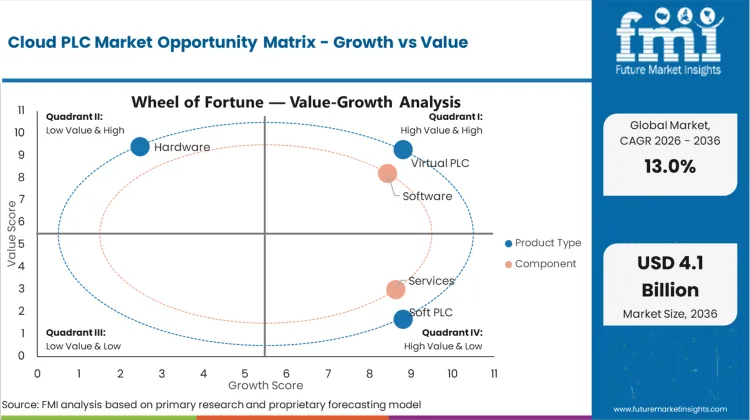
The drive for operational efficiency forces manufacturing leaders to transition away from siloed control architectures. In 2024, global industry value added (IVA) rose by 2.5%, below the 2.8% increase in global GDP [7], exposing a severe productivity gap in traditional manufacturing paradigms. The plant managers mandate the deployment of IOT in manufacturing frameworks to extract real-time optimization insights. Equipment buyers that refuse to integrate virtual PLCs into their capital expenditure plans structurally limit their throughput potential, cementing an enduring cost disadvantage against digitally integrated competitors.
Strict deterministic execution requirements constrain the adoption of fully cloud-hosted control systems for high-speed motion applications. Network latency presents an insurmountable barrier for microsecond-level synchronization, forcing engineers to rely on localized hardware layers. Beckhoff Automation addressed this gap by launching TwinCAT 3.1 with full Linux-based virtual PLC support in September 2025 [8], providing a robust localized edge environment. FMI analysts opine that deploying high-performance edge compute clusters effectively mitigates latency risks while preserving the scalability benefits of a virtualized programmable logic controller ecosystem.
- Robotics Integration Density: Companies across the region ordered 36,766 robots valued at USD2.25 billion last year (2025) [9]. Logistics operators and assembly plants rapidly deploy autonomous systems to counter labor shortages.
- Hardware Agnosticism: Procurement directors decouple logic software from physical constraints to secure multi-vendor flexibility. Mitsubishi Electric launched the MELSEC iQ-R Series virtual PLC for cloud-hosted runtime in January 2025 to capture this precise demand [10].
- Cloud-Native Platform Expansion: Automation vendors aggressively expand virtual portfolios to support Edge AI for smart manufacturing. Bosch Rexroth unveiled its CtrlX automation cloud-native virtual PLC platform expansion in 2025 [11].
Regional Market Analysis
Based on the regional analysis, the cloud PLC market is segmented into North America, Latin America, Europe, East Asia, South Asia, Oceania and Middle East & Africa across 40+ countries. The full report also offers market attractiveness analysis based on regional trends.
.webp "Top Country Growth Comparison Cloud Plc Market Cagr (2026 2036)")
| Country | CAGR (2026 to 2036) |
|---|---|
| China | 15.0% |
| India | 16.0% |
| USA | 12.0% |
| Germany | 11.0% |
| Japan | 10.0% |
| UK | 9.0% |
| South Korea | 10.0% |
Source: Future Market Insights (FMI) analysis, based on proprietary forecasting model and primary research
Asia Pacific Cloud PLC Market Analysis
Asia Pacific's industrial automation sector faces an inflection point as rapid capacity expansion collides with the limitations of legacy physical control networks. 40% of manufacturing leaders hope to realize cost reductions and greater customer satisfaction by embracing a smart factory strategy [12]. This urgency drives regional electronics producers to replace discrete hardware controllers with scalable automated control system architectures. The transition from capital-intensive hardware provisioning to software-defined operational frameworks fundamentally realigns regional procurement behavior. Facilities reliant on localized manual integration confront an escalating competitive deficit as software-defined control becomes the baseline expectation across East and South Asia.
- China: State-backed industrial modernization mandates force domestic discrete manufacturers to rapidly digitize their control environments to maintain export positioning. Manufacturing activity continues to expand at a moderate pace worldwide, reaching a growth rate of 2.9% in 2024 [13]. Plant managers must transition to hardware-agnostic runtime ecosystems to participate in advanced state-backed manufacturing funding programs.
- India: Surveys confirm that 50% of these stakeholders plan to use new tech, such as artificial intelligence, machine learning and Industrial Internet of Things sensor networks in production facilities by 2026 [14]. Demand for Cloud PLC in India is estimated to expand at a CAGR of 16.0% as mid-market logistics operators embrace digital infrastructure initiatives. Automation procurement teams without established virtual PLC deployment strategies face severe integration bottlenecks as their facility capabilities expand.
- Japan: Japan's automotive sector prioritizes operational continuity, cautiously migrating non-critical monitoring tasks to the edge before attempting full control virtualization. Based on an industry-wide survey conducted in 2025, the study captures both the industry’s strong consensus on the necessity of PM automation [15]. Systems integrators that fail to provide high-reliability edge-hosted execution platforms face immediate disqualification during conservative vendor selection cycles.
- South Korea: South Korea's robotics-heavy discrete manufacturing sector requires intense orchestration capabilities that traditional controllers cannot synchronize. As of June 2025, HICs accounted for 77% of global co-location data center capacity [16], providing the robust backbone required for South Korea's highly digitized smart-factory roadmap. Operations managers must adopt containerized runtime environments to extract maximum yield from these continuous capital outlays.
FMI's report includes comprehensive tracking of the broader Asia Pacific processing landscape. Tracking developments across emerging Southeast Asian manufacturing hubs, the analysis reveals how ASEAN nations establish cloud-hosted runtime as a prerequisite for greenfield facility planning to attract smart-factory investment structures.
North America Cloud PLC Market Analysis
Stringent cybersecurity mandates and reshoring initiatives structurally redefine automation procurement across North America. The push to repatriate critical manufacturing capacity exposes the inflexibility of rigid hardware networks, compelling operators to deploy resilient, software-centric united states process automation and instrumentation environments. In 2025 small manufacturers will face a mix of opportunities and challenges as they navigate these changes driven by AI, automation, and cloud technologies [17]. This digital imperative forces plant managers to prioritize over-the-air firmware updates and secure internet of things iot monetization capabilities. The transition ensures that facility architectures can dynamically adapt to shifting supply chain demands without requiring physical hardware overhauls.
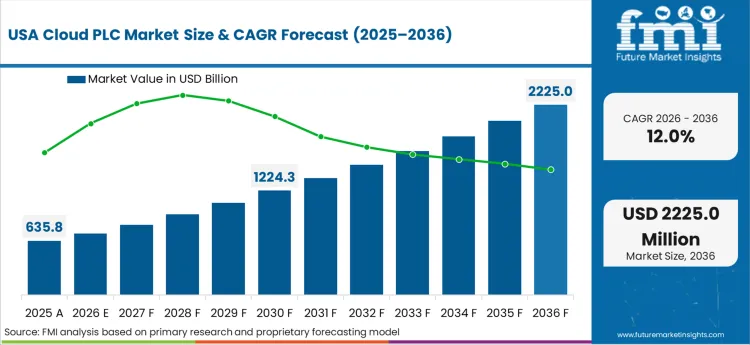
- United States: Procurement directors must stipulate localized edge-runtime capabilities that strictly isolate critical control loops from public network exposure. Over the forecast period, Cloud PLC in the United States is set for a CAGR of 12.0% as defense and advanced process industries prioritize secure IT/OT convergence. Cybersecurity will be a top priority as manufacturers add IoT devices, AI, and cloud technologies [18].
FMI's report includes detailed mapping of the North American manufacturing landscape. Cross-border integration between Canada and the United States emphasizes the deployment of distributed united states edge server infrastructure, ensuring hybrid cloud architectures maintain regulatory compliance across tier-1 automotive supply networks.
Europe Cloud PLC Market Analysis
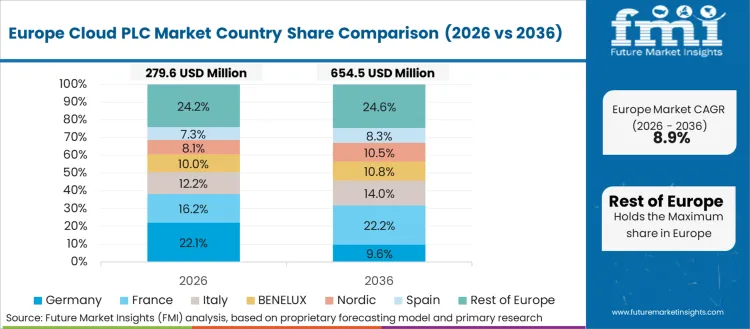
Europe functions as the proving ground for advanced, interoperable automation frameworks driven by mature Industrie 4.0 policy systems. The integration of high-level industrial analytics directly with factory-floor execution systems forces a departure from proprietary vendor silos. 72% of German companies plan to invest in cloud-based systems by 2026 according to trade data [19]. FMI analysts opine that this concerted migration establishes software-defined control as a baseline commercial necessity across the continent. Suppliers unable to deliver fully virtualized, hardware-agnostic control platforms will be structurally excluded from the region's most lucrative industrial modernization tenders.
- Germany: Automation suppliers must guarantee seamless API integration with higher-level cloud electronic design automation eda networks to secure primary automotive contracts. Germany's automation sector is poised to expand at a CAGR of 11.0% as incumbent equipment providers transition to software-centric business models. Companies adopting Industry 4.0 technologies are rapidly advancing, but the rest are falling behind [20].
- UK: A CAGR of 9.0% is projected for Cloud PLC in the UK through 2036, supported by robust institutional funding aimed at industrial digitalization. 81% beneficiary survey respondents reported increased understanding of industrial digital technologies (IDTs) including IoT and automation [21]. Integrators must provide verifiable process automation and instrumentation roadmaps that leverage edge computing to satisfy government-backed grant requirements.
FMI's report includes expansive tracking of the European industrial ecosystem. France, Italy, and the Nordics collectively prioritize sustainable manufacturing processes, deploying localized virtual PLC nodes to optimize energy consumption algorithms and iot enabled equipment maintenance solutions across decentralized production grids.
Competitive Aligners for Market Players
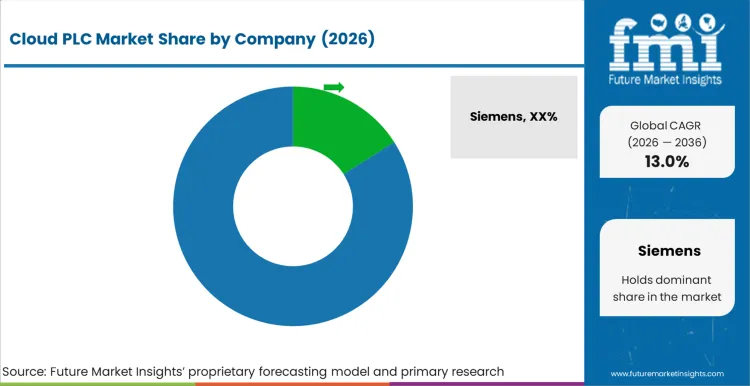
Strategic partnerships and open-source consortiums rapidly dismantle the proprietary hardware lock-in that historically dominated industrial control networks. ABB released Ability EdgeInsight with virtual PLC containerization for process industries in November 2025 [22], signaling a permanent shift toward IT-standard execution environments. Automation suppliers that refuse to adopt containerized microservices face severe disqualification risks as tier-1 buyers mandate absolute interoperability.
Vendor advantage realigns where software orchestration capabilities outpace legacy physical I/O module configurations. Buyers adopting these IT-centric architectures eliminate intermediary hardware layers, drastically compressing deployment timelines for new automated workcells.
Competitive posture shifts as digital twin simulation becomes indistinguishable from physical commissioning. Schneider Electric partnered with Microsoft for Azure-integrated virtual PLC edge-to-cloud solutions in 2025 [24], enabling engineers to validate logic entirely in the cloud before pushing it to local edge nodes. Procurement teams specifying these process automation and instrumentation market share analysis frameworks drastically reduce capital risk during facility upgrades.
Recent Developments
The report includes full coverage of key trends from competitive benchmarking. Some of the recent developments covered in the reports:
- In January 2026, Siemens and NVIDIA announced an expanded strategic partnership to build an “Industrial AI operating system,” advancing AI-accelerated simulation and autonomous digital twins across the industrial lifecycle [25].
- In September 2025, Phoenix Contact introduced Virtual PLCnext Control (software-based/virtual controller) as a hardware-independent, OCI-containerized PLC runtime that can run in virtualized IT environments (for example Docker/Hyper-V) on Windows or Linux, locally or in the cloud [27].
Key Players in Cloud PLC Market
- Siemens
- Schneider Electric
- Rockwell Automation
- Beckhoff Automation
- ABB
- Bosch Rexroth
- Mitsubishi Electric
- Honeywell
- Emerson
- Yaskawa Electric
- Phoenix Contact
Scope of the Report
| Metric | Value |
|---|---|
| Quantitative Units | USD 1.24 billion to USD 4.2 billion, at a CAGR of 13.00% |
| Market Definition | A software-defined industrial control architecture that abstracts programmable logic controller functions from dedicated hardware, executing real-time automation tasks within edge servers, industrial PCs, or cloud environments. |
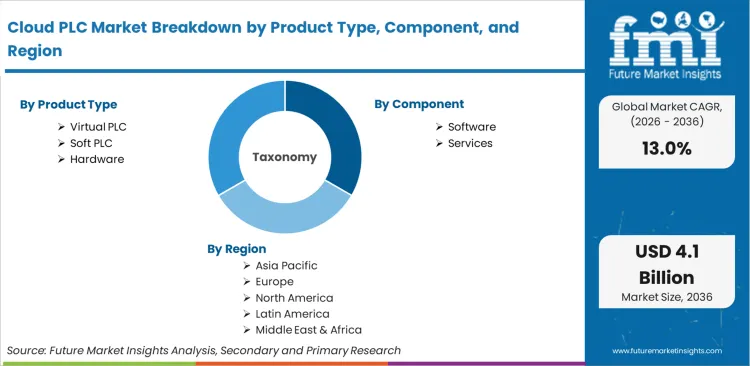
| Product Type Segmentation | Virtual PLC, Soft PLC, Hardware |
| Component Segmentation | Software, Services |
| End Use Segmentation | Discrete manufacturing, Process industries, Energy & utilities, Logistics |
| Deployment Model Segmentation | Edge/industrial PC runtime, Cloud-hosted PLC runtime |
| Regions Covered | North America, Latin America, Europe, East Asia, South Asia, Oceania, Middle East & Africa |
| Countries Covered | United States, Canada, Mexico, Brazil, Argentina, Germany, France, United Kingdom, Italy, Spain, China, India, Japan, South Korea, Indonesia, Australia and 40 plus countries |
| Key Companies Profiled | Siemens, Schneider Electric, Rockwell Automation, Beckhoff Automation, ABB |
| Forecast Period | 2026 to 2036 |
| Approach | Bottom-up adoption modeling tracking the migration of control loops from dedicated hardware to edge and cloud compute nodes. |
Source: Future Market Insights (FMI) analysis, based on proprietary forecasting model and primary research
Bibliography
- [1] Siemens. (2025). Siemens and Audi are taking shop-floor to the next level (Press release).
- [2] Siemens AG. (2025, March 27). Siemens and Audi are taking the shop floor to the next level with AI and IT-empowered automation at scale [Press release].
- [3] American Society of Mechanical Engineers (ASME). (2025). Digital and smart are key to manufacturing (Industry report).
- [4] Schneider Electric. (2025). EcoStruxure Automation Expert cloud PLC launch (Press release).
- [5] International Federation of Robotics (IFR). (2026). Top 5 global robotics trends 2026 (Press release).
- [6] Rockwell Automation. (2025). FactoryTalk Edge Gateway cloud PLC (Press release).
- [7] United Nations Industrial Development Organization (UNIDO). (2025, November). UNIDO Industrial Statistics Yearbook 2025 (2.5% IVA Data).
- [8] Beckhoff Automation. (2025, September). TwinCAT Linux virtual PLC launch (Press release).
- [9] Association for Advancing Automation (A3). (2026). Robot orders grow in 2025 as general industries drive broader automation adoption.
- [10] Mitsubishi Electric. (January 2025). Mitsubishi Electric introduces MELSEC iQ-R safety local IO modules (Press release).
- [11] Bosch Rexroth. (2025). ctrlX AUTOMATION cloud PLC expansion (Press release).
- [12] National Association of Manufacturers (NAM). (2025, January). NAM 2025 Manufacturing Trends (40% Survey finding).
- [13] United Nations Industrial Development Organization (UNIDO). (2025, November). UNIDO Industrial Statistics Yearbook 2025 (2.9% Growth rate).
- [14] National Association of Manufacturers (NAM). (2025, January). NAM 2025 Manufacturing Trends (50% Technology plan).
- [15] Semiconductor Equipment and Materials International (SEMI.org). (2025). Smart Manufacturing Industry Survey.
- [16] World Bank. (2025). Data Center Capacity Indicators.
- [17] National Institute of Standards and Technology (NIST). (2025). What's coming for US manufacturing in 2025 (Small manufacturers data).
- [18] National Institute of Standards and Technology (NIST). (2025). What's coming for US manufacturing in 2025 (Cybersecurity priority).
- [19] International Trade Administration. (2025). Germany digital manufacturing profile.
- [20] MAGNET (Manufacturing Advocacy & Growth Network). (2025). 2025 Ohio Manufacturing Survey.
- [21] UK Research and Innovation (UKRI). (2025, May). Evaluation of the Made Smarter Innovation Challenge.
- [22] ABB. (November 2025). ABB releases Ability EdgeInsight virtual PLC (Press release).
- [24] Schneider Electric. (2025). Schneider partnered with Microsoft for Azure-integrated virtual PLC.
- [25] NVIDIA. (2026, January 5). Siemens and NVIDIA expand partnership to build the Industrial AI operating system.
- [27] Phoenix Contact. (2025, September 30). Virtual PLCnext Control: A software-based controller for the industrial future.
This bibliography is provided for reader reference and is not exhaustive. The full report contains the complete reference list and detailed citations.
This Report Addresses
- Market size estimation and revenue forecasts from 2026 to 2036, modeling the shift from legacy proprietary controllers to decoupled software ecosystems.
- Growth opportunity mapping across virtual and soft PLC architectures to inform capacity planning and R&D capital allocation.
- Segment and regional revenue forecasts delineating edge-based runtime adoption versus fully centralized cloud execution models.
- Competition strategy assessment detailing how tier-1 automation vendors deploy containerized microservices to preserve ecosystem lock-in.
- Product reformulation tracking covering the critical metrics of hypervisor latency, deterministic execution, and over-the-air update reliability.
- Regulatory impact analysis evaluating data sovereignty laws and localized processing mandates dictating hybrid cloud deployments.
- Supply chain vulnerability assessment connecting semiconductor lead times directly to the accelerated adoption of hardware-agnostic runtime tools.
Market report delivery in PDF, Excel, PPT, and interactive dashboard formats for executive and operational use.
Frequently Asked Questions
How large is the demand for Cloud PLC in the global market in 2026?
Demand for Cloud PLC in the global market is estimated to be valued at USD 1.24 billion in 2026.
What will be the market size of Cloud PLC in the global market by 2036?
Market size for Cloud PLC is projected to reach USD 4.2 billion by 2036.
What is the expected demand growth for Cloud PLC in the global market between 2026 and 2036?
Demand for Cloud PLC is expected to grow at a CAGR of 13.00% between 2026 and 2036.
Which Product Type is poised to lead global sales by 2026?
Virtual PLC commands 54% of the volume in 2026 as manufacturers decouple control logic from proprietary semiconductor hardware.
How significant is the role of Discrete manufacturing in driving Cloud PLC adoption in 2026?
Discrete manufacturing represents 42% of segment share as automotive and electronics sectors scale complex robotic workcells.
What is driving demand in India?
Digital initiatives and smart logistics expansions push mid-market operators to adopt edge-to-cloud architectures for scalable facility management.
What compliance standards or regulations are referenced for India?
Broader Industrial Internet of Things standardization mandates influence IT/OT convergence efforts across regional facilities.
What is the India growth outlook in this report?
India is projected to grow at a CAGR of 16.0% during 2026 to 2036.
Why is North America described as a priority region in this report?
Rigorous cybersecurity standards and critical reshoring programs mandate secure, software-defined control loops.
What type of demand dominates in North America?
Secure edge orchestration and isolated IT/OT hybrid cloud models dominate process industry procurement.
What is China's growth outlook in this report?
China is projected to expand at a CAGR of 15.0% during 2026 to 2036.
Does the report cover the United States in its regional analysis?
Yes, the United States is included within North America under the regional scope of analysis.
What are the sources referred to for analyzing the United States?
Official cybersecurity adoption metrics from NIST and industrial automation data form the analytical baseline.
What is the main demand theme linked to the United States in its region coverage?
Cybersecurity compliance driving the deployment of localized, resilient edge-hosted virtual PLC nodes.
Does the report cover the United Kingdom in its regional analysis?
Yes, the United Kingdom is included within Europe under the regional coverage framework.
What is the main United Kingdom related demand theme in its region coverage?
Leveraging government-backed industrial digitalisation funding to adopt software-centric manufacturing models.
Which product formats or configurations are strategically important for Europe supply chains?
Fully interoperable edge-runtime containers capable of ingesting enterprise resource planning APIs are critically essential.
What is Cloud PLC and what is it mainly used for?
It is a software-defined architecture that decouples control logic from physical controllers, used primarily to manage factory-floor machinery via IT infrastructure.
What does Cloud PLC mean in this report?
The market refers to the global production, deployment, and service revenue associated with virtualized industrial control logic.
What is included in the scope of this Cloud PLC report?
Scope includes pure virtual PLCs, edge/cloud runtime environments, necessary orchestrating software, and dedicated industrial PC nodes.
What is excluded from the scope of this report?
Legacy physical PLCs, non-networked micro/nano controllers, and generic cloud storage platforms are strictly excluded.
What does market forecast mean on this page?
The market forecast represents a model-based projection built on defined industrial and technology assumptions for strategic planning purposes.
How does FMI build and validate the Cloud PLC forecast?
Forecasts combine top-down IT hardware tracking with bottom-up logic migration modeling, validated by automation engineering executive interviews.
What does zero reliance on speculative third-party market research mean here?
Primary interviews, verified corporate launch data, and official industrial automation datasets are used exclusively instead of unverified syndicated estimates.
Preview the report firsthand - request a free sample
Get SampleGet the brochure for pricing and purchase details.
Get PDFTable of Content
- Executive Summary
- Global Market Outlook
- Demand-side Trends
- Supply-side Trends
- Technology Roadmap Analysis
- Analysis and Recommendations
- Market Overview
- Market Coverage / Taxonomy
- Market Definition / Scope / Limitations
- Research Methodology
- Chapter Orientation
- Analytical Lens and Working Hypotheses
- Market Structure, Signals, and Trend Drivers
- Benchmarking and Cross-market Comparability
- Market Sizing, Forecasting, and Opportunity Mapping
- Research Design and Evidence Framework
- Desk Research Programme (Secondary Evidence)
- Company Annual and Sustainability Reports
- Peer-reviewed Journals and Academic Literature
- Corporate Websites, Product Literature, and Technical Notes
- Earnings Decks and Investor Briefings
- Statutory Filings and Regulatory Disclosures
- Technical White Papers and Standards Notes
- Trade Journals, Industry Magazines, and Analyst Briefs
- Conference Proceedings, Webinars, and Seminar Materials
- Government Statistics Portals and Public Data Releases
- Press Releases and Reputable Media Coverage
- Specialist Newsletters and Curated Briefings
- Sector Databases and Reference Repositories
- FMI Internal Proprietary Databases and Historical Market Datasets
- Subscription Datasets and Paid Sources
- Social Channels, Communities, and Digital Listening Inputs
- Additional Desk Sources
- Expert Input and Fieldwork (Primary Evidence)
- Primary Modes
- Qualitative Interviews and Expert Elicitation
- Quantitative Surveys and Structured Data Capture
- Blended Approach
- Why Primary Evidence is Used
- Field Techniques
- Interviews
- Surveys
- Focus Groups
- Observational and In-context Research
- Social and Community Interactions
- Stakeholder Universe Engaged
- C-suite Leaders
- Board Members
- Presidents and Vice Presidents
- R&D and Innovation Heads
- Technical Specialists
- Domain Subject-matter Experts
- Scientists
- Physicians and Other Healthcare Professionals
- Governance, Ethics, and Data Stewardship
- Research Ethics
- Data Integrity and Handling
- Primary Modes
- Tooling, Models, and Reference Databases
- Desk Research Programme (Secondary Evidence)
- Data Engineering and Model Build
- Data Acquisition and Ingestion
- Cleaning, Normalisation, and Verification
- Synthesis, Triangulation, and Analysis
- Quality Assurance and Audit Trail
- Market Background
- Market Dynamics
- Drivers
- Restraints
- Opportunity
- Trends
- Scenario Forecast
- Demand in Optimistic Scenario
- Demand in Likely Scenario
- Demand in Conservative Scenario
- Opportunity Map Analysis
- Product Life Cycle Analysis
- Supply Chain Analysis
- Investment Feasibility Matrix
- Value Chain Analysis
- PESTLE and Porter’s Analysis
- Regulatory Landscape
- Regional Parent Market Outlook
- Production and Consumption Statistics
- Import and Export Statistics
- Market Dynamics
- Global Market Analysis 2021 to 2025 and Forecast, 2026 to 2036
- Historical Market Size Value (USD Million) Analysis, 2021 to 2025
- Current and Future Market Size Value (USD Million) Projections, 2026 to 2036
- Y-o-Y Growth Trend Analysis
- Absolute $ Opportunity Analysis
- Global Market Pricing Analysis 2021 to 2025 and Forecast 2026 to 2036
- Global Market Analysis 2021 to 2025 and Forecast 2026 to 2036, By Product Type
- Introduction / Key Findings
- Historical Market Size Value (USD Million) Analysis By Product Type , 2021 to 2025
- Current and Future Market Size Value (USD Million) Analysis and Forecast By Product Type , 2026 to 2036
- Virtual PLC
- Soft PLC
- Hardware
- Virtual PLC
- Y-o-Y Growth Trend Analysis By Product Type , 2021 to 2025
- Absolute $ Opportunity Analysis By Product Type , 2026 to 2036
- Global Market Analysis 2021 to 2025 and Forecast 2026 to 2036, By Component
- Introduction / Key Findings
- Historical Market Size Value (USD Million) Analysis By Component, 2021 to 2025
- Current and Future Market Size Value (USD Million) Analysis and Forecast By Component, 2026 to 2036
- Software
- Services
- Software
- Y-o-Y Growth Trend Analysis By Component, 2021 to 2025
- Absolute $ Opportunity Analysis By Component, 2026 to 2036
- Global Market Analysis 2021 to 2025 and Forecast 2026 to 2036, By End Use
- Introduction / Key Findings
- Historical Market Size Value (USD Million) Analysis By End Use, 2021 to 2025
- Current and Future Market Size Value (USD Million) Analysis and Forecast By End Use, 2026 to 2036
- Discrete Manufacturing
- Process industries
- Energy & utilities
- Discrete Manufacturing
- Y-o-Y Growth Trend Analysis By End Use, 2021 to 2025
- Absolute $ Opportunity Analysis By End Use, 2026 to 2036
- Global Market Analysis 2021 to 2025 and Forecast 2026 to 2036, By Deployment Model
- Introduction / Key Findings
- Historical Market Size Value (USD Million) Analysis By Deployment Model, 2021 to 2025
- Current and Future Market Size Value (USD Million) Analysis and Forecast By Deployment Model, 2026 to 2036
- Edge/Industrial PC runtime
- Cloud-hosted PLC runtime
- Edge/Industrial PC runtime
- Y-o-Y Growth Trend Analysis By Deployment Model, 2021 to 2025
- Absolute $ Opportunity Analysis By Deployment Model, 2026 to 2036
- Global Market Analysis 2021 to 2025 and Forecast 2026 to 2036, By Region
- Introduction
- Historical Market Size Value (USD Million) Analysis By Region, 2021 to 2025
- Current Market Size Value (USD Million) Analysis and Forecast By Region, 2026 to 2036
- North America
- Latin America
- Western Europe
- Eastern Europe
- East Asia
- South Asia and Pacific
- Middle East & Africa
- Market Attractiveness Analysis By Region
- North America Market Analysis 2021 to 2025 and Forecast 2026 to 2036, By Country
- Historical Market Size Value (USD Million) Trend Analysis By Market Taxonomy, 2021 to 2025
- Market Size Value (USD Million) Forecast By Market Taxonomy, 2026 to 2036
- By Country
- USA
- Canada
- Mexico
- By Product Type
- By Component
- By End Use
- By Deployment Model
- By Country
- Market Attractiveness Analysis
- By Country
- By Product Type
- By Component
- By End Use
- By Deployment Model
- Key Takeaways
- Latin America Market Analysis 2021 to 2025 and Forecast 2026 to 2036, By Country
- Historical Market Size Value (USD Million) Trend Analysis By Market Taxonomy, 2021 to 2025
- Market Size Value (USD Million) Forecast By Market Taxonomy, 2026 to 2036
- By Country
- Brazil
- Chile
- Rest of Latin America
- By Product Type
- By Component
- By End Use
- By Deployment Model
- By Country
- Market Attractiveness Analysis
- By Country
- By Product Type
- By Component
- By End Use
- By Deployment Model
- Key Takeaways
- Western Europe Market Analysis 2021 to 2025 and Forecast 2026 to 2036, By Country
- Historical Market Size Value (USD Million) Trend Analysis By Market Taxonomy, 2021 to 2025
- Market Size Value (USD Million) Forecast By Market Taxonomy, 2026 to 2036
- By Country
- Germany
- UK
- Italy
- Spain
- France
- Nordic
- BENELUX
- Rest of Western Europe
- By Product Type
- By Component
- By End Use
- By Deployment Model
- By Country
- Market Attractiveness Analysis
- By Country
- By Product Type
- By Component
- By End Use
- By Deployment Model
- Key Takeaways
- Eastern Europe Market Analysis 2021 to 2025 and Forecast 2026 to 2036, By Country
- Historical Market Size Value (USD Million) Trend Analysis By Market Taxonomy, 2021 to 2025
- Market Size Value (USD Million) Forecast By Market Taxonomy, 2026 to 2036
- By Country
- Russia
- Poland
- Hungary
- Balkan & Baltic
- Rest of Eastern Europe
- By Product Type
- By Component
- By End Use
- By Deployment Model
- By Country
- Market Attractiveness Analysis
- By Country
- By Product Type
- By Component
- By End Use
- By Deployment Model
- Key Takeaways
- East Asia Market Analysis 2021 to 2025 and Forecast 2026 to 2036, By Country
- Historical Market Size Value (USD Million) Trend Analysis By Market Taxonomy, 2021 to 2025
- Market Size Value (USD Million) Forecast By Market Taxonomy, 2026 to 2036
- By Country
- China
- Japan
- South Korea
- By Product Type
- By Component
- By End Use
- By Deployment Model
- By Country
- Market Attractiveness Analysis
- By Country
- By Product Type
- By Component
- By End Use
- By Deployment Model
- Key Takeaways
- South Asia and Pacific Market Analysis 2021 to 2025 and Forecast 2026 to 2036, By Country
- Historical Market Size Value (USD Million) Trend Analysis By Market Taxonomy, 2021 to 2025
- Market Size Value (USD Million) Forecast By Market Taxonomy, 2026 to 2036
- By Country
- India
- ASEAN
- Australia & New Zealand
- Rest of South Asia and Pacific
- By Product Type
- By Component
- By End Use
- By Deployment Model
- By Country
- Market Attractiveness Analysis
- By Country
- By Product Type
- By Component
- By End Use
- By Deployment Model
- Key Takeaways
- Middle East & Africa Market Analysis 2021 to 2025 and Forecast 2026 to 2036, By Country
- Historical Market Size Value (USD Million) Trend Analysis By Market Taxonomy, 2021 to 2025
- Market Size Value (USD Million) Forecast By Market Taxonomy, 2026 to 2036
- By Country
- Kingdom of Saudi Arabia
- Other GCC Countries
- Turkiye
- South Africa
- Other African Union
- Rest of Middle East & Africa
- By Product Type
- By Component
- By End Use
- By Deployment Model
- By Country
- Market Attractiveness Analysis
- By Country
- By Product Type
- By Component
- By End Use
- By Deployment Model
- Key Takeaways
- Key Countries Market Analysis
- USA
- Pricing Analysis
- Market Share Analysis, 2025
- By Product Type
- By Component
- By End Use
- By Deployment Model
- Canada
- Pricing Analysis
- Market Share Analysis, 2025
- By Product Type
- By Component
- By End Use
- By Deployment Model
- Mexico
- Pricing Analysis
- Market Share Analysis, 2025
- By Product Type
- By Component
- By End Use
- By Deployment Model
- Brazil
- Pricing Analysis
- Market Share Analysis, 2025
- By Product Type
- By Component
- By End Use
- By Deployment Model
- Chile
- Pricing Analysis
- Market Share Analysis, 2025
- By Product Type
- By Component
- By End Use
- By Deployment Model
- Germany
- Pricing Analysis
- Market Share Analysis, 2025
- By Product Type
- By Component
- By End Use
- By Deployment Model
- UK
- Pricing Analysis
- Market Share Analysis, 2025
- By Product Type
- By Component
- By End Use
- By Deployment Model
- Italy
- Pricing Analysis
- Market Share Analysis, 2025
- By Product Type
- By Component
- By End Use
- By Deployment Model
- Spain
- Pricing Analysis
- Market Share Analysis, 2025
- By Product Type
- By Component
- By End Use
- By Deployment Model
- France
- Pricing Analysis
- Market Share Analysis, 2025
- By Product Type
- By Component
- By End Use
- By Deployment Model
- India
- Pricing Analysis
- Market Share Analysis, 2025
- By Product Type
- By Component
- By End Use
- By Deployment Model
- ASEAN
- Pricing Analysis
- Market Share Analysis, 2025
- By Product Type
- By Component
- By End Use
- By Deployment Model
- Australia & New Zealand
- Pricing Analysis
- Market Share Analysis, 2025
- By Product Type
- By Component
- By End Use
- By Deployment Model
- China
- Pricing Analysis
- Market Share Analysis, 2025
- By Product Type
- By Component
- By End Use
- By Deployment Model
- Japan
- Pricing Analysis
- Market Share Analysis, 2025
- By Product Type
- By Component
- By End Use
- By Deployment Model
- South Korea
- Pricing Analysis
- Market Share Analysis, 2025
- By Product Type
- By Component
- By End Use
- By Deployment Model
- Russia
- Pricing Analysis
- Market Share Analysis, 2025
- By Product Type
- By Component
- By End Use
- By Deployment Model
- Poland
- Pricing Analysis
- Market Share Analysis, 2025
- By Product Type
- By Component
- By End Use
- By Deployment Model
- Hungary
- Pricing Analysis
- Market Share Analysis, 2025
- By Product Type
- By Component
- By End Use
- By Deployment Model
- Kingdom of Saudi Arabia
- Pricing Analysis
- Market Share Analysis, 2025
- By Product Type
- By Component
- By End Use
- By Deployment Model
- Turkiye
- Pricing Analysis
- Market Share Analysis, 2025
- By Product Type
- By Component
- By End Use
- By Deployment Model
- South Africa
- Pricing Analysis
- Market Share Analysis, 2025
- By Product Type
- By Component
- By End Use
- By Deployment Model
- USA
- Market Structure Analysis
- Competition Dashboard
- Competition Benchmarking
- Market Share Analysis of Top Players
- By Regional
- By Product Type
- By Component
- By End Use
- By Deployment Model
- Competition Analysis
- Competition Deep Dive
- Siemens
- Overview
- Product Portfolio
- Profitability by Market Segments (Product/Age /Sales Channel/Region)
- Sales Footprint
- Strategy Overview
- Marketing Strategy
- Product Strategy
- Channel Strategy
- Schneider Electric
- Rockwell Automation
- Beckhoff Automation
- ABB
- Bosch Rexroth
- Mitsubishi Electric
- Siemens
- Competition Deep Dive
- Assumptions & Acronyms Used


