

- Industry Size (2026)
- USD 3.9 Bn
- Forecast (2036)
- USD 16.5 Bn
- CAGR (2026 to 2036)
- 15.5%
Cloud Office Migration Tool Market Forecast and Outlook 2026 to 2036
Enterprise IT transition programs place the cloud office migration tool market at USD 3.9 billion in 2026 and carry it to USD 16.5 billion by 2036 at a 15.5% CAGR. Adoption starts with tenant complexity, identity architecture, and data governance boundaries rather than with feature lists. Program owners map mailboxes, files, permissions, and collaboration spaces into staged waves. Once a cutover plan enters change control, tool choice becomes fixed for the duration of the program. Risk teams focus on rollback paths, audit logs, and permission fidelity. Service providers value automation depth, reporting clarity, and predictable runtime. License models must align with phased rollouts and coexistence periods.
Economic results in this segment follow execution quality across long programs rather than single deal wins. Tool vendors invest in throttling management, error handling, and resume logic because large tenants expose edge cases quickly. Engineering roadmaps prioritize connector coverage and API stability across source and target platforms. Field teams spend time on discovery runs, pilot migrations, and dry runs that surface permission anomalies. Support loads rise during cutover windows, not during procurement. Partners bundle tools with runbooks and governance frameworks. Renewal decisions reflect incident rates and rework hours. Profitability depends on support efficiency, automation reliability, and low defect rates rather than aggressive discounting.
Quick Stats for Cloud Office Migration Tool Market
- Cloud Office Migration Tool Market Value (2026): USD 3.9 billion
- Cloud Office Migration Tool Market Forecast Value (2036): USD 16.5 billion
- Cloud Office Migration Tool Market Forecast CAGR 2026 to 2036: 15.5%
- Leading Tool Type in Cloud Office Migration Tool Market: Automated migration tools
- Leading End User in Cloud Office Migration Tool Market: Large enterprises
- Key Growth Regions in Cloud Office Migration Tool Market: Asia Pacific, Europe, North America
- Top Players in Cloud Office Migration Tool Market: Microsoft, Google, BitTitan, Quest Software
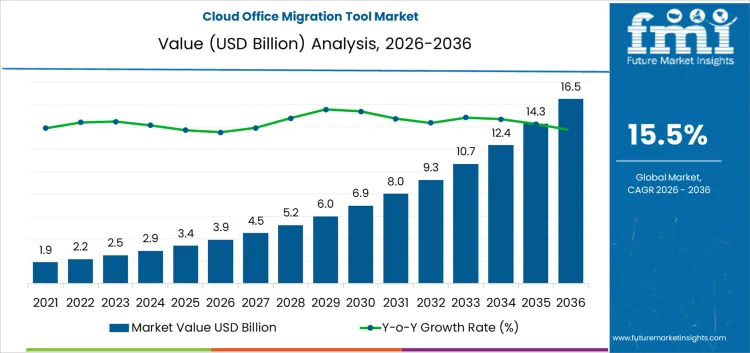
What Is the Growth Forecast for the Cloud Office Migration Tool Market through 2036?
IT estate structure and change management policy shape spending in the cloud office migration tool market more than annual software budgets. In 2026, at about USD 3.9 billion, demand is anchored in enterprises standardizing email, document storage, and collaboration platforms across large user bases. Tool selection sits inside multi-phase transition programs that include data mapping, access control redesign, and user retraining. Once a migration framework is chosen, it remains in place across several waves of departmental moves, which links revenue to program scope rather than to single cutover events. Growth follows the expansion of multi-tenant environments, tighter governance needs, and consolidation of fragmented on premises systems into unified cloud estates.
Execution risk and service continuity define the upper half of the cloud office migration tool market. As value approaches roughly USD 16.5 billion by 2036, buyers focus on error handling, rollback capability, audit logging, and performance under large data volumes. Product development effort shifts toward automation depth, monitoring, and integration with identity and security systems. Delivery models place more weight on managed migrations and long running transformation contracts. The move from under four billion into the mid-teens reflects accumulated enterprise programs across many sectors rather than a single upgrade cycle. Vendors that combine reliable tooling, predictable project outcomes, and strong support coverage tend to secure repeat engagements across complex organizations.
Cloud Office Migration Tool Market Key Takeaways
| Metric | Value |
|---|---|
| Market Value (2026) | USD 3.9 billion |
| Forecast Value (2036) | USD 16.5 billion |
| Forecast CAGR 2026 to 2036 | 15.5% |
How Is the Cloud Office Migration Tool Market Restructuring Enterprise Productivity Transitions?
Cloud office migration tools are used to move email, files, calendars, and collaboration data from on premises systems into hosted platforms with minimal disruption. Earlier transitions depended on manual exports, staged cutovers, and extended coexistence periods, which increased risk of data loss and user downtime. These tools automate discovery, mapping, permission transfer, and validation across large user bases. IT teams evaluate them by throughput, error handling, rollback options, and reporting depth rather than by interface design. Use is common in mergers, license renewals, and infrastructure consolidation projects. Planning starts with identity structure, archive size, and compliance retention rules. Execution is paced to business calendars because user disruption carries direct cost. Success is measured through completion rates, support ticket volume, and data integrity checks.
Buying decisions are led by IT architecture, security, and compliance teams because migration choices affect audit posture and access control models. Earlier projects relied on one off scripts, which limited repeatability and increased dependence on specific staff. Current programs favor standardized toolchains that can be reused across departments and regions. Vendors compete on connector coverage, throttling control, and verification workflows rather than headline speed claims. Enterprises assess total cost through project duration, rework risk, and post migration support load, not license price alone. Integrators add value through planning templates, pilot runs, and cutover management. Over time, demand follows SaaS adoption cycles and portfolio simplification efforts, where repeated tenant moves and consolidations require predictable, auditable, and low risk execution across large user populations and data volumes.
What Factors Are Shaping the Demand for Cloud Office Migration Tool Market in 2026?
Demand formation in Cloud Office Migration Tool Market is governed by application portfolio rationalization, data governance policy, and business continuity planning rather than by routine software refresh cycles. Migration projects are approved as transformation programs with defined risk controls, rollback procedures, and audit checkpoints. Once a target architecture and cutover method are selected, tooling becomes part of the approved delivery framework. This ties demand to multiyear modernization roadmaps and license transition schedules. Segment structure reflects differences in automation depth, validation burden, and integration scope. Buyers prioritize data integrity assurance, traceable execution logs, and predictable cutover behavior because migration errors carry operational and compliance consequences.
How Does Tool Type Selection Influence Project Risk Profile and Delivery Economics in the Cloud Office Migration Tool Market?
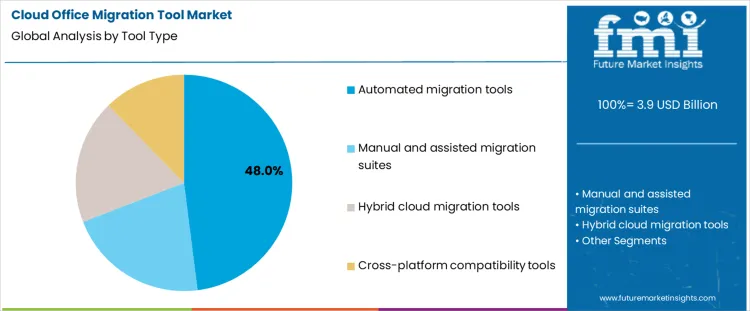
Automated migration tools represent about 48% of demand in the Cloud Office Migration Tool Market because large scale tenant moves require repeatable execution, logging, and rollback capability. These tools support high object counts, scheduling, and rule based transformation with limited manual intervention. Manual and assisted migration suites are used where data sets are smaller or where bespoke remediation is required, though they increase labor input and project duration. Hybrid cloud migration tools address environments with staged transitions or coexistence periods, expanding testing scope and coordination effort. Cross platform compatibility tools serve organizations moving between heterogeneous ecosystems, which increases mapping and validation workload. Each category establishes different staffing models, timelines, and risk controls.
From a cost control perspective, tool choice fixes much of the project delivery structure. Automated platforms concentrate cost in licensing and preparation while reducing per user labor. Manual and assisted approaches shift cost toward services and extend schedules. Hybrid tools introduce parallel run periods and duplicated validation effort. Cross platform solutions require deeper pre migration analysis and post migration reconciliation. Once a program standardizes on a toolset, change is avoided because process documentation, training, and audit artifacts are aligned to that framework. Demand by tool type therefore follows program scale and risk tolerance rather than short term budget cycles.
Why Does End User Segment Define Volume Scale and Governance Requirements in the Cloud Office Migration Tool Market?
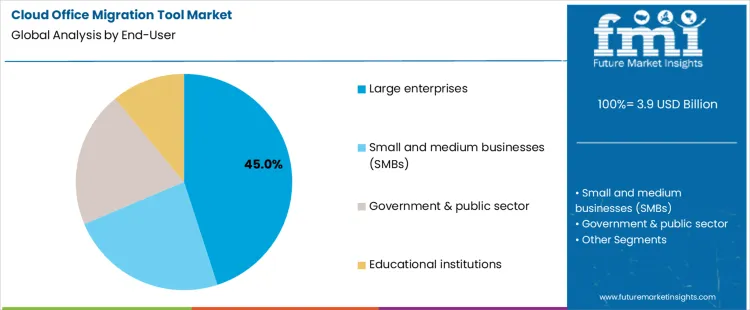
Large enterprises account for about 45% of demand in the Cloud Office Migration Tool Market because they manage complex tenant environments with high user counts and strict continuity requirements. These organizations require detailed planning, staged execution, and extensive reporting. Small and medium businesses operate simpler environments and often accept assisted or templated approaches, producing smaller but more numerous projects. Government and public sector users impose strict data sovereignty, audit, and security controls, which extends approval timelines and narrows tool choice. Educational institutions balance cost constraints with the need to migrate large user populations, often under seasonal scheduling pressure.
End user mix also shapes procurement and delivery models. Enterprises and government bodies purchase through formal programs with defined governance and vendor qualification. SMBs engage through service providers or bundled offerings. Educational institutions often coordinate migrations around academic calendars and funding cycles. The resulting demand structure concentrates revenue in large enterprise and public sector programs while project counts are distributed across smaller organizations. Segment shares therefore move with policy driven modernization initiatives, license lifecycle changes, and organizational consolidation rather than with short term software adoption trends.
How Is the Cloud Office Migration Tool Market Being Shaped by Business Continuity and Data Control Priorities?
The Cloud Office Migration Tool Market is shaped by how organizations move email, documents, and collaboration data without interrupting daily work. Migration projects carry operational risk because data loss, access disruption, or permission errors directly affect employees and customers. Buyers focus on reliability, auditability, rollback capability, and clear visibility into migration progress. Selection decisions involve IT operations, security teams, and business application owners rather than procurement alone. This positions migration tools as risk management software rather than simple transfer utilities, making trust, process control, and support quality central to purchasing decisions.
How Is Standardization of Collaboration Platforms Changing Expectations in The Cloud Office Migration Tool Market?
Organizations increasingly aim to reduce the number of productivity platforms in use to simplify support and governance. This behavior is changing expectations in the Cloud Office Migration Tool Market toward tools that handle large, multi-tenant moves with consistent rules for permissions, identities, and content structure. IT teams prefer repeatable migration playbooks that can be applied across departments and regions. As a result, tools are evaluated on policy mapping, automation depth, and reporting clarity rather than on one-time transfer speed. The buying decision favors products that support controlled, staged transitions over extended periods.
Where Is Ongoing Project Volume Being Built in The Cloud Office Migration Tool Market?
Ongoing project volume is being built through tenant consolidations, mergers, divestments, and periodic platform changes within large organizations. Each restructuring or platform realignment creates a new migration program rather than a single event. The Cloud Office Migration Tool Market also benefits from service providers that run repeated migration projects for different customers using the same toolset. There is opportunity for vendors that support partner ecosystems, licensing models for recurring use, and features that reduce manual project effort. Becoming embedded in standard IT change processes creates repeat demand beyond one-off platform moves.
Why Do Organizational Complexity and Risk Aversion Slow Decision Cycles in The Cloud Office Migration Tool Market?
Migration touches identity systems, security models, and business-critical information stores, which makes decision-makers cautious. Any failure can disrupt operations or create compliance exposure. The Cloud Office Migration Tool Market therefore faces long evaluation cycles, proof-of-concept phases, and multi-stakeholder approvals. Some organizations delay projects or rely on manual methods to avoid perceived tool risk or licensing cost. Internal politics, data ownership questions, and timing conflicts with other IT initiatives also slow progress. These factors keep adoption tied to major organizational change events rather than to continuous optimization programs.
What is the Demand for Cloud Office Migration Tool by Country?
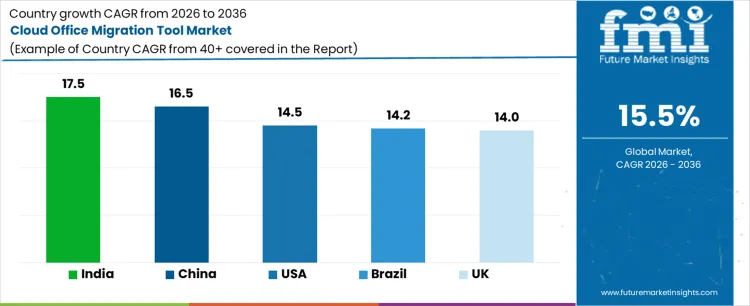
| Country | CAGR |
|---|---|
| USA | 14.5% |
| UK | 14.0% |
| China | 16.5% |
| India | 17.5% |
| Brazil | 14.2% |
Demand for cloud office migration tools is rising as enterprises shift from on premise productivity systems to cloud based collaboration platforms to improve scalability, security management, and remote work support. India leads with a 17.5% CAGR, supported by rapid digitalization of mid-sized enterprises, strong IT services adoption, and large scale workforce transitions to cloud environments. China follows at 16.5%, driven by corporate cloud adoption and modernization of internal collaboration systems. Brazil records 14.2%, reflecting growing use among regional enterprises and service providers. The USA grows at 14.5%, shaped by ongoing upgrades and tenant migrations. The UK, at 14.0%, reflects steady enterprise modernization programs.
How Do Enterprise IT Renewal Programs and Security Reviews Shape Demand in the United States?
Enterprise software refresh cycles keep the cloud office migration tool market in the United States on a 14.5% CAGR path. Demand comes from corporations, public agencies, universities, and healthcare groups moving email, files, and collaboration systems. Technology teams select tools based on data integrity checks, rollback capability, and directory synchronization. Procurement follows multi year modernization programs rather than isolated license purchases. Pilot migrations validate user permissions and archive handling. Change management teams coordinate user training and cutover schedules. Replacement demand appears when legacy tools fail to support scale or compliance needs. Service providers manage staging environments and post migration audits. Budget planning aligns with broader cloud adoption roadmaps. Documentation supports security and governance reviews. Commercial position depends on enterprise account access and proven execution across complex multi-tenant environments rather than small departmental projects.
Why Do Governance Frameworks and Portfolio Standardization Drive Adoption in the United Kingdom?
Central IT governance places the cloud office migration tool market in the United Kingdom on a 14.0% CAGR trajectory. Government departments, financial institutions, and national service providers represent major users. Tool selection follows data residency rules, identity management compatibility, and audit logging requirements. Procurement flows through framework agreements serving multiple agencies and business units. Migration planning aligns with contract renewals and application rationalization programs. Testing cycles confirm mailbox integrity, document permissions, and workflow continuity. Training programs prepare support desks and end users. Replacement decisions follow platform changes or compliance updates. Service partners coordinate phased rollouts and validation reporting. Budget approvals follow portfolio planning cycles. Documentation supports oversight reviews. Commercial access depends on framework participation and demonstrated delivery discipline rather than competition for small team level engagements.
What Role Do Platform Consolidation and Scale Deployment Play in China?
Large enterprise digitization programs place the cloud office migration tool market in China on a 16.5% growth path. State enterprises, technology firms, and industrial groups account for most projects. Central IT teams define approved platforms and migration standards. Domestic software ecosystems influence tool compatibility requirements. Procurement aggregates volumes through group purchasing structures. Execution plans follow staged rollouts across regions and subsidiaries. Testing focuses on identity mapping, data completeness, and performance under load. Local service teams provide on-site coordination. Replacement activity follows platform shifts or policy changes. Reporting dashboards track progress and issue resolution. Payment schedules align with milestone completion. Commercial success depends on inclusion in corporate consolidation programs and delivery capacity across large user bases rather than fragmented projects for small offices.
How Do Digital Workplace Programs and Service Provider Models Shape Demand in India?
Corporate modernization activity fixes the cloud office migration tool market in India at a 17.5% CAGR. IT services firms, conglomerates, and fast growing enterprises represent core users. Tool selection emphasizes automation, error handling, and support for mixed environments. Many projects run through managed service providers responsible for planning and execution. Pilot phases validate user access and archive moves. Training efforts prepare internal support teams. Replacement demand follows scale expansion or cloud vendor changes. Regional delivery centers manage scheduling and progress tracking. Cost management teams review license usage and execution efficiency. Documentation supports client audits. Budget planning links to broader workplace transformation programs. Commercial results depend on partnerships with service providers and repeat delivery performance rather than single company tool sales.
How Do Corporate Restructuring and Shared Service Centers Shape Spending in Brazil?
Business process consolidation keeps the cloud office migration tool market in Brazil near a 14.2% CAGR. Banking groups, retailers, manufacturers, and service companies form the main client base. Migration tools are evaluated on reliability, reporting, and integration with identity systems. Procurement often occurs through multi project contracts managed by IT integrators. Planning cycles align with organizational restructuring and application consolidation. Test migrations confirm permissions and data completeness. Training programs prepare support teams and users. Replacement decisions follow platform changes or contract renewals. Local service partners manage execution and issue resolution. Progress reporting supports management oversight. Budget approvals follow transformation roadmaps. Commercial position depends on integrator relationships and consistent project delivery rather than competition for isolated departmental assignments.
How Do Vendors Compete for Enterprise Programs in the Cloud Office Migration Tool Market?
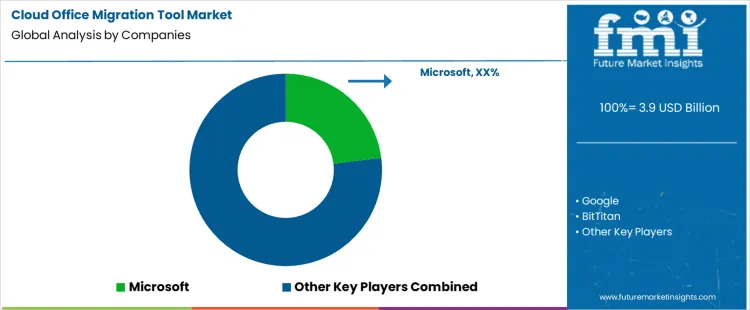
Cloud office migration tool selection follows tenant architecture planning and identity model decisions rather than feature checklists. IT teams define mailbox volumes, data residency rules, coexistence periods, and cutover windows before naming platforms. Microsoft, Google, BitTitan, Quest Software enter those planning cycles through different control points. Microsoft benefits from ownership of destination workloads and directory services. Google participates where Workspace standardization shapes policy. BitTitan focuses on purpose built migration automation and project orchestration. Quest Software relies on long presence in directory and messaging management. Once a migration path enters project governance files, schedule risk and rollback planning keep tool choices fixed. Change introduces retesting of scripts, user communication plans, and security approvals. Procurement treats these tools as project infrastructure rather than discretionary utilities across large organizations.
Competitive outcomes depend on reliability at scale, audit readiness, and failure recovery rather than interface polish. Program leaders examine throttling behavior, error handling, reporting depth, and access control during technical evaluation. Long programs value predictable performance across waves of users and shared resources. Microsoft secures positions where tenant to tenant moves stay inside its administration frameworks. Google gains placements in environments already aligned to Workspace governance. BitTitan wins where mixed environments and staged moves require orchestration discipline. Quest Software competes where identity cleanup and pre migration preparation shape timelines. Service partners influence choices through playbooks and staff familiarity. Market positions differ by tenant size, coexistence length, compliance rules, and internal change control culture.
Key Players of Cloud Office Migration Tool Market
- Microsoft
- BitTitan
- Quest Software
Scope of the Report
| Items | Values |
|---|---|
| Quantitative Units (2026) | USD billion |
| Tool Type | Automated migration tools, Manual and assisted migration suites, Hybrid cloud migration tools, Cross-platform compatibility tools |
| End-User | Large enterprises, Small and medium businesses (SMBs), Government & public sector, Educational institutions |
| Region | Asia Pacific, Europe, North America, Latin America, Middle East & Africa |
| Countries Covered | China, Japan, South Korea, India, Australia & New Zealand, ASEAN, Germany, United Kingdom, France, Italy, Spain, Nordic, BENELUX, United States, Canada, Mexico, Brazil, Chile, Saudi Arabia, Turkey, South Africa, and other regional markets |
| Key Companies Profiled | Microsoft, Google, BitTitan, Quest Software |
| Additional Attributes | Dollar sales by tool type and end-user; demand driven by enterprise cloud transitions and tenant consolidation; selection based on automation depth, rollback capability, audit logging, and permission fidelity; procurement through multi-phase programs; focus on reliability, execution reporting, support load during cutovers, and predictable delivery across large-scale migrations. |
Cloud Office Migration Tool Market Segmentation
Tool Type:
- Automated migration tools
- Manual and assisted migration suites
- Hybrid cloud migration tools
- Cross-platform compatibility tools
End-User:
- Large enterprises
- Small and medium businesses (SMBs)
- Government & public sector
- Educational institutions
Region:
- Asia Pacific
- China
- Japan
- South Korea
- India
- Australia & New Zealand
- ASEAN
- Rest of Asia Pacific
- Europe
- Germany
- United Kingdom
- France
- Italy
- Spain
- Nordic
- BENELUX
- Rest of Europe
- North America
- United States
- Canada
- Mexico
- Latin America
- Brazil
- Chile
- Rest of Latin America
- Middle East & Africa
- Kingdom of Saudi Arabia
- Other GCC Countries
- Turkey
- South Africa
- Other African Union
- Rest of Middle East & Africa
Bibliography
- National Institute of Standards and Technology. (2024). Guide to security logging and event management (NIST Special Publication 800-92, Rev. 2). U.S. Department of Commerce.
- European Union Agency for Cybersecurity (ENISA). (2023). Cloud security for cloud services — Updated guidelines. ENISA.
- European Union Agency for Cybersecurity (ENISA). (2024). Procurement guidelines for secure cloud services. ENISA.
Frequently Asked Questions
How big is the cloud office migration tool market in 2026?
The global cloud office migration tool market is estimated to be valued at USD 3.9 billion in 2026.
What will be the size of cloud office migration tool market in 2036?
The market size for the cloud office migration tool market is projected to reach USD 16.5 billion by 2036.
How much will be the cloud office migration tool market growth between 2026 and 2036?
The cloud office migration tool market is expected to grow at a 15.5% CAGR between 2026 and 2036.
What are the key product types in the cloud office migration tool market?
The key product types in cloud office migration tool market are automated migration tools , manual and assisted migration suites, hybrid cloud migration tools and cross‑platform compatibility tools.
Which end‑user segment to contribute significant share in the cloud office migration tool market in 2026?
In terms of end‑user, large enterprises segment to command 45.0% share in the cloud office migration tool market in 2026.
Preview the report firsthand - request a free sample
Get SampleGet the brochure for pricing and purchase details.
Get PDFTable of Content
- Executive Summary
- Global Market Outlook
- Demand-side Trends
- Supply-side Trends
- Technology Roadmap Analysis
- Analysis and Recommendations
- Market Overview
- Market Coverage / Taxonomy
- Market Definition / Scope / Limitations
- Market Background
- Market Dynamics
- Drivers
- Restraints
- Opportunity
- Trends
- Scenario Forecast
- Demand in Optimistic Scenario
- Demand in Likely Scenario
- Demand in Conservative Scenario
- Opportunity Map Analysis
- Product Life Cycle Analysis
- Supply Chain Analysis
- Investment Feasibility Matrix
- Value Chain Analysis
- PESTLE and Porter’s Analysis
- Regulatory Landscape
- Regional Parent Market Outlook
- Production and Consumption Statistics
- Import and Export Statistics
- Market Dynamics
- Global Market Analysis 2021 to 2025 and Forecast, 2026 to 2036
- Historical Market Size Value (USD Million) Analysis, 2021 to 2025
- Current and Future Market Size Value (USD Million) Projections, 2026 to 2036
- Y-o-Y Growth Trend Analysis
- Absolute $ Opportunity Analysis
- Global Market Pricing Analysis 2021 to 2025 and Forecast 2026 to 2036
- Global Market Analysis 2021 to 2025 and Forecast 2026 to 2036, By Tool Type
- Introduction / Key Findings
- Historical Market Size Value (USD Million) Analysis By Tool Type , 2021 to 2025
- Current and Future Market Size Value (USD Million) Analysis and Forecast By Tool Type , 2026 to 2036
- Automated migration tools
- Manual and assisted migration suites
- Hybrid cloud migration tools
- Cross‑platform compatibility tools
- Automated migration tools
- Y-o-Y Growth Trend Analysis By Tool Type , 2021 to 2025
- Absolute $ Opportunity Analysis By Tool Type , 2026 to 2036
- Global Market Analysis 2021 to 2025 and Forecast 2026 to 2036, By End‑User
- Introduction / Key Findings
- Historical Market Size Value (USD Million) Analysis By End‑User, 2021 to 2025
- Current and Future Market Size Value (USD Million) Analysis and Forecast By End‑User, 2026 to 2036
- Large enterprises
- Small and medium businesses (SMBs)
- Government & public sector
- Educational institutions
- Large enterprises
- Y-o-Y Growth Trend Analysis By End‑User, 2021 to 2025
- Absolute $ Opportunity Analysis By End‑User, 2026 to 2036
- Global Market Analysis 2021 to 2025 and Forecast 2026 to 2036, By Region
- Introduction
- Historical Market Size Value (USD Million) Analysis By Region, 2021 to 2025
- Current Market Size Value (USD Million) Analysis and Forecast By Region, 2026 to 2036
- North America
- Latin America
- Western Europe
- Eastern Europe
- East Asia
- South Asia and Pacific
- Middle East & Africa
- Market Attractiveness Analysis By Region
- North America Market Analysis 2021 to 2025 and Forecast 2026 to 2036, By Country
- Historical Market Size Value (USD Million) Trend Analysis By Market Taxonomy, 2021 to 2025
- Market Size Value (USD Million) Forecast By Market Taxonomy, 2026 to 2036
- By Country
- USA
- Canada
- Mexico
- By Tool Type
- By End‑User
- By Country
- Market Attractiveness Analysis
- By Country
- By Tool Type
- By End‑User
- Key Takeaways
- Latin America Market Analysis 2021 to 2025 and Forecast 2026 to 2036, By Country
- Historical Market Size Value (USD Million) Trend Analysis By Market Taxonomy, 2021 to 2025
- Market Size Value (USD Million) Forecast By Market Taxonomy, 2026 to 2036
- By Country
- Brazil
- Chile
- Rest of Latin America
- By Tool Type
- By End‑User
- By Country
- Market Attractiveness Analysis
- By Country
- By Tool Type
- By End‑User
- Key Takeaways
- Western Europe Market Analysis 2021 to 2025 and Forecast 2026 to 2036, By Country
- Historical Market Size Value (USD Million) Trend Analysis By Market Taxonomy, 2021 to 2025
- Market Size Value (USD Million) Forecast By Market Taxonomy, 2026 to 2036
- By Country
- Germany
- UK
- Italy
- Spain
- France
- Nordic
- BENELUX
- Rest of Western Europe
- By Tool Type
- By End‑User
- By Country
- Market Attractiveness Analysis
- By Country
- By Tool Type
- By End‑User
- Key Takeaways
- Eastern Europe Market Analysis 2021 to 2025 and Forecast 2026 to 2036, By Country
- Historical Market Size Value (USD Million) Trend Analysis By Market Taxonomy, 2021 to 2025
- Market Size Value (USD Million) Forecast By Market Taxonomy, 2026 to 2036
- By Country
- Russia
- Poland
- Hungary
- Balkan & Baltic
- Rest of Eastern Europe
- By Tool Type
- By End‑User
- By Country
- Market Attractiveness Analysis
- By Country
- By Tool Type
- By End‑User
- Key Takeaways
- East Asia Market Analysis 2021 to 2025 and Forecast 2026 to 2036, By Country
- Historical Market Size Value (USD Million) Trend Analysis By Market Taxonomy, 2021 to 2025
- Market Size Value (USD Million) Forecast By Market Taxonomy, 2026 to 2036
- By Country
- China
- Japan
- South Korea
- By Tool Type
- By End‑User
- By Country
- Market Attractiveness Analysis
- By Country
- By Tool Type
- By End‑User
- Key Takeaways
- South Asia and Pacific Market Analysis 2021 to 2025 and Forecast 2026 to 2036, By Country
- Historical Market Size Value (USD Million) Trend Analysis By Market Taxonomy, 2021 to 2025
- Market Size Value (USD Million) Forecast By Market Taxonomy, 2026 to 2036
- By Country
- India
- ASEAN
- Australia & New Zealand
- Rest of South Asia and Pacific
- By Tool Type
- By End‑User
- By Country
- Market Attractiveness Analysis
- By Country
- By Tool Type
- By End‑User
- Key Takeaways
- Middle East & Africa Market Analysis 2021 to 2025 and Forecast 2026 to 2036, By Country
- Historical Market Size Value (USD Million) Trend Analysis By Market Taxonomy, 2021 to 2025
- Market Size Value (USD Million) Forecast By Market Taxonomy, 2026 to 2036
- By Country
- Kingdom of Saudi Arabia
- Other GCC Countries
- Turkiye
- South Africa
- Other African Union
- Rest of Middle East & Africa
- By Tool Type
- By End‑User
- By Country
- Market Attractiveness Analysis
- By Country
- By Tool Type
- By End‑User
- Key Takeaways
- Key Countries Market Analysis
- USA
- Pricing Analysis
- Market Share Analysis, 2025
- By Tool Type
- By End‑User
- Canada
- Pricing Analysis
- Market Share Analysis, 2025
- By Tool Type
- By End‑User
- Mexico
- Pricing Analysis
- Market Share Analysis, 2025
- By Tool Type
- By End‑User
- Brazil
- Pricing Analysis
- Market Share Analysis, 2025
- By Tool Type
- By End‑User
- Chile
- Pricing Analysis
- Market Share Analysis, 2025
- By Tool Type
- By End‑User
- Germany
- Pricing Analysis
- Market Share Analysis, 2025
- By Tool Type
- By End‑User
- UK
- Pricing Analysis
- Market Share Analysis, 2025
- By Tool Type
- By End‑User
- Italy
- Pricing Analysis
- Market Share Analysis, 2025
- By Tool Type
- By End‑User
- Spain
- Pricing Analysis
- Market Share Analysis, 2025
- By Tool Type
- By End‑User
- France
- Pricing Analysis
- Market Share Analysis, 2025
- By Tool Type
- By End‑User
- India
- Pricing Analysis
- Market Share Analysis, 2025
- By Tool Type
- By End‑User
- ASEAN
- Pricing Analysis
- Market Share Analysis, 2025
- By Tool Type
- By End‑User
- Australia & New Zealand
- Pricing Analysis
- Market Share Analysis, 2025
- By Tool Type
- By End‑User
- China
- Pricing Analysis
- Market Share Analysis, 2025
- By Tool Type
- By End‑User
- Japan
- Pricing Analysis
- Market Share Analysis, 2025
- By Tool Type
- By End‑User
- South Korea
- Pricing Analysis
- Market Share Analysis, 2025
- By Tool Type
- By End‑User
- Russia
- Pricing Analysis
- Market Share Analysis, 2025
- By Tool Type
- By End‑User
- Poland
- Pricing Analysis
- Market Share Analysis, 2025
- By Tool Type
- By End‑User
- Hungary
- Pricing Analysis
- Market Share Analysis, 2025
- By Tool Type
- By End‑User
- Kingdom of Saudi Arabia
- Pricing Analysis
- Market Share Analysis, 2025
- By Tool Type
- By End‑User
- Turkiye
- Pricing Analysis
- Market Share Analysis, 2025
- By Tool Type
- By End‑User
- South Africa
- Pricing Analysis
- Market Share Analysis, 2025
- By Tool Type
- By End‑User
- USA
- Market Structure Analysis
- Competition Dashboard
- Competition Benchmarking
- Market Share Analysis of Top Players
- By Regional
- By Tool Type
- By End‑User
- Competition Analysis
- Competition Deep Dive
- Microsoft
- Overview
- Product Portfolio
- Profitability by Market Segments (Product/Age /Sales Channel/Region)
- Sales Footprint
- Strategy Overview
- Marketing Strategy
- Product Strategy
- Channel Strategy
- BitTitan
- Quest Software
- Microsoft
- Competition Deep Dive
- Assumptions & Acronyms Used
- Research Methodology


