

- Industry Size (2026)
- USD 88.9 Bn
- Forecast (2036)
- USD 286.3 Bn
- CAGR (2026 to 2036)
- 12.4%
Cloud Kitchen Market Forecast and Outlook 2026 to 2036
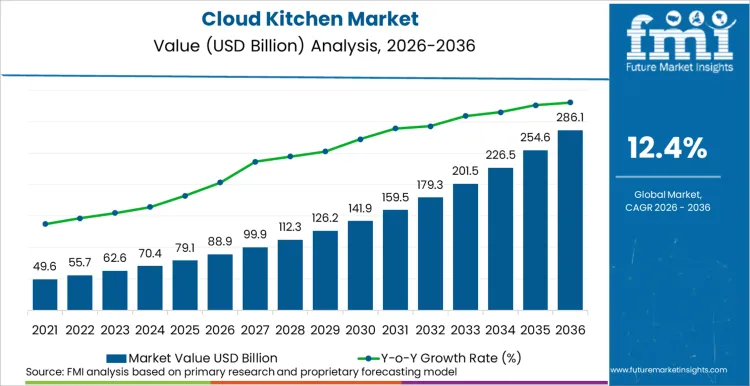
The global cloud kitchen sector is on track to achieve a valuation of USD 286.3 billion by 2036, accelerating from USD 88.9 billion in 2026 at a CAGR of 12.4%. As per Future Market Insights, expansion is structurally underpinned by the permanent behavioral shift toward off-premise dining that was catalyzed by the pandemic and has since been reinforced by the proliferation of rapid delivery infrastructure across urban and semi-urban geographies. The National Restaurant Association of India (NRAI) reported that delivery-first formats now account for over 40% of organized food service revenue in India's top eight cities, confirming that cloud kitchens have transitioned from an experimental model to a core industry segment. This structural shift compels traditional restaurant operators to either adopt hybrid kitchen models or risk losing share to asset-light competitors. Simultaneously, the competitive environment is shifting from volume-based unit expansion to profitability-focused consolidation, which forces operators to invest in automation, supply chain integration, and brand portfolio optimization.
Pedro Botta, CEO of Access Power and Co., stated: 'By expanding into ghost kitchens with Big Papa's Pizza and Wicked Wild Wings, we are positioning the company to capitalise on the continued shift toward digital ordering and off-premise dining.' This confirms that even non-traditional entrants view cloud kitchens as a strategic entry point into the food service value chain. FMI opines that the next phase of industry growth will be defined not by kitchen count but by per-kitchen revenue density and customer lifetime value.
The operational reality for cloud kitchen operators in 2025 and 2026 is defined by an arms race in automation and AI-driven kitchen management. Lenexis Foodworks launched its 200th Big Bowl cloud kitchen in Hyderabad in February 2025 and announced plans for 300 additional units by 2027, targeting Tier II and Tier III Indian cities. Ghost Kitchens International, formerly Toronto-based Ghost Kitchen Brands, rebranded in June 2024 to reflect its aggressive global push, launching a European subsidiary in Greece and integrating robotics into its USA locations. As per FMI, the integration of robotic preparation systems and AI-optimized menu engineering will be the defining capability differentiator over the forecast period.
Key Takeaways
- The cloud kitchen market is controlled by a triangular power structure where delivery aggregators (Zomato, Swiggy, DoorDash, Uber Eats) hold disproportionate influence over consumer traffic, effectively operating as gatekeepers to demand. Kitchen operators bear the capital and labor costs while aggregators extract 25 to 35% commission rates. FMI analysts note that operator profitability depends on negotiating leverage with these platforms or building direct-to-consumer channels.
- Pricing asymmetry in the cloud kitchen market is acute. Aggregator platforms control visibility algorithms, meaning kitchen operators who do not invest in platform advertising face declining order volumes regardless of food quality. The result is margin compression at the operator level while platforms enjoy high-margin fee structures. As per FMI, this imbalance is driving operators toward multi-brand strategies that spread fixed costs across several virtual restaurant concepts.
- Sourcing fragility in the cloud kitchen sector centers on last-mile logistics and raw material consistency. Operators running 10 or more virtual brands from a single kitchen face quality control challenges and supply chain complexity that can erode margins. Rebel Foods' launch of the QuickiES 15-minute delivery app in February 2025 illustrates the pressure to compress delivery windows, which places additional strain on kitchen throughput and ingredient sourcing.
- Brand and compliance risks are rising as food safety regulators in India, the EU, and the United States tighten inspection frameworks for virtual restaurant brands that may not maintain physical consumer-facing premises. The proliferation of virtual brands has created confusion around accountability when food safety incidents occur. FMI is of the opinion that regulatory clarity on virtual brand licensing will emerge as a critical factor shaping operator strategy.
- Geographic leverage is heavily concentrated in Asia Pacific, where India alone hosts the largest number of cloud kitchen operators globally, driven by low real estate costs and high delivery penetration. North America is dominated by platform-driven models, while the Middle East and Latin America are early-stage markets with high growth potential. Europe is constrained by stricter labor regulations and higher operational costs.
- The executive reframing for cloud kitchens is that this is a technology and supply chain business with a food output, not a food business with a technology overlay. FMI analysts emphasize that C-suite leaders must evaluate cloud kitchen investments through the lens of automation ROI, data monetization, and brand portfolio management rather than traditional restaurant metrics.
Summary of Cloud Kitchen Market
What Is Growth Outlook for Cloud Kitchen Market as per Future Market Insights Projection?
Future Market Insights projects the cloud kitchen market to expand at a CAGR of 12.4% from 2026 to 2036, increasing from USD 88.9 Billion in 2026 to USD 286.3 Billion by 2036.
FMI Research Approach: FMI proprietary forecasting model based on delivery order volume correlation and kitchen unit economics.
How Do FMI Analysts Perceive Cloud Kitchen Market to Evolve?
FMI analysts perceive the market evolving toward profitability-driven consolidation where operators leverage AI-optimized menu engineering, automated food preparation, and multi-brand strategies to maximize per-kitchen revenue density.
FMI Research Approach: Delivery platform GMV data and unit-level profitability modeling.
Which Country Holds Largest Share in Global Cloud Kitchen Market?
The United States holds a significant share of the global cloud kitchen market by value which is supported by high delivery order frequency and established aggregator infrastructure.
FMI Research Approach: FMI country-level revenue modeling by delivery platform GMV and kitchen density data.
How Large Will Cloud Kitchen Market Be by 2036?
The global cloud kitchen market is projected to reach USD 286.3 Billion by 2036.
FMI Research Approach: FMI long-term revenue forecast derived from urban population growth and delivery penetration rate projections.
What Is Definition of Cloud Kitchen Market?
The cloud kitchen market includes revenue generated from delivery-only and delivery-first food preparation facilities that operate without consumer-facing dining areas, including independent cloud kitchens, multi-brand virtual kitchens, and commissary kitchen formats.
FMI Research Approach: FMI market taxonomy and inclusion-exclusion framework.
What Are Globally Unique Trends Shaping Cloud Kitchen Market?
Globally unique trends include the integration of robotic food preparation systems, the emergence of 15-minute delivery models, and the consolidation of multi-brand kitchen platforms through strategic acquisitions.
FMI Research Approach: National Restaurant Association of India delivery format data and global aggregator financial disclosures.
Cloud Kitchen Market Key Takeaways
| Metric | Details |
|---|---|
| Industry Size (2026) | USD 88.9 Billion |
| Industry Value (2036) | USD 286.3 Billion |
| CAGR (2026 to 2036) | 12.4% |
Source: Future Market Insights (FMI) analysis, based on proprietary forecasting model and primary research
Factors Driving the Demand for Cloud Kitchen
Increasing Demand for Convenience
One of the primary drivers of the cloud kitchen market is the rising consumer services demand for convenience. As lifestyles become increasingly hectic, many individuals prefer quick and easy dining solutions that eliminate the need for cooking or dining out.
Cloud kitchens cater to this demand by offering delivery-only services that allow customers to enjoy a variety of cuisines from the comfort of their homes. This trend has been further accelerated by the COVID-19 pandemic, which heightened reliance on food delivery services and made online ordering a staple in many households.
Urbanization and Busy Lifestyles
Urbanization is also a very critical factor in the growth of cloud kitchens. Due to their work schedules and time spent commuting, people are in a hurry in cities.
This lifestyle is more prone to preferring easy, convenient dining options, making the cloud kitchen model very attractive. The rapid accessibility of diverse food offerings through delivery apps fits in well with the fast-paced lifestyle of the urban population, driving market growth.
Factors Restraining the Demand for Cloud Kitchen
Competition from Established Restaurants
One of the major restraints for the cloud kitchen market is the intense competition from established dining and QSRs. Most of these traditional establishments have strong brand recognition, loyal customer bases, and extensive resources that allow them to adapt quickly to changing market dynamics.
Consequently, they can easily introduce delivery services in their existing operations. They can tap into their already established infrastructure and customer relationships to capture a share of the increasingly growing online food delivery market.
Key Emerging Trends in the Cloud Kitchen Market
Rise of Virtual Brands
Virtual brands are one of the most popular trends in the cloud kitchen market, which simply refers to restaurant concepts that exist only for delivery market and have no storefront. It has enabled entrepreneurs to create several brands from one kitchen space and cater to diverse culinary preferences without the overhead costs associated with traditional restaurants.
Virtual brands can easily change their menu offerings according to changing consumer tastes and trends. They can offer seasonal menus or limited-time offerings and therefore keep the dining experience fresh and exciting. With such flexibility, a business makes good use of prevailing food trends and assesses new concepts in the least expensive manner possible.
Focus on Sustainability
Sustainability is becoming a prominent trend within the cloud kitchen market as consumers become more environmentally conscious. Many cloud kitchens are adopting eco-friendly practices, such as using sustainable packaging materials and sourcing ingredients from local suppliers.
This shift not only appeals to environmentally aware customers but also helps businesses reduce their carbon footprint. Sustainability will be a great way to distinguish cloud kitchens in a saturated market while also making a positive contribution to the fight against climate change. As this trend continues to gain momentum, it is probable that more cloud kitchens will incorporate sustainable practices into their core business strategies.
Changing Consumer Trends Shaping the Cloud Kitchen Market
Growing Demand for Convenience
One of the major mega-consumer trends in the cloud kitchen market is the increasing demand for convenience among consumers. As lifestyles become busier and more fast-paced, individuals increasingly seek hassle-free dining solutions that fit seamlessly into their daily routines.
Cloud kitchens cater to this need by offering a wide variety of meal options that can be ordered with just a few clicks and delivered directly to consumers' doorsteps.
This trend has been more pronounced in urban areas, where time constraints make cooking at home less feasible for many people. In this regard, cloud kitchens have positioned themselves as an essential service for modern consumers by providing quick access to diverse culinary experiences without the need for dining out.
Cloud Kitchen Industry Analysis by Top Investment Segments
By Type
| Attributes | Details |
|---|---|
| Top Type | Independent Cloud Kitchen |
| Market Share in 2026 | 56% |
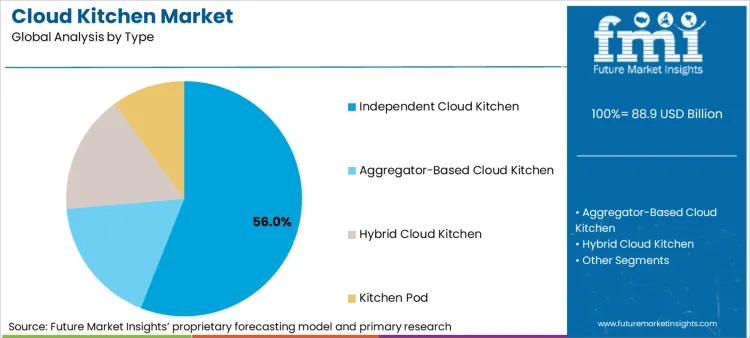
Based on type, the market is divided into independent cloud kitchen, aggregator-based cloud kitchen, hybrid cloud kitchen, kitchen pod, and commissary/shared kitchen. The independent cloud kitchen segment is expected to account for 56% share in 2026. Independent cloud kitchens are widely used as they provide flexible and cost-effective solutions for food entrepreneurs and brands alike. The most common reason for its popularity is because of lower investment and overheads in this model. In independent cloud kitchens, there is no need to have a physical dining space. Thus, such a model can be operated from a less expensive location, saving the costs of rent, utilities, and staff. This will afford new entrants into the market with less risk in capital and enable existing restaurants to expand their presence without big capital investment.
By Business Model
| Attributes | Details |
|---|---|
| Top Business Model | Aggregator-based Platform |
| Market Share in 2026 | 63% |
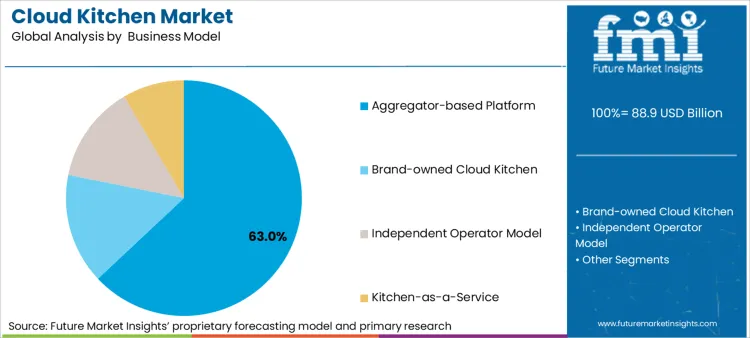
Based on the business model, the market is divided into aggregator-based platforms, brand-owned cloud kitchens, independent operator models, kitchen-as-a-service, and franchise models. The aggregator-based platform segment is expected to account for 63% share in 2026. The use of aggregator-based platforms is predominant in the cloud kitchen market mainly because they provide enhanced visibility and reach for food brands. Platforms such as Uber Eats, Zomato, and DoorDash connect cloud kitchens with a vast customer base that is actively looking for food delivery options. Through listing on such popular delivery apps, cloud kitchens tap into an established audience without having to invest much in marketing, thus making it easier to attract new customers.
By Food Type
| Attributes | Details |
|---|---|
| Leading Food Type | Fast food |
| Market Share in 2026 | 43% |
Based on food type, the market is divided into fast food, casual dining, fine dining, healthy/diet food, ethnic cuisine, and desserts & beverages. Among the options of food prepared in cloud kitchens, fast food is widely used as it has its inherent appeal of convenience and speedy service. Fast food brands have well adapted to the cloud kitchen model, using their already-established popularity and brand recognition to attract customers looking for instant gratification from their meals. A fast-paced lifestyle among many consumers fuels the need for quick, affordable dining options that can be ordered online and delivered quickly.
Additionally, the fast food variety available from burgers to fries, pizzas, and sandwiches goes well with the consumer's taste for comfort food. This makes fast food a significant category in the cloud kitchen market because it caters to a vast audience that emphasizes convenience without compromising on taste.
By End-User
| Attributes | Details |
|---|---|
| Leading End-user | Corporate Offices |
| Market Share in 2026 | 51% |
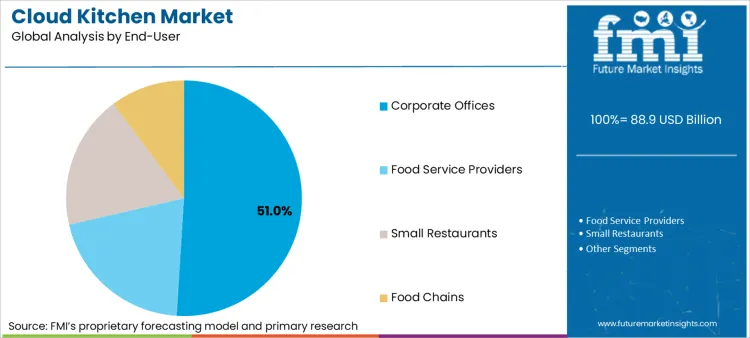
Based on end-users, the market is divided into individual consumers, corporate offices, food service providers, small restaurants, food chains, and caterers. Corporate offices form the most important user group in cloud kitchens since they are significant consumers of ready-to-eat, convenient meal solutions. In fact, the catering requirements for meetings and events and everyday lunches often form a sizeable part of their overall catering demand. This is because corporate offices prefer a varied menu, but a traditional dining setup would involve unnecessary overheads. The flexibility of cloud kitchens allows them to offer a variety of cuisines tailored to different dietary preferences, which is particularly appealing in a corporate environment where employees may have varied tastes and nutritional needs.
Analysis of Top Countries Producing, Formulating, Packaging, Distributing, and Consuming Cloud Kitchen
Growth of the Cloud Kitchen Market in the USA
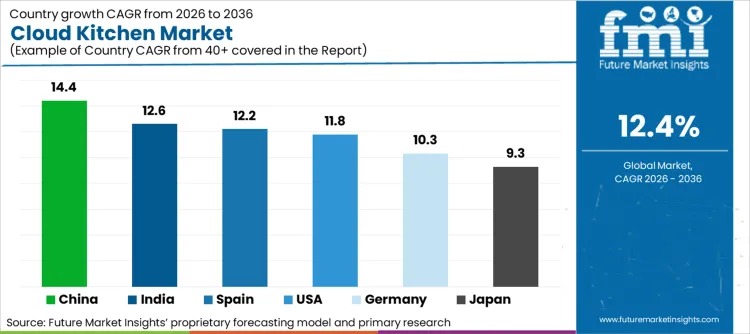
The USA is expected to achieve a CAGR of 11.8% in the forecast period. The cloud kitchen market in the USA is rapidly expanding, driven by a combination of changing consumer preferences and technological advancements.
With increasingly hectic lifestyles, consumers prioritize convenience and rapid access to varied dining options that cloud kitchens provide by focusing solely on delivery and takeout. With the emergence of food delivery applications, consumers easily order meals originating from different cuisines, resulting in an uptick in cloud kitchen demand.
India leads Due to Rising Demand for Disposable Income
India’s cloud kitchen is poised to experience a CAGR of 12.6% till 2035. Urbanization and rising disposable income have increased consumers' tendency to order food at home rather than cook it in the house. The COVID-19 pandemic made things worse because lockdowns and health concerns moved people towards no-contact food delivery services.
China Witnesses High Population Density and Rapid Urbanization
China is set to witness a CAGR of 14.4% from 2025 to 2035. High population density and rapid urbanization create a significant market for delivery-only food services, and cloud kitchens are thriving in densely populated areas where traditional dining options are less accessible. The COVID-19 pandemic has also played a pivotal role in accelerating the adoption of cloud kitchens.
High Demand for Local Cuisines in Spain
Spain is poised to witness a CAGR of 12.2% in the forecast period. The strong agricultural sector of Spain enables the availability of fresh, quality ingredients, making cloud kitchens highly appealing for offering authentic and delicious meals.
The combination of leading food delivery applications and emerging local contenders pushes the environment into a dynamic space from which cloud kitchens can thrive, an ever popular choice for consumers desiring convenience and variation in their dining experiences.
Presence of Well-developed Food Supply Chain in Germany
Cloud kitchen market size in Germany is expected to reach 10.3% CAGR till 2035. The food supply chain in Germany is well developed, that provides ready access to the best quality products at the right time, maintaining product quality throughout and customer satisfaction.
Germany is home to several food startups that contribute to the economy. Convenience, infrastructure availability, and entrepreneurial opportunities places the cloud kitchen sector for sustained growth in Germany's dynamic food landscape.
Rise in Cloud Kitchen Market in Japan
Japan is expected to grow at a CAGR of 9.3% from 2025 to 2035. The cloud kitchen market in Japan is growing fast and is spurred by several interlinked factors, all of which mirror changing consumer behavior and technological advancement. A major driver is the food delivery services largely due to increased demand from cities where time and convenience are highly valued.
Key Cloud Kitchen Market Players and Concentration
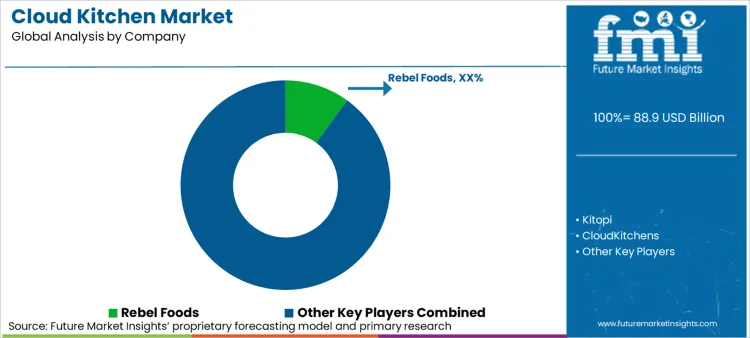
The competitive landscape of the cloud kitchen market is characterized by a mixture of new and existing players who are currently exploring innovative strategies to expand their share in the market. Major companies in this market include Starbucks Coffee Company, DoorDash, Inc., and Rebel Foods.
Growth strategies include expanding delivery networks and menu offerings tailored to consumer preferences. For example, DoorDash focuses on partnerships with local cloud kitchens to broaden its menu range while increasing efficiency in delivery.
Independent cloud kitchens and smaller players such as Ghost Kitchen Orlando and Zuul Kitchens also have made great contributions by targeting specific markets and offering innovative cuisines.
Their business model is more agile because it easily adapts to changing consumer needs and trends, thus enabling quicker changes in menu offerings. For instance, independent cloud kitchens are trying virtual brands that focus on specific dietary needs or trending cuisines, thus attracting a dedicated customer base.
The focus on operational efficiency and lower overhead costs allows these smaller entities to compete effectively against larger chains, fostering a dynamic and competitive atmosphere within the German cloud kitchen market.
As the industry continues to evolve, it is apparent that continued growth and innovation in the rapidly changing landscape will depend crucially on co-operation between stakeholders, including food delivery platforms and local suppliers.
Recent Developments:
- In February 2025, Lenexis Foodworks launched its 200th Big Bowl cloud kitchen in Hyderabad and announced plans for 300 additional units by 2027, targeting Tier II and Tier III Indian cities.
- In June 2024, Ghost Kitchen Brands rebranded as Ghost Kitchens International, launched a European subsidiary in Greece, and announced the integration of robotics into its USA locations.
- In June 2024, the cloud kitchen startup Kitchens secured a USD 160 million investment from London-based Finnest Private Equity, which acquired a 53.75% controlling stake.
Emerging Startups and Innovation in the Cloud Kitchen Market
The cloud kitchen market is emerging to witness several unique innovative startups with new growth strategies to reposition food delivery. For example, Keatz runs multiple cloud kitchens all over Europe. It recently launched its delivery services in Germany with an objective to deliver foods and enabling meals to remain fresh and intact at the point of arrival.
Their strategy is kitchen automation and using technology to increase efficiency. This enables Keatz to operate under several brands from a single location. By teaming up with existing delivery platforms, such as Deliveroo and Uber Eats, Keatz expands its reach while saving on the initial costs of a traditional restaurant business.
Other new startups of notable interest in this sector involve virtual brands targeted specifically for delivery with a large variation of cuisines offered at a cloud kitchen place called Taster. A collaboration with regional, diverse customer-oriented chefs provides their unique products so that this space can accommodate its target client diversity.
Key Market Players for Cloud Kitchen Market
- Rebel Foods
- Kitopi
- CloudKitchens
- Ghost Kitchens Private Limited
- Luckin Coffee (Sgp) Pte. Ltd.
- EatClub Brands Pvt. Ltd.
- Loyal Hospitality Pvt Ltd.
- Nathan's Famous, Inc.
- Dine Brands Global, Inc.
- Dickey's Barbecue Restaurants, Inc.
Market Definition
The cloud kitchen market represents revenue generated from delivery-only and delivery-first food preparation operations that lack consumer-facing dining areas. The market measures the value of food orders fulfilled through independent cloud kitchens, multi-brand virtual kitchen facilities, and shared commissary kitchen platforms.
Inclusions cover delivery-only kitchens (dark kitchens), virtual restaurant brands operated from shared facilities, and hybrid kitchen models with minimal dine-in capacity. It includes revenue from direct-to-consumer and aggregator-mediated orders. Kitchen automation systems, menu optimization software, and kitchen-as-a-service subscription models are also included.
Exclusions include traditional dine-in restaurant revenue, catering services not operated from cloud kitchen infrastructure, and food delivery platform commission revenue that accrues to aggregators rather than kitchen operators. Standard food manufacturing and central production units serving retail channels are outside the scope.
Scope of Report
| Items | Values |
|---|---|
| Quantitative Units (2026) | USD 88.9 Billion |
| Product Type | Independent Cloud Kitchens, Multi-Brand Virtual Kitchens, Commissary/Shared Kitchens, Hybrid Kitchen Models |
| Material Type | Quick Service, Casual Dining, Health and Wellness, Specialty Cuisine, Multi-Cuisine Platforms |
| End-Use / Channel | Aggregator-Mediated (Zomato, Swiggy, DoorDash), Direct-to-Consumer (Branded Apps), Marketplace Hybrid |
| Regions Covered | North America, Europe, Asia Pacific, Latin America, Middle East and Africa |
| Countries Covered | USA, India, China, UK, UAE, Brazil, and 40+ countries |
| Key Companies Profiled | Rebel Foods, CloudKitchens, Kitchen United, Ghost Kitchens International, Kitopi, REEF Technology, Zuul Kitchens |
| Additional Attributes | Revenue analysis by kitchen format and order channel, delivery platform commission impact assessment, automation and robotics adoption tracking, virtual brand portfolio analysis, and unit-level profitability modeling |
Cloud Kitchen Market by Segments
By Product Type:
- Independent Cloud Kitchens
- Multi-Brand Virtual Kitchens
- Commissary and Shared Kitchens
- Hybrid Kitchen Models
By Material Type:
- Quick Service Restaurant (QSR)
- Casual Dining
- Health and Wellness
- Specialty and Ethnic Cuisine
By Region:
- North America
- Europe
- East Asia
- South Asia
- Latin America
- Middle East and Africa
Bibliography
- National Restaurant Association of India. (2025, March). India Food Services Report 2025. NRAI.
- Access Power and Co. (2026, February). Ghost kitchen expansion announcement. Verdict Foodservice.
- Lenexis Foodworks. (2025, February). Big Bowl 200th kitchen launch announcement. Lenexis Corporate.
- Ghost Kitchens International. (2024, June). Global rebranding and robotics integration announcement. GKI Corporate.
Frequently Asked Questions
How big is the cloud kitchen market in 2026?
The global cloud kitchen market is estimated to be valued at USD 88.9 billion in 2026.
What will be the size of cloud kitchen market in 2036?
The market size for the cloud kitchen market is projected to reach USD 286.1 billion by 2036.
How much will be the cloud kitchen market growth between 2026 and 2036?
The cloud kitchen market is expected to grow at a 12.4% CAGR between 2026 and 2036.
What are the key product types in the cloud kitchen market?
The key product types in cloud kitchen market are independent cloud kitchen, aggregator-based cloud kitchen, hybrid cloud kitchen and kitchen pod.
Which business model segment is expected to contribute significant share in the cloud kitchen market in 2026?
In terms of business model, aggregator-based platform segment is expected to command 63.0% share in the cloud kitchen market in 2026.
Preview the report firsthand - request a free sample
Get SampleGet the brochure for pricing and purchase details.
Get PDFTable of Content
- Executive Summary
- Global Market Outlook
- Demand-side Trends
- Supply-side Trends
- Technology Roadmap Analysis
- Analysis and Recommendations
- Market Overview
- Market Coverage / Taxonomy
- Market Definition / Scope / Limitations
- Research Methodology
- Chapter Orientation
- Analytical Lens and Working Hypotheses
- Market Structure, Signals, and Trend Drivers
- Benchmarking and Cross-market Comparability
- Market Sizing, Forecasting, and Opportunity Mapping
- Research Design and Evidence Framework
- Desk Research Programme (Secondary Evidence)
- Company Annual and Sustainability Reports
- Peer-reviewed Journals and Academic Literature
- Corporate Websites, Product Literature, and Technical Notes
- Earnings Decks and Investor Briefings
- Statutory Filings and Regulatory Disclosures
- Technical White Papers and Standards Notes
- Trade Journals, Industry Magazines, and Analyst Briefs
- Conference Proceedings, Webinars, and Seminar Materials
- Government Statistics Portals and Public Data Releases
- Press Releases and Reputable Media Coverage
- Specialist Newsletters and Curated Briefings
- Sector Databases and Reference Repositories
- FMI Internal Proprietary Databases and Historical Market Datasets
- Subscription Datasets and Paid Sources
- Social Channels, Communities, and Digital Listening Inputs
- Additional Desk Sources
- Expert Input and Fieldwork (Primary Evidence)
- Primary Modes
- Qualitative Interviews and Expert Elicitation
- Quantitative Surveys and Structured Data Capture
- Blended Approach
- Why Primary Evidence is Used
- Field Techniques
- Interviews
- Surveys
- Focus Groups
- Observational and In-context Research
- Social and Community Interactions
- Stakeholder Universe Engaged
- C-suite Leaders
- Board Members
- Presidents and Vice Presidents
- R&D and Innovation Heads
- Technical Specialists
- Domain Subject-matter Experts
- Scientists
- Physicians and Other Healthcare Professionals
- Governance, Ethics, and Data Stewardship
- Research Ethics
- Data Integrity and Handling
- Primary Modes
- Tooling, Models, and Reference Databases
- Desk Research Programme (Secondary Evidence)
- Data Engineering and Model Build
- Data Acquisition and Ingestion
- Cleaning, Normalisation, and Verification
- Synthesis, Triangulation, and Analysis
- Quality Assurance and Audit Trail
- Market Background
- Market Dynamics
- Drivers
- Restraints
- Opportunity
- Trends
- Scenario Forecast
- Demand in Optimistic Scenario
- Demand in Likely Scenario
- Demand in Conservative Scenario
- Opportunity Map Analysis
- Product Life Cycle Analysis
- Supply Chain Analysis
- Investment Feasibility Matrix
- Value Chain Analysis
- PESTLE and Porter’s Analysis
- Regulatory Landscape
- Regional Parent Market Outlook
- Production and Consumption Statistics
- Import and Export Statistics
- Market Dynamics
- Global Market Analysis 2021 to 2025 and Forecast, 2026 to 2036
- Historical Market Size Value (USD Million) Analysis, 2021 to 2025
- Current and Future Market Size Value (USD Million) Projections, 2026 to 2036
- Y-o-Y Growth Trend Analysis
- Absolute $ Opportunity Analysis
- Global Market Pricing Analysis 2021 to 2025 and Forecast 2026 to 2036
- Global Market Analysis 2021 to 2025 and Forecast 2026 to 2036, By Type
- Introduction / Key Findings
- Historical Market Size Value (USD Million) Analysis By Type , 2021 to 2025
- Current and Future Market Size Value (USD Million) Analysis and Forecast By Type , 2026 to 2036
- Independent Cloud Kitchen
- Aggregator-Based Cloud Kitchen
- Hybrid Cloud Kitchen
- Kitchen Pod
- Independent Cloud Kitchen
- Y-o-Y Growth Trend Analysis By Type , 2021 to 2025
- Absolute $ Opportunity Analysis By Type , 2026 to 2036
- Global Market Analysis 2021 to 2025 and Forecast 2026 to 2036, By Business Model
- Introduction / Key Findings
- Historical Market Size Value (USD Million) Analysis By Business Model, 2021 to 2025
- Current and Future Market Size Value (USD Million) Analysis and Forecast By Business Model, 2026 to 2036
- Aggregator-based Platform
- Brand-owned Cloud Kitchen
- Independent Operator Model
- Kitchen-as-a-Service
- Aggregator-based Platform
- Y-o-Y Growth Trend Analysis By Business Model, 2021 to 2025
- Absolute $ Opportunity Analysis By Business Model, 2026 to 2036
- Global Market Analysis 2021 to 2025 and Forecast 2026 to 2036, By End-User
- Introduction / Key Findings
- Historical Market Size Value (USD Million) Analysis By End-User, 2021 to 2025
- Current and Future Market Size Value (USD Million) Analysis and Forecast By End-User, 2026 to 2036
- Corporate Offices
- Food Service Providers
- Small Restaurants
- Food Chains
- Corporate Offices
- Y-o-Y Growth Trend Analysis By End-User, 2021 to 2025
- Absolute $ Opportunity Analysis By End-User, 2026 to 2036
- Global Market Analysis 2021 to 2025 and Forecast 2026 to 2036, By Region
- Introduction
- Historical Market Size Value (USD Million) Analysis By Region, 2021 to 2025
- Current Market Size Value (USD Million) Analysis and Forecast By Region, 2026 to 2036
- North America
- Latin America
- Western Europe
- Eastern Europe
- East Asia
- South Asia and Pacific
- Middle East & Africa
- Market Attractiveness Analysis By Region
- North America Market Analysis 2021 to 2025 and Forecast 2026 to 2036, By Country
- Historical Market Size Value (USD Million) Trend Analysis By Market Taxonomy, 2021 to 2025
- Market Size Value (USD Million) Forecast By Market Taxonomy, 2026 to 2036
- By Country
- USA
- Canada
- Mexico
- By Type
- By Business Model
- By End-User
- By Country
- Market Attractiveness Analysis
- By Country
- By Type
- By Business Model
- By End-User
- Key Takeaways
- Latin America Market Analysis 2021 to 2025 and Forecast 2026 to 2036, By Country
- Historical Market Size Value (USD Million) Trend Analysis By Market Taxonomy, 2021 to 2025
- Market Size Value (USD Million) Forecast By Market Taxonomy, 2026 to 2036
- By Country
- Brazil
- Chile
- Rest of Latin America
- By Type
- By Business Model
- By End-User
- By Country
- Market Attractiveness Analysis
- By Country
- By Type
- By Business Model
- By End-User
- Key Takeaways
- Western Europe Market Analysis 2021 to 2025 and Forecast 2026 to 2036, By Country
- Historical Market Size Value (USD Million) Trend Analysis By Market Taxonomy, 2021 to 2025
- Market Size Value (USD Million) Forecast By Market Taxonomy, 2026 to 2036
- By Country
- Germany
- UK
- Italy
- Spain
- France
- Nordic
- BENELUX
- Rest of Western Europe
- By Type
- By Business Model
- By End-User
- By Country
- Market Attractiveness Analysis
- By Country
- By Type
- By Business Model
- By End-User
- Key Takeaways
- Eastern Europe Market Analysis 2021 to 2025 and Forecast 2026 to 2036, By Country
- Historical Market Size Value (USD Million) Trend Analysis By Market Taxonomy, 2021 to 2025
- Market Size Value (USD Million) Forecast By Market Taxonomy, 2026 to 2036
- By Country
- Russia
- Poland
- Hungary
- Balkan & Baltic
- Rest of Eastern Europe
- By Type
- By Business Model
- By End-User
- By Country
- Market Attractiveness Analysis
- By Country
- By Type
- By Business Model
- By End-User
- Key Takeaways
- East Asia Market Analysis 2021 to 2025 and Forecast 2026 to 2036, By Country
- Historical Market Size Value (USD Million) Trend Analysis By Market Taxonomy, 2021 to 2025
- Market Size Value (USD Million) Forecast By Market Taxonomy, 2026 to 2036
- By Country
- China
- Japan
- South Korea
- By Type
- By Business Model
- By End-User
- By Country
- Market Attractiveness Analysis
- By Country
- By Type
- By Business Model
- By End-User
- Key Takeaways
- South Asia and Pacific Market Analysis 2021 to 2025 and Forecast 2026 to 2036, By Country
- Historical Market Size Value (USD Million) Trend Analysis By Market Taxonomy, 2021 to 2025
- Market Size Value (USD Million) Forecast By Market Taxonomy, 2026 to 2036
- By Country
- India
- ASEAN
- Australia & New Zealand
- Rest of South Asia and Pacific
- By Type
- By Business Model
- By End-User
- By Country
- Market Attractiveness Analysis
- By Country
- By Type
- By Business Model
- By End-User
- Key Takeaways
- Middle East & Africa Market Analysis 2021 to 2025 and Forecast 2026 to 2036, By Country
- Historical Market Size Value (USD Million) Trend Analysis By Market Taxonomy, 2021 to 2025
- Market Size Value (USD Million) Forecast By Market Taxonomy, 2026 to 2036
- By Country
- Kingdom of Saudi Arabia
- Other GCC Countries
- Turkiye
- South Africa
- Other African Union
- Rest of Middle East & Africa
- By Type
- By Business Model
- By End-User
- By Country
- Market Attractiveness Analysis
- By Country
- By Type
- By Business Model
- By End-User
- Key Takeaways
- Key Countries Market Analysis
- USA
- Pricing Analysis
- Market Share Analysis, 2025
- By Type
- By Business Model
- By End-User
- Canada
- Pricing Analysis
- Market Share Analysis, 2025
- By Type
- By Business Model
- By End-User
- Mexico
- Pricing Analysis
- Market Share Analysis, 2025
- By Type
- By Business Model
- By End-User
- Brazil
- Pricing Analysis
- Market Share Analysis, 2025
- By Type
- By Business Model
- By End-User
- Chile
- Pricing Analysis
- Market Share Analysis, 2025
- By Type
- By Business Model
- By End-User
- Germany
- Pricing Analysis
- Market Share Analysis, 2025
- By Type
- By Business Model
- By End-User
- UK
- Pricing Analysis
- Market Share Analysis, 2025
- By Type
- By Business Model
- By End-User
- Italy
- Pricing Analysis
- Market Share Analysis, 2025
- By Type
- By Business Model
- By End-User
- Spain
- Pricing Analysis
- Market Share Analysis, 2025
- By Type
- By Business Model
- By End-User
- France
- Pricing Analysis
- Market Share Analysis, 2025
- By Type
- By Business Model
- By End-User
- India
- Pricing Analysis
- Market Share Analysis, 2025
- By Type
- By Business Model
- By End-User
- ASEAN
- Pricing Analysis
- Market Share Analysis, 2025
- By Type
- By Business Model
- By End-User
- Australia & New Zealand
- Pricing Analysis
- Market Share Analysis, 2025
- By Type
- By Business Model
- By End-User
- China
- Pricing Analysis
- Market Share Analysis, 2025
- By Type
- By Business Model
- By End-User
- Japan
- Pricing Analysis
- Market Share Analysis, 2025
- By Type
- By Business Model
- By End-User
- South Korea
- Pricing Analysis
- Market Share Analysis, 2025
- By Type
- By Business Model
- By End-User
- Russia
- Pricing Analysis
- Market Share Analysis, 2025
- By Type
- By Business Model
- By End-User
- Poland
- Pricing Analysis
- Market Share Analysis, 2025
- By Type
- By Business Model
- By End-User
- Hungary
- Pricing Analysis
- Market Share Analysis, 2025
- By Type
- By Business Model
- By End-User
- Kingdom of Saudi Arabia
- Pricing Analysis
- Market Share Analysis, 2025
- By Type
- By Business Model
- By End-User
- Turkiye
- Pricing Analysis
- Market Share Analysis, 2025
- By Type
- By Business Model
- By End-User
- South Africa
- Pricing Analysis
- Market Share Analysis, 2025
- By Type
- By Business Model
- By End-User
- USA
- Market Structure Analysis
- Competition Dashboard
- Competition Benchmarking
- Market Share Analysis of Top Players
- By Regional
- By Type
- By Business Model
- By End-User
- Competition Analysis
- Competition Deep Dive
- Rebel Foods
- Overview
- Product Portfolio
- Profitability by Market Segments (Product/Age /Sales Channel/Region)
- Sales Footprint
- Strategy Overview
- Marketing Strategy
- Product Strategy
- Channel Strategy
- Kitopi
- CloudKitchens
- Ghost Kitchens Private Limited
- Luckin Coffee (Sgp) Pte. Ltd.
- EatClub Brands Pvt. Ltd.
- Loyal Hospitality Pvt Ltd.
- Rebel Foods
- Competition Deep Dive
- Assumptions & Acronyms Used


