

- Industry Size (2026)
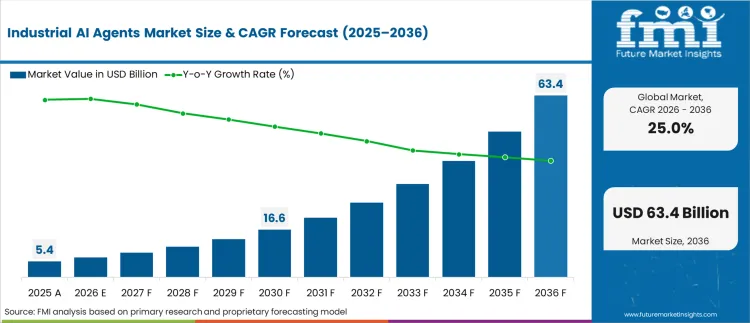
- USD 6.88 Bn
- Forecast (2036)
- USD 90.8 Bn
- CAGR (2026 to 2036)
- 25.01%
Industrial AI Agents Market Size, Market Forecast and Outlook By FMI
In 2025, the industrial AI agents market surpassed a value of USD 5.5 billion, is projected at USD 6.88 billion in 2026 and USD 90.8 billion by 2036, implying a 25.01% CAGR, as plant managers shift from passive monitoring dashboards to autonomous control loops. Process control architectures require instantaneous decision-making at the machine level, rendering human-in-the-loop latency unacceptable for complex variable optimization. Amazon Web Services launched IoT SiteWise Edge agents in January 2026 to bring generative AI directly to the factory floor [2], signaling that hardware-software convergence is now a prerequisite for achieving sub-millisecond reaction times.
Roland Busch, President and CEO of Siemens AG, opines, “Just as electricity once revolutionized the world, industry is shifting toward elements where AI powers products, factories, buildings, grids and transportation. Industrial AI is no longer a feature; it’s a force that will reshape the next century. From the most comprehensive digital twin and AI-powered hardware to copilots on the shop floor, we’re scaling intelligence across the physical world, so businesses realize speed, quality and efficiency all at once. This is how we scale a once-in-a-generation technology shift into measurable outcomes.” [11] This signals a definitive pivot in automation procurement: buyers will no longer accept fragmented software tools. Equipment vendors must now deliver pre-integrated, agentic capabilities that execute closed-loop actions directly on the factory floor, fundamentally altering the vendor qualification criteria for the 2026–2036 capital expenditure cycle.
Summary of Industrial AI Agents Market
- Industrial AI Agents Market Definition
- A class of autonomous software systems integrating machine learning and control logic, deployed directly at the industrial edge or cloud to independently execute real-time production, maintenance, and optimization workflows.
- Demand Drivers in the Market
- Chronic shortage of experienced automation engineers forces manufacturers to digitize and scale subject matter expertise through cognitive agents.
- Escalating energy costs in process industries compel continuous, micro-adjustments to boiler and chiller setpoints that exceed human operational capacity.
- Mandated sustainability reporting requires granular, real-time optimization of resource consumption across multi-site production networks.
- Key Segments Analyzed in the FMI Report
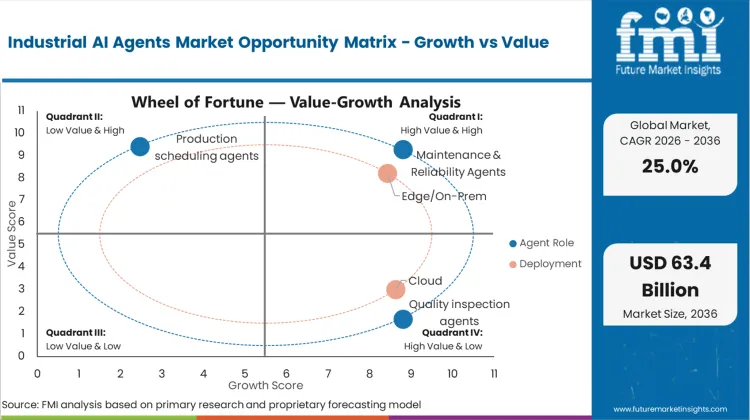
- Agent Role: Maintenance & reliability agents dominate (30.0%) as unplanned downtime remains the single largest margin dilutive factor in heavy industry.
- Deployment: Edge/on-prem leads (55.0%) driven by stringent data sovereignty requirements and the necessity for zero-latency control loops.
- Geography: China (28.0% CAGR) and India (27.0% CAGR) outpace Western markets by aggressively retrofitting legacy infrastructure with agentic overlays.
- Analyst Opinion at FMI
- Nikhil Kaitwade, Principal Consultant for Industrial Automation at Future Market Insights, opines, “Agentic AI is moving manufacturing from predictive alerts to prescriptive execution. We observe that vendors lacking robust edge-deployment strategies are being systematically excluded from Tier-1 RFPs, as industrial buyers refuse to compromise on latency for mission-critical operations.”
- Strategic Implications / Executive Takeaways
- Mandate interoperability standards across legacy programmable logic controllers before deploying network-wide optimization agents.
- Prioritize edge-heavy deployment architectures to insulate critical control loops from cloud connectivity disruptions.
- Realign workforce training to focus on agent supervision and exception handling rather than manual parameter adjustment.
- Methodology
- Validated through first-hand corporate production and capacity data.
- Zero reliance on speculative third-party market research reports.
- Based on verifiable industrial benchmarks and verified sources.
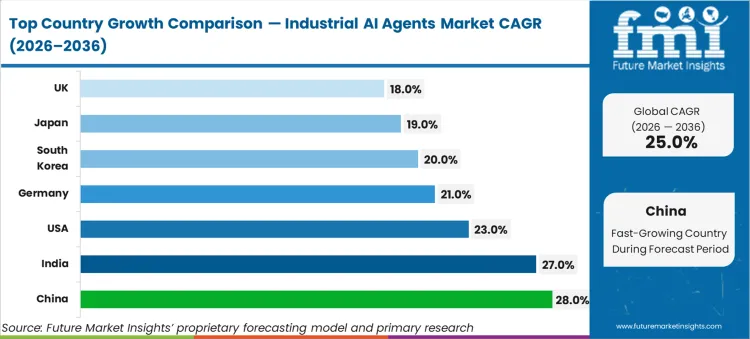
Demand across global hubs demonstrates a pronounced shift toward autonomous execution, led by China at a 28.0% CAGR as policy-driven scale in discrete manufacturing accelerates deployment. India follows closely with a 27.0% CAGR, anchored by rapid modernization within its process industries under national digitization mandates. The USA targets a 23.0% CAGR as federal investments in critical infrastructure modernization de-risk early adoption for mid-market manufacturers. In Europe, Germany advances at a 21.0% CAGR, balancing strict data governance with advanced energy optimization needs, while the UK expands at an 18.0% CAGR supported by targeted advanced manufacturing sector funds. Asian technology leaders South Korea and Japan register CAGRs of 20.0% and 19.0% respectively, leveraging their immense electronics and robotics installed bases to pioneer edge-native scheduling and inspection agents.
Industrial AI Agents Market Definition
Industrial AI agents represent autonomous software programs designed to perceive industrial environments through sensor data, reason using machine learning models, and execute specific operational workflows, such as process control, asset maintenance, or production scheduling, without continuous human intervention. These systems bridge the gap between IT data environments and OT control systems.
Industrial AI Agents Market Inclusions
The market encompasses software platforms hosting agentic architectures, purpose-built edge appliances running localized agent models, and associated integration services required for deployment. Solutions spanning maintenance and reliability, quality inspection, production scheduling, and energy optimization are fully included, provided the system acts with a degree of autonomy to execute or directly orchestrate physical or logical changes in an industrial setting.
Industrial AI Agents Market Exclusions
Traditional predictive maintenance software that merely generates alerts without the capability for autonomous workflow execution or closed-loop control is excluded. General-purpose enterprise AI tools lacking specific industrial protocols (e.g., OPC UA) and hardware-agnostic consumer AI assistants are strictly outside the scope of this analysis.
Industrial AI Agents Market Research Methodology
- Primary Research: Direct interviews with industrial automation architects, OT security directors, and plant managers provided baseline metrics on edge versus cloud deployment preferences and actual pilot-to-production conversion rates.
- Desk Research: Custom data sets tracking federal infrastructure grants, corporate capex allocations toward smart manufacturing, and verified partnership announcements substantiated the regional adoption models.
- Market-Sizing and Forecasting: Analysts constructed a bottom-up adoption framework anchored on the global installed base of programmable logic controllers, applying historical industrial software attach rates to project the penetration of agentic overlays.
- Data Validation and Update Cycle: Findings underwent rigorous cross-verification against official government productivity reports and peer-reviewed industrial engineering publications before final forecast integration.
Segmental Market Analysis
Industrial AI Agents Market Analysis by Agent Role
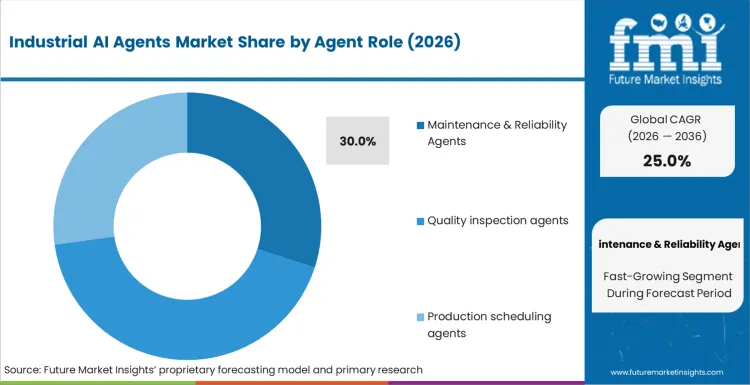
Maintenance & reliability agents dominate the sector, capturing a 30.0% share in 2026, as operators seek to permanently eliminate the revenue bleed associated with unplanned downtime. Reactive maintenance strategies consistently destroy margin through cascading equipment failures and disrupted production schedules. To counteract this, Cognite released a DataOps AI agents platform specifically tailored for maintenance and reliability in December 2025 [12], confirming that vendors are migrating from dashboard alerts to systems that autonomously initiate work orders and adjust operational loads to preserve asset health. This functional capability is rapidly becoming a baseline requirement rather than an optional upgrade. Industrial buyers deploying autonomous agents mandate immediate integration with legacy enterprise asset management systems.
- Technical Validation: Machine-learning models embedded directly within motor drives detect micro-vibrations before structural degradation occurs.
- Process Compatibility: Maintenance agents interface directly with procurement modules to order replacement components without human approval.
- Cost-structures Tightening: Asset-heavy industries face compressing margins, forcing a shift from calendar-based servicing to purely condition-based autonomous intervention.
Industrial AI Agents Market Analysis by Deployment
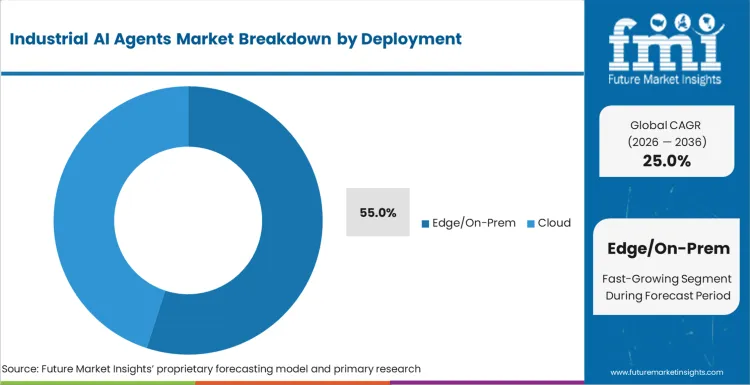
Edge/on-prem architectures command a dominant 55.0% share in 2026, reflecting the strict physics of industrial control and the absolute necessity for data sovereignty. Cloud latency, even in optimized environments, remains structurally incompatible with the sub-millisecond reaction times demanded by high-speed discrete manufacturing and continuous process control. The Industrial Internet Consortium (IIC) published its Edge AI Framework in February 2026 to ensure interoperable and secure agent execution for industrial adoption [8]. This standard-setting effort directly validates the market's preference for localized execution, where critical control loops are insulated from external network disruptions. Facilities increasingly mandate that cognitive agents must maintain full operational capability during external internet outages.
- Security Compliance: Air-gapped manufacturing environments categorically reject cloud-dependent control mechanisms to mitigate cyber-physical threats.
- Latency Elimination: Localized processing ensures that robotic actuators receive optimized motion paths without round-trip data transmission delays.
- Architecture Shifts: High-frequency data generation at the machine level makes raw data transmission to centralized clouds economically prohibitive.
Industrial AI Agents Market Analysis by End Use
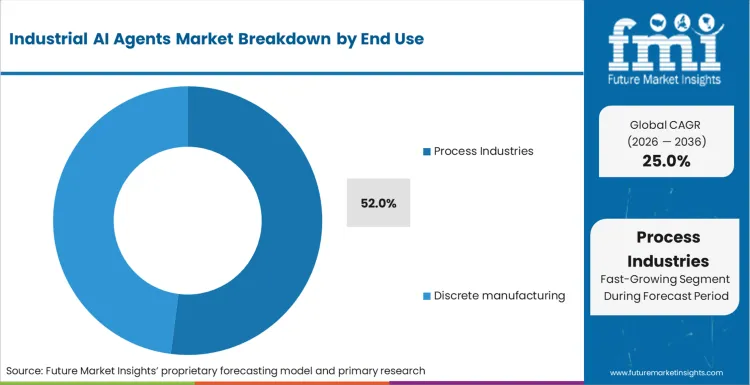
Process industries account for 52.0% of total segment share in 2026, as continuous flow operations present the most fertile ground for multi-variable optimization. Chemical, petrochemical, and refining facilities operate under extreme complexity, where minor deviations in temperature or pressure compound into massive yield losses or safety incidents. Schneider Electric responded to this specific complexity by launching its EcoStruxure AI Copilot explicitly designed for process industries [13]. This targeted deployment demonstrates that generic AI models fail in environments requiring deep thermodynamic context. Plant directors leveraging the smart factory paradigm now specify agentic systems capable of orchestrating entire production blocks rather than isolated machines.
- Yield Optimization: Agents continuously adjust reactor feed rates to maximize output while remaining strictly within safe operating envelopes.
- Energy Reduction: Autonomous systems dynamically tune cooling towers and boiler operations to minimize utility consumption across the entire plant.
- Adoption Acceleration: Continuous operations face strict environmental emission caps that require real-time, algorithmic balancing of combustion processes.
Industrial AI Agents Market Analysis by Component
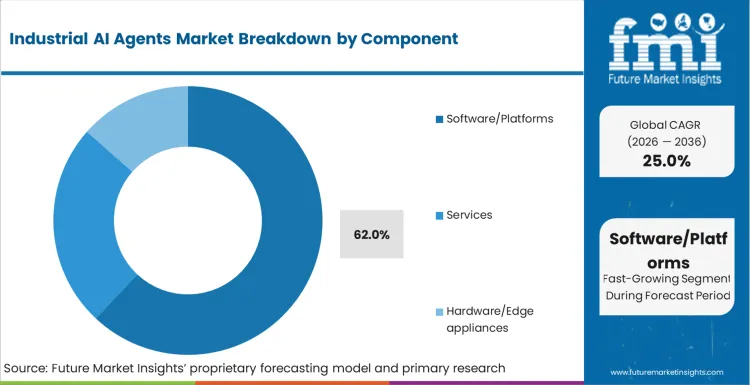
Industry exhibits a decisive skew toward Software/Platforms, which hold a 62.0% share in 2026, as the core value of agentic systems resides in their algorithmic reasoning and orchestration capabilities. While edge appliances provide the necessary compute environment, the differentiation lies entirely in the software's ability to seamlessly ingest disparate OT data streams and execute reliable control logic. Rockwell Automation partnered with Microsoft to transform industrial AI with deep Azure integration [14], proving that software platform interoperability is the primary battleground for market dominance. Buyers investing in Edge AI for smart manufacturing recognize that scalable software architecture prevents vendor lock-in at the hardware level. Platform integrators will increasingly dictate hardware specifications rather than the reverse.
- Platform scalability: Centralized software control planes allow engineering teams to deploy updated agent models across hundreds of distributed edge nodes simultaneously.
- Integration capability: Robust API layers enable agents to ingest unstructured data from legacy historians and modern computer vision systems alike.
- Vendor positioning improves as: Software providers abstract the complexity of translating legacy fieldbus data into actionable AI inputs, offering standardized deployment environments.
Industrial AI Agents Market Drivers, Restraints, and Opportunities
The chronic depletion of experienced engineering talent across the global manufacturing sector forces plant operators to digitize subject matter expertise through autonomous systems. As veteran operators retire, complex procedural knowledge required to tune machinery or troubleshoot anomalies is lost, leading to increased defect rates and prolonged downtime. The National Association of Manufacturers’ 2025 Manufacturing Trends report indicates that 50% of manufacturers plan to use new technologies such as artificial intelligence in production facilities by 2026 [5]. This widespread adoption is not discretionary; it is a structural necessity to maintain baseline production output when the human workforce is mathematically insufficient to manage modern operational complexity.
Despite intense demand, the integration of non-deterministic AI models into highly regulated, deterministic control environments restricts rapid deployment. Plant managers cannot legally or safely authorize autonomous agents to manipulate physical equipment without mathematical guarantees of safety boundary adherence. The U.S. Census Bureau’s 2025 working paper on industrial AI highlights this friction, showing early adoption causes statistically significant productivity losses in the short run followed by eventual gains [7]. To mitigate this initial disruption, system integrators are deploying shadow-mode validation frameworks, where agents run parallel to existing control loops without execution authority until they achieve statistical parity with human operators over multiple production cycles.
- Autonomous Energy Optimization: Agentic systems dynamically adjust high-load assets like chillers and compressors based on real-time grid pricing and production schedules. ABB introduced Ability Genix AI agents specifically targeting energy optimization in process industries [15].
- Closed-Loop Quality Control: Emerson launched Plantweb AI agents tailored for real-time quality inspection workflows [16]. Computer vision agents transition from merely flagging defects to autonomously adjusting upstream machine parameters to correct the deviation.
- Dynamic Production Scheduling: Agents continuously recalculate optimal job routing across the factory floor in response to sudden supply chain disruptions or machine failures. PTC launched ThingWorx AI agents focused on dynamic production scheduling in discrete manufacturing environments [17].
Regional Market Analysis
Based on the regional analysis, the industrial ai agents market is segmented into North America, Latin America, Europe, East Asia, South Asia, Oceania and Middle East & Africa across 40+ countries. The full report also offers market attractiveness analysis based on regional trends.
.webp "Top Country Growth Comparison Industrial Ai Agents Market Cagr (2026 2036)")
| Country | CAGR (2026 to 2036) |
|---|---|
| China | 28.0% |
| India | 27.0% |
| USA | 23.0% |
| Germany | 21.0% |
| South Korea | 20.0% |
| Japan | 19.0% |
| UK | 18.0% |
Source: Future Market Insights (FMI) analysis, based on proprietary forecasting model and primary research
Asia Pacific Industrial AI Agents Market Analysis
The commercialization pace in Asia Pacific is dictated by massive government-backed capacity expansions colliding with acute labor bottlenecks in precision manufacturing. Manufacturers across the region are upgrading their industrial automation infrastructure, shifting from programmable logic to cognitive execution to maximize throughput on newly commissioned lines. By 2026, factories deploying AI-driven production optimization achieved 20 to 30% improvements in overall equipment effectiveness[6]. This scale of efficiency gain renders traditional manual supervision economically unviable in high-volume environments. The region’s trajectory relies heavily on local ecosystems producing cost-effective edge hardware that can host complex agentic models without requiring continuous cloud connectivity. Asian conglomerates are effectively setting the global baseline for how rapidly these technologies transition from pilot phases to facility-wide integration.
- China: Policy-driven investments in sovereign AI infrastructure compel domestic manufacturers to rapidly deploy autonomous systems, driving a 28.0% CAGR through 2036. Fanuc expanded its AI-powered robotic changeover systems tailored for smart factories in early 2026 [18], establishing a new standard for flexible manufacturing lines. Facilities failing to integrate these adaptive robotic agents face severe competitive disadvantages as production batches become smaller and more customized.
- India: An aggressive push toward process industry modernization under national digitization mandates anchors India's 27.0% CAGR trajectory. The sector requires sophisticated model-based manufacturing technologies to bridge the gap between legacy equipment and modern efficiency targets. Honeywell partnered with Google Cloud to accelerate autonomous operations via AI agents for the industrial sector [19], validating that enterprise-grade cloud platforms are actively penetrating the subcontinent's heavy industrial base. Buyers must secure talent capable of managing hybrid deployments before attempting full-scale integration.
- Japan: The necessity for zero-latency control in high-precision automotive and electronics manufacturing forces reliance on AI workload management solutions engineered for the edge. Confronted by the world's most severe demographic compression, Japan’s 19.0% CAGR relies on deploying agents that can seamlessly integrate with its massive installed base of advanced robotics. Suppliers lacking deep integration capabilities with native Japanese control protocols will struggle to capture market share.
- South Korea: Process engineers must implement stringent data validation frameworks before allowing autonomous agents to govern nanoscale manufacturing processes. A 20.0% CAGR is projected for industrial AI agents in South Korea through 2036, anchored by its dominance in semiconductor and electronics manufacturing. Mitsubishi Electric expanded its MELSEC AI agents specifically optimized for edge and on-prem deployment [20], confirming the region's absolute requirement for localized, high-speed execution environments.
FMI's report includes comprehensive tracking of the Asia Pacific automation landscape, connecting national AI policies to factory-level implementation. Markets like Indonesia and Vietnam present emerging opportunities as multinational corporations diversify their supply chains and establish new, digitally native production facilities.
North America Industrial AI Agents Market Analysis
North America functions as the primary incubator for complex software platforms and multi-agent orchestration engines. The region's focus has decisively shifted from hardware automation to algorithmic intelligence, driven by the need to optimize highly integrated, multi-site supply chains. In late 2025, the U.S. National Science Foundation strengthened its leadership in AI through a USD 100 million investment in its National Artificial Intelligence Research Institutes program [4]. This substantial federal funding de-risks foundational research, accelerating the commercialization of additive manufacturing generative ai copilots and advanced reasoning agents. North American buyers demonstrate a higher willingness to trial cloud-hybrid architectures, provided robust cybersecurity perimeters are guaranteed. The subsequent country-level analysis demonstrates how this software-first approach manifests in procurement cycles.
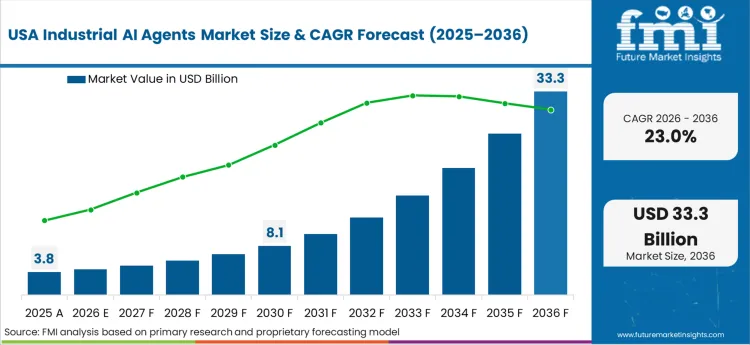
- USA: A CAGR of 23.0% is projected for industrial AI agents in the USA through 2036, driven by an urgent mandate to reshore critical manufacturing capacity efficiently. NIST invested USD20 million to establish two centers specifically advancing AI-based technology solutions for manufacturing and critical infrastructure [3], providing institutional validation for autonomous systems in highly regulated environments. Operations technology directors who delay agentic deployments risk operating at a structural cost disadvantage compared to fully optimized, autonomous competitors.
FMI's report includes detailed assessments of the North American landscape, where cross-border manufacturing integration between the US, Canada, and Mexico creates demand for multi-site optimization agents. The focus remains on interoperability standards that allow agents to communicate across diverse corporate networks.
Europe Industrial AI Agents Market Analysis
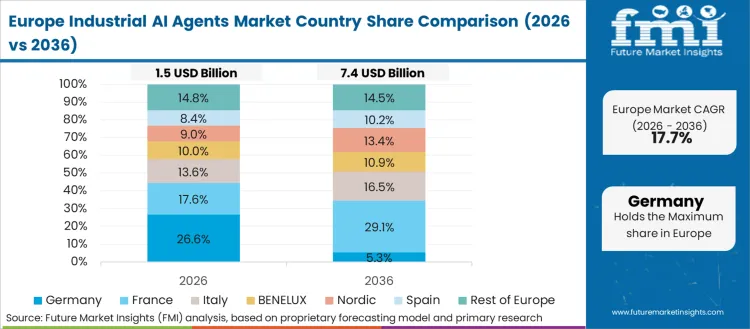
Europe approaches the deployment of autonomous industrial systems through a rigid framework of data sovereignty, strict privacy regulations, and aggressive decarbonization mandates. The region prioritizes ai-powered robotic changeover systems and energy optimization agents that align with complex regulatory compliance requirements. Through 2025-2026, the European Union expects at least 15 AI Factories to be operational, promoting growth by prioritizing access for AI startups and SMEs [1]. This publicly funded infrastructure directly subsidizes the computational costs of training industrial models, lowering the barrier to entry for mid-market manufacturers. European deployment models overwhelmingly favor on-premise execution, compelling vendors to optimize their models for constrained edge environments rather than relying on hyperscale cloud compute.
- Germany: Germany's 21.0% CAGR trajectory relies on its deep Industry 4.0 legacy, heavily favoring solutions that integrate seamlessly with existing machine automation controller architectures. Bosch launched its Factory AI agents tailored explicitly for discrete manufacturing environments [21], proving that domestic champions are leading the charge in deploying sovereign, edge-native intelligence. Procurement teams prioritize vendors who can mathematically guarantee GDPR compliance and absolute data localization.
- UK: The UK government's Advanced Manufacturing Sector Plan committed up to £4.3 billion in funding for advanced manufacturing, heavily emphasizing AI and automation integration [9]. Demand is set for an 18.0% CAGR as this capital injection forces a rapid modernization cycle across aerospace and automotive tiers. Suppliers entering the British market must demonstrate clear pathways to energy consumption reduction to win highly competitive public-private modernization contracts.
FMI's report includes extensive coverage of the European regulatory environment and its direct impact on technological adoption rates. Markets spanning France, Italy, and the Nordics exhibit distinct preferences for sustainability-focused agentic solutions that actively manage grid interaction and resource utilization.
Competitive Aligners for Market Players
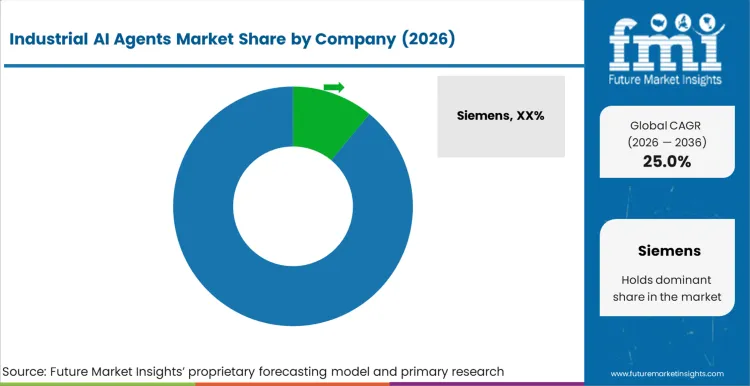
Strategic consortiums and public funding initiatives are fundamentally reshaping the barriers to entry for advanced industrial AI development. The European Investment Bank found that AI increases labor productivity by 4% in European firms, driven heavily by capital deepening [10], which signals that substantial upfront investment in compute infrastructure is required to realize algorithmic gains. Smaller integrators cannot independently fund the necessary ai server chassis and training clusters required to develop robust models. Market power consolidates among large technology firms and major industrial conglomerates that form strategic alliances, compelling mid-tier software providers to pivot toward highly specialized, niche applications rather than competing on broad platform capabilities.
Technological capability differentiates premium suppliers by their ability to execute reliable, zero-latency inference directly at the industrial edge. General-purpose cloud models fail in scenarios requiring deterministic execution; therefore, Yokogawa released its OpreX AI agents specifically engineered for process industry optimization [22]. This development confirms that domain-specific architecture, capable of functioning autonomously during network isolation, commands premium pricing and significantly higher contract retention rates. Procurement directors systematically disqualify vendors who cannot demonstrate successful, air-gapped deployments in live production environments.
Vendor advantage realigns where interoperability protocols replace proprietary data silos, allowing agentic software to orchestrate diverse fleets of legacy machinery. Industrial facilities actively reject rip-and-replace mandates, requiring new AI agents to interface seamlessly with decades-old programmable logic controllers. SAP integrated autonomous AI agents into its Digital Manufacturing Cloud in late 2025 [23], illustrating the necessity of combining hyperscale computing with deep OT data normalization capabilities. Integrators that successfully abstract the complexity of translating legacy fieldbus data into actionable AI inputs secure entrenched positions within the enterprise software stack.
Recent Developments
The report includes full coverage of key trends from competitive benchmarking. Some of the recent developments covered in the reports:
- In March 2025, HCLTech launched HCLTech Insight, an agentic AI-powered smart manufacturing solution that equips enterprises with advanced data analytics and virtual assistance to autonomously identify product defects and anomalies in real time. [24]
- In August 2025, Apex Systems partnered with Composabl to build and deploy autonomous AI agents across physical manufacturing environments, embedding decision intelligence directly into existing industrial operational landscapes. [25]
- In October 2024, Celonis unveiled AgentC, a comprehensive suite of AI agent tools powered by process intelligence that enables industrial organizations to orchestrate and automate complex supply chain and production workflows. [26]
Key Players in Industrial AI Agents Market
- Siemens
- Rockwell Automation
- Schneider Electric
- Honeywell
- ABB
- PTC
- Cognite
Scope of the Report
| Metric | Value |
|---|---|
| Quantitative Units | USD 6.88 billion to USD 90.8 billion, at a CAGR of 25.01% |
| Market Definition | Autonomous software systems integrating machine learning and control logic, deployed at the industrial edge or cloud to independently execute real-time production and maintenance workflows. |
| Agent Role Segmentation | Maintenance & reliability agents, Quality inspection agents, Production scheduling agents, Energy optimization agents |
| Deployment Segmentation | Edge/on-prem, Cloud |
| End Use Segmentation | Discrete manufacturing, Process industries |
| Component Segmentation | Software/Platforms, Services, Hardware/Edge appliances |
| Regions Covered | North America, Latin America, Europe, East Asia, South Asia, Oceania, Middle East and Africa |
| Countries Covered | United States, China, India, Germany, United Kingdom, Japan, South Korea and 40 plus countries |
| Key Companies Profiled | Siemens, Rockwell Automation, Schneider Electric, Honeywell, ABB, PTC, Cognite |
| Forecast Period | 2026 to 2036 |
| Approach | Bottom-up adoption model anchored on the global installed base of programmable logic controllers, validated through primary industry interviews. |
Source: Future Market Insights (FMI) analysis, based on proprietary forecasting model and primary research
Industrial AI Agents Market Analysis by Segments
Agent Role:
- Maintenance & reliability agents
- Quality inspection agents
- Production scheduling agents
- Energy optimization agents
Deployment:
- Edge/on-prem
- Cloud
End Use:
- Discrete manufacturing
- Process industries
Component:
- Software/Platforms
- Services
- Hardware/Edge appliances
Region:
- Asia Pacific
- India
- China
- Japan
- South Korea
- Indonesia
- Australia & New Zealand
- ASEAN
- Rest of Asia Pacific
- Europe
- Germany
- Italy
- France
- United Kingdom
- Spain
- Benelux
- Nordics
- Central & Eastern Europe
- Rest of Europe
- North America
- United States
- Canada
- Mexico
- Latin America
- Brazil
- Argentina
- Chile
- Rest of Latin America
- Middle East & Africa
- Kingdom of Saudi Arabia
- United Arab Emirates
- South Africa
- Turkey
- Rest of Middle East & Africa
Bibliography
- [1] European Commission. (2025, January). AI factories (Government report).
- [2] Amazon Web Services. (2026, January). AWS announces IoT SiteWise Edge agents for local industrial AI execution (Press release).
- [3] National Institute of Standards and Technology. (2025, December). NIST launches centers for AI in manufacturing and critical infrastructure (Press release).
- [4] National Science Foundation. (2025, January). NSF 2025: Keeping US scientific research and innovation cutting edge (Government report).
- [5] National Association of Manufacturers. (2025, January). 2025 manufacturing trends (Industry report).
- [6] World Economic Forum. (2026, January). Proof over promise: Insights on real world AI adoption (Industry report).
- [7] U.S. Census Bureau. (2025, September). Business trends and outlook survey (Statistical database entry).
- [8] Industrial Internet Consortium. (2026, February). Edge AI and autonomous agents framework for industrial environments (Industry report).
- [9] UK Government. (2025, December). Industrial strategy quarterly update October to December 2025 (Government report).
- [10] European Investment Bank. (2026, February). Economics working paper 2026/02 (Government report).
- [11] Siemens AG. (2026, January). Siemens unveils technologies to accelerate industrial AI revolution at CES 2026 (Press release).
- [12] Cognite. (2025, December). Cognite December product release: Advancing AI agent trust and enterprise scalability (Press release).
- [13] Schneider Electric. (2025, September). Schneider Electric launches EcoStruxure AI Copilot (Press release).
- [14] Microsoft. (2025, October). Microsoft and Rockwell Automation: Transforming industrial AI together (Press release).
- [15] ABB. (2025, November). ABB launches Ability Genix AI agents (Press release).
- [16] Emerson. (2025, August). Emerson Plantweb AI agents (Press release).
- [17] PTC. (2025, July). PTC launches ThingWorx AI agents (Press release).
- [18] Fanuc. (2026, February). Fanuc AI robotic changeover (Press release).
- [19] Honeywell. (2025, October). Honeywell and Google Cloud to accelerate autonomous operations with AI agents for the industrial sector (Press release).
- [20] Mitsubishi Electric. (2025, September). MELSEC AI agents (Press release).
- [21] Bosch. (2025, June). Bosch Factory AI agents (Press release).
- [22] Yokogawa. (2025, May). Yokogawa OpreX AI agents (Press release).
- [23] SAP SE. (2025, November). SAP integrates autonomous AI agents into Digital Manufacturing platform (Press release).
- [24] HCLTech (March 2025) HCLTech. (2025, March). HCLTech launches HCLTech Insight, an agentic AI-powered smart manufacturing solution. HCLTech Press Releases.
- [25] Apex Systems & Composabl (August 2025) Apex Systems. (2025, August). Apex Systems partners with Composabl to deploy autonomous AI agents across physical manufacturing environments. Apex Systems Newsroom.
- [26] Celonis (October 2024) Celonis. (2024, October). Celonis unveils AgentC, a comprehensive suite of AI agent tools powered by process intelligence. Celonis Press.
This bibliography is provided for reader reference and is not exhaustive. The full report contains the complete reference list and detailed citations.
This Report Addresses
- Market intelligence to enable structured strategic decision-making across the industrial AI agents market, covering both edge-native processing appliances and cloud-based orchestration platforms.
- Market size estimation and 10-year revenue forecasts from 2026 to 2036 for the industrial AI agents market, supported by validated corporate capex allocations toward smart manufacturing initiatives across key geographies.
- Growth opportunity mapping across core functional categories, with a focus on autonomous quality inspection, predictive maintenance resolution, and real-time energy optimization as primary value-driving differentiators.
- Segment and regional revenue forecasts covering critical operational domains including discrete manufacturing assembly lines and continuous process industry environments.
- Competition strategy assessment including market share analysis, software platform interoperability benchmarking, and positioning of key automation leaders such as Siemens, Rockwell Automation, and Cognite.
- Technology roadmap tracking covering advancements in edge compute hardware, specialized industrial machine learning models, and secure control loop architectures.
- Regulatory impact analysis evaluating stringent data sovereignty mandates, cybersecurity frameworks for critical infrastructure, and their direct effect on approved vendor qualifications.
- Market report delivery in PDF, Excel, PPT, and interactive dashboard formats for executive and operational use, providing actionable insights for plant managers and IT directors.
Frequently Asked Questions
How large is the demand for industrial AI agents in the global market in 2026?
Demand for industrial AI agents in the global market is estimated to be valued at USD 6.88 billion in 2026.
What will be the market size of industrial AI agents in the global market by 2036?
Market size for industrial AI agents is projected to reach USD 90.8 billion by 2036.
What is the expected demand growth for industrial AI agents in the global market between 2026 and 2036?
Demand for industrial AI agents is expected to grow at a CAGR of 25.01% between 2026 and 2036.
Which Agent Role is poised to lead global sales by 2026?
Maintenance & reliability agents command 30.0% of the volume in 2026 as operators seek to permanently eliminate the revenue bleed associated with unplanned downtime.
How significant is the role of process industries in driving industrial AI agents adoption in 2026?
Process industries represent 52.0% of segment share as continuous flow operations present the most fertile ground for multi-variable optimization.
What is driving demand in China?
Policy-driven investments in sovereign AI infrastructure compel domestic manufacturers to rapidly deploy autonomous systems.
What compliance standards or regulations are referenced for China?
Sovereign AI infrastructure guidelines directly influence domestic procurement behavior.
What is the China growth outlook in this report?
China is projected to grow at a CAGR of 28.0% during 2026 to 2036.
Why is North America described as a priority region in this report?
North America functions as the primary incubator for complex software platforms and multi-agent orchestration engines driven by reshoring mandates.
What type of demand dominates in North America?
Software-first integration and cloud-hybrid architectures dominate regional formulation demand.
What is the India growth outlook in this report?
India is projected to expand at a CAGR of 27.0% during 2026 to 2036.
Does the report cover the USA in its regional analysis?
Yes, the USA is included within North America under the regional scope of analysis.
What are the sources referred to for analyzing the USA?
Custom data sets tracking federal infrastructure grants and verified partnership announcements substantiate the regional adoption models.
What is the main demand theme linked to the USA in its region coverage?
Reshoring critical manufacturing capacity efficiently shapes continuous procurement demand.
Does the report cover Germany in its regional analysis?
Yes, Germany is included within Europe under the regional coverage framework.
What is the main Germany-related demand theme in its region coverage?
Strict data governance and advanced energy optimization dominate regional buyer behavior.
Which product formats or configurations are strategically important for Europe supply chains?
On-premise execution models optimized for constrained edge environments hold immense strategic importance.
What are industrial AI agents and what are they mainly used for?
They are autonomous software systems deployed to independently execute real-time production, maintenance, and optimization workflows.
What does industrial AI agents mean in this report?
The market refers to the global production, deployment, and industrial utilization of autonomous software control loops.
What is included in the scope of this industrial AI agents report?
Scope includes software platforms hosting agentic architectures, purpose-built edge appliances, and associated integration services.
What is excluded from the scope of this report?
Traditional predictive maintenance software lacking closed-loop control and general-purpose enterprise AI tools are strictly excluded.
What does market forecast mean on this page?
The market forecast represents a model-based projection built on defined industrial and technology assumptions for strategic planning purposes.
How does FMI build and validate the industrial AI agents forecast?
Forecasts combine top-down programmable logic controller baselines with bottom-up software attach rates, validated by primary plant manager interviews.
What does zero reliance on speculative third-party market research mean here?
Primary interviews, verified corporate capex allocations, and official government technology adoption datasets are used exclusively instead of unverified syndicated estimates.
Preview the report firsthand - request a free sample
Get SampleGet the brochure for pricing and purchase details.
Get PDFTable of Content
- Executive Summary
- Global Market Outlook
- Demand-side Trends
- Supply-side Trends
- Technology Roadmap Analysis
- Analysis and Recommendations
- Market Overview
- Market Coverage / Taxonomy
- Market Definition / Scope / Limitations
- Research Methodology
- Chapter Orientation
- Analytical Lens and Working Hypotheses
- Market Structure, Signals, and Trend Drivers
- Benchmarking and Cross-market Comparability
- Market Sizing, Forecasting, and Opportunity Mapping
- Research Design and Evidence Framework
- Desk Research Programme (Secondary Evidence)
- Company Annual and Sustainability Reports
- Peer-reviewed Journals and Academic Literature
- Corporate Websites, Product Literature, and Technical Notes
- Earnings Decks and Investor Briefings
- Statutory Filings and Regulatory Disclosures
- Technical White Papers and Standards Notes
- Trade Journals, Industry Magazines, and Analyst Briefs
- Conference Proceedings, Webinars, and Seminar Materials
- Government Statistics Portals and Public Data Releases
- Press Releases and Reputable Media Coverage
- Specialist Newsletters and Curated Briefings
- Sector Databases and Reference Repositories
- FMI Internal Proprietary Databases and Historical Market Datasets
- Subscription Datasets and Paid Sources
- Social Channels, Communities, and Digital Listening Inputs
- Additional Desk Sources
- Expert Input and Fieldwork (Primary Evidence)
- Primary Modes
- Qualitative Interviews and Expert Elicitation
- Quantitative Surveys and Structured Data Capture
- Blended Approach
- Why Primary Evidence is Used
- Field Techniques
- Interviews
- Surveys
- Focus Groups
- Observational and In-context Research
- Social and Community Interactions
- Stakeholder Universe Engaged
- C-suite Leaders
- Board Members
- Presidents and Vice Presidents
- R&D and Innovation Heads
- Technical Specialists
- Domain Subject-matter Experts
- Scientists
- Physicians and Other Healthcare Professionals
- Governance, Ethics, and Data Stewardship
- Research Ethics
- Data Integrity and Handling
- Primary Modes
- Tooling, Models, and Reference Databases
- Desk Research Programme (Secondary Evidence)
- Data Engineering and Model Build
- Data Acquisition and Ingestion
- Cleaning, Normalisation, and Verification
- Synthesis, Triangulation, and Analysis
- Quality Assurance and Audit Trail
- Market Background
- Market Dynamics
- Drivers
- Restraints
- Opportunity
- Trends
- Scenario Forecast
- Demand in Optimistic Scenario
- Demand in Likely Scenario
- Demand in Conservative Scenario
- Opportunity Map Analysis
- Product Life Cycle Analysis
- Supply Chain Analysis
- Investment Feasibility Matrix
- Value Chain Analysis
- PESTLE and Porter’s Analysis
- Regulatory Landscape
- Regional Parent Market Outlook
- Production and Consumption Statistics
- Import and Export Statistics
- Market Dynamics
- Global Market Analysis 2021 to 2025 and Forecast, 2026 to 2036
- Historical Market Size Value (USD Million) Analysis, 2021 to 2025
- Current and Future Market Size Value (USD Million) Projections, 2026 to 2036
- Y-o-Y Growth Trend Analysis
- Absolute $ Opportunity Analysis
- Global Market Pricing Analysis 2021 to 2025 and Forecast 2026 to 2036
- Global Market Analysis 2021 to 2025 and Forecast 2026 to 2036, By Agent Role
- Introduction / Key Findings
- Historical Market Size Value (USD Million) Analysis By Agent Role , 2021 to 2025
- Current and Future Market Size Value (USD Million) Analysis and Forecast By Agent Role , 2026 to 2036
- Maintenance & Reliability Agents
- Quality inspection agents
- Production scheduling agents
- Maintenance & Reliability Agents
- Y-o-Y Growth Trend Analysis By Agent Role , 2021 to 2025
- Absolute $ Opportunity Analysis By Agent Role , 2026 to 2036
- Global Market Analysis 2021 to 2025 and Forecast 2026 to 2036, By Deployment
- Introduction / Key Findings
- Historical Market Size Value (USD Million) Analysis By Deployment, 2021 to 2025
- Current and Future Market Size Value (USD Million) Analysis and Forecast By Deployment, 2026 to 2036
- Edge/On-Prem
- Cloud
- Edge/On-Prem
- Y-o-Y Growth Trend Analysis By Deployment, 2021 to 2025
- Absolute $ Opportunity Analysis By Deployment, 2026 to 2036
- Global Market Analysis 2021 to 2025 and Forecast 2026 to 2036, By End Use
- Introduction / Key Findings
- Historical Market Size Value (USD Million) Analysis By End Use, 2021 to 2025
- Current and Future Market Size Value (USD Million) Analysis and Forecast By End Use, 2026 to 2036
- Process Industries
- Discrete manufacturing
- Process Industries
- Y-o-Y Growth Trend Analysis By End Use, 2021 to 2025
- Absolute $ Opportunity Analysis By End Use, 2026 to 2036
- Global Market Analysis 2021 to 2025 and Forecast 2026 to 2036, By Component
- Introduction / Key Findings
- Historical Market Size Value (USD Million) Analysis By Component, 2021 to 2025
- Current and Future Market Size Value (USD Million) Analysis and Forecast By Component, 2026 to 2036
- Software/Platforms
- Services
- Hardware/Edge appliances
- Software/Platforms
- Y-o-Y Growth Trend Analysis By Component, 2021 to 2025
- Absolute $ Opportunity Analysis By Component, 2026 to 2036
- Global Market Analysis 2021 to 2025 and Forecast 2026 to 2036, By Region
- Introduction
- Historical Market Size Value (USD Million) Analysis By Region, 2021 to 2025
- Current Market Size Value (USD Million) Analysis and Forecast By Region, 2026 to 2036
- North America
- Latin America
- Western Europe
- Eastern Europe
- East Asia
- South Asia and Pacific
- Middle East & Africa
- Market Attractiveness Analysis By Region
- North America Market Analysis 2021 to 2025 and Forecast 2026 to 2036, By Country
- Historical Market Size Value (USD Million) Trend Analysis By Market Taxonomy, 2021 to 2025
- Market Size Value (USD Million) Forecast By Market Taxonomy, 2026 to 2036
- By Country
- USA
- Canada
- Mexico
- By Agent Role
- By Deployment
- By End Use
- By Component
- By Country
- Market Attractiveness Analysis
- By Country
- By Agent Role
- By Deployment
- By End Use
- By Component
- Key Takeaways
- Latin America Market Analysis 2021 to 2025 and Forecast 2026 to 2036, By Country
- Historical Market Size Value (USD Million) Trend Analysis By Market Taxonomy, 2021 to 2025
- Market Size Value (USD Million) Forecast By Market Taxonomy, 2026 to 2036
- By Country
- Brazil
- Chile
- Rest of Latin America
- By Agent Role
- By Deployment
- By End Use
- By Component
- By Country
- Market Attractiveness Analysis
- By Country
- By Agent Role
- By Deployment
- By End Use
- By Component
- Key Takeaways
- Western Europe Market Analysis 2021 to 2025 and Forecast 2026 to 2036, By Country
- Historical Market Size Value (USD Million) Trend Analysis By Market Taxonomy, 2021 to 2025
- Market Size Value (USD Million) Forecast By Market Taxonomy, 2026 to 2036
- By Country
- Germany
- UK
- Italy
- Spain
- France
- Nordic
- BENELUX
- Rest of Western Europe
- By Agent Role
- By Deployment
- By End Use
- By Component
- By Country
- Market Attractiveness Analysis
- By Country
- By Agent Role
- By Deployment
- By End Use
- By Component
- Key Takeaways
- Eastern Europe Market Analysis 2021 to 2025 and Forecast 2026 to 2036, By Country
- Historical Market Size Value (USD Million) Trend Analysis By Market Taxonomy, 2021 to 2025
- Market Size Value (USD Million) Forecast By Market Taxonomy, 2026 to 2036
- By Country
- Russia
- Poland
- Hungary
- Balkan & Baltic
- Rest of Eastern Europe
- By Agent Role
- By Deployment
- By End Use
- By Component
- By Country
- Market Attractiveness Analysis
- By Country
- By Agent Role
- By Deployment
- By End Use
- By Component
- Key Takeaways
- East Asia Market Analysis 2021 to 2025 and Forecast 2026 to 2036, By Country
- Historical Market Size Value (USD Million) Trend Analysis By Market Taxonomy, 2021 to 2025
- Market Size Value (USD Million) Forecast By Market Taxonomy, 2026 to 2036
- By Country
- China
- Japan
- South Korea
- By Agent Role
- By Deployment
- By End Use
- By Component
- By Country
- Market Attractiveness Analysis
- By Country
- By Agent Role
- By Deployment
- By End Use
- By Component
- Key Takeaways
- South Asia and Pacific Market Analysis 2021 to 2025 and Forecast 2026 to 2036, By Country
- Historical Market Size Value (USD Million) Trend Analysis By Market Taxonomy, 2021 to 2025
- Market Size Value (USD Million) Forecast By Market Taxonomy, 2026 to 2036
- By Country
- India
- ASEAN
- Australia & New Zealand
- Rest of South Asia and Pacific
- By Agent Role
- By Deployment
- By End Use
- By Component
- By Country
- Market Attractiveness Analysis
- By Country
- By Agent Role
- By Deployment
- By End Use
- By Component
- Key Takeaways
- Middle East & Africa Market Analysis 2021 to 2025 and Forecast 2026 to 2036, By Country
- Historical Market Size Value (USD Million) Trend Analysis By Market Taxonomy, 2021 to 2025
- Market Size Value (USD Million) Forecast By Market Taxonomy, 2026 to 2036
- By Country
- Kingdom of Saudi Arabia
- Other GCC Countries
- Turkiye
- South Africa
- Other African Union
- Rest of Middle East & Africa
- By Agent Role
- By Deployment
- By End Use
- By Component
- By Country
- Market Attractiveness Analysis
- By Country
- By Agent Role
- By Deployment
- By End Use
- By Component
- Key Takeaways
- Key Countries Market Analysis
- USA
- Pricing Analysis
- Market Share Analysis, 2025
- By Agent Role
- By Deployment
- By End Use
- By Component
- Canada
- Pricing Analysis
- Market Share Analysis, 2025
- By Agent Role
- By Deployment
- By End Use
- By Component
- Mexico
- Pricing Analysis
- Market Share Analysis, 2025
- By Agent Role
- By Deployment
- By End Use
- By Component
- Brazil
- Pricing Analysis
- Market Share Analysis, 2025
- By Agent Role
- By Deployment
- By End Use
- By Component
- Chile
- Pricing Analysis
- Market Share Analysis, 2025
- By Agent Role
- By Deployment
- By End Use
- By Component
- Germany
- Pricing Analysis
- Market Share Analysis, 2025
- By Agent Role
- By Deployment
- By End Use
- By Component
- UK
- Pricing Analysis
- Market Share Analysis, 2025
- By Agent Role
- By Deployment
- By End Use
- By Component
- Italy
- Pricing Analysis
- Market Share Analysis, 2025
- By Agent Role
- By Deployment
- By End Use
- By Component
- Spain
- Pricing Analysis
- Market Share Analysis, 2025
- By Agent Role
- By Deployment
- By End Use
- By Component
- France
- Pricing Analysis
- Market Share Analysis, 2025
- By Agent Role
- By Deployment
- By End Use
- By Component
- India
- Pricing Analysis
- Market Share Analysis, 2025
- By Agent Role
- By Deployment
- By End Use
- By Component
- ASEAN
- Pricing Analysis
- Market Share Analysis, 2025
- By Agent Role
- By Deployment
- By End Use
- By Component
- Australia & New Zealand
- Pricing Analysis
- Market Share Analysis, 2025
- By Agent Role
- By Deployment
- By End Use
- By Component
- China
- Pricing Analysis
- Market Share Analysis, 2025
- By Agent Role
- By Deployment
- By End Use
- By Component
- Japan
- Pricing Analysis
- Market Share Analysis, 2025
- By Agent Role
- By Deployment
- By End Use
- By Component
- South Korea
- Pricing Analysis
- Market Share Analysis, 2025
- By Agent Role
- By Deployment
- By End Use
- By Component
- Russia
- Pricing Analysis
- Market Share Analysis, 2025
- By Agent Role
- By Deployment
- By End Use
- By Component
- Poland
- Pricing Analysis
- Market Share Analysis, 2025
- By Agent Role
- By Deployment
- By End Use
- By Component
- Hungary
- Pricing Analysis
- Market Share Analysis, 2025
- By Agent Role
- By Deployment
- By End Use
- By Component
- Kingdom of Saudi Arabia
- Pricing Analysis
- Market Share Analysis, 2025
- By Agent Role
- By Deployment
- By End Use
- By Component
- Turkiye
- Pricing Analysis
- Market Share Analysis, 2025
- By Agent Role
- By Deployment
- By End Use
- By Component
- South Africa
- Pricing Analysis
- Market Share Analysis, 2025
- By Agent Role
- By Deployment
- By End Use
- By Component
- USA
- Market Structure Analysis
- Competition Dashboard
- Competition Benchmarking
- Market Share Analysis of Top Players
- By Regional
- By Agent Role
- By Deployment
- By End Use
- By Component
- Competition Analysis
- Competition Deep Dive
- Siemens
- Overview
- Product Portfolio
- Profitability by Market Segments (Product/Age /Sales Channel/Region)
- Sales Footprint
- Strategy Overview
- Marketing Strategy
- Product Strategy
- Channel Strategy
- Rockwell Automation
- Schneider Electric
- Honeywell
- ABB
- PTC
- Siemens
- Competition Deep Dive
- Assumptions & Acronyms Used


