

- Industry Size (2026)
- USD 55.38 Bn
- Forecast (2036)
- USD 567.4 Bn
- CAGR (2026 to 2036)
- 26.20%
Proactive Maintenance Agents Market Size, Market Forecast and Outlook By FMI
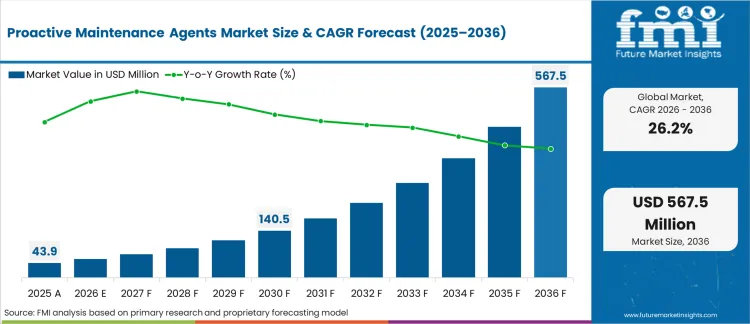
In 2025, the proactive maintenance agents market recorded a value of USD 43.88 billion. Projections place it at USD 55.38 billion in 2026 and USD 567.4 billion by 2036, indicating a robust CAGR of 26.20%. Industry growth is underpinned by widespread adoption of “reliability‑first” modernization initiatives across power, refining, and discrete manufacturing. Operator shortages and escalating downtime costs force plant managers to substitute manual inspection with agentic AI models that diagnose anomalies autonomously. Regulatory audits and safety compliance mandates trigger rapid deployment of condition monitoring system arrays.
Capital allocation decisions are already reshaping vendor qualification timelines. Honeywell and TotalEnergies announced a collaboration to pilot the AI-assisted Experion Operations Assistant at the Port Arthur Refinery in November 2025 [1], signaling that agentic maintenance infrastructure has crossed from optional to contractually mandated, compressing the window for operators to upgrade before the next procurement cycle opens. Buyers who do not hold approved autonomous vendor lists cannot meet category commitments without exposing themselves to severe operational basis-risk.
Jim Masso, President and CEO of Honeywell Process Solutions, opined, "Honeywell's decades of domain expertise and industry knowledge are helping to solve our customers' toughest challenges with tangible solutions like Experion Operations Assistant. This pilot with TotalEnergies will mark a meaningful milestone for bridging the gap between autonomous technology and the operators that keep these facilities running safely and efficiently every day." [2] Facilities lacking certified predictive maintenance traceability are already being removed from Tier-1 approved vendor lists ahead of upcoming safety enforcement cycles. This commitment resets buyer expectations for autonomous capabilities, establishing AI-driven monitoring as the baseline entry requirement rather than a differentiating feature for continuous process industries.
Summary of Proactive Maintenance Agents Market
- Proactive Maintenance Agents Market Definition
- A specialized software and service ecosystem utilizing artificial intelligence, machine learning, and sensor telemetry to autonomously predict, diagnose, and prescribe maintenance actions for industrial assets before failure occurs.
- Demand Drivers in the Market
- Escalating financial penalties for unplanned downtime force continuous asset monitoring.
- Aging industrial infrastructure combined with workforce skill gaps accelerates the transition toward automated diagnostic copilots.
- Stricter safety and environmental compliance mandates require verifiable, data-backed maintenance audit trails.
- Key Segments Analyzed in the FMI Report
- Solutions/Software: 58% share driven by integration demands across legacy enterprise asset management platforms.
- Cloud: 52% share as distributed edge-to-cloud architectures enable real-time processing of massive sensor datasets.
- Asia-Pacific: High-growth scaling across electronics and automotive manufacturing hubs prioritizes near-real-time anomaly detection.
- Analyst Opinion at FMI
- Nikhil Kaitwade, Principal Consultant for Process Automation, opines, “Procurement organizations are moving beyond transactional software purchases and are now architecting for total system autonomy. Forward‑leaning operators recognize that only fully integrated predictive‑maintenance ecosystems can insulate them from the operational and financial shocks that continue to penalize facilities dependent on reactive, manual inspection models.”
- Strategic Implications / Executive Takeaways
- Mandate unified data architectures to ensure interoperability between legacy OT sensors and agentic AI platforms.
- Prioritize pilot programs in high-criticality asset clusters to validate return on investment before enterprise-wide scaling.
- Shift procurement criteria to heavily weigh cybersecurity and edge-processing capabilities in asset performance management deployments.
- Methodology
- Primary Research: Direct interviews with plant managers, OT security directors, and industrial AI implementation leads across 40+ countries.
- Desk Research: Custom import/export datasets, corporate capacity announcements, and regulatory compliance filings substantiated regional models.
- Market-Sizing and Forecasting: Analysts developed a bottom-up adoption model starting from industrial asset bases and historical maintenance spend.
- Data Validation and Update Cycle: Findings underwent cross-verification against official industrial benchmarks before final integration.
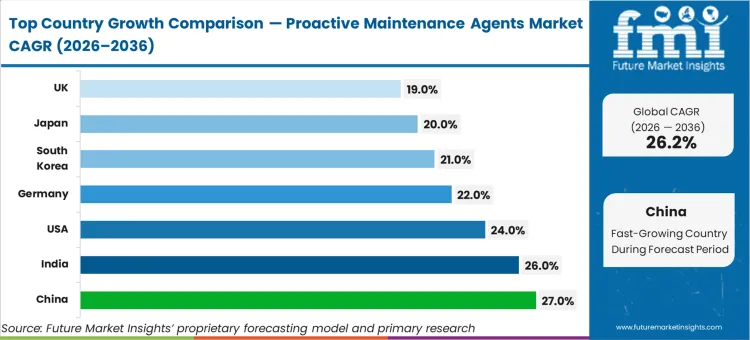
Demand across China is projected to expand at a 27.0% CAGR through 2036, anchored by large installed bases pushing scale adoption in heavy industry. India follows closely at 26.0%, where uptake is strongest in refineries and utilities where downtime economics are highly visible. The USA expands at a 24.0% CAGR, driven by "reliability-first" modernization. Germany registers a 22.0% CAGR as mature maintenance programs shift from dashboards to copilots. South Korea’s 21.0% CAGR reflects deep integration into automotive and electronics MES flows. Japan grows at 20.0%, prioritizing precision yield protection, while the UK advances at 19.0% as adoption concentrates in regulated infrastructure.
Proactive Maintenance Agents Market Definition
Proactive maintenance agents represent an advanced software paradigm where AI-driven modules autonomously monitor, diagnose, and resolve potential equipment failures. These systems ingest high-frequency telemetry from industrial sensors to map degradation curves. Using agentic logic, they bypass passive dashboards to issue direct work orders or adjust operational parameters.
Proactive Maintenance Agents Market Inclusions
The category includes cloud-based and on-premise software platforms, predictive analytics engines, and associated integration services designed for asset health management. It covers solutions utilizing vibration, thermography, and oil analysis data for the explicit purpose of forecasting and preventing mechanical or electrical failures in industrial environments.
Proactive Maintenance Agents Market Exclusions
The scope excludes basic, reactive computerized maintenance management systems (CMMS) that solely track historical work orders without predictive capabilities. It does not include the raw hardware sensors themselves or generic enterprise resource planning (ERP) modules that lack dedicated, AI-driven asset health forecasting logic.
Proactive Maintenance Agents Market Research Methodology
- Primary Research: Direct interviews with plant operations directors, IT/OT integration specialists, and predictive maintenance software developers across North America, Europe, and Asia.
- Desk Research: Analysis of official regulatory safety mandates, corporate digital transformation announcements, and technical integration whitepapers.
- Market-Sizing and Forecasting: Bottom-up modeling combining industrial sensor deployment rates with software license revenue baselines to project total agent adoption.
- Data Validation and Update Cycle: Verification against peer-reviewed industrial engineering journals and cross-checked with quarterly earnings reports from top automation vendors.
Segmental Analysis
Proactive Maintenance Agents Market Analysis by Component
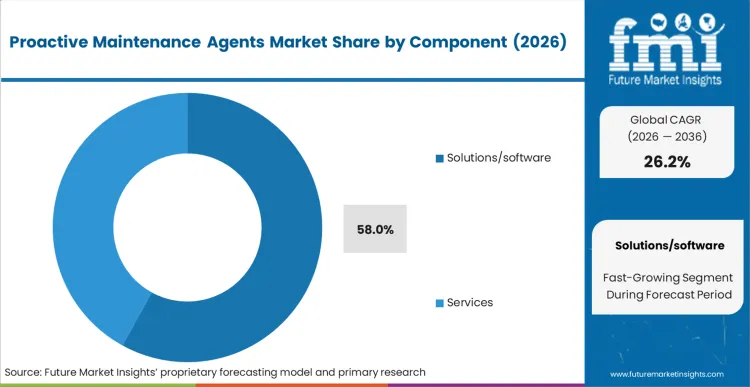
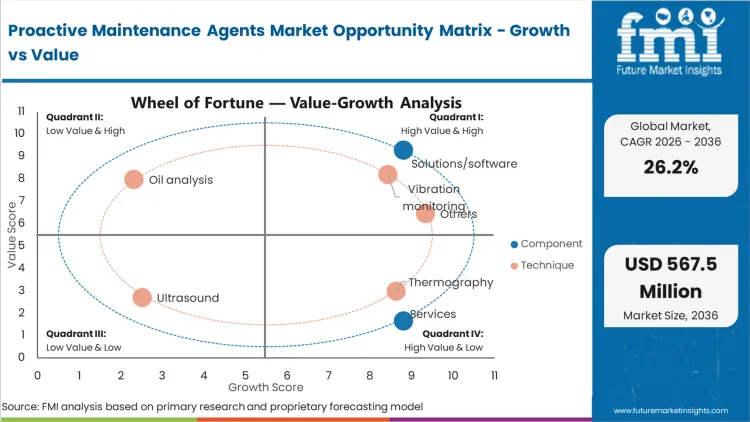
Tier-1 industrial operators are actively migrating from manual inspection routines to automated agent frameworks, driving stronger adoption of predictive quality assurance equipment layers. Solutions/software holds a dominant 58% share in 2026. Processing facilities increasingly prioritize edge-processing capabilities to secure competitive uptime advantages.
- Process Compatibility: Factory setups designed for legacy CMMS readily integrate with API-driven AI agents.
- Technical Validation: High-performance data lakes allow agents to process historical failure data efficiently.
- Procurement Shifts: Buyers demand holistic asset visibility rather than siloed diagnostic tools.
Proactive Maintenance Agents Market Analysis by Technique
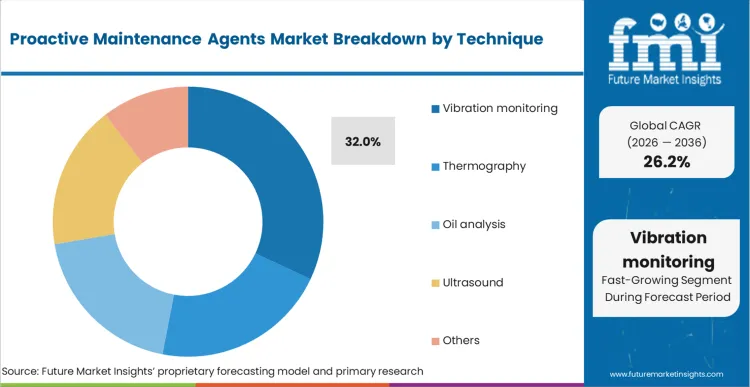
Vibration monitoring leads the technique segment with 32% of total volume in 2026. Hardware-first suppliers assumed buyers would defer software integration until post-installation. However, Siemens advanced its Senseye Predictive Maintenance with artificial intelligence at Sachsenmilch [4], indicating that continuous mechanical monitoring is now non-negotiable for high-speed production lines. Procurement departments source unified vibration monitoring agent suites to align with stricter quality control guidelines.
- Volume Concentration: Rotating equipment where failure signatures are well-documented.
- Supplier Positioning: Vendors bundle sensor analytics with prescriptive repair logic.
- Adoption Acceleration: Mechanical failure immediately cascades into total line stoppage.
Proactive Maintenance Agents Market Analysis by Deployment
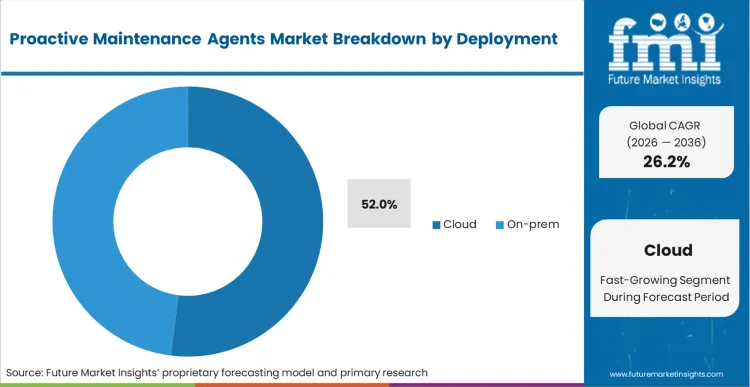
Cloud deployment architectures capture a 52% share in 2026, reflecting the logical necessity of training advanced machine learning models on aggregated cross-facility data. The structural push toward decentralized operations forces plant managers to adopt enterprise asset management solutions accessible from remote operating centers. IBM issued support withdrawal notices for on-premise Maximo Asset Performance Management versions in June 2025 [5], explicitly forcing the transition toward modern, cloud-native architectures. FMI analysts opine that latency and cybersecurity remain critical quality parameters for industrial buyers.
- Logistics Advantage: Cloud platforms eliminate the need for intensive local server maintenance.
- Requalification Cycles: Lengthen cloud providers manage continuous model updates dynamically.
- Cost Structures: Tighten when subscription models convert massive capex into predictable opex.
Proactive Maintenance Agents Market Analysis by Industry
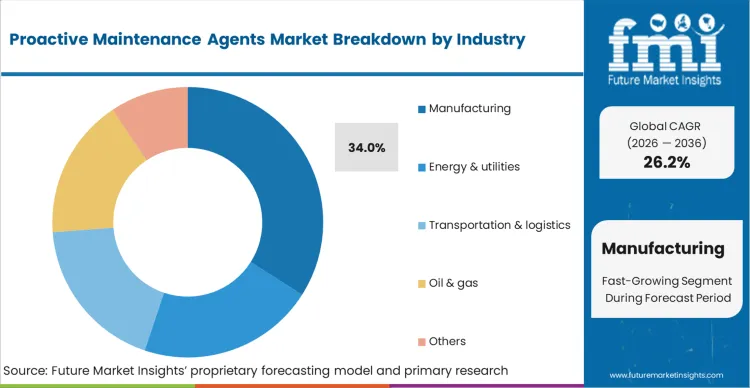
Manufacturing applications command a 34% segment share in 2026 as production floors face extreme pressure to maintain zero-defect output. Yield and quality metrics serve as the primary disqualification threshold for suppliers. The U.S. Bureau of Labor Statistics reported manufacturing labor productivity rose 3.7% in Q3 2025 [6], underscoring the operational efficiency gains tied to automated workflows. Discrete and process manufacturers leverage AI driven predictive maintenance to mitigate the impact of skilled labor shortages.
- Product Innovation: Agents natively link machine health status directly to production scheduling.
- Shelf Stability: Continuous monitoring prevents batch spoilage in critical pharmaceutical and food lines.
- Dietary Compliance: Strict FDA audit trails are automatically generated by maintenance AI systems.
Proactive Maintenance Agents Market Drivers, Restraints, and Opportunities
Asset owners are replacing legacy break-fix routines with autonomous diagnostics to capture rapidly expanding margins tied to operational uptime. The DOE’s National Power Outage Study stated that blackouts could increase by 100 times in 2030 if no action is taken [7], actively supporting the continuous scaling of proactive monitoring across critical infrastructure. Facilities adapt to these agentic workflows without facing sudden operational blind spots, encouraging long-term enterprise software commitments.
Integration debt and cybersecurity vulnerabilities restrict rapid capacity scaling for highly networked industrial environments. The margin pressure intensifies when plant operators attempt to unify proprietary, closed-loop OT protocols with modern IT cloud agents. IBM withdrew support for Maximo APM for Energy & Utilities On-Premise 3.0.x in 2025 [8], forcing operators to navigate complex and costly migration paths that temporarily compress operational budgets.
- Autonomous Work Order Generation: Enterprise asset systems automatically dispatch technicians before failure thresholds are breached.
- Edge-to-Cloud Synchronization: Real-time localized processing reduces latency for critical safety shutdowns. Compass Datacenters described using Schneider Electric EcoCare and analytics to reduce on-site maintenance interventions [10].
- Automotive Over-The-Air Maintenance: Connected vehicles utilize remote diagnostics to prevent mechanical degradation. Volvo Cars stated that later in 2025 around 2.5 million customers will receive an OTA upgrade [11].
Regional Analysis
Based on the regional analysis, the Proactive Maintenance Agents market is segmented into North America, Latin America, Europe, East Asia, South Asia, Oceania and Middle East & Africa across 40+ countries. The full report also offers market attractiveness analysis based on regional trends.
.webp "Top Country Growth Comparison Proactive Maintenance Agents Market Cagr (2026 2036)")
| Country | CAGR (2026 to 2036) |
|---|---|
| China | 27.0% |
| India | 26.0% |
| USA | 24.0% |
| Germany | 22.0% |
| South Korea | 21.0% |
| Japan | 20.0% |
| UK | 19.0% |
Source: Future Market Insights (FMI) analysis, based on proprietary forecasting model and primary research
Asia Pacific Proactive Maintenance Agents Market Analysis
Asia Pacific’s commercialization pace is increasingly defined by how quickly massive industrial hubs can transition from manual labor to highly automated, continuous monitoring frameworks. Cost physics dictates that downtime in high-volume electronics and automotive manufacturing fundamentally destroys margin viability. China's scale advantage drives aggressive sensorization. Japan prioritizes precision yield protection. India accelerates adoption within critical utilities. Procurement teams increasingly prioritize IOT enabled equipment maintenance solutions to protect margin structures against unpredictable supply chain disruptions, establishing agentic AI as the baseline for modern factory planning.
- China: The National Science Foundation announced a USD 25.5 million investment to support manufacturing technologies [12], indicating structural state-level backing for industrial AI. Procurement directors must secure integrated sensor networks now or face systemic inefficiencies that lock them out of competitive export pricing tiers. China's proactive maintenance sector is poised to expand at a CAGR of 27.0% through 2036 as massive heavy industry and energy sectors push for scale adoption to offset rising labor costs.
- India: Demand for agentic maintenance in India is estimated to expand at a CAGR of 26.0% driven by acute utility downtime economics and rapid data center expansion. The U.S. Bureau of Reclamation stated that it has used risk analysis as primary support for safety decision-making for 15 years [13], framework of Indian operators that are rapidly mirroring. Suppliers without localized integration support teams face a widening disqualification gap during national infrastructure tender cycles.
- South Korea: A CAGR of 21.0% is projected for proactive maintenance software in South Korea through 2036, anchored by deep integration into electronics and automotive manufacturing execution systems. Volkswagen stated a new software architecture will debut in its ID. EVERY1 production version [14], a standard that Korean automotive giants are actively matching. Buyers that fail to implement near-real-time anomaly detection before 2028 cannot meet the defect-rate expectations of global OEM partners.
- Japan: Japan is expected to see its proactive maintenance sector grow at a CAGR of 20.0% annually, responding to severe demographic labor shortages and a deeply ingrained quality control culture. PTC announced ServiceMax AI as part of its agentic AI demonstrations in March 2025 [15], validating that copilot-assisted maintenance is replacing retiring human expertise. Plant managers must migrate to prescriptive diagnostic platforms or face catastrophic knowledge-drain over the next decade.
FMI's report includes comprehensive tracking of the Asia Pacific industrial landscape, connecting capital expenditure cycles to software deployment rates across Indonesia, Vietnam, and Australia. The shift toward closed-loop autonomous quality assurance forms the primary analytical basis.
North America Proactive Maintenance Agents Market Analysis
North America functions as the technical proving ground for advanced cloud-native IT/OT convergence under strict grid reliability and safety protocols. Regulatory scrutiny compels manufacturers to eliminate unplanned outages while minimizing exposure to severe safety penalties. The energy sector's transition toward decentralized generation creates immense complexity that only AI agents can manage. As FMI analysts opine, grid instability and aging pipeline infrastructure compress the adoption window from a decade down to a single capital cycle. Operators are rapidly deploying condition monitoring service architectures to avoid catastrophic regulatory interventions.
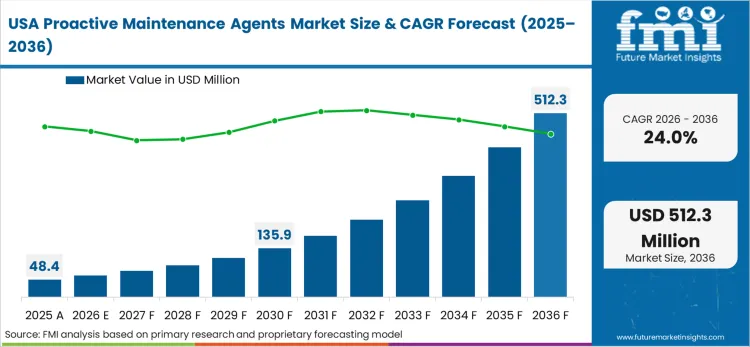
- USA: "Reliability-first" modernization across power, refining, and discrete manufacturing in the USA is set to grow at a CAGR of 24.0% through 2036. OSHA’s 2025 penalty memo listed maximum penalties of USD 165,514 per willful violation [16], rendering reactive maintenance strategies financially untenable. Facility operators must deploy verifiable, AI-audited maintenance workflows before the next regulatory inspection wave or face compounding legal and operational liabilities.
FMI's report includes deep tracking of the North American grid and manufacturing ecosystems, providing detailed analysis for Canada and Mexico. The transition toward continuous pipeline and aerospace telemetry analysis dominates regional buyer behavior.
Europe Proactive Maintenance Agents Market Analysis
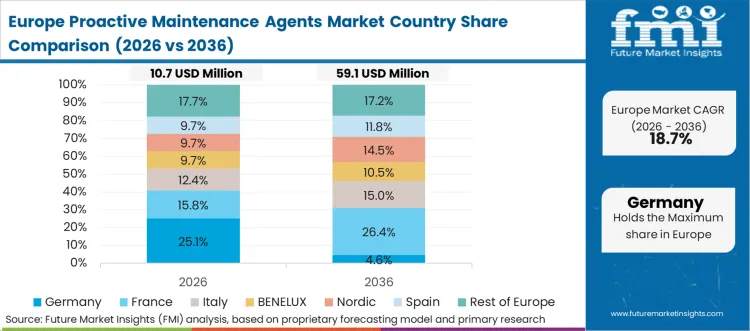
European adoption curves are heavily influenced by stringent sustainability mandates, high labor costs, and mature risk management frameworks. Instead of isolated pilot programs, industrial players are embedding agentic logic directly into core enterprise planning systems. The region's automotive transition forces a massive retooling of factory floors, requiring predictive systems to manage entirely new classes of robotic assets. European operators compete on compliance, efficiency, and zero-carbon downtime, pulling forward investments in advanced vibration analyzer networks.
- Germany: ISO reported that in 2025 it published 1,493 standards [17], emphasizing the extreme documentation rigor required in European operations. Converters lacking digital twin validation capability face exclusion from first-round shortlisting by major German OEMs. Over the forecast period, proactive agents in Germany are set for a CAGR of 22.0% as mature automotive and industrial sectors shift from passive dashboards to active copilots.
- UK: The UK's proactive agent sector is poised to expand at a CAGR of 19.0%, concentrating heavily in regulated infrastructure such as transport and energy grids. The FAA’s 2024 GA fact sheet described a goal of a 10% reduction in fatal accident rates [18], mirroring the extreme safety focus UK rail and aviation operators apply to maintenance. Regulated utility buyers must lock in multi-year predictive software contracts to satisfy national infrastructure risk audits.
FMI's report includes extensive coverage of the European processing and manufacturing landscape, detailing adoption metrics across France, Italy, and the Nordics. The strategic management of supply chain resilience through predictive logistics tracking defines the regional procurement strategy.
Competitive Aligners for Market Players
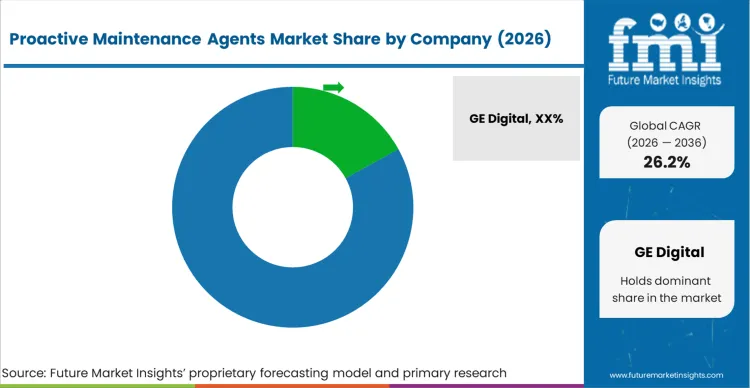
Market structure relies heavily on the ability to unify siloed IT and OT environments into a single, cohesive data lake. The EIA reported U.S. customers averaged 11 hours of electricity interruptions in 2024 [19], proving that legacy grid operators desperately require seamless software overlays. Suppliers holding intellectual property for edge-to-cloud synchronization capture early market share in high-value utility contracts.
Strategic consortiums and technology partnerships accelerate commercialization timelines for advanced agentic AI. Vendors must pivot from selling point-solutions to offering comprehensive ecosystem integrations to survive vendor consolidation.
Vendor advantage realigns where cybersecurity and verifiable data provenance become the primary decision criteria. Rockwell and Plex announced expanded integration capabilities for their Connected Worker solution [21], establishing secure, cross-platform workflows. Procurement teams now specify strict API certification standards, disqualifying niche software providers that cannot guarantee end-to-end encryption across legacy industrial networks.
Recent Developments
The report includes full coverage of key trends from competitive benchmarking. Some of the recent developments covered in the reports:
- In November 2025, Schneider Electric announced EcoStruxure Foresight Operation, an AI-powered platform unifying built environment systems. [3]
- In October 2025, General Motors announced a unified software platform featuring major increases in OTA capacity and AI performance. [20]
- In January 2026, PTC announced new AI functionality with ALM releases, including integrations connecting Codebeamer with Windchill. [9]
Key Players in Proactive Maintenance Agents Market
- GE Digital
- Siemens
- Honeywell
- IBM
- SAP
- Schneider Electric
- ABB
Scope of the Report
| Metric | Value |
|---|---|
| Quantitative Units | USD 55.38 billion (2026) to USD 567.4 billion (2036), at a CAGR of 26.20% |
| Market Definition | A specialized software and service ecosystem utilizing AI and sensor telemetry to autonomously predict and prescribe maintenance actions. |
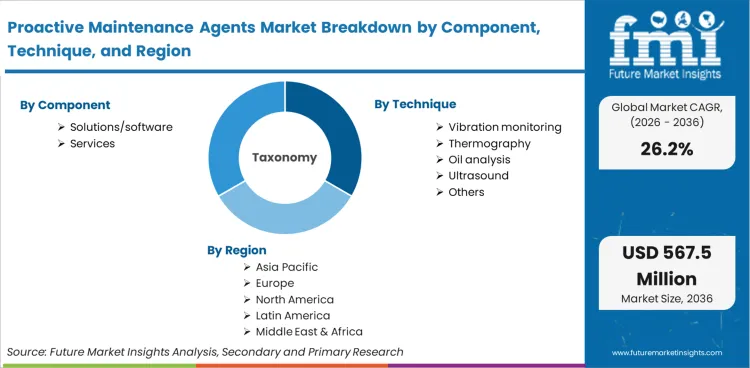
| Component Segmentation | Solutions/software, Services |
| Technique Segmentation | Vibration monitoring, Thermography, Oil analysis, Ultrasound, Others |
| Deployment Segmentation | Cloud, On-prem |
| Industry Segmentation | Manufacturing, Energy & utilities, Transportation & logistics, Oil & gas, Others |
| Regions Covered | North America, Latin America, Europe, East Asia, South Asia, Oceania, Middle East and Africa |
| Countries Covered | United States, Canada, Mexico, Brazil, Argentina, Germany, France, United Kingdom, Italy, Spain, China, India, Japan, South Korea, Indonesia, Australia and 40 plus countries |
| Key Companies Profiled | GE Digital, Siemens, Honeywell, IBM, SAP, Schneider Electric, ABB |
| Forecast Period | 2026 to 2036 |
| Approach | Hybrid top-down and bottom-up market modeling validated through primary interviews and software deployment tracking. |
Source: Future Market Insights (FMI) analysis, based on proprietary forecasting model and primary research
Proactive Maintenance Agents Market Analysis by Segments
Component:
- Solutions/software
- Services
Technique:
- Vibration monitoring
- Thermography
- Oil analysis
- Ultrasound
- Others
Deployment:
- Cloud
- On-prem
Industry:
- Manufacturing
- Energy & utilities
- Transportation & logistics
- Oil & gas
- Others
Region:
- Asia Pacific
- India
- China
- Japan
- South Korea
- Indonesia
- Australia & New Zealand
- ASEAN
- Rest of Asia Pacific
- Europe
- Germany
- Italy
- France
- United Kingdom
- Spain
- Benelux
- Nordics
- Central & Eastern Europe
- Rest of Europe
- North America
- United States
- Canada
- Mexico
- Latin America
- Brazil
- Argentina
- Chile
- Rest of Latin America
- Middle East & Africa
- Kingdom of Saudi Arabia
- United Arab Emirates
- South Africa
- Turkey
- Rest of Middle East & Africa
Bibliography
- [1] Honeywell. (2025, November 11). Honeywell and TotalEnergies pilot AI-assisted control room (Press release).
- [2] TotalEnergies. (2025, November 11). Honeywell and TotalEnergies pilot AI-assisted control room (Press release).
- [3] Schneider Electric. (2025, November 18). Schneider Electric EcoStruxure Foresight Operation (Press release).
- [4] Siemens. (2025). Siemens advances predictive maintenance artificial intelligence Sachsenmilch (Press release).
- [5] IBM. (2025, June 12). IBM Maximo Asset Performance Management withdrawal notification (Support notice).
- [6] U.S. Bureau of Labor Statistics. (2026, January 29). Productivity and Costs, Third Quarter 2025 (Government report).
- [7] U.S. Department of Energy. (2025, November 27). National Power Outage Study (Government report).
- [8] IBM. (2025, June 12). IBM Maximo APM for Energy & Utilities withdrawal notification (Support notice).
- [9] PTC. (2026, January 15). PTC delivers new AI functionality with ALM releases (Press release).
- [10] Compass Datacenters. (2025, March 12). Compass and Schneider Electric utilize AI (Company news release).
- [11] Volvo Cars. (2025, January 28). Volvo Cars OTA upgrade (Press release).
- [12] National Science Foundation. (2025, June 24). NSF invests 25.5M in research to drive new US manufacturing (Government report).
- [13] U.S. Bureau of Reclamation. (2025, July 21). Dam Safety Risk Methodology (Government report).
- [14] Volkswagen. (2025, March 05). Volkswagen ID EVERY1 production version (Press release).
- [15] PTC. (2025, March 25). PTC brings AI-powered PLM to Hannover Messe (Press release).
- [16] Occupational Safety and Health Administration. (2025, January 14). OSHA Civil Penalty Adjustments 2025 (Government report).
- [17] International Organization for Standardization. (2026, February). ISO in figures 2025 (Statistical database entry).
- [18] Federal Aviation Administration. (2025, January). General Aviation Safety Fact Sheet (Government report).
- [19] U.S. Energy Information Administration. (2025, December 01). U.S. customers averaged 11 hours of electricity interruptions (Government report).
- [20] General Motors. (2025, October 22). GM unified software platform and conversational AI (Press release).
- [21] Rockwell Automation. (2025, September 30). Connected Worker momentum (Press release).
This bibliography is provided for reader reference and is not exhaustive. The full report contains the complete reference list and detailed citations.
This Report Addresses
- Market size estimation and revenue forecasts from 2026 to 2036, supported by validated capacity and software deployment benchmarks across major industrial hubs.
- Growth opportunity mapping across cloud and on-premise architectures with emphasis on edge-processing transition models.
- Segment and regional revenue forecasts covering critical applications like discrete manufacturing, energy utilities, and oil & gas.
- Competition strategy assessment including software integration models, cost survivability positioning, and AI capability benchmarking.
- Product reformulation tracking covering key metrics such as anomaly detection latency, API interoperability, and cybersecurity encryption standards.
- Regulatory impact analysis evaluating strict safety compliance mandates, grid stability protocols, and industrial auditing guidelines.
- Market report delivery in PDF, Excel, PPT, and interactive dashboard formats for executive and operational use.
Frequently Asked Questions
How large is the demand for Proactive Maintenance Agents in the global market in 2026?
Demand for Proactive Maintenance Agents in the global market is estimated to be valued at USD 55.38 billion in 2026.
What will be the market size of Proactive Maintenance Agents in the global market by 2036?
Market size for Proactive Maintenance Agents is projected to reach USD 567.4 billion by 2036.
What is the expected demand growth for Proactive Maintenance Agents in the global market between 2026 and 2036?
Demand for Proactive Maintenance Agents is expected to grow at a CAGR of 26.20% between 2026 and 2036.
Which Component is poised to lead global sales by 2026?
Solutions/software accounts for 58% in 2026 as manufacturers prioritize edge-processing integrations.
How significant is the role of Manufacturing in driving Proactive Maintenance Agents adoption in 2026?
Manufacturing represents 34% of segment share as facilities deploy autonomous agents to offset severe labor shortages.
What is driving demand in China?
Scale adoption in heavy industry and aggressive sensorization mandates drive structural AI investments in China.
What compliance standards or regulations are referenced for China?
National manufacturing technology funding programs directly influence local procurement behavior.
What is the China growth outlook in this report?
China is projected to grow at a CAGR of 27.0% during 2026 to 2036.
Why is North America described as a priority region in this report?
Aging pipeline infrastructure and severe grid instability accelerate the need for continuous autonomous monitoring.
What type of demand dominates in North America?
"Reliability-first" modernization and strict regulatory safety compliance dominate regional formulation demand.
What is India's growth outlook in this report?
India is projected to expand at a CAGR of 26.0% during 2026 to 2036.
Does the report cover South Korea in its regional analysis?
Yes, South Korea is included within East Asia under the regional scope of analysis.
What are the sources referred to for analyzing South Korea?
Corporate integration announcements from major automotive OEMs form the analytical basis.
What is the main demand theme linked to South Korea in its region coverage?
Deep integration of AI copilots into electronics and automotive manufacturing execution systems.
Does the report cover Germany in its regional analysis?
Yes, Germany is included within Europe under the regional coverage framework.
What is the main Germany related demand theme in its region coverage?
The shift from passive dashboards to active copilots to manage complex, standardized operations.
Which product formats or configurations are strategically important for Asia Pacific supply chains?
Near-real-time anomaly detection frameworks operating on decentralized edge networks hold immense strategic importance.
What is Proactive Maintenance Agents and what is it mainly used for?
It is a specialized software ecosystem utilizing AI to autonomously predict and prescribe maintenance actions for industrial assets.
What does Proactive Maintenance Agents mean in this report?
The market refers to the global deployment of software platforms and predictive analytics intended for automated asset health management.
What is included in the scope of this Proactive Maintenance Agents report?
Scope includes cloud-based platforms, analytics engines, and integration services utilizing sensor data to forecast mechanical failures.
What is excluded from the scope of this report?
Raw hardware sensors and generic ERP systems lacking dedicated AI-driven forecasting logic are strictly excluded.
What does market forecast mean on this page?
The market forecast represents a model-based projection built on defined industrial and technology adoption assumptions for strategic planning purposes.
How does FMI build and validate the Proactive Maintenance Agents forecast?
Forecasts combine top-down industrial sensor data with bottom-up software deployment models, validated by OT manager interviews.
What does zero reliance on speculative third-party market research mean here?
Primary interviews, verified integration case studies, and official regulatory datasets are used exclusively instead of unverified syndicated estimates.
Preview the report firsthand - request a free sample
Get SampleGet the brochure for pricing and purchase details.
Get PDFTable of Content
- Executive Summary
- Global Market Outlook
- Demand-side Trends
- Supply-side Trends
- Technology Roadmap Analysis
- Analysis and Recommendations
- Market Overview
- Market Coverage / Taxonomy
- Market Definition / Scope / Limitations
- Research Methodology
- Chapter Orientation
- Analytical Lens and Working Hypotheses
- Market Structure, Signals, and Trend Drivers
- Benchmarking and Cross-market Comparability
- Market Sizing, Forecasting, and Opportunity Mapping
- Research Design and Evidence Framework
- Desk Research Programme (Secondary Evidence)
- Company Annual and Sustainability Reports
- Peer-reviewed Journals and Academic Literature
- Corporate Websites, Product Literature, and Technical Notes
- Earnings Decks and Investor Briefings
- Statutory Filings and Regulatory Disclosures
- Technical White Papers and Standards Notes
- Trade Journals, Industry Magazines, and Analyst Briefs
- Conference Proceedings, Webinars, and Seminar Materials
- Government Statistics Portals and Public Data Releases
- Press Releases and Reputable Media Coverage
- Specialist Newsletters and Curated Briefings
- Sector Databases and Reference Repositories
- FMI Internal Proprietary Databases and Historical Market Datasets
- Subscription Datasets and Paid Sources
- Social Channels, Communities, and Digital Listening Inputs
- Additional Desk Sources
- Expert Input and Fieldwork (Primary Evidence)
- Primary Modes
- Qualitative Interviews and Expert Elicitation
- Quantitative Surveys and Structured Data Capture
- Blended Approach
- Why Primary Evidence is Used
- Field Techniques
- Interviews
- Surveys
- Focus Groups
- Observational and In-context Research
- Social and Community Interactions
- Stakeholder Universe Engaged
- C-suite Leaders
- Board Members
- Presidents and Vice Presidents
- R&D and Innovation Heads
- Technical Specialists
- Domain Subject-matter Experts
- Scientists
- Physicians and Other Healthcare Professionals
- Governance, Ethics, and Data Stewardship
- Research Ethics
- Data Integrity and Handling
- Primary Modes
- Tooling, Models, and Reference Databases
- Desk Research Programme (Secondary Evidence)
- Data Engineering and Model Build
- Data Acquisition and Ingestion
- Cleaning, Normalisation, and Verification
- Synthesis, Triangulation, and Analysis
- Quality Assurance and Audit Trail
- Market Background
- Market Dynamics
- Drivers
- Restraints
- Opportunity
- Trends
- Scenario Forecast
- Demand in Optimistic Scenario
- Demand in Likely Scenario
- Demand in Conservative Scenario
- Opportunity Map Analysis
- Product Life Cycle Analysis
- Supply Chain Analysis
- Investment Feasibility Matrix
- Value Chain Analysis
- PESTLE and Porter’s Analysis
- Regulatory Landscape
- Regional Parent Market Outlook
- Production and Consumption Statistics
- Import and Export Statistics
- Market Dynamics
- Global Market Analysis 2021 to 2025 and Forecast, 2026 to 2036
- Historical Market Size Value (USD Million) Analysis, 2021 to 2025
- Current and Future Market Size Value (USD Million) Projections, 2026 to 2036
- Y-o-Y Growth Trend Analysis
- Absolute $ Opportunity Analysis
- Global Market Pricing Analysis 2021 to 2025 and Forecast 2026 to 2036
- Global Market Analysis 2021 to 2025 and Forecast 2026 to 2036, By Component
- Introduction / Key Findings
- Historical Market Size Value (USD Million) Analysis By Component , 2021 to 2025
- Current and Future Market Size Value (USD Million) Analysis and Forecast By Component , 2026 to 2036
- Solutions/software
- Services
- Solutions/software
- Y-o-Y Growth Trend Analysis By Component , 2021 to 2025
- Absolute $ Opportunity Analysis By Component , 2026 to 2036
- Global Market Analysis 2021 to 2025 and Forecast 2026 to 2036, By Technique
- Introduction / Key Findings
- Historical Market Size Value (USD Million) Analysis By Technique, 2021 to 2025
- Current and Future Market Size Value (USD Million) Analysis and Forecast By Technique, 2026 to 2036
- Vibration monitoring
- Thermography
- Oil analysis
- Ultrasound
- Others
- Vibration monitoring
- Y-o-Y Growth Trend Analysis By Technique, 2021 to 2025
- Absolute $ Opportunity Analysis By Technique, 2026 to 2036
- Global Market Analysis 2021 to 2025 and Forecast 2026 to 2036, By Deployment
- Introduction / Key Findings
- Historical Market Size Value (USD Million) Analysis By Deployment, 2021 to 2025
- Current and Future Market Size Value (USD Million) Analysis and Forecast By Deployment, 2026 to 2036
- Cloud
- On-prem
- Cloud
- Y-o-Y Growth Trend Analysis By Deployment, 2021 to 2025
- Absolute $ Opportunity Analysis By Deployment, 2026 to 2036
- Global Market Analysis 2021 to 2025 and Forecast 2026 to 2036, By Industry
- Introduction / Key Findings
- Historical Market Size Value (USD Million) Analysis By Industry, 2021 to 2025
- Current and Future Market Size Value (USD Million) Analysis and Forecast By Industry, 2026 to 2036
- Manufacturing
- Energy & utilities
- Transportation & logistics
- Oil & gas
- Others
- Manufacturing
- Y-o-Y Growth Trend Analysis By Industry, 2021 to 2025
- Absolute $ Opportunity Analysis By Industry, 2026 to 2036
- Global Market Analysis 2021 to 2025 and Forecast 2026 to 2036, By Region
- Introduction
- Historical Market Size Value (USD Million) Analysis By Region, 2021 to 2025
- Current Market Size Value (USD Million) Analysis and Forecast By Region, 2026 to 2036
- North America
- Latin America
- Western Europe
- Eastern Europe
- East Asia
- South Asia and Pacific
- Middle East & Africa
- Market Attractiveness Analysis By Region
- North America Market Analysis 2021 to 2025 and Forecast 2026 to 2036, By Country
- Historical Market Size Value (USD Million) Trend Analysis By Market Taxonomy, 2021 to 2025
- Market Size Value (USD Million) Forecast By Market Taxonomy, 2026 to 2036
- By Country
- USA
- Canada
- Mexico
- By Component
- By Technique
- By Deployment
- By Industry
- By Country
- Market Attractiveness Analysis
- By Country
- By Component
- By Technique
- By Deployment
- By Industry
- Key Takeaways
- Latin America Market Analysis 2021 to 2025 and Forecast 2026 to 2036, By Country
- Historical Market Size Value (USD Million) Trend Analysis By Market Taxonomy, 2021 to 2025
- Market Size Value (USD Million) Forecast By Market Taxonomy, 2026 to 2036
- By Country
- Brazil
- Chile
- Rest of Latin America
- By Component
- By Technique
- By Deployment
- By Industry
- By Country
- Market Attractiveness Analysis
- By Country
- By Component
- By Technique
- By Deployment
- By Industry
- Key Takeaways
- Western Europe Market Analysis 2021 to 2025 and Forecast 2026 to 2036, By Country
- Historical Market Size Value (USD Million) Trend Analysis By Market Taxonomy, 2021 to 2025
- Market Size Value (USD Million) Forecast By Market Taxonomy, 2026 to 2036
- By Country
- Germany
- UK
- Italy
- Spain
- France
- Nordic
- BENELUX
- Rest of Western Europe
- By Component
- By Technique
- By Deployment
- By Industry
- By Country
- Market Attractiveness Analysis
- By Country
- By Component
- By Technique
- By Deployment
- By Industry
- Key Takeaways
- Eastern Europe Market Analysis 2021 to 2025 and Forecast 2026 to 2036, By Country
- Historical Market Size Value (USD Million) Trend Analysis By Market Taxonomy, 2021 to 2025
- Market Size Value (USD Million) Forecast By Market Taxonomy, 2026 to 2036
- By Country
- Russia
- Poland
- Hungary
- Balkan & Baltic
- Rest of Eastern Europe
- By Component
- By Technique
- By Deployment
- By Industry
- By Country
- Market Attractiveness Analysis
- By Country
- By Component
- By Technique
- By Deployment
- By Industry
- Key Takeaways
- East Asia Market Analysis 2021 to 2025 and Forecast 2026 to 2036, By Country
- Historical Market Size Value (USD Million) Trend Analysis By Market Taxonomy, 2021 to 2025
- Market Size Value (USD Million) Forecast By Market Taxonomy, 2026 to 2036
- By Country
- China
- Japan
- South Korea
- By Component
- By Technique
- By Deployment
- By Industry
- By Country
- Market Attractiveness Analysis
- By Country
- By Component
- By Technique
- By Deployment
- By Industry
- Key Takeaways
- South Asia and Pacific Market Analysis 2021 to 2025 and Forecast 2026 to 2036, By Country
- Historical Market Size Value (USD Million) Trend Analysis By Market Taxonomy, 2021 to 2025
- Market Size Value (USD Million) Forecast By Market Taxonomy, 2026 to 2036
- By Country
- India
- ASEAN
- Australia & New Zealand
- Rest of South Asia and Pacific
- By Component
- By Technique
- By Deployment
- By Industry
- By Country
- Market Attractiveness Analysis
- By Country
- By Component
- By Technique
- By Deployment
- By Industry
- Key Takeaways
- Middle East & Africa Market Analysis 2021 to 2025 and Forecast 2026 to 2036, By Country
- Historical Market Size Value (USD Million) Trend Analysis By Market Taxonomy, 2021 to 2025
- Market Size Value (USD Million) Forecast By Market Taxonomy, 2026 to 2036
- By Country
- Kingdom of Saudi Arabia
- Other GCC Countries
- Turkiye
- South Africa
- Other African Union
- Rest of Middle East & Africa
- By Component
- By Technique
- By Deployment
- By Industry
- By Country
- Market Attractiveness Analysis
- By Country
- By Component
- By Technique
- By Deployment
- By Industry
- Key Takeaways
- Key Countries Market Analysis
- USA
- Pricing Analysis
- Market Share Analysis, 2025
- By Component
- By Technique
- By Deployment
- By Industry
- Canada
- Pricing Analysis
- Market Share Analysis, 2025
- By Component
- By Technique
- By Deployment
- By Industry
- Mexico
- Pricing Analysis
- Market Share Analysis, 2025
- By Component
- By Technique
- By Deployment
- By Industry
- Brazil
- Pricing Analysis
- Market Share Analysis, 2025
- By Component
- By Technique
- By Deployment
- By Industry
- Chile
- Pricing Analysis
- Market Share Analysis, 2025
- By Component
- By Technique
- By Deployment
- By Industry
- Germany
- Pricing Analysis
- Market Share Analysis, 2025
- By Component
- By Technique
- By Deployment
- By Industry
- UK
- Pricing Analysis
- Market Share Analysis, 2025
- By Component
- By Technique
- By Deployment
- By Industry
- Italy
- Pricing Analysis
- Market Share Analysis, 2025
- By Component
- By Technique
- By Deployment
- By Industry
- Spain
- Pricing Analysis
- Market Share Analysis, 2025
- By Component
- By Technique
- By Deployment
- By Industry
- France
- Pricing Analysis
- Market Share Analysis, 2025
- By Component
- By Technique
- By Deployment
- By Industry
- India
- Pricing Analysis
- Market Share Analysis, 2025
- By Component
- By Technique
- By Deployment
- By Industry
- ASEAN
- Pricing Analysis
- Market Share Analysis, 2025
- By Component
- By Technique
- By Deployment
- By Industry
- Australia & New Zealand
- Pricing Analysis
- Market Share Analysis, 2025
- By Component
- By Technique
- By Deployment
- By Industry
- China
- Pricing Analysis
- Market Share Analysis, 2025
- By Component
- By Technique
- By Deployment
- By Industry
- Japan
- Pricing Analysis
- Market Share Analysis, 2025
- By Component
- By Technique
- By Deployment
- By Industry
- South Korea
- Pricing Analysis
- Market Share Analysis, 2025
- By Component
- By Technique
- By Deployment
- By Industry
- Russia
- Pricing Analysis
- Market Share Analysis, 2025
- By Component
- By Technique
- By Deployment
- By Industry
- Poland
- Pricing Analysis
- Market Share Analysis, 2025
- By Component
- By Technique
- By Deployment
- By Industry
- Hungary
- Pricing Analysis
- Market Share Analysis, 2025
- By Component
- By Technique
- By Deployment
- By Industry
- Kingdom of Saudi Arabia
- Pricing Analysis
- Market Share Analysis, 2025
- By Component
- By Technique
- By Deployment
- By Industry
- Turkiye
- Pricing Analysis
- Market Share Analysis, 2025
- By Component
- By Technique
- By Deployment
- By Industry
- South Africa
- Pricing Analysis
- Market Share Analysis, 2025
- By Component
- By Technique
- By Deployment
- By Industry
- USA
- Market Structure Analysis
- Competition Dashboard
- Competition Benchmarking
- Market Share Analysis of Top Players
- By Regional
- By Component
- By Technique
- By Deployment
- By Industry
- Competition Analysis
- Competition Deep Dive
- GE Digital
- Overview
- Product Portfolio
- Profitability by Market Segments (Product/Age /Sales Channel/Region)
- Sales Footprint
- Strategy Overview
- Marketing Strategy
- Product Strategy
- Channel Strategy
- Siemens
- Honeywell
- IBM
- SAP
- Schneider Electric
- ABB
- GE Digital
- Competition Deep Dive
- Assumptions & Acronyms Used


