

- Market Size (2026)
- USD 310.0 Mn
- Forecast (2036)
- USD 675.5 Mn
- CAGR (2026 to 2036)
- 8.1%
How big is the industrial vision lighting controllers market in 2026?
USD 310.0 million in 2026 and USD 675.5 million by 2036 at an 8.1% CAGR.
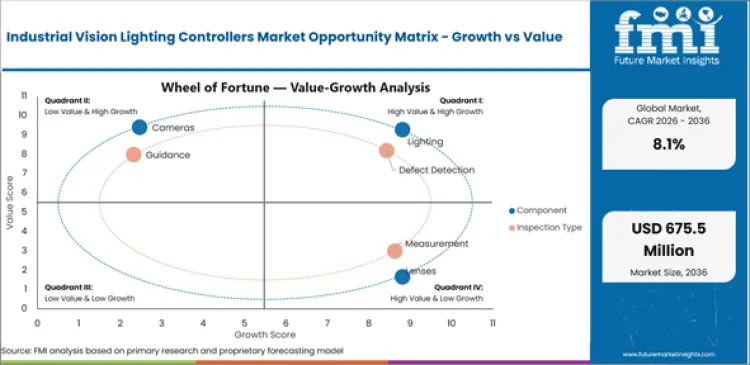
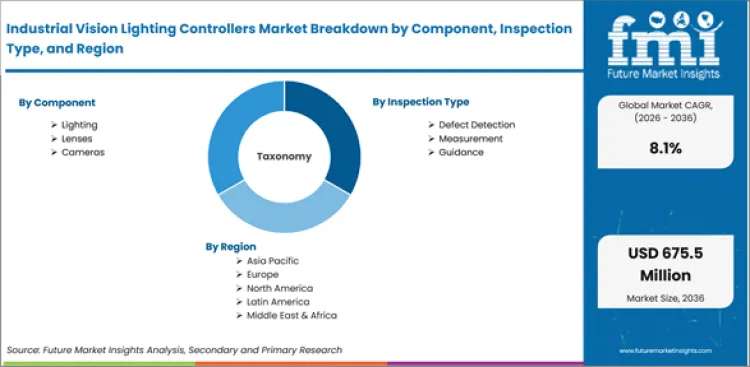
The industrial vision lighting controllers market is expected to grow from USD 286.8 million in 2025 to USD 675.5 million by 2036. Demand is shaped by machine vision systems that need stable contrast and repeatable trigger timing. Lighting is projected to account for 34.0% of the market in 2026, driven by its critical role in enhancing image quality and surface contrast, while defect detection is expected to hold a 38.0% share due to its importance in surface inspection and reducing false reject rates.
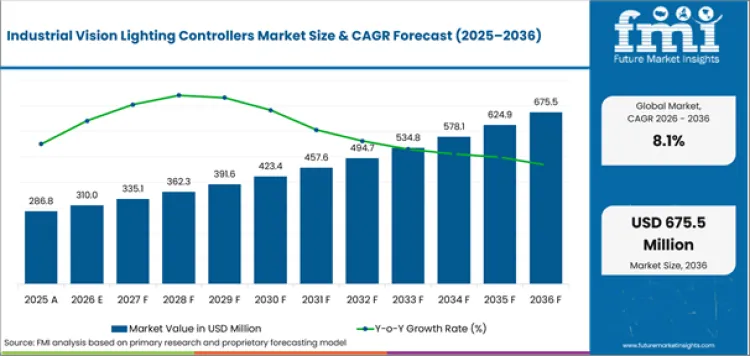
| Metric | Value |
|---|---|
| 2026 Market Size | USD 310.0 million |
| 2036 Market Size | USD 675.5 million |
| Forecast CAGR (2026-2036) | 8.1% |
| Leading Component | Lighting |
| Lighting Share (2026) | 34.0% |
| Leading Inspection Type | Defect Detection |
| Defect Detection Share (2026) | 38.0% |
| Fastest-growing Country | China |
| China CAGR by 2036 | 9.4% |
Summary of the Industrial Vision Lighting Controllers Market
| Market Signal | Commercial Impact |
|---|---|
| Demand and Growth Drivers | Demand for industrial vision lighting controllers is increasing as manufacturers replace manual inspection with automated machine vision systems requiring stable illumination and repeatable image quality.
|
| Product and Segment View | Lighting, defect detection, inline deployment, and electronics lead their respective market segments.
|
| Geography and Growth Outlook | Asia remains the leading growth region while developed manufacturing economies continue investing in factory automation.
|
| Competitive Landscape | Competition increasingly focuses on lighting precision, controller performance, and application engineering support.
|
| Analyst Perspective | Industrial vision lighting controllers are becoming a strategic component of automated quality inspection as manufacturers seek higher inspection accuracy, production consistency, and operational efficiency.
- Nikhil Kaitwade, Principal Analyst at Future Market Insights |
Industrial vision lighting controller demand is being driven by factories that need stable image capture at higher inspection speeds. The U.S. Census Bureau reported April 2026 manufacturing new orders of USD 662.7 billion. This order base raises the cost of false rejects and missed defects on automated lines. Advanced Illumination’s April 2025 DL071 documentation shows why controller choice matters in practice. The light delivers 6 klx at a 25 mm working distance under continuous operation. When paired with the company’s strobe-enabled Inline Controller, it can reach up to 5X continuous output. Buyers are therefore prioritizing controllers that manage strobe timing and brightness without shortening LED life or destabilizing inspection results.
Packaging cells use industrial barcode scanners with controlled lighting to reduce misreads at conveyor speed. This reinforces controller demand in code reading and label inspection. Broader machine vision adoption makes lighting control more visible during supplier qualification. Buyers test the full image chain before approving the controller.
Which factors support expansion in the industrial vision lighting controllers market?
Repeatable light timing and retrofit-friendly integration support market value across industrial inspection cells.
- Market value is supported by controller revenue before cameras and services add wider system revenue.
- Supplier pricing reflects channel count and trigger response before enclosure design affects project cost.
- Revenue improves as manufacturers convert manual checks into inline inspection cells.
- Buyer trust rises as controllers store recipes and keep light output repeatable between product runs.
Why is the industrial vision lighting controllers market growing?
Factories are moving toward continuous quality control with shorter exposure windows and tighter traceability needs.
Rapid growth in industrial automation and AI-driven inspection is increasing the need for precise lighting synchronization and seamless integration across machine vision systems. The International Federation of Robotics reported 542 thousand industrial robots installed worldwide in 2024. Asia accounted for 74% of new deployments. This automation density raises the number of camera stations that need synchronized lighting and repeatable trigger control.
Controller demand also benefits from factory automation and industrial controls spending. Inspection cells must work with PLCs robots and production software. Buyers now ask whether the light can fire at the correct millisecond. Industrial vision gateways help line-control teams move image data toward reject logs. Poor contrast weakens training images and production inference. AI inspection therefore needs tighter lighting discipline inside smart factory programs that combine camera data and reject logs.
How is the industrial vision lighting controllers market segmented?
The industrial vision lighting controllers industry is segmented by component, inspection type, deployment and end-use industry. Region is used for geographic analysis.
- Lighting is projected to secure 34.0% share in 2026 with current control and controlled strobe pulses.
- Defect Detection is anticipated to hold 38.0% share in 2026 for surface inspection and glare control.
- Inline deployment is forecast to represent 51.0% share in 2026 with inspection inside the main production flow.
- Electronics is expected to account for 29.0% share in 2026 with small-feature inspection and tighter tolerances.
Which component category holds a notable share in the industrial vision lighting controllers market?
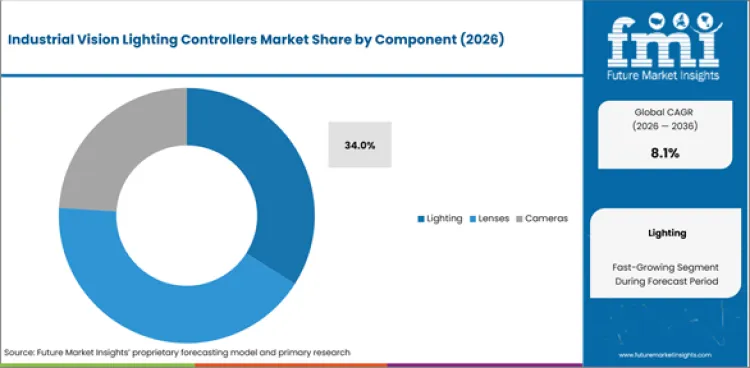
- Lighting is projected to account for 34.0% share in 2026 with controlled strobe pulses and stable illumination.
- Cameras and lenses remain important. They must capture the contrast that lighting controllers create during each inspection cycle.
What drives inspection-type demand in the industrial vision lighting controllers market?
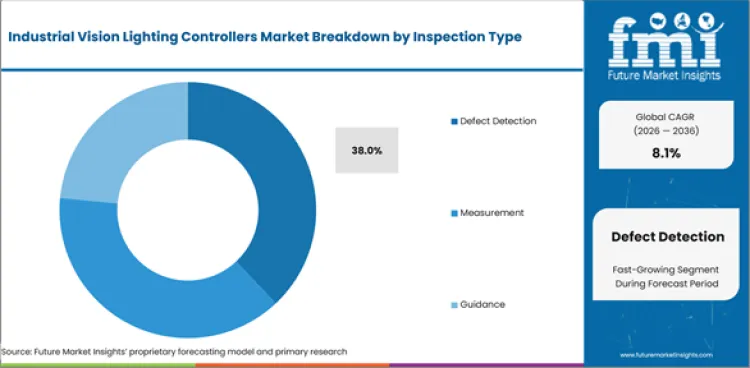
- Defect Detection is expected to hold 38.0% share in 2026 for scratches cracks and coating-gap inspection.
- Measurement and OCR or OCV use cases gain value from consistent angles and repeatable exposure settings.
How are buyers selecting across deployment options in the industrial vision lighting controllers market?
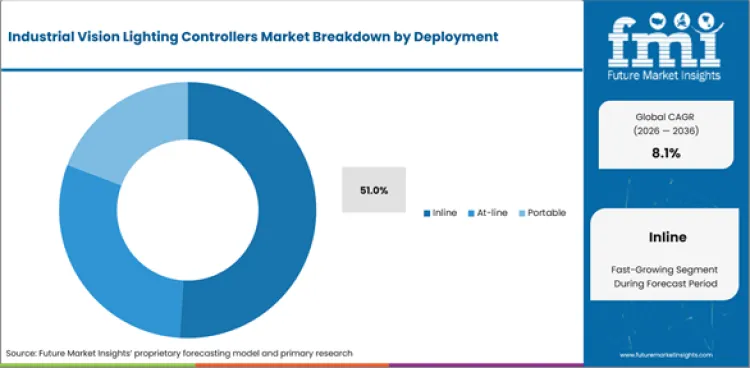
- Inline deployment is anticipated to represent 51.0% share in 2026 with inspection that does not stop production flow.
- Robotic cells gain attention with synchronized light pulses that match robot position and camera exposure.
Which end-use industry shows a prominent position in the industrial vision lighting controllers market?
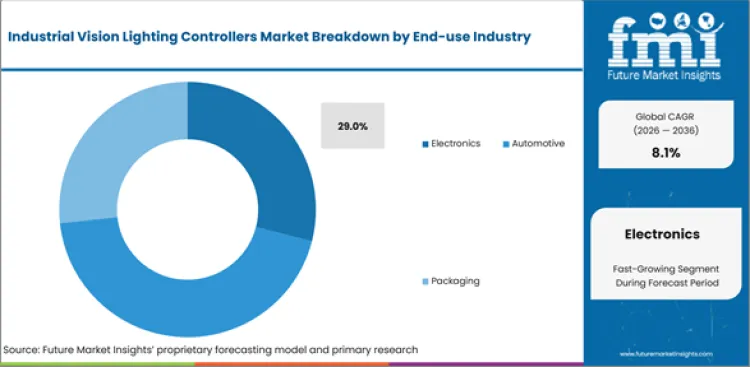
- Electronics is forecast to account for 29.0% share in 2026 with circuit board and semiconductor inspection needs.
- Automotive and packaging buyers use lighting controllers to reduce inspection variability across reflective and printed surfaces.
What are the driver, restraints, and opportunities in the industrial vision lighting controllers market?
High-speed inspection supports growth. Integration risk and heat limits restrict wider controller replacement.
- Driver: High-speed strobing is expected to reduce motion blur on fast packaging and electronics lines.
- Restraint: Heat and overdrive limits can shorten LED life if controller selection is weak.
- Opportunity: Retrofit projects can upgrade lighting control without replacing the full camera system.
Strobe Timing Demand Outlook
Strobe timing demand is rising because faster lines need sharper images without a full camera replacement. Gardasoft states that pulsing can freeze fast-moving objects and let LEDs be overdriven for short periods. This changes retrofit economics because plants can improve contrast and motion control through lighting behavior before changing cameras or lenses. Buyers therefore look for controllers that can manage pulse width and LED intensity without creating heat or life-cycle risk.
Controller Integration and Retrofit Risk
Controller integration remains a key buying concern because many inspection lines already have cameras, sensors, triggers, and PLC links in place. Stemmer Imaging describes machine vision controllers as devices that provide precise LED control and exact trigger synchronization. This creates value when lighting must match camera exposure during high-speed inspection. It also creates retrofit risk when cable types and timing settings do not match the existing line.
AI Inspection Lighting Recipes
AI inspection is making lighting recipes more important because model performance depends on repeatable image conditions. Cognex introduced OneVision in June 2025 as a cloud platform for building, training, and scaling AI-powered machine vision applications. Cognex later said more than 100 customers had used OneVision since beta launch. This is important as lighting differences between training images and production images can weaken model reliability.
Which countries are growing fastest in the industrial vision lighting controllers market?
China 9.4% CAGR and India 9.1% CAGR lead the country outlook. South Korea 8.8% CAGR and Japan 8.3% CAGR follow. The United States is 7.7% CAGR and Germany is 7.6% CAGR. The United Kingdom is 7.4% CAGR and France is 7.1% CAGR through 2036.
.webp "Top Country Growth Comparison Industrial Vision Lighting Controllers Market Cagr (2026 2036)")
| Country | CAGR |
|---|---|
| China | 9.4% |
| India | 9.1% |
| South Korea | 8.8% |
| Japan | 8.3% |
| United States | 7.7% |
| Germany | 7.6% |
| United Kingdom | 7.4% |
| France | 7.1% |
Source: Future Market Insights, 2026.
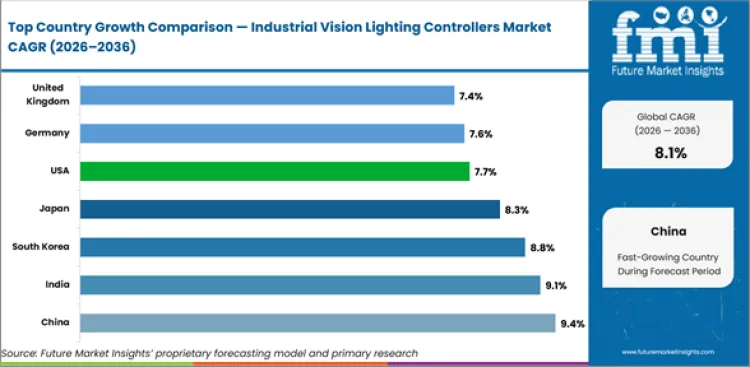
How do country-level CAGRs compare in the industrial vision lighting controllers market?
China is expected to remain considerable market through the forecast period, whereas France is projected to record moderate expansion among the countries analyzed.
- China is forecast to record a 9.4% CAGR through 2036, supported by continued investment in electronics manufacturing and robotics.
- India is projected to expand at a 9.1% CAGR through 2036, driven by rising automation adoption and growth in domestic electronics production.
- South Korea is expected to post an 8.8% CAGR through 2036, fueled by inspection requirements across semiconductor and battery manufacturing facilities.
- Japan is estimated to rise at an 8.3% CAGR through 2036, aided by demand for highly integrated vision platforms in precision manufacturing.
- The United States is forecast to record a 7.7% CAGR through 2036, underpinned by factory modernization initiatives and large-scale automation programs.
- Germany is projected to post a 7.6% CAGR through 2036, reflecting strong demand from machine builders and high-accuracy inspection applications.
- The United Kingdom is expected to advance at a 7.4% CAGR through 2036, benefiting from compliance-focused packaging operations and system integration activity.
How fast is the industrial vision lighting controllers market growing in China?
A 9.4% CAGR through 2036 reflects electronics scale, EV output and high factory automation intensity.
Country Market Snapshot Table
| Parameter | Value |
|---|---|
| Market Size in 2025 (Value) | USD 58.5 million |
| Market Size in 2026 (Value) | USD 64.0 million |
| Market Forecast in 2036 (Value) | USD 157.2 million |
| CAGR (2026 to 2036) | 9.4% |
| Years Considered | 2021 to 2036 |
| Base Year | 2025 |
| Forecast Period | 2026 to 2036 |
| Units Considered | Value (USD million) |
| Leading Sub-Region | Yangtze River Delta and Pearl River Delta electronics corridors |
China Industrial Vision Lighting Controllers Market Outlook
China is the main scale market with factories combining large output and fast automation cycles. Lighting controllers are often bought inside machine-builder packages instead of standalone global-brand purchases.
Price pressure is material with local component vendors competing aggressively. Global brands need to defend share through stability, documentation and application support.
Key Growth Drivers
- NBS reported industrial value added above designated size increased 5.9% in 2025, supporting inspection demand across factories.
- IFR reported 295 thousand industrial robots were installed in China in 2024 across a broad base for camera-light stations.
- Electronics and EV supply chains need fast visual checks at high throughput for reflective and small parts.
- Local machine builders expand controller demand through bundled inspection cells for electronics and automotive plants.
Key Restraints
- IFR reported domestic Chinese robot suppliers held 57% share in 2024, intensifying price pressure on imported controller ecosystems.
- Low-cost lighting products can raise maintenance and false reject risk under weak thermal control.
- Global suppliers need local technical support to compete against faster-moving domestic machine builders.
What makes China unique
China is the volume scale market with controller demand tied closely to local machine builders and fast factory automation cycles.
Key Companies
- KEYENCE China
- Cognex China
- CCS China Inc.
- Hikrobot
- OPT Machine Vision
- LUSTER LightTech
Sales & Marketing Channels
- Local machine builder bundles
- Automation integrator networks
- Direct enterprise accounts
- Online technical catalogs
- Electronics factory qualification routes
- Regional automation trade fairs
Country Segment Breakdown Table
| Segment | Sub-Segments |
|---|---|
| By Component | Cameras · Lenses · Lighting · Frame Grabbers · Vision Software · Services |
| By Inspection Type | Defect Detection · Measurement · OCR/OCV · Presence/Absence · Guidance |
| By Deployment | Inline · At-line · Robotic Cell · Portable |
| By End-use Industry | Electronics · Automotive · Packaging · Pharmaceuticals · Food & Beverage · Metals |
| Key Sub-Regions Covered, Industrial Clusters | Yangtze River Delta · Pearl River Delta · Beijing-Tianjin-Hebei · Chengdu-Chongqing · Wuhan · Xi’an |
Frequently Asked Questions
How fast is China industrial vision lighting controllers market growing?
Demand in China is projected to rise at 9.4% CAGR from 2026 to 2036 through inspection automation.
Who leads China industrial vision lighting controllers market?
China supplier coverage includes KEYENCE China and Cognex China. Hikrobot and OPT Machine Vision add local machine vision depth.
What is driving adoption in China industrial vision lighting controllers market?
Adoption is shaped by inline quality checks, retrofit projects and the need for repeatable lighting recipes.
How is the industrial vision lighting controllers market growing in India?
A 9.1% CAGR through 2036 reflects electronics and automotive inspection plus pharmaceutical automation growth.
Country Market Snapshot Table
| Parameter | Value |
|---|---|
| Market Size in 2025 (Value) | USD 13.7 million |
| Market Size in 2026 (Value) | USD 15.0 million |
| Market Forecast in 2036 (Value) | USD 35.8 million |
| CAGR (2026 to 2036) | 9.1% |
| Years Considered | 2021 to 2036 |
| Base Year | 2025 |
| Forecast Period | 2026 to 2036 |
| Units Considered | Value (USD million) |
| Leading Sub-Region | Bengaluru, Pune, Chennai, Hyderabad and Gujarat automation corridors |
India Industrial Vision Lighting Controllers Market Outlook
India is moving from selective quality checks toward wider line inspection in export-facing sectors. Buyers rely on automation integrators, OEMs and local distributors for installation support.
Local demo centers can lower buyer hesitation by allowing factories to test lighting recipes before purchase. Price sensitivity still favors bundled systems in smaller plants.
Key Growth Drivers
- PIB reported IIP growth of 7.8% in December 2025, supporting broader factory automation spending.
- PIB reported computer electronic and optical products grew 34.9% in December 2025 and strengthened demand for small-feature inspection.
- Pharmaceutical packaging needs controlled imaging for label and code checks during batch documentation.
- Automotive suppliers use lighting controllers to reduce inspection variability on assembly lines.
Key Restraints
- IFR reported India installed 9,100 industrial robots in 2024 and showed a smaller installed base than China and Japan.
- Price sensitivity favors bundled systems over premium standalone controllers in mid-sized factories.
- Limited in-house vision skills can delay system tuning after installation and reduce repeat purchases.
What makes India unique
India is service-led with local demos and integrator skills converting automation interest into purchases.
Key Companies
- KEYENCE India
- Cognex India
- OMRON Automation India
- Zebra Technologies India
- Qualitas Technologies
- Jekson Vision
Sales & Marketing Channels
- Automation integrator projects
- OEM machine builder partnerships
- Distributor-led component sales
- Demo center evaluations
- Pharmaceutical validation channels
- Automotive supplier audits
Country Segment Breakdown Table
| Segment | Sub-Segments |
|---|---|
| By Component | Cameras · Lenses · Lighting · Frame Grabbers · Vision Software · Services |
| By Inspection Type | Defect Detection · Measurement · OCR/OCV · Presence/Absence · Guidance |
| By Deployment | Inline · At-line · Robotic Cell · Portable |
| By End-use Industry | Electronics · Automotive · Packaging · Pharmaceuticals · Food & Beverage · Metals |
| Key Sub-Regions Covered, Industrial Clusters | Bengaluru · Pune · Chennai · Hyderabad · Gujarat · Noida |
Frequently Asked Questions
How fast is India industrial vision lighting controllers market growing?
Demand in India is projected to rise at 9.1% CAGR from 2026 to 2036 through inspection automation.
Who leads India industrial vision lighting controllers market?
India supplier coverage includes KEYENCE India and Cognex India. Qualitas Technologies and Jekson Vision add regional inspection-system depth.
What is driving adoption in India industrial vision lighting controllers market?
Adoption is shaped by inline quality checks, retrofit projects and the need for repeatable lighting recipes.
What is the industrial vision lighting controllers market outlook in South Korea?
An 8.8% CAGR through 2036 reflects semiconductor and display inspection plus battery and automotive electronics lines.
Country Market Snapshot Table
| Parameter | Value |
|---|---|
| Market Size in 2025 (Value) | USD 23.9 million |
| Market Size in 2026 (Value) | USD 26.0 million |
| Market Forecast in 2036 (Value) | USD 60.4 million |
| CAGR (2026 to 2036) | 8.8% |
| Years Considered | 2021 to 2036 |
| Base Year | 2025 |
| Forecast Period | 2026 to 2036 |
| Units Considered | Value (USD million) |
| Leading Sub-Region | Gyeonggi semiconductor and display clusters |
South Korea Industrial Vision Lighting Controllers Market Outlook
South Korea demand is concentrated in factories with yield and export quality exposure from inspection failure. Lighting controllers often enter through qualified integrators serving semiconductor and battery lines.
Buyer behavior is qualification-heavy with emphasis on repeatability and local response. Global brands can win premium applications through field support and proven compatibility.
Key Growth Drivers
- Korea.net reported Korea’s industrial production index increased 1.7% in 2024, supporting continued automation spending.
- IFR reported South Korea installed 30,600 industrial robots in 2024 across a sizable base for machine vision cells.
- Battery manufacturing raises need for defect detection on coated and reflective materials in high-value production.
- Automotive electronics create inspection demand across connectors, modules and sensors used in export supply chains.
Key Restraints
- IFR reported South Korean robot installations declined 3% in 2024, indicating stricter project screening by large accounts.
- Approved vendor rules can slow new supplier access to conglomerate production networks.
- High technical support expectations raise the cost of serving enterprise buyers with custom lighting recipes.
What makes South Korea unique
South Korea is yield-sensitive with lighting control valued for protecting output quality in high-cost production.
Key Companies
- KEYENCE Korea
- Cognex Korea
- Vieworks
- L-LIGHT
- Basler Korea
- SICK Korea
Sales & Marketing Channels
- Enterprise account sales
- Approved vendor routes
- Semiconductor equipment integrators
- Display line integrators
- Battery equipment OEMs
- Technical distributor support
Country Segment Breakdown Table
| Segment | Sub-Segments |
|---|---|
| By Component | Cameras · Lenses · Lighting · Frame Grabbers · Vision Software · Services |
| By Inspection Type | Defect Detection · Measurement · OCR/OCV · Presence/Absence · Guidance |
| By Deployment | Inline · At-line · Robotic Cell · Portable |
| By End-use Industry | Electronics · Automotive · Packaging · Pharmaceuticals · Food & Beverage · Metals |
| Key Sub-Regions Covered, Industrial Clusters | Gyeonggi · Seoul · Incheon · Chungcheong · Ulsan · Busan |
Frequently Asked Questions
How fast is South Korea industrial vision lighting controllers market growing?
Demand in South Korea is projected to rise at 8.8% CAGR from 2026 to 2036 through inspection automation.
Who leads South Korea industrial vision lighting controllers market?
South Korea supplier coverage includes KEYENCE Korea and Cognex Korea. Vieworks and L-LIGHT add regional imaging and lighting depth.
What is driving adoption in South Korea industrial vision lighting controllers market?
Adoption is shaped by inline quality checks, retrofit projects and the need for repeatable lighting recipes.
What is the industrial vision lighting controllers market forecast for Japan?
An 8.3% CAGR through 2036 reflects precision electronics, automotive inspection and tightly integrated supplier ecosystems.
Country Market Snapshot Table
| Parameter | Value |
|---|---|
| Market Size in 2025 (Value) | USD 32.3 million |
| Market Size in 2026 (Value) | USD 35.0 million |
| Market Forecast in 2036 (Value) | USD 77.7 million |
| CAGR (2026 to 2036) | 8.3% |
| Years Considered | 2021 to 2036 |
| Base Year | 2025 |
| Forecast Period | 2026 to 2036 |
| Units Considered | Value (USD million) |
| Leading Sub-Region | Tokyo, Nagoya and Kansai precision manufacturing corridors |
Japan Industrial Vision Lighting Controllers Market Outlook
Japan demand is disciplined and supplier-relationship driven. Buyers prefer tightly integrated systems that reduce setup risk across similar production cells.
Domestic supplier depth supports lighting, cameras and inspection controllers in one procurement route. Specialist lighting remains important for reflective surfaces and custom geometry.
Key Growth Drivers
- METI listed motor vehicles as the top contributor to higher industrial production in October 2025, supporting inspection demand in automotive plants.
- Japan Cabinet Office reported machinery orders from 280 manufacturers rose 23.8% in December 2025, supporting capital equipment visibility.
- Electronics and semiconductor lines require exact lighting recipes for small-feature inspection under strict yield targets.
- Domestic vision suppliers reduce integration risk for complex inspection cells that need repeatable field support.
Key Restraints
- IFR reported Japan installed 44,500 industrial robots in 2024 with a 4% decrease that indicated selective automation demand.
- Approved supplier lists can slow entry for smaller foreign controller vendors that lack local references.
- High reliability expectations raise testing time before volume purchase across precision manufacturing accounts.
What makes Japan unique
Japan has a deep domestic supplier ecosystem for integrated lighting, cameras and inspection controllers.
Key Companies
- KEYENCE Corporation
- CCS Inc.
- MORITEX Corporation
- OMRON Corporation
- Cognex K.K.
- SICK K.K.
Sales & Marketing Channels
- Direct factory engineering sales
- OEM machine builder channels
- Distributor demo centers
- Semiconductor equipment routes
- Automotive supplier qualification
- Application testing labs
Country Segment Breakdown Table
| Segment | Sub-Segments |
|---|---|
| By Component | Cameras · Lenses · Lighting · Frame Grabbers · Vision Software · Services |
| By Inspection Type | Defect Detection · Measurement · OCR/OCV · Presence/Absence · Guidance |
| By Deployment | Inline · At-line · Robotic Cell · Portable |
| By End-use Industry | Electronics · Automotive · Packaging · Pharmaceuticals · Food & Beverage · Metals |
| Key Sub-Regions Covered, Industrial Clusters | Tokyo · Nagoya · Osaka · Kyoto · Yokohama · Fukuoka |
Frequently Asked Questions
How fast is Japan industrial vision lighting controllers market growing?
Demand in Japan is projected to rise at 8.3% CAGR from 2026 to 2036 through inspection automation.
Who leads Japan industrial vision lighting controllers market?
Japan supplier coverage includes KEYENCE Corporation and CCS Inc. MORITEX Corporation and OMRON Corporation add local optics and automation depth.
What is driving adoption in Japan industrial vision lighting controllers market?
Adoption is shaped by inline quality checks, retrofit projects and the need for repeatable lighting recipes.
What is the industrial vision lighting controllers market outlook in the United States?
A 7.7% CAGR through 2036 reflects retrofit demand across packaging and electronics lines plus logistics automation projects.
Country Market Snapshot Table
| Parameter | Value |
|---|---|
| Market Size in 2025 (Value) | USD 69.6 million |
| Market Size in 2026 (Value) | USD 75.0 million |
| Market Forecast in 2036 (Value) | USD 157.5 million |
| CAGR (2026 to 2036) | 7.7% |
| Years Considered | 2021 to 2036 |
| Base Year | 2025 |
| Forecast Period | 2026 to 2036 |
| Units Considered | Value (USD million) |
| Leading Sub-Region | Midwest, Southeast and West Coast automation corridors |
United States Industrial Vision Lighting Controllers Market Outlook
United States demand is shaped by the cost of inspection failure in high-value production. Buyers usually approve lighting controllers through full cell testing before line rollout.
Local technical support matters with plants expecting quick replacement availability and integration help. Retrofit projects remain active in packaging, electronics and warehouse automation.
Key Growth Drivers
- The U.S. Census Bureau reported manufactured goods orders of USD 662.7 billion in April 2026, supporting automation replacement budgets for quality control lines.
- IFR reported 34,200 industrial robot installations in the United States in 2024 across automated cells that use camera and light stations.
- Food and pharmaceutical packaging lines are adopting controlled lighting for code checks and seal inspection to reduce avoidable rejects.
- Warehouse automation projects use controlled illumination for barcode and piece-level inspection in high-throughput logistics cells.
Key Restraints
- IFR reported U.S. robot installations fell 9% in 2024, indicating some capital caution around new automation cells.
- Integration labor can exceed controller hardware cost for smaller manufacturers that lack in-house vision engineering.
- Mixed-brand camera and light setups raise compatibility risk during retrofit projects that reuse older machine controls.
What makes United States unique
The United States is service-sensitive with buyers valuing local integration speed alongside controller specifications.
Key Companies
- Smart Vision Lights
- Advanced Illumination
- Cognex Corporation
- KEYENCE Corporation of America
- CCS America
- Zebra Technologies
Sales & Marketing Channels
- Direct enterprise automation sales
- Machine builder partnerships
- System integrator networks
- Distributor catalogs
- Trade show demonstrations
- OEM-approved component lists
Country Segment Breakdown Table
| Segment | Sub-Segments |
|---|---|
| By Component | Cameras · Lenses · Lighting · Frame Grabbers · Vision Software · Services |
| By Inspection Type | Defect Detection · Measurement · OCR/OCV · Presence/Absence · Guidance |
| By Deployment | Inline · At-line · Robotic Cell · Portable |
| By End-use Industry | Electronics · Automotive · Packaging · Pharmaceuticals · Food & Beverage · Metals |
| Key Sub-Regions Covered, Industrial Clusters | Midwest · Southeast · West Coast · Texas · California · Northeast |
Frequently Asked Questions
How fast is United States industrial vision lighting controllers market growing?
Demand in United States is projected to rise at 7.7% CAGR from 2026 to 2036 through inspection automation.
Who leads United States industrial vision lighting controllers market?
United States supplier coverage includes Smart Vision Lights and Advanced Illumination. Cognex and KEYENCE Corporation of America add wider vision-system depth.
What is driving adoption in United States industrial vision lighting controllers market?
Adoption is shaped by inline quality checks, retrofit projects and the need for repeatable lighting recipes.
What is the industrial vision lighting controllers market forecast for Germany?
A 7.6% CAGR through 2036 reflects machine-builder specification and precision automation demand.
Country Market Snapshot Table
| Parameter | Value |
|---|---|
| Market Size in 2025 (Value) | USD 28.8 million |
| Market Size in 2026 (Value) | USD 31.0 million |
| Market Forecast in 2036 (Value) | USD 64.5 million |
| CAGR (2026 to 2036) | 7.6% |
| Years Considered | 2021 to 2036 |
| Base Year | 2025 |
| Forecast Period | 2026 to 2036 |
| Units Considered | Value (USD million) |
| Leading Sub-Region | Bavaria, Baden-Württemberg and North Rhine-Westphalia machine builder clusters |
Germany Industrial Vision Lighting Controllers Market Outlook
Germany demand is specification-led with machine builders often deciding the controller before the end customer buys the line. This makes controller reliability part of exported automation quality.
Premium supplier pricing faces pressure in slower industrial cycles. Buyers still value documented timing, application testing and compatibility with established camera brands.
Key Growth Drivers
- Destatis reported manufacturing order stock was up 8.4% in April 2026 from April 2025, supporting machine builder visibility.
- IFR reported Germany installed 26,982 industrial robots in 2024 across automated production cells that need camera-light control.
- Automotive suppliers need controlled lighting for metal, plastic and battery component checks in repeatable inspection cells.
- Packaging and pharmaceutical projects require validated imaging that meets line documentation expectations.
Key Restraints
- IFR reported German robot installations fell 5% in 2024, indicating a more cautious capex cycle for new automation cells.
- Premium controller pricing faces pressure from Asian component vendors during budget-sensitive tenders.
- Machine builders need documented compatibility before changing controller brands in exported equipment.
What makes Germany unique
Germany is specification-led with machine builders often selecting the controller inside the line design.
Key Companies
- Basler AG
- Balluff GmbH
- SICK AG
- STEMMER IMAGING AG
- KEYENCE Deutschland
- Cognex Germany
Sales & Marketing Channels
- Machine builder specification
- Distributor engineering support
- OEM component approval
- Application labs
- Automotive supplier projects
- Packaging machinery partnerships
Country Segment Breakdown Table
| Segment | Sub-Segments |
|---|---|
| By Component | Cameras · Lenses · Lighting · Frame Grabbers · Vision Software · Services |
| By Inspection Type | Defect Detection · Measurement · OCR/OCV · Presence/Absence · Guidance |
| By Deployment | Inline · At-line · Robotic Cell · Portable |
| By End-use Industry | Electronics · Automotive · Packaging · Pharmaceuticals · Food & Beverage · Metals |
| Key Sub-Regions Covered, Industrial Clusters | Bavaria · Baden-Württemberg · North Rhine-Westphalia · Hesse · Saxony · Hamburg |
Frequently Asked Questions
How fast is Germany industrial vision lighting controllers market growing?
Demand in Germany is projected to rise at 7.6% CAGR from 2026 to 2036 through inspection automation.
Who leads Germany industrial vision lighting controllers market?
Germany supplier coverage includes Basler AG and SICK AG. Balluff and STEMMER IMAGING AG add regional automation and distribution depth.
What is driving adoption in Germany industrial vision lighting controllers market?
Adoption is shaped by inline quality checks, retrofit projects and the need for repeatable lighting recipes.
How is the industrial vision lighting controllers market performing in the United Kingdom?
A 7.4% CAGR through 2036 is supported by regulated packaging, food inspection and integrator-led upgrades.
Country Market Snapshot Table
| Parameter | Value |
|---|---|
| Market Size in 2025 (Value) | USD 16.8 million |
| Market Size in 2026 (Value) | USD 18.0 million |
| Market Forecast in 2036 (Value) | USD 36.8 million |
| CAGR (2026 to 2036) | 7.4% |
| Years Considered | 2021 to 2036 |
| Base Year | 2025 |
| Forecast Period | 2026 to 2036 |
| Units Considered | Value (USD million) |
| Leading Sub-Region | Midlands, London and national packaging-line corridors |
United Kingdom Industrial Vision Lighting Controllers Market Outlook
United Kingdom demand is more selective than large export-led manufacturing markets. Buyers tend to upgrade one production line at a time through integrators and regional distributors.
Gardasoft gives the country a direct lighting controller base for machine vision work. This supports application support for code reading, packaging checks and logistics inspection.
Key Growth Drivers
- ONS reported production output rose 1.2% in the fourth quarter of 2025, giving factories a better backdrop for selective inspection upgrades.
- ONS reported manufacturing output increased 0.9% in the fourth quarter of 2025, supporting budget release for packaging and line-control projects.
- Food and beverage plants use lighting control for label, date code and seal inspection across regulated lines.
- Logistics sites are adding controlled illumination for parcel and tote identification at conveyor speed.
Key Restraints
- IFR reported UK robot installations fell 35% to 2,500 units in 2024 and showed a smaller automation base than other industrial markets.
- SME factories face payback pressure if defect savings are difficult to quantify before testing.
- Post-install service availability can influence supplier selection outside major industrial regions.
What makes United Kingdom unique
The United Kingdom combines local controller expertise with line-by-line upgrade behavior among mid-sized buyers.
Key Companies
- Gardasoft Vision
- KEYENCE UK
- Cognex UK
- STEMMER IMAGING Ltd.
- Multipix Imaging
- Scorpion Vision
Sales & Marketing Channels
- Integrator-led line audits
- Distributor-led product selection
- OEM machine builder channels
- Packaging-line retrofit projects
- Trade exhibitions and demo labs
- Service-led replacement routes
Country Segment Breakdown Table
| Segment | Sub-Segments |
|---|---|
| By Component | Cameras · Lenses · Lighting · Frame Grabbers · Vision Software · Services |
| By Inspection Type | Defect Detection · Measurement · OCR/OCV · Presence/Absence · Guidance |
| By Deployment | Inline · At-line · Robotic Cell · Portable |
| By End-use Industry | Electronics · Automotive · Packaging · Pharmaceuticals · Food & Beverage · Metals |
| Key Sub-Regions Covered, Industrial Clusters | Midlands · London · Manchester · Birmingham · Bristol · Glasgow |
Frequently Asked Questions
How fast is United Kingdom industrial vision lighting controllers market growing?
Demand in United Kingdom is projected to rise at 7.4% CAGR from 2026 to 2036 through inspection automation.
Who leads United Kingdom industrial vision lighting controllers market?
United Kingdom supplier coverage includes Gardasoft Vision and STEMMER IMAGING Ltd. Multipix Imaging and Scorpion Vision add regional machine vision depth.
What is driving adoption in United Kingdom industrial vision lighting controllers market?
Adoption is shaped by inline quality checks, retrofit projects and the need for repeatable lighting recipes.
How is the industrial vision lighting controllers market developing in France?
A 7.1% CAGR through 2036 reflects selective automation in aerospace and premium packaging plus food and pharmaceutical lines.
Country Market Snapshot Table
| Parameter | Value |
|---|---|
| Market Size in 2025 (Value) | USD 15.9 million |
| Market Size in 2026 (Value) | USD 17.0 million |
| Market Forecast in 2036 (Value) | USD 33.8 million |
| CAGR (2026 to 2036) | 7.1% |
| Years Considered | 2021 to 2036 |
| Base Year | 2025 |
| Forecast Period | 2026 to 2036 |
| Units Considered | Value (USD million) |
| Leading Sub-Region | Île-de-France, Auvergne-Rhône-Alpes and aerospace-linked clusters |
France Industrial Vision Lighting Controllers Market Outlook
France buys lighting controllers in applications that carry brand risk or compliance risk from poor visual quality. Projects often start with application testing before controller approval.
Local lighting expertise matters for projects that are not large enough for global enterprise procurement. Distributor support remains important in surface inspection and packaging applications.
Key Growth Drivers
- INSEE reported manufacturing output increased 0.4% in April 2026, supporting cautious factory automation activity.
- INSEE reported computer electronic and optical equipment output stabilized in February 2026 and gave precision inspection suppliers a clearer demand base.
- Aerospace and high-value manufacturing need surface inspection with stable illumination during finishing and assembly checks.
- Luxury packaging lines require repeatable print and finish inspection to reduce brand-facing defects.
Key Restraints
- INSEE reported whole industry output rose only 0.1% in April 2026, showing a slower industrial backdrop for discretionary upgrades.
- Validation steps can slow controller replacement on regulated pharmaceutical and food lines.
- Smaller factories may prefer integrator-supplied bundles over standalone controller purchases.
What makes France unique
France has an application-specific lighting culture in surface inspection and premium packaging use cases.
Key Companies
- Effilux
- KEYENCE France
- Cognex France
- STEMMER IMAGING S.A.S.
- SICK France
- Basler France
Sales & Marketing Channels
- Distributor application testing
- Integrator-led inspection design
- Packaging OEM channels
- Aerospace supplier qualification
- Pharmaceutical line validation
- Regional automation trade events
Country Segment Breakdown Table
| Segment | Sub-Segments |
|---|---|
| By Component | Cameras · Lenses · Lighting · Frame Grabbers · Vision Software · Services |
| By Inspection Type | Defect Detection · Measurement · OCR/OCV · Presence/Absence · Guidance |
| By Deployment | Inline · At-line · Robotic Cell · Portable |
| By End-use Industry | Electronics · Automotive · Packaging · Pharmaceuticals · Food & Beverage · Metals |
| Key Sub-Regions Covered, Industrial Clusters | Île-de-France · Auvergne-Rhône-Alpes · Occitanie · Hauts-de-France · Grand Est · Nouvelle-Aquitaine |
Frequently Asked Questions
How fast is France industrial vision lighting controllers market growing?
Demand in France is projected to rise at 7.1% CAGR from 2026 to 2036 through inspection automation.
Who leads France industrial vision lighting controllers market?
France supplier coverage includes Effilux and STEMMER IMAGING S.A.S. KEYENCE France and Cognex France add wider inspection-system coverage.
What is driving adoption in France industrial vision lighting controllers market?
Adoption is shaped by inline quality checks, retrofit projects and the need for repeatable lighting recipes.
Who are the leading companies in the industrial vision lighting controllers market?
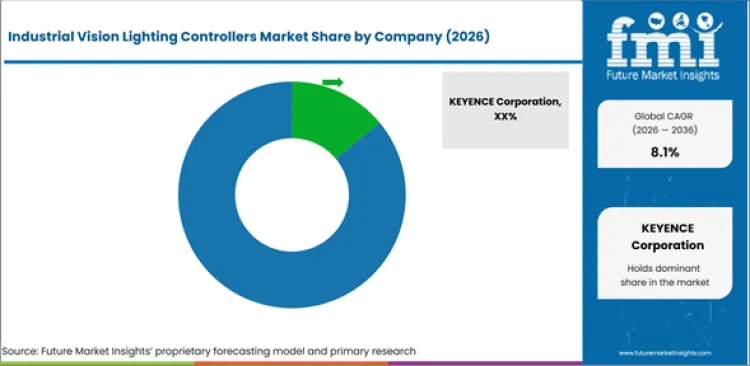
KEYENCE and CCS are profiled alongside Gardasoft, Smart Vision Lights and Advanced Illumination. Basler and Cognex are also profiled.
- Vision ecosystem suppliers hold an advantage through camera-light integration and field support.
- Lighting specialists compete through strobe timing and custom application testing.
- Automation channel companies influence demand through broader line-control and integrator relationships.
- Retail-ready documentation and wiring simplicity support supplier trust during retrofit projects.
Competitive dynamics are increasingly influenced by a supplier’s ability to optimize image quality before data reaches the vision system. Large machine vision vendors benefit from offering integrated portfolios that combine cameras and other system components. Lighting specialists maintain a strong position by addressing illumination challenges such as glare control and precise timing that cannot be solved through software alone. Controller performance remains a key differentiator in machine vision inspection applications.
Suppliers with strong application engineering and field support are well placed to meet customer requirements for consistent results under strict trigger and recipe conditions. Application laboratories are also important for validating performance in high-speed inspection environments that rely on TDI cameras.
How do top industrial vision lighting controllers market companies compare?
KEYENCE and CCS score strongly on ecosystem fit. Gardasoft and Smart Vision Lights stand out in specialist lighting control support.
| Company | Strobe Timing Depth | Lighting Ecosystem Fit | Application Support Reach | Geographic Footprint |
|---|---|---|---|---|
| KEYENCE Corporation | High | Very High | Very Strong | Global |
| CCS Inc. | High | High | Strong | Global |
| Gardasoft Vision | High | Strong | Strong | Europe and North America |
| Smart Vision Lights | Strong | Strong | Strong | North America and global channels |
| Advanced Illumination | Strong | Strong | Moderate | North America and global channels |
| Basler AG | Medium | High | Strong | Global |
| Cognex Corporation | Medium | Strong | High | Global |
| OMRON Corporation | Medium | Medium | Strong | Global |
| Zebra Technologies | Medium | Medium | Strong | Global |
| SICK AG | Medium | Medium | Strong | Global |
Source: Future Market Insights competitive analysis, 2026.
Who are the key players in the industrial vision lighting controllers market?
KEYENCE and CCS are listed alongside Gardasoft, Smart Vision Lights and Advanced Illumination. Basler and Cognex are listed with automation channel suppliers.
Key global companies leading the industrial vision lighting controllers market include:
- KEYENCE Corporation
- CCS Inc.
- Gardasoft Vision
- Smart Vision Lights
- Advanced Illumination
- Basler AG
- Cognex Corporation
- OMRON Corporation
- Zebra Technologies
- SICK AG
Key Developments in Industrial Vision Lighting Controllers Market
- In May 2026, Cognex launched the In-Sight 3900 high-performance AI vision system for high-speed inspection at the edge.
- In June 2026, KEYENCE listed the VS-G Series as a high-performance vision system with AI-based image inspection on the controller.
- In March 2025, CCS released the PD4-A Series of LED lighting digital control units for image processing applications.
Key Players in the Industrial Vision Lighting Controllers Market
Vision Ecosystem Suppliers
- KEYENCE Corporation
- Cognex Corporation
- Basler AG
Lighting Control Specialists
- CCS Inc.
- Gardasoft Vision
- Smart Vision Lights
- Advanced Illumination
Automation and Channel Companies
- OMRON Corporation
- Zebra Technologies
- SICK AG
- Balluff GmbH
- Stemmer Imaging
Industrial Vision Lighting Controllers Market - Report Scope
| Parameter | Details |
|---|---|
| Forecast period | 2026 to 2036 |
| Historical period | 2021 to 2025 |
| Quantitative unit | Revenue in USD million |
| By component | Cameras, lenses, lighting, frame grabbers, vision software, services |
| By inspection type | Defect detection, measurement, OCR/OCV, presence/absence, guidance |
| By deployment | Inline, at-line, robotic cell, portable |
| By end-use industry | Electronics, automotive, packaging, pharmaceuticals, food and beverage, metals |
| Regions covered | North America, Latin America, Europe, East Asia, South Asia and Pacific, Middle East and Africa |
| Countries covered | China, India, South Korea, Japan, United States, Germany, United Kingdom, France |
| Key companies profiled | KEYENCE, CCS, Gardasoft, Smart Vision Lights, Advanced Illumination, Basler, Cognex |
| Approach | Bottom-up controller attach-rate approach using component pricing, inspection use rates, automation signals and supplier channel checks |
Source: Future Market Insights, 2026.
Industrial Vision Lighting Controllers Market - Scope & Definition
| Attribute | Detail |
|---|---|
| Market Definition | Industrial vision lighting controllers are hardware and software used to control LED lighting timing, intensity, strobing and synchronization inside factory machine vision systems. |
| Functions Covered | Lighting timing, pulse control, strobe synchronization, current control, recipe storage, trigger coordination and thermal protection. |
| Applications Covered | Defect detection, dimensional checks, code reading, presence checks, guidance and inline quality verification. |
| End-Use Industries | Electronics, automotive, packaging, pharmaceuticals, food and beverage, metals and other discrete manufacturing sectors. |
| Grades Covered | Single-channel controllers, multi-channel controllers, current controllers, strobe controllers, trigger timing units and software-linked modules. |
| Inclusions | Lighting controllers, industrial lights, cameras, lenses, frame grabbers, vision software, services, inline systems, at-line systems, robotic cells and portable inspection setups. |
| Exclusions | Architectural dimmers, decorative LED controls, consumer camera flashes, traffic lighting, non-industrial power supplies and medical imaging lighting without factory use. |
Industrial Vision Lighting Controllers Market - Research Methodology
| Method | Description |
|---|---|
| Primary Research | FMI analyst interviews with automation engineers, machine builders, lighting specialists, camera suppliers, distributors and system integrators across key markets. |
| Desk Research | Review of official statistics, company product pages, machine vision supplier documentation, robotics data and industrial automation references. |
| Market Sizing & Forecasting | Bottom-up model using controller attach rates, channel count mix, average selling prices, replacement cycles and country-level automation activity. |
| Data Validation | Cross-verification using robot installation trends, manufacturing output signals, company portfolios, product launches and supplier channel checks. |
Industrial Vision Lighting Controllers Market Breakdown by Component, Inspection Type, Deployment, End-use Industry, and Region
Industrial Vision Lighting Controllers Market Segmented by Component:
- Cameras
- Lenses
- Lighting
- Frame Grabbers
- Vision Software
- Services
Industrial Vision Lighting Controllers Market Segmented by Inspection Type:
- Defect Detection
- Measurement
- OCR/OCV
- Presence/Absence
- Guidance
Industrial Vision Lighting Controllers Market Segmented by Deployment:
- Inline
- At-line
- Robotic Cell
- Portable
Industrial Vision Lighting Controllers Market Segmented by End-use Industry:
- Electronics
- Automotive
- Packaging
- Pharmaceuticals
- Food & Beverage
- Metals
Industrial Vision Lighting Controllers Market by Region:
- North America
- Latin America
- Europe
- East Asia
- South Asia and Pacific
- Middle East and Africa
Research Sources and Bibliography
- Basler AG. (2026). Machine vision lighting.
- Basler AG. (2025, March 18). What is machine vision?
- CCS Inc. (2025, March 7). CCS releases LED lighting digital control units PD4-A Series.
- Cognex Corporation. (2025, June 9). Cognex introduces OneVision.
- Cognex Corporation. (2026, May 5). Cognex launches In-Sight 3900 high-performance AI vision system.
- Federal Statistical Office of Germany. (2026, June 20). Stock of orders in manufacturing in April 2026.
- Gardasoft Vision. (2026). Practical use of machine vision light controllers.
- INSEE. (2026, April 3). In February 2026, manufacturing output was stable.
- INSEE. (2026, June 5). In April 2026, manufacturing output increased by 0.4%.
- International Federation of Robotics. (2025, September 25). Best-of World Robotics 2025.
- International Federation of Robotics. (2025, September 25). World Robotics 2025 report: Industrial robots.
- Japan Cabinet Office. (2026, February 18). Machinery orders in December 2025 and forecast for January to March 2026.
- KEYENCE Corporation. (2026). Illumination controller CA-DC.
- KEYENCE Corporation of America. (2026, June). News and events: VS-G Series high-performance vision system.
- Korea.net. (2025, February 4). Industrial output in 2024 grows 1.7%, facility investment 4.1%.
- Ministry of Economy, Trade and Industry, Japan. (2025, November 28). Indices of industrial production forecast: Preliminary report for October 2025.
- National Bureau of Statistics of China. (2026, January 20). Industrial production operation in December 2025.
- Office for National Statistics. (2026, February 12). Index of Production, UK: December 2025.
- OMRON Corporation. (2025, October 7). OMRON launches Bengaluru Automation Center to advance India’s smart manufacturing future.
- Press Information Bureau, Government of India. (2026, January 28). India’s Index of Industrial Production records growth of 7.8 percent in December 2025.
- Smart Vision Lights. (2025, April 17). See us at Automate 2025.
- U.S. Census Bureau. (2026, June 3). Monthly full report on manufacturers’ shipments, inventories, and orders.
- Zebra Technologies. (2025, July 1). Zebra Technologies and Clearview launch Industrial Automation Centre of Excellence.
- Zebra Technologies. (2025, May 12). Zebra Technologies showcases new intelligent automation solutions at Automate 2025.
This bibliography is provided for reader reference and is not exhaustive. The full report contains the complete reference list and detailed citations.
This Report Answers
- Market size estimates for 2026 and forecasts through 2036 for the industrial vision lighting controllers market.
- Insights across more than 30 regional and country-level markets.
- Analysis of demand drivers and inspection use cases. It also reviews deployment models and buyer selection behavior.
- Evaluation of component categories including lighting and cameras. It also covers lenses, software and services.
- Assessment of country-level growth across China and India. It also covers South Korea and Japan. The section extends to the United States Germany the United Kingdom and France.
- Identification of opportunities across inline inspection and robotic cells. It also reviews defect detection and retrofit projects.
- Evaluation of competitive positioning across vision ecosystems, lighting specialists and automation channel companies.
- Analysis of supplier selection factors including strobe timing and current control. It also reviews thermal handling and field support.
- Definition of market inclusions and exclusions for hardware, software and service coverage.
- Delivery of market data, forecasts and supporting analysis in document-ready format.
Frequently Asked Questions
What is the growth prospect for industrial vision lighting controllers?
Demand for industrial vision lighting controllers is expected to rise as factories need repeatable lighting for inline inspection and defect detection.
Which companies are expected to shape the industrial vision lighting controllers market?
KEYENCE and CCS are expected to shape supplier competition with Gardasoft, Smart Vision Lights and Advanced Illumination. Basler and Cognex also influence camera ecosystem decisions.
Why are factories investing in industrial vision lighting controllers?
Factories are investing in controllers to stabilize light output, reduce false rejects and improve image repeatability across production runs.
Which component category is most relevant to the market?
Controlled illumination determines whether cameras can capture useful surface detail. This makes lighting the most relevant component category.
Which inspection use case receives the most attention?
Defect detection receives the most attention. Scratches cracks and coating gaps require controlled contrast under line speed.
Why are inline systems important for this market?
Inline systems are important. They inspect every part without diverting products to separate test stations.
How do regulations influence controller adoption?
Regulations influence adoption by pushing packaging, pharmaceutical and food lines toward repeatable code checks and traceable reject records.
How do retrofit projects support market demand?
Retrofit projects support demand by improving lighting control without replacing the full camera system.
Preview the report firsthand - request a free sample
Get SampleGet the brochure for pricing and purchase details.
Get PDFTable of Content
- Key Takeaways
- Market Size and CAGR
- Top Growth Driver
- Fastest Growing Segment
- Leading Region
- Key Companies
- Emerging Opportunities
- Executive Summary
- Global Market Outlook
- Demand-side Trends
- Supply-side Trends
- Technology Roadmap Analysis
- Analysis and Recommendations
- Analyst Perspective (What is happening? Why now? What should investors know?)
- Key Questions Answered
- How large is the market?
- What is the CAGR?
- What are key trends?
- Which region dominates?
- Who are the leaders?
- Market Overview
- Market Coverage / Taxonomy
- Market Definition / Scope / Limitations
- Research Methodology
- Chapter Orientation
- Analytical Lens and Working Hypotheses
- Market Structure, Signals, and Trend Drivers
- Benchmarking and Cross-market Comparability
- Market Sizing, Forecasting, and Opportunity Mapping
- Research Design and Evidence Framework
- Desk Research Programme (Secondary Evidence)
- Expert Input and Fieldwork (Primary Evidence)
- Tooling, Models, and Reference Databases
- Data Engineering and Model Build
- Quality Assurance and Audit Trail
- Market Background
- Market Dynamics (Drivers, Restraints, Opportunity, Trends)
- Scenario Forecast (Optimistic, Likely, Conservative)
- Impact Analysis
- AI Impact
- Sustainability Impact
- Regulatory Impact
- Technology Impact
- Consumer / Buyer Analysis
- Purchase Drivers
- Adoption Barriers
- Buyer Journey
- Opportunity Map Analysis
- Product Life Cycle Analysis
- Supply Chain Analysis
- Investment Feasibility Matrix
- Value Chain Analysis
- PESTLE and Porter's Analysis
- Regulatory Landscape
- Regional Parent Market Outlook
- Production and Consumption Statistics
- Import and Export Statistics
- Global Market Analysis and Forecast, 2021 to 2036
- Historical Market Size Value (USD Million) & Volume (Unit) Analysis, 2021 to 2025
- Current and Future Market Size Value (USD Million) & Volume (Unit) Projections, 2026 to 2036
- Y-o-Y Growth Trend Analysis
- Absolute $ Opportunity Analysis
- Global Market Pricing Analysis, 2021 to 2036
- Global Market Analysis and Forecast, By Component, 2021 to 2036
- Introduction / Key Findings
- Historical Market Size Value (USD Million) & Volume (Unit) Analysis By Component, 2021 to 2025
- Current and Future Market Size Value (USD Million) & Volume (Unit) Analysis and Forecast By Component, 2026 to 2036
- Lighting
- Lenses
- Cameras
- Frame Grabbers
- Vision Software
- Services
- Lighting
- Y-o-Y Growth Trend Analysis By Component, 2021 to 2025
- Absolute $ Opportunity Analysis By Component, 2026 to 2036
- Global Market Analysis and Forecast, By Inspection Type, 2021 to 2036
- Introduction / Key Findings
- Historical Market Size Value (USD Million) & Volume (Unit) Analysis By Inspection Type, 2021 to 2025
- Current and Future Market Size Value (USD Million) & Volume (Unit) Analysis and Forecast By Inspection Type, 2026 to 2036
- Defect Detection
- Measurement
- Guidance
- Defect Detection
- Y-o-Y Growth Trend Analysis By Inspection Type, 2021 to 2025
- Absolute $ Opportunity Analysis By Inspection Type, 2026 to 2036
- Global Market Analysis and Forecast, By Deployment, 2021 to 2036
- Introduction / Key Findings
- Historical Market Size Value (USD Million) & Volume (Unit) Analysis By Deployment, 2021 to 2025
- Current and Future Market Size Value (USD Million) & Volume (Unit) Analysis and Forecast By Deployment, 2026 to 2036
- Inline
- At-line
- Portable
- Inline
- Y-o-Y Growth Trend Analysis By Deployment, 2021 to 2025
- Absolute $ Opportunity Analysis By Deployment, 2026 to 2036
- Global Market Analysis and Forecast, By End-use Industry, 2021 to 2036
- Introduction / Key Findings
- Historical Market Size Value (USD Million) & Volume (Unit) Analysis By End-use Industry, 2021 to 2025
- Current and Future Market Size Value (USD Million) & Volume (Unit) Analysis and Forecast By End-use Industry, 2026 to 2036
- Electronics
- Automotive
- Packaging
- Electronics
- Y-o-Y Growth Trend Analysis By End-use Industry, 2021 to 2025
- Absolute $ Opportunity Analysis By End-use Industry, 2026 to 2036
- Global Market Analysis and Forecast, By Region, 2021 to 2036
- Introduction
- Historical Market Size Value (USD Million) & Volume (Unit) Analysis By Region, 2021 to 2025
- Current Market Size Value (USD Million) & Volume (Unit) Analysis and Forecast By Region, 2026 to 2036
- North America
- Latin America
- Western Europe
- Eastern Europe
- East Asia
- South Asia and Pacific
- Middle East & Africa
- Market Attractiveness Analysis By Region
- North America Market Analysis and Forecast, By Country, 2021 to 2036
- Historical Market Size Value (USD Million) & Volume (Unit) Trend Analysis By Market Taxonomy, 2021 to 2025
- Market Size Value (USD Million) & Volume (Unit) Forecast By Market Taxonomy, 2026 to 2036
- By Country
- USA
- Canada
- Mexico
- By Component
- By Inspection Type
- By Deployment
- By End-use Industry
- By Country
- Market Attractiveness Analysis
- By Country
- By Component
- By Inspection Type
- By Deployment
- By End-use Industry
- Key Takeaways
- Latin America Market Analysis and Forecast, By Country
- Historical Market Size Value (USD Million) & Volume (Unit) Trend Analysis By Market Taxonomy, 2021 to 2025
- Market Size Value (USD Million) & Volume (Unit) Forecast By Market Taxonomy, 2026 to 2036
- By Country
- Brazil
- Chile
- Rest of Latin America
- By Component
- By Inspection Type
- By Deployment
- By End-use Industry
- By Country
- Market Attractiveness Analysis
- By Country
- By Component
- By Inspection Type
- By Deployment
- By End-use Industry
- Key Takeaways
- Western Europe Market Analysis and Forecast, By Country
- Historical Market Size Value (USD Million) & Volume (Unit) Trend Analysis By Market Taxonomy, 2021 to 2025
- Market Size Value (USD Million) & Volume (Unit) Forecast By Market Taxonomy, 2026 to 2036
- By Country
- Germany
- UK
- Italy
- Spain
- France
- Nordic
- BENELUX
- Rest of Western Europe
- By Component
- By Inspection Type
- By Deployment
- By End-use Industry
- By Country
- Market Attractiveness Analysis
- By Country
- By Component
- By Inspection Type
- By Deployment
- By End-use Industry
- Key Takeaways
- Eastern Europe Market Analysis and Forecast, By Country
- Historical Market Size Value (USD Million) & Volume (Unit) Trend Analysis By Market Taxonomy, 2021 to 2025
- Market Size Value (USD Million) & Volume (Unit) Forecast By Market Taxonomy, 2026 to 2036
- By Country
- Russia
- Poland
- Hungary
- Balkan & Baltic
- Rest of Eastern Europe
- By Component
- By Inspection Type
- By Deployment
- By End-use Industry
- By Country
- Market Attractiveness Analysis
- By Country
- By Component
- By Inspection Type
- By Deployment
- By End-use Industry
- Key Takeaways
- East Asia Market Analysis and Forecast, By Country
- Historical Market Size Value (USD Million) & Volume (Unit) Trend Analysis By Market Taxonomy, 2021 to 2025
- Market Size Value (USD Million) & Volume (Unit) Forecast By Market Taxonomy, 2026 to 2036
- By Country
- China
- Japan
- South Korea
- By Component
- By Inspection Type
- By Deployment
- By End-use Industry
- By Country
- Market Attractiveness Analysis
- By Country
- By Component
- By Inspection Type
- By Deployment
- By End-use Industry
- Key Takeaways
- South Asia and Pacific Market Analysis and Forecast, By Country
- Historical Market Size Value (USD Million) & Volume (Unit) Trend Analysis By Market Taxonomy, 2021 to 2025
- Market Size Value (USD Million) & Volume (Unit) Forecast By Market Taxonomy, 2026 to 2036
- By Country
- India
- ASEAN
- Australia & New Zealand
- Rest of South Asia and Pacific
- By Component
- By Inspection Type
- By Deployment
- By End-use Industry
- By Country
- Market Attractiveness Analysis
- By Country
- By Component
- By Inspection Type
- By Deployment
- By End-use Industry
- Key Takeaways
- Middle East & Africa Market Analysis and Forecast, By Country
- Historical Market Size Value (USD Million) & Volume (Unit) Trend Analysis By Market Taxonomy, 2021 to 2025
- Market Size Value (USD Million) & Volume (Unit) Forecast By Market Taxonomy, 2026 to 2036
- By Country
- Kingdom of Saudi Arabia
- Other GCC Countries
- Türkiye
- South Africa
- Other African Union
- Rest of Middle East & Africa
- By Component
- By Inspection Type
- By Deployment
- By End-use Industry
- By Country
- Market Attractiveness Analysis
- By Country
- By Component
- By Inspection Type
- By Deployment
- By End-use Industry
- Key Takeaways
- Key Countries Market Analysis
- USA
- Pricing Analysis
- Market Share Analysis, 2025
- By Component
- By Inspection Type
- By Deployment
- By End-use Industry
- Canada
- Pricing Analysis
- Market Share Analysis, 2025
- By Component
- By Inspection Type
- By Deployment
- By End-use Industry
- Mexico
- Pricing Analysis
- Market Share Analysis, 2025
- By Component
- By Inspection Type
- By Deployment
- By End-use Industry
- Brazil
- Pricing Analysis
- Market Share Analysis, 2025
- By Component
- By Inspection Type
- By Deployment
- By End-use Industry
- Chile
- Pricing Analysis
- Market Share Analysis, 2025
- By Component
- By Inspection Type
- By Deployment
- By End-use Industry
- Germany
- Pricing Analysis
- Market Share Analysis, 2025
- By Component
- By Inspection Type
- By Deployment
- By End-use Industry
- UK
- Pricing Analysis
- Market Share Analysis, 2025
- By Component
- By Inspection Type
- By Deployment
- By End-use Industry
- Italy
- Pricing Analysis
- Market Share Analysis, 2025
- By Component
- By Inspection Type
- By Deployment
- By End-use Industry
- Spain
- Pricing Analysis
- Market Share Analysis, 2025
- By Component
- By Inspection Type
- By Deployment
- By End-use Industry
- France
- Pricing Analysis
- Market Share Analysis, 2025
- By Component
- By Inspection Type
- By Deployment
- By End-use Industry
- India
- Pricing Analysis
- Market Share Analysis, 2025
- By Component
- By Inspection Type
- By Deployment
- By End-use Industry
- ASEAN
- Pricing Analysis
- Market Share Analysis, 2025
- By Component
- By Inspection Type
- By Deployment
- By End-use Industry
- Australia & New Zealand
- Pricing Analysis
- Market Share Analysis, 2025
- By Component
- By Inspection Type
- By Deployment
- By End-use Industry
- China
- Pricing Analysis
- Market Share Analysis, 2025
- By Component
- By Inspection Type
- By Deployment
- By End-use Industry
- Japan
- Pricing Analysis
- Market Share Analysis, 2025
- By Component
- By Inspection Type
- By Deployment
- By End-use Industry
- South Korea
- Pricing Analysis
- Market Share Analysis, 2025
- By Component
- By Inspection Type
- By Deployment
- By End-use Industry
- Russia
- Pricing Analysis
- Market Share Analysis, 2025
- By Component
- By Inspection Type
- By Deployment
- By End-use Industry
- Poland
- Pricing Analysis
- Market Share Analysis, 2025
- By Component
- By Inspection Type
- By Deployment
- By End-use Industry
- Hungary
- Pricing Analysis
- Market Share Analysis, 2025
- By Component
- By Inspection Type
- By Deployment
- By End-use Industry
- Kingdom of Saudi Arabia
- Pricing Analysis
- Market Share Analysis, 2025
- By Component
- By Inspection Type
- By Deployment
- By End-use Industry
- Türkiye
- Pricing Analysis
- Market Share Analysis, 2025
- By Component
- By Inspection Type
- By Deployment
- By End-use Industry
- South Africa
- Pricing Analysis
- Market Share Analysis, 2025
- By Component
- By Inspection Type
- By Deployment
- By End-use Industry
- USA
- Market Structure Analysis
- Competition Dashboard
- Competition Benchmarking
- Market Share Analysis of Top Players
- By Regional
- By Component
- By Inspection Type
- By Deployment
- By End-use Industry
- Emerging Startups
- Innovation Benchmarking
- Competition Analysis
- Competition Deep Dive
- KEYENCE Corporation
- Overview
- Product Portfolio
- Profitability by Market Segments (Product/Region/Sales Channel)
- Sales Footprint
- Strategy Overview
- Marketing Strategy
- Product Strategy
- Channel Strategy
- CCS Inc.
- Gardasoft Vision
- Smart Vision Lights
- Advanced Illumination
- Basler AG
- KEYENCE Corporation
- Case Studies
- Success Stories
- Recent Developments
- Competition Deep Dive
- Assumptions & Acronyms Used


