

- Market Size (2026)
- USD 165.0 Mn
- Forecast (2036)
- USD 622.5 Mn
- CAGR (2026 to 2036)
- 14.2%
AI Model Drift Monitoring for Industrial Vision Market Size, Market Forecast and Outlook By FMI
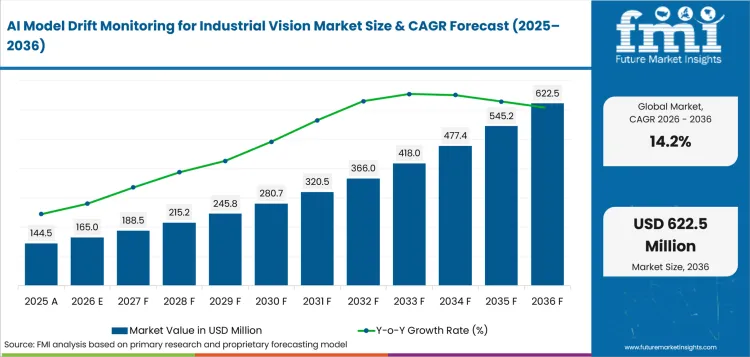
USD 165.0 million in 2026 and USD 622.5 million by 2036 at a 14.2% CAGR.
The AI model drift monitoring for industrial vision industry value is expected to increase from USD 144.5 million in 2025 to USD 622.5 million by 2036 at 14.2% CAGR, driven by factories connecting image inspection accuracy with production stability and retraining approval. Defect detection is forecast to represent 42.0% share in 2026 since rare defects can change appearance after material or camera-position updates. Vision software is expected to secure 38.0% share in 2026, led by dashboards, thresholds and alert workflows.
AI Model Drift Monitoring for Industrial Vision Market Overview: Size and Forecast
- 2025 Market Size: USD 144.5 million
- 2026 Market Size: USD 165.0 million
- 2036 Market Size: USD 622.5 million
- Forecast CAGR: 14.2% from 2026 to 2036
- Leading Inspection Type: Defect Detection
- Defect Detection Share in 2026: 42.0%
- Leading Component: Vision Software
- Vision Software Share in 2026: 38.0%
- Fastest-growing Country: India
- India CAGR: 16.0% by 2036
Summary of the AI Model Drift Monitoring for Industrial Vision Market
- Demand and Growth Drivers
- Factory quality teams use drift alerts to detect false rejects and missed defects before errors spread across shifts.
- Robotized inspection cells increase camera checkpoints needing repeatable model behavior after line adjustments.
- AI governance planning raises buyer interest in model logs and human review routines for inspection systems.
- Product and Segment View
- Defect detection is projected to hold 42.0% share in 2026, led by high-cost exposure from rare, visually changing defects.
- Vision software is forecast to secure 38.0% share in 2026, supported by model version histories and approval workflows.
- Inline deployment is expected to account for 34.0% share in 2026, shaped by production stations needing alerts before reject rates escalate.
- Geography and Competitive Outlook
- India is projected to record 16.0% CAGR by 2036, backed by factory automation expansion and electronics manufacturing scale-up.
- China is expected to expand at 15.1% CAGR by 2036, driven by high robot installations and dense inspection endpoints.
- Cognex and Keyence compete due to industrial vision systems and established factory access.
- Siemens, Zebra Technologies, SICK, Omron, Basler, and Teledyne focus on software and quality inspection support.
- Analyst Opinion
- Nikhil Kaitwade, Principal Consultant for Technology at FMI, observes, “AI model drift monitoring is moving from pilot oversight into factory quality control. Inspection models can weaken after lighting drift or camera movement. Buyers now want proof that an approved model continues to perform after months of production change. Suppliers connecting image capture and retraining approval should gain stronger buyer confidence.”
- Which factors support expansion in the AI model drift monitoring for industrial vision market?
- Factory image data and edge alerts support market value across automated inspection lines.
- Market value is supported by monitoring software revenue before service contracts and retraining support add incremental sales.
- Supplier pricing reflects integration effort and plant-level validation requirements.
- Revenue improves as factories convert AI inspection pilots into controlled quality workflows with documented model review.
- Buyer confidence improves as systems compare model behavior and production change records in one workflow.
Factory automation scale is making drift monitoring a quality assurance tool rather than a data science add-on. International Federation of Robotics reported 542,000 industrial robot installations in 2024, while Asia accounted for 74.0% of new deployments. EU AI Act Service Desk guidance states high-risk AI system deployers must keep logs for at least six months under Article 26, which supports demand for controlled model records in regulated factories. Siemens stated in November 2024 that NVIDIA-accelerated industrial PCs can deliver up to 25-fold faster AI execution for industrial workloads, supporting line-side quality inspection and local alert handling.
Why is the AI model drift monitoring for industrial vision market growing?
Factory inspection models need continuous review as production images change through new materials, lighting drift, and product variants.
Market expansion is supported by rising automation density and stronger demand for inspection evidence. International Federation of Robotics reported that global robot density increased from 163 to 177 robots per 10,000 manufacturing employees in 2024. Higher robot density increases automated inspection points and creates more image streams needing stability checks. Industrial vision buyers need drift alerts that show whether an issue came from the model or process change. Monitoring tools therefore help quality teams reduce scrap and protect approved inspection performance across production shifts.
How is the AI model drift monitoring for industrial vision market segmented?
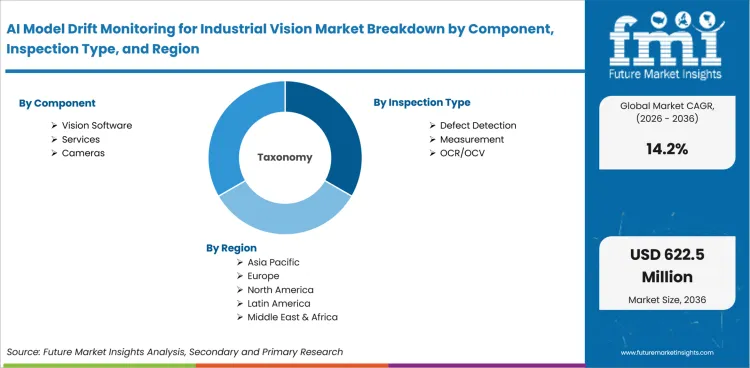
AI model drift monitoring for industrial vision industry is segmented by component, inspection type, deployment, end-use industry, and monitoring workflow.
- Vision software is projected to secure 38.0% share in 2026, led by buyer need for drift thresholds, model logs and retraining workflow control.
- Defect detection is anticipated to hold 42.0% share in 2026 since visual defect classes can change across coatings and product revisions.
- Inline deployment is forecast to capture 34.0% share in 2026, supported by live production stations needing immediate drift evidence before good parts are rejected.
- Electronics is expected to account for 31.5% share in 2026, guided by dense image variability across circuit boards and micro-components.
- Detection and alerting is projected to represent 33.5% share in 2026, shaped by factories needing fast warning signals before moving into retraining approval.
Why does vision software lead component demand?
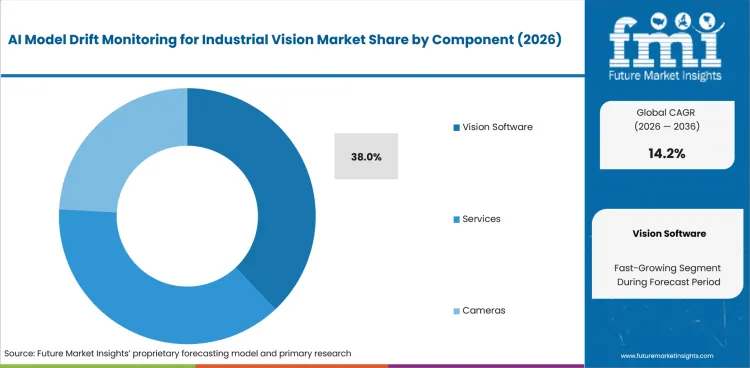
- Vision software is projected to account for 38.0% share in 2026, influenced by drift thresholds and retraining triggers inside quality systems.
- Camera and frame grabber demand improves as monitoring platforms require image context to separate model drift from capture-related inspection errors.
Which inspection type leads the AI model drift monitoring for industrial vision market?
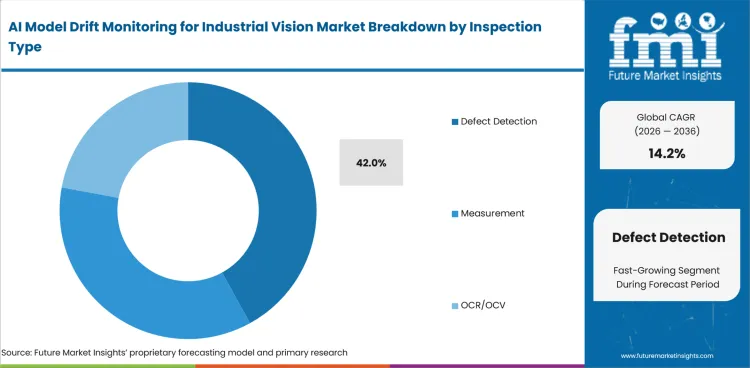
- Defect detection is anticipated to hold 42.0% share in 2026 through stronger exposure to rare defect classes and visual changes after material or supplier adjustments.
- Measurement and OCR/OCV monitoring still gain use. Defined rules and gauges make failure modes easier to confirm during plant review.
Which deployment mode leads the AI model drift monitoring for industrial vision market?
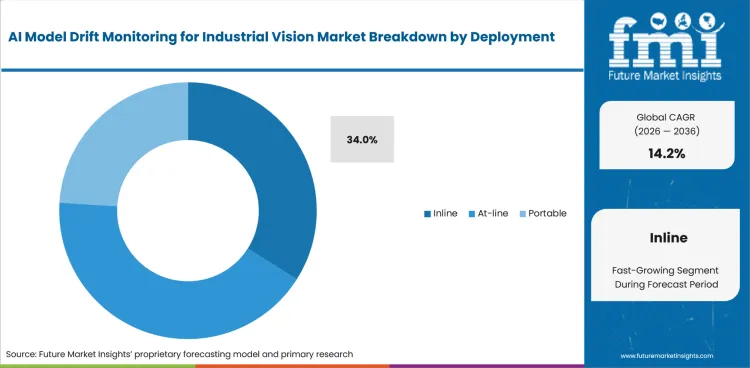
- Inline deployment is forecast to secure 34.0% share in 2026, shaped by live inspection decisions affecting scrap and line stoppage risk.
- At-line and portable deployments gain acceptance for validation checks and staged adoption across brownfield factories.
Which end-use industry leads the AI model drift monitoring for industrial vision market?
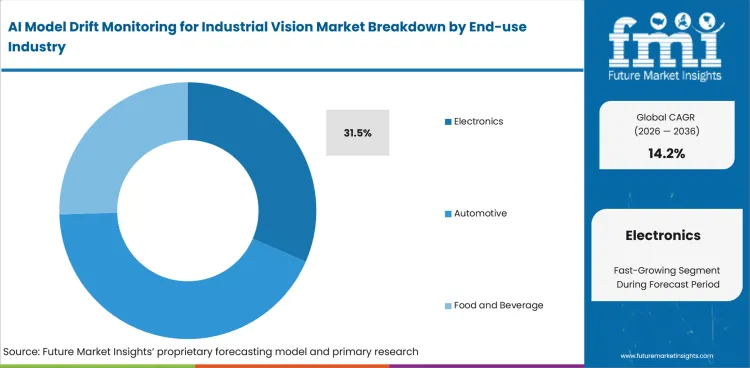
- Electronics is expected to represent 31.5% share in 2026, led by dense product variation across solder joints, panels, boards, and miniature components.
- Automotive and pharmaceutical plants add demand as safety checks and surface defects require repeatable evidence.
Which monitoring workflow leads the AI model drift monitoring for industrial vision market?
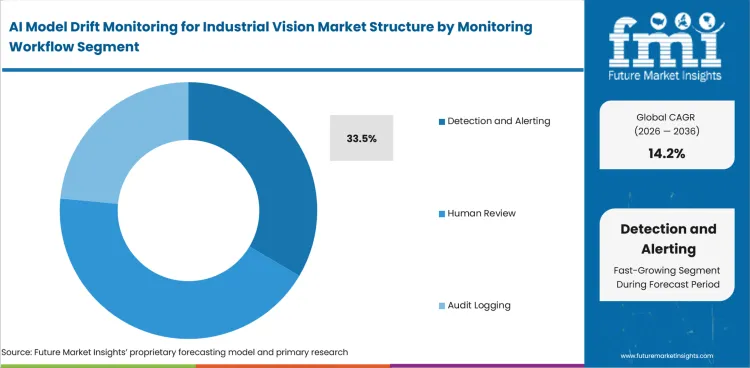
- Detection and alerting is projected to account for 33.5% share in 2026, supported by plant teams needing fast warning signals before defect patterns spread across shifts.
- Human review and audit logging gain importance in regulated factories requiring documented decisions before updated models return to production.
What are the drivers, restraints, and opportunities in the AI model drift monitoring for industrial vision market?
Factory image change and AI governance support demand while data-control limits can slow cloud-based inspection review.
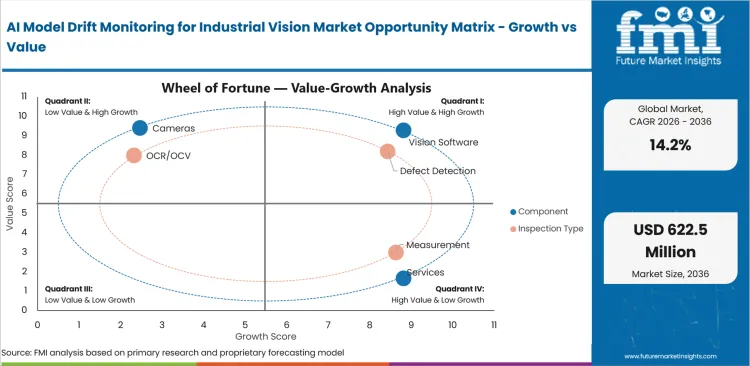
- Product variant changes create image shifts that weaken approved AI inspection models, forcing plants to monitor accuracy before false rejects or missed defects rise.
- Plant data controls limit external image transfer and can delay cloud-based retraining, especially where production images include sensitive product or process information.
- Edge AI computing lets suppliers monitor model behavior closer to the inspection station, reducing data-transfer concerns and speeding response when drift appears.
Factory Image Variation and Model Stability
Electronics and automotive inspection lines create the strongest monitoring need as visual variation grows across high-speed factories. The International Federation of Robotics reported that electrical and electronics robot installations rose 2.0% to 128,899 units in 2024, reclaiming the largest customer-industry position worldwide. Higher electronics automation increases camera checkpoints and defect-image volume. Drift monitoring helps quality teams catch model weakening before false rejects or rework costs spread across multiple stations.
Data Control and Audit Burden
Factory image data can expose process sequence or proprietary assembly methods. EU AI Act Service Desk guidance states high-risk AI system deployers must keep automatically generated logs for at least 6 months, supporting demand for local evidence retention and controlled audit records. Regulated factories therefore need monitoring systems retaining evidence without pushing sensitive image sets outside plant control. Suppliers lacking local logging and audit export functions can face slower acceptance.
Edge Monitoring and Local AI Execution
Edge monitoring creates the strongest commercial opening as factories seek faster alerts without external image transfer. Siemens stated in November 2024 that its Industrial Operations X portfolio and NVIDIA GPU-enabled industrial PCs can accelerate AI execution up to 25-fold for industrial applications. Local execution supports inspection alerts near cameras and line operators. Suppliers combining edge compute and retraining approval can reduce adoption barriers in electronics and battery plants.
Who are the leading companies in the AI model drift monitoring for industrial vision market?
Cognex, Keyence, Siemens, Zebra Technologies and Basler.
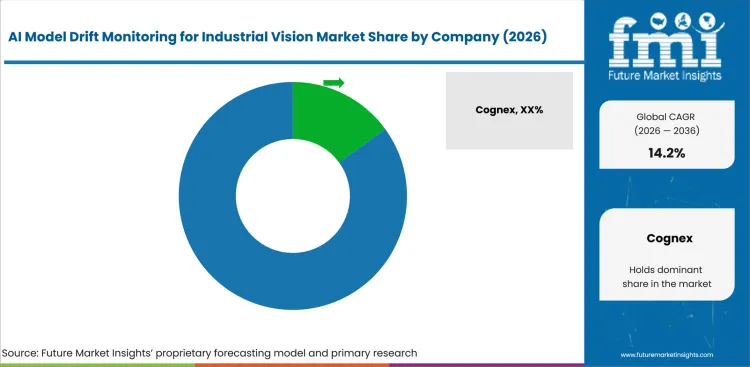
- Established machine vision companies hold an advantage led by camera fleets and factory application support.
- Automation platform suppliers gain stronger access by connecting edge computing and production data with inspection model records.
- Specialist AI software firms can gain brownfield opportunities by supporting mixed-camera fleets and existing quality systems.
- Systems integrators improve adoption by linking alert rules and factory documentation.
Industrial vision suppliers compete by proving that monitoring alerts can explain image change inside real production conditions. Lighting changes, equipment wear, and model decay can all affect inspection results. Cognex, Keyence, Basler, Teledyne, Omron, and SICK hold strong positions since their portfolios connect image capture and inspection software. Buyers prefer suppliers that can show root-cause evidence rather than only model confidence scores.
Automation and edge platforms are gaining value as factories keep more inspection data near the line. Siemens and Zebra Technologies compete through industrial computing, traceability and edge execution. Local alert handling helps factories protect sensitive images while giving quality teams a clear record of model behavior. Vendors connecting drift warnings with MES and quality databases should gain stronger acceptance in regulated plants.
Smaller AI software firms can profit through flexible integration and multi-vendor monitoring. Brownfield factories often run cameras and inspection tools from several suppliers. A software provider that can read model outputs, image statistics, retraining records, and operator decisions across mixed systems can support phased adoption. Service depth will remain important because many plants still need help assigning ownership across quality and IT teams.
How do top AI model drift monitoring for industrial vision companies compare?
| Company | Relevance to Market Title | Machine Vision Portfolio | AI Monitoring Capability | Factory Integration Support | Channel Reach | Geographic Footprint |
|---|---|---|---|---|---|---|
| Cognex | Very High | Very Strong | Strong | Strong | Very Strong | Global |
| Keyence | Very High | Very Strong | Strong | Strong | Very Strong | Global |
| Basler | High | Very Strong | Moderate to Strong | Strong | Strong | Global |
| Zebra Technologies | High | Strong | Strong | Strong | Very Strong | Global |
| SICK | High | Strong | Moderate to Strong | Very Strong | Strong | Global |
| Omron | High | Strong | Moderate to Strong | Strong | Strong | Global |
| Siemens | High | Moderate | Very Strong | Very Strong | Very Strong | Global |
| Teledyne | High | Very Strong | Moderate to Strong | Strong | Strong | Global |
| Datalogic | Moderate to High | Strong | Moderate | Strong | Strong | Global |
| Balluff | Moderate to High | Strong | Moderate | Strong | Moderate | Europe and Americas |
Source: Future Market Insights competitive analysis, 2026.
Who are the key players in the AI model drift monitoring for industrial vision market?
Cognex, Keyence and Siemens are listed with Zebra Technologies and Basler among other suppliers.
Key global companies leading the AI model drift monitoring for industrial vision market include:
- Cognex
- Keyence
- Basler
- Zebra Technologies
- SICK
- Omron
- Siemens
- Teledyne
- Datalogic
- Balluff
Key Developments in AI Model Drift Monitoring for Industrial Vision Market
- In April 2024, Cognex launched the In-Sight L38 3D vision system with embedded AI, combining 2D and 3D vision for inspection and measurement applications.
- In August 2024, Zebra Technologies added deep learning tools to Aurora machine vision software for machine builders and industrial users handling visual inspection tasks.
- In November 2024, Siemens expanded Industrial Operations X with NVIDIA-accelerated industrial PCs, stating the setup can deliver up to 25-fold faster AI execution for industrial applications.
Key Players in the AI Model Drift Monitoring for Industrial Vision Market
Industrial Vision Leaders
- Cognex
- Keyence
- Basler
- Teledyne
- Omron
- SICK
Automation and Edge Platform Companies
- Siemens
- Zebra Technologies
- Datalogic
- Balluff
Factory Integration and Application Specialists
- Machine vision integrators
- Industrial AI software firms
- Automation distributors
- Quality system integrators
Which countries are growing fastest in the AI model drift monitoring for industrial vision market?
India 16.0% CAGR, China 15.1% CAGR, South Korea 14.7% CAGR, Japan 13.9% CAGR, United States 13.7% CAGR, Germany 13.5% CAGR, France 13.2% CAGR, and United Kingdom 12.8% CAGR through 2036.
.webp "Top Country Growth Comparison Ai Model Drift Monitoring For Industrial Vision Market Cagr (2026 2036)")
| Country | CAGR |
|---|---|
| India | 16.0% |
| China | 15.1% |
| South Korea | 14.7% |
| Japan | 13.9% |
| United States | 13.7% |
| Germany | 13.5% |
| France | 13.2% |
| United Kingdom | 12.8% |
Source: Future Market Insights, 2026.
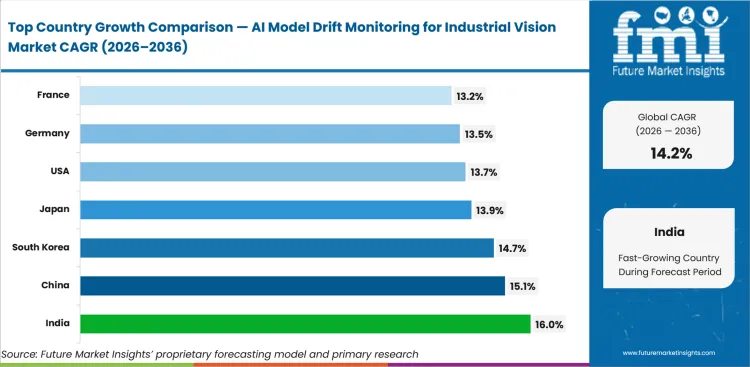
How do country-level CAGRs compare in the AI model drift monitoring for industrial vision market?
India leads country expansion while United Kingdom records the most cautious expansion outlook among profiled markets.
- India is forecast to record 16.0% CAGR by 2036, driven by electronics manufacturing scale and automation service demand expansion.
- China is expected to expand at 15.1% CAGR from 2026 to 2036 due to dense robot deployment increasing inspection endpoints.
- South Korea is projected to grow at 14.7% CAGR through 2036 since semiconductor and automotive plants require yield evidence.
- Japan is estimated to rise at 13.9% CAGR by 2036 with precision manufacturing and domestic automation suppliers supporting model review.
- United States is expected to advance at 13.7% CAGR over the forecast period, led by retrofit software adoption supporting existing inspection cells.
- Germany is forecast to grow at 13.5% CAGR through 2036, influenced by automotive and machine-builder channels expanding validation-led adoption.
- France is projected to post 13.2% CAGR by 2036 as aerospace and pharmaceutical lines add targeted AI inspection monitoring.
- United Kingdom is estimated to record 12.8% CAGR through 2036, backed by validation services and skills programs influencing staged deployment.
How fast is the AI model drift monitoring for industrial vision market growing in India?
A 16.0% CAGR through 2036 reflects electronics manufacturing scale-up and service-heavy adoption across plants.
Country Market Snapshot Table
| Parameter | Value |
|---|---|
| Market Size in 2025 (Value) | USD 10.4 million |
| Market Size in 2026 (Value) | USD 12.1 million |
| Market Forecast in 2036 (Value) | USD 53.3 million |
| CAGR (2026 to 2036) | 16.0% |
| Years Considered | 2021 to 2036 |
| Base Year | 2025 |
| Forecast Period | 2026 to 2036 |
| Units Considered | Value (USD million) |
| Leading Sub-Region | Western and southern electronics corridors |
India AI Model Drift Monitoring for Industrial Vision Market Outlook
Sector in India is influenced by rapid electronics manufacturing expansion and growing robot use across automotive suppliers. Plant teams need monitoring tools that work with mixed camera fleets and support integrator-led model review.
Service-heavy adoption is expected as many factories need external support for AI inspection validation and retraining approval. Suppliers offering local engineering support and affordable staged deployment should gain early buyer confidence.
Key Growth Drivers
- Electronics manufacturing scale increases inspection checkpoints across components and assembly lines. Press Information Bureau reported electronics production at ₹11.3 lakh crore in 2024 to 2025.
- Robot adoption supports automated inspection cells across automotive and electronics sites. International Federation of Robotics reported 9,120 industrial robots installed in India in 2024, a 7.0% increase.
- Semiconductor and display investment improves demand for camera-based process checks and model validation across clean manufacturing environments.
- Local integrator support helps factories add drift monitoring without replacing cameras and existing inspection software.
Key Restraints
- Skills availability can delay adoption as plants need engineers who understand AI inspection and quality records. India Semiconductor Mission reported a ₹76,000 crore outlay to build semiconductor and display capabilities, pointing to heavy talent requirements.
- Smaller factories can delay software subscriptions if inspection lines still rely on manual checks and basic rule-based vision.
- Mixed vendor equipment expected to raise integration time as plants attempt to connect drift tools with legacy cameras and quality systems.
What makes India unique
India is unique due to fast electronics manufacturing scale-up and a service-heavy adoption model shaped by integrators and machine builders.
Key Companies
- Cognex India
- Keyence India
- Omron Automation India
- SICK India
- Siemens India
- Zebra Technologies India
- Basler India
- Teledyne India
Sales & Marketing Channels
- Machine vision integrators
- Automation distributors
- Electronics manufacturing service providers
- Automotive supplier networks
- Industrial software partners
- Direct enterprise sales
Country Segment Breakdown Table
| Segment | Sub-Segments |
|---|---|
| By Component | Cameras · Lenses · Lighting · Frame Grabbers · Vision Software · Services |
| By Inspection Type | Defect Detection · Measurement · OCR/OCV · Presence/Absence · Guidance |
| By Deployment | Inline · At-line · Robotic Cell · Portable |
| By End-use Industry | Electronics · Automotive · Packaging · Pharmaceuticals · Food and Beverage · Metals |
| By Monitoring Workflow | Detection and Alerting · Human Review · Retraining and Approval · Audit Logging |
| Key Sub-Regions Covered, Electronics and Automotive Corridors | Maharashtra · Karnataka · Tamil Nadu · Telangana · Gujarat · Delhi NCR |
Frequently Asked Questions
How fast is India AI model drift monitoring for industrial vision market growing?
Sales in India are ready to expand at 16.0% CAGR from 2026 to 2036, guided by electronics manufacturing and automation services.
Who leads India AI model drift monitoring for industrial vision market?
Cognex, Keyence, Omron, SICK, Siemens, Zebra Technologies, Basler, and Teledyne compete led by machine vision and automation channels.
What is driving adoption in India AI model drift monitoring for industrial vision market?
Electronics manufacturing, robot additions, and service-led validation are moving factories toward drift alerts and model review.
What is the AI model drift monitoring for industrial vision market outlook in China?
A 15.1% CAGR through 2036 is supported by dense robot installations and large electronics manufacturing networks.
Country Market Snapshot Table
| Parameter | Value |
|---|---|
| Market Size in 2025 (Value) | USD 33.5 million |
| Market Size in 2026 (Value) | USD 38.6 million |
| Market Forecast in 2036 (Value) | USD 157.8 million |
| CAGR (2026 to 2036) | 15.1% |
| Years Considered | 2021 to 2036 |
| Base Year | 2025 |
| Forecast Period | 2026 to 2036 |
| Units Considered | Value (USD million) |
| Leading Sub-Region | Yangtze River Delta and Pearl River Delta factory corridors |
China AI Model Drift Monitoring for Industrial Vision Market Outlook
China demand is influenced by high robot adoption and fast product cycles. Inspection models face frequent variation from new components and production batches.
Factories value drift monitoring working near the line and proves yield impact quickly. Price pressure stays high, so suppliers need measurable scrap reduction and fast deployment support.
Key Growth Drivers
- Automated inspection endpoints are expanding across large factory networks. International Federation of Robotics reported 295,000 industrial robots installed in China in 2024, equal to 54.0% of global deployments.
- Electronics manufacturing creates dense image streams across device and assembly lines. China’s State Council reported major electronic information manufacturers reached 16.19 trillion yuan operating revenue in 2024.
- Domestic robot suppliers improve local automation reach and model monitoring move into more production cells.
- Short product cycles increase image variation and make drift alerts valuable for high-volume electronics and battery lines.
Key Restraints
- Factory conditions can stay uneven across provinces and suppliers. National Bureau of Statistics reported China’s manufacturing PMI at 49.2 in November 2025, below the expansion threshold.
- Price-sensitive buyers can delay full workflow adoption if suppliers cannot show savings from lower scrap and rework.
- Local data-control practices can restrict external image review and require on-site monitoring architecture.
What makes China unique
China is unique due to the world’s largest industrial robot base and high-volume electronics production requiring dense inspection coverage.
Key Companies
- Cognex China
- Keyence China
- SICK China
- Siemens China
- Zebra Technologies China
- Datalogic China
- Hikrobot
- Daheng Imaging
Sales & Marketing Channels
- Direct factory sales
- Machine builder channels
- Electronics manufacturing service networks
- Automation distributors
- Systems integrators
- Industrial software partners
Country Segment Breakdown Table
| Segment | Sub-Segments |
|---|---|
| By Component | Cameras · Lenses · Lighting · Frame Grabbers · Vision Software · Services |
| By Inspection Type | Defect Detection · Measurement · OCR/OCV · Presence/Absence · Guidance |
| By Deployment | Inline · At-line · Robotic Cell · Portable |
| By End-use Industry | Electronics · Automotive · Packaging · Pharmaceuticals · Food and Beverage · Metals |
| By Monitoring Workflow | Detection and Alerting · Human Review · Retraining and Approval · Audit Logging |
| Key Sub-Regions Covered, Factory Automation Corridors | Yangtze River Delta · Pearl River Delta · Beijing-Tianjin-Hebei · Chongqing · Chengdu · Wuhan |
Frequently Asked Questions
How fast is China AI model drift monitoring for industrial vision market growing?
Demand in China is projected to expand at 15.1% CAGR from 2026 to 2036 with electronics and robot density supporting adoption.
Who leads China AI model drift monitoring for industrial vision market?
Cognex, Keyence, SICK, Siemens, Zebra Technologies, Hikrobot, Datalogic, and Daheng Imaging compete depending on inspection and automation channels.
What is driving adoption in China AI model drift monitoring for industrial vision market?
High robot installations and fast product updates are pushing factories toward line-side model monitoring.
How is South Korea positioned in the AI model drift monitoring for industrial vision market?
A 14.7% CAGR through 2036 reflects yield-sensitive demand across semiconductor, display, battery, and automotive production.
Country Market Snapshot Table
| Parameter | Value |
|---|---|
| Market Size in 2025 (Value) | USD 11.8 million |
| Market Size in 2026 (Value) | USD 13.5 million |
| Market Forecast in 2036 (Value) | USD 53.1 million |
| CAGR (2026 to 2036) | 14.7% |
| Years Considered | 2021 to 2036 |
| Base Year | 2025 |
| Forecast Period | 2026 to 2036 |
| Units Considered | Value (USD million) |
| Leading Sub-Region | Seoul Capital Area and Gyeonggi technology corridor |
South Korea AI Model Drift Monitoring for Industrial Vision Market Outlook
South Korea demand is shaped by advanced electronics and automotive production. High-value outputs make false passes and false rejects costly for factory teams.
Buyers value root-cause evidence that separates model drift from camera or process variation. Suppliers need strong field support and production-proven alert workflows.
Key Growth Drivers
- High robot density supports advanced inspection workflows. International Federation of Robotics reported South Korea at 1,220 robots per 10,000 manufacturing employees in 2024.
- Semiconductor scale supports advanced machine vision demand. Invest Korea reported semiconductor exports at USD 141.9 billion in 2024, equal to 20.8% of national exports.
- Display and battery plants require repeatable visual checks across surface and contamination conditions.
- Automotive and electronics suppliers value drift records protecting yield and support customer quality audits.
Key Restraints
- AI adoption can create uneven workforce outcomes. OECD’s 2025 Korea AI labor report noted firm and worker views on AI job satisfaction differed, with firms scoring 2.88 and employees 2.67.
- Semiconductor and battery lines may restrict external image transfer, limiting cloud-only drift review services.
- High validation expectations can slow supplier onboarding if model evidence lacks plant-specific root-cause detail.
What makes South unique
South Korea is unique due to dense robotics use and yield-sensitive manufacturing in semiconductors and vehicles.
Key Companies
- Cognex Korea
- Keyence Korea
- SICK Korea
- Omron Korea
- Siemens Korea
- Zebra Technologies Korea
- Basler Korea
- Teledyne Korea
Sales & Marketing Channels
- Semiconductor equipment channels
- Battery manufacturing integrators
- Display equipment suppliers
- Automotive automation partners
- Direct enterprise sales
- Machine vision distributors
Country Segment Breakdown Table
| Segment | Sub-Segments |
|---|---|
| By Component | Cameras · Lenses · Lighting · Frame Grabbers · Vision Software · Services |
| By Inspection Type | Defect Detection · Measurement · OCR/OCV · Presence/Absence · Guidance |
| By Deployment | Inline · At-line · Robotic Cell · Portable |
| By End-use Industry | Electronics · Automotive · Packaging · Pharmaceuticals · Food and Beverage · Metals |
| By Monitoring Workflow | Detection and Alerting · Human Review · Retraining and Approval · Audit Logging |
| Key Sub-Regions Covered, Semiconductor and Battery Corridors | Seoul Capital Area · Gyeonggi · Incheon · Daejeon · Ulsan · Gwangju |
Frequently Asked Questions
How fast is South Korea AI model drift monitoring for industrial vision market growing?
Sector in South Korea is anticipated to expand at 14.7% CAGR from 2026 to 2036 through yield-sensitive inspection demand.
Who leads South Korea AI model drift monitoring for industrial vision market?
Cognex, Keyence, SICK, Omron, Siemens, Zebra Technologies, Basler, and Teledyne compete depending on high-precision inspection networks.
What is driving adoption in South Korea AI model drift monitoring for industrial vision market?
Semiconductor and automotive factories need drift records that protect yield and audit confidence.
What is the AI model drift monitoring for industrial vision market outlook in Japan?
A 13.9% CAGR through 2036 is supported by precision manufacturing and compact inspection systems.
Country Market Snapshot Table
| Parameter | Value |
|---|---|
| Market Size in 2025 (Value) | USD 14.7 million |
| Market Size in 2026 (Value) | USD 16.7 million |
| Market Forecast in 2036 (Value) | USD 61.5 million |
| CAGR (2026 to 2036) | 13.9% |
| Years Considered | 2021 to 2036 |
| Base Year | 2025 |
| Forecast Period | 2026 to 2036 |
| Units Considered | Value (USD million) |
| Leading Sub-Region | Kanto, Kansai, and Chubu manufacturing corridors |
Japan AI Model Drift Monitoring for Industrial Vision Market Outlook
Japan demand is influenced by precision manufacturing and trusted supplier relationships. Factories value compact equipment and inspection records that do not disrupt established production discipline.
Domestic automation suppliers support adoption through machine vision and factory software access. Model drift tools need simple operator workflows and strong root-cause explanation.
Key Growth Drivers
- Robot use supports recurring inspection automation. International Federation of Robotics reported 44,500 industrial robots installed in Japan in 2024 and an operational stock of 450,500 units.
- Semiconductor investment improves demand for inspection validation. JETRO reported Japan aims to raise domestic semiconductor company revenue to 15 trillion yen by 2030.
- Precision automotive and electronics lines require repeatable visual decisions across long production runs.
- Domestic supplier relationships help factories adopt monitoring through trusted machine vision and automation channels.
Key Restraints
- AI skills gaps can slow model review ownership across production teams. OECD reported 8.4% of employees in Japan use AI at work and 6.4% use generative AI, indicating a limited user base for routine AI inspection review.
- Factory teams can resist complex retraining steps if monitoring tools disrupt established quality routines.
- Smaller plants may choose rule-based vision upgrades before adopting full AI model monitoring.
What makes Japan unique
Japan is unique due to precision manufacturing discipline and strong domestic automation brands with deep factory access.
Key Companies
- Keyence Corporation
- Omron Corporation
- Cognex Japan
- SICK Japan
- Siemens Japan
- Basler Japan
- Teledyne Japan
- Datalogic Japan
Sales & Marketing Channels
- Direct automation sales
- Machine builders
- Electronics equipment suppliers
- Automotive automation partners
- Industrial distributors
- Application engineering labs
Country Segment Breakdown Table
| Segment | Sub-Segments |
|---|---|
| By Component | Cameras · Lenses · Lighting · Frame Grabbers · Vision Software · Services |
| By Inspection Type | Defect Detection · Measurement · OCR/OCV · Presence/Absence · Guidance |
| By Deployment | Inline · At-line · Robotic Cell · Portable |
| By End-use Industry | Electronics · Automotive · Packaging · Pharmaceuticals · Food and Beverage · Metals |
| By Monitoring Workflow | Detection and Alerting · Human Review · Retraining and Approval · Audit Logging |
| Key Sub-Regions Covered, Precision Manufacturing Corridors | Kanto · Kansai · Chubu · Kyushu · Tohoku · Hokkaido |
Frequently Asked Questions
How fast is Japan AI model drift monitoring for industrial vision market growing?
Japan is forecast to expand at 13.9% CAGR from 2026 to 2036 with precision manufacturing and robot use supporting adoption.
Who leads Japan AI model drift monitoring for industrial vision market?
Keyence, Omron, Cognex, SICK, Siemens, Basler, Teledyne, and Datalogic compete led by machine vision and automation channels.
What is driving adoption in Japan AI model drift monitoring for industrial vision market?
Precision production and domestic automation support are moving factories toward documented model stability.
How is the United States AI model drift monitoring for industrial vision market performing?
A 13.7% CAGR through 2036 reflects retrofit-led software adoption across existing inspection cells and automation lines.
Country Market Snapshot Table
| Parameter | Value |
|---|---|
| Market Size in 2025 (Value) | USD 26.6 million |
| Market Size in 2026 (Value) | USD 30.2 million |
| Market Forecast in 2036 (Value) | USD 109.3 million |
| CAGR (2026 to 2036) | 13.7% |
| Years Considered | 2021 to 2036 |
| Base Year | 2025 |
| Forecast Period | 2026 to 2036 |
| Units Considered | Value (USD million) |
| Leading Sub-Region | Midwest, Southeast, and West Coast manufacturing corridors |
United States AI Model Drift Monitoring for Industrial Vision Market Outlook
United States demand is shaped by retrofit-heavy factories already using industrial PCs and quality software. Buyers ask whether drift tools can connect with existing equipment without full line redesign.
Software value per line is high as regulated manufacturers need model records and local logging. Integrators remain important for brownfield plants with mixed camera fleets.
Key Growth Drivers
- Retrofit opportunity is supported by a large automation base. International Federation of Robotics reported 34,200 industrial robots installed in the United States in 2024, equal to 68.0% of installations in the Americas.
- Manufacturing innovation networks support factory technology transfer. Manufacturing USA’s 2025 annual report covered 17 public-private manufacturing innovation institutes.
- Medical device and electronics plants need inspection evidence for supplier qualification and internal quality review.
- Domestic integrator networks help connect model monitoring with legacy cameras and quality databases.
Key Restraints
- AI inspection readiness can stay uneven across factories with different data and legacy-system maturity. NIST reported 46.0% of USA manufacturers use AI tools in manufacturing operations, leaving many plants at an earlier stage for drift monitoring.
- Cloud review can face buyer resistance if product images contain customer labels or controlled process details.
- Smaller plants may need phased software packages as AI inspection ownership may sit between automation and IT teams.
What makes United unique
United States is unique due to retrofit-led adoption and high software value across regulated manufacturing sites.
Key Companies
- Cognex Corporation
- Zebra Technologies
- Teledyne Technologies
- SICK Inc.
- Siemens USA
- Keyence Corporation of America
- Omron Automation Americas
- Datalogic USA
Sales & Marketing Channels
- Direct enterprise sales
- Systems integrators
- Machine vision distributors
- Automation platform partners
- Medical device supplier networks
- Automotive supplier channels
Country Segment Breakdown Table
| Segment | Sub-Segments |
|---|---|
| By Component | Cameras · Lenses · Lighting · Frame Grabbers · Vision Software · Services |
| By Inspection Type | Defect Detection · Measurement · OCR/OCV · Presence/Absence · Guidance |
| By Deployment | Inline · At-line · Robotic Cell · Portable |
| By End-use Industry | Electronics · Automotive · Packaging · Pharmaceuticals · Food and Beverage · Metals |
| By Monitoring Workflow | Detection and Alerting · Human Review · Retraining and Approval · Audit Logging |
| Key Sub-Regions Covered, Manufacturing and Retrofit Corridors | Midwest · Southeast · Texas · California · New York · Pacific Northwest |
Frequently Asked Questions
How fast is United States AI model drift monitoring for industrial vision market growing?
United States demand is projected to rise at 13.7% CAGR from 2026 to 2036 through retrofit-led inspection monitoring.
Who leads United States AI model drift monitoring for industrial vision market?
Cognex, Zebra Technologies, Teledyne, SICK, Siemens, Keyence, Omron, and Datalogic compete based on software and automation channels.
What is driving adoption in United States AI model drift monitoring for industrial vision market?
Existing inspection lines and integrator support are moving buyers toward model logs and drift alerts.
What is the AI model drift monitoring for industrial vision market outlook in Germany?
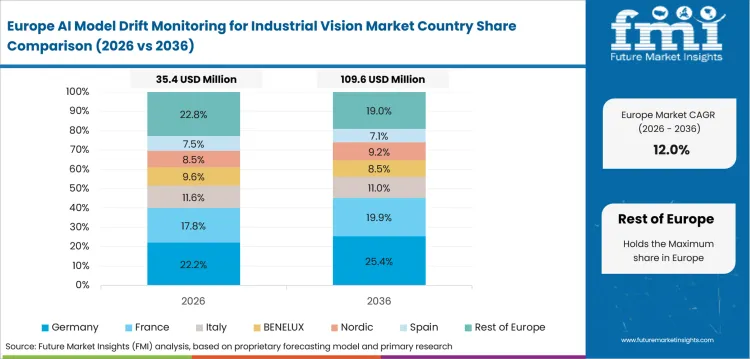
A 13.5% CAGR through 2036 is supported by machine-builder channels and Europe’s largest robot market.
Country Market Snapshot Table
| Parameter | Value |
|---|---|
| Market Size in 2025 (Value) | USD 15.6 million |
| Market Size in 2026 (Value) | USD 17.7 million |
| Market Forecast in 2036 (Value) | USD 62.8 million |
| CAGR (2026 to 2036) | 13.5% |
| Years Considered | 2021 to 2036 |
| Base Year | 2025 |
| Forecast Period | 2026 to 2036 |
| Units Considered | Value (USD million) |
| Leading Sub-Region | Bavaria, Baden-Württemberg, and North Rhine-Westphalia |
Germany AI Model Drift Monitoring for Industrial Vision Market Outlook
The market in Germany is reflected by automotive and precision manufacturing. Machine builders can embed drift monitoring into exported inspection equipment and production systems.
Buyers expect repeatability after tool wear and lighting shifts. Suppliers need evidence that monitoring tools support validation and engineering documentation.
Key Growth Drivers
- Germany remains Europe’s largest robot market. International Federation of Robotics reported 26,982 robot installations in Germany in 2024, representing 32.0% of Europe’s annual total.
- Automotive output supports inspection density. Germany Trade and Invest reported nearly 4.1 million passenger cars and 351,000 commercial vehicles manufactured in Germany in 2024.
- Machine builders create a natural route for drift monitoring through embedded inspection modules and exported production lines.
- Battery and electric vehicle production increases camera-based checks for welds and assembly tolerances.
Key Restraints
- Skilled labor limits can affect deployment and validation speed. ifo Institute reported 28.3% of German companies had too few qualified workers in February 2025.
- High engineering expectations can extend supplier qualification timelines for new AI inspection software.
- Cost-sensitive machinery buyers may delay monitoring subscriptions during weak order cycles.
What makes Germany unique
Germany is unique due to machine-builder access and strong validation expectations across engineered factories.
Key Companies
- Basler AG
- SICK AG
- Siemens AG
- Balluff GmbH
- Cognex Germany
- Keyence Germany
- Datalogic Germany
- IDS Imaging Development Systems GmbH
Sales & Marketing Channels
- Machine builders
- Automation distributors
- Automotive supplier networks
- Direct enterprise sales
- Industrial software partners
- Application engineering centers
Country Segment Breakdown Table
| Segment | Sub-Segments |
|---|---|
| By Component | Cameras · Lenses · Lighting · Frame Grabbers · Vision Software · Services |
| By Inspection Type | Defect Detection · Measurement · OCR/OCV · Presence/Absence · Guidance |
| By Deployment | Inline · At-line · Robotic Cell · Portable |
| By End-use Industry | Electronics · Automotive · Packaging · Pharmaceuticals · Food and Beverage · Metals |
| By Monitoring Workflow | Detection and Alerting · Human Review · Retraining and Approval · Audit Logging |
| Key Sub-Regions Covered, Automotive and Machine-Building Areas | Bavaria · Baden-Württemberg · North Rhine-Westphalia · Lower Saxony · Hesse · Saxony |
Frequently Asked Questions
How fast is Germany AI model drift monitoring for industrial vision market growing?
Sector in Germany is projected to expand at 13.5% CAGR from 2026 to 2036 through machine-builder and automotive inspection demand.
Who leads Germany AI model drift monitoring for industrial vision market?
Basler, SICK, Siemens, Balluff, Cognex, Keyence, Datalogic, and IDS compete based on machine vision and automation channels.
What is driving adoption in Germany AI model drift monitoring for industrial vision market?
Machine-builder integration and validation discipline are moving buyers toward model monitoring and audit evidence.
How is the AI model drift monitoring for industrial vision market performing in France?
A 13.2% CAGR through 2036 reflects targeted adoption across aerospace, luxury packaging, food, and pharmaceutical inspection lines.
Country Market Snapshot Table
| Parameter | Value |
|---|---|
| Market Size in 2025 (Value) | USD 8.2 million |
| Market Size in 2026 (Value) | USD 9.3 million |
| Market Forecast in 2036 (Value) | USD 32.1 million |
| CAGR (2026 to 2036) | 13.2% |
| Years Considered | 2021 to 2036 |
| Base Year | 2025 |
| Forecast Period | 2026 to 2036 |
| Units Considered | Value (USD million) |
| Leading Sub-Region | Île-de-France, Auvergne-Rhône-Alpes, and Occitanie |
France AI Model Drift Monitoring for Industrial Vision Market Outlook
France demand is selective and quality-led. Aerospace and pharmaceutical manufacturers adopt AI inspection monitoring after defining clear validation outcomes.
Suppliers need strong local support and simple audit records. Buyers value systems reducing customer claims without adding complicated review steps for operators.
Key Growth Drivers
- Targeted automation keeps inspection upgrades active. International Federation of Robotics reported 4,900 robot installations in France in 2024.
- Industrial innovation funding supports advanced manufacturing projects. France 2030 represents €54 billion of investment across companies and research bodies.
- Aerospace and pharmaceutical plants need explainable visual inspection decisions and strong model records.
- Luxury packaging and food manufacturers use AI vision monitoring to protect surface quality and seal inspection.
Key Restraints
- Wider automation softness can limit faster rollout. International Federation of Robotics reported French robot installations fell 24.0% in 2024.
- Conservative buyer qualification can extend pilot periods before full-line deployment.
- Smaller manufacturers may choose targeted inspection upgrades instead of full monitoring workflows.
What makes France unique
France is unique due to selective quality-led adoption in aerospace and pharmaceutical manufacturing.
Key Companies
- Cognex France
- Keyence France
- SICK France
- Siemens France
- Teledyne e2v
- Basler France
- Omron France
- Datalogic France
Sales & Marketing Channels
- Aerospace supplier networks
- Packaging machine builders
- Pharmaceutical equipment suppliers
- Food automation integrators
- Direct enterprise sales
- Industrial distributors
Country Segment Breakdown Table
| Segment | Sub-Segments |
|---|---|
| By Component | Cameras · Lenses · Lighting · Frame Grabbers · Vision Software · Services |
| By Inspection Type | Defect Detection · Measurement · OCR/OCV · Presence/Absence · Guidance |
| By Deployment | Inline · At-line · Robotic Cell · Portable |
| By End-use Industry | Electronics · Automotive · Packaging · Pharmaceuticals · Food and Beverage · Metals |
| By Monitoring Workflow | Detection and Alerting · Human Review · Retraining and Approval · Audit Logging |
| Key Sub-Regions Covered, Aerospace and Packaging Areas | Île-de-France · Auvergne-Rhône-Alpes · Occitanie · Hauts-de-France · Grand Est · Nouvelle-Aquitaine |
Frequently Asked Questions
How fast is France AI model drift monitoring for industrial vision market growing?
Industry in France is anticipated to grow at 13.2% CAGR from 2026 to 2036 with targeted inspection upgrades supporting adoption.
Who leads France AI model drift monitoring for industrial vision market?
Cognex, Keyence, SICK, Siemens, Teledyne e2v, Basler, Omron, and Datalogic compete led by local industrial channels.
What is driving adoption in France AI model drift monitoring for industrial vision market?
Aerospace and food manufacturers need validated inspection records and root-cause evidence.
What is the AI model drift monitoring for industrial vision market outlook in the United Kingdom?
A 12.8% CAGR through 2036 reflects validation-led adoption and staged factory software upgrades.
Country Market Snapshot Table
| Parameter | Value |
|---|---|
| Market Size in 2025 (Value) | USD 6.1 million |
| Market Size in 2026 (Value) | USD 6.9 million |
| Market Forecast in 2036 (Value) | USD 23.0 million |
| CAGR (2026 to 2036) | 12.8% |
| Years Considered | 2021 to 2036 |
| Base Year | 2025 |
| Forecast Period | 2026 to 2036 |
| Units Considered | Value (USD million) |
| Leading Sub-Region | Midlands, North West, and South East manufacturing corridors |
United Kingdom AI Model Drift Monitoring for Industrial Vision Market Outlook
United Kingdom demand is led by validation services and medical packaging. Adoption often begins with software upgrades and integrator-led pilots rather than full production-line replacement.
Factories need inspection tools that explain drift in practical terms for quality managers and operators. Skills support and robotics adoption programs should help suppliers improve buyer readiness.
Key Growth Drivers
- Smart machine policy supports adoption of industrial AI and robotics. Smart Machines Strategy 2035 states smart machines could increase United Kingdom GVA from £6.4 billion to £150 billion by 2035.
- Robotics support is moving into manufacturing adoption programs. Advanced Manufacturing Sector Plan includes an initial £40 million investment for Robotics Adoption Hubs.
- Aerospace and food manufacturers need controlled AI vision logs for validation review.
- Integrators can help brownfield factories connect model monitoring with existing cameras and inspection software.
Key Restraints
- Robot adoption has been uneven. International Federation of Robotics reported United Kingdom industrial robot installations fell 35.0% to 2,500 units in 2024.
- Skills gaps can slow drift monitoring ownership across automation and IT teams.
- Smaller factories may prefer phased inspection upgrades before adopting full model review workflows.
What makes United unique
United Kingdom is unique due to validation-led adoption and a strong role for integrators in brownfield inspection upgrades.
Key Companies
- Cognex UK
- Keyence UK
- SICK UK
- Siemens UK
- Zebra Technologies UK
- Omron UK
- Basler UK
- Teledyne UK
Sales & Marketing Channels
- Systems integrators
- Aerospace supplier networks
- Food and packaging automation partners
- Medical device equipment suppliers
- Industrial software partners
- Direct enterprise sales
Country Segment Breakdown Table
| Segment | Sub-Segments |
|---|---|
| By Component | Cameras · Lenses · Lighting · Frame Grabbers · Vision Software · Services |
| By Inspection Type | Defect Detection · Measurement · OCR/OCV · Presence/Absence · Guidance |
| By Deployment | Inline · At-line · Robotic Cell · Portable |
| By End-use Industry | Electronics · Automotive · Packaging · Pharmaceuticals · Food and Beverage · Metals |
| By Monitoring Workflow | Detection and Alerting · Human Review · Retraining and Approval · Audit Logging |
| Key Sub-Regions Covered, Validation and Manufacturing Corridors | Midlands · North West · South East · Yorkshire · Scotland · Wales |
Frequently Asked Questions
How fast is United Kingdom AI model drift monitoring for industrial vision market growing?
United Kingdom demand is expected to rise at 12.8% CAGR from 2026 to 2036 with validation-led deployment.
Who leads United Kingdom AI model drift monitoring for industrial vision market?
Cognex, Keyence, SICK, Siemens, Zebra Technologies, Omron, Basler, and Teledyne compete due to industrial vision and automation channels.
What is driving adoption in United Kingdom AI model drift monitoring for industrial vision market?
Robotics programs and validation-heavy manufacturing are moving buyers toward drift monitoring workflows.
AI Model Drift Monitoring for Industrial Vision Market - Report Scope
| Parameter | Details |
|---|---|
| Forecast period | 2026 to 2036 |
| Historical period | 2021 to 2025 |
| Quantitative unit | Revenue in USD million |
| By component | Cameras, lenses, lighting, frame grabbers, vision software, services |
| By inspection type | Defect detection, measurement, OCR/OCV, presence/absence, guidance |
| By deployment | Inline, at-line, robotic cell, portable |
| By end-use industry | Electronics, automotive, packaging, pharmaceuticals, food and beverage, metals |
| By monitoring workflow | Detection and alerting, human review, retraining and approval, audit logging |
| Regions covered | North America, Latin America, Europe, East Asia, South Asia and Pacific, Middle East and Africa |
| Countries covered | India, China, South Korea, Japan, United States, Germany, France, United Kingdom |
| Key companies profiled | Cognex, Keyence, Basler, Zebra Technologies, SICK, Omron, Siemens, Teledyne |
| Approach | Bottom-up workflow-boundary approach using eligible software revenue, camera integration, deployment mode, service intensity, and country-level automation readiness |
Source: Future Market Insights, 2026.
AI Model Drift Monitoring for Industrial Vision Market - Scope & Definition
| Attribute | Detail |
|---|---|
| Market Definition | Software, hardware-linked monitoring tools, and services that track whether AI-based industrial vision models remain reliable as production images, products, lighting, and inspection conditions change |
| Functions Covered | Model drift detection, image distribution checks, alerting, model version control, retraining approval, audit logging, and human review support |
| Applications Covered | Defect detection, dimensional measurement, OCR/OCV, presence checks, guidance, surface inspection, label inspection, and quality review |
| End-Use Industries | Electronics, automotive, packaging, pharmaceuticals, food and beverage, metals, battery production, aerospace, and medical devices |
| Grades Covered | Inline monitoring, at-line review, robotic-cell monitoring, portable inspection monitoring, cloud-assisted monitoring, and edge-based monitoring |
| Inclusions | Vision software, cameras, lighting, frame grabbers, services, and monitoring workflows directly used to track AI model behavior in industrial inspection |
| Exclusions | General surveillance analytics, consumer camera AI, barcode scanning without model drift review, robotics packages without AI vision monitoring, and image analytics projects outside industrial quality workflows |
AI Model Drift Monitoring for Industrial Vision Market - Research Methodology
| Method | Description |
|---|---|
| Primary Research | FMI analyst interviews with quality managers, automation engineers, machine vision integrators, industrial software teams, camera suppliers, and factory AI specialists across key markets |
| Desk Research | Review of regulatory data, AI governance material, robot installation data, manufacturing technology references, and official company product releases related to machine vision and industrial AI |
| Market Sizing & Forecasting | Bottom-up workflow-boundary approach using eligible software revenue, AI inspection penetration, service intensity, component attachment, deployment mode, and country-level automation readiness |
| Data Validation | Cross-verification using robot density, inspection-critical manufacturing sectors, machine vision supplier portfolios, edge-computing availability, and factory quality workflow requirements |
AI Model Drift Monitoring for Industrial Vision Market Breakdown by Component, Inspection Type, Deployment, End-use Industry, Monitoring Workflow, and Region
AI Model Drift Monitoring for Industrial Vision Market Segmented by Component
- Cameras
- Lenses
- Lighting
- Frame Grabbers
- Vision Software
- Services
AI Model Drift Monitoring for Industrial Vision Market Segmented by Inspection Type
- Defect Detection
- Measurement
- OCR/OCV
- Presence/Absence
- Guidance
AI Model Drift Monitoring for Industrial Vision Market Segmented by Deployment
- Inline
- At-line
- Robotic Cell
- Portable
AI Model Drift Monitoring for Industrial Vision Market Segmented by End-use Industry
- Electronics
- Automotive
- Packaging
- Pharmaceuticals
- Food and Beverage
- Metals
AI Model Drift Monitoring for Industrial Vision Market Segmented by Monitoring Workflow
- Detection and Alerting
- Human Review
- Retraining and Approval
- Audit Logging
AI Model Drift Monitoring for Industrial Vision Market by Region
- North America
- Latin America
- Europe
- East Asia
- South Asia and Pacific
- Middle East and Africa
Research Sources and Bibliography
- Basler AG. (2024, October). Basler presents machine vision solution portfolio at VISION 2024.
- Cognex Corporation. (2024, April 2). Cognex launches In-Sight L38 3D vision system with AI.
- European Commission. (2024, July). Regulation (EU) 2024/1689 laying down harmonised rules on artificial intelligence.
- European Commission AI Act Service Desk. (2025). Article 26: Obligations of deployers of high-risk AI systems.
- France Government Information Service. (2025). Understanding France 2030.
- Germany Trade and Invest. (2025, May). The automotive industry in Germany.
- ifo Institute. (2025, February). Economic slowdown eases shortage of skilled workers in Germany.
- International Federation of Robotics. (2025, September). World Robotics 2025 report: Industrial robots.
- International Federation of Robotics. (2025, September). China tops world record of 2 million factory robots.
- International Federation of Robotics. (2025, September). India rises to sixth in global factory robot installations.
- International Federation of Robotics. (2026, April). Robot density surges in Europe, Asia, and Americas.
- Invest Korea. (2025, October). South Korea’s semiconductor industry and investment status.
- Japan External Trade Organization. (2025). Semiconductors and microelectronics attractive markets.
- Ministry of Electronics and Information Technology, India. (2025, August). India’s semiconductor revolution.
- Ministry of Economy, Trade and Industry, Japan. (2026, May). FY2025 measures to promote manufacturing technology.
- Ministry of Trade, Industry and Energy, Republic of Korea. (2026, January). Korea’s annual exports reach new highs in 2025.
- National Bureau of Statistics of China. (2026, January). Purchasing managers’ index for December 2025.
- National Institute of Standards and Technology. (2026, May 13). The rise of artificial intelligence (AI) in USA manufacturing.
- National Institute of Standards and Technology. (2026, March). Manufacturing USA 2025 annual report.
- OECD. (2025, November 28). Artificial intelligence and the labour market in Japan.
- OECD. (2025, October). Artificial intelligence and the labour market in Korea.
- Press Information Bureau, India. (2025, October). India’s electronics leap.
- Siemens AG. (2024, November 11). Siemens drives AI adoption with Industrial Operations X and NVIDIA-accelerated industrial PCs.
- SICK AG. (2024, June). SICK Inspector83x delivers AI quality control out-of-the-box.
- United Kingdom Department for Business and Trade. (2025, June). Advanced Manufacturing Sector Plan.
- United Kingdom Department for Science, Innovation and Technology. (2025, February). Smart Machines Strategy 2035.
- United States Census Bureau. (2024, October). Manufacturing data from the Annual Survey of Manufactures.
- Zebra Technologies. (2024, August 26). Zebra Technologies adds new deep learning tools to Aurora machine vision software.
- European Commission AI Act Service Desk. (2025). Article 26: Obligations of deployers of high-risk AI systems.
This bibliography is provided for reader reference and is not exhaustive. The full report contains the complete reference list and detailed citations.
This Report Answers
- Market size estimates for 2026 and forecasts through 2036 for the AI model drift monitoring for industrial vision market.
- Insights across more than 30 regional and country-level markets.
- Analysis of demand drivers, inspection adoption patterns and monitoring workflow maturity.
- Evaluation of component demand across cameras and services.
- Assessment of AI governance and human review requirements.
- Identification of opportunities across defect detection and retraining approval workflows.
- Evaluation of software integration and validation service dynamics.
- Country-level analysis covering India, China, South Korea, Japan, United States, Germany, France, and United Kingdom.
- Assessment of competition across machine vision suppliers and systems integrators.
- Analysis of buyer preferences and brownfield integration requirements.
- Regional outlooks across North America, Europe, East Asia, South Asia and Pacific, Latin America, and Middle East and Africa.
- Delivery of market data, forecasts, and supporting analysis in PDF and Excel formats.
Frequently Asked Questions
What is the growth prospect for AI model drift monitoring for industrial vision?
Demand for AI model drift monitoring for industrial vision is expected to rise at a considerable pace as factories protect AI inspection accuracy across changing production conditions.
Which companies are expected to shape the AI model drift monitoring for industrial vision market?
Cognex, Keyence, Basler, Zebra Technologies, SICK, Omron, Siemens, and Teledyne are expected to shape market competition through machine vision, edge automation, and inspection software capabilities.
Why are leading machine vision companies investing in AI model drift monitoring?
Leading machine vision companies are investing in AI model drift monitoring to help factories prove inspection stability after lighting, material, camera, or product changes.
Why is edge computing important in the AI model drift monitoring for industrial vision market?
Edge computing supports local inspection alerts and plant-controlled image handling, helping factories reduce external image transfer and improve line-side response.
Which inspection type is gaining attention in AI model drift monitoring for industrial vision?
Defect detection is gaining attention as rare defects can change appearance after material or camera-position adjustments.
How do regulations influence AI model drift monitoring adoption?
Regulations influence adoption through documentation and audit-readiness expectations.
Why is software important for AI model drift monitoring?
Software is important since drift thresholds and audit logs sit above the camera and lighting layer.
What role do systems integrators play in AI model drift monitoring adoption?
Systems integrators help factories connect monitoring tools with cameras and quality records.
How do brownfield plants adopt AI model drift monitoring?
Brownfield plants adopt AI model drift monitoring through phased software integration and validation services.
Preview the report firsthand - request a free sample
Get SampleGet the brochure for pricing and purchase details.
Get PDFTable of Content
- Key Takeaways
- Market Size and CAGR
- Top Growth Driver
- Fastest Growing Segment
- Leading Region
- Key Companies
- Emerging Opportunities
- Executive Summary
- Global Market Outlook
- Demand-side Trends
- Supply-side Trends
- Technology Roadmap Analysis
- Analysis and Recommendations
- Analyst Perspective (What is happening? Why now? What should investors know?)
- Key Questions Answered
- How large is the market?
- What is the CAGR?
- What are key trends?
- Which region dominates?
- Who are the leaders?
- Market Overview
- Market Coverage / Taxonomy
- Market Definition / Scope / Limitations
- Research Methodology
- Chapter Orientation
- Analytical Lens and Working Hypotheses
- Market Structure, Signals, and Trend Drivers
- Benchmarking and Cross-market Comparability
- Market Sizing, Forecasting, and Opportunity Mapping
- Research Design and Evidence Framework
- Desk Research Programme (Secondary Evidence)
- Expert Input and Fieldwork (Primary Evidence)
- Tooling, Models, and Reference Databases
- Data Engineering and Model Build
- Quality Assurance and Audit Trail
- Market Background
- Market Dynamics (Drivers, Restraints, Opportunity, Trends)
- Scenario Forecast (Optimistic, Likely, Conservative)
- Impact Analysis
- AI Impact
- Sustainability Impact
- Regulatory Impact
- Technology Impact
- Consumer / Buyer Analysis
- Purchase Drivers
- Adoption Barriers
- Buyer Journey
- Opportunity Map Analysis
- Product Life Cycle Analysis
- Supply Chain Analysis
- Investment Feasibility Matrix
- Value Chain Analysis
- PESTLE and Porter's Analysis
- Regulatory Landscape
- Regional Parent Market Outlook
- Production and Consumption Statistics
- Import and Export Statistics
- Global Market Analysis and Forecast, 2021 to 2036
- Historical Market Size Value (USD Million) Analysis, 2021 to 2025
- Current and Future Market Size Value (USD Million) Projections, 2026 to 2036
- Y-o-Y Growth Trend Analysis
- Absolute $ Opportunity Analysis
- Global Market Pricing Analysis, 2021 to 2036
- Global Market Analysis and Forecast, By Component, 2021 to 2036
- Introduction / Key Findings
- Historical Market Size Value (USD Million) Analysis By Component, 2021 to 2025
- Current and Future Market Size Value (USD Million) Analysis and Forecast By Component, 2026 to 2036
- Vision Software
- Services
- Cameras
- Vision Software
- Y-o-Y Growth Trend Analysis By Component, 2021 to 2025
- Absolute $ Opportunity Analysis By Component, 2026 to 2036
- Global Market Analysis and Forecast, By Inspection Type, 2021 to 2036
- Introduction / Key Findings
- Historical Market Size Value (USD Million) Analysis By Inspection Type, 2021 to 2025
- Current and Future Market Size Value (USD Million) Analysis and Forecast By Inspection Type, 2026 to 2036
- Defect Detection
- Measurement
- OCR/OCV
- Defect Detection
- Y-o-Y Growth Trend Analysis By Inspection Type, 2021 to 2025
- Absolute $ Opportunity Analysis By Inspection Type, 2026 to 2036
- Global Market Analysis and Forecast, By Deployment, 2021 to 2036
- Introduction / Key Findings
- Historical Market Size Value (USD Million) Analysis By Deployment, 2021 to 2025
- Current and Future Market Size Value (USD Million) Analysis and Forecast By Deployment, 2026 to 2036
- Inline
- At-line
- Portable
- Inline
- Y-o-Y Growth Trend Analysis By Deployment, 2021 to 2025
- Absolute $ Opportunity Analysis By Deployment, 2026 to 2036
- Global Market Analysis and Forecast, By End-use Industry, 2021 to 2036
- Introduction / Key Findings
- Historical Market Size Value (USD Million) Analysis By End-use Industry, 2021 to 2025
- Current and Future Market Size Value (USD Million) Analysis and Forecast By End-use Industry, 2026 to 2036
- Electronics
- Automotive
- Food and Beverage
- Electronics
- Y-o-Y Growth Trend Analysis By End-use Industry, 2021 to 2025
- Absolute $ Opportunity Analysis By End-use Industry, 2026 to 2036
- Global Market Analysis and Forecast, By Monitoring Workflow, 2021 to 2036
- Introduction / Key Findings
- Historical Market Size Value (USD Million) Analysis By Monitoring Workflow, 2021 to 2025
- Current and Future Market Size Value (USD Million) Analysis and Forecast By Monitoring Workflow, 2026 to 2036
- Detection and Alerting
- Human Review
- Audit Logging
- Detection and Alerting
- Y-o-Y Growth Trend Analysis By Monitoring Workflow, 2021 to 2025
- Absolute $ Opportunity Analysis By Monitoring Workflow, 2026 to 2036
- Global Market Analysis and Forecast, By Region, 2021 to 2036
- Introduction
- Historical Market Size Value (USD Million) Analysis By Region, 2021 to 2025
- Current Market Size Value (USD Million) Analysis and Forecast By Region, 2026 to 2036
- North America
- Latin America
- Western Europe
- Eastern Europe
- East Asia
- South Asia and Pacific
- Middle East & Africa
- Market Attractiveness Analysis By Region
- North America Market Analysis and Forecast, By Country, 2021 to 2036
- Historical Market Size Value (USD Million) Trend Analysis By Market Taxonomy, 2021 to 2025
- Market Size Value (USD Million) Forecast By Market Taxonomy, 2026 to 2036
- By Country
- USA
- Canada
- Mexico
- By Component
- By Inspection Type
- By Deployment
- By End-use Industry
- By Monitoring Workflow
- By Country
- Market Attractiveness Analysis
- By Country
- By Component
- By Inspection Type
- By Deployment
- By End-use Industry
- By Monitoring Workflow
- Key Takeaways
- Latin America Market Analysis and Forecast, By Country
- Historical Market Size Value (USD Million) Trend Analysis By Market Taxonomy, 2021 to 2025
- Market Size Value (USD Million) Forecast By Market Taxonomy, 2026 to 2036
- By Country
- Brazil
- Chile
- Rest of Latin America
- By Component
- By Inspection Type
- By Deployment
- By End-use Industry
- By Monitoring Workflow
- By Country
- Market Attractiveness Analysis
- By Country
- By Component
- By Inspection Type
- By Deployment
- By End-use Industry
- By Monitoring Workflow
- Key Takeaways
- Western Europe Market Analysis and Forecast, By Country
- Historical Market Size Value (USD Million) Trend Analysis By Market Taxonomy, 2021 to 2025
- Market Size Value (USD Million) Forecast By Market Taxonomy, 2026 to 2036
- By Country
- Germany
- UK
- Italy
- Spain
- France
- Nordic
- BENELUX
- Rest of Western Europe
- By Component
- By Inspection Type
- By Deployment
- By End-use Industry
- By Monitoring Workflow
- By Country
- Market Attractiveness Analysis
- By Country
- By Component
- By Inspection Type
- By Deployment
- By End-use Industry
- By Monitoring Workflow
- Key Takeaways
- Eastern Europe Market Analysis and Forecast, By Country
- Historical Market Size Value (USD Million) Trend Analysis By Market Taxonomy, 2021 to 2025
- Market Size Value (USD Million) Forecast By Market Taxonomy, 2026 to 2036
- By Country
- Russia
- Poland
- Hungary
- Balkan & Baltic
- Rest of Eastern Europe
- By Component
- By Inspection Type
- By Deployment
- By End-use Industry
- By Monitoring Workflow
- By Country
- Market Attractiveness Analysis
- By Country
- By Component
- By Inspection Type
- By Deployment
- By End-use Industry
- By Monitoring Workflow
- Key Takeaways
- East Asia Market Analysis and Forecast, By Country
- Historical Market Size Value (USD Million) Trend Analysis By Market Taxonomy, 2021 to 2025
- Market Size Value (USD Million) Forecast By Market Taxonomy, 2026 to 2036
- By Country
- China
- Japan
- South Korea
- By Component
- By Inspection Type
- By Deployment
- By End-use Industry
- By Monitoring Workflow
- By Country
- Market Attractiveness Analysis
- By Country
- By Component
- By Inspection Type
- By Deployment
- By End-use Industry
- By Monitoring Workflow
- Key Takeaways
- South Asia and Pacific Market Analysis and Forecast, By Country
- Historical Market Size Value (USD Million) Trend Analysis By Market Taxonomy, 2021 to 2025
- Market Size Value (USD Million) Forecast By Market Taxonomy, 2026 to 2036
- By Country
- India
- ASEAN
- Australia & New Zealand
- Rest of South Asia and Pacific
- By Component
- By Inspection Type
- By Deployment
- By End-use Industry
- By Monitoring Workflow
- By Country
- Market Attractiveness Analysis
- By Country
- By Component
- By Inspection Type
- By Deployment
- By End-use Industry
- By Monitoring Workflow
- Key Takeaways
- Middle East & Africa Market Analysis and Forecast, By Country
- Historical Market Size Value (USD Million) Trend Analysis By Market Taxonomy, 2021 to 2025
- Market Size Value (USD Million) Forecast By Market Taxonomy, 2026 to 2036
- By Country
- Kingdom of Saudi Arabia
- Other GCC Countries
- Türkiye
- South Africa
- Other African Union
- Rest of Middle East & Africa
- By Component
- By Inspection Type
- By Deployment
- By End-use Industry
- By Monitoring Workflow
- By Country
- Market Attractiveness Analysis
- By Country
- By Component
- By Inspection Type
- By Deployment
- By End-use Industry
- By Monitoring Workflow
- Key Takeaways
- Key Countries Market Analysis
- USA
- Pricing Analysis
- Market Share Analysis, 2025
- By Component
- By Inspection Type
- By Deployment
- By End-use Industry
- By Monitoring Workflow
- Canada
- Pricing Analysis
- Market Share Analysis, 2025
- By Component
- By Inspection Type
- By Deployment
- By End-use Industry
- By Monitoring Workflow
- Mexico
- Pricing Analysis
- Market Share Analysis, 2025
- By Component
- By Inspection Type
- By Deployment
- By End-use Industry
- By Monitoring Workflow
- Brazil
- Pricing Analysis
- Market Share Analysis, 2025
- By Component
- By Inspection Type
- By Deployment
- By End-use Industry
- By Monitoring Workflow
- Chile
- Pricing Analysis
- Market Share Analysis, 2025
- By Component
- By Inspection Type
- By Deployment
- By End-use Industry
- By Monitoring Workflow
- Germany
- Pricing Analysis
- Market Share Analysis, 2025
- By Component
- By Inspection Type
- By Deployment
- By End-use Industry
- By Monitoring Workflow
- UK
- Pricing Analysis
- Market Share Analysis, 2025
- By Component
- By Inspection Type
- By Deployment
- By End-use Industry
- By Monitoring Workflow
- Italy
- Pricing Analysis
- Market Share Analysis, 2025
- By Component
- By Inspection Type
- By Deployment
- By End-use Industry
- By Monitoring Workflow
- Spain
- Pricing Analysis
- Market Share Analysis, 2025
- By Component
- By Inspection Type
- By Deployment
- By End-use Industry
- By Monitoring Workflow
- France
- Pricing Analysis
- Market Share Analysis, 2025
- By Component
- By Inspection Type
- By Deployment
- By End-use Industry
- By Monitoring Workflow
- India
- Pricing Analysis
- Market Share Analysis, 2025
- By Component
- By Inspection Type
- By Deployment
- By End-use Industry
- By Monitoring Workflow
- ASEAN
- Pricing Analysis
- Market Share Analysis, 2025
- By Component
- By Inspection Type
- By Deployment
- By End-use Industry
- By Monitoring Workflow
- Australia & New Zealand
- Pricing Analysis
- Market Share Analysis, 2025
- By Component
- By Inspection Type
- By Deployment
- By End-use Industry
- By Monitoring Workflow
- China
- Pricing Analysis
- Market Share Analysis, 2025
- By Component
- By Inspection Type
- By Deployment
- By End-use Industry
- By Monitoring Workflow
- Japan
- Pricing Analysis
- Market Share Analysis, 2025
- By Component
- By Inspection Type
- By Deployment
- By End-use Industry
- By Monitoring Workflow
- South Korea
- Pricing Analysis
- Market Share Analysis, 2025
- By Component
- By Inspection Type
- By Deployment
- By End-use Industry
- By Monitoring Workflow
- Russia
- Pricing Analysis
- Market Share Analysis, 2025
- By Component
- By Inspection Type
- By Deployment
- By End-use Industry
- By Monitoring Workflow
- Poland
- Pricing Analysis
- Market Share Analysis, 2025
- By Component
- By Inspection Type
- By Deployment
- By End-use Industry
- By Monitoring Workflow
- Hungary
- Pricing Analysis
- Market Share Analysis, 2025
- By Component
- By Inspection Type
- By Deployment
- By End-use Industry
- By Monitoring Workflow
- Kingdom of Saudi Arabia
- Pricing Analysis
- Market Share Analysis, 2025
- By Component
- By Inspection Type
- By Deployment
- By End-use Industry
- By Monitoring Workflow
- Türkiye
- Pricing Analysis
- Market Share Analysis, 2025
- By Component
- By Inspection Type
- By Deployment
- By End-use Industry
- By Monitoring Workflow
- South Africa
- Pricing Analysis
- Market Share Analysis, 2025
- By Component
- By Inspection Type
- By Deployment
- By End-use Industry
- By Monitoring Workflow
- USA
- Market Structure Analysis
- Competition Dashboard
- Competition Benchmarking
- Market Share Analysis of Top Players
- By Regional
- By Component
- By Inspection Type
- By Deployment
- By End-use Industry
- By Monitoring Workflow
- Emerging Startups
- Innovation Benchmarking
- Competition Analysis
- Competition Deep Dive
- Cognex
- Overview
- Product Portfolio
- Profitability by Market Segments (Product/Region/Sales Channel)
- Sales Footprint
- Strategy Overview
- Marketing Strategy
- Product Strategy
- Channel Strategy
- Keyence
- Basler
- Zebra Technologies
- SICK
- Omron
- Siemens
- Cognex
- Case Studies
- Success Stories
- Recent Developments
- Competition Deep Dive
- Assumptions & Acronyms Used


