

- Industry Size (2026)
- USD 0.8 Bn
- Forecast (2036)
- USD 3.9 Bn
- CAGR (2026 to 2036)
- 17.00%
Industrial ROS-Distribution and Middleware Software Market Size, Market Forecast and Outlook By FMI
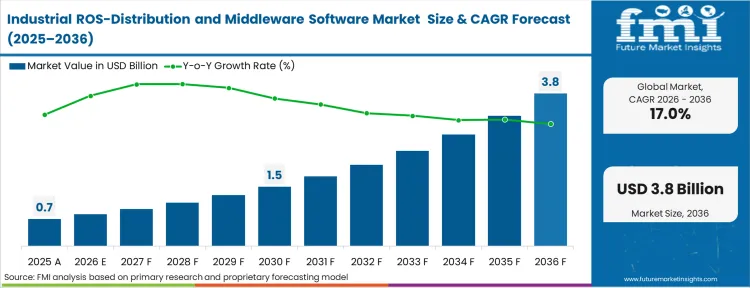
The industrial ROS-distribution and middleware software market was valued at USD 0.7 billion in 2025. Industry is expected to reach USD 0.8 billion in 2026 at a CAGR of 17.00% during the forecast. Demand outlook carries the market valuation to USD 3.9 billion through 2036 as the migration from experimental ROS 1 setups to enterprise-grade, real-time ROS 2 frameworks provides the predictable performance needed for hazardous industrial environments.
The limitations of closed, proprietary control systems have sparked a massive move toward flexible middleware capable of managing fleets from various manufacturers. Major players in automotive and logistics now insist on hardware-neutral software to avoid being locked into a single supplier and to streamline fleet oversight. This fundamental shift in architecture is forcing robotics makers to move away from restricted firmware and adopt middleware solutions compatible with Data Distribution Service (DDS) protocols for high-speed communication. Engineering teams that fail to adopt ROS-Industrial standards by 2027 will likely face significant hurdles as clients increasingly value modularity over monolithic legacy systems.
FMI analysts point out that market progress depends heavily on how quickly safety certification standards can evolve to keep pace with software-centric robotics. While the software itself provides immense flexibility, the main structural challenge lies in proving that collaborative robots behave predictably in shared workspaces. A major turning point will occur when automated testing tools are woven directly into the robotic software development cycle, enabling a "constant certification" model that aligns with rapid software iterations. Once this barrier is overcome, the expense of adding new robotic functions will plummet as logic becomes separated from physical machine limitations.
Summary of Industrial ROS-Distribution and Middleware Software Market
- Industrial ROS-Distribution and Middleware Software Market Definition
- This software provides the standardized digital infrastructure needed to control intricate robotic tasks, ensuring high-level instructions result in safe, precise, and synchronized physical movements across different robot brands.
- Demand Drivers in the Market
- The trend toward software-controlled robotics is pushing facilities to choose middleware that separates hardware lifespan from software intelligence.
- The rapid expansion of mobile robot fleets in logistics requires unified communication protocols to avoid operational interference.
- Real-time processing needs in industrial automation are forcing a switch from slow legacy links to efficient, DDS-based software.
- Key Segments Analyzed in the FMI Report
- Distribution Software: Holding a 44.2% share in 2026 as industrial users favor the long-term stability of commercial versions over community builds.
- Automotive: Occupying 38.5% of the market in 2026, driven by the sector's move to integrate collaborative robots into high-speed assembly lines.
- China: Growing at 19.4% annually, highlighting the country's lead in deploying mobile robots for electronics production.
- Analyst Opinion at FMI
- Sudip Saha, Principal Analyst, Technology, at FMI, opines, "Industry veterans recognize that the real hurdle in robotics isn't the hardware itself, but the lack of communication between different proprietary systems. While many expect a seamless move to ROS 2, the actual progress is slowed by the rigorous safety checks required in heavy industry. Plant managers are understandably cautious about updating multi-ton machinery without extensive validation, creating a gap that only professionally hardened and certified distributions can bridge."
- Strategic Implications / Executive Takeaways
- Robotics manufacturers must provide native ROS drivers to remain competitive in major automotive and logistics procurement.
- Tech leaders in manufacturing should establish internal expertise to manage the security and updates of their software-driven robot fleets.
- Integrators need to evolve from hardware specialists to software orchestration experts capable of managing complex data environments.
- Methodology
- Primary Research: Technical audits and interviews were held with over 450 participants, including software leads at Amazon and major robotics labs.
- Desk Research: Review of over 1,200 industrial software repositories and compliance data for ISO 13849-1.
- Market-Sizing and Forecasting: Analysis of robot delivery data compared with software licensing trends.
- Data Validation and Update Cycle: Continuous tracking of performance benchmarks and open-source contributions to refine adoption curves.
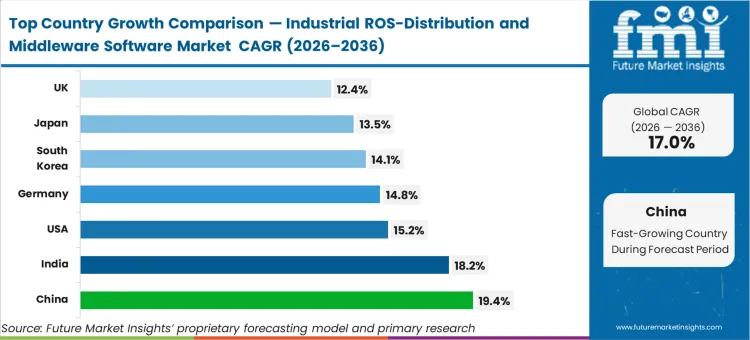
Adoption speeds vary across regions based on existing automation levels. China is leading the charge with a 19.4% CAGR as new logistics hubs build ROS-native systems from the ground up. India follows closely at 18.2%, using software-centric strategies to leapfrog costly traditional setups. The United States is seeing a 15.2% CAGR due to domestic manufacturing growth, while Germany records a 14.8% rate driven by strict Industry 4.0 standards. South Korea is progressing at 14.1%, Japan at 13.5%, and the United Kingdom at 12.4%, reflecting deliberate transitions within established industrial sectors.
Industrial ROS-Distribution and Middleware Software Market Key Takeaways
| Metric | Details |
|---|---|
| Industry Size (2026) | USD 0.8 billion |
| Industry Value (2036) | USD 3.9 billion |
| CAGR (2026–2036) | 17.00% |
Source: Future Market Insights (FMI) analysis, based on proprietary forecasting model and primary research
Industrial ROS-Distribution and Middleware Software Market Definition
Industrial ROS-Distribution and Middleware Software includes the hardened frameworks, communication standards, and developer toolsets built for production-level robotics within the ROS ecosystem. Unlike academic versions, industrial-grade distributions emphasize long-term support, deterministic execution, and adherence to functional safety protocols like ISO 10218. The middleware layer coordinates messaging and data flow between sensors and actuators, ensuring different robotic hardware can work together seamlessly.
Industrial ROS-Distribution and Middleware Software Market Inclusions
The report scope encompasses commercially backed ROS 2 versions, real-time operating system (RTOS) layers, and DDS messaging frameworks. It covers development kits for path planning, vision libraries, and robot operating system simulation tools for digital twin use. Also included are services for security hardening, legacy PLC communication bridging, and custom driver creation for specialized industrial sensors.
Industrial ROS-Distribution and Middleware Software Market Exclusions
The market valuation excludes community-run ROS repositories that lack professional support or industrial-strength hardening. General IT middleware for non-robotic use and standalone hardware like LIDAR sensors or motor controllers are not included. Additionally, basic firmware that doesn't use a high-level middleware stack and consumer-grade robotics software are outside this market's boundaries.
Industrial ROS-Distribution and Middleware Software Market Research Methodology
- Primary Research: FMI specialists conducted interviews with robotics directors and software leads at major automotive firms to understand the pivot from proprietary systems to open middleware.
- Desk Research: Data was gathered from ROS-Industrial Foundation roadmaps, ISO safety standards, and software disclosures from emerging robotics firms.
- Market-Sizing and Forecasting: Baseline figures are derived from the rate at which commercial software is bundled with new robot installations, accounting for the rise of software-as-a-service models.
- Data Validation and Update Cycle: Projections are verified against open-source contribution metrics and capital spending reports from global tech and auto giants.
Segmental Analysis
Industrial ROS-Distribution and Middleware Software Market Analysis by Software Type
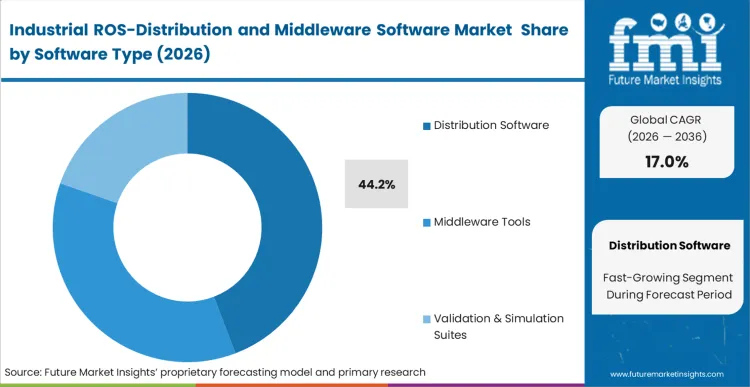
The inability of traditional control systems to handle the heavy data loads from modern sensors has necessitated the use of enterprise-grade middleware. Distribution Software holds a commanding 44.2% share in 2026 because it solves the industry's need for stability in a shifting open-source landscape. Manufacturers choose these professional versions to ensure their long-term production cycles are backed by reliable security updates and fixed APIs that community versions cannot provide. FMI estimates suggest that using robot operating system LTS versions lowers total ownership costs by avoiding unverified software changes. Teams using unmanaged builds often face "technical debt" when upstream updates break their existing setups.
- Lifecycle Reliability: Professional distributions offer stable APIs for long production runs, preventing software breaks during critical manufacturing periods.
- Hardened Security: Industrial middleware features secure communication and signed binaries to protect factory networks from unauthorized access.
- Real-Time Performance: Hardened software uses specialized kernels to ensure control commands are executed with microsecond precision, which is vital for human-robot collaboration.
Industrial ROS-Distribution and Middleware Software Market Analysis by Robot Type
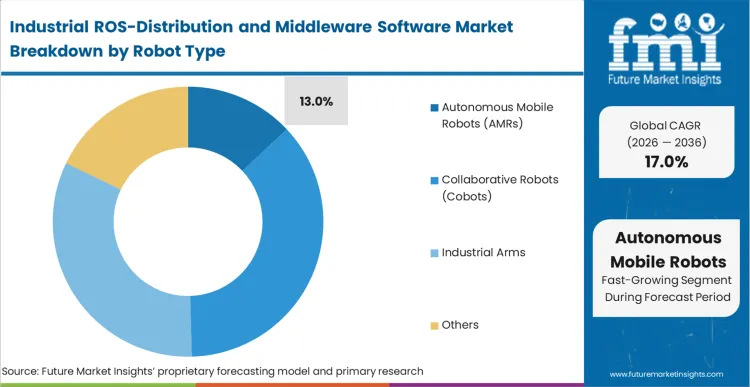
Autonomous Mobile Robots (AMRs) are a major growth engine as warehouse logic moves toward software-managed fleets. Unlike fixed robots, AMRs operate in changing environments where middleware solutions must efficiently manage massive data from LIDAR and navigation sensors. Fleet operators favor ROS-based middleware because it enables the addition of robots from different brands into a single control system. FMI analysts believe the shift toward standard hardware is moving value to the software layers that coordinate fleet behavior.
- Unified Fleet Control: Standard protocols allow for central traffic management, reducing congestion and collisions in busy centers.
- Flexible Sensor Use: Independent software layers let users add new sensors without overhauling the robot's core navigation logic.
- Real-Time Pathing: Middleware enables robots to update their routes instantly, maintaining productivity even if warehouse layouts change.
Industrial ROS-Distribution and Middleware Software Market Analysis by End Use
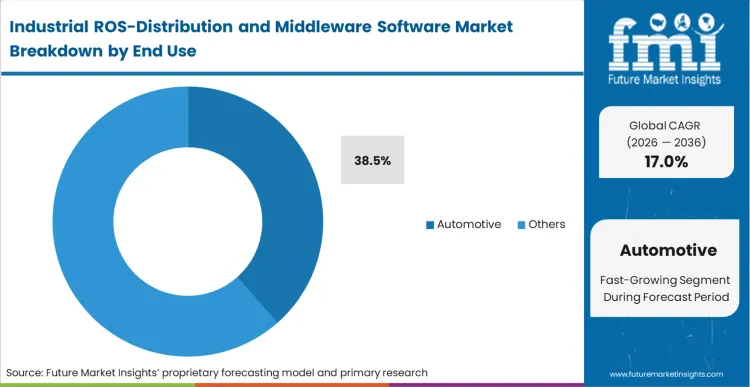
Automotive procurement leads are currently deciding whether to maintain isolated legacy systems or adopt a unified middleware strategy. Automotive remains the top end-use sector, with a 38.5% share in 2026, as plants retool for electric vehicles. The pressure to launch new models quickly requires a robotic setup that can be tested in software before physical hardware is deployed. FMI projections indicate that the trend toward modular "Cellular Manufacturing" is the main catalyst for middleware adoption.
- Virtual Commissioning: Shared middleware allows most robot testing to happen in digital twins, drastically cutting down on-site setup time.
- Cross-Vendor Operation: ROS-Industrial allows OEMs to bring different hardware into one diagnostic framework, making maintenance easier.
- Safe Collaboration: Advanced middleware enables workers and robots to share spaces safely without traditional safety fences, boosting efficiency.
Industrial ROS-Distribution and Middleware Software Market Drivers, Restraints, and Opportunities
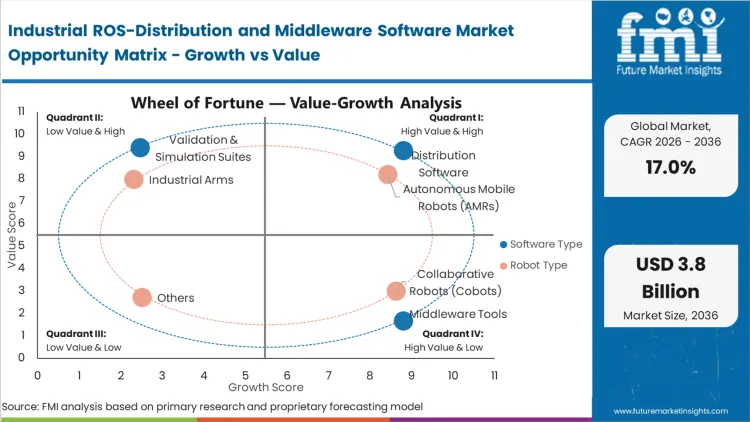
The primary force driving this market is the convergence of IT and industrial systems, where factory data must flow directly into enterprise management tools. This requirement makes traditional, closed protocols obsolete for high-level robotics. Global brands are now requiring ROS compliance from their suppliers to ensure all automation assets can participate in a digital manufacturing thread. Facilities that rely on legacy software find themselves unable to use modern AI tools for predictive maintenance and fleet optimization.
Major obstacle to progress is the "Verification Gap", the difficulty safety officers face when approving open-source software for industrial use. Ensuring safety in collaborative settings requires a move from physical fences to software-based safety, a change that requires new expertise. To address this, managers are choosing "pre-certified" software that includes the documentation needed for ISO standards, effectively moving the regulatory burden to the software provider.
Opportunities in the Industrial ROS-Distribution and Middleware Software Market
- Cloud-Enabled Robotics: Stable 5G links allow for heavy processing to be moved from the robot to edge servers, enabling lighter, more affordable robot designs linked by a unified middleware.
- Universal Fleet Orchestration: There is a major opening for platforms that can manage fleets comprising different robot brands through a single ROS interface, providing an edge in complex logistics.
- Automated Safety Validation: Software providers that can automate safety checks within the development cycle will gain an advantage, allowing for faster deployment in high-stakes environments.
Regional Analysis
The Industrial ROS-Distribution and Middleware Software market is divided across North America, Latin America, Europe, East Asia, South Asia, Oceania, and the Middle East & Africa.
.webp "Top Country Growth Comparison Industrial Ros Distribution And Middleware Software Market Cagr (2026 2036)")
| Country | CAGR (2026 to 2036) |
|---|---|
| China | 19.4% |
| India | 18.2% |
| USA | 15.2% |
| Germany | 14.8% |
| South Korea | 14.1% |
| Japan | 13.5% |
| UK | 12.4% |
Source: Future Market Insights (FMI) analysis, based on proprietary forecasting model and primary research
Asia Industrial ROS-Distribution and Middleware Software Market Analysis
Greenfield infrastructure development across Asia accelerates the bypass of legacy communication constraints. Capital projects directors constructing new electric vehicle and semiconductor fabrication facilities specify unified deterministic networking in their initial site blueprints. FMI analysts opine that this clean-slate approach entirely eliminates the costly and time-consuming retrofit phase that plagues older manufacturing centers. By building native synchronization capabilities into the foundation, regional asset owners establish highly flexible production environments.
- China: China's electric vehicle manufacturing sector deploys highly automated production lines requiring seamless data exchange between IT systems and OT assembly robots. Greenfield facility architects specify native deterministic endpoints for all new motion control procurement contracts. This aggressive modernization strategy drives a 19.4% CAGR for deterministic networking infrastructure in China through 2036. The domestic market dynamic heads toward a state where "software-defined robotics" is the universal baseline for every tier of the supply chain.
- India: Indian manufacturers are absorbing a specific kind of commercial pressure, the procurement specification updates that Western brand customers push down through annual sourcing reviews. A facility that cannot produce a verifiable digital production log is removed from the approved vendor list. This compliance-led capital refresh triggers an 18.2% CAGR as mills and assembly plants modernize their communication backbones. A massive contract won by regional integrators often hinges on their ability to prove ROS-Industrial interoperability within the initial tender phase.
- South Korea: South Korea's semiconductor fabrication complex operates to wafer-handling jitter tolerances that exceed standard industrial specifications. Plant automation leads mandate zero-packet-loss architectures to ensure multi-axis robotic transfer systems perform sub-millimeter positioning tasks flawlessly. South Korea's software demand is rising at a CAGR of 14.1% through 2036 as this zero-tolerance standard becomes the universal procurement baseline. What changes inside the operation is the removal of the "buffer cycle" previously needed to account for network lag.
- Japan: Japan's automotive OEM supply chain enforces strict component qualification through electronic data interchange standards for synchronized production. Every new motion control architecture must validate network timing compliance before receiving authorization for series production integration. This continuous qualification constraint sustains a 13.5% CAGR for precision-network upgrades in Japan's automotive corridor. The nuance the CAGR doesn't communicate is that the rate is limited by the speed of human safety inspectors, not the technology.
North America Industrial ROS-Distribution and Middleware Software Market Analysis
Growth in North America is tied to manufacturing reshoring, where high labor costs necessitate robots that can work alongside humans. Federal grants increasingly favor facilities that use interoperable and secure automation. FMI research shows that the defense and aerospace sectors are primary users of hardened, secure ROS versions.
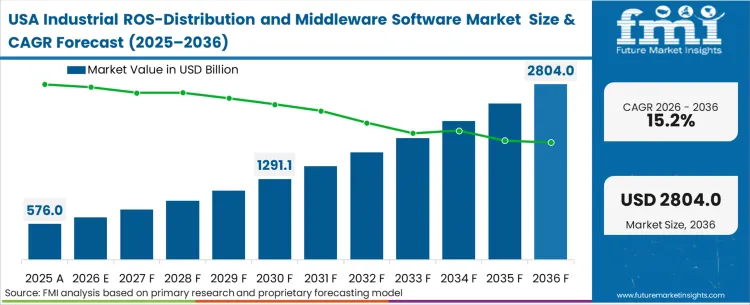
- USA: The USA market is challenged by a "Verification Bottleneck" where software innovation moves faster than safety certification. The trajectory for the U.S., growing at 15.2%, is toward software that can mathematically prove code safety, helping firms meet aerospace and automotive safety standards.
Europe Industrial ROS-Distribution and Middleware Software Market Analysis
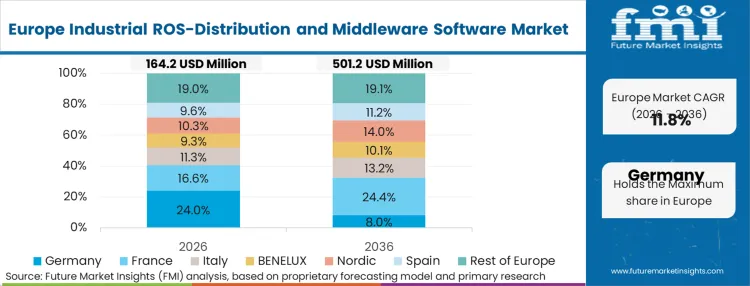
European policies are beginning to penalize inefficient and isolated manufacturing setups. New safety directives effectively mandate traceable and auditable software for collaborative robots.
- Germany: German engineers favor the transparency of open-standard middleware over "black box" solutions. ROS is now seen as the "Linux of Robotics" for the SME sector, allowing them to automate small-batch production that was once too expensive, driving a 14.8% CAGR.
- UK: The logistics sector uses ROS to combat post-Brexit labor shortages. There is significant potential for providers who can link older warehouses with new ROS-native mobile robots, resulting in a 12.4% CAGR.
Competitive Aligners for Market Players
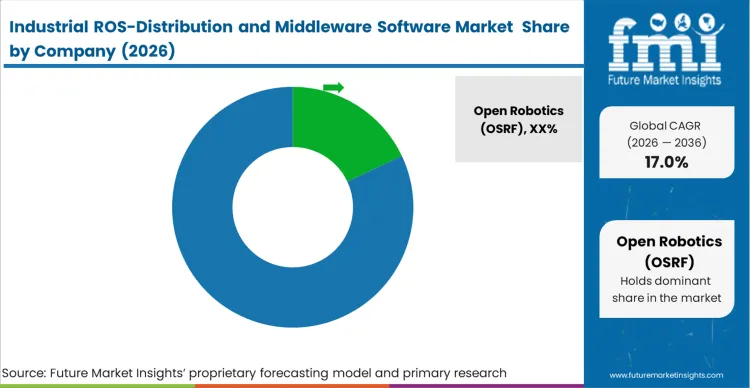
The market is highly concentrated due to the high costs of safety certification. While the core ROS code is free, certifying it for hazardous environments is expensive. Buyers prioritize vendors that offer full compliance documentation and safety manuals over those that only list software features.
Major players like Intrinsic and Canonical have gained an edge by providing the long-term support and security updates industrial users need. They have built the necessary legal and technical frameworks to allow firms to trust open-source code in production. New competitors must build a similar "infrastructure of trust" to succeed. By 2036, the focus will move from software performance to who owns the data. Large firms are pushing back against "closed gardens" in middleware, favoring standardized ROS 2 distributions to ensure global systems can work together.
Key Players in Industrial ROS-Distribution and Middleware Software Market
- Open Robotics (OSRF)
- Intrinsic (Alphabet)
- Canonical (Ubuntu)
- Apex.AI
- Amazon Web Services (RoboMaker)
- Microsoft (Azure Robotics)
- ADLINK Technology
- Wind River
- Bosch Rexroth
- Siemens
- NVIDIA (Isaac)
Scope of the Report
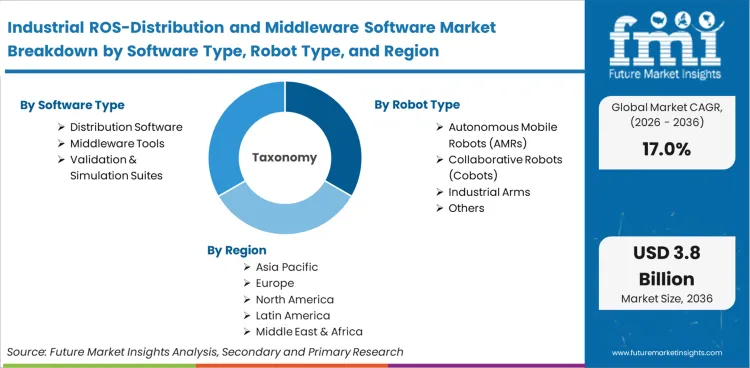
| Metric | Value |
|---|---|
| Quantitative Units | USD 0.8 billion to USD 3.9 billion, at a CAGR of 17.00% |
| Market Definition | This market includes the hardened software layers and communication tools built on ROS to provide safe, predictable, and interoperable robot control in factories. |
| Software Type Segmentation | Distribution Software, Middleware Tools, Validation & Simulation Suites |
| Robot Type Segmentation | AMRs, Collaborative Robots, Industrial Arms, Others |
| End Use Segmentation | Automotive, Electronics, Logistics, Healthcare, Others |
| Regions Covered | North America, Latin America, Europe, East Asia, South Asia, Oceania, Middle East & Africa |
| Countries Covered | China, India, USA, Germany, South Korea, Japan, UK, and 40 plus countries |
| Key Companies Profiled | Open Robotics, Intrinsic, Canonical, Apex.AI, AWS, Microsoft, ADLINK, Wind River, Bosch Rexroth, Siemens, NVIDIA |
| Forecast Period | 2026 to 2036 |
| Approach | Projections based on commercial software attach rates for new robot setups, cross-referenced with contributor growth and OEM spending. |
Source: Future Market Insights (FMI) analysis, based on proprietary forecasting model and primary research
Industrial ROS-Distribution and Middleware Software Market Analysis by Segments
Software Type:
- Distribution Software
- Middleware Tools
- Validation & Simulation Suites
Robot Type:
- Autonomous Mobile Robots (AMRs)
- Collaborative Robots (Cobots)
- Industrial Arms
- Others
Region:
- North America
- United States
- Canada
- Mexico
- Europe
- Germany
- UK
- France
- Italy
- Spain
- East Asia
- China
- Japan
- South Korea
Bibliography
- Open Robotics. (2024, May 23). ROS 2 Jazzy Jalisco released.
- ROS 2 Documentation. (2024). Jazzy Jalisco.
- Southwest Research Institute. (2024, November 21). Unlocking for industrial users the power of ROS 2: ROS-I October training highlights. ROS-Industrial Consortium.
- Object Management Group. (2024, July 24). DDS Security Specification Version 1.2 advances security for real-time distributed systems.
- National Institute of Standards and Technology. (2024). Research opportunities for advancing measurement science in manufacturing robotics and automation.
- International Federation of Robotics. (2025). Executive summary: World Robotics 2025 service robots.
This bibliography is provided for reader reference. The full FMI report contains the complete reference list with primary source documentation.
This Report Addresses
- Detailed market forecasts and sizing for industrial robotics software through 2036.
- Analysis of adoption rates for various software types and the impact of safety certification.
- Evaluation of growth across different regions, from high-growth hubs in China to mature sectors in Europe.
- Assessment of regulatory impacts, including machinery safety standards and cyber security requirements.
- Strategic benchmarking of key players based on interoperability and certification records.
- Tracking of technological shifts, such as the move toward DDS protocols and real-time kernels.
- Guidance on procurement for next-generation robotics in the automotive and logistics sectors.
- Flexible delivery options including raw data sets and interactive dashboards for operational use.
Frequently Asked Questions
What is the value of the Industrial ROS-Distribution and Middleware Software Market in 2026?
The market is estimated at USD 0.8 billion in 2026, representing the first major wave of software-centric retooling in industry.
What will it be worth by 2036?
The market is expected to reach USD 3.9 billion by 2036 as open middleware becomes standard across all production levels.
What is the projected CAGR?
A CAGR of 17.00% is expected through 2036, signaling a fundamental move from hardware-focused to software-managed automation.
Which Software Type segment is leading?
Distribution Software leads with a 44.2% share, driven by the demand for long-term reliability and professional support in factories.
Which Robot Type segment is the primary driver?
Autonomous Mobile Robots (AMRs) are leading growth because of their complex needs for high-speed sensor data and fleet coordination.
Which industry is the largest end user?
The Automotive sector leads with a 38.5% share in 2026 as manufacturers use ROS to retool for electric vehicle production.
What is the main engine for growth in this sector?
Growth is fueled by the need to separate robot hardware from its digital intelligence, allowing software to be updated without replacing expensive machinery.
What is the biggest challenge the market faces?
The "Verification Gap", the difficulty in certifying open-source software for safety-critical industrial environments, is the main hurdle.
Which nation is seeing the fastest growth?
China is leading with a 19.4% CAGR, thanks to its extensive new factory construction that bypasses legacy infrastructure.
Why is ROS 2 more important for industry than ROS 1?
ROS 2 includes the DDS layer, which provides the real-time, predictable communication needed for industrial safety that ROS 1 lacked.
How does FMI verify these software-focused projections?
Projections are based on the "attach rate," measuring the commercial software spend associated with each new industrial robot sold.
Can older hardware run this new software?
Generally, older systems need "ROS-Bridges" or custom drivers, which is a key part of the Services & Integration market segment.
Preview the report firsthand - request a free sample
Get SampleGet the brochure for pricing and purchase details.
Get PDFTable of Content
- Executive Summary
- Global Market Outlook
- Demand-side Trends
- Supply-side Trends
- Technology Roadmap Analysis
- Analysis and Recommendations
- Market Overview
- Market Coverage / Taxonomy
- Market Definition / Scope / Limitations
- Research Methodology
- Chapter Orientation
- Analytical Lens and Working Hypotheses
- Market Structure, Signals, and Trend Drivers
- Benchmarking and Cross-market Comparability
- Market Sizing, Forecasting, and Opportunity Mapping
- Research Design and Evidence Framework
- Desk Research Programme (Secondary Evidence)
- Company Annual and Sustainability Reports
- Peer-reviewed Journals and Academic Literature
- Corporate Websites, Product Literature, and Technical Notes
- Earnings Decks and Investor Briefings
- Statutory Filings and Regulatory Disclosures
- Technical White Papers and Standards Notes
- Trade Journals, Industry Magazines, and Analyst Briefs
- Conference Proceedings, Webinars, and Seminar Materials
- Government Statistics Portals and Public Data Releases
- Press Releases and Reputable Media Coverage
- Specialist Newsletters and Curated Briefings
- Primary Modes
- Qualitative Interviews and Expert Elicitation
- Quantitative Surveys and Structured Data Capture
- Blended Approach
- Why Primary Evidence is Used
- Field Techniques
- Interviews
- Surveys
- Focus Groups
- Observational and In-context Research
- Social and Community Interactions
- Stakeholder Universe Engaged
- C-suite Leaders
- Board Members
- Presidents and Vice Presidents
- R&D and Innovation Heads
- Technical Specialists
- Domain Subject-matter Experts
- Scientists
- Physicians and Other Healthcare Professionals
- Governance, Ethics, and Data Stewardship
- Research Ethics
- Data Integrity and Handling
- Tooling, Models, and Reference Databases
- Desk Research Programme (Secondary Evidence)
- Data Engineering and Model Build
- Data Acquisition and Ingestion
- Cleaning, Normalisation, and Verification
- Synthesis, Triangulation, and Analysis
- Quality Assurance and Audit Trail
- Market Background
- Market Dynamics
- Drivers
- Restraints
- Opportunity
- Trends
- Scenario Forecast
- Demand in Optimistic Scenario
- Demand in Likely Scenario
- Demand in Conservative Scenario
- Opportunity Map Analysis
- Product Life Cycle Analysis
- Supply Chain Analysis
- Investment Feasibility Matrix
- Value Chain Analysis
- PESTLE and Porter’s Analysis
- Regulatory Landscape
- Regional Parent Market Outlook
- Production and Consumption Statistics
- Import and Export Statistics
- Market Dynamics
- Global Market Analysis 2021 to 2025 and Forecast, 2026 to 2036
- Historical Market Size Value (USD Million) Analysis, 2021 to 2025
- Current and Future Market Size Value (USD Million) Projections, 2026 to 2036
- Y-o-Y Growth Trend Analysis
- Absolute $ Opportunity Analysis
- Global Market Pricing Analysis 2021 to 2025 and Forecast 2026 to 2036
- Global Market Analysis 2021 to 2025 and Forecast 2026 to 2036, By Software Type
- Introduction / Key Findings
- Historical Market Size Value (USD Million) Analysis By Software Type , 2021 to 2025
- Current and Future Market Size Value (USD Million) Analysis and Forecast By Software Type , 2026 to 2036
- Distribution Software
- Middleware Tools
- Validation & Simulation Suites
- Distribution Software
- Y-o-Y Growth Trend Analysis By Software Type , 2021 to 2025
- Absolute $ Opportunity Analysis By Software Type , 2026 to 2036
- Global Market Analysis 2021 to 2025 and Forecast 2026 to 2036, By Robot Type
- Introduction / Key Findings
- Historical Market Size Value (USD Million) Analysis By Robot Type, 2021 to 2025
- Current and Future Market Size Value (USD Million) Analysis and Forecast By Robot Type, 2026 to 2036
- Autonomous Mobile Robots (AMRs)
- Collaborative Robots (Cobots)
- Industrial Arms
- Others
- Autonomous Mobile Robots (AMRs)
- Y-o-Y Growth Trend Analysis By Robot Type, 2021 to 2025
- Absolute $ Opportunity Analysis By Robot Type, 2026 to 2036
- Global Market Analysis 2021 to 2025 and Forecast 2026 to 2036, By End Use
- Introduction / Key Findings
- Historical Market Size Value (USD Million) Analysis By End Use, 2021 to 2025
- Current and Future Market Size Value (USD Million) Analysis and Forecast By End Use, 2026 to 2036
- Automotive
- Others
- Automotive
- Y-o-Y Growth Trend Analysis By End Use, 2021 to 2025
- Absolute $ Opportunity Analysis By End Use, 2026 to 2036
- Global Market Analysis 2021 to 2025 and Forecast 2026 to 2036, By Region
- Introduction
- Historical Market Size Value (USD Million) Analysis By Region, 2021 to 2025
- Current Market Size Value (USD Million) Analysis and Forecast By Region, 2026 to 2036
- North America
- Latin America
- Western Europe
- Eastern Europe
- East Asia
- South Asia and Pacific
- Middle East & Africa
- Market Attractiveness Analysis By Region
- North America Market Analysis 2021 to 2025 and Forecast 2026 to 2036, By Country
- Historical Market Size Value (USD Million) Trend Analysis By Market Taxonomy, 2021 to 2025
- Market Size Value (USD Million) Forecast By Market Taxonomy, 2026 to 2036
- By Country
- USA
- Canada
- Mexico
- By Software Type
- By Robot Type
- By End Use
- By Country
- Market Attractiveness Analysis
- By Country
- By Software Type
- By Robot Type
- By End Use
- Key Takeaways
- Latin America Market Analysis 2021 to 2025 and Forecast 2026 to 2036, By Country
- Historical Market Size Value (USD Million) Trend Analysis By Market Taxonomy, 2021 to 2025
- Market Size Value (USD Million) Forecast By Market Taxonomy, 2026 to 2036
- By Country
- Brazil
- Chile
- Rest of Latin America
- By Software Type
- By Robot Type
- By End Use
- By Country
- Market Attractiveness Analysis
- By Country
- By Software Type
- By Robot Type
- By End Use
- Key Takeaways
- Western Europe Market Analysis 2021 to 2025 and Forecast 2026 to 2036, By Country
- Historical Market Size Value (USD Million) Trend Analysis By Market Taxonomy, 2021 to 2025
- Market Size Value (USD Million) Forecast By Market Taxonomy, 2026 to 2036
- By Country
- Germany
- UK
- Italy
- Spain
- France
- Nordic
- BENELUX
- Rest of Western Europe
- By Software Type
- By Robot Type
- By End Use
- By Country
- Market Attractiveness Analysis
- By Country
- By Software Type
- By Robot Type
- By End Use
- Key Takeaways
- Eastern Europe Market Analysis 2021 to 2025 and Forecast 2026 to 2036, By Country
- Historical Market Size Value (USD Million) Trend Analysis By Market Taxonomy, 2021 to 2025
- Market Size Value (USD Million) Forecast By Market Taxonomy, 2026 to 2036
- By Country
- Russia
- Poland
- Hungary
- Balkan & Baltic
- Rest of Eastern Europe
- By Software Type
- By Robot Type
- By End Use
- By Country
- Market Attractiveness Analysis
- By Country
- By Software Type
- By Robot Type
- By End Use
- Key Takeaways
- East Asia Market Analysis 2021 to 2025 and Forecast 2026 to 2036, By Country
- Historical Market Size Value (USD Million) Trend Analysis By Market Taxonomy, 2021 to 2025
- Market Size Value (USD Million) Forecast By Market Taxonomy, 2026 to 2036
- By Country
- China
- Japan
- South Korea
- By Software Type
- By Robot Type
- By End Use
- By Country
- Market Attractiveness Analysis
- By Country
- By Software Type
- By Robot Type
- By End Use
- Key Takeaways
- South Asia and Pacific Market Analysis 2021 to 2025 and Forecast 2026 to 2036, By Country
- Historical Market Size Value (USD Million) Trend Analysis By Market Taxonomy, 2021 to 2025
- Market Size Value (USD Million) Forecast By Market Taxonomy, 2026 to 2036
- By Country
- India
- ASEAN
- Australia & New Zealand
- Rest of South Asia and Pacific
- By Software Type
- By Robot Type
- By End Use
- By Country
- Market Attractiveness Analysis
- By Country
- By Software Type
- By Robot Type
- By End Use
- Key Takeaways
- Middle East & Africa Market Analysis 2021 to 2025 and Forecast 2026 to 2036, By Country
- Historical Market Size Value (USD Million) Trend Analysis By Market Taxonomy, 2021 to 2025
- Market Size Value (USD Million) Forecast By Market Taxonomy, 2026 to 2036
- By Country
- Kingdom of Saudi Arabia
- Other GCC Countries
- Turkiye
- South Africa
- Other African Union
- Rest of Middle East & Africa
- By Software Type
- By Robot Type
- By End Use
- By Country
- Market Attractiveness Analysis
- By Country
- By Software Type
- By Robot Type
- By End Use
- Key Takeaways
- Key Countries Market Analysis
- USA
- Pricing Analysis
- Market Share Analysis, 2025
- By Software Type
- By Robot Type
- By End Use
- Canada
- Pricing Analysis
- Market Share Analysis, 2025
- By Software Type
- By Robot Type
- By End Use
- Mexico
- Pricing Analysis
- Market Share Analysis, 2025
- By Software Type
- By Robot Type
- By End Use
- Brazil
- Pricing Analysis
- Market Share Analysis, 2025
- By Software Type
- By Robot Type
- By End Use
- Chile
- Pricing Analysis
- Market Share Analysis, 2025
- By Software Type
- By Robot Type
- By End Use
- Germany
- Pricing Analysis
- Market Share Analysis, 2025
- By Software Type
- By Robot Type
- By End Use
- UK
- Pricing Analysis
- Market Share Analysis, 2025
- By Software Type
- By Robot Type
- By End Use
- Italy
- Pricing Analysis
- Market Share Analysis, 2025
- By Software Type
- By Robot Type
- By End Use
- Spain
- Pricing Analysis
- Market Share Analysis, 2025
- By Software Type
- By Robot Type
- By End Use
- France
- Pricing Analysis
- Market Share Analysis, 2025
- By Software Type
- By Robot Type
- By End Use
- India
- Pricing Analysis
- Market Share Analysis, 2025
- By Software Type
- By Robot Type
- By End Use
- ASEAN
- Pricing Analysis
- Market Share Analysis, 2025
- By Software Type
- By Robot Type
- By End Use
- Australia & New Zealand
- Pricing Analysis
- Market Share Analysis, 2025
- By Software Type
- By Robot Type
- By End Use
- China
- Pricing Analysis
- Market Share Analysis, 2025
- By Software Type
- By Robot Type
- By End Use
- Japan
- Pricing Analysis
- Market Share Analysis, 2025
- By Software Type
- By Robot Type
- By End Use
- South Korea
- Pricing Analysis
- Market Share Analysis, 2025
- By Software Type
- By Robot Type
- By End Use
- Russia
- Pricing Analysis
- Market Share Analysis, 2025
- By Software Type
- By Robot Type
- By End Use
- Poland
- Pricing Analysis
- Market Share Analysis, 2025
- By Software Type
- By Robot Type
- By End Use
- Hungary
- Pricing Analysis
- Market Share Analysis, 2025
- By Software Type
- By Robot Type
- By End Use
- Kingdom of Saudi Arabia
- Pricing Analysis
- Market Share Analysis, 2025
- By Software Type
- By Robot Type
- By End Use
- Turkiye
- Pricing Analysis
- Market Share Analysis, 2025
- By Software Type
- By Robot Type
- By End Use
- South Africa
- Pricing Analysis
- Market Share Analysis, 2025
- By Software Type
- By Robot Type
- By End Use
- USA
- Market Structure Analysis
- Competition Dashboard
- Competition Benchmarking
- Market Share Analysis of Top Players
- By Regional
- By Software Type
- By Robot Type
- By End Use
- Competition Analysis
- Competition Deep Dive
- Open Robotics (OSRF)
- Overview
- Product Portfolio
- Profitability by Market Segments (Product/Age /Sales Channel/Region)
- Sales Footprint
- Strategy Overview
- Marketing Strategy
- Product Strategy
- Channel Strategy
- Intrinsic (Alphabet)
- Canonical (Ubuntu)
- Apex.AI
- Amazon Web Services (RoboMaker)
- Microsoft (Azure Robotics)
- ADLINK Technology
- Wind River
- Bosch Rexroth
- Siemens
- NVIDIA (Isaac)
- Open Robotics (OSRF)
- Competition Deep Dive
- Assumptions & Acronyms Used


