

- Industry Size (2026)
- USD 6.3 Bn
- Forecast (2036)
- USD 9.2 Bn
- CAGR (2026 to 2036)
- 3.8%
Industrial Plant Derived Cleaning Ingredients Market Size, Market Forecast and Outlook By FMI
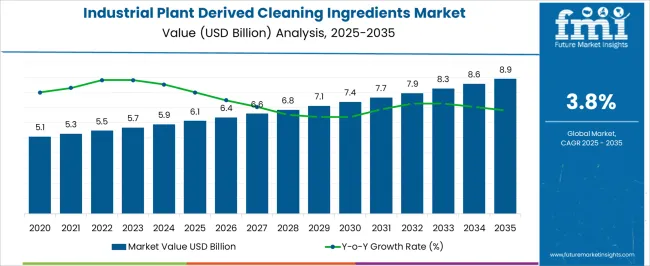
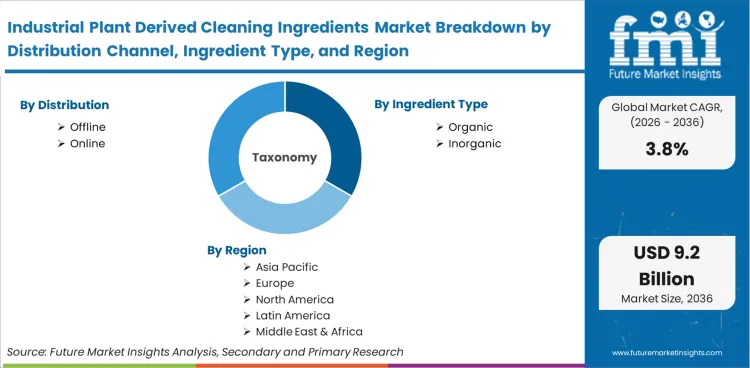
In 2025, the industrial plant derived cleaning ingredients market was valued at USD 6.1 billion. Based on Future Market Insights’ analysis, demand for industrial plant derived cleaning ingredients is estimated to grow to USD 6.3 billion in 2026 and USD 9.2 billion by 2036. FMI projects a CAGR of 3.8% during the forecast period.
As per FMI, absolute dollar growth of USD 2.9 billion over the decade reflects steady expansion driven by regulatory, sustainability, and reformulation dynamics shaping procurement across major consuming economies.
Summary of Industrial Plant Derived Cleaning Ingredients Market
- Industrial Plant Derived Cleaning Ingredients Market Definition
- The industrial plant-derived cleaning ingredients market covers the global production, trade, and consumption of bio-based surfactants, solvents, enzymes, and other cleaning active ingredients sourced.
- Demand Drivers in the Market
- FMI analysts observe that regulatory and sustainability mandates are expanding the addressable market for certified and traceable industrial plant derived cleaning ingredients products across major consuming regions.
- Technology advancement and reformulation requirements are creating specification-grade demand segments that command pricing premiums above commodity alternatives.
- Regional compliance divergence is multiplying procurement complexity, forcing multinational buyers to maintain parallel sourcing and certification capabilities.
- Key Segments Analyzed in the FMI Report
- As per FMI, organic ingredients holds 61.2% of market value in 2026.
- Offline distribution holds 57.8% of channel demand in 2026, organic ingredients account for 61.2% of ingredient type demand, and household application represents 29.7% share.
- Analyst Opinion at FMI
- Nandini Roy Choudhury, Principal Consultant for Food & Beverage at Future Market Insights, opines, 'In the updated version of the Industrial Plant Derived Cleaning Ingredients Market Report for 2026 to 2036, CXOs will find that APG production capacity expansion by BASF in Thailand and the USA is closing the cost gap between plant-derived and petrochemical surfactants, shifting procurement decisions from sustainability premiums toward total formulation cost parity. My findings also indicate that EU Ecolabel and US EPA Safer Choice certification requirements are tightening ingredient biodegradability thresholds, creating compliance-driven demand for plant-based alternatives that conventional petrochemical surfactants cannot meet without reformulation.'
- Strategic Implications / Executive Takeaways
- Invest in certification and traceability infrastructure to capture premiums in regulated markets.
- Diversify sourcing across at least two geographic regions to mitigate supply concentration and regulatory compliance risk.
- Build specification-grade capability rather than competing on commodity pricing as technology and regulatory shifts create value segmentation.
- Methodology
- Validated through first-hand interviews with producers, formulators, and procurement managers across 10+ countries.
- Zero reliance on speculative third-party market research reports.
- Based on verifiable trade data, production statistics, and plant-level capacity verification from primary disclosures.
As Aude Lemoine-Dessaint, Marketing Manager, Croda Home Care, stated regarding the launch of NeutraFresh BD biodegradable odor-neutralizing technology, 'At Croda, we understand that consumers are increasingly looking for clean, sustainable solutions without compromising on performance.' [1] In October 2025, BASF and International Flavors and Fragrances (IFF) announced a strategic partnership to accelerate the development of IFF's Designed Enzymatic Biomaterials technology platform, creating next-generation enzyme and bio-based polymer technologies for fabric care, dish care, and industrial cleaning applications.
China (5.1% CAGR) India (4.8% CAGR) Germany (4.4% CAGR) France (4.0% CAGR) UK (3.6% CAGR) USA (3.2% CAGR) Brazil (2.9% CAGR) are the key growth markets. Based on FMI’s report, Offline distribution holds 57.8% of channel demand in 2026, organic ingredients account for 61.2% of ingredient type demand, and household application represents 29.7% share.
Industrial Plant Derived Cleaning Ingredients Market Definition
The industrial plant-derived cleaning ingredients market covers the global production, trade, and consumption of bio-based surfactants, solvents, enzymes, and other cleaning active ingredients sourced from plant feedstocks. These ingredients replace or supplement petrochemical-derived alternatives in household, personal care, industrial, and institutional cleaning formulations, including alkyl polyglucosides (APGs), coconut-derived surfactants, plant-based solvents, and bio-enzyme blends.
Industrial Plant Derived Cleaning Ingredients Market Inclusions
The report covers global and regional market sizes by value with a 10-year forecast from 2026 to 2036. Segmental breakdowns include distribution channel (offline, online), ingredient type (organic, inorganic), ingredient application (household, personal care, industrial, institutional), and geographic analysis across major producing and consuming regions.
Industrial Plant Derived Cleaning Ingredients Market Exclusions
The scope excludes finished cleaning products (laundry detergents, surface cleaners) where value is attributed to brand and formulation rather than ingredient sourcing. Petrochemical-derived cleaning ingredients are excluded unless used in direct substitution analysis. Water treatment chemicals and disinfectants with pharmaceutical classification are not included.
Industrial Plant Derived Cleaning Ingredients Market Research Methodology
- Primary Research: Interviews were conducted with producers, distributors, formulators, and procurement managers across major regions.
- Desk Research: Production and trade data from national agencies, FAO, UN Comtrade, and industry associations supported volume benchmarking.
- Market-Sizing and Forecasting: A hybrid top-down and bottom-up model was developed, validated against plant-level capacities and trade flows.
- Data Validation and Update Cycle: Outputs undergo anomaly screening, variance checks, and structured peer review prior to release.
Why is the Industrial Plant Derived Cleaning Ingredients Market Growing?
The industrial plant derived cleaning ingredients market is experiencing strong growth, supported by increasing demand for sustainable and eco-friendly alternatives in cleaning and hygiene applications. Rising awareness among consumers and industries regarding the environmental impact of synthetic chemicals is creating significant momentum for plant-based formulations. Manufacturers are responding by expanding their portfolios with bio-based surfactants, solvents, and enzymes that deliver comparable or superior performance to conventional chemical ingredients.
Government initiatives and stricter regulations targeting carbon footprint reduction and chemical toxicity are also shaping market adoption, making plant-derived options more attractive across industries. Furthermore, partnerships between ingredient producers and cleaning product manufacturers are accelerating innovation and improving scalability in production.
Growth is being reinforced by investments in biotechnology and green chemistry, which are enabling more efficient extraction and processing of plant-based materials With strong support from both regulatory frameworks and consumer preferences, the market is positioned to achieve sustained expansion, with increasing penetration in household, commercial, and industrial applications globally.
Segmental Analysis
The industrial plant derived cleaning ingredients market is segmented by distribution channel, ingredient type, ingredient application, source, and geographic regions. By distribution channel, industrial plant derived cleaning ingredients market is divided into Offline and Online. In terms of ingredient type, industrial plant derived cleaning ingredients market is classified into Organic and Inorganic. Based on ingredient application, industrial plant derived cleaning ingredients market is segmented into Household, Personal Care, Industrial, and Institutional. By source, industrial plant derived cleaning ingredients market is segmented into Coconuts, Corn, Oranges, Sugarcane, and Flower Fragrances. Regionally, the industrial plant derived cleaning ingredients industry is classified into North America, Latin America, Western Europe, Eastern Europe, Balkan & Baltic Countries, Russia & Belarus, Central Asia, East Asia, South Asia & Pacific, and the Middle East & Africa.
Insights into the Offline Distribution Channel Segment
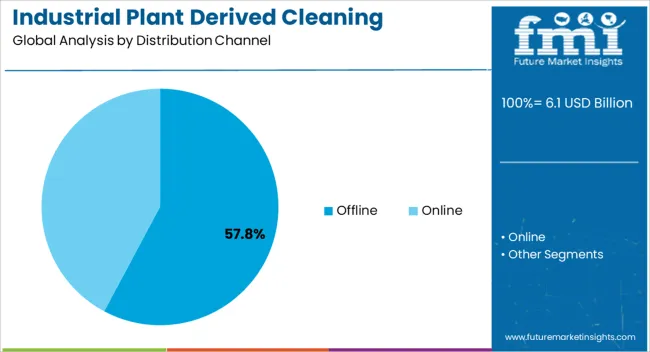
The offline distribution channel segment is projected to hold 57.8% of the industrial plant derived cleaning ingredients market revenue share in 2025, making it the leading distribution channel. This dominance is being driven by the wide availability of plant-based cleaning ingredients in supermarkets, specialty stores, and wholesale outlets that cater directly to both consumers and businesses. Many customers continue to prefer purchasing through offline channels as they offer product assurance, direct consultation, and the ability to compare different product ranges physically.
In addition, partnerships with large retail chains and distributors have significantly expanded the visibility and accessibility of these products, reinforcing customer trust. Offline distribution is also favored in regions where digital infrastructure is less developed, ensuring that products reach diverse consumer bases.
Marketing strategies such as in-store promotions and sampling programs are enhancing consumer awareness and adoption, further solidifying this channel’s market leadership As the trend toward sustainable consumption strengthens, offline distribution is expected to remain a critical pathway for plant-based cleaning ingredient adoption, particularly in regions with strong traditional retail networks.
Insights into the Organic Ingredient Type Segment
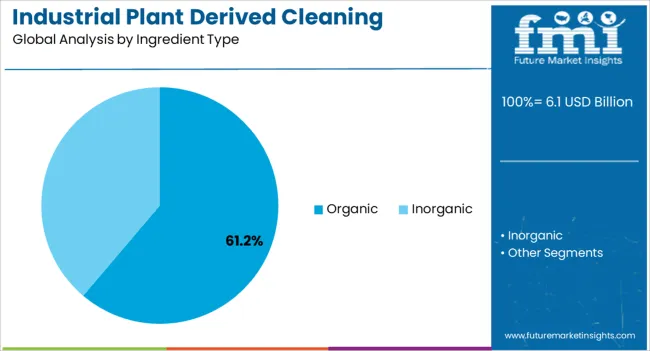
The organic ingredient type segment is expected to account for 61.2% of the industrial plant derived cleaning ingredients market revenue share in 2025, positioning it as the dominant ingredient category. This leadership is being reinforced by the rising consumer preference for certified organic cleaning solutions that ensure safety for both human health and the environment. Organic ingredients are widely perceived as safer alternatives due to the absence of synthetic pesticides, fertilizers, or genetically modified organisms in their production.
Regulatory certifications and eco-labeling are further boosting consumer trust and driving adoption across both residential and commercial markets. In addition, organic ingredients are increasingly favored by manufacturers seeking to align with sustainability goals and clean-label product positioning.
Continuous advancements in extraction and formulation technologies are enhancing the performance of organic components, enabling them to match or exceed the efficacy of conventional chemical alternatives As demand for transparent, traceable, and environmentally responsible cleaning products rises, the organic ingredient segment is anticipated to retain its leadership, supported by expanding supply chains and increasing global regulatory support.
Insights into the Household Ingredient Application Segment
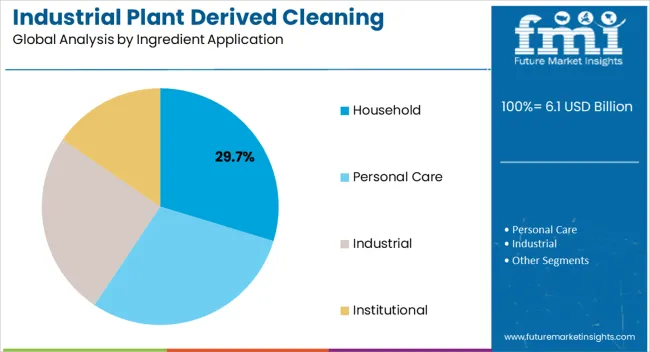
The household application segment is projected to capture 29.7% of the industrial plant derived cleaning ingredients market revenue share in 2025, making it the leading application area. Its dominance is being driven by the strong shift in consumer preference toward eco-friendly and non-toxic cleaning products for daily use in kitchens, bathrooms, and general home care. The rising health awareness among households, particularly regarding allergies and chemical sensitivities, is creating strong demand for plant-derived alternatives.
This trend is further supported by the growing emphasis on family health and wellness, as well as the influence of eco-conscious lifestyles. Marketing campaigns highlighting biodegradability, safety, and natural origins are increasing consumer confidence and driving repeat purchases.
Additionally, household applications benefit from the widespread availability of diverse product formats, including sprays, detergents, and surface cleaners that incorporate plant-based ingredients As sustainability continues to shape consumer decisions and regulatory pressures encourage greener product adoption, the household segment is positioned to remain the most prominent application area, with consistent growth opportunities across both developed and emerging markets.
Regional Analysis
Based on the regional analysis, the industrial plant derived cleaning ingredients market is segmented across 30+ countries. The full report also offers market attractiveness analysis based on regional trends.
.webp "Top Country Growth Comparison Industrial Plant Derived Cleaning Ingredients Market Cagr (2026 2036)")
| Country | CAGR (2026 to 2036) |
|---|---|
| China | 5.1% |
| India | 4.8% |
| Germany | 4.4% |
| France | 4.0% |
| UK | 3.6% |
| USA | 3.2% |
| Brazil | 2.9% |
Source: Future Market Insights (FMI) analysis, based on proprietary forecasting model and primary research
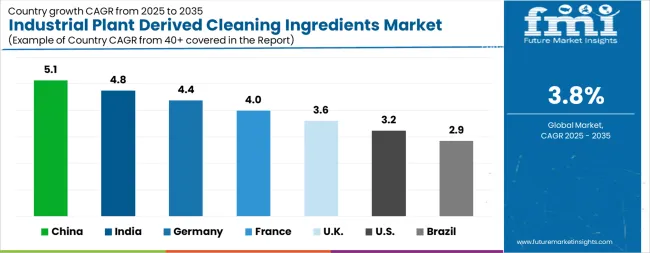
China
Demand for plant-derived cleaning ingredients in China is projected to rise at 5.1% CAGR through 2036. China's Ministry of Ecology and Environment has tightened biodegradability standards for industrial cleaning chemicals discharged into waterways, directly increasing demand for plant-based surfactants that meet GB/T 15818 requirements. Major household cleaning brands including Blue Moon and Liby are reformulating product lines to incorporate coconut-derived and palm kernel oil-based surfactants for marketing as eco-friendly alternatives. BASF and Dow operate surfactant production facilities in China serving both domestic consumption and regional export markets across Southeast Asia.
India
Demand for plant-derived cleaning ingredients in India is projected to rise at 4.8% CAGR through 2036. India's Bureau of Indian Standards (BIS) is developing eco-label criteria for cleaning products that include plant-derived ingredient content requirements. Domestic surfactant manufacturers including Godrej Industries and Galaxy Surfactants are investing in oleochemical-based surfactant capacity using coconut and palm kernel oil feedstocks from Kerala and Karnataka. The Central Pollution Control Board's effluent discharge standards for industrial cleaning applications are driving institutional buyers toward biodegradable plant-based formulations.
Germany
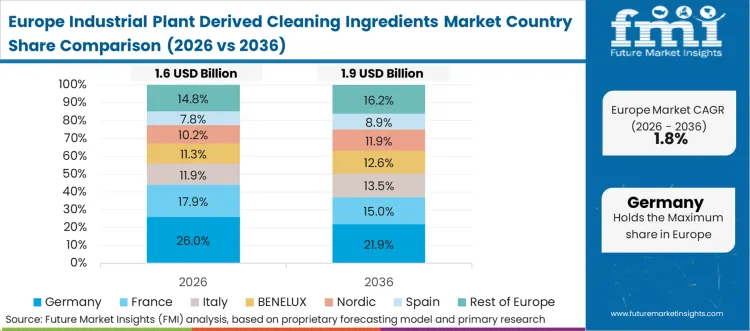
Demand for plant-derived cleaning ingredients in Germany is projected to rise at 4.4% CAGR through 2036. Germany's EU Ecolabel certification requirements for cleaning products specify minimum bio-based carbon content thresholds that are pushing formulators toward plant-derived surfactants and solvents. BASF inaugurated expanded APG production in Thailand in November 2025, with a new Cincinnati production line scheduled for 2026, directly serving German and EU cleaning product manufacturers through integrated supply chains [3]. Henkel AG and Reckitt Benckiser specify plant-derived ingredient content targets in their procurement standards for household cleaning product lines.
USA
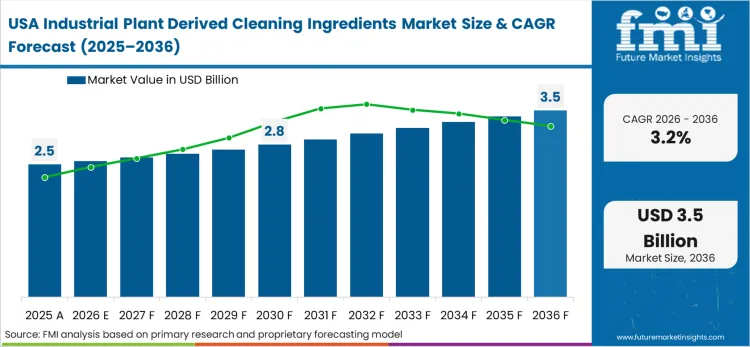
Demand for plant-derived cleaning ingredients in the USA is projected to rise at 3.2% CAGR through 2036. The EPA Safer Choice program certifies cleaning products meeting ingredient safety and environmental standards, with plant-derived surfactants increasingly required for certification. BASF's new APG production line in Cincinnati, scheduled for 2026 completion, is designed to serve North American demand for plant-based surfactants in household and institutional cleaning. Clorox, P&G, and SC Johnson have expanded plant-derived cleaning product lines under brands such as Burt's Bees, Green Works, and Mrs. Meyer's, pulling ingredient demand toward bio-based surfactant suppliers.
Brazil
Demand for plant-derived cleaning ingredients in Brazil is projected to grow at 2.9% CAGR through 2036. Brazil's abundant coconut oil and palm kernel oil feedstock base in northeastern states supports domestic oleochemical surfactant production at competitive costs. ANVISA's cleaning product registration requirements are aligning with international biodegradability standards, creating regulatory pull for plant-derived formulations. Natura and Co., as Brazil's largest cosmetics and personal care company, specifies Amazonian plant-derived ingredients across its cleaning and personal care portfolio, creating procurement demand that extends to industrial applications through its supply chain.
FMI’s analysis of the industrial plant derived cleaning ingredients market consists of country-wise assessment across all major economies. Readers can find regional trends, regulations, pricing dynamics, and demand drivers.
Competitive Aligners for Market Players
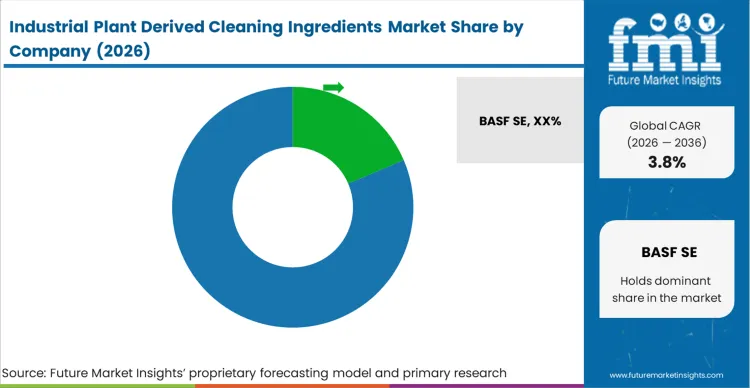
BASF SE holds approximately 18.6% market share, leveraging integrated operations across sourcing, processing, and distribution. Competition is defined by certification capability, supply chain traceability, and formulation service differentiation.
Buyer leverage varies by end-use segment. Large manufacturers negotiate volume contracts with formula-based pricing, while specification-grade buyers pay fixed premiums for certified or specialty grades. Contract structures increasingly tie pricing to commodity indices.
Recent Developments
The report includes full coverage of recent trends from competitive benchmarking. Some of the recent developments covered in the reports:
- In October 2025, BASF and International Flavors and Fragrances (IFF) announced a strategic partnership to accelerate the development of IFF's Designed Enzymatic Biomaterials technology platform, creating next-generation enzyme and bio-based polymer technologies for fabric care, dish care, and industrial cleaning applications.
- In November 2025, BASF inaugurated an expanded production facility for Alkyl Polyglucosides (APGs) in Bangpakong, Thailand, as part of a global ramp-up that includes a new production line in Cincinnati, USA, scheduled for completion in 2026 to meet rising North American demand for plant-derived surfactants.
- In October 2025, Croda International expanded its home and industrial care portfolio with the launch of NeutraFresh BD, a readily biodegradable odor-neutralizing technology designed for industrial surface cleaners and laundry detergents.
Key Players in Industrial Plant Derived Cleaning Ingredients Market
- BASF SE
- Procter & Gamble
- Dow
- Henkel AG and Co. KGaA
- Sasol
- SOLVAY
- Croda International PLC
- STEPAN Company
- Huntsman International LLC
- Eastman Chemical Corporation
- Clariant
- Westlake Chemicals Corporation
- Albemarle Corporation
- Reckitt Benckiser Group plc
- Clorox Inc.
- Kimberly-Clark Corporation
- 3M
Scope of the Report
| Item | Value |
|---|---|
| Quantitative Units | USD 6.3 billion (2026) to USD 9.2 billion (2036), at a CAGR of 3.8% |
| Distribution Channel | Offline and Online |
| Forecast Period | 2026 to 2036 |
| Approach | Hybrid top-down and bottom-up market modeling validated through primary interviews, supported by trade data benchmarking and capacity verification |
| Ingredient Type | Organic and Inorganic |
| Ingredient Application | Household, Personal Care, Industrial, and Institutional |
| Source | Coconuts, Corn, Oranges, Sugarcane, and Flower Fragrances |
| Regions Covered | North America, Europe, Asia-Pacific, Latin America, Middle East & Africa |
| Country Covered | United States, Canada, Germany, France, United Kingdom, China, Japan, India, Brazil, South Africa |
| Key Companies Profiled | BASF SE, Procter & Gamble, Dow, Henkel AG & Co. KGaA, Sasol, SOLVAY, Croda International PLC, STEPAN Company, Huntsman International LLC, Eastman Chemical Corporation, Clariant, Westlake Chemicals Corporation, Albemarle Corporation, Reckitt Benckiser Group plc, Clorox Inc., Kimberly-Clark Corporation, and 3M |
Industrial Plant Derived Cleaning Ingredients Market Analysis by Segments
By Distribution Channel:
Offline and Online
By Ingredient Type:
Organic and Inorganic
By Ingredient Application:
Household, Personal Care, Industrial, and Institutional
Bibliography
- [1] Croda International. (2025). NeutraFresh BD launch for home and industrial care. Corporate News Release, October 2025. https://www.croda.com/en-gb/media-hub/news/general/neutrafresh-bd
- [2] BASF. (2025). BASF and IFF announce strategic partnership on Designed Enzymatic Biomaterials. Corporate Press Release, October 2025. https://www.basf.com/global/en/media/news-releases/2025/10/p-25-207
- [3] BASF. (2025). BASF inaugurates expanded APG production facility in Thailand. Corporate Press Release, November 2025. https://www.basf.com/global/en/media/news-releases/2025/11/p-25-229
- [4] Croda International. (2025). NeutraFresh BD biodegradable odor neutralizing technology. Corporate News Release, October 2025. https://www.croda.com/en-gb/media-hub/news/general/neutrafresh-bd
This bibliography is provided for reader reference and is not exhaustive. The full report contains the complete reference list and detailed citations.
This Report Addresses
- Market intelligence to enable structured strategic decision making across mature and emerging industrial plant derived cleaning ingredients economies
- Market size estimation and 10-year revenue forecasts from 2026 to 2036
- Growth opportunity mapping across key segments
- Segment and regional revenue forecasts
- Competition strategy assessment
- Regulatory impact analysis
- Market report delivery in PDF, Excel, PPT, and interactive dashboard formats
Frequently Asked Questions
How large is the demand for industrial plant derived cleaning ingredients in the global market in 2026?
Demand for industrial plant derived cleaning ingredients in the global market is estimated to be valued at USD 6.3 billion in 2026.
What will be the market size of industrial plant derived cleaning ingredients by 2036?
Market size for industrial plant derived cleaning ingredients is projected to reach USD 9.2 billion by 2036.
What is the expected CAGR for industrial plant derived cleaning ingredients between 2026 and 2036?
Demand is expected to grow at a CAGR of 3.8% between 2026 and 2036.
Which segment leads the industrial plant derived cleaning ingredients market in 2026?
Organic Ingredients is expected to lead, capturing approximately 61.2% of global market share in 2026.
What is the growth outlook for China in the industrial plant derived cleaning ingredients market?
China is projected to grow at a CAGR of 5.1% during 2026 to 2036.
What is the growth outlook for India in the industrial plant derived cleaning ingredients market?
India is projected to grow at a CAGR of 4.8% during 2026 to 2036.
What is the growth outlook for Germany in the industrial plant derived cleaning ingredients market?
Germany is projected to grow at a CAGR of 4.4% during 2026 to 2036.
What is the growth outlook for France in the industrial plant derived cleaning ingredients market?
France is projected to grow at a CAGR of 4.0% during 2026 to 2036.
What is industrial plant derived cleaning ingredients market in this report?
The industrial plant-derived cleaning ingredients market covers the global production, trade, and consumption of bio-based surfactants, solvents, enzymes, and other cleaning active ingredients sourced.
How does FMI build and validate the forecast?
Forecast is developed using hybrid top-down and bottom-up modeling validated through trade data, production statistics, and structured industry review.
Preview the report firsthand - request a free sample
Get SampleGet the brochure for pricing and purchase details.
Get PDFTable of Content
- Executive Summary
- Global Market Outlook
- Demand-side Trends
- Supply-side Trends
- Technology Roadmap Analysis
- Analysis and Recommendations
- Market Overview
- Market Coverage / Taxonomy
- Market Definition / Scope / Limitations
- Research Methodology
- Chapter Orientation
- Analytical Lens and Working Hypotheses
- Market Structure, Signals, and Trend Drivers
- Benchmarking and Cross-market Comparability
- Market Sizing, Forecasting, and Opportunity Mapping
- Research Design and Evidence Framework
- Desk Research Programme (Secondary Evidence)
- Company Annual and Sustainability Reports
- Peer-reviewed Journals and Academic Literature
- Corporate Websites, Product Literature, and Technical Notes
- Earnings Decks and Investor Briefings
- Statutory Filings and Regulatory Disclosures
- Technical White Papers and Standards Notes
- Trade Journals, Industry Magazines, and Analyst Briefs
- Conference Proceedings, Webinars, and Seminar Materials
- Government Statistics Portals and Public Data Releases
- Press Releases and Reputable Media Coverage
- Specialist Newsletters and Curated Briefings
- Sector Databases and Reference Repositories
- FMI Internal Proprietary Databases and Historical Market Datasets
- Subscription Datasets and Paid Sources
- Social Channels, Communities, and Digital Listening Inputs
- Additional Desk Sources
- Expert Input and Fieldwork (Primary Evidence)
- Primary Modes
- Qualitative Interviews and Expert Elicitation
- Quantitative Surveys and Structured Data Capture
- Blended Approach
- Why Primary Evidence is Used
- Field Techniques
- Interviews
- Surveys
- Focus Groups
- Observational and In-context Research
- Social and Community Interactions
- Stakeholder Universe Engaged
- C-suite Leaders
- Board Members
- Presidents and Vice Presidents
- R&D and Innovation Heads
- Technical Specialists
- Domain Subject-matter Experts
- Scientists
- Physicians and Other Healthcare Professionals
- Governance, Ethics, and Data Stewardship
- Research Ethics
- Data Integrity and Handling
- Primary Modes
- Tooling, Models, and Reference Databases
- Desk Research Programme (Secondary Evidence)
- Data Engineering and Model Build
- Data Acquisition and Ingestion
- Cleaning, Normalisation, and Verification
- Synthesis, Triangulation, and Analysis
- Quality Assurance and Audit Trail
- Market Background
- Market Dynamics
- Drivers
- Restraints
- Opportunity
- Trends
- Scenario Forecast
- Demand in Optimistic Scenario
- Demand in Likely Scenario
- Demand in Conservative Scenario
- Opportunity Map Analysis
- Product Life Cycle Analysis
- Supply Chain Analysis
- Investment Feasibility Matrix
- Value Chain Analysis
- PESTLE and Porter’s Analysis
- Regulatory Landscape
- Regional Parent Market Outlook
- Production and Consumption Statistics
- Import and Export Statistics
- Market Dynamics
- Global Market Analysis 2021 to 2025 and Forecast, 2026 to 2036
- Historical Market Size Value (USD Million) Analysis, 2021 to 2025
- Current and Future Market Size Value (USD Million) Projections, 2026 to 2036
- Y-o-Y Growth Trend Analysis
- Absolute $ Opportunity Analysis
- Global Market Pricing Analysis 2021 to 2025 and Forecast 2026 to 2036
- Global Market Analysis 2021 to 2025 and Forecast 2026 to 2036, By Distribution Channel
- Introduction / Key Findings
- Historical Market Size Value (USD Million) Analysis By Distribution Channel , 2021 to 2025
- Current and Future Market Size Value (USD Million) Analysis and Forecast By Distribution Channel , 2026 to 2036
- Offline
- Online
- Offline
- Y-o-Y Growth Trend Analysis By Distribution Channel , 2021 to 2025
- Absolute $ Opportunity Analysis By Distribution Channel , 2026 to 2036
- Global Market Analysis 2021 to 2025 and Forecast 2026 to 2036, By Ingredient Type
- Introduction / Key Findings
- Historical Market Size Value (USD Million) Analysis By Ingredient Type, 2021 to 2025
- Current and Future Market Size Value (USD Million) Analysis and Forecast By Ingredient Type, 2026 to 2036
- Organic
- Inorganic
- Organic
- Y-o-Y Growth Trend Analysis By Ingredient Type, 2021 to 2025
- Absolute $ Opportunity Analysis By Ingredient Type, 2026 to 2036
- Global Market Analysis 2021 to 2025 and Forecast 2026 to 2036, By Ingredient Application
- Introduction / Key Findings
- Historical Market Size Value (USD Million) Analysis By Ingredient Application, 2021 to 2025
- Current and Future Market Size Value (USD Million) Analysis and Forecast By Ingredient Application, 2026 to 2036
- Household
- Personal Care
- Industrial
- Institutional
- Household
- Y-o-Y Growth Trend Analysis By Ingredient Application, 2021 to 2025
- Absolute $ Opportunity Analysis By Ingredient Application, 2026 to 2036
- Global Market Analysis 2021 to 2025 and Forecast 2026 to 2036, By Region
- Introduction
- Historical Market Size Value (USD Million) Analysis By Region, 2021 to 2025
- Current Market Size Value (USD Million) Analysis and Forecast By Region, 2026 to 2036
- North America
- Latin America
- Western Europe
- Eastern Europe
- East Asia
- South Asia and Pacific
- Middle East & Africa
- Market Attractiveness Analysis By Region
- North America Market Analysis 2021 to 2025 and Forecast 2026 to 2036, By Country
- Historical Market Size Value (USD Million) Trend Analysis By Market Taxonomy, 2021 to 2025
- Market Size Value (USD Million) Forecast By Market Taxonomy, 2026 to 2036
- By Country
- USA
- Canada
- Mexico
- By Distribution Channel
- By Ingredient Type
- By Ingredient Application
- By Country
- Market Attractiveness Analysis
- By Country
- By Distribution Channel
- By Ingredient Type
- By Ingredient Application
- Key Takeaways
- Latin America Market Analysis 2021 to 2025 and Forecast 2026 to 2036, By Country
- Historical Market Size Value (USD Million) Trend Analysis By Market Taxonomy, 2021 to 2025
- Market Size Value (USD Million) Forecast By Market Taxonomy, 2026 to 2036
- By Country
- Brazil
- Chile
- Rest of Latin America
- By Distribution Channel
- By Ingredient Type
- By Ingredient Application
- By Country
- Market Attractiveness Analysis
- By Country
- By Distribution Channel
- By Ingredient Type
- By Ingredient Application
- Key Takeaways
- Western Europe Market Analysis 2021 to 2025 and Forecast 2026 to 2036, By Country
- Historical Market Size Value (USD Million) Trend Analysis By Market Taxonomy, 2021 to 2025
- Market Size Value (USD Million) Forecast By Market Taxonomy, 2026 to 2036
- By Country
- Germany
- UK
- Italy
- Spain
- France
- Nordic
- BENELUX
- Rest of Western Europe
- By Distribution Channel
- By Ingredient Type
- By Ingredient Application
- By Country
- Market Attractiveness Analysis
- By Country
- By Distribution Channel
- By Ingredient Type
- By Ingredient Application
- Key Takeaways
- Eastern Europe Market Analysis 2021 to 2025 and Forecast 2026 to 2036, By Country
- Historical Market Size Value (USD Million) Trend Analysis By Market Taxonomy, 2021 to 2025
- Market Size Value (USD Million) Forecast By Market Taxonomy, 2026 to 2036
- By Country
- Russia
- Poland
- Hungary
- Balkan & Baltic
- Rest of Eastern Europe
- By Distribution Channel
- By Ingredient Type
- By Ingredient Application
- By Country
- Market Attractiveness Analysis
- By Country
- By Distribution Channel
- By Ingredient Type
- By Ingredient Application
- Key Takeaways
- East Asia Market Analysis 2021 to 2025 and Forecast 2026 to 2036, By Country
- Historical Market Size Value (USD Million) Trend Analysis By Market Taxonomy, 2021 to 2025
- Market Size Value (USD Million) Forecast By Market Taxonomy, 2026 to 2036
- By Country
- China
- Japan
- South Korea
- By Distribution Channel
- By Ingredient Type
- By Ingredient Application
- By Country
- Market Attractiveness Analysis
- By Country
- By Distribution Channel
- By Ingredient Type
- By Ingredient Application
- Key Takeaways
- South Asia and Pacific Market Analysis 2021 to 2025 and Forecast 2026 to 2036, By Country
- Historical Market Size Value (USD Million) Trend Analysis By Market Taxonomy, 2021 to 2025
- Market Size Value (USD Million) Forecast By Market Taxonomy, 2026 to 2036
- By Country
- India
- ASEAN
- Australia & New Zealand
- Rest of South Asia and Pacific
- By Distribution Channel
- By Ingredient Type
- By Ingredient Application
- By Country
- Market Attractiveness Analysis
- By Country
- By Distribution Channel
- By Ingredient Type
- By Ingredient Application
- Key Takeaways
- Middle East & Africa Market Analysis 2021 to 2025 and Forecast 2026 to 2036, By Country
- Historical Market Size Value (USD Million) Trend Analysis By Market Taxonomy, 2021 to 2025
- Market Size Value (USD Million) Forecast By Market Taxonomy, 2026 to 2036
- By Country
- Kingdom of Saudi Arabia
- Other GCC Countries
- Turkiye
- South Africa
- Other African Union
- Rest of Middle East & Africa
- By Distribution Channel
- By Ingredient Type
- By Ingredient Application
- By Country
- Market Attractiveness Analysis
- By Country
- By Distribution Channel
- By Ingredient Type
- By Ingredient Application
- Key Takeaways
- Key Countries Market Analysis
- USA
- Pricing Analysis
- Market Share Analysis, 2025
- By Distribution Channel
- By Ingredient Type
- By Ingredient Application
- Canada
- Pricing Analysis
- Market Share Analysis, 2025
- By Distribution Channel
- By Ingredient Type
- By Ingredient Application
- Mexico
- Pricing Analysis
- Market Share Analysis, 2025
- By Distribution Channel
- By Ingredient Type
- By Ingredient Application
- Brazil
- Pricing Analysis
- Market Share Analysis, 2025
- By Distribution Channel
- By Ingredient Type
- By Ingredient Application
- Chile
- Pricing Analysis
- Market Share Analysis, 2025
- By Distribution Channel
- By Ingredient Type
- By Ingredient Application
- Germany
- Pricing Analysis
- Market Share Analysis, 2025
- By Distribution Channel
- By Ingredient Type
- By Ingredient Application
- UK
- Pricing Analysis
- Market Share Analysis, 2025
- By Distribution Channel
- By Ingredient Type
- By Ingredient Application
- Italy
- Pricing Analysis
- Market Share Analysis, 2025
- By Distribution Channel
- By Ingredient Type
- By Ingredient Application
- Spain
- Pricing Analysis
- Market Share Analysis, 2025
- By Distribution Channel
- By Ingredient Type
- By Ingredient Application
- France
- Pricing Analysis
- Market Share Analysis, 2025
- By Distribution Channel
- By Ingredient Type
- By Ingredient Application
- India
- Pricing Analysis
- Market Share Analysis, 2025
- By Distribution Channel
- By Ingredient Type
- By Ingredient Application
- ASEAN
- Pricing Analysis
- Market Share Analysis, 2025
- By Distribution Channel
- By Ingredient Type
- By Ingredient Application
- Australia & New Zealand
- Pricing Analysis
- Market Share Analysis, 2025
- By Distribution Channel
- By Ingredient Type
- By Ingredient Application
- China
- Pricing Analysis
- Market Share Analysis, 2025
- By Distribution Channel
- By Ingredient Type
- By Ingredient Application
- Japan
- Pricing Analysis
- Market Share Analysis, 2025
- By Distribution Channel
- By Ingredient Type
- By Ingredient Application
- South Korea
- Pricing Analysis
- Market Share Analysis, 2025
- By Distribution Channel
- By Ingredient Type
- By Ingredient Application
- Russia
- Pricing Analysis
- Market Share Analysis, 2025
- By Distribution Channel
- By Ingredient Type
- By Ingredient Application
- Poland
- Pricing Analysis
- Market Share Analysis, 2025
- By Distribution Channel
- By Ingredient Type
- By Ingredient Application
- Hungary
- Pricing Analysis
- Market Share Analysis, 2025
- By Distribution Channel
- By Ingredient Type
- By Ingredient Application
- Kingdom of Saudi Arabia
- Pricing Analysis
- Market Share Analysis, 2025
- By Distribution Channel
- By Ingredient Type
- By Ingredient Application
- Turkiye
- Pricing Analysis
- Market Share Analysis, 2025
- By Distribution Channel
- By Ingredient Type
- By Ingredient Application
- South Africa
- Pricing Analysis
- Market Share Analysis, 2025
- By Distribution Channel
- By Ingredient Type
- By Ingredient Application
- USA
- Market Structure Analysis
- Competition Dashboard
- Competition Benchmarking
- Market Share Analysis of Top Players
- By Regional
- By Distribution Channel
- By Ingredient Type
- By Ingredient Application
- Competition Analysis
- Competition Deep Dive
- BASF SE
- Overview
- Product Portfolio
- Profitability by Market Segments (Product/Age /Sales Channel/Region)
- Sales Footprint
- Strategy Overview
- Marketing Strategy
- Product Strategy
- Channel Strategy
- Procter & Gamble
- Dow
- Henkel AG & Co. KGaA
- Sasol
- SOLVAY
- Croda International PLC
- STEPAN Company
- Huntsman International LLC
- Eastman Chemical Corporation
- Clariant
- Westlake Chemicals Corporation
- Albemarle Corporation
- Reckitt Benckiser Group plc
- Clorox Inc.
- Kimberly-Clark Corporation
- 3M
- BASF SE
- Competition Deep Dive
- Assumptions & Acronyms Used


