

- Industry Size (2026)
- USD 2.59 Bn
- Forecast (2036)
- USD 11.6 Bn
- CAGR (2026 to 2036)
- 16.20%
Industrial DataOps Market Size, Market Forecast and Outlook By FMI
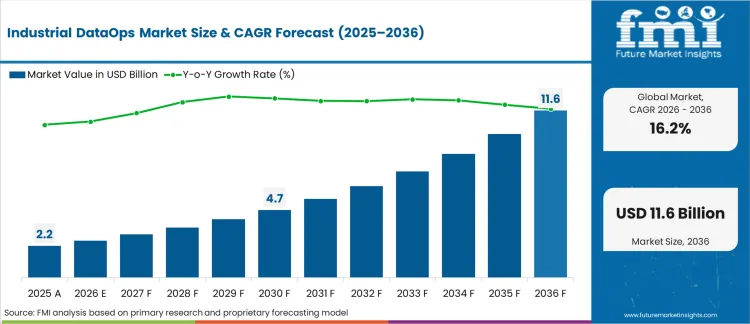
The industrial DataOps market reached USD 2.23 billion in 2025 and is projected to grow to USD 2.59 billion in 2026 before accelerating to USD 11.6 billion by 2036. Expansion outlook reflects a robust compound annual growth rate of 16.20%, driven primarily by intensifying global AI governance mandates that are pushing manufacturers to modernize data infrastructure and adopt unified industrial data orchestration frameworks. Data architecture decisions are reshaping vendor qualification timelines, signaling that secure data exchange infrastructure has crossed from optional to contractually mandated, compressing the window for operators to upgrade before the 2027 procurement cycle opens.
Roland Busch, CEO at Siemens AG, opined, “Access to high-quality machine data from different manufacturers is the key. With this alliance, we can develop AI systems that reflect the complexity entailed in development and manufacturing, and so it will become a powerful partner for skilled workers.” [9] This commitment directly shifts procurement economics for mid-market machine builders. Manufacturers that fail to establish standardized semantic models cannot participate in advanced Industrial DataOps consortiums, locking them out of future predictive maintenance service revenues.
Summary of Industrial DataOps Market
- Industrial DataOps Market Definition
- A specialized framework of software and operational practices utilizing automated data pipelines and edge-to-cloud integration techniques to isolate, contextualize, and deliver actionable machine data for industrial AI and analytics formulation.
- Demand Drivers in the Market
- Stringent AI governance and traceability mandates push manufacturers away from siloed legacy historians.
- Rising global energy costs compel asset-heavy industries to deploy real-time optimization models requiring unified telemetry.
- Advancements in semantic mapping and standard connectors reduce the friction of integrating diverse OT protocols.
- Key Segments Analyzed in the FMI Report
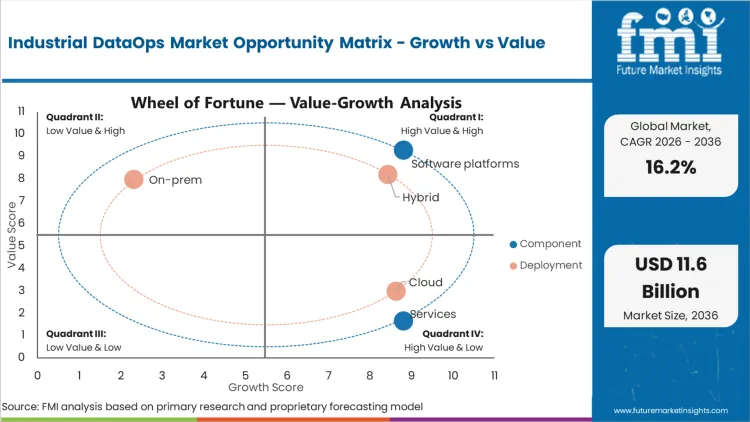
- Software Platforms: 64% of total volume driven by enterprise-wide standardization mandates.
- Manufacturing: 48% of total volume as smart factory initiatives require continuous pipeline observability.
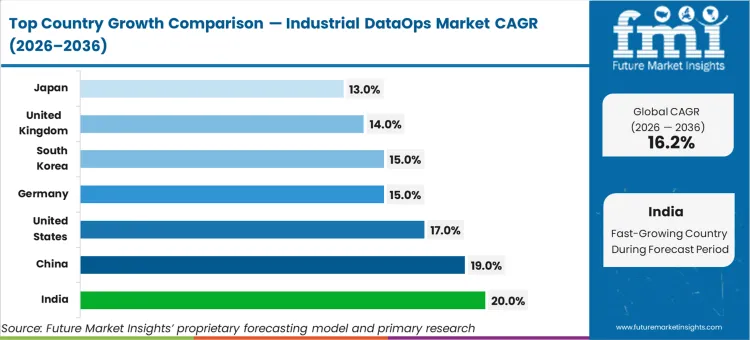
- Asia-Pacific: High-growth Asia-Pacific (India 20%, China 19%) outpaces mature North American markets as localized data sovereignty policies take effect.
- Analyst Opinion at FMI
- Nikhil Kaitwade, Principal Consultant for Industrial Automation at Future Market Insights, opines, “Through our recent evaluation, we observed that Industrial DataOps is gaining traction in predictive maintenance applications due to its contextualization and governance capabilities. Suppliers investing in application-specific OT-IT integration protocols will secure stronger positioning in enterprise AI innovation pipelines.”
- Strategic Implications / Executive Takeaways
- Secure robust data fabric architectures to insulate against integration bottlenecks during AI deployments.
- Prioritize edge-level contextualization to capture high-value, low-latency manufacturing applications.
- Build resilient observability frameworks across hybrid pipelines to minimize costly downtime events.
- Methodology
- Validated through first-hand corporate production and infrastructure integration data.
- Zero reliance on speculative third-party market research reports.
- Based on verifiable industrial benchmarks and verified sources.
Demand across India (20% CAGR) and China (19% CAGR) are shaped by aggressive industrial automation mandates, where localization aligns with lead-time reduction. In the United States (17% CAGR), functionality-led substitution away from isolated historians continues to influence platform formulation, as brands seek continuous observability without compromising security performance. European markets like Germany (15% CAGR) and the UK (14% CAGR) prioritize shared semantics and secure exchange under strict data privacy regulations, while Japan (13% CAGR) and South Korea (15% CAGR) target efficiency gains to combat aging workforce demographics.
Industrial DataOps Market Definition
Industrial DataOps represents a specialized framework of software and operational practices utilizing automated data pipelines and edge-to-cloud integration techniques to isolate, contextualize, and deliver actionable machine data for industrial AI formulation. Processors utilize semantic mapping to normalize disparate OT protocols into usable enterprise datasets. It enables continuous delivery of high-quality data to analytics engines across modern manufacturing environments.
Industrial DataOps Market Inclusions
The category includes software platforms, data catalogs, automated pipeline monitoring tools, and hybrid integration services developed for OT/IT convergence systems. It covers solutions deployed across manufacturing, energy grids, and logistics networks specifically designed to handle high-frequency time-series data and SCADA outputs.
Industrial DataOps Market Exclusions
The scope excludes general-purpose IT data warehousing systems without specific industrial protocol capabilities. It does not include raw hardware sensors or basic PLCs unless bundled inherently with advanced data orchestration layers. Consumer-facing data analytics and basic business intelligence visualization tools lacking pipeline automation are strictly excluded.
Industrial DataOps Market Research Methodology
- Primary Research: Direct interviews with data engineering managers, industrial automation directors, and platform architects provided baseline pricing and capacity utilization metrics.
- Desk Research: Custom corporate capacity announcements, SEC filings, and national technology infrastructure datasets substantiated regional adoption flow models.
- Market-Sizing and Forecasting: Analysts developed a bottom-up adoption model starting from regional industrial IoT deployments, applying historical integration spend ratios to project available market value.
- Data Validation and Update Cycle: Findings underwent cross-verification against official technology investment logs and peer-reviewed computer science journals before final forecast integration.
Segmental Analysis
Industrial DataOps Market Analysis by Component
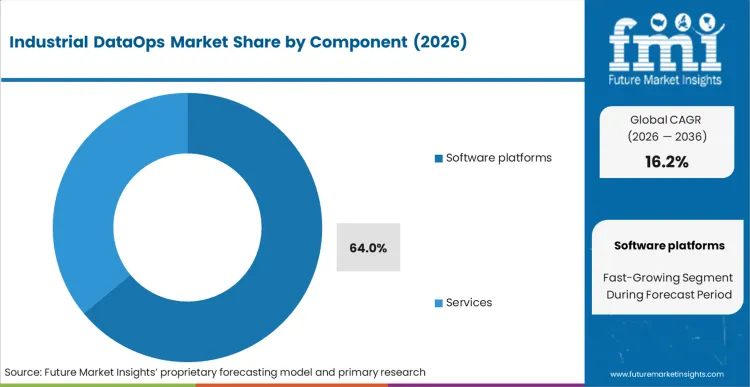
Enterprise architects are actively reformulating infrastructure portfolios, driving stronger adoption of enterprise data management layers that help remove integration bottlenecks while improving AI-readiness. Software platforms capture a 64% share in 2026, reflecting the operational necessities of scalable enterprise data governance. Technical functionality remains central to commercial success, as platforms offering native observability enable smooth incorporation into diverse manufacturing applications. Integration facilities increasingly prioritize pre-built connectors to secure competitive contracts within the industrial analytics segment.
- Technical Validation: High-performance data catalogs automatically map complex SCADA tags into normalized formats for downstream AI consumption.
- Process Compatibility: Plant managers avoid capital expenditure on custom middleware by sticking to standardized DataOps software platforms.
- Procurement Shifts: Native observability tools lower the total cost of ownership across distributed hybrid networks.
Industrial DataOps Market Analysis by Deployment
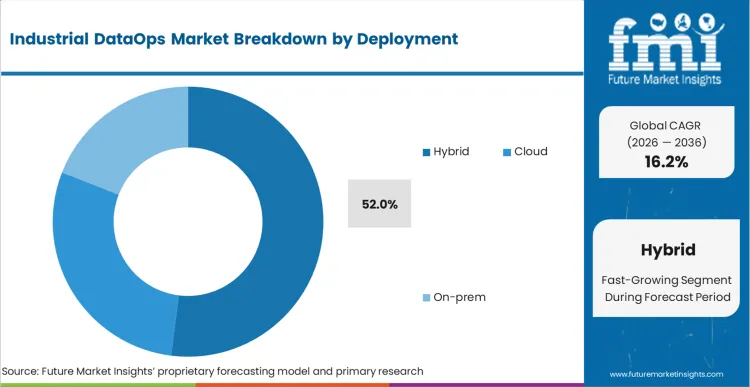
Hybrid deployments command 52% of the market in 2026, anchoring the structural transition toward edge-to-cloud architectures. Facilities must balance the low-latency requirements of shop-floor control systems with the massive computing power needed for data orchestration tool workloads in the cloud. FMI analysts opine that deployment flexibility shields operators from sudden cloud cost spikes and strict data residency compliance risks.
- Security Compliance: Critical infrastructure mandates force a transition away from public-only cloud configurations toward hybrid environments.
- Logistics Advantage: Edge nodes process high-frequency machine data locally, minimizing bandwidth costs and preventing latency during critical operations.
- Adoption Acceleration: Legacy SCADA systems demand on-premise retention while predictive models require hyperscale cloud environments.
Industrial DataOps Market Analysis by Data Source
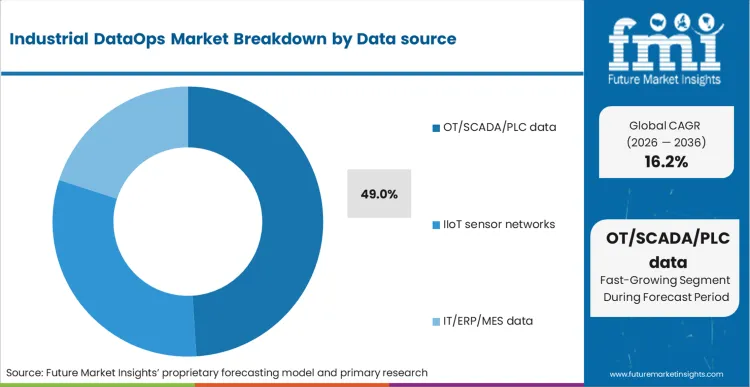
OT/SCADA/PLC data accounts for 49% of segment share as brands replace isolated data extraction methods with unified data fabric solutions. Extracting value from legacy machine controllers forms the absolute foundation of any industrial analytics initiative. The structural push toward real-time visibility forces operators to integrate raw telemetry directly into their enterprise data lakes. Microsoft published Fabric Data Factory innovations featuring over 170 native connectors [11], lowering the barrier for ingesting proprietary factory-floor protocols into advanced analytics environments.
- Volume Concentration: Narrows to standardized ingestion pipelines capable of handling millions of tags per second.
- Product Innovation: Joint ventures linking extraction technology with data science accelerate model commercialization timelines.
- Requalification Cycles: Lengthen data engineering teams lock into specific connector ecosystems for legacy PLC integration.
Industrial DataOps Market Analysis by End Use
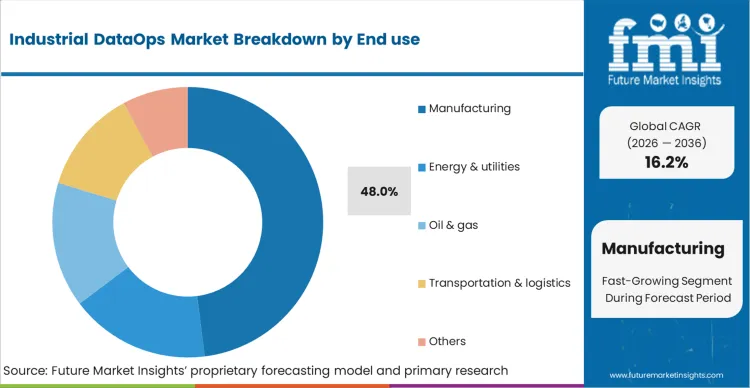
Manufacturing leads the end-use segment with 48% share, driven by a relentless focus on operational equipment effectiveness (OEE). The National Institute of Standards and Technology invested USD 20 million to establish AI centers for manufacturing in December 2025 [5], ensuring that early-stage data integration strategies receive institutional validation. The data pipeline observability solutions are no longer optional for automotive and aerospace brands operating under just-in-time constraints. Factories require unified DataOps to feed predictive maintenance models that eliminate unplanned downtime.
- Quality Validation: Continuous data streams feed digital twin environments to identify microscopic defects before physical assembly concludes.
- Supplier Positioning: Improves specialized system integrators demonstrate verifiable ROI through rapid pipeline deployment.
- Cost Structures: Tighten when manufacturers use DataOps to identify granular energy waste across thousands of industrial assets.
Industrial DataOps Market Analysis by Enterprise Size
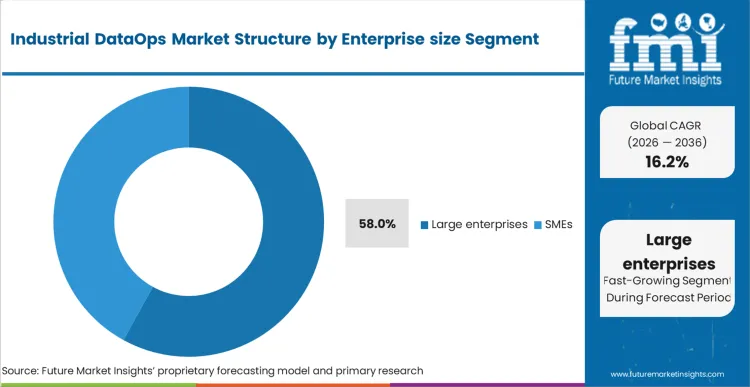
Large enterprises dictate architectural standards, comprising 58% of the deployment base. Only organizations with significant capital budgets and complex, multi-site operational footprints experience the acute data friction required to justify massive DataOps platform investments. These global entities require enterprise-grade data catalog systems to navigate thousands of overlapping systems. Snowflake acquired Select Star in November 2025 [15], validating that scalable cataloging capabilities are critical for large enterprises managing distributed data assets.
- Architectural Compliance: Global manufacturers mandate centralized data governance frameworks to satisfy regional privacy audits.
- Talent Optimization: Centralized data engineering teams automate pipeline creation to offset persistent shortages in specialized OT-IT integration skills.
- Resource Allocation Shifts: Large enterprises consolidate fragmented data management vendor lists into single-pane-of-glass platforms.
Industrial DataOps Market Drivers, Restraints, and Opportunities
Data fragmentation across legacy industrial assets forces widespread architecture reformulations across the manufacturing sector. Plant engineers replace manual data extraction with automated pipelines to capture expanding AI-driven optimization opportunities. The Bureau of Labor Statistics reported a 3.7% increase in manufacturing labor productivity in late 2025 [7], validating the immediate ROI generated when optimized data pipelines feed advanced operational algorithms. Production lines adapt to these novel tools without facing sudden IT bottlenecks, encouraging long-term procurement commitments.
Integration complexity and a lack of specialized talent restrict rapid capacity scaling for advanced analytics models. Deployment protocols demand significant cultural and technical shifts, compressing ROI timelines for emerging manufacturers competing against entrenched digital leaders. The UK Government reported that 97% of businesses identified at least one AI skills gap in 2025 [4], highlighting the structural barrier preventing widespread adoption of complex data orchestration architectures. Operators refine semantic mapping methods to lower unit costs and simplify deployment to justify platform premiums.
- Pipeline Observability Expansion: Solutions that automatically detect data drift secure massive enterprise budgets. Snowflake announced intent to acquire Observe in early 2026 [14], proving that AI-powered observability is now a mandatory acquisition target for major data platforms.
- Edge-to-Cloud Consolidation: AVEVA announced comprehensive Databricks integration [13], creating a direct bridge between industrial edge networks and advanced cloud AI.
- Secure Networking Integration: Schneider Electric introduced the Modicon Edge I/O NTS [16], demonstrating that hardware vendors are embedding native IT/OT data management capabilities directly into the physical infrastructure layer.
Regional Analysis
.webp "Top Country Growth Comparison Industrial Dataops Market Cagr (2026 2036)")
Based on the regional analysis, the Industrial DataOps market is segmented into North America, Latin America, Europe, East Asia, South Asia, Oceania and Middle East & Africa across 40+ countries. The full report also offers market attractiveness analysis based on regional trends.
| Country | CAGR (2026 to 2036) |
|---|---|
| India | 20.0% |
| China | 19.0% |
| United States | 17.0% |
| Germany | 15.0% |
| South Korea | 15.0% |
| United Kingdom | 14.0% |
| Japan | 13.0% |
Source: Future Market Insights (FMI) analysis, based on proprietary forecasting model and primary research
Asia Pacific Industrial DataOps Market Analysis
Asia Pacific's commercialization pace is increasingly defined by how quickly regional manufacturers convert raw industrial telemetry into higher-value functional insights. Instead of operating fragmented local control systems, domestic manufacturers are upgrading network systems to capture better margins from predictive AI applications. This structural shift reflects a broader opportunity: replacing volatile manual oversight with regionally available cloud computing platforms. The International Energy Agency projects global data center electricity will reach approximately 945 TWh by 2030 [2], making data infrastructure energy efficiency a primary design constraint for Asian manufacturing hubs scaling their digital operations. Localized processing depth determines long-term architectural profitability.
- India: The National Science Foundation’s massive investments into AI research globally influence standard architectures utilized by Indian service integrators [6]. Demand for Industrial DataOps in India is projected to expand at a 20.0% CAGR through 2036, supported by value-focused digital fortification strategies ahead of broader mass-market penetration. Domestic integrators must secure partnerships with top-tier platform providers to avoid being relegated to low-margin legacy maintenance contracts.
- China: As industrial formulation capabilities scale, Industrial DataOps sales in China are projected to grow at a 19.0% CAGR. Aggressive domestic mandates require complete data sovereignty across manufacturing ecosystems. Procurement teams must deploy locally hosted or hybrid data fabrics to ensure compliance before state-driven digital transformation deadlines pass.
- Japan: Operators who do not hold approved digital twin capabilities before the 2028 enforcement wave cannot maintain output levels. Aging workforce demographics in Japan force a hard substitution toward automated data handling, resulting in a 13.0% CAGR. Plant directors must transition to fully automated data pipelines to bridge the knowledge gap left by retiring process engineers.
- South Korea: South Korea’s smart factory sector is poised to expand at a 15.0% CAGR through 2036. High-tech electronics manufacturing demands microsecond-level data pipeline observability to prevent defect propagation. The quality control directors must integrate real-time anomaly detection frameworks directly into their MES layers to maintain competitive yield rates.
FMI's report includes comprehensive tracking of the Asia Pacific ecosystem, mapping infrastructure developments across Vietnam, Thailand, and Malaysia. The localization of robust hybrid data frameworks determines the speed at which these emerging industrial corridors can integrate into the global smart manufacturing supply chain.
North America Industrial DataOps Market Analysis
North America's architectural landscape is undergoing recalibration as domestic manufacturing recovery aligns with downstream AI investment. Rebounding industrial output reduces dependence on fragmented legacy software, while public-private consortiums channel funding into commercial-scale digital infrastructure. The region heavily prioritizes data discovery and governance to satisfy strict corporate risk profiles. Bridging pilot success to industrial throughput is the real unlock for DataOps, reflecting how capital inflows are translating into infrastructure expansion. FMI analysts opine that functionality-led substitution continues to influence formulation across the continent.
- United States: The World Economic Forum notes 86% of employers expect AI to be transformative by 2030 [8], forcing US manufacturing giants to aggressively modernize their underlying data foundations. The United States DataOps segment is expected to grow at a 17.0% CAGR from 2026 to 2036. Enterprise CIOs must transition their data architectures to support distributed AI agents or risk massive efficiency disadvantages against digitally native competitors.
FMI's report includes complete operational analysis covering Canada and Mexico. The expansion of nearshored manufacturing networks directly accelerates the deployment of unified cross-border data orchestration tools to maintain visibility over regionalized supply chains.
Europe Industrial DataOps Market Analysis
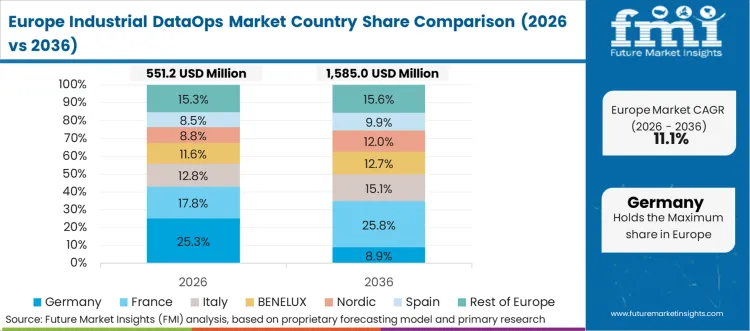
Europe functions as a technical proving ground for advanced data exchange frameworks under strict privacy and sustainability rules. Regulatory scrutiny compels manufacturers to source secure, federated platforms while minimizing exposure to volatile public cloud lock-in. This dynamic reinforces strategic pivoting toward shared semantic architectures and sovereign data spaces. Data security performance dictates vendor selection across the continent.
- Germany: In Germany, DataOps demand is forecast to expand at a 15.0% CAGR through 2036, supported by a maturing technical ecosystem and defined Industry 4.0 budgets. German process engineers must deploy cryptographically secure integration nodes to meet stringent regional data privacy regulations.
- United Kingdom: The UK Government reports that 83% of businesses handle some form of digital data [1], but advanced pipeline capabilities remain concentrated among top-tier operators. Rising AI adoption reshapes procurement economics in the United Kingdom, projecting a 14.0% CAGR. IT directors must invest in automated data catalogs to bridge the gap between basic data storage and advanced algorithmic analysis.
FMI's report includes deep intelligence on France, Italy, and the Nordics. The transition toward low-emission industrial networking and highly regulated data sovereignty forces localized operators to adopt hybrid architectures capable of processing telemetry entirely within domestic borders.
Competitive Aligners for Market Players
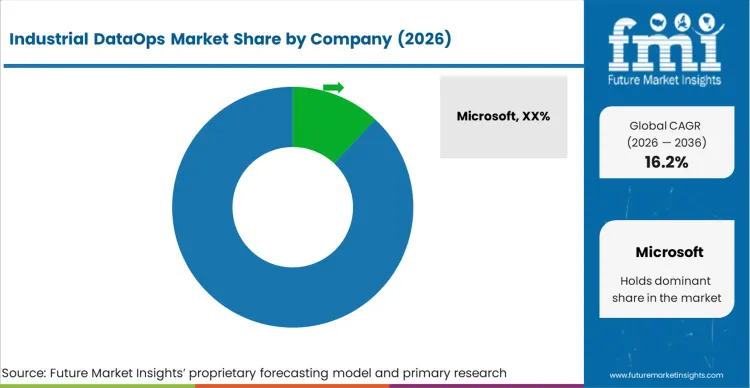
Technological capability differentiates premium platforms from basic data aggregation tools. Companies holding intellectual property for specific semantic mapping and automated cataloging techniques command higher margins by delivering pipelines with superior data quality and lower latency profiles. Enterprise buyers secure multi-year procurement contracts to stabilize these critical digital operations.
Strategic consortiums and open-ecosystem partnerships accelerate commercialization timelines for emerging players. Rockwell Automation's expansion of OT networking product lines [17] demonstrates how traditional hardware vendors are positioning themselves as critical data intermediaries. Integrators positioned near major industrial corridors maintain a structural advantage over competitors reliant purely on cloud software. Vendor advantage realigns where localized deployment and rapid field support meet strict enterprise compliance demands.
Competitive posture shifts as industrial AI becomes mainstream, forcing a convergence between specialized OT software and enterprise IT infrastructure. Facilities secure robust platform architectures to insulate against integration bottlenecks. IT/OT alignment requires significant cultural shifts, compressing margins for integrators lacking deep domain expertise in both networking hardware and cloud analytics.
Recent Developments
The report includes full coverage of key trends from competitive benchmarking. Some of the recent developments covered in the reports:
- In November 2025, SAP announced BDC Connect for Microsoft Fabric to streamline the flow of industrial ERP insights into advanced AI innovation pipelines. [10]
- In May 2025, Databricks announced its intent to acquire Neon to deliver high-performance, serverless Postgres infrastructure for complex AI systems. [12]
Key Players in Industrial DataOps Market
- Microsoft
- IBM
- AWS
- Oracle
- SAP
- Snowflake
- PTC
- Siemens
- Databricks
- AVEVA
- Schneider Electric
- Rockwell Automation
Scope of the Report
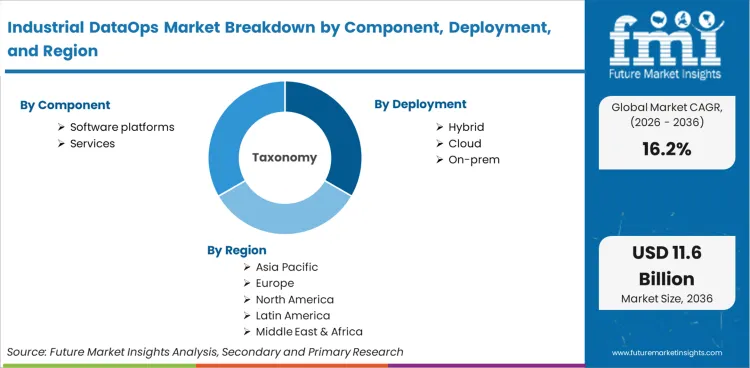
| Metric | Value |
|---|---|
| Quantitative Units | USD 2.59 billion (2026) to USD 11.6 billion (2036), at a CAGR of 16.20% |
| Market Definition | A specialized framework of software and operational practices utilizing automated data pipelines to isolate, contextualize, and deliver actionable machine data for industrial AI formulation. |
| Component Segmentation | Software platforms, Services |
| Deployment Segmentation | Hybrid, Cloud, On-prem |
| Data source Segmentation | OT/SCADA/PLC data, IIoT sensor networks, IT/ERP/MES data |
| End use Segmentation | Manufacturing, Energy & utilities, Oil & gas, Transportation & logistics, Others |
| Enterprise size Segmentation | Large enterprises, SMEs |
| Regions Covered | North America, Latin America, Europe, East Asia, South Asia, Oceania, Middle East and Africa |
| Countries Covered | United States, Canada, Mexico, Brazil, Argentina, Germany, France, United Kingdom, Italy, Spain, China, India, Japan, South Korea, Indonesia, Australia and 40 plus countries |
| Key Companies Profiled | Microsoft, IBM, AWS, Oracle, SAP, Snowflake, PTC, Siemens, Databricks, AVEVA |
| Forecast Period | 2026 to 2036 |
| Approach | Hybrid top-down and bottom-up market modeling validated through primary interviews with IT directors and automation architects, supported by infrastructure investment benchmarking. |
Source: Future Market Insights (FMI) analysis, based on proprietary forecasting model and primary research
Segmental Analysis
Component:
- Software platforms
- Services
Deployment:
- Hybrid
- Cloud
- On-prem
Data source:
- OT/SCADA/PLC data
- IIoT sensor networks
- IT/ERP/MES data
End use:
- Manufacturing
- Energy & utilities
- Oil & gas
- Transportation & logistics
- Others
Enterprise size:
- Large enterprises
- SMEs
Region:
- Asia Pacific
- India
- China
- Japan
- South Korea
- Indonesia
- Australia & New Zealand
- ASEAN
- Rest of Asia Pacific
- Europe
- Germany
- Italy
- France
- United Kingdom
- Spain
- Benelux
- Nordics
- Central & Eastern Europe
- Rest of Europe
- North America
- United States
- Canada
- Mexico
- Latin America
- Brazil
- Argentina
- Chile
- Rest of Latin America
- Middle East & Africa
- Kingdom of Saudi Arabia
- United Arab Emirates
- South Africa
- Turkey
- Rest of Middle East & Africa
Bibliography
- [1] UK Government. (2025). Business data use and productivity study wave 2 (Statistical report).
- [2] International Energy Agency. (2025). Energy demand from AI (Government report).
- [4] UK Government. (2025). AI labour market survey 2025 (Government report).
- [5] National Institute of Standards and Technology. (2025, December). NIST launches centers for AI in manufacturing (Press release).
- [6] National Science Foundation. (2025). NSF 2025 keeping US scientific research innovation cutting (Press release).
- [7] Bureau of Labor Statistics. (2025). Productivity and costs (Statistical database entry).
- [8] World Economic Forum. (2025). Future of jobs report 2025 (Industry report).
- [9] Siemens. (2025, September 23). Siemens and machine builders agree groundbreaking data alliance (Press release).
- [10] SAP. (2025, November 18). SAP BDC connect for Microsoft Fabric (Press release).
- [11] Microsoft. (2025). Advancing data integration innovations in Fabric (Company news release).
- [12] Databricks. (2025, May 14). Databricks agrees to acquire Neon (Press release).
- [13] AVEVA. (2025, April 8). CONNECT and Databricks integration is here (Company news release).
- [14] Snowflake. (2026, January 8). Snowflake announces intent to acquire Observe (Press release).
- [15] Snowflake. (2025, November 24). Snowflake acquire Select Star (Press release).
- [16] Schneider Electric. (2025, March 17). Schneider Electric introduces Modicon Edge I/O NTS (Press release).
- [17] Rockwell Automation. (2025, October 21). New solutions Automation Fair 2025 (Press release).
This bibliography is provided for reader reference and is not exhaustive. The full report contains the complete reference list and detailed citations.
This Report Addresses
- Market size estimation and revenue forecasts from 2026 to 2036, supported by validated enterprise IT adoption benchmarks across major global manufacturing hubs.
- Segment and regional revenue forecasts covering critical applications like software platforms, OT/SCADA integration, and hybrid deployments.
- Competition strategy assessment including cloud ecosystem integration models, edge computing positioning, and process capability benchmarking.
- Regulatory impact analysis evaluating strict data sovereignty mandates, critical infrastructure security protocols, and enterprise AI compliance guidelines.
- Structural shift evaluation mapping the migration from localized legacy historians to unified cloud data fabrics enabling predictive industrial analytics.
- Growth opportunity mapping across energy, utilities, and transportation sectors with an emphasis on low-latency operational data architectures.
- Supply chain vulnerability assessment linking edge data collection capabilities directly to final machine learning model accuracy and uptime.
- Market report delivery in PDF, Excel, PPT, and interactive dashboard formats for executive and operational use.
Frequently Asked Questions
How large is the demand for Industrial DataOps in the global market in 2026?
Demand for Industrial DataOps in the global market is estimated to be valued at USD 2.59 billion in 2026.
What will be the market size of Industrial DataOps in the global market by 2036?
Market size for Industrial DataOps is projected to reach USD 11.6 billion by 2036.
What is the expected demand growth for Industrial DataOps in the global market between 2026 and 2036?
Demand for Industrial DataOps is expected to grow at a CAGR of 16.20% between 2026 and 2036.
Which Component is poised to lead global sales by 2026?
Software platforms command 64% of the volume in 2026 as manufacturers prioritize standardized data orchestration models.
How significant is the role of Manufacturing in driving Industrial DataOps adoption in 2026?
Manufacturing represents 48% of segment share as brands replace isolated data silos to enable advanced predictive maintenance.
What is driving demand in India?
Value-driven digital fortification and alignment with global AI infrastructure expansions drive data orchestration adoption in India.
What compliance standards or regulations are referenced for India?
Broad corporate data sovereignty regulations and evolving national AI infrastructure mandates directly influence domestic procurement behavior.
What is the India growth outlook in this report?
India is projected to grow at a CAGR of 20.0% during 2026 to 2036.
Why is North America described as a priority region in this report?
Maturing enterprise AI infrastructure budgets and high demand for unified digital twins accelerate commercial IT/OT platform capacity.
What type of demand dominates in North America?
Functionality-led substitution away from legacy historians toward modern data fabrics dominates regional infrastructure demand.
What is China's growth outlook in this report?
China is projected to expand at a CAGR of 19.0% during 2026 to 2036.
Does the report cover United States in its regional analysis?
Yes, the United States is included within North America under the regional scope of analysis.
What are the sources referred to for analyzing United States?
Official automation investment data from economic databases and corporate cloud platform capacity announcements form the analytical basis.
What is the main demand theme linked to United States in its region coverage?
Enterprise migration toward scalable data lakes to support distributed AI models shapes continuous procurement demand.
Does the report cover Germany in its regional analysis?
Yes, Germany is included within Europe under the regional coverage framework.
What is the main Germany related demand theme in its region coverage?
Strict privacy regulations and the deployment of cryptographically secure OT networking nodes dominate regional architectural behavior.
Which product formats or configurations are strategically important for Europe supply chains?
Hybrid and on-premise edge computing platforms designed to satisfy local data residency laws hold immense strategic importance.
What is Industrial DataOps and what is it mainly used for?
It is a specialized framework of software and practices utilized primarily to automate data pipelines for industrial AI applications.
What does Industrial DataOps mean in this report?
The market refers to the global production, trade, and enterprise deployment of platforms that integrate OT and IT datasets.
What is included in the scope of this Industrial DataOps report?
Scope includes software platforms, automated catalogs, and edge-to-cloud integration services designated for industrial environments.
What is excluded from the scope of this report?
Basic consumer BI tools, standalone hardware sensors without software logic, and non-industrial enterprise data warehouses are strictly excluded.
What does market forecast mean on this page?
The market forecast represents a model-based projection built on defined technological and industrial adoption assumptions for strategic planning purposes.
How does FMI build and validate the Industrial DataOps forecast?
Forecasts combine top-down IT spend data with bottom-up factory automation metrics, validated by primary platform architect interviews.
What does zero reliance on speculative third-party market research mean here?
Primary interviews, verified corporate integration announcements, and official government technology datasets are used exclusively instead of unverified syndicated estimates.
Preview the report firsthand - request a free sample
Get SampleGet the brochure for pricing and purchase details.
Get PDFTable of Content
- Executive Summary
- Global Market Outlook
- Demand-side Trends
- Supply-side Trends
- Technology Roadmap Analysis
- Analysis and Recommendations
- Market Overview
- Market Coverage / Taxonomy
- Market Definition / Scope / Limitations
- Research Methodology
- Chapter Orientation
- Analytical Lens and Working Hypotheses
- Market Structure, Signals, and Trend Drivers
- Benchmarking and Cross-market Comparability
- Market Sizing, Forecasting, and Opportunity Mapping
- Research Design and Evidence Framework
- Desk Research Programme (Secondary Evidence)
- Company Annual and Sustainability Reports
- Peer-reviewed Journals and Academic Literature
- Corporate Websites, Product Literature, and Technical Notes
- Earnings Decks and Investor Briefings
- Statutory Filings and Regulatory Disclosures
- Technical White Papers and Standards Notes
- Trade Journals, Industry Magazines, and Analyst Briefs
- Conference Proceedings, Webinars, and Seminar Materials
- Government Statistics Portals and Public Data Releases
- Press Releases and Reputable Media Coverage
- Specialist Newsletters and Curated Briefings
- Sector Databases and Reference Repositories
- FMI Internal Proprietary Databases and Historical Market Datasets
- Subscription Datasets and Paid Sources
- Social Channels, Communities, and Digital Listening Inputs
- Additional Desk Sources
- Expert Input and Fieldwork (Primary Evidence)
- Primary Modes
- Qualitative Interviews and Expert Elicitation
- Quantitative Surveys and Structured Data Capture
- Blended Approach
- Why Primary Evidence is Used
- Field Techniques
- Interviews
- Surveys
- Focus Groups
- Observational and In-context Research
- Social and Community Interactions
- Stakeholder Universe Engaged
- C-suite Leaders
- Board Members
- Presidents and Vice Presidents
- R&D and Innovation Heads
- Technical Specialists
- Domain Subject-matter Experts
- Scientists
- Physicians and Other Healthcare Professionals
- Governance, Ethics, and Data Stewardship
- Research Ethics
- Data Integrity and Handling
- Primary Modes
- Tooling, Models, and Reference Databases
- Desk Research Programme (Secondary Evidence)
- Data Engineering and Model Build
- Data Acquisition and Ingestion
- Cleaning, Normalisation, and Verification
- Synthesis, Triangulation, and Analysis
- Quality Assurance and Audit Trail
- Market Background
- Market Dynamics
- Drivers
- Restraints
- Opportunity
- Trends
- Scenario Forecast
- Demand in Optimistic Scenario
- Demand in Likely Scenario
- Demand in Conservative Scenario
- Opportunity Map Analysis
- Product Life Cycle Analysis
- Supply Chain Analysis
- Investment Feasibility Matrix
- Value Chain Analysis
- PESTLE and Porter’s Analysis
- Regulatory Landscape
- Regional Parent Market Outlook
- Production and Consumption Statistics
- Import and Export Statistics
- Market Dynamics
- Global Market Analysis 2021 to 2025 and Forecast, 2026 to 2036
- Historical Market Size Value (USD Million) Analysis, 2021 to 2025
- Current and Future Market Size Value (USD Million) Projections, 2026 to 2036
- Y-o-Y Growth Trend Analysis
- Absolute $ Opportunity Analysis
- Global Market Pricing Analysis 2021 to 2025 and Forecast 2026 to 2036
- Global Market Analysis 2021 to 2025 and Forecast 2026 to 2036, By Component
- Introduction / Key Findings
- Historical Market Size Value (USD Million) Analysis By Component , 2021 to 2025
- Current and Future Market Size Value (USD Million) Analysis and Forecast By Component , 2026 to 2036
- Software platforms
- Services
- Software platforms
- Y-o-Y Growth Trend Analysis By Component , 2021 to 2025
- Absolute $ Opportunity Analysis By Component , 2026 to 2036
- Global Market Analysis 2021 to 2025 and Forecast 2026 to 2036, By Deployment
- Introduction / Key Findings
- Historical Market Size Value (USD Million) Analysis By Deployment, 2021 to 2025
- Current and Future Market Size Value (USD Million) Analysis and Forecast By Deployment, 2026 to 2036
- Hybrid
- Cloud
- On-prem
- Hybrid
- Y-o-Y Growth Trend Analysis By Deployment, 2021 to 2025
- Absolute $ Opportunity Analysis By Deployment, 2026 to 2036
- Global Market Analysis 2021 to 2025 and Forecast 2026 to 2036, By Data source
- Introduction / Key Findings
- Historical Market Size Value (USD Million) Analysis By Data source, 2021 to 2025
- Current and Future Market Size Value (USD Million) Analysis and Forecast By Data source, 2026 to 2036
- OT/SCADA/PLC data
- IIoT sensor networks
- IT/ERP/MES data
- OT/SCADA/PLC data
- Y-o-Y Growth Trend Analysis By Data source, 2021 to 2025
- Absolute $ Opportunity Analysis By Data source, 2026 to 2036
- Global Market Analysis 2021 to 2025 and Forecast 2026 to 2036, By End use
- Introduction / Key Findings
- Historical Market Size Value (USD Million) Analysis By End use, 2021 to 2025
- Current and Future Market Size Value (USD Million) Analysis and Forecast By End use, 2026 to 2036
- Manufacturing
- Energy & utilities
- Oil & gas
- Transportation & logistics
- Others
- Manufacturing
- Y-o-Y Growth Trend Analysis By End use, 2021 to 2025
- Absolute $ Opportunity Analysis By End use, 2026 to 2036
- Global Market Analysis 2021 to 2025 and Forecast 2026 to 2036, By Enterprise size
- Introduction / Key Findings
- Historical Market Size Value (USD Million) Analysis By Enterprise size, 2021 to 2025
- Current and Future Market Size Value (USD Million) Analysis and Forecast By Enterprise size, 2026 to 2036
- Large enterprises
- SMEs
- Large enterprises
- Y-o-Y Growth Trend Analysis By Enterprise size, 2021 to 2025
- Absolute $ Opportunity Analysis By Enterprise size, 2026 to 2036
- Global Market Analysis 2021 to 2025 and Forecast 2026 to 2036, By Region
- Introduction
- Historical Market Size Value (USD Million) Analysis By Region, 2021 to 2025
- Current Market Size Value (USD Million) Analysis and Forecast By Region, 2026 to 2036
- North America
- Latin America
- Western Europe
- Eastern Europe
- East Asia
- South Asia and Pacific
- Middle East & Africa
- Market Attractiveness Analysis By Region
- North America Market Analysis 2021 to 2025 and Forecast 2026 to 2036, By Country
- Historical Market Size Value (USD Million) Trend Analysis By Market Taxonomy, 2021 to 2025
- Market Size Value (USD Million) Forecast By Market Taxonomy, 2026 to 2036
- By Country
- USA
- Canada
- Mexico
- By Component
- By Deployment
- By Data source
- By End use
- By Enterprise size
- By Country
- Market Attractiveness Analysis
- By Country
- By Component
- By Deployment
- By Data source
- By End use
- By Enterprise size
- Key Takeaways
- Latin America Market Analysis 2021 to 2025 and Forecast 2026 to 2036, By Country
- Historical Market Size Value (USD Million) Trend Analysis By Market Taxonomy, 2021 to 2025
- Market Size Value (USD Million) Forecast By Market Taxonomy, 2026 to 2036
- By Country
- Brazil
- Chile
- Rest of Latin America
- By Component
- By Deployment
- By Data source
- By End use
- By Enterprise size
- By Country
- Market Attractiveness Analysis
- By Country
- By Component
- By Deployment
- By Data source
- By End use
- By Enterprise size
- Key Takeaways
- Western Europe Market Analysis 2021 to 2025 and Forecast 2026 to 2036, By Country
- Historical Market Size Value (USD Million) Trend Analysis By Market Taxonomy, 2021 to 2025
- Market Size Value (USD Million) Forecast By Market Taxonomy, 2026 to 2036
- By Country
- Germany
- UK
- Italy
- Spain
- France
- Nordic
- BENELUX
- Rest of Western Europe
- By Component
- By Deployment
- By Data source
- By End use
- By Enterprise size
- By Country
- Market Attractiveness Analysis
- By Country
- By Component
- By Deployment
- By Data source
- By End use
- By Enterprise size
- Key Takeaways
- Eastern Europe Market Analysis 2021 to 2025 and Forecast 2026 to 2036, By Country
- Historical Market Size Value (USD Million) Trend Analysis By Market Taxonomy, 2021 to 2025
- Market Size Value (USD Million) Forecast By Market Taxonomy, 2026 to 2036
- By Country
- Russia
- Poland
- Hungary
- Balkan & Baltic
- Rest of Eastern Europe
- By Component
- By Deployment
- By Data source
- By End use
- By Enterprise size
- By Country
- Market Attractiveness Analysis
- By Country
- By Component
- By Deployment
- By Data source
- By End use
- By Enterprise size
- Key Takeaways
- East Asia Market Analysis 2021 to 2025 and Forecast 2026 to 2036, By Country
- Historical Market Size Value (USD Million) Trend Analysis By Market Taxonomy, 2021 to 2025
- Market Size Value (USD Million) Forecast By Market Taxonomy, 2026 to 2036
- By Country
- China
- Japan
- South Korea
- By Component
- By Deployment
- By Data source
- By End use
- By Enterprise size
- By Country
- Market Attractiveness Analysis
- By Country
- By Component
- By Deployment
- By Data source
- By End use
- By Enterprise size
- Key Takeaways
- South Asia and Pacific Market Analysis 2021 to 2025 and Forecast 2026 to 2036, By Country
- Historical Market Size Value (USD Million) Trend Analysis By Market Taxonomy, 2021 to 2025
- Market Size Value (USD Million) Forecast By Market Taxonomy, 2026 to 2036
- By Country
- India
- ASEAN
- Australia & New Zealand
- Rest of South Asia and Pacific
- By Component
- By Deployment
- By Data source
- By End use
- By Enterprise size
- By Country
- Market Attractiveness Analysis
- By Country
- By Component
- By Deployment
- By Data source
- By End use
- By Enterprise size
- Key Takeaways
- Middle East & Africa Market Analysis 2021 to 2025 and Forecast 2026 to 2036, By Country
- Historical Market Size Value (USD Million) Trend Analysis By Market Taxonomy, 2021 to 2025
- Market Size Value (USD Million) Forecast By Market Taxonomy, 2026 to 2036
- By Country
- Kingdom of Saudi Arabia
- Other GCC Countries
- Turkiye
- South Africa
- Other African Union
- Rest of Middle East & Africa
- By Component
- By Deployment
- By Data source
- By End use
- By Enterprise size
- By Country
- Market Attractiveness Analysis
- By Country
- By Component
- By Deployment
- By Data source
- By End use
- By Enterprise size
- Key Takeaways
- Key Countries Market Analysis
- USA
- Pricing Analysis
- Market Share Analysis, 2025
- By Component
- By Deployment
- By Data source
- By End use
- By Enterprise size
- Canada
- Pricing Analysis
- Market Share Analysis, 2025
- By Component
- By Deployment
- By Data source
- By End use
- By Enterprise size
- Mexico
- Pricing Analysis
- Market Share Analysis, 2025
- By Component
- By Deployment
- By Data source
- By End use
- By Enterprise size
- Brazil
- Pricing Analysis
- Market Share Analysis, 2025
- By Component
- By Deployment
- By Data source
- By End use
- By Enterprise size
- Chile
- Pricing Analysis
- Market Share Analysis, 2025
- By Component
- By Deployment
- By Data source
- By End use
- By Enterprise size
- Germany
- Pricing Analysis
- Market Share Analysis, 2025
- By Component
- By Deployment
- By Data source
- By End use
- By Enterprise size
- UK
- Pricing Analysis
- Market Share Analysis, 2025
- By Component
- By Deployment
- By Data source
- By End use
- By Enterprise size
- Italy
- Pricing Analysis
- Market Share Analysis, 2025
- By Component
- By Deployment
- By Data source
- By End use
- By Enterprise size
- Spain
- Pricing Analysis
- Market Share Analysis, 2025
- By Component
- By Deployment
- By Data source
- By End use
- By Enterprise size
- France
- Pricing Analysis
- Market Share Analysis, 2025
- By Component
- By Deployment
- By Data source
- By End use
- By Enterprise size
- India
- Pricing Analysis
- Market Share Analysis, 2025
- By Component
- By Deployment
- By Data source
- By End use
- By Enterprise size
- ASEAN
- Pricing Analysis
- Market Share Analysis, 2025
- By Component
- By Deployment
- By Data source
- By End use
- By Enterprise size
- Australia & New Zealand
- Pricing Analysis
- Market Share Analysis, 2025
- By Component
- By Deployment
- By Data source
- By End use
- By Enterprise size
- China
- Pricing Analysis
- Market Share Analysis, 2025
- By Component
- By Deployment
- By Data source
- By End use
- By Enterprise size
- Japan
- Pricing Analysis
- Market Share Analysis, 2025
- By Component
- By Deployment
- By Data source
- By End use
- By Enterprise size
- South Korea
- Pricing Analysis
- Market Share Analysis, 2025
- By Component
- By Deployment
- By Data source
- By End use
- By Enterprise size
- Russia
- Pricing Analysis
- Market Share Analysis, 2025
- By Component
- By Deployment
- By Data source
- By End use
- By Enterprise size
- Poland
- Pricing Analysis
- Market Share Analysis, 2025
- By Component
- By Deployment
- By Data source
- By End use
- By Enterprise size
- Hungary
- Pricing Analysis
- Market Share Analysis, 2025
- By Component
- By Deployment
- By Data source
- By End use
- By Enterprise size
- Kingdom of Saudi Arabia
- Pricing Analysis
- Market Share Analysis, 2025
- By Component
- By Deployment
- By Data source
- By End use
- By Enterprise size
- Turkiye
- Pricing Analysis
- Market Share Analysis, 2025
- By Component
- By Deployment
- By Data source
- By End use
- By Enterprise size
- South Africa
- Pricing Analysis
- Market Share Analysis, 2025
- By Component
- By Deployment
- By Data source
- By End use
- By Enterprise size
- USA
- Market Structure Analysis
- Competition Dashboard
- Competition Benchmarking
- Market Share Analysis of Top Players
- By Regional
- By Component
- By Deployment
- By Data source
- By End use
- By Enterprise size
- Competition Analysis
- Competition Deep Dive
- Microsoft
- Overview
- Product Portfolio
- Profitability by Market Segments (Product/Age /Sales Channel/Region)
- Sales Footprint
- Strategy Overview
- Marketing Strategy
- Product Strategy
- Channel Strategy
- IBM
- AWS
- Oracle
- SAP
- Snowflake
- PTC
- Siemens
- Databricks
- AVEVA
- Schneider Electric
- Rockwell Automation
- Microsoft
- Competition Deep Dive
- Assumptions & Acronyms Used


