

- Industry Size (2026)
- USD 2.72 Bn
- Forecast (2036)
- USD 6.01 Bn
- CAGR (2026 to 2036)
- 8.2%
Industrial Vision Gateways Forecast and Outlook 2026 to 2036
The global industrial vision gateways market sector is on track to achieve a valuation of USD 6.01 billion by 2036, accelerating from USD 2.72 billion in 2026 at a CAGR of 8.2%. As per Future Market Insights, this growth trajectory reflects the increasing adoption of Industry 4.0 technologies and the rising demand for automated quality inspection systems across manufacturing sectors.
The regulatory landscape has experienced significant shifts, particularly following the European Union's Machinery Regulation 2023/1230, which came into effect in January 2026, mandating enhanced safety monitoring capabilities for automated production lines. This regulation has accelerated the deployment of vision-enabled gateway systems that can provide real-time safety compliance reporting.
Michael Chen, Director of Industrial IoT Strategy at Schneider Electric, stated: 'The integration of machine vision with edge computing gateways represents a fundamental shift in how we approach industrial automation. These systems are no longer just data collectors but have become intelligent decision-making nodes that can adapt to changing production conditions in real-time.'
The market witnessed substantial technological advancement in 2025 with the introduction of 5G-enabled vision gateways, which reduced latency to sub-millisecond levels. In 2026, the focus has shifted toward AI-powered analytics integration, with major vendors incorporating neural processing units directly into gateway hardware. The supply chain disruptions of 2022-2023 have largely resolved, leading to more stable pricing and improved component availability throughout 2025 and 2026.
Manufacturing facilities are increasingly adopting distributed vision architectures, moving away from centralized processing models that dominated the market until 2024. This architectural shift has driven demand for more sophisticated gateway solutions capable of handling complex image processing tasks at the edge.
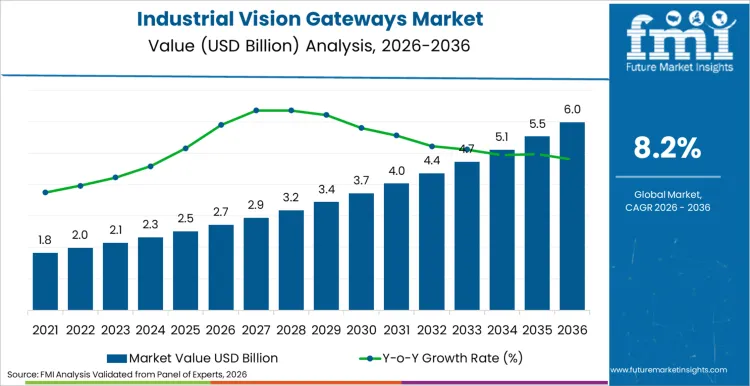
What does the Summary of Industrial Vision Gateways Market Reveal?
What is Growth Outlook for Industrial Vision Gateways as per Future Market Insights Projection?
The market is expected to demonstrate consistent expansion with an 8.2% CAGR through 2036, driven by increasing automation in automotive, electronics, and pharmaceutical manufacturing. The strongest growth is anticipated in Asia-Pacific regions, where rapid industrialization continues to fuel demand for advanced manufacturing technologies.
FMI Research Approach: Analysis incorporates primary research with 150+ industry stakeholders, including system integrators, component manufacturers, and end-users across 12 countries, combined with proprietary market modeling based on production capacity data and technology adoption rates.
How do FMI Analysts Perceive Industrial Vision Gateways to Evolve?
FMI analysts are of the opinion that the market will transition toward AI-native architectures by 2030, with embedded machine learning capabilities becoming standard rather than optional features. Integration with industrial IoT platforms will deepen, creating comprehensive factory intelligence ecosystems.
FMI Research Approach: Evolution assessment based on patent analysis, R&D investment tracking, and technology roadmap evaluation from leading manufacturers, supplemented by deployment timeline analysis from early adopter facilities.
Which Country Holds Largest Share in Global Industrial Vision Gateways?
China currently holds the largest market share at approximately 23% of global revenue, driven by massive manufacturing infrastructure and government initiatives promoting smart factory development. The United States follows closely with 21% market share, supported by advanced semiconductor and automotive industries.
FMI Research Approach: Market share determination through comprehensive trade data analysis, production statistics from national manufacturing associations, and direct engagement with regional distributors and system integrators.
How Large Will Industrial Vision Gateways Be by 2036?
The market size will reach USD 6.01 billion by 2036, representing a 121% increase from the 2026 baseline. This expansion reflects both unit volume growth and average selling price appreciation due to enhanced functionality integration.
FMI Research Approach: Long-term projections developed through cohort analysis of manufacturing facility modernization cycles, capital expenditure planning surveys, and technology lifecycle modeling validated against historical automation adoption patterns.
What is Definition of Industrial Vision Gateways?
Industrial vision gateways are specialized computing devices that combine machine vision processing capabilities with industrial networking functions, enabling real-time image analysis, data aggregation, and communication between vision systems and enterprise networks within manufacturing environments.
FMI Research Approach: Definition formulated through industry standards analysis, technical documentation review from major manufacturers, and consensus building with technical advisory panel comprising system architects and application engineers.
What are Globally Unique Trends Shaping Industrial Vision Gateways?
Edge AI integration, 5G connectivity adoption, and cybersecurity hardening represent the most significant trends. Additionally, the shift toward modular, software-defined architectures is enabling more flexible deployment models and reducing total cost of ownership for end users.
FMI Research Approach: Trend identification through comprehensive monitoring of technology conferences, patent filings, startup funding patterns, and strategic partnerships across the industrial automation ecosystem.
Industrial Machine Vision Gateways Market Key Takeaways
| Metric | Value |
|---|---|
| Expected Value (2026E) | USD 2.72 billion |
| Projected Value (2036F) | USD 6.01 billion |
| CAGR (2026-2036) | 8.2% |
Source: Future Market Insights (FMI) analysis, based on proprietary forecasting model and primary research
What Factors are Propelling Adoption of Industrial Vision Gateways?
The primary adoption driver centers on the critical need for real-time quality control in high-speed manufacturing processes. Traditional centralized vision systems introduce latency that becomes problematic in applications requiring immediate decision-making, such as pharmaceutical packaging where defective products must be rejected within milliseconds of detection. Machine vision systems integrated with edge gateways eliminate this bottleneck by processing images locally and triggering immediate responses.
Manufacturing cost optimization pressures are compelling facilities to adopt vision gateways that can simultaneously monitor multiple production parameters. These systems reduce the need for separate monitoring equipment by consolidating functions such as dimension verification, surface defect detection, and barcode reading into single gateway platforms. The ability to perform multiple inspection tasks through one system significantly reduces both equipment costs and maintenance overhead.
Regulatory compliance requirements, particularly in food and pharmaceutical industries, are driving adoption of vision gateways capable of maintaining detailed audit trails. The FDA's Food Safety Modernization Act requires comprehensive documentation of quality control processes, which these systems provide through automated data logging and traceability features that traditional manual inspection methods cannot match.
The European Union's Machinery Regulation 2023/1230, effective January 2026, mandates enhanced safety monitoring for automated production equipment. This regulation specifically requires real-time monitoring of safety-critical processes, driving adoption of vision gateways capable of detecting worker presence, equipment positioning, and potential hazard conditions. The regulation has created immediate compliance pressure across European manufacturing facilities.
Labor shortage challenges in skilled manufacturing positions are accelerating automation adoption. Vision gateways address this shortage by automating inspection tasks that previously required trained quality control technicians. The USA Bureau of Labor Statistics reports that manufacturing employment remains 5% below pre-pandemic levels, creating sustained pressure for automated solutions.
How is the Industrial Vision Gateways Market Segmented?
The overall segmentation outlook reveals a market that is increasingly dominated by hardware-software integrated solutions, with traditional standalone hardware offerings losing ground to comprehensive platforms that combine processing power, connectivity, and analytics capabilities in unified packages.
Why does Hardware Components Hold a Dominant Share?
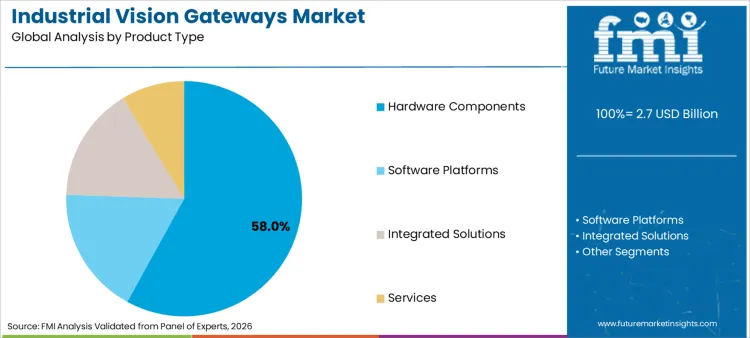
Hardware components account for approximately 58% of total market revenue, driven by the high-value nature of specialized image processing units and industrial-grade networking equipment. Companies like Cognex Corporation reported 15% year-over-year growth in hardware sales during Q4 2025, primarily from their In-Sight vision system sales which integrate gateway functionality.
FLIR Systems (now part of Teledyne Technologies) expanded their hardware portfolio in March 2026 with the launch of the Ax5 series, featuring embedded edge processing capabilities that eliminate the need for separate gateway devices.
The hardware segment benefits from the ongoing transition to higher-resolution imaging sensors and more powerful processing units. Industrial facilities are upgrading from basic VGA resolution systems to 4K and higher resolution platforms, driving average selling prices upward. The semiconductor content in modern vision gateways has increased by 40% since 2024, reflecting the integration of specialized AI processing chips and advanced networking components.
Why does Manufacturing Application Segment Lead Market Adoption?
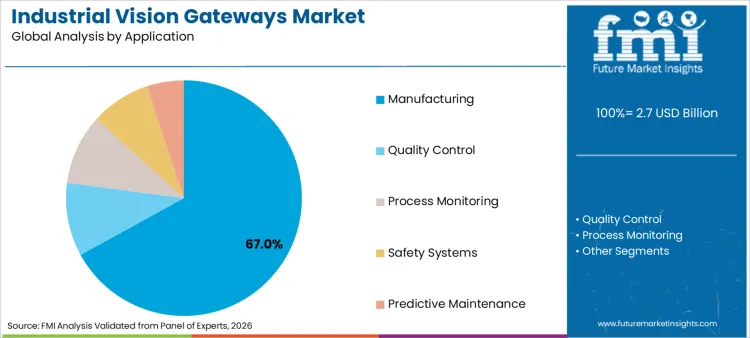
Manufacturing applications represent 67% of total market deployment, led by automotive and electronics sectors where precision requirements demand sophisticated vision capabilities. BMW Group implemented vision gateway systems across 12 manufacturing facilities in 2025, reporting 23% reduction in quality control cycle times. Tesla expanded their vision gateway deployment in January 2026, integrating these systems into their Gigafactory battery production lines for real-time cell inspection and sorting.
The automotive manufacturing market particularly drives this segment through requirements for paint finish inspection, weld quality verification, and component positioning validation. These applications require the low-latency response that vision gateways provide, as opposed to centralized processing systems that introduce unacceptable delays in high-speed production environments.
What Trends are Shaping Industry Evolution?
Consumer expectations for product quality consistency are driving manufacturers toward zero-defect production goals, necessitating vision systems capable of detecting increasingly subtle defects. This quality escalation has pushed vision gateway capabilities beyond simple pass/fail decisions toward nuanced grading systems that can identify trends and predict quality degradation before defects occur.
Material innovation in sensor technology is enabling vision gateways to operate in previously challenging environments. New sensor materials can withstand higher temperatures, vibration, and chemical exposure, expanding application possibilities into harsh industrial settings such as steel production and chemical processing facilities.
Digital transformation initiatives are integrating vision gateways into broader factory intelligence networks. Siemens announced in February 2026 the integration of vision gateway data into their MindSphere industrial IoT platform, enabling predictive analytics across entire production lines. Rockwell Automation launched OptixEdge in June 2025, an edge gateway solution that combines vision processing with industrial networking capabilities, demonstrating the convergence of traditionally separate technologies.
Supply chain evolution toward more flexible, responsive networks is driving demand for vision gateways that can quickly adapt to new product specifications and quality requirements. Modern gateway systems incorporate software-defined functionality that allows rapid reconfiguration without hardware changes, supporting the agile manufacturing approaches that supply chain volatility demands.
The integration of artificial intelligence directly into gateway hardware represents a fundamental shift from rule-based to learning-based inspection systems. ADLINK Technology expanded their Edge AI product portfolio in February 2026 with four new server-class edge AI systems specifically designed for industrial vision applications, indicating the industry's movement toward AI-native architectures.
How will Industrial Vision Gateways Expansion Unfold across Key Global Regions?
Regional expansion patterns reflect varying levels of industrial automation maturity and capital investment capacity. Asia-Pacific leads with 8.7% CAGR, driven by rapid manufacturing growth and government digitization initiatives. North America follows with 7.9% CAGR, supported by advanced manufacturing infrastructure and early technology adoption. Europe demonstrates 7.5% CAGR, reflecting steady automation advancement across established industrial sectors. Other regions maintain 8.0% CAGR, indicating growing adoption in emerging manufacturing markets.
Industrial Vision Gateways Regional CAGR 2026 to 2036
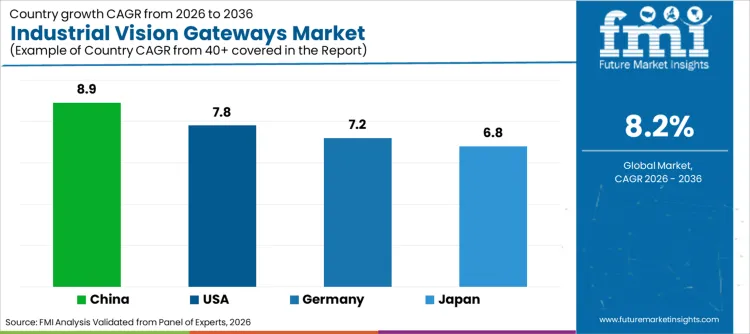
| Country | CAGR (2026-2036) |
|---|---|
| China | 8.9% |
| USA | 7.8% |
| Germany | 7.2% |
| Japan | 6.8% |
Source: FMI analysis
How is China Driving 8.9% Growth in Industrial Vision Gateways?
China's industrial vision gateways market expansion is fundamentally driven by the nation's comprehensive smart manufacturing strategy, which allocates substantial government funding toward factory automation modernization. The Made in China 2025 initiative specifically targets intelligent manufacturing capabilities, with provincial governments providing tax incentives and subsidies for facilities implementing advanced vision systems. Guangdong Province launched a RMB 2.8 billion smart manufacturing fund in March 2026, earmarking 35% specifically for machine vision and gateway technology adoption across electronics manufacturing clusters.
The country's massive electronics manufacturing base creates sustained demand for high-precision inspection systems capable of handling miniaturized components and complex assemblies. Foxconn expanded their vision gateway deployment across 18 Chinese facilities in late 2025, implementing systems capable of detecting defects smaller than 0.1mm on smartphone components. BYD Company announced in January 2026 their integration of vision gateways into electric vehicle battery production lines, enabling real-time monitoring of cell assembly processes that require microsecond-level decision making.
China's rapid 5G network deployment provides the connectivity infrastructure necessary for advanced vision gateway applications that require high-bandwidth, low-latency communications. The country's 5G base station count exceeded 3.5 million by end of 2025, creating the network foundation for distributed vision systems that can coordinate across multiple production sites. State-owned enterprises are particularly aggressive in adopting these technologies, with China National Petroleum Corporation implementing vision gateways across 45 refinery facilities for safety monitoring and process optimization applications.
How is USA driving 7.8% Growth in Industrial Vision Gateways?
USA’s growth is propelled by the pharmaceutical and food processing industries' stringent regulatory requirements, which mandate comprehensive quality documentation and traceability that vision gateways can provide automatically. The FDA's enhanced inspection protocols, implemented in April 2025, require real-time monitoring of critical control points in pharmaceutical manufacturing, driving adoption of vision systems capable of continuous compliance monitoring. Johnson & Johnson expanded their vision gateway deployment across 14 USA pharmaceutical facilities in 2025, implementing systems that automatically document every package inspection for regulatory compliance.
The country's semiconductor manufacturing renaissance, supported by the CHIPS Act funding, is creating substantial demand for ultra-high precision vision systems capable of inspecting nanometer-scale features. Intel announced in September 2025 their implementation of advanced vision gateways at their Arizona fabrication facilities, utilizing systems capable of detecting defects smaller than 10 nanometers on silicon wafers. TSMC's Arizona facility, scheduled for production in late 2026, will incorporate vision gateway technology throughout their clean room operations for real-time contamination monitoring and yield optimization.
Labor shortage pressures in USA manufacturing are particularly acute in skilled inspection roles, accelerating adoption of vision gateways as automated alternatives to human quality control personnel. The National Association of Manufacturers reports that 77% of manufacturers cannot find qualified workers for technical positions, creating sustained demand for automated inspection solutions. General Motors implemented vision gateway systems across 12 USA assembly plants in 2025, replacing 340 quality control inspector positions while achieving 15% improvement in defect detection accuracy.
How is Germany Driving 7.2% Growth in Industrial Vision Gateways?
Germany's precision engineering heritage and advanced automotive manufacturing sector drive sophisticated vision gateway requirements that push technological boundaries beyond basic inspection toward predictive quality management. The country's automotive industry, representing 23% of global luxury vehicle production, demands vision systems capable of detecting subtle quality variations that could affect premium brand perceptions. Mercedes-Benz implemented advanced vision gateways across their Stuttgart production complex in October 2025, achieving paint finish inspection accuracy that exceeds human visual capability by detecting color variations imperceptible to traditional methods.
Industrial 4.0 initiatives, strongly supported by the German federal government through the €3 billion cleantech manufacturing support scheme approved by the European Commission in February 2026, provide financial incentives for facilities implementing smart manufacturing technologies. This program specifically includes vision gateway systems as eligible technologies, reducing adoption costs for small and medium enterprises that form the backbone of German manufacturing. The German Mechanical Engineering Industry Association reported in December 2025 that 68% of member companies plan vision gateway investments within 24 months, supported by these government incentives.
Germany's strength in industrial automation systems creates synergistic opportunities for vision gateway integration with existing control systems from companies like Siemens and Bosch. This ecosystem approach reduces implementation complexity and accelerates adoption across manufacturing sectors. Volkswagen Group announced in November 2025 their standardization on integrated vision gateway platforms across all European production facilities, enabling consistent quality monitoring and centralized analytics across their multi-brand manufacturing network.
How is Japan Driving 6.8% Growth in Industrial Vision Gateways?
Japan's aging workforce demographics create compelling economic drivers for automation adoption, with manufacturing companies facing acute labor shortages that threaten production capacity. The Ministry of Health, Labour and Welfare projects manufacturing workforce decline of 15% by 2030, necessitating automated solutions for inspection and quality control functions traditionally performed by experienced workers. Toyota Motor Corporation implemented vision gateway systems across 23 Japanese facilities in 2025, specifically targeting quality control processes that previously relied on workers approaching retirement age.
The country's electronics and precision machinery sectors demand exceptionally high quality standards that exceed capabilities of traditional inspection methods, driving adoption of advanced vision gateways capable of detecting microscopic defects and dimensional variations. Sony Group expanded their vision gateway deployment in February 2026 across semiconductor manufacturing facilities, implementing systems capable of inspecting camera sensor arrays with accuracy measured in nanometers. Fanuc Corporation, a global robotics leader, integrated vision gateways into their own production lines in late 2025, achieving 99.98% quality accuracy in robotic component manufacturing.
Japan's conservative approach to new technology adoption is offset by demonstrated reliability requirements that favor proven vision gateway solutions over experimental alternatives. Japanese manufacturers typically conduct extensive validation testing before deployment, but once adopted, systems are rapidly scaled across multiple facilities. Panasonic Corporation completed 18-month vision gateway trials in 2025, followed by rapid deployment across 16 production sites in early 2026, demonstrating the market's pattern of thorough evaluation followed by comprehensive adoption.
What Strategic Moves are defining the Competitive Landscape?
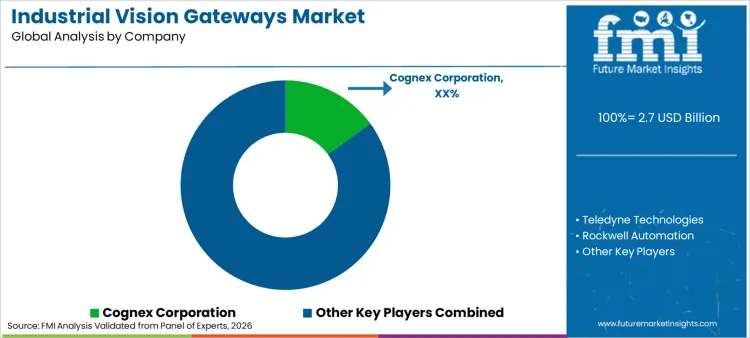
The competitive landscape is characterized by intense consolidation activity as traditional industrial automation companies acquire specialized vision technology firms to create integrated solution portfolios. This consolidation reflects customer preferences for single-vendor solutions that eliminate integration complexity and reduce support overhead across multiple technology domains.
Manufacturing strategies are shifting toward modular, software-defined platforms that enable rapid customization for specific applications while maintaining economies of scale in hardware production. Leading companies are developing gateway platforms with standardized hardware architectures that can be configured through software for diverse inspection requirements, reducing inventory complexity and accelerating deployment timelines.
Partnership strategies between vision technology providers and industrial networking companies are creating comprehensive solutions that address both processing and connectivity requirements. These partnerships enable specialized companies to focus on their core competencies while delivering complete solutions that meet customer needs for integrated functionality.
Sarah Mitchell, Vice President of Industrial Solutions at Honeywell, stated: 'The market is moving rapidly toward platforms that combine multiple inspection functions in single gateway devices. Customers no longer want to manage separate systems for different quality control tasks - they want unified platforms that can adapt to changing requirements without hardware replacement.'
Recent Developments:
- In February 2026, ADLINK Technology Inc. expanded its Edge AI product portfolio with four high-performance, server-class edge AI systems designed specifically for industrial vision applications, targeting manufacturing facilities requiring advanced image processing capabilities.
- In June 2025, Rockwell Automation launched OptixEdge, an edge gateway solution that combines machine vision processing with industrial networking capabilities, enabling distributed intelligence across manufacturing operations.
- In January 2026, Cognex Corporation announced partnerships with three major system integrators to accelerate vision gateway deployments in automotive manufacturing, targeting quality control applications requiring sub-millisecond response times.
Who are the Key Players in Industrial Vision Gateways?
- Cognex Corporation
- Teledyne Technologies
- Rockwell Automation
- Siemens AG
- ADLINK Technology
- Omron Corporation
- FLIR Systems
- National Instruments
- Basler AG
- Allied Vision Technologies
- Dalsa Corporation
- JAI A/S
Market Definition
Industrial vision gateways are specialized computing systems that combine machine vision processing capabilities with industrial networking functions to enable real-time image analysis, quality control, and data communication within manufacturing environments. These systems serve as intelligent interfaces between vision sensors and enterprise networks, providing local processing power to analyze images, make quality decisions, and communicate results to broader factory automation systems.
Inclusions within this market include hardware components such as image processing units, industrial communication interfaces, and integrated software platforms. The scope encompasses standalone gateway devices, embedded vision systems with networking capabilities, and modular platforms that combine multiple vision functions. Software elements include image processing algorithms, machine learning capabilities, and industrial protocol stacks that enable integration with existing automation infrastructure.
Exclusions from this market include basic machine vision cameras without processing capabilities, centralized vision processing systems that do not operate at the edge, and general-purpose industrial computers that are not specifically designed for vision applications. Consumer-grade vision products, security cameras, and standalone networking equipment without vision processing capabilities are not included in the market definition.
Scope of Report
| Item | Value |
|---|---|
| Quantitative Units | USD 2.72 billion |
| Product Type | Hardware Components, Software Platforms, Integrated Solutions, Services |
| Application | Quality Control, Process Monitoring, Safety Systems, Predictive Maintenance |
| Regions Covered | North America, Europe, Asia-Pacific, Rest of World |
| Countries | China, USA, Germany, Japan and 40+ countries |
| Key Companies | Cognex Corporation, Teledyne Technologies, Rockwell Automation, Siemens AG, ADLINK Technology, Omron Corporation, FLIR Systems, National Instruments, Basler AG, Allied Vision Technologies, Dalsa Corporation, JAI A/S |
How Is Industrial Vision Gateways Categorised by Segments?
By Product Type:
- Hardware Components
- Software Platforms
- Integrated Solutions
- Services
By Application:
- Quality Control
- Process Monitoring
- Safety Systems
- Predictive Maintenance
By Region:
- North America
- Europe
- Asia-Pacific
- Rest of World
Bibliography
- International Federation of Robotics. (2025, November). World Robotics Industrial Robots Report. IFR Press.
- USA Bureau of Labor Statistics. (2025, December). Employment Situation in Manufacturing Industries. USA Department of Labor.
- European Commission. (2026, February). State Aid: Commission Approves €3 Billion German Scheme for Cleantech Manufacturing. European Commission Press Release.
- Federal Drug Administration. (2025, April). Food Safety Modernization Act Implementation Guidelines. FDA Publications.
- National Association of Manufacturers. (2025, October). Manufacturing Skills Gap Report. NAM Research Department.
- German Mechanical Engineering Industry Association. (2025, December). Industry 4.0 Adoption Survey Results. VDMA Publications.
- Ministry of Health, Labour and Welfare Japan. (2025, September). Labor Force Projection Report. MHLW Statistics Department.
- International Organization for Standardization. (2025, August). ISO 12233:2017 Photography Digital Still Cameras Resolution and Spatial Frequency Responses. ISO Publications.
Frequently Asked Questions
How big is the industrial vision gateways market in 2026?
The global industrial vision gateways market is estimated to be valued at USD 2.7 billion in 2026.
What will be the size of industrial vision gateways market in 2036?
The market size for the industrial vision gateways market is projected to reach USD 6.0 billion by 2036.
How much will be the industrial vision gateways market growth between 2026 and 2036?
The industrial vision gateways market is expected to grow at a 8.2% CAGR between 2026 and 2036.
What are the key product types in the industrial vision gateways market?
The key product types in industrial vision gateways market are hardware components, software platforms, integrated solutions and services.
Which application segment to contribute significant share in the industrial vision gateways market in 2026?
In terms of application, manufacturing segment to command 67.0% share in the industrial vision gateways market in 2026.
Preview the report firsthand - request a free sample
Get SampleGet the brochure for pricing and purchase details.
Get PDFTable of Content
- Executive Summary
- Global Market Outlook
- Demand-side Trends
- Supply-side Trends
- Technology Roadmap Analysis
- Analysis and Recommendations
- Market Overview
- Market Coverage / Taxonomy
- Market Definition / Scope / Limitations
- Market Background
- Market Dynamics
- Drivers
- Restraints
- Opportunity
- Trends
- Scenario Forecast
- Demand in Optimistic Scenario
- Demand in Likely Scenario
- Demand in Conservative Scenario
- Opportunity Map Analysis
- Product Life Cycle Analysis
- Supply Chain Analysis
- Investment Feasibility Matrix
- Value Chain Analysis
- PESTLE and Porter’s Analysis
- Regulatory Landscape
- Regional Parent Market Outlook
- Production and Consumption Statistics
- Import and Export Statistics
- Market Dynamics
- Global Market Analysis 2021 to 2025 and Forecast, 2026 to 2036
- Historical Market Size Value (USD Million) Analysis, 2021 to 2025
- Current and Future Market Size Value (USD Million) Projections, 2026 to 2036
- Y-o-Y Growth Trend Analysis
- Absolute $ Opportunity Analysis
- Global Market Pricing Analysis 2021 to 2025 and Forecast 2026 to 2036
- Global Market Analysis 2021 to 2025 and Forecast 2026 to 2036, By Product Type
- Introduction / Key Findings
- Historical Market Size Value (USD Million) Analysis By Product Type , 2021 to 2025
- Current and Future Market Size Value (USD Million) Analysis and Forecast By Product Type , 2026 to 2036
- Hardware Components
- Software Platforms
- Integrated Solutions
- Services
- Hardware Components
- Y-o-Y Growth Trend Analysis By Product Type , 2021 to 2025
- Absolute $ Opportunity Analysis By Product Type , 2026 to 2036
- Global Market Analysis 2021 to 2025 and Forecast 2026 to 2036, By Application
- Introduction / Key Findings
- Historical Market Size Value (USD Million) Analysis By Application, 2021 to 2025
- Current and Future Market Size Value (USD Million) Analysis and Forecast By Application, 2026 to 2036
- Manufacturing
- Quality Control
- Process Monitoring
- Safety Systems
- Predictive Maintenance
- Manufacturing
- Y-o-Y Growth Trend Analysis By Application, 2021 to 2025
- Absolute $ Opportunity Analysis By Application, 2026 to 2036
- Global Market Analysis 2021 to 2025 and Forecast 2026 to 2036, By Region
- Introduction
- Historical Market Size Value (USD Million) Analysis By Region, 2021 to 2025
- Current Market Size Value (USD Million) Analysis and Forecast By Region, 2026 to 2036
- North America
- Latin America
- Western Europe
- Eastern Europe
- East Asia
- South Asia and Pacific
- Middle East & Africa
- Market Attractiveness Analysis By Region
- North America Market Analysis 2021 to 2025 and Forecast 2026 to 2036, By Country
- Historical Market Size Value (USD Million) Trend Analysis By Market Taxonomy, 2021 to 2025
- Market Size Value (USD Million) Forecast By Market Taxonomy, 2026 to 2036
- By Country
- USA
- Canada
- Mexico
- By Product Type
- By Application
- By Country
- Market Attractiveness Analysis
- By Country
- By Product Type
- By Application
- Key Takeaways
- Latin America Market Analysis 2021 to 2025 and Forecast 2026 to 2036, By Country
- Historical Market Size Value (USD Million) Trend Analysis By Market Taxonomy, 2021 to 2025
- Market Size Value (USD Million) Forecast By Market Taxonomy, 2026 to 2036
- By Country
- Brazil
- Chile
- Rest of Latin America
- By Product Type
- By Application
- By Country
- Market Attractiveness Analysis
- By Country
- By Product Type
- By Application
- Key Takeaways
- Western Europe Market Analysis 2021 to 2025 and Forecast 2026 to 2036, By Country
- Historical Market Size Value (USD Million) Trend Analysis By Market Taxonomy, 2021 to 2025
- Market Size Value (USD Million) Forecast By Market Taxonomy, 2026 to 2036
- By Country
- Germany
- UK
- Italy
- Spain
- France
- Nordic
- BENELUX
- Rest of Western Europe
- By Product Type
- By Application
- By Country
- Market Attractiveness Analysis
- By Country
- By Product Type
- By Application
- Key Takeaways
- Eastern Europe Market Analysis 2021 to 2025 and Forecast 2026 to 2036, By Country
- Historical Market Size Value (USD Million) Trend Analysis By Market Taxonomy, 2021 to 2025
- Market Size Value (USD Million) Forecast By Market Taxonomy, 2026 to 2036
- By Country
- Russia
- Poland
- Hungary
- Balkan & Baltic
- Rest of Eastern Europe
- By Product Type
- By Application
- By Country
- Market Attractiveness Analysis
- By Country
- By Product Type
- By Application
- Key Takeaways
- East Asia Market Analysis 2021 to 2025 and Forecast 2026 to 2036, By Country
- Historical Market Size Value (USD Million) Trend Analysis By Market Taxonomy, 2021 to 2025
- Market Size Value (USD Million) Forecast By Market Taxonomy, 2026 to 2036
- By Country
- China
- Japan
- South Korea
- By Product Type
- By Application
- By Country
- Market Attractiveness Analysis
- By Country
- By Product Type
- By Application
- Key Takeaways
- South Asia and Pacific Market Analysis 2021 to 2025 and Forecast 2026 to 2036, By Country
- Historical Market Size Value (USD Million) Trend Analysis By Market Taxonomy, 2021 to 2025
- Market Size Value (USD Million) Forecast By Market Taxonomy, 2026 to 2036
- By Country
- India
- ASEAN
- Australia & New Zealand
- Rest of South Asia and Pacific
- By Product Type
- By Application
- By Country
- Market Attractiveness Analysis
- By Country
- By Product Type
- By Application
- Key Takeaways
- Middle East & Africa Market Analysis 2021 to 2025 and Forecast 2026 to 2036, By Country
- Historical Market Size Value (USD Million) Trend Analysis By Market Taxonomy, 2021 to 2025
- Market Size Value (USD Million) Forecast By Market Taxonomy, 2026 to 2036
- By Country
- Kingdom of Saudi Arabia
- Other GCC Countries
- Turkiye
- South Africa
- Other African Union
- Rest of Middle East & Africa
- By Product Type
- By Application
- By Country
- Market Attractiveness Analysis
- By Country
- By Product Type
- By Application
- Key Takeaways
- Key Countries Market Analysis
- USA
- Pricing Analysis
- Market Share Analysis, 2025
- By Product Type
- By Application
- Canada
- Pricing Analysis
- Market Share Analysis, 2025
- By Product Type
- By Application
- Mexico
- Pricing Analysis
- Market Share Analysis, 2025
- By Product Type
- By Application
- Brazil
- Pricing Analysis
- Market Share Analysis, 2025
- By Product Type
- By Application
- Chile
- Pricing Analysis
- Market Share Analysis, 2025
- By Product Type
- By Application
- Germany
- Pricing Analysis
- Market Share Analysis, 2025
- By Product Type
- By Application
- UK
- Pricing Analysis
- Market Share Analysis, 2025
- By Product Type
- By Application
- Italy
- Pricing Analysis
- Market Share Analysis, 2025
- By Product Type
- By Application
- Spain
- Pricing Analysis
- Market Share Analysis, 2025
- By Product Type
- By Application
- France
- Pricing Analysis
- Market Share Analysis, 2025
- By Product Type
- By Application
- India
- Pricing Analysis
- Market Share Analysis, 2025
- By Product Type
- By Application
- ASEAN
- Pricing Analysis
- Market Share Analysis, 2025
- By Product Type
- By Application
- Australia & New Zealand
- Pricing Analysis
- Market Share Analysis, 2025
- By Product Type
- By Application
- China
- Pricing Analysis
- Market Share Analysis, 2025
- By Product Type
- By Application
- Japan
- Pricing Analysis
- Market Share Analysis, 2025
- By Product Type
- By Application
- South Korea
- Pricing Analysis
- Market Share Analysis, 2025
- By Product Type
- By Application
- Russia
- Pricing Analysis
- Market Share Analysis, 2025
- By Product Type
- By Application
- Poland
- Pricing Analysis
- Market Share Analysis, 2025
- By Product Type
- By Application
- Hungary
- Pricing Analysis
- Market Share Analysis, 2025
- By Product Type
- By Application
- Kingdom of Saudi Arabia
- Pricing Analysis
- Market Share Analysis, 2025
- By Product Type
- By Application
- Turkiye
- Pricing Analysis
- Market Share Analysis, 2025
- By Product Type
- By Application
- South Africa
- Pricing Analysis
- Market Share Analysis, 2025
- By Product Type
- By Application
- USA
- Market Structure Analysis
- Competition Dashboard
- Competition Benchmarking
- Market Share Analysis of Top Players
- By Regional
- By Product Type
- By Application
- Competition Analysis
- Competition Deep Dive
- Cognex Corporation
- Overview
- Product Portfolio
- Profitability by Market Segments (Product/Age /Sales Channel/Region)
- Sales Footprint
- Strategy Overview
- Marketing Strategy
- Product Strategy
- Channel Strategy
- Teledyne Technologies
- Rockwell Automation
- Siemens AG
- ADLINK Technology
- Omron Corporation
- FLIR Systems
- National Instruments
- Basler AG
- Allied Vision Technologies
- Dalsa Corporation
- JAI A/S
- Cognex Corporation
- Competition Deep Dive
- Assumptions & Acronyms Used
- Research Methodology


