

- Market Size (2026)
- USD 315.0 Mn
- Forecast (2036)
- USD 705.7 Mn
- CAGR (2026 to 2036)
- 8.4%
How big is the robotic case erecting cells market in 2026?
USD 315.0 million in 2026 and USD 705.7 million by 2036 at an 8.4% CAGR.
The robotic case erecting cells industry value is forecast to grow from USD 290.6 million in 2025 to USD 705.7 million by 2036 at 8.4% CAGR as packaging plants replace manual carton forming with compact robotic cells. Packaging is forecast to secure 71.0% share in 2026, led by direct use before case packing, sealing, labeling, and palletizing. The 5-20 kg payload range is expected to represent 46.0% share in 2026 since carton blanks, vacuum tooling, and flap guides usually need moderate handling force.
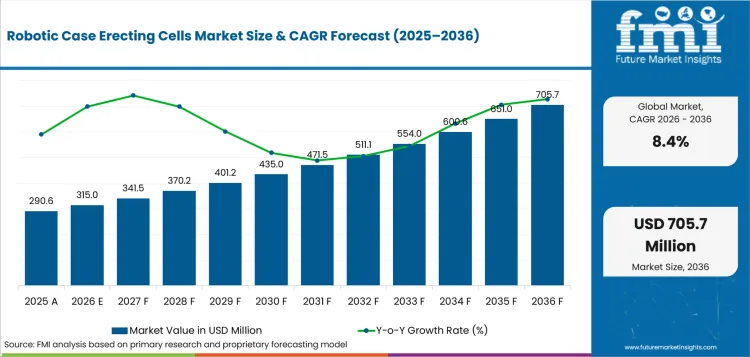
Robotic Case Erecting Cells Market Overview: Size and Forecast
- 2025 Market Size: USD 290.6 million
- 2026 Market Size: USD 315.0 million
- 2036 Market Size: USD 705.7 million
- Forecast CAGR: 8.4% from 2026 to 2036
- Leading Application: Packaging
- Packaging Share in 2026: 71.0%
- Leading Payload: 5-20 kg
- 5-20 kg Payload Share in 2026: 46.0%
- Fastest-growing Country: India
- India CAGR: 10.1% by 2036
Summary of the Robotic Case Erecting Cells Market
- Demand and Growth Drivers
- Packaging plants are shifting toward robotic case forming cells designed for frequent carton changes.
- Manufacturers are giving more attention to end-of-line equipment that reduces manual folding and line stoppages.
- Integrators are extending robotic packaging portfolios through compact cobot cells and case forming systems.
- Product and Segment View
- Packaging is expected to secure 71.0% share in 2026, supported by direct case forming, bottom closing, and carton release workflows.
- The 5-20 kg payload range is projected to hold 46.0% share in 2026, influenced by carton blank handling and moderate gripper loads.
- Collaborative Robots are projected to represent 39.0% share in 2026, led by compact retrofit layouts and operator-adjacent packaging rooms.
- Geography and Competitive Outlook
- India is projected to record 10.1% CAGR by 2036, backed by packaged goods manufacturing and automation catch-up.
- China is expected to expand at 9.3% CAGR by 2036 through large factory clusters and local robot supply.
- FANUC, ABB Robotics, and Yaskawa compete through robot platforms and packaging automation support.
- ONExia, Clearpack, ProMach, and Universal Robots focus on cell integration, cobot deployment, and secondary packaging use cases.
- Analyst Opinion
- Nandini Roy Choudhury, Principal Consultant at Future Market Insights for industrial domain, observes, “Robotic case erecting cells are becoming line-stability investments for packaging plants. Buyers are not only replacing manual box forming. They are trying to keep carton supply steady when product runs change across shifts. Suppliers that prove magazine design, gripper reliability, safe access, and local service support should gain stronger project approval.”
Automation readiness is improving as packaging buyers gain more confidence in robot-supported line equipment. IFR reported 542,000 industrial robot installations in 2024, with annual installations staying above 500,000 units for the fourth straight year. PMMI projected packaging machinery sales growth to rise toward 8.0% by 2027 after a slower 2024 cycle. FANUC America highlighted a 30 kg payload CRX-25iA cobot with 1,889 mm reach for case palletizing in January 2024, showing how packaging robot suppliers are promoting flexible end-of-line systems for carton handling.
The robotic case erecting cells market is expected to witness steady growth through 2036, driven by demand from manufacturers seeking repeatable carton forming and reduced manual box handling. Market expansion is further supported by growing interest in compact secondary packaging automation.
Which factors support expansion in the robotic case erecting cells market?
Finished robotic cell revenue and packaging-line integration support market value across automated secondary packaging channels.
- Market value is supported by robotic cell revenue before conveyors, sealers, and palletizing systems add incremental scope.
- Supplier pricing reflects robot arms, magazines, vacuum end effectors, guards, controls, and commissioning support before service contracts affect repeat buying.
- Revenue improves when manufacturers convert manual carton-forming stations into robotic packaging cells that can handle repeatable formats, uptime data, and downstream flow.
- Buyer trust rises when suppliers document changeover time, jam recovery, payload validation, and safety layout before installation.
Why is the robotic case erecting cells market growing?
Manufacturers are moving toward robotic carton forming because manual case building becomes unstable when pack rates and carton sizes change.
Packaging line operators are buying robotic cells to remove a repetitive but fragile manual task from end-of-line operations. The U.S. Census Bureau reported first-quarter 2026 retail e-commerce sales of USD 326.7 billion, up 2.7% from the fourth quarter of 2025. That raises pressure on carton-forming stations as fulfillment and retail channels push shorter order runs. Robotic case erecting cells help plants change case size with recipes instead of long mechanical adjustments. This gives suppliers a stronger reason to combine robot arms, magazines, grippers, sealers, and controls in one validated cell.
How is the robotic case erecting cells market segmented?
The robotic case erecting cells industry is segmented by robot type, payload, application, end-use industry, and cell configuration.
- Collaborative Robots are projected to secure 39.0% share in 2026, led by buyers needing compact robotic packaging cells near operators, conveyors, and existing case packers.
- The 5-20 kg payload range is anticipated to hold 46.0% share in 2026 since carton blanks and vacuum tools usually require moderate lifting capacity without heavier robotic frames.
- Packaging is expected to capture 71.0% share in 2026 because case erecting directly supports secondary packaging before packing, sealing, labeling, and pallet movement.
- Food & Beverage is forecast to represent 34.0% share in 2026, reflected by frequent carton changes across snacks, beverages, frozen foods, and shelf-ready packaging.
- Integrated case erecting-sealing cells are projected to account for 37.5% share in 2026, supported by buyer preference for one validated cell combining forming, folding, sealing, and conveyor release.
Why do collaborative robots dominate the robotic case erecting cells market?
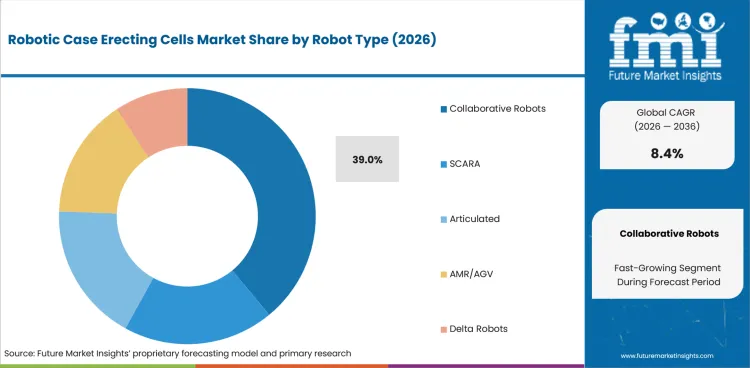
- Collaborative Robots are projected to account for 39.0% share in 2026, influenced by packaging rooms that need small-footprint automation close to workers and existing conveyors.
- Articulated robots gain use in higher-speed case forming lines where longer reach and stronger handling capability matter more than operator-adjacent placement.
Which payload range leads the robotic case erecting cells market?
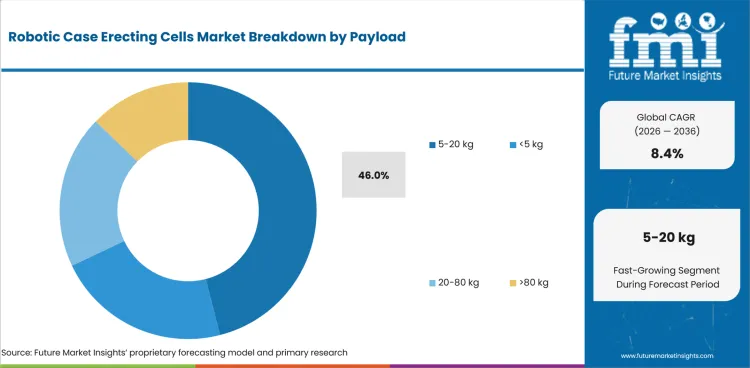
- The 5-20 kg range is anticipated to hold 46.0% share in 2026 through balanced handling capacity for carton blanks, gripper plates, and flap-control tooling.
- The 20-80 kg range gains value in industrial goods packaging where larger corrugated cases and heavier tooling require stronger robot arms.
Which application leads the robotic case erecting cells market?
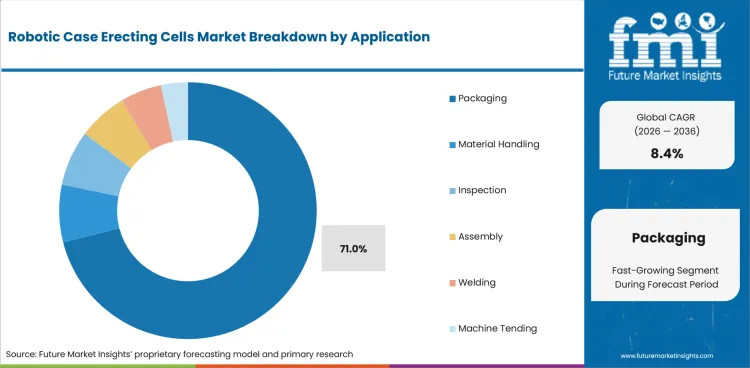
- Packaging is forecast to secure 71.0% share in 2026, reflected by case forming being a direct secondary packaging workflow before carton filling and sealing.
- Material handling gains importance when case erecting cells are linked with blank magazines, conveyors, inspection steps, and pallet flow.
Which end-use industry leads the robotic case erecting cells market?
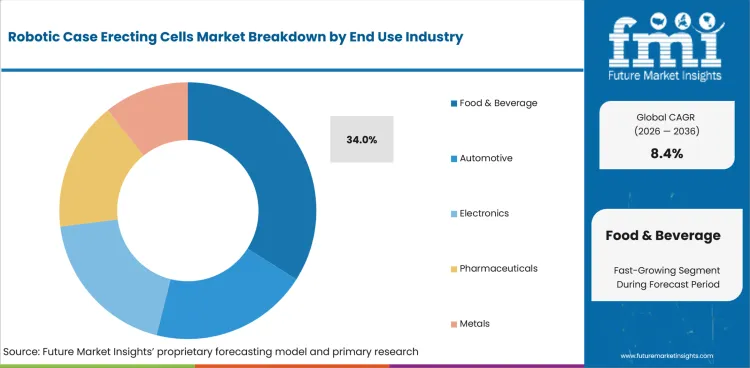
- Food & Beverage is expected to account for 34.0% share in 2026, led by high-volume lines that handle frequent carton size and SKU changes.
- Pharmaceuticals gain adoption as validated secondary packaging cells support repeatable carton handling near controlled product flows.
Which cell configuration leads the robotic case erecting cells market?
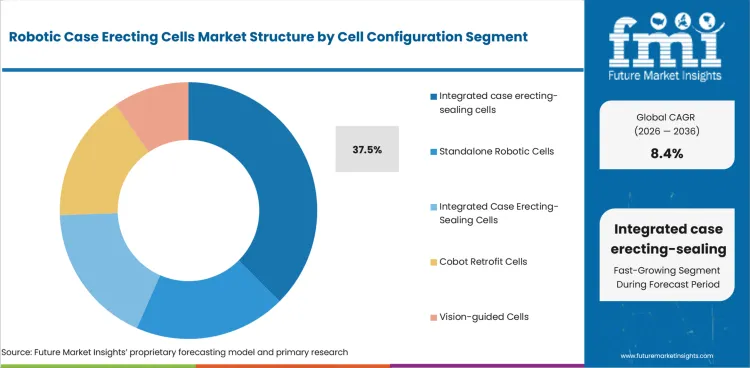
- Integrated case erecting-sealing cells are projected to secure 37.5% share in 2026, shaped by buyer preference for complete forming and bottom-sealing workflows.
- Cobot retrofit cells gain value when older packaging rooms need automation beside existing conveyors without a full line rebuild.
What are the driver, restraints, and opportunities in the robotic case erecting cells market?
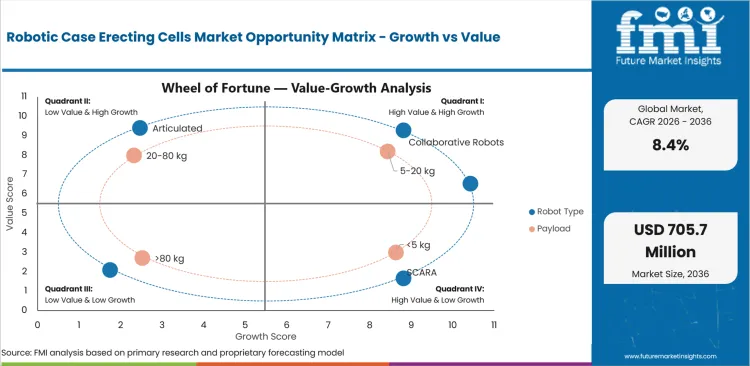
SKU variety and labor pressure support adoption while retrofit complexity limits faster installation in older packaging rooms.
- Manufacturers use robotic case erecting cells to reduce downtime during carton size changes, especially where packaging lines handle frequent SKU shifts.
- Older packaging rooms restrict robotic cell placement when conveyor spacing, guarding needs, and operator walkways leave little room for safe layouts.
- Integrated cells can connect case forming with sealing, inspection, labeling, and pallet flow, giving buyers a stronger automation case than standalone carton forming.
Robotic Case Erecting Cells Market Demand Outlook
Demand outlook is moving toward compact robotic cells that prove carton handling reliability before wider packaging-line automation. IFR reported that operational industrial robot stock reached 4,663,698 units in 2024, rising 9% as factories expanded their installed robot base. This wider operating base improves maintenance familiarity for robotic packaging equipment. Suppliers that combine magazines, grippers, sensors, and case sealing interfaces can make robotic case erecting easier for buyers already using industrial automation.
Retrofit Constraint and Layout Risk Analysis
Retrofit risk remains the main restraint because case erecting cells must fit around existing conveyors, guards, magazines, and sealers. OSHA posted partial data from more than 732,000 Forms 300 and 301 records in 2025 for 2024 injury and illness reporting. This keeps safety planning important when robotic cells are placed near operators and moving cartons. Buyers are expected to ask for safe access routes, jam recovery methods, and proof trials before approving installations in older packaging rooms.
Service-Ready Automation Opportunity Analysis
Opportunity is rising for suppliers that deliver robotic cells with diagnostics, recipe screens, and local maintenance support. BLS projected employment of industrial machinery mechanics, machinery maintenance workers, and millwrights to grow 13% from 2024 to 2034. That indicates a broader service workforce around automated production machinery. Robotic case erecting suppliers can benefit when they support training, spare parts, preventive maintenance, and fast recovery after vacuum or magazine faults.
Which countries are growing fastest in the robotic case erecting cells market?
India 10.1% CAGR, China 9.3% CAGR, United States 8.6% CAGR, South Korea 8.5% CAGR, Japan 8.2% CAGR, Germany 8.0% CAGR, United Kingdom 7.8% CAGR, and France 7.6% CAGR through 2036.
.webp "Top Country Growth Comparison Robotic Case Erecting Cells Market Cagr (2026 2036)")
| Country | CAGR |
|---|---|
| United States | 8.6% |
| United Kingdom | 7.8% |
| Germany | 8.0% |
| France | 7.6% |
| Japan | 8.2% |
| China | 9.3% |
| South Korea | 8.5% |
| India | 10.1% |
Source: Future Market Insights, 2026.
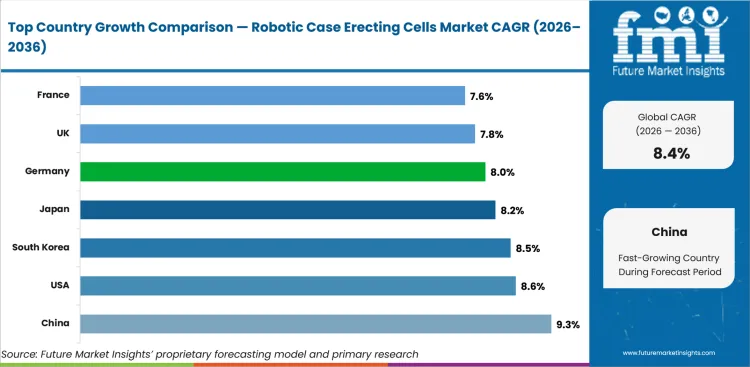
How do country-level CAGRs compare in the robotic case erecting cells market?
India leads country growth while France records the most cautious expansion outlook among profiled markets.
- The United States is expected to expand at 8.6% CAGR from 2026 to 2036 due to e-commerce scale and mature robot integrator access.
- The United Kingdom is estimated to rise at 7.8% CAGR by 2036 with compact food plants and contract packing demand.
- Germany is projected to grow at 8.0% CAGR through 2036 as specification-heavy buyers modernize secondary packaging lines.
- France is forecast to advance at 7.6% CAGR by 2036 with food, cosmetics, and healthcare packaging upgrades.
- Japan is expected to rise at 8.2% CAGR over the forecast period as compact factories extend robot use into secondary packaging.
- China is forecast to grow at 9.3% CAGR through 2036 as large manufacturing clusters add local robotic packaging cells.
- South Korea is projected to post 8.5% CAGR by 2036 as electronics and healthcare factories adopt precise end-of-line automation.
- India is projected to record 10.1% CAGR by 2036 as packaged goods plants move from manual carton forming to robotic cells.
What is the robotic case erecting cells market outlook in the United States?
A 8.6% CAGR through 2036 reflects e-commerce scale and established packaging automation channels.
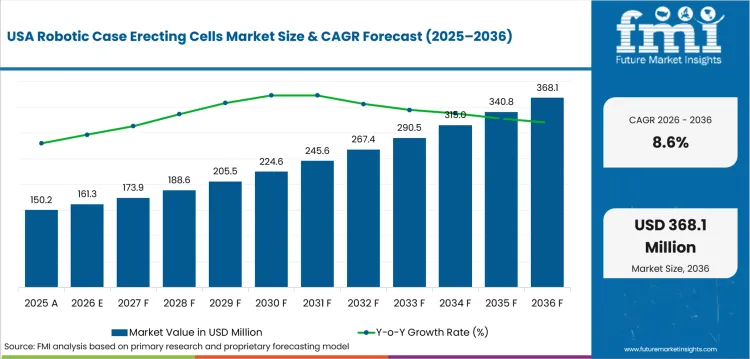
Country Market Snapshot Table
| Parameter | Value |
|---|---|
| Market Size in 2025 (Value) | USD 87.0 million |
| Market Size in 2026 (Value) | USD 94.5 million |
| Market Forecast in 2036 (Value) | USD 215.5 million |
| CAGR (2026 to 2036) | 8.6% |
| Years Considered | 2021 to 2036 |
| Base Year | 2025 |
| Forecast Period | 2026 to 2036 |
| Units Considered | Value (USD million) |
| Leading Sub-Region | South Atlantic and national fulfillment corridors |
United States Robotic Case Erecting Cells Market Outlook
- United States robotic case erecting cell demand is shaped by e-commerce fulfillment, packaged food production, and mature integrator networks. Plants often begin with one robotic cell near the case packer before expanding automation around sealing and palletizing.
- Buyers are expected to prioritize uptime proof, service support, and safe operator access. Suppliers with documented carton trials and local commissioning depth should gain stronger approval across food, pharmaceutical, and logistics facilities.
Key Growth Drivers
- E-commerce fulfillment supports variable carton demand across distribution hubs. U.S. total retail sales reached USD 1,929.0 billion in the first quarter of 2026.
- Robot adoption improves buyer confidence in robotic packaging cells. IFR reported United States industrial robot installations rose 11% year over year to 38,000 units in 2025.
- Food processors use robotic cells to stabilize case supply before sealing, labeling, and palletizing.
- Pharmaceutical sites value controlled carton handling and documented machine settings near regulated product flows.
Key Restraints
- Safety documentation can extend installation planning. OSHA received 370,000 Form 300A summary reports for 2024 injury and illness data.
- Retrofit cost can slow adoption in older Midwest and East Coast plants with limited conveyor space.
- Skilled technician access varies across rural manufacturing regions and can weaken service confidence.
What makes United States unique
United States is unique due to e-commerce scale, deep integrator channels, and strong replacement demand across secondary packaging lines.
Key Companies
- FANUC America Corporation
- ABB Robotics USA
- Universal Robots USA
- ONExia Inc.
- ProMach Inc.
- Quest Industrial LLC
- Clearpack Automation USA
Sales & Marketing Channels
- Direct enterprise sales
- Authorized robot integrators
- Packaging OEM partnerships
- Distributor service networks
- Trade show lead generation
- Retrofit service programs
Country Segment Breakdown Table
| Segment | Sub-Segments |
|---|---|
| By Robot Type | Collaborative Robots · SCARA · Articulated · AMR/AGV · Delta Robots |
| By Payload | <5 kg · 5-20 kg · 20-80 kg · >80 kg |
| By Application | Material Handling · Inspection · Assembly · Welding · Packaging · Machine Tending |
| By End-use Industry | Automotive · Electronics · Food & Beverage · Logistics · Pharmaceuticals · Metals |
| By Cell Configuration | Standalone Robotic Cells · Integrated Case Erecting-Sealing Cells · Cobot Retrofit Cells · Vision-guided Cells |
| Key Sub-Regions Covered, Fulfillment and Packaging Corridors | South Atlantic · Midwest · Texas · California · Mid-Atlantic · Pacific Northwest |
Frequently Asked Questions
How fast is United States robotic case erecting cells market growing?
Sales in the United States are ready to scale at 8.6% CAGR from 2026 to 2036, guided by e-commerce and packaging automation.
Who leads United States robotic case erecting cells market?
FANUC America, ABB Robotics, Universal Robots, ONExia, ProMach, and Quest Industrial compete through robot platforms and integration channels.
What is driving adoption in United States robotic case erecting cells market?
E-commerce fulfillment and end-of-line labor pressure are moving manufacturers toward robotic carton forming cells.
What is driving robotic case erecting cells growth in the United Kingdom?
A 7.8% CAGR through 2036 is supported by compact factory layouts and food packaging automation needs.
Country Market Snapshot Table
| Parameter | Value |
|---|---|
| Market Size in 2025 (Value) | USD 15.3 million |
| Market Size in 2026 (Value) | USD 16.5 million |
| Market Forecast in 2036 (Value) | USD 35.0 million |
| CAGR (2026 to 2036) | 7.8% |
| Years Considered | 2021 to 2036 |
| Base Year | 2025 |
| Forecast Period | 2026 to 2036 |
| Units Considered | Value (USD million) |
| Leading Sub-Region | Midlands and national food manufacturing corridors |
United Kingdom Robotic Case Erecting Cells Market Outlook
- United Kingdom robotic case erecting cell demand is supported by compact automation needs in food, pharmaceuticals, consumer goods, and e-commerce distribution. Smaller factory rooms make cobot and retrofit cells attractive for secondary packaging upgrades.
- Capital approval remains focused on fast payback and service availability. Buyers often require local maintenance support before approving robotic case forming cells in space-constrained production areas.
Key Growth Drivers
- Manufacturing output supports automation review. ONS reported manufacturing output grew 1.5% in the three months to January 2026.
- Digital adoption funding can help manufacturers review automation. The UK government committed up to GBP 16.0 million in 2025-26 to expand Made Smarter Adoption across England.
- Food manufacturers need flexible case forming for private-label and branded SKU changes.
- Contract packers favor compact cells that can fit older packaging rooms without full line reconstruction.
Key Restraints
- Production softness can slow smaller projects. ONS reported production output fell 0.2% year over year in the three months to April 2026.
- High upfront cell cost limits adoption among small processors and contract packers.
- Integration delays occur when older lines lack digital controls and safe magazine-loading space.
What makes United Kingdom unique
United Kingdom is unique due to compact food plants and contract packing sites that need small-footprint robotic case forming.
Key Companies
- ABB Robotics UK
- Universal Robots UK
- FANUC UK
- Yaskawa UK
- RMGroup
- Brillopak
- CKF Systems
Sales & Marketing Channels
- System integrator quotes
- Packaging equipment distributors
- OEM retrofit programs
- Food plant engineering teams
- Trade exhibition sourcing
- Maintenance service contracts
Country Segment Breakdown Table
| Segment | Sub-Segments |
|---|---|
| By Robot Type | Collaborative Robots · SCARA · Articulated · AMR/AGV · Delta Robots |
| By Payload | <5 kg · 5-20 kg · 20-80 kg · >80 kg |
| By Application | Material Handling · Inspection · Assembly · Welding · Packaging · Machine Tending |
| By End-use Industry | Automotive · Electronics · Food & Beverage · Logistics · Pharmaceuticals · Metals |
| By Cell Configuration | Standalone Robotic Cells · Integrated Case Erecting-Sealing Cells · Cobot Retrofit Cells · Vision-guided Cells |
| Key Sub-Regions Covered, Food and Fulfillment Corridors | Midlands · London · Manchester · West Yorkshire · Scotland · Wales |
Frequently Asked Questions
How fast is United Kingdom robotic case erecting cells market growing?
Industry in the United Kingdom is projected to increase at 7.8% CAGR from 2026 to 2036 through compact packaging automation.
Who leads United Kingdom robotic case erecting cells market?
ABB Robotics, Universal Robots, FANUC, Yaskawa, RMGroup, Brillopak, and CKF Systems compete through integration and retrofit channels.
What is driving adoption in United Kingdom robotic case erecting cells market?
Compact factory rooms and food packaging labor pressure are moving buyers toward robotic carton forming.
How is the robotic case erecting cells market performing in Germany?
A 8.0% CAGR through 2036 reflects engineered system demand and strict packaging automation requirements.
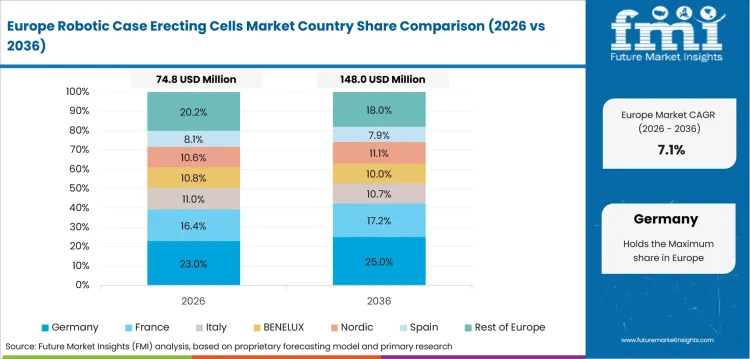
Country Market Snapshot Table
| Parameter | Value |
|---|---|
| Market Size in 2025 (Value) | USD 22.2 million |
| Market Size in 2026 (Value) | USD 24.0 million |
| Market Forecast in 2036 (Value) | USD 51.8 million |
| CAGR (2026 to 2036) | 8.0% |
| Years Considered | 2021 to 2036 |
| Base Year | 2025 |
| Forecast Period | 2026 to 2036 |
| Units Considered | Value (USD million) |
| Leading Sub-Region | Bavaria and Baden-Württemberg automation corridors |
Germany Robotic Case Erecting Cells Market Outlook
- Germany robotic case erecting cell demand is technical and specification-heavy. Buyers expect safety files, documentation, uptime proof, and service access before approving packaging automation projects.
- The market favors engineered cells that connect case forming with inspection, sealing, and plant control systems. Suppliers with local automation depth and detailed performance validation should gain stronger acceptance.
Key Growth Drivers
- Order backlog supports modernization planning. Destatis reported manufacturing order stock was 8.4% higher year over year in April 2026 after calendar adjustment.
- Robot readiness supports secondary packaging automation. IFR reported Germany’s robot density at 449 robots per 10,000 employees in manufacturing.
- Food and industrial exporters need reliable carton presentation before outbound logistics.
- Engineering buyers value integration with robot controller software and validated safety files.
Key Restraints
- New order volatility can delay purchasing. Destatis reported new manufacturing orders fell 3.8% month over month in April 2026.
- Compliance documentation raises selling cost for smaller integrators.
- Legacy packaging rooms can require longer engineering studies before cell magazines and guards are approved.
What makes Germany unique
Germany is unique due to demanding proof-of-performance expectations and strong domestic automation engineering depth.
Key Companies
- KUKA AG
- ABB Robotics Germany
- Yaskawa Europe GmbH
- FANUC Deutschland GmbH
- Bosch Rexroth AG
- Gerhard Schubert GmbH
- MULTIVAC Group
Sales & Marketing Channels
- Direct OEM tenders
- Automation integrator networks
- Packaging machinery builders
- Engineering consultant referrals
- Aftermarket service agreements
- Industry fair demonstrations
Country Segment Breakdown Table
| Segment | Sub-Segments |
|---|---|
| By Robot Type | Collaborative Robots · SCARA · Articulated · AMR/AGV · Delta Robots |
| By Payload | <5 kg · 5-20 kg · 20-80 kg · >80 kg |
| By Application | Material Handling · Inspection · Assembly · Welding · Packaging · Machine Tending |
| By End-use Industry | Automotive · Electronics · Food & Beverage · Logistics · Pharmaceuticals · Metals |
| By Cell Configuration | Standalone Robotic Cells · Integrated Case Erecting-Sealing Cells · Cobot Retrofit Cells · Vision-guided Cells |
| Key Sub-Regions Covered, Automation Clusters | Bavaria · Baden-Württemberg · North Rhine-Westphalia · Lower Saxony · Hesse · Saxony |
Frequently Asked Questions
How fast is Germany robotic case erecting cells market growing?
Sector in Germany is projected at 8.0% CAGR from 2026 to 2036 as packaging buyers modernize secondary lines.
Who leads Germany robotic case erecting cells market?
KUKA, ABB Robotics, Yaskawa, FANUC, Bosch Rexroth, Schubert, and MULTIVAC compete through engineered automation channels.
What is driving adoption in Germany robotic case erecting cells market?
High automation density and specification-led packaging upgrades are supporting robotic case forming adoption.
What is the robotic case erecting cells market outlook in France?
A 7.6% CAGR through 2036 reflects demand from food, cosmetics, and healthcare packaging lines.
Country Market Snapshot Table
| Parameter | Value |
|---|---|
| Market Size in 2025 (Value) | USD 13.0 million |
| Market Size in 2026 (Value) | USD 14.0 million |
| Market Forecast in 2036 (Value) | USD 29.2 million |
| CAGR (2026 to 2036) | 7.6% |
| Years Considered | 2021 to 2036 |
| Base Year | 2025 |
| Forecast Period | 2026 to 2036 |
| Units Considered | Value (USD million) |
| Leading Sub-Region | Île-de-France and Auvergne-Rhône-Alpes industrial corridors |
France Robotic Case Erecting Cells Market Outlook
- France robotic case erecting cell demand is strongest in industries where packaging quality and carton presentation matter. Food, cosmetics, healthcare, and export-facing goods plants are expected to review modular robotic cells.
- Buyers favor equipment that can be added without rebuilding the full packaging room. Integrators with retrofit experience and reliable service support should convert more projects in premium packaging operations.
Key Growth Drivers
- Manufacturing improvement supports automation evaluation. INSEE reported manufacturing output increased 1.2% in March 2026 after being nearly stable in February.
- Industrial recovery supports packaging line planning. INSEE reported manufacturing output increased 0.4% in April 2026.
- Food and beverage exporters need dependable secondary packaging before shipment.
- Cosmetics and healthcare brands require clean carton presentation and traceable cell settings.
Key Restraints
- Industrial volatility can delay automation approvals. INSEE reported whole industry output declined 0.7% in February 2026 after a January increase.
- Smaller plants often lack enough staff trained to maintain robotic cells across multiple shifts.
- Modular retrofits can take longer when older European lines use non-standard conveyor heights and guarding layouts.
What makes France unique
France is unique due to premium packaging quality expectations across food, beauty, healthcare, and export-facing manufacturing.
Key Companies
- ABB Robotics France
- FANUC France
- Stäubli Robotics
- Yaskawa France
- Schneider Electric
- Sidel Group
- Cermex Packaging Solutions
Sales & Marketing Channels
- Packaging OEM sales
- Regional integrator networks
- Plant engineering referrals
- Food sector trade events
- Maintenance service contracts
- Automation proof trials
Country Segment Breakdown Table
| Segment | Sub-Segments |
|---|---|
| By Robot Type | Collaborative Robots · SCARA · Articulated · AMR/AGV · Delta Robots |
| By Payload | <5 kg · 5-20 kg · 20-80 kg · >80 kg |
| By Application | Material Handling · Inspection · Assembly · Welding · Packaging · Machine Tending |
| By End-use Industry | Automotive · Electronics · Food & Beverage · Logistics · Pharmaceuticals · Metals |
| By Cell Configuration | Standalone Robotic Cells · Integrated Case Erecting-Sealing Cells · Cobot Retrofit Cells · Vision-guided Cells |
| Key Sub-Regions Covered, Packaging Clusters | Île-de-France · Auvergne-Rhône-Alpes · Hauts-de-France · Grand Est · Nouvelle-Aquitaine · Occitanie |
Frequently Asked Questions
How fast is France robotic case erecting cells market growing?
France demand is ready to rise at 7.6% CAGR from 2026 to 2036 through food and healthcare packaging automation.
Who leads France robotic case erecting cells market?
ABB Robotics, FANUC, Stäubli, Yaskawa, Schneider Electric, Sidel, and Cermex support robotic packaging projects.
What is driving adoption in France robotic case erecting cells market?
Premium packaging requirements and modular retrofit demand are supporting robotic case forming adoption.
What is the robotic case erecting cells market forecast for Japan?
A 8.2% CAGR through 2036 reflects compact automation and strong domestic robot supplier support.
Country Market Snapshot Table
| Parameter | Value |
|---|---|
| Market Size in 2025 (Value) | USD 20.3 million |
| Market Size in 2026 (Value) | USD 22.0 million |
| Market Forecast in 2036 (Value) | USD 48.4 million |
| CAGR (2026 to 2036) | 8.2% |
| Years Considered | 2021 to 2036 |
| Base Year | 2025 |
| Forecast Period | 2026 to 2036 |
| Units Considered | Value (USD million) |
| Leading Sub-Region | Tokyo and Osaka manufacturing corridors |
Japan Robotic Case Erecting Cells Market Outlook
- Japan demand is expected to build from compact production rooms and high expectations for stable motion control. Case erecting cells must coordinate with sealers, inspection systems, and precise conveyor timing.
- Domestic robot suppliers strengthen buyer confidence through service depth and long product support. Secondary packaging lines should follow the automation maturity already seen across production operations.
Key Growth Drivers
- Factory output supports automation review. METI reported Japan’s April 2026 production index at 102.5, up 0.5% month over month.
- Robot density supports packaging automation readiness. IFR reported Japan’s robot density at 446 robots per 10,000 employees in manufacturing.
- Domestic robot suppliers reduce platform risk for manufacturers adding carton handling cells.
- Compact plant layouts favor robotic cells that combine forming, folding, and release in tight spaces.
Key Restraints
- Output volatility can delay automation timing. METI reported February 2026 production declined 2.1% month over month.
- Strict facility layouts can make magazine placement difficult in older packaging rooms.
- Buyers often need longer validation before changing established secondary packaging workflows.
What makes Japan unique
Japan is unique due to compact factory engineering, domestic robot supply strength, and high expectations for uptime.
Key Companies
- FANUC Corporation
- Yaskawa Electric Corporation
- Kawasaki Robotics
- Epson Robots
- Omron Corporation
- Mitsubishi Electric Corporation
- Shibuya Corporation
Sales & Marketing Channels
- Domestic robot distributors
- OEM machine builders
- Direct plant engineering sales
- Integrator proof trials
- Maintenance-led replacement programs
- Packaging automation exhibitions
Country Segment Breakdown Table
| Segment | Sub-Segments |
|---|---|
| By Robot Type | Collaborative Robots · SCARA · Articulated · AMR/AGV · Delta Robots |
| By Payload | <5 kg · 5-20 kg · 20-80 kg · >80 kg |
| By Application | Material Handling · Inspection · Assembly · Welding · Packaging · Machine Tending |
| By End-use Industry | Automotive · Electronics · Food & Beverage · Logistics · Pharmaceuticals · Metals |
| By Cell Configuration | Standalone Robotic Cells · Integrated Case Erecting-Sealing Cells · Cobot Retrofit Cells · Vision-guided Cells |
| Key Sub-Regions Covered, Compact Factory Areas | Tokyo · Osaka · Nagoya · Yokohama · Fukuoka · Saitama |
Frequently Asked Questions
How fast is Japan robotic case erecting cells market growing?
Sector in Japan is projected at 8.2% CAGR from 2026 to 2036 as compact factories automate carton forming.
Who leads Japan robotic case erecting cells market?
FANUC, Yaskawa, Kawasaki Robotics, Epson Robots, Omron, Mitsubishi Electric, and Shibuya compete through domestic automation channels.
What is driving adoption in Japan robotic case erecting cells market?
Compact factory layouts and domestic robot platforms are supporting early robotic case erecting cell adoption.
What is the robotic case erecting cells market outlook in China?
A 9.3% CAGR through 2036 reflects large manufacturing clusters and strong local robot supply.
Country Market Snapshot Table
| Parameter | Value |
|---|---|
| Market Size in 2025 (Value) | USD 46.2 million |
| Market Size in 2026 (Value) | USD 50.5 million |
| Market Forecast in 2036 (Value) | USD 122.8 million |
| CAGR (2026 to 2036) | 9.3% |
| Years Considered | 2021 to 2036 |
| Base Year | 2025 |
| Forecast Period | 2026 to 2036 |
| Units Considered | Value (USD million) |
| Leading Sub-Region | Guangdong and Yangtze River Delta manufacturing corridors |
China Robotic Case Erecting Cells Market Outlook
- China demand scales through large production plants, electronics manufacturing, food processing, and warehouse operations. Buyers compare local and global robot platforms on price, uptime, and service speed.
- The strongest suppliers are expected to combine cost control with reliable blank picking and recovery support. Local integrators should gain share when they prove carton handling across high-volume packaging lines.
Key Growth Drivers
- Local robot production supports standard packaging cells. Guangdong’s industrial robot output exceeded 240,000 units in 2024, up 31.2% year over year.
- Manufacturing automation capacity is expanding. IFR reported China installed 295,000 industrial robots in 2024, representing 54% of global deployments.
- Large electronics and consumer goods clusters need high-throughput case forming before outbound packing.
- Local robot suppliers lower entry cost for standard robotic case erecting cells.
Key Restraints
- Product flow pressure can affect project timing. NBS reported China’s industrial product sales rate at 95.5% from January to February 2025, down 0.6 percentage points year over year.
- Low-cost competition can reduce budgets for advanced guarding, diagnostics, and validation.
- Imported premium systems face price resistance outside top-tier factories.
What makes China unique
China is unique due to large robot deployment volume and a fast-growing local automation supplier ecosystem.
Key Companies
- ABB Robotics China
- FANUC China
- Yaskawa China
- KUKA China
- Omron China
- Estun Automation
- SIASUN Robot & Automation
Sales & Marketing Channels
- Large enterprise tenders
- Regional system integrators
- Robot distributor networks
- OEM packaging machine sales
- Factory automation exhibitions
-
Local service contracts
Country Segment Breakdown Table
| Segment | Sub-Segments |
|---|---|
| By Robot Type | Collaborative Robots · SCARA · Articulated · AMR/AGV · Delta Robots |
| By Payload | <5 kg · 5-20 kg · 20-80 kg · >80 kg |
| By Application | Material Handling · Inspection · Assembly · Welding · Packaging · Machine Tending |
| By End-use Industry | Automotive · Electronics · Food & Beverage · Logistics · Pharmaceuticals · Metals |
| By Cell Configuration | Standalone Robotic Cells · Integrated Case Erecting-Sealing Cells · Cobot Retrofit Cells · Vision-guided Cells |
| Key Sub-Regions Covered, Manufacturing Corridors | Guangdong · Jiangsu · Zhejiang · Shanghai · Shandong · Chongqing |
Frequently Asked Questions
How fast is China robotic case erecting cells market growing?
China is expected to expand at 9.3% CAGR from 2026 to 2036, reflected by manufacturing scale and robot supply.
Who leads China robotic case erecting cells market?
ABB Robotics, FANUC, Yaskawa, KUKA, Omron, Estun, and SIASUN compete through automation and integration channels.
What is driving adoption in China robotic case erecting cells market?
Large manufacturing clusters and local robot supply are shaping robotic case forming cell development.
How is the robotic case erecting cells market performing in South Korea?
A 8.5% CAGR through 2036 reflects high-specification factories and electronics-led packaging automation.
Country Market Snapshot Table
| Parameter | Value |
|---|---|
| Market Size in 2025 (Value) | USD 13.8 million |
| Market Size in 2026 (Value) | USD 15.0 million |
| Market Forecast in 2036 (Value) | USD 33.9 million |
| CAGR (2026 to 2036) | 8.5% |
| Years Considered | 2021 to 2036 |
| Base Year | 2025 |
| Forecast Period | 2026 to 2036 |
| Units Considered | Value (USD million) |
| Leading Sub-Region | Seoul Capital Area and Gyeonggi-do manufacturing corridors |
South Korea Robotic Case Erecting Cells Market Outlook
- South Korea demand is tied to highly automated electronics, battery, food, and healthcare factories. Robotic case erecting cells must match precise conveyor timing and inspection-led packaging workflows.
- Buyers often value proven platforms and after-sales response more than the lowest equipment price. Approved vendor qualification remains important for large corporate automation programs.
Key Growth Drivers
- Robot adoption depth supports packaging cell confidence. IFR reported South Korea installed 30,600 industrial robots in 2024.
- Electronics exports support high-volume packaging demand. Korea reported semiconductor exports of USD 173.4 billion in 2025, up 22.2% year over year.
- Battery and precision goods plants prefer automated carton handling near inspection stations.
- Pharmaceutical packaging users value repeatable cell settings and audit-ready records.
Key Restraints
- Near-term production softness can slow smaller projects. Korea’s Ministry of Data and Statistics reported the all-industry production index fell 0.6% month over month in April 2026.
- Supplier qualification cycles are strict for large corporate buyers using approved automation vendors.
- Small manufacturers may delay robotic cell projects when spare parts access and engineering support are limited.
What makes South Korea unique
South Korea is unique due to high factory automation intensity, electronics export scale, and strict quality expectations.
Key Companies
- ABB Robotics Korea
- FANUC Korea
- Yaskawa Korea
- Kawasaki Robotics Korea
- Omron Korea
- Hyundai Robotics
- Neuromeka
Sales & Marketing Channels
- Approved vendor programs
- Direct automation tenders
- Robot distributor support
- OEM packaging partnerships
- Engineering validation projects
- After-sales service agreements
Country Segment Breakdown Table
| Segment | Sub-Segments |
|---|---|
| By Robot Type | Collaborative Robots · SCARA · Articulated · AMR/AGV · Delta Robots |
| By Payload | <5 kg · 5-20 kg · 20-80 kg · >80 kg |
| By Application | Material Handling · Inspection · Assembly · Welding · Packaging · Machine Tending |
| By End-use Industry | Automotive · Electronics · Food & Beverage · Logistics · Pharmaceuticals · Metals |
| By Cell Configuration | Standalone Robotic Cells · Integrated Case Erecting-Sealing Cells · Cobot Retrofit Cells · Vision-guided Cells |
| Key Sub-Regions Covered, High-specification Factory Areas | Seoul Capital Area · Gyeonggi-do · Busan · Ulsan · Daegu · Daejeon-Chungcheong |
Frequently Asked Questions
How fast is South Korea robotic case erecting cells market growing?
Industry in South Korea is expected to rise at 8.5% CAGR from 2026 to 2036 through precise factory automation.
Who leads South Korea robotic case erecting cells market?
ABB Robotics, FANUC, Yaskawa, Kawasaki Robotics, Omron, Hyundai Robotics, and Neuromeka compete through automation supply channels.
What is driving adoption in South Korea robotic case erecting cells market?
Electronics packaging and high robot familiarity are supporting robotic carton forming adoption.
What is the robotic case erecting cells market forecast for India?
A 10.1% CAGR through 2036 reflects packaged goods expansion and manufacturing automation catch-up.
Country Market Snapshot Table
| Parameter | Value |
|---|---|
| Market Size in 2025 (Value) | USD 11.4 million |
| Market Size in 2026 (Value) | USD 12.5 million |
| Market Forecast in 2036 (Value) | USD 32.7 million |
| CAGR (2026 to 2036) | 10.1% |
| Years Considered | 2021 to 2036 |
| Base Year | 2025 |
| Forecast Period | 2026 to 2036 |
| Units Considered | Value (USD million) |
| Leading Sub-Region | Maharashtra, Gujarat, and Tamil Nadu packaging corridors |
India Robotic Case Erecting Cells Market Outlook
- India demand is developing as packaged goods producers, food processors, pharmaceutical manufacturers, and logistics operators improve end-of-line consistency. Robotic case erecting cells are attractive when plants need faster carton supply and lower manual folding exposure.
- Local integration capability and after-sales service will shape adoption. Suppliers that offer compact cells, operator training, and validated carton trials should gain stronger acceptance among mid-sized manufacturers.
Key Growth Drivers
- Industrial investment supports automation capacity. India’s PLI scheme attracted investments worth INR 1.76 lakh crore across 14 sectors by March 2025.
- Food processing automation is gaining support. The food processing PLI scheme catalyzed investments of more than INR 9,200 crore across approved projects.
- Pharmaceutical and consumer goods producers need repeatable secondary packaging for regulated and retail channels.
- Local integrators can expand adoption by offering lower-cost retrofits and operator training.
Key Restraints
- Workforce transition can affect service readiness. India’s PLFS Annual Report 2025 reported a worker population ratio of 57.4%.
- Smaller manufacturers can delay adoption when payback depends on multi-shift utilization.
- Service response outside major industrial clusters can limit confidence in robotic cell uptime.
What makes India unique
India is unique due to fast automation catch-up, packaged goods expansion, and demand for compact cells suited to mid-sized factories.
Key Companies
- FANUC India
- ABB India
- Yaskawa India
- Universal Robots India
- Omron Automation India
- Clearpack India
- Robotic Automation Systems India
Sales & Marketing Channels
- Direct plant engineering sales
- Packaging machinery distributors
- System integrator proposals
- OEM retrofit programs
- Food and pharma trade exhibitions
- Local service contracts
Country Segment Breakdown Table
| Segment | Sub-Segments |
|---|---|
| By Robot Type | Collaborative Robots · SCARA · Articulated · AMR/AGV · Delta Robots |
| By Payload | <5 kg · 5-20 kg · 20-80 kg · >80 kg |
| By Application | Material Handling · Inspection · Assembly · Welding · Packaging · Machine Tending |
| By End-use Industry | Automotive · Electronics · Food & Beverage · Logistics · Pharmaceuticals · Metals |
| By Cell Configuration | Standalone Robotic Cells · Integrated Case Erecting-Sealing Cells · Cobot Retrofit Cells · Vision-guided Cells |
| Key Sub-Regions Covered, Packaged Goods Corridors | Maharashtra · Gujarat · Tamil Nadu · Karnataka · Telangana · Haryana-Delhi NCR |
Frequently Asked Questions
How fast is India robotic case erecting cells market growing?
Demand in India is ready to rise at 10.1% CAGR from 2026 to 2036 with packaged goods automation.
Who leads India robotic case erecting cells market?
FANUC India, ABB India, Yaskawa India, Universal Robots India, Omron Automation India, and Clearpack India compete through automation channels.
What is driving adoption in India robotic case erecting cells market?
Packaged goods investment and factory automation catch-up are moving manufacturers toward robotic case forming cells.
Who are the leading companies in the robotic case erecting cells market?
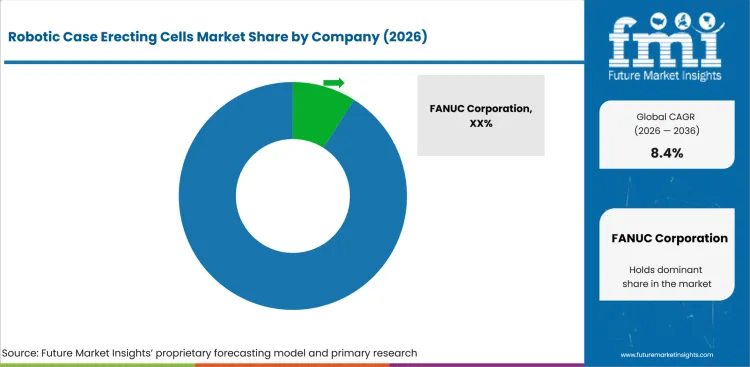
FANUC, ABB Robotics, Yaskawa, Universal Robots and KUKA.
- Established robot companies hold an advantage through installed robot platforms and global service networks.
- Packaging cell integrators gain projects by proving carton trials, magazine reliability, and recovery support.
- Cobot suppliers gain better acceptance in plants needing compact equipment beside existing conveyors.
- Retail-ready packaging automation supports demand through faster case forming and consistent carton presentation.
Robot groups in the market compete by combining platform reliability with packaging-specific integration. FANUC, ABB Robotics, Yaskawa, and KUKA hold strong positions because buyers trust established controllers, spare parts access, and installed support networks. Universal Robots remains relevant where facilities need collaborative systems for retrofit layouts. Packaging line buyers assess safety layout and service depth before awarding projects.
Manufacturing scale has become a competitive separator as robotic packaging demand moves beyond isolated pilot cells. ABB’s AI-enabled item picking modules show how robot suppliers are extending automation into variable parcel and logistics handling. FANUC’s food and packaging demonstrations show continued emphasis on palletizing, packing, and flexible end-of-line automation. Yaskawa’s machine controller updates strengthen motion and safety support for machine builders integrating packaging cells.
Smaller and regional integrators can win through application proof and faster commissioning. ONExia, Clearpack, ProMach, Quest Industrial, and CKF Systems compete by adapting cells to existing conveyors, carton magazines, and plant room constraints. Germany and Japan create higher documentation expectations, while India and China reward cost control and local service availability. Suppliers with proof trials and operator training should gain more durable project acceptance.
How do top robotic case erecting cells companies compare?
FANUC and ABB Robotics score strongest on platform depth while ONExia and Clearpack lead case erecting specialization.
| Company | Relevance to Market Title | Robot Platform Depth | Packaging Cell Integration | Service Support | Channel Reach | Geographic Footprint |
|---|---|---|---|---|---|---|
| FANUC Corporation | Very High | Very Strong | Strong | Very Strong | Very Strong | Global |
| ABB Robotics | Very High | Very Strong | Very Strong | Very Strong | Very Strong | Global |
| Yaskawa Electric Corporation | Very High | Very Strong | Strong | Strong | Very Strong | Global |
| Universal Robots | High | Strong | Strong | Strong | Very Strong | Global |
| KUKA AG | High | Very Strong | Strong | Strong | Strong | Global |
| Omron Corporation | High | Strong | Moderate to Strong | Strong | Strong | Global |
| ONExia Inc. | Very High | Moderate | Very Strong | Strong | Moderate | United States |
| Clearpack Group | Very High | Moderate | Very Strong | Strong | Strong | Asia and Americas |
| ProMach Inc. | High | Moderate | Strong | Strong | Very Strong | North America |
| CKF Systems | Moderate to High | Moderate | Strong | Moderate | Moderate | United Kingdom |
Source: Future Market Insights competitive analysis, 2026.
Who are the key players in the robotic case erecting cells market?
FANUC Corporation, ABB Robotics and Yaskawa Electric Corporation are listed with Universal Robots and KUKA among other suppliers.
Key global companies leading the robotic case erecting cells market include:
- FANUC Corporation
- ABB Robotics
- Yaskawa Electric Corporation
- Universal Robots
- KUKA AG
- Omron Corporation
- ONExia Inc.
- Clearpack Group
- ProMach Inc.
- Quest Industrial LLC
Key Developments in Robotic Case Erecting Cells Market
- In January 2024, FANUC America showcased robotic solutions for food processing and packaging at IPPE 2024, including a CRX-25iA cobot with 30 kg payload and 1,889 mm reach for case palletizing.
- In March 2025, ABB expanded its robotic item picking family with AI-powered functional modules for fashion and logistics, with picking accuracy of more than 99.5% in variable item environments.
- In November 2025, Yaskawa launched its iC9000 series machine controllers with IEC 61131-3 programming support and EtherCAT motion networks for machine automation platforms.
Key Players in the Robotic Case Erecting Cells Market
Global Robot Platform Suppliers
- FANUC Corporation
- ABB Robotics
- Yaskawa Electric Corporation
- KUKA AG
- Kawasaki Robotics
Collaborative Robot and Control Specialists
- Universal Robots
- Omron Corporation
- Epson Robots
- Mitsubishi Electric Corporation
Packaging Cell Integrators
- ONExia Inc.
- Clearpack Group
- ProMach Inc.
- Quest Industrial LLC
- CKF Systems
Robotic Case Erecting Cells Market - Report Scope
| Parameter | Details |
|---|---|
| Forecast period | 2026 to 2036 |
| Historical period | 2021 to 2025 |
| Quantitative unit | Revenue in USD million |
| By robot type | Collaborative robots, SCARA, articulated, AMR/AGV, delta robots |
| By payload | <5 kg, 5-20 kg, 20-80 kg, >80 kg |
| By application | Material handling, inspection, assembly, welding, packaging, machine tending |
| By end-use industry | Automotive, electronics, food & beverage, logistics, pharmaceuticals, metals |
| By cell configuration | Standalone robotic cells, integrated case erecting-sealing cells, cobot retrofit cells, vision-guided cells |
| Regions covered | North America, Latin America, Europe, East Asia, South Asia and Pacific, Middle East and Africa |
| Countries covered | United States, United Kingdom, Germany, France, Japan, China, South Korea, India |
| Key companies profiled | FANUC, ABB Robotics, Yaskawa, Universal Robots, KUKA, Omron, ONExia, Clearpack, ProMach, Quest Industrial |
| Approach | Bottom-up robotic cell revenue approach using system pricing, robot type mix, payload class, end-use adoption, and country-level automation readiness |
Source: Future Market Insights, 2026.
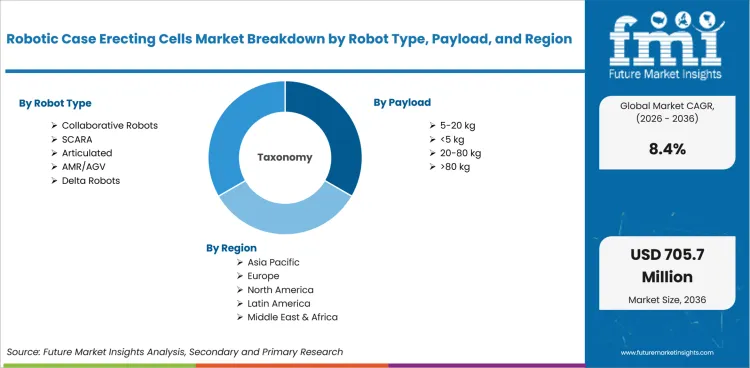
Robotic Case Erecting Cells Market Breakdown by Robot Type, Payload, Application, End-use Industry, Cell Configuration, and Region
Robotic Case Erecting Cells Market Segmented by Robot Type
- Collaborative Robots
- SCARA
- Articulated
- AMR/AGV
- Delta Robots
Robotic Case Erecting Cells Market Segmented by Payload
- <5 kg
- 5-20 kg
- 20-80 kg
- >80 kg
Robotic Case Erecting Cells Market Segmented by Application
- Material Handling
- Inspection
- Assembly
- Welding
- Packaging
- Machine Tending
Robotic Case Erecting Cells Market Segmented by End-use Industry
- Automotive
- Electronics
- Food & Beverage
- Logistics
- Pharmaceuticals
- Metals
Robotic Case Erecting Cells Market Segmented by Cell Configuration
- Standalone Robotic Cells
- Integrated Case Erecting-Sealing Cells
- Cobot Retrofit Cells
- Vision-guided Cells
Robotic Case Erecting Cells Market by Region
- North America
- Latin America
- Europe
- East Asia
- South Asia and Pacific
- Middle East and Africa
Research Sources and Bibliography
- ABB Robotics. (2025, March 11). ABB expands robotic item picking family with new AI-powered functional modules.
- Bureau of Labor Statistics. (2025, August 28). Industrial machinery mechanics, machinery maintenance workers, and millwrights: Occupational Outlook Handbook.
- Department for Business and Trade. (2024). Made Smarter Adoption research project.
- Federal Statistical Office of Germany. (2026, June 8). New orders in manufacturing in April 2026.
- Federal Statistical Office of Germany. (2026, June 18). Stock of orders in manufacturing in April 2026.
- FANUC America Corporation. (2024, January 8). FANUC America showcases robotic solutions for food processing and packaging at IPPE 2024.
- INSEE. (2026, April 3). In February 2026, manufacturing output was stable.
- INSEE. (2026, May 6). In March 2026, manufacturing output increased by 1.2%.
- INSEE. (2026, June 5). In April 2026, manufacturing output increased by 0.4%.
- International Federation of Robotics. (2025, September 25). World Robotics 2025 report: Industrial Robots.
- International Federation of Robotics. (2026, April 8). Robot density surges in Europe, Asia, and Americas.
- International Federation of Robotics. (2026, June 18). US robot industry returns to double digit growth.
- Japan Ministry of Economy, Trade and Industry. (2026, March 31). Preliminary Report for February 2026: Indices of Industrial Production.
- Japan Ministry of Economy, Trade and Industry. (2026, June 12). Revised Report for April 2026: Indices of Industrial Production.
- Korea Ministry of Data and Statistics. (2026). All industry production index, April 2026.
- Korea.net. (2026). Korea’s annual exports reach new highs in 2025.
- National Bureau of Statistics of China. (2025, March 18). Industrial production operation from January to February 2025.
- Office for National Statistics. (2026, March 13). GDP monthly estimate, UK: January 2026.
- Office for National Statistics. (2026, June 12). GDP monthly estimate, UK: April 2026.
- Omron Corporation. (2025, June). OMRON announces PTS Automation as certified systems integrator partner.
- PMMI. (2024, November 18). Packaging machinery sales projected to grow to new highs through 2027.
- Press Information Bureau. (2025, August 24). PLI Scheme: Powering India’s industrial renaissance.
- Press Information Bureau. (2026, February 20). Production Linked Incentive Scheme for Food Processing Industry.
- Press Information Bureau. (2026, March 27). Periodic Labour Force Survey Annual Report 2025.
- USA Census Bureau. (2026, May 18). Quarterly retail e-commerce sales: First quarter 2026.
- USA Occupational Safety and Health Administration. (2025, April 17). Department of Labor releases 2024 injury and illness data.
- Yaskawa Electric Corporation. (2025, November 6). Yaskawa launches new iC9000 series machine controllers.
This bibliography is provided for reader reference and is not exhaustive. The full report contains the complete reference list and detailed citations.
This Report Answers
- Market size estimates for 2026 and forecasts through 2036 for the robotic case erecting cells market.
- Insights across regional and country-level robotic packaging automation markets.
- Analysis of demand drivers, cell adoption patterns, retrofit constraints, and purchasing behavior.
- Evaluation of robot type, payload range, application, end-use industry, and cell configuration segments.
- Assessment of packaging-line automation, carton handling reliability, and service support requirements.
- Identification of opportunities across integrated cells, cobot retrofits, vision-guided systems, and end-of-line automation.
- Evaluation of supply chain dynamics, robot platform competition, and packaging integration channels.
- Country-level growth analysis covering the United States, United Kingdom, Germany, France, Japan, China, South Korea, and India.
- Assessment of the competitive landscape, including robot suppliers, integrators, and packaging automation companies.
- Analysis of buyer preferences, line retrofit patterns, and emerging secondary packaging opportunities.
- Regional outlooks across North America, Europe, East Asia, South Asia and Pacific, Latin America, and Middle East and Africa.
- Delivery of market data, forecasts, and supporting analysis in PDF and Excel formats.
Frequently Asked Questions
What is the growth prospect for robotic case erecting cells?
Demand for robotic case erecting cells is expected to rise at a considerable pace as manufacturers automate carton forming and reduce manual case handling.
Which companies are expected to shape the robotic case erecting cells market?
FANUC, ABB Robotics, Yaskawa, Universal Robots, KUKA, Omron, ONExia, Clearpack, and ProMach are expected to shape market competition through robot platforms and packaging cell integration.
Why are manufacturers investing in robotic case erecting cells?
Manufacturers are investing in robotic case erecting cells to stabilize carton supply, reduce manual folding, and support frequent case size changes.
Why are integrator channels important in the robotic case erecting cells market?
Integrator channels are important because buyers need magazines, grippers, guards, sealers, controls, and conveyors to work as one validated cell.
Which robot types are gaining attention in robotic case erecting cells?
Collaborative robots and articulated robots are gaining attention as buyers balance compact retrofit needs with speed and reach requirements.
How do payload requirements influence robotic case erecting cell purchases?
Payload requirements influence purchases because carton blanks, vacuum tooling, flap guides, and case size determine the robot arm and gripper specification.
Why is packaging the leading application for robotic case erecting cells?
Packaging is the leading application because case forming is a direct secondary packaging step before packing, sealing, labeling, and palletizing.
What role does service support play in robotic case erecting cell adoption?
Service support is important because vacuum faults, magazine jams, and recipe issues can stop the full packaging line.
How do retrofit cells support older packaging rooms?
Retrofit cells support older packaging rooms by adding robotic carton forming beside existing conveyors and sealers without a full line rebuild.
Preview the report firsthand - request a free sample
Get SampleGet the brochure for pricing and purchase details.
Get PDFTable of Content
- Key Takeaways
- Market Size and CAGR
- Top Growth Driver
- Fastest Growing Segment
- Leading Region
- Key Companies
- Emerging Opportunities
- Executive Summary
- Global Market Outlook
- Demand-side Trends
- Supply-side Trends
- Technology Roadmap Analysis
- Analysis and Recommendations
- Analyst Perspective (What is happening? Why now? What should investors know?)
- Key Questions Answered
- How large is the market?
- What is the CAGR?
- What are key trends?
- Which region dominates?
- Who are the leaders?
- Market Overview
- Market Coverage / Taxonomy
- Market Definition / Scope / Limitations
- Research Methodology
- Chapter Orientation
- Analytical Lens and Working Hypotheses
- Market Structure, Signals, and Trend Drivers
- Benchmarking and Cross-market Comparability
- Market Sizing, Forecasting, and Opportunity Mapping
- Research Design and Evidence Framework
- Desk Research Programme (Secondary Evidence)
- Expert Input and Fieldwork (Primary Evidence)
- Tooling, Models, and Reference Databases
- Data Engineering and Model Build
- Quality Assurance and Audit Trail
- Market Background
- Market Dynamics (Drivers, Restraints, Opportunity, Trends)
- Scenario Forecast (Optimistic, Likely, Conservative)
- Impact Analysis
- AI Impact
- Sustainability Impact
- Regulatory Impact
- Technology Impact
- Consumer / Buyer Analysis
- Purchase Drivers
- Adoption Barriers
- Buyer Journey
- Opportunity Map Analysis
- Product Life Cycle Analysis
- Supply Chain Analysis
- Investment Feasibility Matrix
- Value Chain Analysis
- PESTLE and Porter's Analysis
- Regulatory Landscape
- Regional Parent Market Outlook
- Production and Consumption Statistics
- Import and Export Statistics
- Global Market Analysis and Forecast, 2021 to 2036
- Historical Market Size Value (USD Million) & Volume (Unit) Analysis, 2021 to 2025
- Current and Future Market Size Value (USD Million) & Volume (Unit) Projections, 2026 to 2036
- Y-o-Y Growth Trend Analysis
- Absolute $ Opportunity Analysis
- Global Market Pricing Analysis, 2021 to 2036
- Global Market Analysis and Forecast, By Robot Type, 2021 to 2036
- Introduction / Key Findings
- Historical Market Size Value (USD Million) & Volume (Unit) Analysis By Robot Type, 2021 to 2025
- Current and Future Market Size Value (USD Million) & Volume (Unit) Analysis and Forecast By Robot Type, 2026 to 2036
- Collaborative Robots
- SCARA
- Articulated
- AMR/AGV
- Delta Robots
- Collaborative Robots
- Y-o-Y Growth Trend Analysis By Robot Type, 2021 to 2025
- Absolute $ Opportunity Analysis By Robot Type, 2026 to 2036
- Global Market Analysis and Forecast, By Payload, 2021 to 2036
- Introduction / Key Findings
- Historical Market Size Value (USD Million) & Volume (Unit) Analysis By Payload, 2021 to 2025
- Current and Future Market Size Value (USD Million) & Volume (Unit) Analysis and Forecast By Payload, 2026 to 2036
- 5-20 kg
- <5 kg
- 20-80 kg
- >80 kg
- 5-20 kg
- Y-o-Y Growth Trend Analysis By Payload, 2021 to 2025
- Absolute $ Opportunity Analysis By Payload, 2026 to 2036
- Global Market Analysis and Forecast, By Application, 2021 to 2036
- Introduction / Key Findings
- Historical Market Size Value (USD Million) & Volume (Unit) Analysis By Application, 2021 to 2025
- Current and Future Market Size Value (USD Million) & Volume (Unit) Analysis and Forecast By Application, 2026 to 2036
- Packaging
- Material Handling
- Inspection
- Assembly
- Welding
- Machine Tending
- Packaging
- Y-o-Y Growth Trend Analysis By Application, 2021 to 2025
- Absolute $ Opportunity Analysis By Application, 2026 to 2036
- Global Market Analysis and Forecast, By End-use Industry, 2021 to 2036
- Introduction / Key Findings
- Historical Market Size Value (USD Million) & Volume (Unit) Analysis By End-use Industry, 2021 to 2025
- Current and Future Market Size Value (USD Million) & Volume (Unit) Analysis and Forecast By End-use Industry, 2026 to 2036
- Food & Beverage
- Automotive
- Electronics
- Logistics
- Pharmaceuticals
- Metals
- Food & Beverage
- Y-o-Y Growth Trend Analysis By End-use Industry, 2021 to 2025
- Absolute $ Opportunity Analysis By End-use Industry, 2026 to 2036
- Global Market Analysis and Forecast, By Cell Configuration, 2021 to 2036
- Introduction / Key Findings
- Historical Market Size Value (USD Million) & Volume (Unit) Analysis By Cell Configuration, 2021 to 2025
- Current and Future Market Size Value (USD Million) & Volume (Unit) Analysis and Forecast By Cell Configuration, 2026 to 2036
- Integrated Case Erecting-Sealing Cells
- Standalone Robotic Cells
- Cobot Retrofit Cells
- Vision-guided Cells
- Integrated Case Erecting-Sealing Cells
- Y-o-Y Growth Trend Analysis By Cell Configuration, 2021 to 2025
- Absolute $ Opportunity Analysis By Cell Configuration, 2026 to 2036
- Global Market Analysis and Forecast, By Region, 2021 to 2036
- Introduction
- Historical Market Size Value (USD Million) & Volume (Unit) Analysis By Region, 2021 to 2025
- Current Market Size Value (USD Million) & Volume (Unit) Analysis and Forecast By Region, 2026 to 2036
- North America
- Latin America
- Western Europe
- Eastern Europe
- East Asia
- South Asia and Pacific
- Middle East & Africa
- Market Attractiveness Analysis By Region
- North America Market Analysis and Forecast, By Country, 2021 to 2036
- Historical Market Size Value (USD Million) & Volume (Unit) Trend Analysis By Market Taxonomy, 2021 to 2025
- Market Size Value (USD Million) & Volume (Unit) Forecast By Market Taxonomy, 2026 to 2036
- By Country
- USA
- Canada
- Mexico
- By Robot Type
- By Payload
- By Application
- By End-use Industry
- By Cell Configuration
- By Country
- Market Attractiveness Analysis
- By Country
- By Robot Type
- By Payload
- By Application
- By End-use Industry
- By Cell Configuration
- Key Takeaways
- Latin America Market Analysis and Forecast, By Country
- Historical Market Size Value (USD Million) & Volume (Unit) Trend Analysis By Market Taxonomy, 2021 to 2025
- Market Size Value (USD Million) & Volume (Unit) Forecast By Market Taxonomy, 2026 to 2036
- By Country
- Brazil
- Chile
- Rest of Latin America
- By Robot Type
- By Payload
- By Application
- By End-use Industry
- By Cell Configuration
- By Country
- Market Attractiveness Analysis
- By Country
- By Robot Type
- By Payload
- By Application
- By End-use Industry
- By Cell Configuration
- Key Takeaways
- Western Europe Market Analysis and Forecast, By Country
- Historical Market Size Value (USD Million) & Volume (Unit) Trend Analysis By Market Taxonomy, 2021 to 2025
- Market Size Value (USD Million) & Volume (Unit) Forecast By Market Taxonomy, 2026 to 2036
- By Country
- Germany
- UK
- Italy
- Spain
- France
- Nordic
- BENELUX
- Rest of Western Europe
- By Robot Type
- By Payload
- By Application
- By End-use Industry
- By Cell Configuration
- By Country
- Market Attractiveness Analysis
- By Country
- By Robot Type
- By Payload
- By Application
- By End-use Industry
- By Cell Configuration
- Key Takeaways
- Eastern Europe Market Analysis and Forecast, By Country
- Historical Market Size Value (USD Million) & Volume (Unit) Trend Analysis By Market Taxonomy, 2021 to 2025
- Market Size Value (USD Million) & Volume (Unit) Forecast By Market Taxonomy, 2026 to 2036
- By Country
- Russia
- Poland
- Hungary
- Balkan & Baltic
- Rest of Eastern Europe
- By Robot Type
- By Payload
- By Application
- By End-use Industry
- By Cell Configuration
- By Country
- Market Attractiveness Analysis
- By Country
- By Robot Type
- By Payload
- By Application
- By End-use Industry
- By Cell Configuration
- Key Takeaways
- East Asia Market Analysis and Forecast, By Country
- Historical Market Size Value (USD Million) & Volume (Unit) Trend Analysis By Market Taxonomy, 2021 to 2025
- Market Size Value (USD Million) & Volume (Unit) Forecast By Market Taxonomy, 2026 to 2036
- By Country
- China
- Japan
- South Korea
- By Robot Type
- By Payload
- By Application
- By End-use Industry
- By Cell Configuration
- By Country
- Market Attractiveness Analysis
- By Country
- By Robot Type
- By Payload
- By Application
- By End-use Industry
- By Cell Configuration
- Key Takeaways
- South Asia and Pacific Market Analysis and Forecast, By Country
- Historical Market Size Value (USD Million) & Volume (Unit) Trend Analysis By Market Taxonomy, 2021 to 2025
- Market Size Value (USD Million) & Volume (Unit) Forecast By Market Taxonomy, 2026 to 2036
- By Country
- India
- ASEAN
- Australia & New Zealand
- Rest of South Asia and Pacific
- By Robot Type
- By Payload
- By Application
- By End-use Industry
- By Cell Configuration
- By Country
- Market Attractiveness Analysis
- By Country
- By Robot Type
- By Payload
- By Application
- By End-use Industry
- By Cell Configuration
- Key Takeaways
- Middle East & Africa Market Analysis and Forecast, By Country
- Historical Market Size Value (USD Million) & Volume (Unit) Trend Analysis By Market Taxonomy, 2021 to 2025
- Market Size Value (USD Million) & Volume (Unit) Forecast By Market Taxonomy, 2026 to 2036
- By Country
- Kingdom of Saudi Arabia
- Other GCC Countries
- Türkiye
- South Africa
- Other African Union
- Rest of Middle East & Africa
- By Robot Type
- By Payload
- By Application
- By End-use Industry
- By Cell Configuration
- By Country
- Market Attractiveness Analysis
- By Country
- By Robot Type
- By Payload
- By Application
- By End-use Industry
- By Cell Configuration
- Key Takeaways
- Key Countries Market Analysis
- USA
- Pricing Analysis
- Market Share Analysis, 2025
- By Robot Type
- By Payload
- By Application
- By End-use Industry
- By Cell Configuration
- Canada
- Pricing Analysis
- Market Share Analysis, 2025
- By Robot Type
- By Payload
- By Application
- By End-use Industry
- By Cell Configuration
- Mexico
- Pricing Analysis
- Market Share Analysis, 2025
- By Robot Type
- By Payload
- By Application
- By End-use Industry
- By Cell Configuration
- Brazil
- Pricing Analysis
- Market Share Analysis, 2025
- By Robot Type
- By Payload
- By Application
- By End-use Industry
- By Cell Configuration
- Chile
- Pricing Analysis
- Market Share Analysis, 2025
- By Robot Type
- By Payload
- By Application
- By End-use Industry
- By Cell Configuration
- Germany
- Pricing Analysis
- Market Share Analysis, 2025
- By Robot Type
- By Payload
- By Application
- By End-use Industry
- By Cell Configuration
- UK
- Pricing Analysis
- Market Share Analysis, 2025
- By Robot Type
- By Payload
- By Application
- By End-use Industry
- By Cell Configuration
- Italy
- Pricing Analysis
- Market Share Analysis, 2025
- By Robot Type
- By Payload
- By Application
- By End-use Industry
- By Cell Configuration
- Spain
- Pricing Analysis
- Market Share Analysis, 2025
- By Robot Type
- By Payload
- By Application
- By End-use Industry
- By Cell Configuration
- France
- Pricing Analysis
- Market Share Analysis, 2025
- By Robot Type
- By Payload
- By Application
- By End-use Industry
- By Cell Configuration
- India
- Pricing Analysis
- Market Share Analysis, 2025
- By Robot Type
- By Payload
- By Application
- By End-use Industry
- By Cell Configuration
- ASEAN
- Pricing Analysis
- Market Share Analysis, 2025
- By Robot Type
- By Payload
- By Application
- By End-use Industry
- By Cell Configuration
- Australia & New Zealand
- Pricing Analysis
- Market Share Analysis, 2025
- By Robot Type
- By Payload
- By Application
- By End-use Industry
- By Cell Configuration
- China
- Pricing Analysis
- Market Share Analysis, 2025
- By Robot Type
- By Payload
- By Application
- By End-use Industry
- By Cell Configuration
- Japan
- Pricing Analysis
- Market Share Analysis, 2025
- By Robot Type
- By Payload
- By Application
- By End-use Industry
- By Cell Configuration
- South Korea
- Pricing Analysis
- Market Share Analysis, 2025
- By Robot Type
- By Payload
- By Application
- By End-use Industry
- By Cell Configuration
- Russia
- Pricing Analysis
- Market Share Analysis, 2025
- By Robot Type
- By Payload
- By Application
- By End-use Industry
- By Cell Configuration
- Poland
- Pricing Analysis
- Market Share Analysis, 2025
- By Robot Type
- By Payload
- By Application
- By End-use Industry
- By Cell Configuration
- Hungary
- Pricing Analysis
- Market Share Analysis, 2025
- By Robot Type
- By Payload
- By Application
- By End-use Industry
- By Cell Configuration
- Kingdom of Saudi Arabia
- Pricing Analysis
- Market Share Analysis, 2025
- By Robot Type
- By Payload
- By Application
- By End-use Industry
- By Cell Configuration
- Türkiye
- Pricing Analysis
- Market Share Analysis, 2025
- By Robot Type
- By Payload
- By Application
- By End-use Industry
- By Cell Configuration
- South Africa
- Pricing Analysis
- Market Share Analysis, 2025
- By Robot Type
- By Payload
- By Application
- By End-use Industry
- By Cell Configuration
- USA
- Market Structure Analysis
- Competition Dashboard
- Competition Benchmarking
- Market Share Analysis of Top Players
- By Regional
- By Robot Type
- By Payload
- By Application
- By End-use Industry
- By Cell Configuration
- Emerging Startups
- Innovation Benchmarking
- Competition Analysis
- Competition Deep Dive
- FANUC America Corporation
- Overview
- Product Portfolio
- Profitability by Market Segments (Product/Region/Sales Channel)
- Sales Footprint
- Strategy Overview
- Marketing Strategy
- Product Strategy
- Channel Strategy
- ABB Robotics USA
- Universal Robots USA
- ONExia Inc.
- ProMach Inc.
- Quest Industrial LLC
- Clearpack Automation USA
- FANUC America Corporation
- Case Studies
- Success Stories
- Recent Developments
- Competition Deep Dive
- Assumptions & Acronyms Used


