

- Market Size (2026)
- USD 3.5 Bn
- Forecast (2036)
- USD 101.2 Bn
- CAGR (2026 to 2036)
- 40.0%
How big is the Industrial Humanoid Robots Market in 2026?
USD 3.5 billion in 2026 and USD 101.2 billion by 2036 at a 40.0% CAGR.
Demand for industrial humanoid robots is projected to expand at a 40.0% CAGR between 2026 and 2036, increasing valuation from USD 3.5 billion in 2026 to USD 101.2 billion by 2036. Early gains are expected in repeated lifting across work areas that fixed equipment cannot follow. This work is expected to establish the humanoid robot field as a practical extension of factory automation plans. The Association for Advancing Automation reported in February 2025 that North American companies ordered 31,311 robots worth USD 1.963 billion during 2024. That order base is expected to give integrators deeper control and service experience before humanoid fleets enter active lines.
Country growth will diverge as hardware supply and workplace approval move at different speeds. China can support shorter build cycles through dense component networks and public standards work. United States programs face a wider service burden because factory sites are spread across a large industrial base. The National Institute of Standards and Technology stated in March 2025 that more than 13 million people worked for over 244,000 USA manufacturers in January 2025. Plant engineers will compare reset time and parts access with the installed industrial robot base before they approve capital. The commercial gap between countries therefore depends on service depth as much as robot performance.
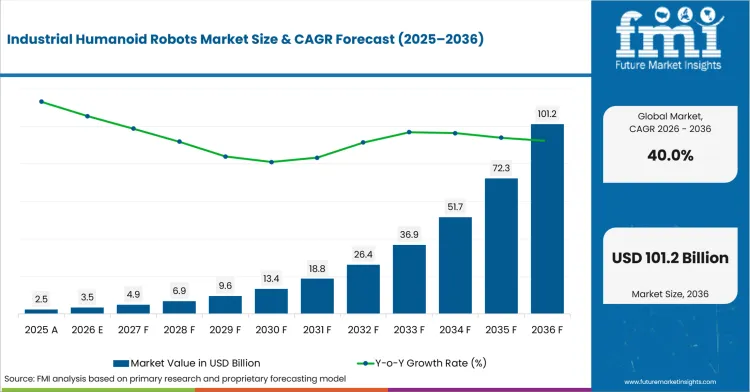
Key Takeaways of Industrial Humanoid Robots Market
- Demand for industrial humanoid robots is driven by the need for work completed without routine resets, with factories starting adoption in repetitive movement tasks inside spaces built for people that fixed equipment cannot reach.
- By component, hardware cost is expected to shape early revenue and purchasing decisions, with hands and batteries setting operating limits since grip reliability and charging time determine completed work per shift.
- Bipedal systems are estimated to earn a premium in facilities where stairs and standing stations block wheeled platforms from reaching assigned work.
- Tote handling is anticipated to lead early application adoption, as repeated container shapes make each transfer easier to measure during live warehouse operations.
- Long-term spending is expected to follow safe output and predictable service cost rather than isolated demonstrations, with software value rising later as one platform learns more tasks without new mechanical equipment.
- China, the United States, South Korea, and Japan are expected to lead adoption through component supply advantages, funded developer programs, and established robotics skills, while the European Union moves more carefully under machinery and AI control rules.
- Competition centers on platform developers, learning-model providers, and industrial partners, with vendors differentiating through useful runtime, recovery behavior, factory-derived task data, and clearly defined repair and software update terms.
Analyst Perspective
"The industrial humanoid robots market is progressing as manufacturers evaluate whether these systems can perform repetitive shop-floor tasks with consistent reliability in real production environments. Commercial decisions are shaped by sustained operational performance, adaptability across changing workflows, and the ability to minimize unplanned interruptions rather than by demonstration results alone. Vendors that combine dependable robotic capabilities with practical deployment expertise, responsive local support, and scalable implementation strategies are likely to build stronger customer confidence as adoption expands."
- Nikhil Kaitwade, Principal Analyst at Future Market Insights
How is the Industrial Humanoid Robots Market segmented?
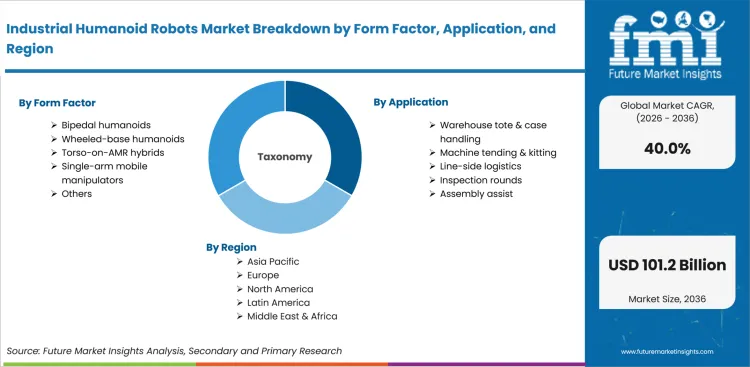
By form factor, application, component, end-use industry, business model, and region
The market is segmented by form factor, application, component, end-use industry, business model, and region. Form factor and application define what the robot must reach and what it must move inside an industrial site. Component analysis separates the physical platform from learning software and recurring service. End-use coverage compares automotive plants with contract logistics and electronics facilities. Business-model analysis tests whether direct purchase or recurring service better matches risk during early fleet use. Each parent segment is expected to move at a different pace because body design and task structure determine failure exposure. Regional coverage is anticipated to reflect local engineering depth and workplace rules rather than simple demand volume.
Why are bipedal humanoids expected to hold 44.0% of form factor revenue in 2026?
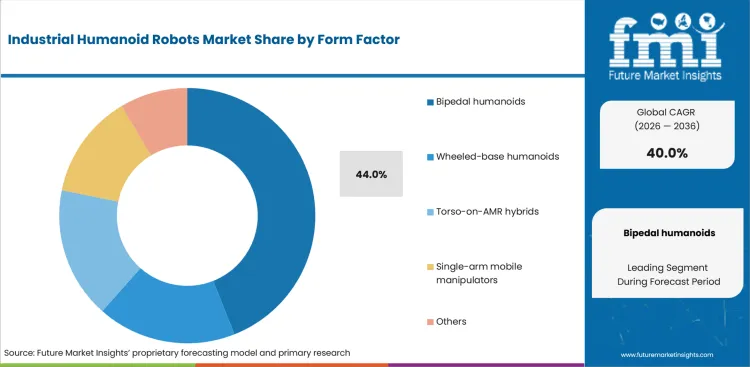
Human work areas favor legs where steps and standing benches limit wheeled access. A bipedal platform can approach several stations without rails across mixed industrial areas. Balance control raises energy use and repair exposure during each operating shift. Bipedal systems therefore hold their share when added route access offsets higher joint cost. Maintenance engineers are likely to compare stair access with service time before approving the body plan.
- With an estimated 44.0% of form factor revenue in 2026, bipedal humanoids are anticipated to lead since legs reach stairs and standing workstations without fixed route equipment inside mixed industrial layouts.
- Maintenance engineers are expected to favor bipedal systems over alternatives due to route access inside mixed work areas. The collaborative mobile manipulation systems category is projected to provide a practical benchmark for reach and navigation.
How is warehouse tote and case handling expected to reach 32.0% of application revenue in 2026?
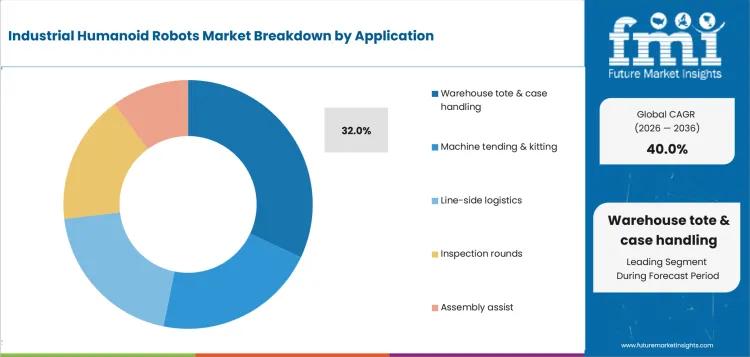
Repeated tote shapes make warehouse handling easier to measure than loose-item work. A successful transfer is measured through completed moves and the number of manual resets during each operating hour. Damaged containers and blocked aisles can expose weak object detection or slow recovery during live operations. A commercial case emerges once the robot keeps material flowing without constant technician support.
- By application, warehouse tote and case handling is expected to account for 32.0% of application revenue in 2026 owing to repeated containers that provide clearer grasp targets and predictable transfer points inside mapped lanes.
- Purchase activity for mobile handling systems is anticipated to rise as completed output becomes easier to measure across mapped lanes. The autonomous mobile robot workflow is expected to provide a lower-cost benchmark for navigation and task assignment. Humanoid value is forecast to appear when two-handed transfer is needed at the route endpoint during live work.
What is expected to keep hardware at 58.0% of component revenue in 2026?
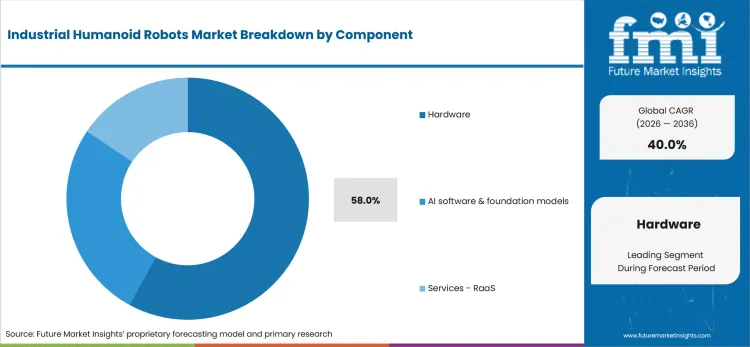
A humanoid combines many costly physical systems that must work together under load. Useful operation requires precise joint control plus cameras and batteries that remain stable throughout each assigned task. A single fall can damage linked parts and extend repair time during live industrial use. Software value can rise later, while early revenue remains tied to the physical platform and its service needs.
- Costly joints and battery packs are projected to push hardware to a 58.0% share across components in 2026, reflecting expensive hands and frames at limited production volume during early fleet orders.
- Modular hardware is expected to draw interest from maintenance engineers owing to repair exposure across moving joints during routine industrial shifts. Robotic gripper options are expected to help maintenance engineers compare payload and grasp repeatability before a hand purchase. Repair plans are likely to carry greater weight once daily uptime becomes a contracted operating measure.
What are the drivers, restraints, and opportunities in the Industrial Humanoid Robots Market?
Driver: repeated lifting and injury exposure are expected to support trials. Restraint: safety approval and inconsistent recovery are anticipated to slow fleet expansion. Opportunity: shared platforms are projected to widen robot use across several tasks.
- Driver: repeated lifting and injury exposure are expected to support trials across long walking routes during industrial shifts.
- Restraint: slow recovery from errors is expected to raise operating cost even after the robot performs well in a controlled test.
- Opportunity: one robot body is projected to serve several tasks through software updates and swappable tools.
Repeated lifting and long walking routes support trials in work that exposes people to strain across every shift. The USA Bureau of Labor Statistics reported in January 2026 that manufacturing recorded a total recordable case rate of 2.7 per 100 full-time workers during 2024. Industrial automation leaders are therefore likely to test humanoids in routes that combine lifting with repeated walking. Commercial demand depends on lower exposure and completed output rather than broad claims about replacing labor.
Safety review remains a real restraint because a tall mobile machine shares space with people and equipment. The International Organization for Standardization published ISO 10218-2:2025 in February 2025 for industrial robot applications and robot cells. Each site must document speed limits and stop behavior before normal production use. Reset frequency can still erase savings after the formal safety case is accepted by plant management.
Shared platforms create value when one body can handle material transfer and later perform inspection work. Google DeepMind introduced Gemini Robotics On-Device in June 2025 and said new tasks could be adapted with 50 to 100 demonstrations. That learning path can improve the Robots-as-a-Service model by spreading hardware cost across more operating hours. Commercial gain depends on usable task transfer rather than a broad general-purpose claim.
Which country CAGRs are profiled in the Industrial Humanoid Robots Market?
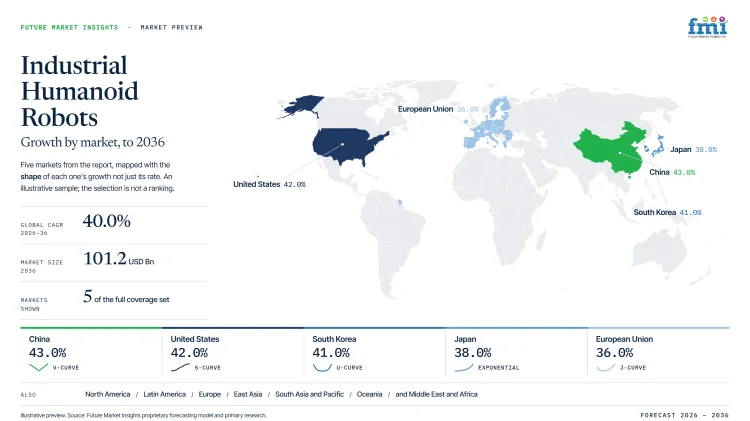
| Country or Market | CAGR |
|---|---|
| China | 43.0% |
| United States | 42.0% |
| South Korea | 41.0% |
| Japan | 38.0% |
| European Union | 36.0% |
Source: FMI's proprietary forecasting model and primary research
How do country-level CAGRs compare in the Industrial Humanoid Robots Market?
The country comparison spans 7.0 percentage points and reveals three distinct growth tiers across the industrial humanoid robots market. China, the United States and South Korea form the leading group with only 2.0 percentage points separating the three markets. Japan creates a transition to the next tier, sitting 3.0 percentage points below South Korea. The European Union follows 2.0 percentage points behind Japan. Markets with stronger investments in factory automation, AI-enabled robotics and advanced manufacturing are generally recording faster adoption of industrial humanoid robots.
- China leads the comparison with a CAGR of 43.0%. Large-scale manufacturing operations, continued investment in embodied AI and growing interest in humanoid robots for material handling, assembly and repetitive industrial tasks are creating favorable conditions for commercial deployment.
- Just 1.0 percentage point behind China, the United States records a CAGR of 42.0%. Manufacturers are evaluating humanoid robots for applications where flexible automation is needed alongside existing industrial robotics, particularly in logistics, warehouse operations and high-mix production environments.
- South Korea posts a CAGR of 41.0%, remaining 1.0 percentage point below the United States. Strong robotics expertise, widespread factory automation and continued development of smart manufacturing facilities contribute to early adoption across industrial settings.
- A further 3.0 percentage point difference places Japan at 38.0%. Demand reflects the country's established industrial robotics ecosystem and growing interest in humanoid systems that can perform complex tasks within existing production lines while helping manufacturers address workforce constraints.
- The European Union records a CAGR of 36.0%, standing 2.0 percentage points below Japan. Investment is centered on advanced manufacturing, collaborative robotics and industrial digitalization, although commercialization timelines vary across member states because of differences in industrial structure, automation priorities and regulatory approaches.
Comparable CAGRs can still produce different market entry conditions. Differences in manufacturing automation maturity, AI development, labor availability and industrial investment priorities influence deployment timelines and long-term commercial opportunities. The full report provides country-level CAGR analysis across North America, Latin America, Western Europe, Eastern Europe, East Asia, South Asia and Pacific, and the Middle East & Africa.
Country-wise Analysis
- Platform developers in China are expected to benefit from dense component networks as factory programs cluster around local industrial hubs. By 2036, China is projected to grow at a 43.0% CAGR supported by local platform programs and national standards work. The State Council reported in April 2025 that Guangdong produced more than 240,000 industrial robots during 2024 and recorded 31.2% year-on-year growth. That output base is expected to shorten hardware changes and expand nearby testing capacity for industrial developers. Local access to joint motors and sensors is likely to reduce delays after a trial failure during active factory testing.
- United States plant engineers evaluate safe output before approving a new humanoid platform for routine production. The United States sector is anticipated to advance at a 42.0% CAGR through 2036 stemming from AI investment and visible factory programs. The International Federation of Robotics reported in June 2026 that USA factories installed 38,000 industrial robots during 2025. That installed base is expected to give system integrators deeper experience with controls and service response. Large automotive and warehouse sites are anticipated to provide enough work volume for disciplined comparison across full shifts.
- South Korea's automation mix is expected to shift toward humanoid platforms across electronics and automotive material handling. Industrial humanoid robot use in South Korea is forecast to rise at a 41.0% CAGR through 2036 linked to established robotics skills. Korea.net reported in April 2025 that about 350 people from 40 organizations attended the K-Humanoid Alliance launch. The alliance is expected to connect platform work with components and university research through shared development programs. Component companies are likely to gain a clearer path from research into industrial supply contracts.
- The service base in Japan is anticipated to grow as industrial robot support volumes rise through the forecast period. Adoption of industrial humanoids in Japan is estimated to expand at a 38.0% CAGR through 2036 on the back of mature automation skills. The Japan Robot Association reported in July 2025 that first-quarter orders reached 45,432 units among member companies. The same release placed first-quarter production at 44,022 units among member companies during the period. Local manufacturing depth is expected to support nearby parts access and disciplined maintenance throughout the country.
- The European Artificial Intelligence Act is projected to reshape the region's industrial robot sourcing base through the forecast period. Industrial humanoid use in the European Union is predicted to record a 36.0% CAGR through 2036 driven by flexible automation needs under formal review. The European Commission reported in July 2024 that the Act would enter into force on August 1, 2024. Eurostat reported in December 2025 that 8.55% of large EU enterprises used AI for autonomous machine movement during 2025. That software base is expected to support robot learning although machinery rules still shape physical approval.
Who are the notable companies in the Industrial Humanoid Robots Market?
Tesla, Figure, Apptronik, Boston Dynamics, Agility Robotics, NEURA Robotics, UBTECH Robotics, Hexagon Robotics, NVIDIA, and Google DeepMind represent notable platform and robot-learning contributors.
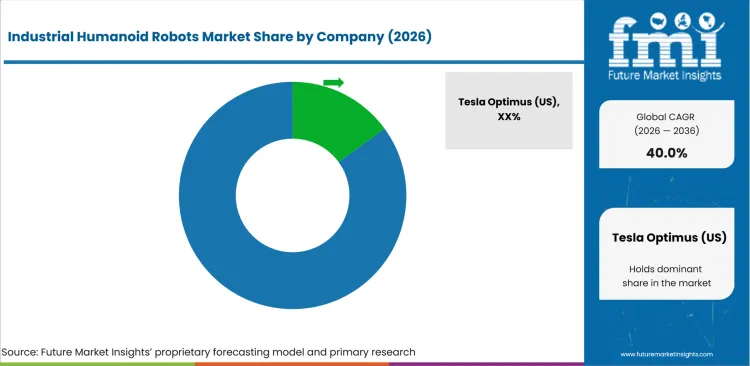
Competition splits between hardware scale and proof of useful work at live industrial sites. Some platform groups are preparing factory capacity before broad customer sales begin across several industrial regions. Others are gathering task data inside customer operations to guide later design and service decisions. Learning-model providers can lower training effort through simulation and local control that transfers across robot bodies. Industrial teams compare these approaches with the automated material handling base already supported in their facilities. Commercial advantage favors companies that pair measured industrial evidence with reliable service reach across customer sites.
- Figure reported in April 2026 that BotQ delivered over 350 Figure 03 robots at one robot per hour. In November 2025 the company said Figure 02 logged over 1,250 hours at BMW. The same program supported production of more than 30,000 BMW vehicles and strengthened Figure's automotive record.
- Figure introduced Helix in February 2025 to control a humanoid's wrists and fingers plus its torso and head through language and vision. This wider control range is expected to shorten task teaching after hardware reliability meets industrial needs at commercial sites.
- Agility Robotics reported in November 2025 that Digit had moved over 100,000 totes at GXO. Apptronik announced in February 2025 that Jabil would build Apollo and test it in manufacturing operations. These paths are expected to connect platform production with measurable work inside warehouse robotics programs.
- Boston Dynamics described Atlas control policies in August 2025 that follow language instructions during long task sequences across changing industrial work areas. UBTECH stated in September 2025 that Walker S trials had reached multi-robot production-line tasks and a small-batch purchase contract. The two records are expected to show progress from isolated motion toward coordinated industrial work.
Competitive Benchmarking: Industrial Humanoid Robots Market
| Company | Industrial Use Evidence | Humanoid Hardware Readiness | Learning Software Depth | Service Reach |
|---|---|---|---|---|
| Tesla | Medium | High | High | North America |
| Figure | High | High | High | North America and Europe |
| Apptronik | Medium | Medium | Medium | North America |
| Boston Dynamics | Medium | High | High | North America and Asia |
| Agility Robotics | High | High | Medium | North America |
| NEURA Robotics | Medium | Medium | Medium | Europe |
| UBTECH Robotics | Medium | High | Medium | China and East Asia |
| Hexagon Robotics | Medium | Medium | Medium | Europe and North America |
| NVIDIA | Low | Low | High | Global developer support |
| Google DeepMind | Low | Low | High | Global model partnerships |
Scoring basis: High indicates direct capability supported by a dated official release and clear evidence from an industrial use case. Medium indicates relevant evidence that remains partial or reflects an earlier commercial stage with limited operating history. Low indicates limited direct evidence for hardware readiness or sustained industrial use across active customer operations.
Source: Future Market Insights competitive analysis, 2026. Ratings are independent by column and reflect official disclosures through July 2026.
Key Developments in the Industrial Humanoid Robots Market
- In June 2026, Figure demonstrated Figure 03 in a logistics workflow at BMW Group Plant Spartanburg. The program is expected to test coordinated picking and cart movement inside an established automotive process.
- In February 2026, Agility Robotics signed a Robots-as-a-Service agreement with Toyota Motor Manufacturing Canada after a successful Digit pilot. The agreement is expected to show how a controlled program can move into recurring factory use.
- In April 2026, Hexagon Robotics agreed with Schaeffler to deploy at least 1,000 AEON humanoids by 2032. The planned fleet is expected to connect robot demand with service processes and production data across several sites.
- In January 2026, Boston Dynamics, unveiled a new Atlas robot designed for enterprise material handling and order fulfillment. Autonomous battery swapping is expected to support longer operating periods with less manual service between tasks.
Key Players in the Industrial Humanoid Robots Market
Factory and logistics humanoid developers
- Tesla
- Figure
- Apptronik
- Agility Robotics
- UBTECH Robotics
Industrial mobility and sensing specialists
- Boston Dynamics
- NEURA Robotics
- Hexagon Robotics
Robot learning and simulation providers
- NVIDIA
- Google DeepMind
Industrial Humanoid Robots Market - Report Scope
| Report Attribute | Coverage |
|---|---|
| Market Breakdown | Form Factor, Application, Component, End-use Industry, Business Model, and Region |
| Market Definition | Humanoid robots intended for factories and warehouses plus distribution centers or related industrial sites. Consumer companionship and care applications are excluded unless the same platform is evaluated for industrial work. |
| Regions Covered | North America, Latin America, Europe, East Asia, South Asia and Pacific, Oceania, and Middle East and Africa |
| Countries Profiled | China, United States, South Korea, Japan, and European Union member markets |
| Companies Profiled | Tesla, Figure, Apptronik, Boston Dynamics, Agility Robotics, NEURA Robotics, UBTECH Robotics, Hexagon Robotics, NVIDIA, and Google DeepMind |
| Approach | Task-level demand review, platform evidence, and country forecast alignment across industrial operating conditions. |
Source: Future Market Insights - analysis driven by proprietary forecasting models and primary research
Industrial Humanoid Robots Market - Research Methodology
| Method | Application |
|---|---|
| Primary Research | FMI analysts gathered input from manufacturers, service providers, technology developers, distributors, end users, procurement teams, and subject-matter experts. Interviews examined purchasing decisions, product or service evaluation, adoption barriers, approval requirements, pricing considerations, and expectations for technical or commercial support. Respondents were also asked what evidence is required before a trial, pilot, or initial order develops into regular purchasing. |
| Desk Research | Desk research covered government statistics, regulatory publications, trade data, industry associations, technical literature, standards, company filings, product information, and official corporate announcements. Sources were reviewed for relevance, publication date, geographic coverage, and consistency with the defined market scope. Claims relating to performance, applications, approvals, capacity, investment, and commercial activity were retained only when supported by credible public evidence. |
| Market Sizing and Forecasting | The market model combined the baseline value with historical performance, segment structure, pricing and volume indicators, adoption levels, company participation, and country-level demand conditions. Forecast assumptions considered economic activity, investment trends, regulatory developments, technology adoption, purchasing cycles, supply availability, and barriers to wider market use. Segment and regional estimates were reconciled before the final market total was calculated. |
| Data Validation | Estimates were checked against multiple independent indicators, including public data, company activity, trade patterns, industry developments, and findings from primary interviews. Validation also tested whether products, services, applications, and company revenues fell within the defined market boundaries. Adjacent categories, unsupported claims, overlapping revenues, and activities without direct market relevance were excluded to reduce double counting and maintain consistency across segments and countries. |
Industrial Humanoid Robots Market by Segments
Industrial Humanoid Robots Market segmented by Form Factor:
- Bipedal humanoids
- Wheeled-base humanoids
- Torso-on-AMR hybrids
- Single-arm mobile manipulators
- Others
Industrial Humanoid Robots Market segmented by Application:
- Warehouse tote & case handling
- Machine tending & kitting
- Line-side logistics
- Inspection rounds
- Assembly assist
Industrial Humanoid Robots Market segmented by Component:
- Hardware
- AI software & foundation models
- Services - RaaS
Industrial Humanoid Robots Market segmented by End-use Industry:
- Automotive manufacturing
- 3PL & e-commerce warehousing
- Electronics
- Retail & grocery distribution centers
- Others
Industrial Humanoid Robots Market segmented by Business Model:
- Direct purchase
- Robots-as-a-Service
- Lease - finance
- Pilot programs
Industrial Humanoid Robots Market by Region:
- North America
- United States
- Canada
- Latin America
- Brazil
- Mexico
- Other Latin American Countries
- Europe
- Germany
- France
- United Kingdom
- Italy
- Spain
- Other European Countries
- East Asia
- China
- Japan
- South Korea
- South Asia and Pacific
- India
- ASEAN Countries
- Other South Asian and Pacific Countries
- Oceania
- Australia
- New Zealand
- Middle East and Africa
- Gulf Cooperation Council Countries
- South Africa
- Other Middle Eastern and African Countries
Research Sources and Bibliography
- Agility Robotics. (2025, November 20).
- Agility Robotics. (2026, February 19).
- Apptronik. (2025, February 25).
- Association for Advancing Automation. (2025, February 17).
- Boston Dynamics. (2025, August 14).
- Boston Dynamics. (2026, January 5).
- Bureau of Labor Statistics. (2026, January 22).
- European Commission. (2024, July 31).
- Eurostat. (2025, December).
- Figure. (2025, February 20).
- Figure. (2025, November 19).
- Figure. (2026, April 29).
- Figure. (2026, June 30).
- Google DeepMind. (2025, June 24).
- Google DeepMind. (2025, March 12).
- Hexagon Robotics. (2026, April 22).
- Hexagon. (2025, June 17).
- International Federation of Robotics. (2026, June 18).
- International Organization for Standardization. (2025, February).
- Japan Robot Association. (2025, July).
- Korea.net. (2025, April 11).
- National Institute of Standards and Technology. (2025, March 4).
- NEURA Robotics. (2025, November 4).
- NVIDIA. (2025, March 18).
- State Council of the People's Republic of China. (2025, April 9).
- Tesla. (2026, January 28).
- UBTECH Robotics. (2025, September 16).
This Report Answers
- How large is the Industrial Humanoid Robots Market in 2026 and what value is forecast by 2036?
- Why are bipedal humanoids expected to dominate form factor revenue in 2026?
- Which industrial task is expected to lead in 2026?
- Why is hardware projected to represent notable revenue during the estimate year?
- How do direct purchase and Robots-as-a-Service change the fleet decision?
- Why are China and the United States expected to follow different growth paths?
- Which operating problems can prevent a successful pilot from becoming a larger fleet?
- How are platform developers and robot-learning providers positioned differently?
- What should industrial teams measure before expanding a humanoid program?
Frequently Asked Questions
What is driving growth in the Industrial Humanoid Robots Market?
Repeated lifting and material movement support trials in factories and warehouses during daily operations. Fleet growth follows measured output gains and fewer manual resets during full operating shifts.
Who are the key players in the Industrial Humanoid Robots Market?
Tesla and Figure develop humanoid platforms alongside Apptronik and Agility Robotics for factory or logistics work. Boston Dynamics and UBTECH Robotics add industrial hardware alongside NEURA Robotics and Hexagon Robotics while NVIDIA and Google DeepMind provide learning models.
What is a notable restraint in the Industrial Humanoid Robots Market?
Slow recovery from errors raises operating cost after a controlled demonstration moves into normal production. Safety review and maintenance access extend the path from pilot to routine use.
Why should executives track the Industrial Humanoid Robots Market?
Executives should track the category because humanoids automate work that changes too often for a fixed cell. The shift affects labor planning and capital use inside shared industrial areas.
What business problem does the Industrial Humanoid Robots Market address?
Industrial humanoids address repeated manual movement inside sites built around human reach and access. They reduce layout changes for tasks that need mobility and two-handed handling in the same work area.
What should procurement leaders evaluate before selecting suppliers?
Procurement leaders should evaluate completed cycles and reset time alongside battery service records and safety evidence. Service coverage should match each operating location and the planned fleet size during wider rollout.
What limits return on investment for purchasers?
Frequent manual resets are likely to reduce useful output and raise technician cost during every operating shift. Low task reuse may leave an expensive platform working too few hours each day across the site.
How do suppliers build long-term account confidence?
Suppliers build confidence through stable output and clear recovery behavior under normal variation at customer sites. Reliable parts support and documented updates protect performance after routine use begins.
Preview the report firsthand - request a free sample
Get SampleGet the brochure for pricing and purchase details.
Get PDFTable of Content
- Key Takeaways
- Market Size and CAGR
- Top Growth Driver
- Fastest Growing Segment
- Leading Region
- Key Companies
- Emerging Opportunities
- Executive Summary
- Global Market Outlook
- Demand-side Trends
- Supply-side Trends
- Technology Roadmap Analysis
- Analysis and Recommendations
- Analyst Perspective (What is happening? Why now? What should investors know?)
- Key Questions Answered
- How large is the market?
- What is the CAGR?
- What are key trends?
- Which region dominates?
- Who are the leaders?
- Market Overview
- Market Coverage / Taxonomy
- Market Definition / Scope / Limitations
- Research Methodology
- Chapter Orientation
- Analytical Lens and Working Hypotheses
- Market Structure, Signals, and Trend Drivers
- Benchmarking and Cross-market Comparability
- Market Sizing, Forecasting, and Opportunity Mapping
- Research Design and Evidence Framework
- Desk Research Programme (Secondary Evidence)
- Expert Input and Fieldwork (Primary Evidence)
- Tooling, Models, and Reference Databases
- Data Engineering and Model Build
- Quality Assurance and Audit Trail
- Market Background
- Market Dynamics (Drivers, Restraints, Opportunity, Trends)
- Scenario Forecast (Optimistic, Likely, Conservative)
- Impact Analysis
- AI Impact
- Sustainability Impact
- Regulatory Impact
- Technology Impact
- Consumer / Buyer Analysis
- Purchase Drivers
- Adoption Barriers
- Buyer Journey
- Opportunity Map Analysis
- Product Life Cycle Analysis
- Supply Chain Analysis
- Investment Feasibility Matrix
- Value Chain Analysis
- PESTLE and Porter's Analysis
- Regulatory Landscape
- Regional Parent Market Outlook
- Production and Consumption Statistics
- Import and Export Statistics
- Global Market Analysis and Forecast, 2021 to 2036
- Historical Market Size Value (USD Bn) Analysis, 2021 to 2025
- Current and Future Market Size Value (USD Bn) Projections, 2026 to 2036
- Y-o-Y Growth Trend Analysis
- Absolute $ Opportunity Analysis
- Global Market Pricing Analysis, 2021 to 2036
- Global Market Analysis and Forecast, By Form Factor, 2021 to 2036
- Introduction / Key Findings
- Historical Market Size Value (USD Bn) Analysis By Form Factor, 2021 to 2025
- Current and Future Market Size Value (USD Bn) Analysis and Forecast By Form Factor, 2026 to 2036
- Bipedal humanoids
- Wheeled-base humanoids
- Torso-on-AMR hybrids
- Single-arm mobile manipulators
- Others
- Bipedal humanoids
- Y-o-Y Growth Trend Analysis By Form Factor, 2021 to 2025
- Absolute $ Opportunity Analysis By Form Factor, 2026 to 2036
- Global Market Analysis and Forecast, By Application, 2021 to 2036
- Introduction / Key Findings
- Historical Market Size Value (USD Bn) Analysis By Application, 2021 to 2025
- Current and Future Market Size Value (USD Bn) Analysis and Forecast By Application, 2026 to 2036
- Warehouse tote & case handling
- Machine tending & kitting
- Line-side logistics
- Inspection rounds
- Assembly assist
- Warehouse tote & case handling
- Y-o-Y Growth Trend Analysis By Application, 2021 to 2025
- Absolute $ Opportunity Analysis By Application, 2026 to 2036
- Global Market Analysis and Forecast, By Component, 2021 to 2036
- Introduction / Key Findings
- Historical Market Size Value (USD Bn) Analysis By Component, 2021 to 2025
- Current and Future Market Size Value (USD Bn) Analysis and Forecast By Component, 2026 to 2036
- Hardware
- AI software & foundation models
- Services - RaaS
- Hardware
- Y-o-Y Growth Trend Analysis By Component, 2021 to 2025
- Absolute $ Opportunity Analysis By Component, 2026 to 2036
- Global Market Analysis and Forecast, By End-use Industry, 2021 to 2036
- Introduction / Key Findings
- Historical Market Size Value (USD Bn) Analysis By End-use Industry, 2021 to 2025
- Current and Future Market Size Value (USD Bn) Analysis and Forecast By End-use Industry, 2026 to 2036
- Automotive manufacturing
- 3PL & e-commerce warehousing
- Electronics
- Retail & grocery distribution centers
- Others
- Automotive manufacturing
- Y-o-Y Growth Trend Analysis By End-use Industry, 2021 to 2025
- Absolute $ Opportunity Analysis By End-use Industry, 2026 to 2036
- Global Market Analysis and Forecast, By Business Model, 2021 to 2036
- Introduction / Key Findings
- Historical Market Size Value (USD Bn) Analysis By Business Model, 2021 to 2025
- Current and Future Market Size Value (USD Bn) Analysis and Forecast By Business Model, 2026 to 2036
- Direct purchase
- Robots-as-a-Service
- Lease - finance
- Pilot programs
- Direct purchase
- Y-o-Y Growth Trend Analysis By Business Model, 2021 to 2025
- Absolute $ Opportunity Analysis By Business Model, 2026 to 2036
- Global Market Analysis and Forecast, By Region, 2021 to 2036
- Introduction
- Historical Market Size Value (USD Bn) Analysis By Region, 2021 to 2025
- Current Market Size Value (USD Bn) Analysis and Forecast By Region, 2026 to 2036
- North America
- Latin America
- Western Europe
- Eastern Europe
- East Asia
- South Asia and Pacific
- Middle East & Africa
- Market Attractiveness Analysis By Region
- North America Market Analysis and Forecast, By Country, 2021 to 2036
- Historical Market Size Value (USD Bn) Trend Analysis By Market Taxonomy, 2021 to 2025
- Market Size Value (USD Bn) Forecast By Market Taxonomy, 2026 to 2036
- By Country
- USA
- Canada
- By Form Factor
- By Application
- By Component
- By End-use Industry
- By Business Model
- By Country
- Market Attractiveness Analysis
- By Country
- By Form Factor
- By Application
- By Component
- By End-use Industry
- By Business Model
- Key Takeaways
- Latin America Market Analysis and Forecast, By Country
- Historical Market Size Value (USD Bn) Trend Analysis By Market Taxonomy, 2021 to 2025
- Market Size Value (USD Bn) Forecast By Market Taxonomy, 2026 to 2036
- By Country
- Brazil
- Mexico
- Chile
- Rest of Latin America
- By Form Factor
- By Application
- By Component
- By End-use Industry
- By Business Model
- By Country
- Market Attractiveness Analysis
- By Country
- By Form Factor
- By Application
- By Component
- By End-use Industry
- By Business Model
- Key Takeaways
- Western Europe Market Analysis and Forecast, By Country
- Historical Market Size Value (USD Bn) Trend Analysis By Market Taxonomy, 2021 to 2025
- Market Size Value (USD Bn) Forecast By Market Taxonomy, 2026 to 2036
- By Country
- Germany
- UK
- Italy
- Spain
- France
- Nordic
- BENELUX
- Rest of Western Europe
- By Form Factor
- By Application
- By Component
- By End-use Industry
- By Business Model
- By Country
- Market Attractiveness Analysis
- By Country
- By Form Factor
- By Application
- By Component
- By End-use Industry
- By Business Model
- Key Takeaways
- Eastern Europe Market Analysis and Forecast, By Country
- Historical Market Size Value (USD Bn) Trend Analysis By Market Taxonomy, 2021 to 2025
- Market Size Value (USD Bn) Forecast By Market Taxonomy, 2026 to 2036
- By Country
- Russia
- Poland
- Hungary
- Balkan & Baltic
- Rest of Eastern Europe
- By Form Factor
- By Application
- By Component
- By End-use Industry
- By Business Model
- By Country
- Market Attractiveness Analysis
- By Country
- By Form Factor
- By Application
- By Component
- By End-use Industry
- By Business Model
- Key Takeaways
- East Asia Market Analysis and Forecast, By Country
- Historical Market Size Value (USD Bn) Trend Analysis By Market Taxonomy, 2021 to 2025
- Market Size Value (USD Bn) Forecast By Market Taxonomy, 2026 to 2036
- By Country
- China
- Japan
- South Korea
- By Form Factor
- By Application
- By Component
- By End-use Industry
- By Business Model
- By Country
- Market Attractiveness Analysis
- By Country
- By Form Factor
- By Application
- By Component
- By End-use Industry
- By Business Model
- Key Takeaways
- South Asia and Pacific Market Analysis and Forecast, By Country
- Historical Market Size Value (USD Bn) Trend Analysis By Market Taxonomy, 2021 to 2025
- Market Size Value (USD Bn) Forecast By Market Taxonomy, 2026 to 2036
- By Country
- India
- ASEAN
- Australia & New Zealand
- Rest of South Asia and Pacific
- By Form Factor
- By Application
- By Component
- By End-use Industry
- By Business Model
- By Country
- Market Attractiveness Analysis
- By Country
- By Form Factor
- By Application
- By Component
- By End-use Industry
- By Business Model
- Key Takeaways
- Middle East & Africa Market Analysis and Forecast, By Country
- Historical Market Size Value (USD Bn) Trend Analysis By Market Taxonomy, 2021 to 2025
- Market Size Value (USD Bn) Forecast By Market Taxonomy, 2026 to 2036
- By Country
- Kingdom of Saudi Arabia
- Other GCC Countries
- Türkiye
- South Africa
- Other African Union
- Rest of Middle East & Africa
- By Form Factor
- By Application
- By Component
- By End-use Industry
- By Business Model
- By Country
- Market Attractiveness Analysis
- By Country
- By Form Factor
- By Application
- By Component
- By End-use Industry
- By Business Model
- Key Takeaways
- Key Countries Market Analysis
- USA
- Pricing Analysis
- Market Share Analysis, 2025
- By Form Factor
- By Application
- By Component
- By End-use Industry
- By Business Model
- Canada
- Pricing Analysis
- Market Share Analysis, 2025
- By Form Factor
- By Application
- By Component
- By End-use Industry
- By Business Model
- Mexico
- Pricing Analysis
- Market Share Analysis, 2025
- By Form Factor
- By Application
- By Component
- By End-use Industry
- By Business Model
- Brazil
- Pricing Analysis
- Market Share Analysis, 2025
- By Form Factor
- By Application
- By Component
- By End-use Industry
- By Business Model
- Chile
- Pricing Analysis
- Market Share Analysis, 2025
- By Form Factor
- By Application
- By Component
- By End-use Industry
- By Business Model
- Germany
- Pricing Analysis
- Market Share Analysis, 2025
- By Form Factor
- By Application
- By Component
- By End-use Industry
- By Business Model
- UK
- Pricing Analysis
- Market Share Analysis, 2025
- By Form Factor
- By Application
- By Component
- By End-use Industry
- By Business Model
- Italy
- Pricing Analysis
- Market Share Analysis, 2025
- By Form Factor
- By Application
- By Component
- By End-use Industry
- By Business Model
- Spain
- Pricing Analysis
- Market Share Analysis, 2025
- By Form Factor
- By Application
- By Component
- By End-use Industry
- By Business Model
- France
- Pricing Analysis
- Market Share Analysis, 2025
- By Form Factor
- By Application
- By Component
- By End-use Industry
- By Business Model
- India
- Pricing Analysis
- Market Share Analysis, 2025
- By Form Factor
- By Application
- By Component
- By End-use Industry
- By Business Model
- ASEAN
- Pricing Analysis
- Market Share Analysis, 2025
- By Form Factor
- By Application
- By Component
- By End-use Industry
- By Business Model
- Australia & New Zealand
- Pricing Analysis
- Market Share Analysis, 2025
- By Form Factor
- By Application
- By Component
- By End-use Industry
- By Business Model
- China
- Pricing Analysis
- Market Share Analysis, 2025
- By Form Factor
- By Application
- By Component
- By End-use Industry
- By Business Model
- Japan
- Pricing Analysis
- Market Share Analysis, 2025
- By Form Factor
- By Application
- By Component
- By End-use Industry
- By Business Model
- South Korea
- Pricing Analysis
- Market Share Analysis, 2025
- By Form Factor
- By Application
- By Component
- By End-use Industry
- By Business Model
- Russia
- Pricing Analysis
- Market Share Analysis, 2025
- By Form Factor
- By Application
- By Component
- By End-use Industry
- By Business Model
- Poland
- Pricing Analysis
- Market Share Analysis, 2025
- By Form Factor
- By Application
- By Component
- By End-use Industry
- By Business Model
- Hungary
- Pricing Analysis
- Market Share Analysis, 2025
- By Form Factor
- By Application
- By Component
- By End-use Industry
- By Business Model
- Kingdom of Saudi Arabia
- Pricing Analysis
- Market Share Analysis, 2025
- By Form Factor
- By Application
- By Component
- By End-use Industry
- By Business Model
- Türkiye
- Pricing Analysis
- Market Share Analysis, 2025
- By Form Factor
- By Application
- By Component
- By End-use Industry
- By Business Model
- South Africa
- Pricing Analysis
- Market Share Analysis, 2025
- By Form Factor
- By Application
- By Component
- By End-use Industry
- By Business Model
- USA
- Market Structure Analysis
- Competition Dashboard
- Competition Benchmarking
- Market Share Analysis of Top Players
- By Regional
- By Form Factor
- By Application
- By Component
- By End-use Industry
- By Business Model
- Emerging Startups
- Innovation Benchmarking
- Competition Analysis
- Competition Deep Dive
- Tesla (US)
- Overview
- Product Portfolio
- Profitability by Market Segments
- Sales Footprint
- Strategy Overview
- Marketing Strategy
- Product Strategy
- Channel Strategy
- Figure (US)
- Apptronik (US)
- Boston Dynamics (US-KR)
- Agility Robotics (US)
- NEURA Robotics (DE)
- Tesla (US)
- Success Stories
- Recent Developments
- Competition Deep Dive
- Assumptions & Acronyms Used


