

- Market Size (2026)
- USD 1.2 Bn
- Forecast (2036)
- USD 9.5 Bn
- CAGR (2026 to 2036)
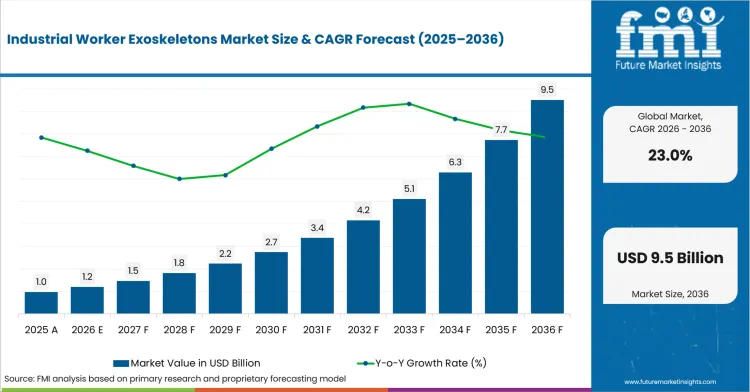
- 23.0%
How big is the Industrial Worker Exoskeletons Market in 2026?
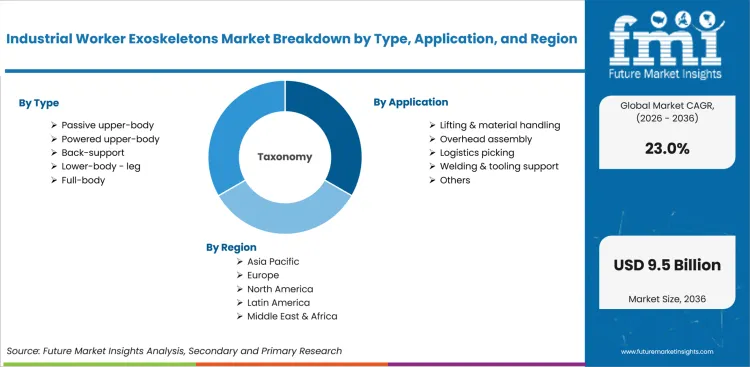
USD 1.2 billion in 2026 and USD 9.5 billion by 2036 at a 23.0% CAGR.
Industrial worker exoskeletons are estimated to advance from USD 1.2 billion in 2026 to USD 9.5 billion by 2036, reflecting a 23.0% CAGR over the forecast period. Lifting heavy loads repeatedly and working above shoulder height takes a physical toll on workers, prompting employers to invest in wearable support gear. Facility managers continuously evaluate these ergonomic suits with full workstation redesigns and robotic automation to improve daily comfort. United States Bureau of Labor Statistics figures published in January 2026 showed private employers recording 2.5 million nonfatal workplace injuries and illnesses during 2024. Such high injury numbers compel companies to closely scrutinize assistive equipment to better protect laborers on the shop floor.
Regional priorities heavily influence how different factories select physical assistance tools. Operators across the United States and the European Union focus on proven safety records and equipment reliability during multi-shift operations. Manufacturers in China and South Korea prioritize local engineering support and increasing testing setups. International Federation of Robotics data published in September 2025 logged 542,000 industrial robots installed globally during 2024. This significant equipment rollout demonstrates how physical labor and automated machines continue to operate side by side across modern manufacturing.
Key Takeaways of Industrial Worker Exoskeletons Market
- Demand for industrial worker exoskeletons is driven by employers connecting ergonomic support with task continuity, with program decisions reflecting comfort evidence and supervisor training.
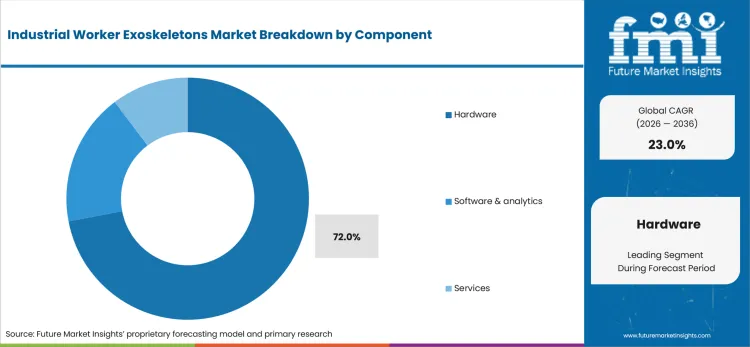
- By component, hardware is expected to lead with 72.0% share in 2026, owing to frames and actuation value.
- Direct purchase is the dominant business model segment, projected to hold 48.0% share in 2026, reflecting controlled internal deployment.
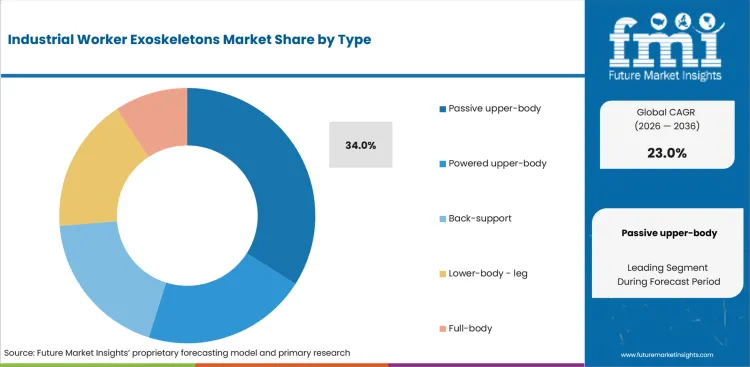
- Passive upper-body exoskeletons are estimated to lead the product category with 34.0% share in 2026, aided by lightweight overhead support.
- Device comfort and movement across complete working shifts remain critical to adoption, as safety managers value trials that preserve worker judgment during physically demanding assignments.
- China, the United States, and South Korea are expected to form the higher-growth country tier, advancing at 26.0%, 24.0%, and 23.5% CAGR respectively through 2036, supported by factory modernization, logistics trials, and robotics engineering depth.
- Competition centers on SUITX by Ottobock, German Bionic, Comau, Auxivo, CYBERDYNE, and Hilti, with vendors differentiating through back-support programs, manufacturing/logistics evaluation support, and powered/construction-use applications.
Analyst Perspective
"Industrial exoskeleton adoption is increasingly driven by ergonomics and workforce productivity rather than wearable technology alone. Manufacturers are evaluating these systems on their ability to reduce physical strain during repetitive tasks while preserving worker mobility, safety, and operational efficiency. Market growth will be supported by application-specific deployment, user acceptance, and measurable improvements in workplace performance across diverse industrial environments."
- Nikhil Kaitwade, Principal Consultant for Industrial Automation at Future Market Insights
Source: Future Market Insights analysis, 2026.
How is Industrial Worker Exoskeletons Market segmented?
The industrial worker exoskeletons industry is segmented by type, application, component, end-use industry, business model and region.
The industrial worker exoskeletons market is segmented by type, application, component, end-use industry, business model and region. Type coverage includes passive upper-body alongside powered upper-body, back-support, lower-body and full-body designs. Application coverage includes lifting and material handling, overhead assembly, logistics picking, welding and tooling support and other tasks. Component coverage includes hardware, software and analytics and services. End-use coverage includes automotive, logistics and warehousing, construction, aerospace and shipbuilding and other industries. Business model coverage includes direct purchase, subscription or RaaS, lease and pilot programs. Regional coverage includes North America and Latin America. Coverage further includes Western Europe, Eastern Europe, East Asia, South Asia and Pacific, Middle East and Africa.
Why does passive upper-body shape type selection?
Musso and colleagues reported in January 2024 recording shoulder flexor activity reductions reaching 45.46% during industrial task testing, supporting passive upper-body evaluation across repetitive overhead work involving sustained arm elevation and frequent tool handling. Mechanical springs redistribute part of the arm load without batteries or powered controls and provide continuous assistance across extended work cycles. Powered upper-body designs use actuators and wearable sensors to deliver responsive support across heavier assignments requiring greater force.
- Passive upper-body is set to represent 34.0% share of type in 2026, backed by lightweight construction and continuous mechanical assistance across repetitive overhead assembly tasks. Plant teams assess shoulder movement and pressure distribution across complete work cycles to confirm support does not interfere with tools or protective equipment.
- Powered upper-body and back-support products address assignments requiring stronger assistance during lifting or sustained load handling. Lower-body and full-body systems support specialized movement patterns involving walking and crouching or prolonged standing across industrial operations.
How does lifting and material handling shape application demand?
Material handling continues to rely on worker judgment across changing package dimensions and irregular storage layouts requiring frequent grip and posture adjustments. Palletizing robots remove predictable movements from selected production lines although variable warehouse activity continues to require human-guided handling. Health and Safety Executive reported in 2025 recording 511,000 workers with work-related musculoskeletal disorders, reinforcing employer evaluation of physical support across repeated lifting and load-transfer activities.
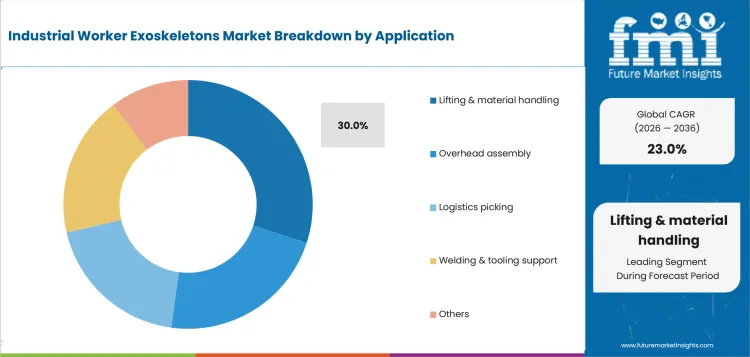
- Lifting and material handling is anticipated to secure 30.0% share in 2026, led by frequent bending and rising or carrying motions across factories and distribution facilities. Supervisors evaluate grip variation and walking distance alongside shelf height to confirm assistance continues across each stage of the assigned task.
- Overhead assembly and logistics picking create distinct movement profiles involving arm elevation and repeated reaching or package handling. Welding and tooling support requires sustained posture relief without reducing tool control or limiting access to confined work areas.
Why does hardware account for component leadership?
Hess and colleagues reported in January 2025 assessing 146 warehouse employees during active back-exosuit field use, demonstrating how hardware comfort and usability influence continued workplace use across physically demanding assignments. Frames and textiles transfer assistance through carefully positioned contact areas designed to distribute pressure across the wearer. Motors and batteries add control and charging requirements alongside robotic grippers and other factory equipment operating within shared production environments.
- By component, hardware is forecast to capture 72.0% share in 2026 since it reflects the value of engineered frames and adjustment systems or actuators across passive and powered units. Buyers compare total device weight and adjustment range alongside mechanical durability to determine whether equipment remains comfortable across repeated shifts.
- Software and analytics configure powered assistance and record utilization patterns across selected tasks or worker groups. Service providers support task assessment and fitting or training and maintenance to preserve safe equipment use across operating locations.
Why does automotive lead end-use industry demand?
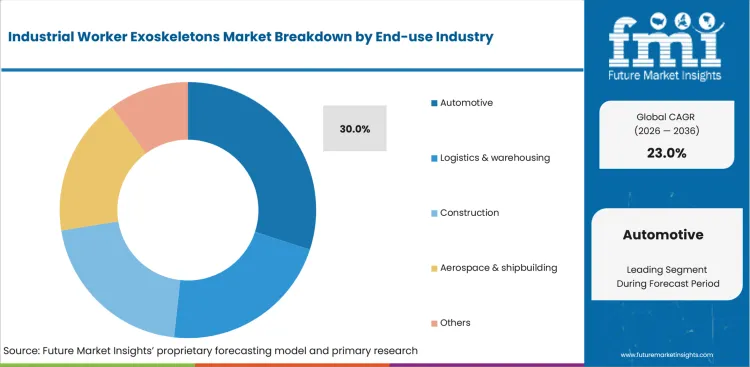
Automotive plants use defined workstations and structured ergonomic programs to compare posture exposure across repeatable production cycles. Manufacturing teams combine robotic screwdriving workcells with worker assistance across variable fastening and component movement requiring human judgment. International Organization of Motor Vehicle Manufacturers reported in April 2026 noting global vehicle production reached 92.7 million units during 2024, sustaining numerous assembly and material-handling tasks suited to wearable physical support.
- In 2026, automotive is projected to hold 30.0% share in 2026 as guided by repeatable workstation trials and established procedures for measuring worker movement across assembly operations. Engineers compare posture relief and tool access across complete production cycles to confirm assistance improves comfort without interrupting task precision.
- Logistics and warehousing emphasize lifting and picking assistance across variable packages or storage conditions. Construction and aerospace applications use wearable support across tool-intensive assignments and constrained working positions requiring sustained physical effort.
How does direct purchase retain business model strength?
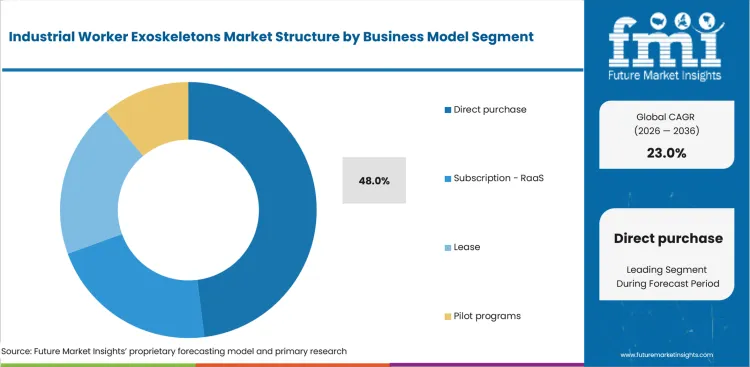
Direct purchase supports assigned equipment and internal cleaning or inspection routines under employer control. Pilot programs mirror robotics prototyping through staged evaluation across selected tasks prior to expansion across another workforce group or facility. Pupkes and colleagues reported in 2025 surveying 50 participants about exoskeleton expectations and implementation barriers, highlighting how product knowledge and worker acceptance influence ownership decisions across industrial programs.
- Based on business model, direct purchase is estimated to hold 48.0% share in 2026, helped by employer control over equipment availability and assigned-use policies across selected operations. Organizations connect ownership with trained users and documented maintenance routines to preserve consistent fitting and equipment readiness.
- Subscription and lease options distribute equipment access across changing programs without requiring permanent ownership across every participating site. Pilot arrangements support structured comparison across tasks and workforce groups prior to broader operational deployment.
What are drivers, restraints, and opportunities in Industrial Worker Exoskeletons Market?
Ergonomic pressure and skilled-worker continuity support industrial exoskeleton evaluation. Poor task matching and discomfort may delay regular workplace use.
- Driver: Employers depend on assistance for variable physical work resisting fixed automation. Experienced workers need support preserving task knowledge across demanding shifts.
- Restraint: Incorrect device selection may shift strain toward unsupported body regions. Heat and pressure likely reduce wearing time across long assignments.
- Opportunity: Task analytics may improve assistance settings and training quality. Service programs are expected to extend access beyond specialist ergonomic teams.
European Agency for Safety and Health at Work reported in February 2025 stating 52% of surveyed workplaces faced lifting or moving people or heavy loads, reflecting ergonomic tools for variable physical tasks. Industrial exoskeleton programs are expected to complement workstation changes and modular robotics investments across selected operations.
Unmatched assistance may obstruct walking or seated work across mixed assignments. Safety teams are likely to require task-specific validation ahead of wider release. Dufraisse and colleagues reported in January 2025 examining 25 operators through field familiarization, highlighting acceptance risks linked with comfort and expectations.
Service providers are projected to combine fitting and coaching with utilization review. Capodaglio and colleagues reported in 2024 evaluating 8 textile workers using passive arm support, indicating opportunity for structured worker feedback during real production activity. Evidence-led programs may improve retention across several facilities.
How are country CAGRs aligned in Industrial Worker Exoskeletons Market?
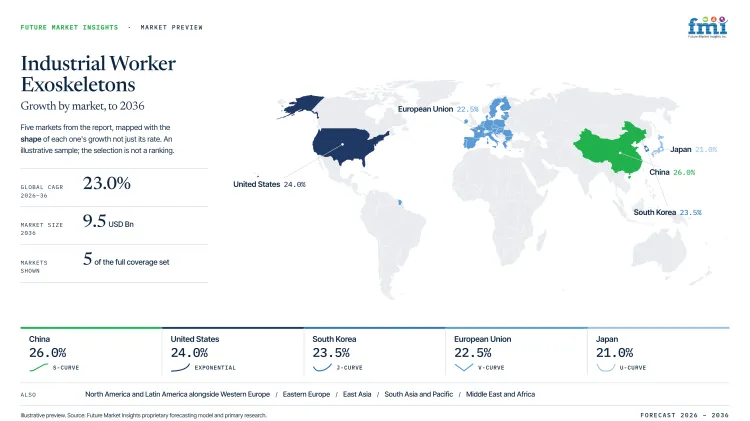
| Country or Market | CAGR |
|---|---|
| China | 26.0% |
| United States | 24.0% |
| South Korea | 23.5% |
| European Union | 22.5% |
| Japan | 21.0% |
Source: Future Market Insights analysis, 2026.
How do country-level CAGRs compare in Industrial Worker Exoskeletons Market?
Manufacturing structure and workplace ergonomics programs may create distinct country-level conditions for industrial worker exoskeleton deployment across the profiled economies. China and United States lead supplied comparisons due to extensive factory and logistics activity. South Korea and European Union reflect different combinations of engineering capability and industrial safety planning.
- Industrial worker exoskeletons sales in China are anticipated to rise at 26.0% CAGR between 2026 and 2036, driven by factory modernization and local robotics engineering. Extensive automated production capacity creates practical settings for evaluating wearable support alongside fixed robotic systems. National Bureau of Statistics of China reported in January 2026 stating industrial robot output reached 773,074 units during 2025, reflecting dense production settings suited to combined automation and worker support.
- United States Census Bureau reported in September 2025 stating California employed 1,181,588 manufacturing workers and highlighted a sizable workforce exposed to varied physical tasks. Extensive manufacturing employment supports task-specific evaluations involving lifting and repeated movement across production facilities. The market in United States is anticipated to scale at 24.0% CAGR during the assessment period, backed by logistics trials and workplace safety programs.
- Sector in South Korea is projected to record 23.5% CAGR during forecast period, guided by electronics and automotive manufacturing alongside domestic engineering depth. High automation intensity encourages manufacturers to assess wearable assistance for physical work continuing beside robotic production equipment. International Federation of Robotics reported in April 2026 noting 1,220 robots per 10,000 manufacturing employees and reinforced advanced factory settings supporting wearable assistance evaluations.
- Eurostat reported in January 2026 recording 80.1 million people employed in science and technology occupations during 2024, supporting technical capacity for product testing and workplace integration. Skilled technical employment supports structured trials and detailed assessment of comfort or task compatibility across industrial settings. Industry in the European Union are estimated to expand at 22.5% CAGR from 2026 to 2036, aided by established ergonomic programs and diverse industrial applications.
- Industrial worker exoskeletons market in Japan is forecast to grow at 21.0% CAGR by 2036, influenced by workforce aging and established wearable robotics expertise. Employers are expected to examine physical assistance for preserving experienced worker participation across demanding industrial assignments. Statistics Bureau of Japan reported in 2025 stating 36.24 million residents were aged 65 years or older during 2024, increasing attention toward physical support across skill-intensive workplaces.
Who are notable companies in Industrial Worker Exoskeletons Market?
SUITX by Ottobock supports passive and powered industrial applications. German Bionic and Comau add powered and passive industrial systems. Auxivo AG and HeroWear, LLC support lightweight assistance programs. CYBERDYNE Inc. and Hilti Group address powered support and construction use.
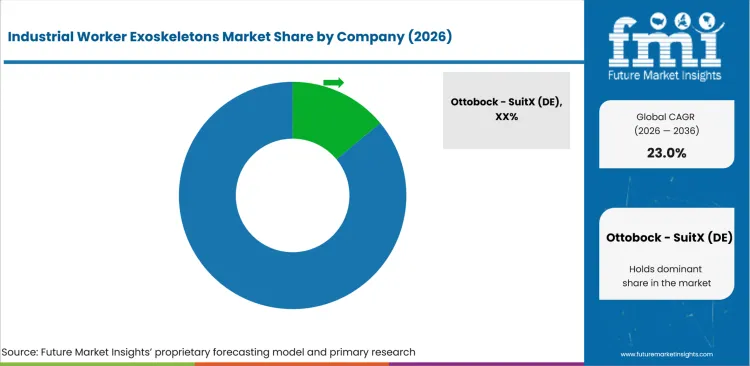
Competition in industrial worker exoskeletons is anticipated to center on task matching and wearer acceptance. Employer teams are likely to compare companies through assistance level and fitting support ahead of deployment. SUITX by Ottobock and German Bionic are expected to receive attention through back-support product depth. Comau is projected to add automotive and manufacturing access. Auxivo AG and HeroWear, LLC are estimated to support passive-system review through lightweight designs. CYBERDYNE Inc. is anticipated to compete across powered lumbar assistance. Hilti Group and Skelex are likely to strengthen construction and overhead applications.
- SUITX by Ottobock and German Bionic are expected to gain review attention due to powered and passive back-support portfolios. Employer programs are likely to assess battery duration and wearer movement.
- Comau and Auxivo AG are anticipated to compete based on factory experience and lightweight assistance. Automotive teams are projected to compare overhead support and lower-back options.
- CYBERDYNE Inc. and Hilti Group are forecast to support powered lifting and construction applications. Channel access is expected to influence training and replacement support.
- HeroWear, LLC and Skelex are likely to serve passive back and shoulder programs. Specialized distributors are anticipated to support regional trial delivery and fitting.
Competitive Benchmarking: Industrial Worker Exoskeletons Market
| Company | Portfolio Depth | Industrial Match | Service Support | Service Reach |
|---|---|---|---|---|
| SUITX by Ottobock | High | High | High | Germany and global |
| German Bionic | High | High | High | Germany, United States and global |
| Comau | High | High | High | Italy and global |
| Auxivo AG | Medium | High | Medium | Switzerland and Europe |
| CYBERDYNE Inc. | Medium | Medium | Medium | Japan |
| Hilti Group | High | High | High | Liechtenstein and global |
| HeroWear, LLC | Medium | High | Medium | United States and global |
| Skelex | Medium | High | Medium | Netherlands and global |
| INNOPHYS CO., LTD. | Medium | High | Medium | Japan and Europe |
| Wearable Robotics Srl | Medium | High | Medium | Italy and Europe |
Source: Future Market Insights competitive analysis, 2026.
Key Developments in Industrial Worker Exoskeletons Market
- In January 2025, German Bionic announced Apogee ULTRA with lifting support reaching 36 kg. German Bionic stated increased assistance targeted logistics and manufacturing work, influencing powered back-support evaluation across heavier handling tasks.
- In March 2025, Comau presented MATE-XT and MATE-XB at Global Industrie Lyon. Comau stated wearables reduced muscular strain by up to 35%, supporting upper-body and lower-back program comparison across industrial users.
- In November 2025, Ottobock introduced IX BACK VOLTON products providing up to 17 kg relief. Ottobock stated powered lumbar assistance supported lifting and carrying tasks, extending product choice across logistics and production settings.
Key Players in Industrial Worker Exoskeletons Market
Powered and integrated industrial exoskeleton companies
- SUITX by Ottobock
- German Bionic
- CYBERDYNE Inc.
- Comau
Passive support and industrial ergonomics specialists
- Auxivo AG
- HeroWear, LLC
- Skelex
- Hilti Group
Emerging and regional wearable robotics providers
- INNOPHYS CO., LTD.
- Wearable Robotics Srl
- Ekso Bionics Holdings, Inc.
- Hapo
Industrial Worker Exoskeletons Market Report Scope
| Coverage field | Report scope |
|---|---|
| Market breakdown | Industrial Worker Exoskeletons Market breakdown by type alongside application, component, end-use industry, business model and region |
| Quantitative Units | Revenue in USD Billion, CAGR in %. |
| Market Definition | Industrial worker exoskeletons include passive and powered wearable systems supporting physical work across manufacturing, logistics, construction and specialist industrial tasks. |
| Regions Covered | North America and Latin America alongside Western Europe, Eastern Europe, East Asia, South Asia and Pacific, Middle East and Africa |
| Countries Covered | United States and China alongside South Korea, Japan, Canada, Brazil, Mexico, Germany, France, United Kingdom, Italy, Spain, India, ASEAN, Australia, New Zealand, GCC countries, South Africa and Türkiye |
| Key Companies Profiled | SUITX by Ottobock and German Bionic alongside Comau, Auxivo AG, CYBERDYNE Inc., Hilti Group, HeroWear, LLC, Skelex, INNOPHYS CO., LTD., Wearable Robotics Srl, Ekso Bionics Holdings, Inc. and Hapo |
| Forecast Period | 2026 to 2036 |
| Approach | Hybrid bottom-up and top-down methodology using segment share, country CAGR, task exposure, product portfolio depth, field evidence and service coverage |
Source: Future Market Insights analysis, 2026.
Industrial Worker Exoskeletons Market - Research Methodology
| Method | Approach |
|---|---|
| Primary Research | FMI analysts gathered input from manufacturers, service providers, technology developers, distributors, end users, procurement teams, and subject-matter experts. Interviews examined purchasing decisions, product or service evaluation, adoption barriers, approval requirements, pricing considerations, and expectations for technical or commercial support. Respondents were also asked what evidence is required before a trial, pilot, or initial order develops into regular purchasing. |
| Desk Research | Desk research covered government statistics, regulatory publications, trade data, industry associations, technical literature, standards, company filings, product information, and official corporate announcements. Sources were reviewed for relevance, publication date, geographic coverage, and consistency with the defined market scope. Claims relating to performance, applications, approvals, capacity, investment, and commercial activity were retained only when supported by credible public evidence. |
| Market Sizing and Forecasting | The market model combined the baseline value with historical performance, segment structure, pricing and volume indicators, adoption levels, company participation, and country-level demand conditions. Forecast assumptions considered economic activity, investment trends, regulatory developments, technology adoption, purchasing cycles, supply availability, and barriers to wider market use. Segment and regional estimates were reconciled before the final market total was calculated. |
| Data Validation | Estimates were checked against multiple independent indicators, including public data, company activity, trade patterns, industry developments, and findings from primary interviews. Validation also tested whether products, services, applications, and company revenues fell within the defined market boundaries. Adjacent categories, unsupported claims, overlapping revenues, and activities without direct market relevance were excluded to reduce double counting and maintain consistency across segments and countries. |
Source: Future Market Insights analysis, 2026.
Industrial Worker Exoskeletons Market by Segments
Industrial Worker Exoskeletons Market segmented by Type:
- Passive upper-body
- Powered upper-body
- Back-support
- Lower-body - leg
- Full-body
Industrial Worker Exoskeletons Market segmented by Application:
- Lifting & material handling
- Overhead assembly
- Logistics picking
- Welding & tooling support
- Others
Industrial Worker Exoskeletons Market segmented by Component:
- Hardware
- Software & analytics
- Services
Industrial Worker Exoskeletons Market segmented by End-use Industry:
- Automotive
- Logistics & warehousing
- Construction
- Aerospace & shipbuilding
- Others
Industrial Worker Exoskeletons Market segmented by Business Model:
- Direct purchase
- Subscription - RaaS
- Lease
- Pilot programs
Industrial Worker Exoskeletons Market segmented by Region:
- North America
- United States
- Canada
- Latin America
- Brazil
- Mexico
- Rest of Latin America
- Western Europe
- Germany
- France
- United Kingdom
- Italy
- Spain
- Rest of Western Europe
- Eastern Europe
- Poland
- Romania
- Czech Republic
- Rest of Eastern Europe
- East Asia
- China
- Japan
- South Korea
- South Asia and Pacific
- India
- ASEAN
- Australia and New Zealand
- Rest of South Asia and Pacific
- Middle East and Africa
- GCC countries
- South Africa
- Türkiye
- Rest of Middle East and Africa
Research Sources and Bibliography
- Bureau of Labor Statistics. (2026, January 22). Employer-reported workplace injuries and illnesses, 2023-2024.
- International Federation of Robotics. (2025, September 25). Global robot demand in factories doubles over 10 years.
- Musso, M., Oliveira, A. S., & Bai, S. (2024). Influence of an upper limb exoskeleton on muscle activity during various construction and manufacturing tasks. Applied Ergonomics, 114, 104158.
- Health and Safety Executive. (2025). Health and safety at work: Summary statistics for Great Britain 2025.
- Hess, A., Jacobs, J. V., Sullivan, S., Roberts Williams, D. O., Awad, L. N., Dalton, D., Walsh, C. J., & Quirk, D. A. (2025). Active back exosuits demonstrate positive usability perceptions that drive intention-to-use in the field among logistic warehouse workers. Applied Ergonomics, 122, 104400.
- International Organization of Motor Vehicle Manufacturers. (2026, April 23). Auto industry growth shifted east in 2025 amid global repositioning.
- Pupkes, B., Petzoldt, C., & Freitag, M. (2025). User expectations, requirements, and applications of exoskeletons: Insights from a survey. Procedia CIRP, 134, 91-96.
- European Agency for Safety and Health at Work. (2025, February 7). Prolonged sitting, psychosocial risks and digitalisation top workplace safety and health concerns, new EU survey reveals.
- Dufraisse, M., Cegarra, J., Atain Kouadio, J.-J., Clerc-Urmès, I., & Wioland, L. (2025). From unknown to familiar: An exploratory longitudinal field study of occupational exoskeleton adoption. Applied Ergonomics, 122, 104393.
- Capodaglio, E. M., Amitrano, F., Coccia, A., Gabba, V., Pagano, G., D’Addio, G., & Panigazzi, M. (2024). Subjective effects of using a passive upper limb exoskeleton for industrial textile workers. Safety, 10(3), 59.
- National Bureau of Statistics of China. (2026, January 20). Industrial production operation in December 2025.
- United States Census Bureau. (2025, September 29). Recognizing manufacturing’s contributions to the USA economy during Manufacturing Week.
- International Federation of Robotics. (2026, April 8). Robot density surges in Europe, Asia, and Americas.
- Eurostat. (2026, January). R&D personnel.
- Statistics Bureau of Japan. (2025). Statistical handbook of Japan 2025.
- German Bionic. (2025, January 7). German Bionic unveils Apogee ULTRA - the world’s most powerful exoskeleton.
- Comau. (2025, March 10). Comau showcases its newest products at Global Industrie Lyon 2025.
- Ottobock. (2025, November 4). New exoskeleton from “SUITX by Ottobock” goes into series production.
This bibliography is provided for reader reference and is not exhaustive. The full report contains the complete reference list and detailed citations.
This Report Answers
- What segments shape demand across type, application, component, end-use industry and business model?
- How do manufacturers and logistics operators evaluate industrial worker exoskeletons before replacing unsupported manual routines?
- How do country CAGRs differ across profiled markets?
- What companies compete through passive and powered portfolio depth and service support?
- How are forecasts validated using a hybrid bottom-up and top-down approach?
- What factors do account teams address before larger account expansion?
- How do assistance level and fitting quality affect equipment selection?
- What limits return on investment for teams adding industrial worker exoskeletons?
- How do comfort records and training guidance influence account approval?
- What vendor capabilities improve long-term account confidence?
Frequently Asked Questions
What supports demand in industrial worker exoskeletons market?
Demand is likely to be supported by manufacturing and logistics teams needing ergonomic assistance during repeated lifting and overhead work. Accounts are expected to favor companies combining task evidence and fitting support.
Who are key players in industrial worker exoskeletons market?
Key companies are anticipated to include SUITX by Ottobock and German Bionic among others supporting competition. Competition is likely to be based on assistance quality and regional service support.
What restraint affects industrial worker exoskeletons market?
A major restraint is the deployment risk created by poor task matching and weak wearer acceptance across operating teams. Accounts slow adoption if products lack comfort evidence or support needed for safe use.
Why do executives track industrial worker exoskeletons market?
Executives are expected to track industrial worker exoskeletons as ergonomic choices affect worker continuity and equipment planning. Factors such as assistance quality and service support shape buyer reviews.
What business problem does industrial worker exoskeletons market address?
Industrial worker exoskeletons market addresses the operational gap created by demanding physical tasks needing human judgment and wearable support. Employers need equipment supporting repeatable assistance and workplace-ready service evidence.
What do account teams evaluate before selecting vendors?
Account teams are likely to evaluate task match, wearer comfort and repeat-use reliability before vendor approval. Fitting access and technical documentation are expected to guide final vendor review.
What limits return on investment for purchasing teams?
Return on investment weakens if task selection or workforce acceptance is not proven during deployment. Low utilization and interrupted work reduce expected operating gains.
How do vendors build long-term account confidence?
Vendors build account confidence by providing consistent product quality and evidence specific to industrial work. Training records and responsive troubleshooting are expected to influence repeat-order trust.
Preview the report firsthand - request a free sample
Get SampleGet the brochure for pricing and purchase details.
Get PDFTable of Content
- Key Takeaways
- Market Size and CAGR
- Top Growth Driver
- Fastest Growing Segment
- Leading Region
- Key Companies
- Emerging Opportunities
- Executive Summary
- Global Market Outlook
- Demand-side Trends
- Supply-side Trends
- Technology Roadmap Analysis
- Analysis and Recommendations
- Analyst Perspective (What is happening? Why now? What should investors know?)
- Key Questions Answered
- How large is the market?
- What is the CAGR?
- What are key trends?
- Which region dominates?
- Who are the leaders?
- Market Overview
- Market Coverage / Taxonomy
- Market Definition / Scope / Limitations
- Research Methodology
- Chapter Orientation
- Analytical Lens and Working Hypotheses
- Market Structure, Signals, and Trend Drivers
- Benchmarking and Cross-market Comparability
- Market Sizing, Forecasting, and Opportunity Mapping
- Research Design and Evidence Framework
- Desk Research Programme (Secondary Evidence)
- Expert Input and Fieldwork (Primary Evidence)
- Tooling, Models, and Reference Databases
- Data Engineering and Model Build
- Quality Assurance and Audit Trail
- Market Background
- Market Dynamics (Drivers, Restraints, Opportunity, Trends)
- Scenario Forecast (Optimistic, Likely, Conservative)
- Impact Analysis
- AI Impact
- Sustainability Impact
- Regulatory Impact
- Technology Impact
- Consumer / Buyer Analysis
- Purchase Drivers
- Adoption Barriers
- Buyer Journey
- Opportunity Map Analysis
- Product Life Cycle Analysis
- Supply Chain Analysis
- Investment Feasibility Matrix
- Value Chain Analysis
- PESTLE and Porter's Analysis
- Regulatory Landscape
- Regional Parent Market Outlook
- Production and Consumption Statistics
- Import and Export Statistics
- Global Market Analysis and Forecast, 2021 to 2036
- Historical Market Size Value (USD Bn) Analysis, 2021 to 2025
- Current and Future Market Size Value (USD Bn) Projections, 2026 to 2036
- Y-o-Y Growth Trend Analysis
- Absolute $ Opportunity Analysis
- Global Market Pricing Analysis, 2021 to 2036
- Global Market Analysis and Forecast, By Type, 2021 to 2036
- Introduction / Key Findings
- Historical Market Size Value (USD Bn) Analysis By Type, 2021 to 2025
- Current and Future Market Size Value (USD Bn) Analysis and Forecast By Type, 2026 to 2036
- Passive upper-body
- Powered upper-body
- Back-support
- Lower-body - leg
- Full-body
- Passive upper-body
- Y-o-Y Growth Trend Analysis By Type, 2021 to 2025
- Absolute $ Opportunity Analysis By Type, 2026 to 2036
- Global Market Analysis and Forecast, By Application, 2021 to 2036
- Introduction / Key Findings
- Historical Market Size Value (USD Bn) Analysis By Application, 2021 to 2025
- Current and Future Market Size Value (USD Bn) Analysis and Forecast By Application, 2026 to 2036
- Lifting & material handling
- Overhead assembly
- Logistics picking
- Welding & tooling support
- Others
- Lifting & material handling
- Y-o-Y Growth Trend Analysis By Application, 2021 to 2025
- Absolute $ Opportunity Analysis By Application, 2026 to 2036
- Global Market Analysis and Forecast, By Component, 2021 to 2036
- Introduction / Key Findings
- Historical Market Size Value (USD Bn) Analysis By Component, 2021 to 2025
- Current and Future Market Size Value (USD Bn) Analysis and Forecast By Component, 2026 to 2036
- Hardware
- Software & analytics
- Services
- Hardware
- Y-o-Y Growth Trend Analysis By Component, 2021 to 2025
- Absolute $ Opportunity Analysis By Component, 2026 to 2036
- Global Market Analysis and Forecast, By End-use Industry, 2021 to 2036
- Introduction / Key Findings
- Historical Market Size Value (USD Bn) Analysis By End-use Industry, 2021 to 2025
- Current and Future Market Size Value (USD Bn) Analysis and Forecast By End-use Industry, 2026 to 2036
- Automotive
- Logistics & warehousing
- Construction
- Aerospace & shipbuilding
- Others
- Automotive
- Y-o-Y Growth Trend Analysis By End-use Industry, 2021 to 2025
- Absolute $ Opportunity Analysis By End-use Industry, 2026 to 2036
- Global Market Analysis and Forecast, By Business Model, 2021 to 2036
- Introduction / Key Findings
- Historical Market Size Value (USD Bn) Analysis By Business Model, 2021 to 2025
- Current and Future Market Size Value (USD Bn) Analysis and Forecast By Business Model, 2026 to 2036
- Direct purchase
- Subscription - RaaS
- Lease
- Pilot programs
- Direct purchase
- Y-o-Y Growth Trend Analysis By Business Model, 2021 to 2025
- Absolute $ Opportunity Analysis By Business Model, 2026 to 2036
- Global Market Analysis and Forecast, By Region, 2021 to 2036
- Introduction
- Historical Market Size Value (USD Bn) Analysis By Region, 2021 to 2025
- Current Market Size Value (USD Bn) Analysis and Forecast By Region, 2026 to 2036
- North America
- Latin America
- Western Europe
- Eastern Europe
- East Asia
- South Asia and Pacific
- Middle East & Africa
- Market Attractiveness Analysis By Region
- North America Market Analysis and Forecast, By Country, 2021 to 2036
- Historical Market Size Value (USD Bn) Trend Analysis By Market Taxonomy, 2021 to 2025
- Market Size Value (USD Bn) Forecast By Market Taxonomy, 2026 to 2036
- By Country
- USA
- Canada
- By Type
- By Application
- By Component
- By End-use Industry
- By Business Model
- By Country
- Market Attractiveness Analysis
- By Country
- By Type
- By Application
- By Component
- By End-use Industry
- By Business Model
- Key Takeaways
- Latin America Market Analysis and Forecast, By Country
- Historical Market Size Value (USD Bn) Trend Analysis By Market Taxonomy, 2021 to 2025
- Market Size Value (USD Bn) Forecast By Market Taxonomy, 2026 to 2036
- By Country
- Brazil
- Mexico
- Chile
- Rest of Latin America
- By Type
- By Application
- By Component
- By End-use Industry
- By Business Model
- By Country
- Market Attractiveness Analysis
- By Country
- By Type
- By Application
- By Component
- By End-use Industry
- By Business Model
- Key Takeaways
- Western Europe Market Analysis and Forecast, By Country
- Historical Market Size Value (USD Bn) Trend Analysis By Market Taxonomy, 2021 to 2025
- Market Size Value (USD Bn) Forecast By Market Taxonomy, 2026 to 2036
- By Country
- Germany
- UK
- Italy
- Spain
- France
- Nordic
- BENELUX
- Rest of Western Europe
- By Type
- By Application
- By Component
- By End-use Industry
- By Business Model
- By Country
- Market Attractiveness Analysis
- By Country
- By Type
- By Application
- By Component
- By End-use Industry
- By Business Model
- Key Takeaways
- Eastern Europe Market Analysis and Forecast, By Country
- Historical Market Size Value (USD Bn) Trend Analysis By Market Taxonomy, 2021 to 2025
- Market Size Value (USD Bn) Forecast By Market Taxonomy, 2026 to 2036
- By Country
- Russia
- Poland
- Hungary
- Balkan & Baltic
- Rest of Eastern Europe
- By Type
- By Application
- By Component
- By End-use Industry
- By Business Model
- By Country
- Market Attractiveness Analysis
- By Country
- By Type
- By Application
- By Component
- By End-use Industry
- By Business Model
- Key Takeaways
- East Asia Market Analysis and Forecast, By Country
- Historical Market Size Value (USD Bn) Trend Analysis By Market Taxonomy, 2021 to 2025
- Market Size Value (USD Bn) Forecast By Market Taxonomy, 2026 to 2036
- By Country
- China
- Japan
- South Korea
- By Type
- By Application
- By Component
- By End-use Industry
- By Business Model
- By Country
- Market Attractiveness Analysis
- By Country
- By Type
- By Application
- By Component
- By End-use Industry
- By Business Model
- Key Takeaways
- South Asia and Pacific Market Analysis and Forecast, By Country
- Historical Market Size Value (USD Bn) Trend Analysis By Market Taxonomy, 2021 to 2025
- Market Size Value (USD Bn) Forecast By Market Taxonomy, 2026 to 2036
- By Country
- India
- ASEAN
- Australia & New Zealand
- Rest of South Asia and Pacific
- By Type
- By Application
- By Component
- By End-use Industry
- By Business Model
- By Country
- Market Attractiveness Analysis
- By Country
- By Type
- By Application
- By Component
- By End-use Industry
- By Business Model
- Key Takeaways
- Middle East & Africa Market Analysis and Forecast, By Country
- Historical Market Size Value (USD Bn) Trend Analysis By Market Taxonomy, 2021 to 2025
- Market Size Value (USD Bn) Forecast By Market Taxonomy, 2026 to 2036
- By Country
- Kingdom of Saudi Arabia
- Other GCC Countries
- Türkiye
- South Africa
- Other African Union
- Rest of Middle East & Africa
- By Type
- By Application
- By Component
- By End-use Industry
- By Business Model
- By Country
- Market Attractiveness Analysis
- By Country
- By Type
- By Application
- By Component
- By End-use Industry
- By Business Model
- Key Takeaways
- Key Countries Market Analysis
- USA
- Pricing Analysis
- Market Share Analysis, 2025
- By Type
- By Application
- By Component
- By End-use Industry
- By Business Model
- Canada
- Pricing Analysis
- Market Share Analysis, 2025
- By Type
- By Application
- By Component
- By End-use Industry
- By Business Model
- Mexico
- Pricing Analysis
- Market Share Analysis, 2025
- By Type
- By Application
- By Component
- By End-use Industry
- By Business Model
- Brazil
- Pricing Analysis
- Market Share Analysis, 2025
- By Type
- By Application
- By Component
- By End-use Industry
- By Business Model
- Chile
- Pricing Analysis
- Market Share Analysis, 2025
- By Type
- By Application
- By Component
- By End-use Industry
- By Business Model
- Germany
- Pricing Analysis
- Market Share Analysis, 2025
- By Type
- By Application
- By Component
- By End-use Industry
- By Business Model
- UK
- Pricing Analysis
- Market Share Analysis, 2025
- By Type
- By Application
- By Component
- By End-use Industry
- By Business Model
- Italy
- Pricing Analysis
- Market Share Analysis, 2025
- By Type
- By Application
- By Component
- By End-use Industry
- By Business Model
- Spain
- Pricing Analysis
- Market Share Analysis, 2025
- By Type
- By Application
- By Component
- By End-use Industry
- By Business Model
- France
- Pricing Analysis
- Market Share Analysis, 2025
- By Type
- By Application
- By Component
- By End-use Industry
- By Business Model
- India
- Pricing Analysis
- Market Share Analysis, 2025
- By Type
- By Application
- By Component
- By End-use Industry
- By Business Model
- ASEAN
- Pricing Analysis
- Market Share Analysis, 2025
- By Type
- By Application
- By Component
- By End-use Industry
- By Business Model
- Australia & New Zealand
- Pricing Analysis
- Market Share Analysis, 2025
- By Type
- By Application
- By Component
- By End-use Industry
- By Business Model
- China
- Pricing Analysis
- Market Share Analysis, 2025
- By Type
- By Application
- By Component
- By End-use Industry
- By Business Model
- Japan
- Pricing Analysis
- Market Share Analysis, 2025
- By Type
- By Application
- By Component
- By End-use Industry
- By Business Model
- South Korea
- Pricing Analysis
- Market Share Analysis, 2025
- By Type
- By Application
- By Component
- By End-use Industry
- By Business Model
- Russia
- Pricing Analysis
- Market Share Analysis, 2025
- By Type
- By Application
- By Component
- By End-use Industry
- By Business Model
- Poland
- Pricing Analysis
- Market Share Analysis, 2025
- By Type
- By Application
- By Component
- By End-use Industry
- By Business Model
- Hungary
- Pricing Analysis
- Market Share Analysis, 2025
- By Type
- By Application
- By Component
- By End-use Industry
- By Business Model
- Kingdom of Saudi Arabia
- Pricing Analysis
- Market Share Analysis, 2025
- By Type
- By Application
- By Component
- By End-use Industry
- By Business Model
- Türkiye
- Pricing Analysis
- Market Share Analysis, 2025
- By Type
- By Application
- By Component
- By End-use Industry
- By Business Model
- South Africa
- Pricing Analysis
- Market Share Analysis, 2025
- By Type
- By Application
- By Component
- By End-use Industry
- By Business Model
- USA
- Market Structure Analysis
- Competition Dashboard
- Competition Benchmarking
- Market Share Analysis of Top Players
- By Regional
- By Type
- By Application
- By Component
- By End-use Industry
- By Business Model
- Emerging Startups
- Innovation Benchmarking
- Competition Analysis
- Competition Deep Dive
- Ottobock - SuitX (DE)
- Overview
- Product Portfolio
- Profitability by Market Segments
- Sales Footprint
- Strategy Overview
- Marketing Strategy
- Product Strategy
- Channel Strategy
- German Bionic (DE)
- Cyberdyne (JP)
- Hilti (LI)
- LG (KR)
- Ottobock - SuitX (DE)
- Case Studies
- Success Stories
- Recent Developments
- Competition Deep Dive
- Assumptions & Acronyms Used


